




Abstract
Landfill gas to energy (LFGE) projects were implemented in the Republic of South Africa (RSA) to diversify the energy mix and transition to a green economy. This study provides an overview of the status of LFGE in RSA and identifies major factors that inhibit the adoption and utilization of this technology, using existing data from 2010–2020 from electronic databases, namely, ScienceDirect, Taylor & Francis, Google Scholar, Sage Open, Springer Link, Sabinet, and IEEE Xplore, and using a combination of keywords and Boolean functions. This study revealed that, although RSA has made significant progress in the adoption and utilization of landfill gas (LFG) through the seventeen (17) planned LFGE projects, only six (6) are operational and generate 15 MW of electricity supplied to the local grid in the KwaZulu-Natal, Western Cape, and Gauteng Province. The waste-to-energy (WtE) sources such as LFGE are not given priority, and the country continues to invest in coal-fired power stations, owing to the abundance, availability, and low cost of coal reserves, which will supply coal for the next 200 years. The study identified factors inhibiting LGFE projects in RSA, which included the lack of sanitary landfill sites, LFG monitoring, funding, skills, research, and development. Potential LFGE in RSA is evident, however, except for limited processing facilities, economic investment, and public awareness. Suggestions for further research on the techno-economic and policy assessments are provided in the study. This study contributes to synthesizing evidence of the status of LFGE, insights on state-of-the-art technologies of WtE and the associated challenges in the waste management sector, identifying the potential for LFGE, and LFGE in the circular economy, and building a foundation for future research on WtE such as LFGE. Moreover, it also offers a reference for policymakers, decision-makers, researchers in the waste management sector on the technologies of WtE, LFGE, and potential to reduce waste generated.
Introduction
In 2016, the global municipal solid waste (MSW) generated was estimated at 2.01 billion tons and this is projected to reach 3.4 billion tons by 2050. It is estimated that around 44% of global waste is categorized as food and green waste while the other 38% are dry recyclables such as paper, cardboard, plastic, glass, and metal. The other 18% includes rubber and leather, wood, and others. Research has indicated that the amount of waste being generated will continue to increase due to rapid economic development, population growth, and degree of urbanization. However, at least 33% of the waste is openly disposed of and not managed in an environmentally safe manner (Adeleke et al., 2021). In Sub-Saharan Africa (SSA), it is estimated that 62 million tons of MSW are generated annually, at an average rate of 1.22 kg per capita−1 day−1 (Dladla et al., 2016; Idowu et al., 2019). Given the rapid industrialization, exponential population growth, and consumption patterns in RSA, the amount of MSW generated is also expected to increase (DEA, 2018).
In RSA, most of the MSW is disposed of at sanitary landfill sites. Landfilling is the common and cheapest method of waste disposal in many African countries (Idowu et al., 2019; Zhang et al., 2019a). During landfilling, microorganisms decompose the waste under anaerobic conditions, which result in the production of leachate and LFG (Barros et al., 2018). The decomposition process depends on temperature, moisture content, the composition of waste, and the age of the waste (Krause et al., 2016; Zhang et al., 2019a, 2019b). LFG comprises 50–60% (v/v) methane (CH4) and 40–50% (v/v) carbon dioxide (CO2), 2–5% nitrogen, less than 1% ammonia, oxygen, non-methane organic compounds (e.g. acrylonitrile, benzene, 1,1-dichloroethane, etc.), and traces of sulfides, hydrogen, carbon monoxide, and benzene (Krause et al., 2016; Purmessur and Surroop, 2019; Scheutz and Kjeldsen, 2019; Townsend et al., 2015). Approximately 0.35 nm3 of LFG is generated per kilogram of MSW, which can degrade air quality, cause odours, and health problems if uncontrolled (Abbasi, 2018). As a result, landfill sites are ranked as the third anthropogenic source of greenhouse gases (GHGs) and are a major contributor to the total GHG emissions (Aghdam et al., 2019; Bogner et al., 2008). Bogner et al. (2008) reported that both the global waste management and wastewater sector contributed around 3% of all GHG emissions and 18% of the global CH4 emissions in 2004. It has been noted that RSA is ranked as the 12th largest emitter of GHGs, with the waste sector contributing 2–4.3% of the national GHG emissions and 12% of the CH4 emissions (Borello et al., 2018; Friedrich and Trois, 2016; Nahman et al., 2012). The release and accumulation of CH4 in the atmosphere is a major environmental concern because of its global warming potential (GWP) (Intergovernmental Panel on Climate Change, IPCC, 2014). The GWP of CH4 is 28–36 times higher than that of CO2 over 100 years (the United States Environmental Protection Agency, USEPA, 2019). Besides moderate temperature increases, global warming is also associated with drought, flooding, veld fires, and a rise in sea levels (Breckner and Sunde, 2019). Controlling LFG emissions must be given a higher priority (Mønster et al., 2019; Scheutz and Kjeldsen, 2019).
It is indicated that CH4 has the potential to accumulate beneath structures, corrode, and cause damage to the vegetation (Idehai and Akujieze, 2015), and is explosive at concentrations between 5–15% in confined spaces or indoor environments (Idehai and Akujieze, 2015; Rajaram et al., 2011), thus causing explosions in adjacent structures beyond the landfill site, particularly if not harnessed or extracted effectively (Shindell et al., 2009; Townsend et al., 2015). Explosions have previously occurred in structures near landfill sites (e.g. Boltze and De Freitas, 1997; Jones and Nedwell, 1990; Kjeldsen and Fischer, 1995), which were attributed to CH4 migrating through the soil and accumulating within nearby structures (Idehai and Akujieze, 2015; Rajaram et al., 2011; Tagaris et al., 2003). Although CH4 is a potent GHG that threatens environmental sustainability due to GWP, it provides efficient MSW and energy generation in an economically and environmentally friendly way-bridging the divide between a sustainable environment and energy supply (Li et al., 2015; Ramachandra et al., 2015). It is noted that 1.5 billion tons of MSW produce approximately 75 billion Nm−3 of CH4 that can be used to generate between 6 500–10 000 MWh of electricity year−1 (Yechiel and Shevah, 2016). Globally, countries have implemented WtE technologies such as the conversion of LFGE for elimination of waste and energy recovery (Asian Development Bank, 2020).
In RSA, several LFGE projects have been implemented to reduce waste and generate energy from MSW. Although the country has the potential to generate energy from LFG, the progress, and contribution of the LFGE projects into the national grid have not been fully evaluated. Fewer studies have been conducted since the implementation of LFGE projects in RSA. Njoku et al. (2020) used theoretical models (LandGEM and Afvalzorg models) to estimate the potential of landfill gas (LFG) from the Thohoyandou landfill site. Furthermore, the LFGcost Web model was used to estimate the cost and benefits of the implementation of an LFG utilization technology. The study found that the methane (CH4) and carbon dioxide (CO2) emitted from the landfill estimated from LandGEM will peak in the year 2026 with values of 3517 Mg/year and 9649 Mg/year respectively, while the Afvalzorg model indicated that CH4 emission will peak in the year 2026 (3336 Mg/year). Furthermore, the LandGEM model indicated that the total LFG, CH4, and CO2 emitted from the landfill between 2005 and 2040 were 293239.3 Mg/year, 78325.7 Mg/year, and 214908.6 Mg/year, respectively, while the simulation from the Afvalzorg model found that the CH4 emitted from the years 2005–2040 was 74,302 Mg/year. The study concluded that the implementation of LFG utilization is economically feasible based on the sales of electricity generated and certified emission reductions (CERs).
Adeleke et al. (2021) investigated the potential of energy recovery from waste in Africa focusing on South Africa. The authors identified challenges facing the full exploration of the energy potentials of waste and full-operative WtE processing in South Africa such as the country's waste management and energy system, the cheap and affordable coal resources, and the low landfill tax. Based on the quantity of waste generated and collected, the authors found that South Africa has the highest theoretical potential of energy from waste in Africa. Furthermore, the study found that approximately 104,463 TJ/year can be recovered from incineration, while 22,710 TJ/year can be recovered from landfill gas. Gumbo (2014) and Couth et al. (2011), gave an update of LFGE projects in RSA, however, the focus was on the eThekweni metropolitan municipality in KwaZulu Natal Province (KZN). Since the implementation of the first LFGE project in KZN, several LFGE projects were implemented across RSA. To the best of our knowledge, no study has assessed the status of and contribution of the LFGE projects. There is somewhat limited data on the potential for energy recovery from LFG regarding the statuses of the LFGE projects. Therefore, the objectives of this study are (i) to provide an overview of the status of LFGE and related policies in RSA and (ii) identify the challenges in the adoption of LFGE technology, and (iii) provide recommendations to improve the utilization of LFGE in the developing countries, particularly RSA. This study contributes to synthesizing evidence of the status of LFGE, insights in the technologies of waste-to-energy (WtE) and the associated challenges, and LFGE in the circular economy (CE) and to build a foundation for future research on LFGE. Moreover, it also offers a reference for policymakers, decision-makers, researchers in developing countries on the implementation of WtE technologies of such as LFGE and the potential to reduce waste generated.
Method
Electronic databases such as Science Direct, Taylor & Francis, Google Scholar, Sage Open, Springer Link, Sabinet, and IEEE Xplore were searched for peer-reviewed literature published in English between 2010 and 2020 using the framework shown in Figure 1. The literature search was done using a combination of keywords and Boolean functions such as “landfill gas to electricity OR landfill gas to energy (LFGE) projects in South Africa” AND “the state of LFGE” OR “electricity in South Africa” AND “LFGE in developing countries” AND “LFGE in developed countries” AND “LFGE in African countries” AND “benefits of LFGE”. Additionally, official government documents and reports from the USEPA for Renewable Energy, and the Intergovernmental Panel on Climate Change were used. The search was conducted from March 2020 until April 2021 and the last extensive search for literature was on the 25th of April 2021.
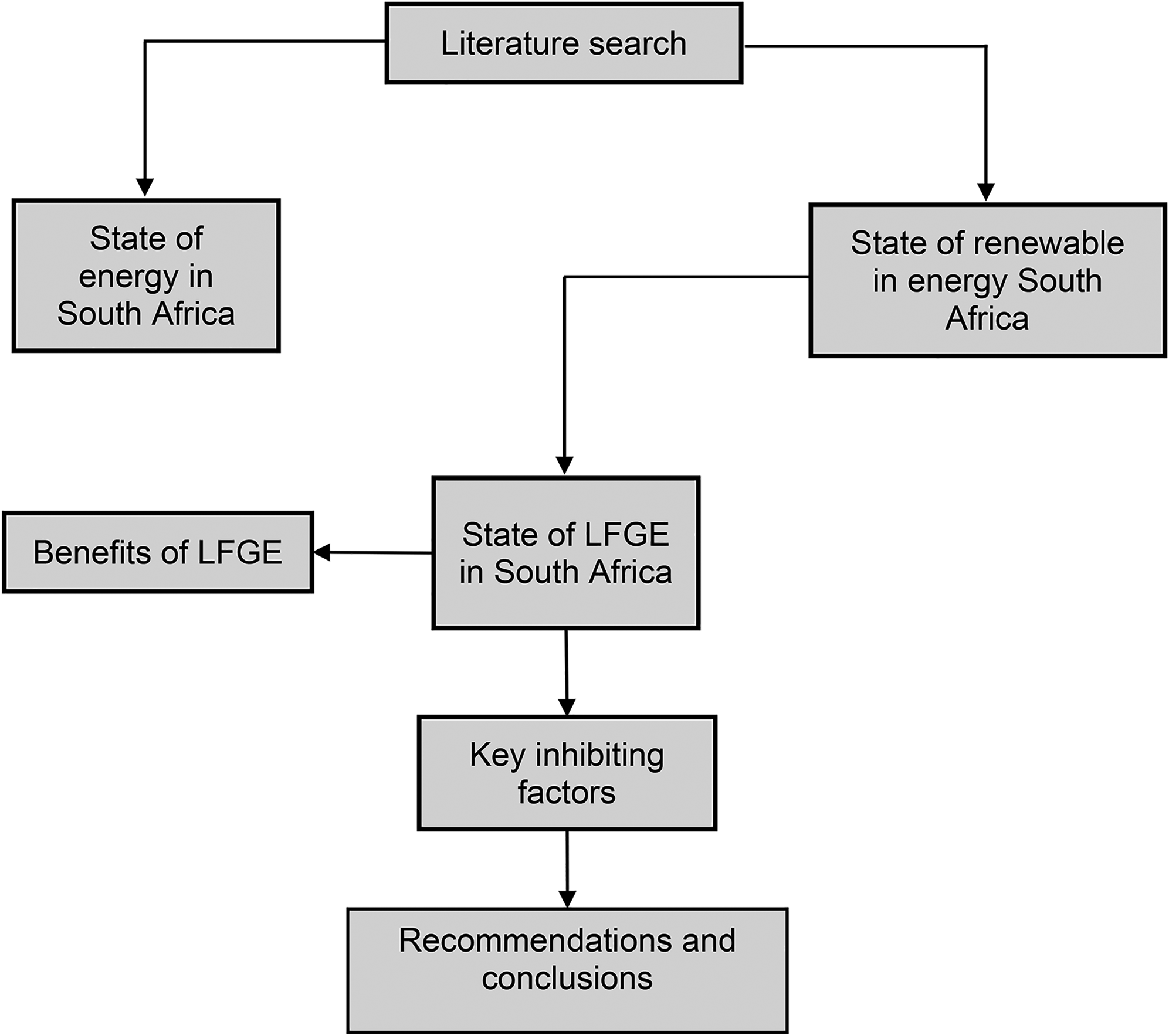
Framework used in the study.
In many African countries, particularly SSA countries, energy supply does not meet the required energy demand (Scarlat et al., 2015), with approximately 600 million people lacking access to electricity, and these countries experience continuous blackouts. It is estimated that the electricity demand will increase by 2.4% in 2030 (Gebreegziabher et al., 2014). This calls for African countries to implement technologies and initiatives that are sustainable and environmentally friendly while maximizing energy generation from waste. It has been noted that African countries are generating increased quantities of organic waste, which present a great potential for adopting WtE such as LFGE for energy recovery and reduction of waste (Purmessur and Surroop, 2019). Despite many African countries generating significant quantities of waste suitable for LFGE (Parawira, 2009; Simelane and Romeela, 2012), there are limited LFGE projects in most African countries, with more reliance on solid fuels, which might pose environmental and public health impacts (International Energy Agency, IEA, 2019). Table 1 summarizes some of the planned and operational WtE projects in the African continent, except for RSA. From Table 1, it can be noted that the adoption and implementation of WtE technologies in African countries is progressing at a slower pace, reflecting that the total energy output in Africa is not half of the energy produced in Brazil through LFGE projects.
African countries (excluding the Republic of South Africa) with a planned or operational capacity of waste-to-energy projects.
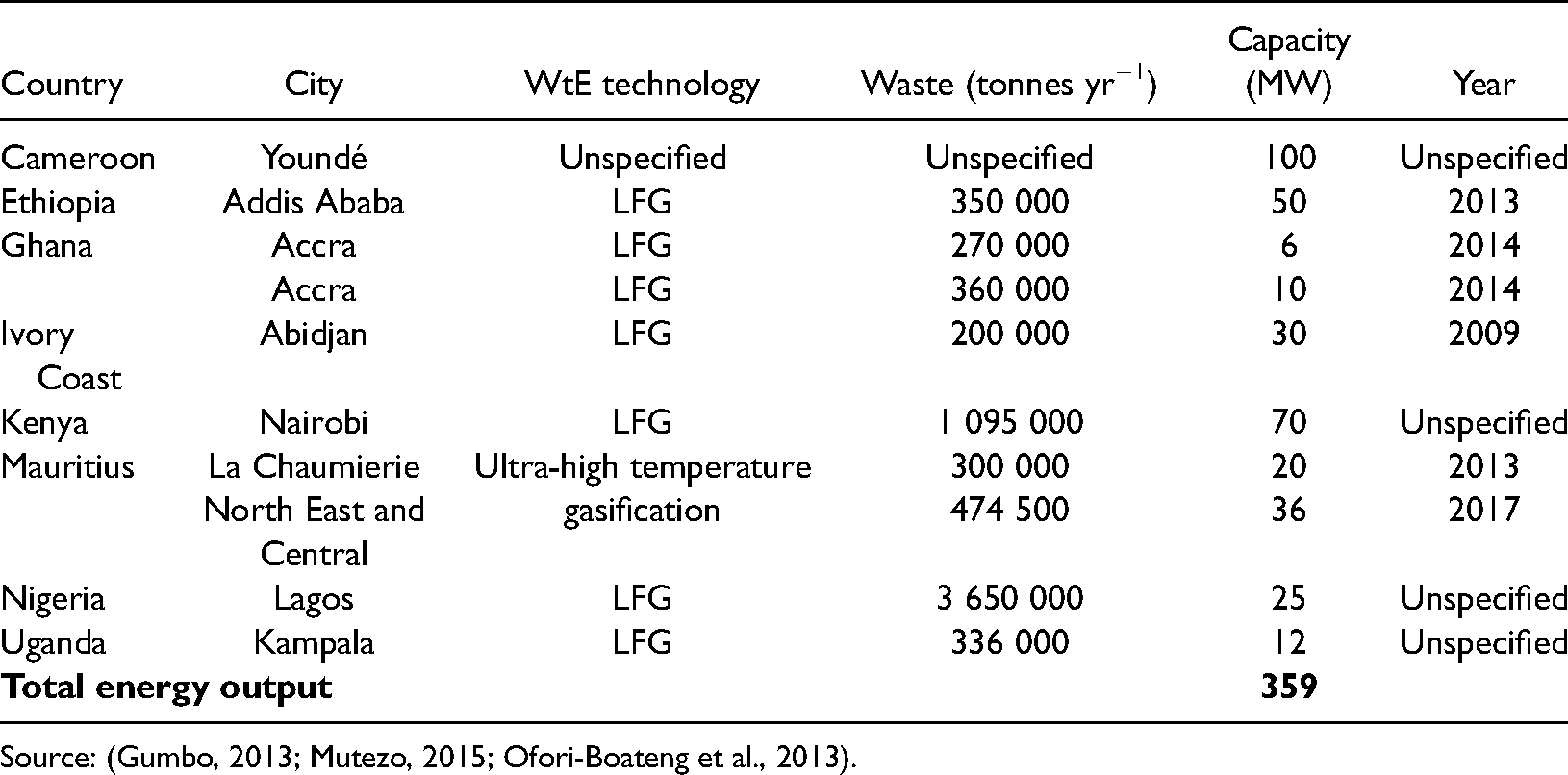
African countries (excluding the Republic of South Africa) with a planned or operational capacity of waste-to-energy projects.
Source: (Gumbo, 2013; Mutezo, 2015; Ofori-Boateng et al., 2013).
The slow adoption of LFGE projects is attributed to inadequate policies, lack of data on waste, poor municipal solid waste management (MSWM), high implementation and maintenance costs, limited knowledge, paucity of research and development (R&D) (Couth and Trois, 2010; Dlamini et al., 2019; Yusuf et al., 2019). Due to the aforementioned challenges, MSW management remains a challenge in many developing countries, particularly SSA countries; presenting an environmental and public health challenge that has existed for the past 20 years (Cudjoe and Han, 2021; Mmereki, 2018; Ofori-Boateng et al., 2013). In many African countries, the inappropriate management of MSW is attributed to limited municipal budgets, lack of technical skills and knowledge, lack of skilled waste management officials, lack or inefficient MSW laws, and inefficiencies in the waste collection (Idowu et al., 2019; Luke and Jason, 2020; Mmereki et al., 2016). The inappropriate management of MSW has implications on public health and the environment, whereby toxic leachate can percolate into the surrounding environment and contaminate groundwater (Ayodele et al., 2020; WHO, 2015).
Studies have also reported inappropriate disposal and inadequately managed sanitary landfill sites in many African countries (Scarlat et al., 2015; Simelane and Romeela, 2012). Dladla et al. (2016), reported that 58% of the MSW generated in developing countries is poorly disposed of. For instance, the Hulene dumpsite in Maputo, Mozambique is regarded as the biggest open dump (dos Muchangos and Tokai, 2020). Many SSA countries, lack data on the composition and generation of MSW, that are important in determining the potential for implementing LFGE projects (Yusuf et al., 2019).
The amount of LFG produced depends on the amount of landfilled waste, type of waste, techniques used to handle and dispose of the waste, and the type of landfill covering system (Friedrich and Trois, 2011; Kamil Salihoglu, 2018). Emissions of LFG are commonly estimated using models based on the first-order decay of organic matter in the MSW. It has been noted that data on the landfilled MSW and estimation of LFG are important in the implementation of LFGE projects (Aghdam et al., 2018; Srivastava and Chakma, 2020). Moreover, in many African countries, the inadequacy of regulatory frameworks, and environmental norms are factors that hinder the adoption of LFGE projects (Njoku et al., 2018; Ogunjuyigbe et al., 2017). Most African countries have semi-arid climatic conditions, making it costly and impractical to construct low permeability sanitary landfills in such areas (Ayodele et al., 2018). In such a semi-arid climate, the low permeability clay layer will crack and the LFG and leachate will escape into the environment (Ayodele et al., 2020).
Approximately 54.2 million tons of MSW were generated in RSA, in 2017, of which 61.4% were landfilled while 38.4% were recycled (Department of Environmental Affairs, DEA, 2018). It was further indicated that the composition of the landfilled MSW comprised 56% organic, 8.3% paper, 4.1% plastic, 2% glass, and the remaining 29.3% was other types of waste (DEA, 2018). The management of MSW is the responsibility of the municipalities in RSA (Dladla et al., 2016). Many municipalities are faced with a lack of capacity and limited resources for improvement of MSW management efficiency. Section 24 (a) of the constitution of RSA states that everyone has a right to an environment that is not harmful to their health or well-being, while Section 156 stipulates that municipalities should promote a clean, safe, and healthy environment. Important frameworks governing MSWM in RSA are the National Environmental Management: Waste Act (NEM: WA) (59 of 2008), National Environmental Management Act (107 of 1998), and National Waste Management Strategy of 2011, which is a legislative requirement of the NEM: WA. The NEM: WA stipulates the management of MSW from the most preferred to the least preferred method in the order of waste reduction, reuse, recycling, and landfilling.
Like many other countries, RSA is faced with a dilemma of increasing waste and limited airspace. There is limited space to develop sanitary landfill sites and the situation is further exacerbated by competition for land with other departments such as the National Department of Human Settlement (Mutezo, 2015). Inadequate government rules and public opposition also hinder the development of sanitary landfill sites (Mutezo, 2015). Due to inadequate policies, RSA is ranked as the 12th largest emitter of GHGs and the waste sector contributes 2–4.3% to the national GHG emissions and 12% of the CH4 emissions (Borello et al., 2018; Friedrich and Trois, 2016; Nahman et al., 2012). This calls for an urgent need to develop effective, efficient, and sustainable MSWM methods while ensuring the protection of public health and the environment (Tan et al., 2014).
The status of energy production and consumption in South Africa
The electricity transmission and distribution system in RSA are controlled and maintained by a state-owned enterprise, with 30 active power stations as of 2018 (Thopil et al., 2018). The 30 power stations generate and supply about 98% (45 561 megawatt (MW)) of the country's electricity (Department of Energy, DoE, 2018), which is mainly from coal-fired stations, accounting for approximately 37 868 MW of the country's total energy. About 2 724 MW is generated through pumped storage, 2 409 MW gas-fired power stations, 1 860 MW nuclear power, while 100 MW is generated through wind and 600 MW is through hydro (DoE, 2018). Recently, electricity consumption has significantly increased and is expected to continue increasing due to industrialization and exponential population growth. Conversely, the coal-fired power stations are failing to meet the country's electricity demand. Consequently, the electricity generation and distribution system have been severely constrained since 2007 leading to frequent power outages termed load shedding which has cost the country billions of Rands. Therefore, it is compelling to include and promote the utilization of RE sources that have less negative environmental and human impacts (Ateba and Prinsloo, 2019; Nahman, 2011; Parawira, 2009).
The utilization of coal has resulted in RSA being the largest emitter of carbon in Africa, thus contributing 45% of the country's coal emissions, which have adverse environmental and human health impacts (Baker and Wlokas, 2015; Friedrich and Trois, 2013). Coal emissions are associated with acid deposition, climate change, and adverse health effects such as premature death, acute lower respiratory illnesses, chronic obstructive pulmonary diseases, and ischaemic lung diseases (Holland, 2017; Langerman and Pauw, 2018; Munawer, 2018). Failure to adopt and prioritize WtE technologies such as LFGE threatens sustainability since energy is central to social and economic development (Ateba et al., 2019; Singh et al., 2015). One of the technologies is microbial fuel cells (MFCs), which present a great potential for electricity generation from available waste resources and have been lauded for its potential to solve both energy and environmental pollution as well as socio-economic impacts of various technological solutions (Sani et al., 2021). It is indicated that technologically MFCs offer the capability to harness electricity from the chemical energy stored in the organic substrate with no intermediate steps, thereby minimizing the entropic loss due to the inter-conversion of energy (Hoang et al., 2022). Compared to traditional anaerobic digestion (AD), MCFs exhibit greater potential with their higher energy recovery efficiency from waste, and use microorganisms as the anodic material, rather than a chemical catalyst, thus a variety of low-grade solid wastes can be regarded as feedstock for MFCs in electricity production (Hoang et al., 2022; Dilip Kumar et al., 2022). It is noted that microorganisms play a critical role in MFC operation for the oxidization of organic matters and generation electron-proton pairs for electricity production. It has been indicated that MFCs are designed principally as two primary configurations known as single-chambered MFCs (SMFCs) and dual-chambered MFCs (DMFCs) with improved performance. Recent research has noted that MFC is an ideal approach to electricity generation and parallel treatment of organic food wastes (Dilip Kumar et al., 2022). Further, in this technique, MFCs present a more sustainable and cost-effective approach to energy production than anaerobic digesters (biogas). More detailed descriptions about the designs of MFCs, advantages, and disadvantages of MFCs in WtE are found in (Dilip Kumar et al., 2022; Hoang et al., 2022; Sani et al., 2021).
Status of renewable energy in South Africa
The ever-increasing costs of traditional fossil fuel-based energy resources and their environmental and health impacts have made RE a viable option, with RSA presently rated as the 12th most attractive investment for RE (DoE, 2017). Policies and regulations such as Clean Development Mechanism (CDM) have been identified as a key tool in the utilization and integration of RE. The ‘White Paper on Renewable Energy’ of 2003 policy aims to promote the utilization of RE sources, thus being expected to achieve a RE target of 10 000 gigawatt-hour (GWh) y−1. By adopting this policy, the government committed to transitioning to low carbon energy by 2030 to meet the country's electricity demand, of which 17 800 MW is expected from RE sources. Hence, a Renewable Energy Independent Power Producer Procurement Programme (REIPPP), aimed at bringing additional megawatts onto the country's electricity system through private sector investment in wind, biomass, and small hydro, among others, was implemented to diversify the energy mix in the country. As a result, over 6 000 MW of RE was generated in 2017 (Naicker and Thopil, 2019). Despite the country's abundance of RE resources, coal remains the dominant source of energy because it is viewed as a cost-effective and abundant resource (DoE, 2015; Zhou et al., 2018). Although LFGE has been proven to be a cleaner and more sustainable energy source relative to coal (Mukherjee et al., 2020), it not adequately utilized. Therefore, there is a need to strengthen institutional capacity to promote the utilization and integration of LFGE into the energy mix (Ateba et al., 2019; Ateba and Prinsloo, 2019).
Waste-to-energy routes in the Republic of South Africa
Past research indicated that the prominent and suitable energy recovery pathway in South Africa includes biochemical conversion namely, AD and landfill gas recovery (Mohlala et al., 2016; Niklasson, 2018), which are used to tackle imminent waste management crisis, thus adding to the energy mix of the power sector and contributes towards the GHG mitigation. AD of MSW is being demonstrated at some landfill sites as an alternative to landfilling and capturing methane emissions from the waste stream. AD is also used in various industries, and communities to process separately collected food waste streams (Adeleke et al., 2021). A study by Stafford (2019) reported that the organics waste in the city of Johannesburg is about 15–35% of the total waste generated, of which only 35–40% is available for AD to yield methane gas which has an inherent theoretical energy potential of 841 TJ per annum. It is indicated that several bio-digester plants have been introduced in South Africa since after its first introduction in 1957 by John Fry (Adeleke et al., 2021; Stafford, 2019).
The government has invested in other efforts such as waste biomass as feedstock to produce bioenergy and biofuels, mostly at the laboratory scale with limited efforts at commercial scales (Adeleke et al., 2021). However, research has indicated that the RSA has the highest energy recovery potential from both incineration and landfill gas recovery and the highest methane potential from landfill gas, accounting for approximately 104,463 TJ and 22,710 TJ of energy per year from incineration and landfill gas respectively and methane potential of 2058 × 106 Nm3 (Adeleke et al., 2021). Although, the high theoretical potential for energy recovery from WtE routes (e.g. agricultural residues, 2.67 × 10⁸ GJ and 3.79 × 10⁸ GJ from residues and energy crops), and 230,000 tonnes of dry matter generating bio-methane of 91.6 million Nm3 /year which can fuel about 2700 buses in the city of Johannesburg) have been reported in the literature (Dada and Mbohwa, 2018; Mohlala et al., 2016; Niklasson, 2018; Stafford, 2019), however, RSA is not practically operating up to its full potential in achieving this expectation because she is under-utilizing its abundant waste resources for energy generation, and is projected to consume 37% of energy and 46% electricity consumption by 2030. This calls for the government to enact and strengthen measures for energy conservation and efficiency (Adeleke et al., 2021).
In recent years, obtaining energy and useful products from waste has become a critical topic of most developed countries, amongst researchers, decision-makers, and policymakers (Charis et al., 2019). WtE technologies have evolved from simple engine turbines to advanced technologies such pyrolysis, MCFs (Dilip Kumar et al., 2022), etc., whereby waste is converted to energy or fuels, compensating for any gaps within the CE (Xiao et al., 2020). The technologies for WtE include combustion, mechanical biological treatment, torrefaction, gasification, pyrolysis, liquefaction, fermentation, and AD (Charis et al., 2019). It has been noted that the selection of technology becomes simpler if the waste characteristics are well understood, and the determination of the capacity of a particular technology solution should be given extra consideration. Developed nations have embraced and established resource-efficient practices and technologies to produce energy, heat, fuels, and compost from solid waste (Mmereki et al., 2016). However, developing countries are viewed as being passive in adopting these WtE technologies. It has been noted that processing waste in its various forms can be technical, which might need significant capital investments. However, developing countres are still lagging socio-economic justification for an investment in some technologies (Charis et al., 2019).
Research has indicated that the main contributory factors to the gap in technology advancement and level of investment in state-of-the-art technologies are well-developed policies, which are accompanied by well-developed infrastructure (Adeleke et al., 2021). Countries such as RSA, on the contrary, are still grappling with the challenges of adopting the state of art technologies. Some lessons can be learned in the success of WtE in developed countries especially in EU countries, and these success factors can be helpful to develop a roadmap for the improvement of WtE platforms considering the socio-economic factors affecting RSA. It has, however, been noted that it is impracticable to simply transfer the EU model or technologies into South Africa without evaluating the peculiar local factors that impede the growth of WtE and the causes of many failed WtE projects. As result, it is indicated that adequate information provided by full exploration of the pitfalls of WtE Industries in South Africa in the light of the success factors in the EU would help enhance the performance and bring about advancement over time (Adeleke et al., 2021).
Status of the landfill to energy projects in the RSA
RSA has made significant progress in the utilization of LFG, and this is considered necessary since the country is a signatory of the Kyoto Protocol (Rajaram et al., 2011). However, compared to other developing countries such as Brazil and the Peoples’ Republic of China (ProC) the adoption of LFG technology is still nascent. Past research indicated that to implement technology regarding LFGE production, a model to estimate LFG collection is an essential tool for planning an LFG flaring or energy project. For instance, in the Limpopo Province, a study modelling potential landfill gas potential and potential energy recovery from the Thohoyandou landfill site proposed LFG standard turbine generator set; standard reciprocating engine generator set; microturbines; small engine. The study found that these LFG engines were economically feasible for the development of LFG technology utilization project (Njoku et al., 2020). On the other hand, research has shown that estimating the volume of LFG generation from a landfill is a critical component of project assessment and conceptualization because the collection projections are used to estimate the size of the project, expected revenues, project design requirements, and capital and operating costs (Charis et al., 2019). The Ethekwini municipal landfill sites at Mariannhill and Bisasar Road are based on a modern cellular approach with methane recovery built into the cells, and a flaring system installed to dispose of the methane in an environmentally acceptable manner. It is noted that the gas collector wells that create a vacuum within the decomposing waste are drilled into the mound of landfilled MSW to suck the gas that is later transported along the pipes to the gas pump and flare station. Thereafter, the gas is converted into electrical energy by the turbines and a step-up transformer is used to supply the electricity of the same voltage into the municipality's grid (Gumbo, 2016). The gas collection system for the flaring as installed in the ethekwini landfill sites proved adequate as a pre-injection treatment system for the engine generators (Adeleke et al., 2021). Since the ethekwini was implemented as the first LFGE project in RSA and the African continent, the activities were used as a prototype to be replicated in other municipalities such as Johannesburg, Ekurhuleni, Cape Town, and other relatively large-scale metropolitan areas. The majority of the landfill sites in RSA employ direct-use technologies. However, LFG has not been commercially used in place of conventional fuel such as natural gas, fuel oil, or coal compared to countries like the United States, Australia, and many European countries such as Sweden, Germany, and the Netherlands.
Numerous WtE plants have been initiated in several regions of RSA, mostly in KwaZulu-Natal, Western Cape, and Gauteng Province. The projects are predominantly focused on metropolitan municipalities. The Buffalo City Metropolitan Municipality in the Eastern Cape Province is currently flaring LFG at the Second Creek landfill site while plans are being made to install gas engines to convert waste to energy.
The eThekwini Metropolitan Municipality in KwaZulu-Natal Province launched its first LFG plant in 2007 that involved extracting LFG from the Mariannhill, Bisasar Road, and La Mercy landfill sites (Table 2) (Pather-Elias et al., 2015). Costs related to the implementation of the three LFGE projects in eThekweni municipality were ZAR 114 million and the annual operational costs were ZAR 12 million (Gumbo, 2016). The project was funded by the Department of Trade and Industry and the Department of Energy. Due to the project being capital intensive, additional funds were sourced through a loan from the French Development Bank (Gumbo, 2016). The Jenbacher spark engines installed at the three landfill sites accounted for a significant portion of the overall budget (Gumbo, 2016). Jenbacher 312 (0.5 MW) and 320 (1 MW) were regarded as appropriate, attractive, and competitive since they are based on a gas engine design and provided a higher output range (Couth et al., 2011).
LFGE projects at the eThekwini Metropolitan Municipality.
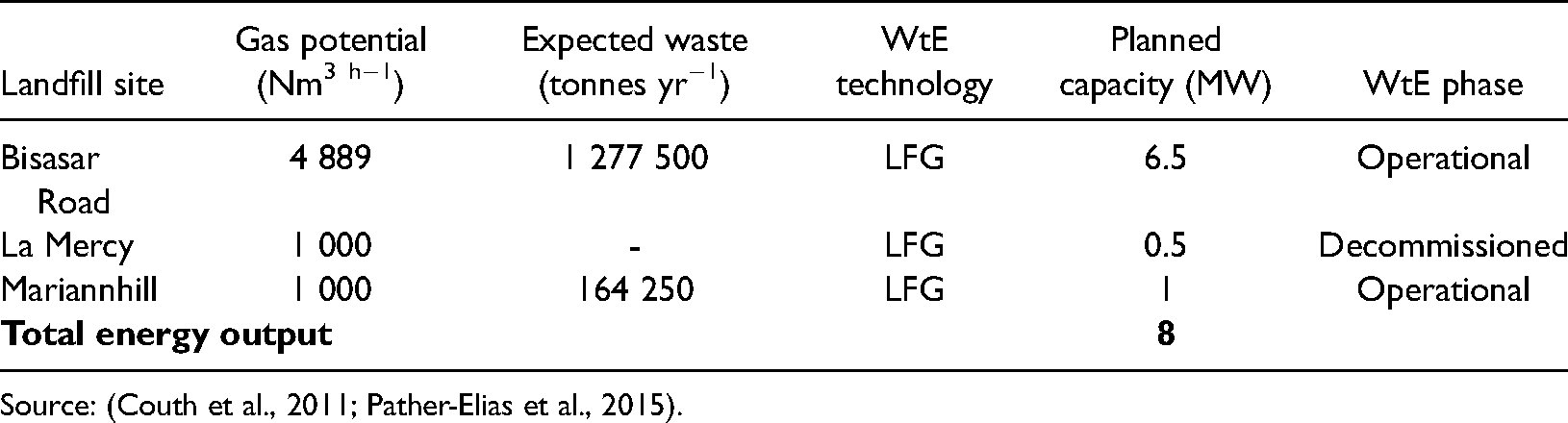
LFGE projects at the eThekwini Metropolitan Municipality.
Source: (Couth et al., 2011; Pather-Elias et al., 2015).
The LFGE project at the La Mercy landfill site was decommissioned in 2009 because of a significant difference between the commitment from the municipality and released low levels of LFG related to technical problems. The technical problems were associated with disturbances experienced by the gas engines and a lack of maintenance and monitoring; LFG is flared to reduce its potency (Kamil Salihoglu, 2018; Moodley et al., 2014). Consequently, the engines installed were moved to Bisasar Road (Gumbo, 2016). Flare units were also installed at the Mariannhill and Bisasar Road LFGE projects to prevent the choking of the engines due to excess LFG (Gumbo, 2016). At the Mariannhill landfill site, approximately 160 m3 hr-1 of LFG is extracted to generate 900 kWh of electricity; while at the Bisasar Road LFGE project, 350 Nm3 hr-1 of LFG is extracted to produce 9 MWh of electricity day−1 (International Energy Agency Bioenergy, 2014). In 2012, the Mariannhill and Bisasar Road landfill LFGE projects generated a combined 7.5-megawatt (MWh) y−1 of electricity that was stepped up using transformers, fed into the municipality grid, and supplied to approximately 3 500 middle-income (Gumbo, 2016; Pather-Elias et al., 2015).
Figure 2 shows the amount of electricity generated by the Bisasar Road LFGE project in 2012. It can be observed that the highest electricity was generated in July and the lowest was in April. The Bisasar Road LFGE project provides an interesting scenario whereby the production of electricity from LFG was lower in winter and higher in summer. The Bisasar Road scenario also indicates the importance of temperature in the production of LFG, which requires enhanced LFG monitoring to improve LFGE. The scenario implies that LFG might not be a reliable source of electricity in winter, which might prove to be a concern since electricity demand and consumption is high in winter in RSA. The findings are in agreement with (Mutezo, 2015), who reported that WtE technologies fall short in addressing the energy problems in RSA, but are advantageous for carbon emission reduction, waste minimization, and waste diversion. Nonetheless, LFGE projects can significantly improve the energy supply at a local, regional and national level (Mutezo, 2015).
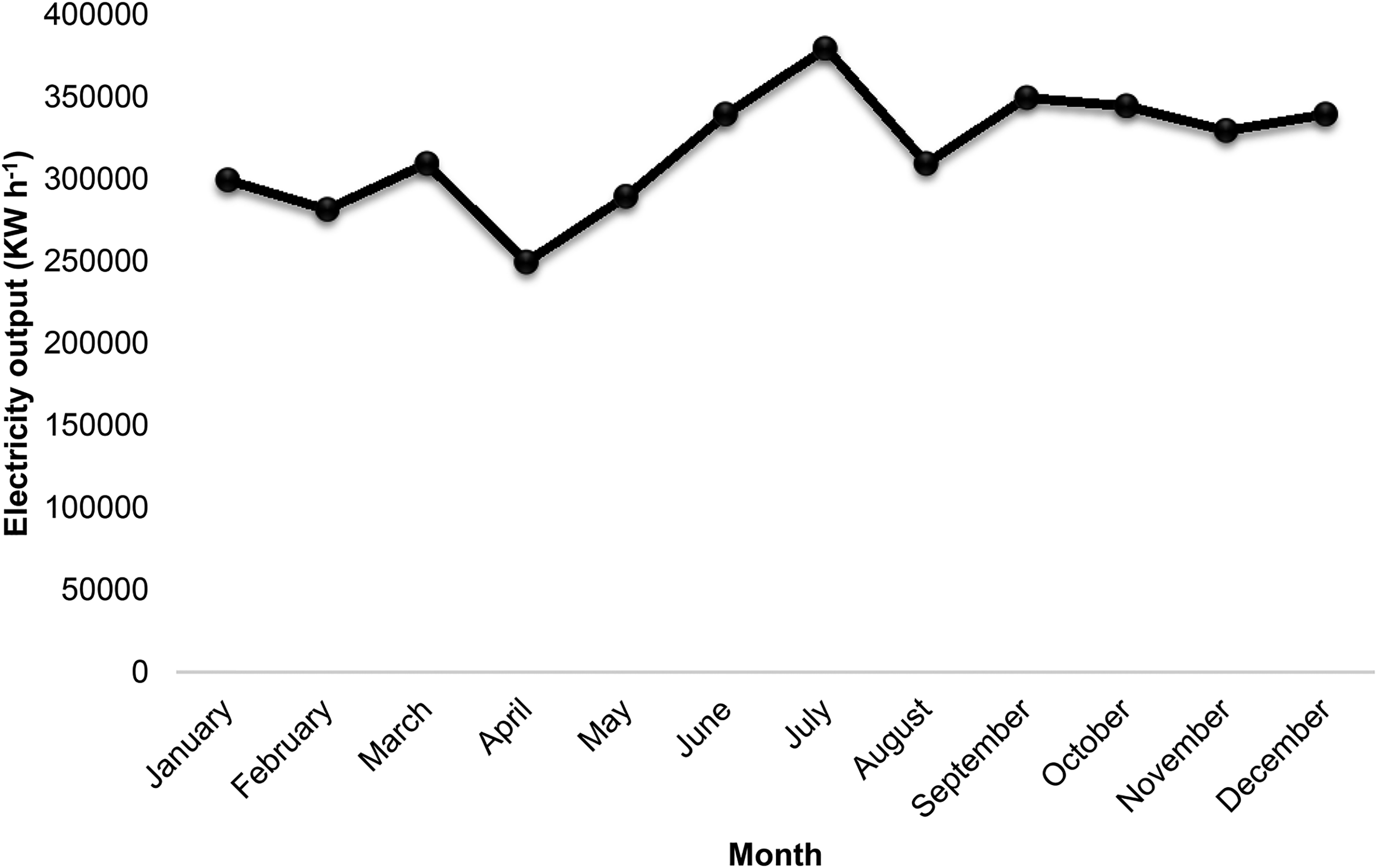
Monthly electricity generation from LFG at Bisasar Road in 2012. (Source: Adapted from Gumbo, 2016).
Although the La Mercy LFGE project was decommissioned, the Mariannhill and Bisasar Road LGFE projects have had significant positive environmental impacts. Over 200 000 CERs have been achieved year−1 as shown in Figure 2. The project achieved 7.7 million tons of CERs (Gumbo, 2016). Within the eThekwini municipality's jurisdiction, there is a privately owned LFGE project that has been operational since 2014 and generates about 1.6 MW of electricity that is fed into the local grid (Bhailall, 2016).
Table 3 shows the planned and operational WtE across the Western Cape Province. The City of Cape Town Metropolitan Municipality (CoCTMM) commissioned an anaerobic digester plant in Athlone, Cape Town in 2017. Approximately 500 tons of MSW from the plant generate biogas and CO2 which are sold to a private company (Western Cape Government, 2017). Moreover, the Coastal Park and Bellville South landfill sites were identified as potential LFGE projects by the CoCTMM. Economic assessments indicated that the two landfill sites can generate 4 MWh y−1 of electricity that can power a wastewater treatment plant and reduce the operating cost for bulk electricity purchases. Meanwhile, the LFG is extracted and flared to reduce its potency thus preventing negative environmental and public health impacts.
Waste-to-energy projects in the Western Cape Province.
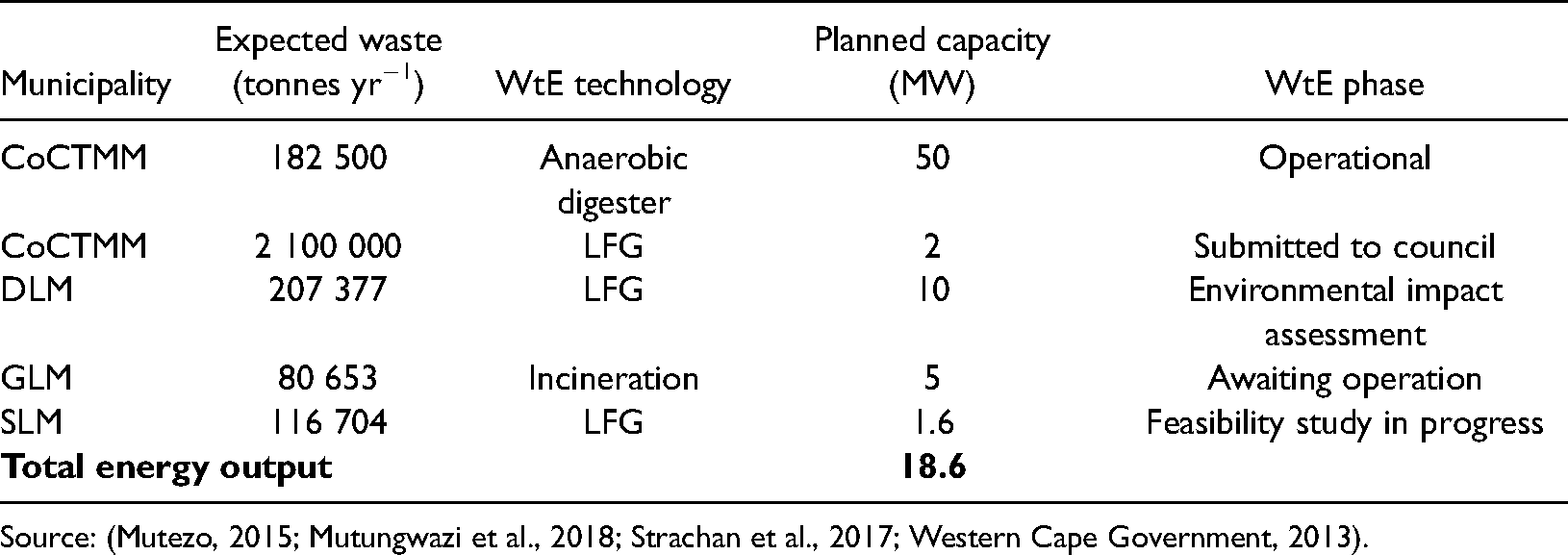
Source: (Mutezo, 2015; Mutungwazi et al., 2018; Strachan et al., 2017; Western Cape Government, 2013).
The Drakenstein Local Municipality (DLM) signed a public-private partnership with the service provider to implement an LFGE project, which will be transferred to the municipality after 20 years (Mutezo, 2015). The George Local Municipality (GLM) was expected to implement WtE plants that will incinerate wood-bark, wood chips, and sawdust to produce electricity, which was to be led by a private company and the electricity sold to the state-owned power utility (Mutezo, 2015). The Stellenbosch landfill site is near its maximum capacity, and the Stellenbosch Local Municipality (SLM) conducted a feasibility study with the help of a private company (Strachan et al., 2017). The feasibility study indicated that the potential gas production at the Stellenbosch landfill site is 1 400 Nm3 hr-1 and there is a potential for implementing an LFGE project which can provide a capacity of 1.6 MW (Strachan et al., 2017). The produced electricity will be supplied to the adjacent wastewater treatment plant.
Table 4 shows the LFGE projects planned for the Ekurhuleni Metropolitan Municipality (EMM) in the Gauteng Province. The Jack and Simmer LFGE project was commissioned in 2014, with a 1 MW gas engine generated 594 600 kilowatt-hours (kWh) of electricity (Franks et al., 2015a). The electricity generated is stepped up to 6.6 kV and fed into the municipal distribution grid (Ferry et al., 2015). The Jack and Simmer LFGE project has generated more than 3 million kWh of electricity and reduced 664 488 CO2 emissions (DoE, 2017). Other planned LFGE projects are still in the implementation phase. However, the progress is unknown due to limited data. Additional to the council-owned LFGE projects, there is a privately-owned project in the EMM jurisdiction, which generates 1.6 MW of electricity that is fed into the local electricity grid (Bhailall, 2016).
LFGE projects in Ekurhuleni Metropolitan Municipality.
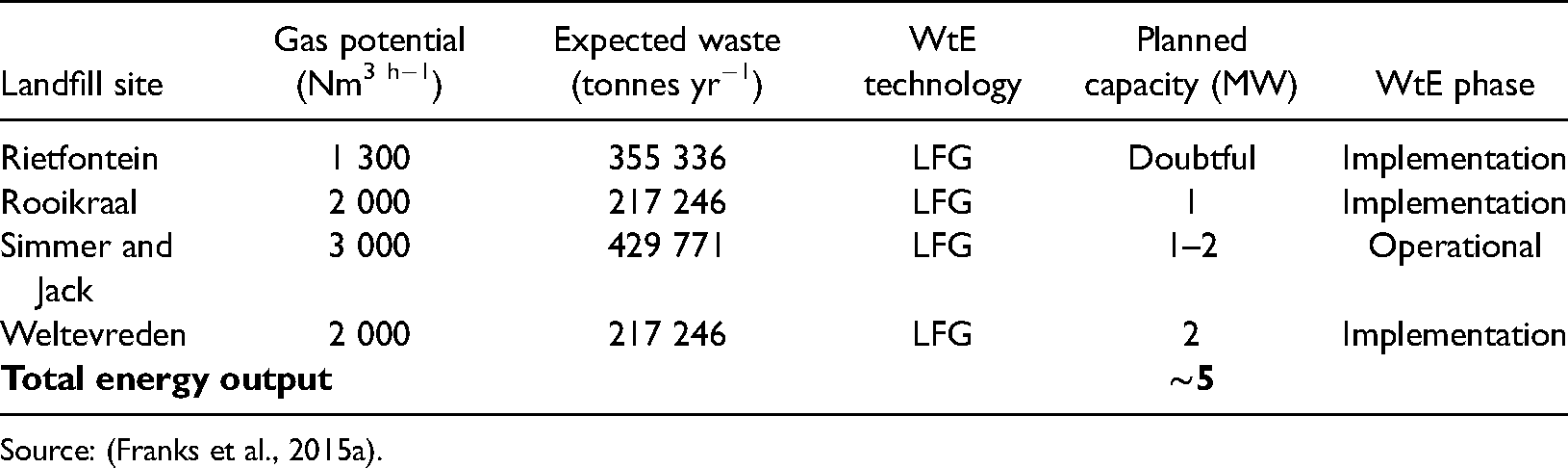
Source: (Franks et al., 2015a).
Due to the GHG emissions being above the licensing threshold limit at landfill sites within the City of Johannesburg Metropolitan Municipality's (CoJMM) jurisdiction in Gauteng Province, several LFG projects were initiated to protect the environment and public health. Table 5 shows landfill sites and their potential energy output. The LFGE projects were commissioned in 2016, with a potential energy output of 8 000 MWh yr−1. Based on the amount of MSW landfilled, the combined energy output of the LFGE projects was estimated at 18.6 MW, while the average combined energy output was estimated at 150 GWh yr−1. The generated electricity was expected to be sold to the national power utility company through the REIPPP and was anticipated to power 25 000 middle-income households (Franks et al., 2015b). It was also anticipated that the LFGE projects will help reduce load shedding in the country (Franks et al., 2015b).
LFGE projects in the City of Johannesburg Metropolitan Municipality.
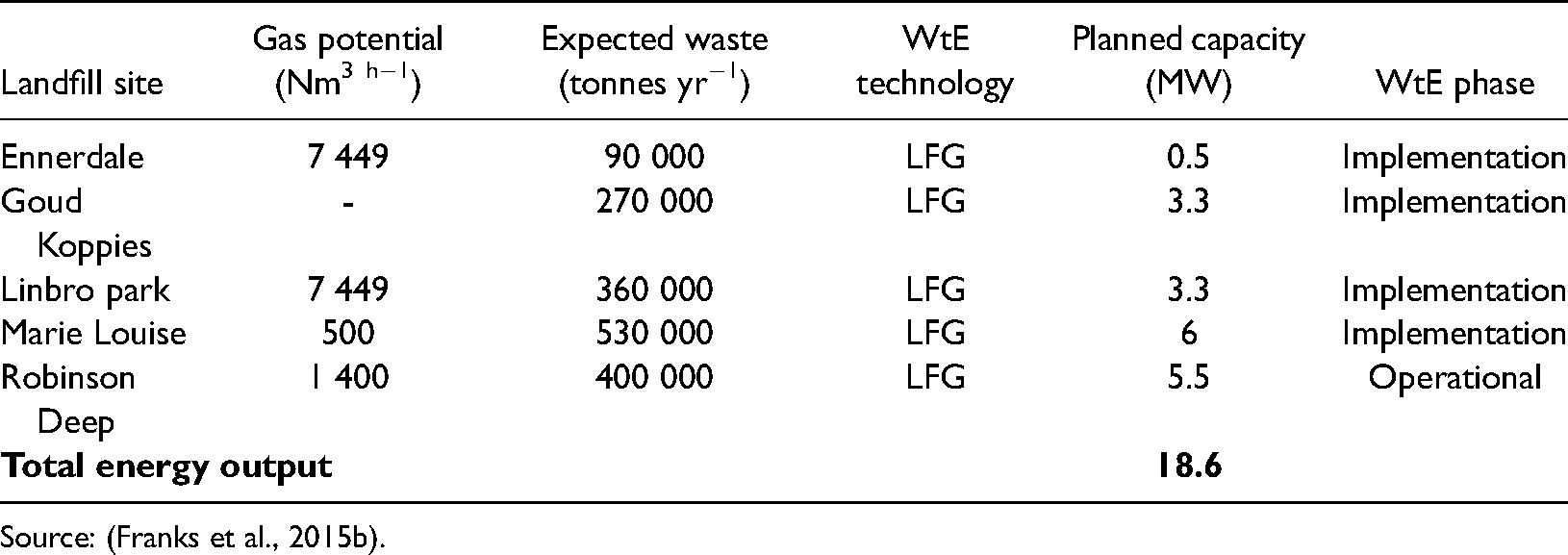
Source: (Franks et al., 2015b).
The concept of the CE has been proposed by China and the European Union (EU) as a solution to allow countries, firms, and consumers to live in harmony with the natural environment and close the loop of the product life cycle. Global challenges like climate change, biodiversity loss, waste, and pollution have been addressed using this system solution framework (Ciuła et al., 2018). In a CE, the reusable waste can be recycled or transformed into energy, such as green fuel pellets, biogas, biochar, refuse-derived fuel, heat, and electricity. It encourages efficient and circular use of resources by using waste resources and by-products which are derived locally, thus minimizing the consumption of conventional fuel resources such as fossil fuel and minerals. This circular form can mitigate the impacts of the production activities on the environment to the minimum extent, making the production activities more environmentally friendly and economically feasible. The focus of the approach is on the minimization of pressure on natural and freshwater resources, as well as ecosystems, using various reuse and recycling schemes (Xiao et al., 2020). The shift toward a CE requires rethinking the supply chains currently used for waste and describes emerging policies, business models, investment foci, and community behaviour on less pollutive, resource-prudent, and efficient activities underpinning our global civilization. These concepts can be simplified to explain the differences between our current throwaway (linear) culture, the recycling economy, and the CE. The transitiong from the current linear thinking model with large set-piece infrastructure to a distributed model using the CE thinking will be crucial (González et al., 2018). The CE is based on three principles, driven by design: (i) eliminate waste and pollution, (ii) circulate products and materials (at their highest value), and (iii) regenerate nature. Research has indicated that by creating smaller circular steps closer to the source of waste generation, more expensive end-of-life solutions can be rightsized due to higher resource recovery rates (from 10% moving closer to 80% recovery) (Asian Development Bank, 2020).
Recently, LFGE has gained attention to significantly contribute to a CE, by optimizing energy consumption at solid waste disposal facilities eliminating fossil fuels (Ciuła et al., 2018), and promoting sustainable development. It has been noted that LGFE depicts the framework of material and energy flow between the WtE system and the environment in a CE. Scientific research has indicated that new resource consumption, waste streams, air emissions, and effluents may arise when changing from a linear to a CE model. For instance, in Chile, a case study of three alternative WtE scenarios was assessed as part of a CE strategy, involving combustion, gasification, and landfill biogas, at the BioRegion in Southern Chile (González et al., 2018). The findings of the study provided a complete view of the environmental performance of each alternative scenario, including the potential reduction of climate change effects and other environmental impacts, and the positive contributions of material and energy recovery. In the Asian countries, a proactive mix of 25% WtE treatment for municipal waste; 8% landfill of inert materials; and combustion products with the remaining 67% being recycled, reused, or upcycled constitutes current best international practices (Asia Development Bank, 2020; Xiao et al., 2020). Therefore, globally, the advantages of CE in the use of LFG, include reduction of the environmental effect coming from discontinued emissions (methane, carbon dioxide), economic benefits due to use of heat and electricity to satisfy user's own needs and, the added value of so-called "green certificates”(Asian Development Bank, 2020). So far in Poland, the development of CE has been accompanied by adopting EU policies implementing sustainable material management to meet its own energy needs and at the same time acts as a "green energy" provider for households, offices, cities, etc. This way, it contributed to the development of prosumer energy, whereby the landfill becomes both a producer and a supplier of electricity needed for landfill operation (utilize local energy resources. Prosumer energy serves as an example of a comprehensive CE approach (Ciuła et al., 2018). Additionally, in other countries such as the U.S., about 70 percent of the landfill gas captured today goes to generate electricity in various kinds of turbines and engines, as well as fuel cells. It has been suggested that the demand for landfill gas will rise alongside the increase in public awareness of climate issues. By supplementing activity in other renewable energy sectors, landfill gas can play a significant role in the CE and in accelerating decarbonization in the U.S. and elsewhere around the globe (Ellen and Company, 2014). Past research has indicated that WtE technologies and pathways in the context of CE principles address several SDGs, including good health and well-being, clean water and sanitation, affordable and clean energy, industry, innovation and infrastructure, sustainable cities and communities, responsible consumption and production, climate action, life below water, and life on land (Taghipour et al., 2016). Schroeder et al. (2019), concluded that CE can directly help achieve 21 of the SDGs and indirectly help achieve 28 of the targets.
On the other hand, developing countries such as Taipei, China, is one of the most successful Asian economies in addressing MSW as an energy resource, into the CE principles (Xiao et al., 2020). As a result, twenty-four WtE facilities have been built over the last 2 decades with an installed capacity of approximately 560 MW, generating 1.24% of the total baseload power in 2017 from more than 6.2 million tons of waste. Regarding waste management decisions in China, sustainable development is of utmost significance to promote the establishment of the WtE system in a CE (Asian Development Bank, 2020).
Furthermore, it has been observed that other countries such as the EU member states, China (Xiao et al., 2020), and the US seem to identify WtE in the CE, mainly related to the reduction of the impact of climate change from waste management and policies on the elimination of waste, with national strategies towards optimization of LFGE (González et al., 2018). Most importantly, in Europe, waste systems achieved this thorough material recovery/recycling and energy recovery through the WtE processes. These policies are underpinned primarily on waste reduction and reuse, and waste management hierarchy (Sanguino et al., 2020). The European Commission (EC) suggested that the transition towards CE implies pulling all waste down to zero, which could also lead to decision-makers developing and implementing integrated strategies to stimulate societies to effectively separate waste at source; encouraging the shift from traditional linear to CE and allowing the reduction of GHG emissions and promoting sustainable development and encouraging the application of innovative recovery technologies to extract LFG and generate electricity (Ciuła et al., 2018). Undoubtedly, the transition towards CE should lead to the prevention of environmental impacts, waste reduction, and energy recovery as well as the utilization of renewable energy. Interestingly, for both developing and lesser developed countries, landfilling remains the dominant means of MSW disposal, which practically prevents the possibility of minimizing the total amount of waste, and waste recovery in the CE perspective. This is in contradiction to the CE, which advocates for sustainable waste reduction and recovery of waste, which otherwise would end up in the environment or waste disposal sites. This situation is exacerbated by the weak institutional capacity, inadequate public-private partnerships (PPPs), insufficient investments, technical know-how, and legal limitations, deficient information on the potential of waste for energy, lack of appropriate technologies for converting waste to energy, chemicals, fuels, and other useful and frail relevant government policy. In the context of developing countries, particularly RSA, there is an urgent need for concerted efforts to optimize LFG in CE.
Benefits of landfill gas to energy
LFGE plays a significant role in sustainable environmental, socio-economic, health, and safety benefits (Yusuf et al., 2019). The utilization of LFG might reduce smog, odour, and GHG emissions, which can enhance indoor and outdoor air quality. The generation of electricity from LFG and feeding into the distribution grid can reduce the constraints on coal-fired power stations, thus reducing CO2 emission and other pollutants that contribute to poor air quality and climate change (Hadidi and Omer, 2017; Rajaram et al., 2011; Stehlik, 2016). LFG has been proven to be a reliable and sustainable energy resource that can significantly reduce GHG emissions, which is in line with the United Nations Framework Convention on Climate Change (UNFCCC) 1997 Kyoto Protocol (Bogner et al., 2008; Yusuf et al., 2019). Relative to conventional fuels, LFG emits water and less harmful CO2 as by-products of combustion and has a high calorific value of 17 megajoules cubic−1 metre (Purmessur and Surroop, 2019; Stehlík, 2009). LFGE projects are also a source of job creation and revenue thus alleviating poverty. For example, in Malaysia, LFG was used to generate up to 1.9 billion kWh of electricity worth US$ 190 million and received over 85 US$ million revenue (Johari et al., 2012). Therefore, the implementation and utilization of LFGE conforms to the United Nations’ sustainable development goals (UN SDGs) one, two, seven, and eight.
Past research has noted that it is important that stakeholders including the public, decision-makers, policymakers understand the benefits of the generation of LFG, and the government generate LFG that can be feasibly collected, used, and provide cost savings over the life of the project. The operation by trained personnel is critical in maximizing the intended benefits (Charis et al., 2019). Other critical factors in the utilization of LFG include the compilation of numerous technical considerations, such as waste composition and volume, quality and quantity of LFG, and availability and awareness and the location of a suitable end user. Thereafter, a holistic assessment of the feedstock capacity requirements, costs, and benefits associated with various WtE alternatives for the country should be evaluated, as well as how well these options fit the social, technical, and economic status of the country. As a result, proven and emerging technologies offer practical solutions to effectively implement LFGE projects for direct use and electricity generation, including the treatment of LFG to remove moisture, particulates, and other impurities. However, in the context of RSA, LFGE is not yet prioritized by the government and is still holding out on coal because of inadequate public acceptance, and there are some misunderstandings on LFGE (Adeleke et al., 2021).
Currently, local, and regulatory energy policy frameworks at many levels of government in RSA targeting and promoting LFGE such as the provision of financial incentives meant to promote the development of LFG resources are not adequately developed. LFG is not yet prioritized because of the need for treatment systems for LFG electricity projects, which could increase the costs, typically including the simple removal of moisture and particulates to the more expensive removal of corrosive and abrasive contaminants (Gumbo, 2016). This is associated with the waste in RSA being characterized by a relatively high moisture content which consequently reduces its heating value, thus incurring increased cost to remove impurities in the LFG because this might require extensive primary and secondary treatment of LFG. It has, however, been noted that this may not be a challenge for biological treatment, whereby a higher heat energy input is required at the drying stage of thermal conversion processes of waste with high moisture content, consequently making it an energy-intensive process. Unfortunately, this is a shortfall in energy investment and techno-economics. Other reasons why LFG is not yet implemented include the lack of a detailed final feasibility assessment by qualified professionals before preparing a system design, initiating construction, purchasing materials, or entering into agreements to provide or purchase energy from an LFGE project (Adeleke et al., 2021).
Research indicated that owing to the abundance, availability, and low cost of coal reserves, which will supply coal for the next 200 years, this has placed South Africa as the fifth-largest coal producer and 7th largest coal-based electricity producer in the world, and the fact there is no competitive alternative energy resource to coal, and the cheap exploitation cost of coal, limitations of independent power producers, and other constraints have made the demand for LFGE unattractive. This continues to be a threat to the survival of it as a potential energy provider in South Africa. It is indicated that many residents in RSA are still unaware and ignorant of the benefits it offers in terms of energy production, reducing landfill disposal, and its environmental benefits, thus resulting in apathy from municipalities. It is revealed that some WtE had faced opposition from residents because of the worries about the supposed environmental concerns with the facilities (Adeleke et al., 2021). However, the benefits of a circular, resource-efficient economy are vast including reduction of GHG emissions, increased employment creation, and business development. For countries like RSA to compete in the 21st global economy, there is a need to strengthen its institutional capacity and utilize the waste resources for improved energy generation, including LGFE.
Utilization of WtE in the southern region
A survey in 2014, of the Southern African nation's energy policies, has noted that only South Africa had come up with a detailed renewable energy policy; one such instrument that covers WtE initiatives (Charis et al., 2019)
In the case of Mozambique, the Hulene dumpsite (after scoring 30) has been identified as a favourable candidate for landfill gas recovery or utilization by transitioning to a controlled facility under the semi-aerobic condition (dos Muchangos and Tokai, 2020). In Namibia, valorization activities of encroacher waste into charcoal, wood chips, and briquettes have been identified for energy recovery options, with many other WtE opportunities (Charis et al., 2019; Development Consultants for Southern Africa, DECOSA, 2015). Stafford (2019) indicated that Zimbabwe has embarked on notable biogas production technology projects in partnership with private investors. These projects include the Harare City council Mbare Biogas project with a capacity of 800 m3 running a 100–200 kVA generator for electrification of Mbare area, installation of 2.5 MW capacity biogas plant at a sewage treatment plant of Firle Biogas Project, and a 2.2 MW and 110,000 litres biodiesel production capacity plant was proposed at Bulawayo City Council. In terms of private sector investment for WtE in Zimbabwe, it is noted that the Harare Institute of Technology partnered with Mutare City Council and Climatic Change Research Center to carry out the thermal distillation of sewage sludge into natural gas, diesel, and char. The detailed status of LGFE projects in these Southern African countries is unknown and lagging even after the introduction of the CDM and JI projects for LFG utilization technology. Based on the present observations from the published literature review, it is evident that most of the Southern African countries’ MSW do not have efficient and effective waste management facilities and treatment systems when compared with RSA. Several studies concerning LFGE in South Africa has shown that it has grown at a very slow pace (Charis et al., 2019; Couth et al., 2011; Dlamini et al., 2019; Mohlala et al., 2016) as compared to other Southern African countries, and has established partnerships with local institutions, non-governmental organizations (NGOs), or local private companies and CDM projects (the country had 19 registered CDM projects in 2010) that are expected to be helpful in the implementation of the LFGE. Concerted efforts on waste management practices and policies in most Southern African countries are urgently needed towards a shift from linear waste management to CE, which encompasses energy recovery to eliminate waste and reduce GHG emissions for environmental protection and prevention of public health impacts. To improve the existing conditions, extensive research is needed to assess the present status of WtE in these countries.
Challenges and alternative solutions for promoting the utilization of the LFGE in RSA
The adoption of LFG technology in RSA is happening at a slow rate compared to countries such as Brazil and China. The lack of effective and environmentally sanitary landfill sites, lack of waste data, and uncollected MSW and policies promoting the utilization of LFG are major contributing factors to the slower progress in the implementation of LFGE projects in RSA. On the other hand, implemented LFGE projects are not meeting their objectives and there is limited data on their efficiency and contributions. The study identified major factors inhibiting the success of the LFGE in RSA as summarized in Table 6, together with the alternative solutions that can help improve the adoption and utilization of the technology in the country.
Challenges and solutions to LFGE in the Republic of South Africa
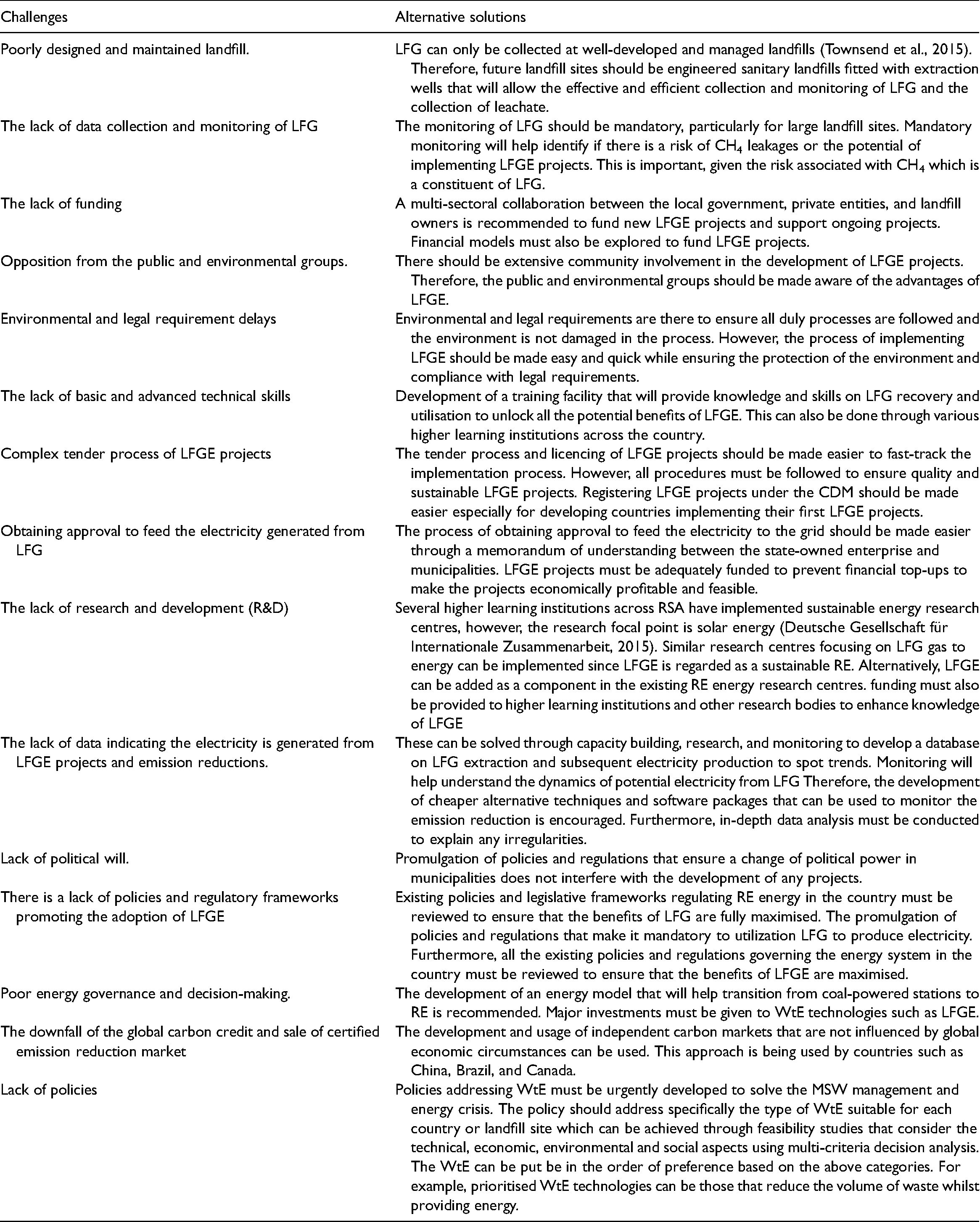
Challenges and solutions to LFGE in the Republic of South Africa
Despite the promising potential, LFGE is constantly disfavoured by the economic investment obstacles and factors affecting its sustainability and scaling-up potential for large industrial production and connection to the national grid. Among these, one of the biggest challenges is the high cost involved in establishing and running the WtE facilities, which are even more than the cost of a conventional thermal plant. Compared to the AD, LFGE projects are considered more costly in their application due to their expensive components which many governments and municipalities might not afford (Markgraf and Kaza, 2016). Past research also indicated that the high degree of uncertainties associated with WtE in developing countries has aggravated government active participation in WtE project support, with a lot of private investors questioning its bankability. For instance, the investment cost of a typical WtE plant with 10 MW capacity in South Africa is estimated at 34– 300 million rands, 50 million rands for a 2 MW capacity, and 200 million rands for a 5 MW capacity (Mutezo, 2015; Adeleke et al., 2021). From this analysis, it can be observed that the scale of the project has a direct influence on the overall costs, suggesting that large-scale projects costs tend to be extremely high. As noted by Adeleke et al. (2021), due to the extremely high costs associated with WtE such as LGFE, no municipality can solely afford this high capital expenditure without support; municipalities may not always have the resources available to finance an entire project and may need to explore alternatives, such as public-private partnerships, and may be required to seek public approval of government-funded projects, which may result in additional time needed to implement LFGE projects. As part of the CDM initiative, financial institutions also conduct a risk assessment before providing loans to these kinds of project proposals which further aggravates the problem. As a result, the large initial capital investments are noted as the factors that held back its progress in advancing this sustainable source of energy production (Gumbo, 2016). Thus, funding is the main bottleneck to LFGE in South Africa; many projects are stuck or are decommissioned because project developers do not have enough capital to implement and sustain the project. A study by Njoku et al. (2020) noted that due to the extremely high costs associated with LGFE, however, landfill engines such as standard turbine generator set; standard reciprocating engine generator set; microturbines; small engine deck at the Thohoyandou landfill site are economically feasible for the implementation of an LFG utilization technology.
LFGE in the CE offer opportunities for elimination of waste, energy recovery, and reduction of environmental and public health impacts. This study provided an overview of the status of LFGE projects in RSA, identified factors inhibiting the implementation of LFGE, and alternative solutions for promotion of LFG, and recommendations for future direction were provided. It was found that although RSA has made significant progress in the adoption and utilization of LFGE, its implementation is progressing at a slow rate. LFGE is not yet prioritized by the government and is still holding out on coal due to coal reserves supply of 200 years and inadequate compilation of numerous technical considerations, such as waste composition and volume, quality and quantity of LFG, viability and awareness. A total of 17 LFGE projects were planned in various municipalities across the country, only nine projects have been implemented thus far, of which only six are operational while the other three were decommissioned due to technical problems. Except for the 50 MW anaerobic digester, the six operational LFGE projects in the different metropolitan municipalities produce a combined electrical output of 15 MW which is fed to the local grid. Although LFG has been viewed as cheap, clean, and assist in the elimination of waste and provide the opportunity for energy recovery, the implementation of LFGE projects in RSA has been progressing at a slower rate because of the following factors: tedious and complex tender process and registering the project under the CDM; inadequate policies to support LFG in CE perspective, poor energy governance; lack of waste data and quantity of LFG, lack of public of awareness, lack of funding, shortage of technical skills. institutional capacity required to implement, operate, and maintain LFGE projects are also factors that affect the success of LFGE projects. From the economic investment point of view, the study found that utilizing WtE technology such as LFGE in RSA to manage waste is not attractive, because the costs of LFGE are relatively higher compared to conventional technologies, especially since the sector is underdeveloped and its organization is partly harnessed in RSA. In the electricity sector, the capital and operating costs of LFGE are very high compared to other available coal-powered stations. This study provided critical information that could be helpful to decision-makers, policymakers, researchers, and analysts in the waste management sector for strengthening institutional capacity and utilizing the waste resources for improved conversion of waste into energy and form a basis for future research on WtE technologies and assessment of policies related to WtE and optimize its benefits in RSA.
Footnotes
The authors would like to thank anonymous reviewers for the comments to improve the article, and Welhemia Letsoalo for editorial advice.
Declaration of Conflicting Interests
The author(s) declared no potential conflicts of interest with respect to the research, authorship, and/or publication of this article.
Funding
The author(s) received no financial support for the research, authorship, and/or publication of this article.
