




Abstract
Energy sustainability is keyed to social development, and thus finding renewable and clean energy sources is crucial to modern society. Waste to energy technology is of particular interest in recent years because the feedstock supply is relatively stable and the technology is less influenced by climate and geographic conditions. This study first reviews this technology, and then provides a case study to explore the potential investment, economic benefits, and environmental consequences associated with such an application. The results indicate that the energy conversion efficiency and net social benefits are highly dependent on the composition of the wastes, the transportation costs, and the distribution of regional population. The results imply that for the application of waste to energy technology to be efficient and effective, the locations of refuse plants play an important role, as well as the recycled rates of municipal solid wastes. Policy implications regarding these points are also discussed in detail.
Introduction
Annual electricity consumption in Taiwan is more than 270,000 GWh (or 270 billion kWh) which still grows at a rate of approximately 2.2% per year (TMOEA, 2018). However, since Taiwan is a small island that has minimal natural resources, more than 99% of energy (i.e. coal, natural gas, and petroleum) depends on imports, making Taiwan vulnerable to fluctuation of international energy prices and political conflicts. To insure sustainable development, Taiwan has no choice but to accept such a fragile energy structure and expensive energy.
This situation has been gradually changing in recent years when the government announces to promote nuclear-free homeland before 2025. Currently, nuclear power provides approximately 8.3% of total electricity (or 4.3% of total energy), implying that substantial amount of lost electricity must be replaced by other sources. Based on the “Emission Management Act” promulgated in 2015, Taiwan cannot increase its fossil share and thus this portion of electricity can only be replaced by renewable energy sources. Since the total renewable energy provides only 1.8% of Taiwan’s electricity, an even greater promotion on renewable energy development must be pursued.
Municipal solid waste (MSW) is a renewable and stable supplied source that can generate substantial amount of electricity. The waste to energy (WtE) technology has already been utilized by many countries (Consonni et al., 2005; Couto et al., 2015; Holanda and Balestieri, 2008; Qiu and Hayden, 2009). As shown in Figure 1, more than 7.8 million tons of wastes are generated but only 60.22% are properly recycled and treated (i.e. incinerate, sanitary landfill, etc.).
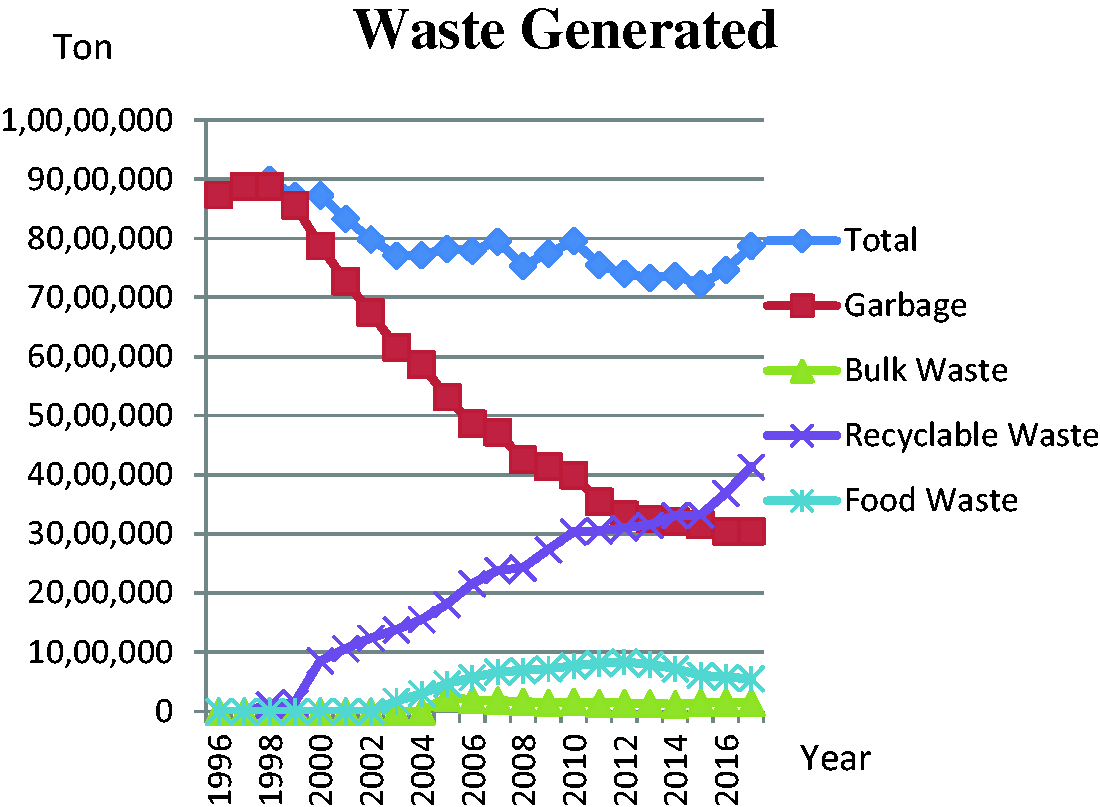
Municipal solid waste generated by years (Source: Taiwan Ministry of Economic Affairs (TMOEA, 2018)).
Since the supply of MSWs is highly dependent on population, which is relatively constant in the short run, electricity generation from this renewable source is more reliable and predictable. However, the efficiency and effectiveness of WtE technology are also keyed to other factors such as components, distribution, and heating values of wastes. Without these measures, the estimation of the power potential from MSWs utilization would be unreliable, leaving a less useful result to decision makers.
There are many studies analyzing the power potential from MSWs. However, simply borrowing these estimates to calculate power generation in other regions would not be feasible, either due to the different compositions of waste components or due to the unequal capacity of incinerators. Therefore, for Taiwan to explore the reliable power generation potential from MSWs utilization, and to investigate to what extent the impact on electricity shortage resulted from loss of nuclear power can be reduced, this study aims to analyze the Taiwan’s components and compositions of MSWs, investigate the idle capacity of current incinerators, calculate the amount of unutilized MSWs, and estimate the power potential in each region.
This study makes contributions by exploring the energy potential from currently unused energy source and providing detailed estimates to decision-makers. More specifically, the usefulness of the results can be illustrated in flowing ways. First, a county-level temporal analysis on waste resource is conducted so that the sources and stability of such a resource can be predicted. This ensures that the estimations of power generation from every region are based on regional characteristics rather than the country-wide average number. Second, capacities of all currently operating incinerators are accommodated so that the results can reflect the true potential of regional renewable energy production. That is, transporting local MSWs to an incinerator far away from their origins is less economically feasible. By finding the idle capacity of every operating incinerator and determining whether current capacity is sufficient, the most efficient way to utilize these wastes can be achieved using simple economic approaches. Third, the potential power generation from MSWs is depicted in regional level and thus the government would gain knowledge about their energy policies on renewable energy development, in whole or in part. The results thus can be more useful for future promotion policies such as industrial subsidy, tax credit and refund, and emission controls.
Utilization of municipal solid wastes
As global economy and population expands, municipal solid wastes have been generated substantially. This happens not only in developing countries such as China and India but also in developed countries such as the United States and the European Union where higher living standard usually induces more consumption of goods (Couto et al., 2015; Malinauskaite et al., 2017). Simply burning or landfilling these wastes is not efficient either because a large portion of wastes are recyclable and reusable, or because such treatments are considered as non-environmental friendly. Under such a circumstance, many countries have been looking for alternative ways to deal with this unprecedented increase in municipal solid wastes (Heffron and Talus, 2016; Ren et al., 2016).
WtE method
Under the consideration of green development, various renewable energy technologies such as solar PV (Chang, 2009; Morcos, 1994; Yakup and Malik, 2001), wind power (Chang et al., 2015; Gualtieri and Secci, 2012; Kung et al., 2019), and bioenergy (Chen et al., 2010; McCarl et al., 2000) have been intensively studied and applied in the recent decades. Because world energy consumption increases considerably, many countries also consider the alternative use of municipal solid wastes as this resource is combustible and its supply is stable. Many studies (Asnani, 2006; Chen and Lee, 2014; Ouda et al., 2016) have indicated that the properly utilization of WtE technology could both improve renewable energy production and reduce environmental problems.
Up to date, the WtE technology has been employed by many countries. For example, in 2016, several WtE plants that can consume up to 460 tons of waste per day have been operating in India to solve problems of insufficient energy supply (Rezaei et al., 2018). China provides up to 80% subsidy of total cost of the facilities with a low interest rate to promote the WtE technology (Finance, 2016), while the United States (Michaels, 2014; Indrawan et al., 2018), Canada (Shareefdeen et al., 2015), Japan (Finance, 2016), Indonesia (Rawlins et al., 2014), Iran (Rezaei et al., 2018), Saudi Arabia (Ouda et al., 2016), Malaysia (Kadir et al., 2013; Sadeghi et al., 2013), Germany (Finance, 2016), and Turkey (Marktscan, 2013) also have subsidies in similar but different ways.
WtE application worldwide
The WtE technology is a mature technology that has been widely applied. Governments across the world also promote various policies to subsidize the construction of WtE plants. This subsection provides a brief introduction of these policies in Asia, North America, and the Europe.
Asia
To implement WtE projects India, the government provides repayable grants to many entities such as municipal corporations, municipalities, technology providers, and project developers (Misra and Kaushal, 2014; Singh et al., 2011). The Ministry of New and Renewable Energy of India also provides financial incentives to support such developments by providing land, training courses, and low-cost or even interest-free loans (Kalyani and Pandey, 2014). However, the progress of large-scale development of WtE is delayed due to lack of appropriate technology, high labor cost, and delays in project approvals from the government (NREL, 2014). Additionally, the public concern to plant safety also makes the development of the WtE power plant market not as successful as planned (Rezaei et al., 2018).
Other Asian countries such as China and Japan also have promoted such a technology by providing various subsidies. In Japan, approximately 1/3 of the total costs to construct WtE incinerators are supported by the government (Finance, 2016). This amount can be increased to 50% if advanced technology and equipment have been used, and the electricity price generated from these incinerators will be determined on the basis of economic and environmental benefits received by the adjacent companies, municipalities, and citizens. On the contrary, the construction of the incineration facility in China is generally supported by the private sector. Up to 80% of total construction cost can be borrowed with nominal interest rates less than 3.5%. The factors determining the price of electricity in China are also different from that of Japan. Region, transmission costs and environmental impacts such as amount of reduced emissions are taken into account (Finance, 2016).
North America
Since 1960 the amount of municipal solid waste produced in the United States has doubled to more than 250 million tons per year. The rapid increase in wastes has been causing serious environmental problems (USEPA, 2013). To deal with fast growing amount of garbage, the U.S. government creates incentives for companies to implement WtE technology. Michaels (2014) estimates that the installed electric capacity is approximately 2800 MW and the USEPA indicates that more than 12.9% of electricity is recovered from the 80 operating WtE plants.
In the United States, the price of waste-based electricity varies from state-to-state. The regulations and policies are proposed by state Congress and thus the regional gate fee could differ considerably. Generally, the electricity price of waste-based electricity for different states ranges from $0.105 to $0.16 per kWh (Rezaei et al., 2018). The effective factor of building new incinerators is collectively determined by gate fee and electricity price, and Themelis and Mussche (2013) point out that private companies have more market share of municipal waste management.
Moreover, since the WtE technology is considered as a clean and renewable source, taxes are added to reduce uses of landfilling and to support carbon reduction from WtE. Williams and Helm (2011) also indicate that promotion policies such as direct subsidies and tax credits can offer incentives to invest in waste management and renewable energy generation.
Europe
Most of the waste processing facility in Europe is supported by the government in the form of low-interest loans and higher electricity price (Finance, 2016). In Germany, approximately 0.3 euros per kWh is determined to encourage the development of this industry in the early stage, which is reduced over time to a guaranteed price of 0.2 euros. A slight difference of the waste processing facility promotion in Turkey is that the government sets up a tariff price of electricity generated by WtE facilities to USD$13.3 over a period of 10 years, along with the road map management to help the waste transport and the subsequent sale of electricity to assist this industry (Marktscan, 2013).
Table 1 presents the general information about costs of investment and operation of waste processing facilities and government guaranteed purchase power price in different countries.
Cost and purchase agreement in different countries.
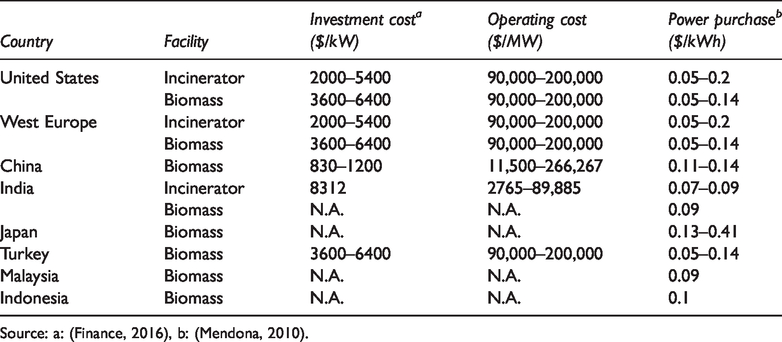
Source: a: (Finance, 2016), b: (Mendona, 2010).
MSWs and incinerators in Taiwan
Taiwan has little energy stocks and is interested in increasing energy supply domestically to reduce reliance on foreign energy, improve energy structure, and enhance energy security. Utilization of MSWs is an attractive alternative to local government, and since 2006 incineration has become the primary approach to deal with MSWs in Taiwan (Tsai and Chou, 2006; Tsai and Kuo, 2010). There are 29 incinerators which are under operation after 2006 and the total power generation is about 2967 GWh in 2008, and the power generation from wastes has been gradually increased to 3188 GWh in 2017 (TEPA, 2018). However, as shown in Table 2, a substantial amount of received wastes are not used in power generation, implying there is space to increase waste-based electricity.
Information of Taiwan’s incineration.
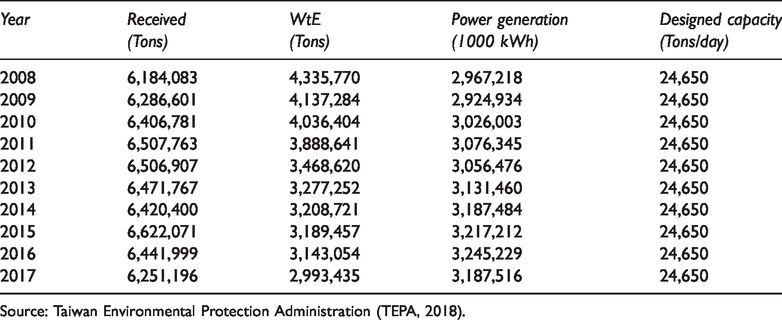
Source: Taiwan Environmental Protection Administration (TEPA, 2018).
Compared to the total electricity consumption of 2.7 million GWh in 2017, the net power generation from MSWs is less than 0.6%. Figure 2 shows the power generation from MSW utilization in different years. The power generation from MSWs is considered to be lower than expectation because more than 7.8 million tons of MSWs will be generated annually but only less than half is utilized in WtE technology. Therefore, it is necessary to determine the cause of such a situation so that the government is able to figure out the actual power potential from MSWs.
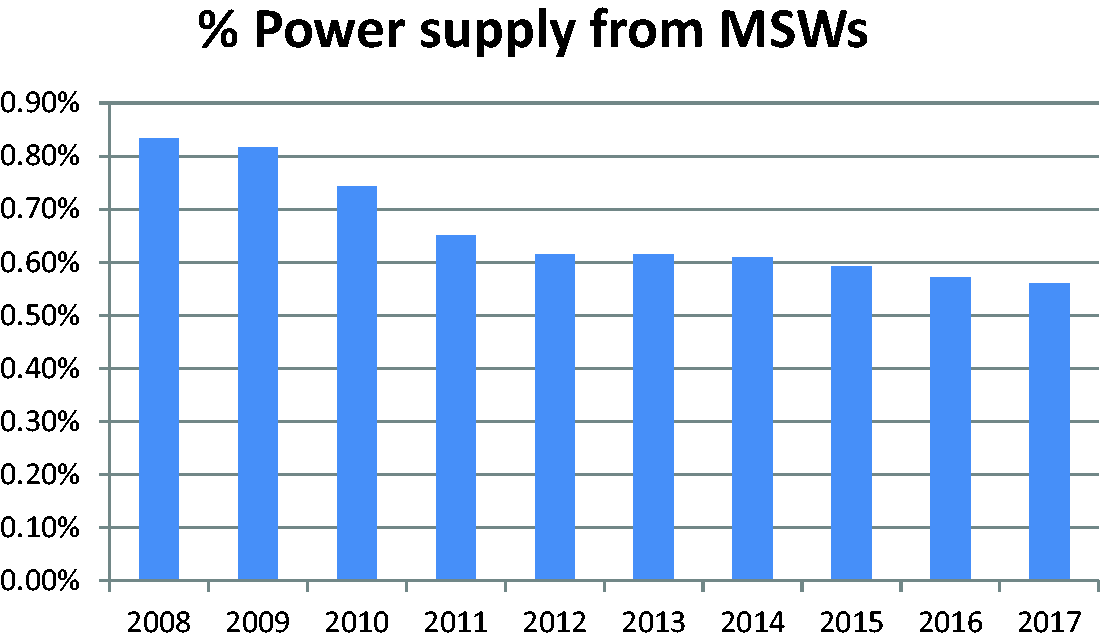
Power generation from MSW utilization in Taiwan.
Status and nature of Taiwan’s MSWs
The Taiwan Environmental Protection Administration (2018) indicates that the total recycling rate of MSWs is only 60.22%, leaving approximately 40% of MSWs unused. The result implies that Taiwan can further improve its power generation from MSWs by increasing the recycling rates (Table 3).
Recycling rates of MSWs.
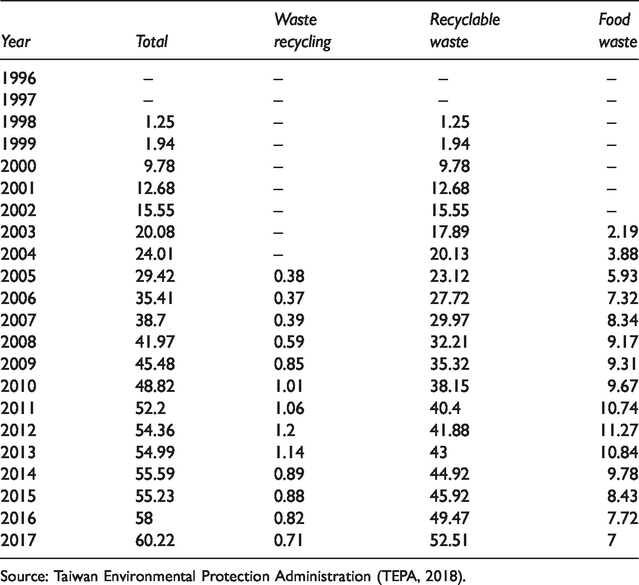
Source: Taiwan Environmental Protection Administration (TEPA, 2018).
The cause of the low power generation from MSWs has been identified, but the power potential is still unknown. To explore the power potential from unused MSWs, it is necessary to consider the heterogeneity among wastes because heating valuing from sources to sources would be greatly different. Therefore, verifying the components and compositions of wastes is important to estimate the power generation. Based on the information released by the Taiwan Environmental Protection Administration (TEPA, 2018), the composition of MSWs is presented in Table 4.
Nature of combustible MSWs.
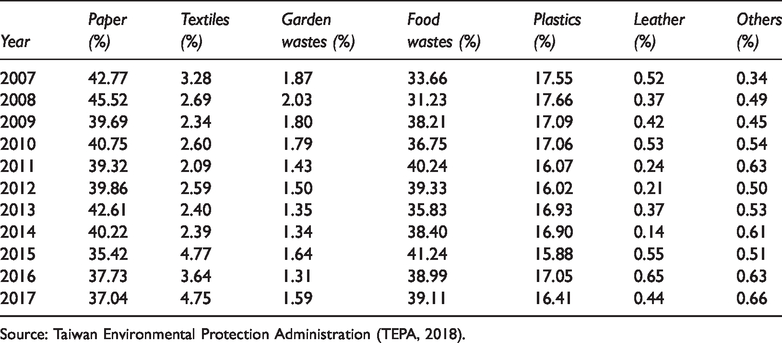
Source: Taiwan Environmental Protection Administration (TEPA, 2018).
Capacity of incinerators and compositions of MSWs by region
Incinerators usually locate in different counties and each of them has different designed capacity. Since it would be economically inefficient to transport local wastes to some incinerators far from their origins, there is a need to explore the capacity of each incinerator to understand whether the incinerator is able to process additional wastes; otherwise, new plants must be constructed and investments must be depreciated during the useful life of plants. The information about plant capacity is presented in Table 5.
Operation of refuse incineration plants.
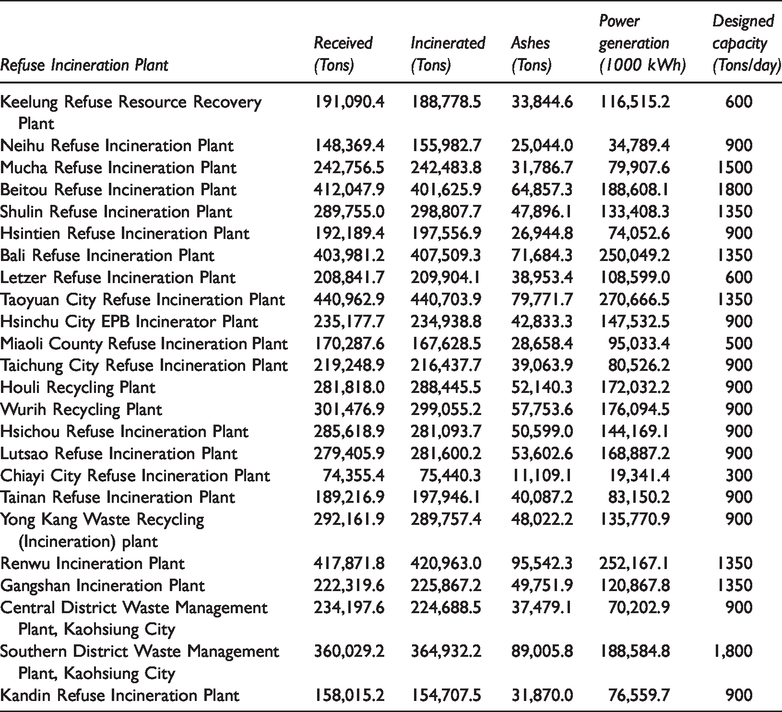
Table 4 provides the aggregate composition of wastes in Taiwan, but to explore the power potential in county level, investigation of the waste characteristics for each region is required. This information is presented in Table 6, and then the results can be employed to estimate the energy potential in each region.
Compositions of MSWs by regions.
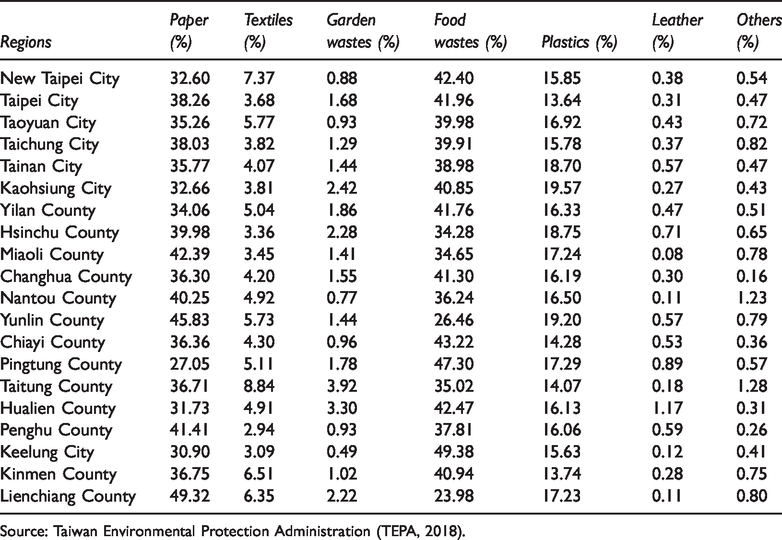
Source: Taiwan Environmental Protection Administration (TEPA, 2018).
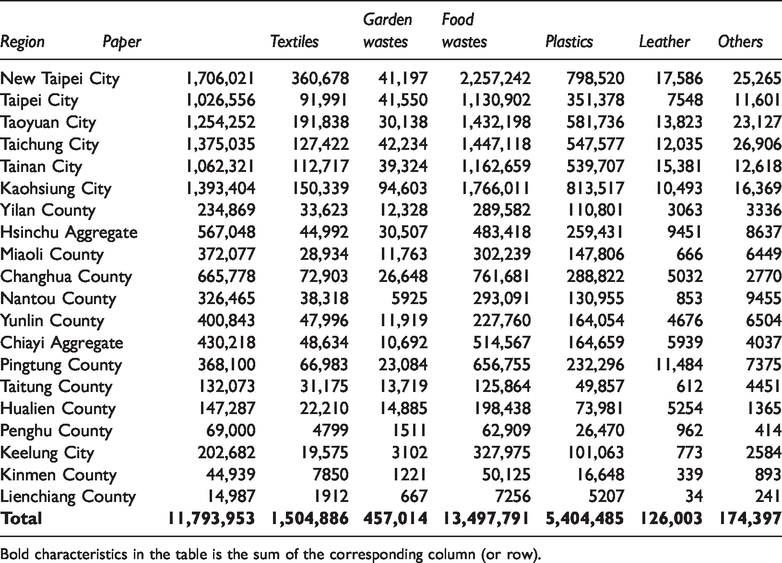
The characteristic of MSWs in every region has been determined, and the next step is to calculate the available quantity of unused wastes to estimate the regional power potential. To do this, this study first assumes the waste is generated proportional to population distribution, and then estimates the total MSWs amount generated in major cities and counties. The results are shown in Table 7.
Amount of MSWs generated by regions.
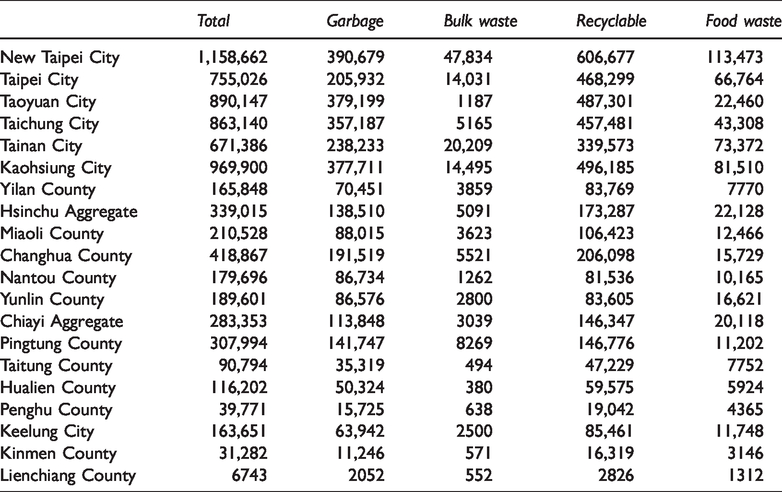
Simply knowing the regional availability of MSWs does note tell the power potential because a portion of waste is already incinerated in WtE plants, and the actual energy potential should be based on the amount of unused MSWs. Therefore, there is merit to explore the recycling rate of MSWs to estimate the additional MSWs available in each region. The results are shown in Table 8.
Recycling rates of MSWs by regions.
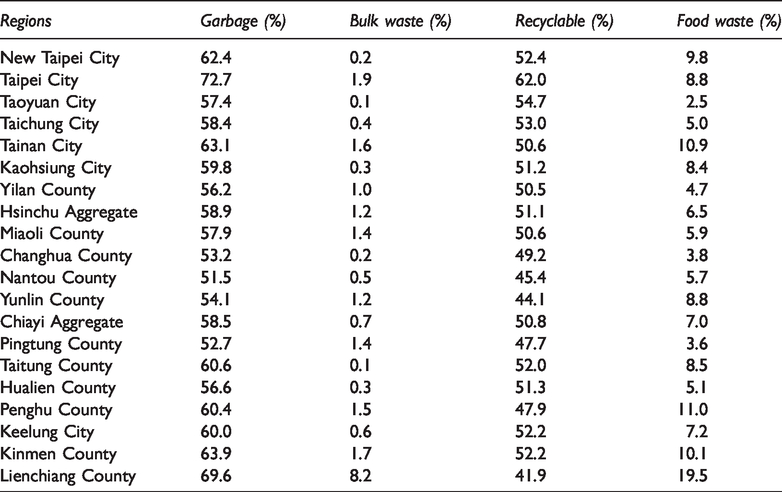
With the regional production and compositions of MSWs (Tables 7 and 8), the following formula can be used to calculate the availability of unused MSWs for region i and type of wastes j.

The results of total and classified amount of unused MSWs are shown in Table 9. Combined with the heating value of each source (Xiong et al., 2016), equation (2) can be deployed to estimate the power potential from unused MSWs in each region.

Amount of unused MSWs (tons).
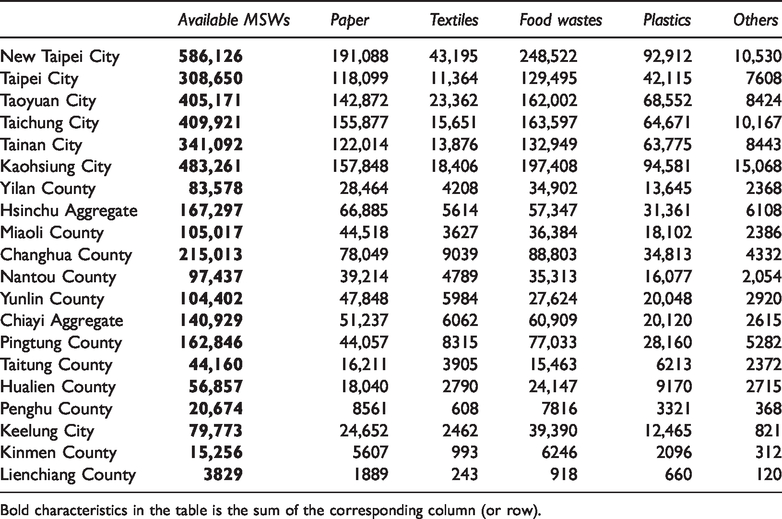
Bold characteristics in the table is the sum of the corresponding column (or row).
The available amount of unused MSWs is indicated in Table 9.
Table 10 shows the power generation from all unused MSWs in each region. The results show that the major cities (in terms of population distribution) such as Taipei city, New Taipei city, Taichung city, Taoyuan city, and Kaohsiung city have the higher power potential from MSWs. Collectively, total power generation from unused MSWs can be up to 3683 GWh, given the distribution of waste composition and population unchanged.
Power generation from unused MSWs (in GWh/year).
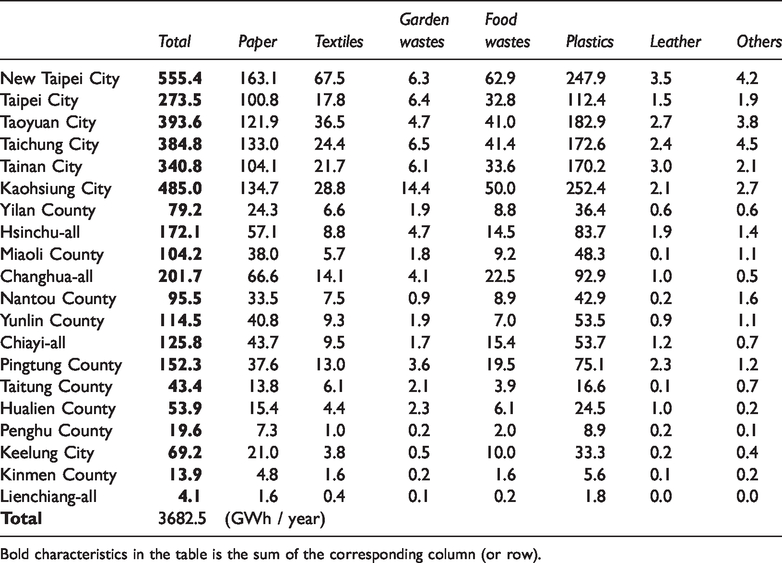
Bold characteristics in the table is the sum of the corresponding column (or row).
In terms of renewable to total energy share, we show that if the municipal solid wastes can be fully utilized in power generation, it could increase Taiwan’s domestic energy production by additional 1.36% and replacing 16.43% of the electricity shortage resulted by loss of nuclear power.
Economic and environmental consequences
Up to date, the incineration of MSWs provides approximately 0.56% of total energy supply in Taiwan, and our results show that the properly utilization of unused MSWs can increase domestically generated power by additional 1.36%, and this is a substantial improvement in renewable energy production. Now the question turns into another side: how much is the society going to pay for this change or is such an application economically feasible? The answer must be provided before the government can turn such power potential into real production. This section evaluates the costs and benefits from this transition.
Costs associated with utilization of unused MSWs
To transport million tons of MSWs to incinerators requires a substantial amount of effort. Since the data that show the designed capacity of incinerators is able to burn all MSWs, this study assumes that there is no need to construct new refuse plants and only transport and processing cost are involved. To estimate the transport cost of feedstocks, assuming that the refuse plant is located in the center of a square surrounded by a square grid layout of roads and the effort is provided by regular workforce, the average hauling distance and hauling cost can be estimated by the methods from McCarl et al. (2009):


Ld is the truck load size, which is assumed to be 23 tons.
Y is the average annual production in tons of municipal solid waste per acre.
640 is a conversion factor for the number of acres in a square mile.
b1 is the fixed cost associated one truck load, which is assumed to be NT$2700.
b2 is the variable cost associated with moving a loaded truck one mile, which is assumed to be NT$66 in this study.
Table 11 shows the results of average hauling distance of wastes to regional incinerators. The increase in transporting these unutilized wastes requires an additional $33 million dollars. However, since a portion of unutilized wastes may still be used in other places, the net cost may be reduced, depending on the amount of recycled wastes with alternative uses.
Average hauling cost of MSWs (by region, NT$/year).
Bold characteristics in the table is the sum of the corresponding column (or row).
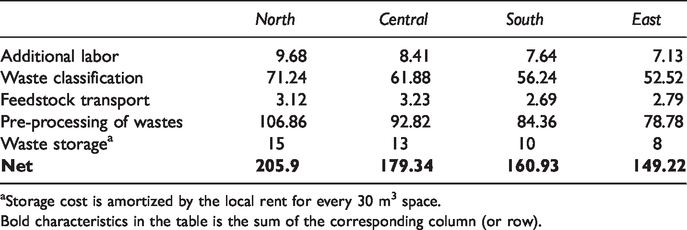
Other costs associated with the waste utilization such as overtime salary, treatment of recycled wastes, classification of the wastes, and energy consumption may also be included. The estimates of these factors are provided in Table 12. It is obvious that the transportation cost is relatively small to total costs. By allocating the costs to each region and sum them altogether, the net cost associated with the municipal solid wastes is approximately NT$681.1 million dollars per year. Therefore, the large-scale development on WtE technology could be expensive, especially on the feedstock classification and processing.
Additional cost of dealing unutilized MSWs (NT$/ton of waste).
aStorage cost is amortized by the local rent for every 30 m3 space.Bold characteristics in the table is the sum of the corresponding column (or row).
Environmental consequences
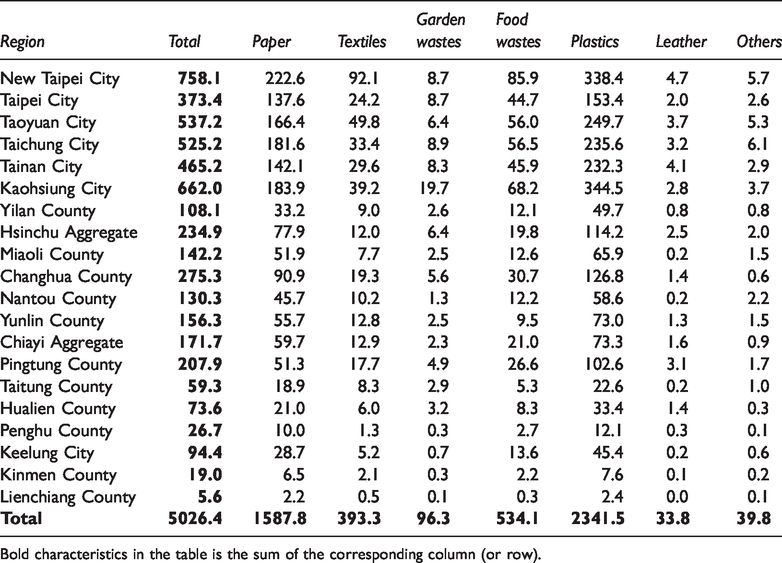
Domestic production of electricity can replace the use of fossil fuel which emits substantial amount of GHGs. Up to 5 million tons of CO2 emission can be reduced by the utilization of municipal solid wastes, as indicated in Table 13.
Emission reduction (1000 t CO2e) from waste-based electricity.
Bold characteristics in the table is the sum of the corresponding column (or row).
However, the result of the emission offset from waste-based electricity has not taken the emission from feedstock transportation into account, which may overstate the environmental benefit from MSW application. To deal with this, the average hauling distance of the feedstocks (i.e. equation (3)) again is used to estimate the gasoline requirement and then calculate the emission released during this stage. In general, additional 1.657 million liters of gasoline is required to transport all wastes to local incinerators, and the associated CO2 emissions is approximately 3832 tons, which is about 0.76% of total emission reduction. Here the emission factor of per ton waste traveling from home to storage station is ignored because such transportation is inevitable no matter if these wastes are used for electricity generation or other methods. In general, the results show that net emission reduction from fossil fuel replacement may be substantial.
Totality of value
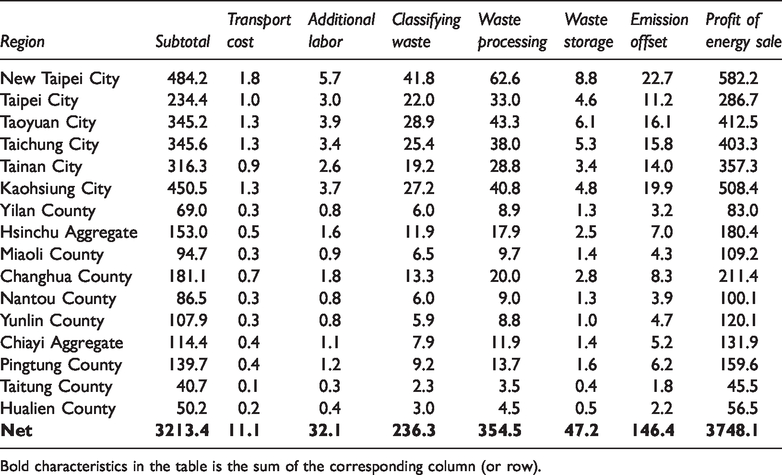
To depict the overall consequences of power generation from municipal solid wastes, it is necessary to aggregate the economic and environmental benefits. The results are presented in Table 14. The results show that the net benefit is approximately NT$3.2 billion dollars, in which the primary attribute comes from the energy sales. The most significant costs of this technology are associated with labor-related components such as classification and processing of wastes. However, the results may be biased due to the assumed labor effort and efficiency and the estimated profitability from energy sale. Additionally, the emission price may also vary under different environmental regulations and policies.
Aggregate benefit of WtE applications (in million NT$).
Bold characteristics in the table is the sum of the corresponding column (or row).
Discussions and policy implications
The results point out that the application of MSW-based power generation can potentially improve environmental quality, enhance domestic energy production, and possibly increase local employment. However, the results are based on a series of assumptions that may not suit for other area or may be biased due to the usual applications of the recycled materials. For this reason, it is necessary to discuss these results in detail so that the decision-makers may gain more knowledge regarding the application of WtE technology and associated economic and environmental effects.
Environmental policy and residential behavior
For WtE technology to be effectively and efficiently operated, supports from various policies are usually required and recommended. For example, to stabilize the waste supply and reduce the environmental damage, using environmental regulations which enforce the users to classify and dispose the wastes to a designated place can be considered as an effective approach to ensure the stability of feedstock supply. This approach may also reduce the costs associated with waste classification, processing, and incineration.
Economics of MSW utilization
For any technology to have market power profitability must be guaranteed, otherwise private sectors will not get involved if they perceive there is no return (or return below their opportunity cost) from this production. Additionally, since the life cycle of the plants is usually more than 20 years, capitalized investment can be amortized or depreciated among multiple years to reduce the initial capital requirement and smooth the return from such investments.
However, if this WtE project is developed by the government, for which profitability is not the prior concern, effects on waste treatment, environmental quality, and energy generation may attract more attention.
Capacity of incinerators
To effectively utilize the municipal solid wastes, one of the most important issues is to have enough capacity to consume these wastes. If this is not the case, the storage costs and investment requirement would increase, and profits and the total energy generation would decline. One simple solution is to provide some economic incentives such as tax credit and cost subsidy to encourage private sectors to invest in new refuse plants. Another concern regarding plant capacity is the location of the plants. Plant capacity must be distributed efficiently to consume the wastes efficiently; otherwise there may be too much capacity in a region but insufficient in other places, both of which influence the efficiency of WtE application.
Employment and labor force transfer
While recycling, transporting, and processing wastes increase production costs, most of these funds would be received by labors, implying that the employment may be increased. From this viewpoint, such costs improve wealth redistribution and transfer the social wealth to unemployed labors or labor force from lower income sector such as agriculture. For this reason, total costs invested in waste utilization may be uneconomically feasible but the net effect to the society as a whole may be eventually improved. This issue is more complicate and beyond the scope of this study, but it provides a hint to decision-makers to take potential changes in social welfare distribution into account.
Energy structure and energy sustainability
For a region or a country whose energy share relies on crude oil and coal, its energy sustainability is considered to be weak because fossil fuel would be eventually depleted. Therefore, a greater promotion of sustainable energy sources may be necessary to insure the development of the economy, technology innovation, and society. Among renewable energy sources, the waste-based energy generation is more stable than wind power, solar energy and geothermal which are highly dependent on the climate and geographic conditions. However, the overall benefits from the application of waste-based energy should be investigated case by case because the composition of the wastes and energy potential in different area may vary substantially. Decision-makers should design proper promotion policies to adjust these differences to achieve country-specific optimal energy structure.
Concluding remarks
Energy sustainability is important to social development, and utilization of municipal solid wastes is considered as an effective approach to achieve this goal because the constant supply of feedstocks can stabilize the renewable energy generation. The increase in both population and energy demand in many countries makes the application of WtE technology attractive.
This study first reviews the WtE technology applied in different countries, and then provides a case study to explore the potential economic and environmental consequences associated with this application. The results indicate that the efficiency of energy conversion is also highly dependent on the composition of the wastes and the transportation effort. The results imply that the distribution of population should be taken into account for the application of WtE technology to be optimal (in terms of economic and environmental benefits). For places where transportation is difficult or household are living relatively diverse, a substantial cost associated with waste collection and transportation could increase and thus decrease social welfare.
Footnotes
Acknowledgements
The authors thank for the insightful comments from Prof. Bruce A. McCarl at Texas A&M University and Prof. Chi-Chung Chen, the Secretary of Taiwan Council of Agriculture, at National Chung-Hsing University.
Declaration of conflicting interests
The author(s) declared no potential conflicts of interest with respect to the research, authorship, and/or publication of this article.
Funding
The author(s) disclosed receipt of the following financial support for the research, authorship, and/or publication of this article: The authors thank for the financial supports from the National Natural Science Foundation (41861042, 71663025), Distinguished Young Scholar Foundation of Jiangxi Province (20171BCB23047), and Science Program of Jiangxi Bureau of Education (GJJ190275).
