




Abstract
The drum is the working mechanism of the coal shearer, and the coal loading performance of the drum is very important for the efficient and safe production of coal mine. In order to study the coal loading performance of the shearer drum, a discrete element model of coupling the drum and coal wall was established by combining the results of the coal property determination and the discrete element method. The movement of coal particles and the mass distribution in different areas were obtained, and the coal particle velocity and coal loading rate were analyzed under the conditions of different helix angles, rotation speeds, traction speeds and cutting depths. The results show that with the increase of helix angle, the coal loading first increases and then decreases; with the increase of cutting depth and traction speed, the coal loading rate decreases; the increase of rotation speed can improve the coal loading performance of drum to a certain extent. The research results show that the discrete element numerical simulation can accurately reflect the coal loading process of the shearer drum, which provides a more convenient, fast and low-cost method for the structural design of shearer drum and the improvement of coal loading performance.
Introduction
With the rapid development of China's economy, the demand for energy is increasing. As one of the main energy sources in China, coal plays an important role in the development of national economy. With the reduction of medium-thick coal seam reserves and the increase of mining depth, the thin coal seam will gradually become the main mining coal seam in the future (Gao, 2020; Wu et al., 2019). If the thin coal seam can not be effectively and reasonably mined, it will inevitably lead to a waste of resources, which affects the sustainable development of the coal industry and does not meet the requirements of the rational development and utilization of coal resources (Liu and Li, 2019; Peng, 2020). Therefore, improving the automatic mining capacity of thin coal seam and ensuring the sustainable mining of coal resources have become the main research direction at this stage.
At present, there are two main mining methods of the thin coal seam: blasting mining and mechanical mining (Nguyen et al., 2018; Wang et al., 2011). Blasting mining refers to the mining of coal by means of drilling and blasting, this method has low efficiency and poor safety. Mechanized mining refers to the use of coal shearer, coal plough and other machinery for mining, which is the main method adopted by the main coal producing countries such as Poland, Russia and Australia. Because of the high requirement of the coal plough on geological conditions and high energy consumption, coal plough is rarely used in China. Due to strong applicability and high degree of mechanization, coal shearer is widely used in mechanized mining of thin coal seam. According to the field application, the working process of thin coal shearer is faced with the problems of low efficiency, low performance and poor coal loading effect, which have become the main obstacles restricting the application of drum shearer (Brodny and Tutak, 2017; Stecuła et al., 2017; Zeng et al., 2018). Due to the poor effect of drum coal loading, a large amount of floating coal remains in the working face. If the floating coal can not be cleaned in time, it will not only affect the working efficiency of fully mechanized mining equipment, but also cause floating coal flying when the wind speed is too high, which is not conducive to the development of underground dust removal work and seriously endanger the health of workers (Zhang et al., 2020; Reng et al; 2018). Therefore, improving the coal loading performance of coal shearer is of great significance for improving the production efficiency of coal mines and increasing the degree of fully mechanized mining in thin coal seam.
The drum is the main working part of the coal shearer, and its performance directly affects the mining efficiency of shearer (Luo et al., 2015; Sasaoka, 2020). As the cutting mechanism of the coal shearer, the drum cuts the coal seam and peels off the coal block, and uses the helix blade to transport the coal piece into the scraper conveyor, but due to the constraints of the working environment and the structure of the drum, the performance of the drum is poor. Therefore, how to improve the coal loading performance of the drum has become a difficult problem in the application process of the thin coal seam shearer. Many experts and scholars have carried out research on the coal loading performance of drums. Hekimoglu et al. (2002) studied the factors affecting the cutting performance and coal loading performance of the shearer through experiments, and analyzed the influence of the distance change of the scraper conveyor to the coal wall on the loading capacity. Ayhan and Eyyuboglu (2006) has carried out the cutting test on the drums of the cone and the cylindrical shape, and compared the cutting performance and coal loading performance of the two types of drums. Liu et al. (2009) analyzed the influence of blade helix angle on drum coal loading performance through cutting test. In order to solve the problem of poor coal loading effect of drum. Gospodarczyk (2016) used the numerical simulation method to analyze the influence of shearer structure and movement parameters on coal flow movement. Gao et al. (2017, 2020) analyzed the factors affecting the loading performance of the drum by PFC simulation. The above research has obtained a lot of valuable conclusions about the drum design, but many of their studies only focus on the analysis of drum loading rate from the angle of experiment or numerical simulation analysis. There is less analysis of mass distribution and movement characteristics of coal particles in coal loading process.
Due to the complex working environment of shearer, the large disturbance of data makes it difficult to accurately identify various parameters, and it is difficult to collect data (Wang and Zhang, 2019). Laboratory experiment needs to prepare different test coal wall, which is not only expensive, but also difficult to ensure that the test coal wall is consistent with the coal wall in the mine. Therefore, it is necessary to find a low-cost method that can quickly analyze the coal loading performance of the shearer. The coal wall can be regarded as a discontinuous whole composed of a series of discrete coal particles based on the discrete element method. The relative movement of coal particles can occur under the action of the drum. By tracking the movement state of the coal particles, the movement and deformation characteristics of the coal wall under the action of the drum can be obtained (Tan et al., 2020). In order to analyze the coal loading performance of shearer drum, this paper analyzed the movement of coal particles in the envelope space of drum according to the movement characteristics of coal particles, and established the simulation model of loading process of the drum by using discrete element method. Taking MG400/951-WD type shearer as the research object, the variation laws of coal particle mass, velocity and quantity in different regions were obtained by the simulation. The research results can provide a reference for the structural optimization of the drum and the improvement of coal loading performance.
Materials and methods
Establishment of coal loading model
Motion analysis of coal particle
When the shearer drum cuts the coal wall, the broken coal blocks from the coal wall enter into the envelope space formed by the helix blades and the hub. These coal blocks flow to the working face along the axial direction of the drum under the pushing of the helix blade, and finally enter into the scraper conveyor for transportation (Jiang and Meng, 2018). The movement track of the coal block is shown in Figure 1. When the inner coal wall is broken, the coal block will reach point E from point A through B, C and D under the action of helix blades.
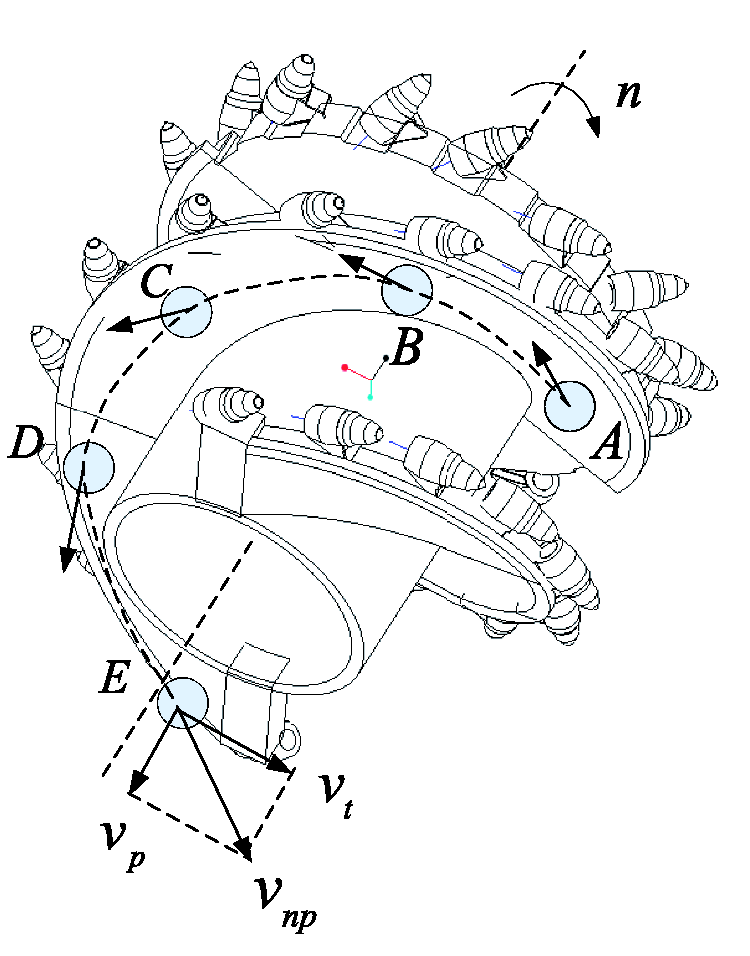
The trajectory of coal particle.
The velocity of coal in envelope space of the drum is shown in Figure 2. Under the pushing of the helix blade, the coal block obtains a circumferential velocity
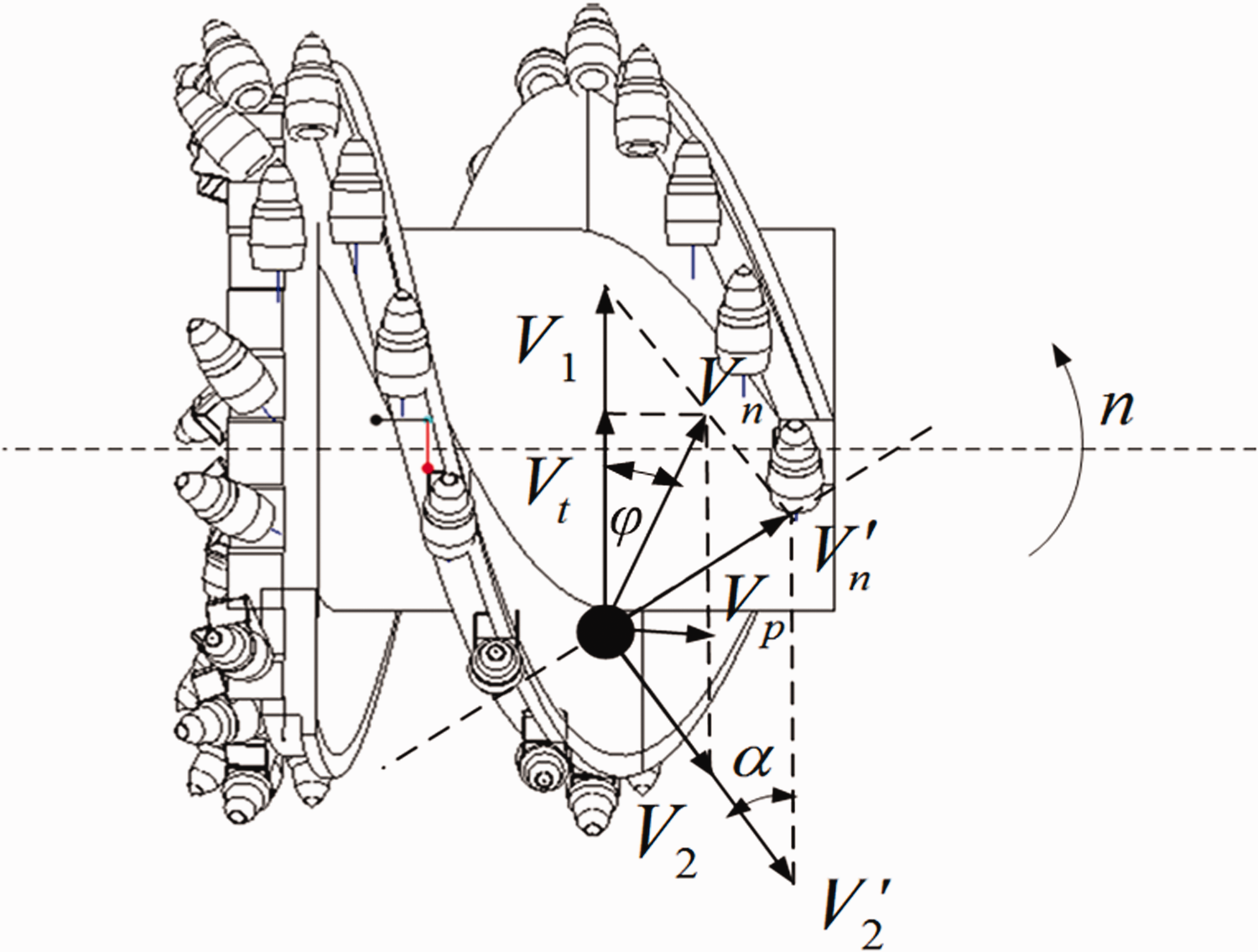
The movement of coal particles in the envelope space of the drum.
The circumferential velocity of coal particle can be expressed as:

The absolute velocity of coal particle is:

The axial velocity


During the cutting process, the movement time of coal particles in the envelope space of the drum is:

In the formula, n is the rotation speed of the drum; α is the helix angle of the blade;
In order to realize the movement of coal block from point A to point E, it is necessary to ensure that the distance of coal block moving along the drum axis in the envelope space is greater than the cutting depth J, which is
Particle contact dynamics model
Suppose two coal particles collide at velocity
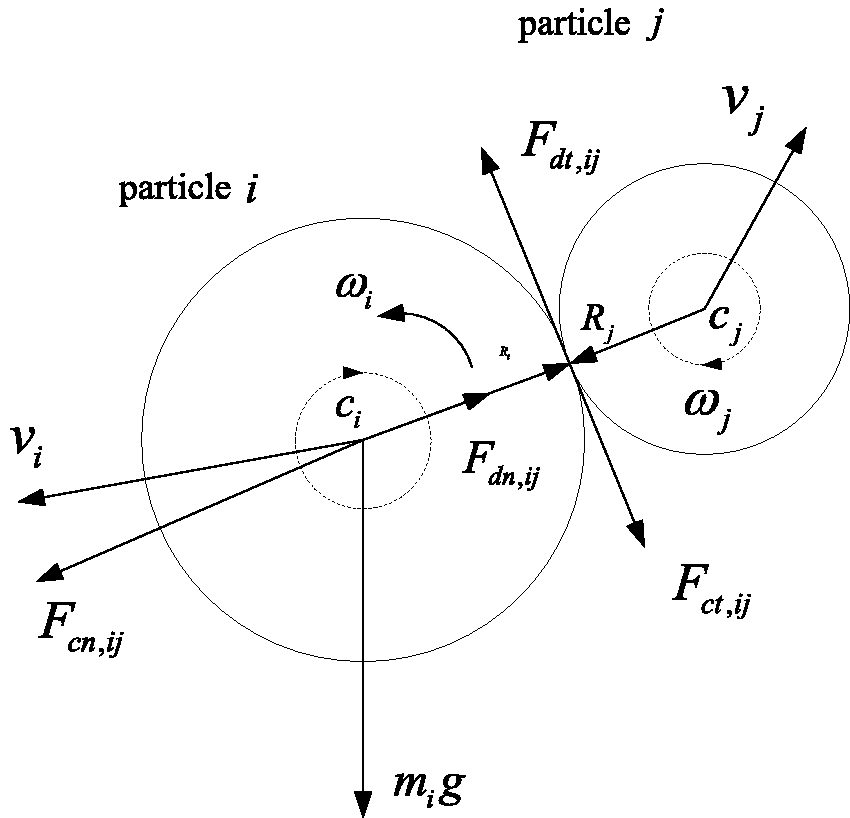
The particle contact dynamics model.
According to Hertz contact theory (Boloz, 2013), the force and displacement of the coal particles are:


In the formula, F is the force between two coal particles; U is the relative displacement of the coal particles; E* is the equivalent elastic modulus; R* is the equivalent contact radius; ε is the overlap between coal particles.
The normal stiffness kn, tangential stiffness ks, normal force Fn and tangential force Fs of coal particles in the process of crushing and collision are:




In the formula, E is the elastic modulus of the coal particles, μ is the poisson's ratio of the coal; Un is the normal displacement of particles; Us is the tangential displacement of particles.
Establishment of discrete element model
The selection of material parameters has an important influence on the calculation of the contact force between the particles and the solution of the model, the bond strength between coal particles is determined by the physical and mechanical properties of the coal. In order to make the model more similar to the real coal wall, it is necessary to determine the properties of the coal wall (Abousleiman, 2020; Xu et al., 2020). The test of coal sample and its physical and mechanical properties is shown in Figure 4.
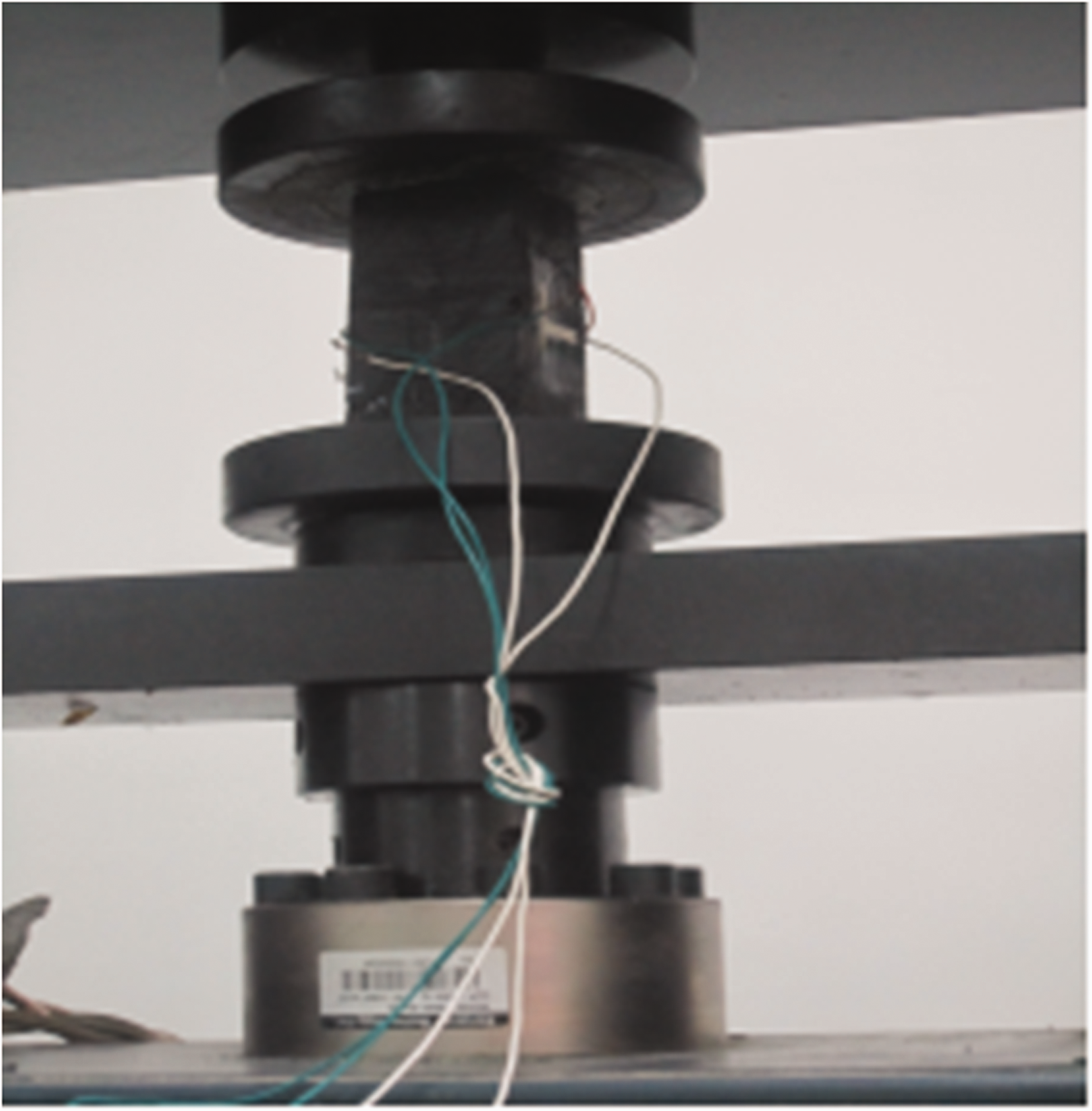
The property test of coal sample.
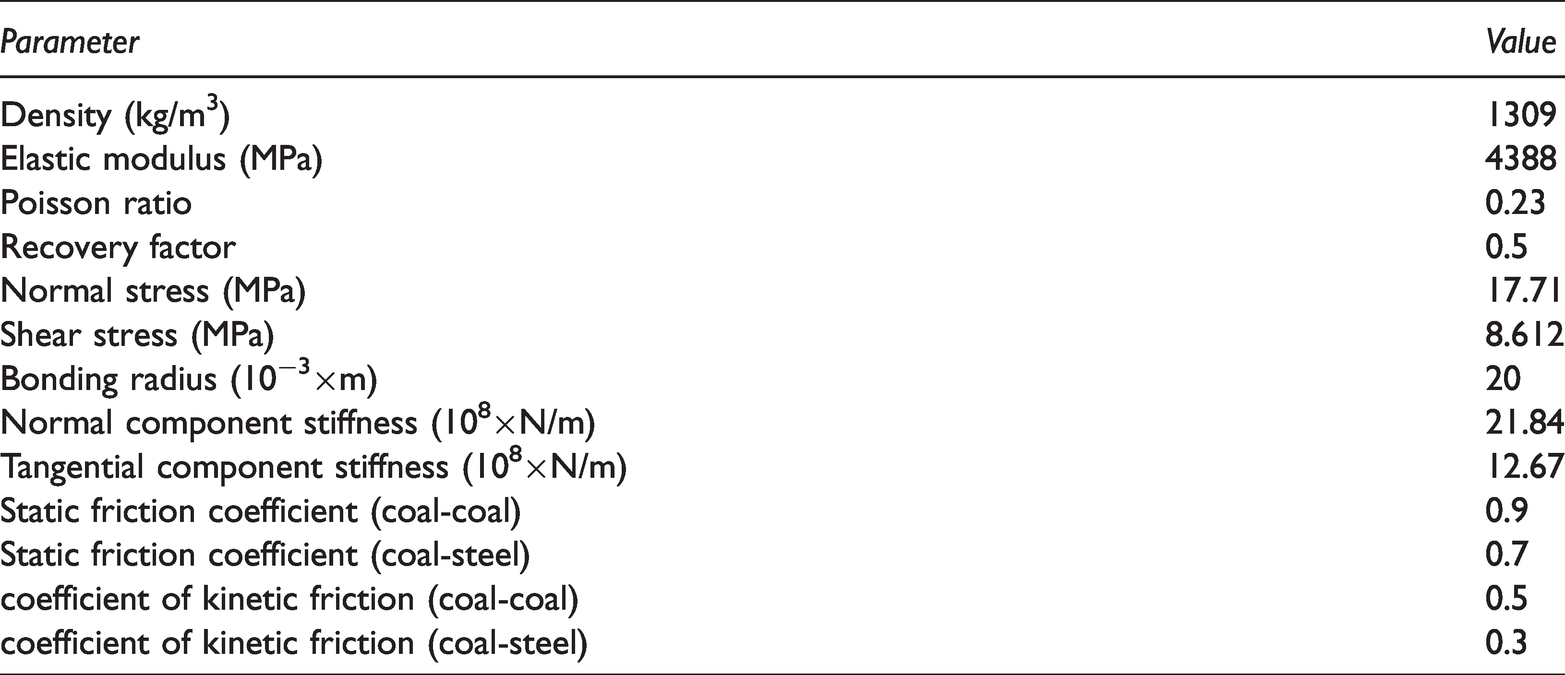
The normal phase stiffness coefficient and tangential stiffness coefficient of coal particles can be calculated according the test results of coal sample properties. According to the Mohr-Coulomb strength theory (Wang and Zhang, 2019; Zhao et al., 2019), the normal stress and shear stress of the particles can be calculated. The contact parameters such as the dynamic friction coefficient and the static friction coefficient between the coal particles, the coal particle and the steel were set. The parameters of coal particle bonding and collision contact are shown in Table 1.
Parameters of the coal particles.
In the construction process of coal wall model, coal particle size and shape have an important impact on simulation accuracy and computer operation efficiency. Under the condition of guaranteeing the simulation accuracy, the following hypotheses are put forward for the coal wall model to reduce the computational complexity and improve the simulation efficiency.
The coal wall model consists of spherical particles of uniform particle size with a uniform nature and a radius of 0.01 m. The force between the coal particles is the same during the cutting process. If the size of the coal wall model is too large, the number of contact and collision of the particles will increase during the cutting process. In order to improve the calculation efficiency, the size of the coal wall model is reduced and simplified accordingly. The height of coal wall is 1150 m, the width is 0.8 m and the length is 3 m. In order to simplify the problem, the coal wall is horizontally arranged in the study. Affected by the thickness of the coal seam, the task of cutting and loading the coal particles is mainly carried out by the front drum.
Based on the above hypotheses, a three-dimensional bond contact model of coal wall was established (Cheng et al., 2019; Gheibi and Holt, 2020). After the completion of the construction of the coal wall, the three-dimensional geometric model of the drum was established, and the material properties were set. The drum material is set as steel, with a density of 7.85 × 10³ kg/m3, an elastic modulus of 2.05 × 10⁵ Mpa and a poisson's ratio of 0.235. In order to facilitate the statistics and analysis of the coal loading rate, the area is divided into the area ① and area ②, as shown in Figure 5.
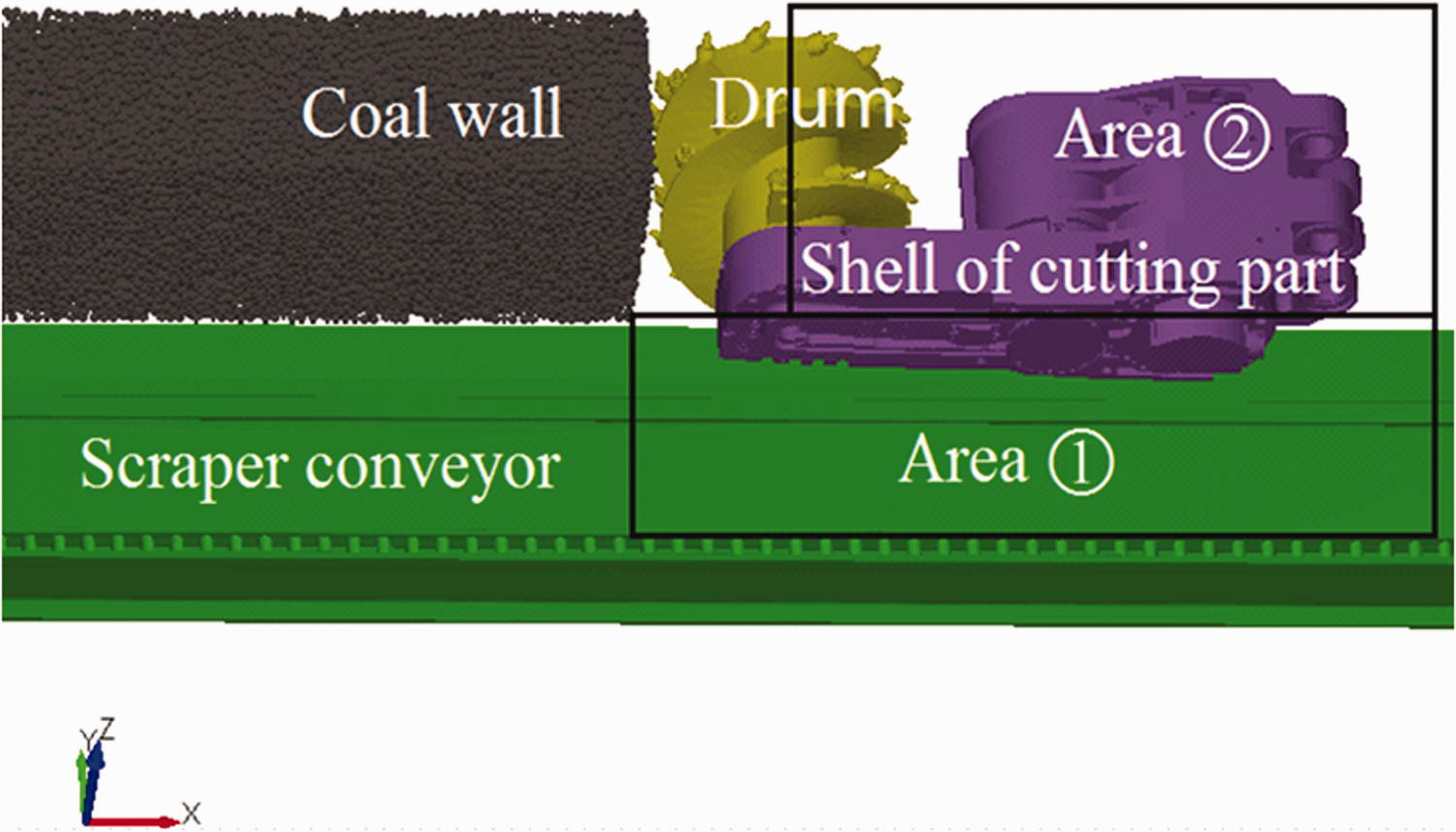
Discrete element model of coal loading process.
Numerical simulation
The coal loading process of the drum was simulated with a traction speed of 5.5 m/min, a drum rotation speed of 58 rpm and a cutting depth of 0.8 m. as shown in Figure 6. When the drum cuts into the coal wall, the coal wall near the side of the working face enters the statistical area ① directly after being broken. The broken coal particles of the inner coal wall gradually enter into the envelope space, and moves under the action of helix blade. When the drum cuts into half of the drum diameter, the coal particles entering the area ① start to increase. Under the action of helix blade pushing and gravity, most of the coal particles flowing along the axial direction of the drum to the working face, and a small part of particles are thrown to area ② (goaf area). When the cut length of the coal wall by the drum is equal to the diameter of the drum, the coal particles flowing to the working face gradually accumulate to form a circulating coal pile, which slides along the traction direction under the action of the rocker arm shell. When the drum is completely cut into the coal wall, the particles flowing into the two areas are increasing continuously. The coal particles thrown to area ② will remain in the goaf to form floating coal when they are separated from the external force, some particles remain on the rocker arm shell, most of the coal particles flowing into area ① gradually accumulate on the circulating coal pile, and the particles gradually flow to the conveyor.
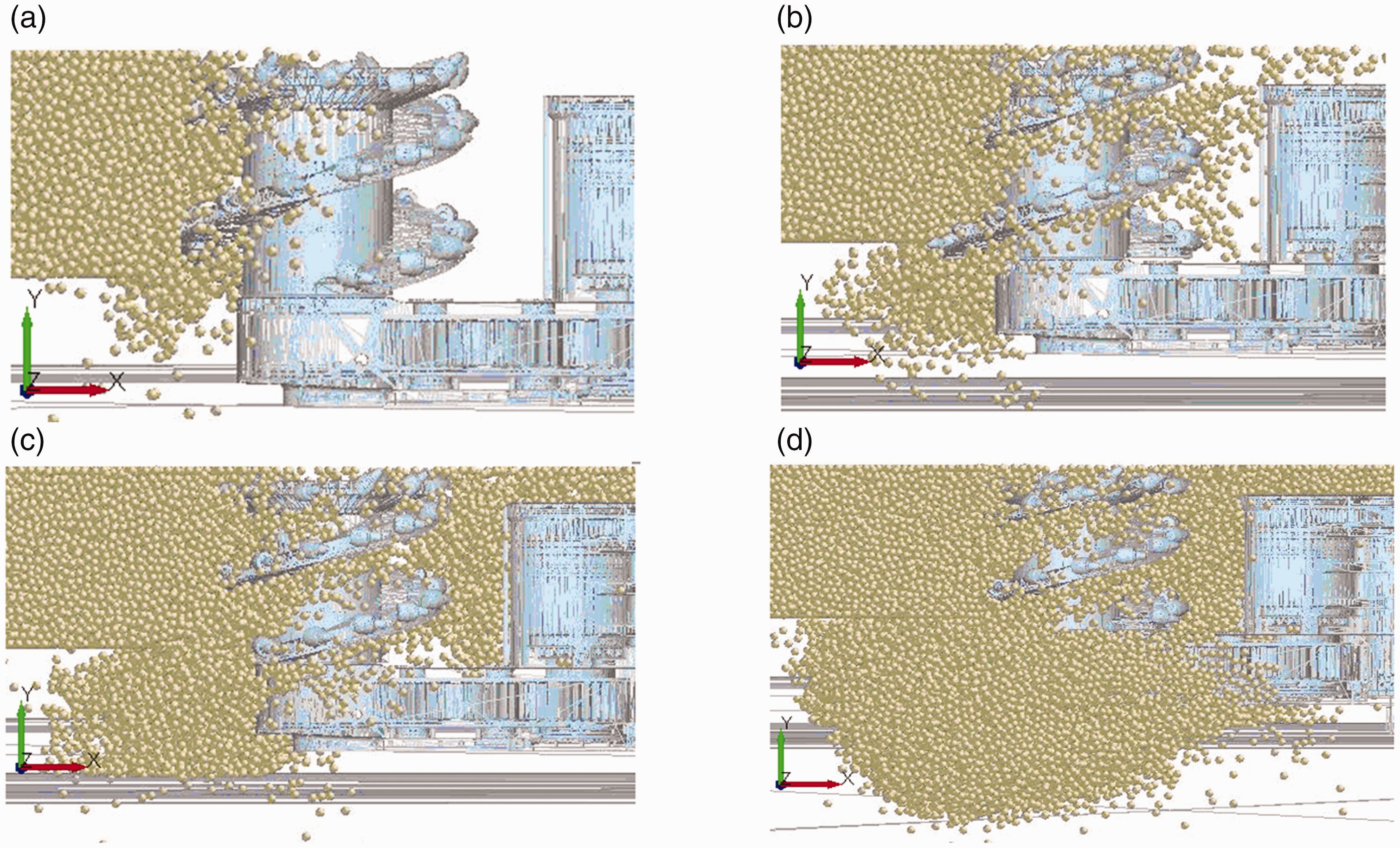
Motion state of coal particles. (a) The drum is just cut into the coal wall; (b) The cutting length is 0.575 m; (c) The cutting length is 1.15 m; (d) The drum cuts into the coal wall completely.
The velocity of coal particles in the envelope space is shown in Figure 7. The coal particles get an extra velocity thrown to the outer edge of the helix blade under the action of the helix blade, which can be decomposed into the velocity along the opposite direction of the traction speed (toward the goaf) and perpendicular to the working face (flowing out along the axis of the drum). Under the action of friction and pushing of the helix blade, the velocity of coal particles increases gradually. The Y direction velocity (along the axial direction of drum) is greater than X direction velocity (opposite direction of traction speed) and Z direction (vertical direction), which indicates that most of the coal particles can be thrown to the working face.
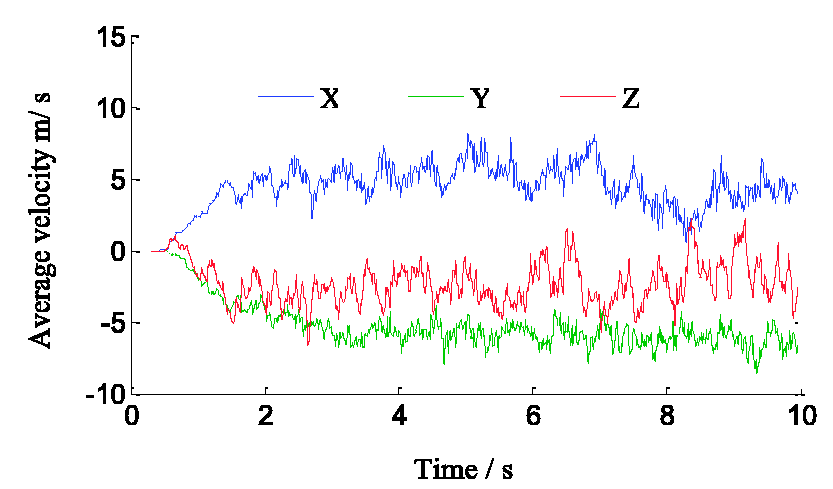
The velocity of particles in envelope space.
The variation of cumulative mass of coal particles in different areas is depicted in Figure 8. It can be seen from Figure 8 that the cumulative mass of particles falling into the area ① and ② exhibits a linear increase with the cutting, while the coal particles entering the area ① are significantly more than the area ②.
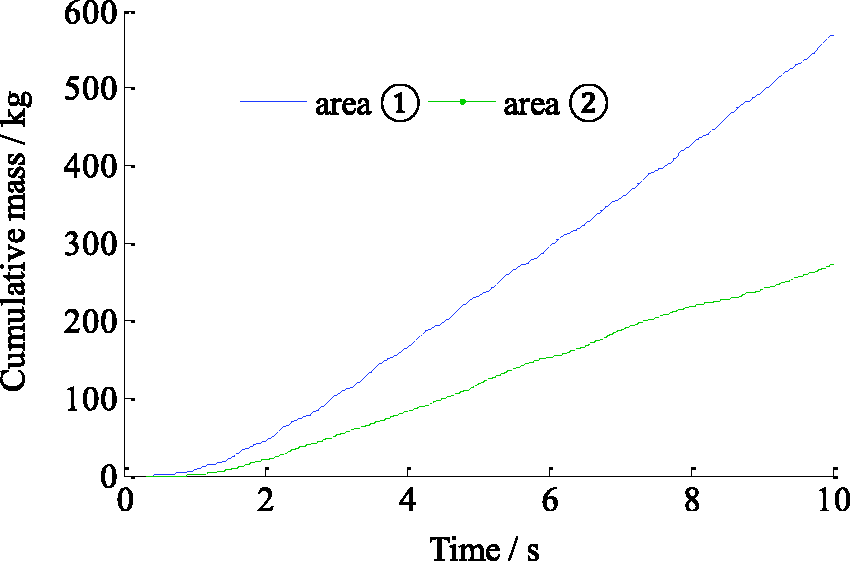
Variation of coal mass in different areas.
The ratio of the mass of coal particles falling into the area ① in the total mass of the broken coal particles can be approximately supposed as the coal loading rate of the drum. According to the statistics, the change of the coal loading rate of the drum is depicted in Figure 9. When the drum is initially cut, the outermost coal wall of the working face first enters the area ① after being broken, and at this time, no particles enter the area ②; the mass of coal particles in the area ① accounts for the largest proportion of the total mass of the broken coal particles. With the progress of cutting, the partially exfoliated coal particles, especially the coal particles near the end plate on the inner side of the coal wall, begin to fall into the area ② in a large amount, so that the coal charging rate of the drum is continuously reduced. When the drum is completely cut into the coal wall and reaches a stable cutting state, the coal loading rate gradually tends to be stable. According to the statistical data, the coal loading rate of the drum is about 65.6%.
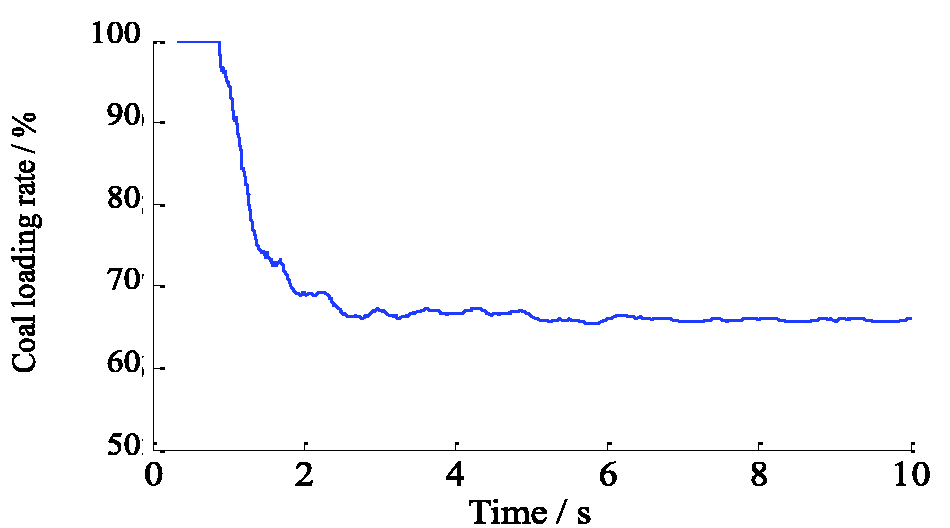
Variation of coal loading rate.
Results and discussion
Numerical simulation of coal loading process
The coal loading process of the drum with different helix angles is analyzed when the rotation speed is 58 rpm, the traction speed is 6 m/min, and the cutting depth is 0.8 m. The coal particle velocity distribution is shown in Figure 10. When the helix angle of the drum increases from 10° to 18°, the velocity of coal particles flowing out of the envelope space increases continuously. When the helix angle of the drum is 22°, the velocity of coal particles at the same area begins to decrease.
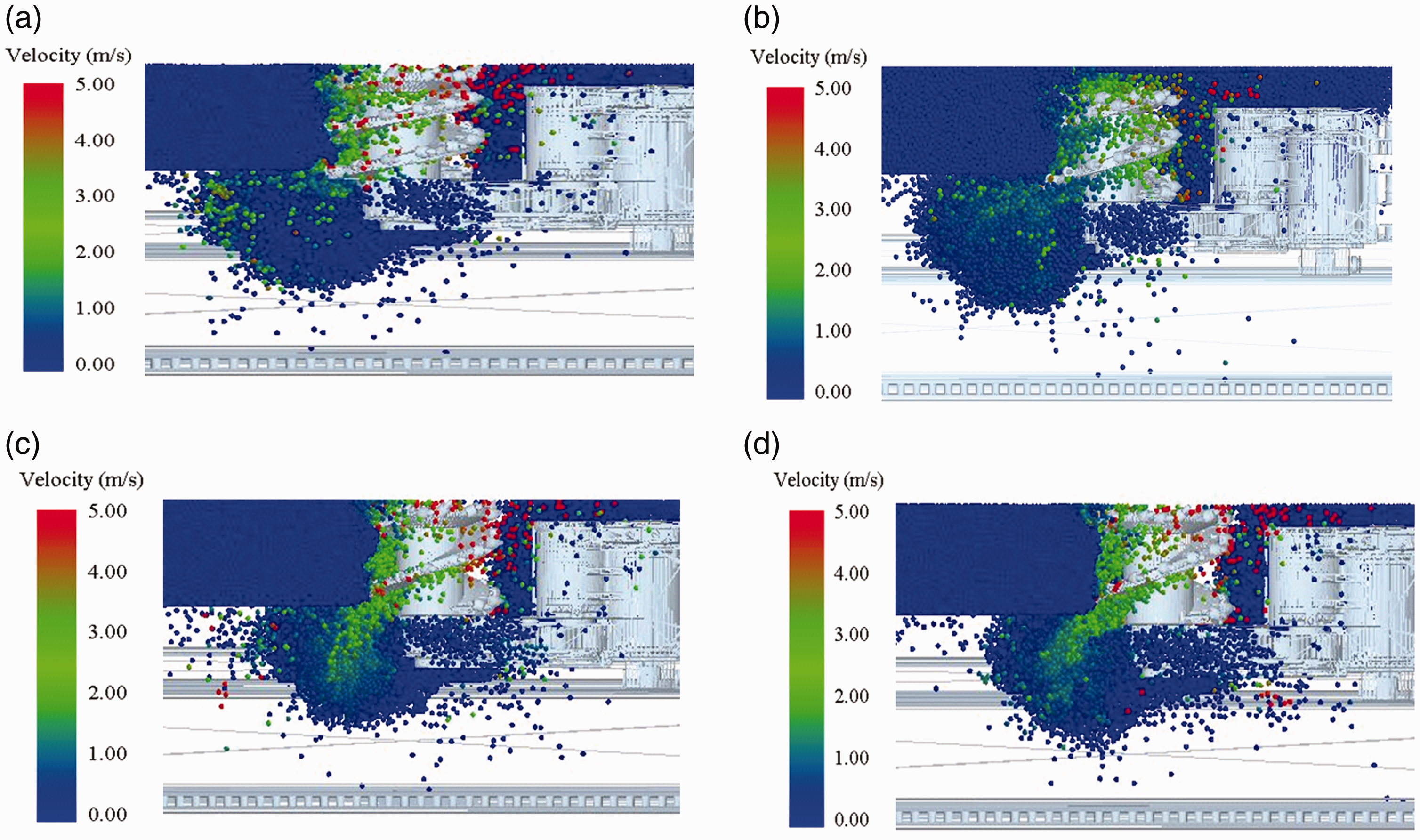
Speed distribution of coal particles with different helix angles; (a) The helix angle is 10°; (b) The helix angle is 12°; (c) The helix angle is 18°; (d) The helix angle is 22°.
The variation of average velocity of coal particles with different helix angles is shown in Figure 11. Due to the same cutting depth and traction speed, the total mass of coal particles broken by different helix angle drums is basically the same. When the helix angle increased from 10° to 18°, the velocity in Y direction of particles in area ① increases with the increase of helix angle, and the ability of particles to flow out of the region is strengthened; when the helix angle is greater than 18°, the velocity of coal particles just falling from the coal wall increases in the X direction and decreases in the Y direction under the action of blades. When the coal particles move in the envelope space of drum, the velocity of coal particles flowing into the area ① decreases in two directions under the friction between the coal particles and the blades. The change of velocity leads to the increase of the cumulative mass of particles in area ① increased first and then decreased, while the cumulative mass of particles in area ② decreased first and then increased.
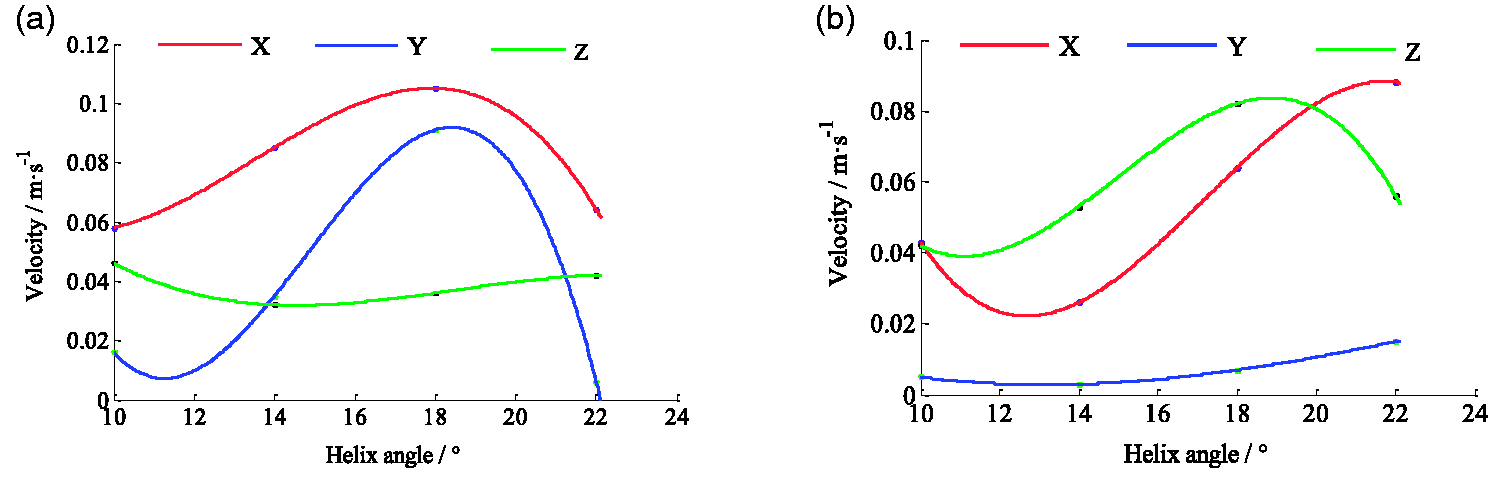
Average velocity of coal particles with different helix angles. (a) Average velocity of coal particles in area ①; (b) Average velocity of coal particles in area ②.
The coal loading process of drum with different cutting depths is analyzed when the rotation speed is 58 rpm, the traction speed is 10 m/min, as shown in Figure 12. Under the pushing action of helix blades, the coal wall closer to the working face is easier to be pushed into the conveyor after crushing, and the coal wall closer to the end plate of the drum is less likely to be transported out after crushing. With the increase of cutting depth, more coal particles are broken in unit time. Due to the constant rotation speed and traction speed, the filling rate in the envelope space of drum increases in unit time, and the coal particles enter into the area ① and area ② both increase.
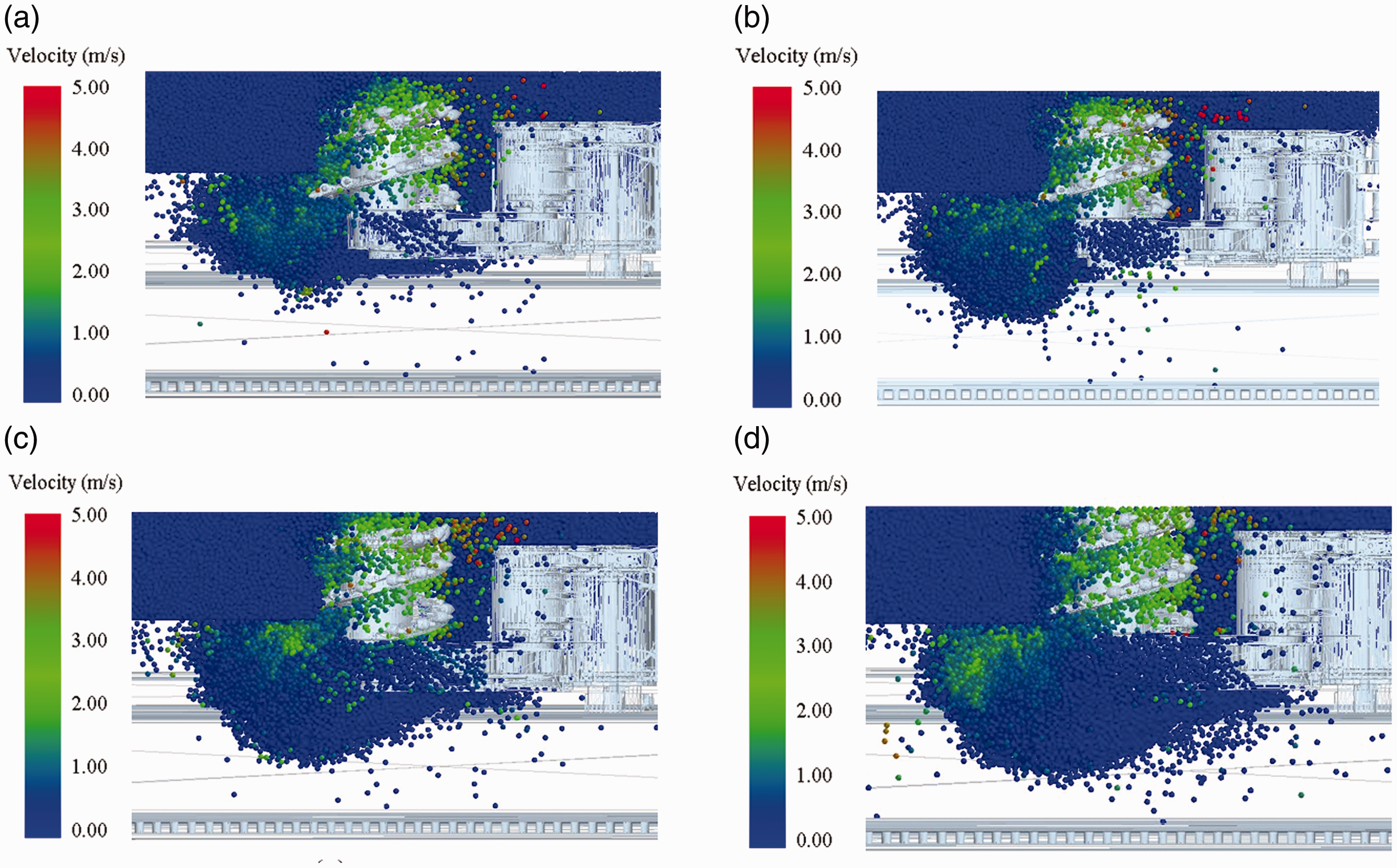
Speed distribution of coal particles with different depths. (a) The cutting depth is 0.5 m; (b) The cutting depth is 0.6 m; (c) The cutting depth is 0.7 m; (d) The cutting depth is 0.8 m.
The variation of average velocity of coal particles with different cutting depths is shown in Figure 13. When the cutting depth is small, the movement time of coal particles in the envelope space of drum is short, and the energy consumed by the friction between the coal particles and the blades is less, which makes the probability of the particles flowing from the drum to the area ① higher. The velocity of coal particles peeled off near the end plate along the axial direction of the drum decreases, which leads to the decrease of coal loading rate from 72.35% to 67.79% when the cutting depth increases from 0.5 m to 0.8 m.
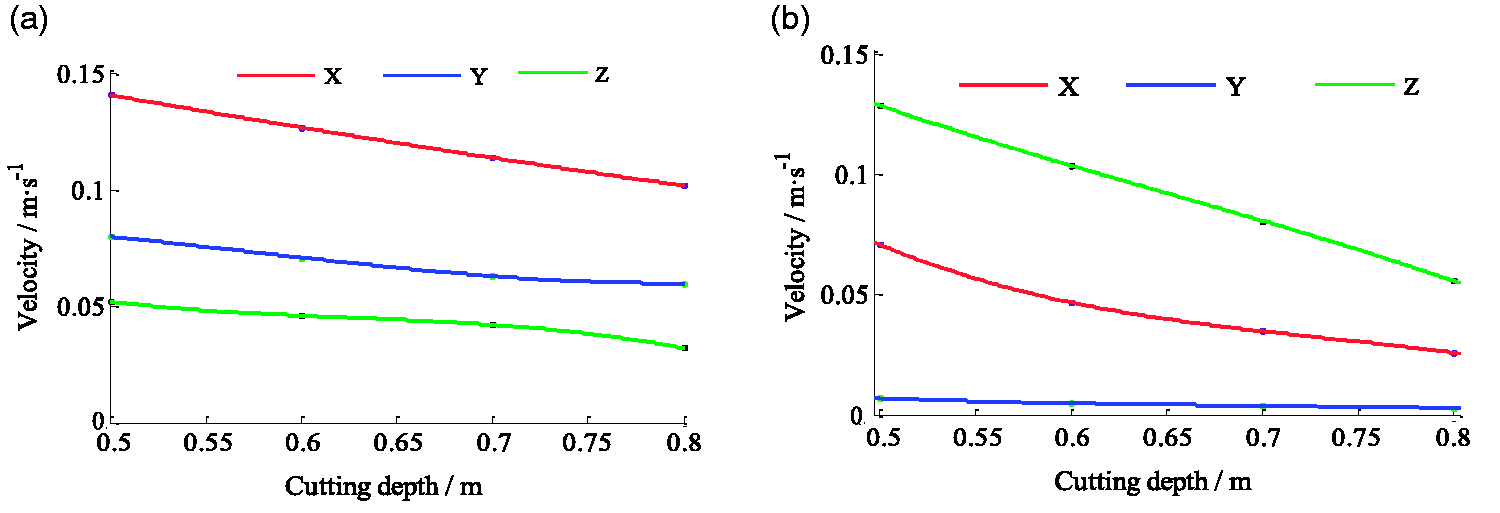
Average velocity of coal particles with different cutting depths. (a) Average velocity of coal particles in area ①; (b) Average velocity of coal particles in area ②.
The coal loading process of drum with different rotation speeds is analyzed when the cutting depth is 0.8 m, the traction speed is 10 m/min, as shown in Figure 14. With the increase of the rotation speed, the number of coal particles in the envelope space of the drum decreases in unit time after the coal particles are peeled off from the coal wall, and the velocity of the particles flowing out to the working face under the action of the helix blades increases. The high rotation speed increases the number of coal particles that can flow into the area ①, which improves the conveying capacity and loading capacity of the drum.
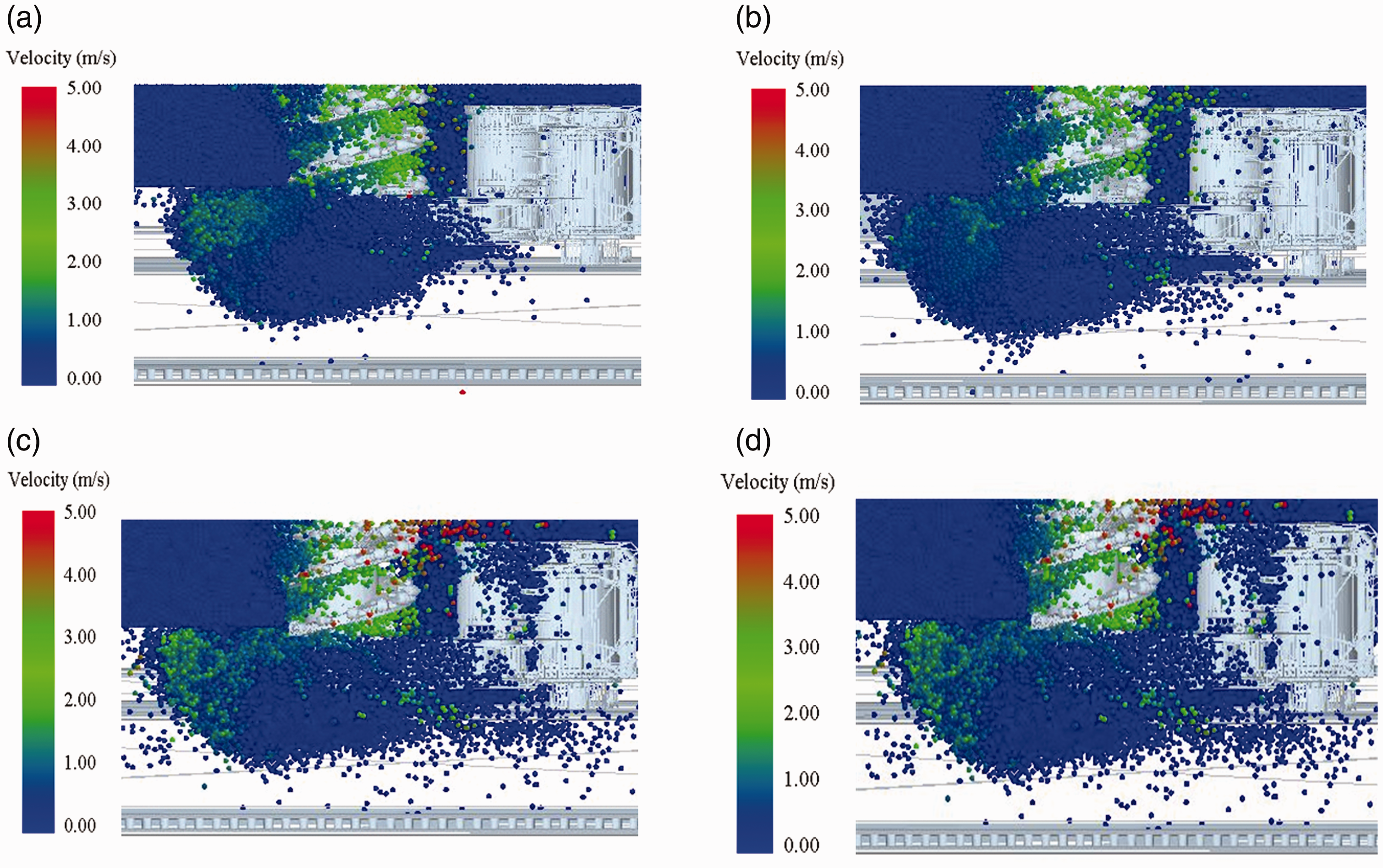
Speed distribution of coal particles with different rotation speeds. (a) The rotation speed is 40 rpm; (b) The rotation speed is 60 rpm; (c) The rotation speed is 80 rpm; (d) The rotation speed is 100 rpm.
The variation of average velocity of coal particles with different rotation speeds is shown in Figure 15. When the rotation speed increases from 40 rpm to 80 rpm, the velocity of coal particles flaking from the coal wall in the Y directions increases, which makes the velocity of coal particles flowing into the area ① increase. When the rotation speed is higher than 80 rpm, the coal particles are thrown into the goaf before they move to the end of the drum due to the increase of the velocity of coal particles in the X direction, and velocity in the X direction of coal particle in area ② increase. When the rotation speed increased from 40 rpm to 60 rpm, the loading rate increased from 65.76% to 67.68%. When the rotation speed continues to increase, the coal loading rate has not been greatly improved.
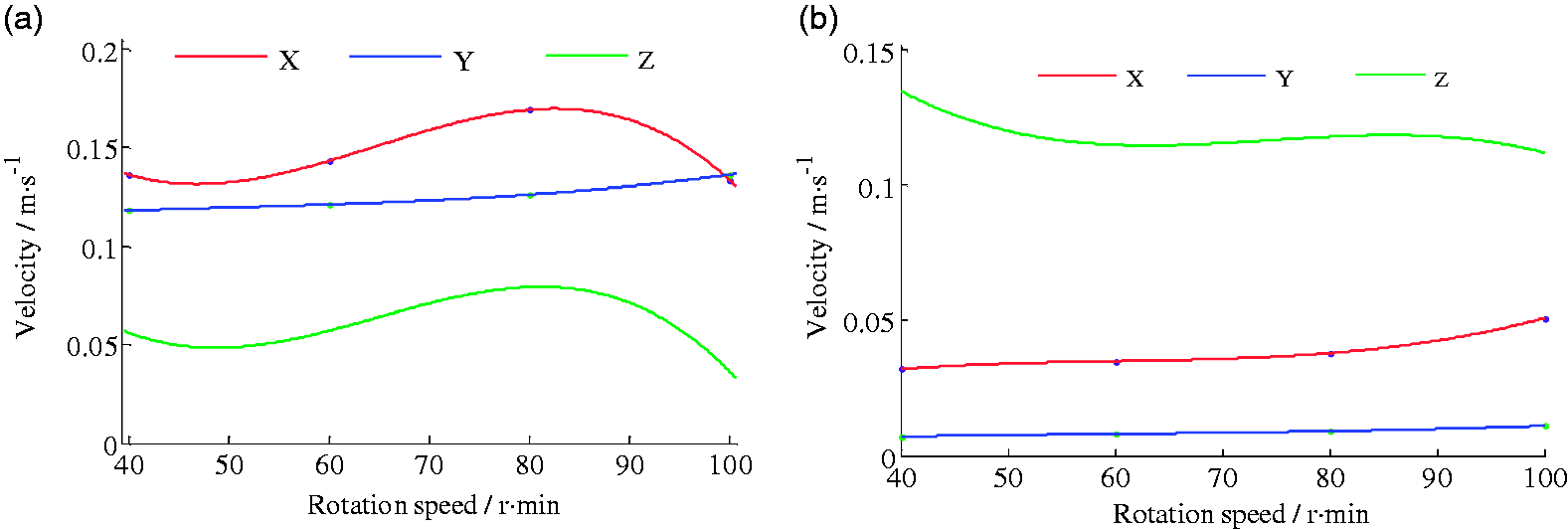
Average velocity of coal particles with different rotation speeds. (a) Average velocity of coal particles in area ①; (b) Average velocity of coal particles in area ②.
The coal loading process of drum with different traction speeds is analyzed when the cutting depth is 0.8 m, the rotation speed is 58 rpm. The coal particle velocity distribution with different traction speeds is shown in Figure 16. With the increase of traction speed, more coal particles are peeled off in unit time, the filling rate of particles in the drum envelope space will increase, and the friction between coal particles is strengthened, which reduces the axial movement ability of particles. The movement velocity of coal particles in the opposite direction of traction increases with the increase of traction speed, when the friction between particles and blades can not make the coal particles continue to move along the axial direction of the drum, the particles will be thrown into the goaf by the helix blades.
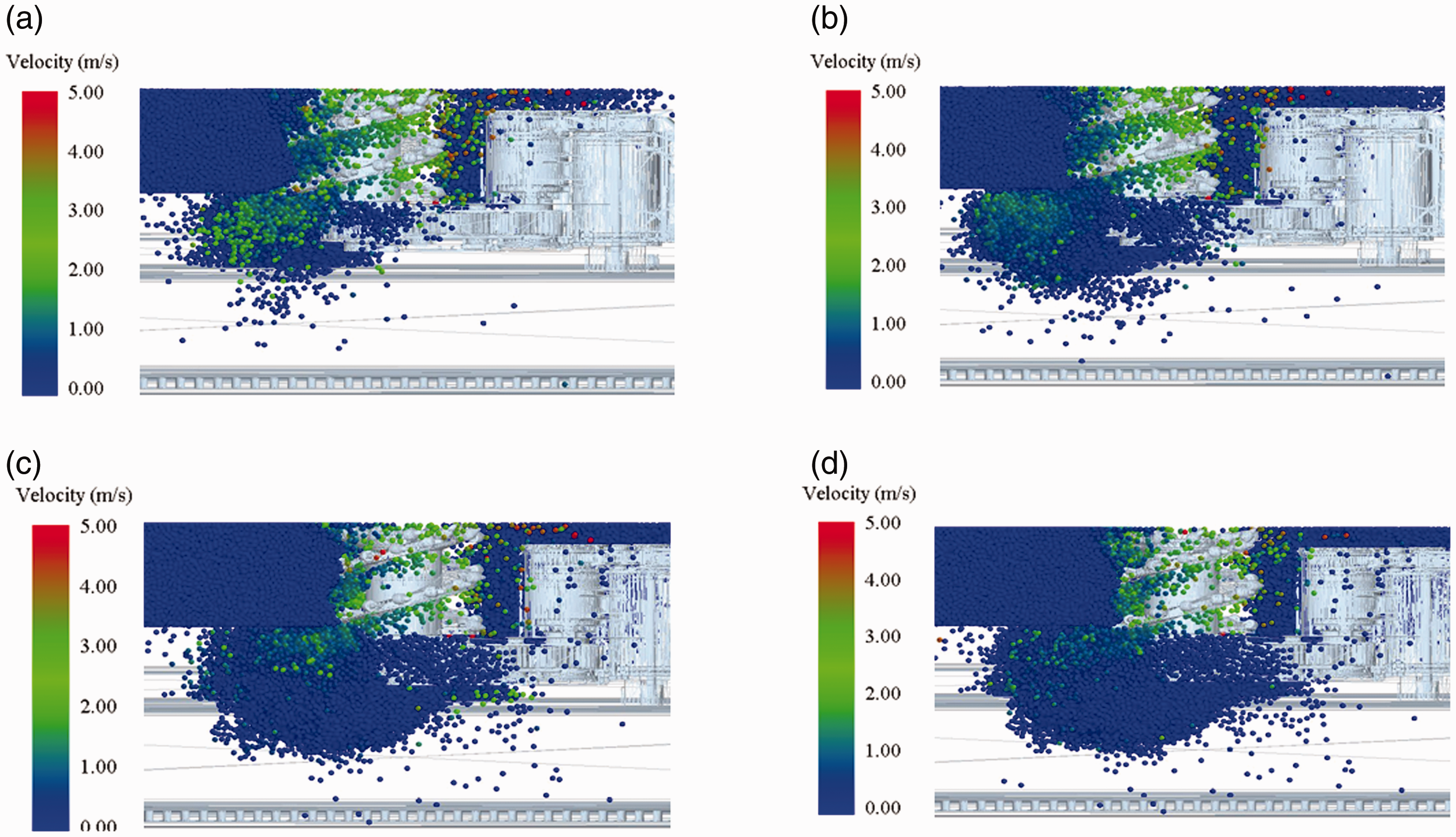
Speed distribution of coal particles with different traction speeds. (a) The traction speed is 4 m/min; (b) The traction speed is 6 m/min; (c) The traction speed is 8 r/min; (d) The traction speed is 10 m/min.
The variation of average velocity of coal particles with different traction speeds is shown in Figure 17. With the increase of traction speed, the change of X direction velocity in area ① is the most obvious. The Y direction velocity of particles in area ② has little change, and the X direction and Z direction velocity decreased first and then increased. Due to the increase of particle velocity in the opposite direction of traction, the contact time between the particles and the helix blade becomes shorter, which leads to the decrease of the axial movement ability of the particles in the envelope space of the drum, and the flow ability of particles to the working face is also weakened, which leads to the decrease of coal loading rate from 75.65% to 67.58%.
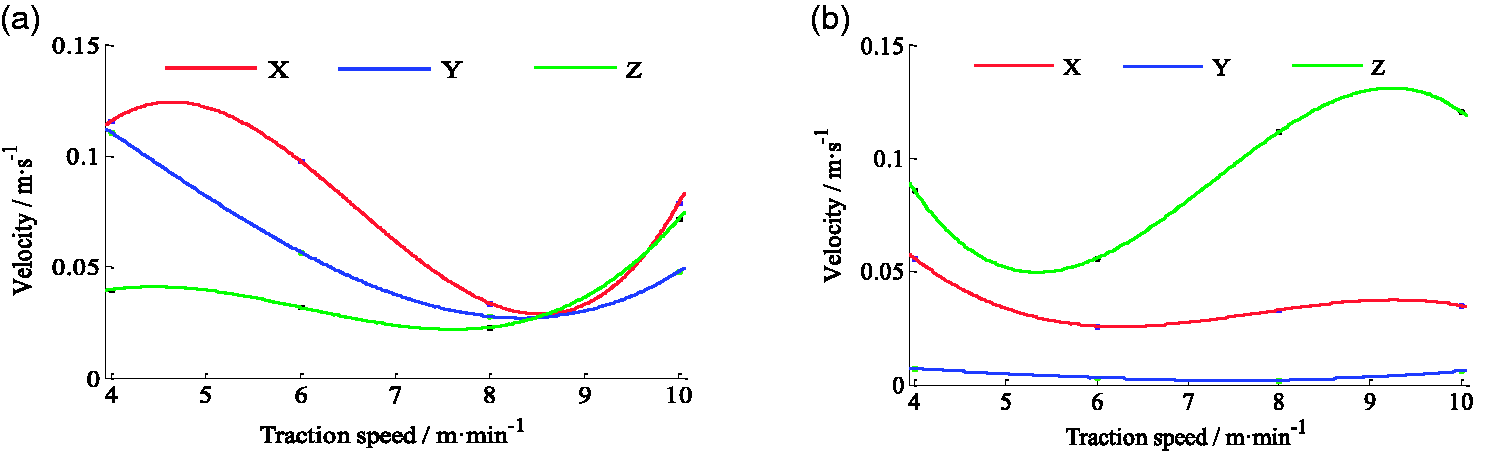
Average velocity of coal particles different traction speeds. (a) Average velocity of coal particles in area ①; (b) Average velocity of coal particles in area ②.
Analysis of coal loading performance under the influence of multiple factors
Four factor levels were selected for the factors of helix angle, cutting depth, rotation speed and traction speed. The orthogonal experiment table L16(45) is selected to determine the number of experiments and arrange the parameter values in experiment. The simulation results of 16 groups of models in the four factors and four levels orthogonal experiment are shown in Table 2, and the results of significance analysis are shown in Table 3.
Result statistics of orthogonal test.
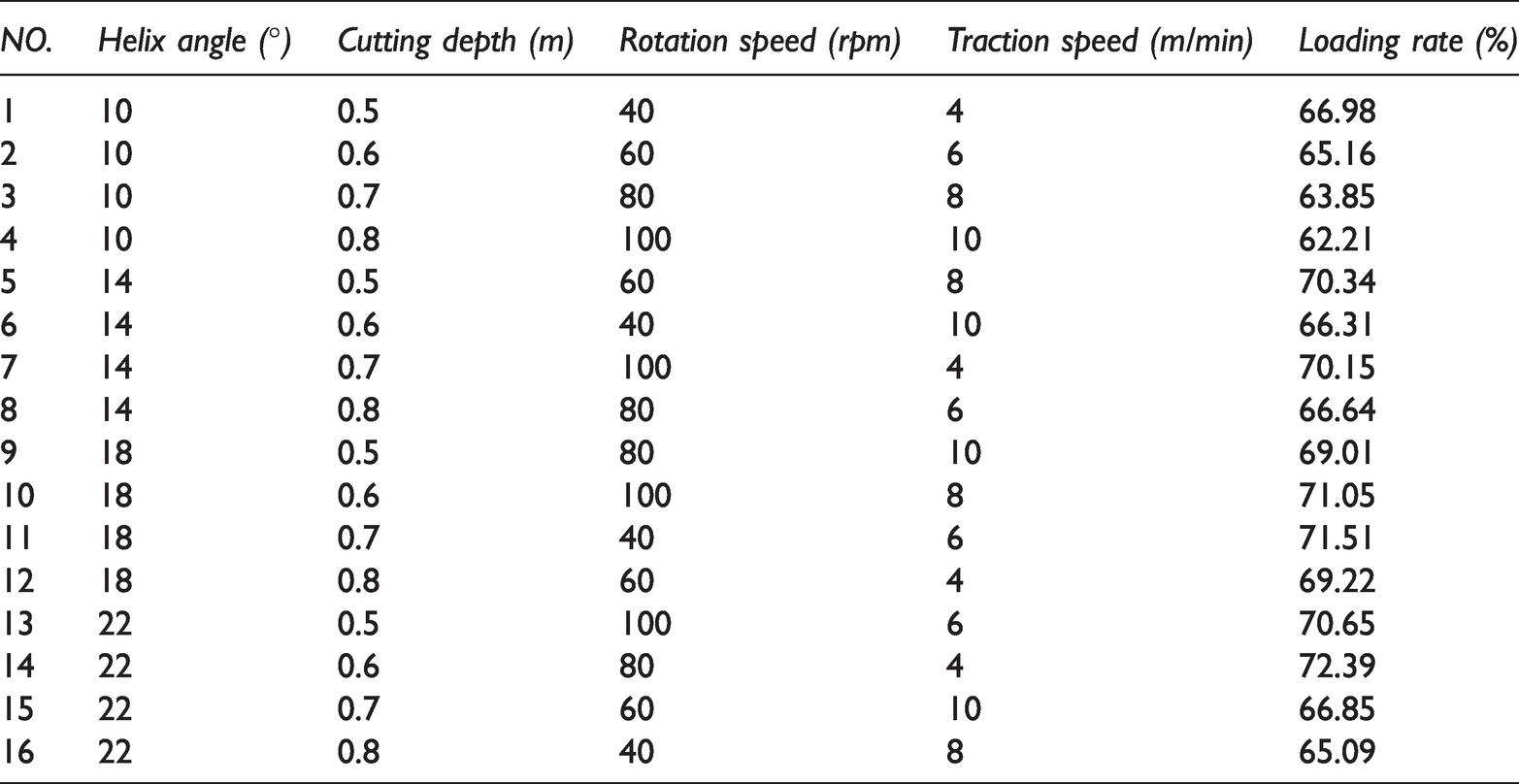
Significance analysis result of orthogonal test.

According to the test results, the average data of helix angle, cutting depth, drum speed and traction speed under four levels are statistically analyzed, and the variation law of coal loading rate is shown in Figure 18. With the increase of helix angle, the coal loading rate increases first and then decreases; the coal loading rate decreased with the increase of cutting depth and traction speed; the increase of rotation speed can improve the coal loading performance of the drum to a certain extent.
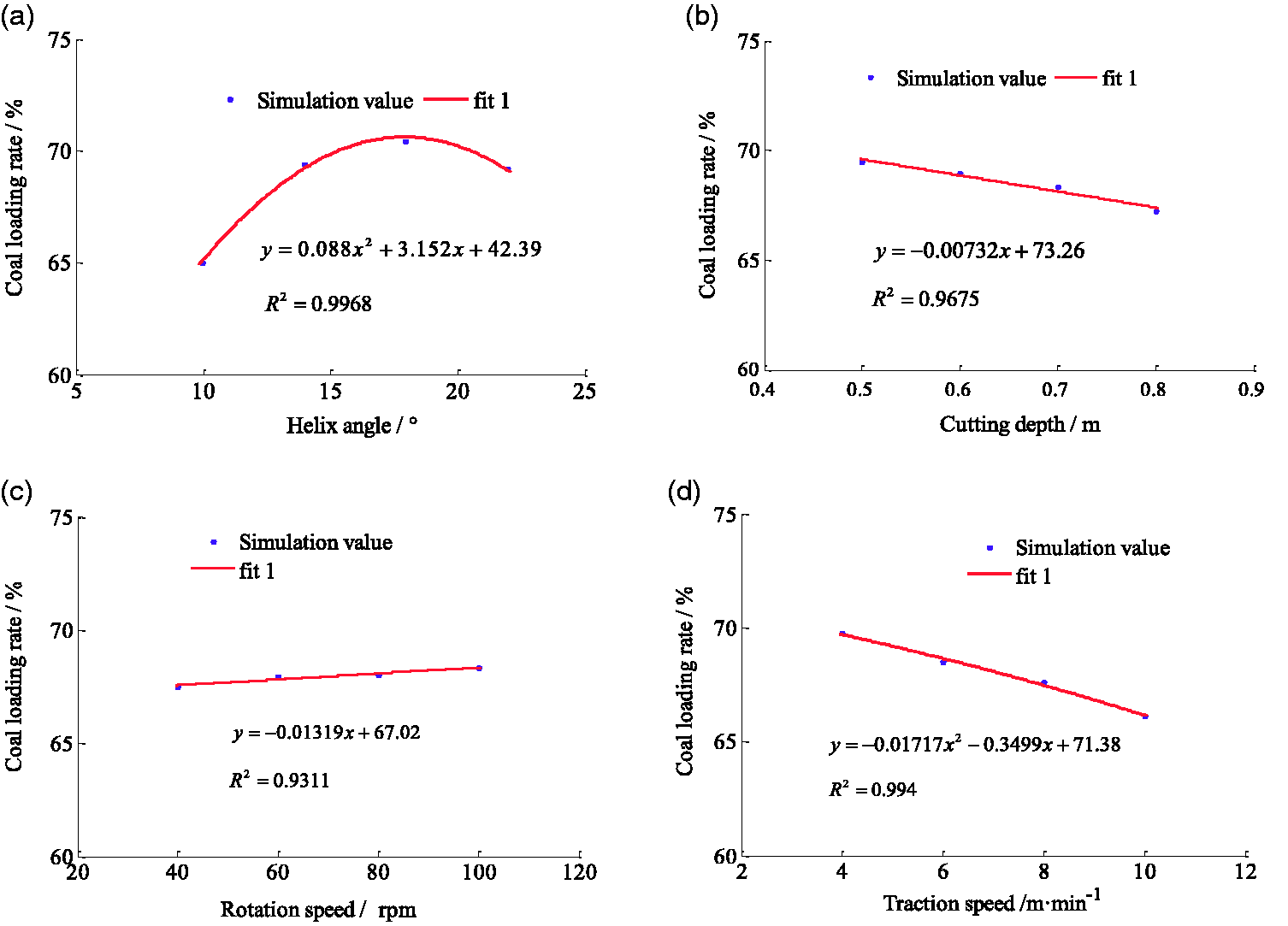
Effects of different factors on loading rate. (a) Coal loading rate with different helix angles; (b) Coal loading rate with different cutting depths; (c) Coal loading rate with different rotation speeds; (d) Coal loading rate with different traction speeds.
Test verification
MG400/951-WD type shearer was tested in a coal mine in Ordos, Inner Mongolia, as shown in Figure 19. The coal loading rate of the drum can be obtained according to the statistics of coal falling weight and the weight of coal transported by scraper conveyor when a single drum cuts the coal wall. The coal loading rate of drum with different traction speeds is obtained by test statistics. The comparison between test results and simulation results is shown in Figure 20. When the helix angle is 18°, the cutting depth is 0.8 m, the rotation speed is 58 rpm and the traction speed is about 4 m/min, the coal loading rate measured in the test is about 64.67%. Under the same conditions, the coal loading rate obtained by numerical simulation is 69.22%, the relative error between the test and the simulation result is about 7.04%.
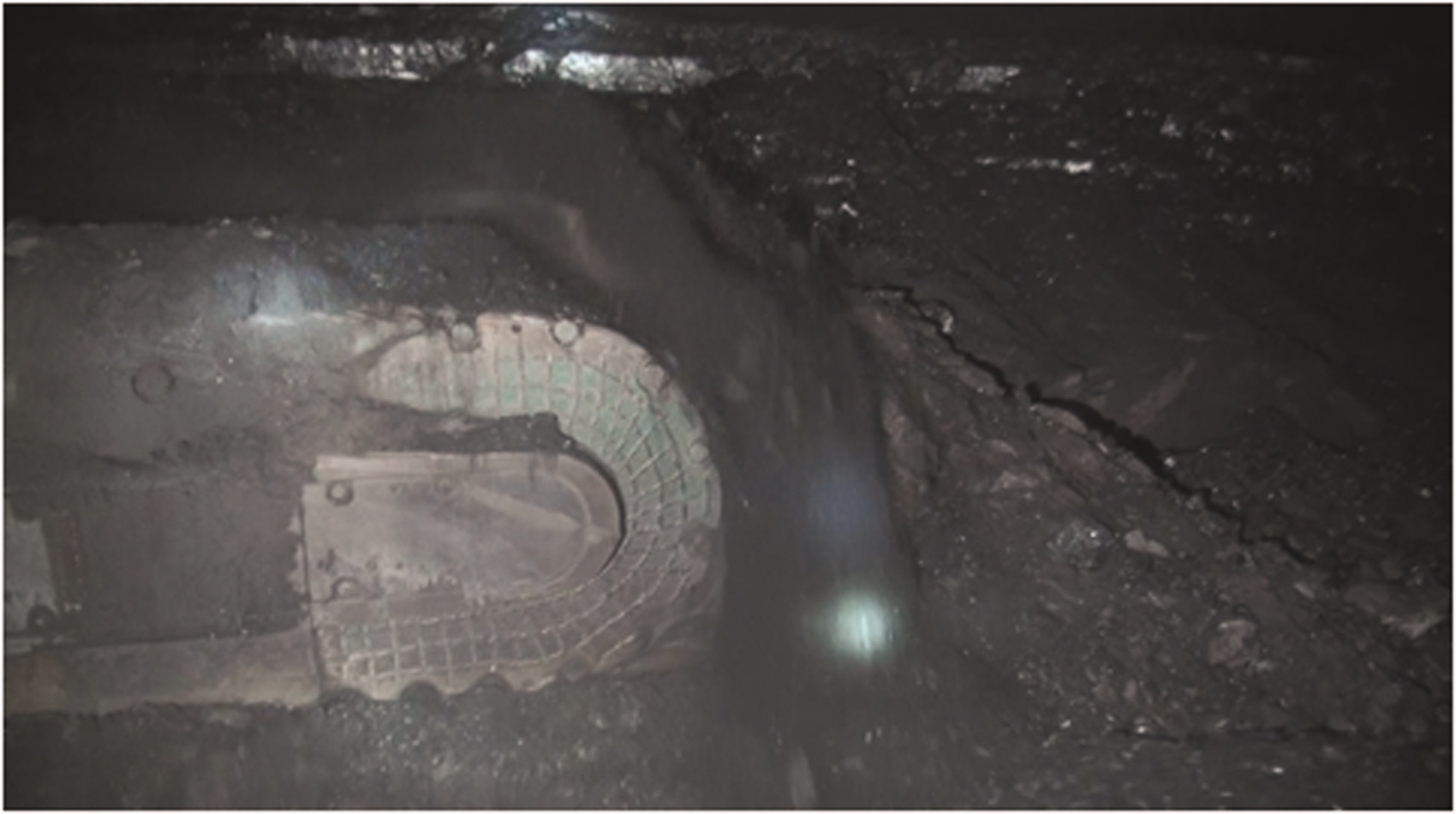
Cutting test.
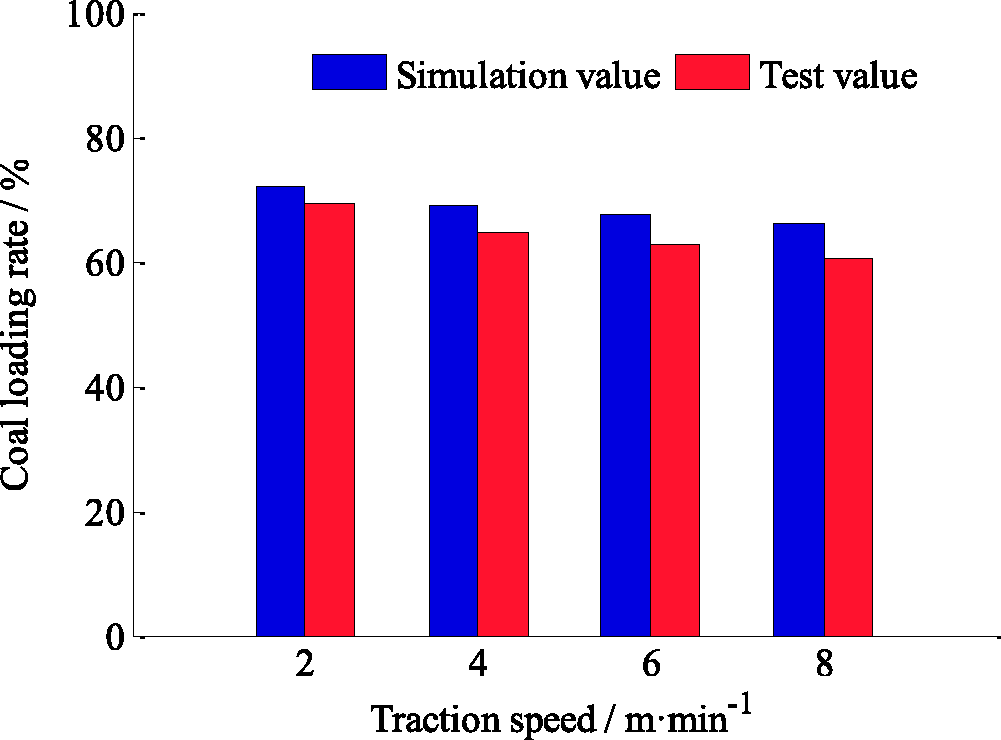
Contrast between simulation and test results.
Through the discrete element numerical simulation, the coal loading rate of drum is basically consistent with the test data, but the coal loading rate obtained by simulation is slightly higher than the test results. The main reasons for the error are as follows:
It is considered that the particles between the scraper conveyor and the coal wall can completely transported out when the coal loading rate is calculated by numerical simulation, and some particles remain on the rocker arm shell, and it will be the effective output by default when calculating the mass of particles, which will lead to some deviation of the simulation results. Due to the complex underground environment, the traction speed of the shearer can not keep constant speed for cutting in the industrial test, and its traction speed is constantly changing around the set value, which will also lead to a certain deviation of coal loading rate. The simulation model does not consider the influence of the conveyor, the machine body of the shearer and other mechanical equipment on the movement of the coal flow, resulting in the coal loading rate obtained by the simulation being slightly higher than the test data.
Conclusions
This paper presents a method to analyze the loading rate of shearer drum based on discrete element numerical simulation. In order to make the discrete element simulation more consistent with the actual cutting process of shearer, the coal seam of Wenyu coal mine in Ordos was sampled and the physical and mechanical properties were determined. According to the test results of coal samples, the intrinsic parameters of coal particles were determined, and the discrete element model of coal wall close to reality was constructed. Through numerical simulation, the quality, velocity distribution and change of coal particles in different area were analyzed, and the velocity variation and coal loading rate of coal particles in different areas under different structure and motion parameters of the drum were found out. The influence of four factors on coal loading rate of drum was analyzed by orthogonal test. The results show that the helix angle has the greatest influence on the coal loading efficiency, and the rotation speed has the least effect on the coal loading rate; with the increase of helix angle, the coal loading rate first increases and then decreases; the coal loading rate decreases with the increase of cutting depth and traction speed; the increase of rotation speed can improve the coal loading performance of the drum to a certain extent, but when the rotation speed is too high, the increase of coal loading rate is not obvious. According to the comparison of test and numerical simulation results, there are some deviations in coal loading rate between the simulation and test values, but the change trend of coal loading rate obtained by the two methods is consistent. Therefore, it is feasible to analyze the coal loading performance of shearer drum by discrete element method. The research results can provide reference and basis for the design of structure parameters and the selection of motion parameters of shearer drum in the future.
Footnotes
Declaration of conflicting interests
The author(s) declared no potential conflicts of interest with respect to the research, authorship, and/or publication of this article.
Funding
The author(s) disclosed receipt of the following financial support for the research, authorship, and/or publication of this article: This research was funded by National Natural Science Foundation of China (51673134), The Science and Technology Tackling Key Project of Henan Province (182102210606, 202102210070), and Colleges and Universities Scientific Research Projects of Henan Province (21B440004).
