




Abstract
The study explores the causality between oil production, industrial production, energy consumption, and unemployment in Iran. We use time-series data, spanning the period 1990–2017 and apply VECM method for the data analysis and our findings suggest that crude oil production significantly causes unemployment through industrial production and energy consumption channel both in the short and long run, while energy consumption and industrial production affect unemployment in the short run only. Furthermore, energy consumption also determines industrial production showing energy as a supplement to the industries. The oil production in Iran substantially contributes to the country’s exports and main energy main input to the local industries. Industrial production increases energy consumption and reduces unemployment in the country. Therefore, the government should formulate appropriate policies, which take into account the fact, that changes in oil production have both short-run as well as long-term effects on employment in the country.
Introduction
Natural resource abundance has significant contributed country’s economic development, it provides employment, alleviate poverty, promoting local businesses, income, and economic growth (Aragón and Rud, 2013; Brunnschweiler and Bulte, 2008; Byakagaba et al., 2019; Dashwood, 2012; Mawejje and Society, 2019). Oil resources could have positive implication for the economy particularly countries that heavily depends on fossil fuel as an energy source. Oil resources may increase energy production that further use in the industrial sector which provides jobs opportunity in the country. Iran provides subsidies to the household and industries, approximately $69 billion of subsidies allocated for various types of energy consumption including oil during 2018 ($26.6 billion), which significantly improved the local industries and also raised the employment level in the country. Therefore, this study investigates the relationship between crude oil production, energy consumption, and employment in Iran. Oil production plays a pivotal role in the industrial development and economic growth of a country. The development of industries is associated with energy consumption, which directly depends on available oil resources, especially if country energy depends on fossil fuels. Oil production is directly associated with employment opportunities by providing jobs to the people working in the oil industry and it indirectly provides employment through the energy provided to the industrial sector. Hoag and Wheeler (1996) reported that oil production and oil prices significantly reduce unemployment. Caporale and Gil-Alana (2002), also confirm the long run and short association between oil price, oil production, and unemployment and they suggest that oil production could significantly reduce unemployment. While Shuddhasawtta Rafiq et al. (2009) predicted a causality through VAR for Thailand between oil and unemployment.
Industrial production could play a pivotal role in reducing unemployment in the economy, industries use energy as an input that heavily relies on the different sources of energy resources including oil, coal, and renewable energy options. Oil production may significantly influence industrial production in those countries where the energy sector substantially depends on oil resources. Industrial production could improve the country's production as well as increase employment opportunities in the country which resultantly reduces unemployment. Several studies have found a positive association between oil production and employment, which means reduces unemployment. Besides government expansionary policies leads to higher industrial production which ultimately leads to lower unemployment (Gao et al., 2004). The oil price shows a dynamic relationship with unemployment and an increase in oil price leads to increased unemployment while there is no significant impact of reduced oil prices. On the one hand, a decrease in oil price uncertainty results in lower unemployment, which oil price uncertainty increase does not have an impact on unemployment (Kocaarslan et al., 2020). The industrial productivity increase which results from the higher energy consumption leads to reduces unemployment(Brown et al., 2021). De Vries and Timmer (2007) explored that economic growth is attached to productivity which comes from the country’s Industry, hence increases employment in society. Roncolato and Kucera (2014), and McMillan and Rodrik (2011) assert that industrial production is a key factor for increasing employment in the economy. Obadan (2001) described the relationship between productivity and employment and found that labor productivity main determinant that affected employment in society. Similarly, Egwaikhide (2001) reported that industrialization is an integral factor that contributes to economic development and employment. Since energy consumption has the main determents of industrial production and unemployment, therefore, this study aims to explore the nexus between oil production, industrial production, and unemployment in Iran. This study contributes to the existing literature from the following aspects; first oil production and unemployment have not been explored in literature particularly for Iran. Secondly, we use VECM method for the analysis, which provides more robust results, because the VECM provides a mutual effect among the variables and a single equation may not capture such type of relationship. The rest of the paper is organized as follows: the next section presents a literature review, the Oil production, energy, industries and unemployment in Iran section contains the stylized facts, the Methodology section and the Results and discussion section related to the results of the study and final section contains the conclusion of the study.
Literature review
Many studies have discussed the impact of oil on macroeconomic variables like GDP, unemployment, energy consumption, and industrial production. However, most available literature focuses on the effect of oil price and its effect on different macroeconomic variables. The first part of the literature deals with oil price shocks on the macroeconomic variables including GDP. Hamilton (1983), examined the effect of oil price shocks on the macroeconomy and argued that energy is an essential component for the economy and oil price shocks doesn’t responsible for the recession in the economy. According to Arouri and Rault (2012), the relationship between crude oil and macroeconomic variables has been changed over time and although oil price is the main factor of energy however there is disagreement in the literature on the relationship between oil prices and macroeconomic variables. Barsky and Kilian (2004) found a unidirectional causality from oil prices to GDP, inflation, and unemployment.(Karanfil and Pierru, 2021) suggest that increase oil price would lead to increase the welfare of the people in Saudi. This argument however could be plausible for Saudi Arabia because Saudi Arabia is exporting country. However, with an increase in price the demand will slightly decrease.
The second part of the literature deals with Oil price shocks and industrial production; oil prices are the important factor affecting macrocosmic variables such as energy consumption, industrial production, cost of production and price, trade, and foreign direct investments (Brown and Yücel, 2002; Chang and Wong, 2003; Hooker, 1996; Qianqian, 2011; Shuddhasawtta Rafiq et al., 2009). Jiménez-Rodríguez and Sánchez (2005) investigated the relationship between aggregate productivity and oil price and found that an oil price increase has a greater influence on aggregate productivity than a decrease in the price of oil. Moreover, their findings also revealed that an increase in oil price negatively affects the country’s GDP. Cuñado and de Gracia (2003) found the negative and significant effect of oil price fluctuation on industrial production. Similarly, Serletis and Shahmoradi (2005), and Ewing and Thompson (2007) also confirm that oil price affects industrial production. The oil price shocks may have a different impact on importing and exporting countries; for example, the increase in oil price has an adverse effect on importing countries, while it is profitable for exporting countries. This justifies the wealth transfer to the oil-exporting countries that increase the purchasing power of oil exporting countries while it decreases purchasing power of importing countries. Hamilton (1983), also reported a positive correlation between oil price change and real GNP growth. Burbidge and Harrison (1984) found causality between oil price change and industrial production in developed countries, furthermore, oil prices are the main factor responsible for higher unemployment.
The third part of the literature elaborates on the oil price shocks and unemployment. In literature, various transmission mechanisms have been noticed for the oil price shocks and their possible impact on economic activity. An increase in oil prices results in a relative output level decline as shown by the classical supply theory in which oil price is assumed as a basic input in production (Beaudreau, 2005). Higher output costs would result due to an increase in oil prices, which lowers the production rate that leads to a decline in the economic growth and lower wages of labor which increases unemployment. (Brown and Yücel, 2002). Phelps (1994) reported that in increase energy prices leads to an increase in unemployment in OECD countries. However, Carruth et al. (1998) also confirm the long run relationship between real oil prices, unemployment, and real interest rate in USA. While Loungani (1986) used 36 years dispersion index for 28 industries in the USA (1947 to 1982), examined labor reallocation as a result of the oil price shocks. The results predict that in the 1950s and 1970s oil price increase is one major cause in USA labor allocation and the oil price shocks lead to unemployment. Brown and Yücel (2002), investigated and analyzed the impact of monetary policy and oil price shocks on unemployment and report that deflationary monetary control inflation which raised due to the oil price shocks, however, it increases the interest rate which slows down the growth and economic activities that resulted in lower wages and raise unemployment. Many studies tested the structuralism view such as Bianchi and Zoega (1998), who noticed that unemployment has a higher variation from the oil price shocks and of price increase leads to lower unemployment. Phelps (1994) also confirms that the unemployment rate increases with the increase of real input oil prices. Similarly, Carruth et al. (1998) for the unemployment rate in the USA, reported a co-integration among real interest rate, real oil prices, and rate of unemployment. Ewing and Thompson (2007), USA reported a negative significant correlation between oil price and unemployment. Andreopoulos (2009), also confirmed the causality between real input prices and unemployment. Cologni and Manera (2009) investigated the impact of oil price shocks of oil price on macroeconomic variables by applying the structural co-integrated VAR model, their findings suggest that oil price shocks increase the interest rate, which ultimately leads to high unemployment and inflation. Robalo and Salvado (2008), also confirmed that oil prices affecting the unemployment rate.
The country’s energy consumption that relies on fossil fuels such as oil resources may affect economic development and unemployment. Economic growth and energy consumption have been extensively studied however studies focusing on the effect of energy consumption on the labor market are scarce (Shuddhasattwa Rafiq et al., 2018). (Payne, 2009) found that energy consumption positively affects the employment generation in the U.S. In contrast, Cheng (1998) reported a negative relationship between energy consumption and employment in Japan. However, Murry and Nan (1990), and Eden and Jin (1992) failed to demonstrate any long-term linkage between energy consumption and employment. Besides, energy consumption also affected unemployment through its prices; the rising oil prices, especially if the country's energy heavily relies on fossil fuel may result in an economic slowdown, which leads to higher unemployment (Nusair, 2020; Papapetrou, 2001). Energy consumption also affects unemployment through the income effect, i.e. energy consumption increases the income of the people, it helps the economy to uplift at repaid pace and boost up employment rate (Murry and Nan, 1990). Another effect of energy consumption on unemployment is technological spillover which results from replacing the old technologies with new advanced sophisticated technologies, and R&D activities that enhance employment opportunities (Çetin and Eğrican, 2011).
Oil production, energy, industries and unemployment in Iran
Iran among OPEC countries stands 5th in the list that producing a greater volume of oil in the world, according to Energy Information Administration Iran produced 3,990,956 bbl/day in 2019, and 44% of oil production to the world is contributed by the OPEC countries. Iran has rich oil resources in the region, however, despite its abundant reserves, the country's production of crude oil has undergone underinvestment for years and faced the effects of international sanctions. Figure 1 presents oil production and energy trend in Iran from 1990 to 2017, although oil production has been expanded, the growth has been recorded lower than expected. However, in the year 2017 oil production has reached 3.8 million barrels per day, since the lifting of sanctions on Iran’s oil sector. There is a decline in Iran’s crude oil production between 2012 to 2016 as a result of nuclear-related sanctions across the energy sector in Iran which hindered its oil export, which greatly affected investment upstream in both gas and oil projects. In the year 2016 more than 270 million tons oil equivalent energy consumed by the country. Approximately 98% of the country's total primary energy consumption accounted for by oil and natural gas, with some contributions from coal, nuclear, hydropower, non-hydro power, and renewables. However, it has been noticed that over the past decade Iran’s consumption of primary energy has grown rapidly continuously throughout even when nuclear-related sanctions were in place, and economic growth was depressed. Between, 2006 and 2016, energy consumption expanded up to 40%.
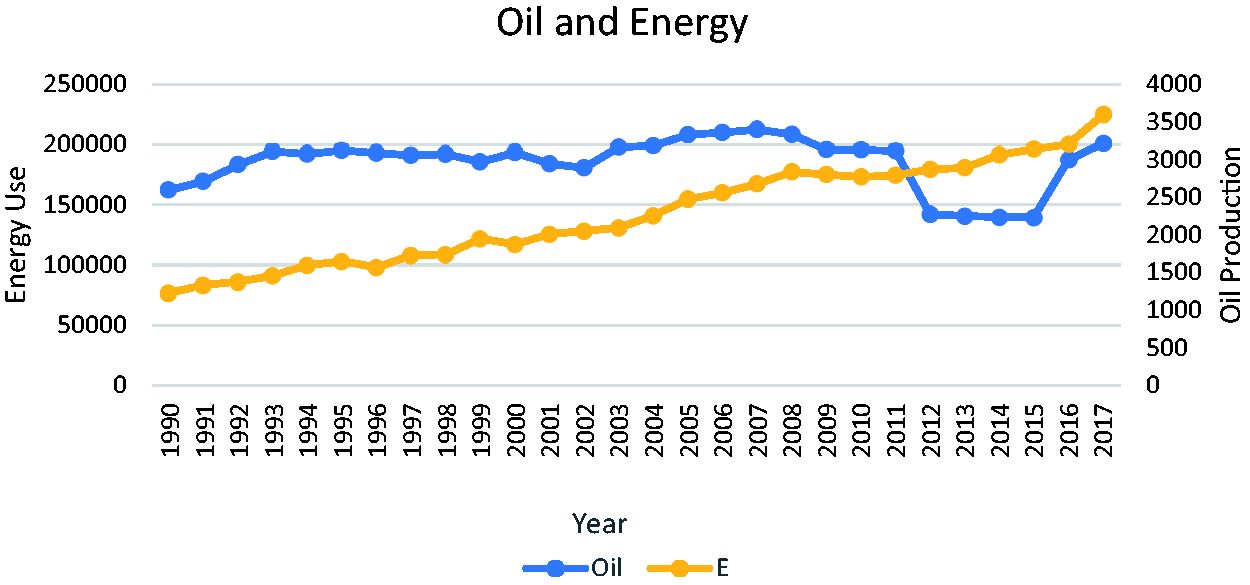
Oil productions and energy.
Figure 2 presents oil production and industrial production in Iran for the period 1990–2016. At the end of year 2011, the United States and European Union imposed sanctions on Iran due to its nuclear activities. These sanctions impeded Iran’s ability to sell oil, consequently in the decline of 1.0-million b/d in crude oil and shrink exports in the year 2012, as compared to the previous year. However, since banking sanctions and oil sector sanctions were lifted, in the Joint Comprehensive Plan of Action (JCPOA) in January 2016, the country's condensate production and crude oil exports have risen to the year 2012 level (see Figures 1 and 2). The sanctions which targeted Iran’s oil exports affected upstream investment between the year 2012 to 2016 in both industry and oil production. Both oil production and industrial production are moving with the same trend and both follow similar dynamics over the period. This indicates that an increase or decrease in industrial expansion is primarily determined by oil production in the country because oil production is the main energy component of the industrial sector.
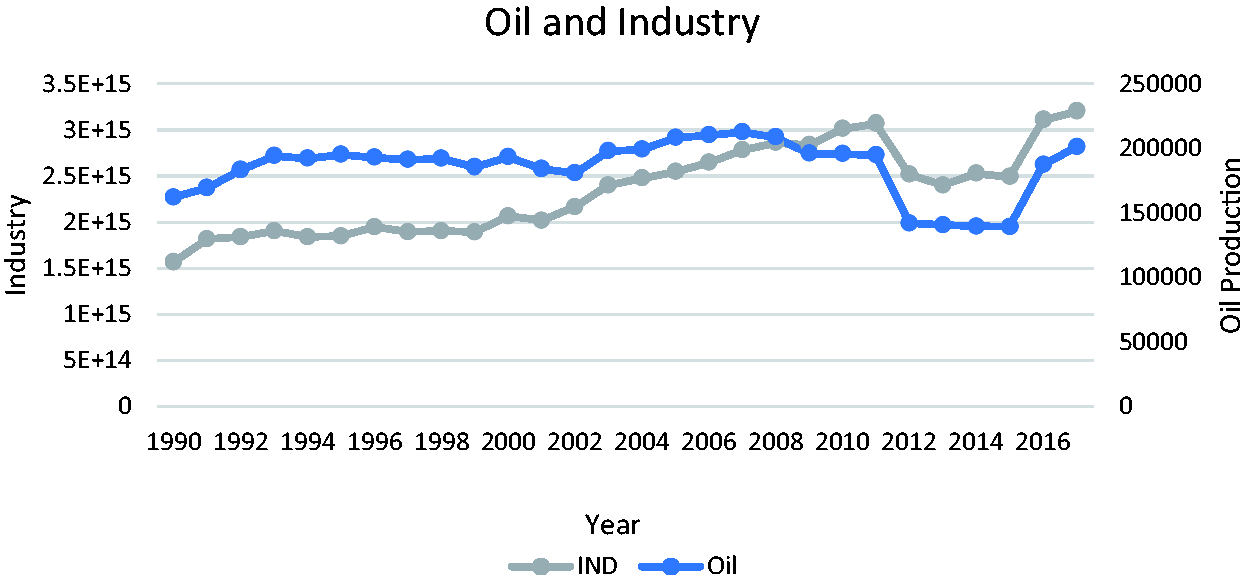
Oil production and industries.
When the United States lifted sections in the year 2015, Iran’s economy has boosted since. In February 2016, Iran started exporting oil to Europe for the first time since 2012. oil makes up 80% of the country's exports. The expansion of oil production leads to expands local industries and provide employment opportunities in the country. Figure 3 shows industrial production and employment in Iran, there is a dynamic trend in industrial production and unemployment, and in most of the year, there is an indirect relationship as both are moving in the opposite direction. The unemployment rate rose to 13% in year 2012 and 2013. Iran gains foreign exchange reserves from 2008 to the year 2014 which decline in year 2015, resulting in a higher unemployment rate. In the year 2017, the unemployment rate rose to 13.8%, and the removal of sanctions has improved the unemployment situation to some extent but still, the economy faces a higher unemployment situation. Figure 4 shows unemployment and oil production in Iran and it shows a mixed trend. From 1990 to 2000 the oil production seems stagnant; however, unemployment has been reduced. While the overall trend suggests that unemployment in Iran has significantly decreased with the increase in oil production.
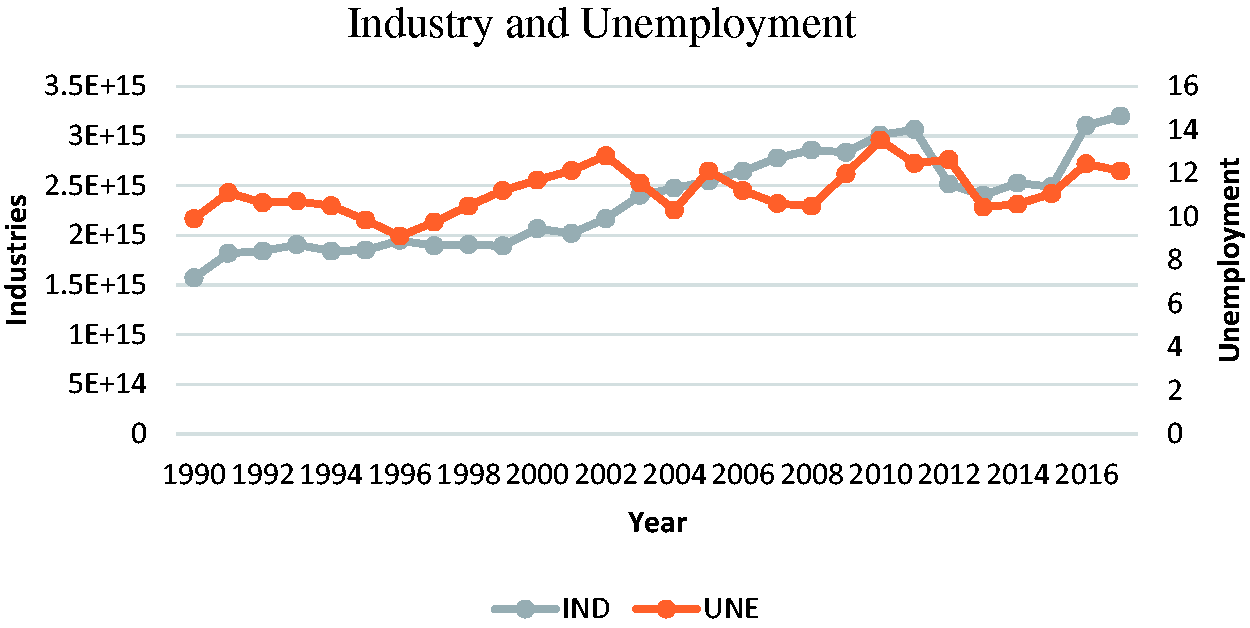
Oil production and unemployment.
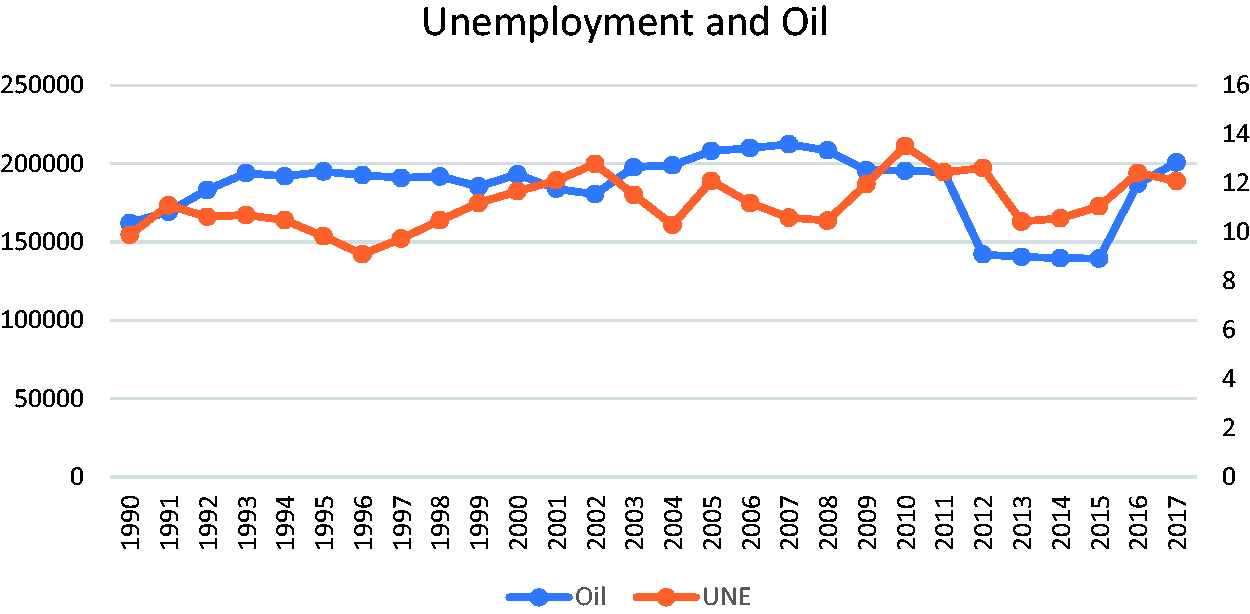
Unemployment and oil.
Methodology
Model
The study uses unemployment, Oil production and energy consumption variable to estimate the causality test and our main interest of causality equation as follows

Where
Une = Unemployment
ID = Industrial Production
E = Energy Consumption
Oil = Oil Production
Methodology
This study focuses on the interrelationship between oil production, energy consumption, industrial production, and unemployment in Iran. The interdependent relationship among the different variables has been tasted in literature, for example, Salies and Waddams Price (2003), Salies and Price (2004), (Apergis and Payne, 2009), and Amountzias et al. (2017) has tested energy consumption, oil production, employment, and industrial production. Since time series may have the possibility of the existence of non-stationary, which leads to spurious results thus conventional OLS techniques results don’t provide reliable results. The presence of stationary behavior in variables provides bias to use the Co-integration and VECM approach for the relationship between Oil price, Energy consumption, Industrial production, and Unemployment. Since the time series data is assumed non-stationary therefore Augmented Dickey-Fuller proposed by Dickey and Fuller (1981) is applied to know the order of integration and the stationary properties of the variables. Augmented Dickey–Fuller (1981) test use the following equation to test the hypothesis (H0) as

This equation test λ by using the tau (τ) statistics or Mackinnon critical values, one may reject the null hypothesis if the computed values exceed from critical value otherwise accept the null hypothesis. Several estimation techniques for the long-run relationship have been used and variables may vary in the short-run and long-run, therefore we estimate both the long-run and short causality between unemployment, energy consumption, industrial production and oil production in our analysis. Engle and Granger (EG) first purposed the cointegration based on the residual of linear equation. It requires that all variables need to be stationary at the first difference, however, the main limitation of Engle and Granger approach that valid only for a single vector. It doesn’t provide information on multiple cointegrations in the system. Johansen and Juselius (1990) purposed a cointegration technique based on maximum likelihood and the test requires that all variables should be at the same order of integration. Unlike EG test, the Johansen and Juselius test provides comparatively wider implications; as it is capable to estimate multiple cointegration vectors in the system. This test is based on the following equation:



Where Π is the rank in the matrix that estimates the cointegration in the model. If there is no rank (r) − r = 0, it can be concluded that there is no cointegration, but, if there is r ≤ (n − 1), it means that (n − 1) cointegration relationships exist in the model (Ullah et al., 2014). The ranks of the vectors are estimated by maximum eigenvalue and trace statistics. Johansen Cointegration provides the long-run relationship only and doesn’t provide a vector-specific causality, therefore we are applying vector error correction model (VECM), we can rewrite the equation (1) in VECM form as follows




These equations show the multivariate vectors in the system for possible causality,
Short run Causality Hypothesis




Long Run Causality Hypothesis




The
Data
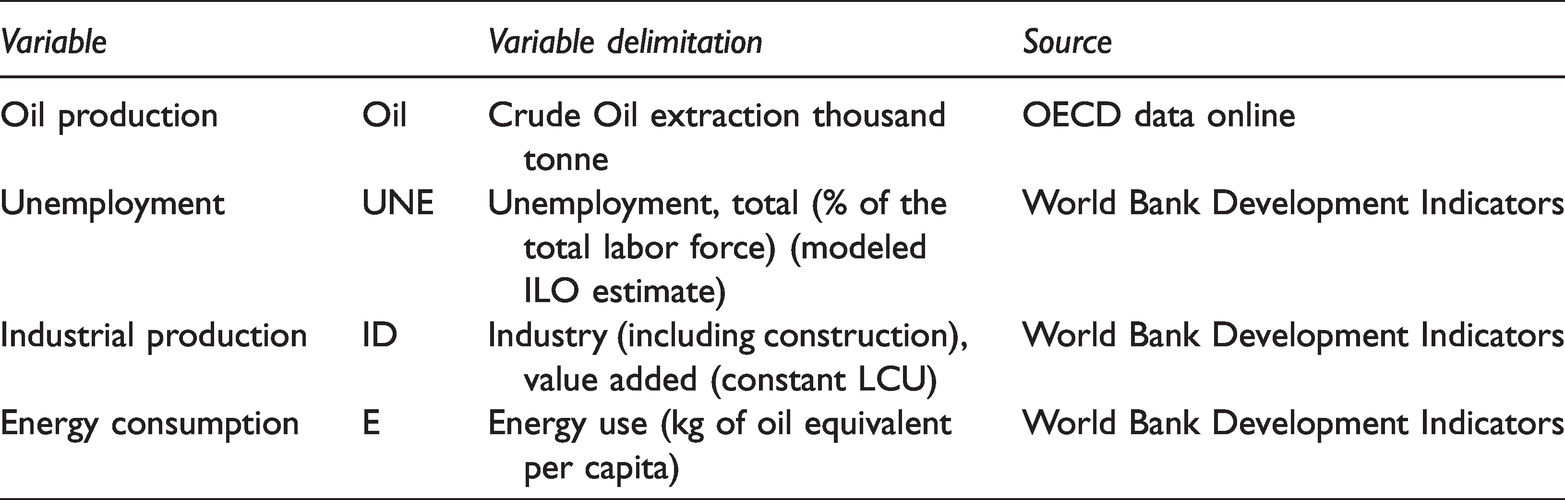
The data of the variables are obtained from the World Bank development indicators and OECD database, Table 1 presents the unit of the variable, definition, and source of the variable, see Appendix 1.
Variable Definition and Data Source.
Results and discussion
ADF unit root analysis
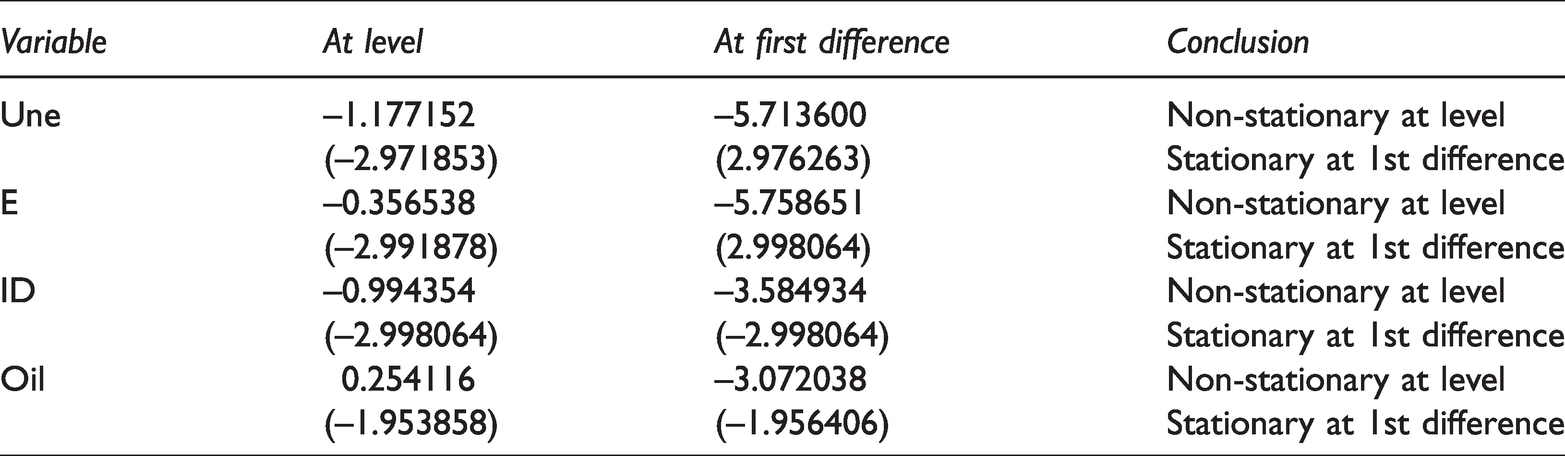
This section provides the results and discussion of VECM model, as first step in formal VECM analysis is the order to integration. It is necessary to test unit root, especially when using the time series data in order to avert the possible spurious results. Besides, order of integration also important to implement the Cointegration test because the same order of integration is one important prerequisite for the application of cointegration. In the presence of mix order integration or at level stationary variable we cannot apply the Johansen or EG cointegration test. Therefore, the ADF provides the desired information, Table 2 presents the ADF results; the ADF results show that all variables are non-stationary at level and become stationary at first difference. The order of integration permits us to apply the cointegration test.
ADF unit root.
Lag length
Table 3 shows that lag length selection by the different criteria, Schwarz information criterion, Final prediction error, and Hannan-Quinn information criterion suggest the 1 lag for the analysis. The lag length is one of the important factors influencing the outcomes, Bahmani-Oskooee and Bohl (2000) argued that long-run relationships depend on optimal lags, the use of too many lags or fewer lags can skip most important information of the model or may cause invalid estimation. Many other researchers also documented the same findings such as Fareed et al. (2018) and Stock and Watson (2012). The improper large selection may lead to misleading results therefore it is important to choose optimal lage length. In our case, it shows one large length to choose.
VAR lag order selection criteria.
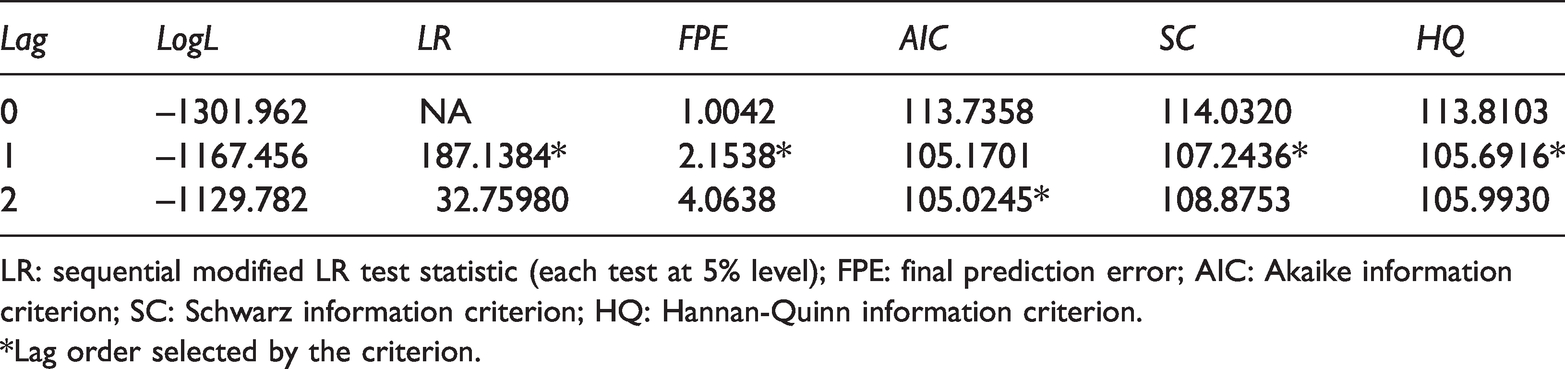
LR: sequential modified LR test statistic (each test at 5% level); FPE: final prediction error; AIC: Akaike information criterion; SC: Schwarz information criterion; HQ: Hannan-Quinn information criterion.
*Lag order selected by the criterion.
Cointegration
Cointegration tests the existence of long-run relationships among the included variables, which clarify whether crude oil production, industrial production, and energy consumption determine unemployment in long run. Table 4 contains the results of the Johannsen Cointegration, it provides the results of two tests, one is trace statistics and the other is the maximum eigenvalue. The rank shows the number of cointegrating vectors, the trace statistics show two cointegrating vectors at 5 percent level of significance, while the maximum eigenvalue provides a single cointegrating vector at a 10 percent level of significance. This implies that crude oil production, industrial production, and energy consumption determine unemployment in long run. In addition, the crude oil, industrial production, and energy consumptions could significantly increase employment opportunities and the long-run objective of low level of unemployment could be successfully achieved by these factors. The crude oil production leads to increase the industrial production, which expands the industrial production and hence leads to lower unemployment in Iran. Besides the other factors affecting unemployement crude oil production could be used as a policy tool in the long run.
Cointegration.
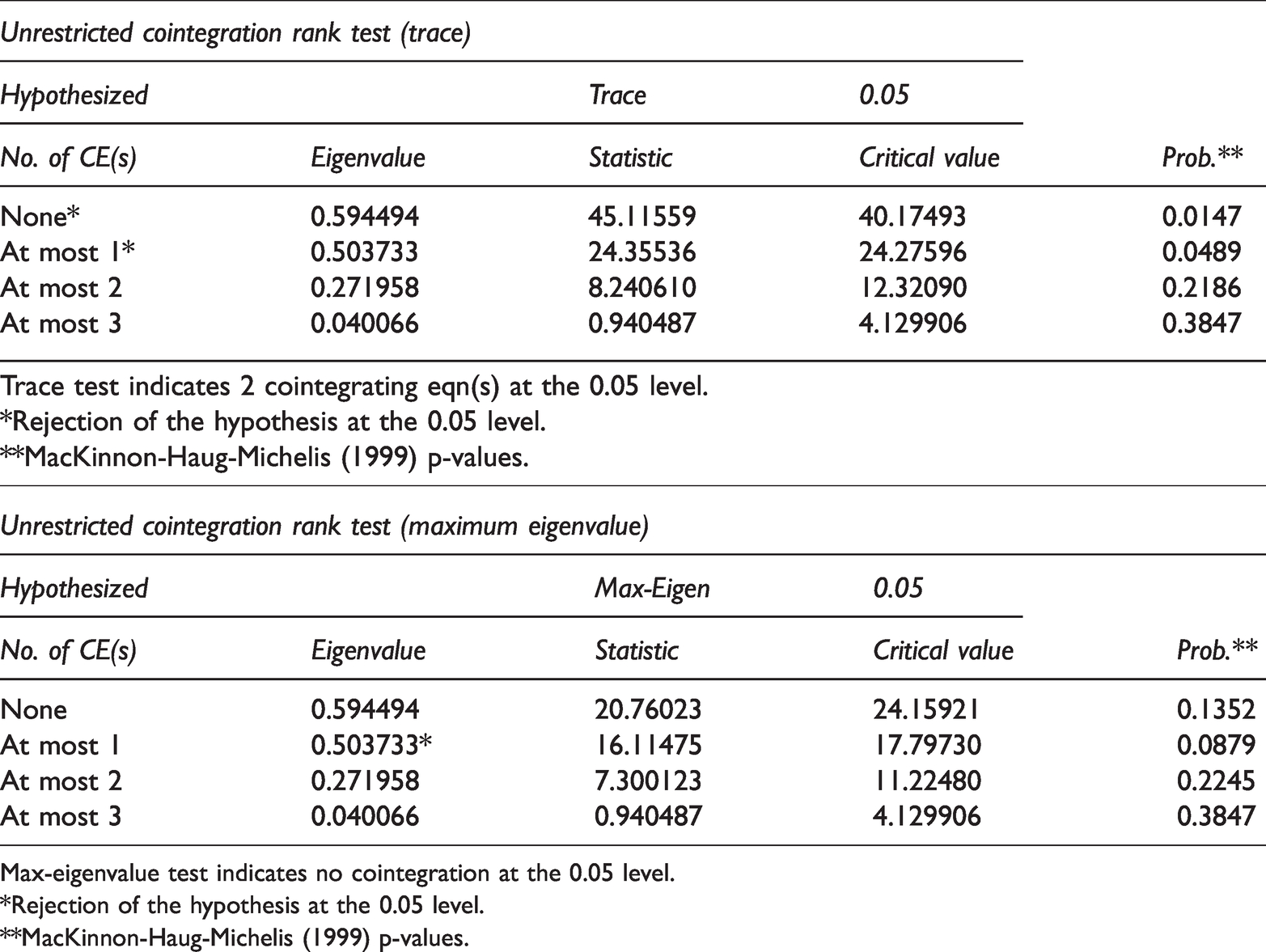
Max-eigenvalue test indicates no cointegration at the 0.05 level. *Rejection of the hypothesis at the 0.05 level.**MacKinnon-Haug-Michelis (1999) p-values.
VECM baseline results
The cointegration results confirm the existence of the long-run relationship, but it doesn’t provide information about short-run and long-run causality in the specific vectors. Therefore, in order to know the short-run and long-run causal relationship between the variables, we apply the VECM. unlike the regression, in VECM estimation we do not show interest in coefficient signs and our main focus is on hypothesis testing for the short run and long-run causality. Since we have four variables in the model so there are four possible vectors for which we are testing the short run and long-run causality.
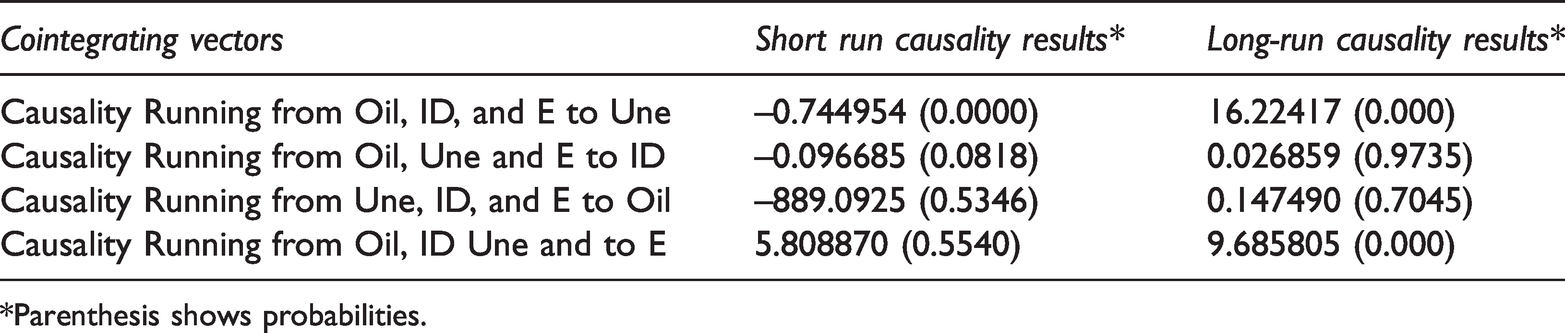
Table 5 presents the short run and long-run causality results; the long results are based on the error term of each cointegrating vector while short run causality test is based on the Wald test estimation based on imposing certain restrictions on the parameters of the cointegrating vectors. The first column in the table shows different vectors and running causality in the vectors, the second column shows the long-run causality statistics while the third column shows short-run causality. The first vector of causality results rejects the null hypothesis for both short-run and long run causality at 1 percent level of significance. The short coefficient value is -0.74, which is signficatnt at 1 percnet level, while long run coefficient value is 16.22 which also significant at 1 percent value. This implies that oil production, industrial production, and energy consumption cause unemployment, which indicates that with oil production provides employment opportunities, similarly industrial production increases the employment opportunities, and hence reduces unemployment. The energy consumption also leads to increase employment opportunities as energy consumption uses an input in industrial production thus lead to higher opportunities in the country and reduce unemployment. Second vector causality results are very interesting; the short coefficient value is -0.096, which is insignificant at 5 percent levels, while long-run coefficient value is 0.026859 which is insignificant at 5 percent value. The outcomes show that in long run there is no causality from Oil, Une and E to ID, while short-run causality indicates the existence of short-run from Oil, Une, and E to ID. It implies that in the short-run crude oil production that is used in energy production could significantly cause industrial production. Energy consumption also enlarges industrial production and unemployment may provide low-cost labor to the industrial sector due to the overall supply of labor in the market thus its industries engage more labor at low cost in the production process. The third vector from ID, E and Une to Oil is insignificant both in the short run and long run. The short coefficient value is -889.09, which is insignificant at 5 percnet level, while long run coefficient value is 0.1474 which is also insignificant at 5 percent value. This result imply that that ID, E, and Une do not affect crude oil production. This result is plausible as most of the crude oil is exported and production of crude oil determined by international factors like crude oil price in the international market, demand for crude oil in the international market etc. The fourth vector provides causal relationship from Oil, ID Une and to E. The short coefficient value is 5.808, which is insignficatnt at 5 percnet level, while long run coefficient value is 09.685805 which is significant at 5 percent value. The outcomes reveal no causality in long run, but in short-run, causality exist from Oil, ID Une and to E. This implies that crude oil production increases the energy production in short-run and most of energy produced in the country generates from fissile energy. Industrial production also affects energy, and the expansion of industrial production, it requires additional energy. The diagnostic test of this model shows that there is no problem with autocorrelation and our models are statistically stable.
Testing the long run and short-run causality based on VECM.
*Parenthesis shows probabilities.
Impulse responses function and variance decomposition analysis
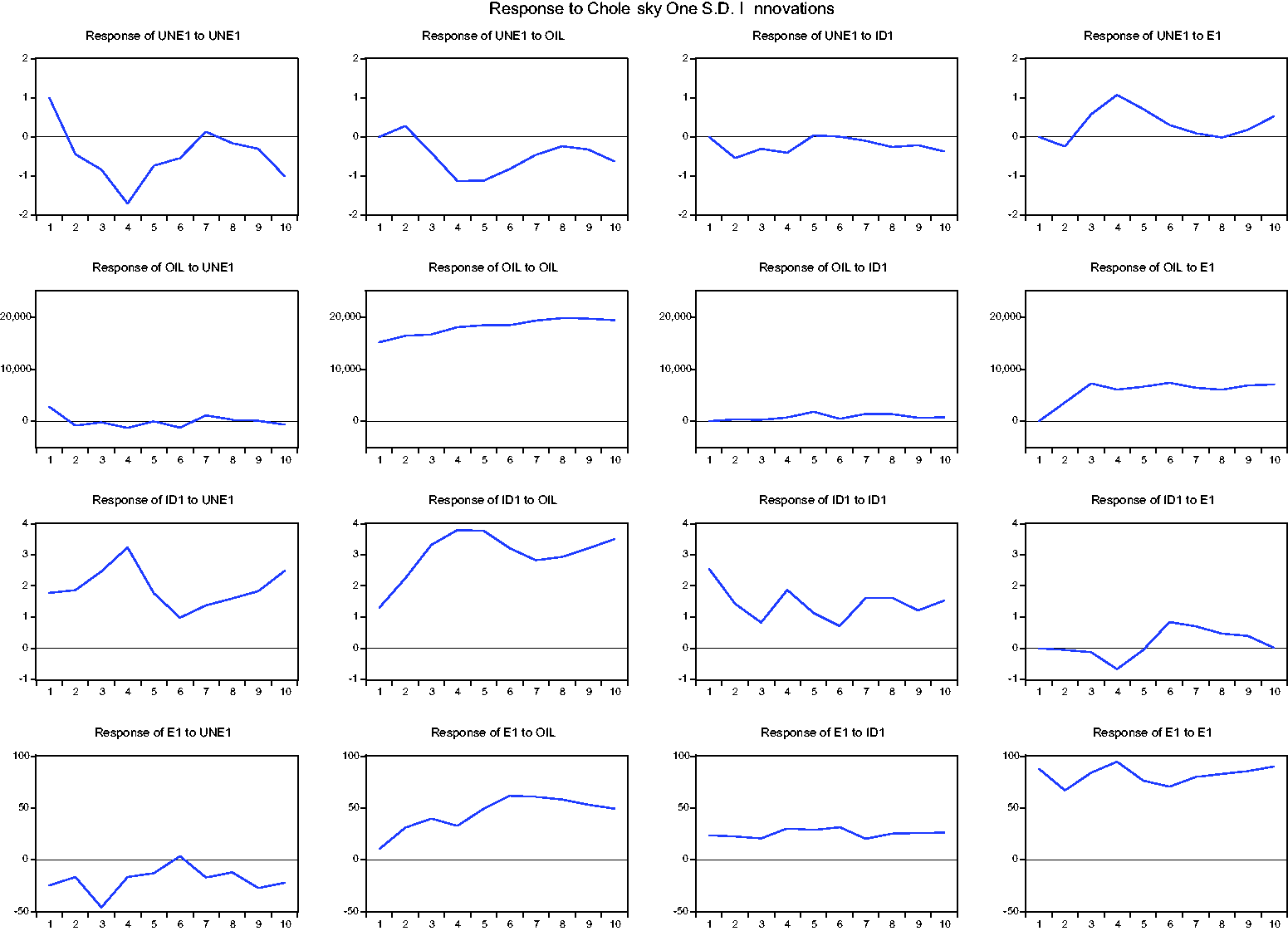
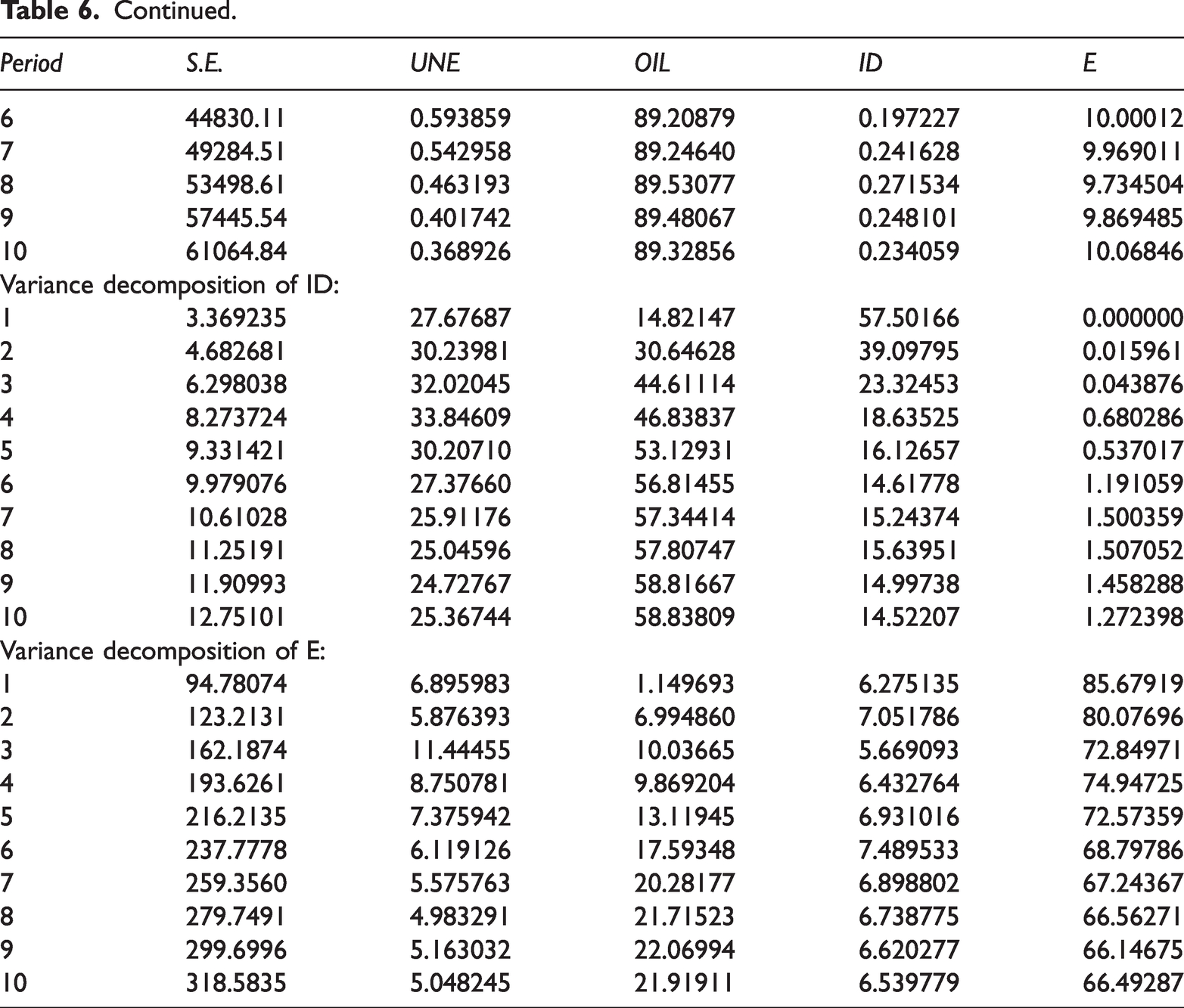
The Granger causality shows causation among the variable but could not provide the magnitude and direction of causation. Therefore, we use variance decomposition analysis and impulse response function to understand the magnitude and direction of the causality respectively. Figure 5 shows the impulse response function and it reports that unemployment has a negative response from its shocks. Similarly, the oil has a negative response to the unemployment from 1st to 10th period, which confirms causality results. Similarly, industrial production has a negative effect on unemployment from 1st to 10th period. While energy response to unemployment shows a mixed outcome from 2nd to 4th and from 9th to 10th period it shows positive but from 4th to 8th period it has a negative association. The impulse response function reports that oil production, industrial production, and energy have a negative association with unemployment. Table 6 contains results for the variance decomposition analysis, it shows a one-stand deviation change in unemployment in the first-period increase unemployment by 100 while oil production, industrial production, and energy have zero increase. In the second period one standard deviation change in oil production increase unemployment by 4.75 percent, while industrial production increase by 17.9 percent and energy increased by 3.47. Each standard deviation in the 3rd to 10th period shows continuously increase oil, industrial production, and energy, and at the 10th period one standard deviation increases in oil production increase unemployment by 29.34, while an increase in industrial production reported by 5.7 percent and energy shows a 17.29 percent increase. The variance decomposition analysis shows that oil is the main determinant of unemployment. Overall the results of our study suggest the long run association between oil production, industrial production, energy consumption, and unemployment in Iran, these findings confirms the other studies outcome such as (Carruth et al., 1998; Doğrul and Soytas, 2010) and (Andreopoulos, 2009) that suggest an oil price affect the unemployment both in the long run and short run. (Karanfil and Pierru, 2021) suggest that oid price deviates with oil production and oil production may affect the oil price which affects the industrial productivity and welfare of the economy. Similarly the findings of (Kocaarslan et al., 2020) shows that oil price has asymatric relationship with unemployment and increase in oil prices lead to increase unemployment. The findings of (Zhang and Liu, 2020) also suggest the causality between oil price and unemployment and both interact by the inflation channel.
Impulse responses function.
Variance decomposition analysis.
Conclusion
Iran is 5th largest oil producer in the world, the curd oil production has a significant contribution to economic growth and manufacturing industries in Iran, besides it is also considered as a major input to the energy production in the economy and it affects the country unemployment level. Therefore, this study explores the causal nexus between crude oil production, industrial production, energy consumption and unemployment in Iran. We used time series data from 1990 to 2018, we demonstrated VECM methodology for the empirical estimation. VECM provides short-run and long-run causality among variables. The empirical outcomes show that unemployment determines by crude oil production, industrial production, and energy consumption in Iran. This indicates that oil production provides employment opportunities which thereby reduce unemployment. Similarly, industrial production also contributes to the country's employment and industrial production reduces unemployment in the economy in long run. The energy also stimulates to run of various businesses and thereby increase employment and reduces unemployment in the economy. The causality results also support the baseline results and we found causality from crude oil, industrial production, and energy consumption to unemployment both in the short run and long run. This implies that crude oil and industrial production could potentially reduce unemployment both in short-run and long-run. In addition, in the short run oil production and energy consumption causes industrial production. This indicates that oil production has a significant influence to determine industrial production and crude oil production may expand industrial production by supplementing the energy sector. The results of this study support the previous studies findings such as (Carruth et al., 1998; Doğrul and Soytas, 2010) and (Andreopoulos, 2009; Kocaarslan et al., 2020) Michieka and Gearhart (2015); Ortego-Marti (2017);Ordóñez, Monfort, and Cuestas (2019). Zhang and Liu (2020) concluded that oil price affects the unemployment. The crude oil production could be a significant tool to reduce unemployment in the economy and it may help the government to achieve the macroeconomic policy objectives, especially unemployment goals. The decision of crude oil production primarily depends on the oil price in the international market and demand for crude oil in the international market and crude oil production is a supplement to industries and energy consumption. Even though oil production facilitates the local industrial production and energy demand, yet government should seek substitutes of oil-based energy resources to lessen dependence on a single type of fuel. The alternate energy resources such as the development of renewable forms of energy, the use of waste as a secondary energy source, and the adoption of energy conservation practices on a national scale could provide additional energy resources. Since the industries and unemployment has a causal relationship therefore the government should focus on the provision of skill education to the labor, which enables labor to absorb in the industrial sector. The study has some limitations as it only focuses on the single countries, the oil production and unemployment hypothesis could be tested for the OPEC countries. Moreover, the effect of oil production on poverty could be an interesting research area.
Footnotes
Declaration of conflicting interests
The author(s) declared no potential conflicts of interest with respect to the research, authorship, and/or publication of this article.
Funding
The author(s) received no financial support for the research, authorship, and/or publication of this article.
