




Abstract
Although new energy has been widely used in our lives, oil is still one of the main energy sources in the world. After the application of traditional oil recovery methods, there are still a large number of oil layers that have not been exploited, and there is still a need to further increase oil recovery to meet the urgent need for oil in the world economic development. Chemically enhanced oil recovery (CEOR) is considered to be a kind of effective enhanced oil recovery technology, which has achieved good results in the field, but these technologies cannot simultaneously effectively improve oil sweep efficiency, oil washing efficiency, good injectability, and reservoir environment adaptability. Viscoelastic surfactants (VES) have unique micelle structure and aggregation behavior, high efficiency in reducing the interfacial tension of oil and water, and the most important and unique viscoelasticity, etc., which has attracted the attention of academics and field experts and introduced into the technical research of enhanced oil recovery. In this paper, the mechanism and research status of viscoelastic surfactant flooding are discussed in detail and focused, and the results of viscoelastic surfactant flooding experiments under different conditions are summarized. Finally, the problems to be solved by viscoelastic surfactant flooding are introduced, and the countermeasures to solve the problems are put forward. This overview presents extensive information about viscoelastic surfactant flooding used for EOR, and is intended to help researchers and professionals in this field understand the current situation.
Introduction
Oil has always been the most important energy source, and it will make an important contribution to meeting future energy needs (Balasubramanian et al., 2018; Lakatos, 2005). As a fluid deposit buried deep in the stratum, compared with other mineral resources, the special extraction method of oil makes the recovery rate always low. Petroleum is a non-renewable resource, and the total geological reserves are certain. As the degree of exploration increases, the difficulty of adding geological reserves will be enormous, and the mining potential is getting smaller and smaller. Therefore, oil recoverable reserves will increasingly depend on the improvement of oil recovery in proven geological reserves. With the increase in global energy demand and the reduction of energy resources, maximizing oil recovery from previously under-exploited reserves is essential to meet the growing energy demand (Guangzhi et al., 2017; Ogiriki et al., 2018; Shiyi and Qiang, 2018).
By convention, oil recovery methods can be divided into three categories: primary, secondary and tertiary (commonly referred to as enhanced oil recovery EOR) processes (Alkafeef and Zaid, 2007; Pal et al., 2016). In the primary process, the oil is forced out of the oil formation by the existing natural prevailing in the reservoir. Generally, only 5–10% of the original oil in place can be recovered. At present, most oil fields start to inject water or natural gas into the reservoir to maintain pressure, and then use the natural energy of the reservoir as the driving force for oil displacement, thereby performing secondary oil recovery (Morvan et al., 2009; Siggel et al., 2012). The oil recovered through the primary and secondary processes can only produce a small part of the petroleum geological reserves, leaving behind around 60% ∼ 70% as remaining oil in reservoirs (Rui et al., 2017; Zhong et al., 2018b, 2020). Therefore, judging from the natural law of oilfield development, traditional water injection mining is only a stage in the entire process of oilfield development. How to use advanced technology to extract the remaining oil as economically and efficiently as possible, that is, to improve the oil recovery, is an inevitable problem faced by all oilfield developments.
Based on conventional oil displacement technology, the oil recovery method that improves the physical and chemical properties of reservoirs and reservoir fluids, regulates the flow characteristics of reservoir fluids, and improves macroscopic sweep efficiency and microscopic oil displacement efficiency is called enhanced oil recovery technology (EOR). It includes all oil production methods except the exploitation of natural energy and water injection to supplement formation energy and maintain formation pressure. Under this definition, according to the displacement medium and displacement method, the existing EOR technology can be divided into Chemical EOR (CEOR), gas flooding, thermal oil recovery, and microbial enhanced oil recovery. Among them, CEOR is one of the most promising technologies to enhance oil recovery (Gbadamosi et al., 2019; Kamal et al., 2017). In the early 1980s, many researchers focused their attention on CEOR research. Chemical EOR (CEOR) methods have received special attention over other methods due to its effectiveness, technical and economic feasibilities (Balasubramanian et al., 2018; Gbadamosi et al., 2019; Hu et al., 2018; Siggel et al., 2012). As oil prices continue to rise, global oil demand continues to increase, new oil fields are rarely discovered and global oil fields are rapidly maturing, CEOR technologies have drawn increased interest(Al-Adasani and Bai, 2010). In China, the successful application of CEOR in the Daqing Oilfield, Shengli Oilfield, Kelamayi Oilfield, etc. provides a guarantee for the long-term stable production (Zhang et al., 2016; Zhu, 2015). According to reports, China's chemical flooding related technologies accounted for more than 55% of EOR produced oil in China (Gao, 2014; Guo et al., 2018).
Traditional CEOR technologies development and limitations
All oil recovery methods with specific chemical agents or their composite systems as the oil displacement agent and the basic principle of improving the flow characteristics of formation fluid and the interface between the oil displacement agent, crude oil, and reservoir pores are collectively referred to as chemical flooding, also known as chemical EOR (CEOR) technology. Traditional CEOR technology is divided into single chemical flooding and chemical combination flooding. The chemical EOR methods involve an injection of various chemicals, usually as dilute solutions, to control mobility and reduce oil-water interfacial tension. Chemicals such as water-soluble polymers, surfactants, and alkalis are usually flooded in the aqueous form (Samin et al., 2017; Yousefvand and Jafari, 2015). Next, the oil displacement mechanism and the actual problems in oil field production of various chemical flooding are discussed.
Mechanism of oil displacement
The target of various CEOR technologies is the remaining oil in the reservoir. The basic principle is to improve the dynamic characteristics of the displacement medium in the reservoir, the physical and chemical characteristics of the interaction between the displacement medium and the crude oil, and the physical and chemical characteristics of the oil layer. The focus of the CEOR method is to improve the oil displacement efficiency by reducing the residual oil saturation in the swept regions, or to improve the oil sweep efficiency by displacing the remaining oil in the unswept area (Al-Adasani and Bai, 2010; Slattery, 1974; Stegemeier, 1977). Two major approaches are used in CEOR: 1) increasing the viscosity of the injected fluid to improve the mobility ratio between the flooding fluid and oil hereby improving the volumetric sweep efficiency or 2) adding fluid to lower the interfacial tension (IFT) between oil and water allowing trapped oil to flow through tight pore necks (Siggel et al., 2012). Mobility control is usually achieved by adding polymers to increase the viscosity of the displacement fluid, while IFT reduction and wettability changes are usually achieved by adding surfactants and alkaline (Abdurrahman, 2017; Han et al., 2013; Zhong et al., 2020). The following commonly used single chemical flooding technology's oil displacement mechanism. See Table 1 for details:
Summary of oil displacement mechanism of single chemical flooding technology.
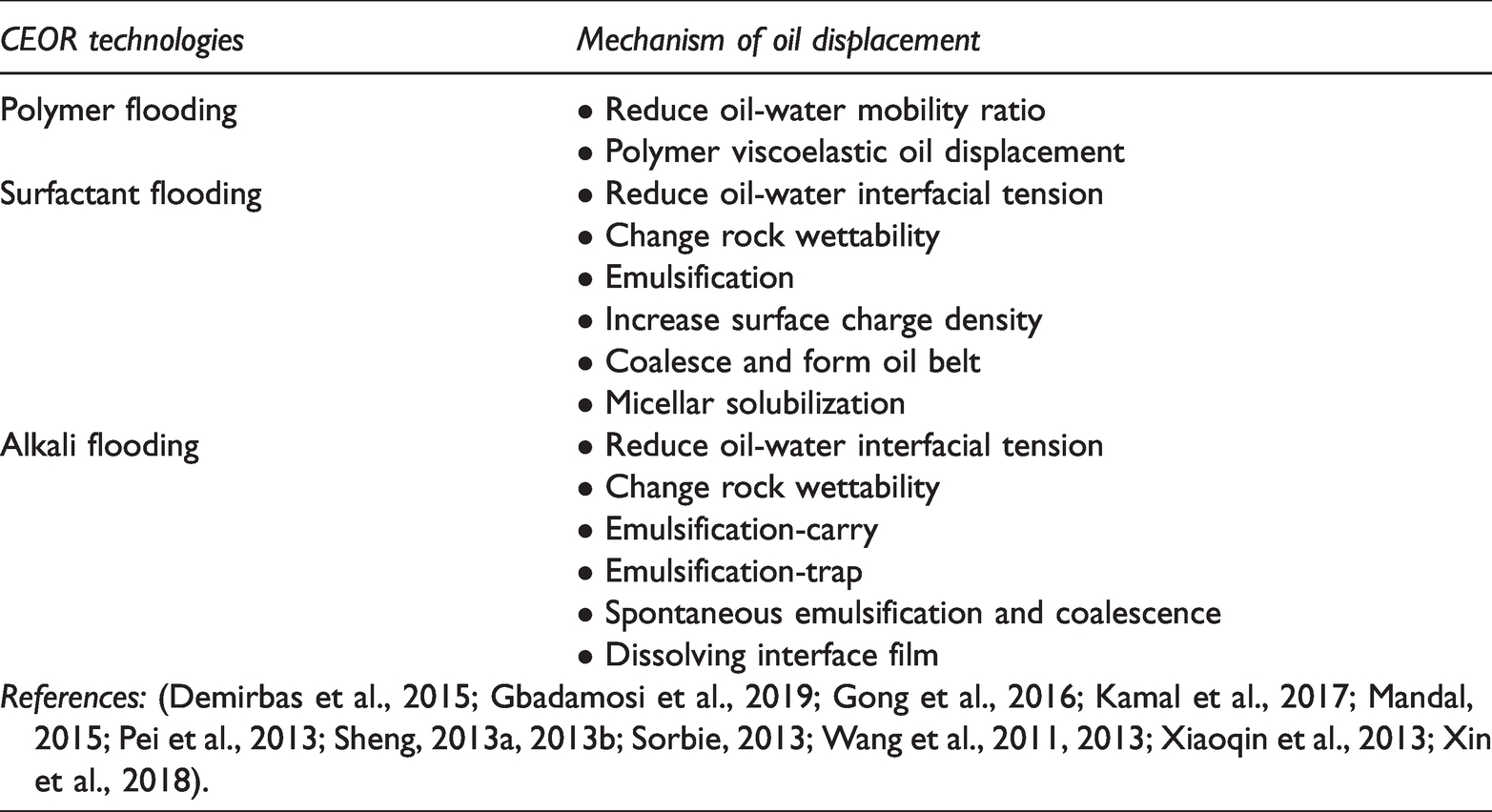
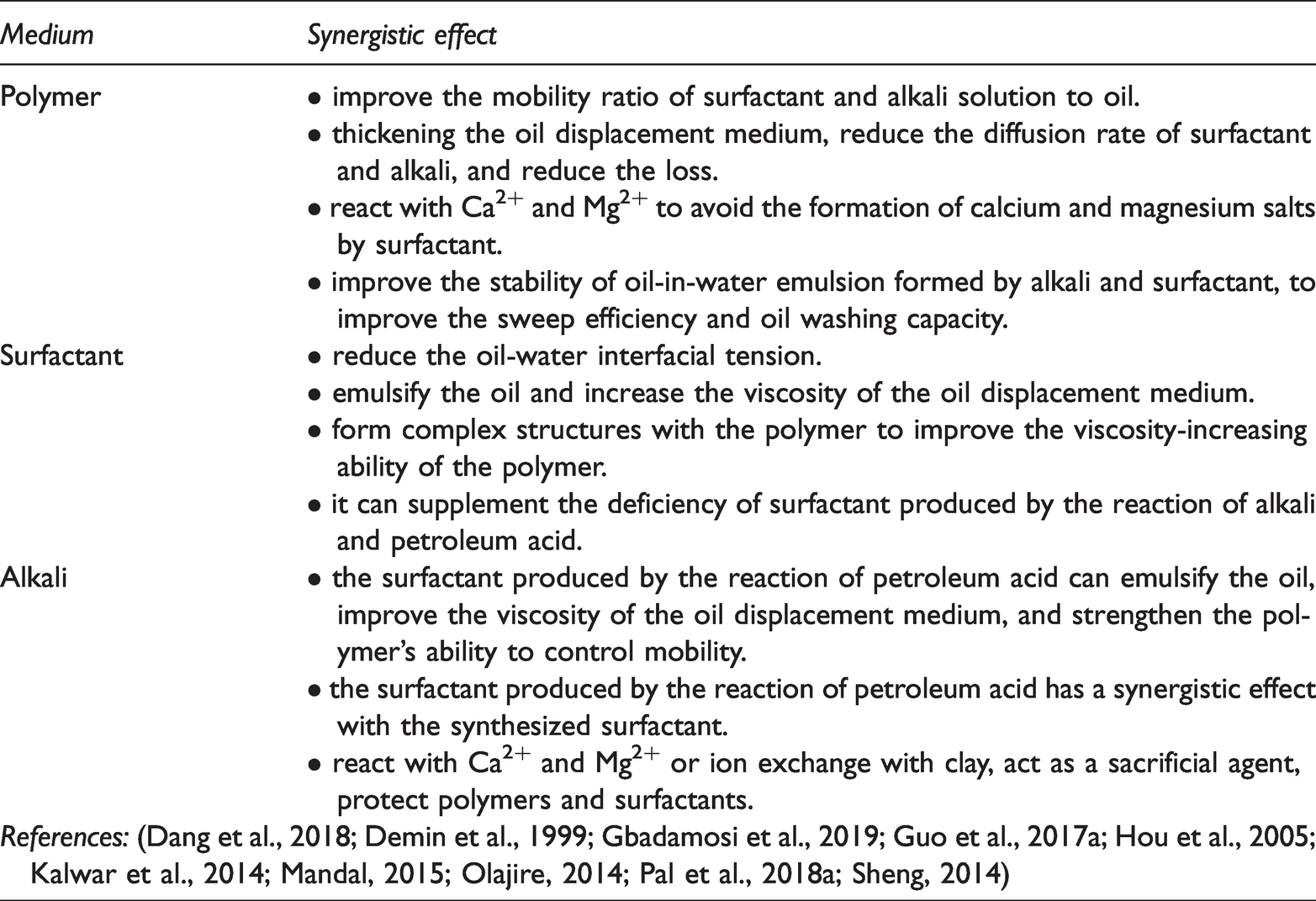
Due to the limitations of conventional single chemical flooding technology, the concept of chemical combined flooding is proposed, and the most representative one is alkaline-surfactant-polymer (ASP) flooding (Abdurrahman, 2017; Guo et al., 2018; Khalilinezhad et al., 2016; Yang et al., 2019). Regarding the ASP flooding mechanism, researchers have conducted many in-depth studies in recent years. However, due to the particularity and complexity of the system itself, a complete theory has not yet been formed, and many issues are worth further study. The most basic principle is to make use of its characteristics to make up for the shortcomings of single-component oil displacement performance, that is, to utilize the combined effect of each component during oil displacement to improve oil recovery. See Table 2 for details:
Synergistic effect between oil displacement components in ASP flooding.
The technical problems in current field applications
Although chemical flooding enhanced oil recovery technologies have been widely used, it still encounters increasingly complex technical problems. With changes in reservoir conditions (high temperature, pressure, salinity, and heterogeneity) and crude oil compositions, existing chemicals used in chemical EOR have unsatisfactory effects on enhancing oil recovery. These conditions have detrimental effects on the performance of EOR chemicals, such as precipitation, degradation, adsorption, etc (Delamaide et al., 2014a; Han et al., 2013; Lakatos, 2005).
Polymer flooding
Polymer flooding has been widely used in large scale field (Sheng, 2013a). However, polymer injection is not always a viable option. The relative molecular mass of the polymer used for oil displacement is relatively large, the injection pressure is high, and the injection performance is poor, and may even block the formation and cause formation damage (Dann et al., 1982; Gbadamosi et al., 2019). It is generally believed that reservoirs with permeability lower than 20mD are not suitable for polymer flooding. In recent years, relevant expert studies have shown that polymer flooding can also be carried out in low permeability reservoirs (Wang et al., 2011, 2013, 2015). However, the impact of polymer injection performance and inaccessible pore volume on the oil displacement effect must be fully considered, and other factors such as start-up pressure gradient, reservoir temperature, salinity, shear, and thermal degradation must be considered comprehensively (Dongling et al., 2005; Wang et al., 2015; Xiaoqin et al., 2013). It is required to select the polymer with an appropriate molecular weight that matches the permeability (Dandan et al., 2014; Peng et al., 2005). However, for unconventional reservoirs such as low permeability and ultra-low permeability, limited by injection performance, only polymers with lower molecular weight can be selected. In this way, the injection pressure is reduced and the injection performance is improved, but the viscosity-increasing effect is poor, and it cannot improve the water-oil mobility ratio and give full play to its ability to enhance oil recovery (Gbadamosi et al., 2019; Sorbie, 2013).
Surfactant flooding
By the 1970s, with the large-scale application of synthetic surfactants, surfactants have been considered as one of the good chemical EOR oil displacement agents (Healy and Reed, 1974; Hill et al., 1973). The loss of surfactants in the reservoir is a key issue that restricts the industrial application of surfactant flooding technology. The factors that cause the loss of surfactants in the oil displacement process are complex. So far, there is no unified understanding. It is generally believed that the loss of surfactant mainly includes precipitation loss and adsorption loss. The reaction of the surfactants with the divalent ions (especially Ca2+ and Mg2+) present in the formation of water produces calcium carbonate and calcium hydroxide precipitation (Chang et al., 2018; ShamsiJazeyi et al., 2014b). At the same time, the adsorption of surfactants on the pores of the reservoir will cause the concentration of surfactants to decrease, thus reducing the oil-water interfacial tension, which makes it difficult to ensure the displacement efficiency of surfactants in the reservoir (Gbadamosi et al., 2019; Hanamertani et al., 2018; Yekeen et al., 2017). To reduce the loss of surfactant, the complex surfactant system is often used to improve the salt tolerance and reduce the adsorption capacity; or adding sacrificial agents to inhibit the adsorption of surfactant; or adding chelating agents to prevent the high-valence metal ions from generating precipitation with the surfactant. However, the multi-components of the oil displacement system may cause chromatographic separation in the reservoir during the displacement process and affect the oil displacement effect (Siggel et al., 2012).
Alkali flooding
Alkali flooding field trials mostly focused on the 20th century. However, the alkaline flooding mechanism is complex, the performance of alkaline flooding alone is not stable enough, and there is no industrial promotion and application, but because of the low price, it has attracted the attention of petroleum workers (Gbadamosi et al., 2019; Mandal, 2015). In the process of oil displacement, the alkaline substance reacts with the petroleum acid in the crude oil to form the surface-active substances underground, thereby achieving the purpose of reducing the oil-water interfacial tension and forming the emulsion (Pei et al., 2013). Therefore, crude oil in the oil layer is required to have a sufficiently high acid value. When the acid value of crude oil is less than 0.2 mg/g, the reservoir is not suitable for alkaline flooding (Mandal, 2015; Symonds et al., 1991). Besides, alkali is more sensitive to divalent ions. Under the influence of pressure, temperature, and pH value, sodium ions in alkali liquor will exchange with Ca2+ and Mg2+ in the rock formation, forming precipitation, causing scaling in the injection system and near-well zone of injection well, which is very detrimental for oil displacement (Gbadamosi et al., 2019; Jennings et al., 1974).
Alkaline-surfactant-polymer (ASP) flooding
ASP flooding technology involves alkali, surfactants, and polymer solutions, compounding chemical agents with different flooding characteristics into an efficient compound flooding system (Morvan et al., 2009; Youyi et al., 2013; Zhu, 2015). In terms of mechanism, ASP flooding has the advantages of alkali flooding, surfactant flooding, and polymer flooding, and has a synergistic effect between the three components, but there are still many key issues that need to be solved. First of all, the adsorption and retention of chemical agents in the pores of the reservoir causes a considerable part of the loss in the reservoir near the injection well, especially the loss of surfactant is the most serious, which greatly reduces the performance of the oil displacement system after reaching the deep part of the reservoir (Dai, 2018; Gbadamosi et al., 2019; Yuan and Wood, 2018; Zhong et al., 2018a, 2020). Secondly, in both laboratory and field experiments, it was found that the composite system had obvious chromatographic separation during the migration and oil displacement in the porous medium. The reason is that the molecular weight of each component in the composite system is different, and the interaction characteristics with the pore surface are different. Due to the separation of the components, the synergistic effect (super-additive effect) of the composite system will definitely be weakened(Li et al., 2009; Ren et al., 2016). Thirdly, in the field experiment, it was found that the scale formation of the wellbore of the production well was very serious. This is mainly due to the scaling caused by the alkali in the system dissolving the reservoir skeleton. Therefore, the damage of the alkali-containing composite system to the reservoir during the flooding process cannot be ignored (Chen et al., 2014; Guo et al., 2017b; Wang et al., 2016). Finally, the ternary compound flooding produced fluid emulsification degree is very serious, the emulsion structure is very complicated, and the production fluid treatment cost is high (Demin et al., 1999; Guo et al., 2017a; Nguyen and Sadeghi, 2012; Olajire, 2014).
In summary, the current commonly used chemical flooding enhanced oil recovery technology cannot meet the needs of effectively improving sweep efficiency, oil washing efficiency, good injectability, and reservoir environmental adaptability.
Research on viscoelastic surfactant for CEOR
Overview of viscoelastic surfactant
Viscoelastic surfactants (VES) are a class of surfactants that have viscoelastic properties in aqueous solution. Viscoelastic surfactants were first reported for upstream oil and gas applications in gravel pack completions and fracturing packs (Brown et al., 1996; Nehmer, 1988; Stewart et al., 1995). Later they also developed into fluids for hydraulic fracturing (Samuel et al., 1999, 2000). Compared to polymer-based systems, VES fracturing fluids are substantially free of solids, which means that residues will not be deposited in the formation or proppant, so these fluids are more effective in increasing the production of hydraulic fracturing reservoirs. Another major application area of viscoelastic surfactants is matrix acidification (Chang et al., 2001a, 2001b), which is widely used to improve the productivity and injectability of drilling in carbonate reservoirs (Hull et al., 2016).
Similar to conventional surfactants, viscoelastic surfactants are also composed of hydrophilic head groups and hydrophobic chains. However, viscoelastic surfactants have remarkable viscoelasticity character due to the ability to form wormlike micelles and entangled structures through hydrophobic interactions, electrostatic interactions, and hydrogen bond interactions in aqueous solutions (Li et al., 2016b; Yu et al., 2009).
The formation process of wormlike micelles is shown in Figure 1. When the concentration of the viscoelastic surfactant solution is low, the solution is in a state of monomolecular dispersion, or through molecular self-assembly to form spherical micelles, the solution viscosity is very low, and it appears as the Newtonian fluid at this time. Continue to increase the concentration of surfactants, micelles can “grow” and “lengthen” to form short rod-shaped micelles. Under certain entropy conditions, the energy required to produce two hemispherical end caps from a semi-infinite cylinder is very large, so it will elongate along the one-dimensional non-axial direction and self-assemble into a wormlike glue. At this time, the viscosity of the solution suddenly increased. After the surfactant concentration reaches the critical entanglement concentration, the flexible wormlike micelles are entangled, adhered, and even fused under the action of the applied shearing force and molecular thermal motion, forming a kind of supramolecular three-dimensional network structure. The viscosity and viscoelasticity of the solution become more and more obvious, forming the viscoelastic fluid (Dreiss, 2007; Moore et al., 2018; Pal et al., 2018b; van Santvoort and Golombok, 2015;Yu and Nasr-El-Din, 2009).
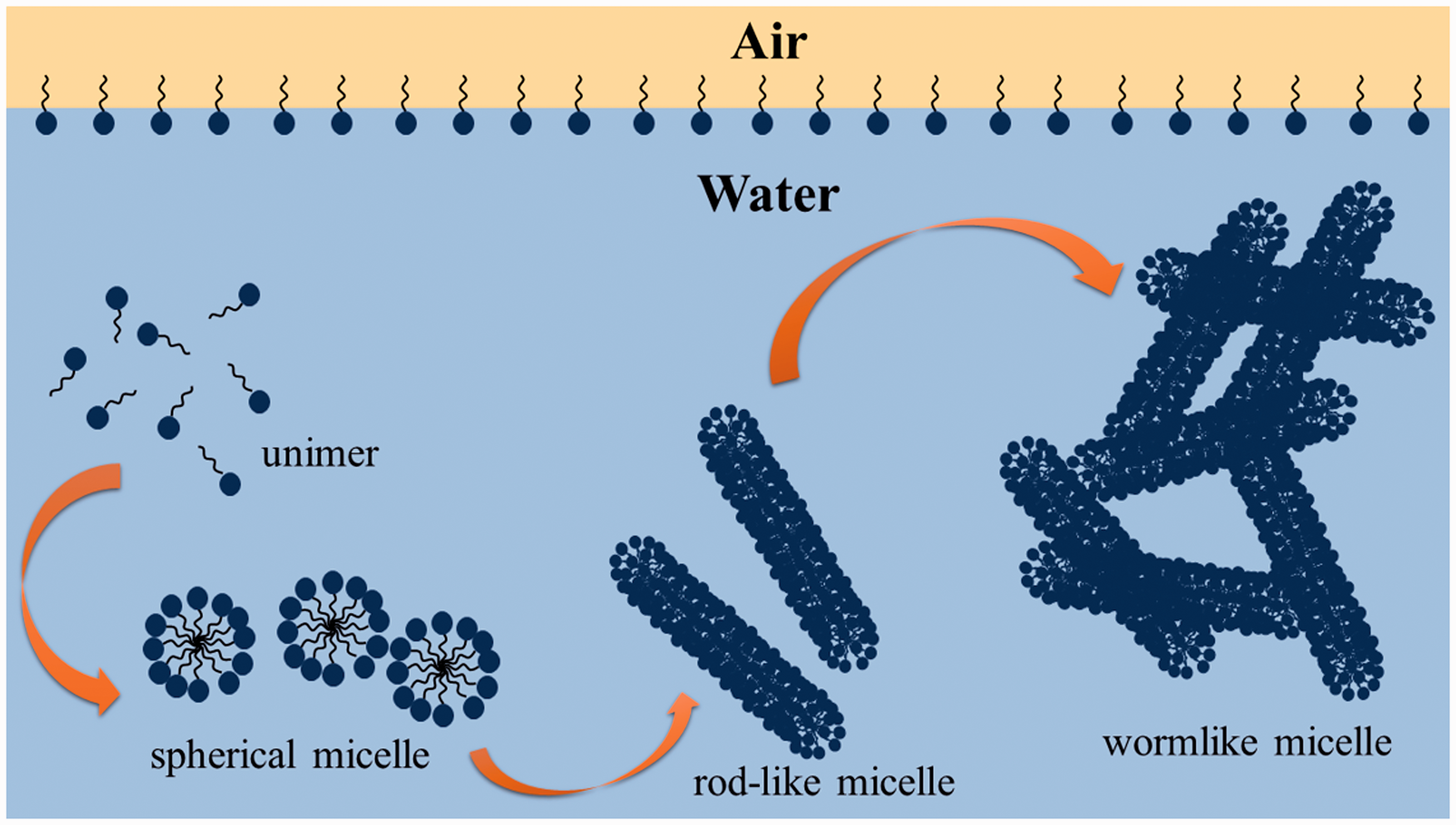
Viscoelastic surfactants self-assemble into wormlike micelles in aqueous solution.
From this perspective, the viscoelastic surfactant wormlike micelle solution behaves similarly to the polymer solution. But compared with polymers, the viscosity-increasing mechanism of viscoelastic surfactants is different. Taking HPAM as an example, the interaction between water molecules and long-chain HPAM molecules is prepared by polymerization reaction through the formation of amido bonds among monomers impart viscosity to the fluid. Once the shear force breaks the covalent bond between HPAM molecules, the long-chain molecules will be separated into relatively short segments, and the solution viscosity will irreversibly decrease. However, the network-like supramolecular wormlike micelle structures formed by the viscoelastic surfactants through hydrophobic interaction, electrostatic interaction, and hydrogen bonding interaction increases the viscosity of the solutions. Wormlike micelles are ordered molecular assemblies formed by the aggregation of monomers under the action of non-covalent bonds. Since the three-dimensional network structure formed by self-assembly in the micellar solution is temporary, these micellar structures have been in a dynamic equilibrium of entanglement and dispersion, reorganization and fracture. When the wormlike micelle structures are destroyed by shearing, the network structures can be restored to its original state through the interaction of molecules, and the viscosity of the solution can be restored. Due to this property, viscoelastic surfactants are often called “active polymers” (Degre et al., 2012; Haiming et al., 2011; Hongyan et al., 2017; Siggel et al., 2012; van Santvoort and Golombok, 2015).
In traditional chemical flooding to enhance oil recovery, macromolecular high-viscosity polymers are usually injected into the formation to use its viscoelasticity to expand the swept volume for oil displacement. However, polymers are degradable at high temperatures, high salinity, and high shear rate harm on their viscosity, and are also unsatisfactory in terms of injectability (Gbadamosi et al., 2019; Zhu et al., 2016). Because viscoelastic surfactants are small molecules, they can be easily injected into low-permeability reservoirs where macromolecular polymers are difficult to flow into, so they can mobilize more residual oil (Li et al., 2019). Istvan Lakatos et al. (2007) first evaluated viscoelastic surfactants as mobility controlling agents used as pre-flush, co-surfactant, and post-buffer media. Studies have shown that viscoelastic surfactants can replace traditional mobility control agents (polymers) in a wide range of temperatures and pressures. Their sensitivity to shear rate and other degradation effects are much lower than that of high molecular weight synthetic and biopolymers. Under the same conditions, a single low interfacial tension surfactant flooding can only increase oil recovery by 5% ∼ 7%, while the low interfacial tension viscoelastic surfactant flooding can increase the recovery efficiency up to 15 ∼ 17%. Their positive effect on recovery efficiency can be explained by mobility control, front stabilization (buffering), improve micro-displacement efficiency, and contour correction. These studies have opened up new prospects for the application of viscoelastic surfactants in chemical flooding to improve recovery.
In summary, the viscoelastic surfactant can completely replace the polymer solution as the chemical oil displacement agent.
Mechanism of viscoelastic surfactant flooding to enhance oil recovery
In the process of oil recovery, the overall oil displacement efficiency is a combination of macroscopic and microscopic displacement efficiency. Macroscopic displacement efficiency is a measure of the effectiveness of the injected fluids in contacting the oil zone volumetrically with respect to the total reservoir volume while microscopic displacement efficiency is the efficiency related to the ability of the displacing fluid to mobilize oil trapped at the pore scale when it contacts the oil (Gbadamosi et al., 2019).
Macroscopic mechanism
During the flooding process, the injected fluid follows the path of the lowest resistance. Due to the heterogeneity of the reservoir, high permeability zones and/or fractures form the preferential flow paths with low flow resistance. These preferential paths act as “thief zones”, and most of the displacement fluid flows through these “channels”, bypassing the oil-rich zones in the low permeability zone (Sang et al., 2014). The excellent rheological properties of viscoelastic surfactants can effectively overcome the preferential flow in heterogeneous reservoirs, which helps to improve the macroscopic oil displacement efficiency (van Santvoort and Golombok, 2018).
Viscoelastic surfactants, as the viscoelastic fluid, exhibit the rheological phenomenon of Couette flow when flowing in the formation. The shear response is non-power law and non-monotonic. The solution exhibited non-monotonic, successive thickening, and thinning behavior under the action of shear (Hartmann and Cressely, 1997a, 1997b; Vasudevan et al., 2010). The schematic diagram of non-monotonic, shear-thickening/shear-thinning of viscoelastic surfactants in heterogeneous porous media is shown in Figure 2, where the relationship between viscosity and shear rate is displayed (van Santvoort and Golombok, 2015). At low shear rates, the viscosity of the solution is relatively constant. As the shear rate increases further, the shear induced structures are formed which increases the viscosity (shear-thickening). The shear-thickening behavior is a consequence of the formation of shear induced structures arising from the shear-induced motion of the micelles (Cressely and Hartmann, 1998; Vasudevan et al., 2008). If the shear rate is further increased, the formed structure will dissolve and the viscosity will be reduced(shear-thinning) (van Santvoort and Golombok, 2016b, 2018).
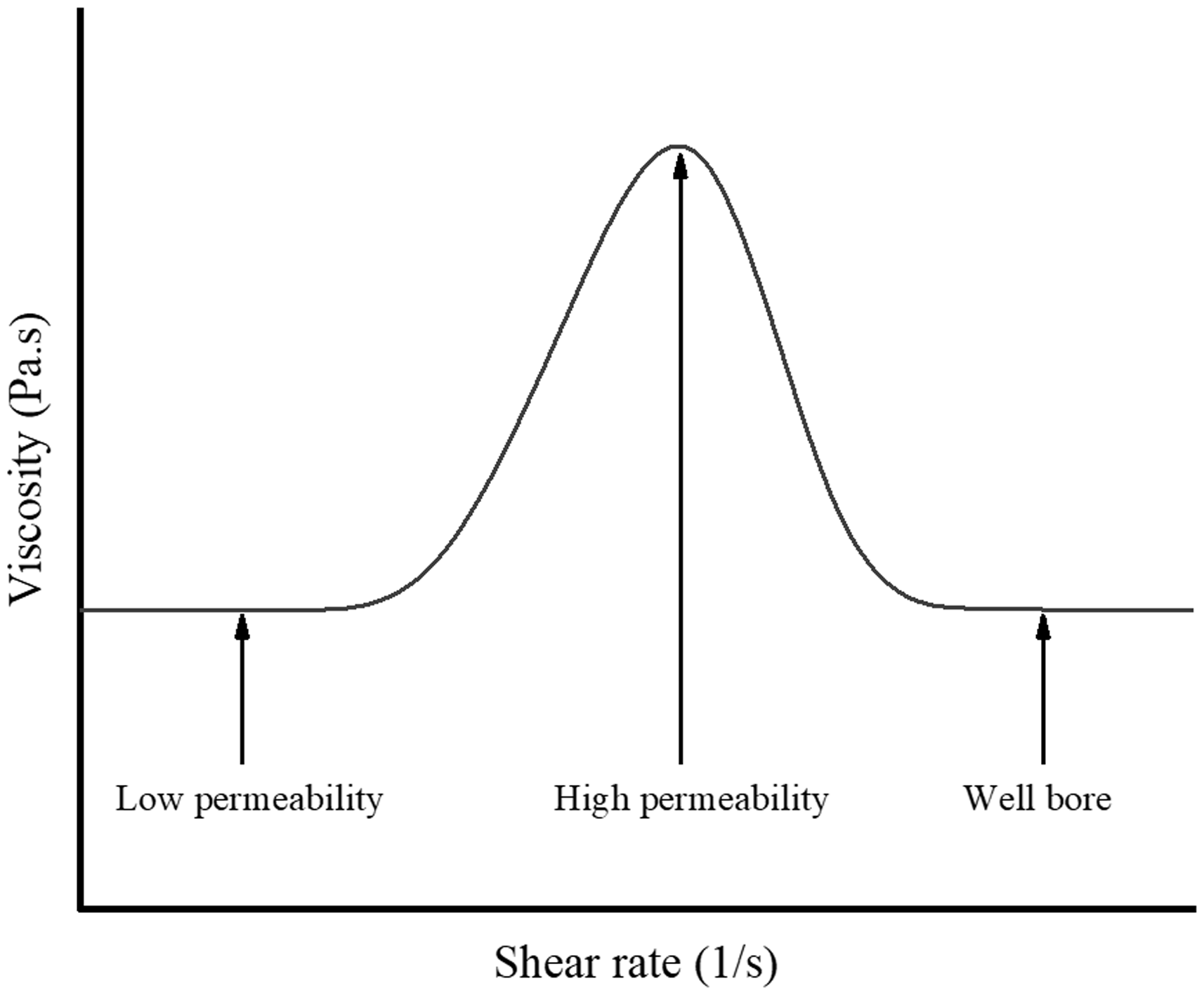
Schematic non-monotonic, shear-thickening/shear-thinning response of viscoelastic surfactant in heterogeneous porous media.
The shear-thickening behavior of viscoelastic surfactants can increase fluid viscosity in high permeability regions, and reduce fluid viscosity in low permeability regions where the shear rate is lower. Figure 2 shows how the viscoelastic surfactant solution matches this behavior. Previous studies have shown that this can reduce the flow through the high permeability zones by selectively changing the viscosity, allowing a large amount of oil displacing agent to flow into the low permeability area of the rich oil zone for oil displacement, thereby expanding the swept volume and improving the macroscopic oil displacement efficiency (Golombok and van der Wijst, 2013; Smeets and Golombok, 2010; van Santvoort and Golombok, 2015, 2016a, 2018).
Microscopic mechanism
The broad consensus is that the main microscopic mechanism of surfactants to enhance oil recovery is to reduce oil-water interfacial tension, wettability reversal, emulsification, etc (Kamal et al., 2018; Kumar et al., 2016; Li et al., 2019). In addition to these, recent reports indicate that the unique viscoelasticity of viscoelastic surfactants is conducive to improving sweep efficiency during oil displacement, and at the same time improving microscale displacement efficiency (van Santvoort and Golombok, 2015, 2016a). This allows the potential of viscoelastic surfactants to further improve oil recovery after water flooding (Li et al., 2016b).
To better understand the microscopic mechanism of viscoelastic surfactants in EOR, Kexing Li et al. (2019) examined to examine the microfluidics of viscoelastic surfactants by using a glass etching microscopic model. By observing the restart and distribution characteristics of oil under viscoelastic surfactant flooding, the EOR mechanism was obtained at the microscopic level. The results show that the viscoelastic surfactant flooding has the dual functions of mobility control and oil washing. The properties of low interfacial tension and wettability make viscoelastic surfactants more capable of expelling residual oil from dead ends, and the oil displacement effect is more excellent. When the viscoelastic surfactants flow through the porous media in the formation, there exist “dragging” and “stretching” effects: “dragging” the oil film from the pore wall by surfactant adsorption and electrochemical action, and “stretching” the residual oil out of the pore throat along the oil displacement direction through the viscoelastic effect. The synergistic effect of these two effects causes the residual oil film to gradually peel off and be taken away from the pores by the viscoelastic surfactant solutions. These observations demonstrate microscopically that the EOR mechanism of viscoelastic surfactants is a synergistic effect of interfacial tension reduction, wettability change, mobility correction, and viscoelastic flow (see Figure 3).
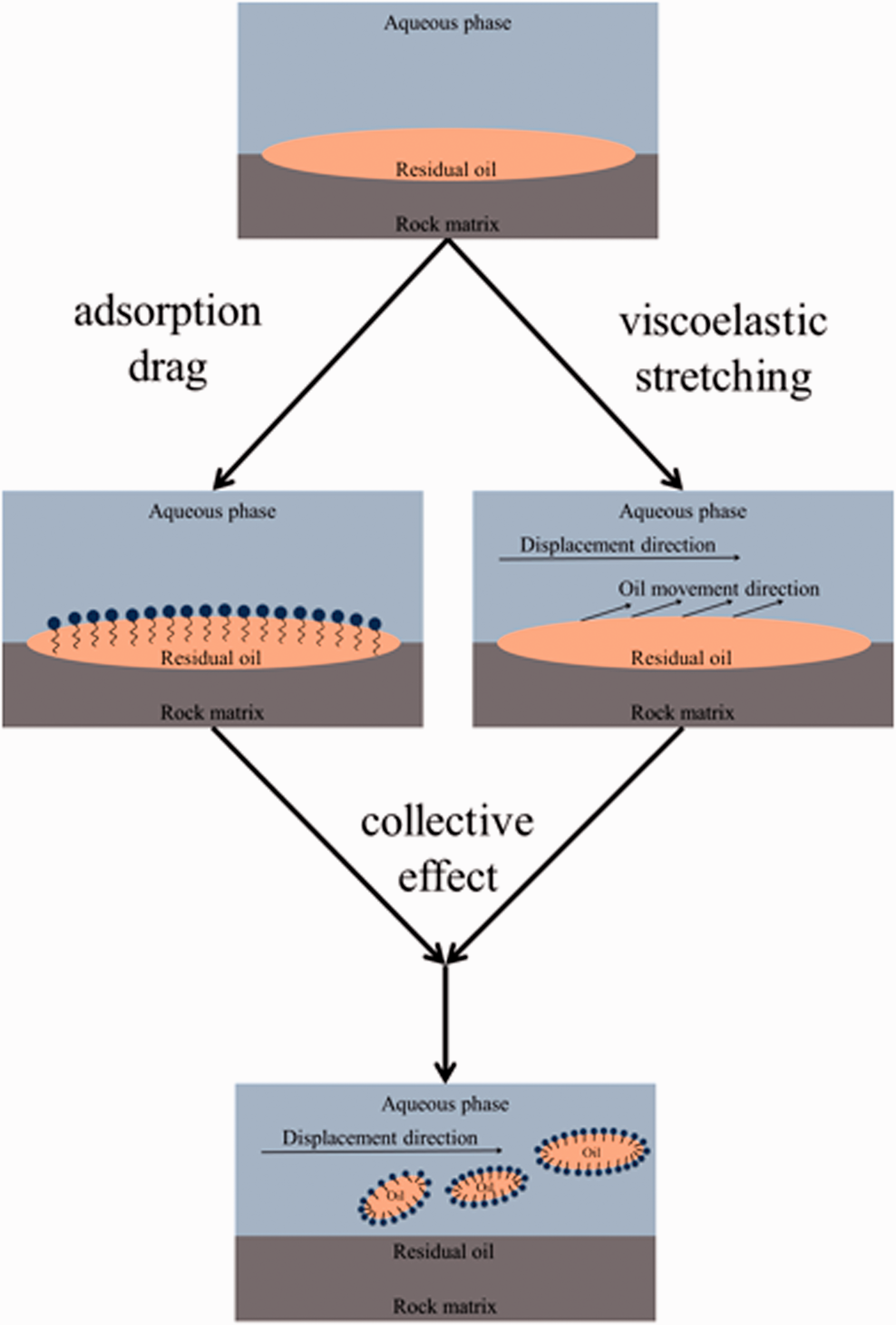
Oil displacement mechanism of viscoelastic surfactants.
The complex interactions between various properties make viscoelastic surfactants very powerful for EOR. If all of these factors are best expressed, compared with other conventional CEOR technologies, people are expected to achieve higher oil recovery. Perhaps viscoelastic surfactants are currently the most suitable chemical agents for CEOR applications (Siggel et al., 2012, 2014).
Laboratory experiment of viscoelastic surfactant flooding
Given these properties of viscoelastic surfactant, in the past ten years, to improve oil recovery, people have conducted a lot of experiments of oil displacement by viscoelastic surfactant under different reservoir conditions.
High temperature and high salt reservoirs
In the reservoirs, the surfactants can precipitate by interacting with divalent cations present in the brine of the reservoirs and will partition to the oil phase at high salinities. High reservoir temperature also affects the stability of the polymer. The high salinity and high temperature in the reservoir limit the application of CEOR (Azad and Sultan, 2014; Han et al., 2013; Kamal et al., 2014).
Concerning this, Mikel Morvan et al. (2009) evaluated a new surfactant-based viscoelastic fluid. The viscoelastic fluid is induced by wormlike micelles formed by self-assembling surfactants. Surfactant-based fluid shows good viscosity (3–15 mPa.s) at low concentrations (0.1% ∼ 0.3% w/w) and high temperatures (80°C), which can be used to improve oil recovery. In the Clashach natural sandstone, a low concentration (0.1% ∼ 0.3% w/w) surfactant core oil displacement experiment was carried out with brine solution (2%NaCl w/w) at 80°C. The surfactant was shown to adsorb moderately on the sandstone (50 µg/g) and displace a great fraction of residual oil (from Sor = 0.49 to Sor = 0.20).
L. Siggel et al. (2012) reported a new class of viscoelastic surfactants and its EOR potential in high-temperature and high-salinity reservoirs, proposed the high performance criteria of viscoelastic surfactant (see Figure 4), and developed Triphenoxmethanes (TPM) series viscoelastic surfactants, among which TPM-101–10 viscoelastic surfactant has the most excellent performance. It has viscoelasticity at low concentration (<0.5% w/w) and shows good stability in mineralized water containing a high concentration of divalent cations at a high temperature (>70°C) and high salt (186 g/L TDS). It has acceptable adsorption values on sand and clay and shows good injection capacity in Darcy Gildehaus sandstone. In the follow-up study, the researchers conducted core flooding experiments on TPM-101–10 (Siggel et al., 2014). TPM-101–10 viscoelastic surfactant mobilize residual oil (ca.7% OOIP) without a significant reduction of the IFT and with less than 1 PV injected fluid.
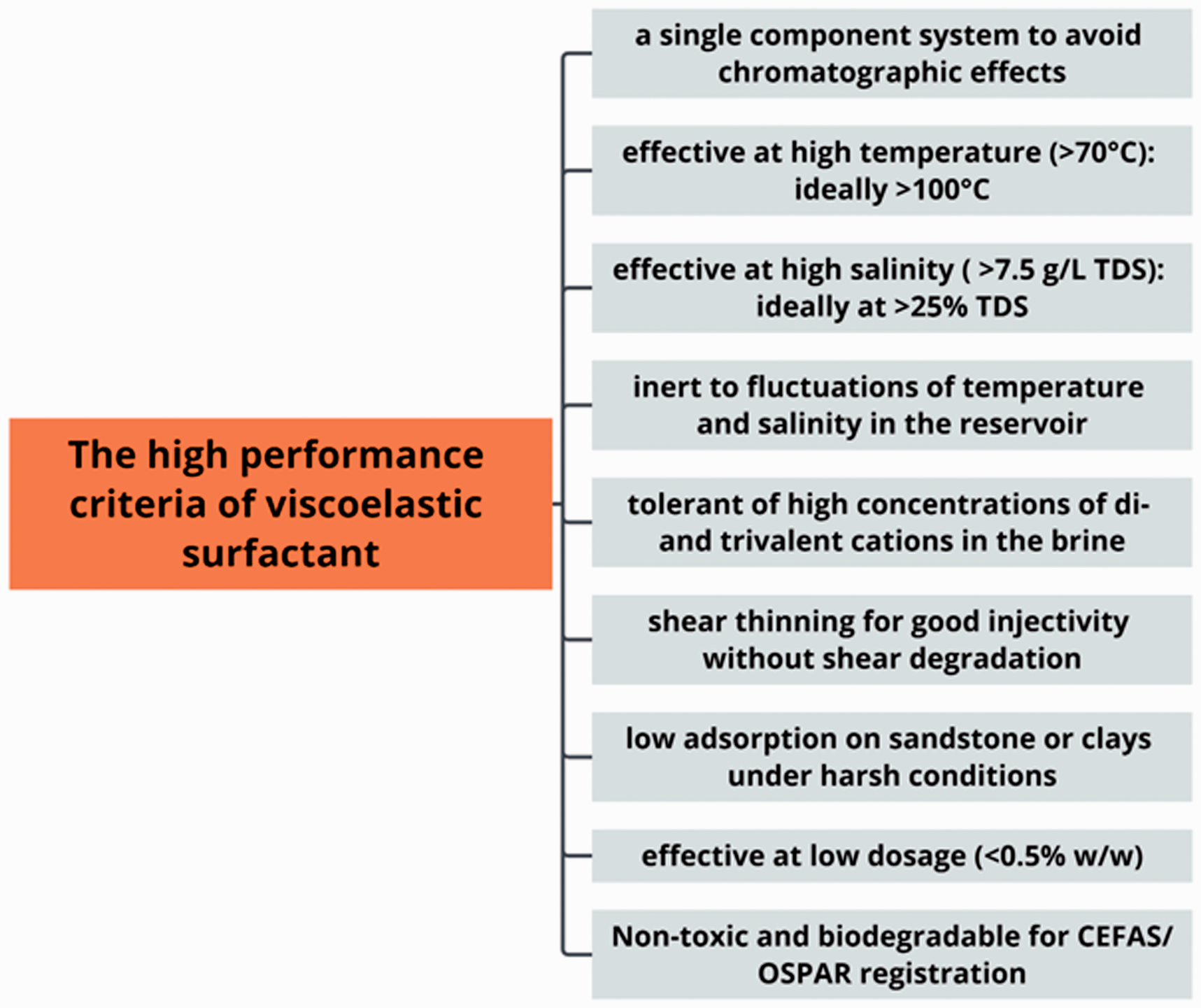
The high performance criteria of viscoelastic surfactant.
M.S. Azad et al. (2014) proposed the use of viscoelastic surfactants to increase the oil displacement efficiency through the formation of wormlike micelles under severe conditions. According to micelles growth and oil-water interfacial tension, three different viscoelastic surfactants (Ethomin, Armovis, and Aquadat) are screened, and then through the double screening of viscosity and oil-water interfacial tension to determine the best viscoelastic surfactant is Armovis. Under the conditions of high temperature (70°C) and high salt (57,000 ppm), the VES, S/VES, and VES/P systems were used to characterize the fluid ability in sweeping and mobilizing the oil (the ratio of viscosity/oil-water interfacial tension). The results show that the single viscoelastic surfactant has the best oil displacement effect and is an EOR fluid potentially used in high-salt and high-temperature fractured carbonate reservoirs.
S. Kumar et al. (2014) proposed wormlike micelle solutions (WLM) based on viscoelastic surfactants as an alternative to HPAM. Two viscoelastic surfactant bodies were prepared, one by mixing zwitterionic surfactant TDPS and SDS as co-surfactant in salty water; the other is prepared by mixing cationic surfactants HTAB and NaNO3 in distilled water. The results show that, compared with the HPAM polymer solutions, the WLM solutions also have excellent rheology. WLM solutions prepared from viscoelastic surfactants can completely replace HPAM polymer solutions as mobility control agents. In subsequent studies (Kumar et al., 2015), WLM solutions are highly tolerant throughout the range of shear rates. Under the condition of repeated shear rate or heating at 70 °0, the viscosity of WLM solutions is highly stable, indicating that the structure of WLM solutions is more stable than polymer at high temperature. At 70°C, the core displacement test was carried out under the WLM solution (zwitterionic surfactant TDPS = 1.09% w/v, R = 0.55) of mixed surfactant. The water recovery factor was 53.66%. After the WLM solutions were injected, the recovery factor was increased by 10.9% and the final recovery factor was 64.56%.
Heavy oil reservoirs
Thermal methods such as steam flooding have been widely used in the development of oil and gas reservoirs. The complex formation conditions (low thickness, deeper depth, and formation nature) of heavy oil reservoirs can lead to steam flooding failure (Babadagli, 2000). Polymer flooding is one of the main non-thermal methods for heavy oil recovery. The high-viscosity, high-temperature, high-salt, and high-permeability fractures in heavy oil reservoirs limit the application of polymer flooding. In particular, the fractures in the reservoirs provide the convenient channel for the injection slug to break through the production well, which greatly reduces the sweep efficiency and is not conducive to improving the recovery (Asghari and Nakutnyy, 2008; Delamaide et al., 2014b; Han et al., 2013).
To apply the potential of viscoelastic surfactant in the recovery of heavy oil in complex reservoirs with steam flooding and polymer flooding failure, according to the IFT reduction, viscosity, elasticity, emulsification, salinity resistance, compatibility, and thermal stability and many other characteristics of viscoelastic surfactant, M.S. Azad (2014) investigated the potential and applicability of viscoelastic surfactants in recovering heavy oil in complex reservoirs (the naturally fractured carbonate heavy oil reservoirs and thin heavy oil reservoirs). Reservoir simulation studies with 5-spot pattern have been conducted to compare the performance of steam flooding, polymer flooding, and viscoelastic surfactant flooding in thin heavy oil reservoirs. The results show that viscoelastic surfactants can be used with hot water, which is an ideal hybrid power option for recovering high-viscosity heavy oil.
Aneeq Nasir Janjua et al. (2018a, 2018b) improve the recovery of carbonate reservoirs in heavy oil reservoirs with the excellent thermal stability and salt tolerance of viscoelastic surfactants. In the low concentration (0.1%∼1%) high temperature (50°C ∼ 80°C) range, the interfacial tension is significantly reduced (10–1∼10-2mN/m). Thermogravimetric analysis shows that it is thermally stable and shows temperature resistance up to 250°C, and can maintain long-term thermal stability for up to 30 days at 90°C and 120°C. Under the conditions of high viscosity (17°API) and high salt (57,642 ppm), the recovery rate of water flooding is 35%. After injecting viscoelastic surfactants with 2PV concentration of 0.3%, the water flooding continues, and the final recovery rate is 41%, and the recovery rate increases by 6%.
Medium and low permeability reservoirs
Medium and low permeability reservoirs have deep burial, high formation temperature, small pore/throat size and uneven thickness, serious Jiamin effect during water flooding, uneven water injection propulsion speed, and are prone to circumvent and jam feature, many traditional chemical floods (polymer flooding, alkali-surfactant-polymer (ASP) flooding and surfactant-polymer (SP) flooding) cannot be effectively applied (Hu et al., 2018; Sheng, 2010; Zhu, 2015; Zhu et al., 2016).
To this end, Youyi Zhu et al. (2016) proposed the use of small molecular viscoelastic surfactants in porous media with special rheology and good interfacial activity to improve oil recovery in low permeability reservoirs. In response to the reservoir conditions, the researchers chose a zwitterionic betaine surfactant with a long carbon chain, eucic amidosulfobetaine (EAB), which exhibits viscosity-increasing behavior, shear-thinning characteristics, low IFT performance (10−3 ∼ 10−2mN/m), and good injectability. The incremental oil recovery of single viscoelastic surfactant formula flooding (0.4 wt% EAB) is 12.6%. The viscoelastic surfactant flooding may have great potential in EOR applications in low permeability reservoirs.
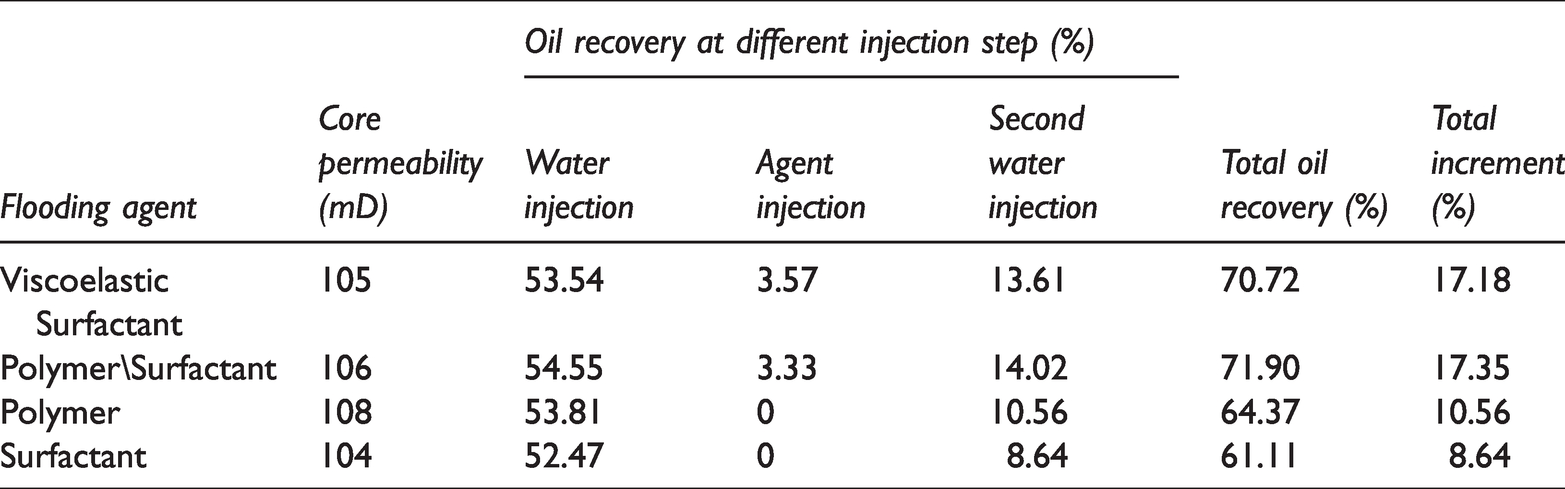
Ke-Xing Li et al. (2016b) used a mixture of cationic surfactant and long-chain unsaturated amide betaine at a certain ratio to obtain VES-JS viscoelastic surfactant. VES-JS viscoelastic surfactants are excellent in viscosity, viscoelasticity, and interfacial activity. Under the conditions of 65°C and salinity of 25830.2 mg/L, the effects of reservoir permeability, viscoelastic surfactant concentration, injection rate, injection volume, injection time, and reservoir heterogeneity on displacement efficiency were evaluated. The results show that under the experimental conditions, viscoelastic surfactant flooding can increase the oil recovery by 10.64% ∼ 24.72%. Under the same conditions, the displacement effects of viscoelastic surfactant flooding, polymer flooding, ordinary surfactant flooding, and polymer/surfactant flooding were compared. As can be seen from Table 3, viscoelastic surfactant flooding can get the recovery increment of 17.18%, while polymer flooding is 10.56% and surfactant flooding is 8.64%, which is close to the ratio of the polymer/surfactant flooding 17.35%. Under comparable experimental conditions, the displacement efficiency of viscoelastic surfactants is greater than that of polymers and surfactants, and is similar to the polymer/surfactant binary system. These exciting results show a strong potential for the viscoelastic surfactant used in relatively low permeability reservoirs for EOR.
The displacement efficiency of different flooding agents.
Offshore oilfields
Compared with onshore-oilfield extraction, there are special requirements for CEOR in offshore oilfields (Alvarado and Manrique, 2013). First of all, due to the very difficult construction of offshore engineering, the limited operating space of the platform, and the high concentration of equipment, this requires the injection process of chemical flooding to be as simple as possible. Second, the rapid dissolution of polymers in high-salinity water is the key to polymer flooding in offshore oil fields. In order to solve the problem is dissolved, typically using mechanical methods or a method of preparing the polymer solution in emulsion form. However, the mechanical methods reduce the viscosity. The instability of the emulsion and the low effective content of those polymers determine the long-term storage and transportation of the emulsion that is not conducive to CEOR in offshore oilfields (Morel et al., 2012; Rivas and Gathier, 2013).
To this end, Haiming Fan et al. (2018) proposed the technical idea of using viscoelastic surfactants with high salt tolerance, rapid solubility, and ultra-low interfacial tension for offshore oilfield chemical flooding. They constructed viscoelastic surfactant systems by mixing the zwitterionic surfactant N-hexadecylN,N-dimethyl-3-ammonio-1-propane sulfonate (HDPS) or N-octyldecyl-N,N-dimethyl-3-ammonio-1-propane sulfonate (ODPS) with anionic surfactants such as sodium dodecyl sulfate (SDS). Studies have shown that at 10,550 mg/L and 60°C, the viscosities of 0.73 wt.% HDPS/SDS system and 0.39 wt.% ODPS/SDS system reach 42.3 mPa.s and 23.8 mPa.s, respectively. Also, both systems show rapid solubility (solution time <25 min). Moreover, the IFT (10−2 ∼ 10−3 mN/m) at the oil-water interface is significantly reduced. By comparison, the HDPS/SDS system was selected as the viscoelastic surfactant oil displacement system to conduct oil displacement experiments under different conditions. The results show that HDPS/SDS viscoelastic surfactant has a good oil displacement effect and can effectively improve the recovery factor by 19.2% ∼ 29.4%. Such a high oil displacement efficiency is even comparable to the previously reported ASP flooding.
Current problems and solutions of viscoelastic surfactant flooding
From the mechanism and experimental point of view, viscoelastic surfactant flooding has the strengths of surfactant flooding and polymer flooding, has a high oil displacement efficiency, and the total recovery factor can be increased by about 20% based on water flooding. Based on the results of laboratory flooding experiments, viscoelastic surfactant flooding is indeed an attractive CEOR technology. However, there are still some issues that need to be resolved:
Problems
During the oil displacement process, the adsorption and retention of the chemical agent in the reservoir pores will cause a considerable part of the loss in the oil layer near the injection well, which will greatly reduce the performance of the oil displacement agent to the depth of the oil layer, which will affect the oil displacement efficiency in severe cases (Kamal et al., 2018). The selected oil displacement system is still dominated by the compound viscoelastic surfactant system. Its composition is complex, and there are still risks of chromatographic separation and unstable reservoir displacement fluid performance (Fan et al., 2018; Kumar et al., 2014, 2015; Lakatos et al., 2007; Li et al., 2016b). Some viscoelastic surfactants still have problems such as high oil-water interfacial tension, poor temperature-resistance, poor viscosity-increase, large dosage, and high cost (Samuel et al., 2000; Siggel et al., 2012, 2014; Zhu et al., 2016).
Solutions
Gemini surfactant. To better solve the problems summarized above, finding and developing new viscoelastic surfactants for oil displacement with extremely high surface activity are the problems and tasks faced by the majority of scientific researchers. The emergence of Gemini surfactants has brought new ideas and directions to everyone.
Gemini surfactants are formed by chemically bonding together two hydrophobic chain monomers on or near the hydrophilic head group through the linking group, which breaks the traditional surfactant single hydrophobic group and a single hydrophilic group. It fundamentally overcomes the separation tendency of traditional ionic surfactants due to the charge repulsion or hydration between the head groups, and promotes its close arrangement in the interface or molecular aggregates. This is the fundamental reason why Gemini surfactants have lower critical micelle concentration and higher surface activity than ordinary surfactants (Kamal, 2016; Menger and Keiper, 2000). At the same time, Gemini surfactants can form wormlike micelles with a length of tens of microns at a relatively low concentration. When the wormlike micelles reach a certain length and density, the micelles begin to entangle and overlap each other, forming the viscoelastic network structure. This gives Gemini surfactant solutions special rheological behavior. For example, in the linear viscoelastic region, the system has a viscoelastic behavior similar to Maxwell fluid; in the nonlinear viscoelastic region, the worm-like micelle system exhibits shear thinning and shear zone flow characteristics (Ezrahi et al., 2006; Haiming et al., 2011). This makes the solution low in viscosity under high shear, easy to pump, and re-forms the network structure at a low flow rate deep in the formation and restores viscoelasticity (Chakraborty et al., 2011; Yu et al., 2014). Also, Gemini surfactants can achieve ultra-low interfacial tension at a lower concentration, which can effectively reduce oil-water interfacial tension, which makes Gemini surfactants have significant advantages in expanding swept volume and improving oil displacement efficiency (Jianxi, 1999; Li et al., 2016a; Wang et al., 2018; Zhao, 2014). From the structure and performance characteristics of Gemini surfactants, it is more in line with our requirements for viscoelastic surfactants for oil displacement.
Compared with cationic Gemini surfactants, anionic Gemini surfactants have obvious advantages in tertiary oil recovery. Due to the negative charge characteristics of the rock formation surface, the cationic wormlike micelle system is not suitable for such occasions, while the anionic Gemini surfactant has lower formation rock adsorption loss, low reservoir damage rate, and better environment (high-salinity, high-temperature) adaptability (Tang et al., 2018; Yixiu et al., 2015; Zheng et al., 2018). Therefore, the use of high-performance anionic Gemini surfactants to construct low interfacial tension viscoelastic fluids for chemical flooding to improve oil recovery has broad application prospects (Hu et al., 2020; Ruizhi et al., 2020).
Our research group (Mpelwa et al., 2019a) studied a series of new sulfonate Gemini surfactants in an attempt to develop a single viscoelastic surfactant that can effectively reduce the interfacial tension of oil and water to ultra-low values. The results show that the new viscoelastic Gemini surfactant 18–3-18 has excellent surface activity and low CMC value. When the surfactant concentration is less than 0.5 wt%, they can significantly reduce the oil-water interfacial tension to an ultra-low value (10−3mN/m). Surfactants have attractive viscosity and viscoelasticity. According to experimental studies, the viscoelastic Gemini surfactant is promising in formulating fluid systems with ultra-low interfacial tension and can be used as CEOR oil displacement agents. On this basis, we (Mpelwa et al., 2020) have studied new viscoelastic Gemini surfactants with intermediate polarity groups and variant spacer groups. The ability of viscoelastic Gemini surfactant EGS to self-assemble into entangled micelles in solution improves the viscosity-increasing effect and temperature resistance. Core flooding experiments show that after water injection in the medium permeability reservoir, the salinity is 1,24,278 mg/L, and EGS can increase oil recovery by at least 12.30%.
Nanotechnology. The application of nanotechnology in oilfield production is mainly to directly add nanoscale solid particles to the oilfield working fluid or process it into nanoscale working emulsion. Due to the small size and large specific surface area of the nanoparticles, the number of atoms, surface energy, and surface tension of the nanoparticles increases sharply as the particle size decreases, thus exhibiting surface effects, small side effects, and quantum size effects. This makes nanoparticles (or materials) exhibit many novel properties that are different from conventional particles (García and Saraji, 2020; Nettesheim et al., 2008).
Relevant studies have shown that the strong specific surface energy of nanomaterials makes it have good adsorption performance, and the surface of the nanoparticle is modified by chemical treatment to make the surface of the nanoparticle carry hydroxyl and charge. When the nanomaterials are uniformly dispersed in the viscoelastic surfactant wormlike micelle solution, the nanoparticles are adsorbed on the surface of the micelles, and their charges will interact with the charges of the micelles electrostatically, and the nanoparticles will reduce the electrostatic repulsion between the micelles. Moreover, due to its adsorption performance, the distance between the micelles is further shortened, and the covalent bond between the hydroxyl group on the surface of the nanoparticles and the organic surfactant molecules makes the three-dimensional network structure more stable, thereby improving the rheology performance and temperature resistance (Al-Muntasheri et al., 2017; Barati, 2015; Helgeson et al., 2010; Peng et al., 2018).
At present, the nanoparticles and surfactant solution flooding systems have also been intensively studied for EOR applications. The addition of nanoparticles changes the wettability and adsorbs on the oil–water interface through the surface-active groups inherent in their component, thereby changing the properties of the reservoir, so that the fluid can achieve ultra-low IFT and generate stable emulsions (Almahfood and Bai, 2018; Shamsijazeyi et al., 2014a). In addition, the adsorption interaction of surfactants on the surface of nanoparticles reduces the adsorption of surfactants in rock pores through competitive adsorption mechanism (Suresh et al., 2018; Wu et al., 2017).
The mixed use of nanoparticles and viscoelastic surfactants is mainly used in the field of cleaning fracturing fluids (Mpelwa et al., 2019b; Philippova and Molchanov, 2019; Raj and Ojha, 2019). However, no researchers have studied nanoparticle-viscoelastic surfactant oil displacement system. Perhaps this may also be a way to solve these problems.
Concluding remarks
Enhanced oil recovery is the eternal theme of oilfield development. CEOR technology improves oil recovery by improving both the macro and micro flooding efficiency. Traditional polymer flooding, surfactant flooding, alkali flooding, ASP flooding have technical bottlenecks that are temporarily difficult to break through in practical applications. To this end, based on deepening the understanding of the oil displacement mechanism, innovating and developing the reservoir development mechanism and enhancing the recovery theory, academia and field engineers put forward the technical idea of viscoelastic surfactant flooding. This article introduces the oil displacement technology of the viscoelastic surfactant in detail, discusses and analyzes its application mechanism and latest progress, and also discusses the challenges and solutions it faces. It is not difficult to find from the current researches that viscoelastic surfactant can effectively reduce the interfacial tension between oil and water, and can effectively displace the residual oil in the pore channel of the reservoir; at the same time, it can use its unique viscoelasticity, reduce the oil-water mobility ratio, enlarge the swept volume, and improve the oil recovery from the macro and micro aspects. And it has been confirmed by laboratory experiments that the oil recovery of viscoelastic surfactant flooding can be increased to 10% to 20% after water flooding, which proves that its ability to enhance oil recovery is not weaker than that of conventional CEOR flooding technologies. Although there are still some technical problems that need to be solved, the researchers have found the way to solve them. Future researches on viscoelastic surfactant flooding should focus on improving viscoelasticity, temperature and salt resistance, reducing adsorption loss, and entering the field experiment as soon as possible. It is believed that viscoelastic surfactant flooding will have good application prospects in enhancing oil recovery in complex reservoirs in the future.
Footnotes
Declaration of conflicting interests
The author(s) declared no potential conflicts of interest with respect to the research, authorship, and/or publication of this article.
Funding
The author(s) disclosed receipt of the following financial support for the research, authorship, and/or publication of this article: This work was funded by the National Natural Science Foundation of China (51774049).
