




Abstract
Hydraulic fracturing is a crucial method for the exploitation of tight gas reservoirs. The matrix permeability is a key factor influencing the fracturing result. This paper assumes that the matrix permeability is provided by a series of capillary bundles and tree-like networks, fully considering the stress sensitivity to establish a single-capillary (fracture) flow equation in terms of factors such as the water saturation, threshold pressure gradient (TPG), fracture width dynamic changes and real gas effect. The established permeability model after fracturing is generalized by Darcy’s law with the fractal theory. The apparent permeability model shows that (1) the gas flow in capillaries and fractures is single-phase flow considering the connate water saturation, stress sensitivity, real gas effect, TPG, and fracture width dynamic changes. The fracture permeability is much higher than the capillary permeability. When the production pressure gradient is lower than the TPG, the flow rate is 0. As the formation pressure decreases, the dual-porosity medium permeability increases. (2) As the water saturation increases, the permeability decreases, and with increasing stress sensitivity and real gas effect, the permeability decreases. (3) The parameters of the tree-like fractal structure greatly affect the permeability. The larger the number and series of bifurcations are, the higher the permeability is. The fracture length ratio is K∝γ, and the fracture width ratio is α∝K. The negative correlation becomes increasingly profound with increasing number and series of bifurcations. This fractal model fully considers TPG, stress sensitivity, and real gas effects, making the dual-porous medium reservoir permeability calculation model more complete, which can provide a more accurate calculation method for the permeability of the reservoir stimulation area after fracturing.
Introduction
With the reduction in conventional gas sources, unconventional gas sources such as tight gas reservoirs have become increasingly crucial, and they exhibit the features of a low permeability, high stress sensitivity (Li et al., 2017, 2020; Ouyang et al., 2018; Tan et al., 2018), notable heterogeneity (Fu et al., 2020), and high threshold pressure gradient (TPG) (Ding et al., 2014; Hao et al., 2008; Tian et al., 2017; Wang et al., 2018; Xue, 2015). Hydraulic fracturing is required to obtain an industrial-scale production capacity. The matrix permeability after fracturing is a crucial factor influencing the fracturing result. Studies have shown that a fracture network is established in the matrix near the fracture surface after high-volume fracturing (Zhu et al., 2018); moreover, this will cause the water phase to invade matrix pores and will result in the water lock effect due to the connate water layer (Yang et al., 2019). To describe the permeability heterogeneity in a dual-porosity medium and the self-similarity of the matrix pore structure (He and Hua, 1998), Yu (Yu and Liu, 2004) proposed the use of the fractal theory to describe the matrix permeability. Cai (Cai, 2014) established an expression of the TPG for low-permeability porous media. Li (Li and Yu, 2010) applied the tree fractal theory to establish a fracture permeability model but did not consider the effects of stress sensitivity and connate water saturation. Wang (Wang et al., 2011) further developed a dual-porosity medium permeability model considering the TPG, but the stress sensitivity and influence of connate water films were not considered. Li (Li et al., 2017, 2018) established a shale matrix permeability model based on the capillary bundle fractal theory but did not investigate the TPG and stress sensitivity effects. Based on the fractal theory, Tan (Tan et al., 2018) established a single-porosity medium permeability model considering the stress sensitivity effect but neglected the impact of the connate water saturation. Wang (Wang et al., 2019), based on the fractal theory, proposed a rapid permeability determination method of a coal-bearing shale matrix through the computed tomography (CT) scanning calculation method, but sensitivity analysis of the matrix permeability was not performed, and no guiding conclusion was obtained. Ye and Bai (Bai et al., 2016; Ye et al., 2019) applied the fractal theory and Newton's internal friction law to create a shale single-capillary pore matrix permeability model considering the TPG and connate water films, but the stress sensitivity was not considered.
The above models are all single-porosity medium models. This article will further comprehensively consider the connate water saturation, TPG, real gas effects and stress sensitivity and propose a theoretical fractal permeability calculation model for a dual-porosity medium, which is based on the fractal theory, without empirical constants. The proposed model in this paper better fits the actual reservoir situation and can quickly calculate the matrix permeability of tight gas reservoirs after hydraulic fracturing, which provides theoretical guidance for the efficient exploitation of tight gas reservoirs.
Fractal characteristics of matrix pores
Tight gas reservoirs constitute an important natural gas resource. However, compared to conventional gas reservoirs, the matrix permeability of tight gas reservoirs is low, and the matrix pores are dominated by capillaries. After hydraulic fracturing, secondary fractures will be generated near the fracture surface, and capillaries and microfractures should be fully considered when establishing a permeability model. Many investigations have illustrated that the distribution of capillary pores and complex fracture networks in tight gas reservoirs comply with capillary bundle and tree-like fractals, respectively.
Capillary porous media
The matrix of a tight gas reservoir is mainly composed of hydrophilic capillary pores, which can be represented by capillary bundle fractals, and the adsorbed connate water films can affect and reduce the effective flow diameter of these pores (Zhang et al., 2010), while the relationship between the effective capillary pore size and water saturation is expressed as follows:

Where λg is the capillary radius, m; λ is the capillary radius without considering the connate water saturation, m; swi is the connate water saturation, %.
According to the definition of the fractal theory (Bo-Ming, 2005), the expression of the capillary fractal dimension is as follows:


Where λgmax is the maximum capillary radius, m; λgmin is the minimum capillary radius, m; Df is the capillary fractal dimension, dimensionless;
A capillary can be regarded as a continuous space, and the differential of Ng can be written as follows:

The equivalent seepage area of a capillary bundle can be expressed as follows:

Substituting equation (4) into equation (5) yields the expression of Ap as follows:

Where Ap is the capillary bundle cross-sectional area, m2.
Similarly, the fractal dimension expression of the capillary tortuosity is as follows:

According to the line-surface equation (Li et al., 2017), we can obtain the following equation:

Where DT is the tortuosity fractal dimension, dimensionless; τ is the tortuosity, dimensionless; l0 is the characterization length of the capillary, m;
Fractured porous media
Secondary microfractures will be formed after fracturing near the main fractures (Zeng et al., 2020). The tree-like fractal is adopted to describe the distribution of fractures, and the water saturation is also employed in the microfracture model to mitigate the influence of bound water films. Selecting rectangular fractures as an example, we can obtain the connate water saturation as follows:


Substituting equation (10) into equation (9) yields the following equation:

Because δ ≪ 1 and 4δ2 can be regarded as infinitesimal, we can obtain the expression of δ, after omitting 4δ2, as follows:

Where a is the fracture width, m; b is the fracture height, m; δ is the connate water film thickness, m; r is the aspect ratio, dimensionless.
According to the definition of the tree-like fractal theory, we can obtain the geometric parameters as follows:



Where a0, b0 is the width and height, respectively, of the 0-th fracture, m; ak, bk is the width and height, respectively, of the k-th fracture, m; α is the fractal width ratio, dimensionless; γ is the fractal length ratio, dimensionless; k is the k-th bifurcation series, dimensionless.
The total horizontal length of the tree-like fractal network can be defined as follows:

The total volume of the tree-like fracture can be expressed as follows:

Where n is the bifurcation number, dimensionless; m is the bifurcation series, dimensionless; θ is the bifurcation angle.
The expression of the total length of the tree-like fractal network can be written as follows:

Coupling equations (17) and (18), the equivalent seepage area of the tree-like fractal can be determined as follows:

Where Af is the tree-like fractal cross-sectional area, m2; L is the total length of the bifurcation, m.
Basic hypothesis
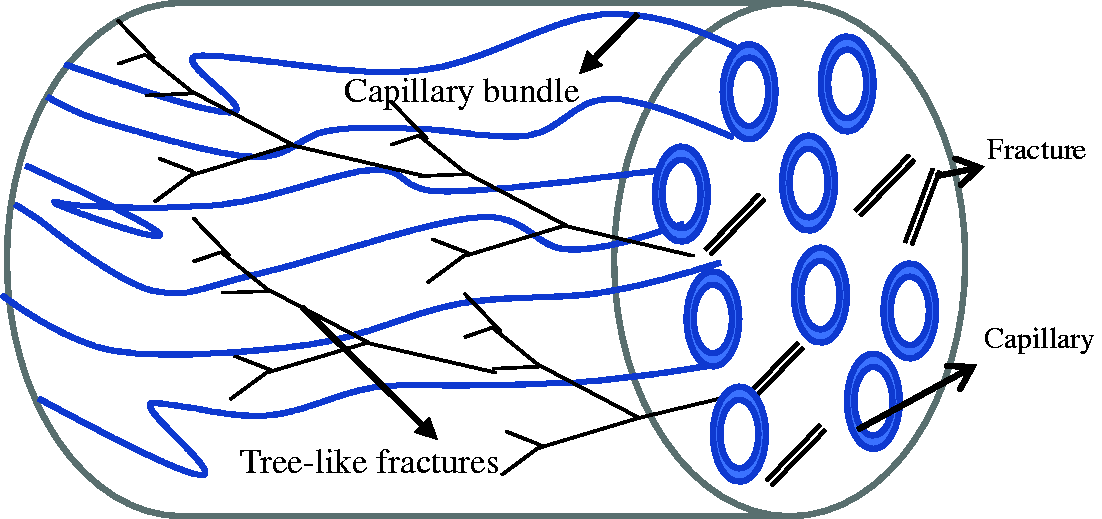
The pore space of a tight gas reservoir, before stimulation, is simplified as a capillary bundle model, and its pores are composed of a group of capillaries with tortuous shapes, while the spatial distribution of the pores agrees with that of capillary bundle fractals. Each capillary is parallel to each other and no interference occurs. Tight gas reservoir fractures, which are the result of fracturing, are simplified as a tree-like fractal network model, and its distribution and the fracture geometric parameters are subject to the tree-like fractal theory. It is also important to consider the effect of connate water films on the permeability. Considering real gas effects, stress sensitivity and TPG, the dual-porosity medium model is shown in Figure 1.
Schematic of the dual-porosity medium model. The flow of fluid in reservoir is single-phase flow, which is ignoring the influence of gravity and temperature changes
Mathematical model of the permeability
After fracturing, the matrix away from the main fracture of a tight gas reservoir is dominated by microscale capillaries, and a certain TPG applies. Gas is still unable to flow until the pressure difference is larger than the limited shear stress. Therefore, by considering the TPG, the gas balance equation for the capillary pores is expressed as follows:

Where η0 is the limited shear stress, Pa; △p is the pressure difference, MPa; v Gas velocity, m/s; μ is the viscosity in the reservoir, Pa·s.
Integrating equation (20), the gas velocity distribution in the capillary pores can be written as follows:

The gas flow rate in a single capillary should abide the following:

Where qm is the gas flow rate in a single capillary, m3/s;
Substituting equation (21) into 22we can obtain qm as follows:

The total gas flow rate in the capillary bundle fractal can be expressed as follows:

Where Qm is the total gas flow rate in a capillary bundle, m3/s;
The gas viscosity does not remain constant under actual reservoir conditions, but it can be regarded as a constant within a small range. Therefore, the range of radius variation is discretized into N segments, and the total gas flow rate in a capillary can be repressed as follows:


Where N is the discretized segments, dimensionless;
Substituting equations (23) and (26) into equation (25), we can obtain:



When the gas flow rate Qm = 0, the TPG of the capillary pore matrix can be expressed as follows:

Where Jm is the TPG of the capillary porous medium, MPa/m;
The generalized Darcy's law should be subject to the following:

Coupling equations (6), (29) and (31), the permeability of the capillary porous medium can be determined as follows:
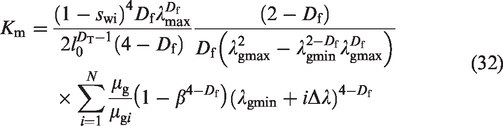
Where Km is the permeability of the capillary medium, mD
The flow in microfractures also considers the TPG, and based on the tree-like fractal theory, the gas balance equation for the k-th fracture is as follows:

Where △pk is the pressure difference across the k-th series, MPa.
Substituting equation (12) into equation (33) for integration, the gas velocity distribution in the microfractures can be expressed as follows:

The flow rate in the k-th microfracture should abide the following:

Where vf is the gas velocity, m/s; qf is the gas flow rate in fracture, m3/s.
Substituting equations (34) and (12) into equation (35), the gas flow rate in the k-th tree-like fracture can be expressed as:

The equation of the total flow rate in the k-th tree-like fracture network can be written as follows:

Where qk is Gas flow rate in the k-th fracture, m3/s; Qf is the total gas flow rate in the tree-like fractures, m3/s.
The equation of the pressure difference across the k-th tree-like fracture network can be calculated as follows:

Coupling equations (10), (13) to (15), and (38), the total pressure difference across the tree-like fractal can be expressed as follows:

Substituting equation (39) into equation (37), Qf can be determined as follows:
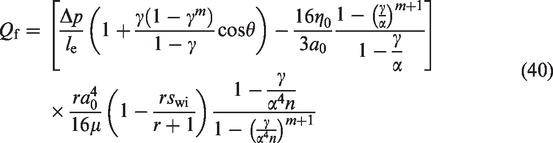
Similarly, the TPG of the fracture pore matrix can be defined as follows:

Substituting equations (40) and (19) into equation (31), the permeability of the fractured porous medium can be determined as follows:
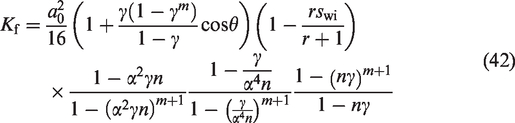
Where Jf is the TPG of the fractured porous medium, MPa/m; Kf is the permeability of the fractured porous medium, Md.
The apparent permeability of the dual-porosity medium of a tight gas reservoir should comply with the following (Kong, 2010):

Where K is the permeability of the dual-porosity medium, mD.
Model modification
Real gas effect
Therefore, under actual formation conditions, the viscosity of natural gas will change. Sakhaee-Pour (Tran and Sakhaee-Pour, 2017) proposed the use of the following equation for modification purposes.




When Kn∈[1,12], f(Kn) should abide the following:




Where μtube is the true viscosity in the capillary, Pa·s; μ0 is the true viscosity in the reservoir, Pa·s; μg is the gas viscosity, Pa·s; Kn is the Knudsen number, dimensionless; R is the gas constant, J/(kg·mol); T is the temperature, K; M is the molar mass, kg/mol.
Stress sensitivity effect
During the development process, as the reservoir pressure drops, the reservoir pore space structure changes, resulting in the stress sensitivity effect (Liu et al., 2020), which can be accounted for with the following equation for capillary pores (Dong et al., 2010):

In tree-like fractures, considering the effect of fracture width dynamic changes on the permeability, Zeng (Zeng et al., 2019) proposed the following equation:


Where P0 is the atmospheric pressure, MPa; Pe is the formation pressure, MPa; q, s are the experimental constants, dimensionless; △a0 is the variation in the fracture width, m.
Modified permeability model
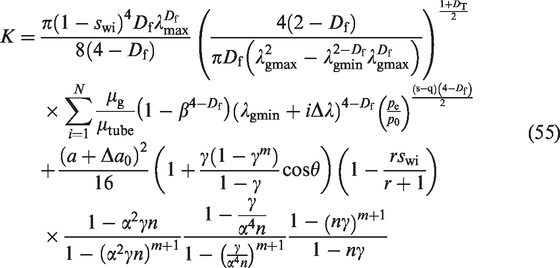
Fully considering the above factors, substituting equations (32), (42), (45), (52) to (54) into equation (43), the dual-porosity medium permeability can be calculated as follows:
Model validation
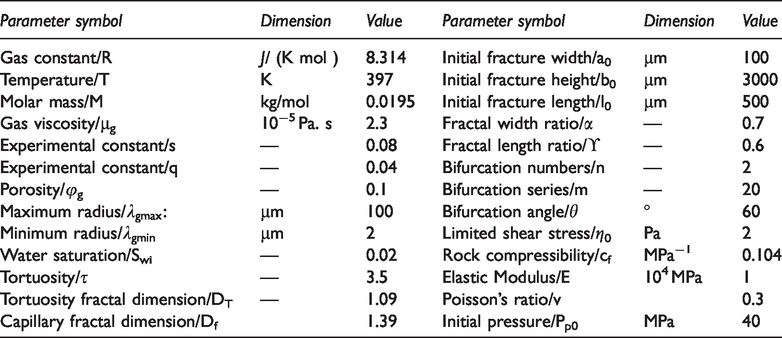
The apparent permeability model parameters are listed in Table 1.
Analysis and calculation parameters of the permeability model.
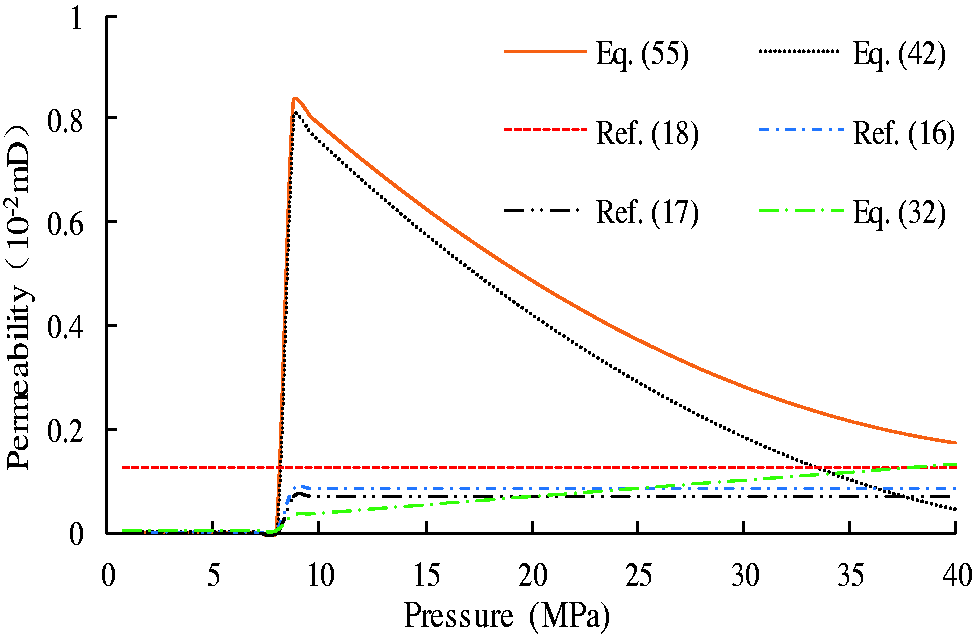
The proposed fractal model (equations (55), (42), and (32)) is compared to the reference model (Refs. (16–18)), as shown in Figure 3.
Figure 2 shows that the permeability (based on equations (32), (42) and (55)) is 0 when the pressure gradient < TPG. Equation (32) considers the water saturation, stress sensitivity, and real gas effects on the basis of Refs. (16,17,18). The calculation result obtained with equation (42) is lower than that reported in Ref. (17) when the formation pressure is high. This occurs because of the connate water saturation reducing the permeability. With decreasing formation pressure, the result obtained with equations (42) and (55) increases as the fracture width increases at low pressures. The dual-porosity medium model combines single pores and tree-like fractures, and based on the models previously developed in Refs. (16,17,18), the water saturation, TPG, real gas effects, and stress sensitivity are comprehensively considered. In summary, the model can be adopted to calculate the matrix permeability of tight gas reservoirs after hydraulic fracturing, as it better reflects the real situation.
Schematic of model verification.
Figure 3 reveals that the permeability decreases with increasing connate water saturation. A high connate water saturation results in a greater impact on the apparent permeability. This occurs because both the water saturation and thickness of the water film adsorbed on the hydrophilic capillary walls increase, which reduces the flowable channel space and decreases the permeability (Zhang et al., 2010).
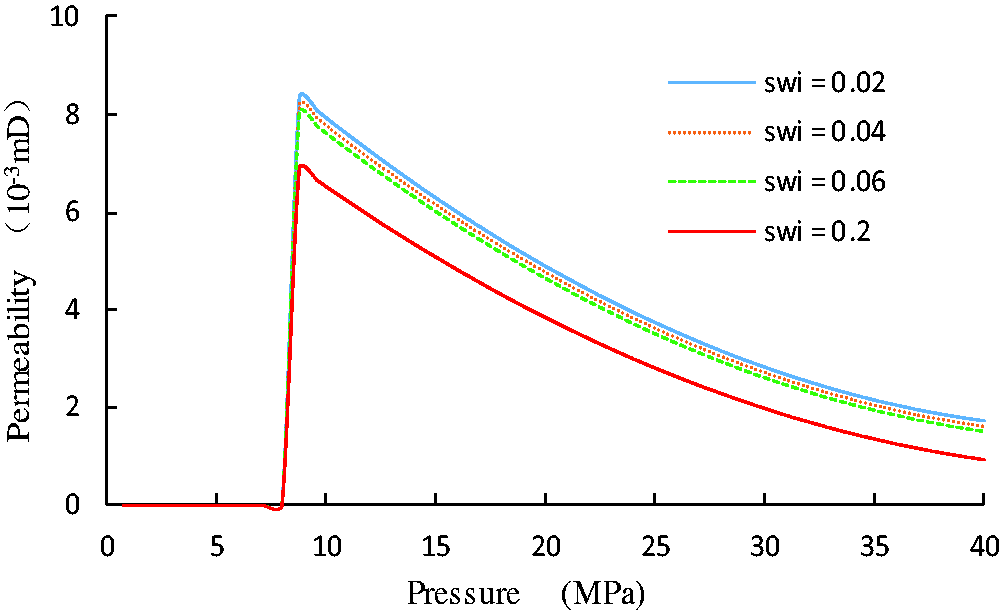
Schematic of the influence of the water saturation on the permeability.
As shown in Figure 4, the permeability decreases after considering the real gas effect. This effect becomes increasingly evident under high formation pressures. Under high-temperature and high-pressure reservoir conditions, the thermal movement and viscosity of gas increase (Tran and Sakhaee-Pour, 2017), which results in a lower permeability.
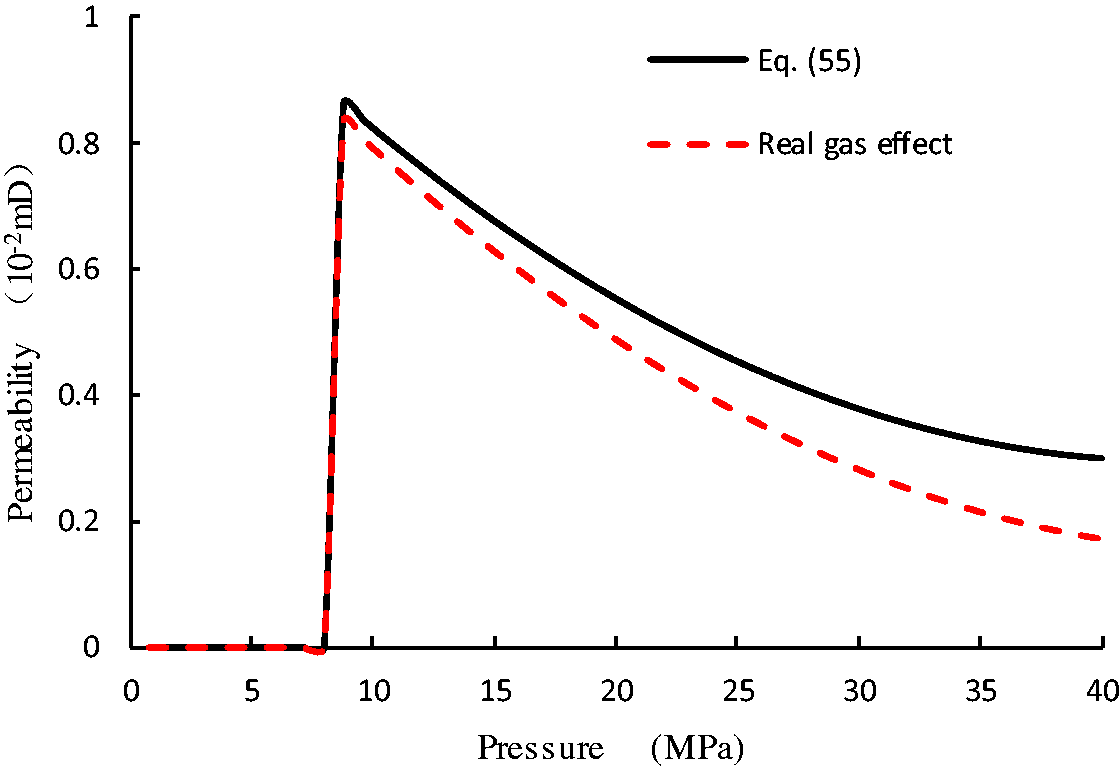
Schematic of the effect of real gas on the permeability.
The reservoir matrix of a tight gas reservoir in the area unaffected by hydraulic fracturing predominantly is a single-porosity medium. As shown in Figure 5(a), after considering the stress sensitivity, the permeability decreases, and this effect becomes more pronounced as the formation pressure increases. However, the matrix in the stimulated area is largely a dual-porosity medium. Figure 5(b) reveals that the stress sensitivity imposes a major impact on the permeability. This occurs because the stress sensitivity causes fracture width dynamic changes. After fracturing, the permeability of the stimulated area is 10 times higher than that of the unstimulated area.
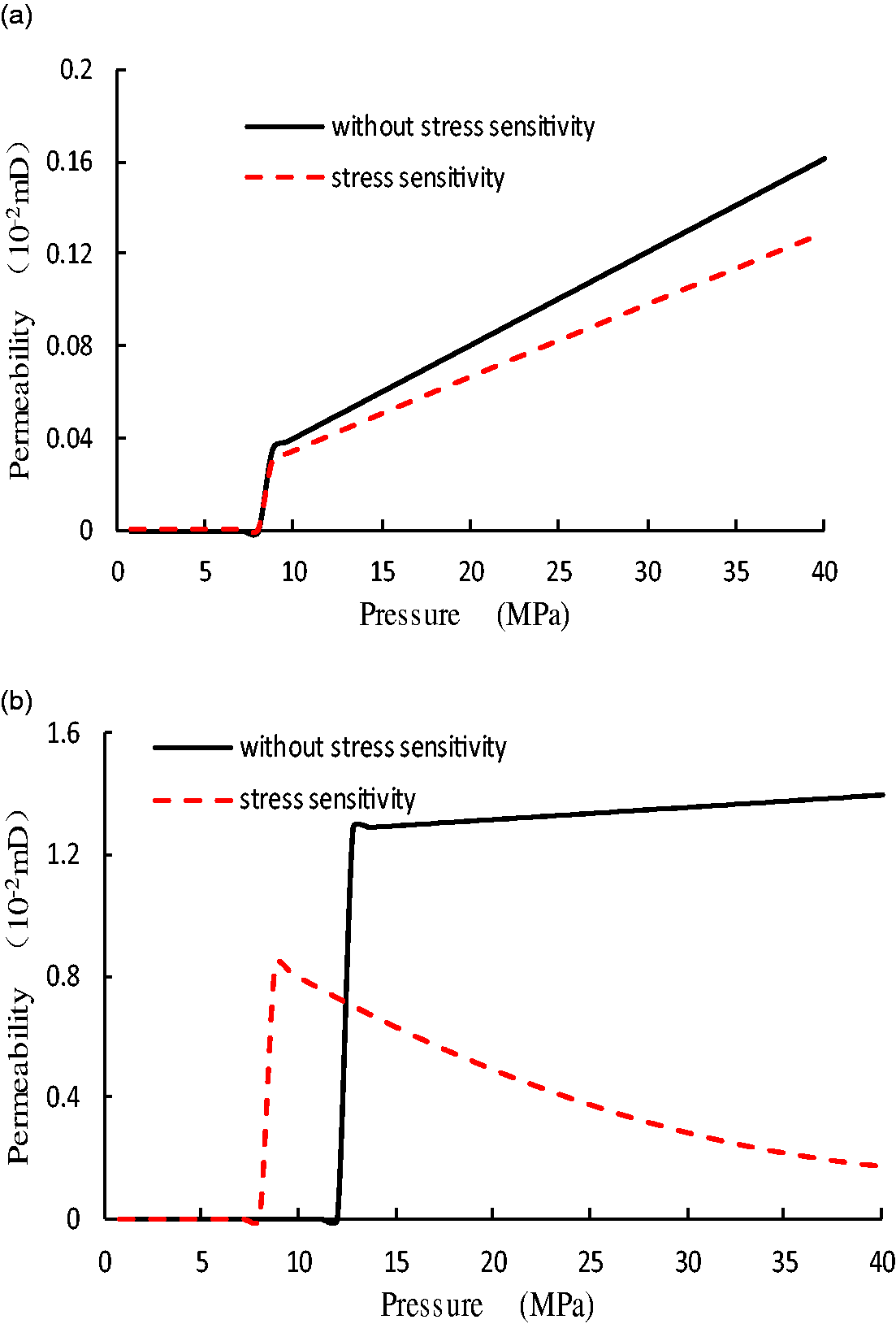
Schematic of the effect of stress sensitivity on the permeability. (a) Unstimulated area. (b) Stimulated area.
Figure 6 demonstrates that the TPG decreases with increasing permeability. This indicates that
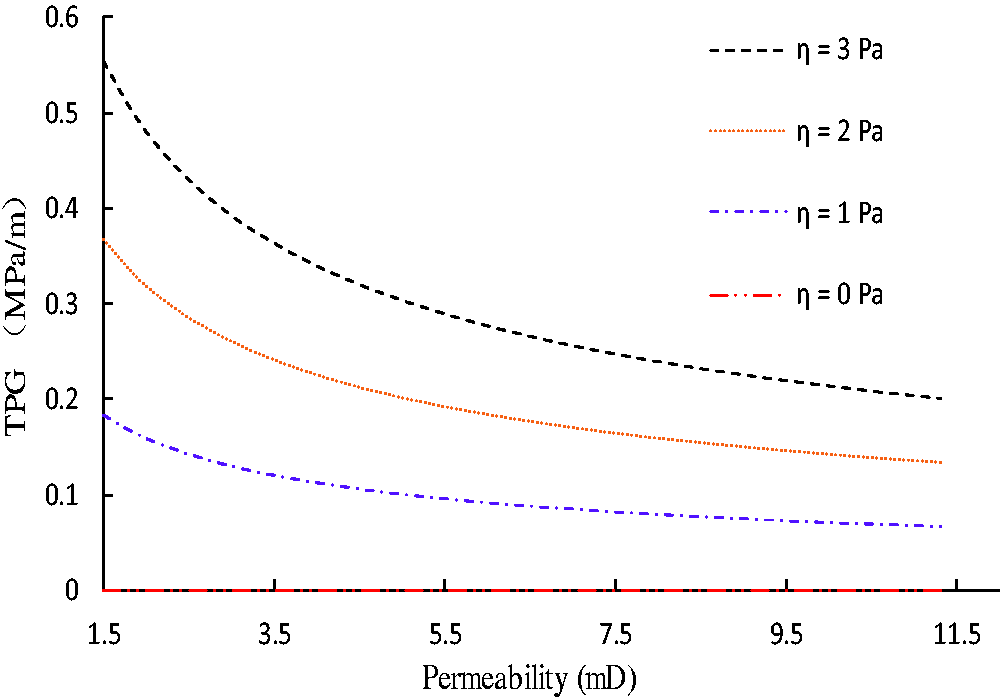
Schematic of the relationship between the TPG and permeability.
Figure 7(a) reveals the influence of n on the permeability. The permeability and n are positively correlated, which indicates that n is an important factor influencing the permeability. Figure 7(b) and (c) show that K∝γ and α∝K for the same value of n. This effect is obvious as the value of n increases.
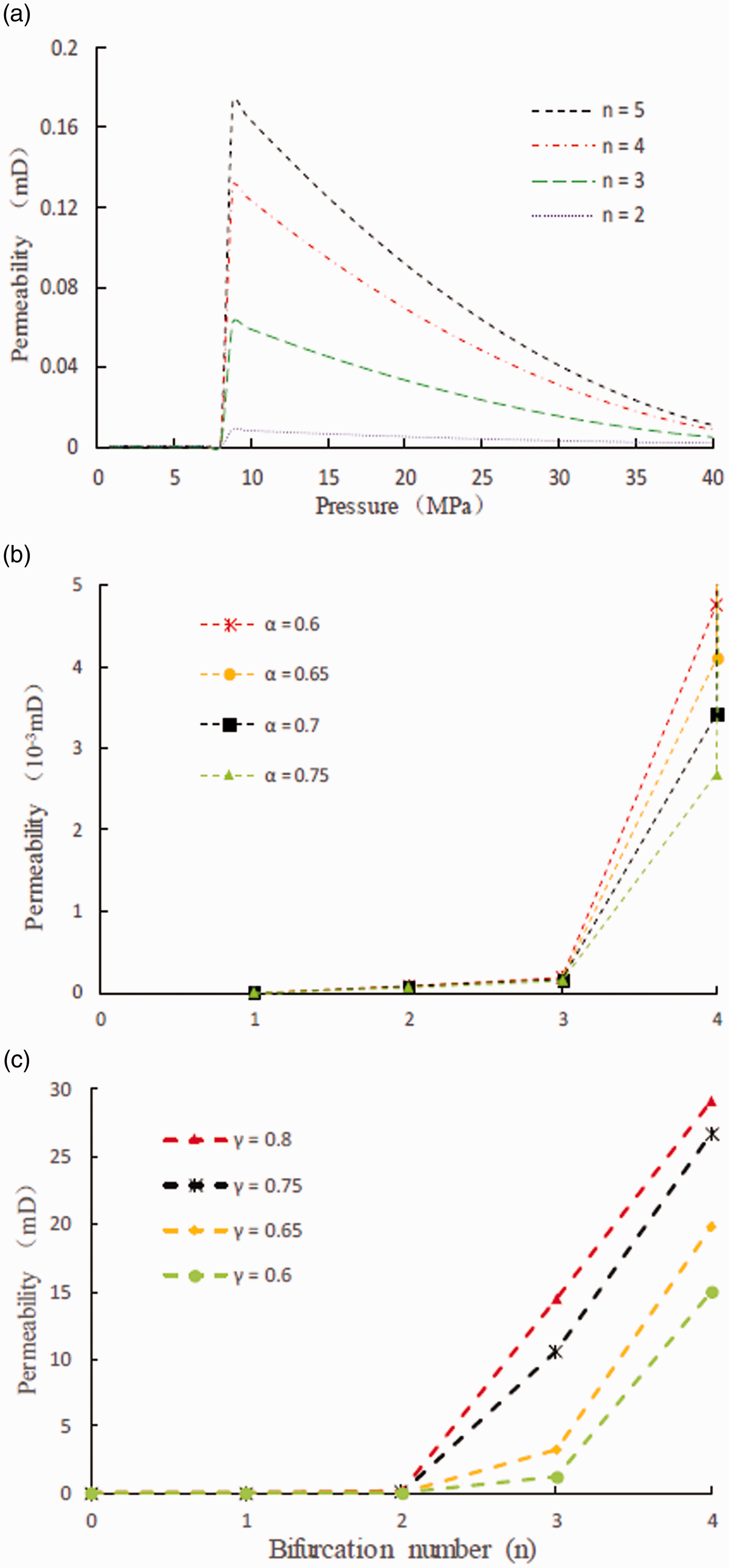
Schematic of the influence of tree-like fractal parameters (n, α, and γ) on the permeability. (a) Permeability for different bifurcation numbers (n). (b) The relationship between the bifurcation number n and permeability for different α values, with γ=0.4 and m=10. (c) The relationship between the bifurcation number n and permeability for different γ values, with α=0.7 and m=10.
As shown in Figure 8(a), the permeability increases with increasing m, and when the number of stages increases by 5, the permeability doubles when m is low. Moreover, when the number of stages increases by 2, the permeability increases 2 times when m is large. This indicates that the larger m is, the greater the impact on the permeability is. Figure 8(b) and (c) reveal that K∝γ and α∝K for the same value of m. This effect becomes increasingly obvious with increasing value of m.
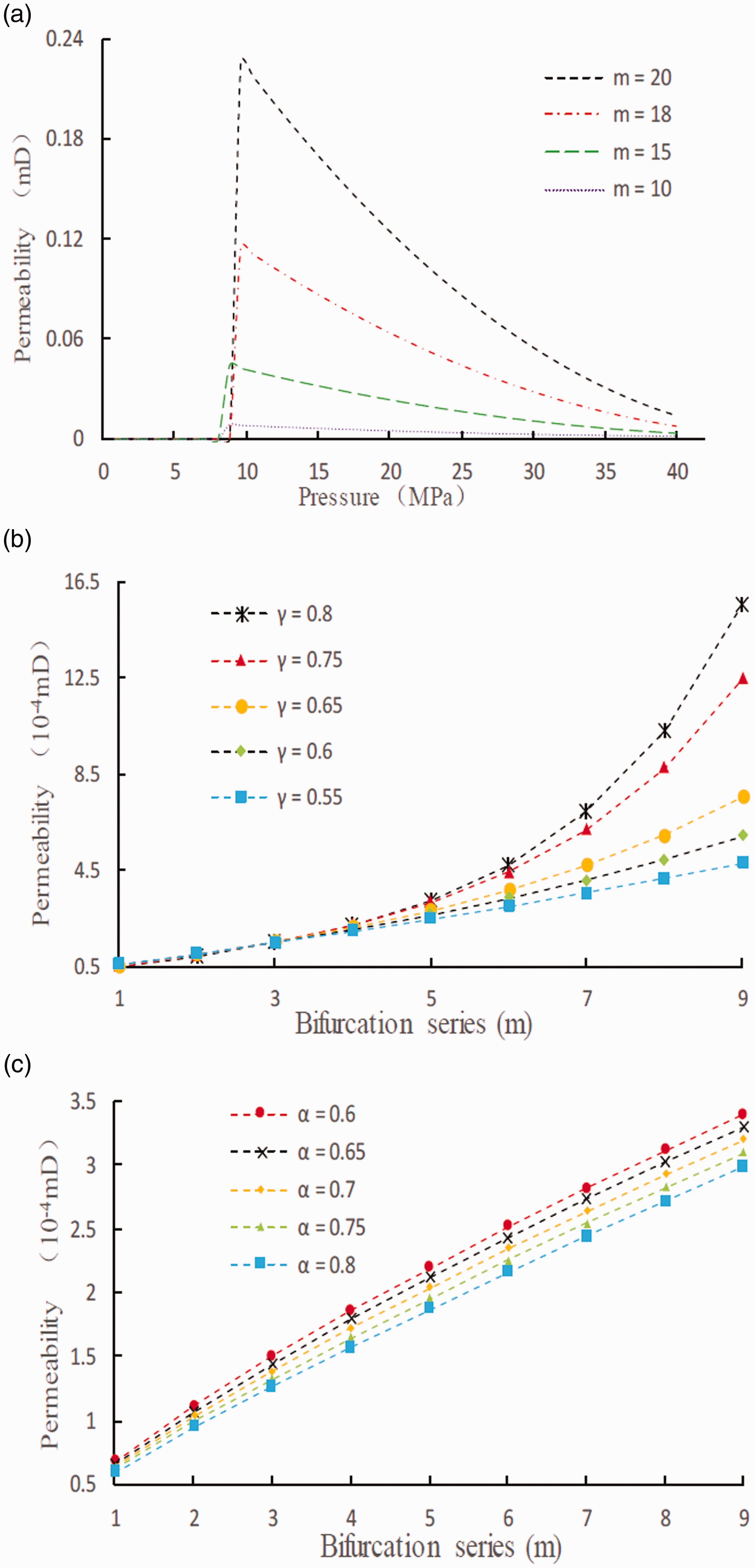
Schematic of the influence of tree-like fractal parameters (m, α, and γ) on the permeability. (a) Permeability for different bifurcation series values (m). (b) The relationship between the bifurcation series m and permeability for different γ values, with n=2 and α=0.7. (c) The relationship between the bifurcation series m and permeability for different α values, with n=2 and γ=0.4.
Conclusions
A dual-porosity medium permeability model of the matrix of a tight gas reservoir after fracturing is established through the fractal theory, which fully considers the connate water saturation, stress sensitivity, real gas effects, TPG, tree network bifurcation number n and bifurcation series m. A sensitivity analysis of the abovementioned influencing factors is performed, and the following conclusions are obtained:
Through the sensitivity analysis, it is found that the apparent permeability increases with decreasing formation pressure. A high-water saturation reduces the permeability, and the stress sensitivity effect decreases the apparent permeability under higher pressures. However, under low pressures, the aforementioned effect is minimal. The effect of the stress sensitivity on the permeability is much more apparent in the stimulated area of a tight gas reservoir than in the unstimulated area, and the viscosity change caused by the real gas effect reduces the apparent permeability, which is more obvious under high pressures. The larger the n and m values are, the higher the permeability is because these two parameters indicate the distribution range of fractures in the reservoir. The larger the n and m values are, the better the development of microfractures in the reservoir is. Moreover, K∝γ and α∝K, and this effect becomes increasingly more pronounced with increasing n and m. The TPG increases with increasing η0 and is negatively correlated with the permeability, which shows that the TPG is negligible in high-permeability reservoirs but not in low-permeability reservoirs.
Footnotes
Declaration of conflicting interests
The author(s) declared no potential conflicts of interest with respect to the research, authorship, and/or publication of this article.
Funding
The author(s) disclosed receipt of the following financial support for the research, authorship, and/or publication of this article: This work was supported by Science and Technology Plan Project “Hydration effect on multi-scale and multi-field coupled gas-water two-phase flow in shale Nano pores” (2020YJ013), the Natural Science Foundation of China [grant numbers 51504203, 51525404, and 51374178]; the National Key and Development Program of China [grant number 2017ZX05037-004].
