




Abstract
In recent years, energy efficiency and energy saving strategies have become priorities for energy policy in most countries, and green energy saving buildings has attracted more attention in the worldwide. The use of passive energy saving natural ventilation strategy can improve the effect of building energy saving and improve the internal microenvironment of the building. This paper introduces and analyzes the passive preheating natural ventilation double skin facade (DSF) comprehensively. The influence of the structural parameters of the double skin facade in cold season ventilation on the preheating ventilation effect is discussed on the basis of the discussion and experiment of an actual double skin facade office building. Further, the energy-saving effect of the passive preheating natural ventilation double skin facade is simulated and verified. The effect of structural parameters of DSF in cold season on the thermal performance is summarized. These corresponding results could provide some reference for the buildings in the similar climate regions.
Introduction
The principle of sustainable development in the built environment encourages researchers to pay attention to more efficient building enclosures (Tan et al., 2020). Because of the concentration of space and the large number of users, public buildings often use air conditioning system for heating in the cold season. As the largest component of building envelope (Omrany et al., 2016), wall plays an important role in protecting indoor environment and controlling the interaction between indoor and outdoor space. The thermal performance of facade is more critical in high-rise buildings with high proportion of wall and enclosure. The traditional external wall maintenance structure will lead to poor natural ventilation, low lighting capacity and increased energy consumption. These shortcomings are often reinforced in the facade of modern buildings with a large amount of glass (Shameri et al., 2011). In cold season or at night, large area of glass curtain wall will lead to a lot of energy consumption due to high solar heat gain or heat loss (Peng et al., 2013). Therefore, the fundamental measure to reduce energy consumption is to select the wall type reasonably and highlight the role of the wall in the public building. A new exterior wall technology is designed and put forward, in order to better insulate heat, block solar radiation, improve thermal comfort and visual quality (Pasut and De Carli, 2012). In the emerging exterior walls, DSF is considered to be an effective solution to control the interaction between indoor and outdoor environment (Blanco et al., 2014; De Carli et al., 2014; Ghadamian et al., 2012; Goia et al., 2010; Gratia and De Herde, 2004a; Jiru et al., 2011; Park and Augenbroe, 2013; Safer et al., 2005; Zhou and Chen, 2010). Double skin façade (DSF) is a special type of enclosure in which the second exterior wall (is usually transparent glass) is placed in front of the conventional building exterior wall (Safer et al., 2005). The concept was first proposed in the early 20th century, and this technology was developed for low energy consumption building in Europe and other temperate regions, in order to reduce the heat load in winter (Saelens, 2002).
However, early design often leads to high temperature in summer, which leads to the research and development of various remedial functions, such as sun protection devices, facade geometry modifications and cavity ventilation scheme, so as to achieve effective thermal performance even in hot areas (Eicker et al., 2008; Gratia and De Herde, 2004b), and this technology made great progress until the 1990s. Under the framework of modern architectural design concept, DSF has become one of the most widely used energy saving design technologies in the world. DSF, as the object of extensive research in recent years, is usually composed of interior wall and additional exterior wall. There is cavity between the interior and exterior layers, and the cavity between facade skins can be natural or mechanical ventilation, or airtight (Chan et al., 2009). DSF can be equipped with forced ventilation in the cavity or natural ventilation (chimney effect). Compared with the traditional facade, DSF can significantly reduce energy consumption, provide natural ventilation in high-rise buildings, and help adjust the indoor microclimate of new buildings and some existing buildings (Poirazis, 2006; Silva et al., 2006). DSF not only reduces the heat loss in winter, but also improves the thermal insulation performance of buildings. It is widely used in modern and high-rise public buildings due to its high-tech appearance and energy-saving ability (Ghaffarianhoseini et al., 2016) and potential response to indoor environmental quality problems (IEQ). The various cavities and glass space configurations, as well as different ventilation characteristics and strategies, present a wide range of types.
DSF has a variety of advantages. Firstly, the transparency of DSF can provide sufficient visual contact with the environment. Secondly, DSF allows a large amount of sunlight into the building without glare. Thirdly, DSF has good aesthetic value. Finally, DSF can promote natural ventilation, improve indoor air quality and thermal comfort.
However, although people are more and more interested in the environmental and energy benefits of building natural ventilation with DSF, on the one hand, the research variables are single, and there is no comprehensive method to evaluate the effect of DSF; on the other hand, due to the lack of simulation verification and performance prediction(Liu et al., 2019), especially in the use of climate driven functions, it has become a key obstacle to the implementation of DSF (Darkwa et al., 2014). Some studies (Hanby et al., 2008; Høseggen et al., 2008; Jiru and Haghighat, 2008; Park, 2003) have been carried out and reported on the thermal performance of DSF, but the real and effective information about passive preheating of DSF in cold season is still insufficient. Therefore, this study focuses on the influence of passive preheating natural ventilation double skin facade on public buildings, such as office buildings, with two purposes: one is to test its thermal performance in the process of passive preheating by means of multi criteria evaluation; the other is to summarize the structural parameter optimization scheme of giving full play to the best thermal performance of DSF in cold season by means of intuitive graphic expression of basic parameters.
Principle and classification of passive preheating natural ventilation double skin facade
Principle of passive preheating natural ventilation double skin facade
The cold lane of traditional residential buildings exerts passive cooling through three strategies of self-shading, wall to ground cold storage and night ventilation because of its deep and narrow, reflecting the Bernoulli effect. Different from the embedded cavities such as the cold lane, inner patio and atrium in traditional residential buildings, the natural ventilation additional cavity can be independent of the main body of the building, and it is a buffer space with the dual function of ventilation and preheating, and has little impact on the spatial layout. The passive energy saving strategy of passive preheating natural ventilation is to improve the indoor microclimate of the building through the special design of the building itself. Its basic principle is to implant an additional cavity with climate regulation function at the climate boundary, and the inner and outer epidermis enclose to form a double-layer clip wall, which is called cavity buffer space. Buffer space can adjust the climate passively. It is the outer skin of the building with composite space form, which increases the heating area of air and increases the space of heat transfer. It is a special place for building to use natural energy.
The cold air enters from the air inlet of the cavity, mainly absorbs energy through the solar radiation, and then enters the indoor space in the way of induced natural ventilation. The indoor air temperature is the main design parameter determining the thermal comfort, and the above progress improves the indoor thermal comfort and air quality, thus forming the “natural air conditioning system”. The passive preheating natural ventilation cavity is also called passive heating cavity. Because the chamber is closed to a certain extent, it can make full use of the passive heating measures to play a role. In terms of space layout, the additional cavity is usually located on the outside of the building, and the temperature in the cavity is higher than the indoor and outdoor temperature, which can not only provide fresh warm air for the interior, but also enhance the insulation effect of the double skin facade, reduce the indoor heat loss and energy consumption.
Whether the connection between the double skin facade cavity and the external environment is reasonable or not is the key to the smooth transformation of natural resources. As the largest part of the contact area between the building and the external environment, the facade energy saving design is particularly important to the building energy saving. The merits and demerits of the facade energy saving technology directly affect the building energy saving effect.
Classification of passive preheating natural ventilation double skin facade
DSF has a variety of skins, covering multiple layers of the building. And it is usually divided into ventilation or air tight type. The type of DSF is also classified according to its ventilation strategy in the cavity (Shameri et al., 2011). Most double skin facades are air internal circulation systems without ventilation functions, such as the Trombe wall. Inspired by the breathing curtain wall, the fresh air can be obtained by setting vent on the surface of buffer cavity, and the indoor thermal comfort can be improved by the stable thermal pressure ventilation (Figure 1).
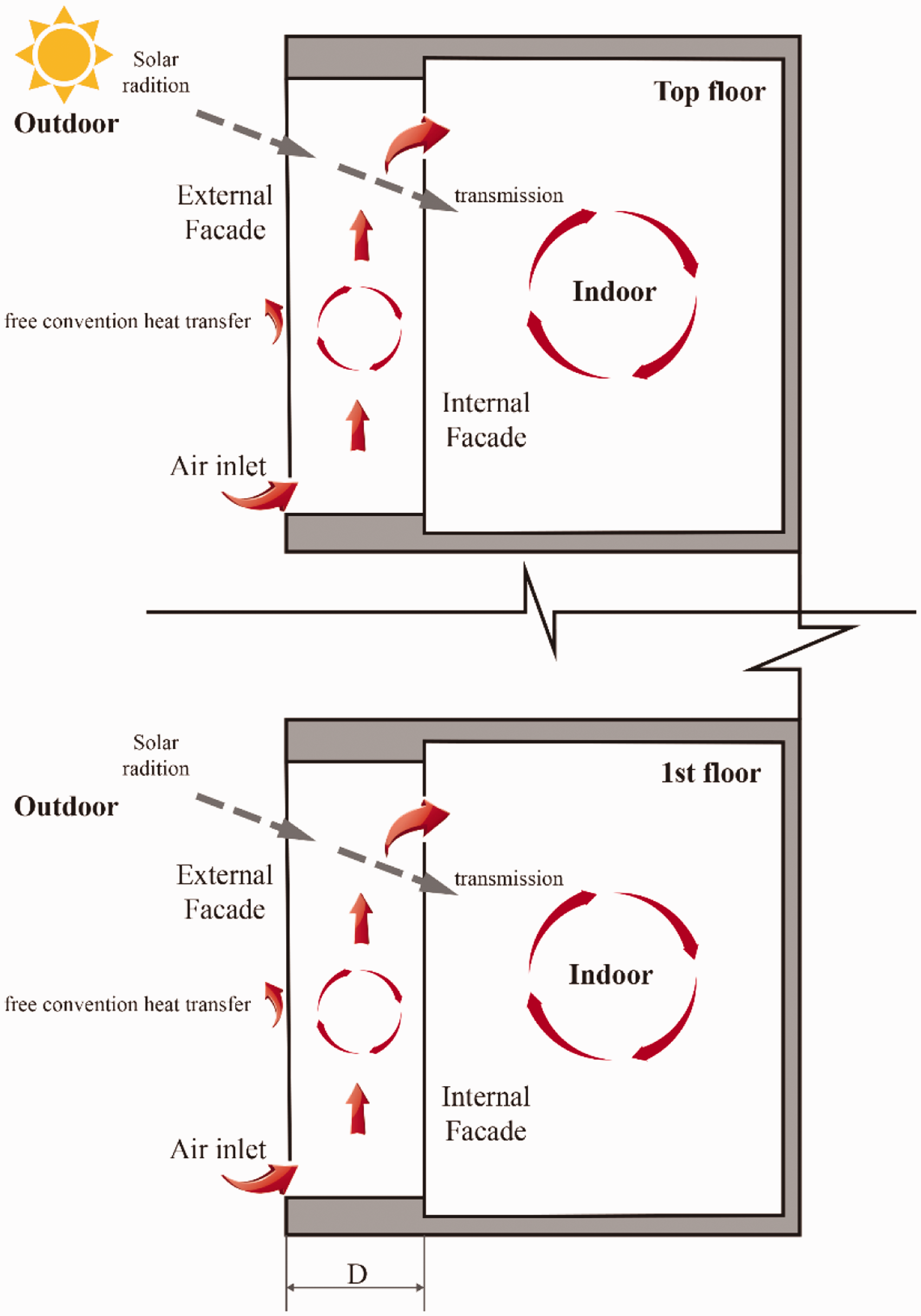
The working modes for DSF.
Ventilation double-layer glass curtain wall: it is also known as breathing double-layer glass curtain wall. It is composed of two layers of glass inside and outside. Inside, it is equivalent to a small greenhouse. The inner and outer surfaces of the chamber are provided with openings. Under the greenhouse effect, the air temperature in the chamber rises to generate heat pressure, and the heat air flows into the building. At the same time, the outdoor fresh air and indoor air are inhaled into the chamber for circulating heating.
Ventilation double-layer heat collection wall: its core is a buffer space composed of heat storage surface and enclosing surface, and it is a double-layer wall with breathing regulation function. The double-layer wall is provided with external and internal air flow inlet. According to different materials and positions of heat storage surface, it can also be seen as a Trombe wall or a solar panel wall.
Ventilation additional greenhouse: the cavity of the ventilation additional greenhouse has a larger depth, which is more closely related to the internal space of the building. It can be designed in combination with the balcony, corridor and hall and so on. The outer side of the ventilation additional greenhouse is wrapped by glass, and the inner side is separated from the sun by a wall. There are vents on the glass surface and the upper and lower positions of the inner wall. The air temperature in the greenhouse rises and enters the building from the upper air outlet. Under the effect of heat pressure, the outdoor fresh air enters from the outer vent, and the air inside the building is inhaled into the cavity from the vent at the bottom of the wall for circulating heating. When absorbing the solar radiation, the air temperature in the cavity will rise rapidly. The wall and the ground can store heat. Improving the heat storage performance of the wall and the ground can enhance the effect of passive preheating natural ventilation.
Calculation method
In this study, CFD calculation was first used to obtain the indoor flow velocity distribution and temperature distribution. The calculation method of CFD is as follows.
CFD calculation principle
Turbulence model
The turbulence model reflects the state of fluid flow. In the numerical simulation of fluid mechanics, different fluid flows should choose the appropriate turbulence model to maximize the simulation of the real flow field value. In this study, the standard k-ε turbulence model is used to calculate the indoor flow field.
Boundary conditions
Enclosure structure: The outer enclosure structure uses the heat transfer coefficient as the boundary condition, and the inner enclosure structure can choose the heat transfer coefficient or the adiabatic boundary condition according to the actual situation;
Air inlet: temperature and wind speed are used as boundary conditions;
Air outlet: Adiabatic and constant pressure boundary conditions are adopted;
Solution calculation
Mathematical model. In this study, the CFD (Computational Fluid Mechanics) method is used to solve the wind field, that is, the mathematical control equations of the mass conservation, momentum conservation and energy conservation of the fluid flow are established in the calculated calculation domain. The general form is as follows:

Control equations of CFD.
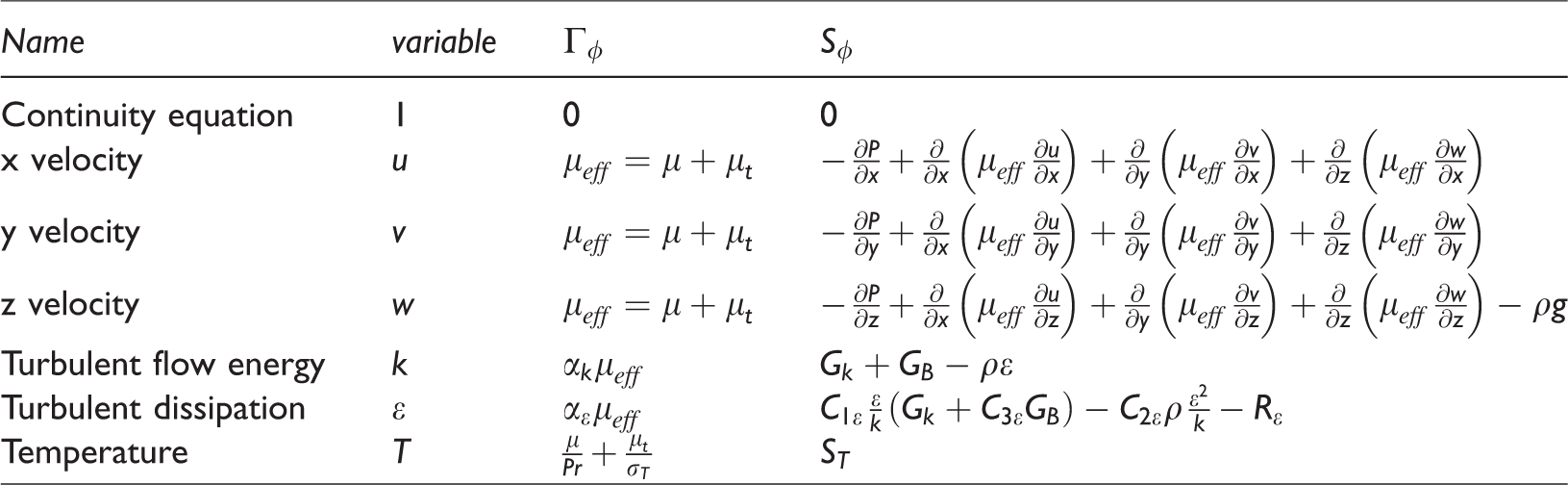
The constants in the table above are as follows:.



By
Among
Differential format. In this study, the second-order upwind style is used to discretize the equation. The accuracy of the second-order upwind style can meet the requirements of general fluid simulation calculations.
Simulation and data analysis of energy saving effect of passive preheating natural ventilation double skin facade
The influence of the shape of ventilation double skin facade on temperature and wind speed
The purpose of simulation calculation: simulate and calculate the influence of the shape of the double skin facade curtain wall on the air supply temperature and air speed; the influence of the opening position of the curtain wall on the indoor average temperature and ventilation frequency; and the operation effect of the double skin facade under different ambient temperature and solar radiation conditions.
Environmental conditions: the location of this model is set in Nanjing, China. Because the air preheating effect of the ventilation double-layer facade is directly affected by the solar radiation conditions, it has periodicity. In order to reflect its operation effect more clearly, the simulated ambient temperature and solar radiation values are taken from the 10:00–14:00 period with better solar radiation conditions. The average temperature and the average total solar radiation of Nanjing during 10:00–14:00 in each month are shown in Figure 2.
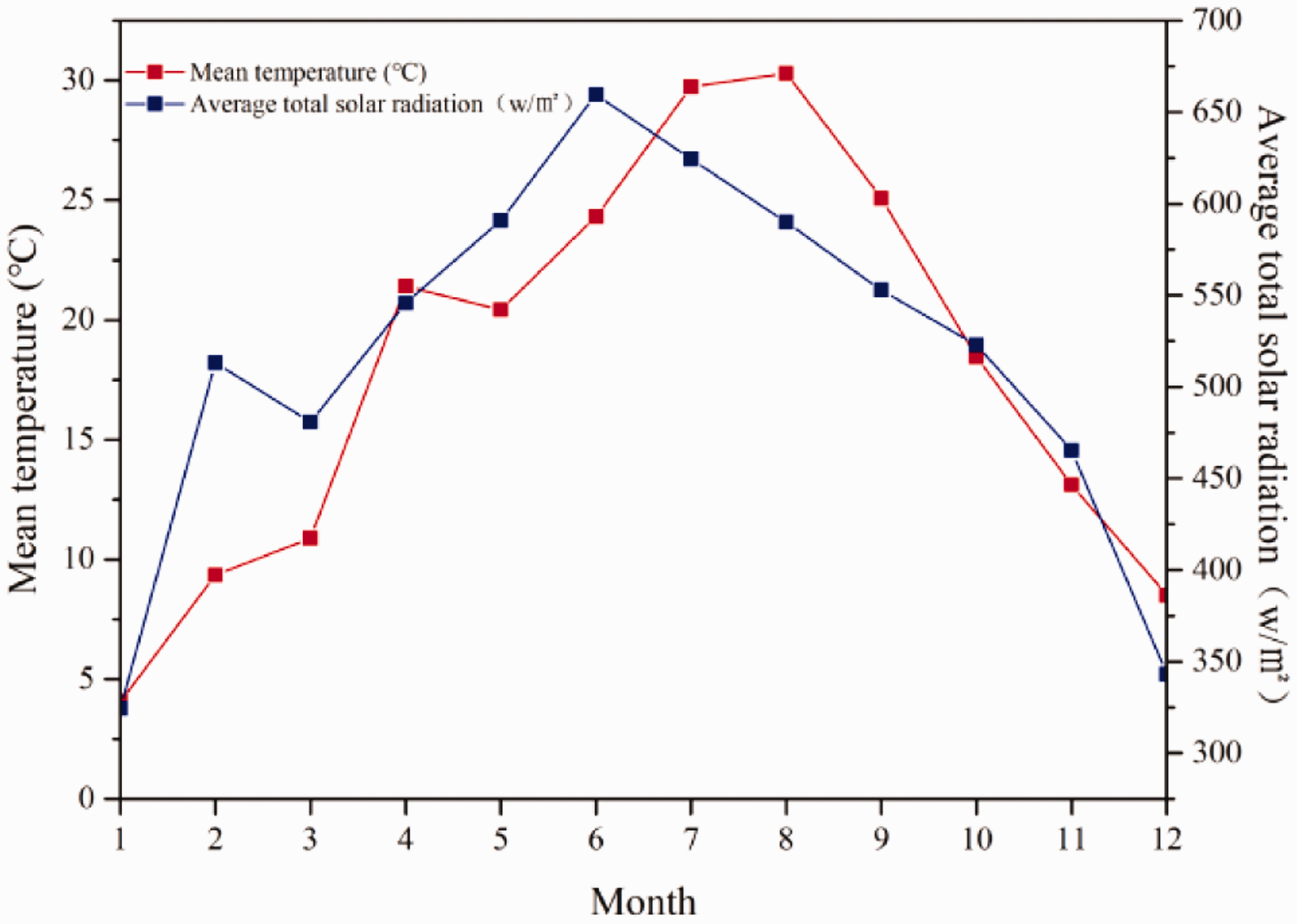
Meteorological data of Nanjing from 10:00 to 14:00 in each month.
The process of simulation
Model establishment: nine groups of ventilation double-layer glass curtain wall models are established, with the height of 1 m, 2 m, 3 m, 4 m, 5 m, 6 m, 7 m, 8 m and 9 m respectively. Each group of model includes nine kinds of thickness of 0.1 m, 0.2 m, 0.3 m, 0.4 m, 0.5 m, 0.6 m, 0.7 m, 0.8 m and 0.9 m respectively. The width of each model is set to be 4 m; there is an opening of 4 m wide and 0.3 m high at the bottom of the outer surface and the top of the inner surface; the ambient temperature and the temperature of each surface of the model are 8.51°C from 10:00 to 14:00 in December in Nanjing; the radiation value of the inner surface of the curtain wall is 343.04 W/m2 from 10:00 to 14:00 in December in Nanjing. The basic model is shown in Figure 3.
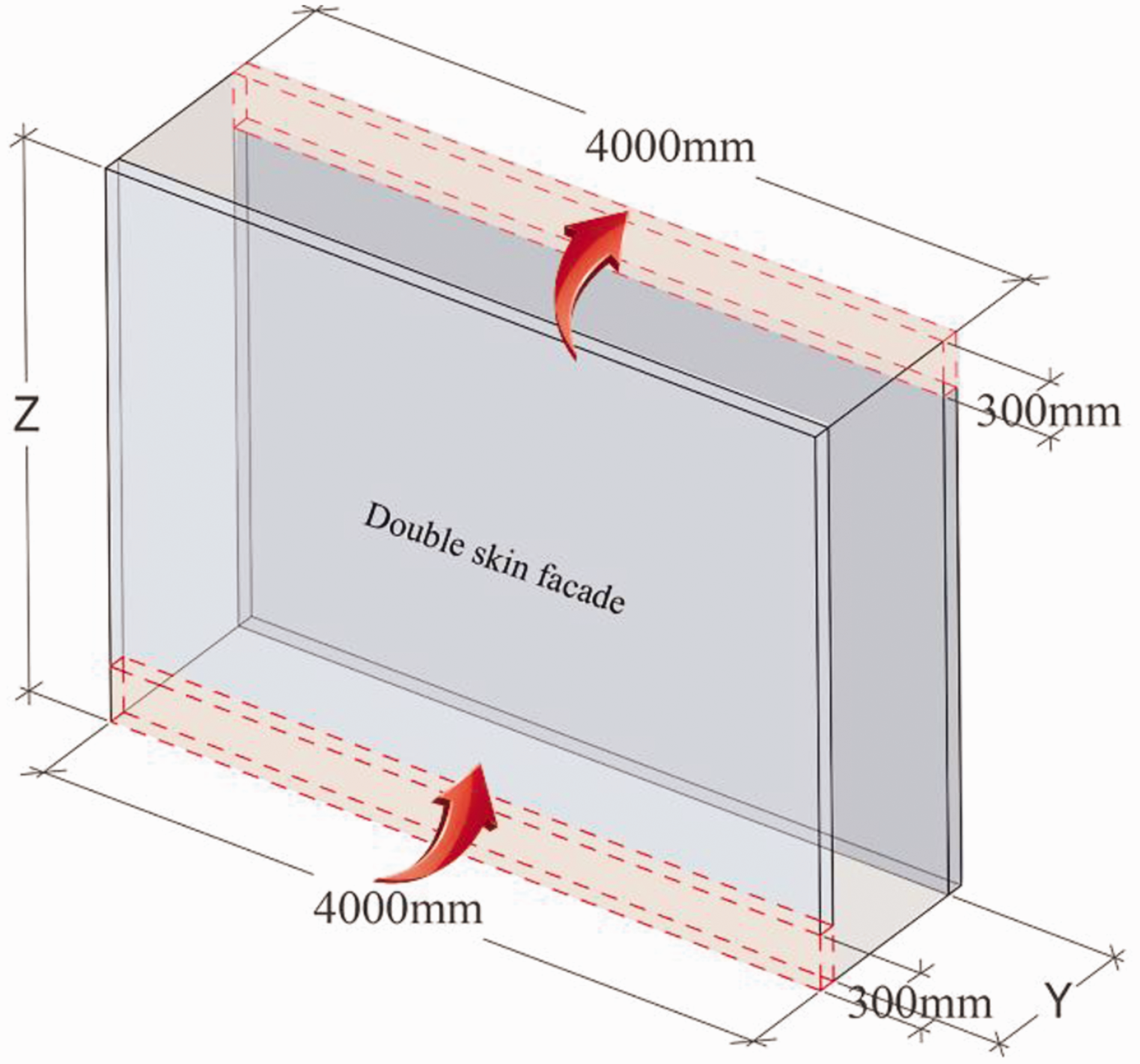
Basic model of ventilation double skin facade cavity.
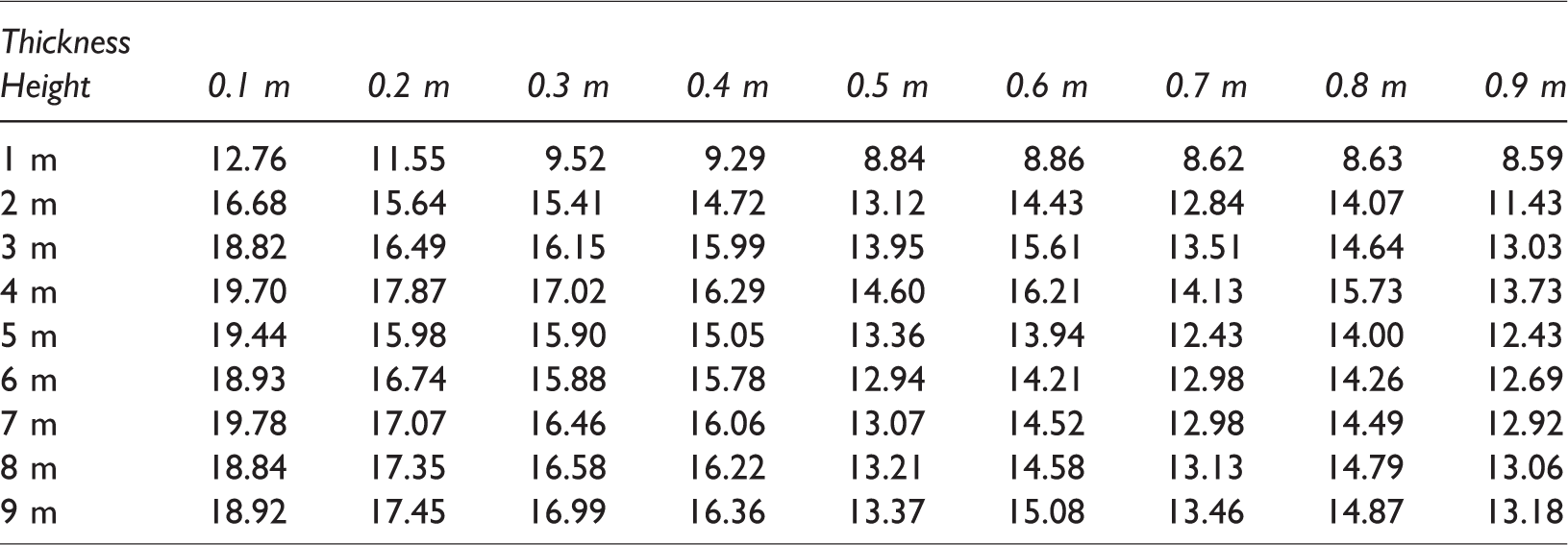
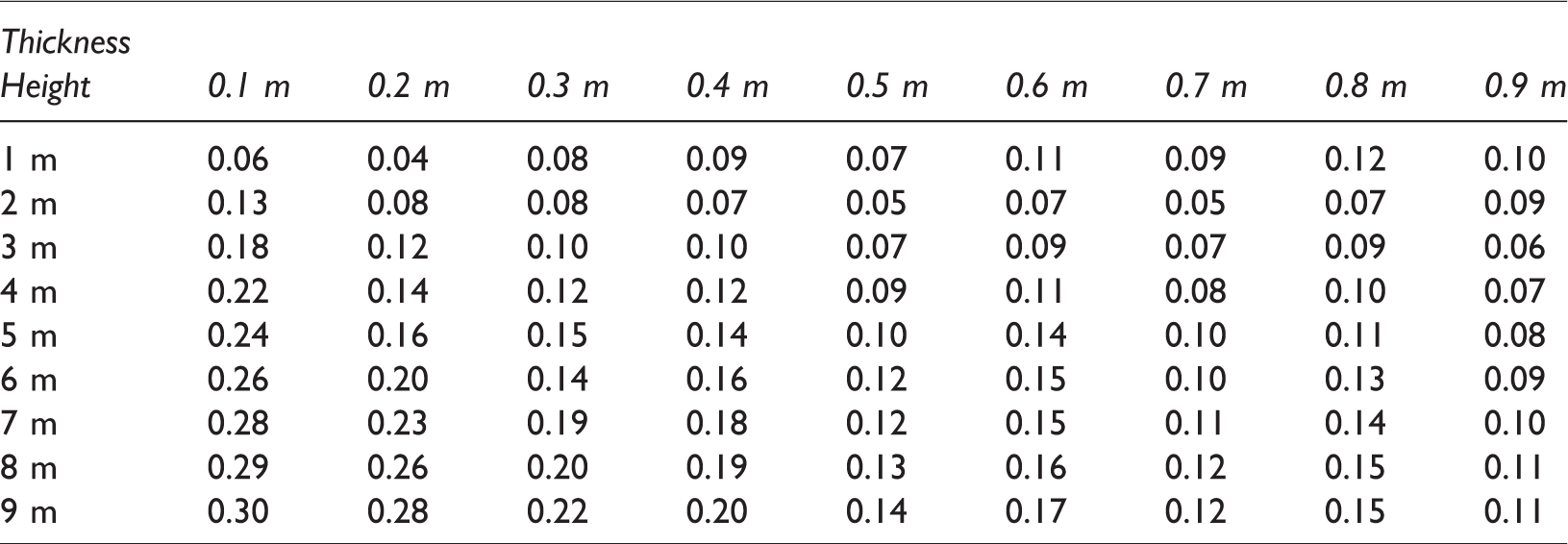
Simulation calculation: divide appropriate grids in each model for calculation. The average air temperature and average wind speed at the opening of the inner surface of the double-layer glass curtain wall are as shown in Tables 2 and 3.
Double skin facade size and air temperature change.
Double skin facade size and air speed change.
Data analysis
It can be seen from Figures 4 and 5 that with the change of height and thickness of double-layer ventilation glass curtain wall, the average temperature at the opening of the inner surface changes regularly. The curves with height of 4 m are high, the curves with height of 1 m and 2 m are low, and the positions of curves with other height are not very different, which are about 1°C different from each other.
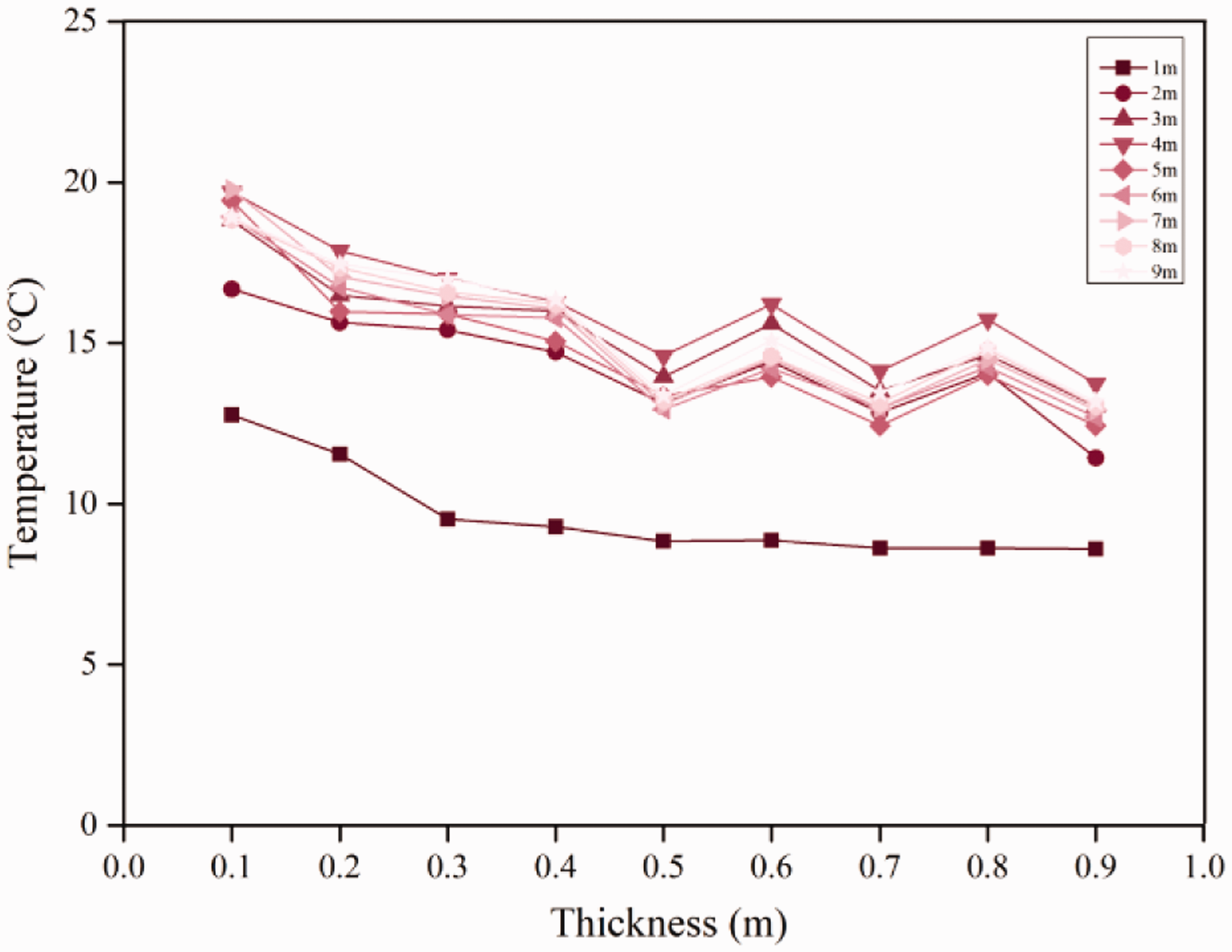
The curve of thickness and air temperature of double skin facade cavity.
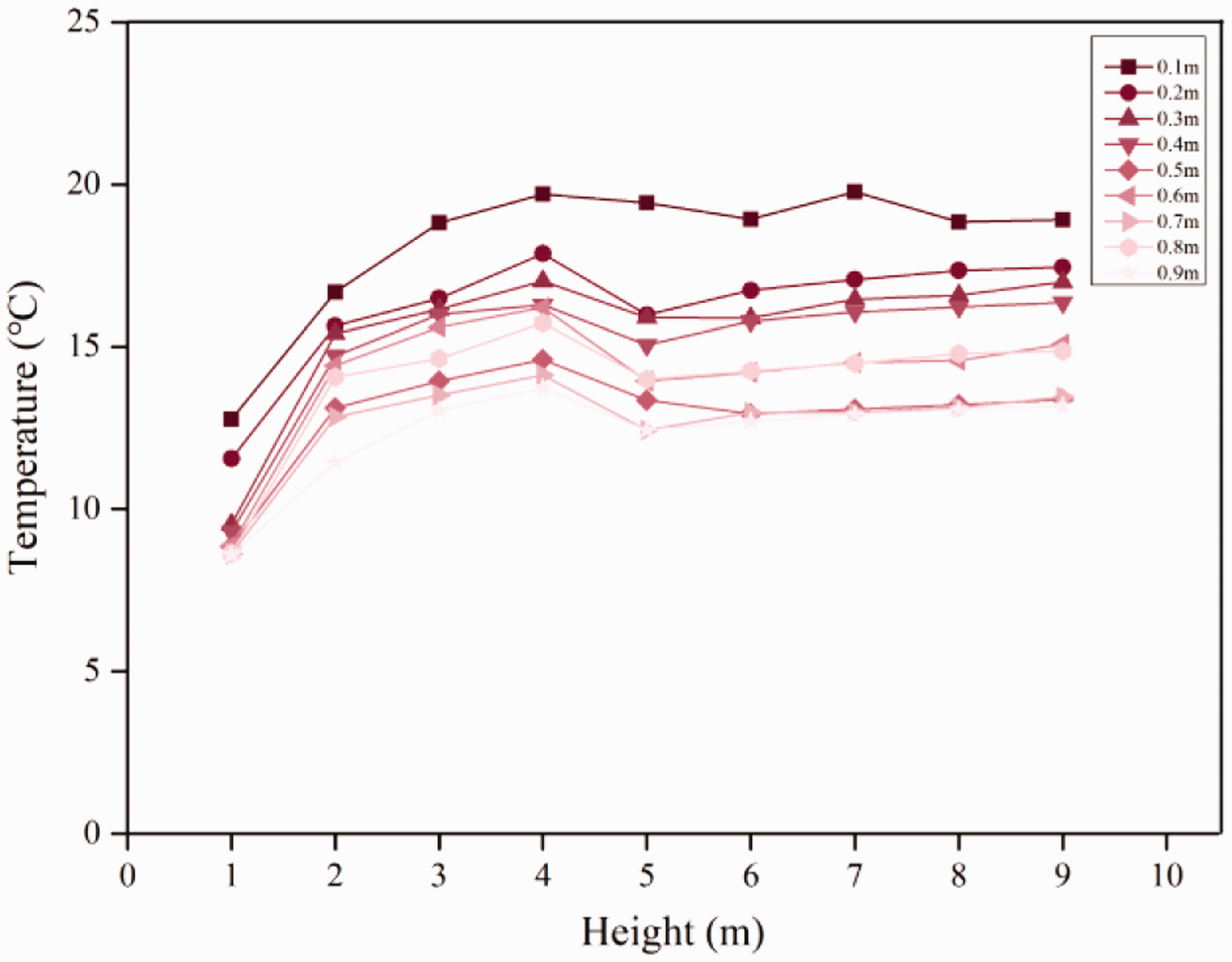
The curve of height and air temperature change of double skin facade cavity.
Under the same thickness, in the height range from 1 m to 4 m, with the increase of the height, the average temperature at the opening of the inner surface increases rapidly, reaching a large value when the height is 4 m, with the increase of about 7°C; In the height range of 4 m–9 m, the temperature of curtain wall with thickness of 0.1 m fluctuates slightly, which is basically maintained at about 19°C. The temperature of other groups of curtain walls decreased significantly at the height of 5 m, with a decrease of about 1.5°C, and then began to rise, but the increase is not significant. When the height reached 9 m, the temperature is close to the high value again. At the same height, the thickness of curtain wall is inversely proportional to the average air temperature at the opening of inner surface. The curtain wall with a thickness of 0.1 m has a high temperature. In the thickness range from 0.1 m to 0.5 m, the temperature has been falling significantly, about 5°C, and in the thickness range from 0.5 m to 0.9 m, the temperature fluctuates slightly, with an amplitude of about 1.5°C.
The thermal comfort standard under natural ventilation environment is that when the ambient temperature is lower than 5°C, the indoor temperature is higher than 16°C, which can reach the acceptable comfort of 80% of the population, and the indoor temperature is higher than 17°C, which can reach the acceptable comfort of 90% of the population. Therefore, in the case of this simulation, the air supply temperature of curtain wall with height and thickness from 3 m to 9 m and 0.1 m to 0.4 m can basically reach the comfort standard accepted by most people, in which the air preheating effect of curtain wall with height of 4 m is the best. It is worth noting that for a curtain wall with a height of 2 m and a thickness of 0.1 m, the average air temperature at the opening of its inner surface can also reach 16.68°C, which shows that the air preheating effect of a single double-layer ventilation glass window is also very obvious when there is no condition for an integral curtain wall. It can be seen from Figures 6 and 7 that the wind speed at the opening of the inner surface of the curtain wall is roughly proportional to the height of the curtain wall, and roughly inversely proportional to the thickness of the curtain wall. However, with the height of the curtain wall decreases, the range of wind speed decreases, meanwhile, the law becomes less obvious. It indicates that increasing the height thickness ratio of the curtain wall is benefit for increasing the wind speed.
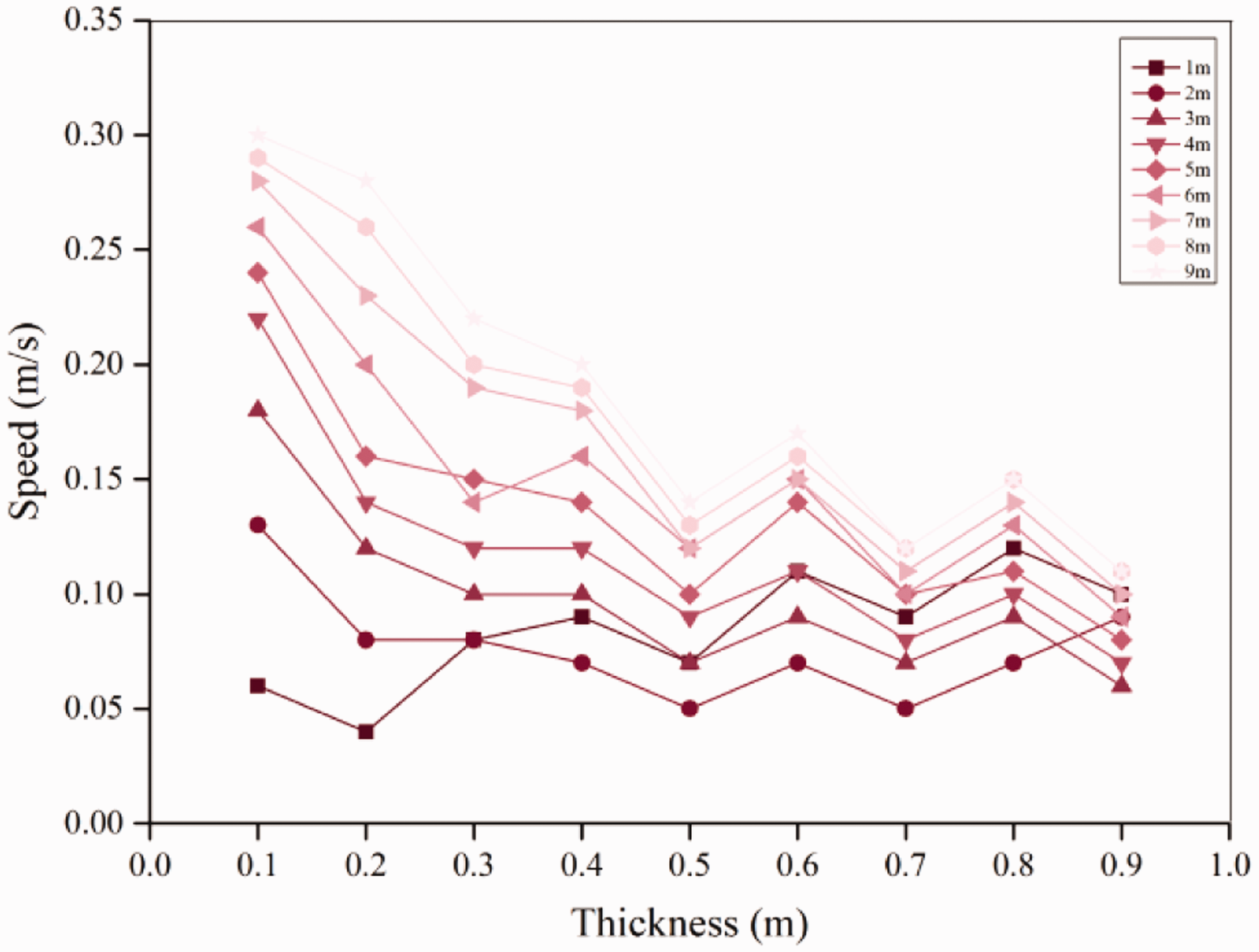
The curve of the thickness and wind speed of the double facade skin cavity.
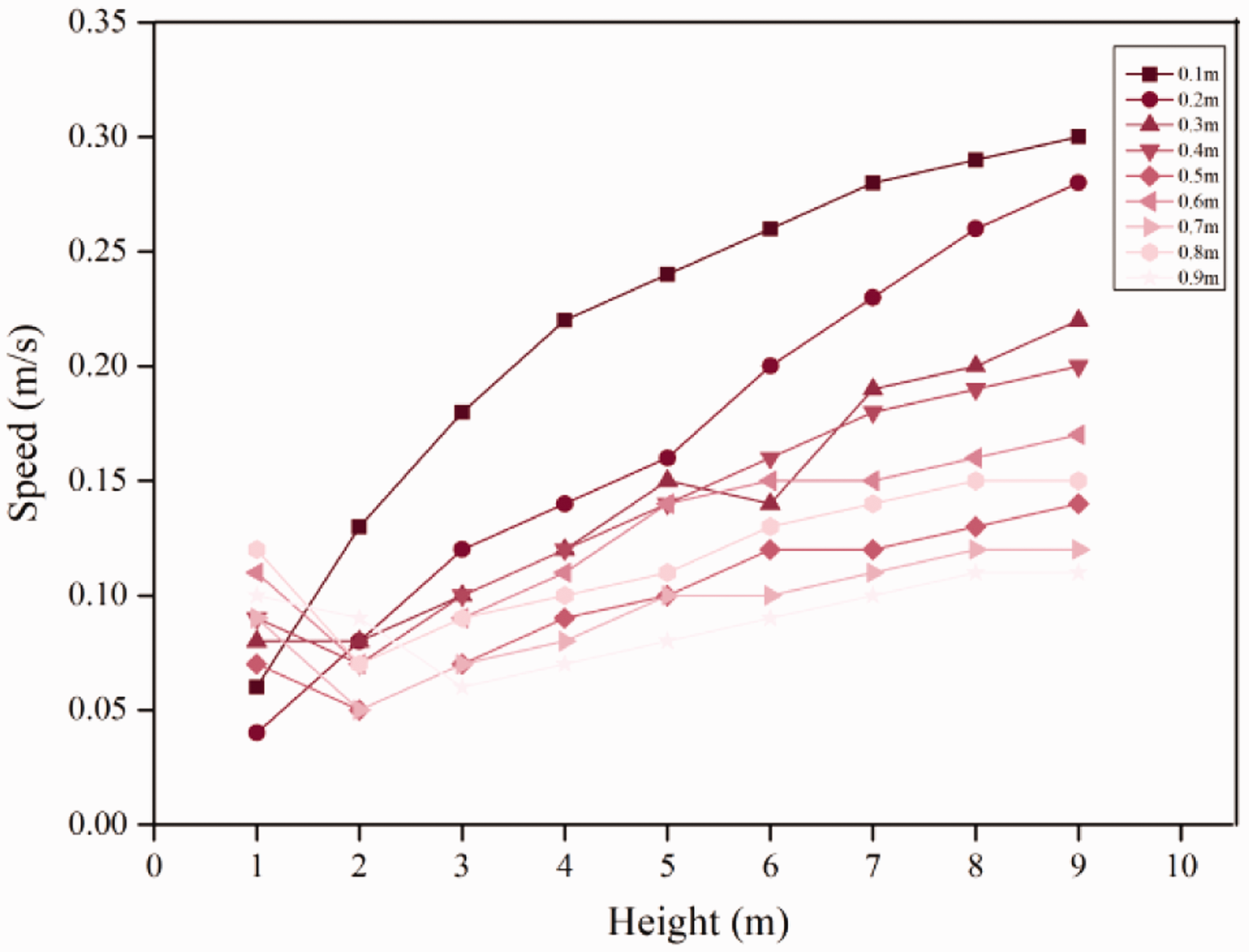
The curve of the height and wind speed of the double facade skin cavity.
The influence of the opening of double skin facade on the preheating ventilation effect
Simulation calculation process
Model establishment: build two sets of room models with ventilation double facade curtain wall. The basic model is shown in Figure 8.
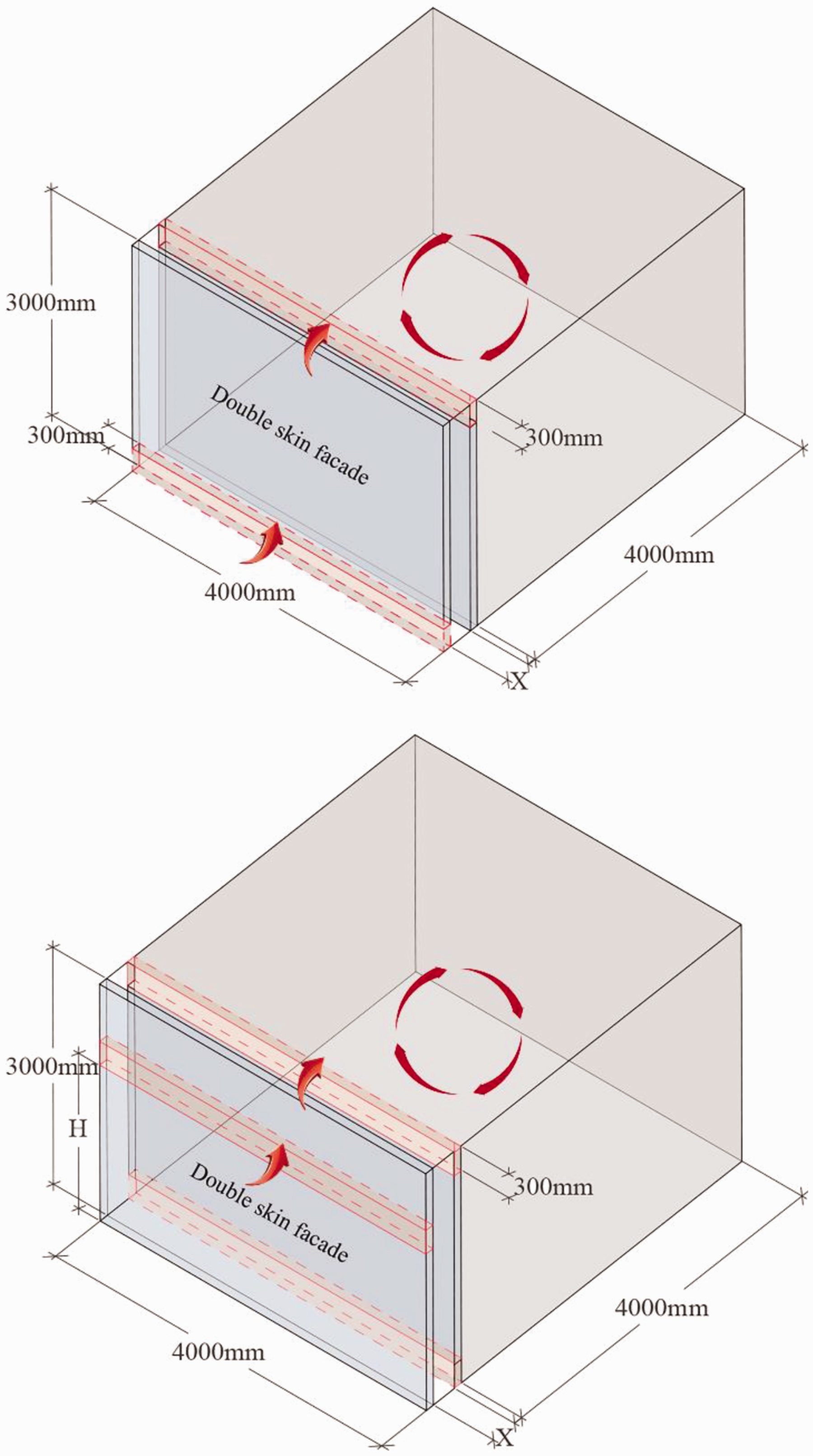
Basic model of ventilation double skin facade curtain wall room.
The first group: there is an opening of 4 m wide and 0.3 m high at the bottom of the outer surface and the top of the inner surface of the curtain wall. The curtain wall is set with a height of 3 m, a width of 4 m and a thickness of 0.1 m, 0.2 m and 0.3 m respectively; the room is set with a height of 3 m, a width of 4 m and a length of 5 m; the ambient temperature and the temperature of each surface of the model are 8.51°C from 10:00 to 14:00 in December in Nanjing; the radiation value of the inner surface of the curtain wall is the average total solar radiation value from 10:00 to 14:00 in December in Nanjing, which is 343.04 W/m2.
The second group: an opening with width of 4 m and height of 0.3 m is set at the top and bottom of the inner surface of the curtain wall, and an opening with width of 4 m and height of 0.3 m is set at the outer surface. Its position changes from top to bottom on the outer surface. The corresponding elevation of the bottom is 0 m, 0.6 m, 1.35 m, 2.1 m and 2.7 m respectively. The other condition settings are the same as the first group of models.
Simulation calculation: appropriate grids are divided in each model for calculation, and the average temperature, air age and PMV in the room are as shown in Tables 4 and 5.
First group simulation results.
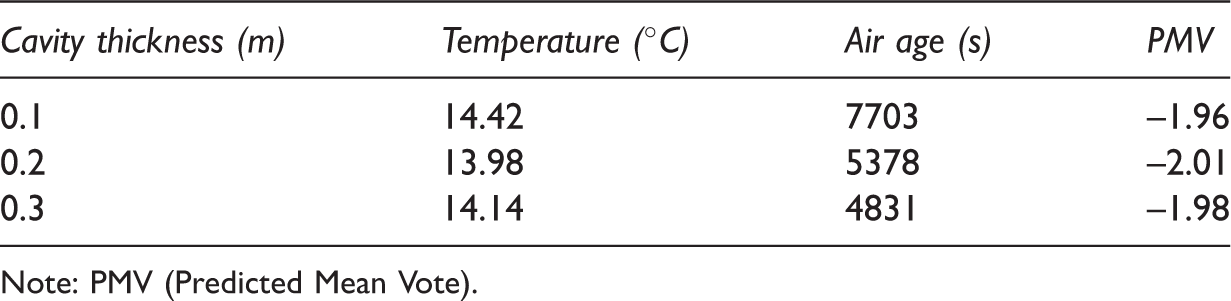
Note: PMV (Predicted Mean Vote).
Second group simulation results.
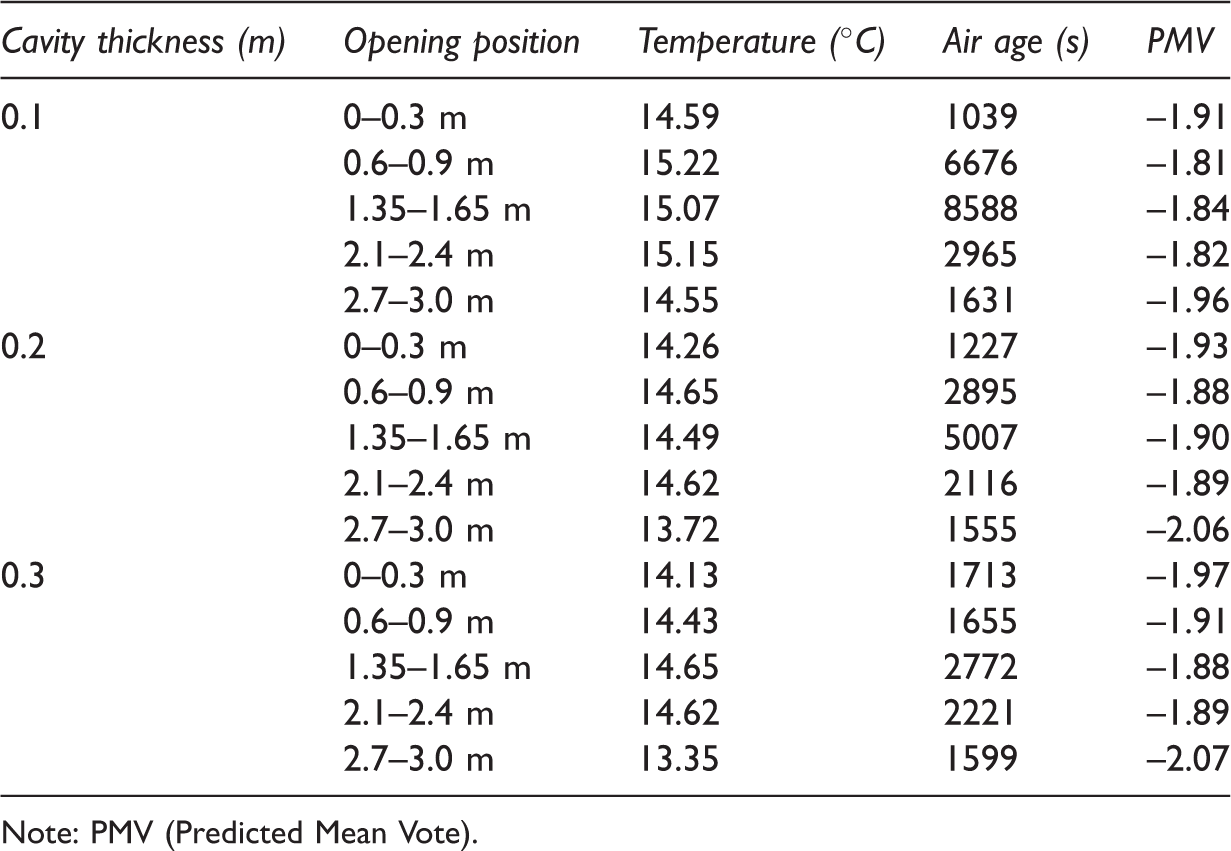
Note: PMV (Predicted Mean Vote).
Data analysis
In the first group of models, the ventilation double-layer glass curtain wall opens at the top of the external surface and the bottom of the internal surface. Although its air supply temperature can reach the comfort standard accepted by most people, the indoor air circulation times cannot reach the healthy ventilation standard of 1 time per hour. Although the air supply temperature is higher when the thickness is smaller, the indoor air age is also higher. In general, the indoor average temperature increases by about 6°C, and the value of PMV is about −2.
In the second group of models, it can be seen from Figure 9(a) and (b) that the indoor average temperature when the opening is in the middle part is lower than when the opening is at both ends. Among them, the air preheating effect of the ventilation double skin facade curtain wall with the thickness of 0.1 m is the best, and the indoor average temperature is about 0.5°C higher than that of the curtain wall with the thickness of 0.2 m and 0.3 m. The trend of PMV is the same as that of indoor average temperature. As shown in Figure 9(c), the average indoor air age is long when the opening is close to the middle. Conversely, the average indoor air age is short when the opening is close to the both ends. When the opening is at both ends, the average air age of the rooms corresponding to curtain walls of different thicknesses is almost the same, all of which are around 1500 s, and the indoor air change times can reach 2–3 times per hour; when the opening is close to the middle, the air age of the curtain wall rooms with the thickness of 0.1 m is significantly longer than that of the rooms with the thickness of other curtain walls.
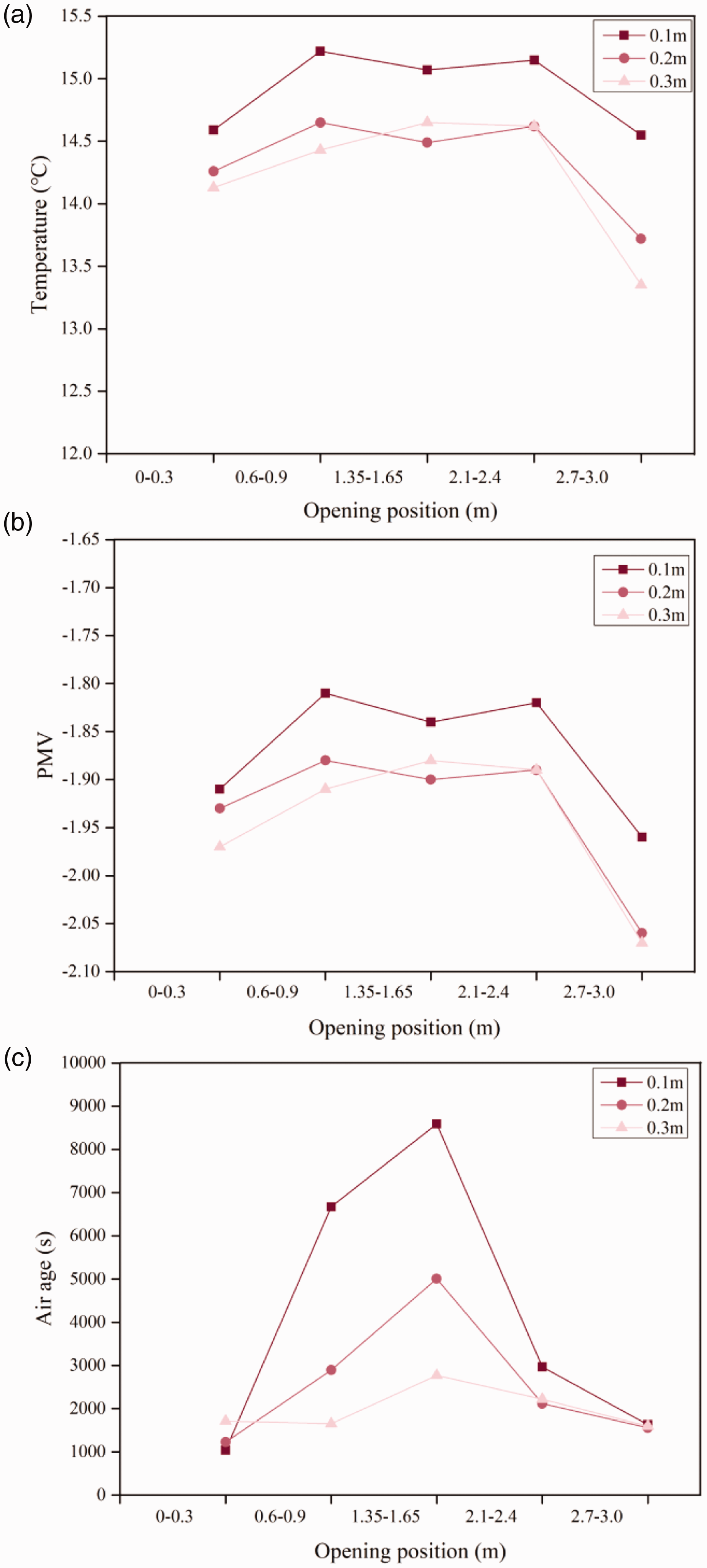
Influence of opening position on temperature, PMV and air age.
The comparison is carried out among all models in which air age meeting the requirements of healthy ventilation. It indicates that when the thickness of curtain wall is 0.1 m, the indoor average temperature of the model with opening bottom elevation of 2.1 m is as high as 15.15°C, and its average air age is 2965 s; when the thickness of curtain wall is 0.1 m, the indoor average air age of the model with opening bottom elevation of 0 m is 1039 s, and its average temperature is 14.59°C. Although the average indoor temperature of the latter is a little lower than that of the former, the number of indoor air changes of the latter is nearly three times higher than that of the former. The number of indoor air changes of the latter can exceed three times per hour, which is better. In addition, compared with other thickness of curtain walls, the curtain wall with thickness of 0.1 m saves a lot of materials and has better air tightness. Therefore, in all models of this simulation, the ventilation double skin facade curtain wall with the thickness of 0.1 m and the bottom elevation of the opening of 0 m is the most favorable for passive preheating and natural ventilation.
In the two group of models, although the indoor average temperature cannot fully meet the comfort standard accepted by most people, its air preheating effect is still obvious.
Operation effect of double skin facade in heating season
For passive preheating natural ventilation, it is suitable for the heating season and the heating transition season, the corresponding time is from November to March of the following year, December, January and February are the heating season, and November and March are the heating transition season.
Simulation calculation process
Model establishment: Establishing five room models with ventilated double-glazed curtain walls. The ambient temperature and the temperature values on all sides of the model correspond to the average air temperature values in Nanjing from 11, 12, 1, 2, and March 10:00 to 14:00; The radiation value of the inner surface of the curtain wall corresponds to the average total solar radiation value of Nanjing from 10:00 to 14:00 in each month. Suppose that each model has an opening 4 m high and 0.3 m wide at the top and bottom of the inner surface of the curtain wall, and an opening 4 m wide and 0.3 m wide at the outer surface, and the bottom elevation is 0 m; the height of the room is 3 m and the width is 4 m. The length is 5 meters (Figure 10).
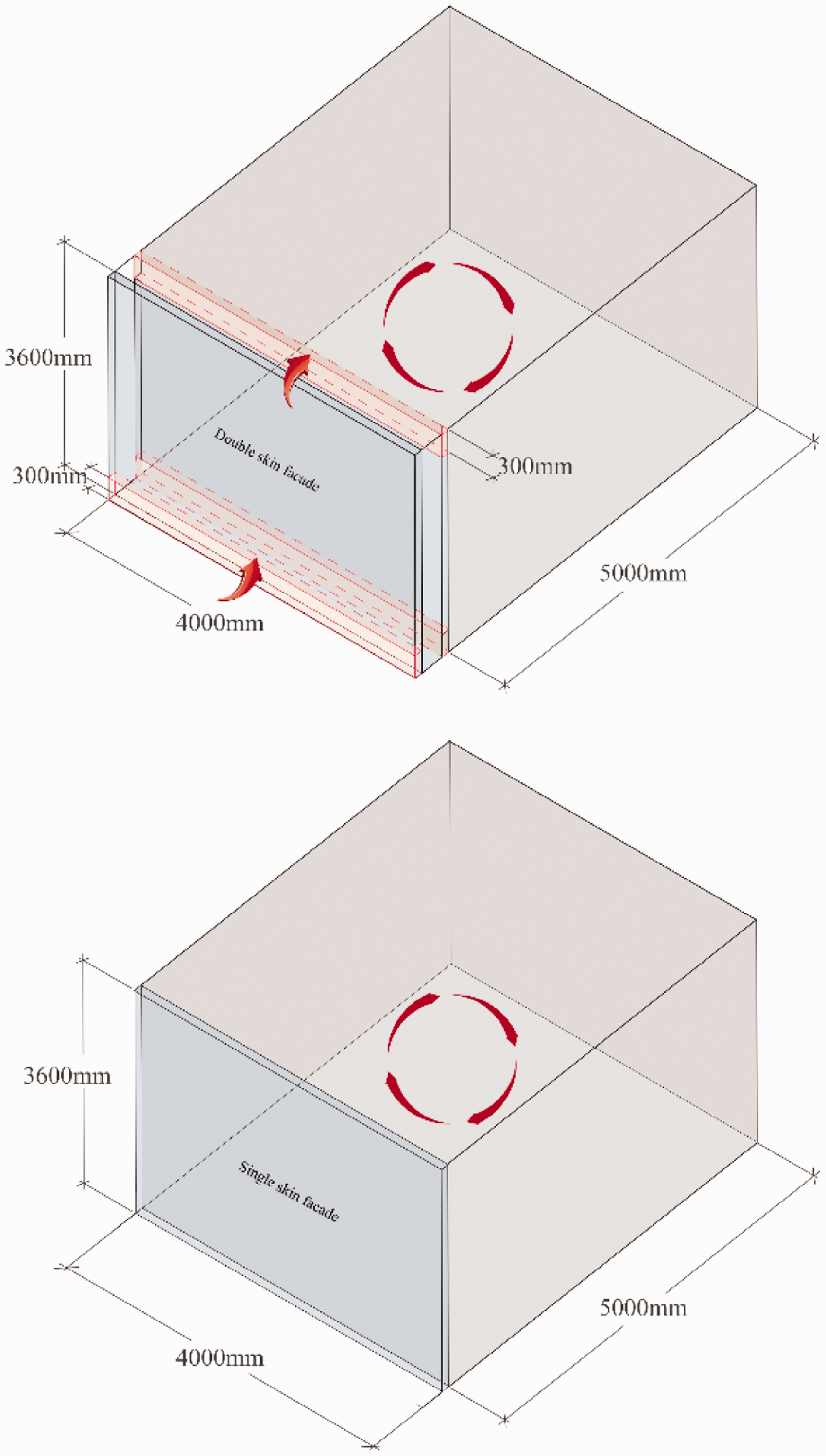
Model of ventilation double skin facade curtain wall room and single curtain wall room.
Simulation calculation: divide the appropriate grid in each model for calculation, and the average temperature inside the room is shown in Table 6 and Figure 11.
The average temperature inside the room.
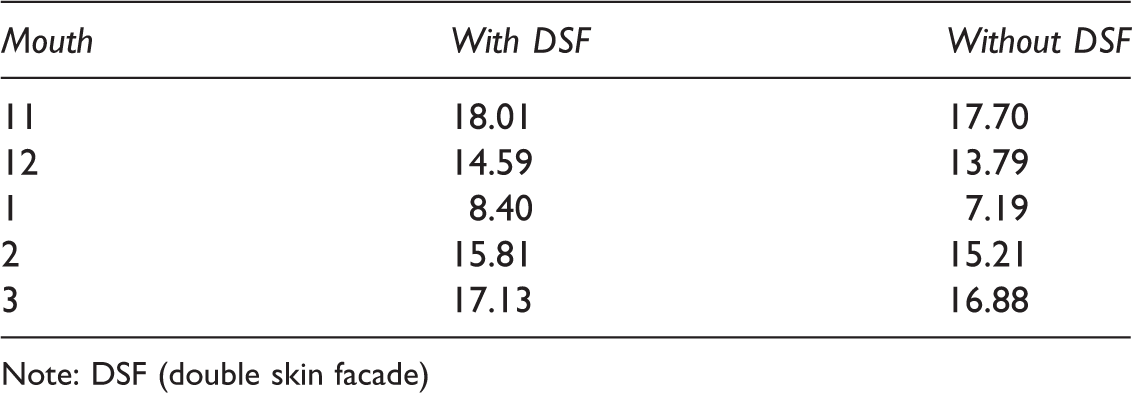
Note: DSF (double skin facade)
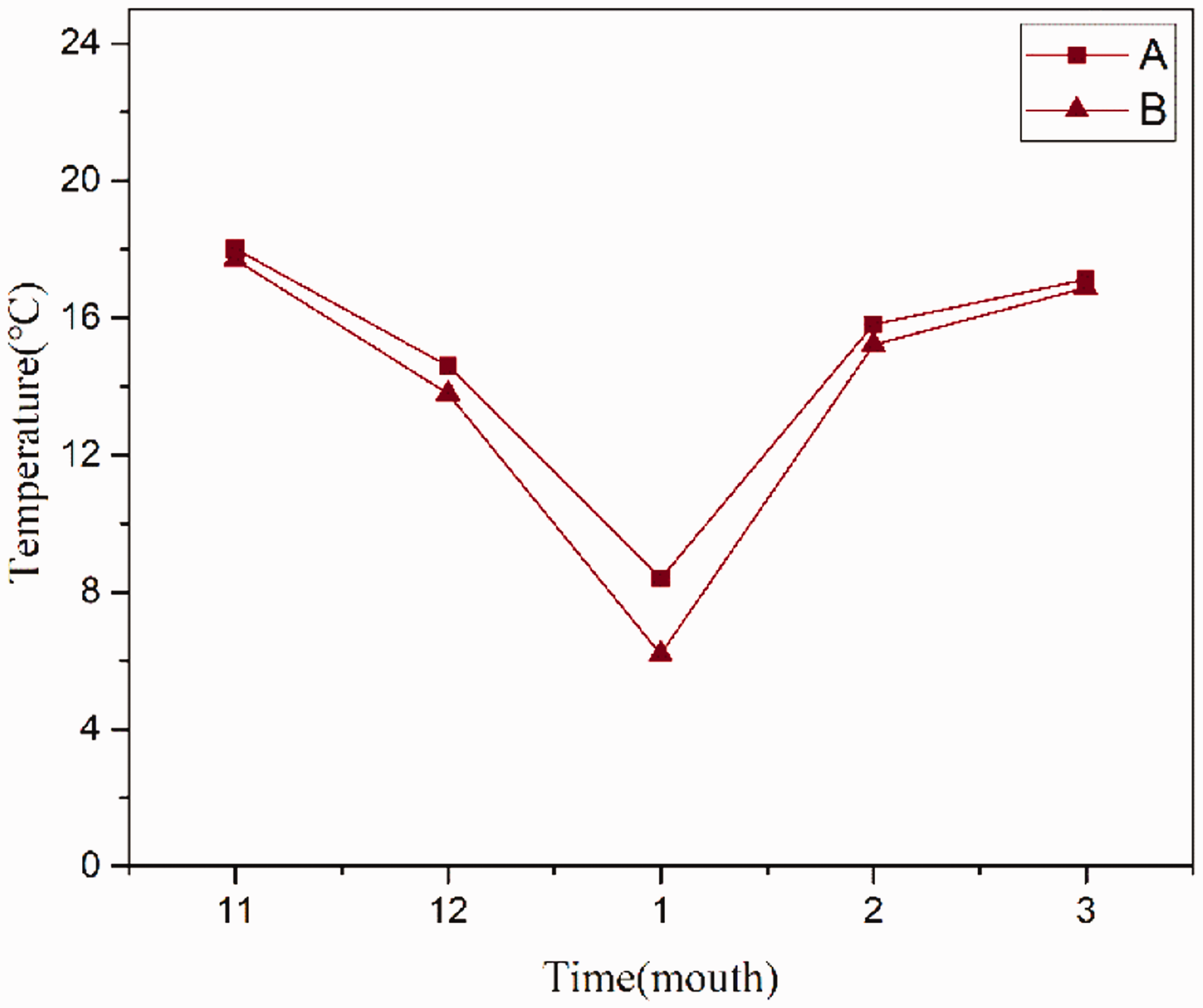
Curve of changing indoor temperature with time.
Data analysis
It can be seen from Figure 12 that the value of the indoor average temperature changes with the change of the ambient temperature. In January of the heating season in Nanjing, the difference between the average indoor temperature of the model without a ventilated double skin facade and the average indoor temperature of the model with a ventilated double facade exceeded 1°C; the difference between the average indoor temperature of the two models in December and February was less than 1°C; the average temperature difference between November and March in the heating transition season is small, less than 0.5°C.
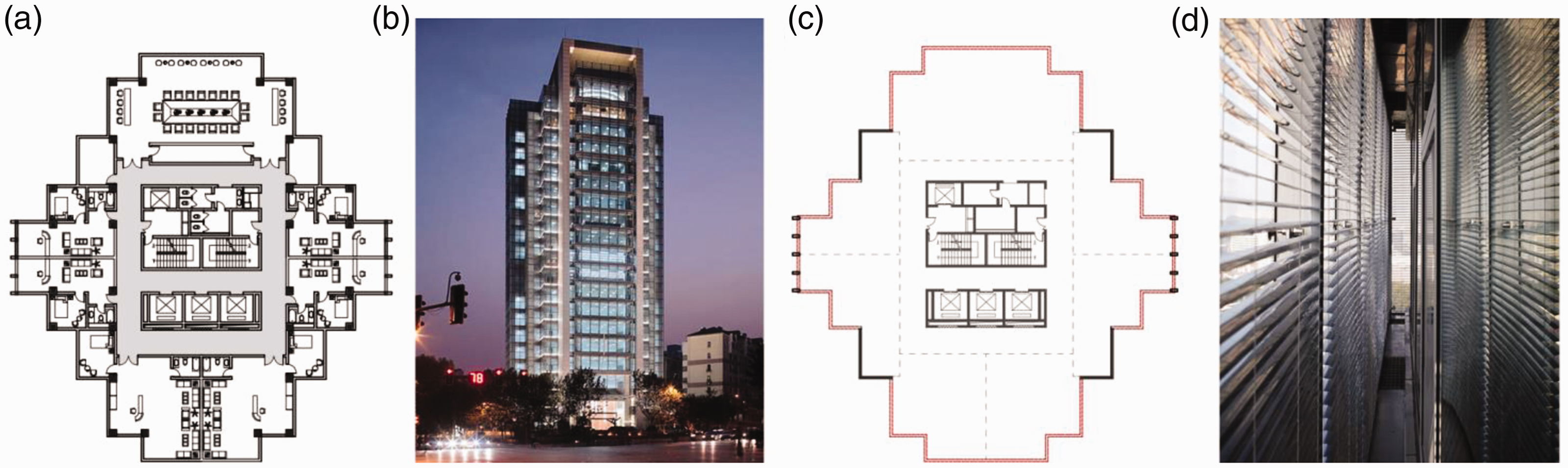
Nanjing Yincheng building.
Case study of passive preheating natural ventilation double skin facade
Test process of Nanjing Yincheng building
Part of the curtain wall of Yincheng building adopts ventilated double skin facade curtain wall. Herein, the outer curtain wall material is 12 mm thick tempered transparent glass, and the inner side is tempered hollow Low-E glass, and the electric sunshade is installed between the inner and outer curtain walls. The other glass curtain walls are single-layer glass, with sun blinds set outside. In the heating season, the temperature of the cavity in the middle of the two-layer curtain wall rises after being exposed to the sun, forming a greenhouse, which can improve the temperature of the outer surface of the inner curtain wall. Meanwhile, the cavity, as a climate buffer space, can radiate heat to the interior, and enhance the heat preservation and insulation of the building skin. Through the control of the air intake device and the exhaust ports at the upper and lower ends of the double-layer glass curtain wall, the heated air flow is generated in the cavity under the action of hot pressure, and enters to the room. That improves the indoor temperature and air quality, and reduces the energy consumption of building heating (Figure 12).
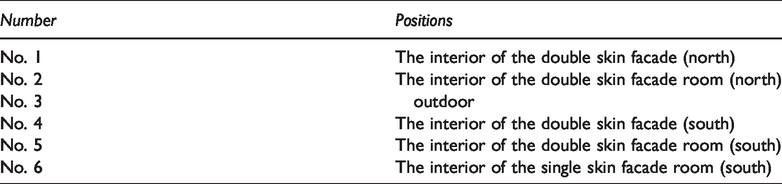
In order to verify the operation effect of facade passive preheating natural ventilation cavity in heating season, the glass curtain wall system of Nanjing Yincheng building was investigated and tested on the spot. The test time is from 15:00 on January 14, 2019 to 10:00 on January 21, 2019; the test instrument is 6 automatic temperature and humidity recorders. By setting up an automatic temperature and humidity recorder to record every 30 minutes, the complete temperature data from January 15 to January 20 are obtained. The arrangement of instruments is shown in Table 7.
Distribution position of automatic hygrometer.
Test data analysis
The temperature change of each test point in six days is shown in Figure 13. The changes of the highest temperature, the lowest temperature and the average temperature at each test point in six day are shown in Table 8.
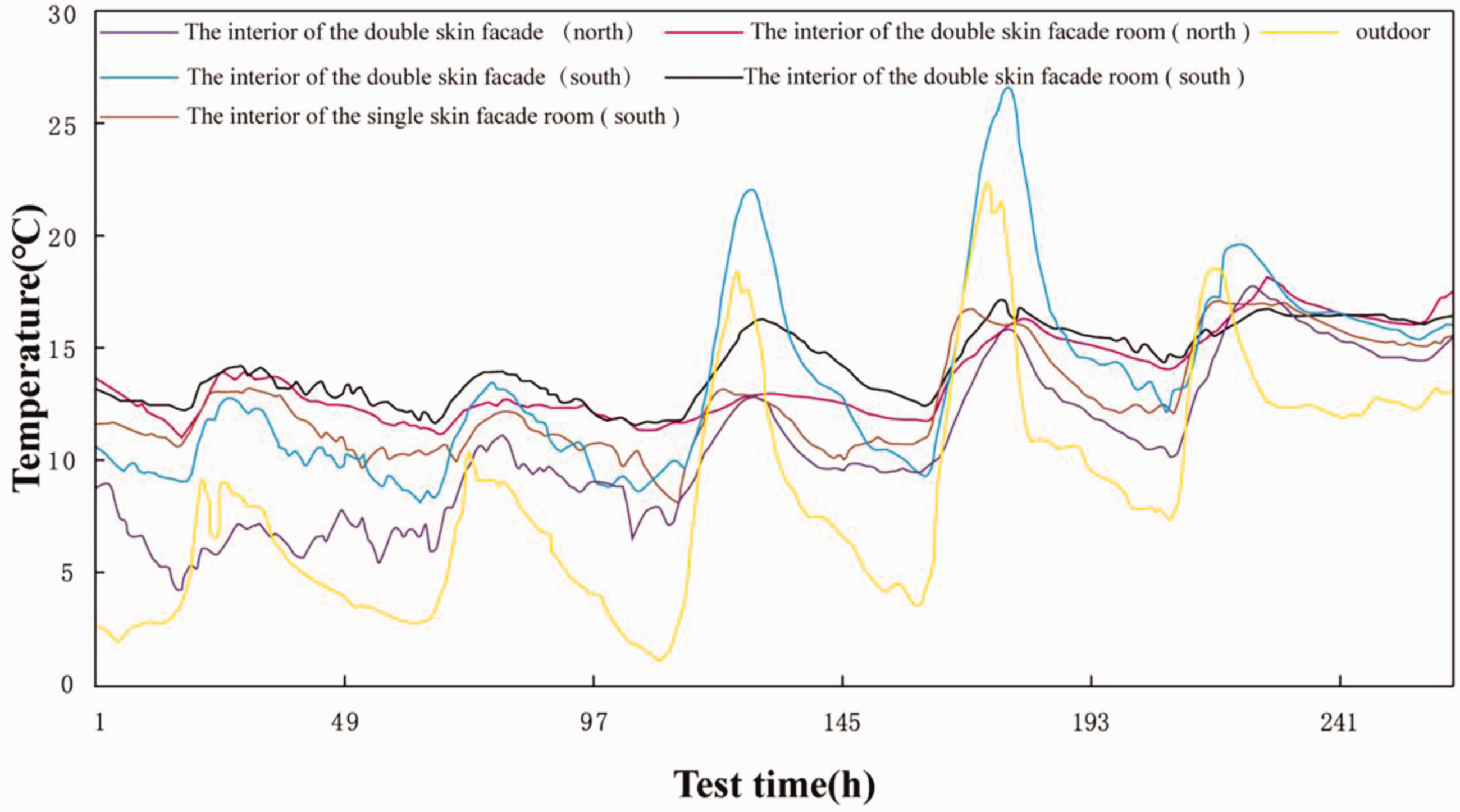
Temperature change curve of each test point in six days.
Changes of the highest temperature, the lowest temperature and the average temperature at each test point in six days.
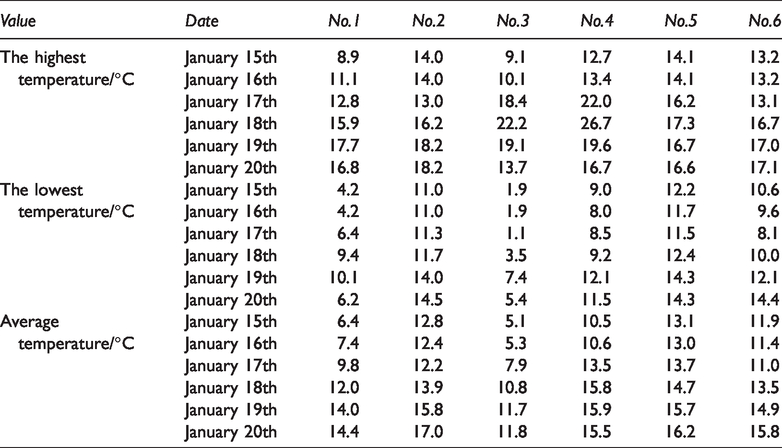
By observing the temperature change curves of each test point in six days, it can be found that the overall temperature change trend of each point is consistent. The temperature fluctuation in the interior and exterior of the double skin on the south side changes greatly. When the sunny days (17th, 18th), the temperature in the interior of the double skin on the south side rises rapidly with the outdoor temperature rising in the daytime, which is significantly higher than that of other points. During the cloudy days (15th, 16th, 19th, 20th), the temperature of each test point does not increase significantly, but the temperature in the interior of the double skin on the south side is always higher than outdoor. The highest outdoor temperature appears at 13:00, and the lowest outdoor temperature appears at 7:00. However, the tested highest temperature occurs at 15:00, and the tested lowest temperature also occurs at 7:00.
It can be seen that in Figure 14(a) that, when the sunny days (17th, 18th), the temperature in the interior of the double skin on the south side is obvious higher than other tested temperatures about 6−10°C.
Influence of opening position on temperature, PMV and air age.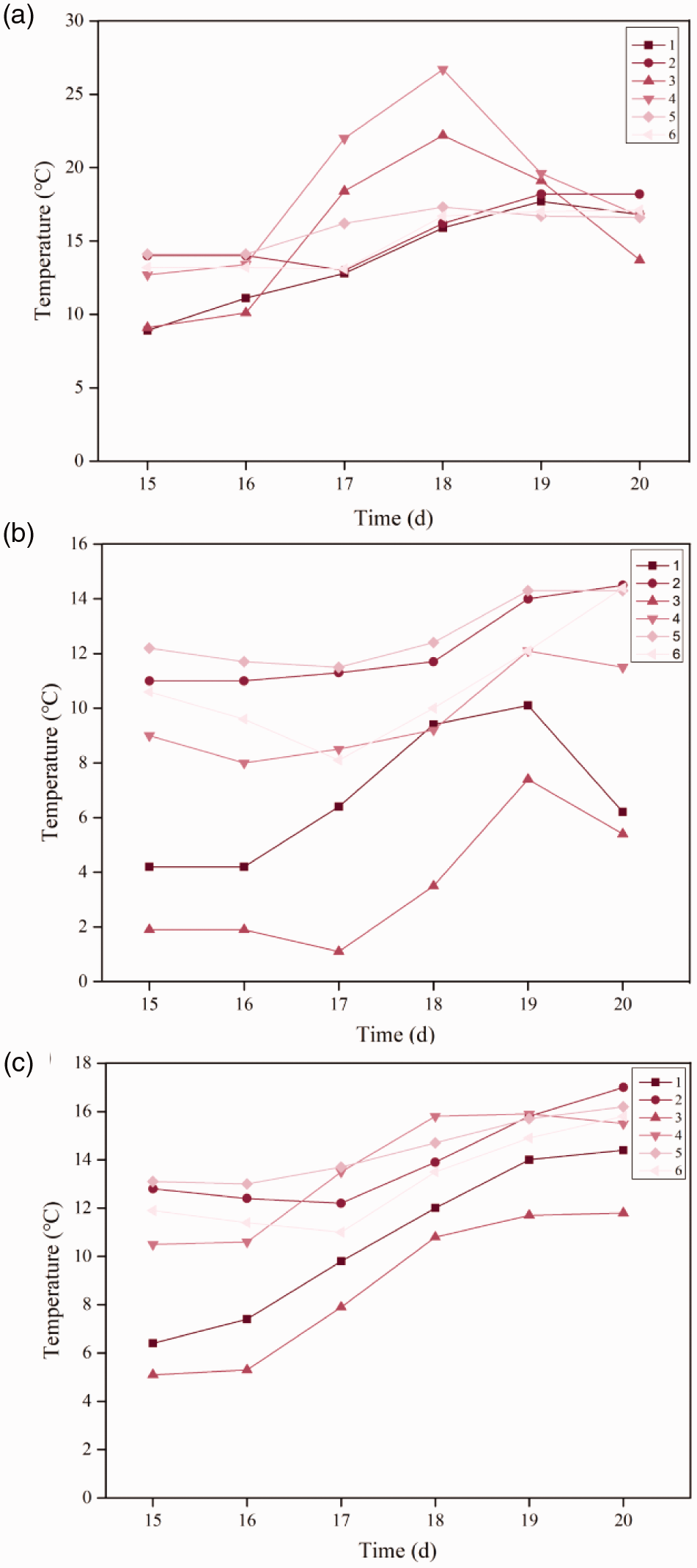
In Figure 14(b), the temperatures at each test point are essentially independent of each other, In order from highest to lowest temperature, they are subsequently the interior of the double skin facade room (south), the interior of the double skin facade room (north), the interior of the single skin facade room (south), the interior of the double skin facade room (south), the interior of the double skin facade room (north), outdoors. Herein, the temperature of double skin facade room is higher than that of single skin facade room about 2°C.
As seen in Figure 14(c), it can be seen that the average temperature curves of the three test points, namely the interior of the south double-layer curtain wall, the interior of the north double-layer curtain wall and the outdoor, fluctuate greatly and tend to be parallel. The average temperature inside the double-layer curtain wall on the south side is about 5°C higher than the outdoor average temperature. The average temperature inside the double-layer curtain wall on the north side is about 2°C higher than the outdoor average temperature. In six tested days, the high average temperature of the three test points is about 6°C higher than their corresponding low average temperature. In contrast, the temperature curves of the three test points in the north double curtain wall room, the south double curtain wall room and the south single curtain wall room are relatively flat, and their high average temperature is about 4°C higher than the low average temperature. The other curves do not cross each other and are arranged in a regular distribution except the average temperature curve of the interior of the south double skin facade, from highest to lowest temperature, they are as follows: the interior of the south double skin facade room, the interior of the north double skin facade room, the interior of the south single skin facade room, the interior of the north double skin façade, outdoors. In sunny days (17th, 18th), the average temperature of the interior of the south double skin facade is not lower or significantly higher than the average temperature of other points. In cloudy days (15th, 16th, 19th, 20th), the average temperature of the interior of the south double skin facade is lower than the average temperature of the three test points inside the room, and higher than the average temperature of the interior of the north double skin facade and outdoors.
Through the above analysis, it can be proved that the air preheating effect of the ventilation double glass curtain wall is greatly restricted by the weather conditions. In the heating season of Nanjing, when the solar radiation condition is good on a sunny day, the south curtain wall can absorb the solar radiation to heat up rapidly, and effectively preheat the air to improve the indoor temperature. Meanwhile, the north curtain wall can absorb the limited solar radiation, and the air preheating effect is not obvious, however, it can effectively maintain the indoor temperature. When the solar radiation conditions are not good in cloudy days, the ventilation double-layer glass curtain wall at the north and south sides cannot effectively preheat the air, but it has a great heat preservation effect as an air buffer layer, which can maintain the indoor temperature at a higher level, much better than the effect of single-layer glass curtain wall.
Comparison and verification of actual measurement and simulation of Yincheng building
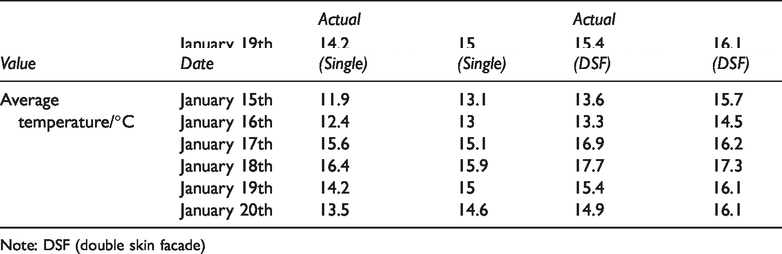
According to the single-storey facade room model and the ventilated double-storey facade model established above, the model temperature is based on the weather temperature measured on the 6th day of Nanjing. The solar radiation standard uses the average solar radiation in January in Nanjing. Compare the obtained single- and double-layer simulation data with the temperature changes of the single- and double-layer facades of Nanjing Yincheng Building measured in January for six days (Table 9).
Simulated and measured temperature changes.
Note: DSF (double skin facade)
As can be seen from Figure 15, on the 17th and 18th days when the weather conditions are better, the temperature of the single-layer facade and the double-layer facade are 3 ∼ 4°C higher than those on the 15, 16, 19, and 20 cloudy days; The measured and simulated data of the single-layer facade skin show that the measured temperature on the 17th and 18th of the sunny day is 0.5°C higher than the simulated value, and the cloudy day is about 1°C higher than the measured temperature; the measured and simulated data of the double-layer facade It is shown that the measured temperature on sunny days is 0.7°C higher than the simulated temperature on the 17th, and 0.4°C higher on the 18th. The simulated temperature on cloudy days is also about 1°C higher than the measured temperature. It can be seen that the temperature difference between the single and double skins is about 0.5°C on sunny days, and the air preheating effect is small. The temperature difference between the single and double skins on cloudy days is about 1°C, which is much better than the heat preservation preheating effect on sunny days. In general, the test temperature trend of each model is basically consistent with the measured temperature trend, which can fully prove the accuracy of the experimental simulation data, that is, the ventilation double-layer glass curtain wall is better than the single-layer glass curtain wall.
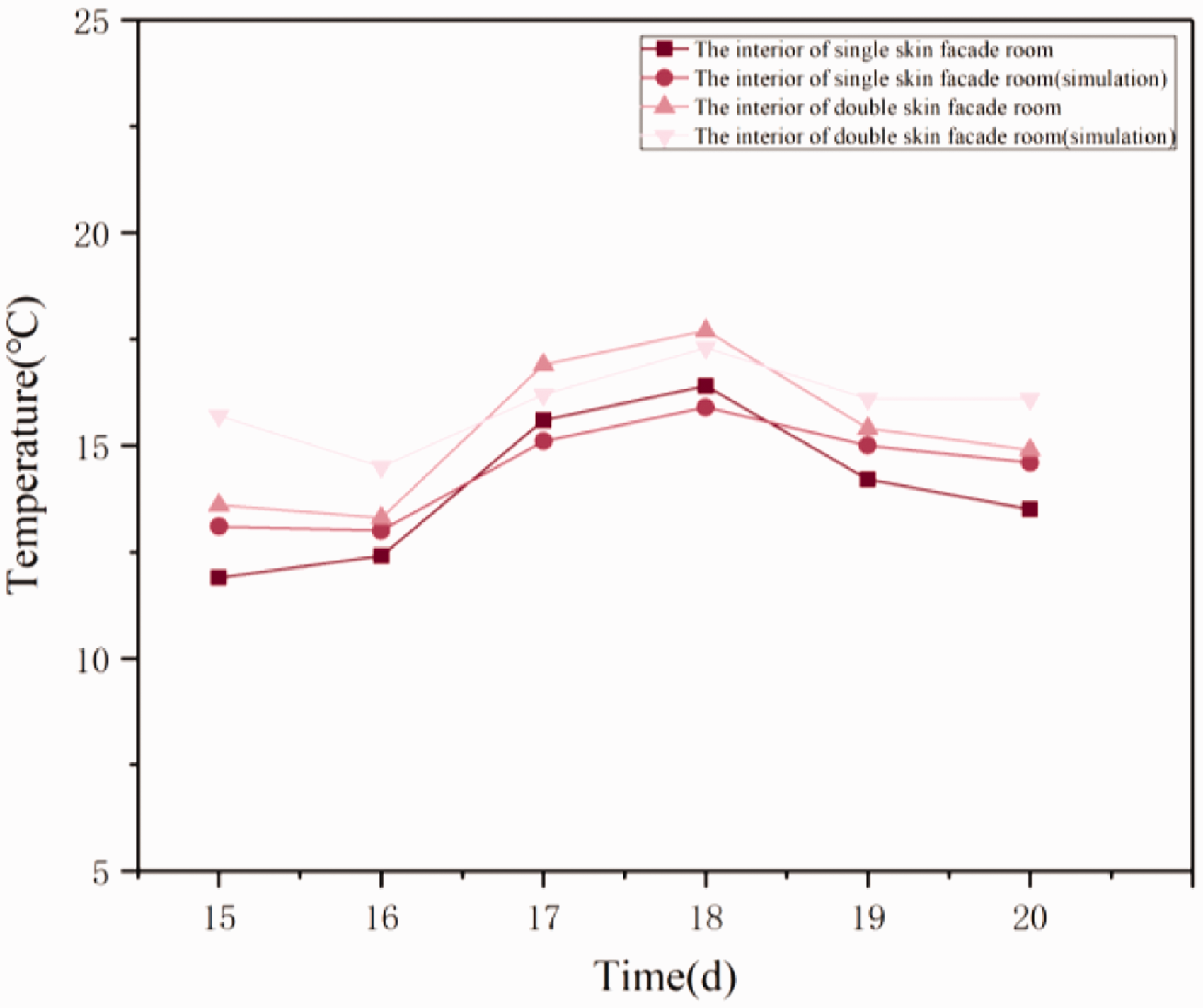
Comparison and verification between actual measurement and simulation.
Conclusions
In the process of building design, the combination of passive preheating measures and natural ventilation double skin facade can meet the heating and ventilation requirements of the building and reduce energy consumption, which is of great significance to the development of the building.
The research conclusion mainly includes the following three aspects:
In the passive preheating natural ventilation double skin facade, for the ventilation double-layer glass curtain wall with openings at the top of the inner surface and the bottom of the outer surface, the air velocity is approximately proportional to the height of the curtain wall, and is approximately inversely proportional to the thickness of the curtain wall. However, with the height of the curtain wall decreased, the range of wind speed decreases. The air supply temperature is inversely proportional to the thickness of the curtain wall, and the curtain wall with a height of about 4m has the best air preheating effect. 2. For the ventilated double glass curtain wall room, if the curtain wall has openings at the top of the inner surface and the bottom of the outer surface, although it can effectively improve the average indoor temperature, the number of indoor air circulation cannot reach the standard of healthy ventilation. If the natural ventilation chamber is preheated passively, the number of air circulation in the room can reach the standard of healthy ventilation. 3. The investigation and test results of the glass curtain wall system of Nanjing Yincheng building show that the air preheating effect of the ventilated double glass curtain wall is greatly restricted by the weather conditions. In sunny days, the passive preheating ventilation effect of the south double skin facade is good, while the effect of the north double skin facade is not obvious. However, in cloudy days, the effect of both is not obvious. The double skin facade has a great heat preservation effect as an air cushion layer, which is more conducive to maintain indoor temperature than single glass curtain wall.
At present, the conclusion of simulation is only based on ideal condition, so the difference between simulation calculation and actual situation needs to be further reduced. In conclusion, by making full use of the natural clean energy in the building, combining with the specific conditions of the building, such as the regional conditions, heating and ventilation demand, construction conditions and project budget, and comprehensively using the passive preheating natural ventilation strategy, we can reduce the transitional dependence on energy consuming equipment and achieve the purpose of energy conservation while improving the internal microclimate of the building in the cold season.
Supplemental Material
sj-pdf-1-eea-10.1177_0144598720956288 - Supplemental material for Simulation and experimental verification of energy saving effect of passive preheating natural ventilation double skin façade
Supplemental material, sj-pdf-1-eea-10.1177_0144598720956288 for Simulation and experimental verification of energy saving effect of passive preheating natural ventilation double skin façade by Keming Hou, Shanshan Li and Haining Wang in Energy Exploration & Exploitation
Footnotes
Declaration of conflicting interests
The author(s) declared no potential conflicts of interest with respect to the research, authorship, and/or publication of this article.
Funding
The author(s) disclosed receipt of the following financial support for the research, authorship, and/or publication of this article: This work was supported by the Open fund projects of State Key Laboratory of Green Building in Western China (No. LSKF202020).
