




Abstract
Considering the perovskite-based building-integrated photovoltaics, we use the single box model of 4 × 4 × 3 m3 to illustrate a promising solution for the zero-energy residential building and the distributed power generators in the Wuhan urban area in China (N30° E114°), where we have the high ratio of façades on the tall buildings. According to our estimation, the energy gains from the solar cells on the façades could be competitive with the ones on the rooftops. In comparison with the perovskite/silicon tandem solar cells, the perovskite-based single-junction solar cells could boost the annual energy gains more than 1.5 times on the façades. It is because of the perovskite-based single-junction solar cells being less angle-dependent, even if their efficiencies under the vertical illumination are lower than that of the perovskite/silicon tandem solar cells. Within the same single box, the energy demands caused by the air-conditioning system are simulated by the program THERB with 100 and 65% solar irradiation; the previous one is the standard case, and the later one assumes that 35% of solar irradiation is converted to the electricity. To control the indoor temperature above 18°C in winter and below 26°C in summer, the single box could achieve zero-energy demand except for January and December. And the annual surplus photovoltaic energy gains of 3071 kW h could be used as the distributed generator for the resident downstairs.
Introduction
Besides rooftops, the building façades are also stimulated to architecturally integrate with photovoltaic technologies due to recent developments. On 2026, the predicted commercial market revenues of the annual worldwide building-integrated photovoltaics (BIPV) based on glass and walling are 3 and 1.2 billion, respectively, while that of roofing is 2.8 billion (Ballif et al., 2018). Mostly, multi- or mono-crystalline silicon-based solar cells (SSCs) are used in the BIPV projects. However, silicon is unlikely to turn into raw building materials; it is unlike wood, concrete, or glass. The strict limitation of construction on silicon-based BIPV is one of the major hurdles. Emerged since 2012 (Lee et al., 2012), cost-effective (Li et al., 2018) perovskite-based single-junction solar cells (PSCs) are generally fabricated on the glass; the state-of-the-art efficiency is 25.2%, approaching the efficiency record of the crystalline SSC (26.1%). Therefore, PSCs are promising for BIPV application as well. What is more, the perovskite/silicon two-terminal tandem solar cells (PSTs) achieved an efficiency of 28% at the end of 2018, and it is announced to go over 30% and be commercialized soon. Nowadays, the focus of research and development on perovskite is shifted from the efficiency to the stability (Wang et al., 2019) and the application (Hörantner and Snaith, 2017) under real-world operating conditions. The overall energy yield of the PSCs is found to maintain almost optimum due to reversible degradation (Tress et al., 2019). However, the energy gain of perovskite-based BIPV is still not well assessed in comparison with the traditional silicon-based BIPV.
In the study, the top floor of the apartment is investigated by using the 4 × 4 × 3 m3 single box model covered by PSCs and PSTs. Rather than only on the rooftops (Assoa et al., 2017; Naveen et al., 2018; Poulek et al., 2018; Sprenger et al., 2016; Walker et al., 2019), we also theoretically estimate the energy gained by different photovoltaic technique on the façades. The hourly energy gains from the rooftops and façades are calculated based on the measured angle-dependent performance of the solar cells and the hourly solar intensities. The efficiency of the PSTs under vertical irradiation is set as 22.6% (Kamino et al., 2019), which is higher than that of PSCs of 18.5% (Jang et al., 2019). However, the PSC performance is less dependent on the incident angle, in comparison with that of the PSTs. We define the effective BIPV efficiency η(BIPV) as the whole building photovoltaic output power divided by the solar energy within the same floor area. Thus, the building with PSTs on the east and west façades could have the η(BIPV) of 30.67% and annual energy gains of 5710 kW h in Wuhan, China, for example. And it is intriguing if we replace PSTs with PSCs, the η(BIPV) is supposed to increase to 34.95% with the annual energy gains of 6507 kW h.
We also simulate the energy demand of the single box by using THERB (Gong et al., 2012), where the part of converted solar energy is removed from the input of solar irradiation intensity on the box. If we assume that 35% of solar irradiation is dedicated to the photovoltaic power, the energy demand in winter could increase from 1504 to 1892 kW h, and that in summer could be reduced from 1931 to 1545 kW h. We could obtain the zero-energy building plus the photovoltaic distributed generator based on the single box covered by PSCs on façades in Wuhan, except in the December and January. However, in December (January), we could obtain net energy gains of 203 (167) kW h, which is 40% (35%) of the standard energy demand.
Method
As shown in Figure 1(a), the residential apartment in Wuhan (N30° E114°) is chosen to test the concept. The city is in the center of the hot summer and cold winter region in China. The lowest average temperature appears in January below 1°C (33.8°F), while the highest average temperature usually occurs in July and August over 28°C (82.4°F). The annual precipitation is large, and the average annual humidity is very high around 78%. The 8760 hourly records of the typical year weather data of Wuhan (Zhang, 2006) are used for simulation. The solar incidence angle and intensity are hourly varied based on the climate data in Wuhan (Zhang and Yang, 2012). The performance of perovskite single solar cells is reported as less solar intensity-dependent; however, that of perovskite/silicon tandem solar cells has not been published yet (Tress et al., 2019). Therefore, we assume the solar cell lifetime could be 30 years under Wuhan’s climate, and the temperature and humidity effects are not considered in the solar cells to focus on architectural influence, which will be studied in the future.
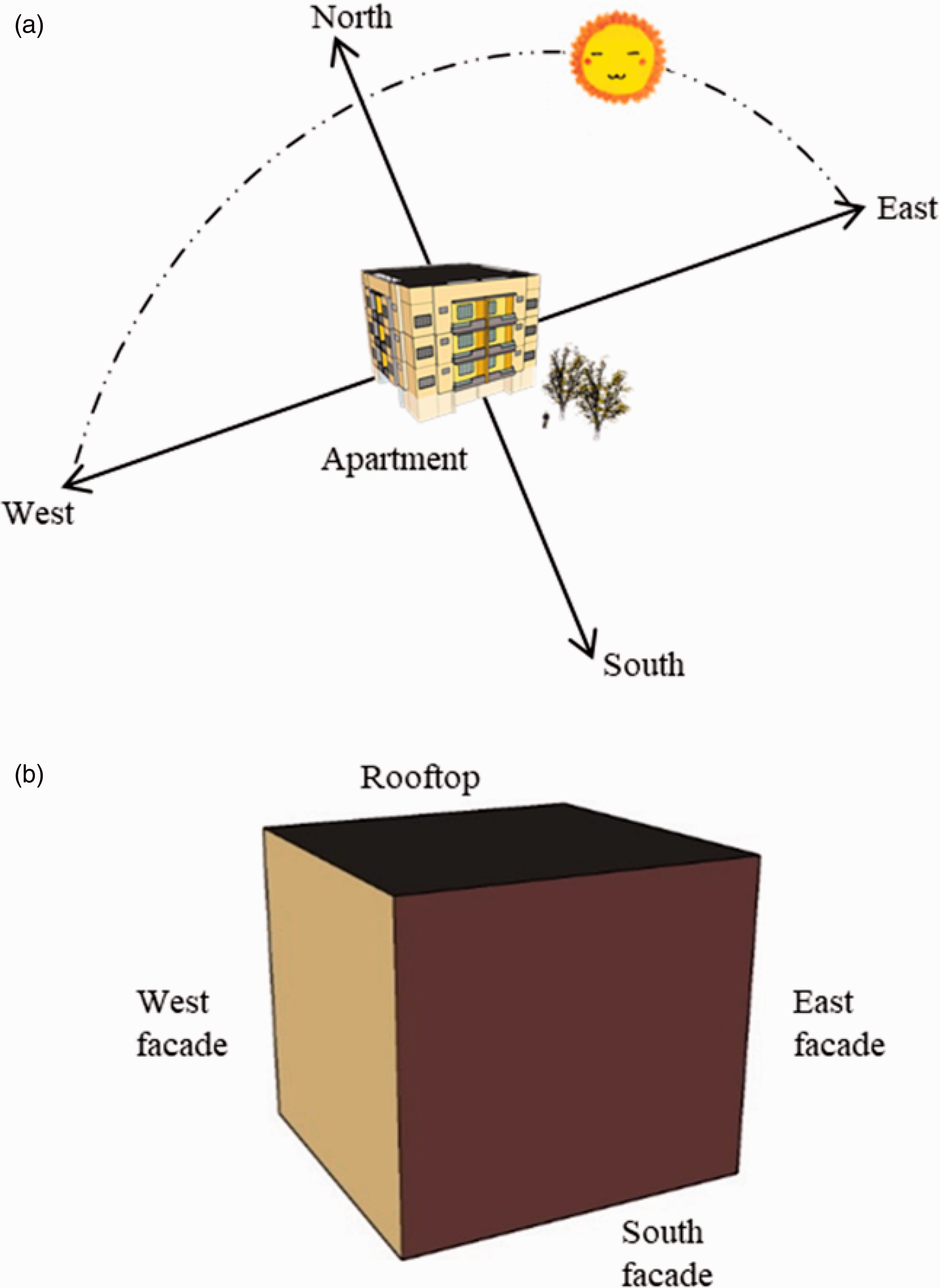
(a) Schematic residence along with the solar trajectory and (b) the 4 × 4 × 3 m3 single box used for simulation.
As shown in Figure 1(b)), to minimize the shading effect caused by the surrounding buildings, we focus on the top floor of the apartment; it is simplified as a single box, which has floor area of 4 m × 4 m and roof-to-floor height of 3 m. On the rooftops, the PSTs are attached. The rooftop, south, east, and west façades of the single box are in different colors. The fixed tilt angle between the rooftop and the north–south axis can be tuned to enhance the effective photovoltaic conversion. For the healthy home environment, the flexible PSCs are employed on the south façade as the window curtain. On the east and west façades, we investigate two cases covered by either of the classic PSCs or the PSTs. To estimate the hourly photovoltaic energy gains, the experimental angle-dependent performance of the PSCs (Ball et al., 2015) and the PSTs (Hörantner and Snaith, 2017) is considered. According to the measurements, the maximum cell efficiencies under vertical irradiation are assumed to be 7.3% (Wong-Stringer et al., 2019), 18.5% (Jang et al., 2019), and 22.6% (Kamino et al., 2019) for the flexible PSCs, the classic PSCs and the PSTs, respectively. The cell efficiency is assumed to be independent with either the solar spectrum or the solar intensity in our first study here.
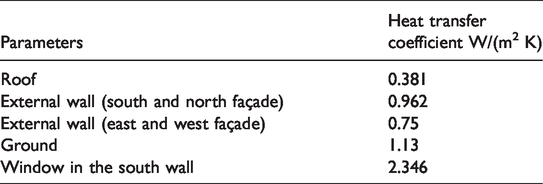
For the building energy demand model, we use the dynamic simulator THERB to estimate the annual thermal load at 1 h interval of the same single box model, where we consider the heating/cooling loads, indoor temperatures, and humidity for the whole building, namely the complete heat, air, solar irradiation, and moisture features (Ozaki and Tsujimaru, 2006). THERB is one of the official programs approved by the Japanese government and is applied nationwide in Japan (Gong et al., 2012). The general single box without any PV technologies represents a standard practice of building construction, where levels of envelopes and control parameters are based on the Design Standard for Energy Efficiency of Residential Buildings in Hot Summer and Cold Winter Zone (MOHURD, 2010) and the Design Standard for Energy Efficiency of Residential Buildings in Wuhan City Zones (DOHURD Hubei, 2009). The heat transfer coefficient of envelopes of the standard case is as shown in Table 1. The total internal heat sources (human body, electric appliances, etc.) are assumed as 3.58 W/m2. Air conditioning system (energy efficiency ratio = 3.0, coefficient of performance = 2.4) is the only energy consumer in the model, which controls indoor temperature above 18°C in winter (from 1 May to 30 September) and below 26°C in summer (from 1 November to the next 31 March) for the whole year on the 24 h basis; the indoor relative humidity is controlled at a high peak 60% and the low peak 40%. The ventilation change rate is 1 h−1. For the single box with solar cells, the indoor thermal situation is calculated based on the solar irradiation filtered by the solar cells.
The heat transfer coefficient of parameters of envelopes.
Results and discussion
As shown in Figure 2, the hourly photovoltaic output power is monthly summed up as a function of the fixed tilt angle of the PSTs on the rooftops; the tilt angle is used to compensate for the solar zenith angle and enable high η(BIPV). On the east and west façades, PSTs are attached, while the south windows are covered by the flexible PSCs. If the tilt angles are 0°, 10°, 20°, and 30°, the η(BIPV) are 28.95, 30.67, 29.74, and 27.58%, respectively. The largest energy gain could be obtained if the tilt angle is 10°. This is because Wuhan is not in the equatorial region, and the sunlight can never vertically illuminate on the ground. However, the BIPV on façades generally faces strong technical installation constraint; it is hard to tune the tilt angle of the PSTs on the façades and obtain the power boost. Therefore, we make a comparison between the PSTs and the PSCs on the east and west façades to study the influence of the angle-dependent cell efficiency on the façade BIPV as follows.
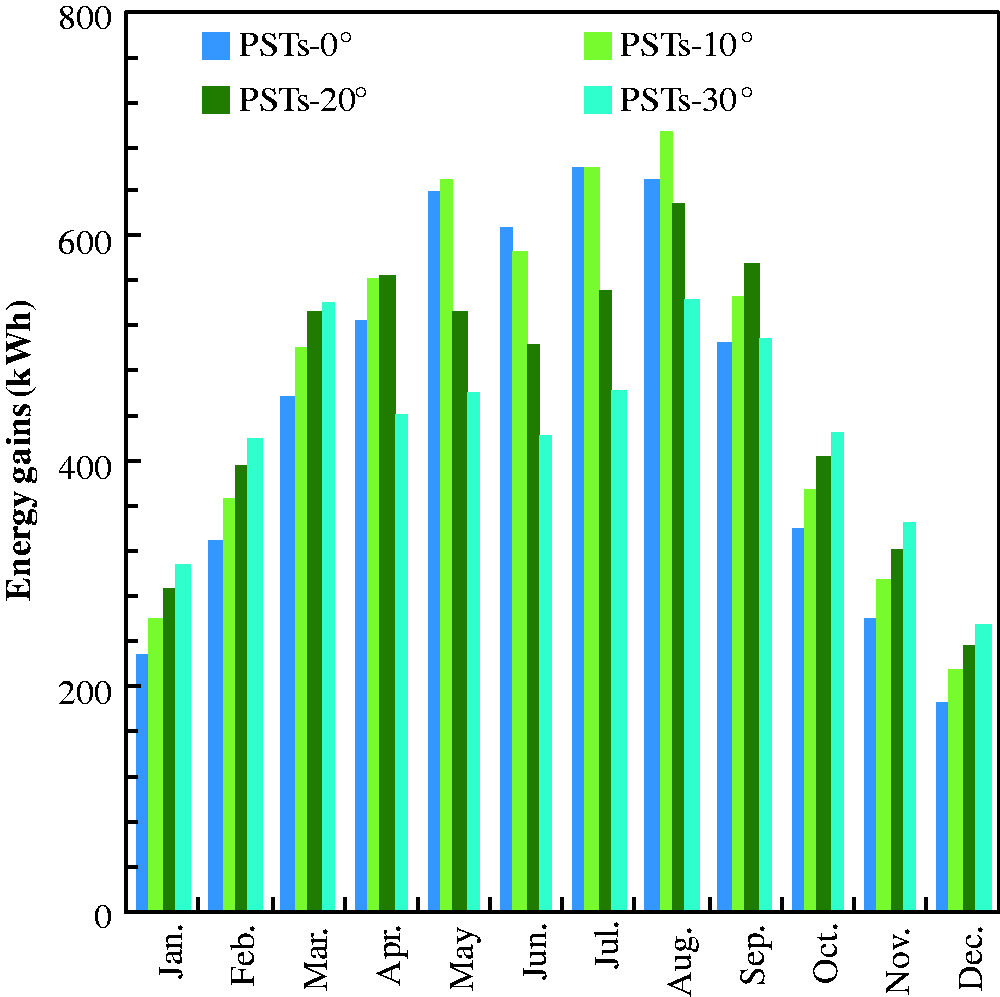
Monthly energy gains from BIPV with the PSTs. PST: perovskite/silicon two-terminal tandem solar cell.
As shown in Figure 3, the PSTs with the cell efficiency of 22.6% are replaced by the PSCs with the cell efficiency of 18.5%; the photovoltaic power generated on the east and west façades could gain more than 1.5 times as indicated by the dashed line. On the rooftops, the PSTs are used with the tilt angle of 10°. On the south windows, the flexible PSCs are attached. Noticeably, the efficiency of PSTs of 22.6% (Kamino et al., 2019) and the efficiency of PSCs of 18.5% (Jang et al., 2019) are measured under vertical illumination of AM1.5G. The monthly photovoltaic energy gains on different faces are illustrated as well; the major photovoltaic power is obtained on the rooftops; the east and west façades could contribute around 34%, and the south façade could bring 16%. In other words, the contribution from façades could be competitive with that from the rooftops if the performance of the solar cells on the façades is less angle dependent.
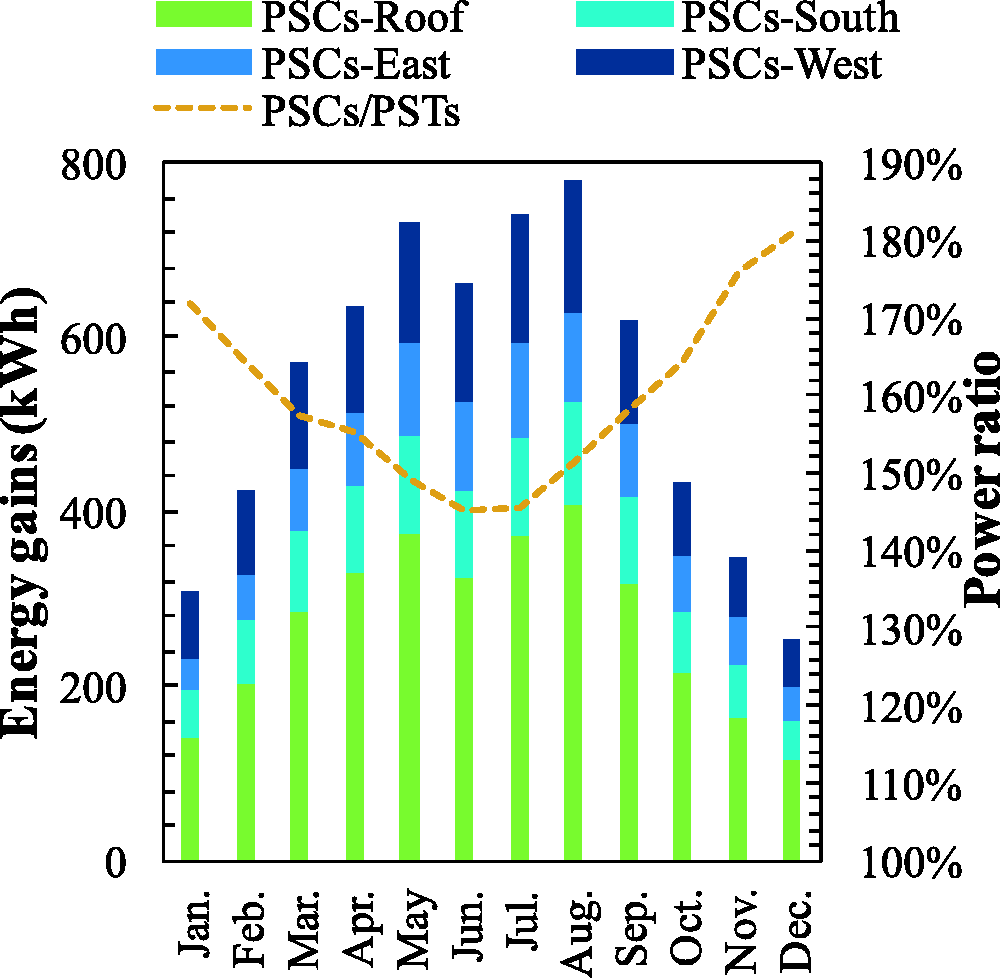
Monthly energy gains from BIPV with the PSCs. PSC: perovskite-based single-junction solar cell; PST: perovskite/silicon two-terminal tandem solar cell.
As shown in Figure 4, for example on 29 August, the hourly cell efficiencies of the PSTs and the PSCs on the east and west façades are illustrated along with the hourly solar irradiation intensity, to further interpret the influence of the angle-dependent cell efficiency on BIPV. Hourly solar irradiation intensity is attached as the orange dotted line. As well known, the solar irradiation achieves maximum power around noon and becomes very weaker in the early morning or near the evening. In the morning (evening), the angle between the solar incidence and the normal line of the east (west) façades is small; therefore, the efficiency of solar cells is high; the cell efficiency of PSTs under vertical illumination (6 and 19 h) is 22.6% and it is higher than that of PSCs of 18.5%. From 8 to 11 h (13 to 16 h), the efficiency of PSCs on the east (west) façade is almost constant and higher than the cell efficiency of PSTs. At noon, neither the PSTs nor PSCs can convert solar energy; the angle between the solar incidence and the cells is 90°. As a result, instead of PSTs, the PSCs on façades could maintain high cell efficiency during the day to benefit powerful solar irradiation and generate high electricity. Therefore, for BIPV on the façades, PSCs are supposed to be better than the PSTs.
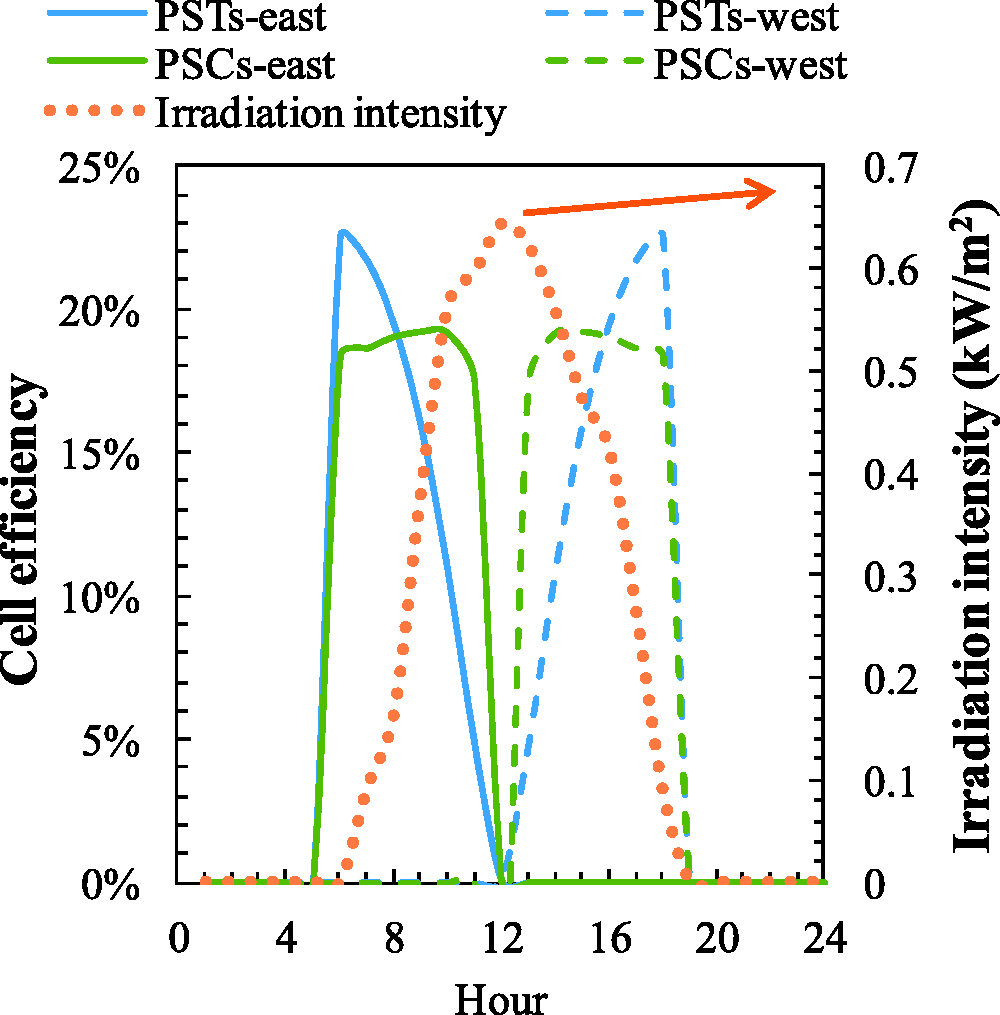
Hourly cell efficiency of the PSTs and the PSCs on the east and west façades. PSC: perovskite-based single-junction solar cell; PST: perovskite/silicon two-terminal tandem solar cell.
In the end, as shown in Figure 5, the energy demands of the standard and the BIPV single box are simulated. The energy demands are illustrated as the negative energy in comparison with the positive monthly photovoltaic output power as the same as that in Figure 3; the net energy gains indicated by the dotted line are equal to the difference between the BIPV energy gains and the energy demand variation induced by the filtered solar irradiation. Due to 35% of solar irradiation being removed, the energy demands of the single box could rise 388 kW h in winter and fall 387 kW h in summer. Besides the air conditioning system, solar irradiation also plays a role in heating the building in winter. To control the indoor temperature above 18°C in winter, the heating system needs more power if the solar irradiation is less. However, to control the indoor temperature below 26°C in summer, less solar irradiation is desired to save the power consumption of the cooling system. A detailed comparison is presented as follows.
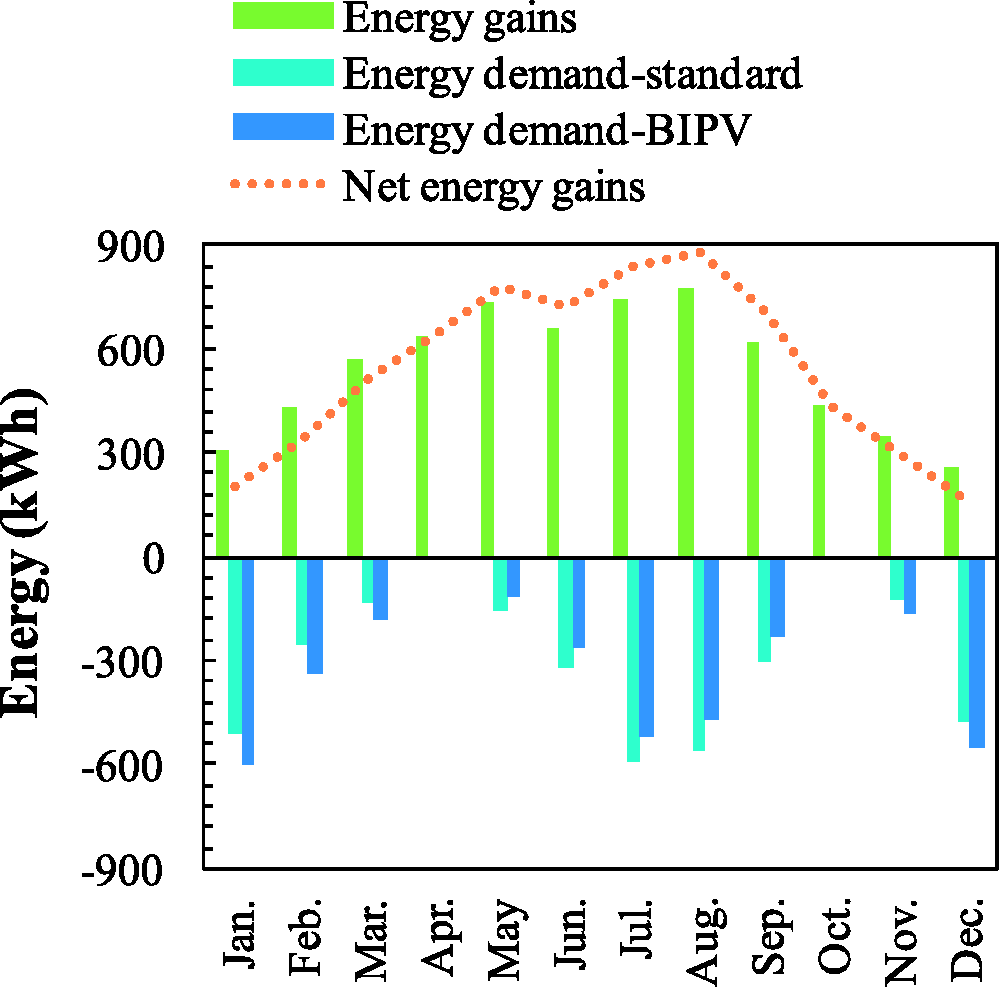
Comparison between the energy gains and the energy demand in the standard and the BIPV cases. BIPV: building-integrated photovoltaics.
In January and December, we could not achieve zero-energy building since the photovoltaic energy gains are lower than the energy demands. However, according to the single box model, 35% of solar irradiation could contribute the energy gains of 307 (254) kW h in January (December) with an increase of energy demand of 104 (88) kW h. Therefore, the net energy gains are 203 (167) kW h, which is 40% (35%) of the standard energy demand. It is promising because of the solar cell efficiency is supposed to be further enhanced in the future.
From February to November, we could obtain zero-energy building and even function as the distributed generator in the urban area. During hot summer, the electricity generated by the BIPV single box could make up 624, 405, 236, 321, and 402 kW h after meeting the building energy demand in May, June, July, August, and September, respectively. The surplus of electricity could be used by the resident downstairs. In the other four months, the BIPV single box could generate 1988 kW h, while the building energy demand is only 361 kW h. Overall, according to our study, the 4 × 4 × 3 m3 BIPV single box with available research photovoltaic techniques based on PSCs could achieve the goal of zero-energy building and even the distributed generators in the apartment in Wuhan. Further study of PSCs on the stability and the performance under the realistic condition is supposed to be critical to driving the concept from the laboratory to the market.
Conclusion
Using the single box model of 4 × 4 × 3 m3, the BIPV energy gains and the energy demand of the top floor of the apartment are estimated at the same time. First, the photovoltaic energy gains on the rooftops and façades are calculated based on the perovskite single junction solar cells and perovskite/silicon tandem solar cells. It is found that the perovskite solar cells with less angle-dependent performance could contribute more electricity on the façades in comparison with the perovskite/silicon tandem solar cells. If 35% of solar irradiation is converted into electricity through photovoltaic technique, the building energy demands increase in winter and decrease in summer. However, we could obtain the zero-energy building on the top floor and even the distributed generator for the other residences within the same apartment, except for the January and December. On the long term, to achieve the goal of perovskite solar cell-based BIPV, further study on the stability and the performance under realistic condition is critical.
Footnotes
Declaration of conflicting interests
The author(s) declared no potential conflicts of interest with respect to the research, authorship, and/or publication of this article.
Funding
The author(s) disclosed receipt of the following financial support for the research, authorship, and/or publication of this article: This work is financially supported by the Project of Guangxi Key Laboratory of New Energy and Building Energy Saving (Grant No. 17-J-21-9).
