




Abstract
Energy supply, the increasing demands for energy, climate change, and the imperative to reduce greenhouse gas emissions must be considered in designing buildings. In order to design energy-efficient buildings, there should be accurate information about the thermal performance of the building. The thermal simulation readings should be precise. Its precision will also have a definite indication of the operational energy costs enabling the likelihood of conserving more energy used in building operations and reducing the greenhouse effect that is a result of emissions of greenhouse gases. Energy-efficient buildings are vital as they reduce the consumption of energy in and allow sustainable development. Erecting such buildings will require correct and realistic prediction of the buildings performance when subjected to a wide variety of harsh weather conditions in order to have a view of the impact of all the physical elements that influence the thermal performance. The behavior of the occupants also influences the thermal performance of a building. To achieve this, energy assessment instruments are used to accurately forecast the buildings thermal performance. This paper critically reviews energy rating methods for housing and the limitations of assessment systems.
Introduction
The materials used in the construction of an energy-efficient building should enhance its thermal performance. This will reduce energy consumption and thus operational costs. This ensures effective durability of the building and a maintained great performance in the future.
In recent years, in many parts of the world, the aim has been to improve thermal performances of buildings, Europe in particular, especially for new buildings. Standards and recommendations for new buildings include thermal performance, initially for purely economic reasons, but recently to reduce the emission of greenhouse gases due to climate change.
The objective for a long time has been to reduce or slow down the unwanted loss of heat during winter and to reduce the heat gain during summer, both of which decrease the overall energy demands. To attain this, suitable thermal insulation is required for all buildings, particularly the main building blocks such as the walls, roof, doors, and windows. The materials used for such constructions should be well considered in terms of their insulation abilities as thermal insulation is a key factor to the betterment of the welfare of the occupants in terms of thermal comfort. The materials chosen should not be good heat conductors and convectors.
The overall heat transfer coefficient (U) of the materials used must be within a standardized range and such ranges are becoming more restrictive. Moreover, the direction and intensity of energy transfer vary throughout the day and throughout the year. As a result, buildings may require good ventilation, air heating and cooling systems, and thermal bridges in addition to basic building elements such as windows, doors, and walls.
In European countries, the House Energy Labels was introduced procedure which required that all new building of all types that are being put up should have the appropriate energy label.
The building sector is a prolific energy consumer. A revised version of the Energy Performance of Buildings Directive (EPBD) in Europe (2018/844), which aims to increase the energy efficiency of buildings, was published in the Official Journal of the European Union (L156) and took effect on 9 July 2018. It will hasten the construction of new energy-efficient buildings and the cost-effective renovation of existing buildings in the European Union (EU).
EU countries must enact the new elements of the EPBD into national law by March 2020. Under the revised EPBD, all EU countries must create solid “long-term renovation strategies” to decarbonize their national building industry by 2050. These strategies must include a strong financial element. The EPBD promotes smart building technology in addition to the health and well-being of occupants (Directive EU, 2012).
The European thermal adaptive comfort standard BS EN 15251 specifies “indoor environmental input parameters for the design and assessment of the energy performance of buildings addressing indoor air quality, thermal environment, lighting, and acoustics.” It is a European standard for four indoor environmental factors: thermal comfort, air quality, lighting, and acoustics. This standard has been widely used in practice, and several scientific papers on its adequacy have been published (EN 15251, 2007).
BS EN 15251 is based on ASHRAE 55. These standards calculate the comfort temperature using similar equations but with different coefficients. In Australia, since there is no national standard, ASHRAE 55 is used (Moore et al., 2016).
REHVA is the Federation of European Heating, Ventilation, and Air Conditioning Associations. Its membership comprises more than 100,000 registered engineers. REHVA is dedicated to improving health, energy efficiency, and comfort in all buildings by supporting the exchange of knowledge and the development of policies within the EU that will be executed at a national level (Jorissen et al., 2018).
Climate change is caused by the emissions of greenhouse gases as one of the factors. There has been a need to reduce such emissions so as to tackle the problem of climate changes and global warming. For this to be made possible, construction of buildings should be made in creative and modified designs and structures that make the building more energy efficient giving it the capacity to respond to the particular climatic conditions. Such designs require a lot of planning, analysis, and assessment of the materials to be used and the effectiveness of such materials in their particular area of placement with the aim of reducing energy consumption and creating a fitting response to climate changes of the area.
However, current building assessments make many simplifying assumptions, which result in discrepancies between the projected theoretical and the real-world energy loads (Kordjamshidi and King, 2009). There are many building energy simulation programs, though most have poor accuracy (Crawley et al., 2008).
The choice of appropriate building material and the study and analysis of the building elements and design methods will potentially improve the overall thermal performance of the building. However, the building designs have some limitations in terms of insulation and materials that are used in the particular elements of the building. These need to be identified and addressed to find the proper solution to improve building design and the thermal energy assessment for current and future buildings (Azhar et al., 2015).
Housing energy rating methods
Many factors influence the thermal performance of a complete building; some of these factors are self-governing, while others are inter-related, but not all factors affect the thermal performance of the building in the same way as some have a greater influence than others (Rabah, 2005).
The heating, cooling, and ventilation systems and insulation have improved in design, structure, and variety over the years as a result of improved energy assessment schemes. Many years of research have increased the amount information available for a wide variety of materials, glazing systems, and techniques that can be used to improve thermal performance.
There has been an increase in the complexity of such systems, making them more efficient. In addition, the move towards highly insulated, more airtight, low-energy buildings has modified the energy balance, so the internal and solar energy gains have a much greater effect (Strachan, 2011).
There are several variables and inputs that are considered in the methods of solving dynamic heat transfer equations. Such equations include the heat balanced method, the admittance method, various finite different methods, and electrical circuit solving programs. The variables, elements, and inputs in the above equations include the physical elements of the building (orientation, width, height, and length), the thermal properties of all the elements (thermal conductivity, heat capacity, R-value), and the climatic conditions (temperatures, solar radiation, wind speeds and direction, humidity).
These variables are constantly changing which makes it difficult to accurately calculate the exact thermal performance of the building. To achieve an accurate thermal performance of a building, account must be taken of the building as a complete system (Alterman et al., 2012). A set of equations that give a description of heat flow in the building are used to solve the above variables. These differential equations are solved numerically.
The key to efficient design is using a metric that correctly encapsulates the influences of the thermal mass and insulation in a dynamic temperature environment. The R-value measures the thermal resistance of a building and is a basic thermal property. However, a more representative parameter than the R-value is required for fully capturing the dynamic thermal behavior of a building’s walling system (Alterman et al., 2012).
Thus, a new thermal performance factor was developed at the University of Newcastle in Australia, the dynamic temperature response (T-value). This encapsulates the impact of all of the physical parameters affecting the thermal performance of walls, not only thermal resistance (R-value) but also its thermal mass (Alterman et al., 2012).
Another factor that plays a significant role in energy consumption is the behavior of the occupants of a building. It is impractical for software programs to predict such behavior in an energy assessment. For example, occupants of energy-efficient buildings may adapt to changes in the weather by using natural methods of ventilation instead of being reliant on mechanical heating and cooling systems. The behavior of occupants is complex and has a substantial influence on a building’s energy performance. Implied models will continue to be used to simulate the behavior of occupants in the near future. However, simulated occupant behavior may not be accurate (Tian et al., 2018).
Occupants have a significant impact on energy consumption. For instance, the type of thermal comfort model used in a building simulation has a critical impact on energy consumption in operative buildings. Predicting thermal comfort accurately is important in mechanically heated and cooled buildings and can save large amounts of energy. These savings can be over 50% (Ferreira et al., 2012). In moderate climates, an assessment of thermal performance can use an adaptive approach instead of an energy-based approach. Such passive design techniques applied in the construction of a building may enhance thermal performance and thus reduce the amount of energy consumed for cooling and heating. Such passive design techniques are easy to apply and can simplify the assessment. On the other hand, an energy-based approach encourages energy consumption since occupants must maintain their thermal comfort using heating and cooling systems (Albatayneh et al., 2017a).
For example, a study in housing test modules in Australia showed that using an adaptive thermal approach to adjust the comfortable temperature ranges for an air-conditioning system saved significant amounts of energy, up to 50%, compared with the predicted mean vote model, as the occupants have more options for realizing their thermal comfort, such as simply using ventilation, wearing suitable clothes, and opening windows, instead of using heating or cooling systems (Albatayneh et al., 2018, 2019a).
Energy-efficient buildings are crucial for reducing energy consumption. Various energy assessment programs are used in developed countries for rating the thermal performance of a building. These programs are based on the weather conditions in the local climate, so that they may not be accurate elsewhere. Since there are no energy assessment programs for buildings in most developing countries, a universally applicable energy assessment tool is highly desirable (Albatayneh et al., 2016).
Moreover, there needs to be a realistic prediction of a building’s performance under different conditions. Although assessment software exists, such programs have not proved effective over the years. All physical, environmental, and social factors need to be considered when designing a building. This will improve the predictions for energy consumption and reduce overall operational costs (Albatayneh et al., 2017b).
There are three principal approaches to housing energy rating based on the energy consumption of a building (Kordjamshidi, 2011):
Prescriptive approach: This approach requires that each building component is built to a mandatory standard, which is the minimum standard for the materials, equipment installed, and methods for energy efficiency. Calculation-based approach: This approach uses software to calculate the thermal performance of a building, which is compared to applicable mandatory standard in the country, state, or region. Such software includes AccuRate, which is used in New South Wales, Australia. Performance-based approach: This approach uses actual energy consumption records to assess a building’s energy efficiency, which is compared with the compulsory local standards. However, this approach is applicable only to existing buildings. The prescriptive and calculation approaches are more common. Performance-based ratings are uncommon because it is time-consuming to collect the data (Kordjamshidi, 2011).
The thermal performance of building is directly related to the accuracy of the thermal simulation used in its design, and therefore, the simulation should be a direct reflection the actual performance of the building. Current building assessment systems lean towards creating a number of simplifying assumptions and results in inconsistencies between the free-running mode and the conditioned mode. For example, an efficient design for a building in a conditioned running mode differs from exactly the same building in the free-running operation mode, which is a primary reason for the incapability of existing energy-based rating schemes to effectively assess a building’s performance in a temperate climate (Kordjamshidi and King, 2009).
For example, a comparison of assessments Home Energy Rating Systems (HERS) and real utility billing data for about 500 houses in four states in the United States found that HERS can, on average, forecast annual energy cost accurately. However, for individual house basis, the match between the predicted energy cost and the actual energy cost was often poor, especially for older houses (Stein and Meier, 2000).
A wide range of building assessment tools is available. A comparison of these tools and their results is very difficult as they were designed for evaluating different types of buildings, they are applied at different stages of the life cycle, and they depend on different guidelines and databases (Haapio and Viitaniemi, 2008).
International rating tools
Many developed countries have assessment programs. Some of them are listed here.
Green Star (Australia). Leadership in Energy and Environmental Design, LEED (USA). ASHRAE Building Energy Quotient, ASHRAE BEQ (USA). Department of Energy, DOE energy asset rating (AR, USA). EnergyPlus (USA). California building energy tool for owners and operators, Cal-Arch (USA). Building Research Establishment Environmental Assessment Methodology, BREEAM (UK). Energy Assessment and Reporting Methodology-Office Assessment Method, EARM-OAM (UK). House Energy Labelling Procedure, HELP (EU). European Landowners Organization (ELO) for large buildings (>1500 m2) and EM for small buildings (Denmark). Energy Performance Assessment (EPA)-W for existing dwellings, EPA-U for existing non-residential buildings, and Energy Performance Coefficient (EPC) for new buildings (Netherlands). “Energiebedarfsausweis” for new buildings and renovated buildings (Germany). Energy Advice Procedure, Energy Charter, and Passive House Platform (Belgium). Energy Performance Assessment for Existing Dwellings (EPA-ED), and Energy Performance Assessment for Non-Residential Buildings (EPA-NR) (EU). A Method to Assess the Energy Performance of Existing Commercial Complexes (HK). Hong Kong Building Environmental Assessment Method, HK-BEAM (HK). Energy efficiency diagnosis for air conditioning systems (China). Energy Smart Office Label (Singapore).
We will consider three major energy simulation programs in Australia, the United States, and the United Kingdom.
AccuRate Australia’s housing energy rating method
AccuRate is a simulation program used in the buildings used for residential purposes. This ensures the energy efficiency of such homes. An older version of AccuRate, the Nationwide House Energy Rating Scheme (NatHERS), did not consider natural ventilation adequately. It did not account for the size and location of the building and the direction of the wind. AccuRate is commercially available (Delsante, 2005).
AccuRate Sustainability (V2.3.3.13 SP1) is a second-generation energy rating system developed by the Manufacturing and Infrastructure Technology Division of the Commonwealth Scientific and Industrial Research Organization to improve the heating and cooling efficiency of residential buildings. It gives a score of between 0 and 10 stars to a house based on its yearly energy usage in MJ (megajoule) for cooling and heating and its floor area in m2. The more stars, the better the thermal performance and energy efficiency of the building (Albatayneh et al., 2019b).
The software considers the nature and behavior of residential occupants (AccuRate Sustainability, 2017), such as the number of hours that heating and cooling is used in each zone of a house, the thermostat settings in winter and summer, windows and other openings used for ventilation, and external and internal adjustable shades or covers for windows (Dewsbury and Arch, 2011). For most Australian homes, AccuRate has resulted in better use of natural ventilation. However, confidence in its accuracy decreased when it was shown to be incapable of modeling heavyweight building elements (Daniel et al., 2015).
EnergyPlus
EnergyPlus is an energy simulation program used by all professionals included in the construction of a building such as civil engineers, architects, and researchers (D&R International, Ltd, 2012).
This software program allows them to model energy consumption for heating and cooling systems, ventilation and lighting, and water use in the buildings. The Department of Energy Building Technologies has provided the funds for the improvement and further development of the software. It has many remarkable features that account for heat transfer offering heat based solutions as well as condensational calculations. The use of larger time steps allows for fast simulation and accuracy of the Energyplus software (EnergyPlus, US, 2016).
BREEAM
BREEAM (Building Research Establishment Environmental Assessment Methodology) is the leading method of rating and assessing the sustainability of all building plans and projects and already existing buildings. It is used in over 70 countries (Figure 1) and can be adapted to the local climate. It supports effective and cost-effective ways of conserving energy using the available resources, leading to a reduction of overall operational cost for energy use. It has improved the construction and management of many buildings and has made evaluation and certification of up-to code buildings easier (BREEAM, 2015).
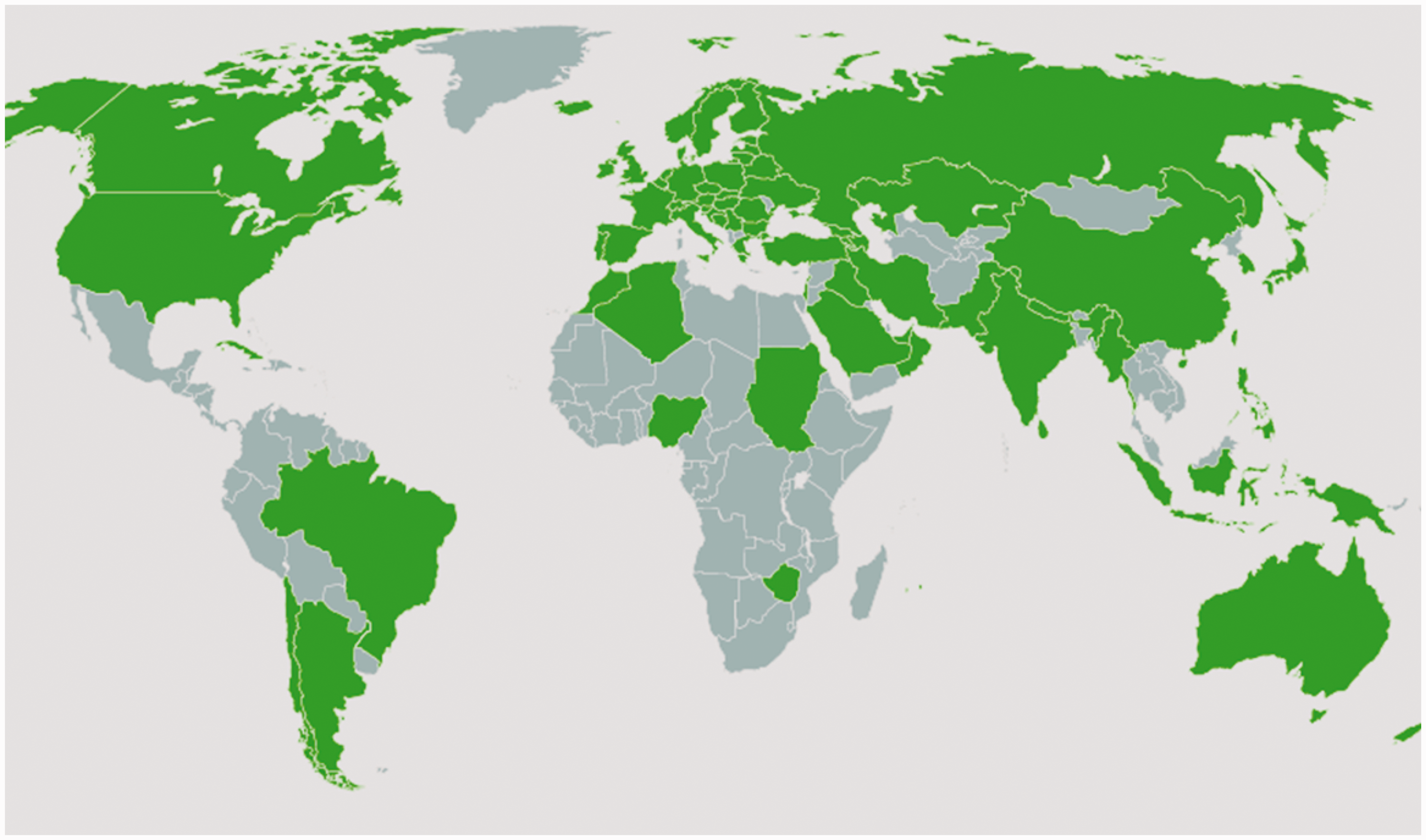
Countries using BREEAM for building simulation (BREEAM).
Knowledge gap with the current rating programs
The objective of energy assessment programs is to evaluate the influence of physical parameters on the thermal performance of a building. Such parameters include the thermal resistance of the building (its R-value), its thermal mass, the type of building, its orientation, the behaviors of its occupants, the weather, and any shading or covering.
The R-value is a basic significant thermal property of a building material and it is a determination of the thermal resistance of a building. However, due to its static nature, it is unable to explicitly characterize the thermal response of buildings interiors such as the walls and as well as the external heat fluctuations. Furthermore, it is unfit to portray the effects of large diurnal changes in temperature and its effects on the wall of the building. Therefore, the R-value alone does not encapsulate all the characteristics involved in heat exchange (Alterman et al., 2012).
Comprehensive research at the University of Newcastle on the performance of the various walling systems used in Australian housing has confirmed that predictions of thermal performance cannot use R-values alone without considering thermal mass (Page et al., n.d., 2011).
The R-value is a good indicator of how quickly heat will be lost, but contrary to the common perception, under different weather conditions, the overall thermal performance of a building cannot be solely defined by the thermal resistance of the walls because that is not the only physical parameter involved (Page et al., 2011; Reardon and Australian Greenhouse Office, 2010).
It has been explained that a higher R-value indicates better thermal performance of the building, but this has not been entirely accurate in some cases where as much as the higher R-value results in better insulation of the building, it does not generally indicate better thermal performance of the building.
Over the past years, there has been a need to improve thermal performance in buildings in many parts of the world, especially in the newly designed buildings that have been considered in the construction of new standards and recommendations for the new designs of the buildings. These problems were analyzed and initially, the analysis was performed for purely economic reasons—to reduce the level of consumption of energy and its costs—but, as years passed, the issue regarding the reduced emission of greenhouse gases, as well as climate change, surfaced as an important consideration.
The accuracy of a thermal assessment has a massive impact on the prediction of the energy consumption that is needed to maintain thermal comfort. The external conditions surrounding a building (such as wind speed and direction, external air temperature, solar radiation, and humidity) can change continuously. This makes it challenging to forecast the thermal energy performance of any house precisely, since the house and its environment must be considered as a complete system (Alterman et al., 2012).
An analysis of well-known building rating tools—BREEAM, LEED, CASBEE (Comprehensive Assessment System for Building Environmental Efficiency), and Green Star—showed that they gave inconsistent results and different outputs (Mattoni et al., 2018).
Moreover, current building assessment methods typically use an energy-based method to evaluate housing thermal performance, with the energy needed to sustain internal thermal comfort being the critical parameter. This results in a higher use of mechanical heating or cooling energy, rather than more passive forms of temperature control (Illankoon et al., 2017).
Another factor that plays a significant role in energy consumption is the behavior and attitudes of the occupants towards the subject matter. It is impractical for software programs to predict such behavior for a precise energy assessment. Due to this, the occupants in energy-efficient buildings should consider natural methods of ventilation by adapting to the different weather changes instead of being reliant of the, mechanical systems of heating and cooling.
In building thermal simulation finding, the accurate thermal comfort prediction is important in mechanically heated and cooled buildings, which can save large amounts of energy. These savings are probably above 50% (Ferreira et al., 2012).
The accuracy of a thermal simulation affects the final thermal performance of the building. The outcomes simulated should be close to the actual performance of the building. However, most current rating systems have various limitations:
Most assessments use energy-based approaches. Energy variables highly fluctuate making energy estimation to have wide differences between the theoretical calculations and real results. This dispels energy-based approaches as a good method of predicting the hermal performance of the building. This makes them incapable of being accurate and precise. The programs encourage and allow for use of energy to obtain thermal comfort which is not a sustainable approach to conserving energy. This approach increases energy consumption rather than reduce it. Thermal assessment tools make various assumptions, which leads to significant differences between buildings in free running and air conditioning mode. This is mainly due to the incapability of energy-based rating systems to assess the influence of passive design in a temperate climate effectively (Kordjamshidi and King, 2009). There is a wide range of factors used in the calculation of thermal performance. Some are dependent and some independent, but all have a different impact on the thermal performance of a building. This wide range of factors makes it difficult to calculate the thermal performance of a whole building accurately (Rabah, 2005). Assumptions given by software models on the prediction of thermal performance of the building are not efficient. For a correct prediction of a building’s thermal performance under different climatic conditions, real data need to be used for the materials used. This is mostly to curb the issues that arise especially in the temperate climate zones. The major assumption made in estimating thermal performance is that the climate will remain stable. The climate data used are based on past historical data. Since the climate is constantly changing, past data are unreliable. For instance, estimates of current heating and cooling loads are based on average historical weather data for a typical meteorological year, without considering climate change. This results in inaccuracy and discrepancies in thermal energy predictions. Some assessments programs such as AccuRate provide a limited variety of materials to consider and input data that cannot be altered by the user. As much as internal and external shading is considered in AccuRate, it is still difficult to predict the behavior of the occupants and the change in structure and growth of trees and leaves in different seasons respectively. This poses a threat to assessing the heat fluctuations. Air leakage, wind direction, humidity, and internal temperature make it difficult for software programs to analyze and predict energy consumptions as these variables keep on changing. Air leakage accounts for about some of the energy lost, about 5–25%. The nature of a buildings opening make it difficult to predict wind speed. This results in discrepancies between actual and predicted results by the assessment programs. The R-value is one of the many properties that determine the thermal performance and energy consumption of a building. Other measures should also be used. Due to the many variable parameters, heat transfer continually changes with time. It is dynamic. Thus, it is difficult for software to model thermal performance. The number of material types, glazing systems, passive options, construction methods, as well aa heating and cooling equipment has become broader and more complex so the simulation tools need constant updating (Strachan, 2011).
Most developing countries do not have assessment programs (Albatayneh et al., 2016).
Conclusions
Energy-efficient buildings are crucial for energy consumption in the future. New and more creative designs should be introduced and applied in constructions of building to enhance better thermal performance. To ensure this, there needs to be a realistic prediction of the performance of the buildings under different conditions, which is done using effective tools such as assessment software programs. Although such programs exist, they have not been very effective over the years, but for the reasons defined, they are not completely effective. Each physical, environmental, and social factors need to be considered before setting up buildings. This will improve the predictions of energy consumption in a building and reduce overall operational costs.
Footnotes
Declaration of conflicting interests
The author(s) declared no potential conflicts of interest with respect to the research, authorship, and/or publication of this article.
Funding
The author(s) disclosed receipt of the following financial support for the research, authorship, and/or publication of this article: The authors are thankful for the seed grant fund provided by the deanship of graduate studies and research at the German Jordanian University.