




Abstract
This work investigated the mineralogy and geochemistry of the No. 3 coal seam in Permian Shanxi Formation in Guotun Mine, Juye Coalfield, north China, in order to understand the genesis of the minerals and the enrichment of trace elements. Approaches used were optical microscopy and electron probe microanalysis for minerals, X-ray fluorescence analysis for major elements and inductively coupled plasma mass spectrometry analysis for trace elements. The coal is comprised of dominant kaolinite and calcite, the claystone is characteristic of major kaolinite, montmorillonite, and proportional illite, and the sandstone contains mainly quartz and chalcedony, and a relative amount of feldspar and kaolinite. These minerals were derived dominantly from the weathered source rocks with volcanic and granitic constituents in the pre-diagenetic period, and minor from the hydrothermal deposit in the epigenetic period. The claystone is relatively enriched in Li, Cs, Be, Nb, Mo, U, Th, V, In, Pb, Bi, and Se, which may probably be controlled by the source rocks and the specific sedimentary environment. The enriched trace elements are mostly associated with minerals. Li may probably occur in montmorillonite and illite, while In, Pb, Bi, and Se occur mainly in selenio-galena.
Keywords
Introduction
The valuable elements in coal seams, such as Li, Ga, Ge, REEs, etc., have been a hot point in the field of coal geology recently for their high concentrations and utilization (Dai et al., 2014; Seredin and Finkelman, 2008; Sun et al., 2012, 2013; Zhao et al., 2017; Zhuang et al., 2006). Dai et al. (2014) reviewed the geological origin, modes of occurrence, and evaluation methods of the coal-hosted rare metal deposits including Ge, Ga, U, Nb, and rare earth elements; Sun et al. (2012, 2013) discovered Li deposits in the coal seams in the Inner Mongolia Autonomous Region and Shanxi Province in north China. Mineralogical and geochemical study is the key to clarify the distribution, origin, modes of occurrence, and evaluation of valuable elements in coal seam (Dai et al., 2012; Singh and Singh, 1995; Sun et al., 2010, 2012, 2013; Ward, 2002; Zhao et al., 2017). For example, Li in the Guanbanwusu coal mainly occurs in the chlorite (an intermediate between cookeite and chamosite), kaolinite, and possibly in illite; Ga in the same coal largely occurs in goyazite (Dai et al., 2012). However, combustion of the coals enriched in certain elements such as As, Cd, Hg, Be, Th, U, Tl and so on, may make potential negative effects on the environment and humans (Finkelman and Gross, 1999; Ren et al., 2006; Swaine and Goodarzi, 1995). So, the mineralogical and geochemical study on coals is also much significant for environmental protection during coal utilization. Though there is an amount of coalfield in north China, the coal seams studied in detail on mineralogy and geochemistry are still a few.
The west Shandong Province, north China, has many large coalfields formed during the Carboniferous and Permian periods such as Yanzhou, Ji’ning, Juye, and other coalfields. Only a few of coalfields had been studied on the coal quality, trace elements in coal and coal-forming environment (Hu, 2009; Liu et al., 2005, 2007). Those studies mainly focused on environmental elements and sedimentary geology, less on mineralogy and valuable elements in coal, and they hardly concerned the Juye Coalfield developed recently. The previous studies concerned only a few of trace elements and showed that the distribution of trace elements in coal seams horizontally and vertically varied much in different coalfields with the similar sedimentary environment (Hu, 2009). In addition, in the Juye Coalfield, the mudstone near the bottom of the No. 3 coal seam was considered to be an altered volcanic ash bed by its high natural gamma-ray (Feng and Dong, 1997); the Permian strata contained a large amount of volcanic clast rock (Wang, 1990) and a petrological study on the No. 3 coal seam in the Yuncheng Mine indicated the existence of volcanic clast as well (Zhang, 2016). These cases are much important for the trace element enrichment in the No. 3 coal seam but they have not been discussed in the literature. This paper will present the mineralogical and geochemical data of the No. 3 coal seam in the Guotun Mine, Juye Coalfield, in order to understand the genesis of valuable and toxic elements enriched in the coal seam and provide important information for harmless mining and utilization of coal.
Geologic setting
The Juye Coalfield is located in the Juye and Yuncheng counties, Heze city, which is at a distance of about 200 km to Jinan city, capital of Shandong Province, to the northeast. It is in the west Luxinan Fault Depression, Luxi Uplift, North China Craton (Figure 1). The Luxi Uplift is bounded by Jiyang-Guangrao Fault on the north, Liaocheng-Lankao Fault on the west, Kaifeng-Peixian Fault on the south, and Tancheng-Lujiang Fault on the east (Figure 1, F1–F4). The Luxinan Fault Depression is bounded by Wenshang-Ningyang Fault on the north, Yishan Fault on the east, Shanxian Fault on the south, and Liaocheng-Lankao Fault on the west (the former three not shown in Figure 1). Abundant coal resource occurs in this depression. There are mainly five large coalfields such as Juye, Ji’ning, Wenshang-Ningyang, Yanzhou and Tengxian coalfields (Figure 1).
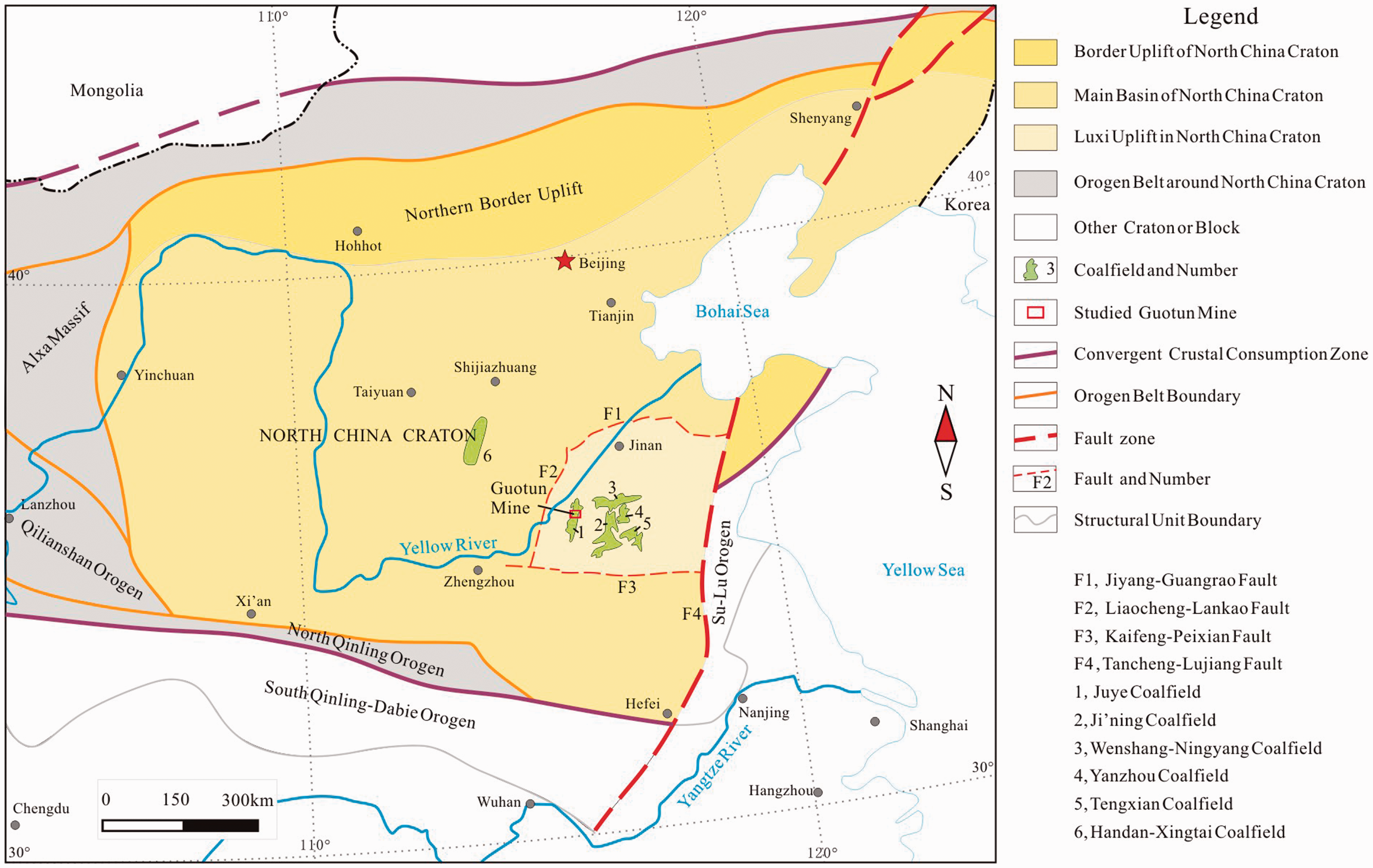
Sketch tectonic map of the North China Craton [modified after Liu and You (2015)] and the location of the studied coal mine.
The Juye Coalfield occurs in long subsidence bounded by faults on its eastern, western, and northern boundaries. It is 80 km long from north to south, 12 km wide from west to east, and has a total area of about 960 km2. The coal types in Juye Coalfield include mainly gas coal and gas-fat coal. In addition, there locally are some 1/3 coking coal, primary coking coal, meagre coal, anthracite, and even natural coke which was formed by the Jurassic magma intrusion. The strata in Juye Coalfield include Quaternary, Neogene, Palaeogene, Permian, Carboniferous, Ordovician, Cambrian, and Neoarchaean units. The Neoarchaean units consist of a series of metamorphic rocks. The Cambrian and Ordovician strata are limestone series, and the Carboniferous and Permian strata consist of marine-terrigenous sediments to terrigenous clasts. The Palaeogene strata occur near the southern margin of the coalfield, and the Neogene and Quaternary strata (mainly Quaternary), with a total thickness ranging from 258 m to 665 m, are the cover of the coal-bearing sequences. The coal-bearing sequences are the Carboniferous-Permian unit including Benxi, Taiyuan, and Shanxi Formations (Figure 2). The Juye Coalfield contains 16 coal seams, but only 4 of them, i.e. Nos. 3, 15, 16, and 17, are mineable. The Benxi and Taiyuan Formations are composed of grey and greyish-white quartzose sandstone, siltstone, claystone, and coal beds interbedded with dark-grey siltstone, claystone, and limestone. The Shanxi Formation is composed of sandstone, siltstone, claystone, and coal beds. The No. 3 coal seam occurs in the lower Shanxi Formation. The stratum overlying the coal-bearing sequences is the non-coal-bearing Lower Shihezi Formation. In addition, the sequences in this coalfield also contain a few layers of Carboniferous-Permian volcanic clast rocks (Wang, 1990; Zhong et al., 1996) and some Jurassic intrusive magmatic rocks.
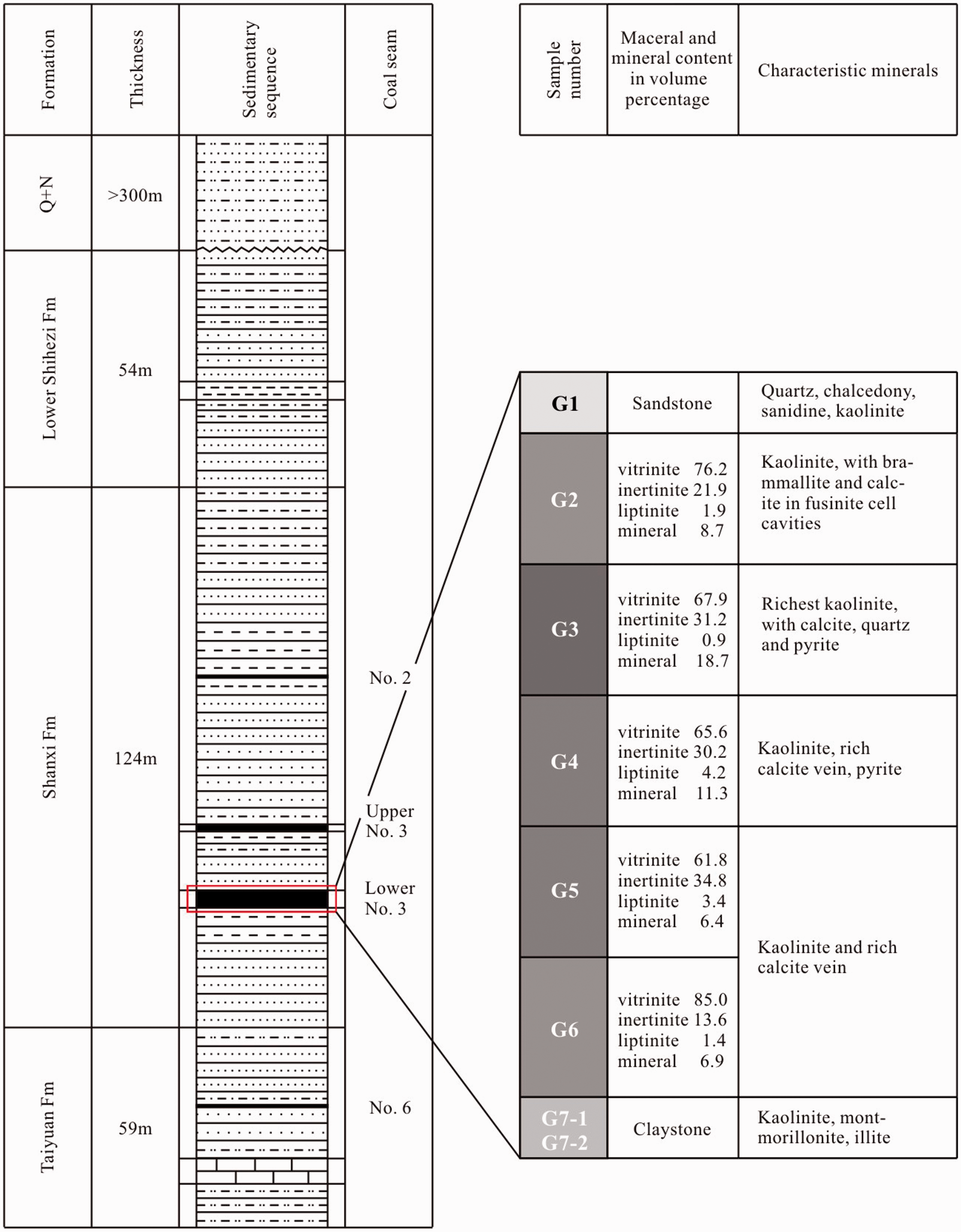
Lithostratigraphic column of Guotun Mine and the sampling profile.
The Guotun Mine, located in the middle-northern Juye Coalfield, has an area of 69.5 km2 and geological coal reserves of 780 Mt (million tonnes). The No. 3 coal seam in this mine is separated into two subdivisions, the upper one and the lower one, by a thick sandstone bed with a thickness ranging from 0.80 m to 27.30 m. The main mineable coal seam is the lower No. 3 coal seam (still called the No. 3 coal seam in the following text) with the mineable reserves of 170 Mt. The No. 3 coal seam has an average thickness of 3.84 m, with thickness of 1.62 m on the western boundary and 7.92 m on the eastern boundary (combined with the upper subdivision). A few of thin partings composed of claystone occur locally.
Samples and methods
There were eight samples including five coals numbered G2 to G6, one sandstone numbered G1, and two claystone numbered G7-1 and G7-2, which were collected from the No. 3 coal seam in Guotun Mine, Juye Coalfield. Each sample was cut over a volume of 10 × 10 × 10 cm3. The locations and characteristics of the samples are shown in Figure 2.
The coal samples are black and have a banded structure. Fine fracture is filled by white carbonate or golden pyrite films or grains. The sandstone is grey-white, fine-grained, and has inconspicuous bedding and negligible organic matter. The claystone is dark grey, without bedding, and has carbonized plant clasts extensively scattered. A proportion of crack in sandstone and claystone is filled by white carbonate film or pyrite grains. All samples were carefully cleaned, powdered, made into blocks and thin sections, etc.
The main methods used were optical microscopy for petrography, electron probe microanalysis (EPMA) for mineral chemistry, X-ray fluorescence (XRF) and inductively coupled plasma mass spectrometry (ICP-MS) for analysis of major and trace elements in rocks, respectively. The petrographic analysis was performed on a DFC425, an optical microscope with transmitted and reflected light manufactured by Leica Microsystems Ltd. The maceral in coal block and mineral in the thin section were counted according to the ISO standard (ISO 7404–3, 2009). The EPMA was quantitatively analyzed on a JEOL JXA-8100. The XRF was analyzed on an Axiosm AX, and the ICP-MS was analyzed on an ELEMENT XR. The EPMA, XRF, and ICP-MS were performed according to the ISO standards (ISO 22489, 2016; ISO 12677, 2011; ISO/TS 16965, 2013) in the laboratory of Beijing Research Institute of Uranium Geology (BRIUG). The data precisions for the major and trace elements are less than 1% and 5%, respectively.
Results
Minerals
The coal comprises maceral and mineral, and their contents range, respectively, from 81.3 vol.% to 93.6 vol.% and from 6.4 vol.% to 18.7 vol.% based on point counting under an optical microscope (Table 1). For the maceral component, the vitrinite is dominant with content ranging from 61.8 vol.% to 85.0 vol.% and includes mainly collodetrinite, secondarily collotelinite and vitrodetrinite, and minor corpogelinite; the inertinite has content ranging from 13.6 vol.% to 34.8 vol.%, and includes mainly inertodetrinite and secondarily fusinite and macrinite; and the liptinite has the lowest abundance less than 4.2 vol.%, and is mainly sporinite, sometimes minor cutinite (Table 2; Figure 3(a) and (b)). Based on the maceral component, the No. 3 coal belongs to vitrinertite in micro lithotype. As to the mineral in coal, 14 kinds identified are kaolinite, brammallite, illite, chamosite, quartz, pseudomorphic beta-quartz, zircon, monazite, rutile, ilmenite, calcite, pyrite, chalcopyrite, and selenio-galena (Table 3; Figure 3). Among them, kaolinite is dominant (48.6 vol.% to 81.7 vol.%, on organic matter free basis), calcite is secondarily rich (9.2 vol.% to 45.0 vol.%), pyrite is minor (<6.2 vol.%) and occurs extensively, brammallite (in G2, 22.9 vol.%) and quartz (in G3, 4.8 vol.%) only occur locally in the coal profile, and the others are trace in abundance.
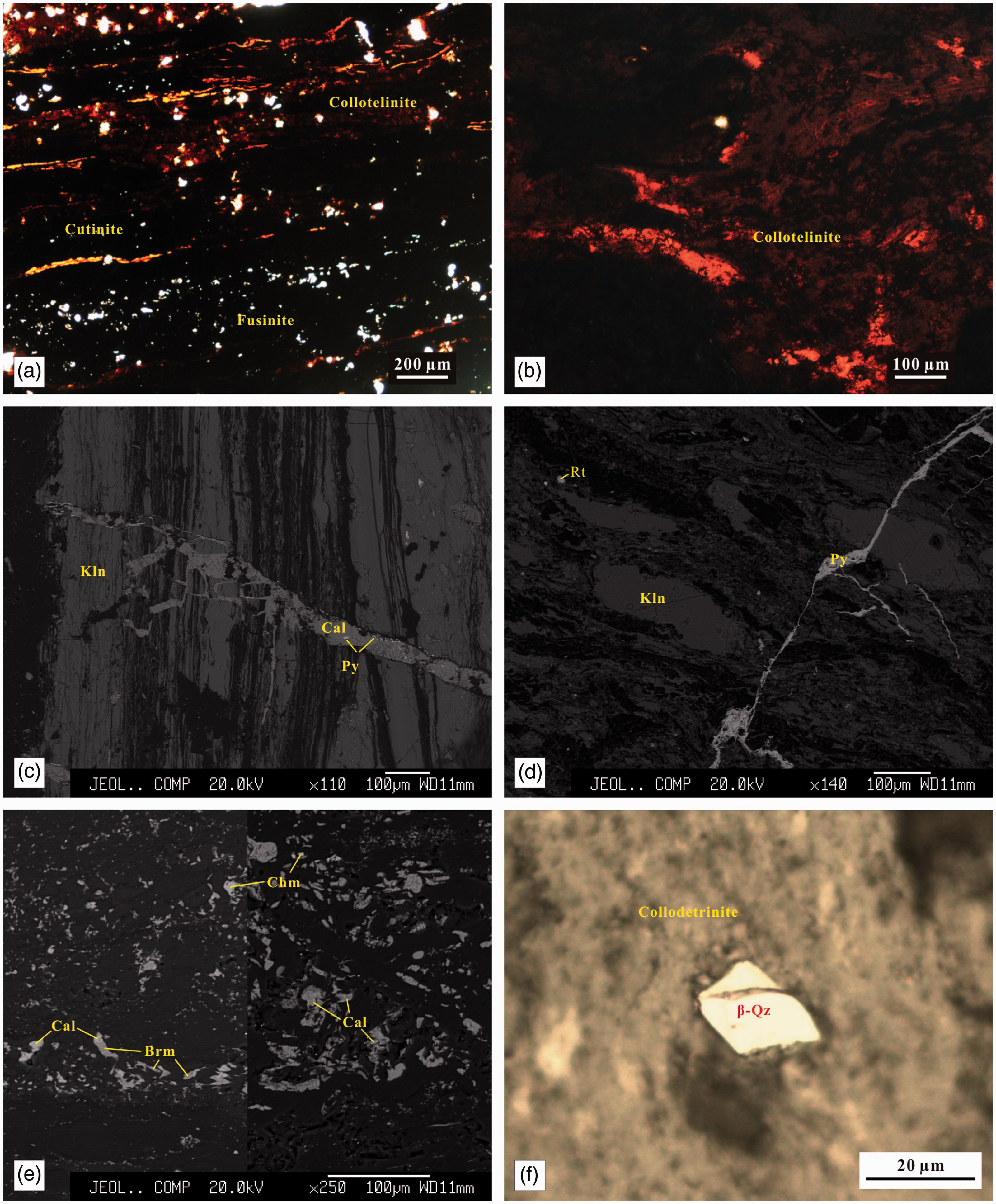
Micrographs of the No. 3 coal (G2–G6) in Guotun Mine.
The total contents of maceral and mineral for the No. 3 coal (G2 to G6; vol. %).

Maceral contents of the No. 3 coal (G2 to G6) on mineral free basis (vol. %).
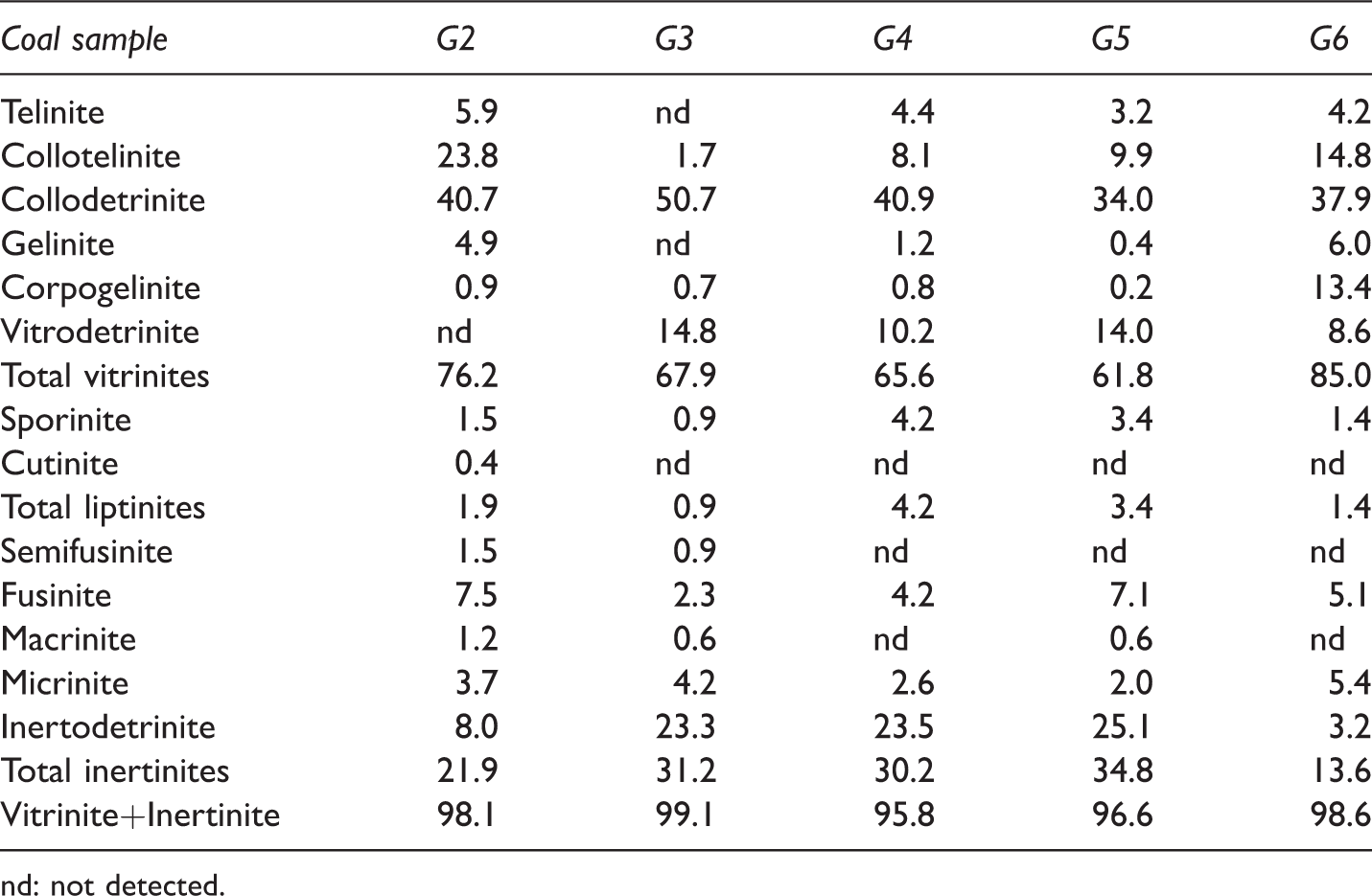
nd: not detected.
Mineral contents of the No. 3 coal (G2 to G6) on organic matter free basis (vol. %).
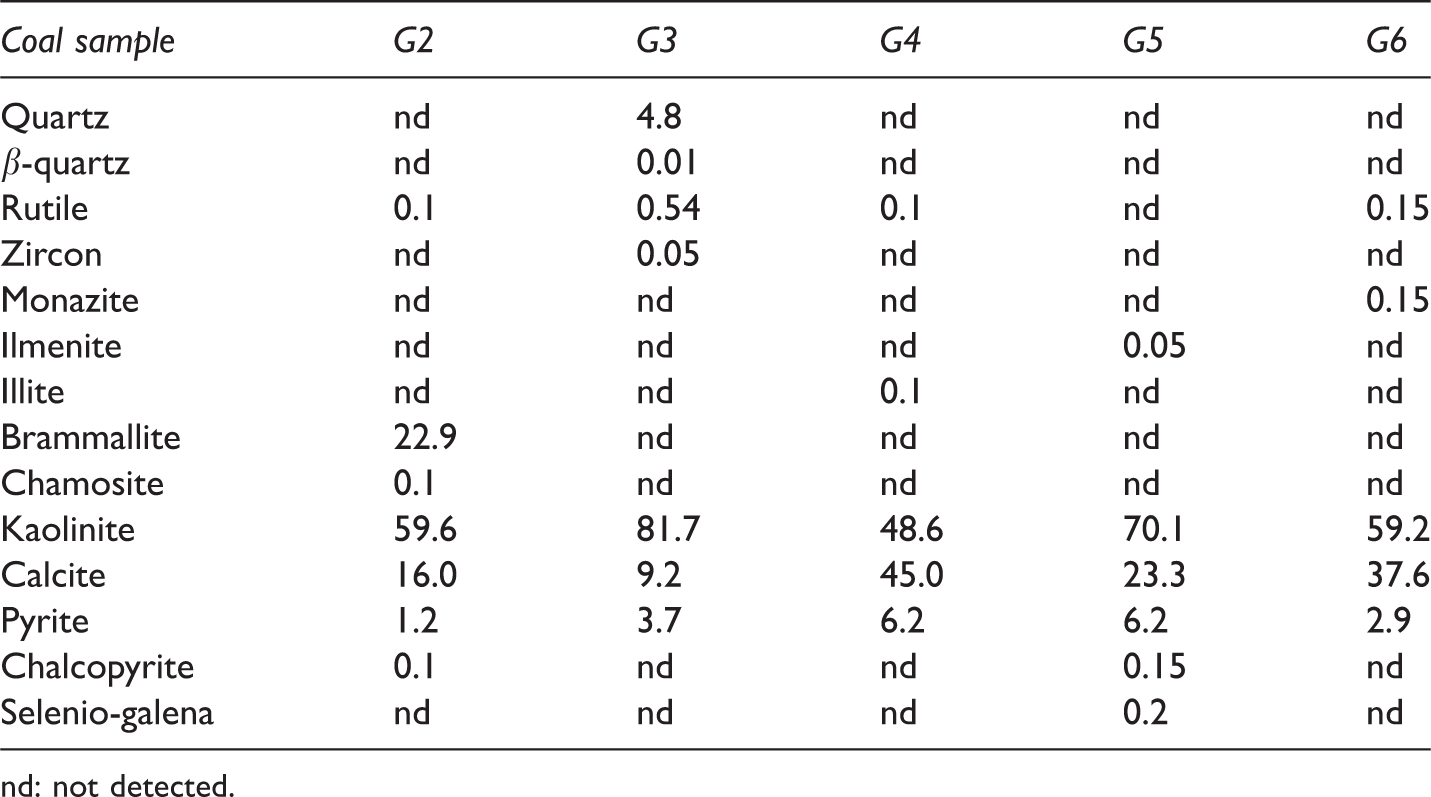
nd: not detected.
The claystone (G7-1 and G7-2), silty montmorillonite-kaolinite claystone, contains 11 kinds of mineral, and they are kaolinite, montmorillonite, illite, quartz, pseudomorphic beta-quartz, rutile, monazite, zircon, apatite, pyrite, and selenio-galena (Table 4; Figure 4). The dominantly abundant minerals are kaolinite (42.2 vol.% to 49.1 vol.%) and montmorillonite (35.6 vol.% to 37.4 vol.%), the secondarily abundant ones are illite (8.0 vol.% to 9.4 vol.%) and quartz (5.7 vol.% to 9.4 vol.%), and the others are minor or trace.
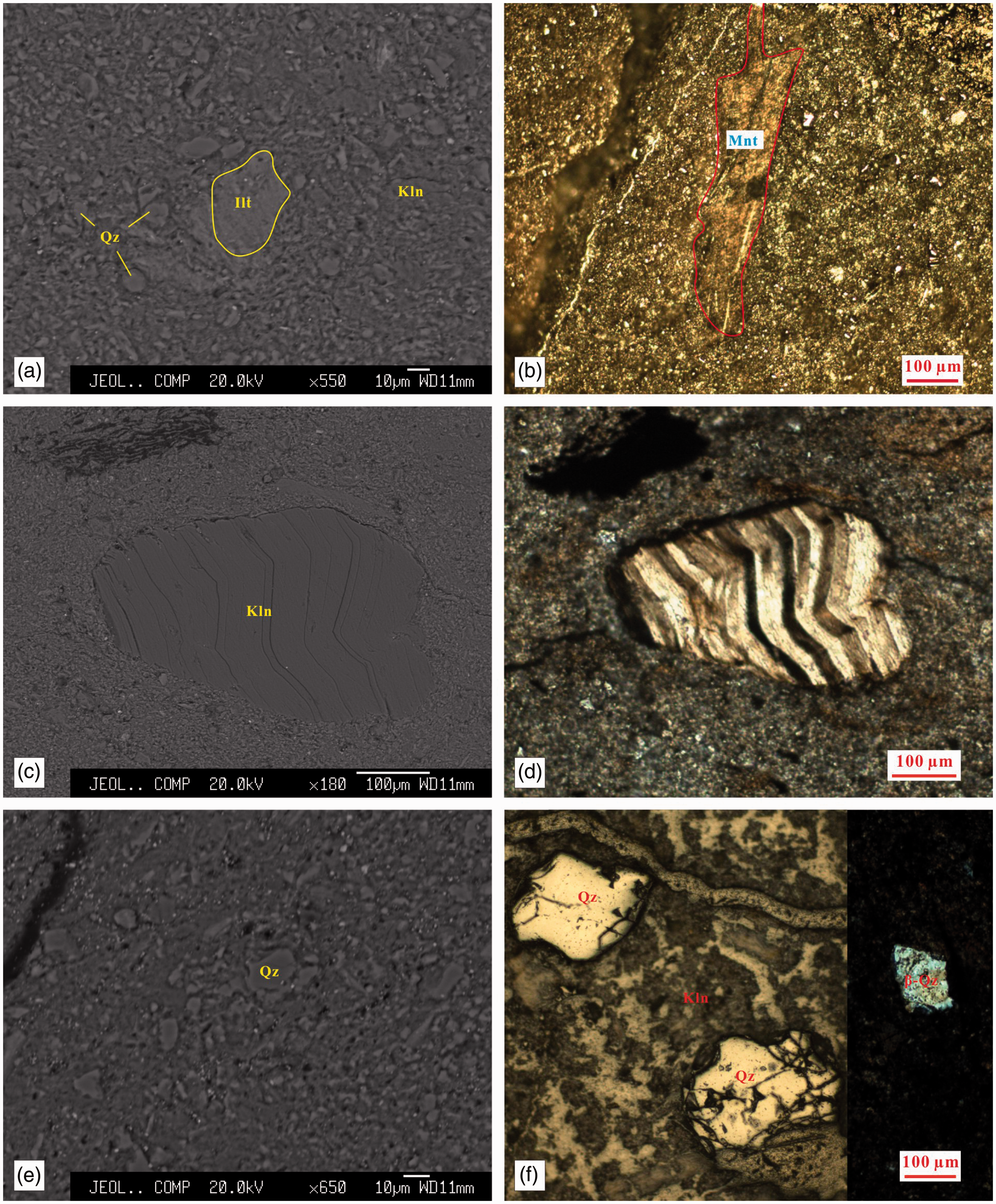
Micrographs for the claystone (G7-1 and G7-2) of the No. 3 coal seam.
Mineral contents in the roof (G1) and floor (G7-1 and G7-2) rocks (vol. %).
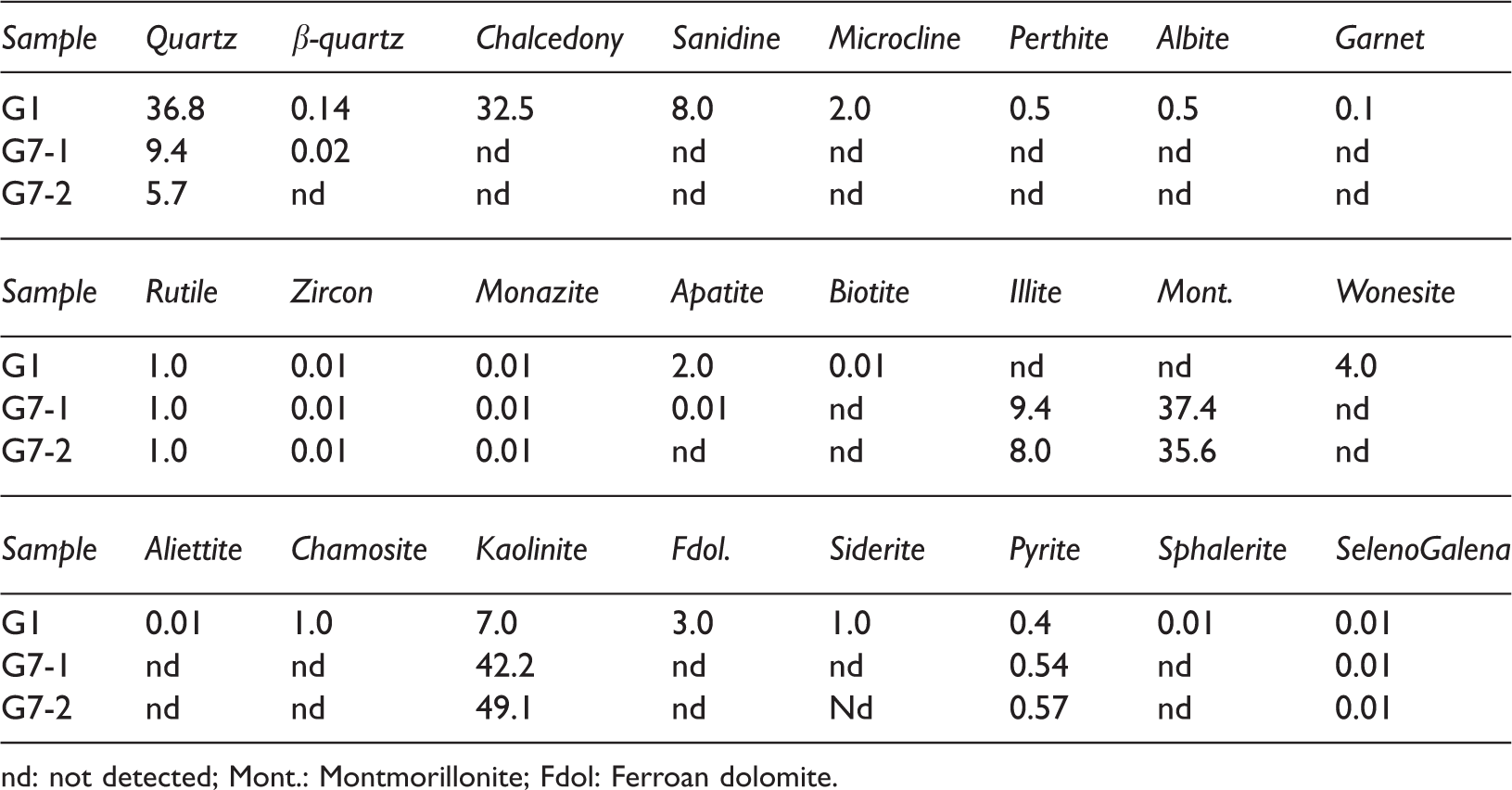
nd: not detected; Mont.: Montmorillonite; Fdol: Ferroan dolomite.
The sandstone (G1), a feldspathic quartz sandstone, contains 22 kinds of mineral, and they are quartz, pseudomorphic beta-quartz, chalcedony, sanidine, albite, microcline, perthite, garnet, zircon, monazite, rutile, apatite, biotite, wonesite, aliettite, kaolinite, chamosite, ferroan dolomite, siderite, sphalerite, pyrite and selenio-galena (Table 4; Figure 5). The dominantly abundant minerals are quartz and chalcedony, with contents of 36.8 vol.% and 32.5 vol.%, respectively; the secondarily abundant ones are alkali feldspar (including sanidine, microcline, perthite, and albite; 11.0 vol.%), kaolinite (7.0 vol.%), wonesite (4.0 vol.%), and ferroan dolomite (3.0 vol.%); and the others are minor or trace in abundance (Table 4). The matrix and cement (being mainly kaolinite) in the sandstone are less than 15 vol.%.
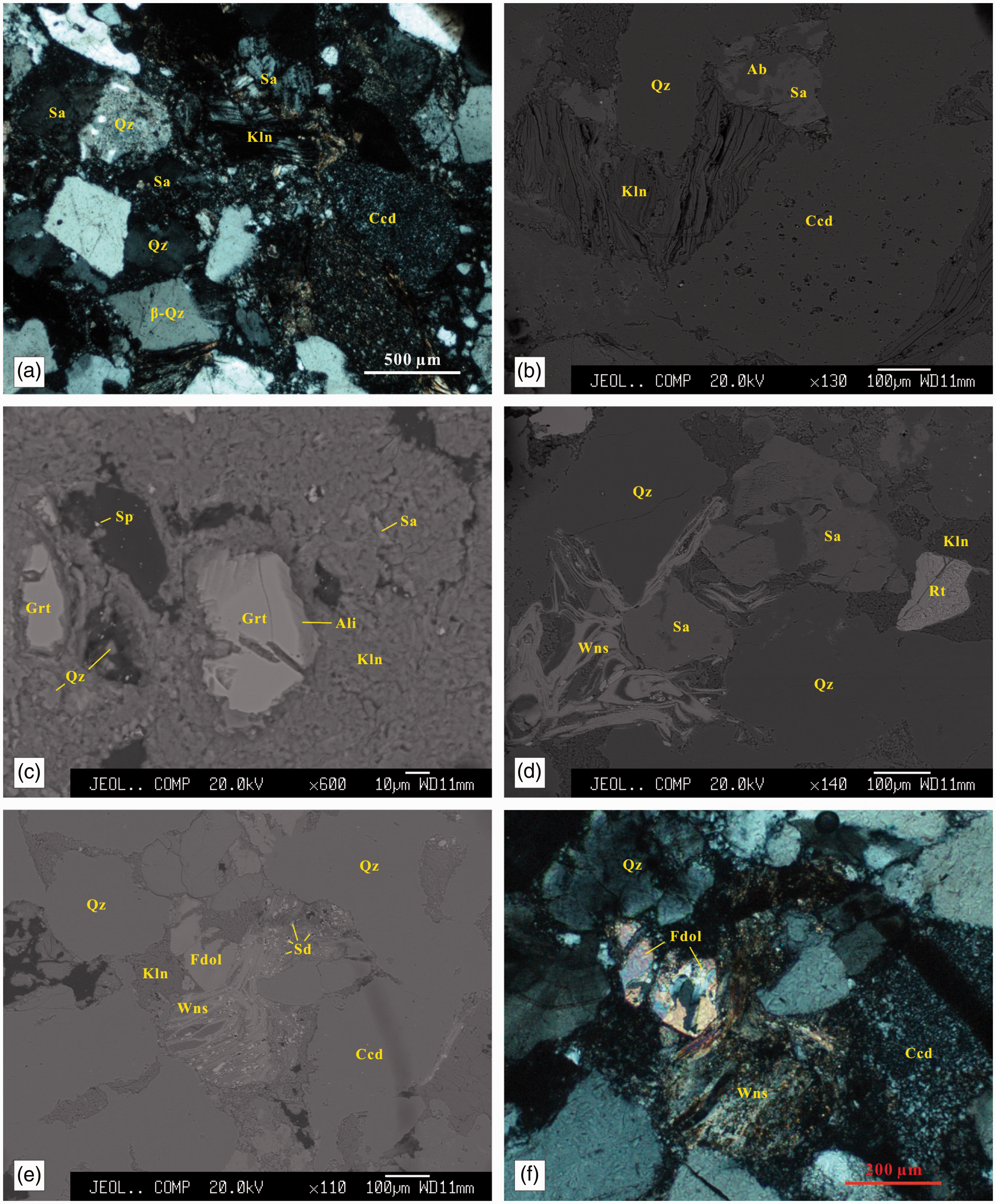
Micrographs for the sandstone (G1) of the No. 3 coal seam.
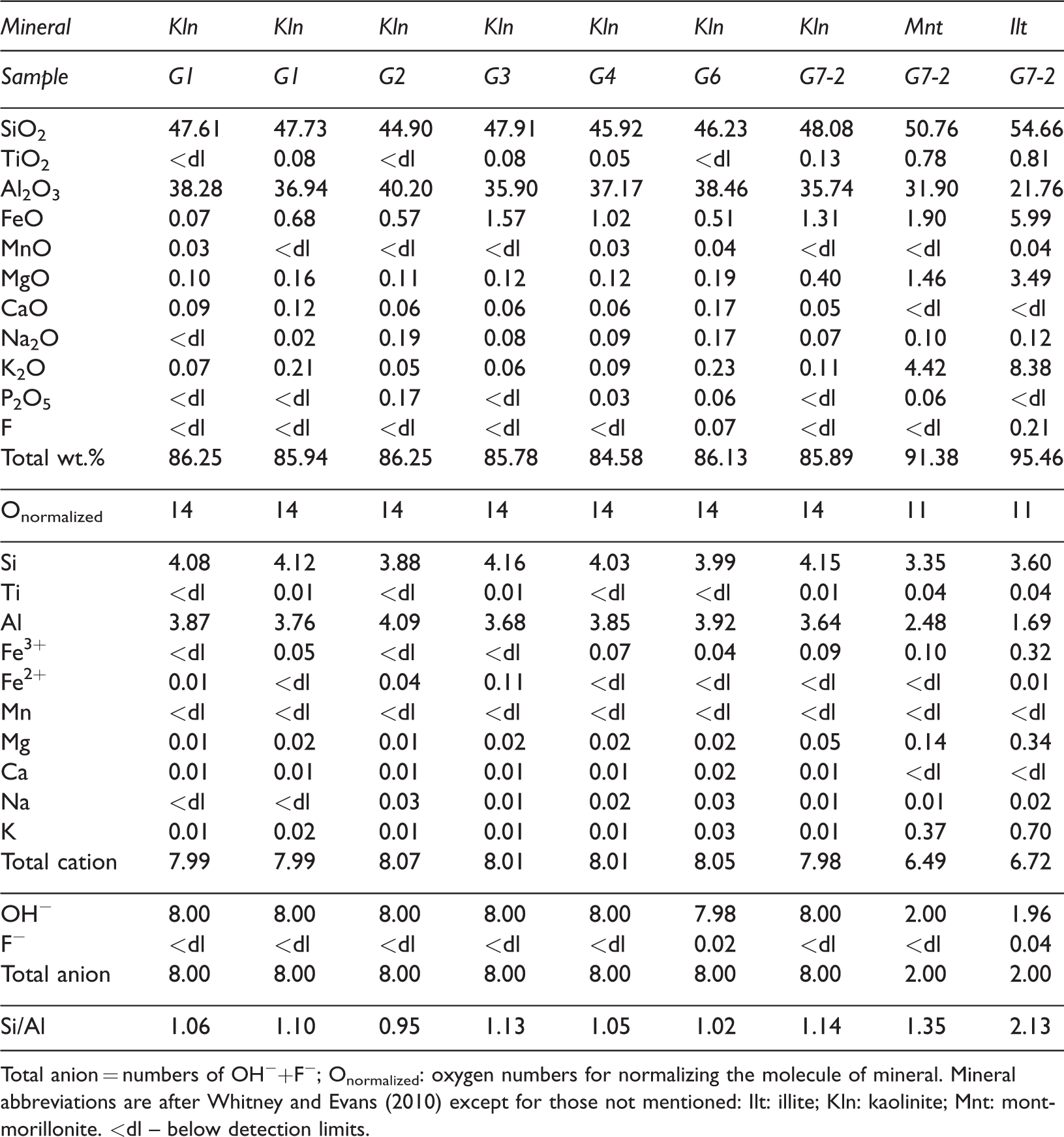
The microphotos of typical minerals in coals (G2 to G6), claystone (G7-1 and G7-2) and sandstone (G1) are shown in Figures 3 to 5, respectively. Their chemical compositions and normalized molecular formulas are presented in Tables 5 to 8. The important minerals are described as following.
Chemical compositions (wt. %) of typical minerals in the coals (G2 to G6), sandstone (G1) and claystone (G7-1 and G7-2).
Total anion = numbers of OH−+F−; Onormalized: oxygen numbers for normalizing the molecule of mineral. Mineral abbreviations are after Whitney and Evans (2010) except for those not mentioned: Ilt: illite; Kln: kaolinite; Mnt: montmorillonite. <dl – below detection limits.
Kaolinite in the coal (G2 to G6), claystone (G7-1 and G7-2), and sandstone (G1), mostly is micro-grained with a diameter ranging from 1.5 µm to 6.0 µm (Figures 3(c) to (d), 4(a) and (c) to (e), and 5(c) to (e)), but it is usually accumulated as a stripe or clump in the coal (Figure 3(c) and (d)), or as a sheet in the claystone (Figure 4(c) and (d)) and sandstone (Figure 5(a) and (b)), or as an intergrain filling in the sandstone (Figure 5(c) to (e)); occasionally, it occurs in worm-shaped coarse crystal in the coal. The wavy stripe and some orientating rhomboid of kaolinite mass in the coal (Figure 3(c)) indicate that they had been reformed by flowing water. Usually, mica-sheeted kaolinite mass may be observed in the coal, claystone, and sandstone, especially in the claystone (Figure 4(c) and (d)) and sandstone (Figure 5(a) and (b)), which indicates that it was transformed in situ from a mica by weathering. No matter what mode of occurrence it is, the kaolinite has a similar composition with a Si/Al molar ratio ranging from 0.95 to 1.13 (Tables 5), close to ideal kaolinite (Si/Al = 1.00).
Montmorillonite only observed in the claystone (G7-1 and G7-2) is mostly granular and short-rod-shaped with a size ranging from 4 µm to 13 µm and a sheeted mass is morphologically similar to a mica (Figure 4(b)). The montmorillonite is a potassium variety (montmorillonite-K), and its molecular formula was calculated based on the EPMA data as (K0.37Na0.01)0.38(Mg0.14Fe3+0.10Al1.83Ti0.04)2.11(Al0.65Si3.35)4O10(OH)2 (Table 5).
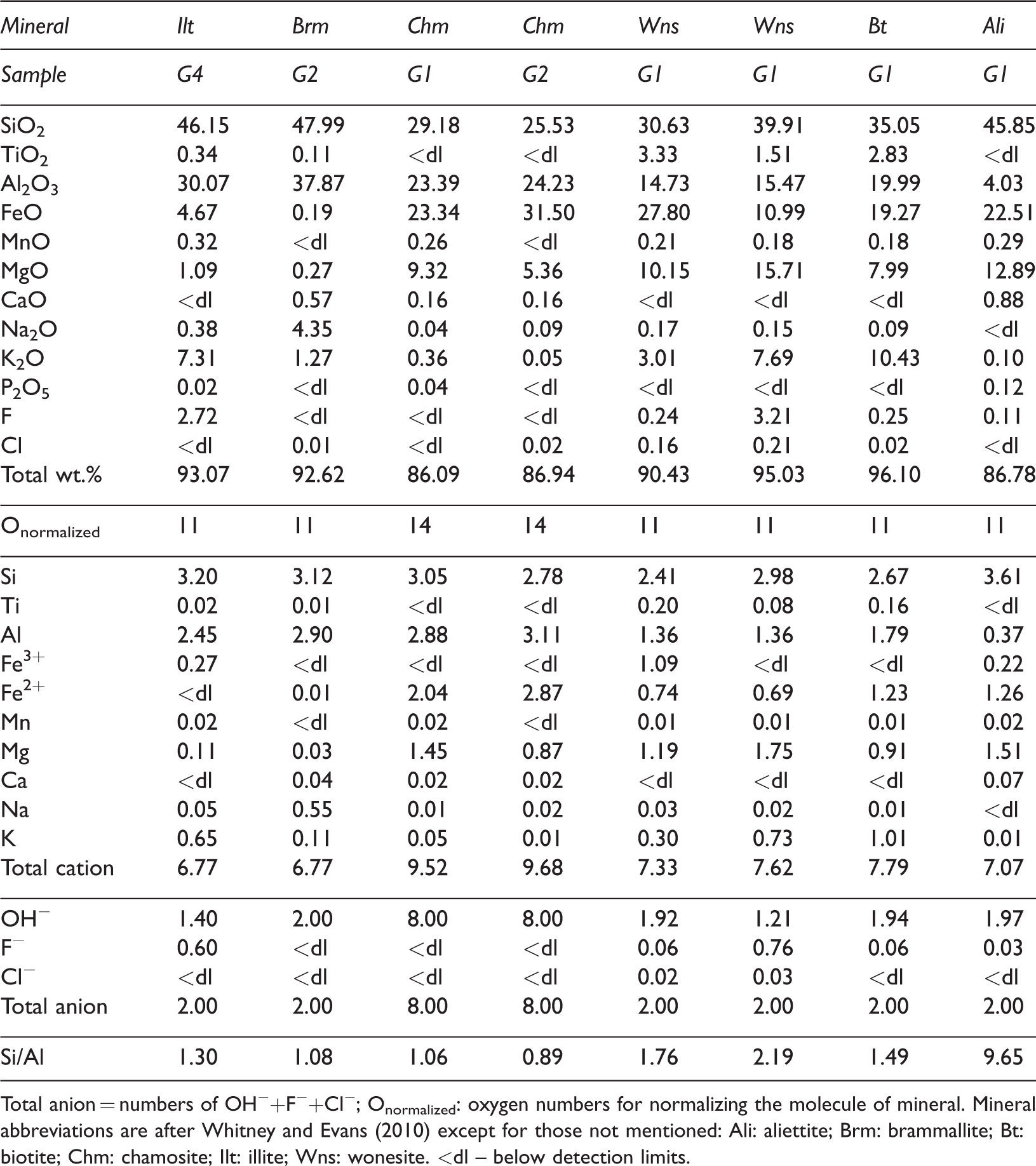
Illite and brammallite both belong to the dioctahedral interlayer-deficient mica, the former is a potassium member, and the latter is a sodium one. The illite in the coal (G2 to G6) is mica-sheeted and coexists with kaolinite aggregate, and that in the claystone (G7-1 and G7-2) is granular less than 4 µm in size or short stripe-shaped with a size about 2 × 6 µm2 (Figure 4(a), (c), and (e)). Their molecular formulas in the coal and claystone are: (K0.65Na0.05)0.70(Mg0.11Mn0.02Fe3+0.27Al1.65Ti0.02)2.07(Al0.80Si3.20)4O10[(OH)1.40F0.60]2 and (K0.72Na0.02)0.74(Fe2+0.01Mg0.34Fe3+0.32Al1.29Ti0.04)2(Al0.40Si3.60)4O10[(OH)1.96F0.04]2 (Tables 5 and 6), respectively. Brammallite only occurs as a filling of fusinite cell cavity in the coal (G2) and coexists with calcite or occasional chamosite (Figure 3(e)), and its molecular formula is given as (Na0.55K0.11Ca0.04)0.70(Fe0.01Mg0.03Al2.02)2.06(Al0.88Si3.12)4O10(OH)2 (Table 6).
Chemical compositions (wt. %) of typical minerals in the coals (G2 to G6), sandstone (G1) and claystone (G7-1 and G7-2).
Total anion = numbers of OH−+F−+Cl−; Onormalized: oxygen numbers for normalizing the molecule of mineral. Mineral abbreviations are after Whitney and Evans (2010) except for those not mentioned: Ali: aliettite; Brm: brammallite; Bt: biotite; Chm: chamosite; Ilt: illite; Wns: wonesite. <dl – below detection limits.
Wonesite is a trioctahedral interlayer-deficient mica. It was observed in the sandstone (G1) with a false form of biotite (Figure 5(d) to (f)). The assemblage of wonesite, siderite, ferroan dolomite and kaolinite (Figure 5(e) and (f)) indicates that it may be an intermediate of weathered biotite. The biotite is only enclosed in a quartz grain. Chemically, the wonesite is similar to the biotite. The molecular formulas are given as (K0.30Na0.03)0.33(Fe0.74Mn0.01Mg1.19Fe3+0.86Ti0.20)3(Fe3+0.23Al1.36Si2.41)4(OH1.92F0.06Cl0.02)2 and (K0.73Na0.02)0.75(Fe0.69Mn0.01Mg1.75Ti0.08Al0.34)2.87(Al1.02Si2.98)4(OH1.21F0.76 Cl0.03)2 for the wonesite, and as (K1.01Na0.01)1.02(Fe1.23Mn0.01Mg0.91Ti0.16Al0.46)2.77(Al1.33Si2.67)4 (OH1.94F0.06)2 for the biotite (Table 6). In addition, the wonesite reported in the literature is a sodium one, but this text gave out a potassium one.
Chamosite is rare, occurs as a filling of fusinite cell cavity with calcite or brammallite in the coal (G2), or coexists with wonesite in the sandstone (G1). Their molecular formulas are (Na0.02K0.01Ca0.02)0.05(Fe2.87Mg0.87Al1.89)5.63(Al1.22Si2.78)4O10(ΟΗ)8 and (Na0.01K0.05Ca0.02)0.08(Fe2.04Mn0.02Mg1.45Al1.93)5.44(Al0.95Si3.05)4O10(ΟΗ)8 (Table 6), respectively.
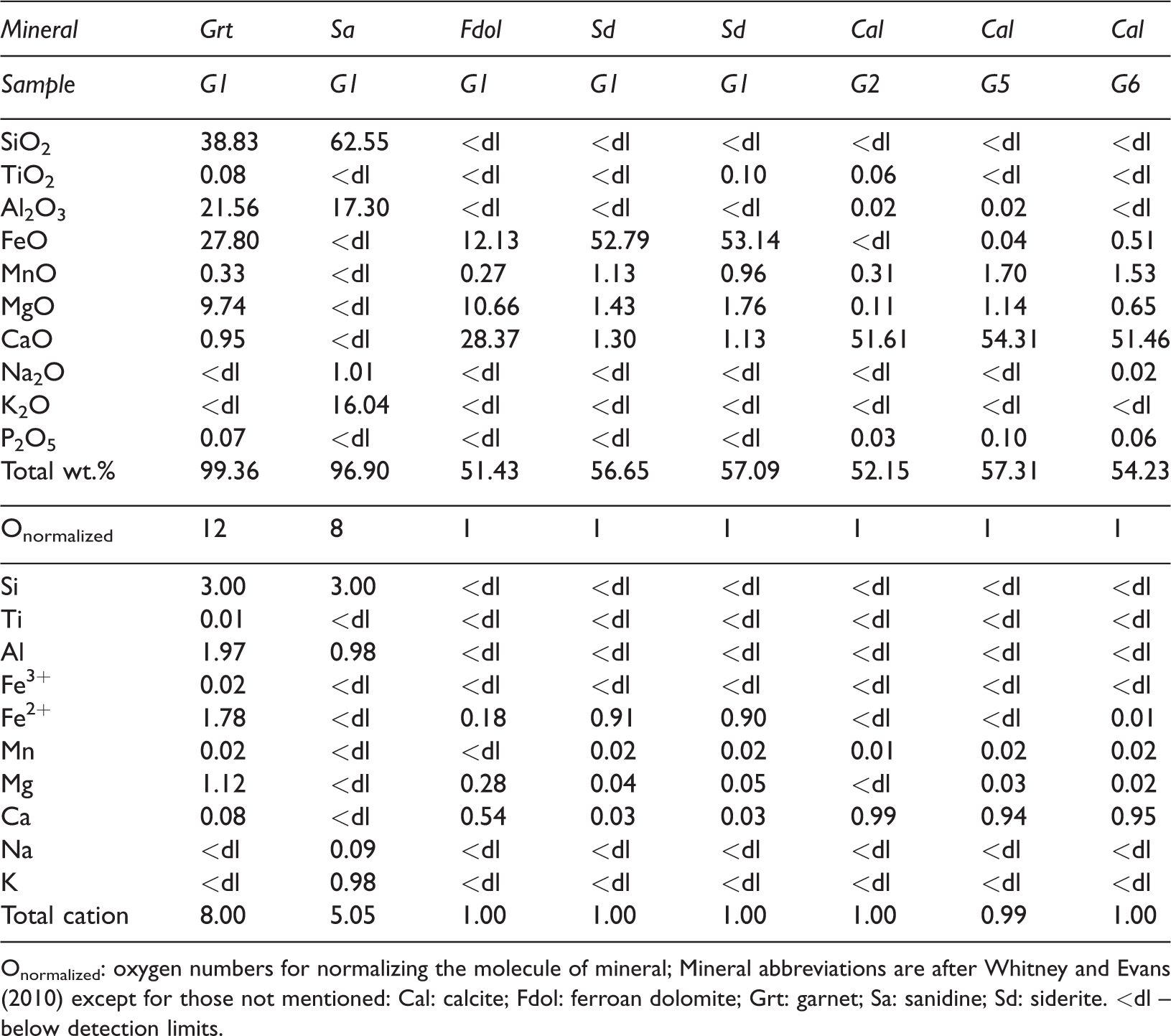
Feldspar in the sandstone (G1) including sanidine, microcline (with grid twinning striation), albite and perthite (intergrown sanidine and albite) is granular with a size ranging from 8 µm to 30 µm. The sanidine, microcline, and albite are almost pure endmembers in chemistry.
Garnet clasts in the sandstone are granular, and their partial rims have transformed into aliettite (Figure 5(c)). The composition of garnet is (Fe2+1.78Mg1.12Ca0.08Mn0.02)3(Fe3+0.02Ti0.01Al1.97)2Si3O12 (Table 7). The composition of aliettite, a regularly interstratified talc-saponite mineral, is (K0.01Ca0.07)0.08(Mn0.02Fe1.26Mg1.51Fe3+0.20)2.99(Fe3+0.02 Al0.37Si3.61)4O10[(ΟΗ)1.97F0.03]2.
Chemical compositions (wt. %) of typical minerals in the coals (G2 to G6), sandstone (G1) and claystone (G7-1 and G7-2).
Onormalized: oxygen numbers for normalizing the molecule of mineral; Mineral abbreviations are after Whitney and Evans (2010) except for those not mentioned: Cal: calcite; Fdol: ferroan dolomite; Grt: garnet; Sa: sanidine; Sd: siderite. <dl – below detection limits.
Quartzose clasts include quartz and chalcedony. Quartz in the coal (G3) occurs locally and is angular or granular less than 30 µm in size. That in the claystone (G7-1 and G7-2) is mostly angular and granular less than 20 µm (Figure 4(a) and (e)), but a few coarse grains with cracks are in size ranging from 200 µm to 320 µm (Figure 4(f)). That in the sandstone is angular and irregularly harbor-shaped clast, and is mostly in size ranging from 100 µm to 600 µm (Figure 5(a) to (f)), partially (coexisting with kaolinite) from 2.5 µm to 8.0 µm (Figure 5(c)). Occasionally, diamond-shaped quartz, indicating a pseudomorph of beta-quartz, could be observed in the coal (Figure 3(f)), claystone (Figure 4(f)) and sandstone (Figure 5(a)). The beta-quartz pseudomorph and cracked grain may indicate their volcanic origin. Chalcedony clast occurs in the sandstone, it has angular or long oval shape with a size ranging from 200 µm to 900 µm, which is comprised of micro quartz crystal less than 10 µm in size (Figure 5(a) and (f)).
Carbonate mineral observed includes calcite, ferroan dolomite, and siderite. Calcite occurs as filling of fusinite cell cavity (Figure 3(a) and (e)) and in the fine vein (Figure 3(c)) in the coal (G2). It is chemically close to pure CaCO3 (Table 7). Ferroan dolomite and siderite occur in the sandstone (G1), the former fills in the intergrain cavity between clasts (Figure 5(e) and (f)) and the latter occurs with wonesite and kaolinite together (Figure 5(e)). The ferroan dolomite is comprised of CaCO3 (54.0 mol.%), MgCO3 (28.0 mol.%), and FeCO3 (18.0 mol.%), and the siderite has FeCO3 content more than 90 mol.%, and minor CaCO3, MgCO3, and MnCO3 (Table 7). The modes of occurrence and compositions of carbonate mineral imply their different origins, that is, the calcite is related to post-diagenetic hydrothermal fluid, the ferroan dolomite and siderite are derived from a biotite weathering after it had been deposited.
Sulfide observed includes pyrite, selenio-galena, chalcopyrite, and sphalerite. Pyrite in the coal (G2 to G6) occurs extensively and is scattered in kaolinite mass or in calcite vein (Figure 3(c)) or forms vein itself (Figure 3(d)). That in the claystone (G7-1 and G7-2) and sandstone (G1) mostly occurs in vein or film. The trace elements in pyrite are minor (Table 8). Selenio-galena in the coal, claystone, and sandstone occurs in a group as grain less than 6.0 µm in size. It contains an amount of selenium ranging from 6.03 wt.% to 16.17 wt.% (Table 8) and a trace amount of bismuth. Chalcopyrite is trace in the coal. Sphalerite is trace in the sandstone.
In general, the coal is comprised of dominant kaolinite and calcite; the claystone is characteristic of major kaolinite and montmorillonite, and proportional illite; and the sandstone contains mainly quartz and chalcedony and relative feldspar and kaolinite (Figure 2). Those minerals show that there are two genetic periods, pre-diagenetic and epigenetic ones. The pre-diagenetic minerals are predominant in the coal seam, which is associated with weathering of source rock, sedimentation, and diagenesis; and the epigenetic ones including calcite and pyrite, etc., are minor, which are derived from the hydrothermal deposit and influence the coal more than the claystone and sandstone for the coal has much more microcrack.
Geochemistry
Major elements
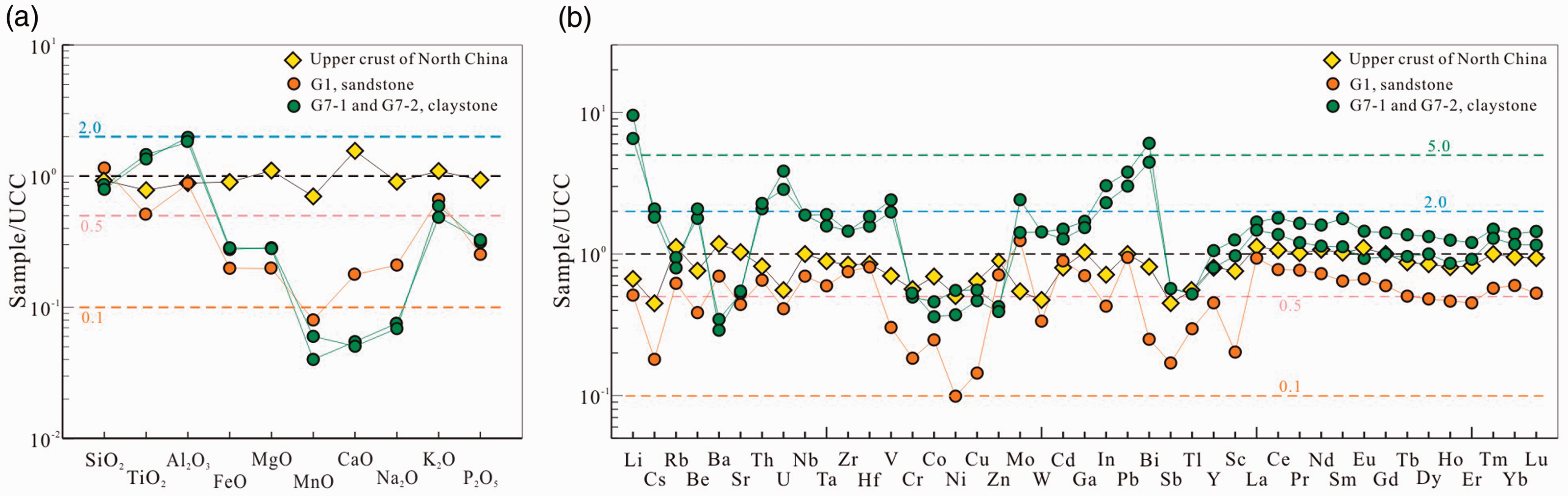
The concentration of major elements in oxide of the sandstone (G1) and claystone (G7-1 and G7-2) is listed in Table 9. The SiO2 and Al2O3 are dominant constituents. The sandstone has high SiO2 76.87 wt.% and high Al2O3 13.39 wt.%; and the claystone has moderate SiO2 52.83–56.17 wt.% and high Al2O3 27.83–30.41 wt.%, which may be utilized as a good refractory. All rocks have moderately high K2O contents (1.36–1.86 wt.%) and low MnO, FeO, MgO, CaO, Na2O and P2O5 contents. The major elements of rocks are dependent on their major mineral components. High SiO2 content indicates the existence of quartz, high Al2O3 does the increase of aluminous clay minerals, high K2O means a constituent of alkali feldspar or another potassium-bearing mineral, and low MnO, FeO, MgO, and CaO imply the lack of ferromagnesian minerals. This is consistent with the observation that the sandstone is mainly comprised of quartz and chalcedony and that the claystone is of kaolinite and montmorillonite. Normalized to the average composition of upper continental crust (UCC; Rudnick and Gao, 2003), the diagram (Figure 6(a)) exhibits that the sandstone and claystone are depleted in MnO, FeO, MgO, CaO, Na2O, P2O5 and K2O, but the sandstone has SiO2 and Al2O3 contents proximal to the UCC, whereas the claystone only has SiO2 proximal to that and is rich in TiO2 and Al2O3. The depletion of ferromagnesian major elements indicates that the sandstone and claystone have similar source rocks which are dominantly comprised of felsic constituents.
Diagrams of major and trace elements of rocks.
Elemental compositions (wt. %) of sulfides in the No. 3 coal (G2, G4 and G6) and sandstone (G1).
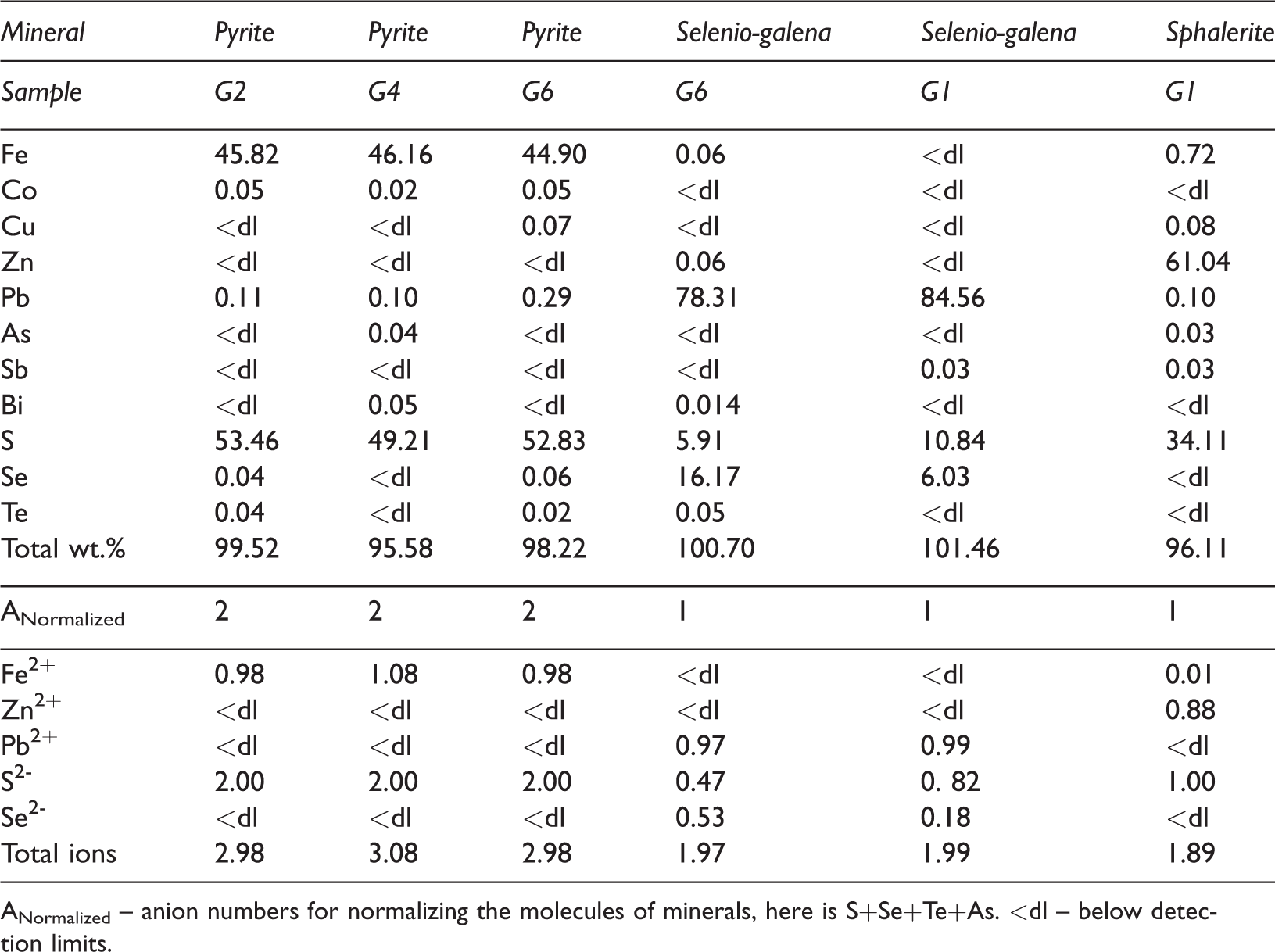
ANormalized – anion numbers for normalizing the molecules of minerals, here is S+Se+Te+As. <dl – below detection limits.
Major oxides (wt. %) and some indices for the sandstone (G1) and claystone (G7-1 and G7-2).
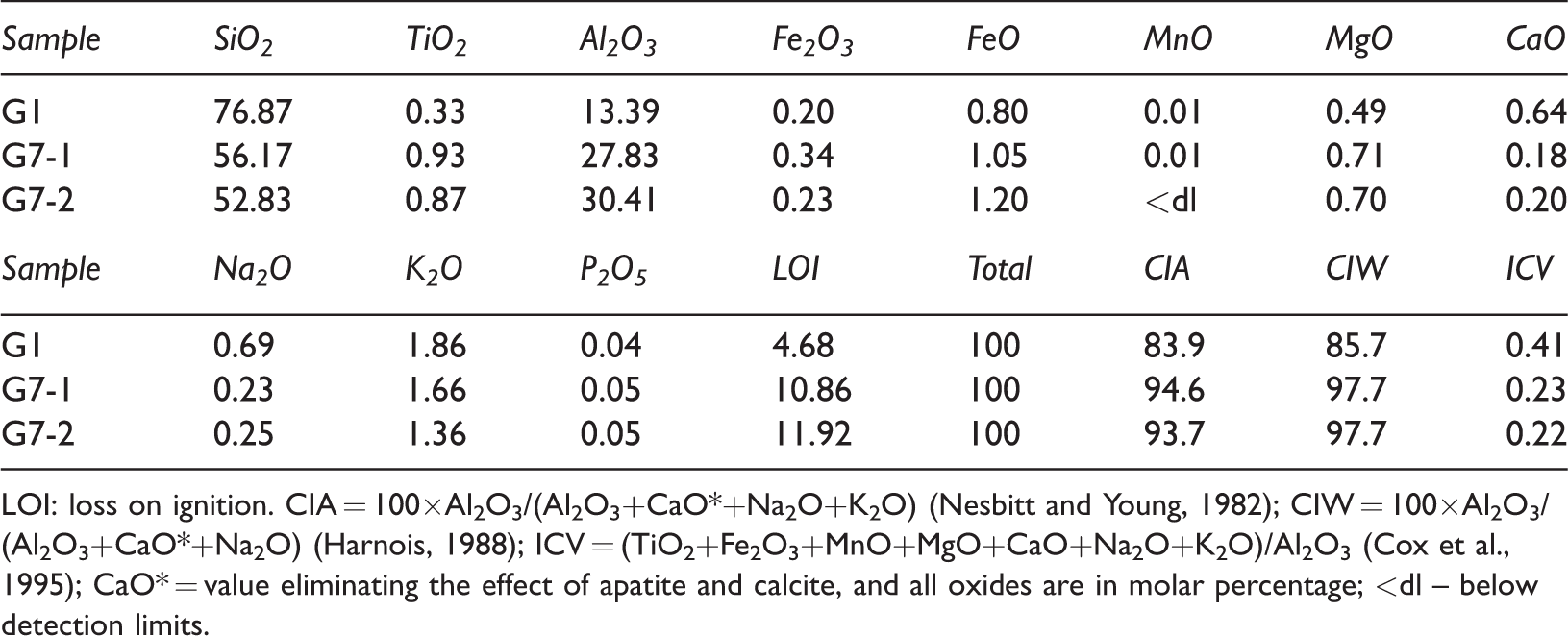
LOI: loss on ignition. CIA = 100×Al2O3/(Al2O3+CaO*+Na2O+K2O) (Nesbitt and Young, 1982); CIW = 100×Al2O3/(Al2O3+CaO*+Na2O) (Harnois, 1988); ICV = (TiO2+Fe2O3+MnO+MgO+CaO+Na2O+K2O)/Al2O3 (Cox et al., 1995); CaO* = value eliminating the effect of apatite and calcite, and all oxides are in molar percentage; <dl – below detection limits.
Trace and rare earth elements
The 43 trace and rare earth elements of the sandstone (G1) and claystone (G7-1 and G7-2) are presented in Table 10. The pattern diagram of trace elements normalized to UCC composition (Rudnick and Gao, 2003) may obviously exhibit their relative enrichment and depletion (Figure 6(b)).
Trace elements (×10−6) and some chemical indices of the sandstone (G1) and claystone (G7-1 and G7-2).
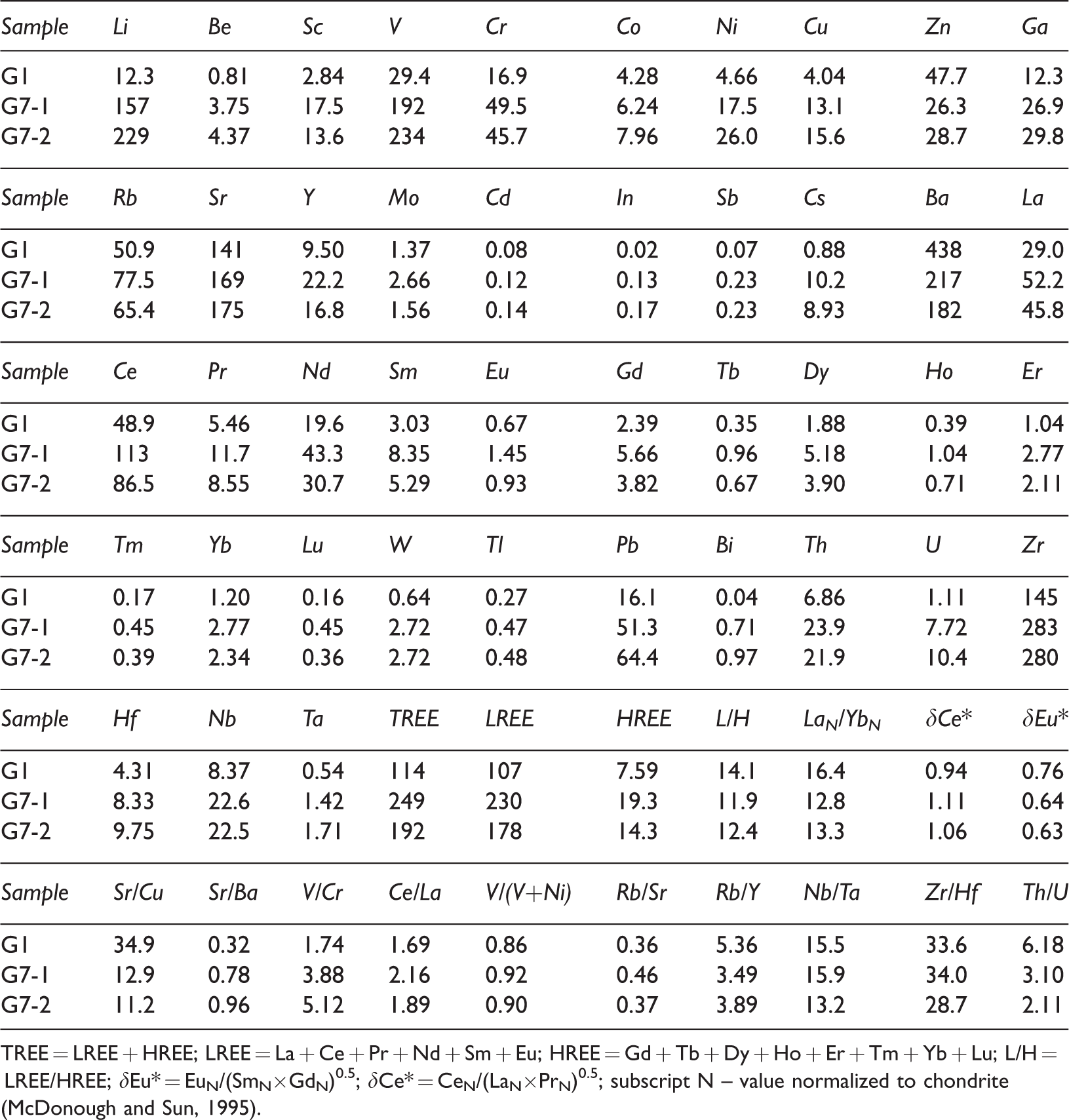
TREE = LREE + HREE; LREE = La + Ce + Pr + Nd + Sm + Eu; HREE = Gd + Tb + Dy + Ho + Er + Tm + Yb + Lu; L/H = LREE/HREE; δEu* = EuN/(SmN×GdN)0.5; δCe* = CeN/(LaN×PrN)0.5; subscript N – value normalized to chondrite (McDonough and Sun, 1995).
Comparing with the UCC, the sandstone (G1) is slightly enriched in only Mo, and is depleted in other else elements, especially in Be, Sr, Cs, V, Cr, Co, Ni, Cu, Bi, Sb, Tl, U, W, In, Y and Sc, whose concentrations are less half of those in the UCC (Figure 6(b)). These depleted trace elements include ferromagnesian trace elements (Cr, Co and Ni), large ion lithophile elements (LILE; Rb, Cs, Sr and Ba), high field strength elements (HFSE; Nb, Ta, Zr, Hf, and Ti), and heavy rare earth elements (HREE; Tb– Er). The depletion of some trace elements in the sandstone is related to the dilution of enriched quartz. The claystone (G7-1 and G7-2) is highly enriched in Li and Bi with concentrations of 157 × 10−6–229 × 10−6 and 0.71 × 10⁻⁶–0.97 × 10⁻⁶, respectively (Table 10), which are five or more times higher than that of the UCC (Figure 6(b)). It is moderately enriched in Cs, Be, U, Th, Nb, V, Mo, In and Pb with two to four times higher concentrations than the UCC, slightly in Ta, Zr, Hf, W, Cd, Ga and Sc, even and light REE (La–Sm) with less than two times concentrations of the UCC (Figure 6(b)). The claystone is depleted in Sr, Ba, Cr, Co, Ni, Cu, Zn, Sb and Tl with less than about half concentrations of the UCC (Figure 6(b)). The claystone is depleted in ferromagnesian trace elements, LILE (Sr and Ba), but enriched in HFSE (Nb, Ta, Zr, Hf, and Ti). The depletion and enrichment of the trace elements in sediments reflect the elemental differentiation in the surface process and the source constituent. The ratios of Rb/Sr, Rb/Y, Nb/Ta, Zr/Hf, and Ti/Zr are close to those of the UCC (Table 10), which indicates that the claystone and sandstone have similar source rock being characteristic of the UCC. The Th/U ratio is higher for the sandstone (G1) and lower for the claystone (G7-1 and G7-2) comparing with the UCC (Table 10), which indicates that the sandstone had a loss of U but the claystone increased U in the weathering and sedimentary processes. The enriched U and Th may cause the high natural gamma-ray level of the claystone near the bottom of the No. 3 coal seam (Feng and Dong, 1997). In addition, combining the cases that the claystone is enriched in Pb, Bi and In, and that the selenio-galena contains much amount of Se and minor Bi (Table 8) (Indium usually occurs in galena but was not analyzed in this study), the trace element group of In, Pb, Bi, and Se enriched would mostly occur in the selenio-galena in the claystone.
The claystone (G7-1 and G7-2) and sandstone (G1) have high total REE (TREE) contents ranging from 114 × 10−6 to 249 × 10−6 (Table 10). The ratios of LREE/HREE (light REE to heavy REE) range from 11.9 to 14.1, and the ratios of LaN/YbN normalized to chondrite (McDonough and Sun, 1995) range from 12.8 to 16.4 (Table 10). These ratios are just slightly higher than those of the UCC (9.33 and 10.5, respectively), which indicates that the rocks have an REE pattern with LREE enrichment compared to HREE and is relatively approximate to that of the UCC. The rocks both have a moderately negative Eu anomaly (0.63–0.76); the claystone has a weak positive Ce anomaly (1.06–1.11), but the sandstone has a weak negative one (0.94) (Table 10). Comparing with the UCC, the sandstone (G1) is slightly depleted in REE, but the claystone (G7-1 and G7-2) is weakly enriched in REE or in the partial members of REE (Figure 6(b)).
Discussion
Genesis of minerals
As mentioned above, the mineral related to the No. 3 coal seam in Guotun Mine has two genetic periods, pre-diagenetic and epigenetic ones. Mineral origins in the pre-diagenetic period include inheriting, weathering and authigenesis; and that in the epigenetic period is a hydrothermal deposit.
In general, minerals in a clastic sedimentary rock are almost derived from the source region. The sedimentary system of the Shanxi Formation bearing the No. 3 coal seam was a river-controlled shallow water delta system, including fore delta, delta front, delta plain, and peat bog facies in the Juye Coalfield basin (Bie, 2013; Han and Wei, 2001). The source region of the Shanxi Formation is the orogenic belt at the northern margin of the North China Craton (Zhu and Mou, 1987) because the orogenic belt uplifting in the Early-Middle Devonian Epochs has made the terrain of the craton high in the north and low in the south (Figure 1) during the Carboniferous and Permian. From the Late Carboniferous to Permian, the post-orogenic extension led to a large amount of bimodal volcanic rock and alkali feldspar granite in the orogenic belt (Zhang et al., 2018). The erosion of these rocks along with the pre-Carboniferous and Carboniferous sedimentary and metamorphic rocks, and some island arc igneous rock of early Palaeozoic (Zhang et al., 2018) may transport mineral clasts into the North China Basin in the Permian. The major minerals in the No. 3 coal seam such as quartz, chalcedony, feldspar, mica, kaolinite, montmorillonite and trace heavy minerals may mostly be inherited from the source region. The quartz, chalcedony, feldspar, and mica in sandstone indicate that their source rock is dominantly a felsic volcanic and granitic rock, which conforms to the rock constituents of the northern uplifting region if considering the intense weathering. The major elements of the rocks may provide important evidence of intense weathering of the source rocks by the high values of chemical index of alteration (CIA, Nesbitt and Young, 1982) and chemical index of weathering (CIW, Harnois, 1988) for the sandstone and claystone (Table 9), though there are only a few samples in this study and the high CIA value may be resulted in by high rainfall (White and Blum, 1995) and by sediment recycling (Tian et al., 2015; Yang and Du, 2017). The values of the index of compositional variability (ICV) for both sandstone and claystone are well below 1 (Table 9), which is suggestive of a possible sediment recycling (Cox et al., 1995) and of a quiescent environment of a stable craton (Weaver, 1989). However, the location of Guotun Mine in the North China Craton well matches the case of a quiescently sedimentary environment of the Shanxi Formation and advances the weathering grade of sediments. The kaolinite and montmorillonite may be the weathering product of feldspar or volcanic rock. Geochemically, the trace elements of the sandstone and claystone are much different from the carbonaceous horizons of Permian Barakar Formation of Sattupalli coal field of Godavari Valley in India (Prachiti et al., 2011), whose source region has mafic and felsic rocks. Therefore, the inheriting minerals derived from the source rocks with volcanic and granitic rocks and their weathering products are the major genesis of the minerals in the studied coal seam.
The inheriting minerals also include minor ones derived from volcanic ash fallout according to the petrological observation. But its proportion is probably minor because the sedimentary area had a far distance to the volcanic source in the northern uplifting region. The relative proportion of quartz with characteristics of volcanic clast in the sandstone (G1) is probably derived from the volcanic rock in the source region. The chalcedony in the sandstone may probably be derived from the volcanic rock in the source region. So, taking the sandstone as a primary volcanic rock for its volcanic clast is not appropriate (Zhang, 2016), that is, the sandstone had been reworked.
The weathering minerals here means those that are weathered after depositing in the basin but before diagenesis. Plotting the composition of kaolinite, illite, montmorillonite, feldspar and rock samples, etc., on the MR3–2R3–3R2 coordinate (Velde, 1985), there are two variational trends of mineral, that one is a clear evolution from phengite (including muscovite) to illite, then to montmorillonite, and finally to kaolinite; and that another is defined by biotite, which is degraded to wonesite, and finally to kaolinite or chamosite (Figure 7). Both trends are associated with loss of potassium, or iron and magnesium. Additionally, garnet has a loss of aluminium. The transformation process between different minerals is of great interest because it reflects all the stages of degradation of minerals and allows people to deduce their genetic processes (Fesharaki et al., 2007). The kaolinite may be derived from the weathering of feldspar, mica, or volcanic ash. That some mass of kaolinite, montmorillonite, illite or wonesite still keeps the mica shape in the coal, claystone, and sandstone is just good evidence of such a process. The calcium, iron, and magnesium released from minerals in weathering may form calcite, siderite and dolomite retaining in the rocks. An acidic condition, for an example in the peat swamp environment, is in favor of the weathering of feldspar and forming of kaolinite.
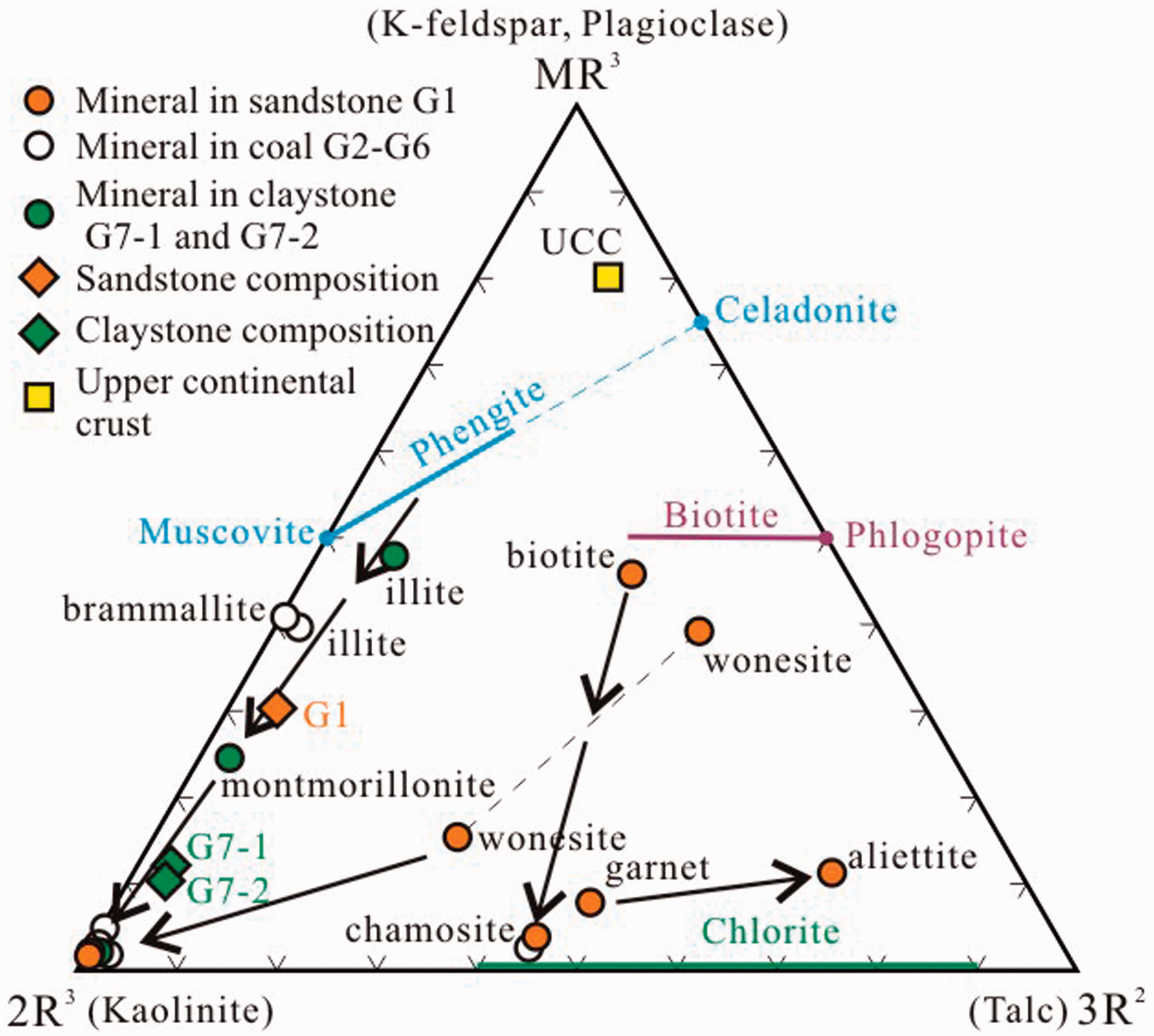
The plot of minerals of the coal and rocks in MR3–2R3–3R2 coordinates (Velde, 1985).
The minor authigenic minerals include mainly the worm-shaped kaolinite in the coal, dolomite in the sandstone, and part of sulfite in the coal, claystone, and sandstone.
The hydrothermally original minerals are mainly calcite and pyrite in veins in the coal, claystone, and sandstone. Petrologically, the calcite vein had affected the coal more intense than the claystone and sandstone because the coal had a large amount of crack and microcrack, whereas the rocks did sparsely. The epigenetic hydrothermal event was probably induced by the widespread Jurassic magmatism in east China. Except for vein, another occurrence of calcite in the coal is filling in the fusinite cavity, coexisting with brammallite. Such calcite and brammallite were derived from the hydrothermal deposit for their filling occurrence. Because that clausthalite in coal may be associated with the hydrothermal activity (Hower and Robertson, 2003), and that selenio-galena is a solid solution between galena and clausthalite, so the selenio-galena in the coal has probably a hydrothermal origin.
Enrichment in trace elements
Coal and relative mudstone are usually enriched in some trace elements. The study on the Handan-Xingtai Coalfield (Zhao, 2008) far to the west of the Juye Coalfield (Figure 1) showed that the coal neighboring the rock enriched in some trace elements was usually enriched in the same trace elements (Zhao, 2008). The claystone of the No. 3 coal seam in Guotun Mine is enriched in Li, U, Th, V, Mo, In, Pb, Bi, and even Se. This is similar in kind and concentration of trace elements with the mudstones in the Handan-Xingtai Coalfield (Zhao, 2008). So, the No. 3 coal in Guotun Mine is probably enriched in the same trace elements as the claystone, though that was not analyzed, unfortunately. The geological report of Guotun Mine shows that the average values of V, Th, and U in the No. 3 coal are slightly higher than that in North China coal (Zhao et al., 2002) or in United States coal (Finkelman, 1993). A neighboring coalfield, the Ji’ning Coalfield, had been studied for 10 kinds of trace elements sensitive to the environment, i.e., As, B, Cd, Hg, Mo, Pb, Se, Ni, Cr, in coals (Hu, 2009). Among them, As, B, Cd, Cr, Ni, and Se are relatively enriched compared to the average values of China coal, but their contents vary much in different coal mines, different coal seams, and different parts of the same coal seam (Hu, 2009). The richest trace elements in coal seam known well usually are Li and Ga. The recommended minimum mining grades of Li and Ga in coal are 120 × 10−6 and 30 × 10−6, respectively (Sun et al., 2014), but those in mudstone has not been determined yet. Li and Ga in part of claystone in the Handan-Xingtai Coalfield reach to the minimum mining grades mentioned above (as the case in Guotun Mine), but those in the coal equivalent to the No. 3 coal in Guotun Mine do not. Considering the similar sedimentary environment of the Shanxi Formation in the two coalfields, it is less likely for the No. 3 coal in Guotun Mine to form rare metal deposits.
The factors affecting the enrichment of trace elements in sediment are an abundant source (Wronkiewicz and Condie, 1987) and suitable depositional environment. On one hand, taking the Li as an example, when the Shanxi Formation in the Juye Coalfield deposited, there were relative proportion of volcanic and granitic rocks in the source region, and they were weathered to supply a relative amount of Li into the basin because Li was usually high in felsic volcanic and granitic rocks and was an easily mobile element in the surface. On the other hand, the delta environment of No. 3 coal seam with various sub-facies was in favor of the sedimentary sorting and enrichment of some trace elements. In the peat bog and bottom sediment, Li is easily bound with small organic molecules and easily released when small molecules are polymerized (He et al., 2016); Mo, V, U, Pb, and Se are easily enriched in reduced condition (Tribovillard et al., 2006). Some ratios of elemental pairs in sediments are usually used as important indicators of the sedimentary environment. For examples, The Sr/Cu ratios greater than 10 of the sandstone and claystone indicated an arid and hot climate (McLennan, 2001); the sandstone with a Sr/Ba ratio of 0.32 less than 0.6 (Table 10) had a terrestrial environment with fresh water, while the claystone with Sr/Ba ratios of 0.78 and 0.96 (Table 10) had a transitional facies between terrene and marine with brackish water (Liu and Zhou, 2007; Zheng and Liu, 1999). The high ratios of V/Cr (Jones and Manning, 1994), V/(V+Ni) (Davis et al., 1999) and Ce/La (Bai et al., 1994) of the claystone suggested a reduced condition of sedimentation (Table 10). The peat bog related to the No. 3 coal seam containing abundant organic compound and having reduced condition provided such a suitable environment to enrich in Li, V, U, Mo, In, Pb, Bi, and Se.
However, the carriers of trace elements are another important factor influencing on their enrichment in coal. Most of the trace elements in coal are associated with minerals, mainly including clay, carbonate and sulfide ones, and some are with organic compound (Hu, 2009; Zhao, 2008). The mode of occurrence of Li in coal is still an unresolved topic. The coalification seems not to be fit for much enrichment of Li (He et al., 2016). A Li-carrier mineral discovered in coal was an intermediate between cookeite and chamosite (Dai et al., 2012). Lithium in coal was usually considered to be associated with illite, montmorillonite, and kaolinite (Dai et al., 2012; Sun et al., 2012, 2013), but from the point of mineral structure, kaolinite unfits to combine Li cation. So, the major Li-carrier may probably be montmorillonite and illite. Uranium or Th occurred in zircon or monazite, and was probably associated with an organic compound; vanadium was probably associated with clay or organic compound; molybdenum occurred in sulfides (Finkelman and Gross, 1999). This study shows that In, Pb, Bi, and Se occur mainly in selenio-galena, and minor in pyrite. For the hydrothermal origin of selenio-galena, the enrichment of at least some trace elements in the No. 3 coal seam is to a certain extent associated with the epigenetic hydrothermal activity.
Conclusion
The No. 3 coal seam of the Permian Shanxi Formation in Guotun Mine, Juye Coalfield, north China, is mineralogically characteristic of different mineral constituents in the coal, claystone, and sandstone. The coal is comprised of dominant kaolinite and calcite, the claystone is characteristic of major kaolinite, montmorillonite, and proportional illite, and the sandstone contains mainly quartz and chalcedony and a relative amount of feldspar and kaolinite. These minerals were derived dominantly from the weathered source rocks with volcanic and granitic constituents in the pre-diagenetic period, and minor from the hydrothermal deposit in the epigenetic period.
The claystone is relatively enriched in Li, Cs, Be, Nb, Mo, U, Th, V, In, Pb, Bi and Se, and the enrichment may be controlled by the felsic source rocks and the specific sedimentary environment. The enriched trace elements are mostly associated with minerals. Li may probably occur in montmorillonite and illite, while In, Pb, Bi, and Se occur mainly in selenio-galena.
Footnotes
Acknowledgements
The authors are grateful to the reviewers for their careful reviews and detailed comments. Thanks are given to Fangyu Ma, the General Engineer in Guotun Mine, for his great help in sampling.
Declaration of conflicting interests
The author(s) declared no potential conflicts of interest with respect to the research, authorship, and/or publication of this article.
Funding
The author(s) disclosed receipt of the following financial support for the research, authorship, and/or publication of this article: This research was supported by the projects of the National Natural Science Foundation of China (No. 41330317 and 41604069), the top talent project of Science and Technology Research in Higher Education Institutions of Hebei Province (No. BJ2018010) and the plan of the Hebei Collaborative Innovation Centre of Coal Exploitation.