




Abstract
This paper proposes a frequency-based method for sizing the hybrid energy storage system in order to smoothen wind power fluctuations. The main goal of the proposed method is to find the power and energy capacities of the hybrid energy storage system that minimizes the total cost per day of all the systems. The energy management strategy used in this paper is designed as a two-level energy distribution scheme: the first level is responsible for setting the output power of hybrid energy storage system, the second level manages the power flow between the battery and supercapacitor. The hybrid parallel particle swarm optimization-genetic algorithm (PSO-GA) optimization algorithm is proposed to solve the control parameters of energy management strategy. In addition, the proposed method uses the piecewise fitting function to describe the lifetime of battery. Obtained results show that the hybrid energy storage system with the proposed energy management strategy is able to offer the best performances for the wind power system in terms of cost and lifetime.
Keywords
Introduction
Wind energy has been a main stream of sources for emerging energy. According to the Global Wind Energy Council (GWEC), the cumulative wind power installation in the world at the end of 2016 was 486.8 GW, especially in China the cumulative capacity was 168.7 GW, which have become an important portion of generation mix with a capacity of 3.9% of net electricity generation (GWEC, 2017). However, variable wind speed has restricted its power quality and system stability for the output power of Wind Turbine Generators (WTG) (Jannati et al., 2014). This phenomenon significantly restricts the wind energy integration with the grid. Comparatively, energy storage system (ESS) offers a relatively better solution and is assumed to be a good solution to smoothen power fluctuation, maintain the power and energy balance as well as to improve the power quality (Khalid and Savkin, 2014). However, different types of ESSs have huge differences in character, the ESS by a single type has some shortcomings for using smoothing fluctuation. For example, battery has a high-energy density but limited power density, and supercapacitor (SC) has a high-power density but limited energy density. Therefore, utilizing both battery and SC provides a compromise of a high-power density and high-energy density hybrid energy storage system (HESS), resulting in improving the technical performance of the wind power generation (Schaltz et al., 2009). Since the cost of energy storage is a strong function of their power and capacity, and too high cost is prohibitive to engineering acceptance, a method for optimizing the size and control of HESS to fit application constraints is a key issue.
Sizing the ESS is finding the proper ESS power and energy capacity to satisfy the special technical requirements of the wind power system. During the past year, some researchers carried out significant works on this issue. Parra et al. (2015) presented control strategies for sizing ESS to comply with the constraint of power ramp rate (PRR). Khalid and Savkin (2014) proposed a semi-distributed ESS scheme to optimize ESS size and operation with a wind power smoothing model. Arabali et al. (2014) studied a combined sizing optimization method using the pattern search and Monte Carlo simulation. Zhang et al. (2015) presented a strategy to allocate the capacity within HESS by applying the Ragon plots. They did not consider the cost of ESS. Meanwhile, other researchers formulated the objective function of the sizing optimization problem and found the solution using the heuristic algorithm or the hybrid algorithm. For instance, Fossati et al. (2015) acquired the power and energy capacities by the genetic algorithm (GA) and the lifetime prediction model of ESS. Bahmani-Firouzi and Azizipanah-Abarghooee (2014) presented a new improved bat algorithm for determining optimal sizing of battery storage system. García-Triviño et al. (2016) calculated the optimal result by the particle swarm optimization (PSO) considering cost, efficiency and lifetime. Those optimal techniques also have some downsides such as trapping in local optima or convergence to the global optima over a long time. Consequently, choosing a robust optimal algorithm to solve the complex problem is important.
In this paper, we propose a hybrid Parallel PSO-GA (PPSO-GA) optimization method to smooth wind power fluctuation. The energy management strategy (EMS) in this paper is designed as a two-level energy distribution scheme. The first level is based on the spectrum analysis and technical rules of PRR for connecting wind farm to power system in China that is used to set the output power of HESS. The second level deploys the output power of the battery and SC according to the battery operation period and cutoff frequency of battery output power, where the goal to find the optimal sizing of HESS to balance the costs and the ESS lifetime. For this purpose, the hybrid PPSO-GA algorithm is suggested to achieve an optimal sizing. Furthermore, owing to the great influence that the depth of discharge (DOD) has on battery lifetime and therefore on the cost of HESS, a lifetime prediction model as constrains parameter is integrated with the algorithm.
This paper is organized as follows: In the next section, the system model of the HESS is explained. Then, the EMS is presented. The hybrid PPSO-GA optimization algorithm is proposed and tested next. This is followed by a section where the simulation result is shown by MATLAB. Finally, conclusions are drawn.
System model
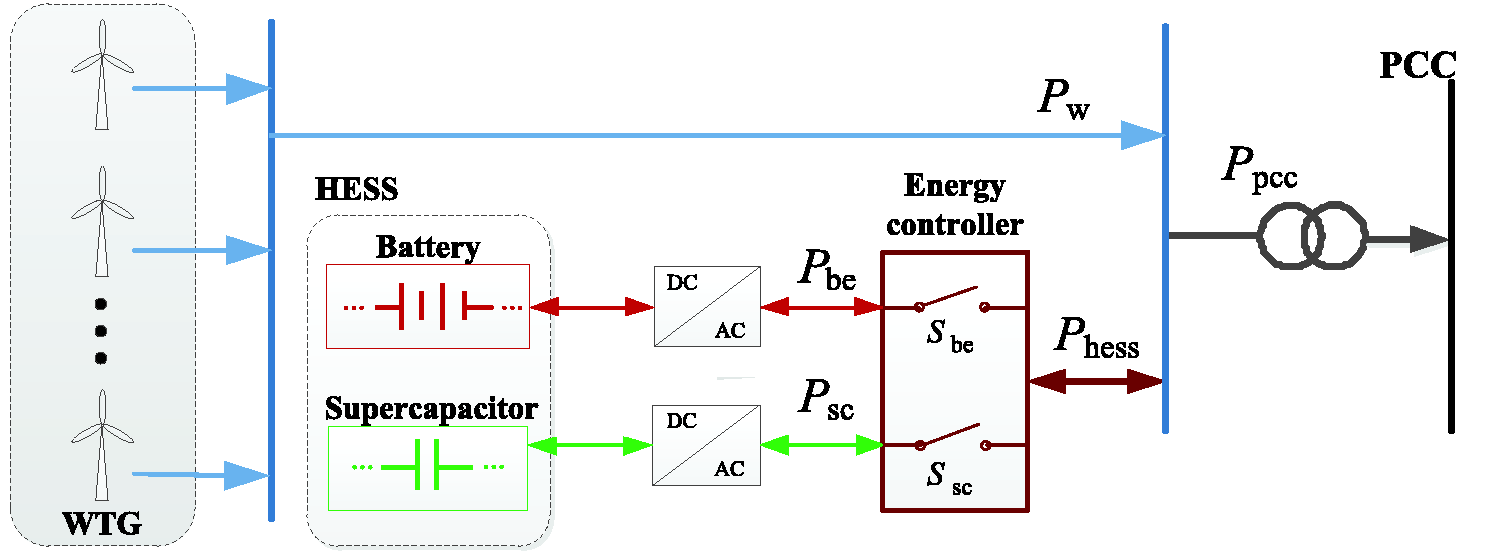
In this paper, the proposed wind power system with the introduced HESS model is used as described in Figure 1.
Layout of wind power system with the introduced HESS.
In Figure 1, the HESS is used to absorb the extra generated energy from the TG or releases the stored energy to the point of common coupling (PCC) of power system. The basic operation of HESS can be described as

HESS constraints
In this paper, one of the aims is to find the desired output power of wind power system with HESS Ppcc,ref which satisfis the technical rule of the PRR. It is assumed that the Ppcc,ref is determined, and the desired output power of the HESS Phess,ref can be calculated as


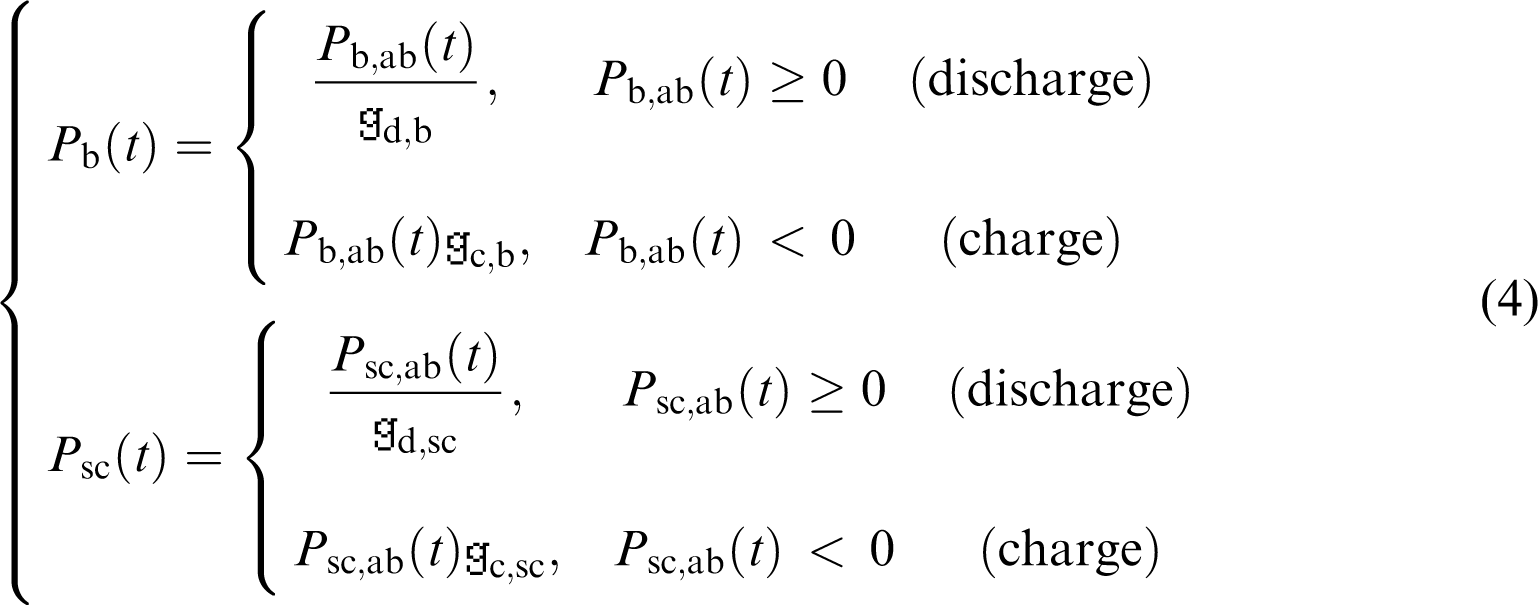
Based on the charge–discharge effciency, the output power of the battery and SC (Pb/Psc) can be expressed as

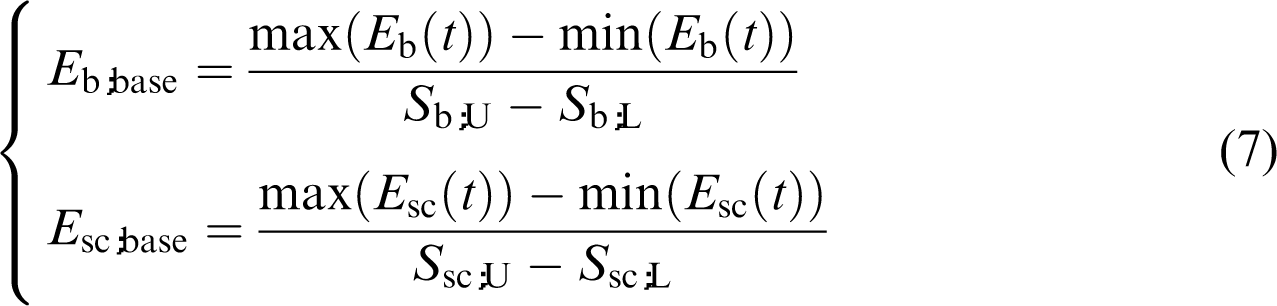
In order to satisfy the safety of ESS, the energy stored at any tth commitment interval E(t) must be limited as


HESS lifetime model
The battery lifetime highly depends on the DOD, charge and discharge cycle, rate of discharge, temperature, equivalent series resisor, charging method, etc. (Layadi et al., 2015). To simplify, the impacts of the most important parameters, DOD and the number of the charge and discharge cycles are studied. In this paper, the preferred reference battery is a 12-V, 2.1-kWh valve-regulated lead-acid (VRLA) battery. The data of cycles to failure Ncyc for a given DOD can be described in Table 1 from the reference battery data sheet.
Cycles to failure and amount of throughput energy versus DOD.

DOD: depth of discharge.
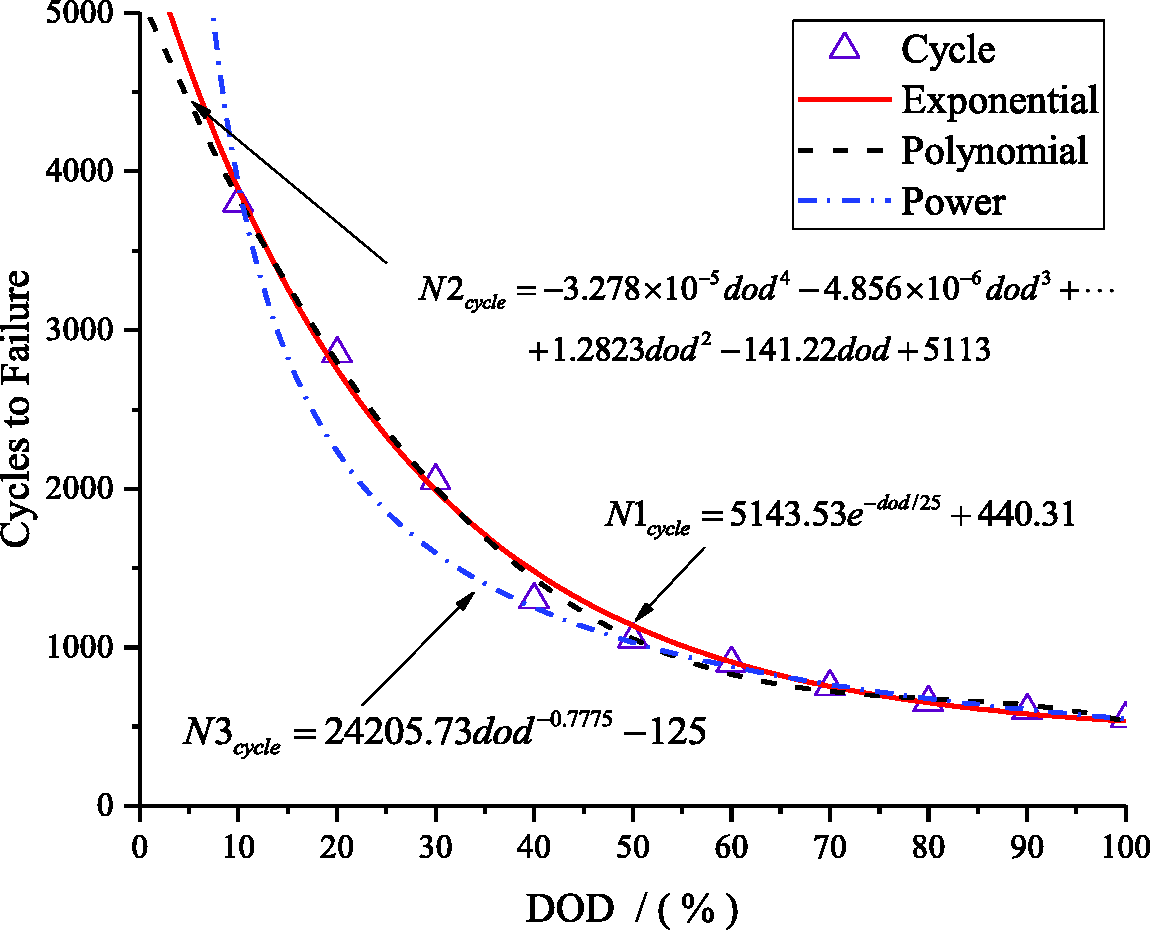
To build the battery lifetime model, it is necessary to obtain a continuous function of the cycle to failure, which can be fitted by the data sheet value. Usually, the number of cycles to failure versus DOD can be expressed by exponential, power and polynomial in Figure 2. These curves have similar shape to describe the characteristic of the number of cycles to failure, and it is difficult to evaluate the applicability of these fitting functions by only one parameter. Hence, we introduce the amount of throughput energy Ethro for testing these fitting functions. The amount of throughput energy at a specific DOD can be expressed as

Cycles to failure versus depth of discharge.
In order to evaluate the applicability of different functions, the three series of throughput energy which are calculated based on exponential, power and polynomial are shown in Figure 3. In Figure 3, three throughput curves have great errors with the reference Ethro, but the power function can better fit the reference data at DOD > 40% and the exponential function has better result at DOD ≤ 40%. Hence, the number of cycles to failure versus DOD can be expressed as

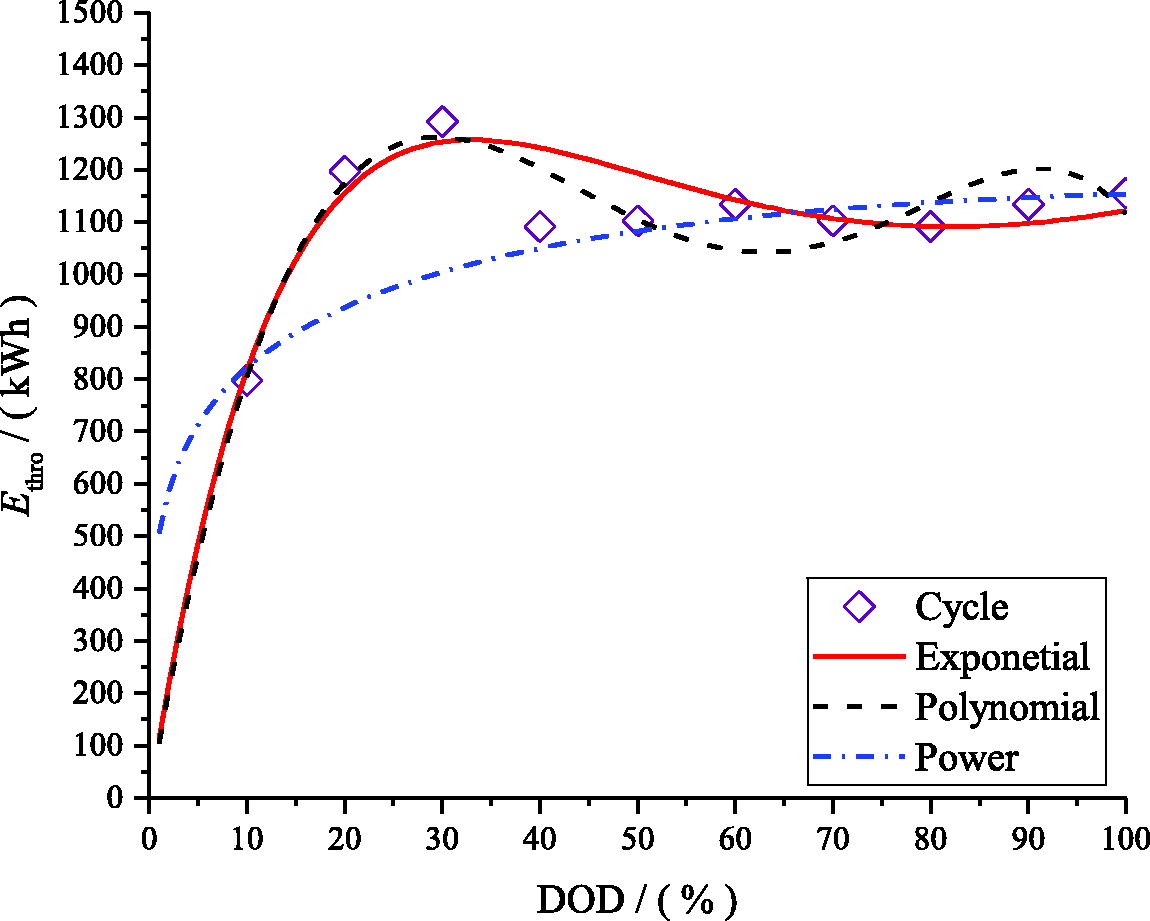
Throughput energy versus depth of discharge.
During the operation of the battery, it is almost impossible to discharge on a certain DOD level all the time, the battery lifetime cannot be directly calculated by equation (10). In this paper, the number of cycles in the different DOD levels is obtained by a rainflow counting method (Sauer and Wenzl, 2008). After one operated cycle of HESS, the battery lose lifetime is defined as

The SC has high-power density, fast charging and discharging, and long life more than 5 × 10⁴–105 cycles with virtually no maintenance. The SC lifetime is influenced by some factors, and the main factor is the number of cycles of charging and discharging (Zhang et al., 2016). To simplify, the supercapcitor lose lifetime is defined as

Objective function
In this paper, the main goal is to minimize the operating cost of HESS. For this reason, the estimation function of cost which consists of initial investment cost and management & operating (M&O) cost must be determined.
The initial investment cost Civ may be expressed as a function of the rated capacity and power of ESS (Fossati et al., 2015; Kaldellis and Zafirakis, 2007) and can be constructed as
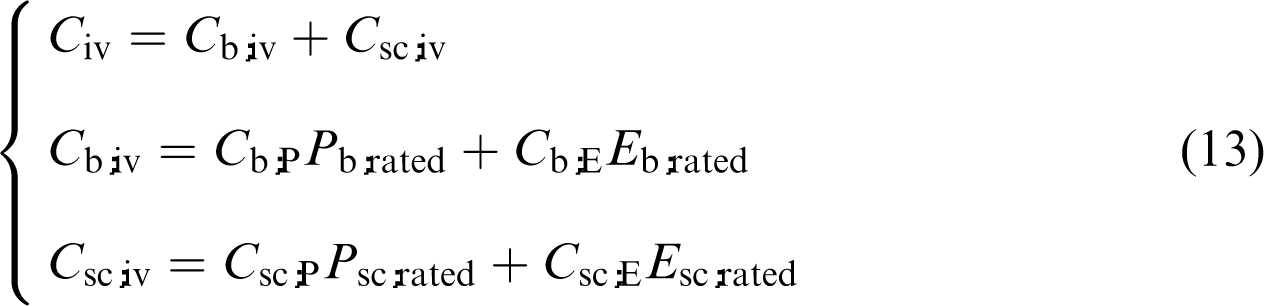
The M&O cost Cmo can be split into the fixed maintenance cost Cfm in normal operation and the variable replacement cost Cre (Han et al., 2013) and can be expressed as


The time horizon of the research sample was set as 24 h. Then, considering the interest rate for financing and system lifetime, the objective function can be expressed by the following equation.
Minimize total cost per day

Energy management strategy
The EMS was divided into two energy schemes: one was applied to produce the appropriate output power to alleviate the fluctuations and the other was to separate the power between the battery and SC.
First level of EMS
For the requirement of grid-connected, the output power that satisfies technical rules of PRR was set as the first level of EMS. The PRR is defined as


The first level strategy is designed based on the cutoff frequency control. The key of the first level strategy selects the proper cutoff frequency fc to achieve the dispatched power to HESS, and further ensures the wind power output to meet equation (18). This method calculates the desired output power Ppcc,ref by the spectrum analysis result of Pw and the selected fc. In addition, fc is obtained by the recursive calculation. According to Ppcc,ref, the desired output power of HESS Phess,ref is determined (Pang et al., 2016). The flowchart representing the calculated Phess,ref is described in Figure 4.
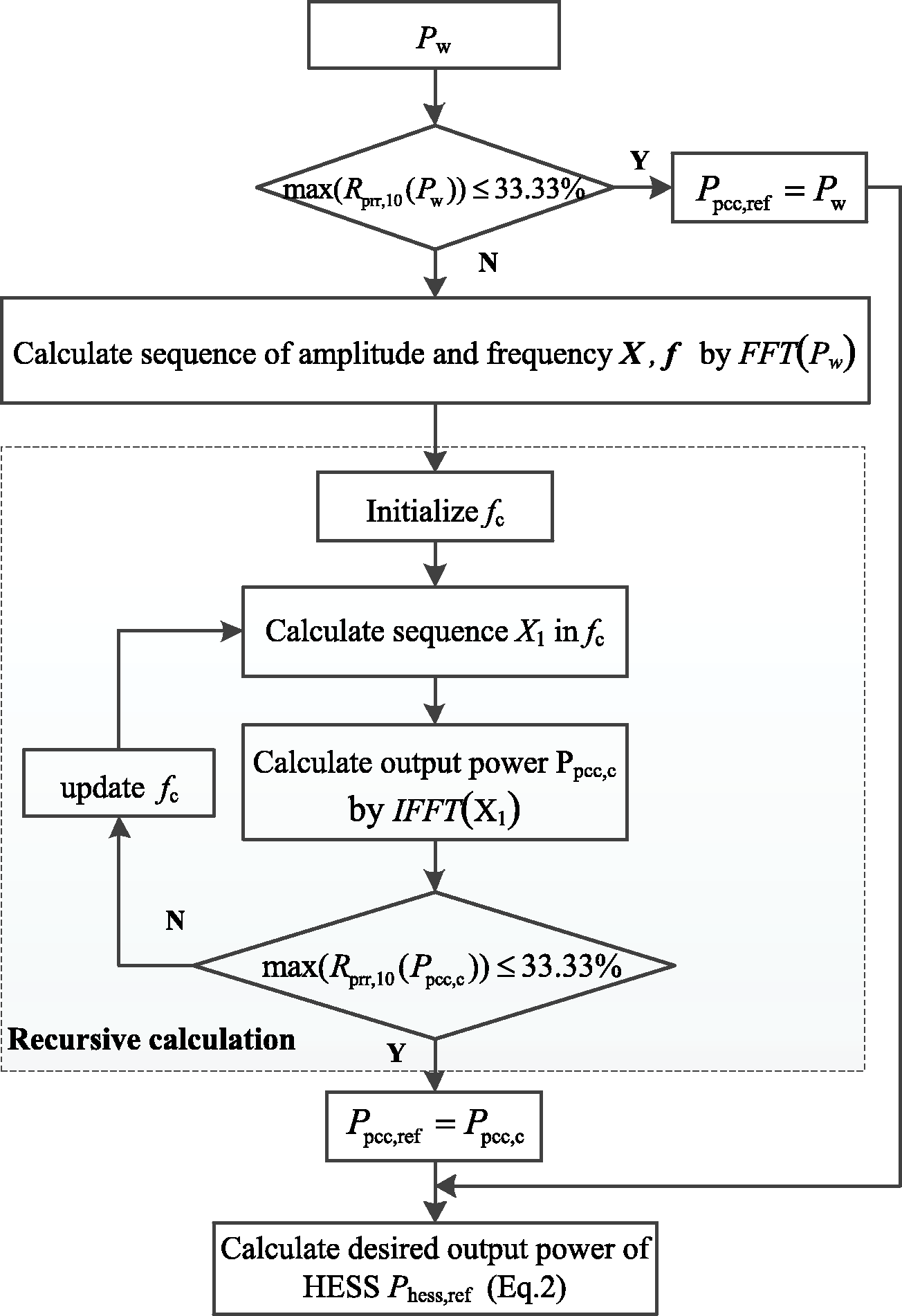
Flowchart of the calculated desired output power of HESS.
Second level of EMS
According to the first level, the desired output power of HESS Phess,ref is calculated. Taking into consideration Phess,ref contains numerous high-frequency components, the second level is in charge of managing the Phess,ref power flow between the battery and SC. In this strategy, the battery works at low frequency range and provides more energy to the system, and the SC deals with the fast peak powers. In order to prolong the lifetime of the battery, the controlled battery by EMS outputs a certain power value for a battery operation period Tb,op in this paper. It is assumed that an output power of battery in Tb,op is determined, the absorbed power of the battery Pb,ab can be definded as


The second level of EMS’s core mission is to control the battery worked at the low frequency band. Due to the characteristics of output power of battery at Tb,op, the Pb,op can be extracted from Pu by a low-pass filter with bandwidth fb,c. Additionally, the amplitude frequency characteristic of Pb,op is given by

In this level strategy, the key factors of the power sharing between the battery and SC are the battery operation period Tb,op and the cutoff frequency of battery output power fb,c, which are obtained, thanks to the hybrid PPSO-GA optimization algorithm in order to improve the cost and lifetime of battery. The hybrid PPSO-GA optimization algorithm will be detailed in the next section.
Hybrid PPSO-GA optimization algorithm
In this study, the battery and SC are selected to smooth wind power fluctuation. However, it is a highly complex problem as to how the power is distributed between the battery and SC under the constraints of cost, lifetime, charging and discharging effciencies, output power and EMS’s control parameters.
A hybrid PPSO-GA optimization algorithm is proposed to solve the optimal sizing and control parameters of the HESS. This algorithm consists of two synchronized parallel algorithms of PSO, and enhances the global and local searching ability to modify the populations results of two PSO based on GA. This section describes the hybrid optimization algorithm.
Particle swarm optimization
PSO is one of the most important meta-heuristic algorithms developed by James Kennedy and Russell Eberhart (Amer et al., 2013; Mesbahi et al., 2017). Compared with other meta-heuristic algorithms, PSO is simple, easy to implement and it needs fewer parameters (Sharafi and Elmekkawy, 2014). In this method, the PSO works with a swarm of particles. Each particle in the population has two characters: position and velocity. For each particle i, its own past best position pbesti and the entire swarm’s best overall position gbest are recorded. The velocity and position of each particle in PSO updating rules (Liu et al., 2010; Ramadan et al., 2017) are given by

Genetic algorithm
GA is also a meta-heuristic algorithm, which simulates the evolution of a population of solutions to optimize a problem based on the genetic theory of Darwin evolution (Roberge et al., 2013). The solution in the GA is similar to the living organisms adapting to their environment by crossover and mutation. The GA operator is selection, crossover and mutation. The initializing population occurs randomly. At every generation, the parents are selected for the next generation by the fitness value. And children solution is subject to a crossover based on the crossover probability. If the mutation probability is met, the parents change randomly to produce children (Ismail et al., 2013).
Hybrid PPSO-GA algorithm
In this section, hybrid PPSO-GA is introduced in detail. In order to solve the optimization problem, it is designed that the two PSOs search the solution independently, and the GA is responsible for the interaction between the two PSOs under the setting rules and obtain the global search results. In this method, the two PSOs of populations with the same search size NP and the same dimension D are used. The two individual populations of two PSO are created randomly and the initial pbest1i, pbest2i, gbest1 and gbest2 are found out. At each generation, the two positions of the particle i from two PSOs: x1 i=(x1 i1,x1 i2,…,x1 iD), x2 i=(x2i1,x2i2,…,x2iD) (i = 1,2,…,NP) are generated by equation (22). Further, the x1 iand x2 iare sorted in descending order according to the fitness values. Based on the GA theory, the crossover process is to randomly determine the position of the crossover, and then to interchange the best fitness values form x1i(or x2i) with the worst fitness values form x2i(or x1i) when the random probability pr1 satisfies the setting crossover probability pcr. Following crossover, if the random probability pr2 has met the setting mutation probability pm, the mutation process is to randomly select the position and quantities of the mutation about the x1 iand x2 i, and to assign the random value within a range for increasing the diversity. The optimal result of this method is the best solution from the two populations by competition. The flowchart representing the hybrid PPSO-GA optimization algorithm is shown in Figure 5.
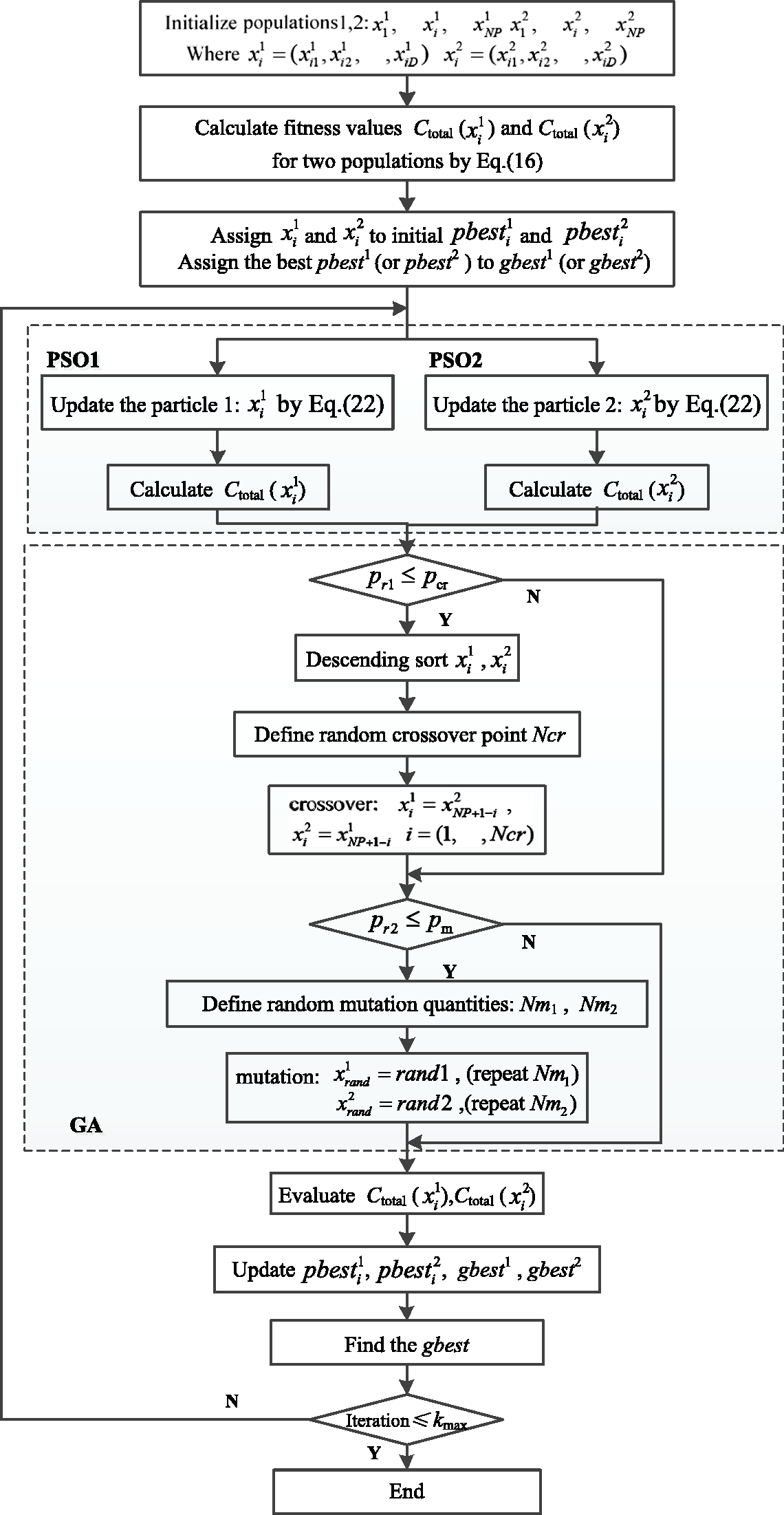
Flowchart of hybrid PPSO-GA optimization algorithm.
As shown in Figure 5, the aim of PSO1 and PSO2 is to search the more potential probability areas. To improve the local search capability, the better solutions are used to replace the corresponding inferior solutions between the both PSOs. The x1rand (or x2rand) is assigned random value rand1 (or rand2) (rand1,2 = xmin + rand(0,1)(xmax − xmin)) in mutation to avoid premature convergence. Meanwhile, excessive particles in mutation destroy the better solutions, so that the mutation rate rm is limited to 20% of the NP in this paper. The parameters of the hybrid PPSO-GA optimization algorithm are illustrated in Table 2.
Parameters of the hybrid PPSO-GA optimization algorithm.

The Ackley function was applied to test the robustness and convergence. In this case, the number of population and maximum iteration was set to 500, 10,000, respectively. The hybrid PPSO-GA GA and differential evolution (DE) can be evaluated and compared by solving testing function with 100 and 200 dimensions. In Figure 6, it is clearly demonstrated that the convergence solution of the hybrid PPSO-GA algorithm is significantly better and faster than the other two algorithms.
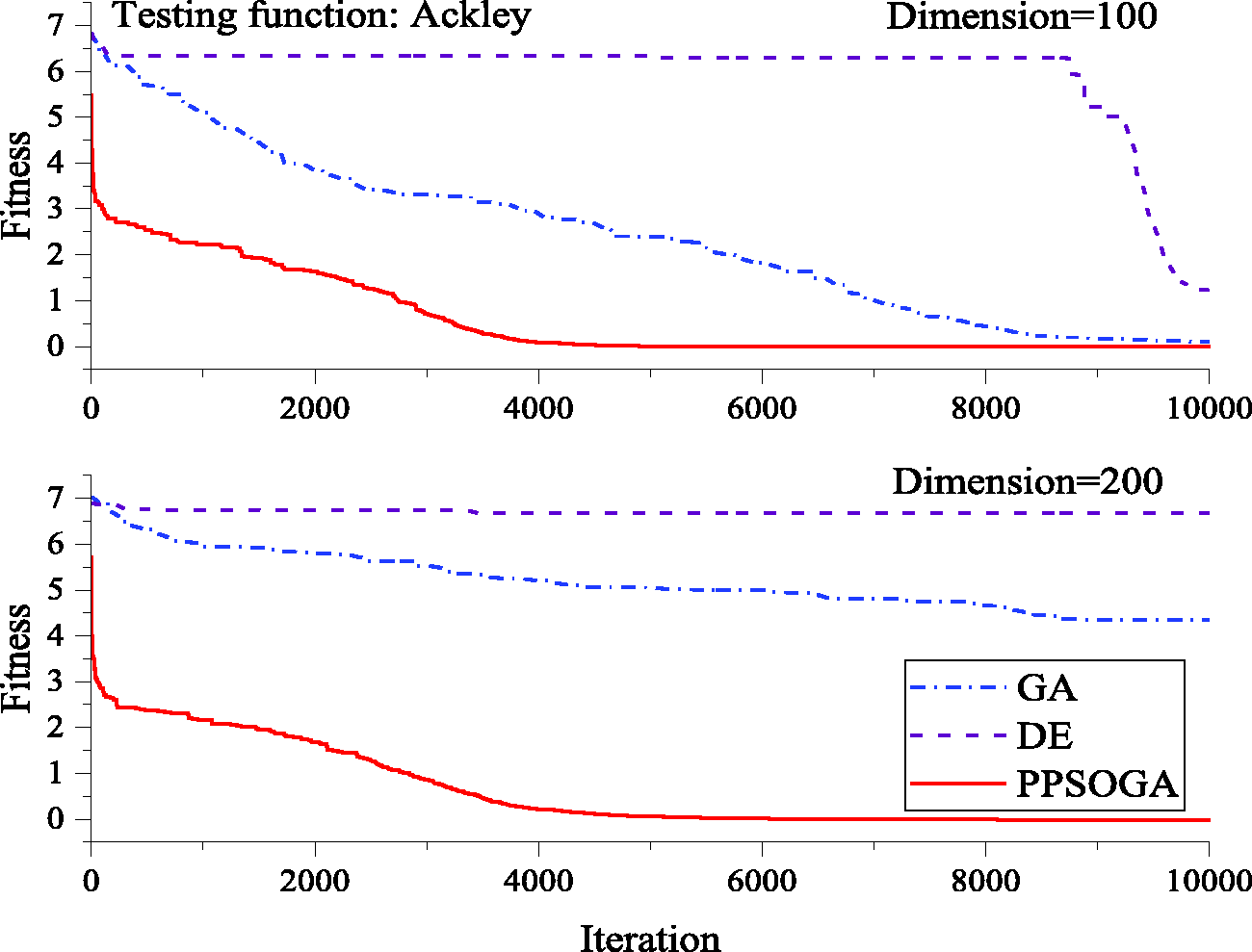
Convergence characteristics of the tested algorithm GA, DE and hybrid PPSO-GA.
Simulation and discussion
The algorithm and system simulation model are implemented by m-files with MATLAB R2014a and run on a PC with Intel I7-3770 CPU and 8 GB of RAM under Windows 7. In this paper, the optimal sizing of HESS using the wind power history date is simulated. The rated power of WTG is 1500 kW. The sample period is 1 min, and the regulation period is 24 h (Td =24 h). The maximum and minimum output powers of the sample (Pw) are 1513.8 kW and 0 kW, respectively. The average of Pw is 406 kW. In Figure 7(a), the blue line is the output power of Pw. Using equation (17) to evaluate the Pw, we can obtain the maximum PPR of 10-min interval of Pw, the value is 76.15% and far exceeds the requirements of equation (18).
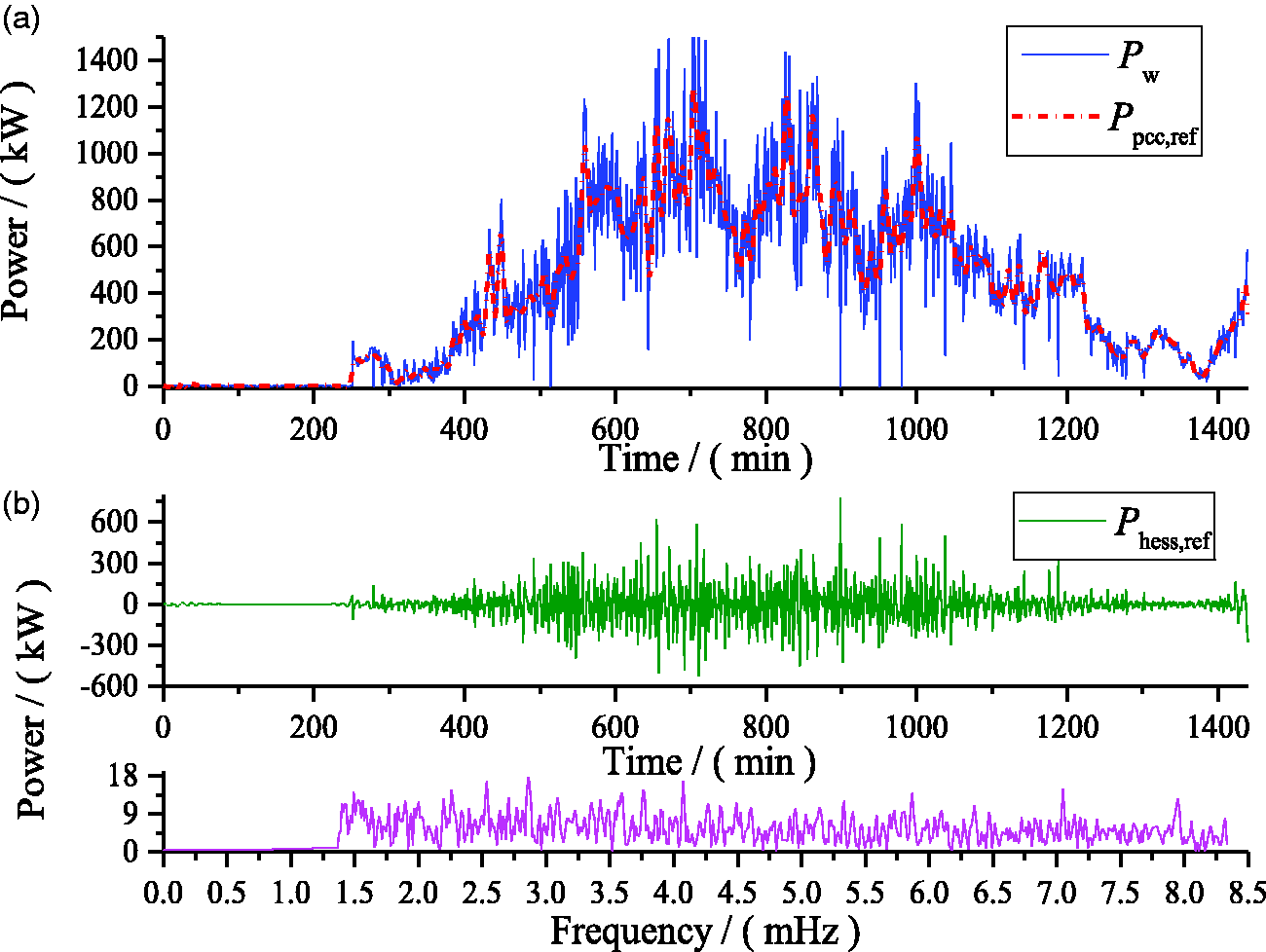
(a) The profile of wind power and system desired output power and (b) The profile desired power and amplitude-frequency of HESS.
The desired power of wind power system is calculated by the first level of EMS. Since the sample frequency fs is 16.667 mHz, the cutoff frequency fc is limited in 0 to 8.333 mHz (Nyquist frequency fN = fs/2). By the recursive calculation, the optimal cutfoff frequecy fc is 1.367 mHz, and the max (Rprr,10) fell to 33.15%. The PRR before and after the optimal is shown in Figure 8. It is clearly shown that the all PRR in any time step are less than the limit value after smoothing. Further, the desired output power of wind power system Ppcc,ref is calculated by equation (2) as indicated by the red dash dot line in Figure 7(a). Using equation (3), the desired output power of the HESS Phess,ref can be obtained as shown in Figure 7(b).
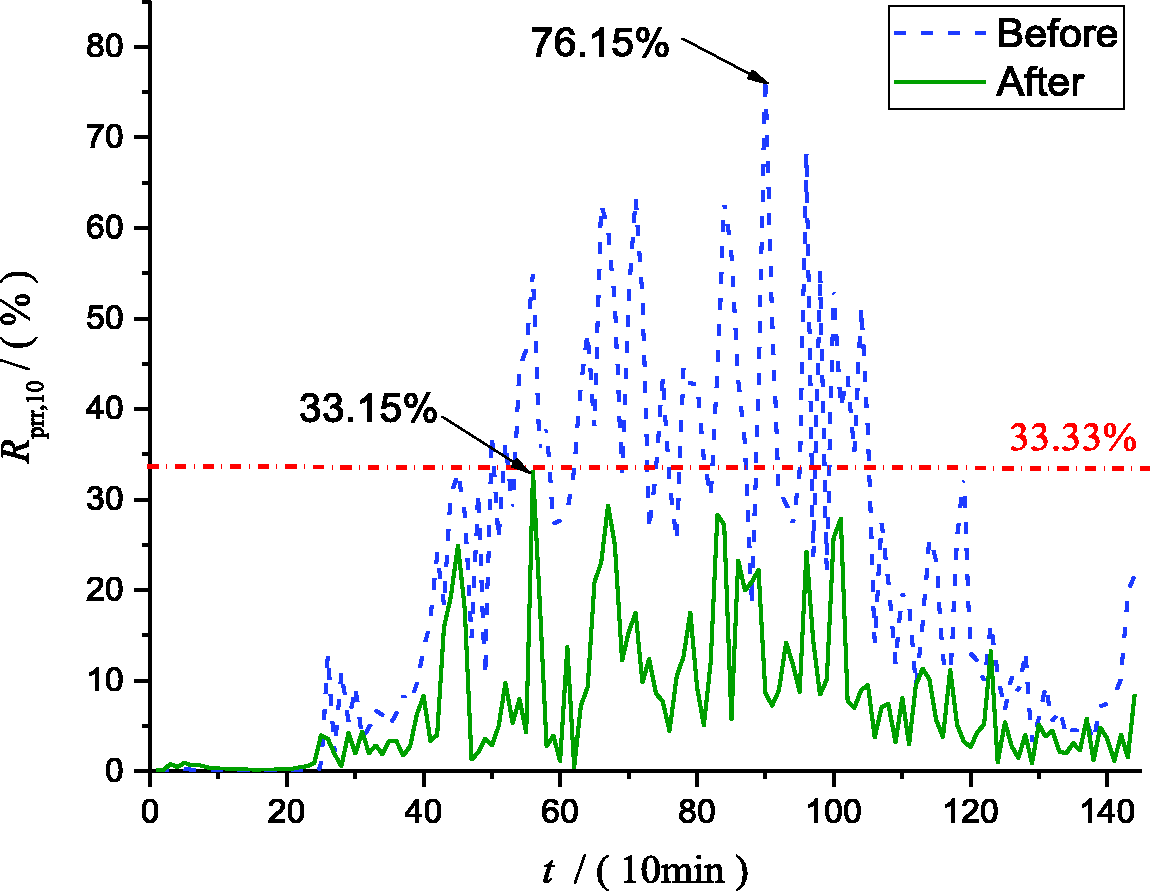
The profile of the PRR of 10-min interval.
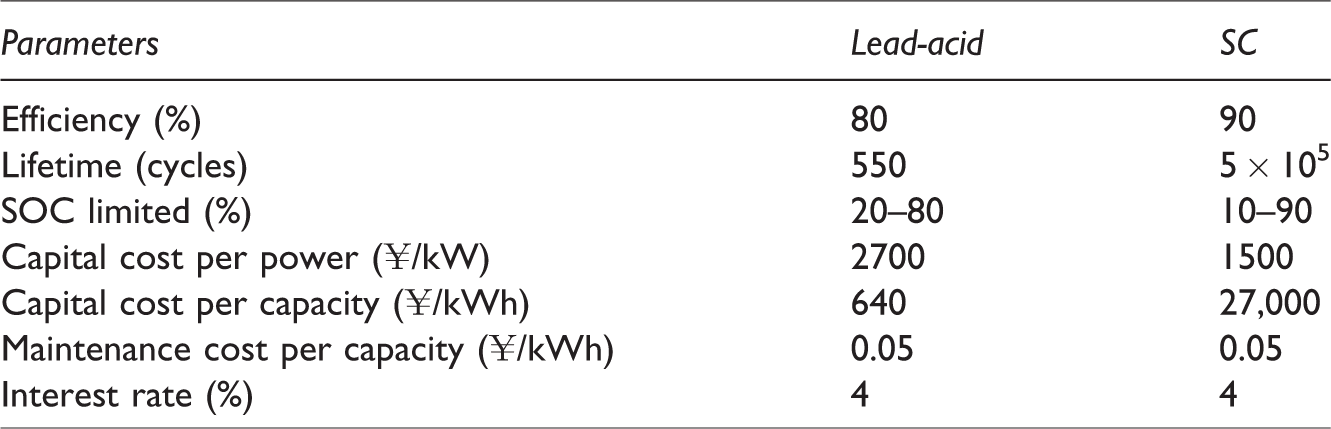
From Figure 7(b), the amplitude–frequency characteristics can obviously be seen that the Phess,ref has high-frequency fluctuation (approximately >1.3 mHz), which can damage the lifetime of the battery. In this study, to prolong the lifetime, the Phess,ref is dispatched to lead-acid battery and SC. The characteristics of the lead-acid battery and SC is shown in Table 3 (Castillo and Gayme, 2014; Chen et al., 2009; Han et al., 2013; Zhao et al., 2015).
Characteristics of the lead-acid battery and SC.
The optimal results are obtained by the designed EMS and hybrid PPSO-GA algorithm. In this simulation, the number of population NP is 200, the maximum number of iterations is set to 500. The parameters of hybrid PPSO-GA are shown in Table 2. For the purpose of comparison, GA and DE are also used to solve the same objective function. For the GA, crossover rate, mutation rate and discretization precision are chosen to be 0.7, 0.3 and 1 × 10⁻⁴, respectively. For the DE, crossover rate and mutation rate are selected to be 0.9 and 0.5, respectively. In this simulation, the battery operation period Tb,op is defined as an integer and the range is 1 to 60 min. The range of values for battery cutoff frequency fb,c is 0 to 8.333 mHz. The range of adjustment factor kb is 1 to 3. Considering the above variable limits, the results of the three methods are shown in Figure 9. It is clear that the hybrid PPSO-GA algorithm converges in 239 iterations that achieve the best objective function value of ¥18,546.95 in less time than that of other tested algorithms. Moreover, the hybrid PPSO-GA algorithm obtains the optimal value of Tb,op, fb,c and kb as 2 min, 1.623 mHz and 1.9, respectively. The optimal parameters of HESS are listed in Table 4.
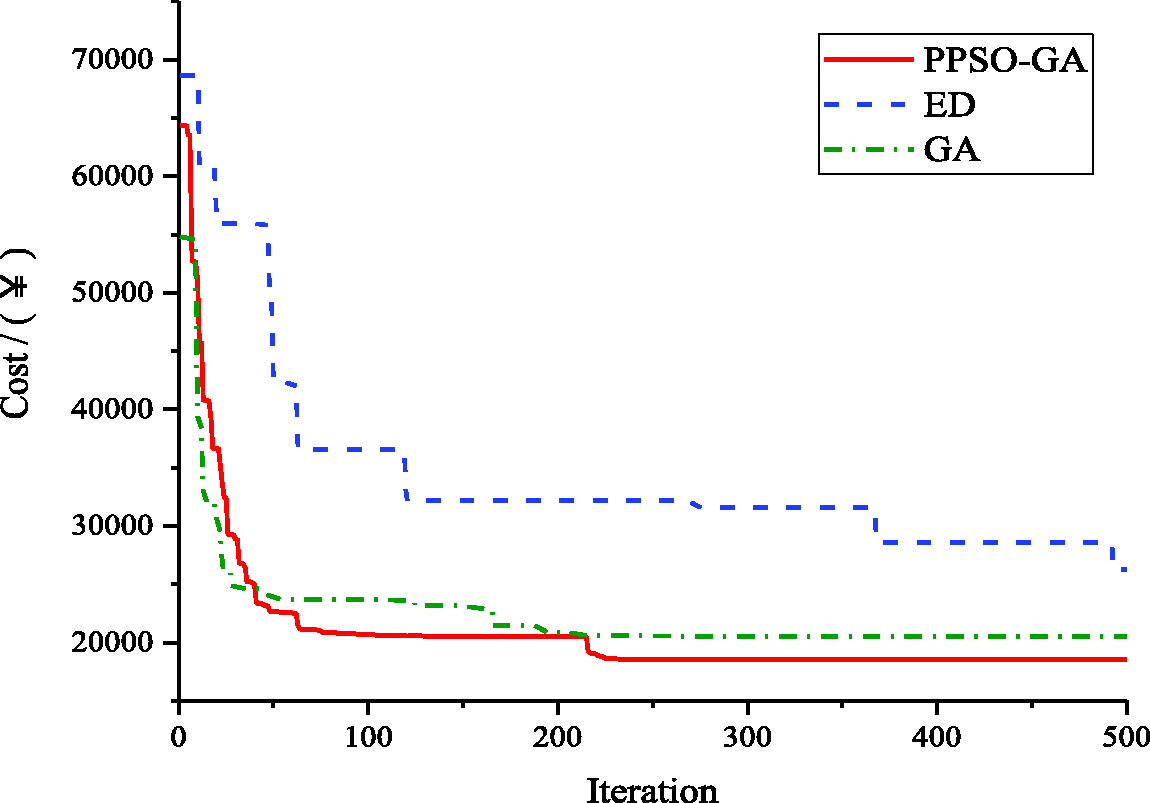
Convergence characteristics of the three algorithms for simulation.
The optimal parameters of HESS.

According to Tb,op, fb,c, kb and the parameters of Table 3, Pb,ab is calculated by equations (19) to (21), and Psc,ab is determined by equation (3). Taking into consideration the charge/discharge efficiency of the battery and SC, Pb,rated and Psc,rated are obtained using equations (4) and (5). For prolonging the lifetime of battery, the SOC of the battery is settled within the band margin of ±20% and the SOC of the SC is settled within the band margin of ±10% for safety. The optimal sizing of HESS can be determined, which is shown in Table 4.
In order to evaluate the efficiency of the HESS, the single ESS uses lead-acid battery for reference. By calculation, the single ESS sizing is 972.92 kW/656.12 kWh. During the frequent charge and discharge conditions, the lifetime of the battery rapidly declines. In this simulation, the nominal lifetime of the battery is 550 times at DOD = 100%, the lifetime of the battery is only 0.23 years on this operation condition. For the above reason, the battery ESS has a high cost, where the total cost per day is 4.5926 × 10⁴. As shown in Table 4, it is obviously show that the HESS can effectively reduce costs, the cost of HESS is only 40.38% of the battery ESS. Meanwhile, the lifetime of the battery can be prolonged for 1.82 years because the high-frequency fluctuations are absorbed by SC. Although the sizing of HESS is greater than the battery ESS, the total cost per day is significantly reduced owing to the prolonged lifetime.
Figure 10 shows that the battery operation period Tb,op has obviously influenced the minimum total cost per day. When Tb,op = 2 min, the total cost can get the optimal value. While Tb,op increases, the total cost also increases. This phenomenon is due to the extra power caused by the battery works in constant power output in Tb,op. Although increasing Tb,op can decline the frequence of the battery output power and prolong lifetime, the cost will increase with the Tb,op.
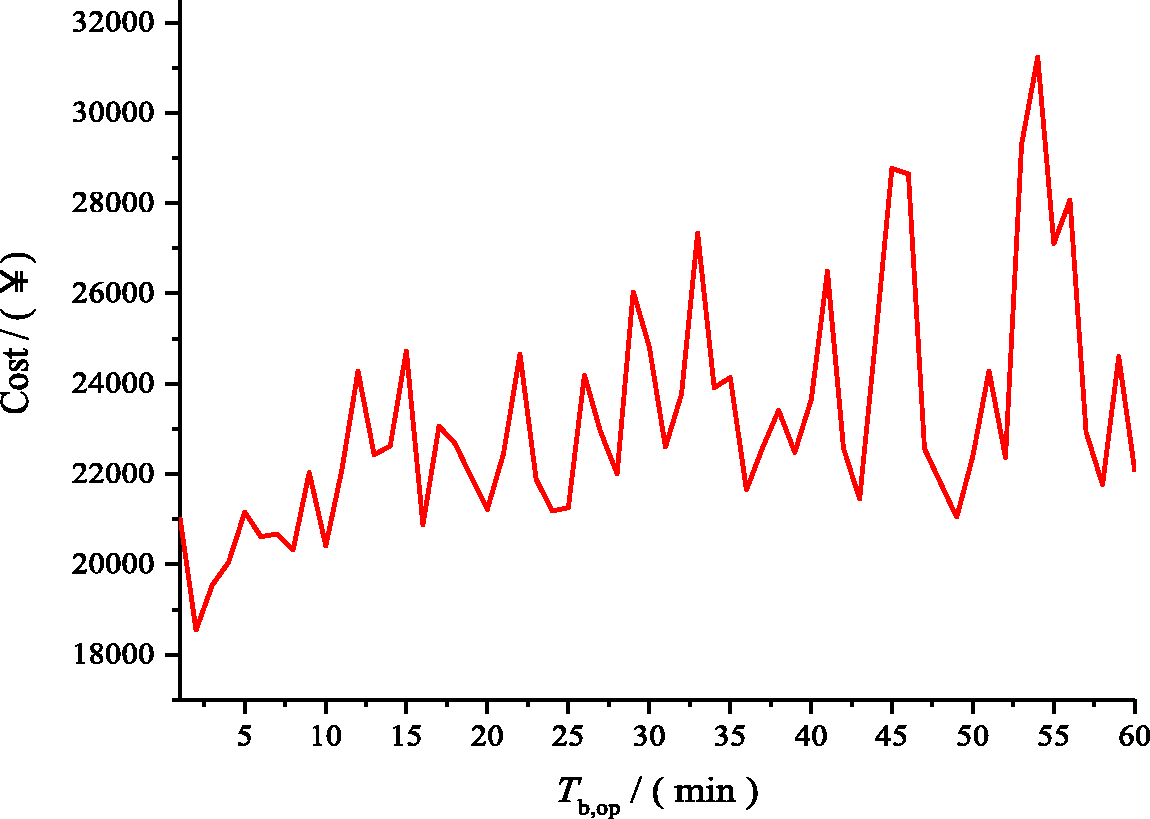
Minimum total cost per day versus the battery operation period Tb,op.
Figure 11 illustrates the relationship between the total cost per day and the fb,c at Tb,op =2 min and kb =1.9. As the battery cutoff frequency increases, the battery sizing also increases and the battery cost is improved, but the change trend is opposite for SC. When fb,c = 1.623 mHz, the optimal cost is obtained. From Figure 12(a), it is clearly seen that the frequency of the output power of the battery is far lower than SC. Figure 12(b) shows that the SOC of HESS meets the system setting requirements: 20%≤Sb≤80% and 10%≤Ssc≤90%.
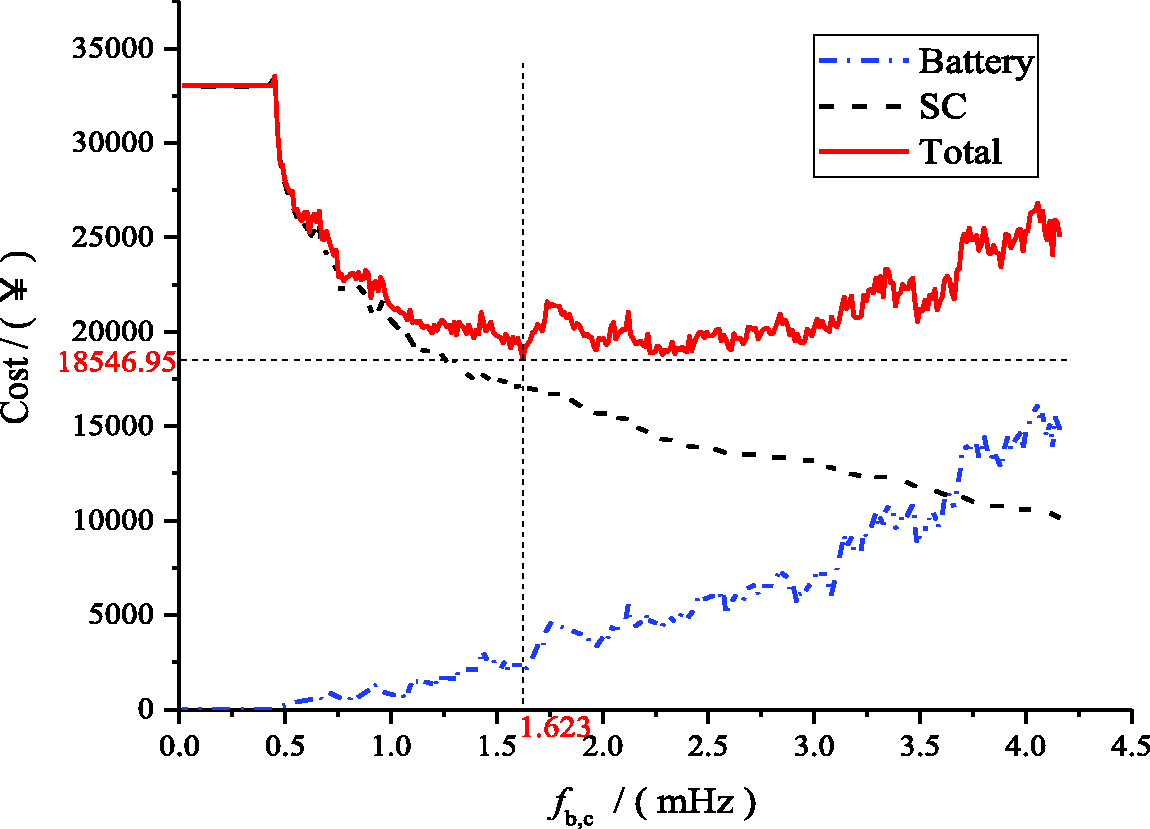
Total cost per day versus the battery cutoff frequency fb,c at Tb,op= 2 min, kb=1.9.
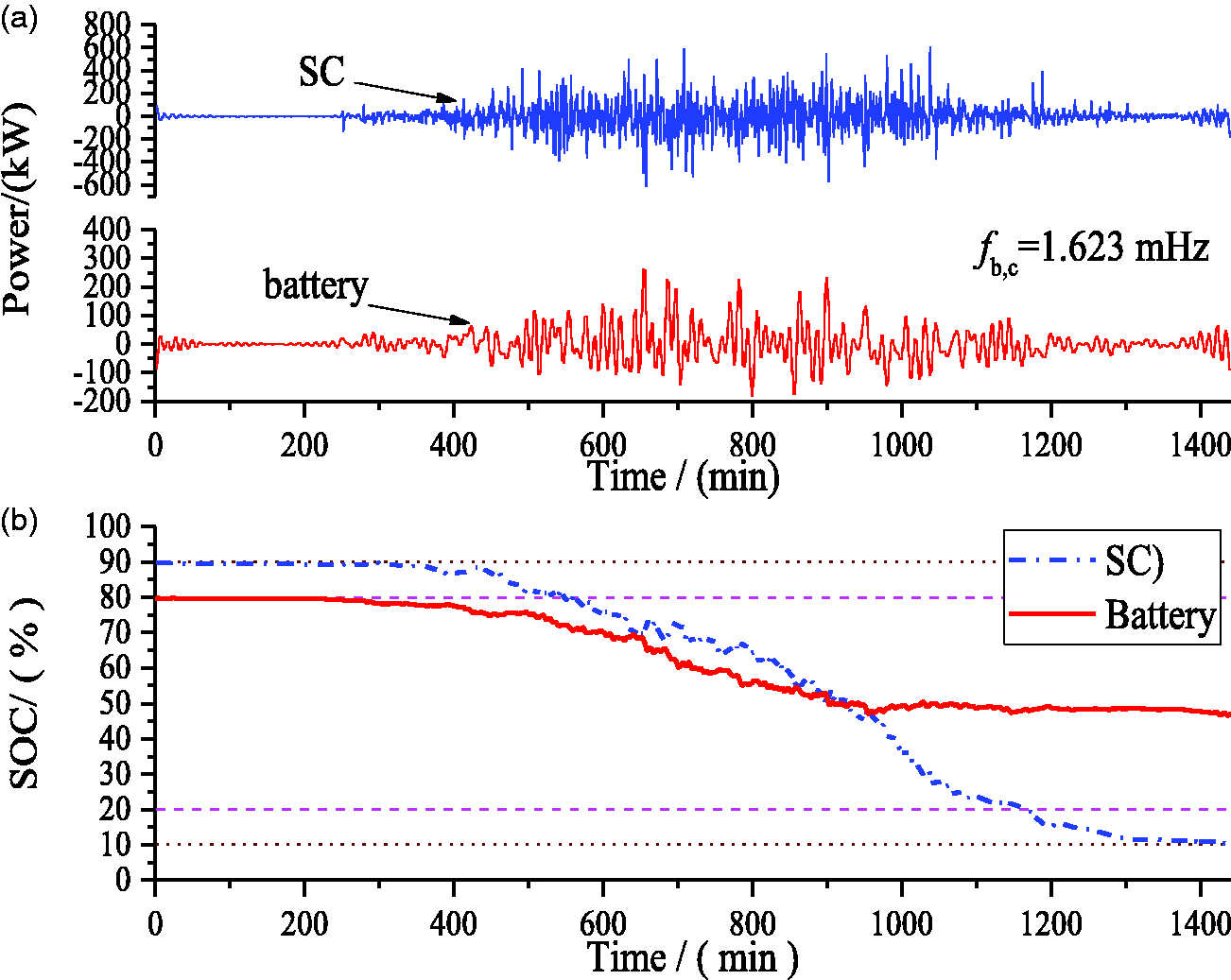
Output power and SOC of HESS at Tb,op= 2 min, fb,c=1.623 mHz, kb=1.9.
The impact of adjustment factor of the battery kb on the relative DOD, lifetime and cost is shown in Figure 13. When kb > 1, the oversizing of the battery has a significant positive effect on its lifetime. When adjustment factor kb=1.9, the DOD is lower than 55% and the lifetime increases from 1.12 to 1.82 years. With kb increasing from 1.9 to 3, the DOD is lower than 40% and the lifetime improves to 2.86 years, but the cost also increases from ¥18,546.95 to ¥21,441.31. The simulation results show that the optimized sizing of HESS satisfies the requirements of smoothing fluctuations of the wind power and lower system cost.
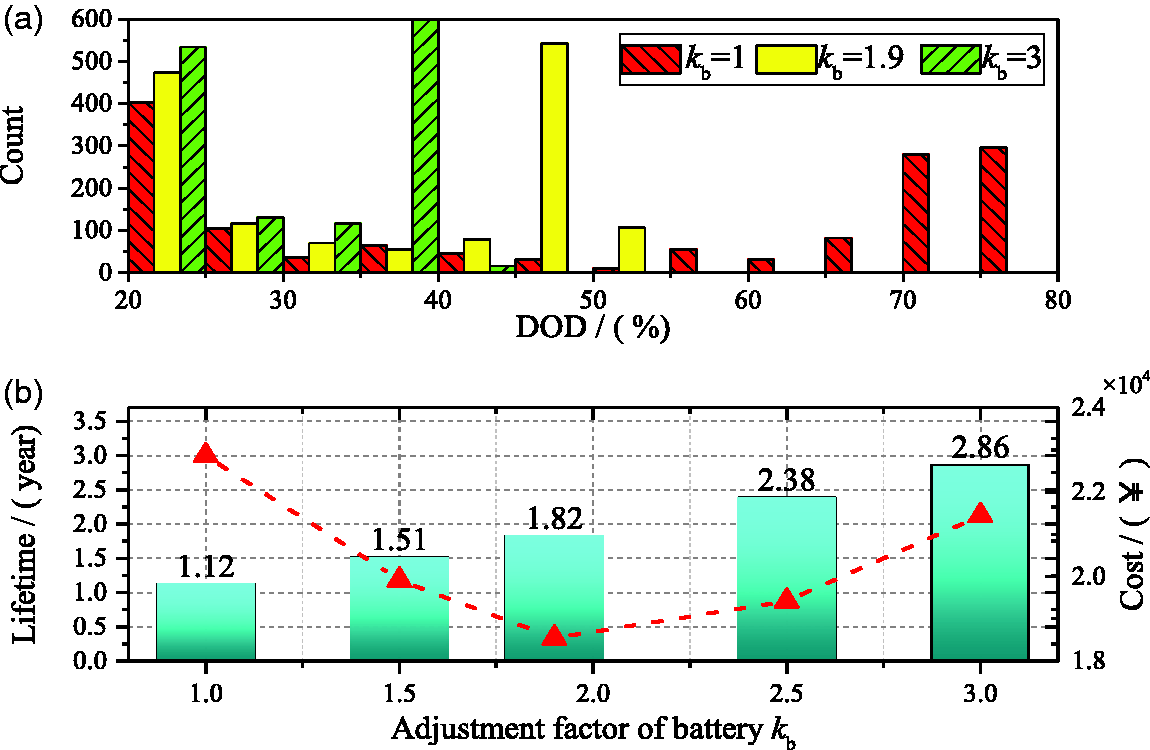
The impact of adjustment factor kb on the relative DOD, lifetime and cost at Tb,op = 2min, fb,c = 1.623mHz: (a) DOD statistics in terms of various kb and (b) lifetime and cost versus kb.
Conclusions
In this paper, a hybrid optimization method combining PSO and GA was proposed to alleviate the fluctuations of wind power energy. By using the proposed method, it is used to find the optimal power and energy capacities of the HESS. We have proposed a two-level EMS based on the cutoff frequency. In first level EMS, the desired output power of HESS is obtained. In second level EMS, the sizing of HESS can be calculated according to the battery operation period and the battery cutoff frequency. We also have proposed the hybrid PPSO-GA optimization algorithm for guaranteeing a feasible optimal solution in terms of cost and lifetime. In addition, we used the piecewise fitting function to estabilsh the relationship between DOD and cycles to failure.
According to the analysis of the simulation results, the optimal sizing of HESS reduces the total cost per day by 59.62% compared to the single battery ESS, whereas the lifetime increases to 1.82 years. Results show that the lifetime is a major factor to influence the cost of all the systems. And the several factors can influence the optimality and reliability of the result such as temporal resolution of sample power, filtering function of power and battery features.
The future works will concentrate on developing the model and EMS, which considers the wind power uncertainty, load and emission objectives.
Footnotes
Declaration of conflicting interests
The author(s) declared no potential conflicts of interest with respect to the research, authorship, and/or publication of this article.
Funding
The author(s) disclosed receipt of the following financial support for the research, authorship, and/or publication of this article: This work was supported by the National Natural Science Foundation of China (Grant No. 51605385) and the Fundamental Research Funds for the Central Universities (Grant No. 3102017zy008).