




Abstract
Due to the uncertainty and randomness of large-scale wind and light, the output power of the power grid has great fluctuations. If it is directly connected to the grid, it will affect the main grid. In addition, when the grid switches between on-grid/off-grid operation modes, there will be power shortages, shocks and oscillations. The scientific and reasonable configuration of energy storage system capacity big data can reduce the load power shortage rate, improve the utilization rate of renewable energy, and ensure the reliable operation of the power grid. For this reason, the key technology of large-scale wind-solar hybrid grid energy storage capacity big data configuration optimization is studied. A large-scale wind-solar hybrid grid energy storage structure is proposed, and the working characteristics of photovoltaic power generation and wind power generation are analyzed, and the probability model of photovoltaic power generation, wind power generation and load, as well as the charging and discharging model of battery and super capacitor are established accordingly. On this basis, the optimization objective function is set, the constraints are determined, and the large-scale wind-solar hybrid grid energy storage capacity big data configuration optimization model is constructed. And the PSO algorithm is used to solve the model to realize the big data configuration optimization of large-scale wind-solar hybrid grid energy storage capacity. The research results show that the proposed method of large-scale wind-solar hybrid grid energy storage system has good power supply reliability and economy, and can effectively improve the utilization rate of renewable energy.
Keywords
Introduction
With the rapid economic development, in order to alleviate the energy crisis and protect the environment, the penetration rate of clean energy, mainly solar energy and wind energy, is increasing worldwide. In the power system, the traditional power production has the problems of complex control operation and low energy utilization efficiency. The new energy power generation has the advantages of high utilization efficiency and flexible operation mode, which can effectively solve various problems of the centralized power grid. The distributed power structure composed of new energy is gradually formed (Gan, 2021; Zhang, 2022). Due to the randomness and intermittency of new energy power generation systems such as photovoltaics and wind power, direct grid connection will bring great challenges to the security and reliability of the system. Especially for grids with renewable energy that operate independently, since they do not feed energy from the large grid. When the power imbalance between the power generation end and the load end occurs, it will cause the phenomenon of abandoning wind and light, and load shedding, which has a serious impact on the normal and reliable power supply of the power grid system. By integrating with energy storage, energy conversion and other devices to form a power grid, the energy storage device can be used to stabilize the power fluctuation of the busbar, so as to realize the reliable power supply of the load and the rational utilization of new energy resources such as wind and solar (Ojetola et al., 2021; Sun et al., 2020; Wang et al., 2022). The scientific and reasonable large-scale wind-solar hybrid grid energy storage capacity configuration can improve the economy of grid construction and operation, maintain the balance of bus voltage and supply and demand power, and ensure the safe and stable operation of the grid. Therefore, the rational allocation of energy storage capacity in large-scale wind-solar hybrid grids is of great significance.
At present, scholars in related fields have carried out research on the optimization of energy storage capacity configuration of wind-solar hybrid power grids. Wang and Li (2021) proposed a multi-objective optimization method for the capacity allocation of ship hybrid energy storage systems. Taking diesel-electric hybrid ships as the object, the mathematical model of the hybrid energy storage device is established in this paper, and the multi-objective optimal allocation of the model is carried out based on NSGA-II. Finally, the optimization model is applied to a ship, and 11 kinds of batteries and 6 kinds of supercapacitors are selected for simulation. The simulation results show the relationship between the objective functions. Wang et al. (2021) proposed an optimal configuration method for microgrid wind-solar energy storage considering carbon emission reduction benefits. This paper studies a microgrid with wind-solar energy storage. First, combined with the system scheduling strategy, the output model of the solar wind turbine is established. The optimization objective is then to minimize the total cost of investment and operation, taking into account the benefits of carbon reduction. Genetic particle swarm optimization algorithm is used to solve the optimal capacity allocation problem. Finally, according to the calculation results of the example, the proposed wind-solar energy storage configuration considering the carbon emission reduction benefit can effectively reduce the carbon emission of the microgrid. Luo and Yixuan (2022) proposes to analyze several common energy storage methods in microgrids, clarifying that hydrogen energy storage with batteries is a response option to overcome the drawbacks of existing energy storage modes. Secondly, the mathematical models of the various components of the wind/solar/storage microgrid are developed to clarify the relevant factors for the operation of each component. Thirdly, from the perspective of the whole life cycle, the physical constraints and indicator trade-offs of the micro grid operation are coordinated, and a complete optimization configuration model of micro Grid energy storage energy storage capacity is established. Deng et al. (2023) adopts a hybrid energy storage system composed of batteries and supercapacitors, and decomposes the total energy output using empirical mode decomposition. With the goal of minimizing the overall cost of configuration, an optimized configuration model for hybrid energy storage capacity is constructed. In order to solve the problem that the traditional whale optimization algorithm is prone to premature and fall into the local optimal solution, the Power function control parameters and adaptive weights are introduced to improve the global search ability, and the improved whale optimization algorithm is used to solve the model. However, the above methods still have the problems of poor power supply reliability and economy, and low utilization rate of renewable energy.
In view of the above problems, the key technologies of large-scale configuration and optimization of energy storage capacity in large-scale wind-solar hybrid grids are studied. A large-scale wind-solar hybrid grid energy storage structure is proposed, the working characteristics of photovoltaic power generation and wind power generation are analyzed, and the probability model of photovoltaic power generation, wind power generation and load, as well as the charging and discharging model of battery and super capacitor are established. By setting the optimization objective function and determining the constraints, a large-scale wind-solar hybrid grid energy storage capacity big data configuration optimization model is constructed, and the PSO algorithm is used to solve the problem to realize the large-scale wind-solar hybrid grid energy storage capacity big data configuration optimization. The method has good power supply reliability and economy, and can effectively improve the utilization rate of renewable energy.
Large-scale wind-solar hybrid grid energy storage structure and modeling
In this paper, the large-scale wind-solar hybrid grid energy storage is modeled, and the large-scale wind-solar hybrid grid energy storage is selected as the research object. The working characteristics of photovoltaic power generation and wind power generation are analyzed, and the probability model of photovoltaic power generation, wind power generation and load, as well as the charging and discharging model of battery and super capacitor are proposed accordingly.
Large-scale wind-solar hybrid grid energy storage structure
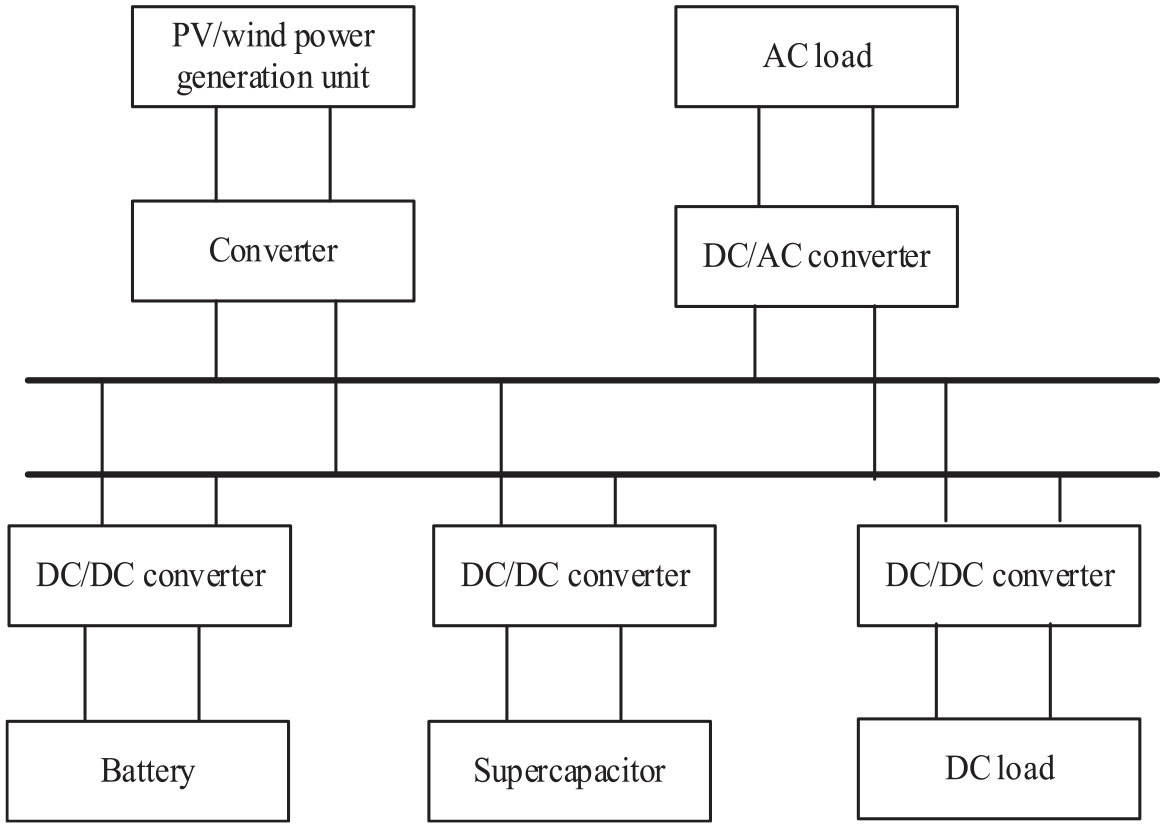
This paper selects the large-scale wind-solar hybrid grid energy storage as the research object. The DC grid system used mainly includes wind turbines, photovoltaic arrays, large-scale wind-solar hybrid grid energy storage systems, energy converters Hou (2019), and AC and DC loads. The energy storage structure of the large-scale wind-solar hybrid grid is shown in Figure 1.
Energy storage structure of large-scale wind-solar hybrid grid.
The power generation unit is connected to the DC bus through a power electronic converter, the energy storage power supply is connected to the DC bus through a DC/DC converter, and the DC bus transmits electrical energy to the AC and DC loads through the converter. When the wind and photovoltaic power generation is greater than the load consumption, the energy storage system is in a charging state to consume excess power. When the wind power and photovoltaic power generation are less than the load consumption, the energy storage system is in the discharge state to ensure the load is supplied smoothly and continuously, and the reliability of the power supply is improved.
Photovoltaic power generation model
In the actual solar power generation, there is a certain deviation between the electrical energy that the photovoltaic cell can output and the theoretical research value. When the actual solar power generation is received, it will be affected by many factors, including the influence of light intensity and temperature Qian et al. (2019). At the same time, the light intensity is also affected by the dimension of the location of the photovoltaic power station and the weather conditions at that time. In the study, it was found that the solar radiation intensity approximately obeys the Beta distribution in each time period, and its probability density function is:

In formula (1),

In formula (2),
Wind power generation model
In this paper, the power-wind speed model is used for calculation, and the wind speed resources of the grid construction site are determined by collecting local wind resources. The output power of the wind turbine can be obtained by formula (3):

In formula (3),
Probabilistic model of load
The distribution load is time-varying. Studies have shown that the load in a certain period of time obeys the normal distribution. When assuming that the load forecast approximately obeys the normal distribution, the real and imaginary parts are

In formula (4),
Large-scale wind-solar hybrid grid energy storage system
Battery charging and discharging model
The battery equivalent circuit model selected in this paper is composed of the polarized internal resistance, ohmic internal resistance and polarized capacitance of the battery (Huang et al., 2022). The remaining power is not a real-time value, it is the remaining power at the end of the previous charge and discharge cycle, that is, the part of the energy that is not used for backup after use These factors are jointly determined by the electric energy supplemented to the energy storage system in the current charging and discharging cycle, and the charging and discharging cycle of the battery. During the charging and discharging time of

In formula (5),
Supercapacitor charging and discharging model
The supercapacitor equivalent circuit model selected in this paper is composed of equivalent resistance and ideal capacitance (Alsabari et al., 2021). The remaining power is similar to the calculation of the battery. During the charging and discharging time of

In formula (6),
Construction of a large-scale wind-solar hybrid grid energy storage capacity big data configuration optimization model
In the planning and construction of large-scale wind-solar hybrid power grids, a very important evaluation factor is the engineering cost. In this paper, the whole life cycle cost of large-scale wind-solar hybrid grid energy storage system is used as the basis for evaluation. On the basis of satisfying the system operation reliability index, the objective function is optimized and solved to obtain the large-scale data ratio of energy storage capacity of large-scale wind-solar hybrid grid under the condition of minimum cost.
Optimization objective function
The whole life cycle cost of large-scale wind-solar hybrid grid energy storage system (Nematchoua and Reiter, 2021) is defined as the sum of one-time input cost, maintenance cost, replacement cost and disposal cost. In order to avoid the model being too complicated, the cost of different sub-cycles is represented by the corresponding proportional coefficient. In this paper, the minimum total cost is taken as the optimization objective function. At the same time, with various technical indicators of the operation of the large-scale wind-solar hybrid grid energy storage system as constraints, the optimal capacity big data ratio that minimizes the cost and satisfies various technical indicators is found.
The cycle of general power grid engineering projects is as long as several decades, and the main tasks of each sub-cycle of the full life cycle of large-scale wind-solar hybrid grid energy storage systems are also different to some extent. Therefore, this paper divides the whole life cycle of hybrid energy storage into three stages: initial design and construction, operation and maintenance, and end-of-life disposal.
(1) Initial stage of design and construction: The initial cost of design and construction is called the one-time investment cost

In formula (7),
(2) Operation and maintenance stage: The funds generated in the operation and maintenance stage in the whole life cycle belong to the annual value

In formula (8),
(3) Scrap disposal stage: The disposal cost generated in the scrap disposal stage belongs to the final value

In formula (9),
The present value of the primary input cost is:

The present value of the maintenance cost is:

In formula (11),
The present value of the replacement cost is:

The present value of disposal cost is:

In summary, the optimization objective function established in this paper is:

Determination of constraints
According to the characteristics of batteries and supercapacitors in large-scale wind-solar hybrid grid energy storage systems, the following constraints need to be considered when designing large-scale wind-solar hybrid grid energy storage systems:
Battery-related constraints
Battery power constraints
If the cycle life of the battery is to be as long as possible, it is necessary to avoid overcharging or overdischarging. Therefore, the charging and discharging power constraints and energy constraints of the battery are as follows:

In formula (15),
Battery capacity constraint
In order to prevent the battery from accelerating its life loss due to deep discharge, thereby increasing the replacement cost of the battery in the objective function, it is necessary to increase the battery state of charge constraint, which is as follows:

Supercapacitor-related constraints
Supercapacitor power constraints
Due to the high power density and long cycle life of supercapacitors, their charging and discharging have little effect on their own life. However, due to the characteristics of the supercapacitor itself, the corresponding power and energy constraints need to be set according to the model used, as follows:

In formula (17),
Supercapacitor capacity constraints
The state of charge of the supercapacitor has a great influence on its voltage, so when the state of charge is too small, the terminal voltage of the supercapacitor will be very small, so that its output cannot meet the requirements of normal power output. Although increasing the terminal voltage of the supercapacitor will increase its energy storage capacity, it may cause the terminal voltage of the supercapacitor to exceed a certain safety margin. So the state-of-charge constraints set for the supercapacitor are as follows:

Relevant constraints on system operation indicators
Constraint of load power shortage rate
In order to ensure the reliability of power supply of the system, it is necessary to set the upper limit

In formula (19),
Constraint of energy loss rate
In order to avoid the phenomenon of abandoning wind and light, the upper limit of energy loss rate

In formula (20),
System power balance constraints
In order to meet the power supply reliability requirements of the large-scale wind-solar hybrid grid energy storage system, the output power of the photovoltaic power generation system, the output power of the wind power generation system, and the charging and discharging power of the hybrid energy storage should be in balance with the power demanded by the electricity load, which is as follows:

The battery charging and discharging power

Optimization model solution
Collect relevant data of Grid energy storage system through sensors, monitoring equipment, etc., such as energy storage capacity, charging and discharging efficiency, operating temperature, etc. Then, Big data technology is used to process and analyze these data to obtain detailed information about the performance and behavior of Grid energy storage system. Use Big data technology to build a model of Grid energy storage system, and predict future demand and supply through analysis of historical data. This can help determine the optimal energy storage capacity configuration scheme to meet the requirements of the power grid. Use Big data technology to develop efficient optimization algorithms, and automatically adjust the configuration of the energy storage system according to real-time data and prediction results to maximize the stability and efficiency of the power grid. In addition, Big data can also provide decision support to help formulate reasonable energy storage capacity configuration strategies. Based on the above-mentioned construction of a large-scale wind-solar hybrid grid energy storage capacity big data configuration optimization model, the model is solved. The model is solved using the PSO algorithm, which is an iterative optimization algorithm (Wang and Liu, 2021). In this algorithm, the system is initialized to generate a set of random solutions, and the optimal solution is searched through iteration. The specific calculation steps are as follows:
Step 1: Determine the power range of wind power generation, photovoltaic power generation, and load according to the optimization objective function and constraint conditions, and then obtain the output power of each unit of the grid within 1 day by sampling it. Calculate the hybrid energy storage consumption power
Step 2: Decompose the dissipated power into
Step 3: Initialize the energy storage capacity
Step 4: Set the length l of the Markov chain, the number of iterations
Step 5: Initialize the particle swarm position and velocity, set the maximum number of iterations, particle swarm dimension, and convergence accuracy;
Step 6: Calculate the fitness of the particle, calculate the optimal value of the individual and the group, and update the position and speed of the particle;
Step 7: Repeat steps 5 and 6 until the convergence condition or the maximum number of iterations is reached;
Step 8: Determine whether the maximum number of iterations is reached, if not, repeat Step 5, if the number of iterations is reached, terminate the loop and execute the next step;
Step 9: When the final number of iterations is reached, the calculation is stopped, and the optimal large-scale wind-solar hybrid grid energy storage capacity big data configuration optimization scheme is determined.
Through the above steps, the large-scale configuration optimization of the energy storage capacity of the large-scale wind-solar hybrid grid is realized.
Experiments and analysis
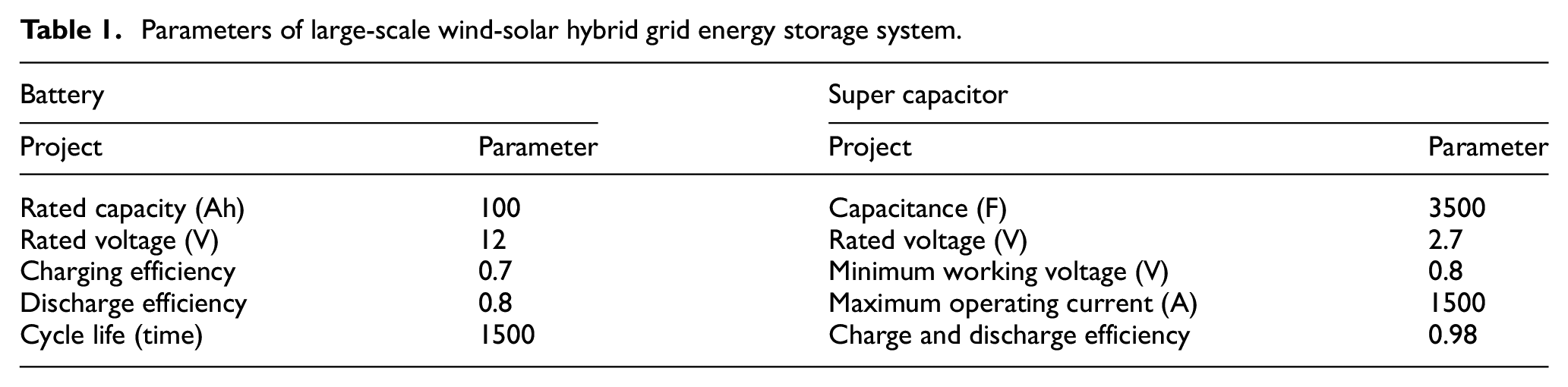
In order to verify the effectiveness of the key technology research on the optimization of large-scale data configuration of energy storage capacity in large-scale wind-solar hybrid power grids, a large-scale wind-solar hybrid grid energy storage system in a certain region was selected as the research object, and the MATLAB 2019a software platform was used to conduct experiments. Renewable energy sources in the DC grid system include 50 MW photovoltaic power generation units and 100 MW wind power generation units. The service life of the project is set to 20 years, and the parameters of the large-scale wind-solar hybrid grid energy storage system are set as shown in Table 1.
Parameters of large-scale wind-solar hybrid grid energy storage system.
Equipment capacity configuration results: Wind turbine generator capacity: 200 MW, photovoltaic generator capacity: 150 MW, energy storage equipment capacity: 100 MWh.
Power supply reliability analysis of large-scale wind-solar hybrid grid energy storage system
In order to verify the power supply reliability of the proposed large-scale wind-solar hybrid grid energy storage system, the load power shortage rate is used as the evaluation index. The smaller the power shortage rate of the load, the smaller the power shortage of the load, which shows that the power supply reliability of the large-scale wind-solar hybrid grid energy storage system of the method is better. It is calculated as follows:

In formula (23),
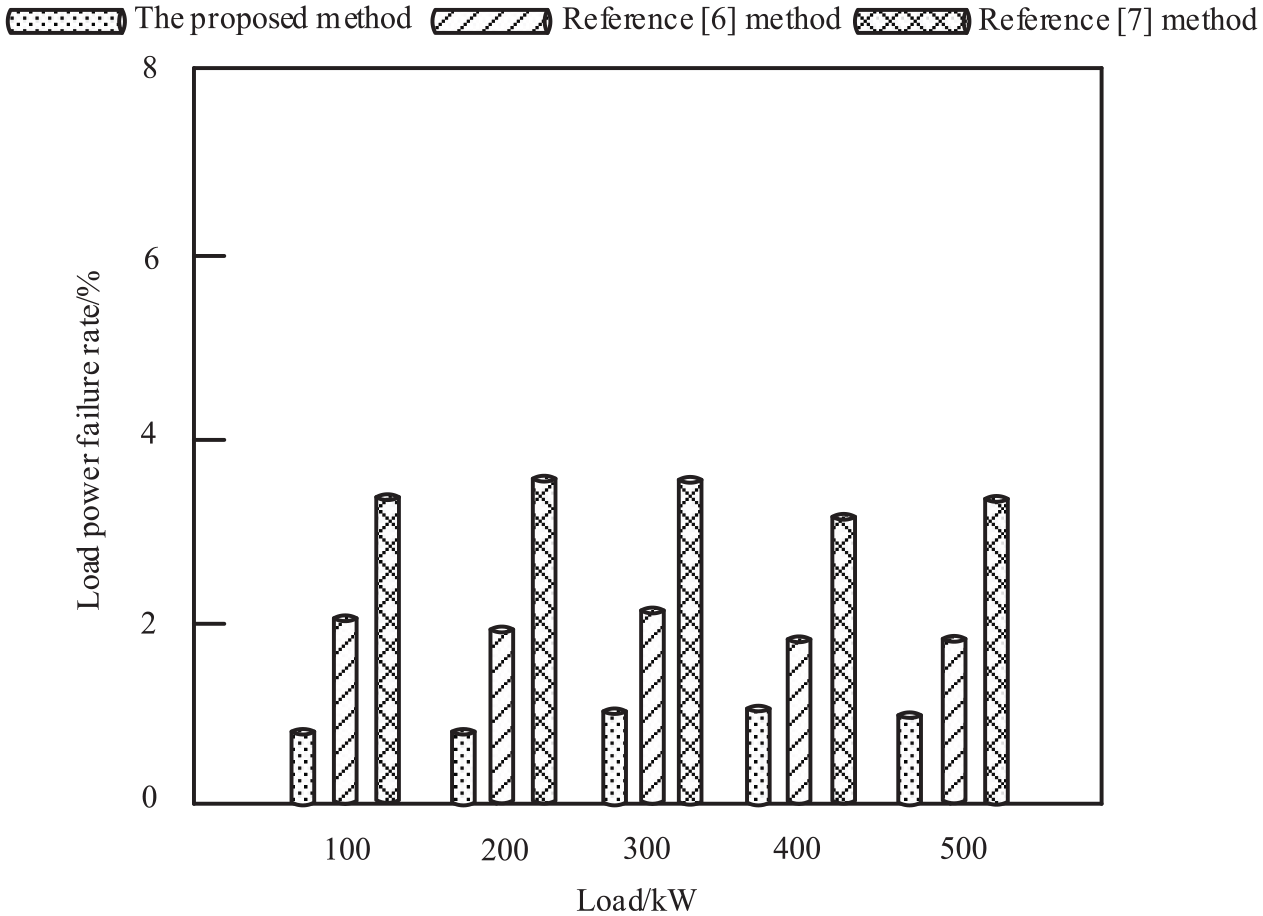
Comparison results of load shortage rate of large-scale wind-solar hybrid grid energy storage systems with different methods.
According to Figure 2, when the load reaches 500 kW, the average load power shortage rate of the large-scale wind-solar hybrid grid energy storage system of the method of Wang and Li (2021) is 2%. The average load power shortage rate of the large-scale wind-solar hybrid grid energy storage system based on the method of Wang et al. (2021) is 3.6%. However, the average load power shortage rate of the proposed method of large-scale wind-solar hybrid grid energy storage system is only 0.98%. It can be seen that the load power shortage rate of the large-scale wind-solar hybrid grid energy storage system of the proposed method is small. The power shortage of the load is small, which shows that the proposed method has better power supply reliability of the large-scale wind-solar hybrid grid energy storage system.
Analysis of renewable energy utilization rate of large-scale wind-solar hybrid grid energy storage system
The utilization rate of renewable energy by the proposed method was further verified, and the energy loss rate was used as the evaluation index. The smaller the energy loss rate, the greater the utilization of the renewable energy of the method. It is calculated as follows:

In formula (24),
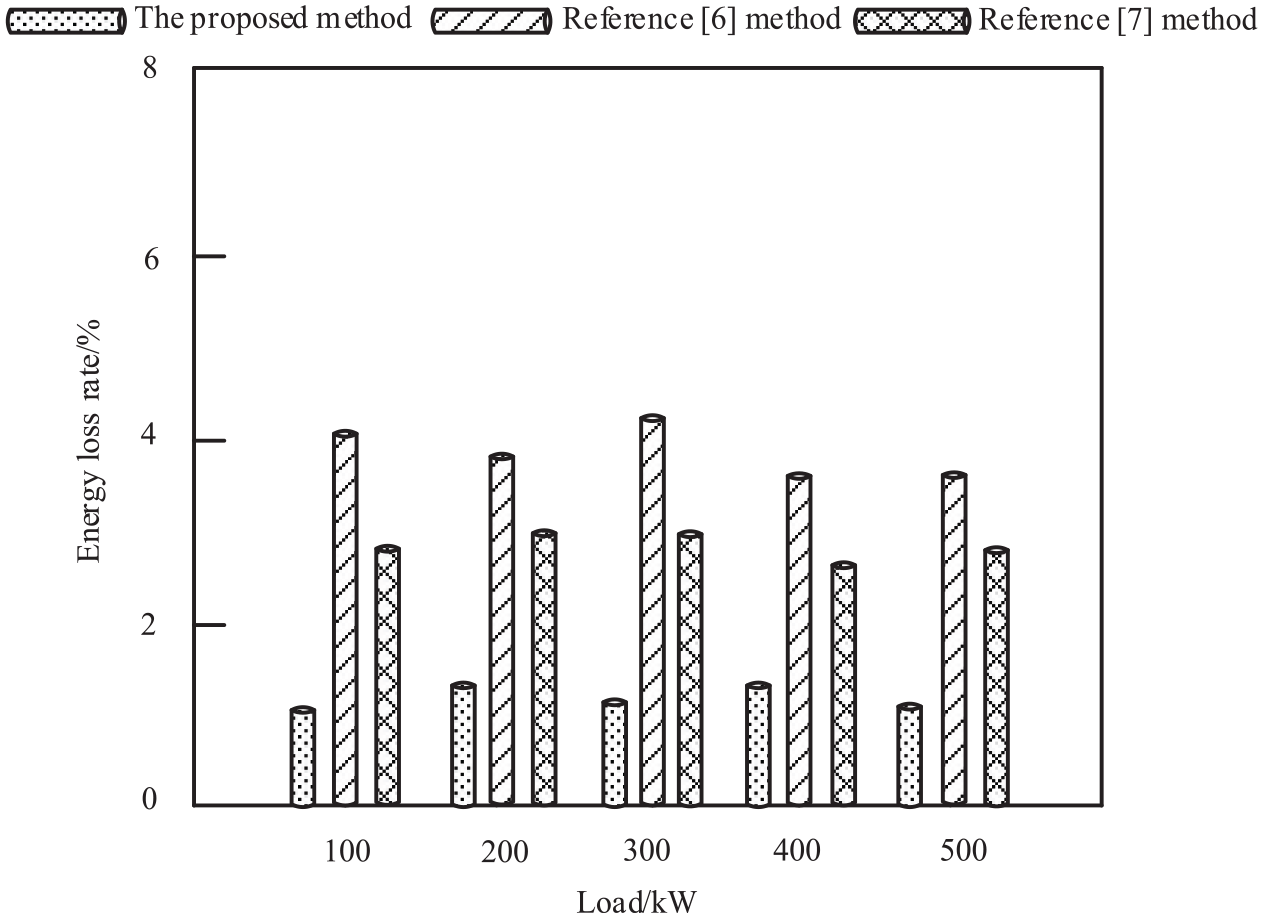
Comparison results of energy loss rate of large-scale wind-solar hybrid grid energy storage system with different methods.
According to Figure 3, when the load reaches 500 kW, the average energy loss rate of the large-scale wind-solar hybrid grid energy storage system of the method of Wang and Li (2021) is 3.89%. The average energy loss rate of the large-scale wind-solar hybrid grid energy storage system in the method of Wang et al. (2021) is 2.98%. The average large-scale wind-solar hybrid grid energy loss rate of the proposed method is only 1.36%. It can be seen that the energy loss rate of the proposed method is small, indicating that the renewable energy of the proposed method has been utilized to a greater extent.
Economic analysis of large-scale wind-solar hybrid grid energy storage system
On this basis, the economics of the proposed large-scale wind-solar hybrid grid energy storage system is verified, and the total life cycle cost is used as the evaluation index. The lower the total life cycle cost, the better the economy of the large-scale wind-solar hybrid grid energy storage system. The method of Wang and Li (2021), the method of Wang et al. (2021), and the proposed method are used to compare, and the comparison results of the total life cycle cost of the large-scale wind-solar hybrid grid energy storage system with different methods are shown in Table 2.
Comparison results of total life cycle cost of large-scale wind-solar hybrid grid energy storage system with different methods.
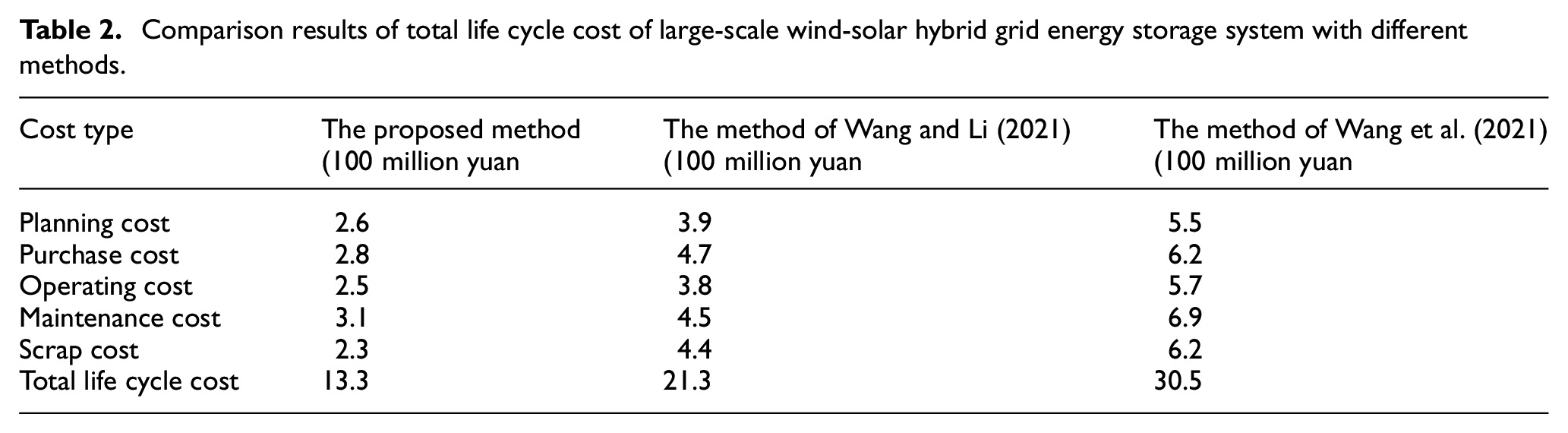
According to Table 2, for the total life cycle cost, the total life cycle cost of the large-scale wind-solar hybrid grid energy storage system based on the method of Wang and Li (2021) is 213 million yuan. The total life cycle cost of the large-scale wind-solar hybrid power grid energy storage system based on the method of Wang et al. (2021) is 305 million yuan. The total life cycle cost of the large-scale wind-solar hybrid grid energy storage system proposed by the proposed method is only 133 million yuan. It can be seen that the total life cycle cost of the large-scale wind-solar hybrid grid energy storage system of the proposed method is low, and the economy of the large-scale wind-solar hybrid grid energy storage system is better.
Conclusion
This paper studies the optimization method of large-scale data configuration of large-scale wind-solar hybrid grid energy storage capacity. The energy storage structure and modeling of large-scale wind-solar hybrid grids are proposed, and the large-scale wind-solar hybrid grid energy storage capacity big data configuration optimization model is constructed and solved to realize the large-scale wind-solar hybrid grid energy storage capacity big data configuration optimization. Through experiments and analysis, it can be seen that the load power shortage rate and energy loss rate of the proposed method are only 0.98% and 1.36%, and the total life cycle cost is only 133 million yuan. It shows that the proposed method has good power supply reliability and economy, and can effectively improve the utilization rate of renewable energy.
Footnotes
Declaration of conflicting interests
The author declared no potential conflicts of interest with respect to the research, authorship, and/or publication of this article.
Funding
The author disclosed receipt of the following financial support for the research, authorship, and/or publication of this article: The study was supported by Yingkou Institute of Technology Introduced Talents Scientific Research Start-up Funding Project “Research on Multi-objective Optimal Control of Rolling Heating Furnace Based on Expert System” Support Project (Grant No. YJRC202020).
