




Abstract
Reservoir quality and productivity of fractured gas reservoirs depend heavily on the degree of fracture development. The fracture evaluation of such reservoir media is the key to quantify reservoir characterization for the purposes such as well drilling and completion as well as development and simulation of fractured gas reservoirs. In this study, a pore-fracture network model was constructed to understand the effects of fracture on permeability in the reservoir media. The microstructure parameters of fractures including fracture length, fracture density, fracture number, and fracture radius were analyzed. Then two modes and effects of matrix and fracture network control were discussed. The results indicate that the network permeability in the fractured reservoir media will increase linearly with fracture length, fracture density, fracture number, and fracture radius. When the fracture radius exceeds 80 µm, the fracture radius has a little effect on network permeability. Within the fracture density less than 0.55, it belongs to the matrix control mode, while the fracture network control mode is dominant in the fracture density exceeding 0.55. The network permeability in the matrix and fracture network control modes is affected by fracture density and the ratio of fracture radius to pore radius. There is a great change in the critical density for the matrix network control compared with the fracture network control. This work can provide a better understanding of the relationship between matrix and fractures, and the effects of fracture on permeability so as to evaluate the fluid flow in the fractured reservoir media.
Keywords
Introduction
As a special complex gas reservoir, fractured gas reservoir takes a large proportion of gas reservoirs found at home and abroad, which is playing an increasingly important role among energy sources and has attracted wide attention (Li et al., 2017; Shen et al., 2014, 2015). With the further exploration and development of natural gas in China, the proven reserve and production of fractured gas reservoirs have also increased year by year (Li et al., 2018). Unlike other gas reservoirs, fractured gas reservoir is characterized by extremely low permeability in matrix, well-developed fractures, strong heterogeneity, and active edge and bottom water (Jiang et al., 2017; Li et al., 2017). During the development of gas reservoirs, water will flow to gas well along the fracture channel owing to the complex fractures existing in reservoir media, and gas production will greatly reduce and even stop with the part gas separated by water, which will give rise to great difficulties in the development of gas reservoirs (Hu et al., 2014; Ould-Amer and Chikh, 2003; Ould-Amer et al., 2004).
Fractured gas reservoir is the heterogeneous and anisotropic media, which is a mere mixture of two distinct populations of fracture and pore voids, and they consist of matrix blocks and fractures (Hao et al., 2008; Lei et al., 2015; Miao et al., 2015). The ultra-low permeability matrix system acts as a source of the fluids, while the fractures serve as the main pathway of the fluids towards production wells. Generally, the fractures are embedded in reservoir matrix with micro pores, which plays an important effect on the flow channel, and randomly distributed fractures dominate the flow channel in the reservoir media (Cacas et al., 1990; Miao et al., 2015; Tsang and Neretnieks, 1998). In the low-permeability reservoir rocks, the fluid flow will occur in highly preferred flow pathways within a limited quantity of fractures (Goc et al., 2010; Tsang and Tsang, 1989). These randomly distributed fractures are often connected to form irregular networks, and the permeability evolution in the fractured reservoir media has the significant effect on the fluid flow (Miao et al., 2015). Therefore, understanding the questions such as the relationship between matrix and fractures, and the effects of fracture on permeability in the reservoir media is crucial for the fluid flow evaluation and for forecasting gas production in fractured gas reservoirs.
Fractures in reservoir rocks are usually random and disordered, which is always a difficult problem to quantify them in the reservoir development. Over the past few decades, many investigators studied the flow characteristics of fracture networks and proposed several mathematical models. Fatt (1956) proposed the pore network model (PNM) to idealize the pore structure of porous media as pore bodies and pore throats, but the model is not able to understand the micro-mechanism of fluid flow in reservoirs with great heterogeneity, fractures, pores, and throats. Barenblatt et al. (1960) and Warren and Root (1963) proposed the dual pore-fracture network model (PFNM) to describe the fluid flow and the exchange between the matrix and the fracture. According to parallel plane model, Snow (1965) proposed an analytical method for permeability of fracture networks. De Dreuzy et al. (2001) used a numerical and theoretical methods to study the permeability of randomly fractured networks and verified the validity of the model with naturally fracture networks. Zheng and Yu (2012) established a fractal permeability model to describe the relationship between gas permeability and pore structure parameters. Noetinger and Jarrige (2012) studied the fluid flow and the exchange between the matrix and the fracture using the dual pore-fracture model. Based on a truncated octahedral support, Jivkov et al. (2013) proposed a novel bi-regular network model to calculate the evolution of permeability in porous media. Gong and Rossen (2014) studied the effects of fracture aperture distribution in naturally fractured reservoirs with the numerical method. However, these above studies did not provide a quantitative relationship among the permeability of fracture networks, fracture density, and microstructure parameters of fractures, such as fracture length, fracture number, and fracture radius, etc. The pore-fracture network model is an effective method to understand the micro-mechanism of fluid flow in the fractured reservoir media with great heterogeneity and a multi-scale pore structure consisting of fractures, pores, and throats. Therefore, it is extremely necessary to understand the relationship between matrix and fractures, and the effects of fracture on permeability so as to understand the fluid flow in the fractured reservoir media.
In this study, a pore-fracture network model was constructed to understand the effects of fracture on permeability in the fractured reservoir media. The microstructure parameters of fractures including fracture density, fracture length, fracture number, and fracture radius were analyzed and discussed. Then the critical density of the matrix and fracture network control mode was determined. Moreover, the effects of matrix and fracture network control modes were performed to understand the evolution of permeability in the fractured reservoir media. The results of these works can provide a better understanding of the relationship between matrix and fractures, and the effects of fracture on fluid flow in the fractured reservoir media.
Pore-fracture network model
Structure of pore-fracture network model
In the study, a 2-D quasistatic pore-fracture network model (PFNM) was constructed to understand the effects of fracture parameters in fractured reservoir media, which consists of the pore, throat, and fracture units. The basic unit (a) and structure of pore-fracture network model (b) were shown in Figure 1. The pore-throat unit is composed of four small spheres and four cylindrical pipes while the fracture unit is made up of a cylindrical pipe. The pore is a larger pore space and the throat is a relatively longer and narrower connective space, while the length of the fracture is much larger than the throat. The main parameters characterizing the pore-fracture network model are dimensions of the network, coordination number, shape factor, pore throat radius, and pore throat distribution, etc. (Zhang et al., 2013). The coordination number is used to represent the connectivity between pores and throats, which is a microscopic parameter to describe the connectivity degree of the reservoir media. The larger the coordination number is, the greater the connectivity is. The shape factor is used to describe the irregular pore shape. The smaller the shape factor is, the more irregular the shape is. The ratio between pore and throat is the ratio of pore radius to throat radius with connection, which demonstrates the pore throat alternating variation.
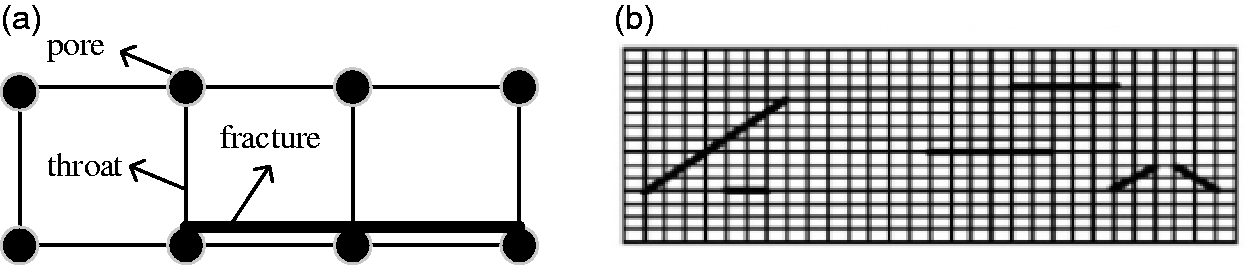
A 2-D quasistatic pore-fracture network model. (a) Basic unit of PFNM; and (b) Structure of PFNM.
In the study, the size of the pore-fracture network model is 90 nodes × 30 nodes, which corresponds to the horizontal and vertical direction, respectively, as illustrated in Figure 2. The parameters of the basic model are listed as follows. The pore radius obeys the average distribution between 0.1 µm and 20 µm, while the throat pore is the normal distribution with the mean value of 2.3 µm. The fracture length is 5 network step sizes and the corresponding radius is 20 µm. The network porosity and permeability under the initial condition are 10% and 3.1 mD, respectively. The simulation is run on the basic model and on models in which parameters are individually varied.

A pore-fracture network model with 90 nodes × 30 nodes.
Flow governing equation
In the pore-fracture network model, the pores act as a source of storage fluid, and the throats are the relatively narrower and longer connective flow paths. While the fractures provide the longest and widest flow paths, which serve as the main pathway of the fluids. For the single phase flow, the flow in the throats and fractures is assumed to satisfy the Poiseuille equation (Shen et al., 2017). The flow governing equation in the throats and fractures can be written as

The pressure at each node can be obtained by flow governing equation, and then the permeability can be calculated by the total flow

Results and discussion
Effect of fracture length and density
Fracture length and fracture density are the important parameters in the characterization of the permeability evolution in the fractured reservoir media, which plays a key role in estimating elastic rock properties, fracture porosity, path length, and connectivity for fluid flow of fractured rock (Mauldon et al., 1999). In the study, the effects of fracture length from 5 µm to 40 µm and fracture density from 0 to 0.55 on network permeability have been chosen to investigate the network permeability in the fractured reservoir media, respectively. Figure 3(a) shows the variation of network permeability versus fracture length in the model. From the result shown in Figure 3(a), it can be seen that the fracture length affects network permeability in the fractured reservoir media. With the fracture length increasing, the network permeability increases linearly. The variation of network permeability versus fracture density is shown in Figure 3(b). From Figure 3(b), we can see that the network permeability increases slowly at the low fracture density and then increases dramatically with the increasing of fracture density. The reason is that the increasing fracture density in such reservoir media is favor of the connection between the pores and the fractures. Thus, the increasing fracture length and fracture density is beneficial to the fluid flow in the fractured reservoir media.
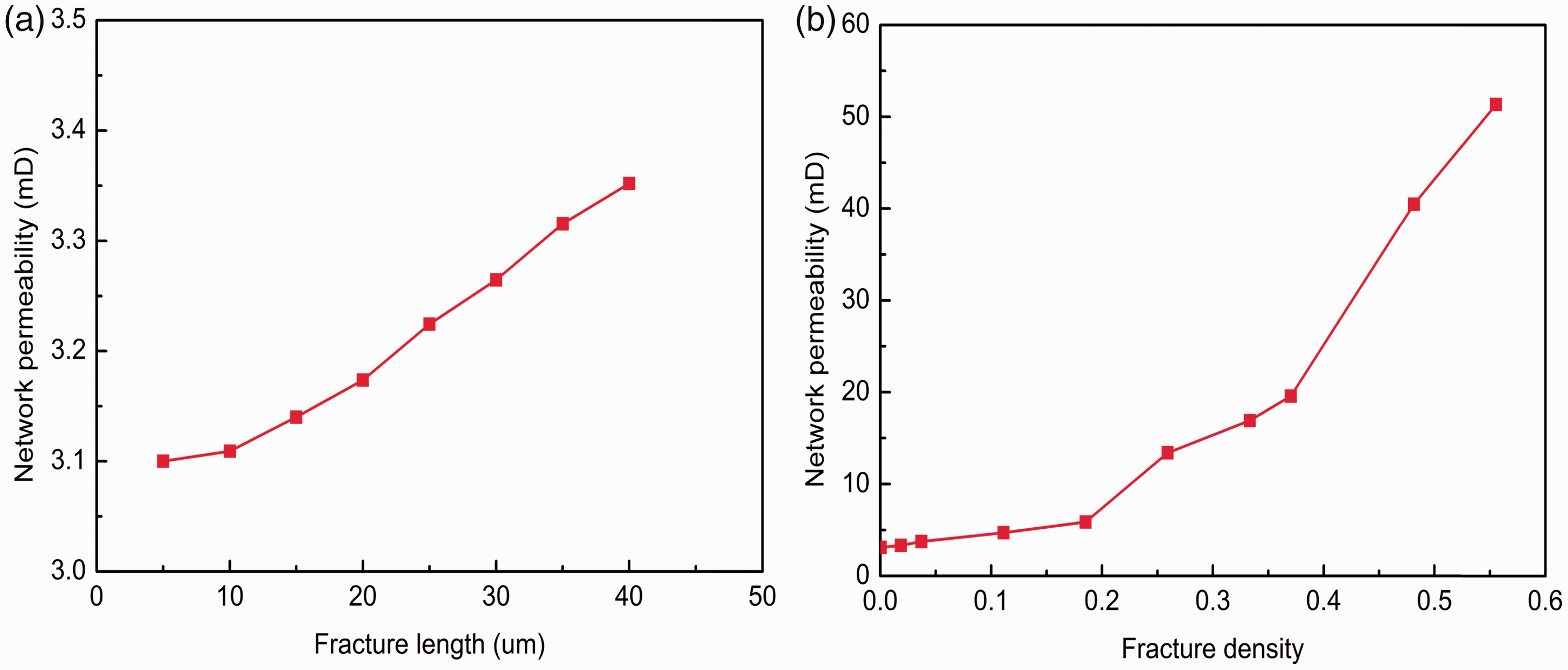
Variation of network permeability versus fracture length (a) and fracture density (b).
Effect of fracture number and radius
The fractures are embedded in the porous matrix with micro pores, and fracture number and fracture radius are the crucial features controlling the fluid flow behavior in the fractured reservoir media (Gong and Rossen, 2014; Miao et al., 2015). In this study, the values of the fracture number from 3 to 30 and fracture radius from 30 µm to 300 µm are conducted to investigate the network permeability in the reservoir media, respectively. The variation of network permeability versus fracture number (a) and fracture radius (b) is illustrated in Figure 4. From the result shown in Figure 4(a), we can see that the network permeability increases with the increase of the fracture number in the fractured reservoir media. As shown in Figure 4(b), it is seen that the network permeability increases linearly at the fracture radius less than 80 µm. When the fracture radius exceeds 80 µm, there is very little change in the network permeability. It implies that the fracture radius has a little effect on the increasing of network permeability when the fracture radius is more than 80 µm.
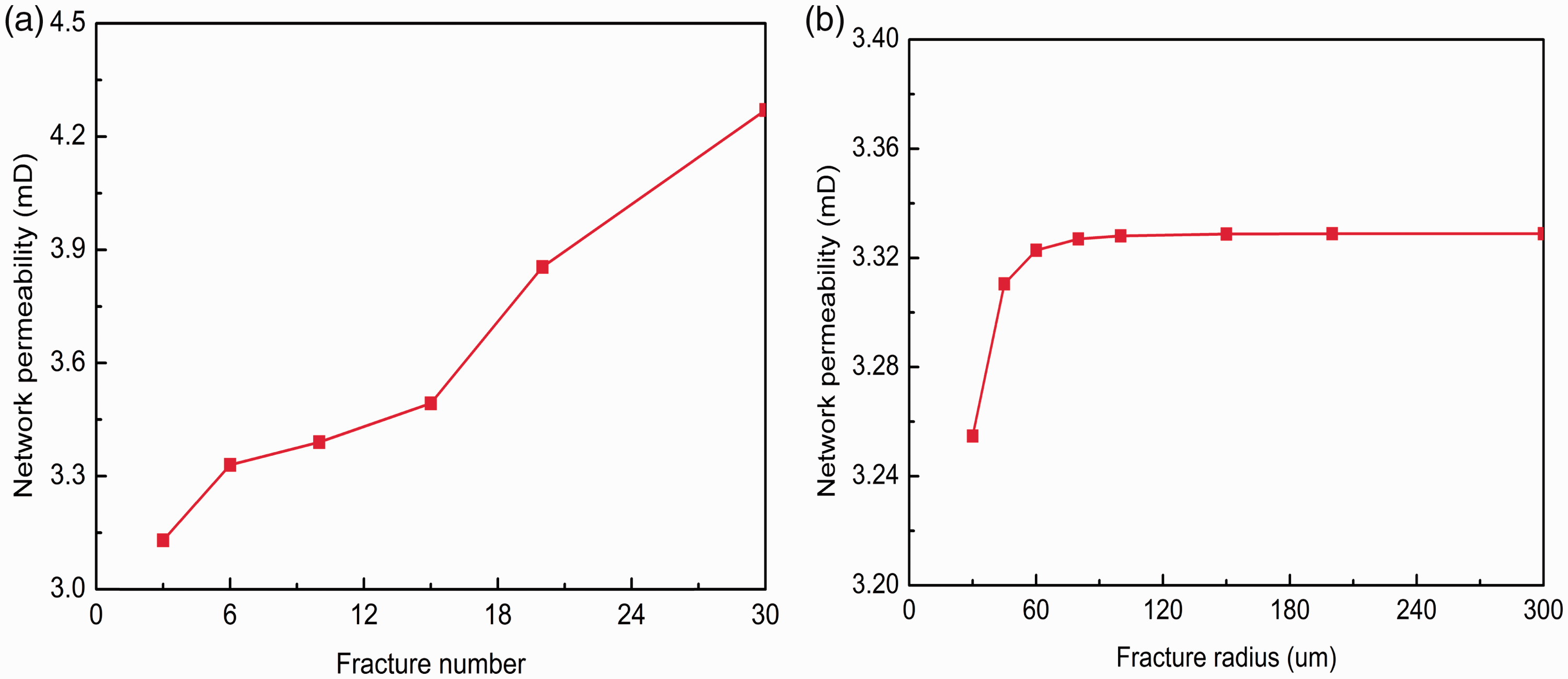
Variation of network permeability versus fracture number (a) and fracture radius (b).
Matrix and fracture network control modes
In the fractured reservoir media, the matrix is the main storage space while the fracture provides the flow path (Shen et al., 2015, 2016). Thus there is of great significance to understand the relationship between matrix and fractures in such reservoir media. In the study, the modes of matrix and fracture network control are conducted to understand network permeability in the fractured reservoir media. Figure 5(a) presents the variation of permeability sensitivity versus fracture density in the pore-fracture network model. It is noted that the critical density of the matrix and fracture network control mode is about 0.55. From the result shown in Figure 5(a), it can be observed that the permeability sensitivity decreases with the increase of the fracture density at the matrix mode, while the permeability sensitivity at the fracture mode increases as the fracture density increases. And the critical density versus the ratio of fracture radius to pore radius is illustrated in Figure 5(b). From Figure 5(b), we can see that the critical density decreases with the increasing of the Rf/Rpt value (Rf and Rpt are fracture radius and pore radius, respectively). As the Rf/Rpt value increases, the decreasing degree decreases slowly.
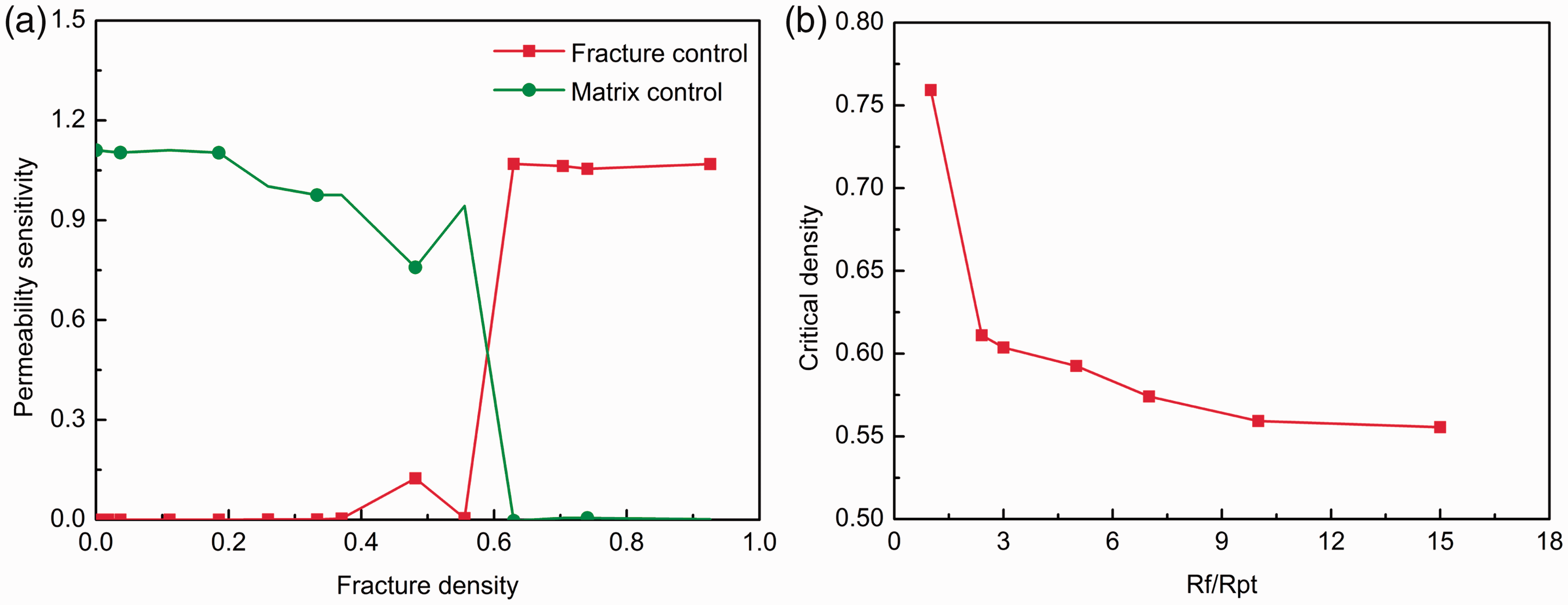
Variation of permeability sensitivity versus fracture density (a) and critical density versus the ratio of fracture mean radius to pore mean radius (b).
Effect of pore and fracture radius
Permeability is a property of the reservoir rock that measures the capacity of the formation to transmit fluid (Shen et al., 2017). The matrix pore size, fracture length, and radius have the significant influences on permeability in the reservoir media (Saboorian-Jooybari et al., 2016). In order to analyze the effect of pore and fracture radius, the values of the different ratios of fracture radius to pore radius are considered in the pore-fracture network model. Figure 6 shows the variation of permeability evaluation coefficient versus Rf/Rpt at matrix control (a) and fracture control (b), respectively. From the result shown in Figure 6(a), with the fracture density increasing at the matrix control mode, the permeability evaluation coefficient increases linearly and then tend to stabilize with the Rf/Rpt value. It indicates that there is a limit that the permeability increases with the Rf/Rpt value at the matrix control. As illustrated in Figure 6(b), there is little change in the permeability evaluation coefficient when the Rf/Rpt value is less than 4 at the fracture control mode. When the Rf/Rpt value exceeds 4, the permeability evaluation coefficient increases fast. The reason is that the bigger fracture radius can favor fluid flow in such reservoir media.
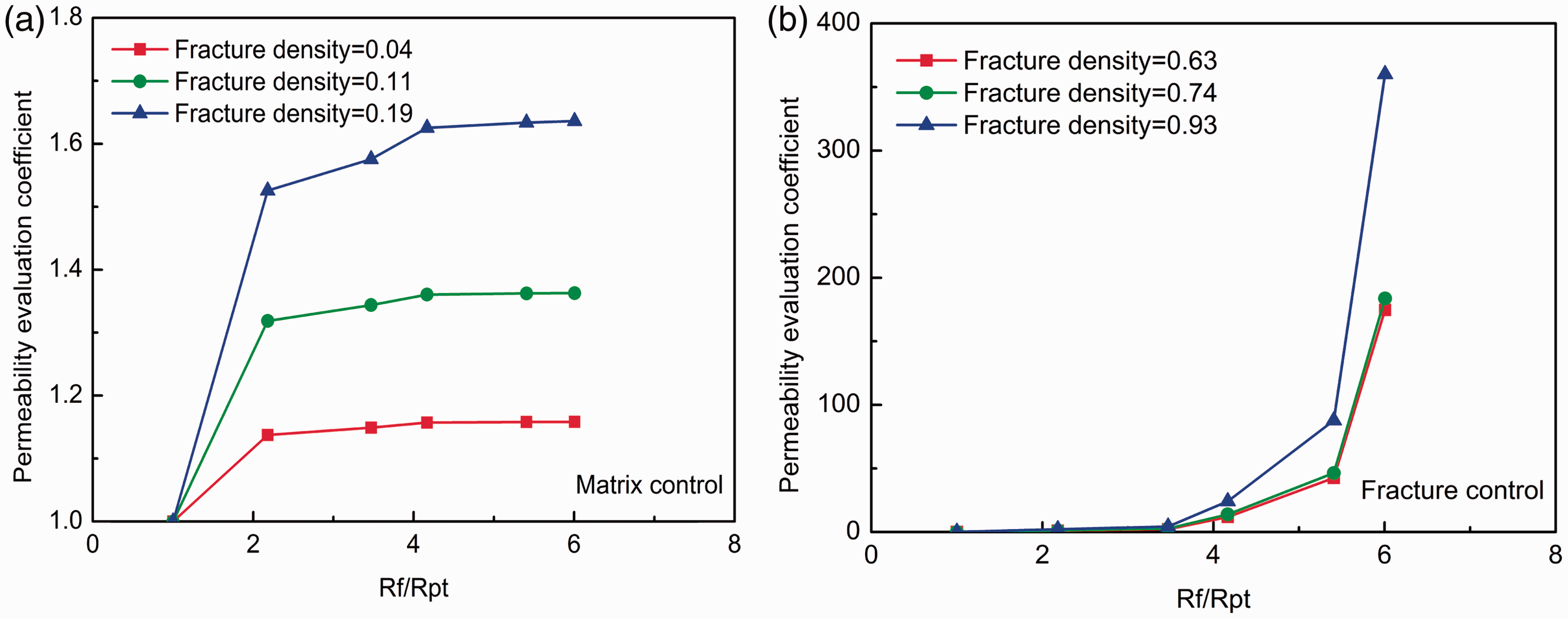
Variation of permeability evaluation coefficient versus Rf/Rpt at matrix control (a) and fracture control (b).
Effect of fracture density on control mode
Fracture density is one of the main fracture parameters to evaluate the reservoir quality in such reservoir media, which has a great effect on the fluid flow in the fractured reservoir media (Saboorian-Jooybari et al., 2016). In the pore-fracture network model, the fracture density is defined as the fracture number divided by the node number. In order to understand the effect of fracture density on different control modes, the different values of fracture density are considered in the pore-fracture network model. Figure 7 shows the variation of permeability sensitivity versus fracture density at matrix control (a) and fracture control (b), respectively. From the result shown in Figure 7(a), it can be seen that the permeability sensitivity in the pore-fracture media decreases with the fracture density increasing at the matrix control mode. And the permeability sensitivity increases with the increasing Rf/Rpt value. As illustrated in Figure 7(b), there is a contrary trend at the fracture control mode. When it is the fracture control mode, the fracture density has little impact on the permeability sensitivity among the matrix and fractures. Thus the fracture density at the matrix control mode can greatly affect the permeability sensitivity in such media.
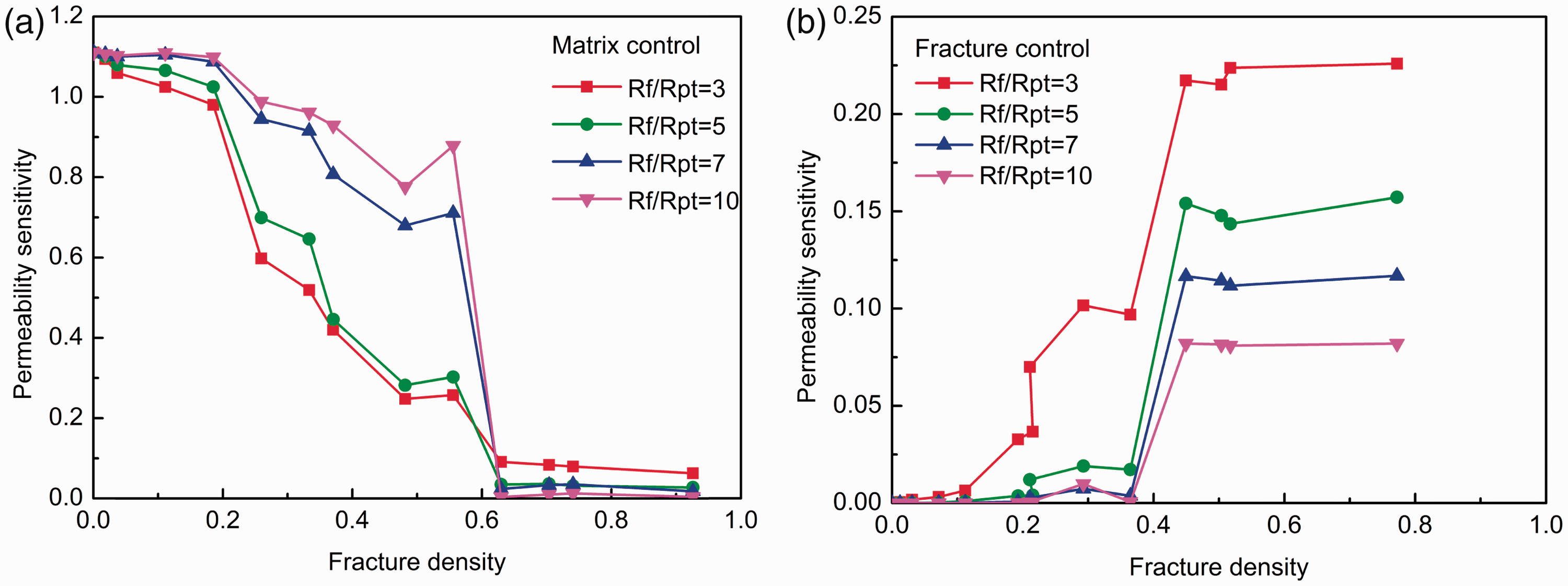
Variation of permeability sensitivity versus fracture density at matrix control mode (a) and fracture control mode (b).
Conclusions
In this study, a pore-fracture network model was presented to understand the microscopic flow mechanism in fractured porous media. The microstructure parameters of fractures including fracture density, fracture length, fracture number and fracture radius were analyzed. Then two modes and effects of matrix and fracture network control were discussed. According to the above results, the following conclusions can be drawn: (1) With fracture length, fracture density, fracture number, and fracture radius increasing, the network permeability in the pore-fracture media will increase linearly and favor fluid flow in the fractured reservoir media, while the fracture radius has a little effect on network permeability when the fracture radius exceeds 80 µm. (2) The control modes of matrix and fracture network are affected by the fracture density. Within the fracture density less than 0.55, it belongs to the matrix control mode, while the fracture network control mode is dominant in the fracture density exceeding 0.55. (3) Fracture density and the ratio of fracture radius to pore radius have a great effect on the network permeability in the matrix and fracture network control modes. There is a great change in the critical density for the matrix control mode compared with the fracture network control modes. These results can provide a better understanding of the relationship between matrix and fractures, and the effects of fracture on fluid flow in the fractured reservoir media, which is significant for optimizing the extraction condition in fractured gas reservoirs.
Footnotes
Acknowledgements
We thank the support from the Youth Foundation of Key Laboratory for Mechanics in Fluid Solid Coupling Systems, Chinese Academy of Sciences.
Declaration of conflicting interests
The author(s) declared no potential conflicts of interest with respect to the research, authorship, and/or publication of this article.
Funding
The author(s) disclosed receipt of the following financial support for the research, authorship, and/or publication of this article: This work was supported by the Project of PetroChina Research Institute of Petroleum Exploration & Development (no. RIPED-LFFY-2017-JS-118) and National Natural Science Foundation of China (no. U1762216).