




Abstract
Shales in the Well district of Yu 106 of the Shanxi Formation in the Eastern Ordos Basin is deposited in the swamp between delta plains, distributary river channels, natural levee, the far end of crevasse splay, and depression environments. According to organic geochemistry, reservoir physical property, gas bearing capacity, lithology experimental analysis, combined with the data of drilling, logging, testing and sedimentary facies, the reservoir conditions of shale gas and the distribution of an advantageous area in Shanxi Formation have been conducted. The results show that the total organic carbon content of the Shanxi Formation is relatively high, with an average content value of 5.28% in the segment 2 and 3.02% in segment 1, and the organic matter is mainly kerogen type II2 and III. The maturity of organic matter is high with 1.89% as the average value of Ro which indicates the superior condition for gas generation of this reservoir. The porosity of shales is 1.7% on average, and the average permeability is 0.0415 × 10⁻³ µm2. The cumulative thickness is relatively large, with an average of 75 m. Brittle mineral and clay content in shales are 49.9% and 50.1%, respectively, but the burial depth of shale is less than 3000 m. The testing gas content is relatively high (0.64 × 10⁴ m3/d), which shows a great potential in commercial development. The total organic carbon of the segment 2 is higher than that of the segment 1, and it is also better than segment 1 in terms of gas content. Based on the thickness of shale and the distribution of sedimentary facies, it is predicted that the advantageous area of shale gas in the segment 2 is distributed in a striped zone along the northeast and the northsouth direction, which is controlled by the swamp microfacies between distributary river channels.
Introduction
In the recent years, shale gas is playing an important role in satisfying increasing energy demands and having attracted wide attention (Shen et al., 2015, 2016). Due to the success in shale gas production in North American (Bowker, 2007; Martineau, 2007; Patzek et al., 2014; Pollastro et al., 2007; Ross and Bustin, 2007), many breakthroughs have been made in shale gas exploration and development in southern China. The proven geological reserves of shale gas in China are about 5440 × 108 m3, and gas production is more than 80 × 108 m3 (Zou et al., 2015). Almost all the shale gas is produced from the Ordovician Wufeng-Silurian Longmaxi formations, and the continental shale gas has no production conversely.
Ordos Basin is one of the important oil and gas-bearing basins in China, which is developed in many sets of shale from Paleozoic and Mesozoic Era. Three sets of shale among them are most likely to form a gas reservoir developing in Pingliang Formation of Ordovician, in Benxi, Taiyuan and Shanxi Formation of Carboniferous and Permian, in the Chang 7 oil reservoir of Upper TriassicYanchang Formation. In the upper Palaeozoic gas reservoirs of the Ordos Basin, the tight sandstone reservoir of Shanxi Formation plays an important role in the development of gas reservoirs. Among them, the Shan 2 quartz sandstone reservoirs in Yulin and Zizhou are stably distributed (Fu et al., 2013; Zhao et al., 2013). Lithic quartz and quartz sandstones in Shan 1 are important reservoirs to form the Sulige and the Daniudi gas fields (Hao et al., 2006; He et al., 2003). In contrast, the shale of Shanxi Formation has long been seen as the important source of rocks for the sandstone reservoirs in the upper Palaeozoic (Li et al., 2009; Yang et al., 2013a, 2013b), which is studied less as the reservoir. Many scholars believe that shale gas in upper Palaeozoic Shanxi Formation of Ordos Basin has a great potential in commercial development and it has been considered as the most advantageous condition for shale gas reservoirs accumulation. The main advantageous areas for shale gas are located in the northeast region of the basin (Wan et al., 2011; Yan et al., 2013; Zhang and Lan, 2006; Zhang et al., 2008a, 2008b, 2008c; Zou et al., 2010, 2011).
To find more natural gas reserves as strategic resources, some researchers and developers have been interested in exploring shale gas in the Ordos Basin. Chen et al. (2011) have conducted the research work in shale reservoirs of the Silurian Longmaxi and Cambrian Qiongzhusi Formations in southern China. However, the research on shale gas in the Shanxi Formation of the Ordos Basin is still in its infancy. Most of the studies focus on pore types, reservoir forming conditions and resource potential (Yang et al., 2013a, 2013b; Zhang et al., 2008a, 2008b, 2008c, 2011). To the best of our knowledge, no research is yet in evidence on shale favorable area optimization in the coal accumulation environment of the Shanxi Formation.
In this work, the Well district of Yu 106 of the Shanxi Formation in the eastern part of the Ordos Basin is introduced as the research topic, which is shown in Figure 1. According to the analysis data of the hydrocarbon generation capability of shale, material property and gas bearing capacity, combined with well drilling, well logging, well testing and the knowledge on sedimentary facies, the shale gas reservoir condition of Yu 106 district of the Shanxi Formation is analyzed. Besides, the advantageous areas of shale gas reservoirs in this area of the Shanxi Formation are screened. All of these results have provided a scientific basis for the exploration and development of shale gas reservoirs of the Shanxi Formation in the Ordos Basin.
Diagram showing tectonic location of the studied area.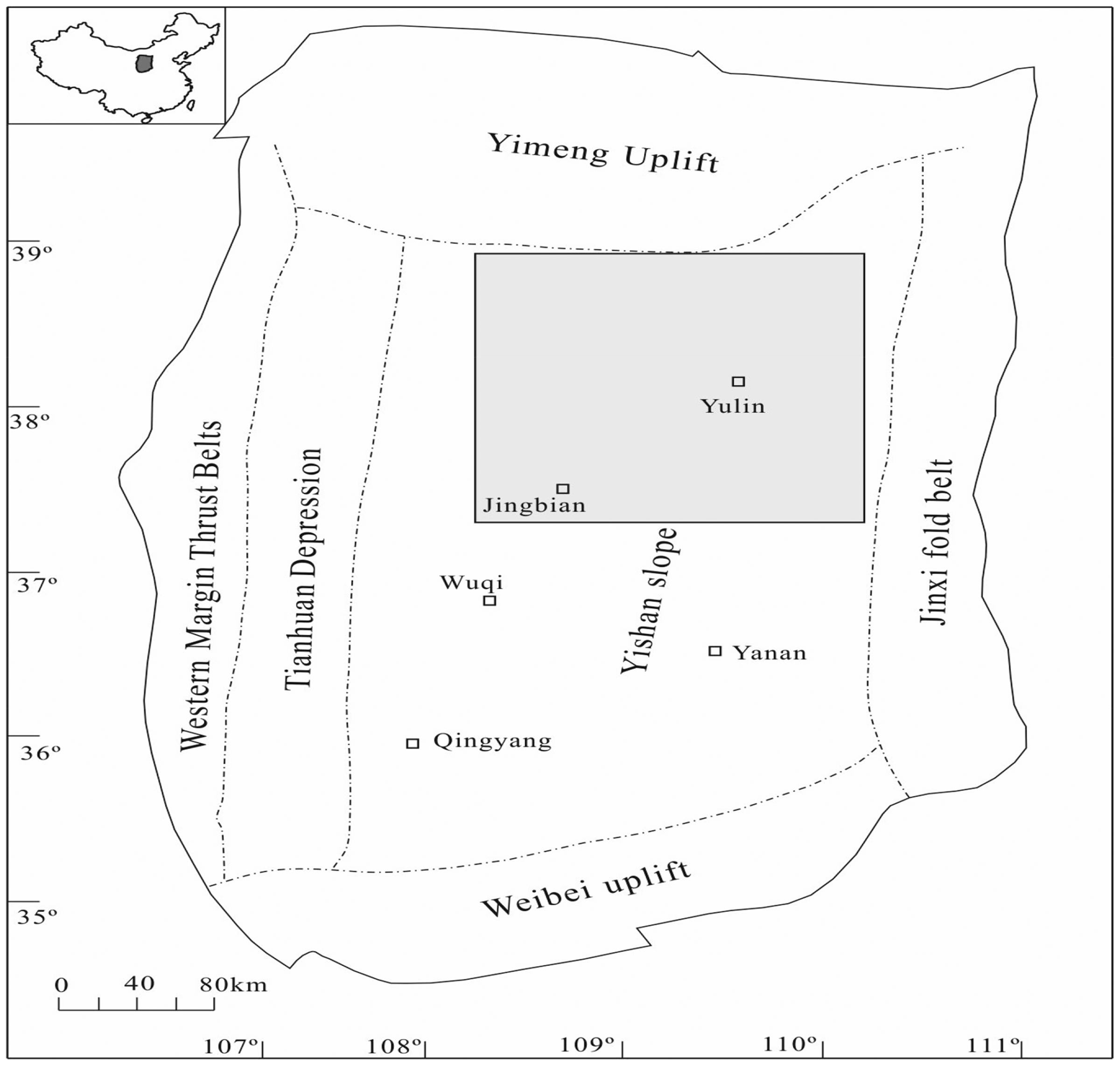
Geological characteristics
The stratum lithology of Well district of Yu 106 in the Shanxi Formation is tight sandstone, mudstone layer and multiple layers of coal seam. According to lithology and logging curve characteristics, the Shanxi Formation can be divided into segment 2 and segment 1 from the bottom to the top. The lithologic color of Shan 1 is shallow, and the coal seam is thin. There are fewer layers, and the deep resistivity value is relatively low. The lithologic color of segment 2 is darker, and the coal seam is thick. There are more layers, and the deep resistivity value is higher. According to lithology combination and sedimentary sequences, segment 2 can be divided into three sand groups including Shan 2-1 layer, Shan 2-2 layer and Shan 2-3 layer. Each sand group includes 1 or 2 lithologic sequences where it is either sandstone, mudstone and coal seam, or mudstone and coal seam from the bottom to the top, shown in Figure 2. The horizontal coal seam of Shan 2 is relatively stable, which can be used as a marker layer to compare the internal layers of the segment 2.
Stratigraphic column of the Permian Shanxi Formation showing the wireline log curve characteristics and the reservoir of shale gas explanation (Well Yu 94).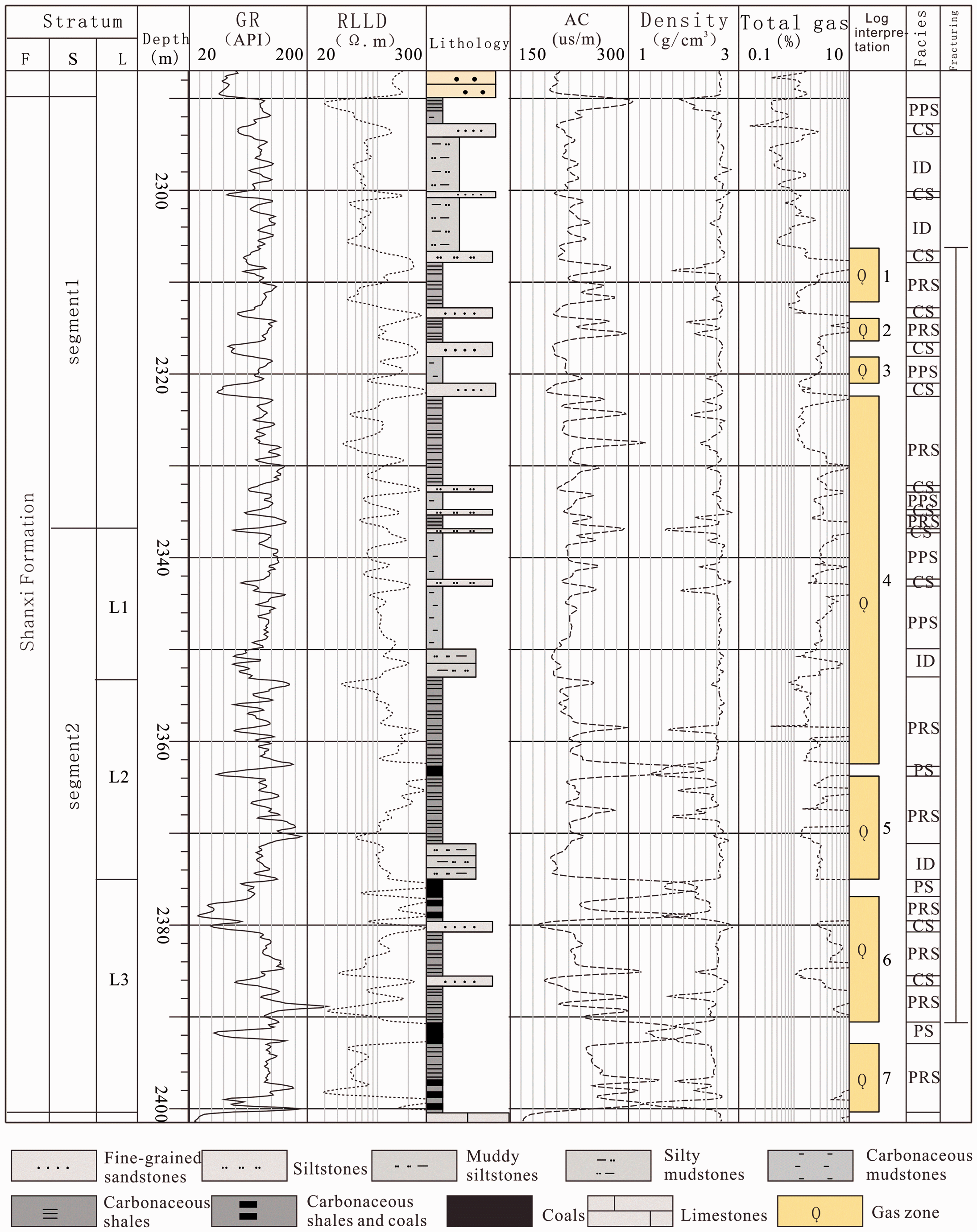
The Shanxi Formation is deposited in environments of large transitional facies and continental delta facies (Chen et al., 2011). Shale is deposited in the swamps of delta plains, natural levee, far end of crevasse splay and depressions environment between distributed river channels, which is mostly associated with coal seam to form coal floors, tight sandstone reservoir caps or lateral barriers (Li et al., 2009; Yang et al., 2013a, 2013b).
Research methods
According to the experience of success in shale gas development in the United States and Southern China (Li et al., 2012; Nie and Zhan, 2012; Nie et al., 2009; Zhang et al., 2008a, 2008b, 2008c), the key standard of shale gas reservoir and mining conditions in commercial development is determined. Based on these facts, shale gas reservoirs and mining conditions of the Well district of Yu 106 in the Shanxi Formation are evaluated. Among them, the key evaluation parameters of reservoir conditions include the hydrocarbon generation condition (organic matter content, types and maturity), reservoir condition (rock mine characteristics, material property, gas content and reservoir thickness) and preservation conditions.
In the study, the organic matter content could be collected from the rock pyrolysis analysis test by LECO CS-200 carbon and sulfur analyzer after treatment with hydrochloric acid to remove carbonates. The organic matter maturity could be collected from the vitrinite reflectance test using a 3Ymicrophotometric system. The reservoir mineral composition could be obtained using X-ray diffraction analysis on a Bruker D8 ADVANCE X-ray diffractometer at 40 kV and 30 mA with a Cu Kα radiation. The reservoir physical properties (porosity and permeability) could be collected from the Helium mercury injection test by Vinci Coreval 700 and Corelab PDP 200, respectively. Gas content could be collected from shale sample tests in the field by our independently developed instruments. All these experiments were conducted in National Energy Shale Gas Research Development (Experiment) Center, Langfang, China. Reservoir thickness could be obtained by the comprehensive interpretation of logging. Evaluation parameters of mining conditions mainly include depth, productivity and abundance of resources. The abundance of resources could be calculated by using the shale gas reservoir thickness, gas content, density and gas bearing areas of each layer (Shan 2-1, Shan 2-2 and Shan 2-3). The density of the reservoir could be obtained from the interpretation of rock core calibration logging. The boundary of the gas-bearing area for each layer is 10 m. The selection of advantageous areas uses the method of advantageous area screening for shale in America and southern China (Kinley et al., 2008; Nie and Zhan, 2012; Nie et al., 2009; Ross and Bustin, 2008; Yang et al., 2013a, 2013b), as well as the reservoir parameters in the study area. The parameters primarily considered are shale thickness and distribution of sedimentary facies, followed by content and maturity of organic matter.
Results and discussion
Statistics of key parameters for evaluating accumulation conditions of shale gas.

TOC: total organic carbon.
Hydrocarbon generation conditions
In the early period of Shanxi Formation sedimentary (Second Member Period), due to the transgression impact, the swamp environment developed widely. It was the period for the generation of the Shanxi Formation shale.
Organic matter types and content
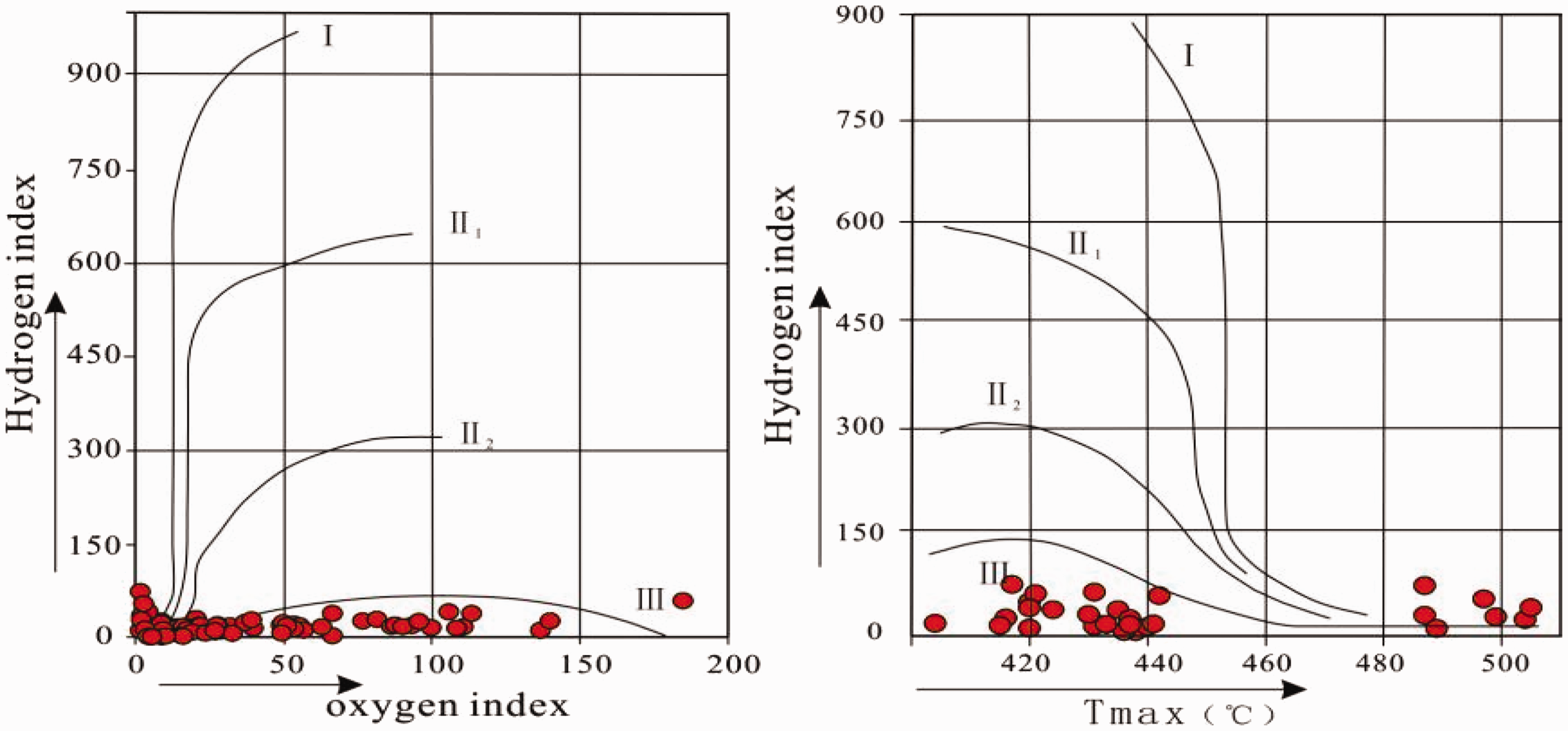
As indicated in the study of sedimentary facies, the Well district of Yu 106 of Shanxi Formation shale is rich in fossils full of stems and leaves of plants, shown in Figure 3. It is associated with coal layer and deposited in delta environments of plant-rich and plant-poor swamps illustrated in Figure 2. Shale pyrolysis analysis reflects that the organic matter is mainly of kerogen type II2 and III, which is shown in Figure 4. It is easy for gas generation, and beneficial for the formation of shale gas reservoirs. The information matches prior understanding of organic matter types of shale in the Shanxi Formation of the Ordos Basin (Fu et al., 2013; Wan et al., 2011; Yan et al., 2013; Zou et al., 2015).
Stem and leaf fossils on cores of Permian Shanxi shales at the Yu 106 Block. (a) Well Yu106, 2041.79 m; (b) Well Yu30, 2484.39 m. Discrimination diagram of organic matter type in Permian Shanxi shales at Yu 106 Block.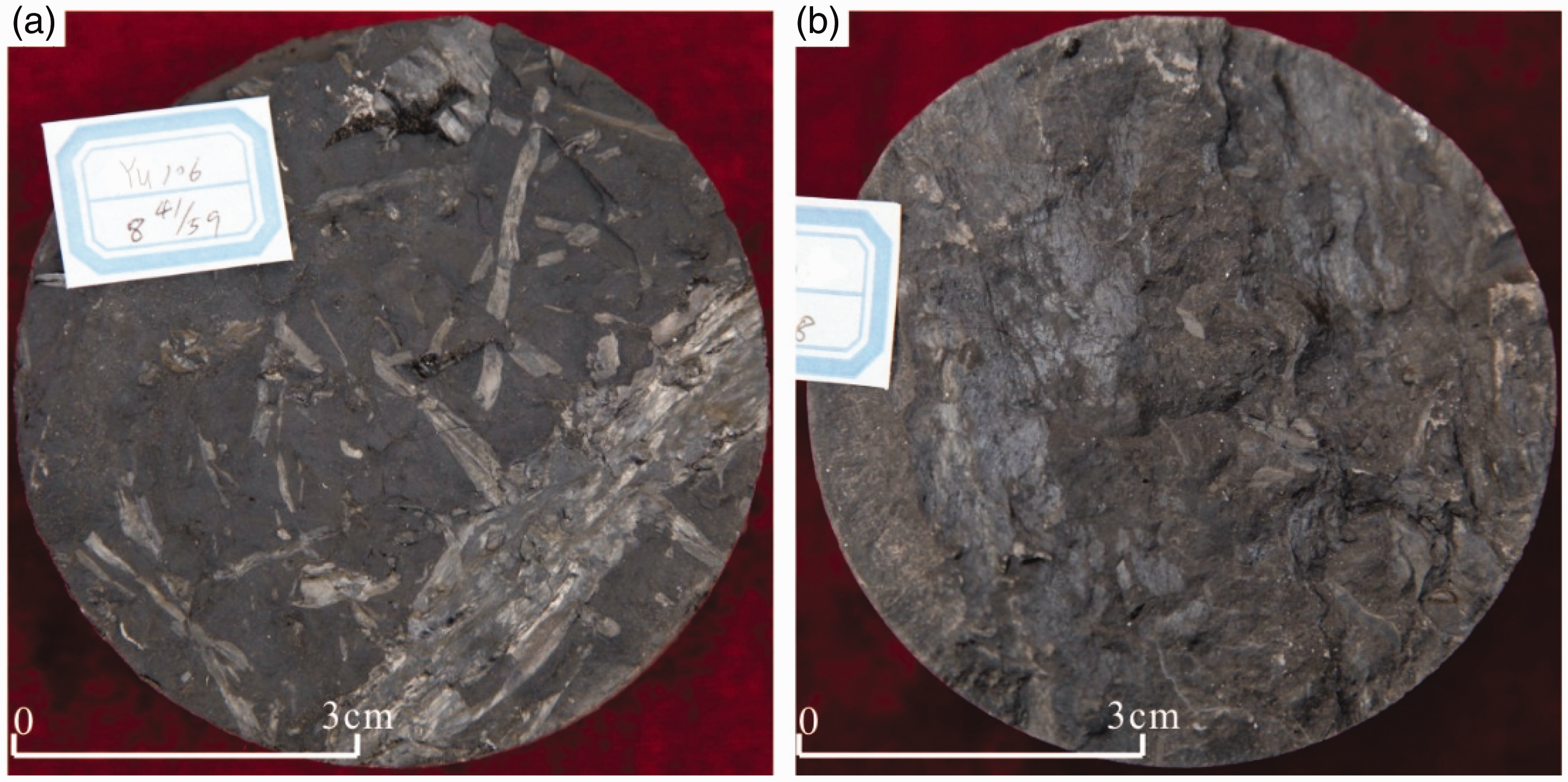
The variation of TOC in the study area in the Shanxi Formation is large, especially in the Shan 2 section where the TOC range is between 0.08% and 37.11%, and the average value is about 5.28% from 133 shale samples. The TOC range in the segment 1 is between 0.17% and 24.95%, and the average value is 3.02% from 18 shale samples. The average TOC values of segment 1 and segment 2 are 1.02% and 3.28% higher than the lower limit in the commercial development of shale gas, respectively. In contrast, the average TOC value of segment 2 is higher, which means it is more favorable for the enrichment of shale gas.
Maturity
Although the shale gas forming condition is satisfied as long as it reaches the threshold of gas generation (Bernard et al., 2012; Hackley et al., 2013), the organic matter maturity is usually higher in the commercial development of shale gas. The shale vitrinite reflectance (Ro) is generally greater than 1.1%. Ro in the study area of the Shanxi Formation is between 1.45% and 2.37% from 68 shale samples, shown in Figure 4, with an average of 1.89%. It indicates that organic matter of the shale in the target layer has reached a high maturity stage. It is higher than the lower limit of the shale gas maturity standard in the commercial development where Ro is 1.1%, which is helpful for the formation of shale gas reservoirs.
Reservoir conditions
According to the core observation, it was found that fine lithology in the Shanxi Formation included major shale, carbonaceous shale, partially carbonaceous shale, partially silty shale with colors of gray, dark gray, black and/or gray. The sedimentary structures are mostly block-shaped and with horizontal bedding, but sometimes with lenticular bedding and wavy bedding.
Reservoir properties
The quantity of material property test in the study area of shale reservoirs in the Shanxi Formation is relatively small. According to experimental tests of 27 shale samples from Well Yu 106, the permeability is in the range of 0.0019 × 10⁻³ to 0.317 × 10⁻³ µm2. The permeability on average is 0.0415 × 10⁻³ µm2, which is much higher than the lower limit of shale gas reservoir permeability in commercial development (10 × 10−9 µm2). This indicates that permeability of shale gas reservoirs in the Shanxi Formation is relatively high. Therefore, the gas well is expected to get high productivity. The porosity is between 0.2% and 4.7% and on average 1.7%, and the porosity is relatively low and below the lower limit of shale gas reservoir porosity in commercial development (2%). This indicates that the capability of gas reservoirs in the Shanxi Formation ability is relatively poor while it is not suitable in terms of stable productivity.
Gas content
There are not many field tests of the Well district of Yu 106, which reflects that shale gas content is between 0.19 and 2.16 m3/t. And the average value is 0.64 m3/t from 16 shale samples. The gas content is relatively low, considerably lower than the lower limit of the standard shale gas content in commercial development (2 m3/t). The absorption tests show that the content of absorbed gas in the Shanxi Formation is generally high. It is between 0.56 m3/t and 15.28 m3/t and on average 3.28 m3/t, which suggests that the Shanxi Formation has great potential of containing adsorption gas. Compression and uplifting formed since Cenozoic (pressure releasing) led to the decrease of formation pressure, which is likely to be the major reason of the loss of its adsorption gas and its low gas content. Water saturation is between 28.4% and 85.0%, and on average 50.8% from 30 shale samples, which is lower than the lower limit of shale gas reservoirs in commercial development (45%).
Reservoir thickness
The shale in both segment 1 and segment 2 in the study area of the Shanxi Formation is more developed, with relatively high cumulative thickness. The cumulative thickness of shale in segment 1 is between 18.8 m and 56.2 m, and the average is 38 m. The cumulative thickness of the three sand groups in Shan 2-1 is between 1.4 and 22.5 m with the average of 10.9 m. The cumulative thickness of shale in Shan 2-2 is between 4.3 and 24.1 m, and the average is 13.2 m. The cumulative thickness of shale in Shan 2-3 is between 2.6 and 23.6 m with the average of 12.5 m. In summary, the cumulative thickness of shale in the Shanxi Formation is 74.6 m on average, which is much higher than the lower limit of the thickness of shale gas reservoirs in commercial development (30 m). Even for the segment 2 where the organic content is relatively high, the average cumulative thickness is up to 36.6 m. The thickness of a single layer shale in the Shanxi Formation is small, which is in general less than 10 m. Meanwhile, the shale in the segment 1 generally forms inter-bed with compact sandstone, shown in Figures 2 and 5. The shale in segment 2 generally forms inter-beds with compact sandstone and coal seam. These are disadvantages for the development of shale gas reservoirs. So we need to consider the development strategies with tight sandstone gas reservoirs and coal seam reservoirs together (Zou et al., 2011).
Profile showing depositional setting of the Shan2 member at the study area.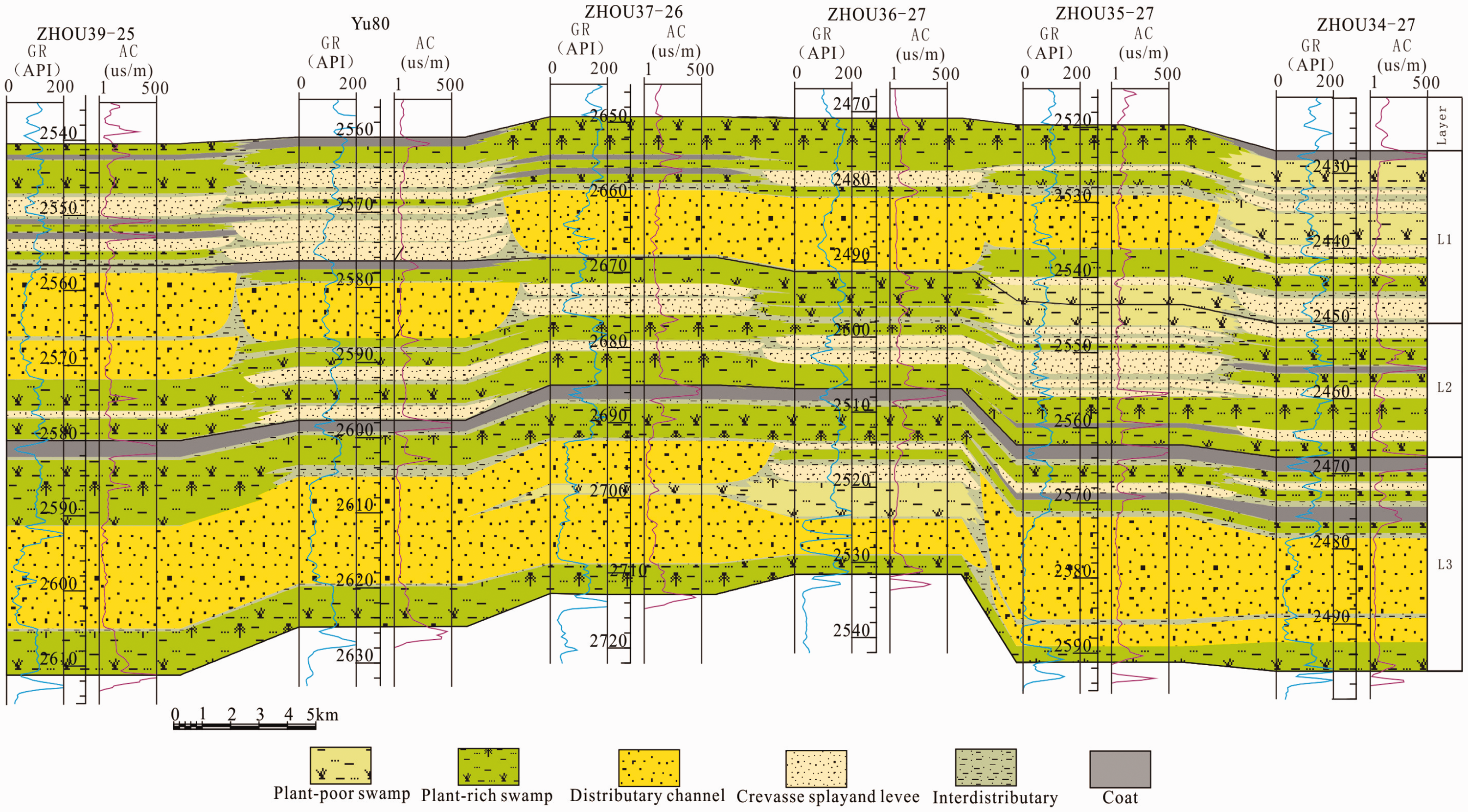
Accumulation conditions
Characters of rock minerals
Regarding reservoir fracturing in the later periods, shale gas reservoirs in commercial development usually need the brittle mineral content to be more than 40% and the clay content to be less than 30%. Considering the study area in the Shanxi Formation, the brittle minerals include quartz, feldspar, carbonate minerals (calcite, siderite, ankerite, etc.) and pyrite, and the content is between 10% and 71% and 49.9% on average from 71 shale samples. The clay mineral content is between 29% and 90% with the average of 50.1%. The brittle mineral content is slightly higher than the lower limit of brittle mineral content of shale gas reservoirs in commercial development (40%). The clay mineral content is relatively high, which has certain adverse effects on reservoir fracturing in the later periods.
Depth of burial
The depth of burial in the Shanxi Formation in the study area is mainly distributed in the range of 2000–2600 m, which is relatively shallow. It also shows that the mining process will cost less, which is certainly advantageous for the development of shale gas reservoirs in this area.
Abundance of resources
Statistics of shale gas resources in Shanxi Formation in study area.
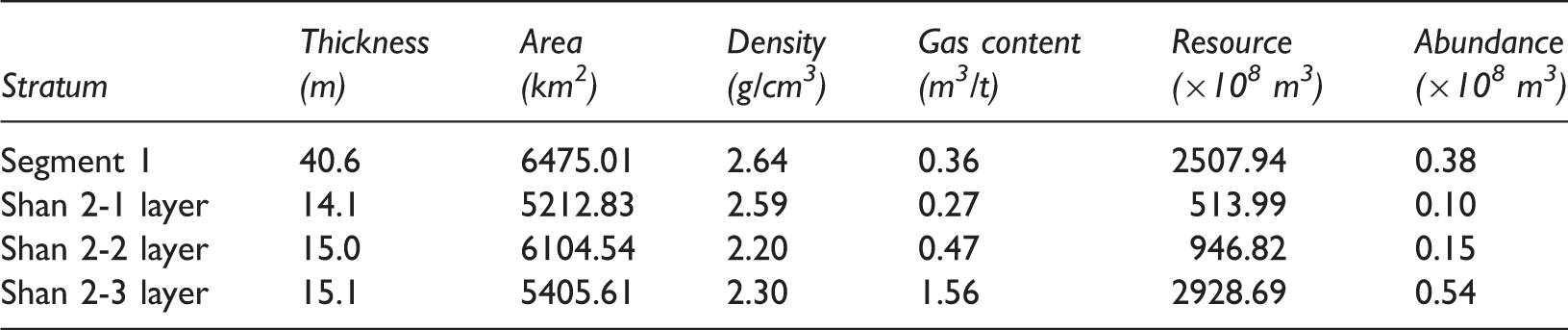
The delineation of the gas-bearing area takes into account the distribution of the Yu sedimentary facies of shale reservoir thickness, as the shale Ro in the study area is generally higher than 1.1%. The results indicate that the abundance of shale gas resource is relatively low in the area, which is below the lower limit of the abundance of shale gas reservoirs in commercial development (2.5 × 10⁸ m3/km2) (Zou et al., 2011). It suggests that the potential of stable shale gas productivity in the area of Shanxi Formation is not relatively poor.
Productivity of gas mines
Currently, only Well Yu 94 has been tested in this study area. It is a vertical well, and the segment in 2307.4–2390.4 m has been fractured, which is shown in Figure 2 with a testing capacity of 0.64 × 10⁴ m3/d. Among them, the cumulative thickness of shale is about 87% of fracturing section thickness, which suggests that shale reservoirs are the major contributor to the productivity of gas wells. If it is converted to a well site with eight horizontal wells, and assuming that the productivity of horizontal wells is four times that of the vertical wells, a shale gas field is likely to obtain an initial productivity of nearly 200,000 m3/d. It indicates great potential in terms of commercial development. This is the reason why such low abundance of resources could obtain relatively high productivity, which is related to its high permeability.
Shanxi Formation in the study area is distributed as a typical form with low amplitude. The relative difference of low-amplitude nose uplift is small, which reflects its overall structural formation as slight, and the fault is not developed in general. These are all in favor of the preservation of shale gas reservoirs. Core observation, however, also shows that there is fault and fracture, as illustrated in Figure 6. It is consistent with the conclusions of preliminary research (Zhang and Lan, 2006). Although these gaps of faults are not considerably huge, the faults and cracks form the high speed seepage channel. And it may cause pressure loss of the original shale connected to the channel and hence the loss of shale gas.
Fault and fractures on cores of the Permian Shanxi shales at the Yu 106 Block. (a) Well Yu 61, 2554.07 m; (b) well Yu 106, 1998.96 m.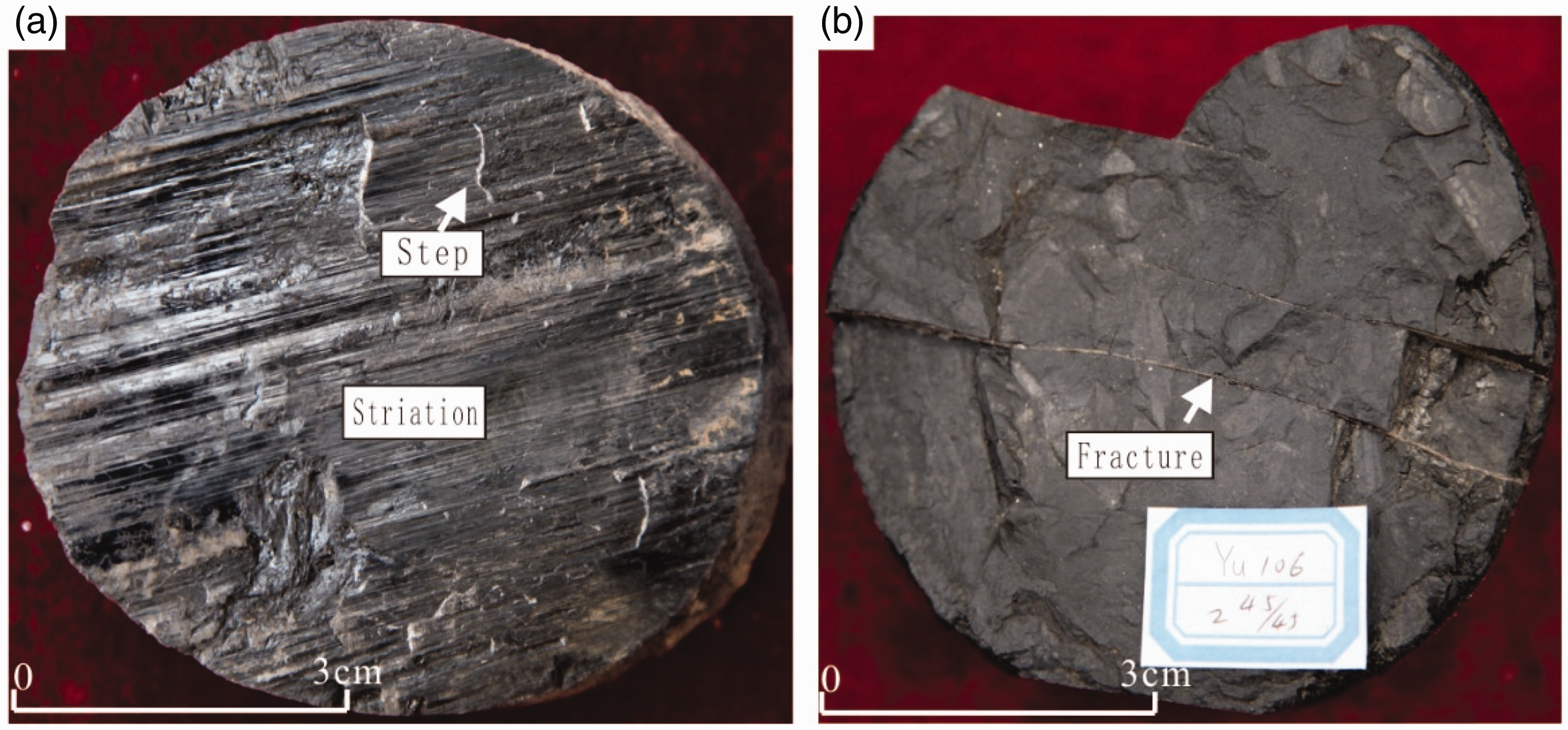
Advantageous areas prediction
Predicting advantageous areas for shale gas reservoirs are obtained based on an analysis of reservoir conditions. Major control factors, such as TOC, Ro, shale thickness, gas content and depth of burial for forming reservoirs are thus utilized (Kinley et al., 2008; Montgomery et al., 2005; Nie et al., 2009; Ross and Bustin, 2008). In addition, the sedimentary microfacies are an important factor in controlling the content of organic matter and gas (Li et al., 2013). Considering the selection of stratum positions, the TOC of Shan 2 section is the highest according to the research of TOC in the study area in the Shanxi Formation. Meanwhile, the hydrocarbon content in gas measurement is significantly higher than that in the Shan 1 section. The base value is generally over 1%. The Shan 1 section has shown a lower content in gas measurements, especially for the upper part of Shan 1 section with less than 1% in general, shown in Figure 2. In addition, the deep resistance in Shan 2 section is generally high while the section in the reservoir is usually greater than 100 Ω m, as illustrated in Figure 2. According to the studies on the Barnett shale, the resistance of its gas-bearing layer is generally greater than 50 Ω m (Kinley et al., 2008). This also reflects that segment 2 is identified with great gas content.
According to the above analysis, the segment 2 for advantageous area screening is chosen. Because the segment 2 enjoys great properties in terms of TOC, Ro and hydrocarbon content and the plane rarely changes, the thickness of shale and environment of sedimentary facies are considered during the selection process of advantageous areas of the Shanxi Formation. As for the segment 2, the shale thickness and distribution of sedimentary facies are predicted, respectively, including three layers, Shan 2-1, Shan 2-2 and Shan 2-3. Taking the area where the shale thickness of three sand groups combined is high (the lower limit of the thickness of each sand group is 10 m, and lower limit of the thickness of three groups combined is 30 m), and considering the distribution of its sedimentary facies especially the swamp facies, the distribution of advantageous areas in the segment 2 was obtained, as shown in Figure 7.
Predicted shale gas favorable areas of the segment 2 at the studied area.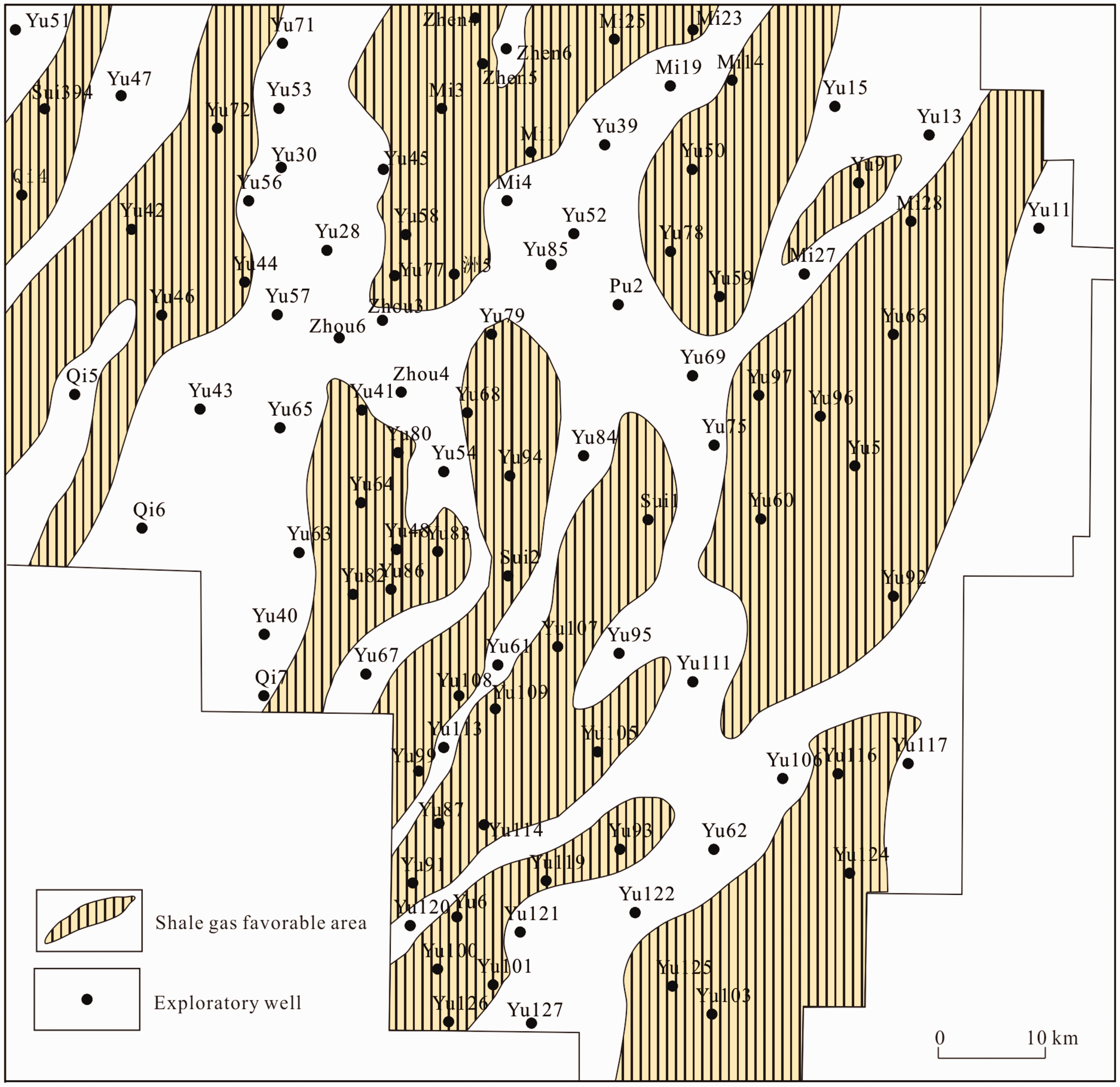
Among them, the sedimentary facies plane prediction (taking Shan 2-3 layer as an example) takes into account the shale thickness and plane distribution of the sand body thickness, which is shown in Figure 8. These advantageous areas are mainly distributed in the over-laps of swamps among distributary river channels in each sand group, and many of them are along the northeast and northsouth directions. These are reflected in the areas where the dense sandstone in the distributary river channels is not developed, and they are the areas where swamp shale reservoirs are developed. It can be expected that a better development effect can be achieved in the overlap of advantageous areas in both segment 1 and segment 2.
Plan of the third zone of the second member of the Shanxi Formation at the studied area. (a) Facies plan; (b) isopach map of shale thickness; (c) isopach map of sandstone thickness.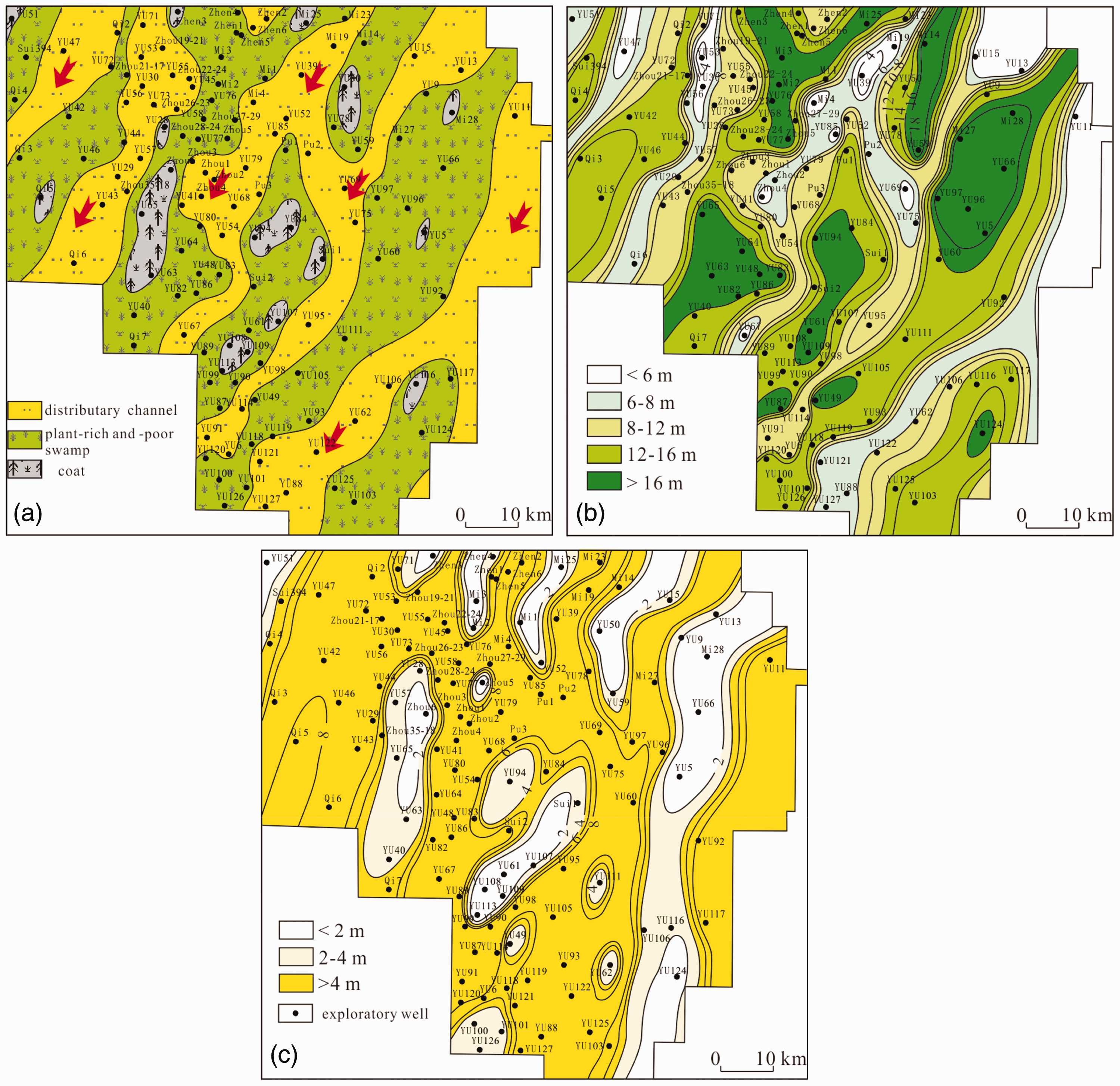
Conclusions
Based on the analysis data of the hydrocarbon generation capability of shale, material property and gas bearing capacity, combined with well drilling, well logging, well testing and the knowledge on sedimentary facies, the reservoir conditions of shale gas and distribution of an advantageous area in Shanxi Formation have been conducted and analyzed. According to the above analysis, the following conclusions can be drawn: (1) the organic carbon content of shale in Well Yu 106 Shanxi Formation in the Eastern Ordos Basin is relatively high, and the organic matter is mainly of kerogen type II2 and III with high maturity of organic matter, which are considered as key conditions for gas generation. (2) Shale in the Shanxi Formation shows a relatively low porosity, a high permeability and low gas content. The thickness of a single layer of shale is thin and shale is interbedded with tight sandstones and coal seams and its cumulative shale thickness is high. These facts reflect that the shale in the Shanxi Formation has good permeability but poor reservoir capacity. (3) The brittle mineral content of shale in the Shanxi Formation is relatively low while the clay mineral content is relatively high. Although resource abundance is generally low, the burial depth of shale is shallow with high productivity achieved during gas tests, which shows great potential in commercial development. (4) By comparing the organic matter content and gas content of both segment 1 and segment 2, segment 2 is considered as the zone with more enrichment of shale gas. The advantageous areas are distributed as stripes along the northeast and northsouth directions, which is closely related to the microfacies of swamps in distributary river channels.
Footnotes
Acknowledgements
We thank the support from the Youth Foundation of Key Laboratory for Mechanics in Fluid Solid Coupling Systems, Chinese Academy of Sciences.
Declaration of conflicting interests
The author(s) declared no potential conflicts of interest with respect to the research, authorship, and/or publication of this article.
Funding
The author(s) disclosed receipt of the following financial support for the research, authorship, and/or publication of this article: This work was supported by the Project Basic Science Research on Efficient Development of Marine Shale Gas in Southern China (No. 2013CB228001), and by National Science and Technology Major Project of the Ministry of Science and Technology of China Project (No. 2016ZX05037006).