




Abstract
The Dengying Formation of Neoprotozoic age deposited in north Sichuan Basin, China, is dominated by dolomitic strata containing microbial carbonates. Thirteen cyanobacteria forms, one oncolite and two stromatolitic structures have been identified. Different microfacies may be related to different microbe forms or assemblages as well as depositional environments. Potential hydrocarbon reservoirs in microbial carbonates are of low porosity and permeability. Microbialites develop in the members Z2dn1, Z2dn2, and Z2dn4. The member Z2dn1 and Z2dn2 lying in the lower part, dominated by thrombolitic and spongiostromata dolostone, with three reservoir intervals of overall 190 m thick. Laminite and stromatolitic dolostone are the most important in member Z2dn4, with three reservoir intervals of 119 m thick. Microbial carbonate reservoirs in members Z2dn1 and Z2dn2 were effected by two stages of fresh water dissolution, three stages of burial dissolution, and one stage of hydrocarbon invasion. But one stage of fresh water dissolution, two stages of burial dissolution, and three stages of hydrocarbon invasion modified the reservoirs of member Z2dn4. The dominant factors for microbial reservoirs were microbial textures and development of Mianyang-Changning intracratonic sag.
Introduction
Microbes are represented in geologic records since early Archean (Lowe, 1980). They are the principal constituents of microbial carbonates. Microbes are generally considered to encompass bacteria (e.g. cyanobacteria), fungi, small algae, and protozoans (Brock et al., 1994; Riding, 2000). The term “microbialite” characterizes organosedimentary deposits that accreted as a result of benthic microbial community trapping and binding detrital sediment and/or forming the locus of mineral precipitation (Burne and Moore, 1987). Microbial carbonates that formed at the surface of water–sediment interface include stromatolites, thrombolites, dendrolites, leiolites, oncolites, and laminites (Mei, 2007; Riding, 2000). In addition to playing an important role in interpreting ancient depositional environments of Precambrian and Phanerozoic limestones (Flügel, 2010; Riding and Awramik, 2000), they are also of significant importance to oil industry. Microbial carbonates present new types of hydrocarbon reservoirs, as documented by recent oil exploration discoveries in the Gulf of Mexico in USA and offshore of Brazil (Mancini et al., 2008; Rezende and Pope, 2015; Wright and Racey, 2009). The increased interest in microbial carbonates has been documented by AAPG special issue on microbial carbonates published by Mancini et al. (2013) and Geological Society in London special issue published in 2015 (Bosence et al., 2015). Both issues deepen our understanding of microbial carbonate reservoirs. Geographically known oil and gas fields with microbial carbonates lie in Gulf of Mexico, Alabama State in USA (Ahr et al., 2011; Mancini et al., 2000, 2004, 2008), Santos Basin, offshore Brazil (Muniz and Bosence, 2012; Rezende and Pope, 2015; Wright and Racey, 2009), South Oman Salt Basin (Bergmann et al., 2012; Grotzinger and Amthor, 2002), Tengiz Field in Kazakhstan (Collins et al., 2012), Eastern Siberia in Russia (Pelechaty et al., 1996; Tull, 1997), and Bohai Bay and Sichuan basins in China (Fei and Wang, 2005; Li et al., 2013; Liu et al., 2008; Luo et al., 2015; Song et al., 2013; Zou et al., 2014). The hydrocarbon producing strata from microbial reservoirs are located in Meso-Neoprotozoic, lower Cambrian, lower Carboniferous, upper Jurassic, and lower Cretaceous.
Recently a series of gas pools, such as Weiyuan, Ziyang, Longnusi, Hebaochang and Anyue, have been discovered in Dengying Formation, increasing gas reserve up to 10,000 × 108 m3 (∼35.3 tcf) (Luo et al., 2015; Wei et al., 2013). The reservoirs of Dengying Formation in Sichuan Basin were described as “blue-green algae dolostone” instead (Luo et al., 2015; Wei et al., 2008, 2013; Zhang et al., 1996; Zou et al., 2014), which are reclassified as microbial (cyanobacteria) dolostone (Fang et al., 2003; Luo et al., 2013; Peng et al., 2014). Although some previous work has been completed on description and morphology of cyanobacteria, microbialite fabrics, and microbe communities (Fang et al., 2003; Luo et al., 2013; Peng et al., 2014; Yin et al., 1980; Zhang et al., 1996), interpretation of these texturally complex and often inscrutable fabrics remains a challenge.
The Yangba outcrop section and borehole TX1, located in northern Sichuan Basin (Figure 1(a)), are examined to determine the microbes, depositional evolution and reservoir characteristics of microbial carbonates in Dengying Formation. The aim is to better understand the reservoir forming mechanisms and controlling factors of microbial carbonates.
(a) Geological map of the study area. (b) Insert – general tectonic framework of the Sichuan Basin, SW China. (c) Stratigraphic column of Dengying Formation, upper Neoproterozoic, North Sichuan Basin.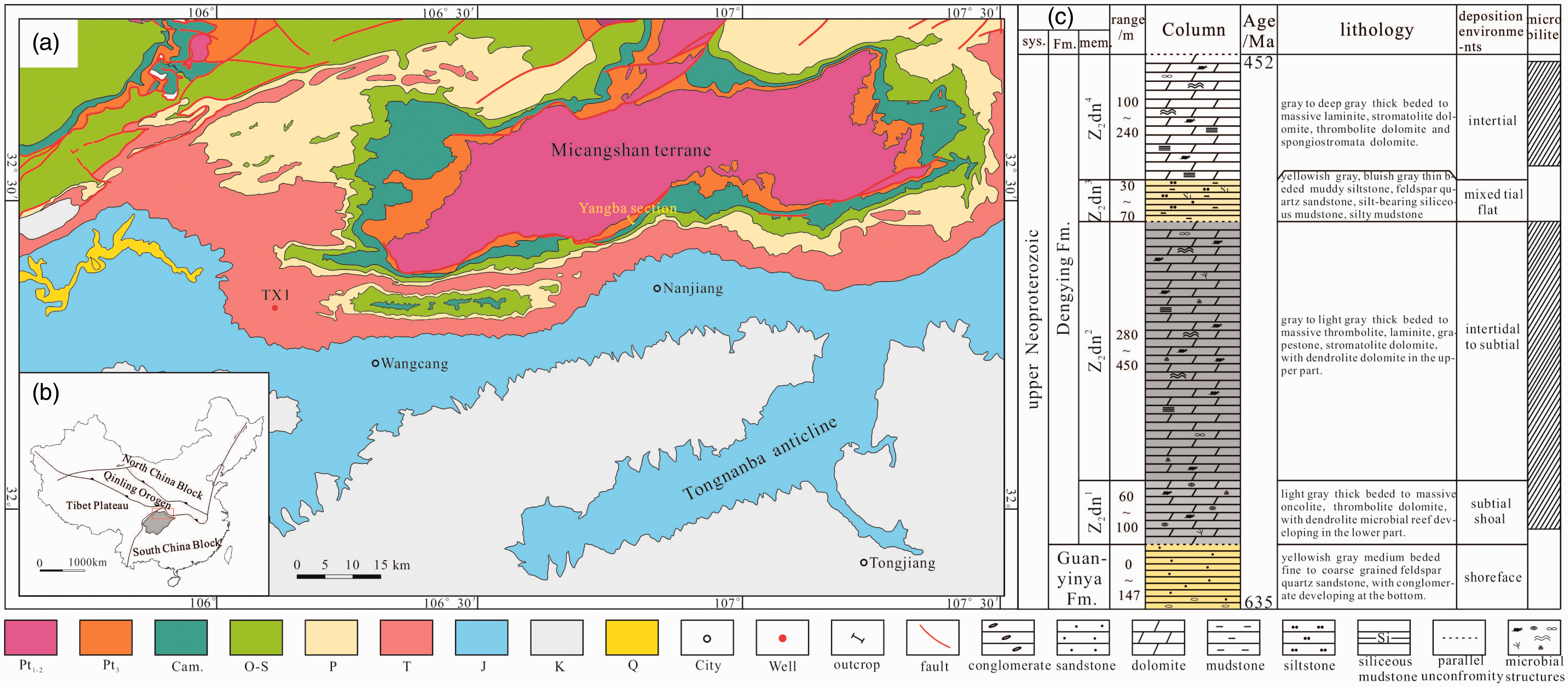
Geological settings
Sichuan Basin lies at eastern margin of Tibetan Plateau in China (Figure 1(b)). The Neoproterozoic strata crop out in Micangshan Terrane (Figure 1(a)), located at the transition between Sichuan Basin and southern margin of Qinling orogenic belt (Li et al., 2011; Liu et al., 2011; Figure 1(b)).
During late Neoprotozoic, northern Sichuan Basin was part of south China block constrained by an extensional tectonic regime related to the break-up of Rodinia super-continent (Craig et al., 2009; Lottaroli et al., 2009). This event in China is called Xingkai taphrogenesis (Huang et al., 1980; Li et al., 2008; Liu et al., 2013; Luo, 1981, 1984; Sun et al., 2011). But also, two other tectonic uplift episodes occurred associated with Tongwan movement in Sichuan Basin, which resulted in two regional disconformities located in the middle and at the top of Dengying Formation (Hou et al., 1999; Liu et al., 2015; Wang et al., 2014). In northern Sichuan Basin, Tongwan movement is usually called “Zhenba uplift”, including Dabashan-Micangshan Terrane (Cheng et al., 1992; Yu et al., 2011). The Mianyang-Changning intracratonic sag formed afterwards during early Cambrian (Liu et al., 2013; Song et al., 2013; Zhong et al., 2013).
The Neoproterozoic strata are comprised of Guanyinya and Dengying Formations (Figure 1(c)). The former is mostly yellowish gray, thin to medium bedded, fine to coarse grained feldspar quartz sandstone, with conglomerate at base. It is disconformably overlain by Dengying Formation, which is subdivided into four members according to their lithology structures. These are member Z2dn1 (Deng 1), Z2dn2 (Deng 2), Z2dn3 (Deng 3), and Z2dn4 (Deng 4), which have total thickness of 650 to 1000 m (Luo et al., 2015; Song et al., 2013; Wei et al., 2015; Zou et al., 2014). The light gray, thick layered to massive oncolitic, thrombolitic dolostone dominate in member Z2dn1. The member Z2dn2 is mainly composed of gray to light gray, thick bedded to massive thrombolite, lace-like texture, stromatolite, and dendrolite dolostone. A regional unconformity separates member Z2dn2 from Z2dn3. Above that, yellowish gray, bluish gray, thin bedded argillaceous siltstone, feldspar quartz sandstone, and silty mudstone were deposited in member Z2dn3. The member Z2dn4 is composed of gray to dark gray thick bedded to massive laminite, stromatolite, thrombolite, and spongiostromata dolostone. At top of member Z2dn4 develop the second regional unconformity separating Neoproterozoic from Cambrian. The unconformity is overlain by dark, carbonaceous mudstone, and silty mudstone of lower Cambrian Qiongzhusi Formation.
An initial carbonate platform has been formed in north Yangtze Block during early Neoproterozoic (Yu et al., 2011). It is overlain by marginal-marine siliciclastic sequence of Guanyinya Formation. During Dengying age, the platform was flooded and shallow carbonate platform was built up, in which tidal flat, lagoon, and shallow neritic sediments alternate as sea level fluctuated (Fang et al., 2003; Li et al., 2013; Luo et al., 2015; Song et al., 2013; Wei et al., 2015; Zou et al., 2014). During Z2dn1 stage subtidal flat environment was dominant, while in Z2dn2 stage, subtidal to intertidal flats prevailed. Major lithological change into marginal marine clastics deposited on a shoreline during Z2dn3 age, indicating period of tectonic upheaval. In Z2dn4 stage, carbonate deposition occurred mostly on intertidal flats. Above late Neoproterozoic unconformity, depositional environment suddenly changed into a deep shelf, with black shale well developed (Yu et al., 2011).
Materials and methods
We carried out detailed field investigations, descriptions, and sampling of Yangba section and borehole TX1. We collected 108 samples from Yangba section and 18 from borehole TX1 oil exploratory well. Thin sections, stained with Alizarin Red-S and potassium ferricyanide (Dickson, 1965), were examined under polarized microscope (Nikon Eclipse E600 POL). The microbe forms' identification were compared to photo plates from Emei area, SW Sichuan Basin, published by Yin et al. (1980). Cathodoluminescence (CL) microscopy was performed on a RELIOTRON III stage (Bedford, MA) with a 5 to 8 kV beam and a current intensity of 300 to 500 μA. Scanning electron microscope–energy dispersive spectrometer (SEM–EDS) analysis have been done on field emission scanning electron microscope (FESEM) (Quanta 250 FEG, USA) and energy spectrometer (Oxford INCAx-max20, UK), using field emission lamp. Porosity and permeability measurement were performed on automated permeameter-porosimeter (AP-608, USA). All analyses were carried out at China State Key Laboratory of Oil and Gas Reservoir Geology and Exploitation.
Results and discussion
Microbes in the upper Neoproterozoic Dengying Formation
According to the fossil discrimination and plate comparison in Sichuan Basin (Yin et al., 1980) and Australia (Lemon, 2000), we identified 13 microbe forms, one oncolite form, and two stromatolitic structures in Dengying Formation. The microbial forms include Trachysphaeridium, Tortofimria, Balios, Praesolenopora, Siphonia, Gleorrh, Renaclis-resembling, Paleomicrocystis, Actinophycus, Acus muricatus, Phacelofimbria, Girvanella-resembling, and Epiphiton-resembling. Meanwhile, the Osagia oncolite, stratifera, and Baicalia stromatolite are also found out.
The Trachysphaeridium is defined by the condensed globular cluster, micritic walls and hollow cavity filled with dolospar and lined by isopachous fibrous rims (Figure 2(a)). The Tortofimria is bubble-like in morphology, micritic walls and hollow cavity filled with dolospar, with rounded, oval or even polygonal chambered structures (Figure 2(b)), which are similar to the equivalent in Namibia (Grotzinger et al., 2000; Wallace et al., 2015). The Balios is dense spotty like morphology, consisting of irregular, unbranching, non-tapering micritic threads with micritic walls and dolospar cavity (Figure 2(c)). The Praesolenopora is tube-like in shape, with micritic walls and dolosparite filled intra skeletal voids (Figure 2(d)), which is similar in the early Neoproterozoic, northwestern Canada (Batten et al., 2004). The Siphonia is in cone shape, with micritic walls and dolosparite cemented voids (Figure 2(e)). The Gloeorrh is related to clots with irregular, dispersed, closely packed, or grade into massive micrite in morphology, with dolosparite in coelom, fibrous dolomite rimming cavity (Figure 2(f)). The Renaclis-resembling is showing chambers and dendritic growth structure, forming very porous framework with fibrous isopachous dolomite microspar rims around the colonies (Figure 2(g)), which is reported in Neoproterozoic of western and southern Australia (Lemon, 2000; Wallace et al., 2015). The Paleomicrocystis is circular or globular, dolomicrite inside, and dolosparite cemented inner coelom cavity (Figure 2(h)), which has been described in upper Neoproterozoic in Emei area, SW Sichuan Basin (Yin et al., 1980). The Actinophycus is like branching, short, radiated micritic threads rooting from clot fabrics (Figure 2(i)). The Acus Muricatus occur like short micritic thorns in morphology, densely-radiated perpendicular to the lamination (Figure 2(j)). The Phacelofimbria is in fasciculate growth, radiated hollow tubules with micritic walls (Figure 2(k)). The Girvanella-resembling is unbranching, non-tapering micritic tubules with micritic walls forming horizontal lamination (Figure 2(l)). The Epiphiton-resembling is dark, clotted, branching texture, with dolospar cemented dendrolite framework pores (Figure 2(m)), which is similar to the equivalent in southern Australia (Lemon, 2000). The Osagia oncolite is characterized by the irregularly concentric lamination, ranging in diameter from 2 to 3 mm (Figure 2(n)). The stratifera stromatolite is in wavy laminated microstructure, with light colored and dark colored lamination alternated (Figure 2(o)). The Baicalia stromatolite is wry or lodging laminated in morphology, sometimes together with wavy lamination (Figure 2(p)).
Microbe forms identified in Dengying Formation in North Sichuan Basin. (a) Trachysphaeridium, in cavity individuals have isopachous fibrous rims (arrow), ybc-33-2b, member Z2dn2. (b) Tortofimria, bubble-like morphology, ybc-45-3b, member Z2dn2. (c) Balios, dense spotty like morphology (arrow), with dolosparite filling in the coelom, ybc-33-2b, member Z2dn2. (d) Praesolenopora, tube-like in shape (arrow), with dolomicrite comprising the tube outer wall and dolosparite filling intra skeletal voids, ybc-33-4b, member Z2dn2. (e) Siphonia, cone shape (arrow), dolosparite cemented voids, ybc-31-1b, member Z2dn2. (f) Gloeorrh, forming clots, with dolosparite in coelom, fibrous dolomite rimming the cavity, ybc-25-3b, member Z2dn2. (g) Renaclis-resembling, forming very porous framework, with fibrous dolomite rims between colonies, ybc-18-2b, member Z2dn2. (h) Paleomicrocystis, dolosparite filling inner coelom, ybc-29b, member Z2dn1. (i) Actinophycus, branching radiation, ybc-17-6b, member Z2dn2. (j) Acus Muricatus (yellow arrow), lamination with Siphonia (red arrow), occurring like short thorns in morphology, ybc-27b, member Z2dn1. (k) Phacelofimbria, fasciculate growth, ybc-28b, member Z2dn1. (l) Girvanella-resembling, ybc-7b, member Z2dn1. (m) Epiphiton-resembling, forming dendrolite, ybc-2b, member Z2dn1. (n) Osagia oncolite, with irregularly concentric lamination, ybc-3b, member Z2dn1. (o) Stratifera stromatolite, ybc-62-5b, member Z2dn4. (p) Baicalia stromatolite, ybc-63-6b, member Z2dn4. All the samples are collected in Yangba section, with location shown on
Figures 5 and 6. All the above photographs were taken under plain polarized light.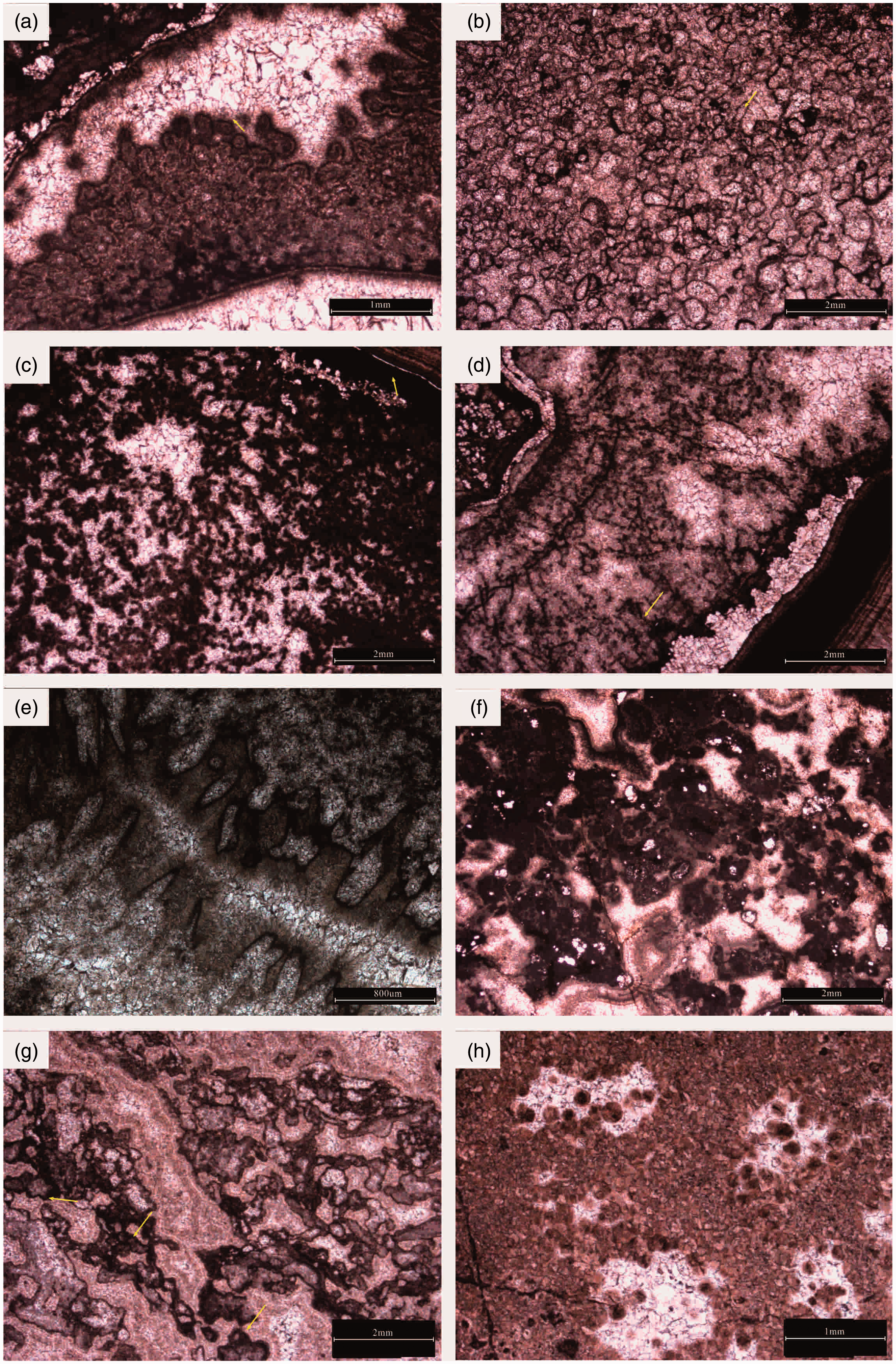
Petrologic textures of microbial carbonates in Dengying Formation
The microbial carbonates are present in the member Z2dn1, Z2dn2, and Z2dn4 of Dengying Formation. The member Z2dn1 and Z2dn2 deposited successively, therefore, they are discussed together. Through study of thin section, nine microbial petrology textures in the carbonates of member Z2dn1 and Z2dn2 have been recognized. They are including laminite (Figure 2(j), (l)), peloid wackestone (Figure 2(h)), stromatolite, thrombolite (Figure 2(f), (o)), oncolite (Figure 2(n)), spongiostromata stone (Figure 2(b)), dendrolite (Figure 2(m)), dolostone with lace-like texture, and coated grainstone. Texturally thrombolites are dominant (>50%), followed by laminites (10%) and oncolites (9.16%) (Figure 3).
Quantitative occurrence of petrologic textures in carbonates of the member Z2dn1 and Z2dn2 in North Sichuan Basin.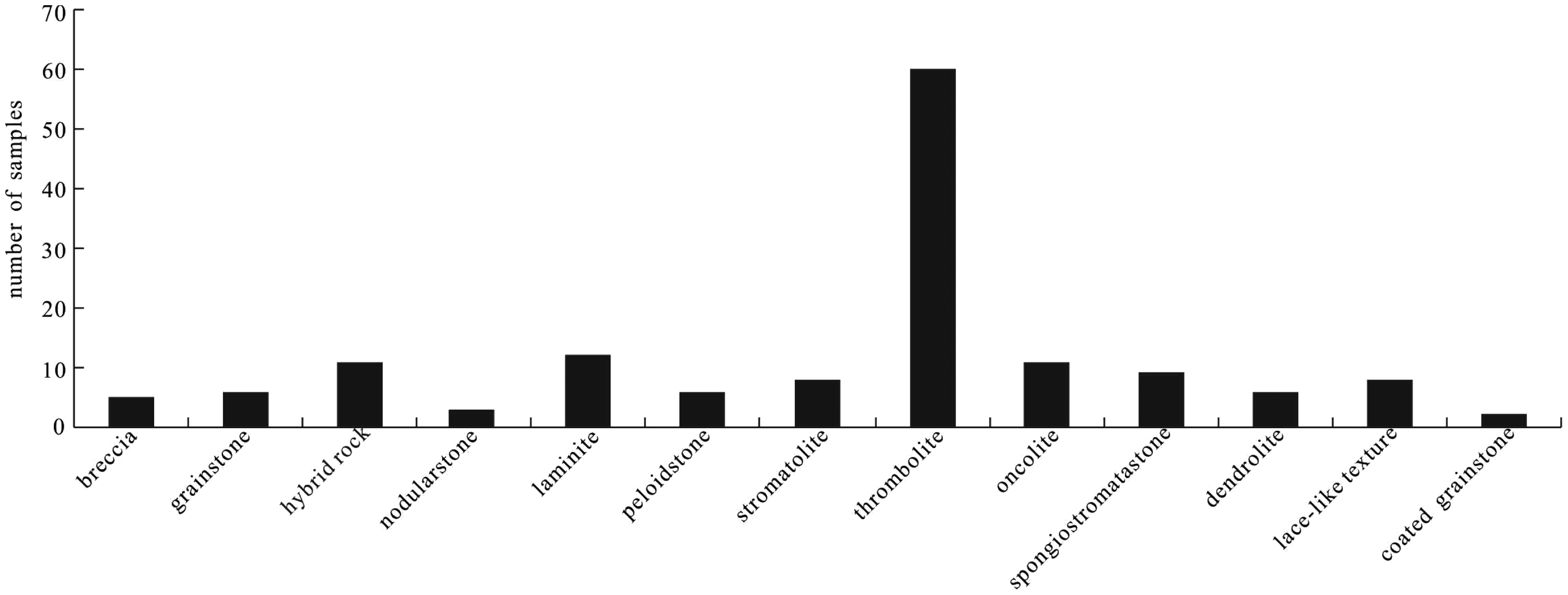
In member Z2dn4, breccia, grainstone, hybrid rock, laminite, peloid wackstone, stromatolite, thrombolite, spongiostromata stone, and limestone are developed (Figure 4), of which laminites and stromatolites are predominate (64.8%). The stromatolite lamination with densely packed filaments (Figure 2(o)–(p)) is similar to early Neoproterozoic Little Dal Group calcimicrobial reefs in northwestern Canada (Batten et al., 2004). It appears that different microbe forms, or assemblages occur in different microbialite textures. Thrombolites are associated with Gloeorrh, Paleomicrocystis, Renaclis, and Trachysph-aeridium. Spongiostromatastone are constructed by Tortofimria. Dendrolites are formed by Epiphiton-resembling. Grapestones are usually formed by Trachysphaeridium, Siphonia, Praesolenopora, and Phacelofimbria. Laminites and stromatolies mostly contain Tortofimria, Balios, Girvanella-resembling, Acus Muricatus, and Siphonia. The coated grainstone are formed by Tortofimria, Praesolenopora, Phacelofimbria, and Actinophycus.
Quantitative occurrence of petrologic textures in carbonates of the member Z2dn4 in North Sichuan Basin.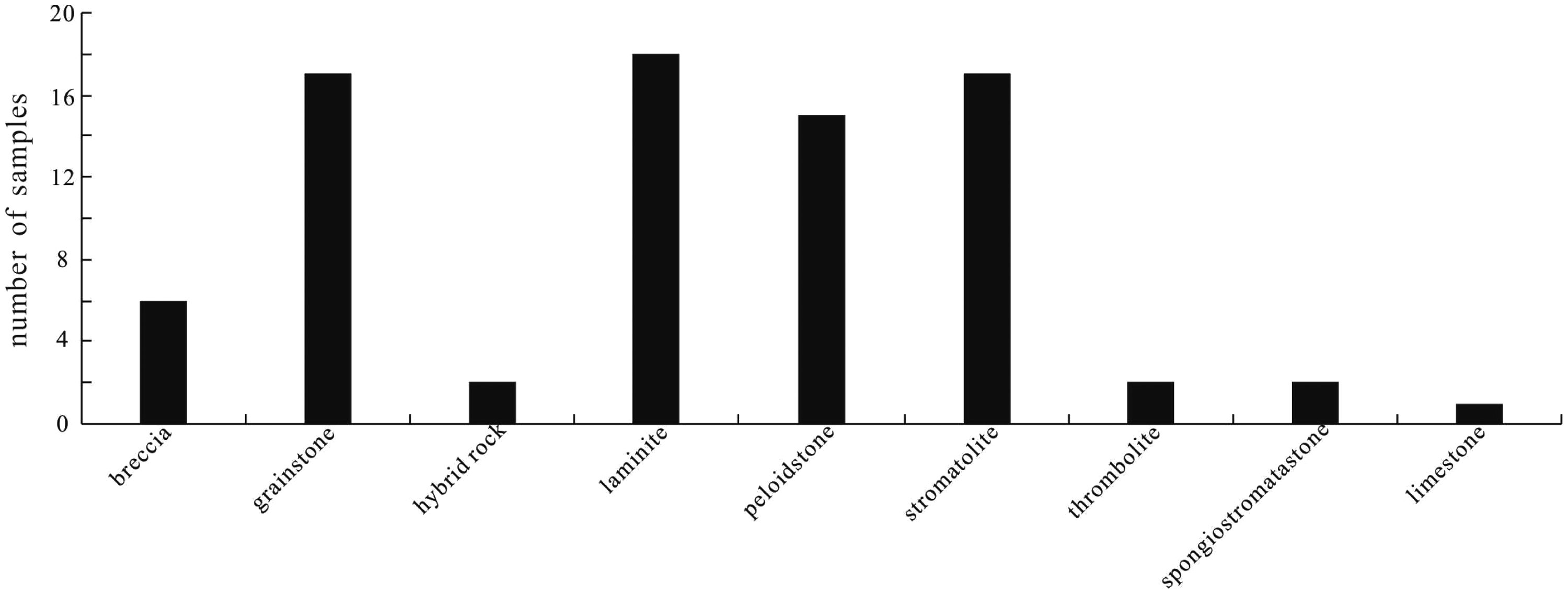
Evolution of microbial form assemblages and depositional environments
Microbe form assemblages change vertically in Dengying Formation. The lower part of member Z2dn1 are formed by Epiphiton–Phacelofimbria–Actinophycus (EPA) assemblages which are gradually changing into Tortofimria–Paleomicrocystis–Praesolenopora (TPP) assemblages in the middle and Gloeorrh–Balios (GB) assemblages at top. In member Z2dn2, the Phacelofimbria–Actinophycus–Tortofimria–Gloeorrh–Renaclis (PATGR) assemblages dominate in the lower part, with Trachysphaeridium–Praesolenopora–Gloeorrh–Balios (TPGB) assemblages in the middle and Balios–Tortofimria–Gloeorrh–Paleomicrocystis (BTGP) assemblages at top. The microbialites textures have changed from laminite–thrombolite– spongiostromata stone, thrombolite–stromatolite to laminite–thrombolite–spongiostromatastone from bottom upwards (Cycle II to IV in Figure 5), with thickness of 214.1 m, 113.3 m, and 114.6 m in each part, respectively. But in member Z2dn4 are mostly represented by Balios–Tortofimria–Gloeorrh (BTG) assemblages, with laminite–stromatolite, laminite– peloidwack stone in the lower part, and thrombolite–spongiostromata stone–stromatolite in the upper part (Figure 6).
Columnar representation of microbial carbonates in the member Z2dn1 and Z2dn2 in North Sichuan Basin. Seri.: series; FM: formation; Mebr: member; Rsv: reservoir; str: structure; lamin: lamination; dolo: dolostone; stroma: stromatolite; spongios: spongiostromata stone; S: shale; M: micrite; F: dolosiltite; X: doloarenite; Z: medium-crystalline dolomite; C: coarse-crystalline dolomite; L: dolorudite or reef. Columnar profile of microbial carbonates in the member Z2dn4 in North Sichuan Basin. Seri.: series; FM: formation; Mebr: member; Rsv: reservoir; str: structure; lamin: lamination; dolo: dolostone; stroma: stromatolite; spongios: spongiostromata stone; S: shale; M: micrite; F: dolosiltite; X: doloarenite; Z: medium-crystalline dolomite; C: coarse-crystalline dolomite; L: dolorudite or reef.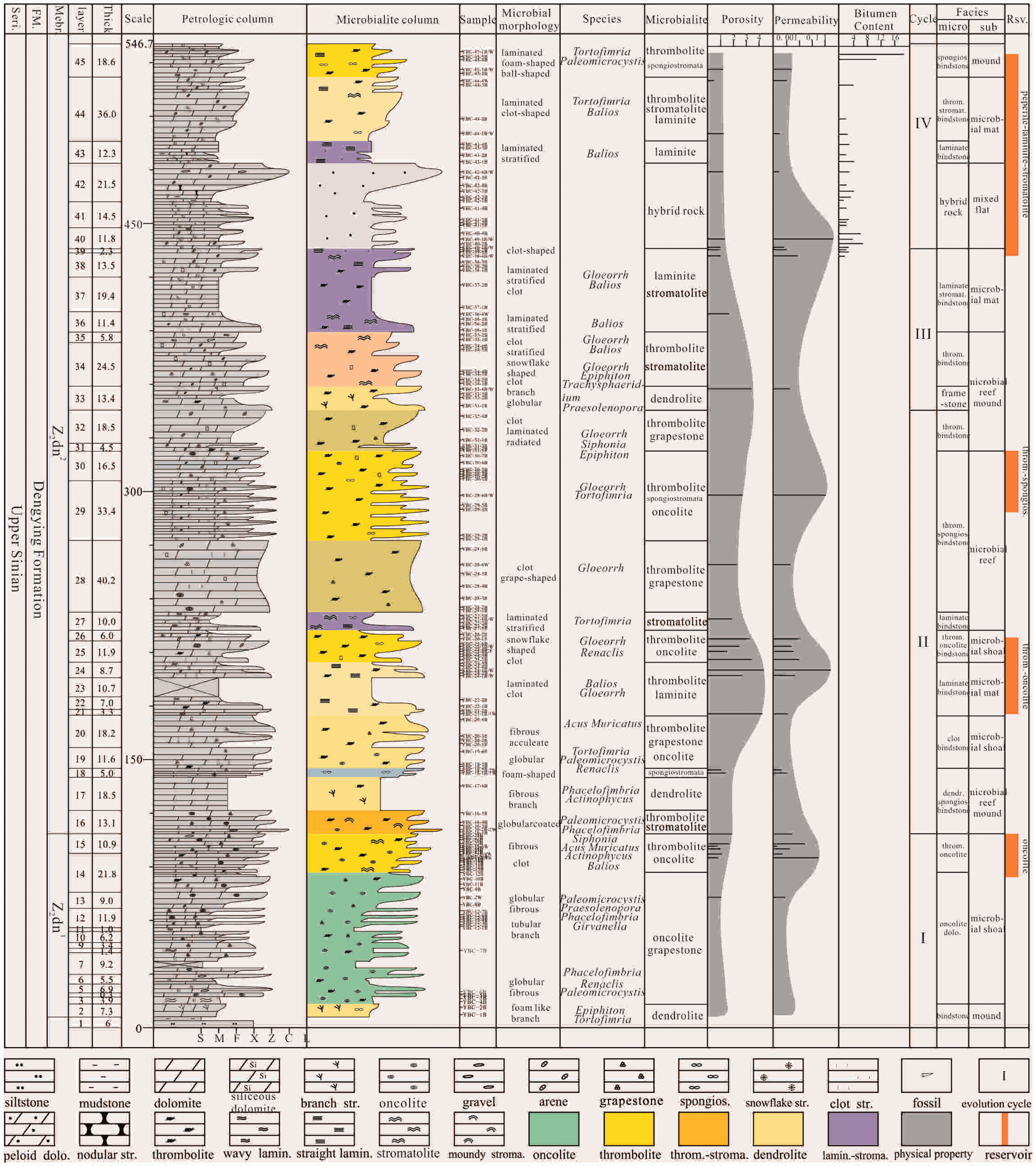
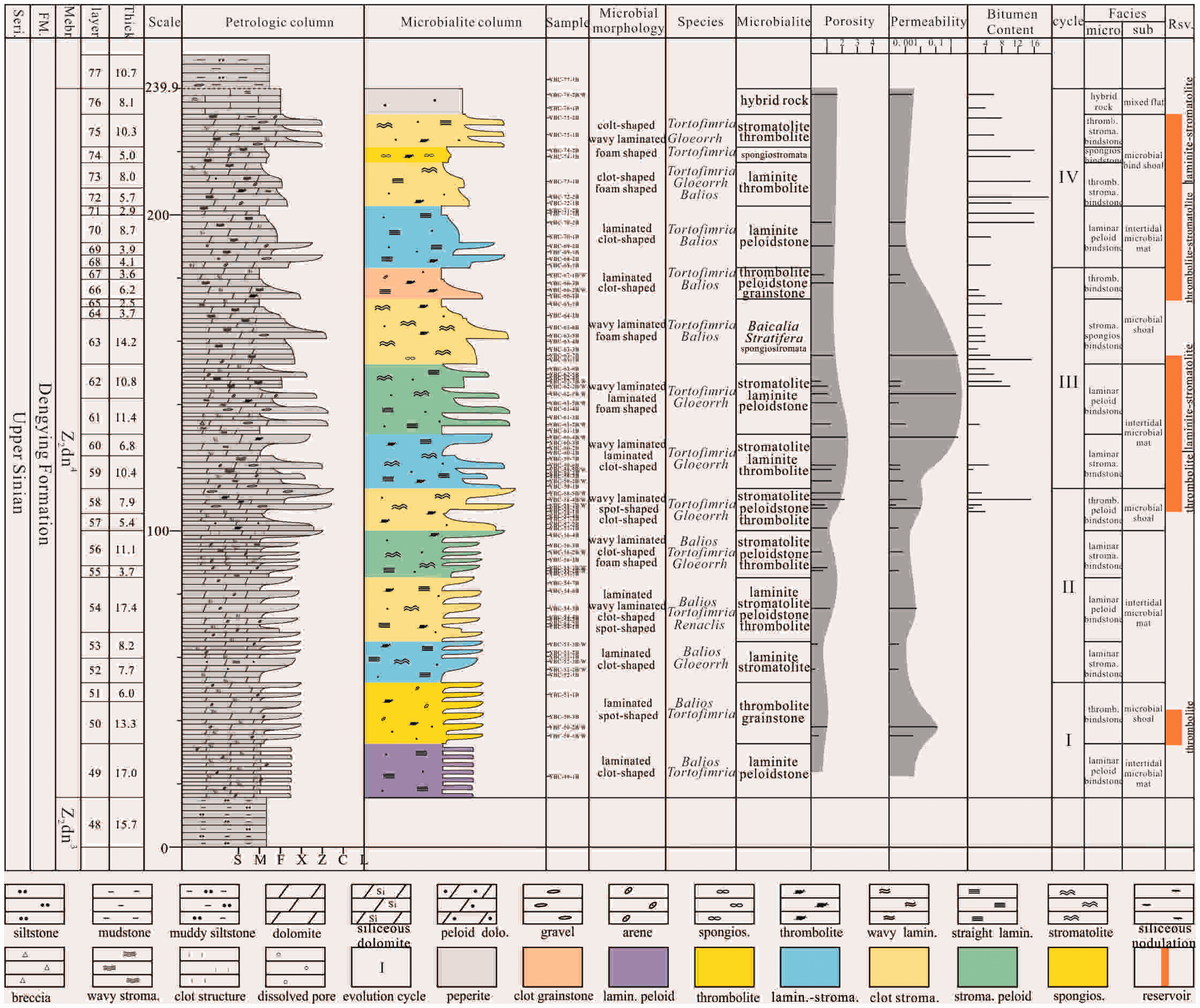
The variation in microbe form assemblages and microbialite textures indicate minor changes in depositional environments. The microfacies in member Z2dn1 are mostly microbial bindstone, oncolite, and thrombolitic dolostone forming thick layered to massive shoal or reef mound in macroscale, indicating subtidal environments. The microfacies in member Z2dn2 consist of thrombolite–spongiostromata stone and laminite–stromatolitic dolostone forming massive reef or laminated depositional structure, suggesting environments changing from subtidal microbial reef into intertidal microbial mat (Figure 5). In member Z2dn3, presence of silty dolostone and silty mudstone indicate coastal marine settings and hybrid tidal flats. The laminite, stromatolite, thrombolite, and spongiostromata dolostone dominate in the microfacies of member Z2dn4, forming straight lamination, wavy lamination or stromatolite mound in macroscale, deposited at intertidal flats, with microbial mats at the lower part and microbial shoal near the top (Figure 6).
Reservoir characteristics of microbial carbonates of Dengying Formation
The microbial carbonate reservoirs occur in member Z2dn1, Z2dn2, and Z2dn4. Member Z2dn1 are mostly comprised of oncolitic dolostone, which are non-oil-saturated and 24.3 m thick (Figures 5 and 7(a)). In the outcrop section, the oncolitic reservoirs are located at top with dissolved pores cemented by dolosparite (Figure 7(b)). The physical property experiments showed a small porosity (0.73%–1.43%) and a low permeability (0.0003 × 10⁻³µm2–0.15 × 10⁻³ µm2).
Microbial carbonate reservoirs' characteristics of the member Z2dn1 and Z2dn2 in Yangba section, North Sichuan Basin. (a) Field outcrop of oncolitic dolostone reservoir in member Z2dn1, person for scale, the red square marks location of photo B, layer 15. (b) Mesoscale view of oncolite dolostone reservoir, with dissolved pores (arrow). (c) The first reservoir interval of member Z2dn2 with massive thrombolite, dolostone with lace-like texture, person for scale, the red square cover is the location of photo E, layer 20-22. (d) Mesoscale view of thrombolite, dolostone with lace-like texture reservoir, with dissolved pores rimmed by isopachous fibrous cement (arrow), layer 21. (e) The third reservoir interval in member Z2dn2, mostly comprised by thrombolite and laminite, layer 40-43. (f) Close view of laminite reservoirs with oil-saturation along lamination (arrow), layer 40. (g) Thrombolite reservoirs, with dissolved pores lined by isopachous fibrous rim cement (red arrow) and GDC (black arrow), ybc-20-2b. (h) Thrombolite reservoirs, with recrystallization, ybc-45-3b. GDC: granular dolosparite cement.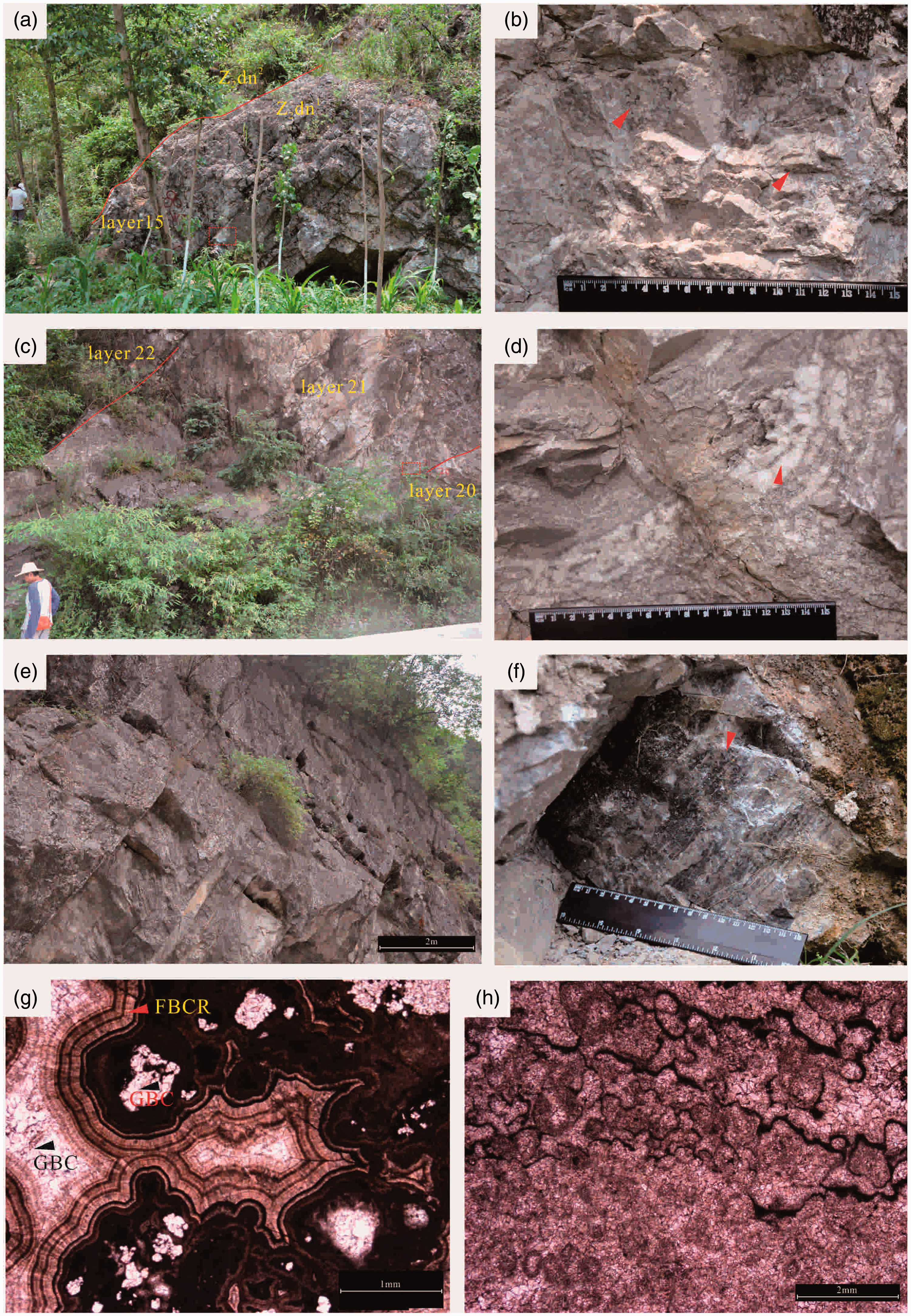
Three microbial carbonate reservoir intervals are developed in member Z2dn2, with total thickness of 190 m (Figure 5). The first reservoir interval, of massive appearance in the lower part (Figure 7(c)), is mostly composed of thrombolitic and oncolitic dolostone. It is non-oil-saturated and 42.8 m thick. Some remnant microbial reef framework cavities, botryoidal-like, and dissolved pores among clots could be seen on mesoscale (several tens of meter in view) (Figure 7(d)). The fibrous isopachous cement (FIC) is lining the framework pores and cavities, while a coarser granular dolosparite cement (GDC) is filling center of the pores in inter and intra clots (Figure 7(g)). The physical property experiments showed a porosity of 1.55%–4.33% with 2.94% on average and a permeability of (0.011–4.488) × 10−3 µm2 with 0.755 × 10⁻³ µm2 on average. The second reservoir interval developed in the middle part. It is comprised of thrombolite and spongiostromata dolostone. It is non-oil-saturated and 34.5 m thick. The porosity ranges from 2.71% to 3.42% and the permeability varies from 0.0025 × 10⁻³ µm2 to 1.531 × 10⁻³ µm2. The third reservoir interval of 112.8 m thick totally is near the unconformity, at top of the member Z2dn2. The microfacies in this interval are dominated by laminite, stromatolite, thrombolite, and spongiostromata dolostone. They are massive on macroscale (Figure 7(e)), clotted, or bedded in texture and oil-saturated on mesoscale (Figure 7(f)). The dissolved pores in the thrombolite are filled by dolospar (Figure 7(h)) and bitumen, 2%–5% in content, ranging from the unconformity surface down to 117 m in depth (Figure 5). The reservoirs are also of low porosity (0.50%–1.33%, 1.065% on average) and low permeability (0.0008×10⁻³μm2–5.9040×10⁻³ µm2, 0.9851 × 10⁻³ µm2 on average).
The microbial carbonates of member Z2dn4 also occur in three reservoir intervals, with a total thickness of 119.7 m. The first reservoir interval is located in the lower part. It is non-oil-saturated and dominated by the thrombolitic and laminite dolostone. It is massive on macroscale and 11 m thick. Few healed fractures can be seen in a closer view, as they are cemented by white dolospar. The porosity ranges from 0.46% to 1.03% and the permeability varies from 0.0048 × 10⁻³ µm2 to 0.2059 × 10⁻³ µm2. The second reservoir interval is located in the middle part of the member. It is 49.5 m thick, and comprised of laminite, stromatolitic, and thrombolitic dolostone (Figure 8(a)). It contains 3% to 15% of bitumen, located along laminations (Figure 8(b) and (e)). The potential reservoirs have small porosity (0.61–2.25%, 1.36% on average) and low permeability (0.0006–4.5183 × 10⁻³ µm2, 0.4641 × 10⁻³ µm2 on average). The last, uppermost reservoir interval is found in the upper part of member Z2dn4, near the unconformity. It is 59 m thick in total and mostly comprised of laminite, stromatolitic, and thrombolitic dolostone. A stromatolite mound can be seen in outcrop section Yangba (Figure 8(c) and (d)) with oil permeated along layers boundaries (Figure 8(f)). Under microscope, the reef mound contains laminite to stromatolite, with fenestra pores oil-saturated and bitumen content up to 18%. The bitumen-bearing intervals are present near the second unconformity, extending vertically from unconformity surface down to 134.2 m (Figure 6). Physical property tests showed the porosity ranging from 1.31% to 1.67% and the permeability varying from 0.0013 × 10⁻³ µm2 to 0.0046 × 10⁻³ µm2.
Features of microbial carbonate reservoirs of the member Z2dn4, in Yangba section, North Sichuan Basin. (a) The second interval with fractured laminite-stromatolite, layer 60-62. (b) Mesoscopic scale show laminite texture, with oil-saturation along lamination as well as in spot (arrow), layer 61. (c) The third reservoir interval, mostly comprised by laminite-stromatolite, forming mound in morphology (yellow line), layer 70-73. (d) Close view of laminite-stromatolite reservoirs with oil-saturation along layers (arrow), forming small-scale mound in morphology (yellow line), layer 73. (e) Laminite reservoirs with oil-saturation along lamination (arrow), ybc-62-3b. (f) Stromatolite dolomite reservoirs with dark dolomicrite lamination separated by microdolospar, with dissolution fenestra pores filled by bitumen, ybc-73-1b.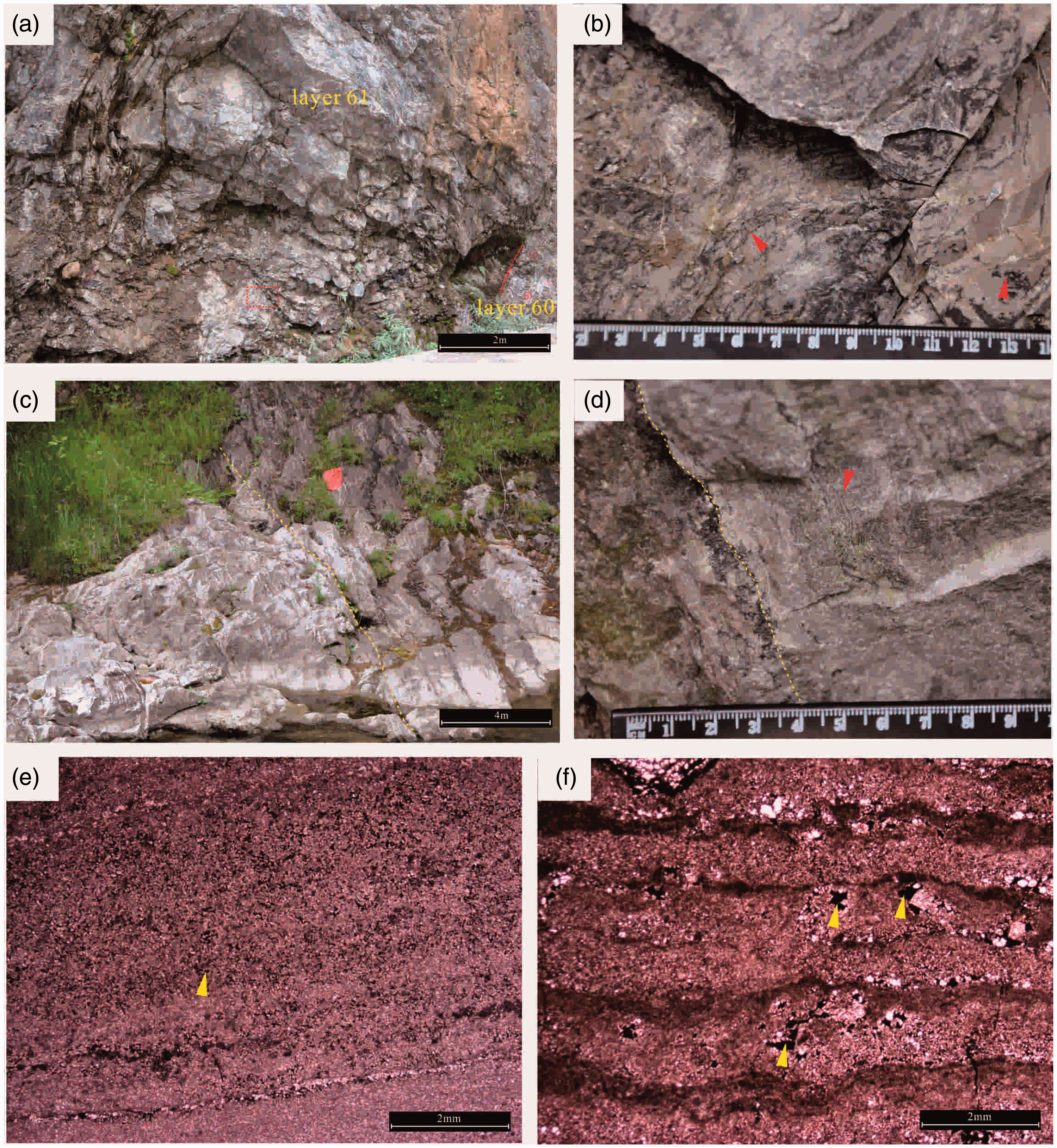
Mechanisms creating microbial carbonate reservoirs of the Dengying Formation
Microbial mediated dolomitization
Recent research on dolomitization showed that microbes can induce precipitation of dolomite under lower temperature and anaerobic conditions (Gebelein and Hoffman,1973; Kenward et al., 2013; Vasconcelos and McKenzie, 1997). Such type of protosomatic microbial dolomites are found in the modern Vermelha lagoon, Brejo do Espinho lagoon in Brazil, living coralline algae in the Heron Island of southern Great Barrier Reef, and the coastal sabkha area in Abu Dhabi of United Arab Emirates (Nash et al., 2011; Sadooni and Howari, 2010; Vasconcelos and McKenzie, 1997, 2000; Yvonne et al., 2003).
The Neoprotozoic marine environment was rich in aragonite, high Mg-calcite and dolomite, had higher Mg/Ca ratio, higher alkane, lower sulfate concentration, higher PCO2, and lower PO2; Importantly, the microbes were thriving during that time (Fang et al., 2003; Partin et al., 2013; Pelechaty et al., 1996; Planavsky et al., 2014; Zou et al., 2014). Under microbial mediation or organic mineralization, dolomite or fibrous dolomite cement could precipitate directly from seawater (Ashleigh et al., 2011). The globular, U-shape, vase-shape and fibrous microbial dolomite have been recognized under the FESEM (Figure 9(a), (c), (e), (g)) from the Dengying Formation samples in North Sichuan Basin. Besides, EDS spectrum show typical composition of dolomite crystals for those microbial mediated textures (Figure 9(b), (d), (f), (h)), which are similar to microbial mediated dolomites in the Vermelha lagoon, Brejo do Espinho lagoon in Brazil (Sánchez-Román et al., 2008; Vasconcelos and McKenzie, 1997, 2000), Northern Calabria in southern Italy (Mastandrea et al., 2006) as well as in the modern anoxic and low temperature culture experiments (Vasconcelos et al., 1995; Warthmann et al., 2000).
Morphology of microbial mediated dolomites of Dengying Formation under FESEM and EDS analysis, North Sichuan Basin. (a) Globular bacterial colony in member Z2dn2 with diameter ∼1 µm; the red arrow is for EDS analysis; ybc-33-2b. (b) EDS spectrum shows a composition of the impure dolomite in (a). (c) U-shaped microbial mediated textures with diameter ∼2 µm in member Z2dn1; the red arrow is for EDS analysis; ybc-12-2b. (d) EDS spectrum shows a typical composition of the dolomite crystals in (c). (e) Fibrous microbial mediated cement with sharp edged crystals enveloping large dolospar crystal in the lower left corner; the red arrow is for EDS analysis; member Z2dn2, ybc-30-2b. (f) EDS spectrum shows a typical composition of the ferrodolomite crystals in (e). (g) Vase-shaped microbial mediated coarse crystalline dolospar, and the red arrow is for EDS analysis; member Z2dn1, ybc-12-2b. (h) EDS spectrum shows a typical composition of the dolomite crystals in (g). EDS: energy dispersive spectrometer; FESEM: field emission scanning electron microscope.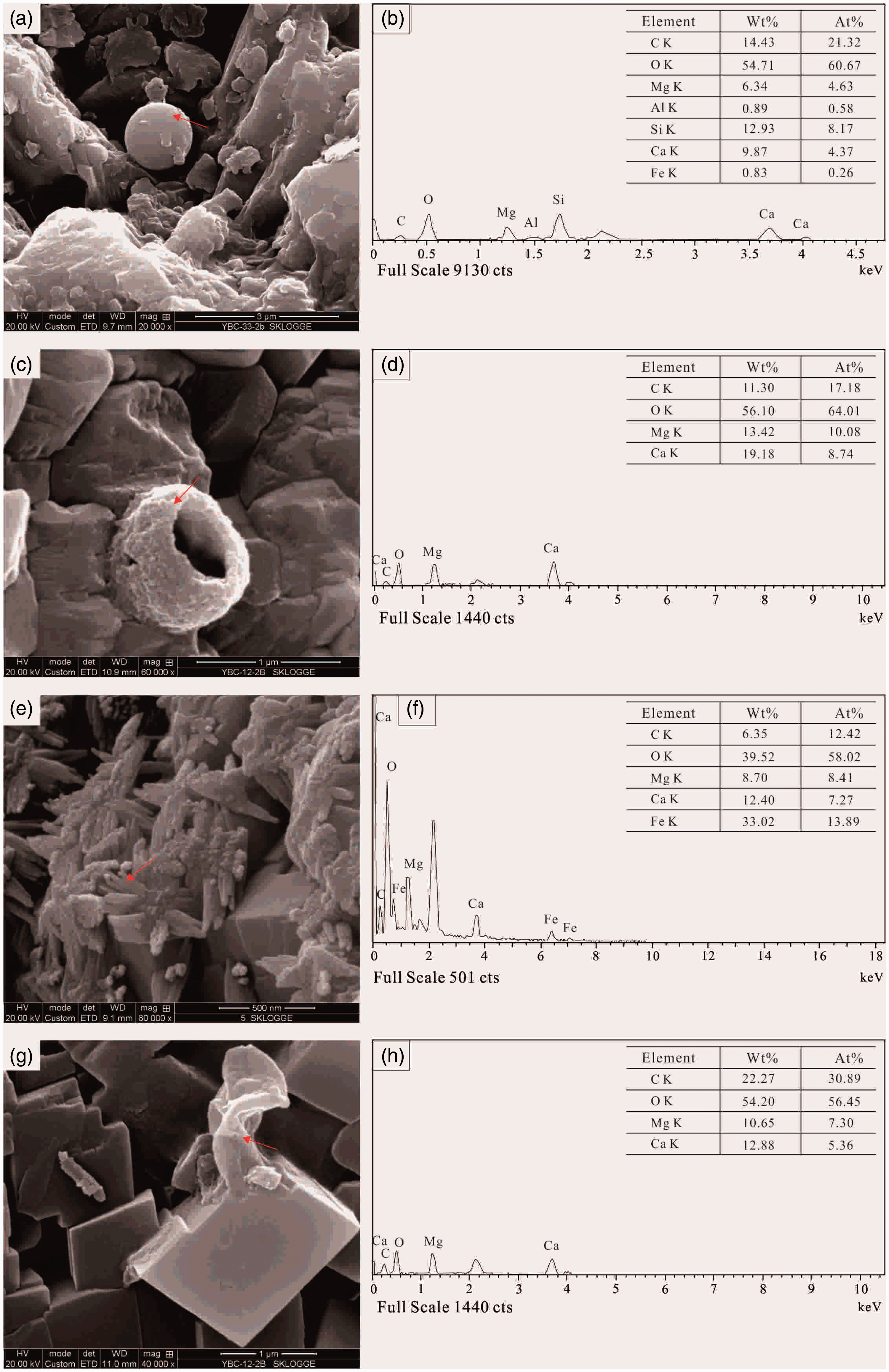
Mechanisms of microbial carbonate reservoir development in Dengying Formation
Deduced by combination of thin section study and CL analysis, the microbial carbonates of member Z2dn1 and Z2dn2 have experienced the following diagenetic processes.
(1) Microbial mediated dolomitization Protosomatic microbial dolomite precipitated from late Neoproterozoic seawater (Figure 9), which is subhedral to anhedral crystalline in micrite size, and orange in CL. (2) Microbial micritization The microbial micritization develop in the early diagenetic stage, mostly lining the margin of the clots to form dark micrite envelop, colorless under CL (Figure 10(a), (b)). (3) Marine cementation After the microbial micritization, the strata fluids are still marine water. And then, the intra framework pores are cemented by dolosparite with the saturation increased, colorless under CL (Figure 10(a), (b), (e), (f)).
Diagenesis of microbial carbonate reservoirs in the member Z2dn1 and Z2dn2, North Sichuan Basin. (a) Thrombolite with isopachous fibrous rim cement and coarse dolospar, member Z2dn2, ybc-26-2b. (b) The CL photo of (a), showing the diagenetic processes: microbial micrite precipitation (black arrow) → marine cementation within the framework (yellow arrow) → fresh water dissolution (white arrow) → the first fibrous botryoidal cement rim (FBCR) precipitation (blue arrow) → the first stage of shallow burial dissolution (green arrow). (c) Thrombolite with documents complexity and heterogeneity of Proterozoic microbiolites. The algae in thrombolite were firstly rimmed by black microbial micrite, then lined by isopachous FBCR and after that this type of algae was dissolved; after dissolution the space was infilled by coarse dolosparite, member Z2dn2, ybc-30-7b. (d) The CL photo of (c), the diagenetic process was as follows: fresh water dissolution (white arrow) → the first stage of shallow burial dissolution (green arrow) → the second stage of fresh water dissolution (grey triangle) → the second FBCR precipitation (blue triangle) → late stage burial dissolution (black arrow). (e) Thrombolite with lace-like texture (FBCR encrustation), strongly dissolved then filled by dolospar, member Z2dn1, ybc-3b-2. (f) The CL photo of (e), marine cementation in the framework (yellow arrow) → fresh water dissolution in penecontemporaneous period (white arrow) → the first FBCR (blue arrow) → the first stage of shallow burial dissolution (green arrow) → the second FBCR (blue triangle) → the second stage of shallow burial dissolution (green triangle) → late stage burial dissolution (black triangle). CL: cathodoluminescence. (4) First stage of karstification At the end of Z2dn2 age, the first episode of Tongwan uplift movement happened, with weathering crust karstification and fresh water infilling. Once the fresh water comes into the strata, the clots or thrombolite would be fabric-selectively dissolved. And dolosparite precipitated in the intra-clot dissolved pores when the fluid saturation increased afterwards, orange under CL (Figure 10(b), (d), (f)). (5) First stage of precipitation in the mixing zone After the first stage of karstification, the microbial carbonates are gradually buried. And also, marine water impact the strata again, together with the pre-existed fresh water, showing the diagenetic characteristics of mixing zone. As a result, the first stage of fibrous botryoidal cement rim (FBCR) precipitated, lining inter-clot pores and cavities, with dull red alternated orange under CL (Figure 10(b), (f)). (6) First stage of shallow burial dissolution The first stage of shallow burial dissolution followed after the first stage of FBCR. It is non-fabric-selected, with both clots and the first stage of FBCR being dissolved, and then cemented by dolosparite with dull red under CL (Figure 10(b), (f)). (7) Second stage of karstification At the end of Z2dn4 age, the second episode of Tongwan uplift movement occurred. Although the microbial carbonates in the member Z2dn1 and Z2dn2 were shallowly buried, the fresh water then still join the diagenetic process. Therefore, the second period of fresh water dissolution occurred intra-clot and inter-clot, non-fabric-selected. And afterwards the dissolved pores were filled by equiaxial granular dolomite with orange color under CL (Figure 10(f)). (8) Second stage of precipitation in the mixing zone After the second stage of karstification, the microbial carbonates in the member Z2dn1 and Z2dn2 also undergone the mixing zone environment. Therefore, the second stage of FBCR precipitated, which is much thicker than the first stage, with dull red laminated with orange under CL (Figure 10(d), (f)). (9) Second stage of shallow burial dissolution The second stage of shallow burial dissolution develops along the second stage of FBCR, forming inter-framework or inter-clot dissolved pores. After that, dolosparite precipitated in the dissolved pores, with weakly dull red under CL (Figure 10(f)). (10) Late stage of oil infilling and burial dissolution The microbial carbonates in the member Z2dn1 and Z2dn2 were buried deeply afterwards. The lower Cambrian Qiongzhusi Formation black shale become matured during late Permian to late Triassic (Zou et al., 2014). Then, a great quantity of liquid hydrocarbon migrated into the reservoirs. And the late stage of burial dissolution related with organic acid occurred, which is non-fabric-selected, with inter-framework or inter-clot dissolved pores emerging. Afterwards, dolosparite and bitumen occluded the pores, dull red under CL (Figure 10(d), (f)).
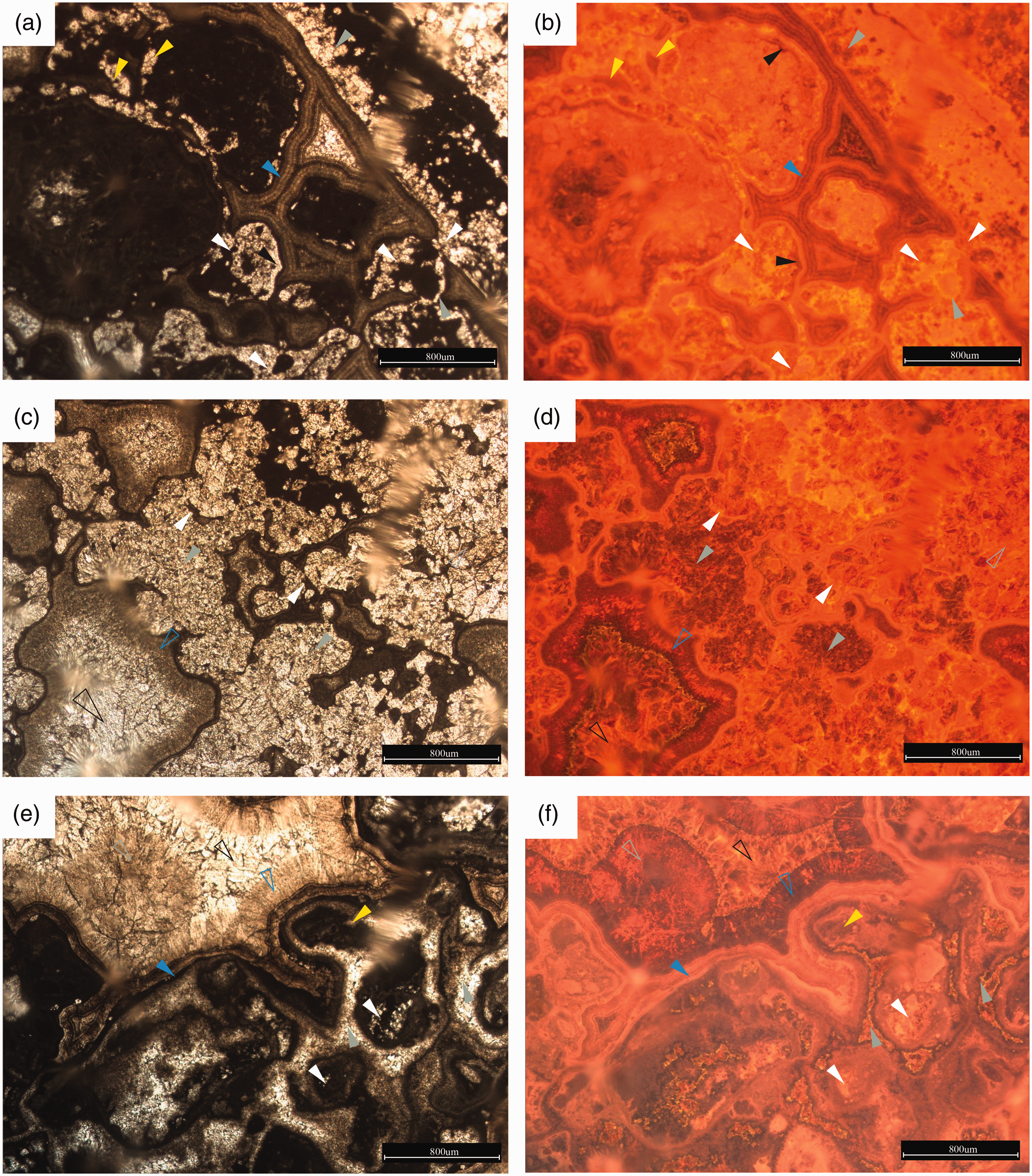
In short, the diagenetic processes of microbial carbonate reservoirs in the member Z2dn1 and Z2dn2 consist of two stages of fresh water dissolution, three stages of burial dissolution, and only one stage of hydrocarbon infilling.
Similarly, the diagenesis of microbial carbonate reservoirs in member Z2dn4 was examined. The diagenetic processes are as follows:
(1) Microbial mediated dolomitization Microbial mediated dolomitization in the member Z2dn4 occurred in the laminite and stromatolite. The light and dark interlayered laminations are of different colors under CL, with light lamination being dull red and dark lamination being shiny red (Figure 11(a), (b)). (2) Marine cementation During the laminite and stromatolite deposition, the strata fluids are marine water. And the marine cementation mostly occurred in the intra framework and fenestra pores, colorless under CL (Figure 11(b)).
Diagenetic processes of microbial carbonate reservoirs in member Z2dn4, North Sichuan Basin. (a) Laminite and stromatolite with dark and light laminations interlayered, fenestra pores being filled by dolosparite, ybc-54-4b. (b) The CL photo of (a), the light lamination show dull red and dark ones being shiny red, however, dolosparite in fenestra pores are no color under CL (black triangle). (c) Spongiostromata dolostone, with dolosparite and bitumen filled in coelom, ybc-63-1b. (d) The CL photo of (c), the diagenesis processes are like this: fresh water dissolution in penecontemporaneous period (yellow arrow) → the first stage of shallow burial dissolution (white arrow). (e) Laminate with layered silicification, ybc-73-2b. (f) The CL photo of (e), showing the first stage of layered silicification (pink arrow) → the first stage of hydrocarbon incoming (blue arrow) → the second stage of laminated silicification (green arrow) → the second stage of hydrocarbon infilling (red arrow). (g) Dissolved pores and fractures among breccia are filled by granular quartz and bitumen, sample ybc-68-1b. (h) The CL photo of (g), showing laminite → fresh water dissolution in penecontemporaneous period (yellow arrow) → the early stage of silicification (pink arrow) → brecciation → the second stage of shallow burial dissolution (white triangle) → the third stage of silicification (blue triangle) → followed by hydrocarbon invasion (grey arrow). CL: cathodoluminescence. (3) Penecontemporaneous karstification The second episode of Tongwan uplift movement lead to penecontemporaneous karstification of member Z2dn4, with fresh water coming into the strata. The fresh water dissolution occurred intra framework, which is fabric-selected, with moldic pores formed. Afterwards the pores were cemented by dolosparite with orange color under CL (Figure 11(c), (d)). Karst breccia is usually composed of laminite (Figure 11(h)). (4) First stage of siliceous fluid infilling The first stage of siliceous fluid occurred in the early diagenesis stage. And the silicification along the lamination, in which the quartz crystalline are of tens of micrometer in size, no color under CL (Figure 11(e), (f)). (5) First stage of oil invasion and shallow burial dissolution Afterwards the member Z2dn4 microbial carbonates were buried gradually. The lower Cambrian Qiongzhusi Formation black shale began to generate liquid hydrocarbon in Silurian (Zou et al., 2014). The oil migrate to the adjacent microbial reservoirs, along the lamination, filling in the fenestra pores (Figure 11(d)). (6) Second stage of siliceous fluid infilling The second stage of siliceous fluid also developed along lamination afterwards, and precipitated granular quartz in the fenestra pores. It was light blue color under CL (Figure 11(f)), indicating hydrothermal activities. (7) Second stage of oil invasion The second stage of hydrocarbon invasion also occurred along lamination, filling into the fenestra pores. But it was much smaller in scale than the first stage of hydrocarbon invasion (Figure 11(f)). (8) Second stage of burial dissolution The second stage of burial dissolution was non-fabric-selected, occurring mostly along the fractures. And it enlarged dissolved inter-particle pores and fractures, precipitated dolosparite with dull red under CL and formed concavo-convex margin along the breccia (Figure 11(h)). (9) Third stage of siliceous fluid infilling The third stage of siliceous fluid infilling occurred in the late stage. And it precipitated granular quartz crystalline of tens to hundreds of micrometers in size, lining along dissolved pores, colorless under CL (Figure 11(g), (h)). (10) Third stage of oil invasion The third stage of oil invasion of the microbial carbonate reservoirs in the member Z2dn4, mostly distributed in the dissolved inter-particle pores and fractures (Figure 11(h)), after the lower Cambrian source rock got maturated during late Permian to late Triassic. It was much larger in scale and more continuous in shape.
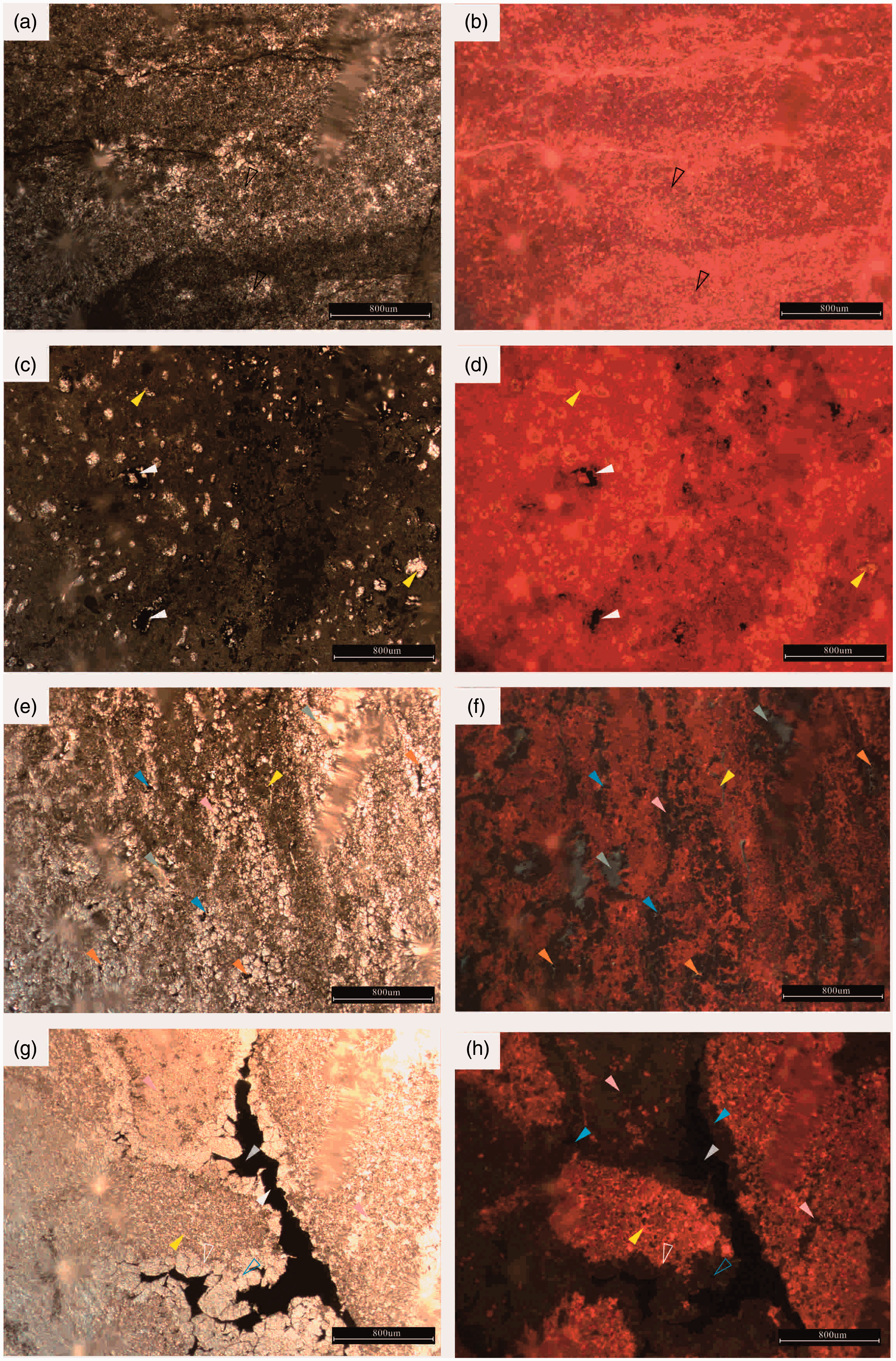
In a word, the constructive diagenetic processes of microbial carbonates in the member Z2dn4 include one period of fresh water dissolution, two stages of burial dissolution, and three stages of hydrocarbon infilling.
Controlling factors on microbial carbonate reservoirs development in Dengying Formation
Primary controls on reservoir quality
According to previous studies on lower Cambrian microbial carbonate reservoirs in Tarim Basin, the different microbial depositional environments and microbial textures or fabrics are the primary controls on reservoir quality (Li et al., 2015; Song et al., 2014). Based on thin section study and physical property experiments, we argue that microbial textures also influence the initial difference of reservoir quality of Dengying Formation. For example, the physical property of different microbial texture reservoirs of member Z2dn1 and Z2dn2 differs. The porosity of thrombolites ranges from 1.01% to 4.33% and permeability varies from 0.0025 × 10⁻³ µm2 to 4.4884 × 10⁻³ µm2. Whereas the porosity of spongiostromata stone varies from 1.07% to 1.18% and permeability from 0.0006 × 10⁻³ µm2 to 0.0039 × 10⁻³ µm2. As for the reservoirs with lace-like texture, the porosity is 1.64%–2.71% and permeability 0.0438 × 10⁻³ µm2. Porosity in oncolites vary from 0.73% to 1.43% and permeability from 0.0003 × 10⁻³ µm2 to 0.15 × 10⁻³ µm2, while in the laminite porosity varies from 1% to 4.29% and permeability from 0.0021 × 10⁻³ µm2 to 0.0087 × 10⁻³ µm2 (Figure 12(a)). Comparing physical properties of above microbialites, the reservoir quality is decreasing gradually from thrombolite, lace-like texture, oncolite, laminite to spongiostromata stone. Similarly, in the member Z2dn4, the reservoir quality drops gradually from thrombolite, stromatolite, laminate, to peloid packstone (Figure 12(b)).
Correlation between microbialite textures and reservoir physical properties in Dengying Formation, North Sichuan Basin. (a) Correlation in the member Z2dn1 and Z2dn2. (b) Correlation of the member Z2dn4.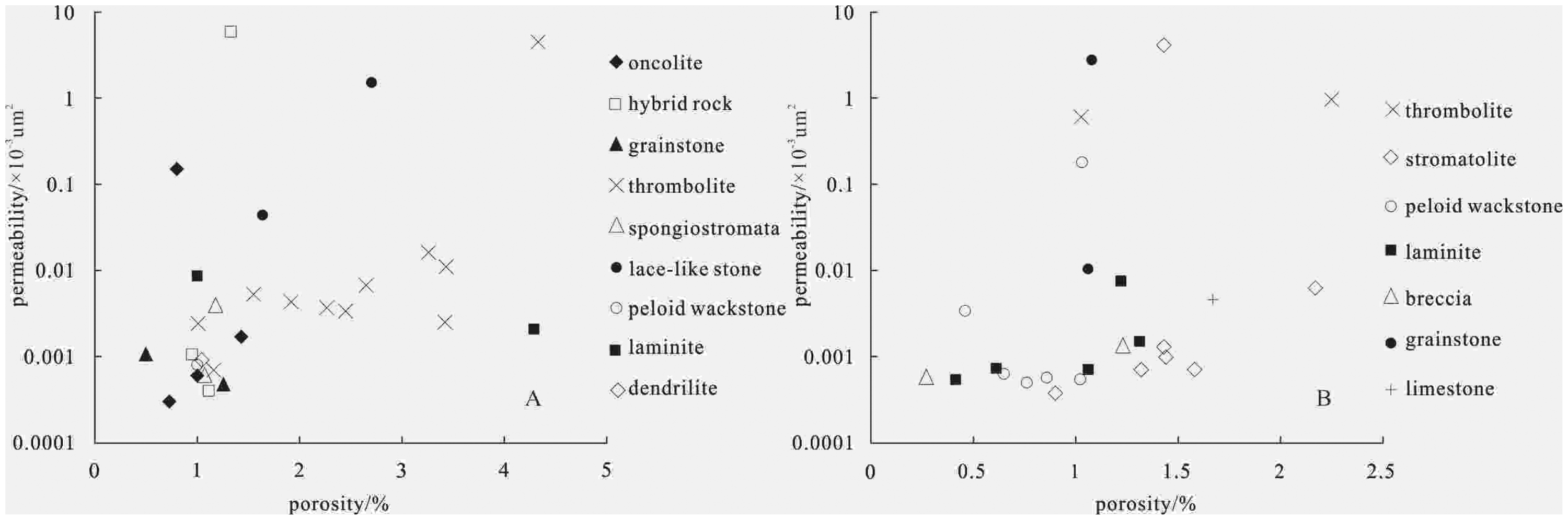
Secondary control on reservoir quality
Two episodes of the Tongwan tectonic uplift during late Neoprotozoic played an important role on the formation of microbial carbonate reservoirs. Previous studies were interested in the role played by karstification associated with the Tongwan movement on carbonate reservoirs in gas field Ziyang, Weiyuan and Central Sichuan Basin (Liu et al., 2008; Luo et al., 2001, 2015; Wang et al., 1996, 1997; Xiang et al., 2001). Recent research has discussed the influences of early Cambrian Mianyang-Changning intracratonic sag on the reservoir modification (Liu et al., 2013, 2015; Song et al., 2013; Figure 13). It has been argued that formation of this intracratonic sag reflected the difference of the weathering and karstification at top of Dengying Formation (Liu et al., 2013, 2015; Song et al., 2013). That is, the intracratonic sag is located where the weathering denudation was greatest, usually in the paleohigh or slope of the karsted topography (Liu et al., 2013, 2015). Therefore, the karst dissolved pores and vugs of Dengying Formation are more frequently close to both margins of the intracratonic sag (Song et al., 2013).
Diagram showing the location of Mianyang-Changning intracratonic sag and gas fields with microbial carbonate reservoirs in Dengying Formation, Sichuan Basin. (a) Location of the intracratonic sag and gas fields in Dengying Formation. (b) Insert-map of location of Sichuan basin. (c) Diagram showing the intracratonic sag controls weathering karstification and burial dissolution along the margins of the sag (modified from Liu et al., 2013, 2014, 2016).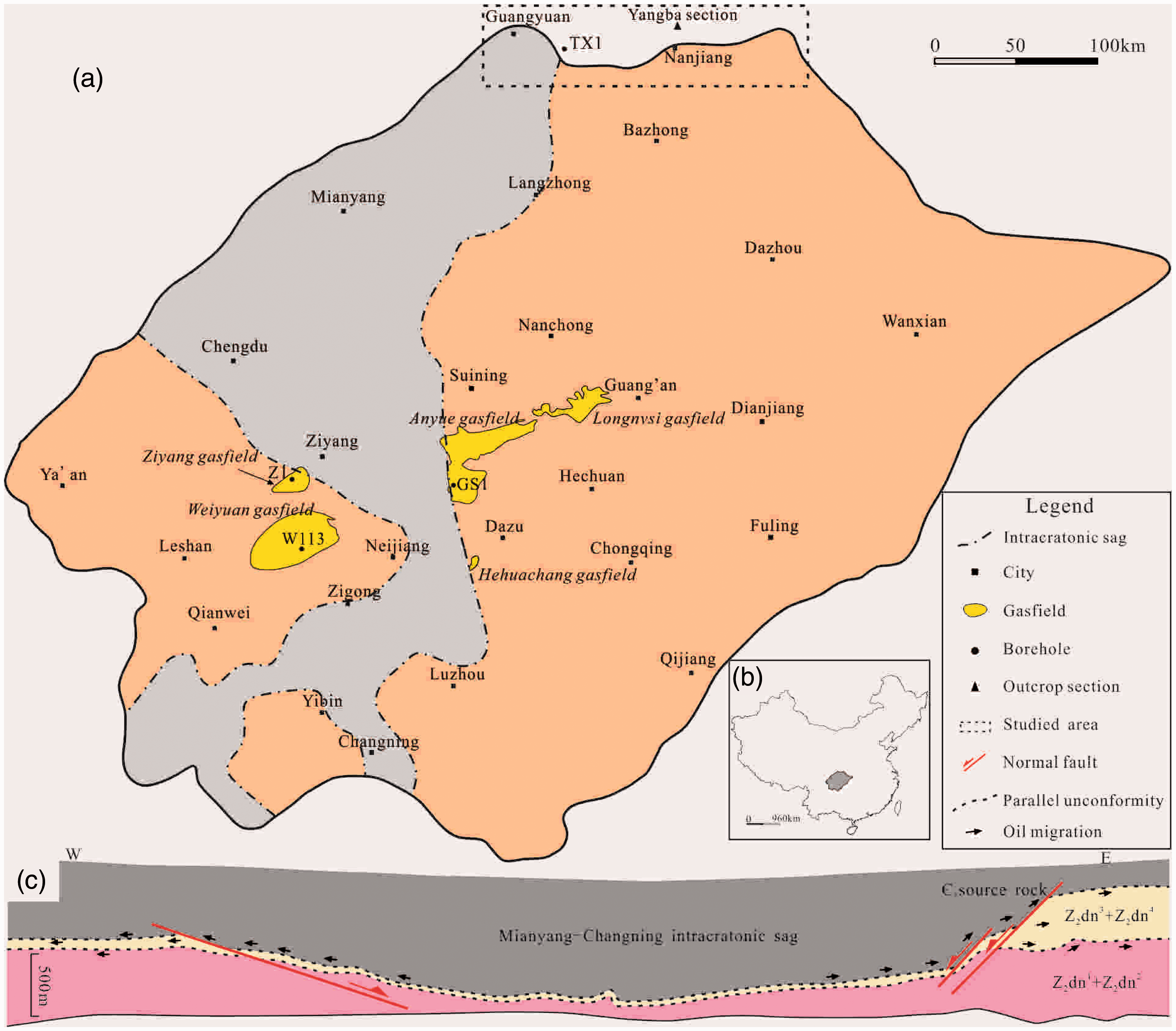
On the other hand, lower Cambrian Qiongzhusi Formation black mudstone is the most important source rock for the Paleozoic petroleum system in Sichuan Basin (Liu et al., 2013, 2015, 2016, 2017; Wei et al., 2014, 2015; Zou et al., 2014), and also the shale gas exploration targets (Jiang et al., 2016; Zeng and Guo, 2015). Furthermore, the source rocks in the intracratonic sag are larger in thickness and better in quality (Liu et al., 2013, 2015, 2016; Zou et al., 2014). Therefore, the intracratonic sag controls the occurrence and quality of the source rocks (Liu et al., 2013, 2015, 2016). Besides, the oil filling is favorable for the preservation of preexisting reservoir pores (Liu et al., 2008), which is testified by the fact that the reservoir bitumen content due to oil decomposition is positively correlated to the reservoir porosity (Cui et al., 2008). The burial dissolution related to organic acid fluids which migrated together with oil along unconformities and faults (Figure 13(a), (c)) is much stronger inner or close to the sag margin horizontally, and also close to the unconformities vertically as well (Liu et al., 2008; Song et al., 2013). Through our studies on microbialite reservoirs of member Z2dn2 and Z2dn4 in North Sichuan Basin, we found that reservoir bitumen interval is controlled by the two unconformities vertically, with bitumen-bearing interval developing under the Z2dn2 unconformity down to ∼117 m (Figure 5), and 134.2 m beneath the Z2dn4 unconformity (Figure 6). Thus, we could predict that it is much more profitable to seek the microbial carbonate targets of Dengying Formation along the margin area of Miangyang-Changning intracratonic sag (Figure 13(a)–(c)).
Conclusions
(1) This study identifies 13 forms of cyanobacteria, one oncolitic form, and two stromatolitic structures in Dengying Formation, upper Neoprotozoic in North Sichuan Basin. Different microbialites may be formed by different microbe forms, or assemblages. (2) The microbial carbonates are mostly present in the member Z2dn1, Z2dn2, and Z2dn4 of Dengying Formation. Thrombolites, laminites, and oncolites are dominant in member Z2dn1 and Z2dn2, while laminites and stromatolites are most important in member Z2dn4. The microbe form assemblages and microfacies change with the depositional environments, from subtidal to intertidal microbial reef in the member Z2dn1 and Z2dn2, to intertidal microbial mat in the member Z2dn4. (3) The microbial dolostone reservoirs are low in porosity and permeability. Member Z2dn1 is composed of oncolitic dolostone, with the reservoir non-oil-saturated and 24.3 m thick locating near the top. In member Z2dn2, there are three reservoir intervals with a total thickness of 190 m. They are mostly comprised of thrombolitic and spongiostromata dolostone. The microbial carbonate reservoirs in member Z2dn4 also occur in three zones with total thickness of 119.7 m and are mostly comprised of laminite and stromatolitic dolostone. (4) Through the research on diagenesis of microbial carbonate reservoirs in the member Z2dn1 and Z2dn2, we recognized two stages of fresh water dissolution, three stages of burial dissolution and one stage of hydrocarbon infilling. In the member Z2dn4, one period of fresh water dissolution, two stages of burial dissolution, and three stages of hydrocarbon infilling are developed. (5) Finally, primary and secondary controls on the microbialite reservoirs in the precambrian Dengying Formation have been discussed. The microbial textures are the primary controls, influencing the initial difference of reservoir quality. The early Cambrian Mianyang-Changning intracratonic sag is the secondary control, which reflected the kastification difference and impacted on the burial dissolution related to organic acids. We suggest that the margin flanks of the intracratonic sag may be more profitable area for the exploration of microbial carbonate reservoirs of Dengying Formation in Sichuan Basin.
Footnotes
Declaration of conflicting interests
The author(s) declared no potential conflicts of interest with respect to the research, authorship, and/or publication of this article.
Funding
The author(s) disclosed receipt of the following financial support for the research, authorship, and/or publication of this article: jointly supported by the National Basic Research Program of China (No. 2012CB214805), the China Natural Science Foundation (Nos. 41302086, 41402176), the Open-End Fund of China State Key Laboratory of Oil and Gas Reservoir Geology and Exploitation (PLC201406) and the CDUT training fund for young and middle-aged key teachers (KYGG201505).