




Abstract
To identify the microscopic pore characteristics and controlling factors of Hetang Formation Shale in the Lower Yangtze Region, the pore types, pore size distribution characteristics, and controlling factors of the Lower Cambrian Hetang Formation (Є1h) marine shale in Northeast Jiangxi were analyzed by using low-temperature liquid nitrogen, X-ray diffraction, scanning electron microscope, mercury intrusion porosimetry, isothermal adsorption experiment, and geochemical indicator test system. The research results show that the pore size distribution curve of Hetang Formation Shale is characterized by “two peaks” and dominated by micropore (2 nm) and mesopore (47–82 nm). The hysteresis loop shows that the open parallel-plate pore and slit pores are the main pore types in shales. The pore volume of Hetang Formation Shale is only positively related to total organic carbon, without obvious correlation with mineral composition and thermal evolution degree. The controlling factors of pore structure characteristics of Hetang Formation Shale are rather complicated. Further analysis shows that diagenesis and excessive thermal evolution are the two main controlling factors restricting the microscopic pore characteristics. Due to great burial depth, organic matter generates numerous micropores during pyrolysis and hydrocarbon generation, and clay minerals generate a lot of micropores and mesopores during conversion from montmorillonite to illite. On the other hand, the development of mesopore and macropore is far better than that of nanoscale pore, because rigid quartz mineral is the dominant composition of shale and the strong compaction resistance of quartz can increase macropore volume with the increase of shale burial depth. It can be inferred that Hetang Formation Shale is a relatively ideal horizon for shale gas development, since the proportion of potential free gas is relatively high and induced cracks are prone to be formed, which is conducive to seepage and desorption of shale gas.
Introduction
In recent years, under the influence of the business development of shale gas in North America, the exploration and development of shale gas in China has made a significant breakthrough (Guo, 2016; Wang, 2015). Shale gas refers to methane existing in shale pores in the adsorption state, free state, and a small proportion of dissolved state. The pore structure characteristics of shale include size, volume, specific surface area, shape, connectivity, and spatial distribution of pores. The pore structure characteristics of shale reservoir greatly affects reservoir characteristics of clay shale (Cao et al., 2015; Ross and Bustin, 2009; Shao et al., 2016) and control the oil/gas accumulation in clay shale and fluid migration capacity of fracture network system. Such features have a great impact on shale gas enrichment, development, and potential evaluation (Tang et al., 2015). Therefore, the analysis and study on microscopic pore characteristics of shale reservoir is quite popular in the field of shale gas study at present (Chalmers et al., 2012).
Different from conventional oil and gas reservoir with micron pore, shale reservoir is usually dominated by nanoscale pore (Nelson, 2009). For this reason, the identification and representation of shale porosity and pore size distribution becomes one of the key parameters for commercial evaluation of shale (Chalmers et al., 2012; Furmann et al., 2014; Loucks et al., 2009; Mastalerz et al., 2013; Milliken et al., 2013; Ross and Bustin, 2009). Domestic and foreign scholars have adopted many qualitative means (including field emission scanning electron microscope (SEM), focused ion beam-SEM and atomic force SEM (Bernard et al., 2012; Zhang et al., 2016; Ji et al., 2016) and quantitative means (including high-pressure mercury intrusion porosimetry, low-temperature N2/CO2 gas adsorption method (Chalmers et al., 2012; Yang et al., 2014), nano-CT scanning and image 3D reconstruction (Bai et al., 2013; Zhang et al., 2016), low-pressure nitrogen adsorption and helium porosity measurements can use to investigate the evolution of shale pore characteristics during comminution (Li et al., 2016)). In general, SEM is used to directly identify the type, shape, and size of pores (Bernard et al., 2012; Chalmers et al., 2012; Curtis et al., 2012; Kelly et al., 2015; Milliken et al., 2013; Tiwari et al., 2013), but it cannot identify mesopore and micropore (Zhang et al., 2015), with poor representativeness when measuring size distribution and geometry of pores (Zhu et al., 2016). High-pressure mercury intrusion porosimetry is generally used for analyzing connected mesopore and macropore, but shale surface heterogeneity will change the surface tension and contact angle of mercury, causing measurement deviation. Because of the nanoscale pore diameter of shale, high-pressure mercury intrusion porosimetry is prone to form artificial fracture, affecting measurement results (Zhong, 2012). As a result, gas adsorption method is mainly used to obtain the quantitative data of pore surface area of shale, pore size distribution, pore volume, porosity, and permeability (Jiao et al., 2014; Kuila and Prasad, 2013; Schmitt et al., 2013; Zhang et al., 2016).
Shale gas exploration and evaluation in China is still at the initial stage and mainly focuses on the Middle and Upper Yangtze Region (Chen et al., 2011; Sun et al., 2012; Tan et al., 2014; Tian et al., 2015). Studies have showed that the Lower Cambrian Hetang Formation marine shale in the Lower Yangtze Region is featured by stable distribution, great deposition thickness, and high content of organic matter and brittle mineral, with solid shale gas accumulation foundation and potential (Wang et al., 2014; Xie et al., 2015). However, the current researches mainly focus on geochemical parameters and reservoir characteristics, with rare reports on reservoir microscopic pore structure characteristics (Zhang et al., 2017). This paper, based on 75 samples used for geochemical analysis and X-ray diffraction analysis for Lower Cambrian Hetang Formation Shale in Northeast Jiangxi, selected nine samples with different content of total organic carbon (TOC) for SEM and low-temperature liquid nitrogen test, analyzed microscopic pore type and pore size distribution scope of Hetang Formation Shale, discussed the correlation between pore volume and organic carbon, mineral composition and thermal evolution degree, and finally discuss the factors influencing microscopic pores of Hetang Formation Shale in Northeast Jiangxi, China. The research results are of great positive and practical significance for shale gas exploration, development, and evaluation in the Lower Yangtze Region.
Geological settings
The northeastern region of Jiangxi covers an area of about 1.8 × 10⁴ km2. It is located at the transition zone between Jiangnan terrane in Yangtze block and Cathaysia terrane in South China Block and is divided into seven tectonic units from west–north to the east–south, i.e. Xiushui–Qimen tectonic unit, Leping–Xixian tectonic melange belt, Wannian tectonic unit, Huaiyu tectonic unit, Dongxiang–Guangfeng melange belt, Tieshajie–Yongping aulacogen, and Beilongyi uplift tectonic units (Figure 1) (Wang et al., 2010). The region has witnessed the superposition and transformation of multiple tectonic movements and sedimentary environment changes in different geological periods (Zhu et al., 1999). It is featured by Pre-Jinning period, plate subducting and collision stage during Jinning movement, and tectonic evolution in plates since Jinning movement. The region is located at the transition zone between Jiangnan terrane in Yangtze block and Cathaysia terrane in South China Block (Deng, 2006).
Geological map and distribution of the samples of the research area.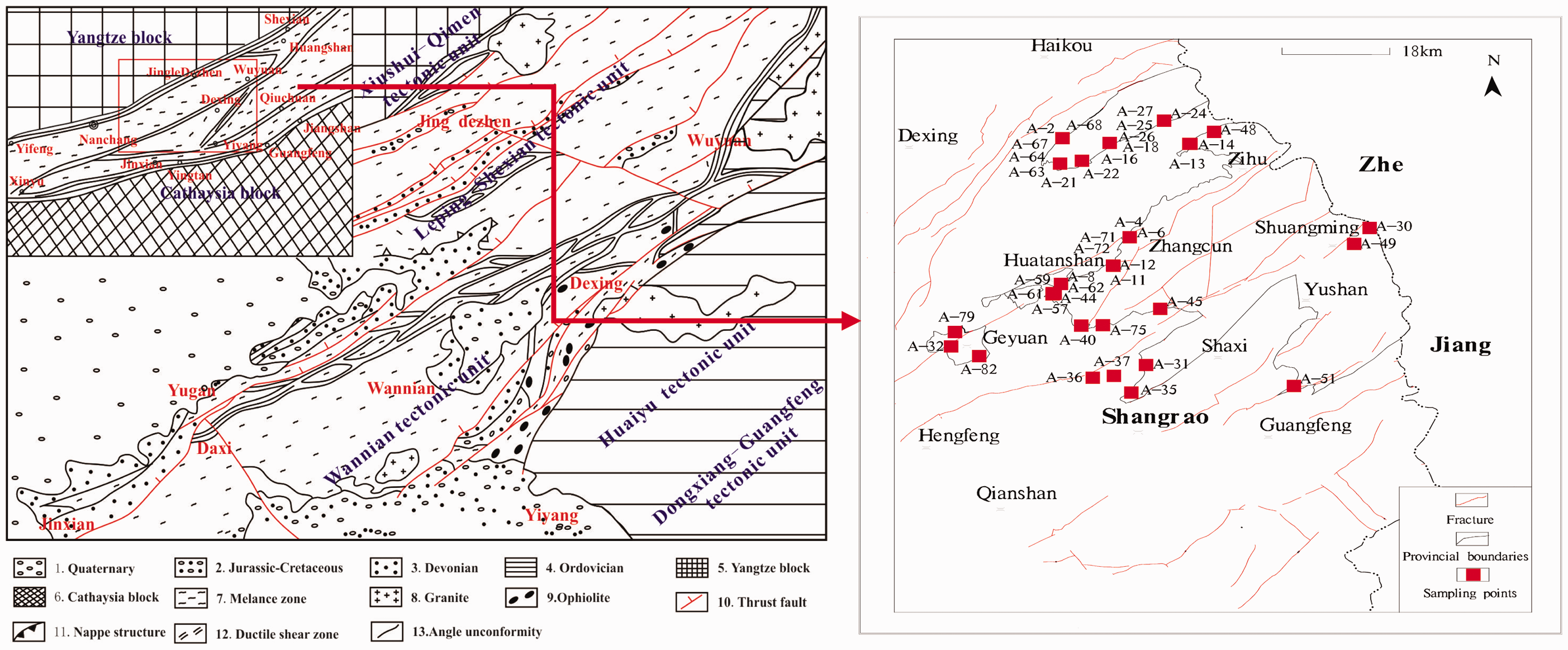
The bottom of Hetang Formation is gray-black high-carbon flaggy shale (containing stone coal) and carbonaceous siliceous shale; its lower part is gray-black carbonaceous shale; the middle part is gray-black siliceous shale and carbon-bearing siliceous shale; and the upper part is grayish brown silty shale, silicon-bearing shale interbedded with lenticular limestone. The main shale intervals with rich organic matters are distributed at the bottom and the lower part of the stratum; Hetang Formation is widely distributed in the research area, extending stably, and has a deposition area of about 1700 km2, and an exposed area of about 50 km2. The thickness of Hetang Formation shale is between 50 and 200 m. The distribution is gradually thinned from the middle to the two sides. The burial depth gradually decreases in the direction of NE–SW with the maximum depth up to 4500 m. In the research area, the early Cambrian crustal movement is relatively stable, resulting in a marine environment in the lithofacies paleogeography. The paleogeomorphic pattern is characterized by the south higher than the north. The northern part (the north to Shangrao) presents a pelagic sedimentary environment with shale and carbonaceous shale while the south to Shangrao presents a coastal outer continental shelf environment.
Samples and methods
During the research, 75 samples of the Lower Cambrian Hetang Formation Shale were collected in Northeast Jiangxi, China for organic geochemical analysis and mineral composition analysis, and nine samples with different content of TOC were selected based on the test results for SEM test and low-temperature liquid nitrogen test. The sampling point distribution is shown in Figure 1.
The low-temperature liquid nitrogen absorption/desorption experiment and isothermal adsorption experiment was conducted in Exploration and Development Research Institute of Huabei Oilfield Company by using Thermo SURFER specific surface area and porosity analyzer produced by Thermo Scientific. The measurement scope of specific surface area of the instrument is not less than 0.01 m2/g (N2/77 K absorption method), with pore volume of not less than 0.0001 cm2/g and pore size of 0.32–500 nm. Before the test, it is required to vacuumize samples under 120 for 5 h (vacuum degree: 1.0 × 10⁻³ Pa) and adopt highly pure nitrogen as adsorbent (purity: 99.999%) to measure the adsorption value of nitrogen under 77.35 K at different relative pressure. The adsorption/desorption isotherm is plotted, with relative pressure (P/P0) as x-coordinate and adsorption value as y-coordinate. BET equation is used to calculate specific surface area (Brunauer et al., 1938), while BJH method is used to calculate pore size distribution (Yan and Zhang, 1979). The isothermal adsorption experiment was carried out as per the requirements stipulated in GB/T 1956–2008 with the high-temperature and high-pressure HPVA adsorber at a constant temperature of 30℃ with a control precision of 0.1℃, and in a pressure measurement accuracy of 0.1 psi. The number of experimental pressure point was 7–9, and the adsorption equilibrium time of each point is over 12 h. The adsorption medium is methane gas with a purity of 99.999%.
Geochemical parameters and petrologic characteristics of shale samples.
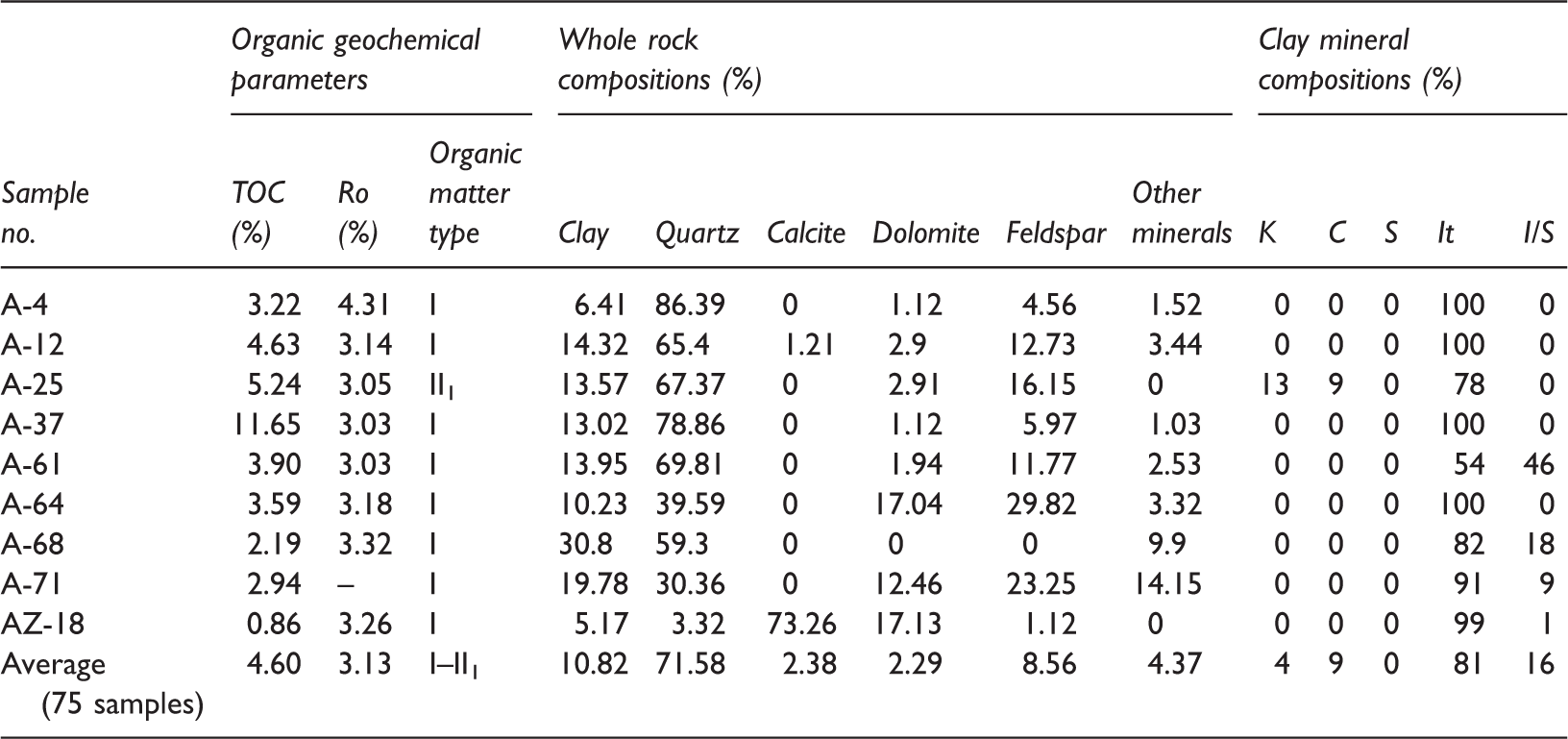
C: chlorite; It: illite; I/S: illite/smectite interstratified mineral; K: kaolinite; S: smectite; TOC: total organic carbon.
Results and discussions
Pore types
The pore types of shale can be divided into organic pores, inorganic pores (intergranular pores, intragranular pores, dissolved pores, and intercrystalline pores), and micro-fracture. Through SEM, it is found that there are rich micro and nano pores developed in Hetang Formation Shale, dominated by mineral pores, which is consistent with the previous research results (He, 2015; Fu et al., 2016).
(1) Organic pores
Organic pores refer to the pores developed through hydrocarbon generation of organic matters. The organic pores are closely related with the thermal evolution and hydrocarbon generation of organic matters. Due to high content of organic matters and intensified thermal evolution in Hetang Formation shale in the research area, it is observed that Hetang Formation shale is developed with a large amount of organic pores, and the pores on the organic matter surface are mostly nano-micron-scale ones. The pore size distribution is mainly 0.02–20 µm, generally in round, oval, and crescent-shaped irregular shape (Figure 2(a) and (b)).
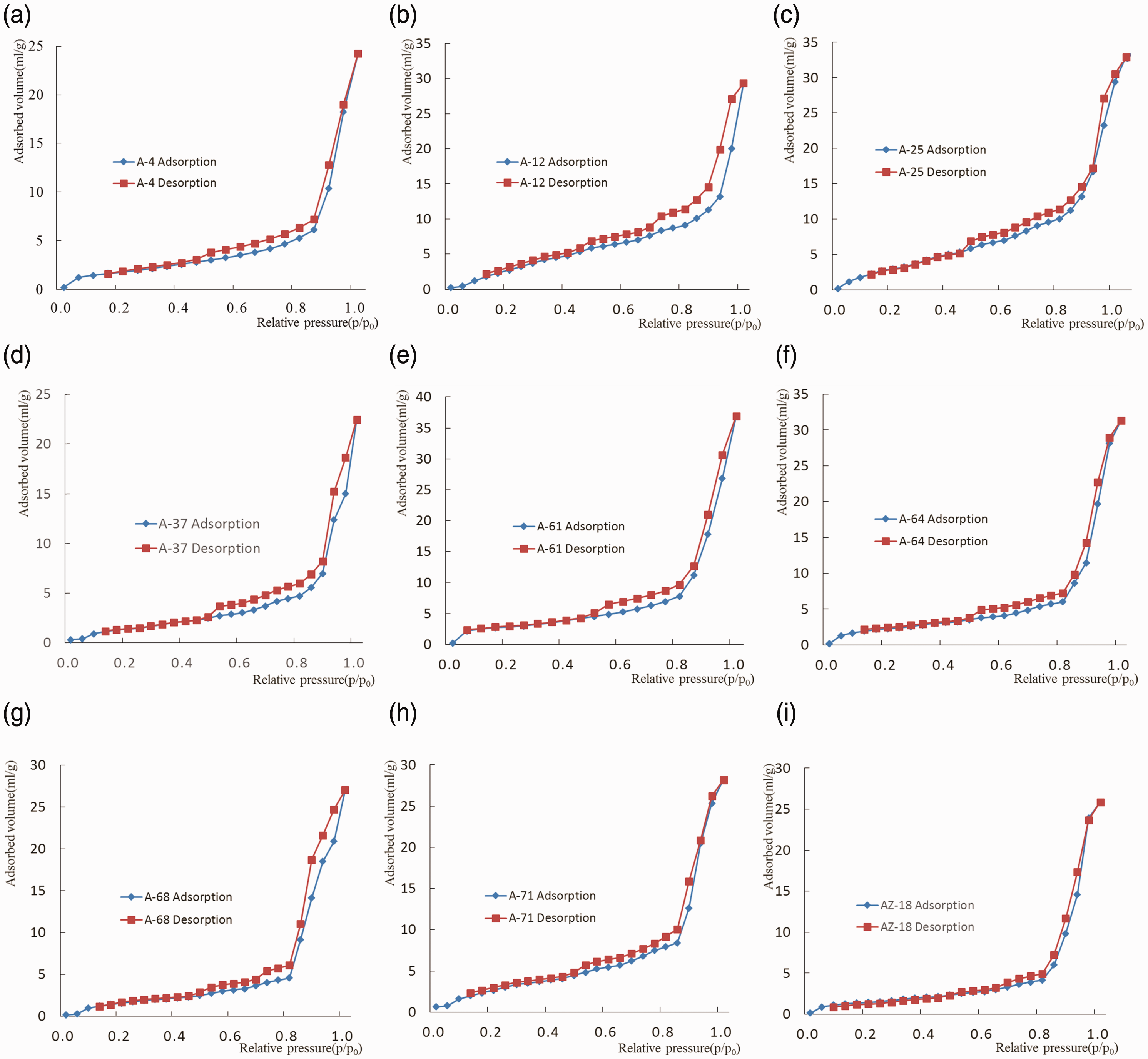
(2) Mineral pores ① Intergranular pores SEM chart of micro-pores in shale reservoir of Hetang Formation. (a) Organic pores, generally in oval, irregular quadrilateral and strip-shaped distribution, A-49; (b) organic pores, mainly oval-shaped, A-35; (c) linear intergranular pores among quartz minerals, A-3; (d) slit intergranular pores formed among quartz mineral granules, A-70; (e) slit intergranular pores developed at the edge of contact between organic matters and clay, AZ-49; (f) intragranular pores of clay, A-3; (g) intragranular pores of clay, A-12; (h) intragranular pores of dolomite, A-37; (i) dissolved pores of calcite, A-3; (j) dissolved pores of feldspar, A-25; (k) dissolved pores of quartz, A-37; (l) dissolved pores of dolomite, A-64; (m) dissolved pores formed under the leaching action of potassium feldspar, filled by calcite, A-69; (n) intercrystalline pores of quartz, JX-005; (o) intercrystalline pores of pyrite, JX-078. SEM: scanning electron microscope. Nitrogen adsorption/desorption isotherms of shale samples.
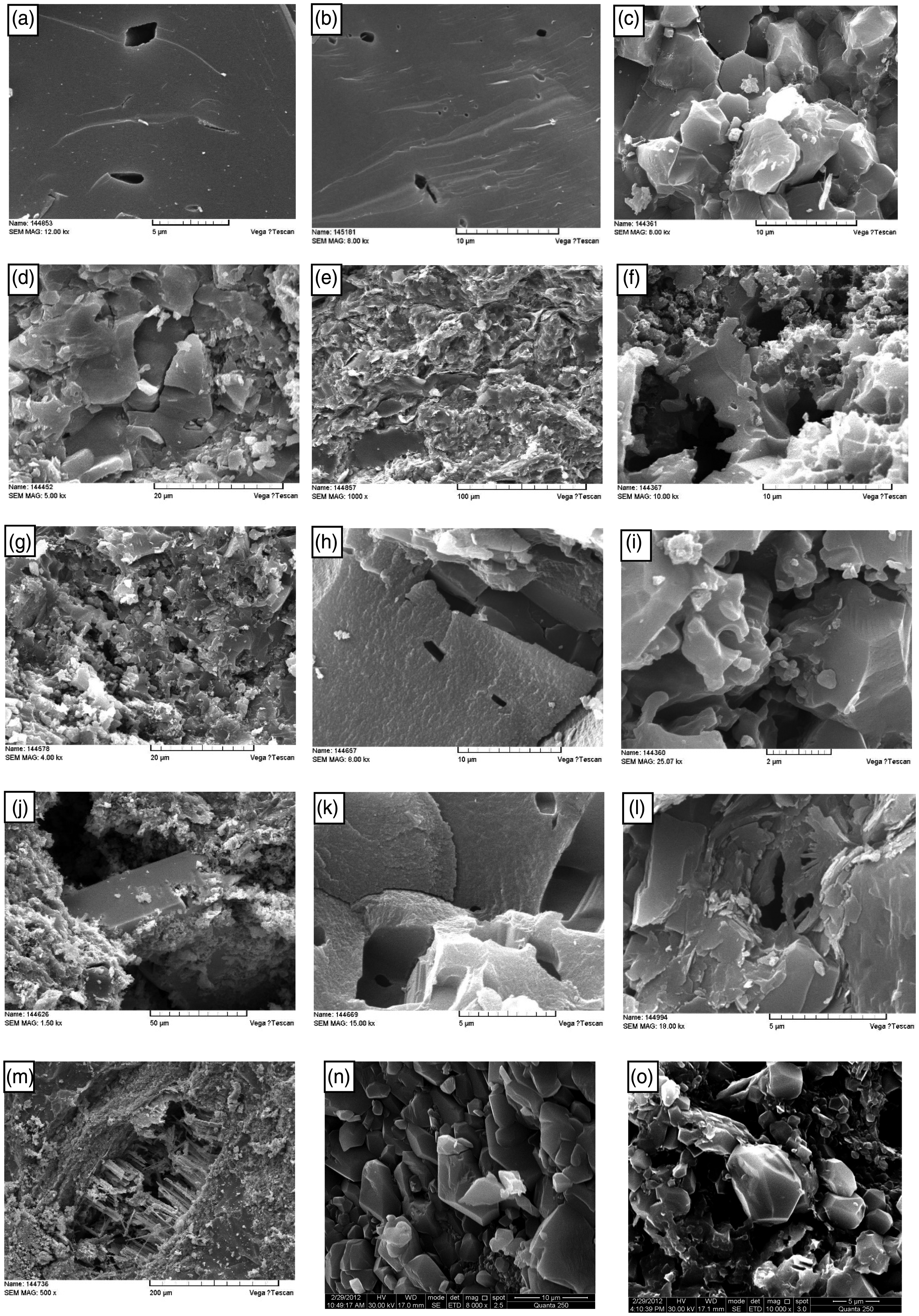
Intergranular pores refer to the pores developed among shale mineral particles or debris particles. The mineral composition of Hetang Formation shale in the research area is mainly quartz, clay, potassium feldspar, dolomite, and calcite (Zhang et al., 2017). Under the microscope, the intergranular pores are mainly the pores among quartz and clay particles. The intergranular pores are arranged irregularly in diversified morphology, mainly in linear, triangular, and slit shapes (Figure 2(c) to (e)). The pore size distribution is mainly micron scale. Generally, the connectivity of the intergranular pores is relatively good, which can provide good seepage channels for methane.
② Intragranular pores
Intragranular pores are mainly developed in the mineral particles, and their pore size and pore morphology are affected significantly by the particles. The intragranular pores of Hetang Formation shale are generally developed in clay (Figure 2(f) and (g)) and dolomite (Figure 2(h)), most of them are irregular. These pores are mostly developed during the transformation process of clay. As shale diagenesis is intensified, a large amount of intragranular pores will be developed when montmorillonite is transformed to an imidone or illite (Zhao, 2016). The intragranular pores can provide a relatively large space for the gas and can constitute pore network with intergranular pores to improve the seepage capacity of shale (Xue et al., 2015).
③ Dissolved pores
In the process of diagenesis, such unstable minerals as quartz, feldspar, carbonate minerals, and clay are formed under the action of underground fluid and pressure, and the dissolution often occurs in the process of diagenesis, resulting in the dissolved pores developed. Because Hetang Formation shale in the research area is in the high mature stage, it has experienced great burial depth and hydrocarbon generation process. Therefore, the dissolved pores are well developed, mainly of potash feldspar, dolomite, and quartz (Figure 2(i) to (m)). Sometimes, the dissolved pores may be filled with quartz, clay, carbonate minerals, and those not filled can be used as a storage space as well as seepage channels for shale gas.
④ Intercrystalline pores
Intercrystalline pores mainly refer to the pores among the particles in the mineral assemblage. In Hetang Formation shale, there are mainly intercrystalline pores of quartz (Figure 2(n)), pyroxene (Figure 2(o)), calcite, etc. in a small scale. Their pore sizes are mostly 0.2–20 µm, and the connectivity between pores is relatively poor.
Pore structure characteristics
(1) Nitrogen adsorption/desorption isotherm.
The nitrogen adsorption/desorption isotherm can reflect pore structure characteristics of shale samples. Figure 3 shows the adsorption/desorption isotherm of low-temperature liquid nitrogen of nine shale samples from the Lower Cambrian Hetang Formation in the research area. Generally, the adsorption isotherm of nine samples is in inverse-S shape, although slightly different in the pattern. According to BDDT classification (Zhao, 2005), the type II isotherm represents physical absorption of gas on nonporous solid surface or macroporous material surface. At the low-pressure stage (P/P0 ≤ 0.1), the adsorption curve rises sharply and is in slightly upward convex shape, indicating monolayer adsorption of nitrogen on shale surface; at the medium–mid-high pressure stage (0.1 < P/P0 ≤ 0.8), the adsorption curve rises slowly in almost a linear way, indicating the transition from monolayer adsorption of nitrogen to multilayer adsorption; at the high-pressure stage (0.8 < P/P0 ≤ 1), the adsorption curve rises sharply and is in downward concave shape, indicating the capillary condensation. When the relative pressure is close to 1, capillary condensation occurs in mesopore and macropore, leading to sharp increase of nitrogen adsorption and sudden rise of isotherm. The research results show that the Lower Cambrian Hetang Formation Shale contains numerous mesopores and macropores. Particularly when P/P0≈1, the sample adsorption value is generally greater than 25 ml/g and much higher than that of the Lower Cambrian Niutitang Formation in the Upper Yangtze Region (Han et al., 2013; Wang and Cai, 2016; Wei et al., 2013), which indicates more mesopores and macropores were developed in shale of the research area.
(2) The significance of low-temperature nitrogen adsorption loop type to different forms of pores in shale.
Adsorption hysteresis occurs when the adsorption and desorption curves of shale samples are not overlapped. The form of hysteresis loop can provide information related to shale pore structure (Chen et al., 2015). According to adsorption and condensation theory, the solids with capillary pores are adsorbed. After pressurization, desorption and evaporation of adsorbent will occur gradually during depressurization. Due to difference of pore shape, if the relative pressure is the same during condensation and evaporation of pores, the adsorption curve may be overlapped with the desorption curve; if the relative pressure is different, the two curves will be separated, leading to adsorption hysteresis and hysteresis loop. The shape of hysteresis loop can reflect the characteristics of shale microscopic pore structure (Chen et al., 2015; Yang et al., 2013).
Currently, the commonly used hysteresis loop is classified mainly according to IUPAC scheme (Sing, 1985) and De Boer scheme (Shao et al., 2016). Based on the hysteresis loop of shale samples, the adsorption and desorption curves are basically overlapped at the low-pressure stage (P/P0 ≤ 0.4). They are not overlapped and form the loop with different hysteresis amplitude at relatively high-pressure stage (0.4 ≤ P/P0 < 1). The hysteresis loop of all samples in the test belongs to type H3(by IUPAC), indicating that the adsorption and desorption curves are almost parallel, hysteresis loop rises gradually, and the hysteresis loop is relatively narrow and small, which reflects that macropores, mesopores, and micropores are all developed in shale samples (dominated by mesopores and macropores) and the open parallel-plate pore and slit pores are the main pore types. As per the De Boer scheme, the hysteresis loop is similar to type D (Figure 4), showing the Hetang Formation Shale is dominated by inclined slit pore.
Classification of adsorption loop curves and pore structure types by De Boer (Shao et al., 2016).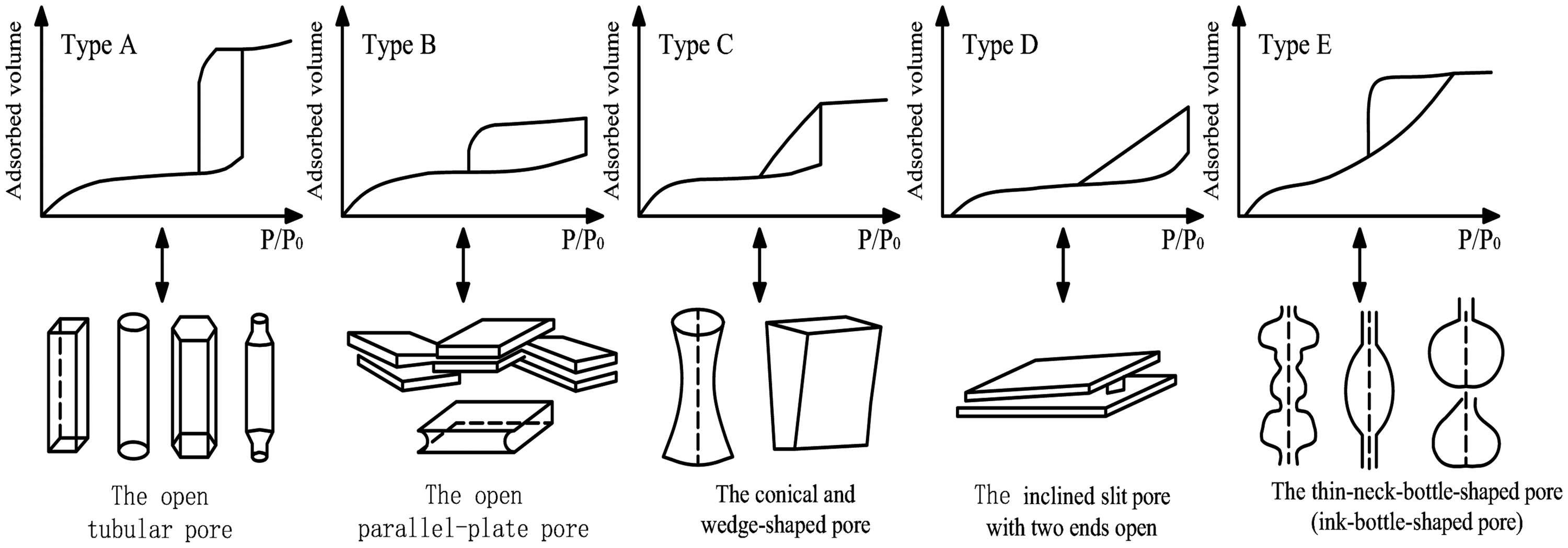
Due to strong heterogeneity of shale reservoir, complex microscopic pore structure and diverse shapes, the hysteresis loop generated is different in details. For this reason, the paper proposed that there are three major types of shale pores in the research area according to the above two schemes by fully considering specific differences.
Type 1 (Figure 2(a), (c), (e), (f), (h), (i)): the adsorption and desorption curves are almost overlapped at the low-pressure stage (P/P0 ≤ 0.4) and high-pressure stage (0.8 < P/P0 ≤ 1); based on Kelvin equation, the corresponding pore size is approximately 3.3 and 10.0 nm when P/P0 is, respectively, 0.4 and 0.8, indicating the mesopore, micropore, and macropore in shale sample are mainly cylindrical pore closed at one end, parallel-plate pore or conical/wedge-shaped pore; in case of 0.4 < P/P0 ≤ 0.8, the “slit type” hysteresis curve shows mesopores are mainly open slit pore, with certain pores closed at one end;
Type 2 (Figure 2(b)): it is similar to type 1 at low-pressure stage (P/P0 ≤ 0.4); hysteresis curve appears when 0.4 < P/P0 ≤ 1, and adsorption curve is obviously separated from desorption curve; when P/P0 is 0.8–1, the adsorption/desorption curve rises sharply, indicating there are numerous mesopores and macropores in the sample, and the inclined slit pores with two ends open are the main types of pores;
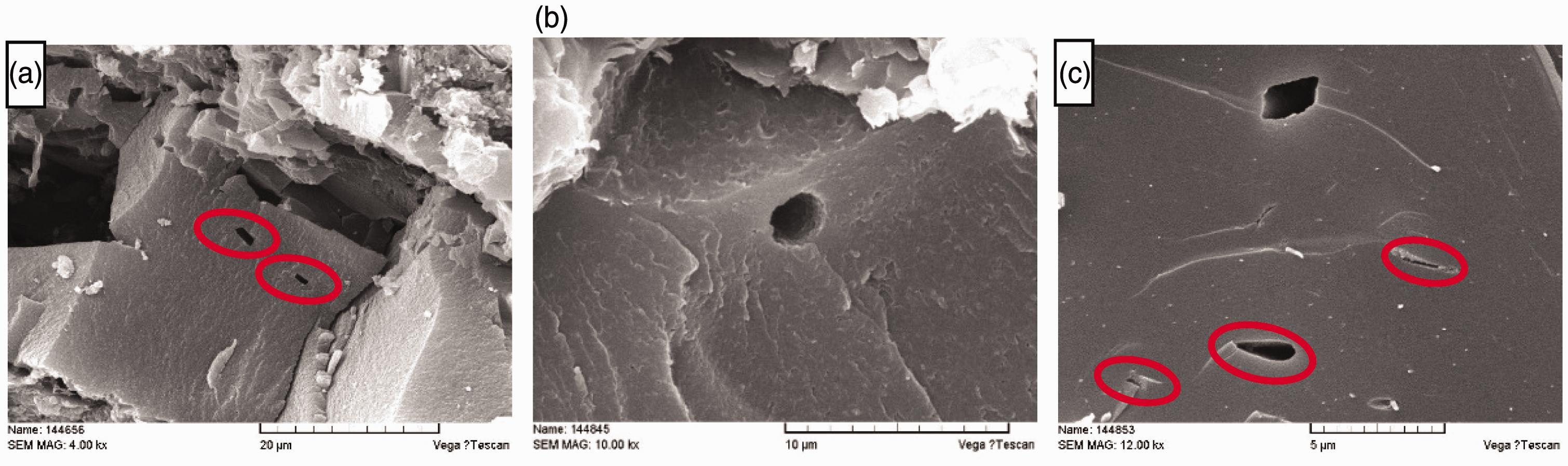
Type 3 (Figure 2(d) and (g)): it is similar to type 1 at low-pressure stage and medium-pressure stage; the major difference is that hysteresis curve appears at the high-pressure stage, but the separation degree of adsorption and desorption curves is much lower than that of type 2, indicating the mesopore and macropore are rather complicated, with coexistence of one-end opened pores and open pores. It should be noticed that there is no “inflection point” in desorption curve when 0.4 ≤ P/P0 ≤ 0.5 for all shale samples, namely, no “forced closure” occurs (Cao et al., 2015), indicating there is no thin-neck-bottle-shaped pores (ink-bottle-shaped pores) in samples. Further XRD analysis shows that the content of clay minerals in shale samples is low, so no obvious “forced closure” occurs (Groen et al., 2003; Yang et al., 2015). The above information shows Hetang Formation Shale is dominated by organic pores and intergranular pores of clay minerals, with micro-fracture developed, which is consistent with the pore characteristics observed by using SEM (Figures 2, 14, and 15). Such pore combination is featured by good connectivity and beneficial for transfer of methane gas.
Pore structure distribution characteristics
(1) Pore size distribution.
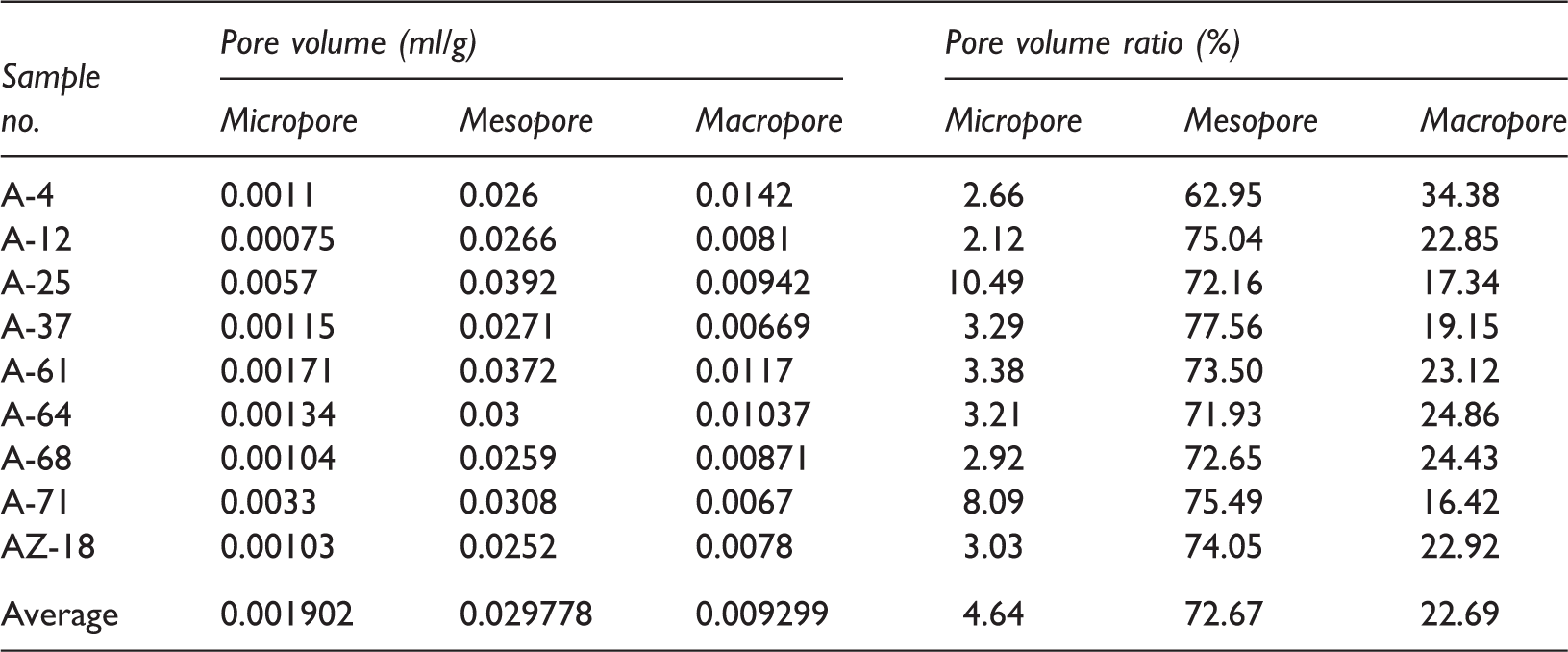
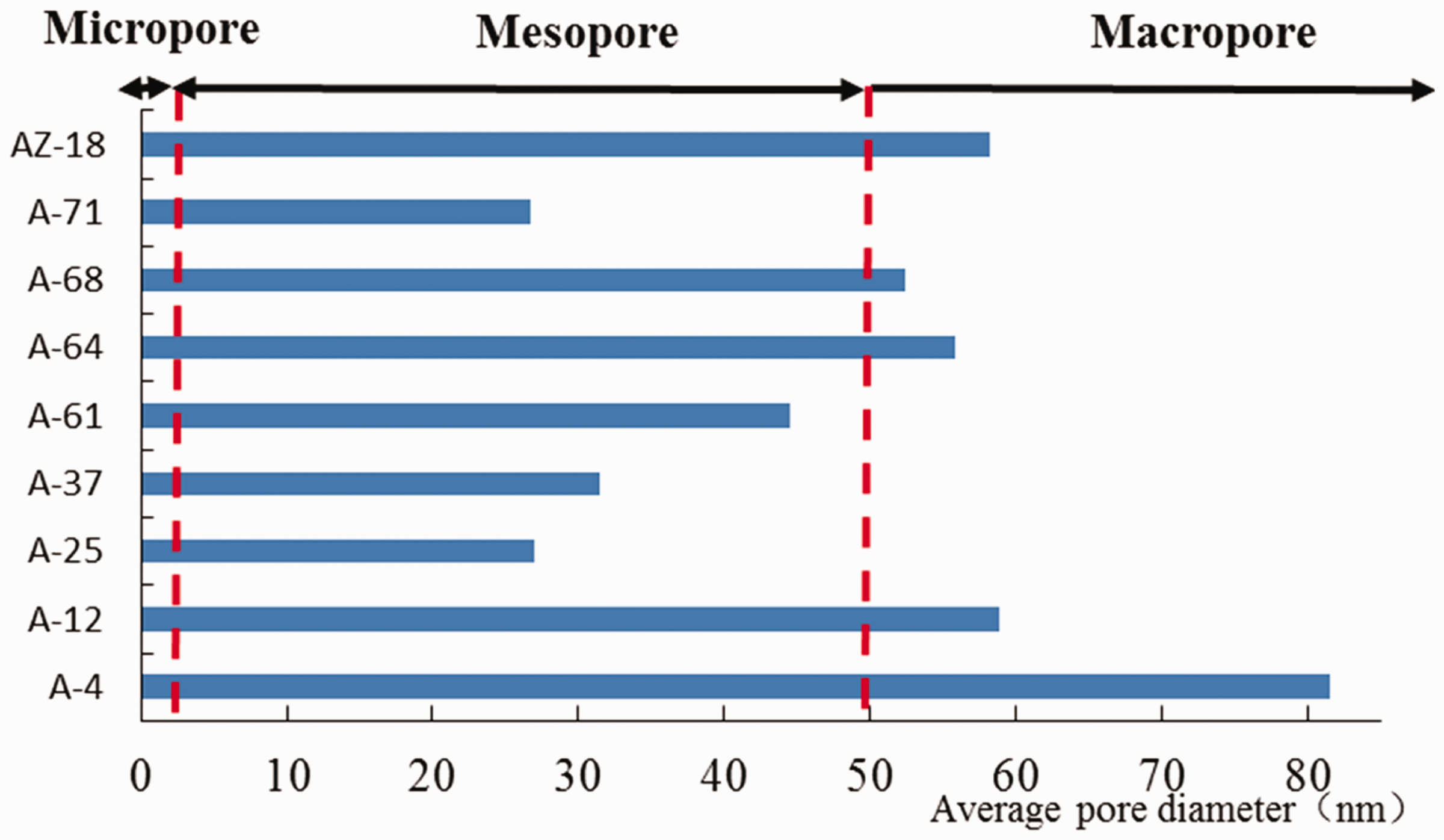
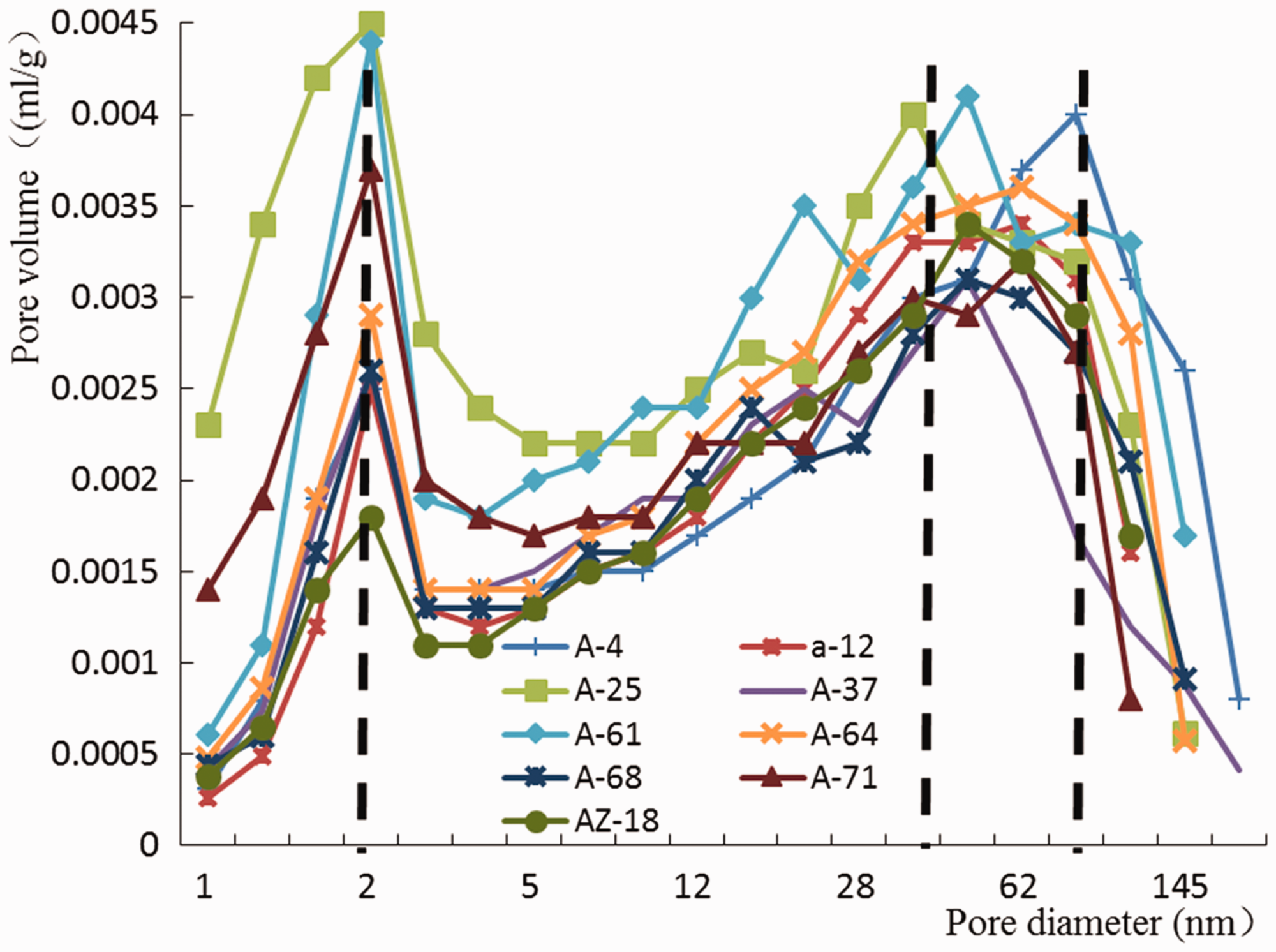
For the nine samples collected in the research area, BJH total pore volume is 0.0371–0.0634 ml/g (average: 0.0479 ml/g), the pore size is 26.7029–81.6226 nm (average: 48.5331 nm) (Figure 5) and the pore volume distribution characteristics are very similar, with “two peaks.” The first peak is concentrated at 2 nm, while the second is at 47–82 nm, indicating micropore, mesopore, and macropore are all developed in Hetang Formation Shale in the research area (Figure 6). Based on the contribution to pore volume of different pore sizes, the micropore volume is relatively small, only accounting for 4.64% in the total pore volume, while mesopore volume accounts for 72.67% (Table 2), so mesopore in Hetang Formation Shale is most developed, with the maximum pore volume. There are researches which have showed that the development of mesopore and macropore in shales is usually related to inorganic minerals. Clay minerals and brittle minerals mainly contribute to formation of mesopore and macropore (Milliken et al., 2013), thus providing places for adsorption and storage of gas in shale.
(2) Specific surface area. Statistics of pore volume in shale samples. Distribution of the pore based on the nitrogen adsorption method. Pore volume change rates based on the nitrogen adsorption method.
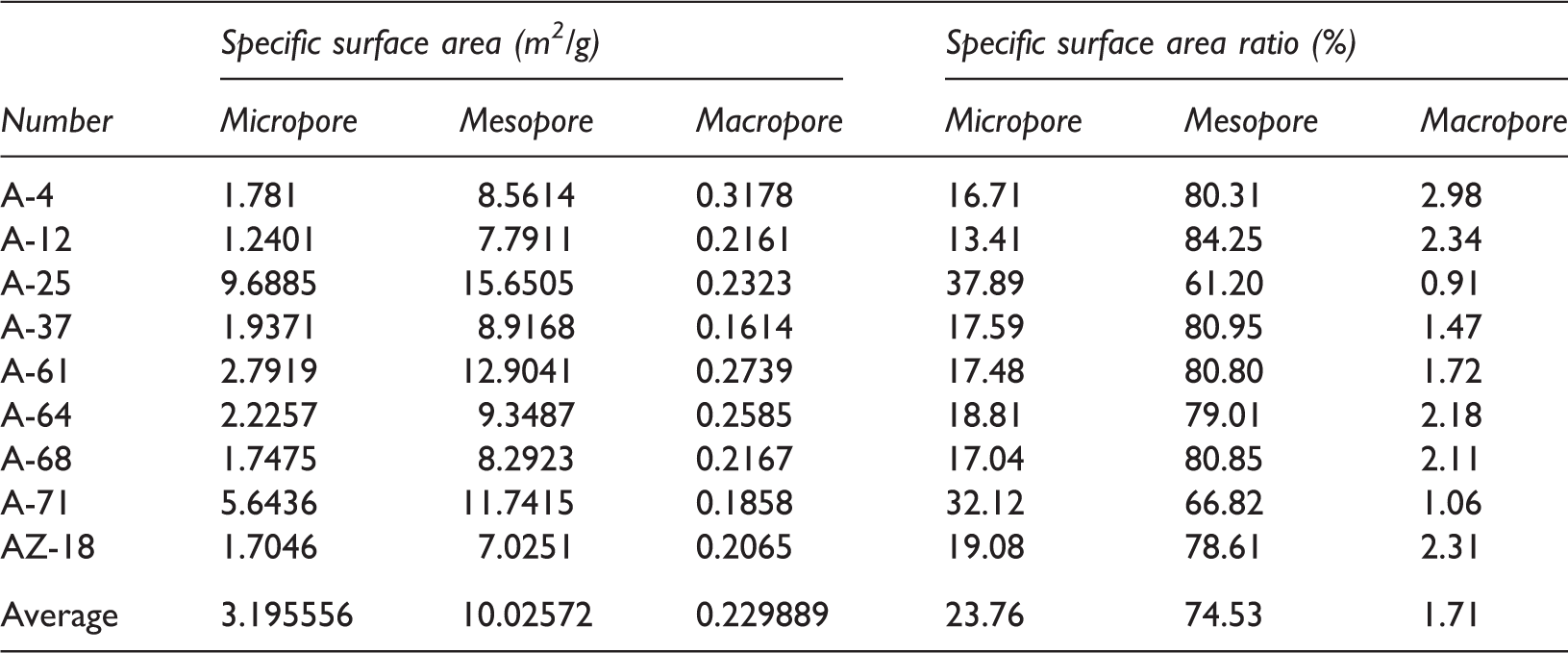
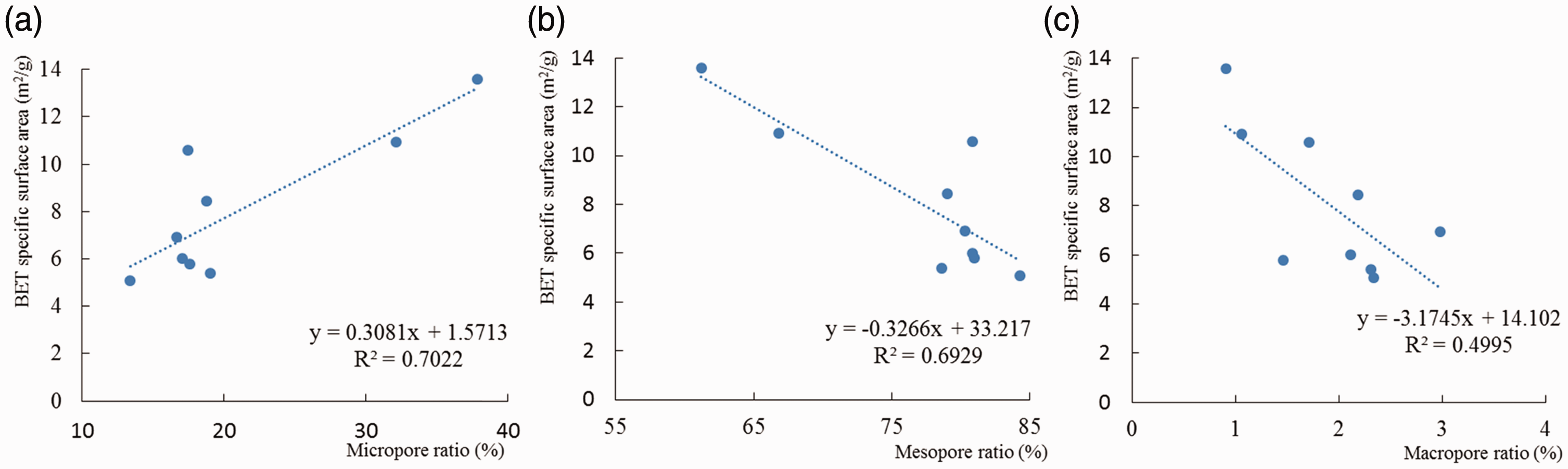
Based on Figure 7, the specific surface area of pores in Hetang Formation Shale in the research area is 5.0678–13.5918 m2/g (average: 7.8013 m2/g), accounting for 1/3–1/2 of that of Niutitang Formation in the Upper Yangtze Region (Han et al., 2013; Jiang et al., 2016). The pore volume of Hetang Formation Shale is basically identical to that of Niutitang Formation, so the main reason for small surface area is as follows. According to Figure 7, the specific surface area generally decreases with the increase of pore size, indicating micropore is the main contributor of specific surface area, the micropore of Hetang Formation Shale is less developed when compared with that of Niutitang Formation Shale, while the specific surface area provided by mesopore and macropore is far less than that provided by micropore (Table 3). On this basis, we inferred that specific surface area of shale pores is greatly influenced by micropore, followed by mesopore and macropore in order (Figure 8). Specific surface area of micropore in shale is positively correlated with shale gas adsorption volume and determines the content of adsorbed gas in shale, while the specific surface area of mesopore and macropore is basically not related to shale gas adsorption volume and is not determinative for volume of adsorbed gas (Jiang et al., 2016), implying that the relatively less micropores in Hetang Formation Shale are not beneficial for the shale gas adsorption.
Variation trend distribution of specific surface area of pores in shale samples. Statistics of specific surface area of pores in shale samples. Correlation between pore size changes of shale sample and BET (Brunauer et al., 1938) specific surface area.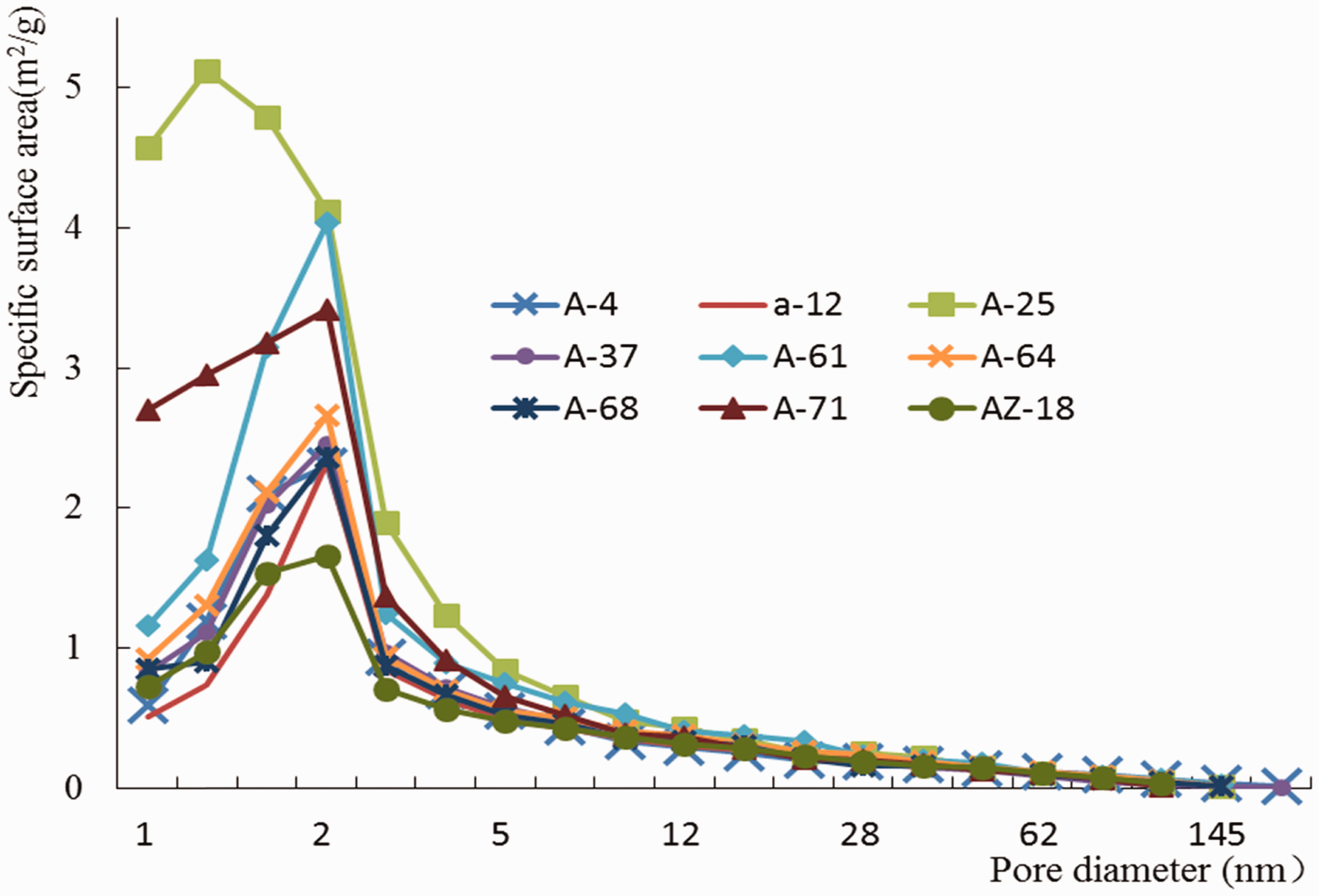
Controlling factors affecting pore characteristics
(1) Content of organic carbon
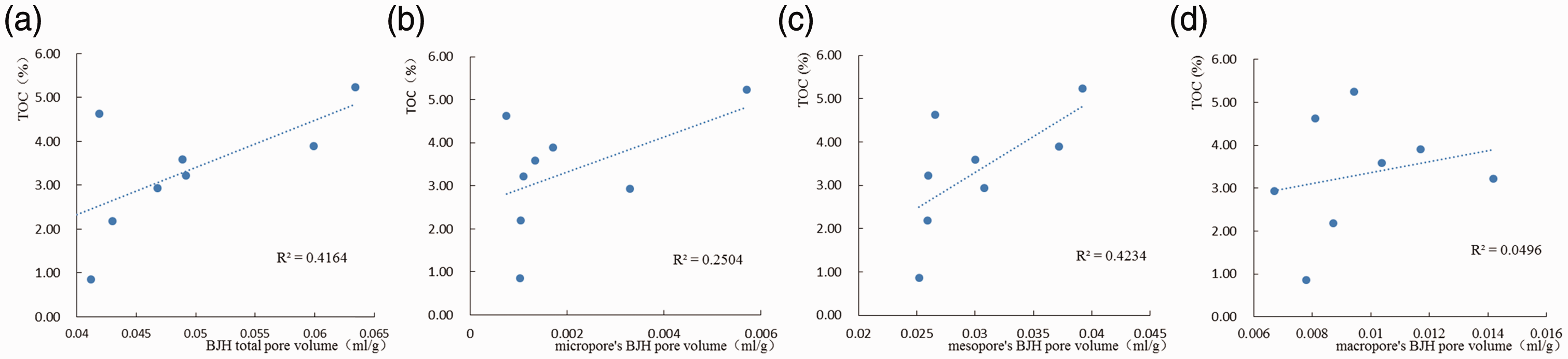
The content of organic carbon in shale affects the development of clay shale pores mainly through hydrocarbon generation. There are researches which have showed that the storage space will increase by 4.9% per consumption of 35% organic carbon in shale during hydrocarbon generation (Jarvie et al., 2007), thus increasing the reservoir pore volume. The positive correlation between organic carbon content in Hetang Formation Shale in the research area and the pore development reflects that the organic carbon is one of the crucial factors that controls pore development in shale, but Hetang Formation clay shale is also affected by other factors based on the moderate correlation (Figure 9(a), R2 = 0.42). Wherein, the content of organic carbon is positively correlated with micropore and mesopore (Figure 9(b) and (c)) and not related to macropore (Figure 9(d)), reflecting the organic matter can generate many organic pores after hydrocarbon generation and discharge and organic carbon is one of the dominant factors that affects the formation of nanoscale pore.
(2) Mineral composition ① Clay minerals. Correlation between TOC content in shale sample and pore volume. TOC: total organic carbon.
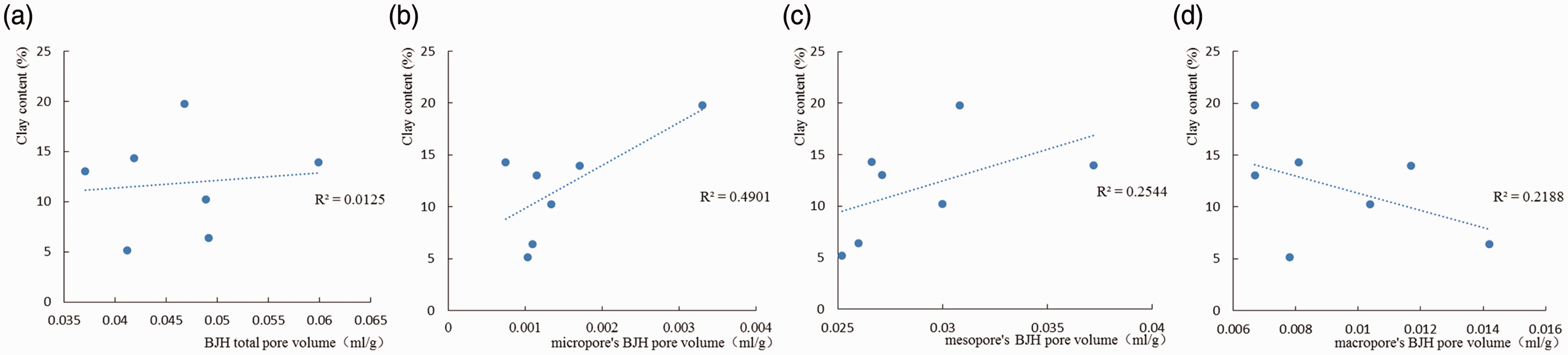
The clay minerals in Hetang Formation Shale are not obviously correlated with the total pore volume (Figure 10(a)), but they are in positive correlation with volume of micropore and mesopore (Figure 10(b) and (c)) and in negative correlation with macropore (Figure 10(d)), because clay minerals in Hetang Formation Shale are dominated by illite, followed by illite/smectite interstratified clay mineral (they account for over 95% in total clay content). When the marine environment is rich in potassium ion, Hetang Formation marine shale generates a lot of micropores due to volume decrease with the increase of burial depth and thermal evolution degree during conversion from montmorillonite to illite/smectite layer and illite; it is conducive to development of 10–50 nm mesopore with the increase of illite (Chalmers et al., 2012); and illite/smectite interstratified clay minerals mainly develop 10–50 nm mesopore (Ji et al., 2012), therefore, the content of clay minerals controls the development of micropore and mesopore to a certain extent.
② Brittle mineral. Correlation between clay content in shale samples and pore volume.
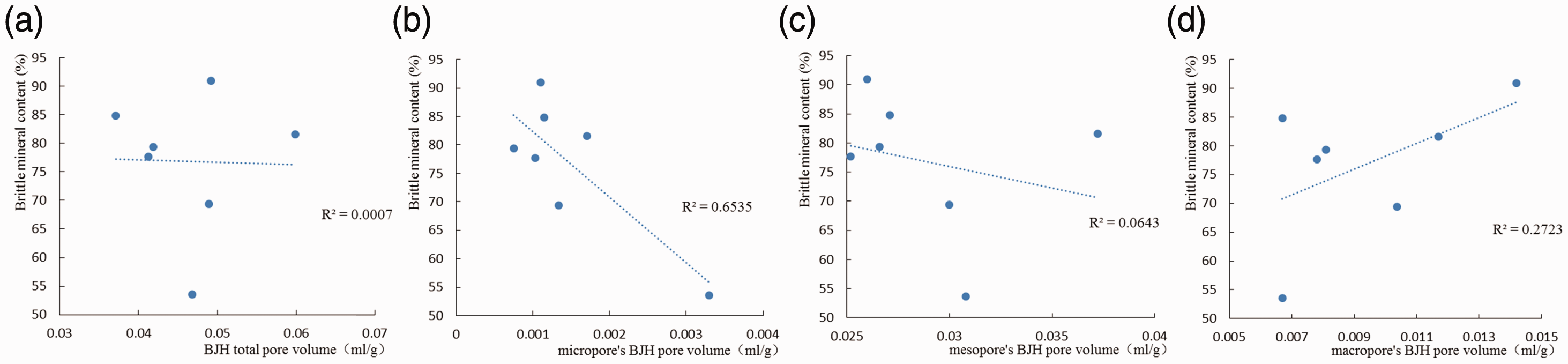
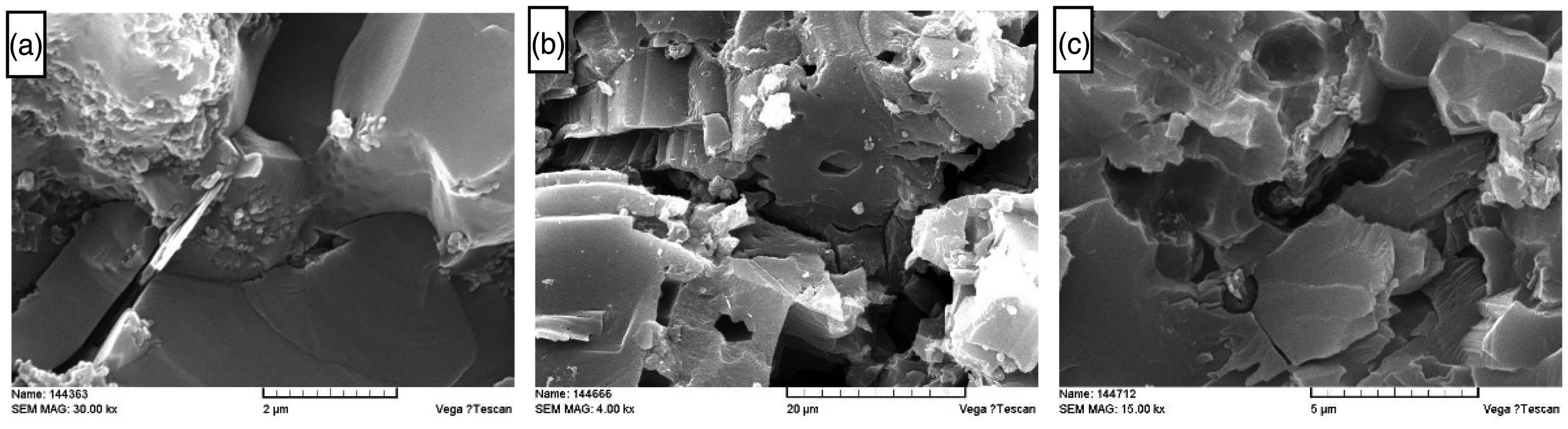
Brittle mineral in Hetang Formation Shale mainly includes quartz, feldspar, and carbonate minerals with high contents (53.61–90.95%). According to Figure 11(a), the content of brittle mineral is not obviously related to the total pore volume, in negative correlation with volume of micropore and mesopore (Figure 11(b) and (c)) and in positive correlation with macropore volume (Figure 11(d)). This is because brittle mineral in Hetang Formation Shale is dominated by quartz (accounting for 55.6%). Quartz is a kind of rigid mineral. With the increase of shale burial depth, its compaction resistance increases and forms a relatively rigid frame, which is beneficial for increase of macropore volume (Figure 12(a) and (b)) (Wu et al., 2013). Under high pressure, brittle minerals are prone to generate cracks (Figure 12(c)), so the brittle mineral may exert great controlling effects on macropore and microcrack.
(3) Thermal evolution degree Correlation between brittle mineral content in shale samples and pore volume. Type of pores in Hetang Formation shale. (a) Intercrystalline pore of quartz mineral, A-4; (b) intergranular pore of quartz mineral, A-37; (c) intercrystalline pore and microcrack of quartz mineral, A-67.
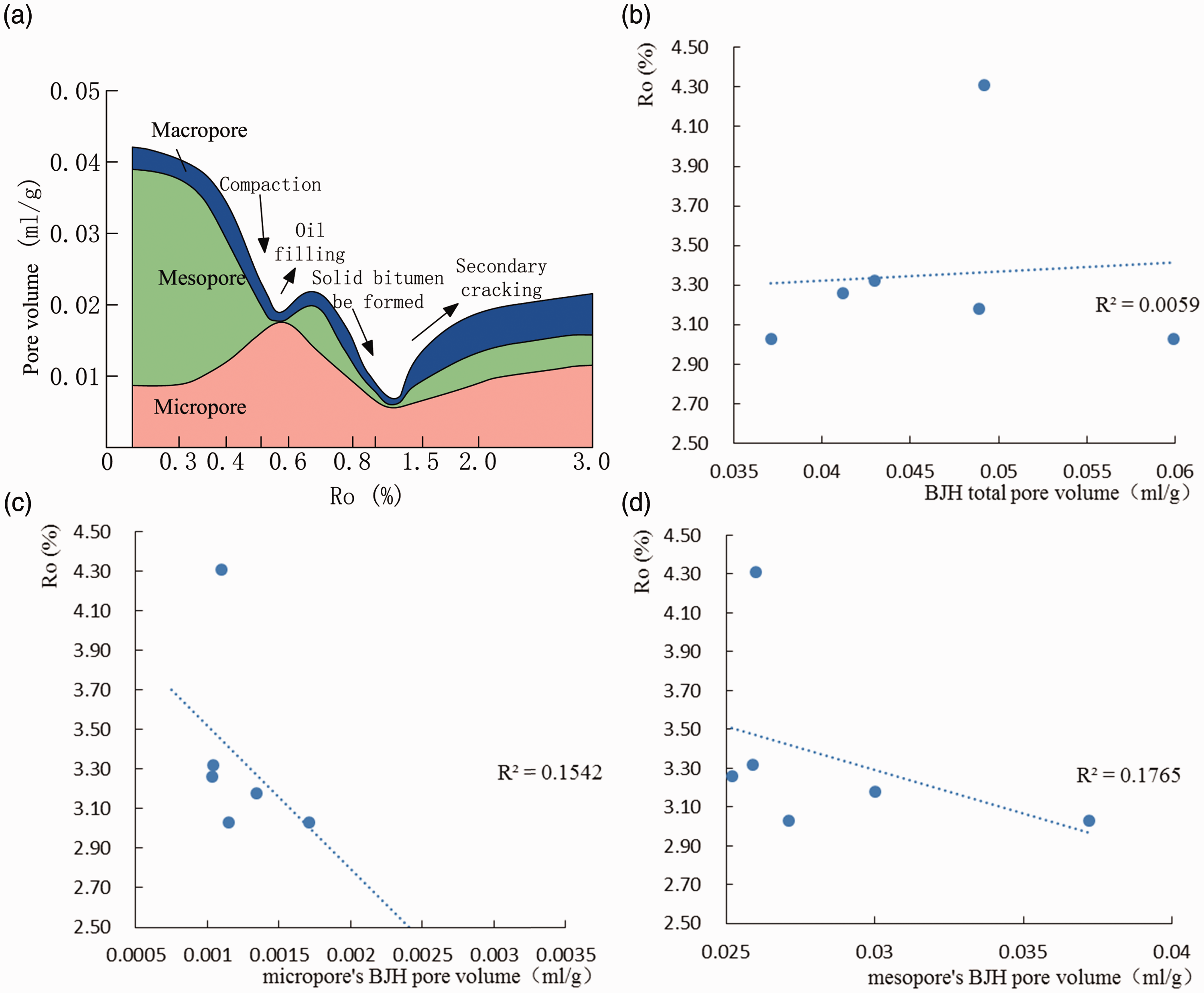
According to the previous researches, there exists certain relation between shale maturity (Ro) and pores (Bustin, 2012). The porosity of shale shows the trend of “increase–decrease–increase” with the increase of maturity (Figure 13(a)). Samples of Hetang Formation Shale in the research area are over mature and are in weak negative correlation with micropore and mesopore (Figure 13(c) and (d)), because most of micropore and mesopore are clay mineral pores. With the increase of burial depth, temperature, and pressure, the mesopores of clay minerals are compacted and the porosity decreases gradually, but the total pore volume and Ro are in complicated relation rather than simple positive or negative correlation (Figure 13(a)). This shows the thermal evolution degree affects microscopic pore structure of shale by affecting organic matter and mineral composition.
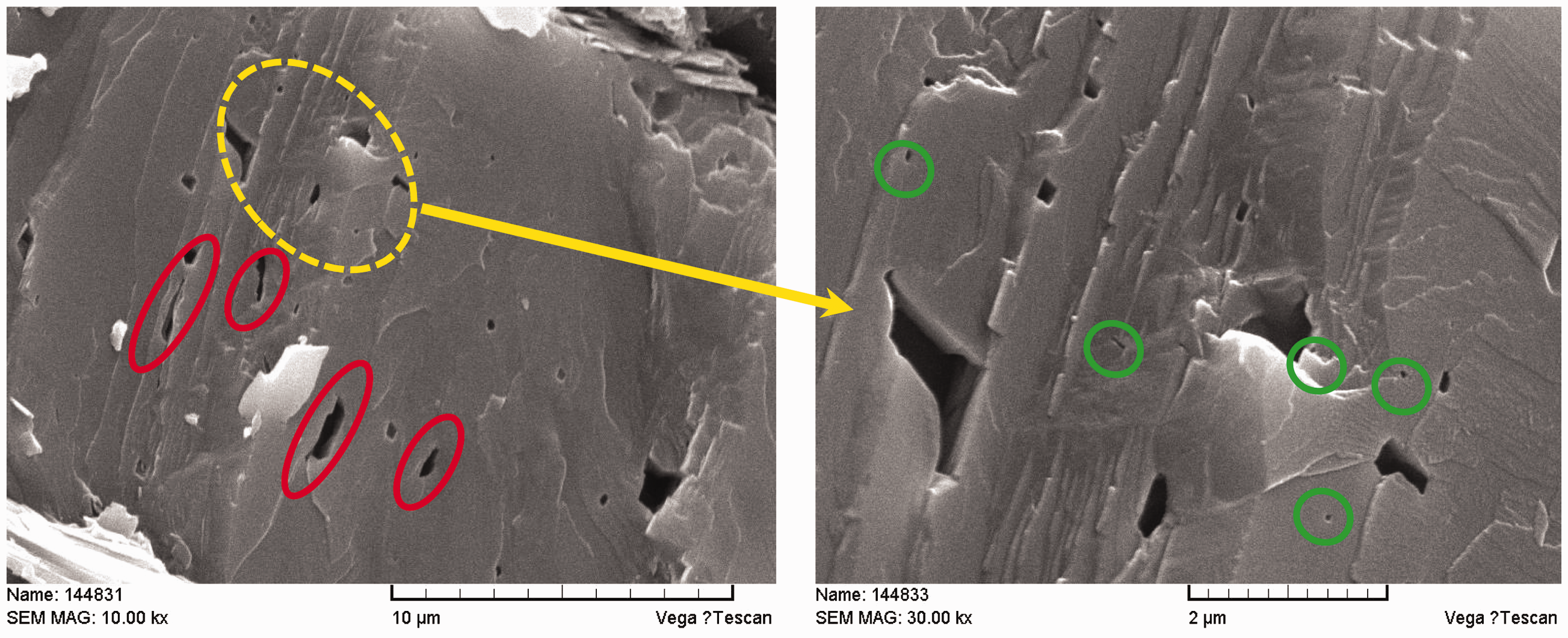
(4) Diagenesis Changes of shale porosity with maturity (Ro) ((a) by Zhang et al. (2015). Morphological characteristics of organic matter in Hetang Formation shale. (a) A-37 and (b, c) AZ-18. Intragranular pore of clay minerals AZ-18. (a) Intragranular pore in clay minerals (many pores are compacted and in directional arrangement) (red circle) and (b) partial enlargement (with many nanoscale pores (green circle), pore size is usually less than 80 nm).
Pore of Hetang Formation Shale is positively related to TOC and is not obviously related to mineral composition and maturity; however, there is apparent relation among micropore, mesopore, and macropore. Due to the obvious influence of diagenesis on shale pores (Fu et al., 2015), it needs to be studied in terms of late diagenesis. Based on previous researches, with the increase of burial depth, the volume of clay minerals with strong plasticity will decrease quickly and the compaction effect will reduce the space of micron pores, leading to sharp reduction of macropore volume in shale (Robert et al., 2012). When the burial depth is more than 2500 m, 83–88% of pore volume will be lost due to diagenesis and compaction effect (Huang and Shen, 2012). The burial depth of Hetang Formation Shale in the research area is mainly between 3500 and 5000 m (Wang et al., 2015), so the thermal evolution degree (Ro) is generally over 3.5% (obviously higher than that of the Lower Cambrian shale in the Middle-Upper Yangtze Region (Nie et al., 2011; Wang et al., 2013)). Due to great burial depth and high thermal evolution degree, its controlling effect over shale pore structures is “conflicting.” In detail, the volume of organic pores in shale increases with the increase of thermal evolution degree, while the volume of micropore reduces with the increase of thermal evolution degree due to conversion of clay minerals.
① Influence of organic pore structure.
The development of organic pores is controlled by thermal evolution degree (Curtis et al., 2012; Loucks et al., 2012). The nanoscale organic pores are not developed or rarely developed at the low maturity stage, but numerous nanoscale pores are generated at the high maturity stage (Figure 14(a) to (c)). By analyzing highly evolved shale samples in Hetang Formation of the research area, we find that TOC is positively related to pore volume, but the correlation coefficient is low, because the structure of organic pores change with the increase of burial depth during pyrolysis and hydrocarbon generation of organic matter, and nanoscale pore shrinks under extrusion and is in directional alignment (red circle in Figure 14(a) and (c)).
② Influence of micropore structure between clay minerals.
The corresponding relationship between shale clay mineral transformation and the degree of thermal evolution.
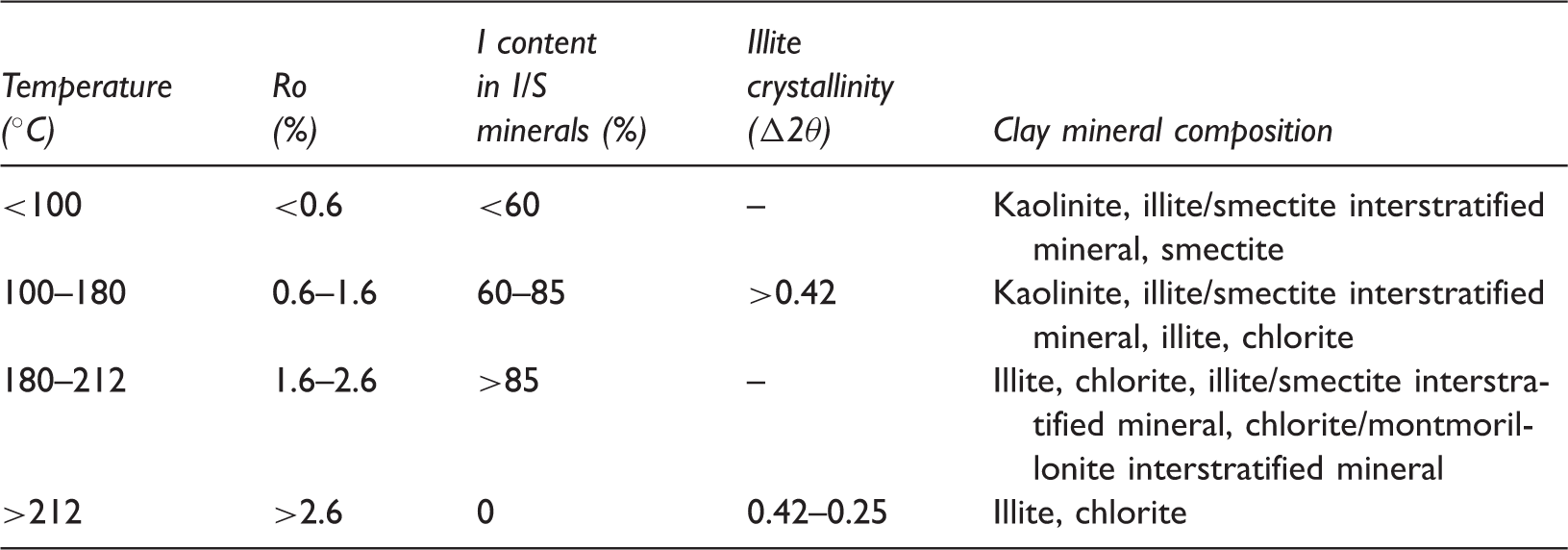
I/S: illite/smectite interstratified mineral.
It can be observed that long-term geological process and excessively high thermal evolution degree are the controlling factors restricting the microscopic pore structure characteristics of Hetang Formation Shale at the over mature period. With the increase of burial depth, numerous micropores were generated during organic matter evolution and mineral composition conversion of clay, but the development of macropore is far better than that of nanoscale pores, because the brittle minerals are the major composition. On the other hand, the increase of burial depth leads to long-strip-shaped nanoscale organic pores and clay mineral pores in directional arrangement under extrusion. Such pore throat is not beneficial for adsorption of methane gas, but macropore is conducive to migration of methane gas. Researches have showed that methane molecules only move in the free state when the pore size exceeds 50 nm (Chen et al., 2015). Based on this, we found that there may be high content of free gas in Hetang Formation Shale and induced cracks are prone to occur, which is good for seepage and desorption of shale gas, so the horizon is ideal for exploration of shale gas.
Conclusions
The adsorption curve of low-temperature liquid nitrogen in the Lower Cambrian Hetang Formation Shale in the research area is in inverse S-shape on the whole. The adsorption volume generally exceeds 25 ml/g, which is higher than that of the Lower Cambrian Niutitang Formation shale in the Upper Yangtze Region. According to hysteresis loop, there are three major pore types in Hetang Formation Shale. The first type includes cylindrical pore closed at one end, parallel-plate pore or conical/wedge-shaped pore (as micropore and macropore), open slit pores (as mesopore), and certain pores closed at one end; the second type includes numerous mesopore and macropore (inclined slit pore with two ends open are the main types of pore); the third type involves complicated mesopores and macropores, with coexistence of one-end opened pores and open pores. The pore size distribution curve of Hetang Formation Shale shows “two peaks.” The main pore size is 2 and 47–82 nm. Based on contribution of pore volume and specific surface area of BET, specific surface area is mainly contributed by micropore, but volume of micropore only accounts for 4.64% of total pore volume, reflecting that mesopore of Hetang Formation Shale forms the main space of shale gas, indicating Hetang Formation Shale is not beneficial for shale gas adsorption, but is conducive to seepage and desorption of shale gas. Besides, induced cracks are prone to occur during development. Pore volume of Hetang Formation Shale is only positively related to organic carbon, without obvious relation with mineral composition and thermal evolution degree. According to volume of different types of pores, the volume of micropore and mesopore is in positive correlation with content of TOC and clay minerals, and in negative correlation with content of brittle mineral Ro; macropore is not related to content of TOC and thermal evolution degree, showing negative correlation with content of clay minerals and positive correlation with content of brittle mineral. This shows the pore structure characteristics of Hetang Formation Shale are influenced by many factors. Diagenesis and high thermal evolution degree are two controlling factors restricting the microscopic pore structure characteristics. With the increase of burial depth, organic matter generates a lot of micropores during pyrolysis and hydrocarbon generation, and clay minerals generate abundant micropore and mesopore due to conversion from montmorillonite to illite. On the other hand, Hetang Formation Shale is dominated by brittle minerals. With the increase of shale burial depth, the compaction resistance of rigid quartz increases and forms a relatively rigid frame, which is beneficial for increase of macropore volume, so the development of macropore is far better than that of nanoscale pore.
By analyzing pore structure characteristics and controlling factors of Hetang Formation Shale in the research area, we can infer that the content of free gas is high in Hetang Formation Shale, and induced cracks are prone to occur, which facilitates seepage and desorption of shale gas, so it is ideal horizon for exploring shale gas. However, microscopic pores are mainly composed of macropores which lead to low gas-holding capacity. Therefore, it is required to pay more attention to the storage conditions during exploration and development.
Footnotes
Acknowledgements
We thank Engineers from the 223 Geological Team, Jiangxi Provincial Coalfield Geological Bureau for their assistance, M.S Degree Lipeng Zhao, Weiyuan Li and Zhisheng Liu from China University of Mining and Technology for their assistance with the collection of the shale samples. We also thank Xinghan Liu from Xuzhou Sino-trans Engineering Translation Co., Ltd for polishing the manuscript.
Declaration of conflicting interests
The author(s) declared no potential conflicts of interest with respect to the research, authorship, and/or publication of this article.
Funding
The author(s) disclosed receipt of the following financial support for the research, authorship, and/or publication of this article: This research was supported by “the Natural Science Foundation of Jiangsu Province (Grants No BK20150176)”; “A Project Funded by the Priority Academic Program Development of Jiangsu Higher Education Institutions (PAPD)”; “the Natural Science Foundation of Jiangxi Province (Grants No 20124ABE02107)”;“ the Natural Science Foundation of Guizhou Province (Grants No Qian Ke He JZ[2014]2005).”