




Abstract
Reservoir characterization is necessary for making reliable models to have future reservoir performances. Since an aquifer typically has positive influences on oil production, its characterization has rarely been regarded as a critical issue. However, in channel oil reservoirs, an aquifer amplifies uncertainty of permeability estimations and has its own uncertainty due to limited information without any direct measurement. Although there have been some researches on channel oil reservoirs using discrete cosine transformation, we cannot characterize reliably an aquifer using discrete cosine transformation alone. Thus, we need additional schemes to manage increased uncertainty by an aquifer and to estimate the aquifer itself. In this study, ensemble Kalman filter with the combination of preservation of facies ratio and discrete cosine transformation is proposed for channel reservoirs with an aquifer. By the proposed method, we confirm that discrete cosine transformation and preservation of facies ratio contribute to preservation of overall channel properties and fine-tuning of the channel in the ensemble Kalman filter algorithm, respectively. Consequently, the proposed method gives us stable characterization performances on oil and water productions, permeability distribution, and aquifer strengths for a reasonable decision.
Keywords
Introduction
Reservoir characterization is a process of making models, which reliably predict future reservoir behaviors. We utilize available reservoir information of interest for characterization. This process is also known as data integration or history matching. For reservoir characterization, there are two types of data: static and dynamic data. Static data such as permeability and porosity are assumed constant, which can be collected from geologic concept, well logging, or core sampling. Oil, gas, and water rates from production wells are archetypal dynamic data. We should utilize these data properly because they reflect characteristics of a reservoir.
Many history matching methods for reservoir characterization have been suggested. Ensemble Kalman filter (EnKF) proposed by Evensen (1994) is one of the typical methods. Nævdal et al. (2002) introduced it into petroleum engineering. It has many advantages: real-time assimilation, sound mathematical background, uncertainty analysis, and so on (Evensen, 1994; Lee et al., 2014; Valles and Nævdal, 2009). In spite of these advantages, there are limitations for reservoir parameters with non-Gaussian distributions, channel reservoirs, and highly uncertain reservoirs with an aquifer. Both non-Gaussian distributed and channel reservoirs disagree with the fundamental assumption of EnKF algorithm: parameters of interest are normally distributed. Violation of the basic assumption could lead to filter divergence or over/under-shooting problem showing too large or small parameter values (Lee et al., 2013a, 2013b). Filter divergence is a state that reservoir models become so similar each other that they are not properly assimilated anymore (Nejadi et al., 2014; Park and Choe, 2006).
Many researchers have studied EnKF applications to non-Gaussian fields. One of them, covariance localization has been applied to non-Gaussian reservoirs for more efficient and reliable characterization (Jung and Choe, 2012; Yeo et al., 2014). Also, Shin et al. (2010) applied a non-parametric approach for highly non-Gaussian permeability fields to EnKF. Lorentzen et al. (2012) performed history matching for channel reservoirs using EnKF. Lee et al. (2013a, 2013b) suggested a distance-based clustering for assimilation of channel oil reservoirs. Kim et al. (2016) utilized discrete cosine transformation (DCT) and preservation of facies ratio (PFR) for enhanced characterization of channel gas reservoirs with an aquifer.
Especially, we have difficulties in characterization of channel reservoirs considering their own pattern, continuity, and connectivity because the matrix of assimilation does not have quantitative factors of channel characteristics for numerical calculation. Many researchers have tried to solve this problem. Jafarpour and McLaughlin (2007, 2008, 2009) applied DCT to characterization of channel oil reservoirs, and its effectiveness is verified over many times. DCT was used for abstracting essential information of permeability distribution, solving ill-posed inverse problem, and grasping continuous features of channel. Also, they concluded that DCT eliminates repetition in the estimation problem and consequently saves computation time.
An aquifer has negative influence on gas production and increases uncertainty of production behavior (Kim et al., 2015, 2016). Therefore, reservoirs with an aquifer should be characterized by a suitable method because conventional EnKF does not work. Gaussian-distributed or channel gas reservoirs with an aquifer have been studied in several papers due to crucial effects of an aquifer (Glegola et al., 2012a, 2012b; Kim et al., 2015, 2016). Combination of EnKF, DCT, and PFR can preserve channel properties and give enhanced history matching performance in channel gas reservoirs with an aquifer (Kim et al., 2016).
In the most cases of oil reservoirs, an aquifer has positive influences like pressure maintenance by water drive, although it sometimes causes early water breakthrough or bypassed oil. For this reason, the characterization of channel oil reservoirs considering an aquifer has rarely been regarded as a critical issue. However, in channel oil reservoirs, an aquifer amplifies uncertainty of permeability estimations and has its own uncertainty due to limited information without any direct measurement. In channel reservoirs, fluid shows quite different behaviors depending on whether it is channel or not. That is why channel reservoirs with an aquifer bring about large uncertainty. As a result, history matching becomes hard owing to an aquifer. Therefore, an aquifer should be considered for future predictions and making reasonable decisions, when we make trustworthy reservoir models.
DCT has limitations on channel oil reservoirs with an aquifer. Even though DCT can catch overall trend of channels, it is not good at fine-tuning and preservation of detailed channel properties. EnKF with DCT alone is not able to fulfill dependable assessment due to high uncertainty by an aquifer. For this reason, its characterization could not been achieved successfully. Therefore, we need additional schemes for EnKF for reliable characterization of channel oil reservoirs with an aquifer.
In this study, combination of DCT and PFR in EnKF is proposed as a solution for channel oil reservoirs with an aquifer. Three methods are compared to demonstrate its soundness: EnKF only, EnKF with DCT alone, and the proposed method. The analysis for the three methods will show how the combination of DCT and PFR makes overall performance better.
Methodologies
Reservoir characterization
We need three things for reliable reservoir characterization: available information of a reservoir, a forward simulation model, and an optimization method. In this study, available data are training image (TI), permeability from core data, oil production rates, and well bottomhole pressure. Eclipse 100 (black oil model) is used as a forward model. EnKF is applied as an optimization method. Besides, DCT and PFR are combined with EnKF to overcome the limitations of the conventional EnKF method.
Ensemble Kalman filter
One reservoir model is represented by a state vector (equation (1)). Typically, state vectors are composed of several hundreds of reservoir models, known as ensembles, and they are calibrated by recursive EnKF. EnKF consists of two steps: forward and assimilation steps. The forward simulation predicts reservoir behaviors for one time step using each reservoir model and operational conditions (equation (2)). Then, we get computed dynamic data such as production rates or pressures of wells of interest. Also, there are actual observed data, which are obtained from measurement of a real field. The larger difference between dynamic and observed data is, the more state vectors are updated (equation (3)). The reservoir models are assimilated by repetition of this procedure





Preservation of facies ratio
In channel reservoirs, rock can be classified into several facies. Facies is defined as a body of rock with specified characteristics. If rocks have same facies, they have similar properties like permeability or porosity. Thus, it is important to find out its facies in reservoir modeling. We assume sand and shale facies in channel reservoirs, and its facies can be assigned by corresponding permeability value.
We can use this geological nature for reservoir characterization. In a field, if there are only sand and shale and their facies ratio is known, the only thing we have to do is to decide whether sand or shale at each grid. In this study, when a grid has sand facies, sand permeability is assigned. If not (shale), it has the shale permeability. Facies ratio can be approximately estimated by geological exploration, well logging, or core sampling. This information will be helpful for detailed reservoir characterization in spite of its uncertainty. Estimated facies ratio is honored, while EnKF procedure is run. We call this process as PFR.
Although EnKF has sound mathematical background, it may provide physically impossible values after the numerical assimilation. For example, porosity should range from 0 to 1, and permeability cannot be negative (Park and Choe, 2006). As EnKF does not know whether updated values are reasonable or not, we need to determine threshold. PFR can be utilized as one of those standards. It prevents overshooting by assigning permeability of sand or shale to the grids. In this study, the permeability of sand is 100 md and that of shale is 1 md. Figure 1 shows an example of PFR. Figure 1(a) presents typical overshooting problem with very high permeability. After the PFR application (Figure 1(b)), extremely small or large permeability values are rectified. We can expect more stable assimilation of EnKF by PFR.
Application example of the preservation of facies ratio. Permeabilities of sand and shale are 100 and 1 md, respectively. Scale is natural log. (a) Updated permeability field and (b) PFR applied to (a).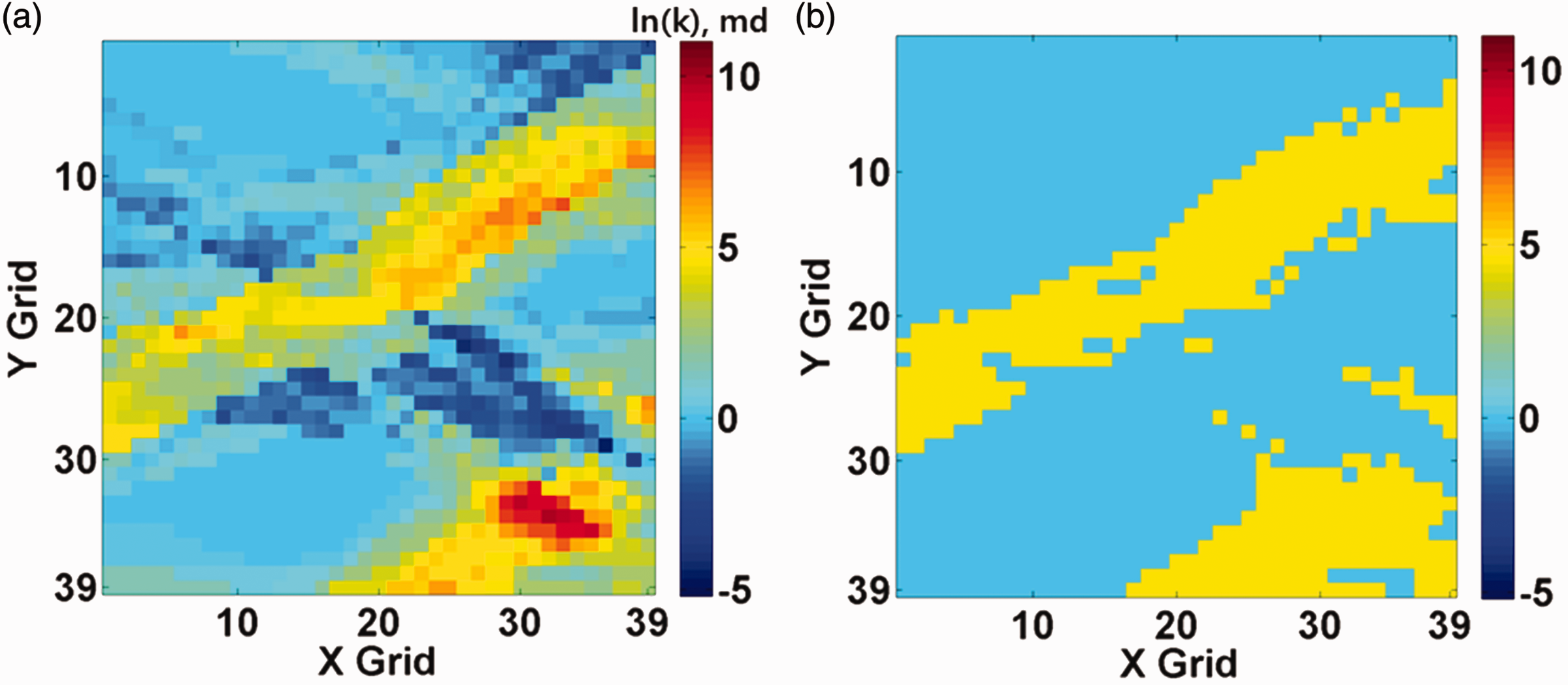
Discrete cosine transformation
DCT is one of the parameterization methods for abstracting of essential part of data. It uses real cosine functions and transforms information into coefficients of cosine functions. One-dimensional DCT is given by equations (6) and (7). Inverse DCT is given by equation (8)



In a two-dimensional (2D) image, DCT’s cosine functions are arranged in a descending order from the upper-left to the lower-right corresponding to their levels of detail and orientations. The more upper-left part is, the lower frequency has. One variable value in a grid is expressed by a sum of M cosine basis functions. A set of M DCT-weighting coefficients illustrates one image. When N is the number of grids of an image and M equals N, the image can be reproduced perfectly by the coefficients. If M<N, although some partial information of the image is lost, the compressed data by DCT can compactly represent the image and still preserve overall characteristics of the original image (Jafarpour and McLaughlin, 2007, 2008, 2009; Jafarpour et al., 2008).
Outline or pattern of an image can be realized by only a small part of the whole DCT elements. Only essential parts of DCT coefficients are enough to estimate the trend of the original field with keeping their properties of channel. Therefore, we can utilize this methodology for characterization of channel reservoirs.
A 2D log permeability field, which has N × N grids is transformed into N × N DCT coefficient value matrix. A part of the DCT basis images can express a main channel pattern of the original field. A small fraction of the DCT coefficients, which are gathered in the upper-left corner of the matrix, are able to represent the permeability field. In EnKF procedure, the coefficients are put into a state vector as elements. After the assimilation of transformed coefficients, updated DCT coefficients are processed in the inverse procedure to get a permeability field.
Complementary combination of DCT and PFR
DCT and PFR can be conjoined with EnKF separately or together for improvement of characterization performances. If just only one method is employed with EnKF, as shown in this paper and previous studies, it could not give satisfactory results (Kim et al., 2016). Since DCT abstracts kernel information of channel, we can expect to get main channel trend by DCT alone. On the contrary, when only PFR is applied with EnKF, it will manage overshooting and provide distinct channel areas. However, none of them is satisfactory.
A separate application of DCT or PFR to EnKF is not able to reliably characterize channel reservoirs with an aquifer. There are still overshooting and filter divergence problems in spite of the respective advantages. Therefore, both of them should be complementarily performed. By doing so, they supplement weakness of each other. Consequently, they can dependably estimate an aquifer and manage its uncertainty.
Figure 2 shows the proposed procedure in detail. Firstly, initial ensemble is generated, and Eclipse 100 simulates each model. All models are transformed by DCT. Kalman gain is calculated, and ensemble members are updated. The coefficients of updated models are transformed to permeability field by the inverse DCT and PFR is applied. This procedure is recursively repeated, while there are observed data. Then, final updated models are given, and we can predict future behaviors of the reservoir of interest.
Entire procedure of the combination of EnKF, DCT, and PFR. The blue boxes are typical EnKF processes. The green boxes are DCT and PFR applications.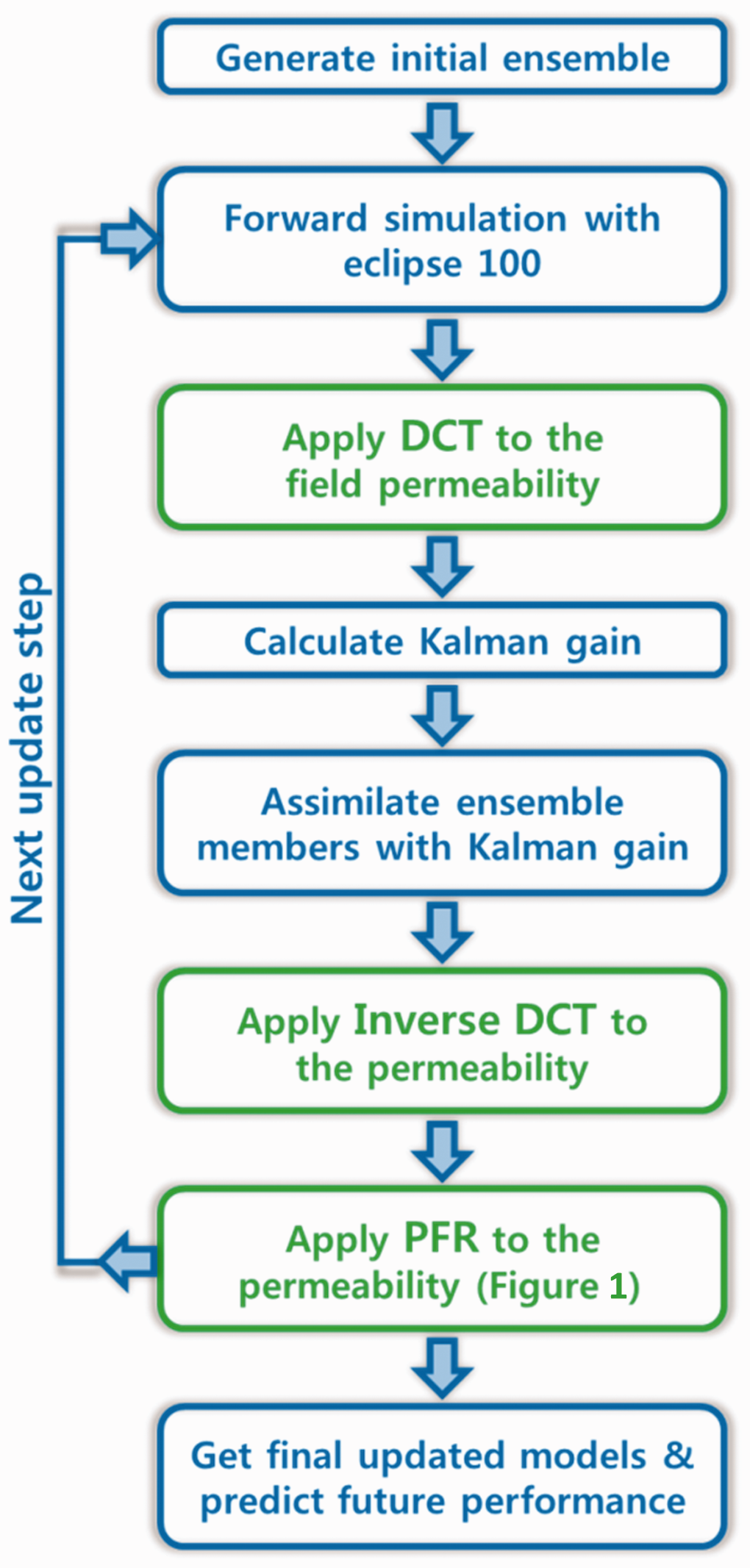
Results
Simulation conditions.
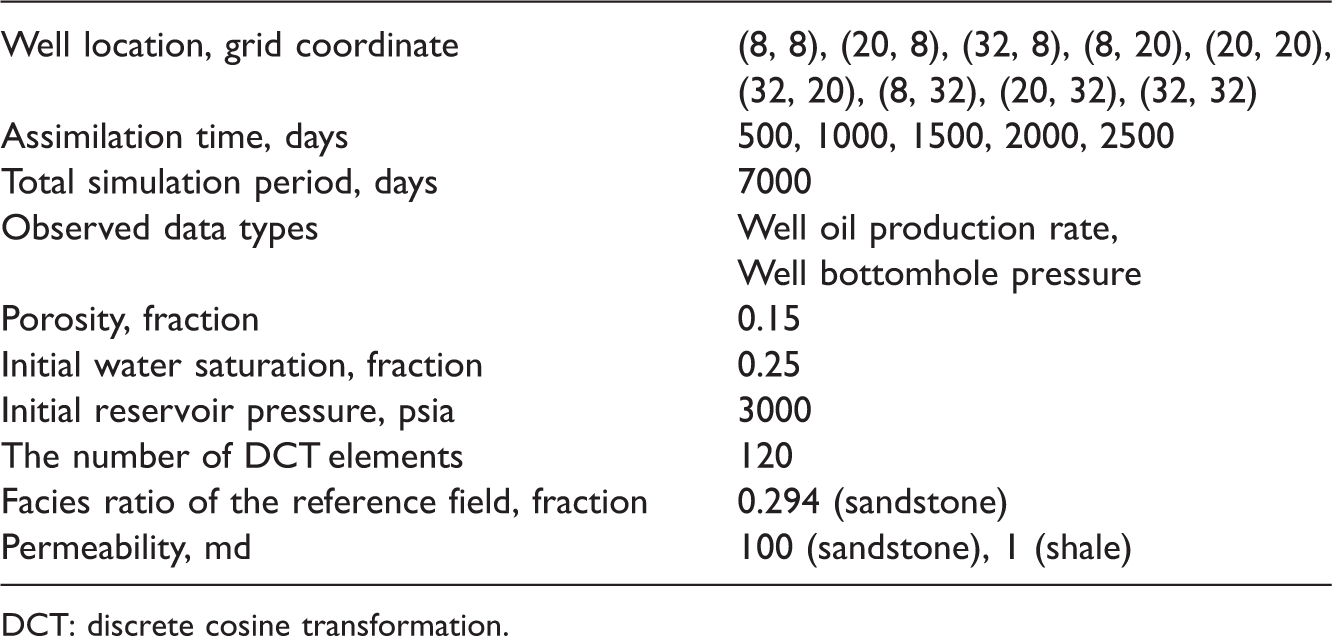
DCT: discrete cosine transformation.
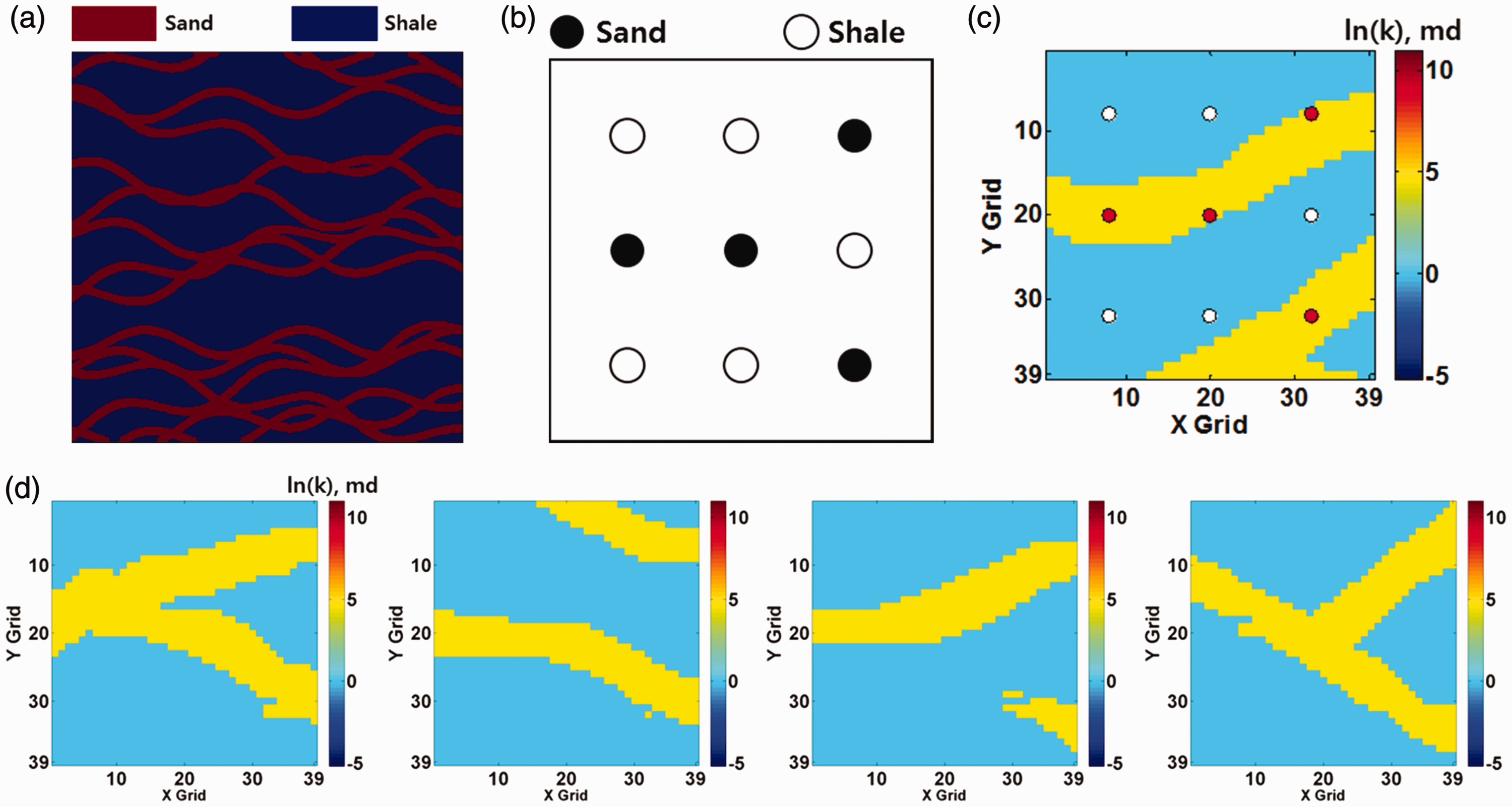
Composition of permeability field. (a) Training image, (b) hard data at the nine wells, (c) log-permeability reference field, and (d) four examples of initial log-permeability field.
Conditions of TI generation.
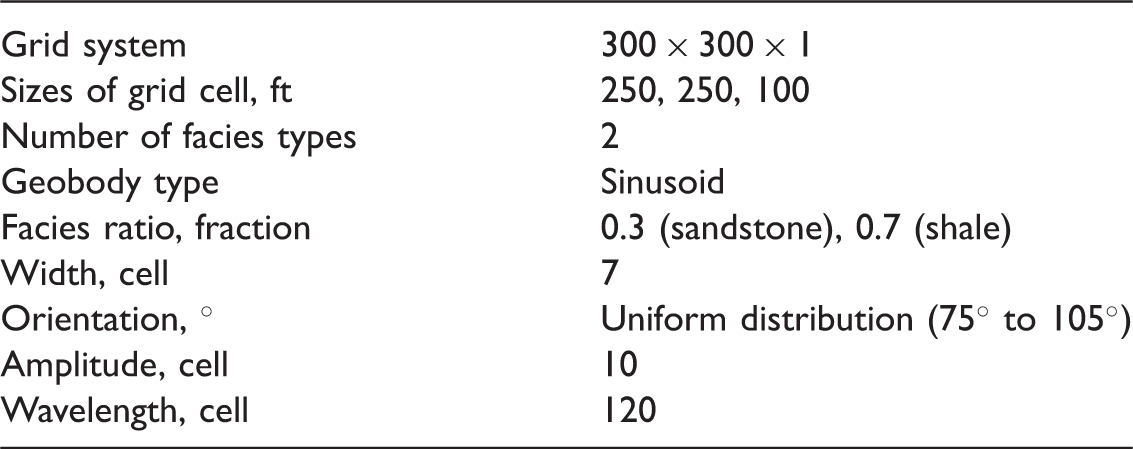
TI has horizontal channel trend, and it makes various initial ensemble members with conservation of the known data. Compared to the reference field, four samples have different channel pattern. It implies that the behavior of the reference will be different with those of the initial ensembles. Although this is challenging to characterize, if the proposed method gives proper predictions after the updates, we can demonstrate its sound performances.
An aquifer is realized by multiplication of pore volumes, which are saturated 100% by water. MULTPV keyword in Eclipse 100 makes pore volume be multiplied as many as user set. Initial MULTPVs follow the uniform distribution between 40 and 65. Total aquifer volume is 4.5–7 times as large as that of the reservoir on average. In the reference field, the east and south aquifers are strong, and the rest are moderate.
Ensemble members go through five times assimilation: 500 days interval from 500 to 2500 days. DCT and PFR are applied in every assimilation time step. After the final update, all ensemble members predict reservoir behaviors to 7000 days. To verify performances of the proposed method, we compare oil and water production rates, cumulative oil and water productions, permeability distribution, and aquifer strengths (MULTPVs).
Prediction of oil and water rates
Oil and water production rates
For comparison of the three methods, both of oil and water productions have to be analyzed. Figure 4 presents oil rate predictions of initial and updated ensembles in comparison with the three methods. The gray lines and the blue lines are initial or updated ensembles and the mean of those, respectively. The red lines are the observed values of the reference. Wells P3, P4, P5, and P9 have high oil productions compared to other wells due to high permeability and the effect of an aquifer (Figure 4(a)). They are most likely on the channels by characteristics of SNESim.
In midterm of the production, water is flooded into wells P3, P4, and P9 (Figure 5(a)). Because well P5 is located on center of the field, it is not directly influenced by an aquifer compared to the other wells. Continuous effects of an aquifer make wells produce water gradually larger. Also, the uncertainties of channels and aquifer strengths emerge as the uncertainty of water productions.
Oil rate predictions from the initial and updated ensemble models by the three methods: with an aquifer. The proposed method uses EnKF with DCT and PFR. (a) Initial ensembles, (b) EnKF, (c) EnKF with DCT, and (d) the proposed method.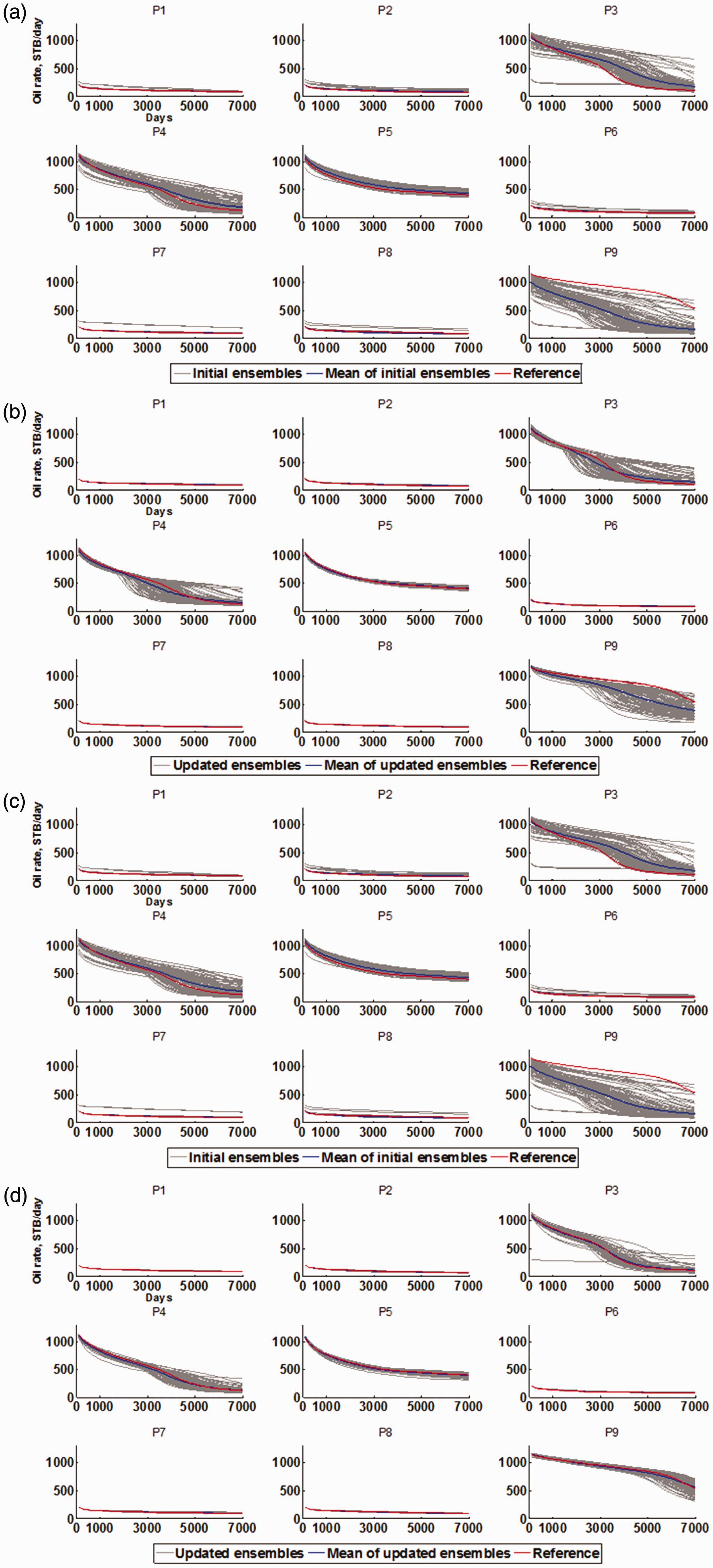
Figure 4(b) shows history matching performed by EnKF alone. Wells P3 and P4 demonstrate decreased uncertainty, while including the reference lines in the bandwidths. However, well P9 has still large uncertainty, and the reference line deviates from the updated ensembles. Even DCT is combined with EnKF, it provides rather poor result (Figure 4(c)). DCT does not give improved outcome in channel oil reservoirs with an aquifer, while previous studies have reliable characterization of channel oil reservoirs without an aquifer (Jafarpour and McLaughlin, 2008).
Moreover, in Figures 5(b) and (c), the updated ensembles show even worse or not enhanced predictions. This is unsatisfactory to characterize the reservoir and predict future productions. On the other hand, in Figures 4(d) and 5(d), oil and water productions are reliably updated conforming the reference. Soundness of the combined DCT and PFR is validated by this history matching performance.
Water rate predictions from the initial and updated ensemble models by the three methods. (a) Initial ensembles, (b) EnKF, (c) EnKF with DCT, and (d) the proposed method.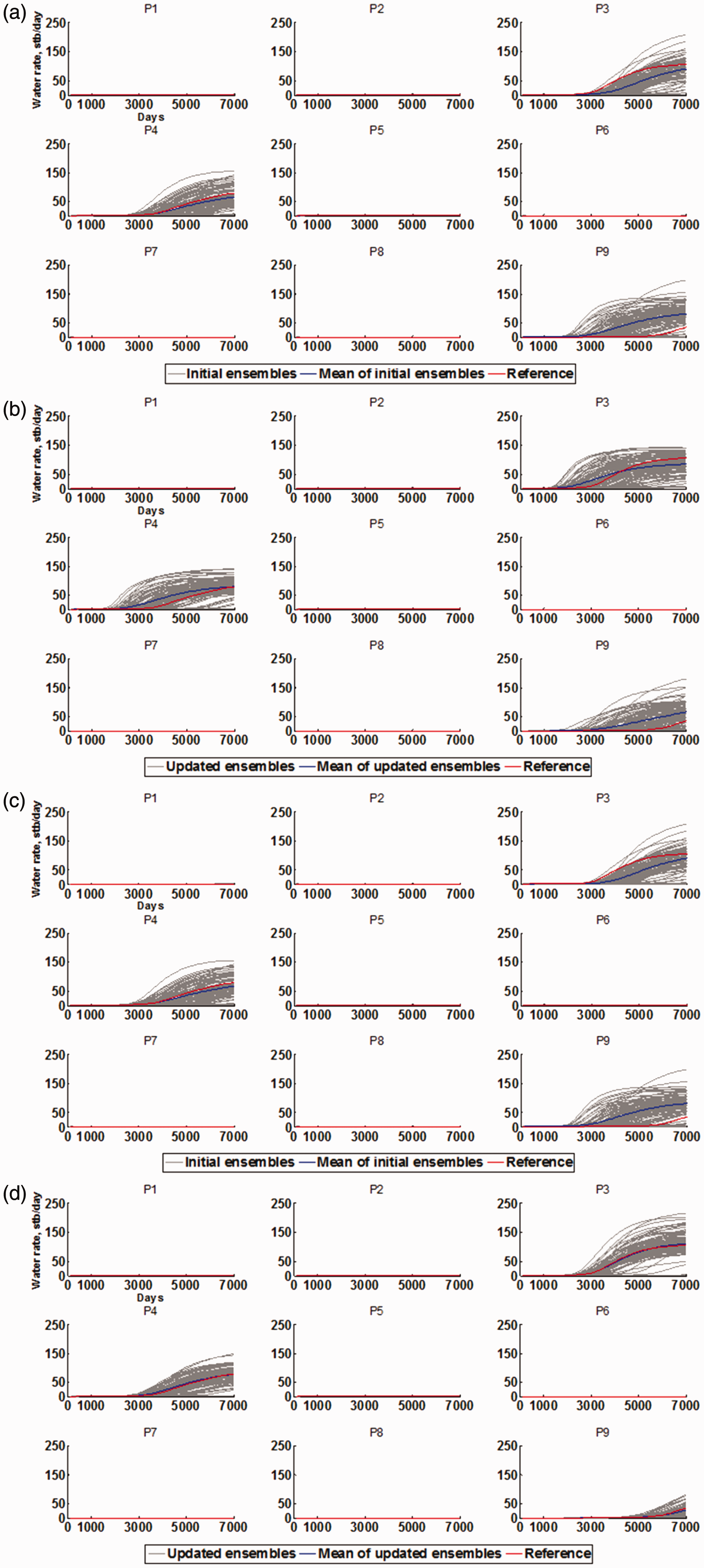
Cumulative oil and water productions
Cumulative oil productions show a gently increasing slope (the left column of Figure 6(a) to (d)). On the other hand, cumulative water productions present a steep slope by the natural waterflood of an aquifer (the right column of Figure 6(a) to (d)). The oil production results by EnKF and EnKF with DCT look reasonable, but their performances can be much more clearly compared by the results of water productions than oil productions (Figure 6(b) and (c)). There is almost no improvement with high uncertainties for the prediction of water rates, even after the characterization. On the other hand, the updated ensemble members by the proposed method are definitely converged on the reference line (Figure 6(d)). That also leads to decrease of the uncertainty.
Total oil and water productions from the initial and updated ensemble models by the three methods. (a) Initial ensembles, (b) EnKF, (c) EnKF with DCT, and (d) the proposed method.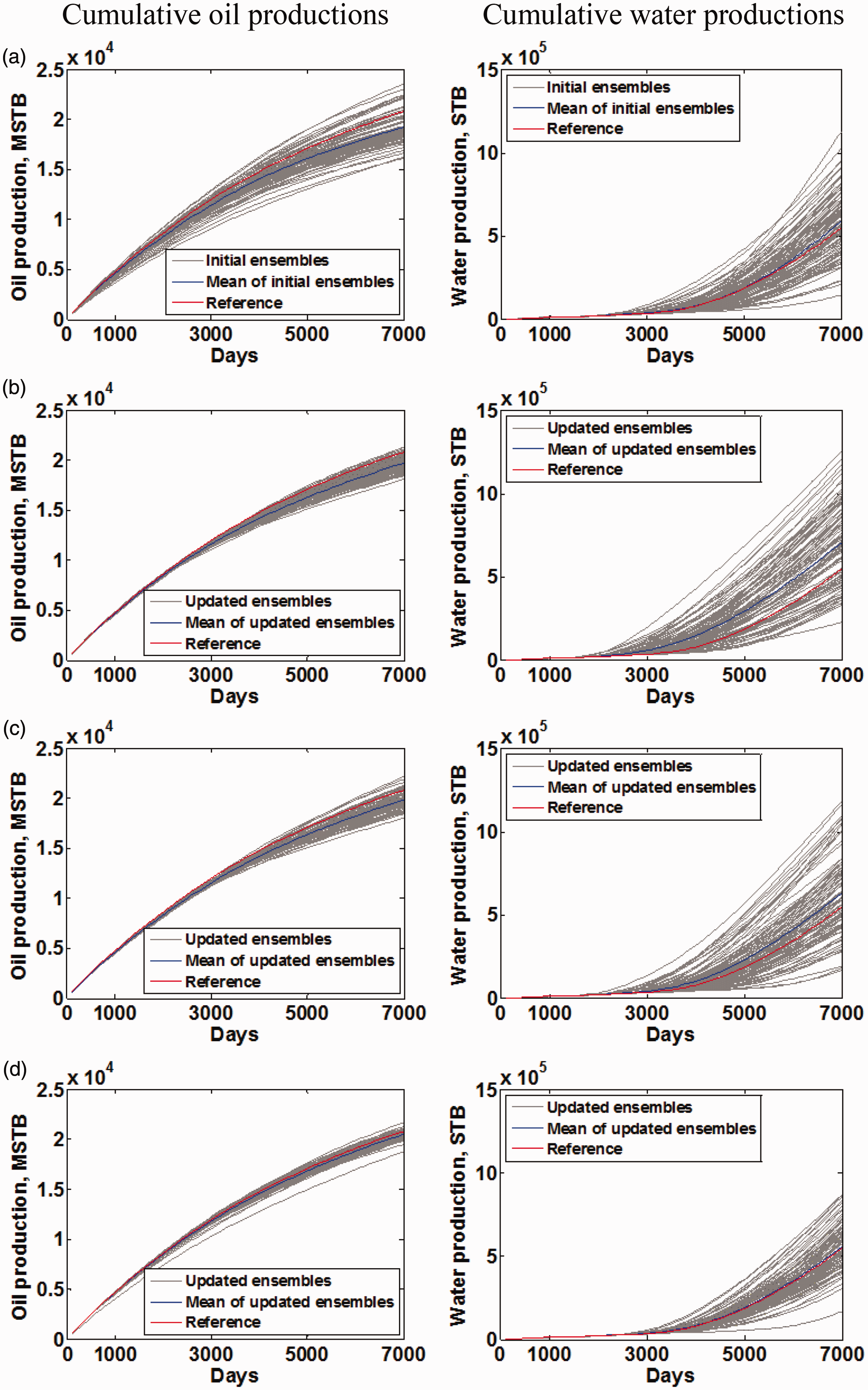
Permeability distribution
Figure 7 shows permeability distribution of the reference, the initial ensembles, and the updated ensembles. The reference has diagonally two main channels and a bimodal distribution in the histogram (Figure 7(a)). Even though the mean of initial ensembles sustains known data for sand facies, it does not have any specific trend because of limited information (Figure 7(b)).
Conventional EnKF makes permeability distribution approximately follow a normal distribution. In the updated permeability, the overall pattern is unclear and has wrong channel connections (Figure 7(c)). Furthermore, overshooting appears in several parts. In the histogram, the distribution becomes even more disordered than that of the initial ensembles. EnKF with DCT presents main pattern, which is similar to the reference. The result lets us can assume where the main channels are. Despite these effects of DCT, it is difficult to identify channel width and its connectivity. Also, wrong connections between the two main channels cause poor estimations on water rates (Figure 6(c)). Overall channel distribution presents gradation and is unclear like cloud. In addition, it shows slight overshooting like the result of EnKF. DCT alone is not enough to reliably characterize channel reservoirs.
Figure 7(e) gives the best updated permeability field compared to the others. It preserves the two main channels of the reference. The updated histogram also clarifies that the distribution has changed into a bimodal distribution. We can see and check the updated permeability more dependably from Figure 8 with four samples of each method. In each column, they are the same ensemble member from initial to the updated ensembles. The results of EnKF and EnKF with DCT display overshooting problem and vague appearance of channel patterns. Channel characteristics such as pattern, connectivity, and border of the channels are not emerged. The four permeability fields by the proposed method are consistent and stably figure out the main channels.
Permeability and its histogram before and after the assimilation by the three methods. (a) Reference, (b) mean of initial ensembles, (c) EnKF, (d) EnKF with DCT, and (e) the proposed method.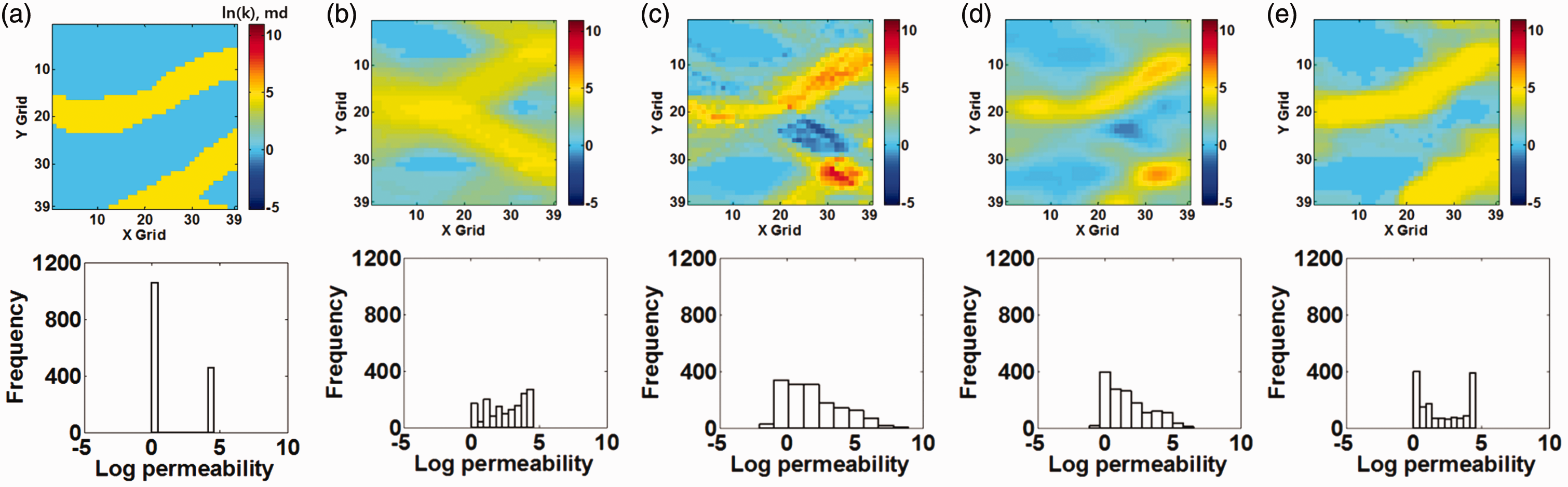
Aquifer strengths
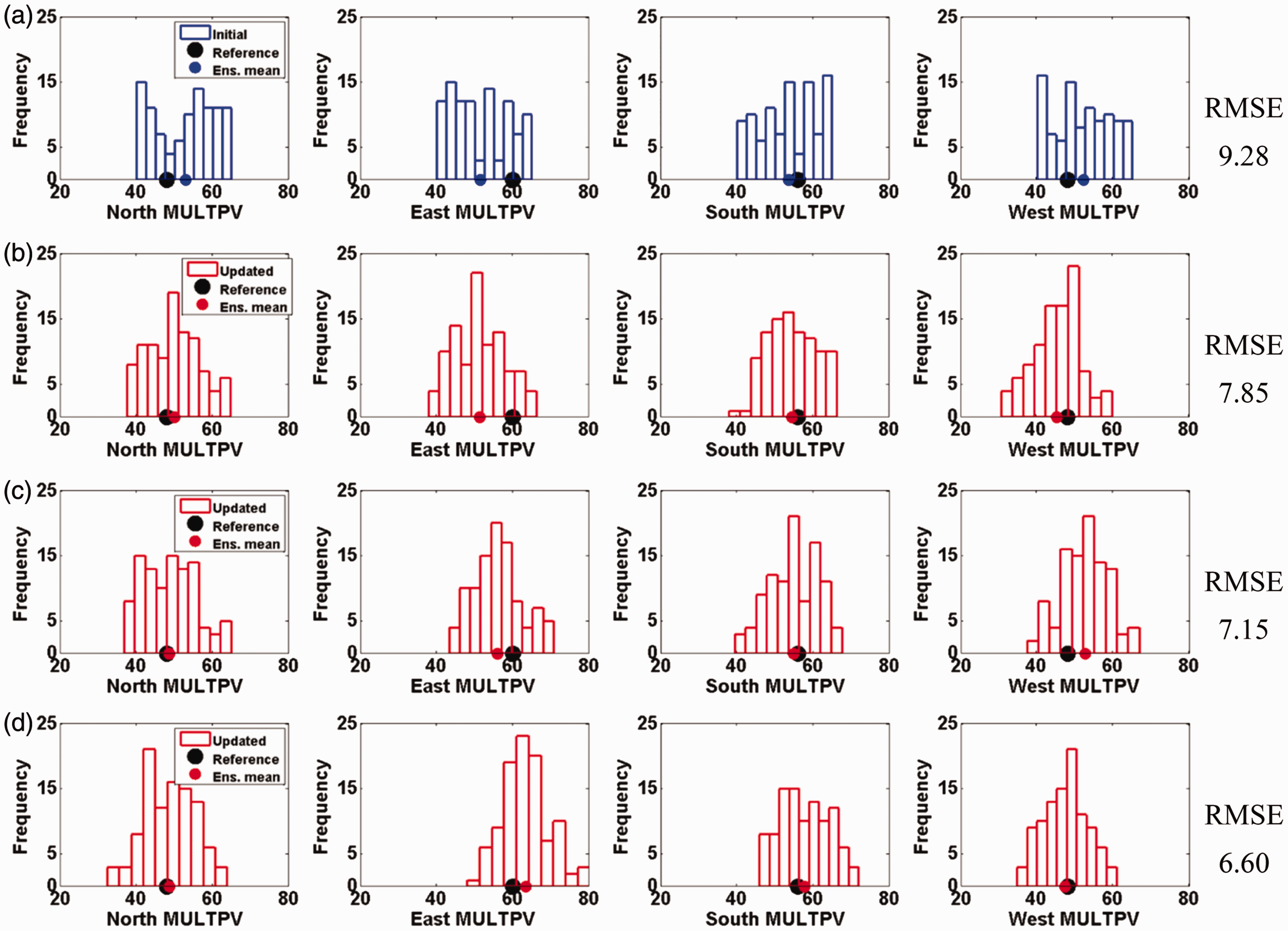
Figure 9 presents updated results of MULTPVs and their averages of root mean square error (RMSE). The blue and red boxes are initial and updated MULTPVs in histogram. The blue and red dots are the means of initial and updated ensembles, respectively. The black one is the references. The initial ensembles overestimate MULTPVs in the north and west and underestimate in the others. The updated MULTPVs by EnKF and EnKF with DCT show reduced RMSE and decreased uncertainty. However, compared to the proposed method, the east of Figure 9(b) and the west of Figure 9(c) represent unstable performances of the two methods. In Figure 9(d), the means of updated MULTPVs correspond to the references. Besides, it has the smallest RMSE value.
Four examples from the initial ensembles and assimilated results by the three methods. (a) Examples of initial ensemble, (b) EnKF, (c) EnKF with DCT, and (d) the proposed method. Initial and updated results of the aquifer parameter (MULTPV) and their RMSE by the three methods. (a) The initial ensembles, (b) EnKF, (c) EnKF with DCT, and (d) the proposed method.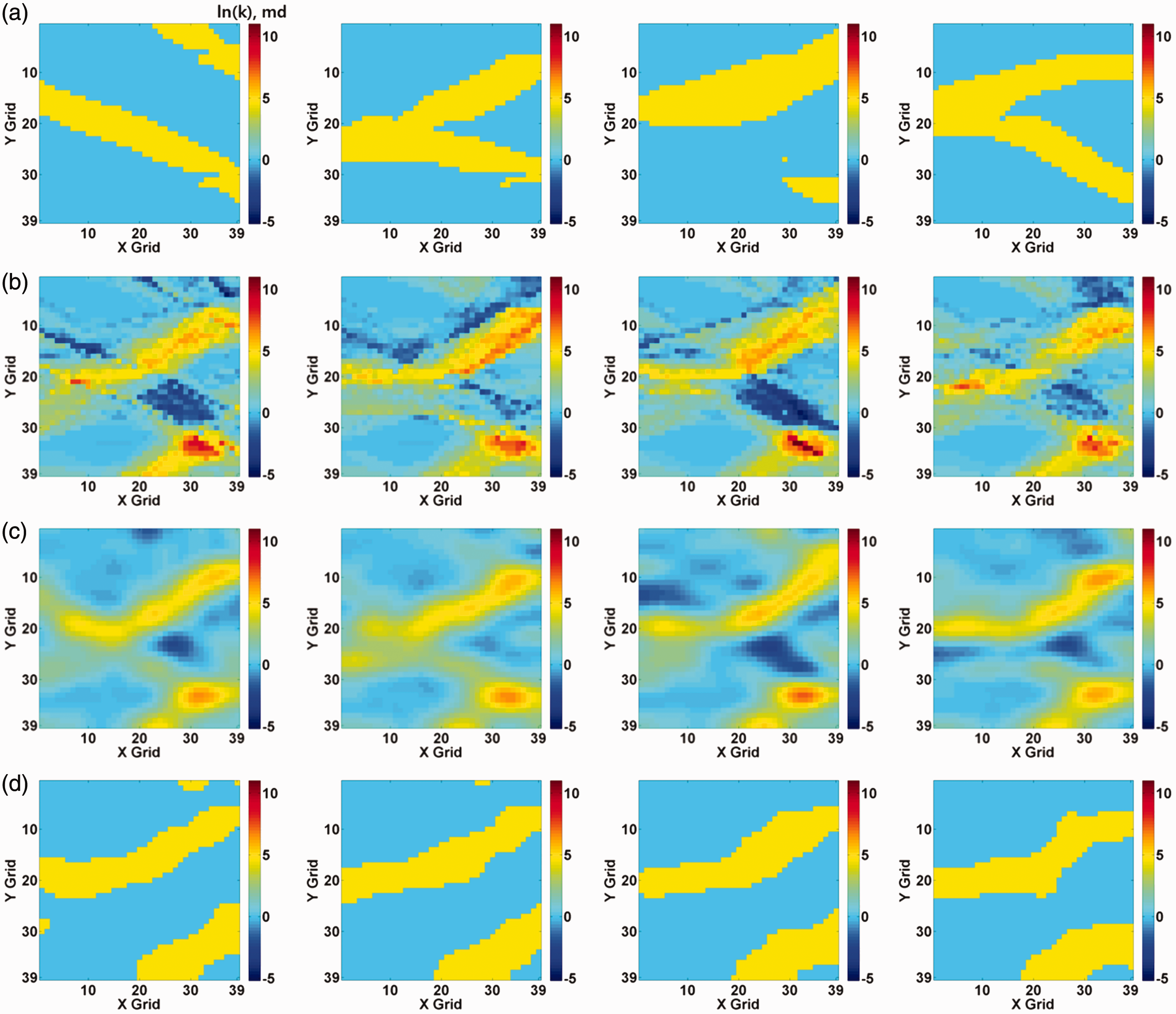
Conclusions
In spite of many researches on channel oil reservoirs, necessity of characterizing aquifer parameters has been neglected. Moreover, EnKF with DCT alone could not characterize channel oil reservoirs with an aquifer. It should have been suggested proper schemes for them. In this study, the complementary combination of DCT and PFR is proposed. It can compensate each weakness and manage high uncertainty by an aquifer. We can draw a conclusion that EnKF with the combination of DCT and PFR can be a solution for characterization of channel oil reservoirs with an aquifer from the following results: oil and water productions, permeability distribution, and aquifer strengths.
In the prediction of future oil and water productions, the proposed method noticeably gives improved predictions covering the true trend in the ensembles’ bandwidths. Also, the results of permeability distribution demonstrate the effectiveness of the combination of DCT and PFR and preserve its bimodal distribution. Lastly, right assimilation of aquifer strengths is a key factor to get reliable characterization results with reduced uncertainties.
All of the results analyzed in this study show that the proposed method can properly characterize channel oil reservoirs with an aquifer. It dependably predicts future production behaviors based on reliable assimilation of channel pattern, its connectivity, and aquifer strengths. Therefore, the proposed method is expected to help make reasonable decisions for production operations and reservoir management.
Footnotes
Acknowledgments
This research is conducted through Engineering Research Institute at Seoul National University, Korea.
Declaration of conflicting interests
The author(s) declared no potential conflicts of interest with respect to the research, authorship, and/or publication of this article.
Funding
The author(s) disclosed receipt of the following financial support for the research, authorship, and/or publication of this article: The authors thank research projects supported by The Ministry of Trade, Industry, and Energy (20142520100440).