




Abstract
Reservoir characterization is a process to make a model similar to a true reservoir by integrating available data. It is necessary for reliable estimation of future productions and making proper decisions. Ensemble Kalman filter is one of the most powerful reservoir characterization methods. Ensemble Kalman filter can update reservoir models in real time and assess uncertainty by multiple models. Characterization of a channelized reservoir is difficult because of irregular channel pattern and connectivity. In this paper, ensemble Kalman filter with preservation of facies ratio and discrete cosine transformation is proposed for solving overshooting problem and maintaining properties of channel. The proposed method gives us stable characterization performances on gas and water productions, channel pattern and connectivity, and aquifer strengths regardless of the existence of an aquifer and uncertainty of facies ratio. Although facies ratio has ± 10% uncertainty with the reference, updated models maintain channel properties properly. Discrete cosine transformation helps to preserve channel pattern and connectivity and, therefore, overall performances are enhanced. Consequently, the proposed method can provide reliable updated models and credible prediction of future reservoir performances for making a proper decision.
Keywords
Introduction
Reservoir characterization is a process to make a model similar to a true reservoir by integrating available data. It is important to predict future reservoir behaviors with less uncertainty for proper operational decisions. Ensemble Kalman filter (EnKF) is one of the most powerful reservoir characterization methods. It has many advantages such as real-time assimilation, sound mathematic background, uncertainty assessment, and easy coupling with commercial simulators. EnKF is introduced by Evensen (1994) in ocean dynamics. Then, Nævdal et al. (2002) applied EnKF first to petroleum engineering for reservoir permeability characterization. Skjervheim and Evensen (2011) introduced ensemble smoother first to synthetic reservoirs.
Two typical problems of EnKF are filter divergence and overshooting. Several schemes of covariance localization are adopted to mitigate these problems (Jung and Choe, 2012; Lee et al., 2013b; Yeo et al., 2014). There are many EnKF studies to overcome non-Gaussian permeability distribution in oil reservoirs (Lee et al., 2014; Shin et al., 2010). EnKF lacks fine tuning of reservoir models and additional optimization is employed (Jeong et al., 2010). When EnKF is directly applied to channelized reservoirs, the characteristics of the fields are lost (Lee et al., 2013a; Lorentzen et al., 2012). Sharp gradient between channel and background are smeared out.
In a grid system, application of EnKF to a channelized field is not easy due to unique characteristics of a channel such as connectivity, continuity, and pattern. Jafarpour and McLaughlin (2007) performed history matching with EnKF and discrete cosine parameterization. It preserves properties of a channel and increase efficiency of matrix calculation by using essential parts of parametrized compositions. Peters et al. (2011) used multi-dimensional scaling which selects proper initial ensembles for history matching of channelized oil reservoirs. Lorentzen et al. (2012) combined EnKF with a level set method to preserve facies structure for the updated fields.
Jafarpour et al. (2008) showed EnKF with discrete cosine transformation (DCT) helps to solve ill-posed inverse problems and to detect continuous features. They verified that DCT eliminates redundancy in posing the estimation problem and results in additional computational savings (Jafarpour and McLaughlin, 2007, 2008, 2009).
Previous studies on history matching using EnKF largely focused on oil reservoirs. Only a few researches are related to gas reservoirs. Glegola et al. (2012a) predicted water front of an aquifer using EnKF with 4D gravimetric data. However, they did not consider aquifer factors, which cause high uncertainty. Glegola et al. (2012b) suggested a method to characterize factors related to an aquifer using ensemble smoother with 4D gravimetric data. In this case, they just assumed the same aquifer strength at each side. Kim et al. (2015) characterized conventional gas reservoirs with an aquifer using only production data and considered different aquifer sizes at the four sides.
Channelized gas reservoirs without an aquifer do not have high uncertainty and gas behaviors are not complex compared to those of oil. Therefore, strict reservoir characterization is not needed for those cases. However, an aquifer hugely increases uncertainty of gas reservoirs (Kim et al., 2015). Figure 1 demonstrates effects of an aquifer on uncertainty of gas productions. Totally, 100 channelized reservoir models are used, and simulation conditions are identical except for aquifer properties.
Gas production rates at wells 3, 5, 9 for 100 initial ensembles: (a) no aquifer, (b) aquifers of the same strengths at the four sides, and (c) aquifers of different strengths at the four sides.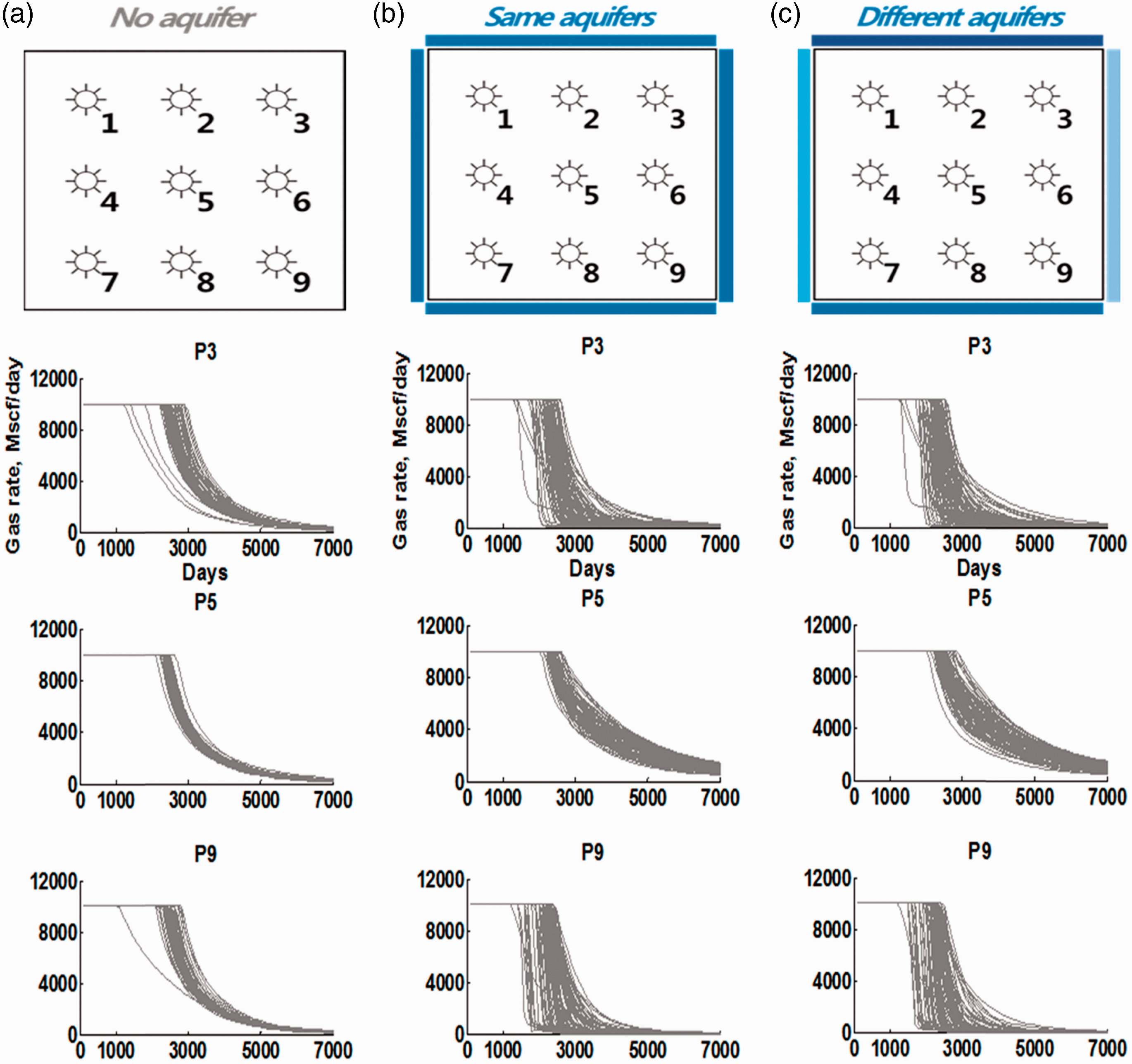
Figure 1(a) shows gas behaviors of the reservoir without any aquifer. It has low uncertainty compared to Figure 1(b) and (c). Uncertainties increase due to aquifer existence (between Figures 1(a) and (b)) and its strength (between Figure 1(b) and (c)). Different behaviors of gas and water cause the high uncertainty. Gas flows faster than water and easily detours a low permeability zone of the reservoir, whereas water flow is much affected by permeability. Therefore, uncertainty of permeability appears as the difference of gas productions in gas reservoirs with an aquifer.
Reliable characterization of channel properties is difficult due to its pattern and connectivity. Moreover, if the reservoir has an aquifer, we have to not only handle high uncertainty of gas behaviors but also need aquifer characterization. Both of them are necessary for reliable prediction of future reservoir performances and sensible operational strategy.
In this study, a method will be proposed for channelized gas reservoirs both with and without an aquifer. It utilizes EnKF with DCT and preservation of facies ratio (PFR) to characterize channel pattern and its connectivity. This research will verify that DCT is a suitable technique for channelized gas reservoirs even with uncertainty of facies ratio.
Methodologies
Ensemble Kalman filter
In EnKF, one model is realized by a state vector, which has all parameters of interest and is composed of static data, dynamic data, and observed data as equation (1). Dynamic data include oil or gas production data, which vary with time at the same position.

EnKF consists of two steps. First one is forecast step and the other is assimilation step. In the forecast step, a forward simulator calculates dynamic behaviors to the next time step using given present static and dynamic data as equation (2).

In the assimilation step, the state vectors are updated as equation (3) with Kalman gain (K) (equation (4)), which is induced by minimizing the estimate error covariance (CY), equation (5). Observed data are available from real field, and the predicted data are obtained from model simulations. If initial models are quite different from the real reservoir, differences between the predicted data and the observed data will be large. In this case, the state vectors are more calibrated as equation (3).



Preservation of facies ratio
Rock facies is a concept that we can assort rock type. Classifying rock facies is very important because rock properties like permeability or porosity strongly depend on rock types. We can conceptually divide rock facies for modeling channelized reservoirs or grasping geologic formation of channels. If we know rock facies and its overall structure, we are able to predict future reservoir performances.
Core or seismic data are gained in exploration period. Although they have uncertainty and error, we can approximately estimate facies ratio of the entire field. If a reservoir has simple structure with only two rock types of sand and shale, grids of rock types can be artificially designated as sand or shale during reservoir characterization by a procedure called PFR.
Although EnKF has mathematically sound background, it is lack of considering geologic features. In some cases, results contain extremely large or small permeability values, porosity and saturation values larger than 1.0 or smaller than 0.0, and so on (Park and Choe, 2006). This is known as over-/under-shooting. PFR can be applied to assimilated results of physically unreasonable values for remedy to satisfy known geologic features.
For the procedure of PFR, the whole permeabilities of the grids are sorted by the descending order. Facies ratio known or assumed will be the criterion, which classifies rock types into sand and shale. If the permeability ranking of the grid is higher than the criterion, that grid is designated as sand (100 md). If not, it is assigned as shale (1 md). This approach will be simple but effective to figure out sand or shale in a reservoir model. Figure 2 shows one example of PFR application. Before PFR application, there are extremely small or large permeability values, but after PFR application, extreme values are managed properly.
Application example of the preservation of facies ratio. Scale is natural log. Permeability of sand and shale are 100 and 1 md, respectively.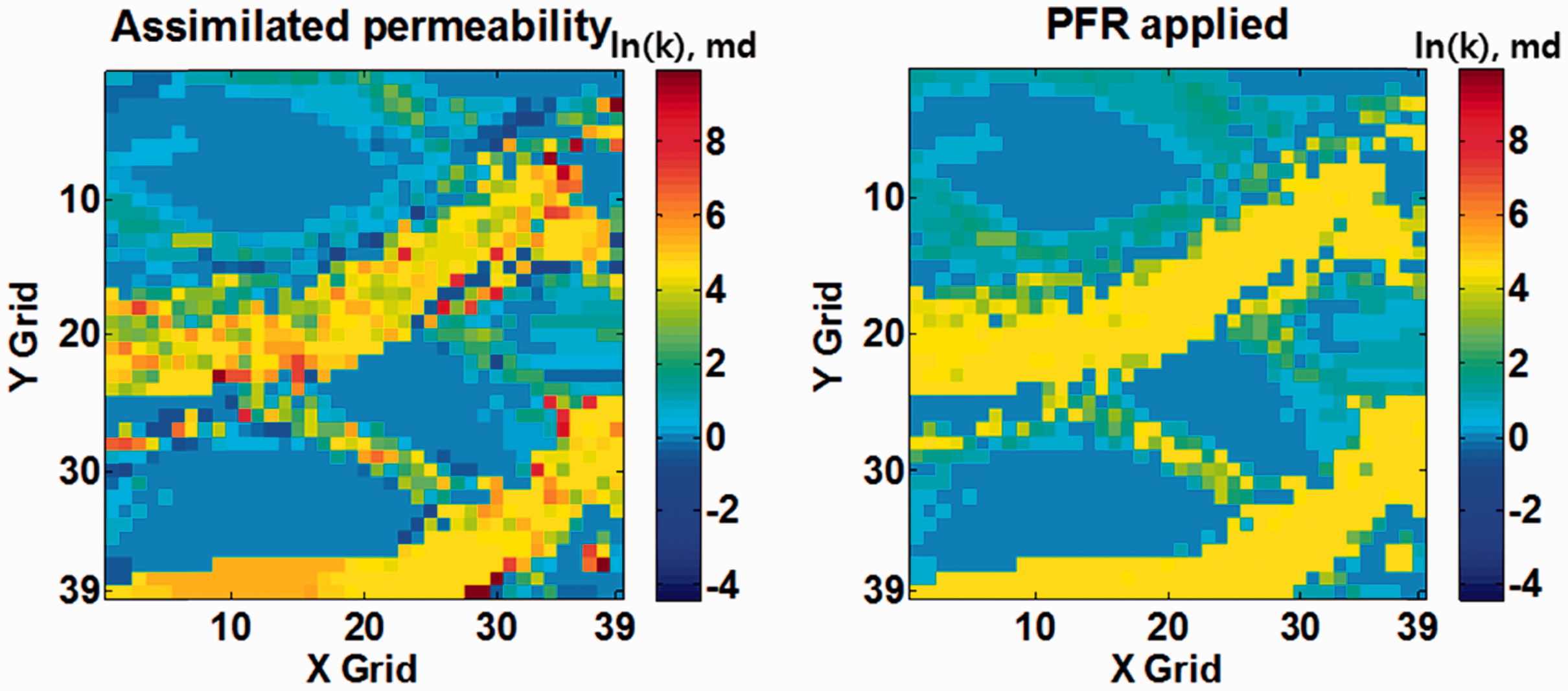
Discrete cosine transformation
DCT is one of parameterization methods for data compression. It uses real cosine functions as transformation kernels. One-dimensional DCT is given by equations (6) and (7). Inverse DCT is given by equation (8).



In a two-dimensional (2D) image, DCT basis functions are organized in the descending order from the upper-left to the lower-right corresponding to their levels of detail and orientations. One variable value in a grid is expressed in a sum of M cosine basis functions. A set of M DCT-weighting coefficients illustrates one image. When N is the number of grids of an image and M equals N, the image can be reproduced perfectly by the coefficients. If M < N, some partial information of the image will be lost. However, the compressed DCT representation of the image is compact and still reserves overall characteristics of the original image (Jafarpour and McLaughlin, 2007, 2008, 2009; Jafarpour et al., 2008).
DCT can be condensed by a set of linear equations. The forward transformation from N grid values to the M coefficients is given by equation (9). The inverse problem can be solved using M DCT-weighting coefficients of the basis functions like equation (10).


A 2D log permeability field, which has N by N grids is transformed into N by N DCT coefficient value matrix. DCT estimation of the field is a linear combination of a specific number of predefined basis functions. A part of the DCT basis images can express a major channel pattern of the original field. A small fraction of the largest DCT coefficients, which are gathered in the upper-left corner of the matrix will be used to represent the permeability field. The coefficients are set as elements of a state vector in EnKF. After the assimilation, assimilated DCT coefficients are utilized in the inverse procedure to get an assimilated permeability field.
Pattern or trend of an image can be realized by only a small part of the whole DCT elements. Only essential parts of DCT coefficients are enough to estimate the trend of the original field with keeping their properties of channel. Therefore, we can apply this methodology for characterization of channelized reservoirs. Only 120 DCT elements are used out of 1521 elements from the 39 by 39 grid system.
Combination of PFR and DCT
PFR and DCT can be applied to EnKF separately or together for improvement of characterization performance. In this study, three methods are analyzed using EnKF, PFR, and DCT (EnKF, EnKF with PFR, and EnKF with PFR and DCT). The procedure of the proposed method is shown in Figure 3. Overall process is same with the conventional EnKF. However, it contains three additional processes mentioned in the red boxes in Figure 3.
Overall procedures of EnKF with combination of PFR and DCT. The red boxes are for DCT and PFR applications.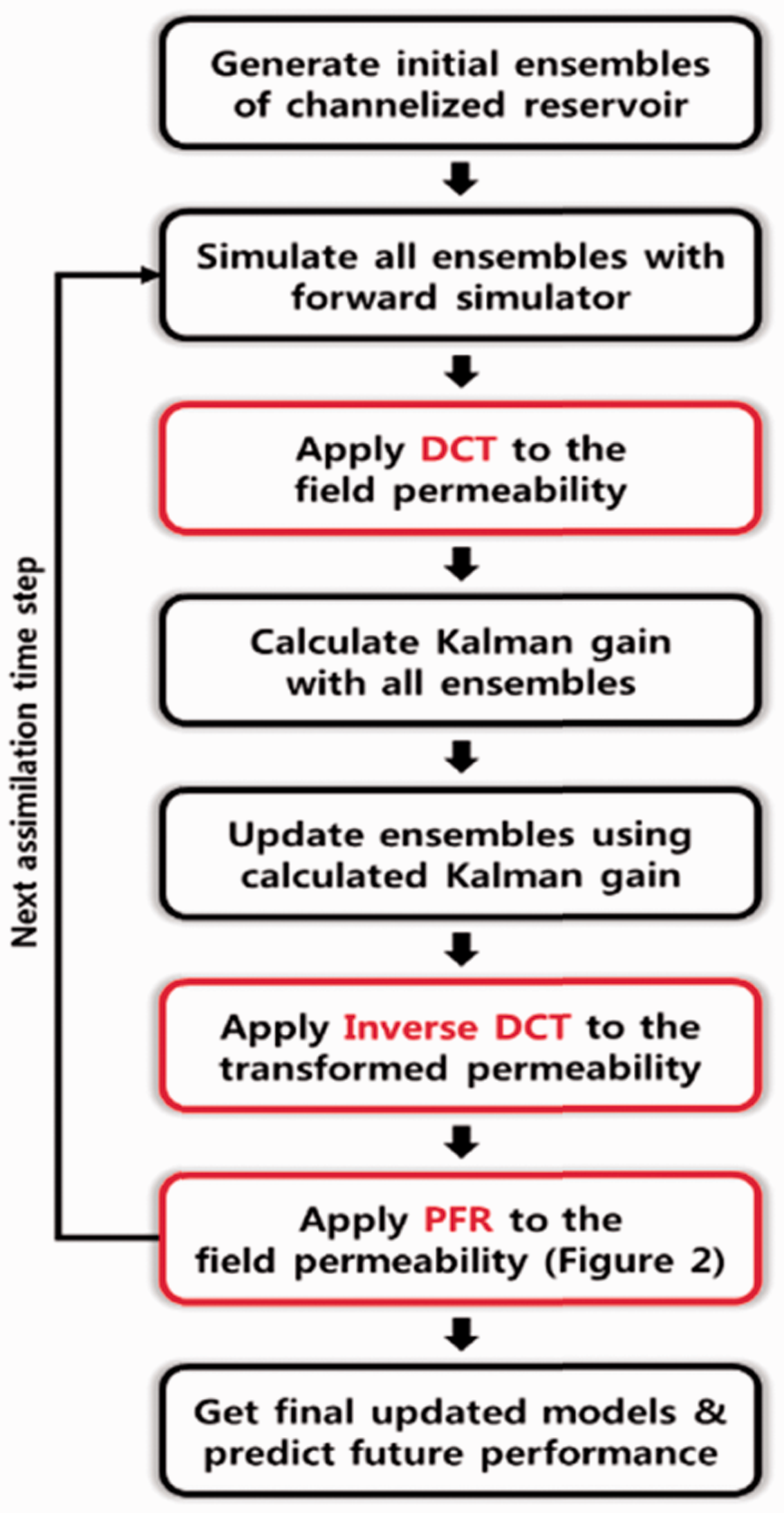
At first, initial ensembles of channelized reservoirs are generated. The field permeability is transformed by DCT. Kalman gain is computed and ensembles are updated with that. Transformed permeability is inversed by the inverse DCT. PFR is utilized to assort rock types. After that, it goes to the next assimilation time step and repeats the procedure again to the final assimilation step. Then, we can get final updated ensembles and predict future reservoir performances.
Results
In this study, a synthetic channelized gas reservoir is characterized by EnKF. The reservoir type is dry gas. Grid system is 39 by 39. Size of the grid cell is 250, 250, and 100 ft of x, y, and z axis, respectively. There are nine production wells (Figure 4(c)). Gas production rate and bottomhole pressure limit are 10,000 Mscf/day and 1000 psi at all wells, respectively. Table 1 lists other simulation details. The reference and 100 initial ensembles are made by SNESim using SGeMS. Figure 4(a) and (b) presents the training image and nine known data as rock facies indicators, respectively. Table 2 gives the conditions of training image generation. Figure 4(c) and (d) shows the reference and four log-permeability examples among the 100 initial ensembles, respectively.
Composition of permeability field: (a) training image, (b) known data at the nine wells, (c) log-permeability reference field, and (d) log-permeability field of four sample realizations generated by SNESim. Reservoir model data and simulation conditions. Conditions of TI generation.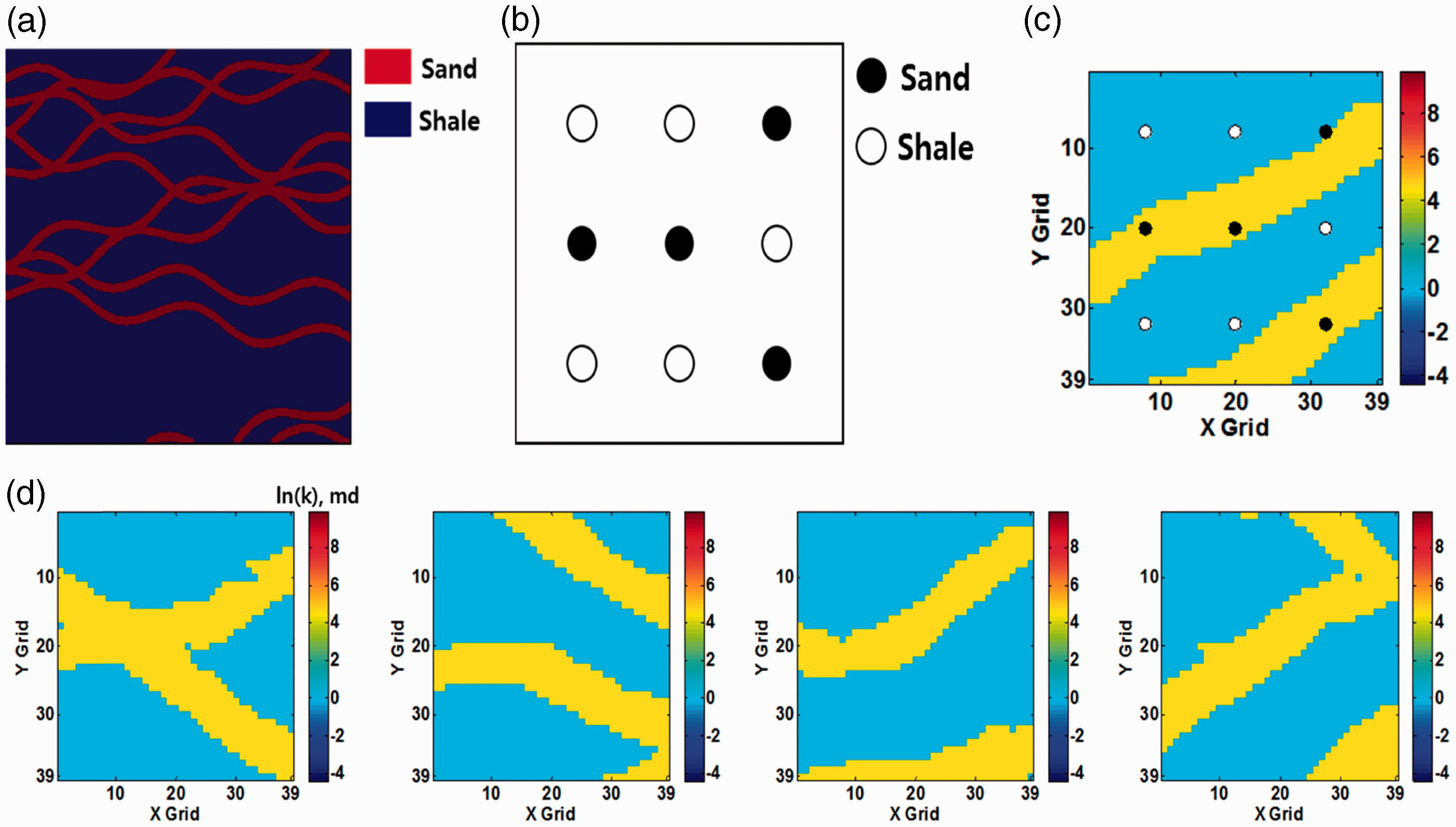
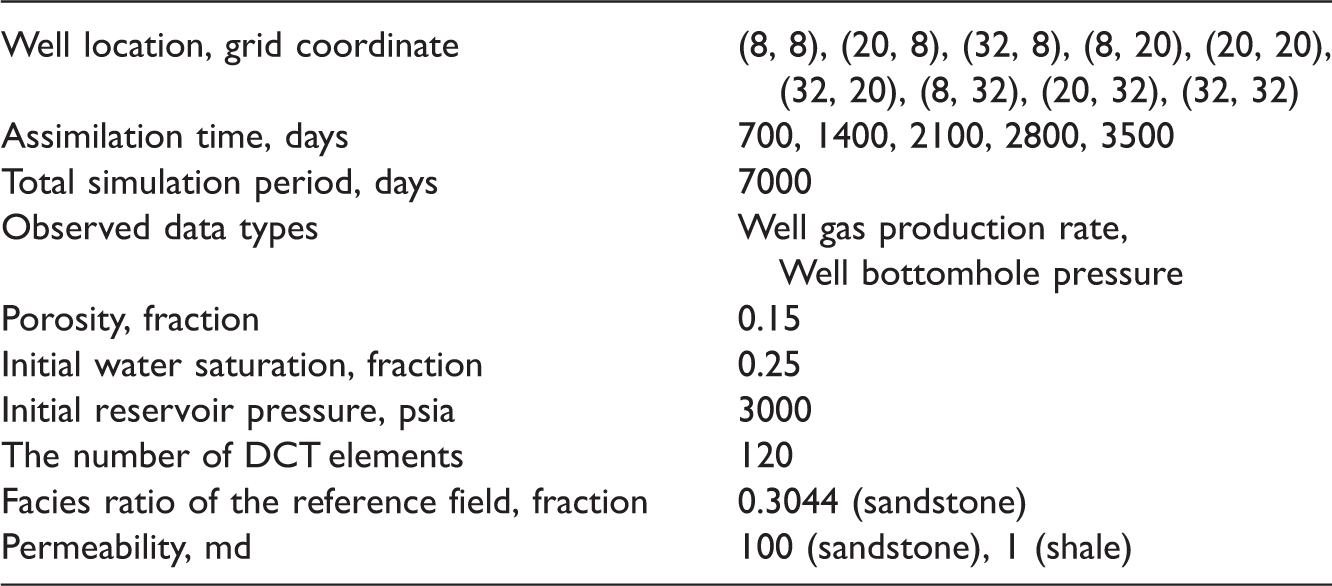
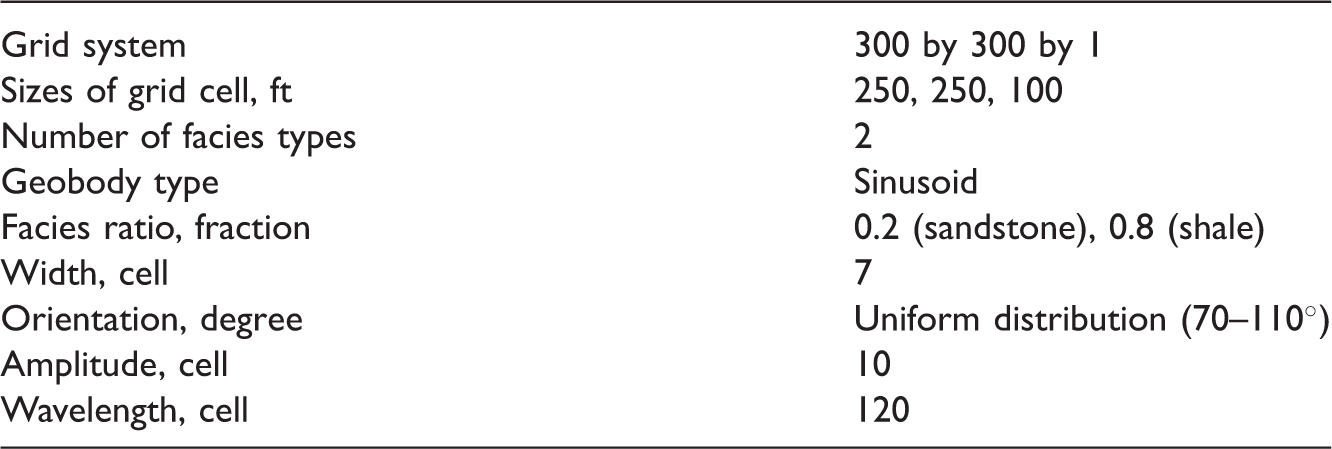
Total simulation period is 7000 days. Ahead half of the total time (3500 days) is used for assimilation. The rest half of the total time is prediction period. Assimilation times consist of five time steps with 700 days interval. We utilize Eclipse 100 as a forward simulator and MATLAB coding for automation of the procedure. As the result of characterization, production performances, permeability distribution, and aquifer strengths will be presented. Three typical cases are analyzed as below.
Case 1: Reservoir without an aquifer
There are two typical characteristics of a reservoir without an aquifer. The first one is very low water production because there is no water source. The second one is low uncertainty compared to cases with an aquifer because gas behaviors are very simple compared to water behaviors (Kim et al., 2015).
Figure 5 shows gas rates of the initial and updated ensembles. The gray lines represent whole ensembles. The blue line is the mean of the initial or updated ensembles. The red line is the reference. After the assimilation, the blue lines of the three results follow the red line very well (Figure 5(b) to (d)). Note that water production rates are almost zero at all wells because the reservoir has no aquifer and low water saturation which cannot make water flow. Figure 6 presents total gas productions of the initial and updated ensembles. As we can see Figure 6, there is little uncertainty and the means of the ensembles catch the reference very closely.
Gas rate predictions of the initial and updated ensemble models for the case without an aquifer: (a) initial ensembles, and updated ensembles by (b) EnKF, (c) EnKF with PFR, and (d) EnKF with PFR and DCT. Total gas productions of the initial and updated ensemble models without an aquifer: (a) initial ensembles, and updated ensembles by (b) EnKF, (c) EnKF with PFR, and (d) EnKF with PFR and DCT.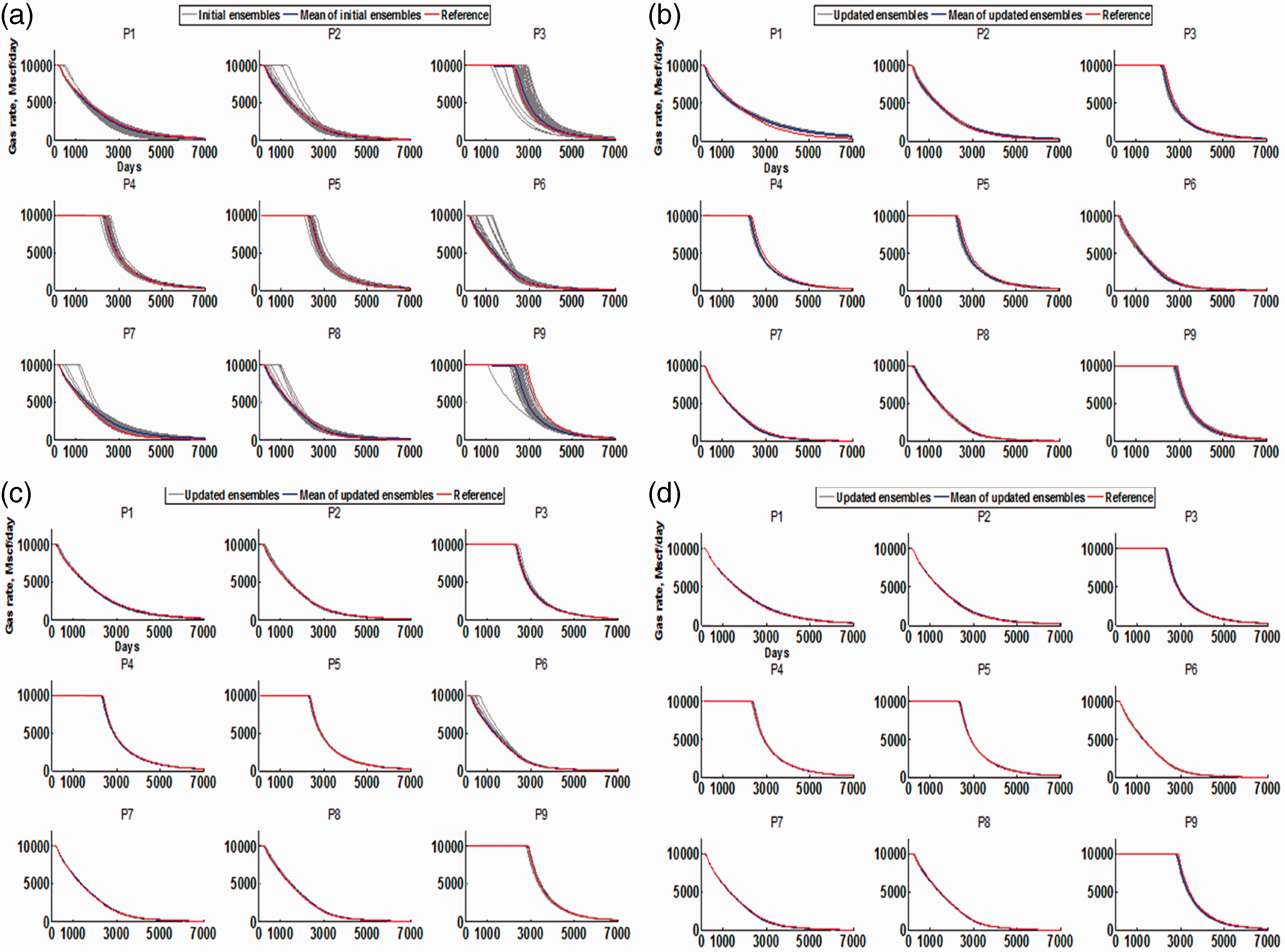
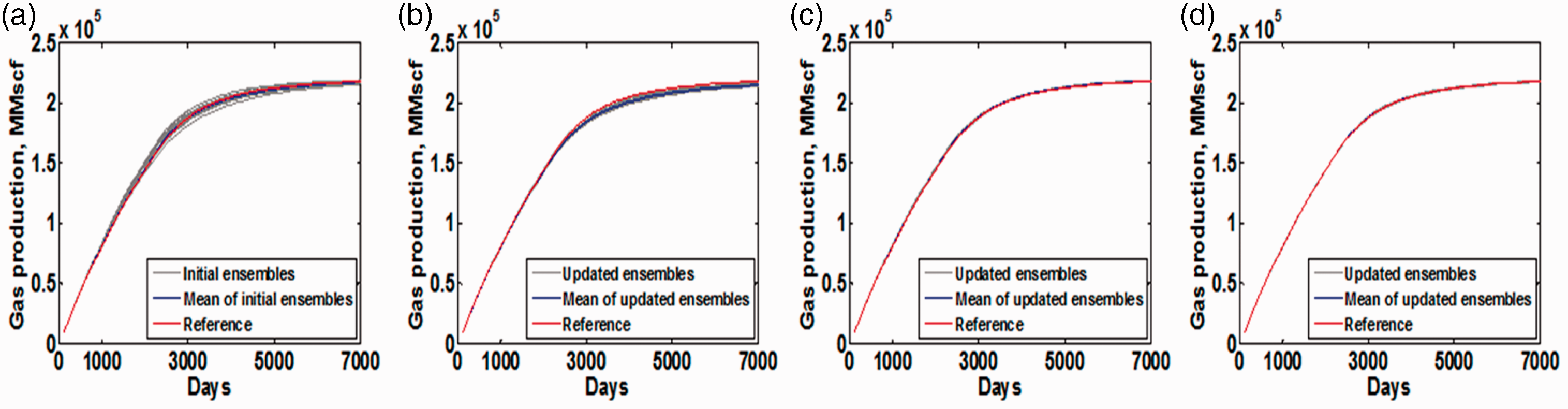
Figure 7 displays permeability distribution and its histogram of the final assimilated models by the three methods. Figure 8 presents three examples among the 100 ensembles for checking each characterization method. Figure 7(a) is for the reference permeability with two main channels and bimodal distribution. The sand facies portion of the reference is 30.44% (Table 1). The mean of the initial ensembles (Figure 7(b)) shows high permeability trend along known sand facies as shown in Figure 4(b). Since SNESim preserves rock facies information of known data, this is a natural result (also see Figure 8(a)).
The final assimilated permeability and its histogram without an aquifer: (a) The reference permeability, (b) the mean of the initial ensembles, and the mean of updated ensembles by (c) EnKF, (d) EnKF with PFR, and (e) EnKF with PFR and DCT. Three examples from the initial ensembles and assimilated results without an aquifer: (a) three examples from the initial ensembles, and assimilated permeability by (b) EnKF, (c) EnKF with PFR, and (d) EnKF with PFR and DCT.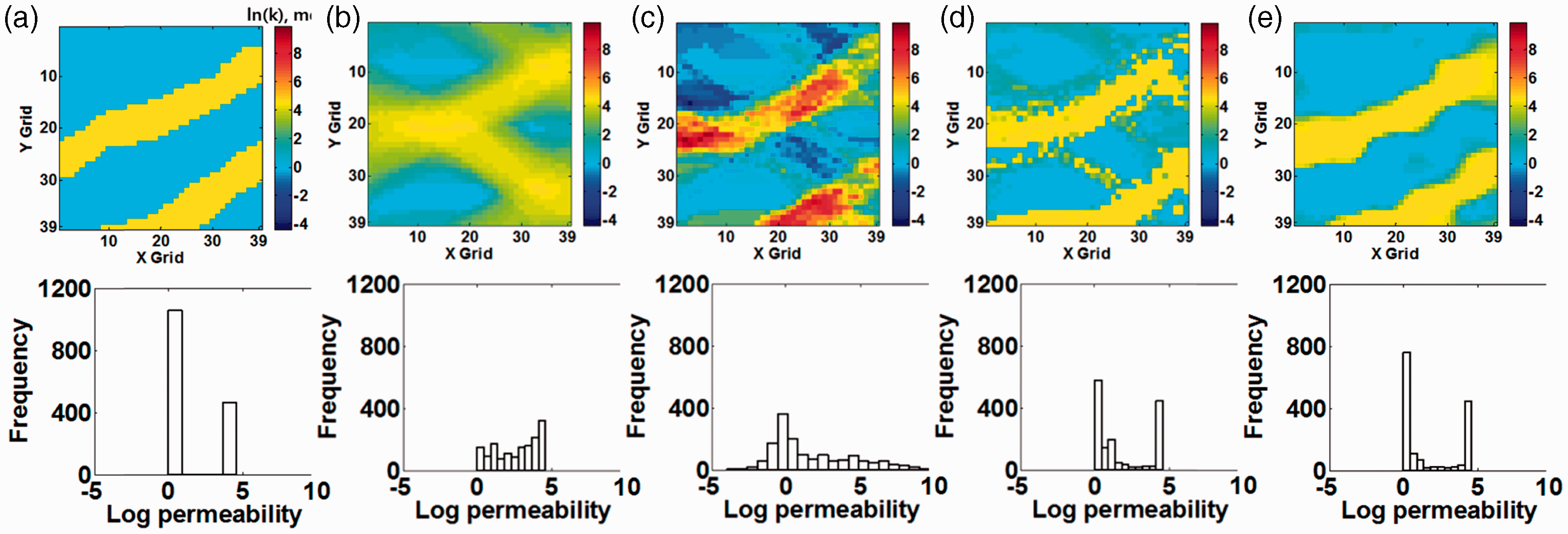
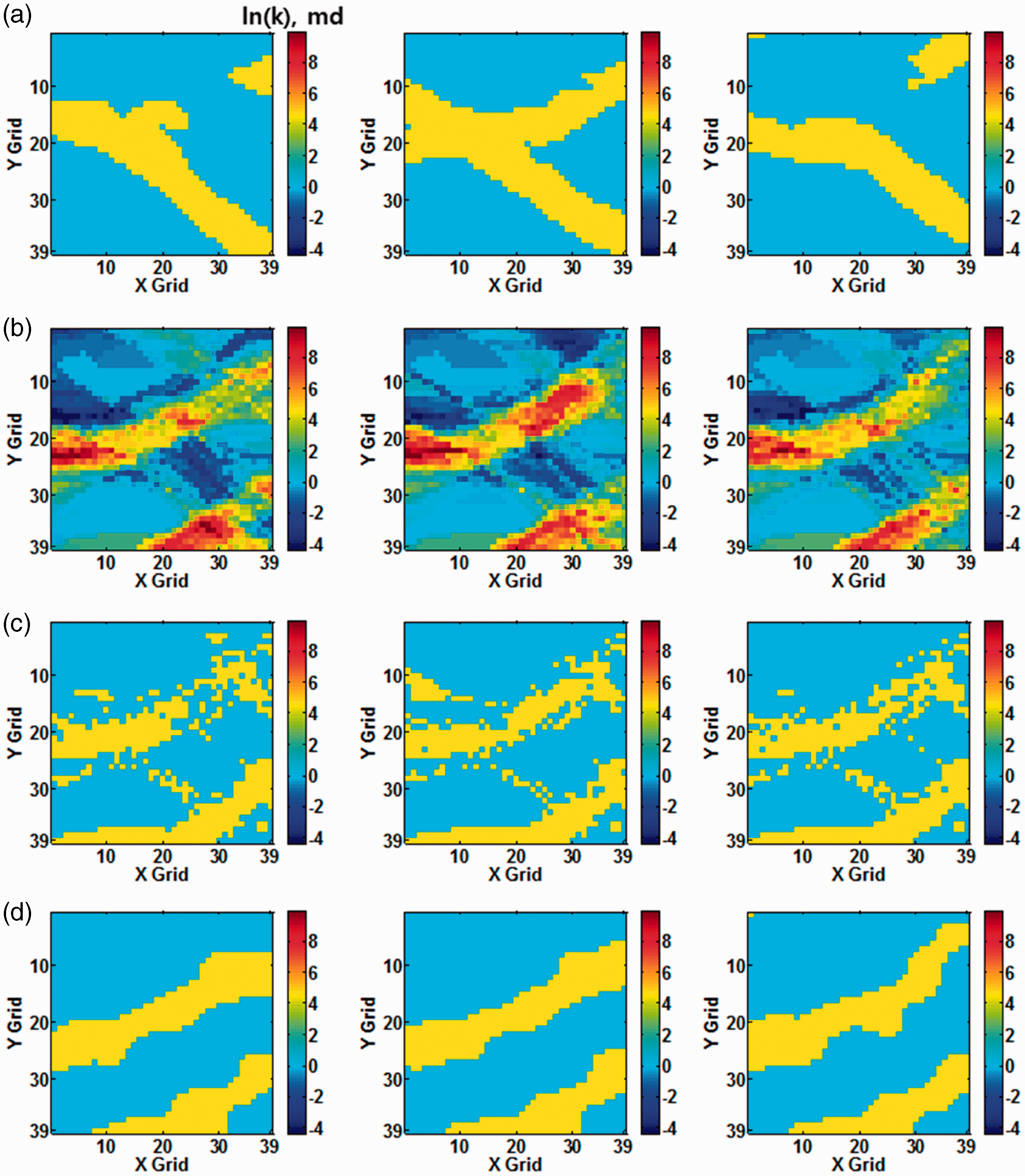
The result of EnKF gives us overall trend matching. However, there are overshooting problem, cutting off connectivity of channel, and loss of the pattern (Figure 7(c)). It cannot preserve properties of the channel. In the assimilation step of EnKF, the average of ensembles is regarded as true. As a result of this assumption, the assimilated result typically tends to become a normal distribution, losing the original bimodal distribution.
In sequence, EnKF with PFR is applied to solve the overshooting. It definitely manages the problem of losing bimodal distribution due to the artificial measure of PFR. Although the result is better on overshooting, connectivity of the channels is poor. It also maintains improper connection between the two channels (Figure 7(d) and Figure 8(c)). However, the proposed method shows an outstanding result compared to the rest (Figure 7(e)). Figure 8(d) undoubtedly follows trend of the reference and surely preserves continuity and patterns of the reference channels as DCT is added.
Case 2: Reservoir with an aquifer
There are two characteristics of reservoirs with an aquifer. The first one is high uncertainty compared to the case without an aquifer. The other is necessity of characterizing an aquifer factor for reliable future predictions and making operational decisions. Aquifer makes history matching challenging due to increase of uncertainty and additional parameters. Like the case without an aquifer, the three methods are applied to the case with an aquifer.
Figure 9 presents gas rates of the initial and updated ensembles with much higher uncertainty than those of Figure 5. Especially, large uncertainty appears at wells P3, P4, P5, and P9, which have sand facies. Since water flows fast along the sand zone, aquifer uncertainty is revealed where the wells have sand facies. Although the three results (Figure 9(b) to (d)) show overall good matching after the updates, the proposed method surely decreases uncertainty and makes the means of the ensembles follow the reference reliably. Figure 10 displays water rates of the initial and updated ensembles. We can see the same trend and the best result by the proposed method on water rates prediction, especially at P9 well.
Gas rate predictions of the initial and updated ensemble models with an aquifer: (a) initial ensembles, and updated ensembles by (b) EnKF, (c) EnKF with PFR, and (d) EnKF with PFR and DCT. Water rate predictions of the initial and updated ensemble models with an aquifer: (a) initial ensembles, and updated ensembles by (b) EnKF, (c) EnKF with PFR, and (d) EnKF with PFR and DCT.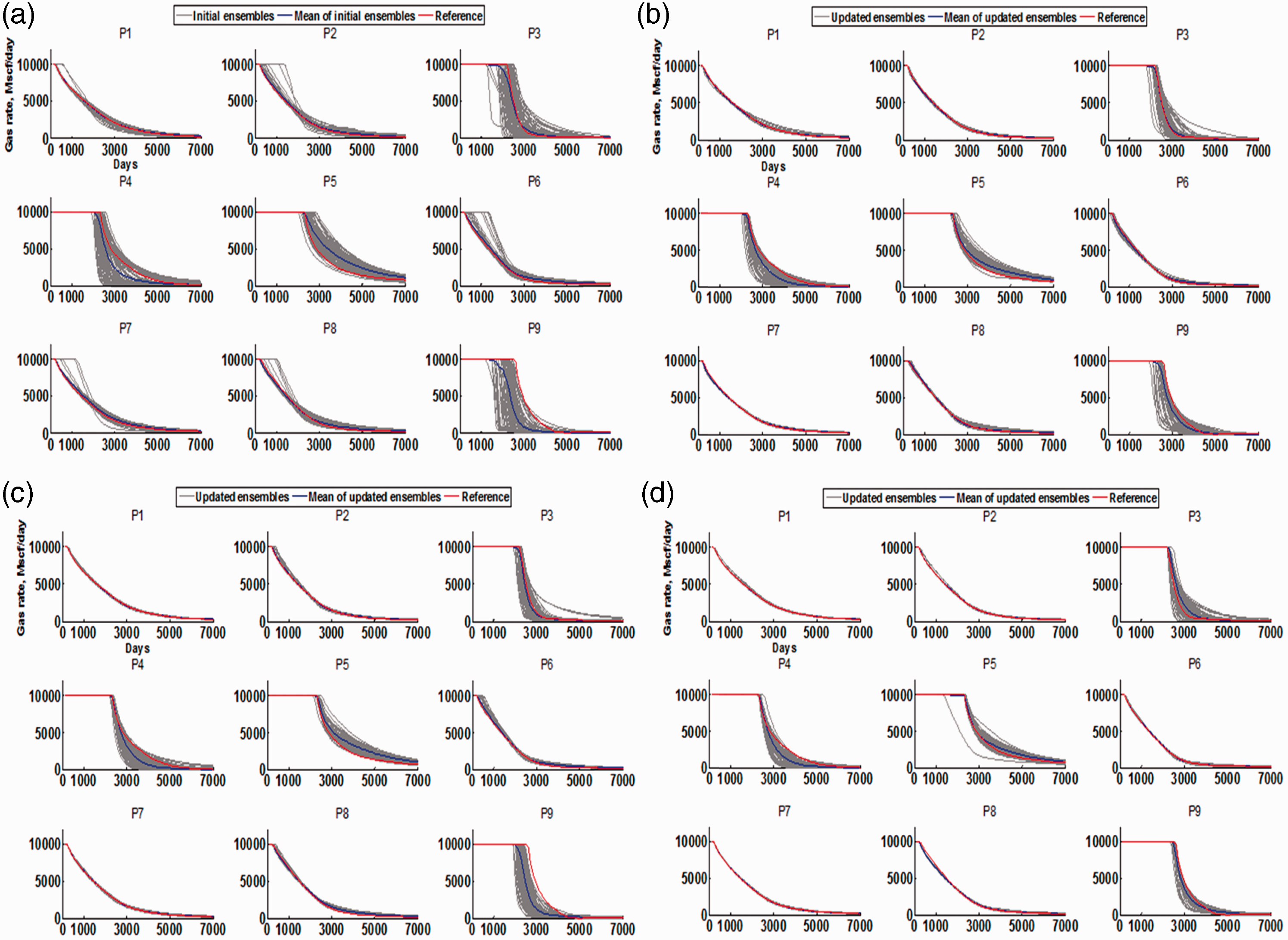
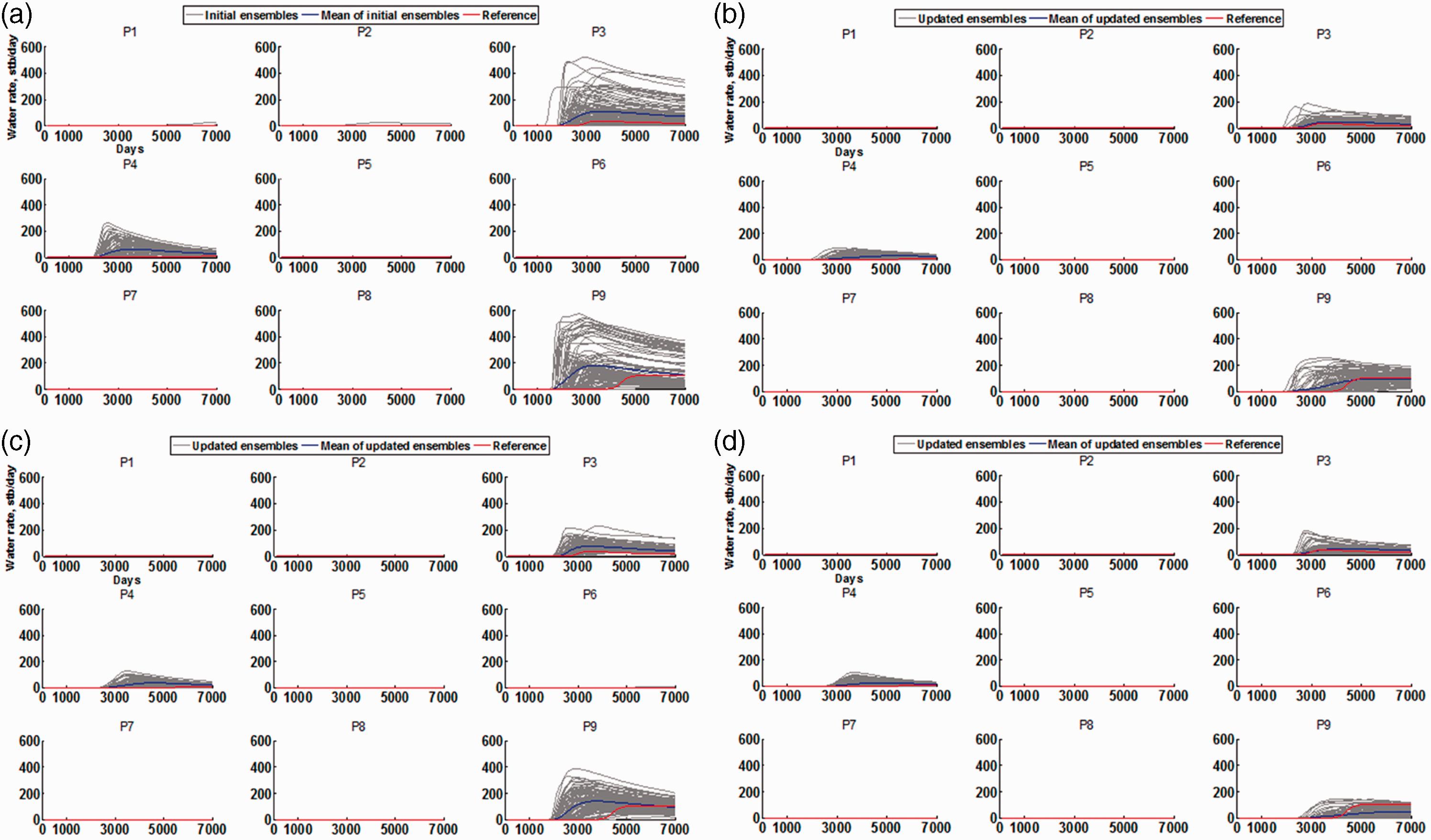
Figure 11 shows total gas and water productions of the initial and updated reservoir models. Uncertainties of total gas and water productions are very high compared to those without an aquifer (Figure 6) and then decrease reliably after the updates. Also note that the proposed method with PFR and DCT provides the best results on uncertainty reduction and matching of the reference (Figure 11(h)).
Total gas and water productions of the initial and updated ensemble models with an aquifer: (a) initial ensembles, and updated ensembles by (b) EnKF, (c) EnKF with PFR, and (d) EnKF with PFR and DCT. (e) to (h) the same forms with water.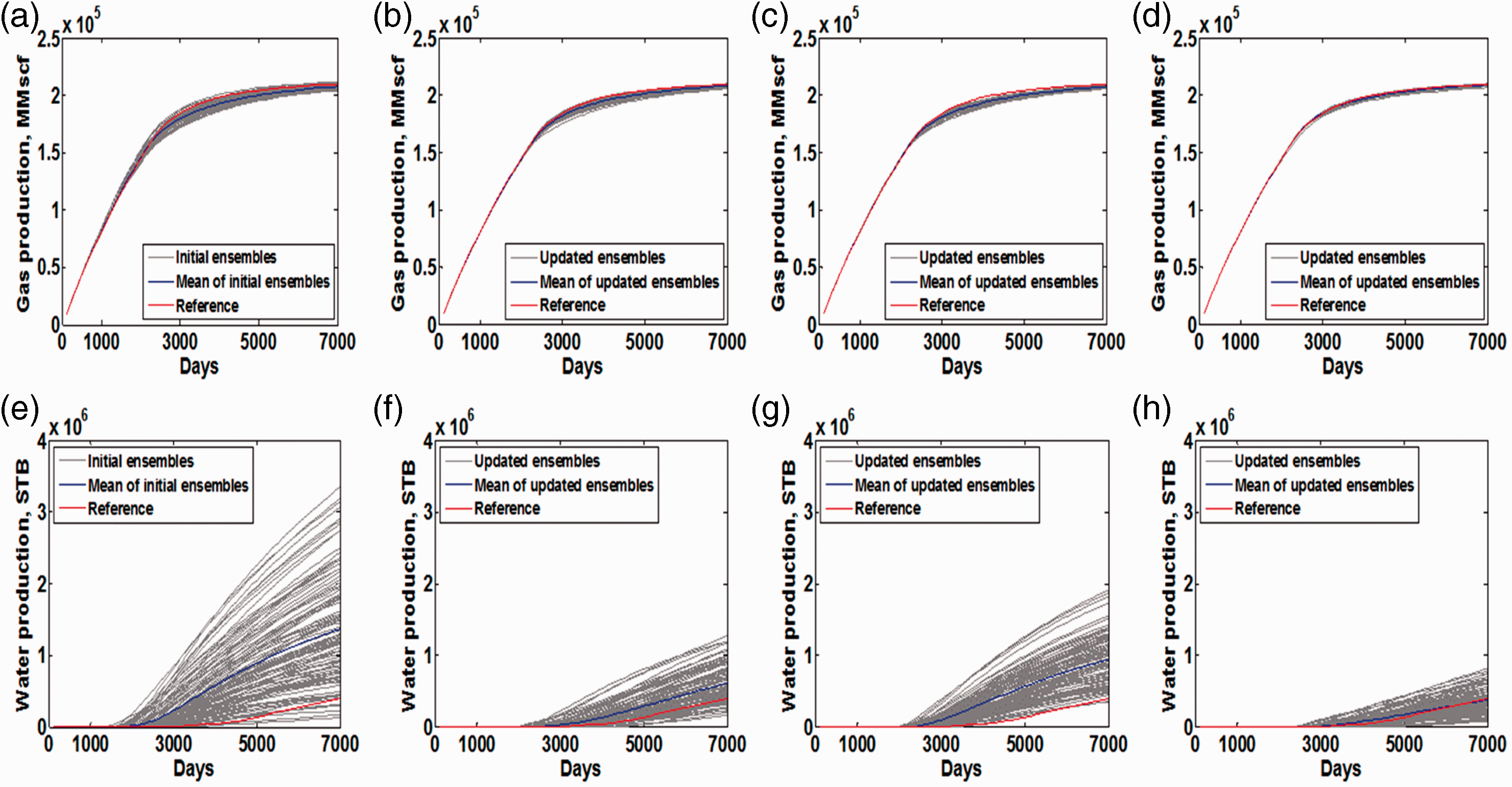
Figure 12 shows permeability distribution and its histogram of the final assimilated models by the three methods. Figure 13 displays three typical models among the 100 reservoir models. Characteristics of each method are similar to the case without an aquifer, except for much higher uncertainty. The result of EnKF has overshooting problem, wrong connectivity of channel, and losing bimodal distribution (Figure 12(c)). The method of EnKF with PFR solves overshooting problem but cannot preserve properties (Figure 12(d)) and pattern and connectivity (Figure 13(c)) of the channel. It loses part of the main channels, while maintaining wrong connection between the two main channels. However, the proposed method presents continuity, connectivity, and similar pattern with the reference. Use of DCT helps to keep the pattern and bimodal distribution of the channel for the both cases with and without an aquifer.
The final assimilated permeability and its histogram with an aquifer: (a) the reference permeability; (b) the mean of the initial ensembles, and the mean of updated ensembles by (c) EnKF, (d) EnKF with PFR, and (e) EnKF with PFR and DCT. Three examples from the initial ensemble and assimilated results with an aquifer: (a) three examples from the initial ensembles, and assimilated permeability by (b) EnKF, (c) EnKF with PFR, and (d) EnKF with PFR and DCT.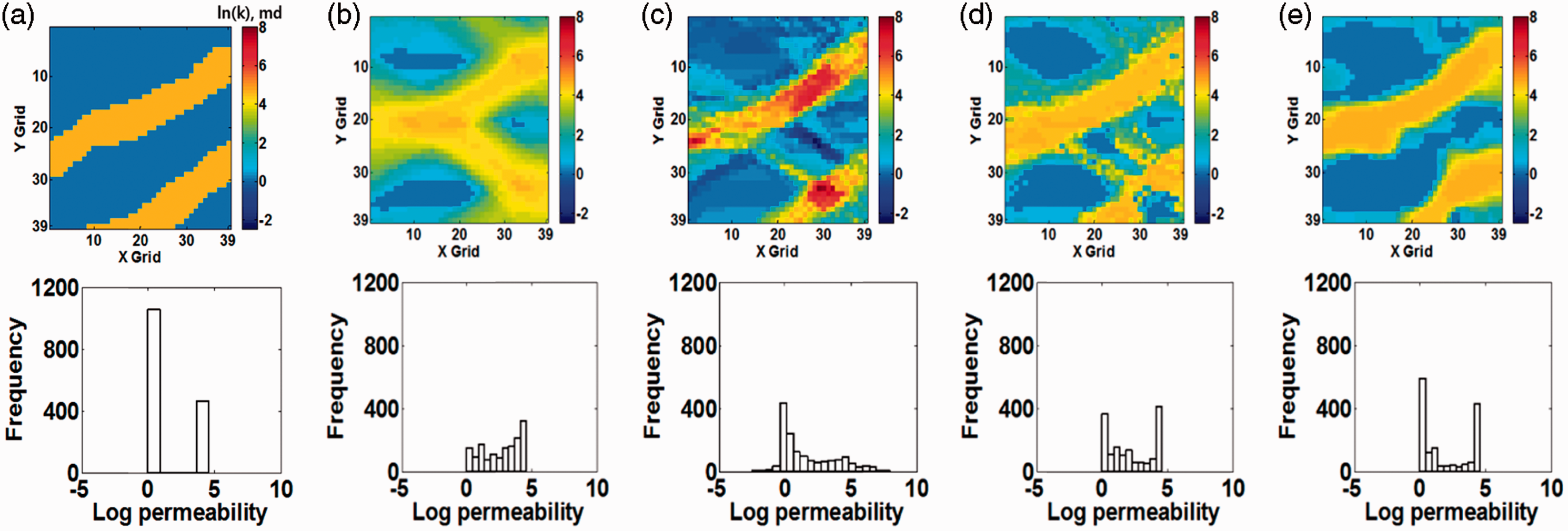
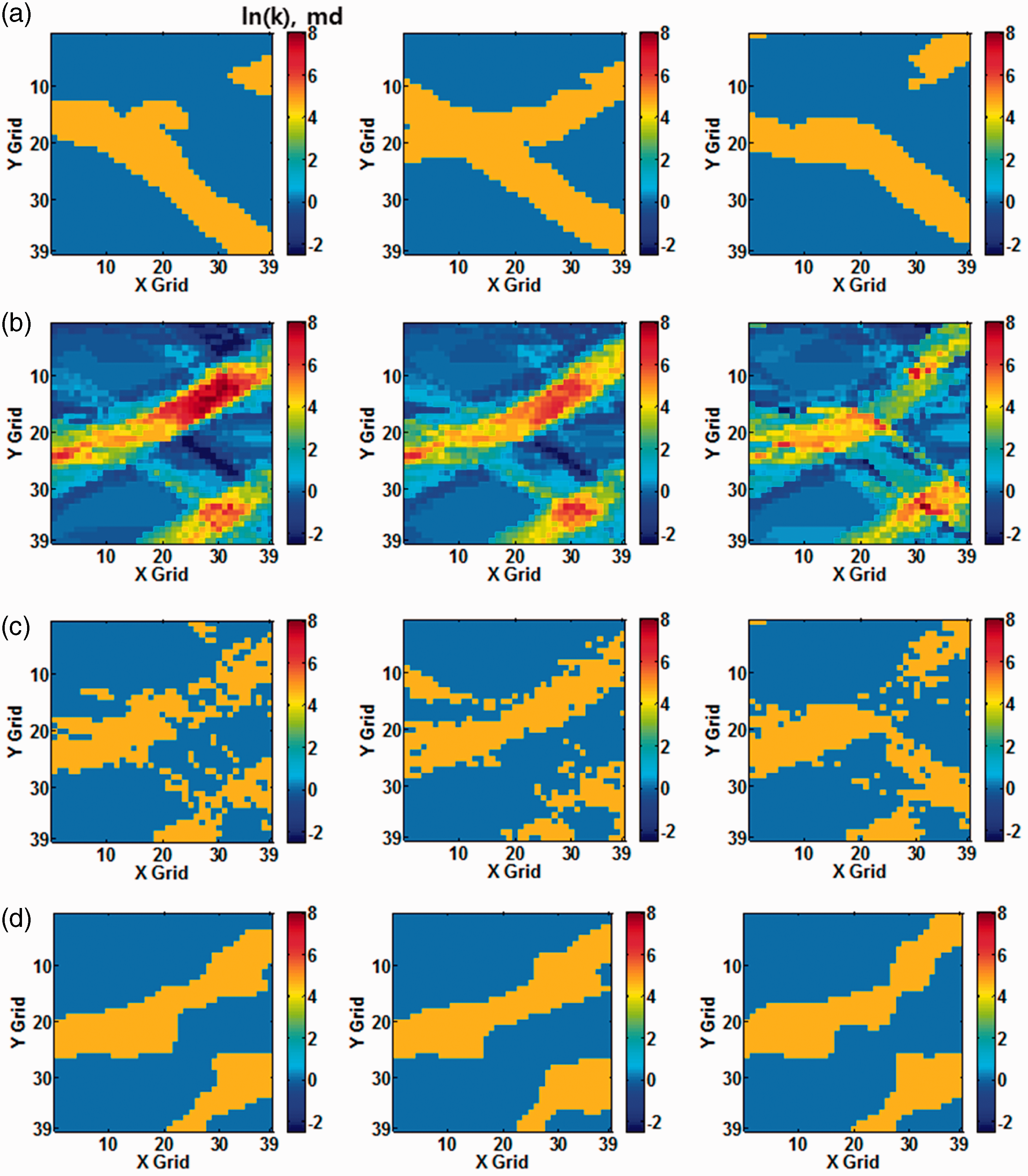
Figure 14 displays characterization results of aquifer strengths and their root mean square error (RMSE). The three methods remarkably decrease uncertainty of MULTPV with less than 0.13% of RMSE value of the initial ensembles. Updated MULTPVs are further improved by PFR and combination of PFR and DCT. After assimilation by the two additional schemes, RMSEs decrease from 51 to 37. As shown, DCT can be stably applied to channelized gas reservoirs with an aquifer.
Characterization results of aquifer parameter (MULTPV) and their RMSE: (a) initial aquifer strengths and assimilated results by (b) EnKF, (c) EnKF with PFR, and (d) EnKF with PFR and DCT. The black dot shows reference value. The blue and red dots indicate the means of the initial and updated ensembles, respectively.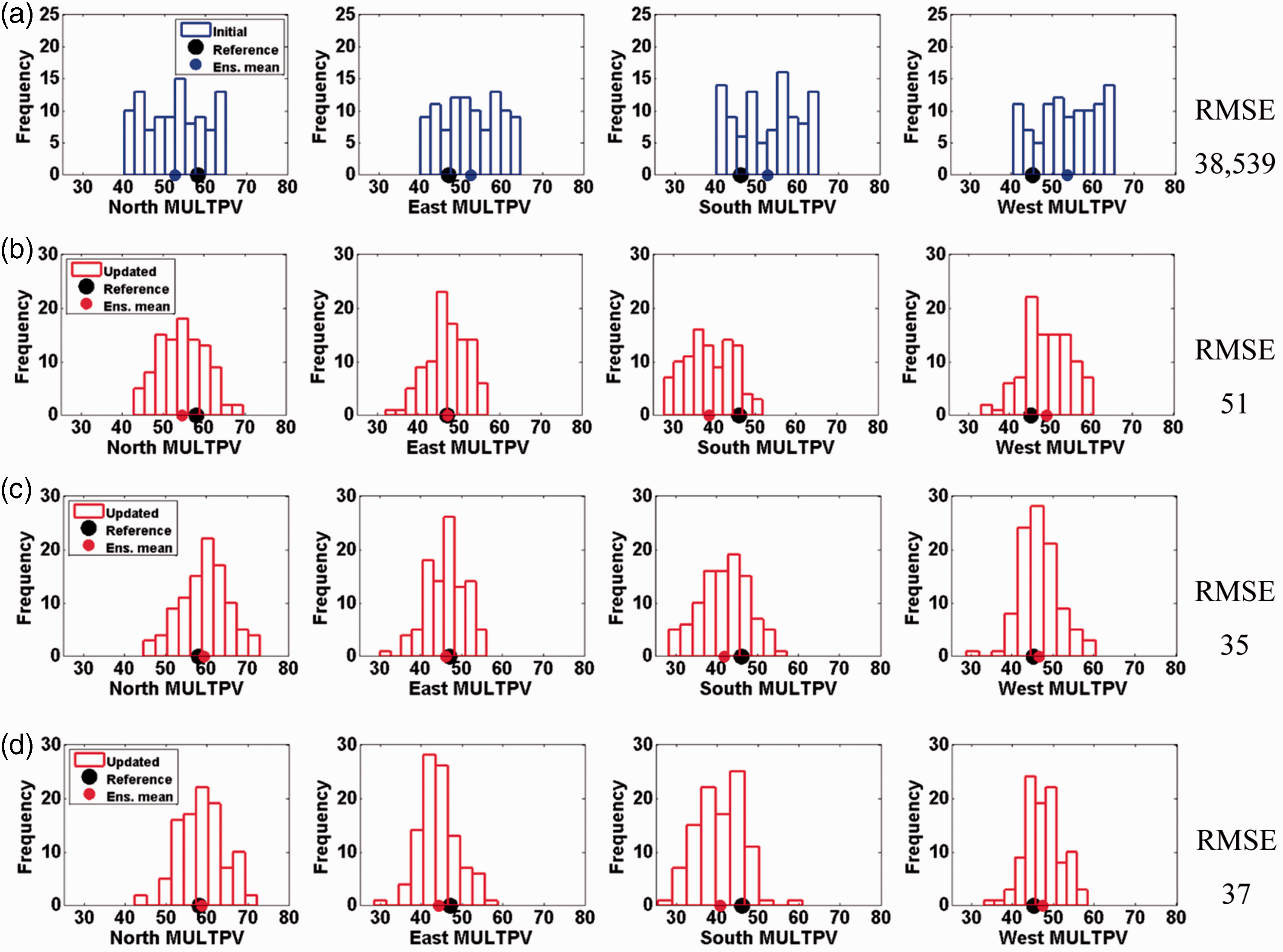
Case 3: Reservoir with uncertainty of facies ratio
The facies ratio of the reference field has uncertainty due to limited data available. We may estimate or assume the facies ratio of the reference, but there is always uncertainty. If assimilated permeabilities show reliable results even though inaccurate values of the facies ratio are applied, the method can be regarded as stable. For verifying applicability and stability of DCT, sand facies ratios with ± 10% uncertainty from the true value of 30.44% (Table 1) are assigned at the case with an aquifer: 27% (Figure 15(a) and (b)) and 33% (Figure 15(c) and (d)).
Four examples of assimilated permeability by EnKF with PFR (Figure (a) and (c)) and EnKF with PFR and DCT (Figure (b) and (d)). Facies ratio of sand is 0.27 for (a) and (b) and 0.33 for (c) and (d).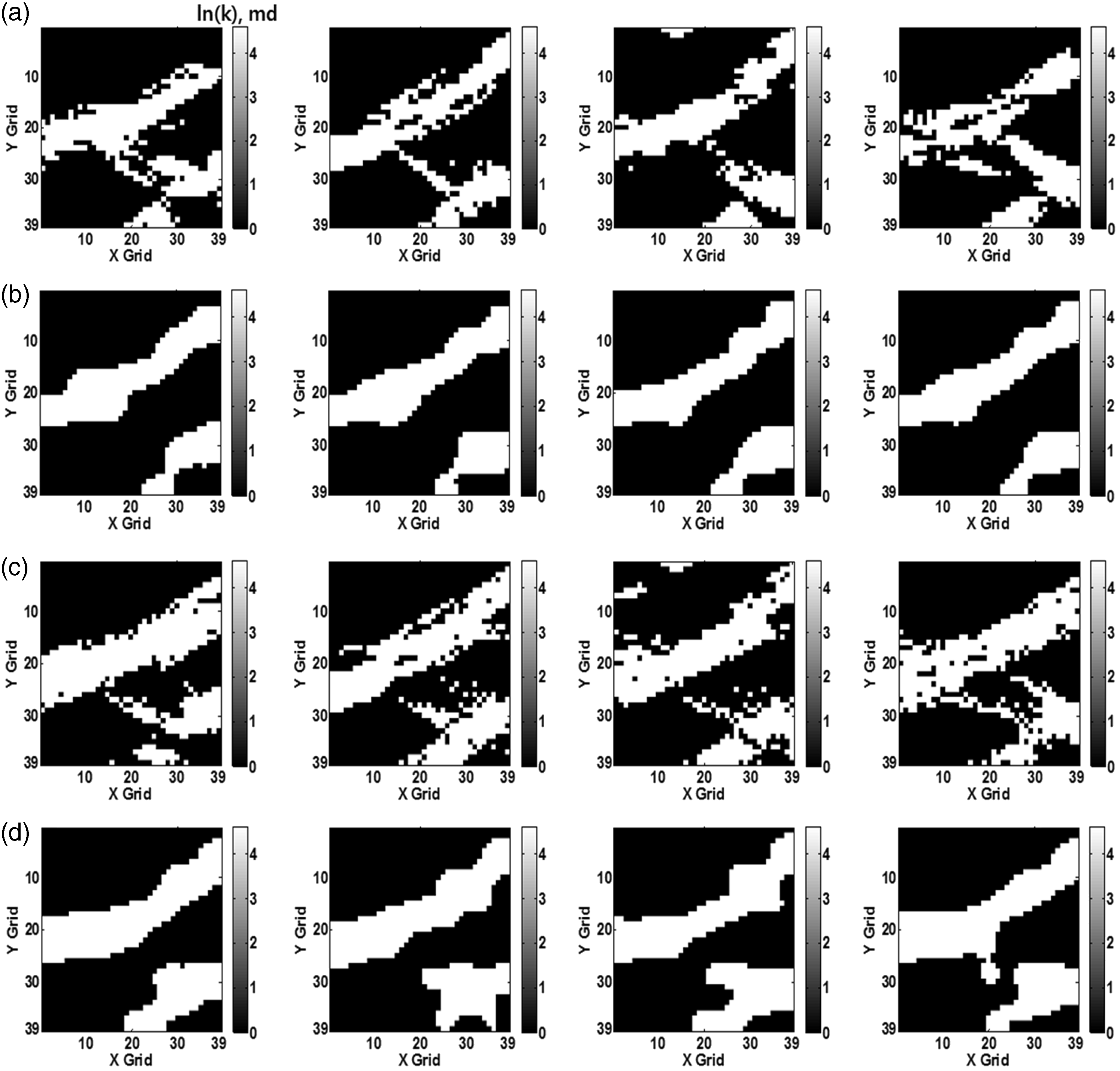
Inappropriate sand grids that appear on the space between the two main channels is shown in Figure 15(a) and (c). They almost form connection between them (Figure 15(a)), whereas the two main channels are maintained properly by the proposed method (Figure 15(b)). The upper main channel shown in Figure 15(c) is strong compared to Figure 15(a), whereas the lower main channel is cut off, showing weak channel continuity. On the other hand, Figure 15(d) shows clear channel pattern and continuity. Through these results, we can conclude that DCT has a definite effect on preserving properties of the channel.
Conclusions
Channelized gas reservoirs are not easy to characterize due to properties and continuity of the channel in a discrete grid system. Moreover, if channelized gas reservoirs have aquifers, their characterizations become harder because of higher uncertainty and necessity of aquifer estimation. EnKF with PFR and DCT is proposed for channelized gas reservoirs with or without an aquifer to preserve properties and patterns of the channel. The proposed method not only characterizes channel reservoirs reliably but also estimates aquifer strengths.
Although PFR can mitigate overshooting problem, it has a limitation on preserving properties and continuity of the channel. DCT helps to preserve its pattern and continuity. Therefore, after application of DCT, characterized results present outstanding performances on gas and water productions, channel distributions, and aquifer strengths. EnKF with PFR and DCT method suggests reliable characterized results, which are demonstrated by cases with and without an aquifer, and with even uncertain facies ratios.
Footnotes
Acknowledgments
This research is conducted through Engineering Research Institute at Seoul National University, Korea.
Declaration of conflicting interests
The author(s) declared no potential conflicts of interest with respect to the research, authorship, and/or publication of this article.
Funding
The authors thank to research projects supported by The Ministry of Trade, Industry, and Energy (20142520100440, 10042556, 10038618, Korea Energy and Mineral Resources Engineering Program) and Brain Korea 21 Plus project (21A20130012821).