




Abstract
The study of the gas diffusion process has a main role in both coalbed methane (CBM) production and CO2 injection in geological sequestration projects. The accurate determination of gas diffusion coefficients in unconventional reservoirs such as coal seams requires a consistent mathematical approach. The study of the gas diffusion process in coal seams was carried out using sorption isotherms. The Langmuir model for individual gases and the extended Langmuir model for multicomponent gas mixtures were applied to fit sorption isotherm data. “Gas content derivative data” and “gas content changes” emerged as crucial mathematical parameters to accurately study the gas diffusion process. The main goal of this paper is to define the degree of interaction between the gas content derivative data and the gas diffusion process. Experiments were performed on three samples selected from two different coals, which were submitted to three different gas compositions, viz 99.999% CH4; 99.999% CO2; and a gas mixture containing 74.99% CH4 + 19.99% CO2 + 5.02% N2, at 35℃, and at pressures ranging from 0 up to 50 bar. Experimental results obtained from the three samples indicate that during adsorption/desorption processes, the diffusion coefficients increase and the gas content changes decrease when the pressure decreases, due to the sample saturation degrees and to the kinetic mechanisms increase. Additionally, the “gas content derivative data” scattering is slightly lower during the desorption process than during the adsorption process. These behaviours are clearly identified when using methane, but are even more evident when using CO2 and the gas mixture, due to the CO2 interaction with coal porous structure, which induces a considerable resistance to CO2 release. The results show that sample B (CH4 + CO2 + N2) displays higher diffusion coefficient values (this behaviour is mainly related to the presence of N2) than sample C (CH4) and than sample A (CO2).
Keywords
Introduction
In the last years, gas diffusion process has been the main topic in several investigations related to gas flow or gas circulation in coal seams (Busch et al., 2004; Cui et al., 2004a; Siemons et al., 2007). In fact, the diffusion process is one of the main mechanisms involved in the whole gas circulation process in coal seams. So, in order to correctly understand the complex diffusion process, several steps must be clearly perceived. The first step consists on studying the gas circulation process as a whole, i.e. the “gas flow” in Mavor et al. (1990), which depends on gas storage mechanisms and, consequently, on the two main “porosities”, i.e. the coal pores and the coal cleat system (Rodrigues and Lemos de Sousa, 2002). Coal porous structure is highly heterogeneous, with pore sizes varying from a few angstroms to frequently over micrometres (Shi and Durucan, 2003). The International Union of Pure and Applied Chemistry (IUPAC) classifies pores into macropores (>50 nm), transient or mesopores (2–50 nm) and micropores (<2 nm) (Rouquerol et al., 1994). Gas circulation in coal seams is controlled by two distinct processes, i.e. diffusion and laminar processes. The diffusion of gas takes place through the coal porous structure into the network of natural fractures (Busch et al., 2008; Close, 1993; Dinis, 2010; Rodrigues et al., 2003, 2013, 2014; Ting, 1977) and subsequently the gas circulates as a synchronized flow through the fracturing structure (cleat system). Gas in coal cleat system is stored in free and absorbed states and gas circulation is accomplished through the laminar process. In the last one, and taking into account the gas concentration and the location, gas circulates into a specific direction depending on the pressure gradient and on the fluid properties (Kolesar and Ertekin, 1986; Shi and Durucan, 2003). In contrast, the gas stored in coal pores is in the adsorbed state and diffusion is the dominant gas circulation process. In the diffusion process, the gas flow depends on three main related parameters: (1) the pressure variation effect, which induces distinct behaviours in the different components present on the gas mixture; (2) the interactions that these gas components establish with the coal porous structure, and, consequently; (3) the coal porous structure shrinking and swelling effects. Several models have been and are being used to describe gas circulation in coal seams, such as those presented by Brouers et al. (2005), Cui et al. (2004 b), Mavor et al. (1990), Mehrer (2007), Pruess (2006), Ruckenstein et al. (1971), Saghafi et al. (2007), and Shi and Durucan (2003). In fact, two different models are being adopted to study the gas circulation in coal seams: one is the unipore diffusion model (Crank, 1975), which is mainly concerned in studying the gas circulation in coal porous structure, i.e. the diffusion process, and the other one is the so-called Ruckenstein's bidisperse model, which focus mainly on the cleat system gas circulation and its relation with the pores diffusion process.
The aim of this investigation consists in studying the gas diffusion process only. In fact, it turns out important to mention that 95-98% of the gas circulation in coal seams is accomplished by processes involving diffusion, and only the remaining 2-5% by processes involving laminar flow (Cui et al., 2004a; Dinis et al., 2010; Rodrigues et al., 2011).
At this preliminary stage in the scope of gas circulation studies, it was decided to apply the unipore diffusion model (Crank, 1975) using the particle size of 212 µm as a constant parameter value, which corresponds to the grain size reference required to carry out gas sorption isotherm determinations (Mavor et al., 1990).
The release and injection phases’ good response, conducted in coalbed methane (CBM) exploration and CO2 geological sequestration programmes, strongly depends on the applied methodologies. The parameters broached in the selected methodology and applied in the three samples presented in this work must be submitted to subsequent mathematical validation. The diffusion model here proposed integrates different and subsequent phases as follows: (1) the determination of gas content derivative data calculated from data produced during adsorption and desorption isotherm steps; (2) the determination of gas diffusion coefficients in each data set of the adsorption and the desorption isotherm steps and; (3) the study of the gas diffusion process behaviour, depending on pressure values, and on adsorbed/injected gas.
Sample preparation and experimental conditions
Petrographic characteristics (maceral and mineral composition, and vitrinite mean random reflectance values) of coals I and II.
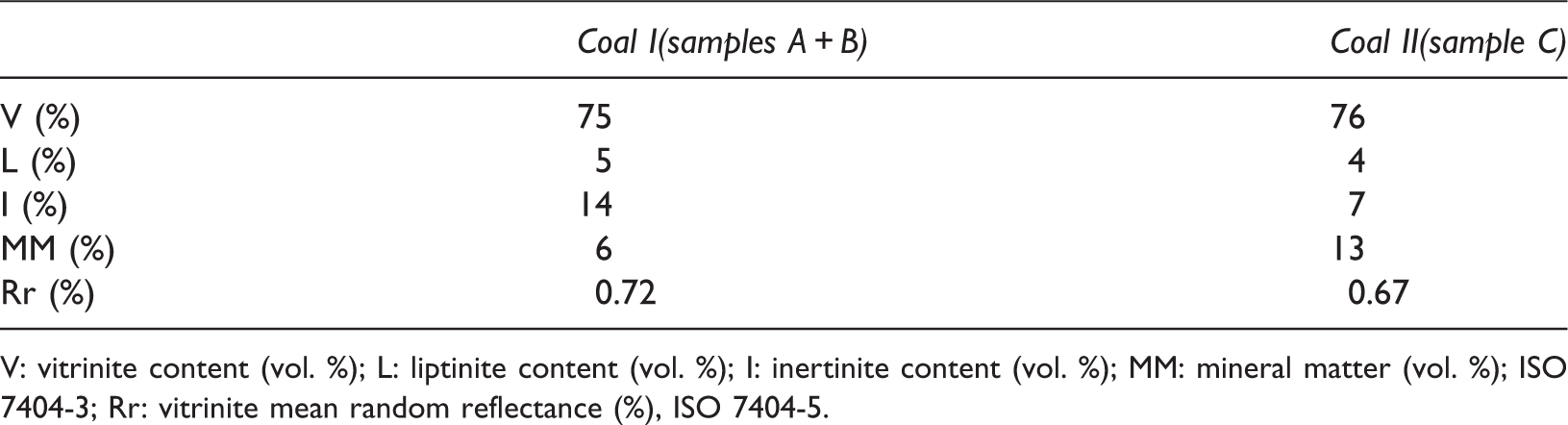
V: vitrinite content (vol. %); L: liptinite content (vol. %); I: inertinite content (vol. %); MM: mineral matter (vol. %); ISO 7404-3; Rr: vitrinite mean random reflectance (%), ISO 7404-5.
Experimental conditions (moisture content, moisture holding capacity, sample mass, bath temperature and particle size) required to perform sorption isotherms in samples A, B and C.
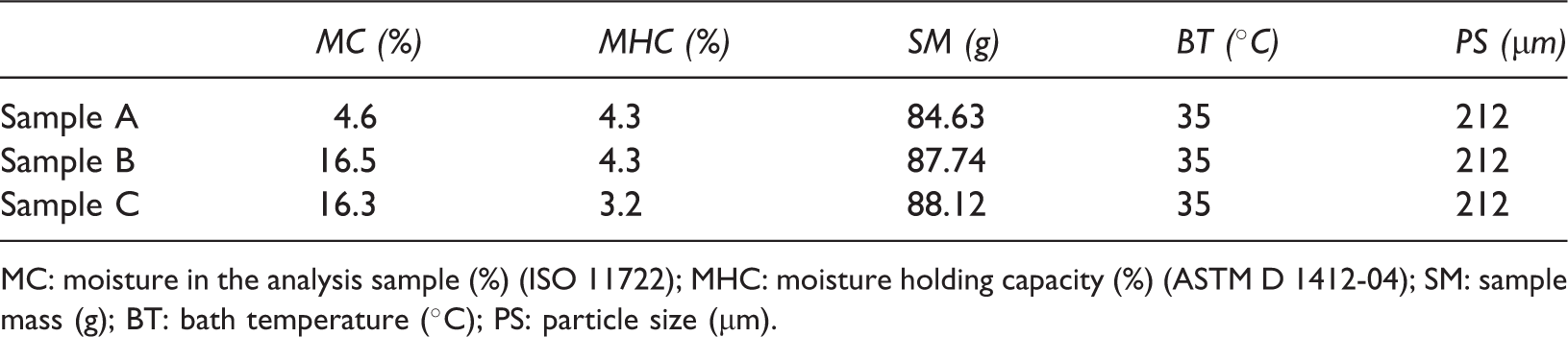
MC: moisture in the analysis sample (%) (ISO 11722); MHC: moisture holding capacity (%) (ASTM D 1412-04); SM: sample mass (g); BT: bath temperature (℃); PS: particle size (µm).
Samples for petrographic analyses were prepared under ISO 7404-2 (1985) standard method. Petrographic determinations were carried out under ISO 7404-3 (1994) (maceral analysis) and ISO 7404-5 (1994) (vitrinite mean random reflectance) standard methods.
Results and discussion
Sorption isotherms and diffusion coefficient determinations
Pressure steps used during adsorption and desorption processes.
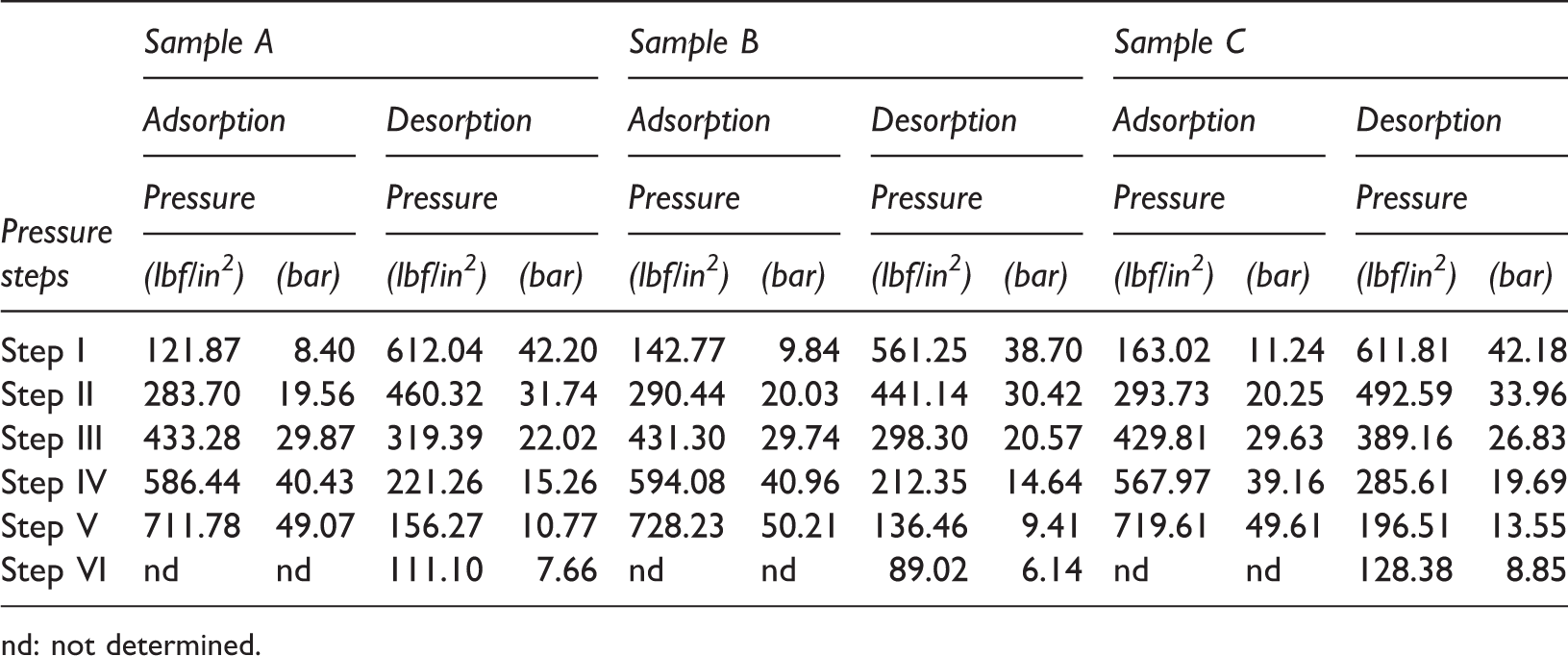
nd: not determined.
In samples A and C, the Langmuir model (equation (1)) was used to determine the equilibrium sorption isotherms for two individual gases (CO2 and CH4):

Sample B was submitted to a multicomponent gas mixture (74.99% CH4 + 19.99% CO2 + 5.02% N2) sorption isotherm test. In fact, the three gases do not sorb independently. They are actually competing for the same sorption spaces in the coal porous structure. To determine the equilibrium sorption isotherms for gas mixtures, the Langmuir model must be adapted, taking into account the molar composition of the gas mixture, by using the so called extended Langmuir model (equation (2)):

To compare CO2, CH4 and gas mixture diffusion behaviours in the three coal samples, measured sorption data from five pressure steps were used during the adsorption stage. Sorption data from six pressure steps were used during the desorption stage. Obtained results show that gas sorption capacity increases from sample C (CH4), followed by sample B (gas mixture) and by sample A (CO2). Consequently, the three sets of sorption data calculated using the Langmuir model (individual gases) and the extended Langmuir model (multicomponent gas mixture) were then submitted to the same diffusion model determination.
As previously mentioned, the current work deals with the unipore diffusion model (Crank, 1975) (equation (3)), which consists on defining the coal porous structure as a homogeneous spherical medium:

Some authors (Mavor et al., 1990; Smith and Williams, 1984) state that the unipore diffusion model is not the most adequate for describing diffusional fluxes in microporous structures, such as coal. In fact, shapes of curves obtained from gas desorption isotherms data appear to be induced by the bidisperse pore structure. This is the reason why it is important to identify and to measure the porosity mean values in vitrinite and inertinite maceral groups, in which pore sizes change from micro to meso-macropores, respectively. Several different authors (Clarkson and Bustin, 2000; Crosdale and Beamish, 1993; Levine, 1993) have proved that sorption behaviour is strongly related to vitrinite and inertinite contents, and in fact, according to the present research, the diffusion behaviour is also conditioned by this duality. In the authors opinion, the best data fit to study the diffusion process should consist on applying a bidisperse model, taking into account porosities measured in both vitrinite and inertinite maceral groups. Thus, to better understand the bidisperse diffusion process through both vitrinite and inertinite maceral groups, it is important to study the diffusion behaviour in the coal porous structure as a whole, using in a primarily stage the simpler unipore model (or single diffusion model used by Mavor et al., 1990), that will therefore allow a better comparison with bidisperse model results, which shall be the subject of future work.
The mathematical approach
Despite the complexity of coal microporous structure, and the limited ability to determine the nature of the pore structure, it is quite possible to achieve a completely predictive approach. Sorption isotherms determination implies the production of a huge amount of data in order to guarantee the analysis accuracy and essentially that any relevant behaviour is revealed (Dinis et al., 2015). Therefore, an enormous database of pressure versus time measurements is available to be submitted to data analysis, with the final aim of allowing diffusion coefficient determinations. In order to implement an accurate scientific approach, and to reduce the experimental database to be analysed, it becomes pertinent the utilization of professional software such as “OriginPro professional data analysis and graphing software” used in the present work. This will allow to extrapolate and interpolate data, and consequently to allow a better understanding of the diffusion process. This software enables to specifically determine, with high accuracy, gas content derivative data. To obtain gas content derivative data, the diverse gas content/time curves obtained in each pressure step required to determine sorption isotherms are used, and subsequently numerical differentiation of the data is applied, thus allowing the calculation of the first and the second derivatives. These calculations are truthfully “translators” of the whole diffusion process, which therefore allow to detect even small deviations.
Sorption isotherm measurements were used to calculate the gas circulation in coal pores, i.e. the diffusion process. However, to determine gas diffusion process through sorption isotherms implies the application of the diffusion coefficient equation – equation (3), in which parameter b represents the tangent slope of the first linear part of the data curve produced during each pressure step of a sorption isotherm. Mavor et al. (1990) and Ruckenstein et al. (1971) are usually cited in the literature in what concerns diffusion coefficient and parameter b determinations. Nevertheless, the procedure followed by those authors does not focus the parameter b determination in an extensive way, and, consequently, does not define exactly what point must be considered to represent the end of the data linear behaviour. However, the practice shows that a less correct data processing will introduce significant uncertainties in the calculation of this point and, consequently in the determination of diffusion coefficient values. Therefore, the present research aimed to develop a new approach to determine the parameter b, and consequently the diffusion coefficient, in a more accurate way.
Gas content derivative data
The present research intends to show that by calculating the derivative data for all gas content values, defined in each pressure step, it is possible to precisely select all data responsible for the definition of the first linear part of the data curve. In fact, in differential calculus, an inflection point (or point of inflection or even, just inflection) is a point on a curve at which the curvature sign changes, i.e. the curvature sign changes from positive (concave upwards) to negative (concave downwards) and vice versa. Infection points can also be determined by calculating the first and the second derivative values. The calculation of a third derivative allows to confirm the possible findings. In the case of the present experiments, the calculation of the first and second derivatives will allow to define, more accurately, where the linear behaviour stops, thus increasing the accuracy of the inflection point calculation.
Thus, the main role on determining gas content derivative data (Rodrigues et al., 2016) consists on defining with accuracy the first inflection point, identified on the sorption isotherm database (gas content/time curves, in each pressure step). As already mentioned, this point indicates the moment where the linear sorption behaviour stops, and sorption data curves start describing a nonlinear response (Jordan and Smith, 2008). Rodrigues et al. (2008a, 2008b) stated that the first inflection point is essential to define the tangent slope (the parameter b) required in diffusion coefficient determinations (equation (3)), based on Mavor et al.’s (1990) experimental procedures.
Figures 1–3 clearly illustrate that some experimental changes took place in the coal porous structure during the adsorption and the desorption processes. Those changes are highly related to the different pressure step values, gas saturation level and gas sorption isotherm used in the experiments. Figures 1–3, mentioned above, show that gas content derivative data scattering is higher in sample A, followed by sample B and finally by sample C. Mechanisms implicated during adsorption/desorption processes are more stable when using CH4 (sample C) than when using the gas mixture (sample B) and CO2 (sample A). Analysing samples B and C only, and in order to strengthen the previous statement, it is also possible to verify that gas content derivative data scattering is higher in sample B, even when using a gas mixture, than in sample C, because the former was submitted to a gas sorption composed by 19.99% of CO2 and the second does not present CO2 in the gas sorption composition, instead it is composed by CH4 only. In fact, this behaviour confirms the high affinity between the CO2 and the coal porous structure, producing a strong physical rearrangement when compared to the other two gas sorption effects. This means that during the adsorption process, and when using the CO2 as a gas sorption, the coal porous structure is submitted to a swelling effect greater than when using the CH4. During the desorption process, on the other hand, and when using CO2, the coal porous structure suffers a shrinking effect lower than when using CH4. In both processes, either adsorption or desorption, the coal structure physical rearrangement degree produced when using the gas mixture falls into both gases previously described, i.e. the coal structure physical rearrangement when using the gas mixture is lower than the one produced with CO2, and higher than the one produced when using CH4.
Sample A gas content derivative data: a) adsorption process, b) desorption process. Sample B gas content derivative data: a) adsorption process, b) desorption process. Sample C gas content derivative data: a) adsorption process, b) desorption process.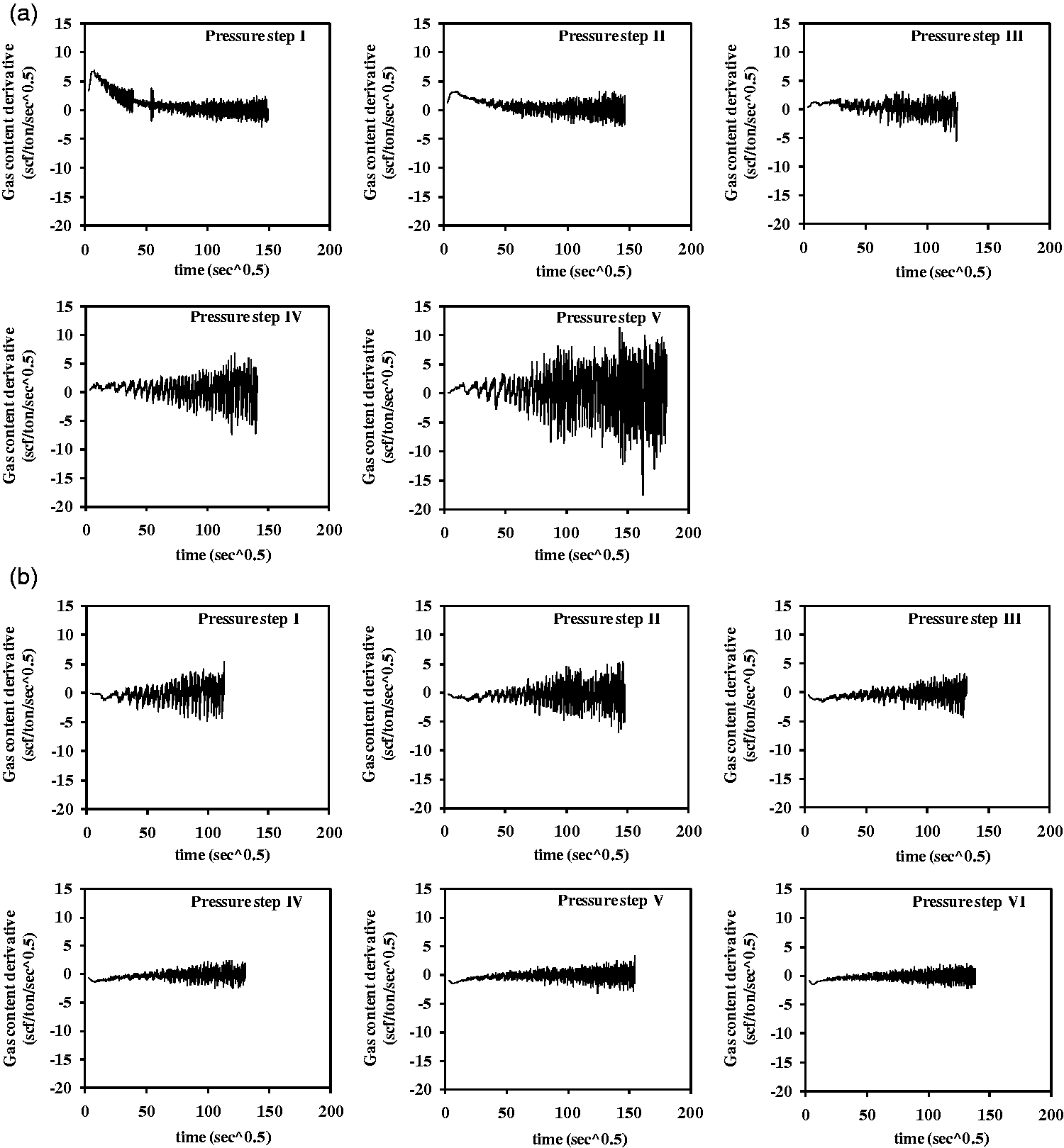
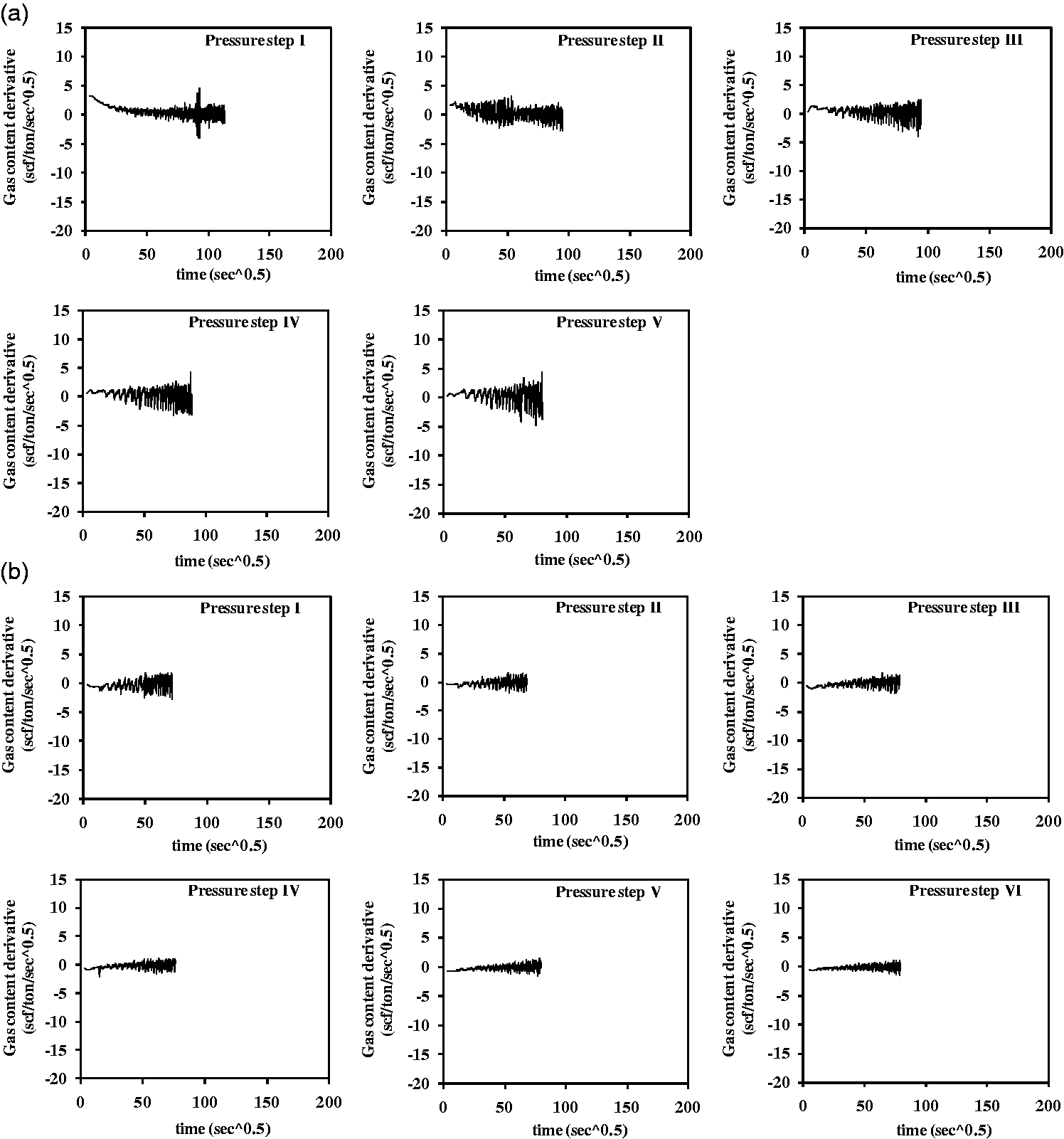
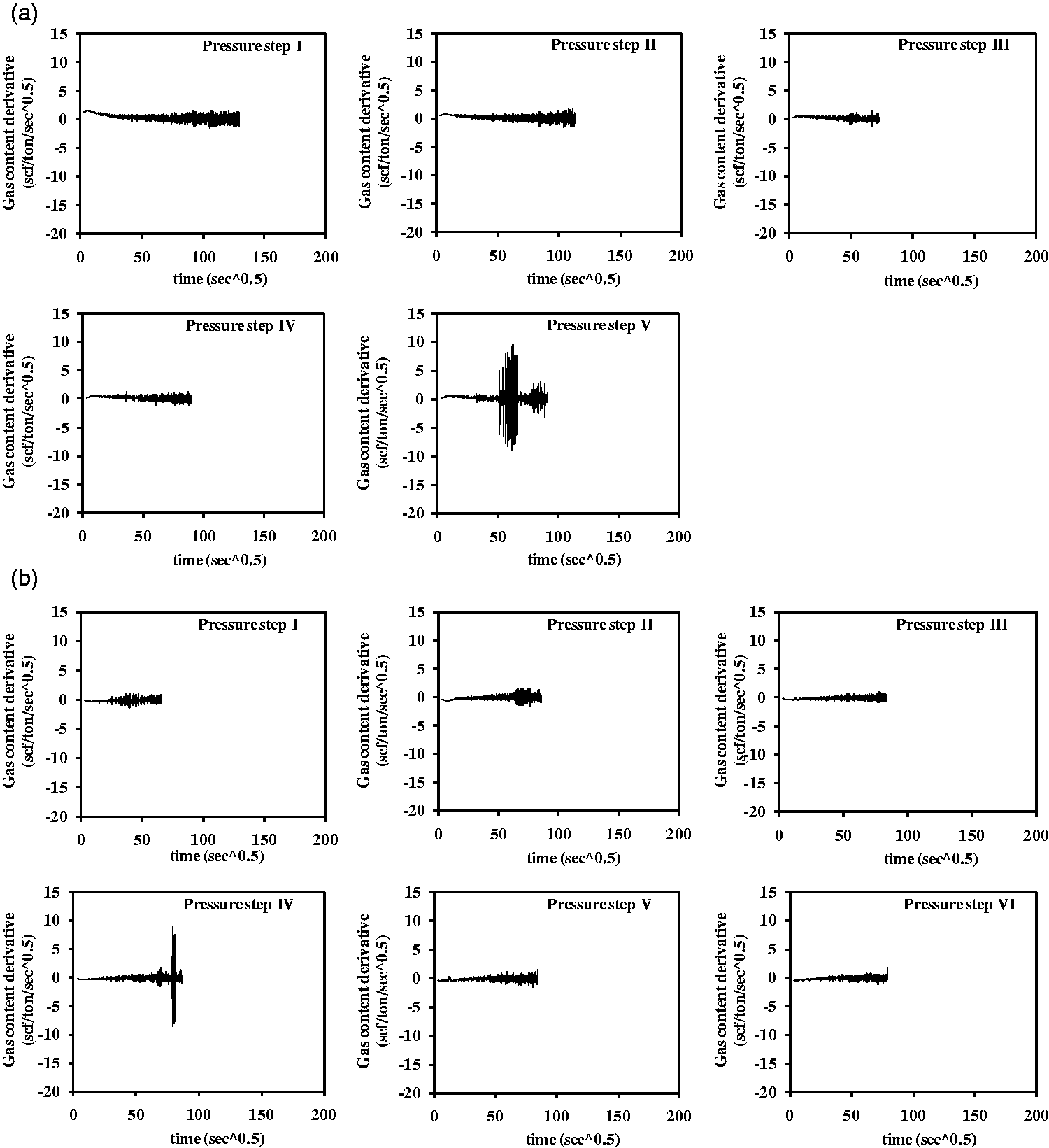
As a matter of fact, during the adsorption process, the three samples present an increase of gas content derivative data scattering from pressure step I to pressure step V. This effect is closely related to pressure increase, which also induces an increase in kinetic mechanisms. Additionally, from pressure step I to pressure step V, the gas saturation level increases. The gas saturation level increase, combined with coal swelling and gas compressibility effects, produce an increase on gas sorption kinetic mechanisms, which allow gas sorption to be able to reach the whole “empty” available space in the coal porous structure.
On the contrary, during the desorption process, the three samples present a decrease of gas content derivative data scattering from pressure step I to pressure step VI. In this case, this effect is associated to pressure decrease, which consequently induces a decrease in kinetic mechanisms. However, the dispersal behaviour presented on the different pressure steps during the desorption process is smaller than the ones observed during the adsorption stage. This is due to the small shrinking effect induced in the coal porous structure during the desorption process, when compared to the great swelling effect produced during the adsorption process. It means that when using any of the three selected gases, the coal porous structure is submitted to a swelling behaviour during the adsorption stage. During the desorption process, on the other hand, the coal porous structure will shrink, but not in the same proportion produced during the swelling phase. This means that the shrinking effect is smaller than the swelling effect and, consequently the coal porous structure will never return to the original shape. Additionally, those swelling and shrinking effects are higher when using CO2, followed by the gas mixture and, finally, by CH4.
Diffusion coefficients
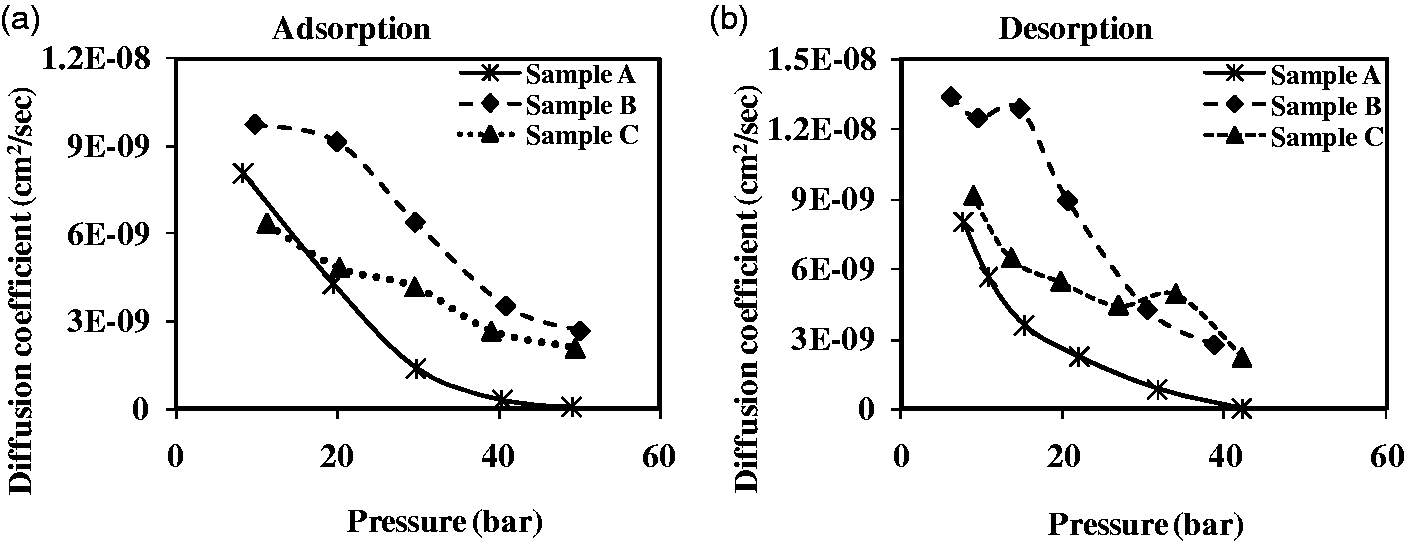
Diffusion is the process responsible for gas circulation in coal porous structure, which depends on coal properties, the gas composition and the pressure gradient. In this paper and as mentioned before, diffusion coefficients were calculated from gas sorption isotherms. In fact, three samples were selected and each one was submitted to a different gas sorption experiment. Consequently, diffusion coefficient values strongly diverge in the three samples (Figure 4a, b, c). Sample A presents higher diffusion coefficient values during adsorption than during the desorption processes, due to coal structure and CO2 high affinity (Figure 4a). As a result, the gas input is really efficient, yet it decreases with pressure increase. In contrast, the gas release process is quite complex since coal structure physical rearrangement induced by coal/CO2 strong interaction (allowing a small shrinking effect during the desorption process), and the high CO2 compressibility effect do not allow an easy gas release, even when pressure decreases. In fact, CO2 will effectively start to be desorbed when pressure reaches the desorption critical pressure point (Rodrigues, 2002). Above 20 bar, the diffusion coefficient in sample B shows higher values during the adsorption than during the desorption stage; whereas below this pressure the diffusion coefficient value becomes higher during the desorption process (Figure 4b). This behaviour is explained by the competition decrease between the different gases present in the mixture, which is, until 20 bar, mainly controlled by CO2. Consequently, and below 20 bar, the interaction between the coal structure and CO2 becomes weaker and CH4 and N2 start flowing more easily. In sample C, the diffusion coefficient shows higher values during the desorption than during the adsorption process, due to the slight interaction between the coal structure and CH4 (Figure 4c) when compared to CO2. This means that the coal porous structure swelling effect is greater when using CO2 than when using CH4. However, the coal porous structure shrinking effect is smaller in the first case than in the second one. When using CH4, the injection and the release processes will be mainly controlled by the gas molecule size, and by its small compressibility effect. Thus, due to the slight coal porous structure shrinking effect (when compared with the strong coal porous structure swelling effect) produced during the gas release phase, the “apparent available space” increases, which, associated to the coal/CH4 weak interaction, will induce a more efficient gas circulation during the desorption process. On comparing the three samples A, B and C, adsorption and desorption processes display, in general terms, higher diffusion coefficient values in sample B (CH4 + CO2 + N2) followed by sample C (CH4) and, finally, by sample A (CO2) (Figure 5). This confirms, once again, both the competition between the different gases in the gas mixture, and the CO2 high affinity with the coal structure. In fact, both CO2 and CH4 interact with the coal structure, although the interaction effect is higher with the former than with the second one, and N2 does not react with the coal structure, since N2 is an inert gas and, consequently, it will not induce a gas release delay, when compared to the other two. This is, specifically, the reason why Sample B, which was submitted to a sorption gas mixture containing 74.99% CH4 + 19.99% CO2 + 5.02% N2, presents higher diffusion coefficient values than the two other samples.
Adsorption and desorption diffusion coefficients of samples A (a), B (b), C (c). Comparison of diffusion coefficients of samples A, B and C for the adsorption and the desorption processes.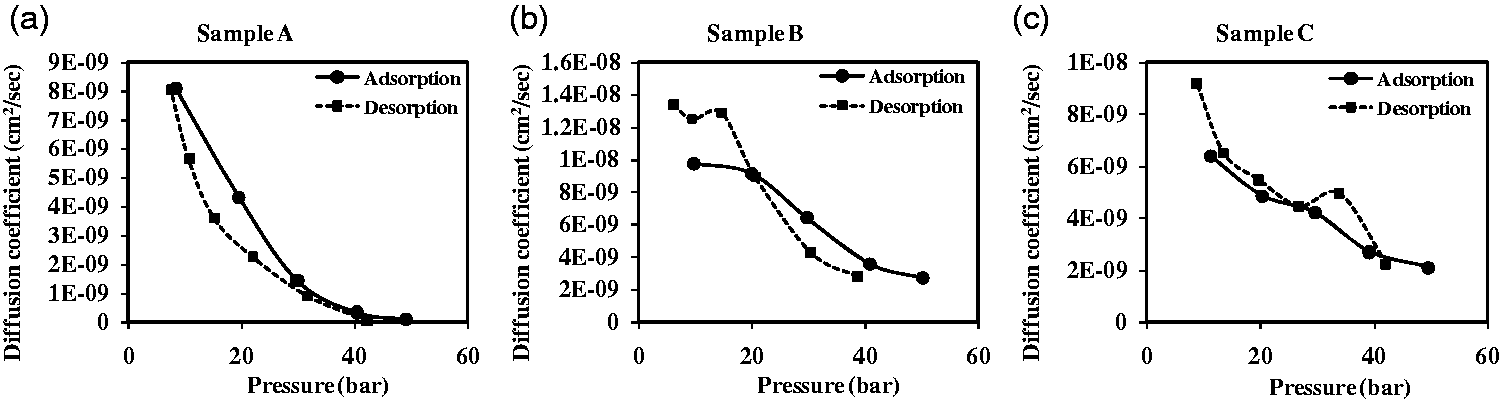
Conclusions
The mathematical methodology described allows to achieve a better and more accurate gas circulation modelling of coal seams as non-conventional reservoirs.
Gas content derivative data accurately reflects the diffusion process performance. The increase of gas content derivative data scattering detected from pressure step I to pressure step V, during all adsorption processes, implies a reduction on gas circulation rate. This reduction is induced by an increase on gas kinetic mechanisms, in order to allow the full gas coal porous structure accommodation. This behaviour, observed in the three samples, is reproduced in diffusion coefficients values, which decrease from pressure step I to pressure step V, as shown in the previous section. The opposite behaviour is detected in all desorption processes. From pressure step I to pressure step VI, gas content derivative data scattering decreases due to pressure decline, which implies a decrease on gas kinetic mechanisms and an increase on gas circulation rate. The referred kinetic mechanisms increase will induce a slow gas release, which depends on the gas sorption and consequently on the coal porous structure/gas interaction, and therefore the diffusion coefficient values increase from pressure step I to pressure step VI, in the three studied samples. Taking into account the three studied samples, it is possible to conclude that during both the adsorption and desorption processes the higher diffusion coefficient values are presented by sample B (gas mixture) followed by sample C (CH4) and, finally, by sample A (CO2).
The mathematical approach used allows to confirm that low diffusion coefficient values, obtained during the CO2 desorption stage as carried out in sample A, validate the huge potential of CO2 geological sequestration programmes applied on coal seams as one of the keys to contribute to CO2 abatement related with greenhouse gas emissions.
Footnotes
Declaration of conflicting interests
The author(s) declared no potential conflicts of interest with respect to the research, authorship, and/or publication of this article.
Funding
The author(s) disclosed receipt of the following financial support for the research, authorship, and/or publication of this article: Fundação Fernando Pessoa/Universidade Fernando Pessoa for supporting this investigation in the scope of the UFP Energy, Environment and Health Research Unit (FP-ENAS), Energy, Environment and Environmental & Public Health Research Laboratories (3ERL).