




Abstract
The total components and isotopes of rare gases as well as hydrocarbon gases for Dabei gas field are analyzed firstly, then their geochemical characteristics and genesis are discussed respectively, finally gas source correlation and their contributions are evaluated. The research results show that: (1) In Dabei gas field, methane is the main component, accompanying with a few N2 and CO2, as well as extremely low rare gases. In total component contents of rare gases, the He content is from 56.0 to 60.4 ppm with an average of 57.8 ppm and generally 1 order of magnitude higher than the air content value, while the Ne, Ar, Kr, and Xe contents are generally 1–3 orders of magnitude lower than the corresponding air content values. (2) The δ13C1 value in Dabei gas field usually ranges from −31.9‰ to −29.4‰. The δ13C2 value generally ranges from −24.2‰ to −19.4‰, which is obviously heavier than −28.5‰, The natural gases in Dabei gas field can be identified as typical coal-formed gas. (3) The 3He/4He value in natural gases is generally from (6.31–11.24) × 10−8 with an average value of 8.42 × 10⁻⁸. The 20Ne/22Ne value is from 9.563 to 9.734, and the 21Ne/22Ne value is from 0.0298 to 0.0307. The 40Ar/36Ar value is usually from 390 to 858 with an average value of 552, and the 38Ar/36Ar value is from 0.1955 to 0.2035. The 129Xe is relative loss, while the 132Xe is relative surplus. The comprehensive genesis identifications of He, Ne, Ar, and Xe indicate that rare gases are crustal derived genesis, mainly originating from the decay of related radioactive elements in crust. (4) The gas source correlation indicates that the natural gases in Dabei gas field are originated from humic coal series source rocks of Triassic-Jurassic, mainly contributed by Jurassic in vertical strata and coal rocks in type, coal rocks accounting for 63% and mudstones accounting for 37%.
Keywords
Introduction
Rare gases contain plenty of oil and gas geological information and play an important role in oil and gas genesis identification, gas source correlation, and oil and gas accumulation, becoming the hotspot and leading edge of current petroleum geology researches(Allegre et al., 1983; Battani et al., 2000; Dai et al., 1995; Honda et al., 1993; Liu and Xu, 1993; Ozima and Podesek, 2002; Poreda and Farley, 1992; Sun, 2001, Sun et al., 1991; Tao et al., 1996; Wang, 1989; Wang et al., 2013; Wei et al., 2014; Welhan and Craig, 1983; Welhan et al., 1983; Xu, 1996; Xu et al., 1979, 1994, 1996, 1997, 1998). The Dabei gas field is located on Kelasu tectonic belt of Kuche depression in Tarim Basin. It is a large terrestrial facies tight sandstone gas field with proven geological gas reserves of 1093.19 × 108 m3, core porosity generally less than 8% and matrix permeability mainly distributed within 0.01–1 × 10⁻³ µm2, has the most complex structures, ultra-deep reservoir (burial depth of 5500–6500 m) and ultra-high pressure (pressure coefficient of 1.54–1.65) (Dai, 2014). Following the Kela-2 gas field, the discovery of Dabei gas field has laid a solid subsequent gas source basis for sustainable development of China’s West-East Natural Gases Transmission Project. Currently, many studies on Dabei gas field are mainly concentrated on quantitative description and evaluation of fractured reservoir (Gao et al., 2012; Wang et al., 2013, 2014; Zhang et al., 2010), whereas the studies on natural gas geochemical characteristics, genesis, and origination are relatively seldom (Dai, 2014; Zhang et al., 2011). Especially, the total components and isotopes of rare gases and their gas source correlation in Dabei gas field have never been reported. Based on experimental analysis, the total components and isotope characteristics of rare gases in natural gases for Dabei gas field are clarified, and their genesis are identified and gas source correlation is carried out.
Geological setting
The Tarim Basin is a foreland superimposed oil & gas bearing basin. Tectonically, it can be divided into three uplifts, namely Tabei, Tazhong, and Ta’nan uplifts as well as four depressions (Figure 1), namely Kuche, Northern, Southwestern, and Southeastern depressions (Jia et al., 2001; Jia and Wei, 2002, 2003). The Kuche depression is located in northern Tarim Basin (Figure 1). It is connected to the South Tianshan orogenic belt in the north and neighboring Tabei uplift in the south, showing a NEE trend distribution. The Kuche depression is a foreland basin with main continental deposits of Mesozoic and Cenozoic. It was developed from ocean basin and the passive continental margin in early Paleozoic, and experienced South Tianshan ocean basin subduction closure and fold thrust in late Paleozoic, Tianshan Mountain planation and pan lakes development in Mesozoic, and intracontinental subduction & orogenic activities in Cenozoic. Controlled by multi-stage structural evolution, the Kuche depression can be divided into eight secondary structural units, namely Northern monocline belt, Kelasu tectonic belt, Yiqikelike tectonic belt, and Southern gentle anticline belt. The Kelasu tectonic belt has an approximately EW trending distribution, consisting of a series of thrust faults and fault-anticlines. It is controlled by the vertical shear generated from the uplift of South Tianshan Mountains as well as the basin mountain overall squeezing action, with characteristics of south-north zoning and east-west segmentation. It can be divided into two zones, namely Kela and Keshen (namely Kelasu sub-salt deep layers) from north to south, and can be further divided into four zones, namely Kela, North Keshen, South Keshen, and North Baicheng. It can be divided into five segments namely Awat, Bozi, Dabei, Keshen, and Kela 3 from west to east (Lei et al., 2007; Neng et al., 2012). Dabei gas field is located in Dabei segment in the western end of Kelasu tectonic belt. Its northern margin is controlled by Kelasu fault, and its southern margin is controlled by Baicheng fault. Dabei gas field consists of gas reservoirs which are complicated by multiple subsidiary fractures and controlled by multiple block structures inside the field. The development and evolution of Dabei structure mainly experienced elongation deformation stage in Jurassic-Cretaceous, weak elongation deformation stage in Paleogene, weak contraction distortion stage in Miocene, and strong deformation retraction stage in Pliocene-Quaternary (Zhang et al., 2011).
Tectonic units and distribution location of Dabei gas field in Kuche depression, Tarim basin (Dai, 2014, Modified).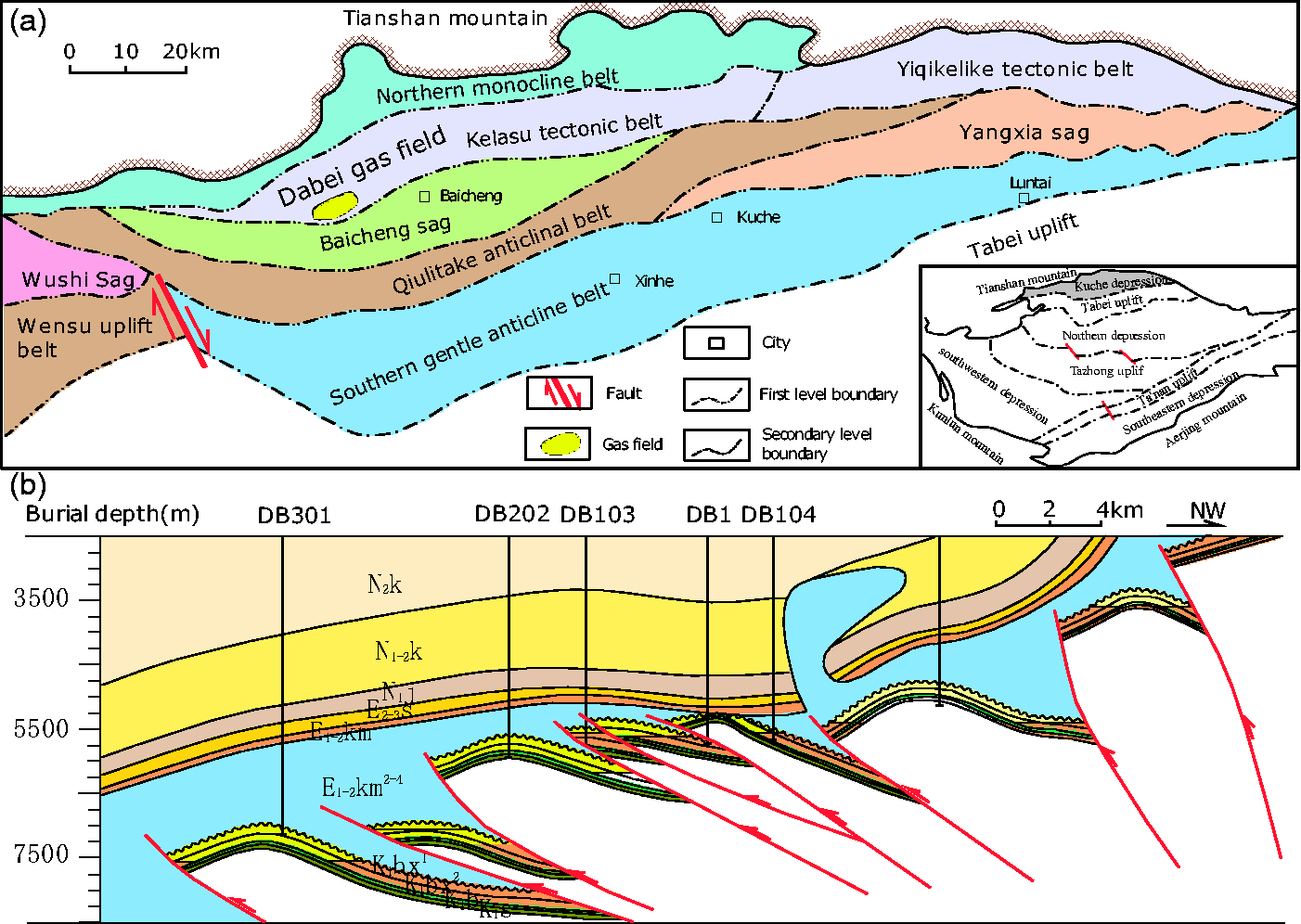
The formation encountered during drilling in Dabei gas field mainly includes Quaternary System, Kuche formation of Neogene (N2k), Kangcun formation (N1-2k), Jidike formation (N1j), Suweiyi formation of Paleogene(E2-3s), Kumugeliemu group (E1–2 km), Bashijiqike formation (K1bs), Baxigai formation (K1b), and Shushanhe formation (K1s) (Figure 2). The main gas layer is Bashijiqike formation in Lower Cretaceous (K1bs), which consists of sediments of braided alluvial plain-braided delta-front facies. The reservoir has tight substrate but with faults and fractures developed. Therefore, the overall permeability performance of the reservoir is greatly improved. The gypsum-salt and gypsum-mudstone of the Kumugeliemu group in Paleogene is one of the most important regional caprocks in Kuche depression. It has extremely strong sealing capacity, mainly distributed in the midwest of Kuche depression. The thickness center is near Dawanqi structure in Baicheng sag with the maximum thickness more than 3000 m. The massive gypsum-salt and gypsum-mudstone caprocks of Kumugeliemu group, Paleogene as well as the sandstone reservoir of Bashijiqike formation, Cretaceous consist of a favorable reservoir-caprock combination for Dabei gas field. A total of two main source sags, namely Baicheng and Yangxia source sags, are developed in Kuche depression with coal series source rocks of Triassic-Jurassic. The source rocks of Triassic are mainly developed in Karamay formation and Taliqike formation of Middle & Upper Triassic. The thickness of the mudstones is generally 200–600 m, and the maximum thickness can be 800 m. The maximum thickness of coal seams can reach 10 m. The average organic carbon content in the mudstones is generally more than 1.20%, and the parent material are mainly of Type II2 and Type II1. The source rocks of Jurassic are mainly developed in Yangxia formation and Kezileluer formation of Middle & Lower Jurassic. The thickness of the mudstones is 100–600 m, and the thickness of coal seams is 5–40 m. The organic carbon content in the mudstones is 1%–3.88%. The parent material is mainly of Type III (Li et al., 2001; Liang et al., 2003; Lu et al., 2000; Song et al., 2006; Zhao et al., 2005).
Comprehensive stratigraphic column of Dabei gas field in Kuche depression, Tarim basin (Dai, 2014, Modified).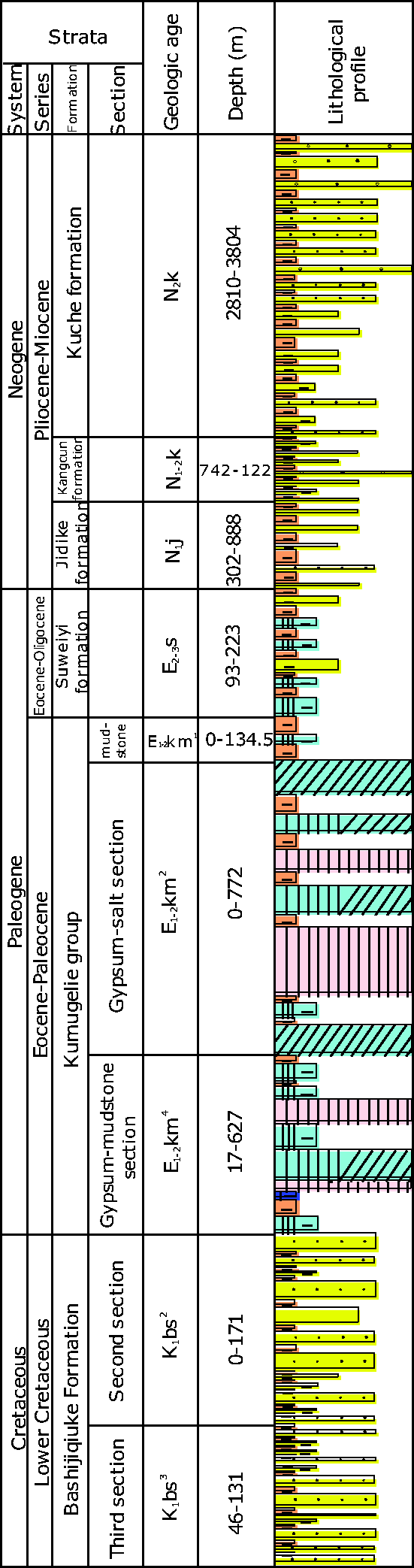
Sample collection and analysis method
Generally, the component contents of hydrocarbon gases are high while the rare gases are very low in natural gases, on the contrary the component contents of hydrocarbon gases are very low and the rare gases are relatively high in air (particularly, the content of Ar is as high as 0.934%). Therefore, the impact of hydrocarbon gases in air on natural gases analysis can be ignored. However, the rare gases in air can not be ignored when analyzing rare gases in natural gases. In order to obtain accurate rare gases analytic results and minimize the bad impact of rare gases in air on gas samples collecting and experimental analyzing, some special methods and processes should be adopted: (1) Use high pressure cylinders with double valves. (2) Pump sampling cylinders with mechanical pumps and molecular pumps in order to reduce the pressure to 10−3 Pa or lower before sampling. (3) Connect the sampling cylinders with gas wells by connecting pipeline when sampling at well sites, use natural gases to flush the cylinders 4–6 times for 10 min and take gas samples in middle segment from continuous gas flow.
A total of five natural gas samples are taken from Dabei gas field. All the samples were collected according to above methods and finally analyzed at Research Institute of Petroleum Exploration and Development-Langfang, PetroChina. (1) Conventional gas components were determined on an agilent 6890 N gas chromatograph (GC) equipped with a thermal conductivity detector, using helium as the carrier gas. (2) The carbon isotopes of natural gases were determined on a Delta S isotope mass spectrometer (Thermo Fischer Scientific) equipped with an agilent 6890 N GC. (3) Total component contents and isotopes of rare gases were measured on rare gases sampling system and isotope mass spectrometer. The detailed analytic processes followed as: The natural gas cylinder is connected to injection port of the instrument through a pressure relief valve, using a mechanical pump to get low vacuum for the stainless steel pipeline as well as a molecular pump and an ion pump to obtain high and ultrahigh vacuum. The gas sample amount is controlled by sample injection controlling valve and vacuum gauge; purifying the active gases such as hydrocarbon gases, nitrogen (N2), oxygen (O2), carbon dioxide (CO2), hydrogen sulfide (H2S), and trace hydrogen gas (H2) with a Zirconium base furnaces and an aspirator pump to enrich rare gases. The total component contents of rare gases analyzing technology with high accuracy and stability is used to measure the total component contents of rare gases after purification. According to different boiling points of various rare gases, a cryogenic pump, an activated carbon furnace, and liquid nitrogen are used to separate the components of Helium (He), Neon (Ne), Argon (Ar), Krypton (Kr), and Xenon (Xe). Finally, the separated rare gases are sent into rare gas isotope mass spectrometer to determine the rare gases isotopes by the method of ion current signal intensity peak height ratio (Wang et al., 2013; Wei et al., 2014). Using the international recognized values of total component contents of rare gases in air, the relative deviations of rare gases He, Ne, Ar, Kr, and Xe in air determined are ±3.36%, ±3.66%, ±1.32%, ±2.99%, and ±6.96%, respectively. The relative deviations of isotopes of rare gases 3He/4He, 20Ne/22Ne, 40Ar/36Ar, 38Ar/36Ar, 129Xe/130Xe, 132Xe/130Xe determined are ±4.50%, ±1.32%, ±1.27%, ±1.39%, ±1.63%, ±1.84%, and ±2.13%, respectively.
Results and discussion
Total component content distribution characteristics of rare gases
Component contents of hydrocarbon, no-hydrocarbon, and rare gases in natural gases for Dabei gas field.
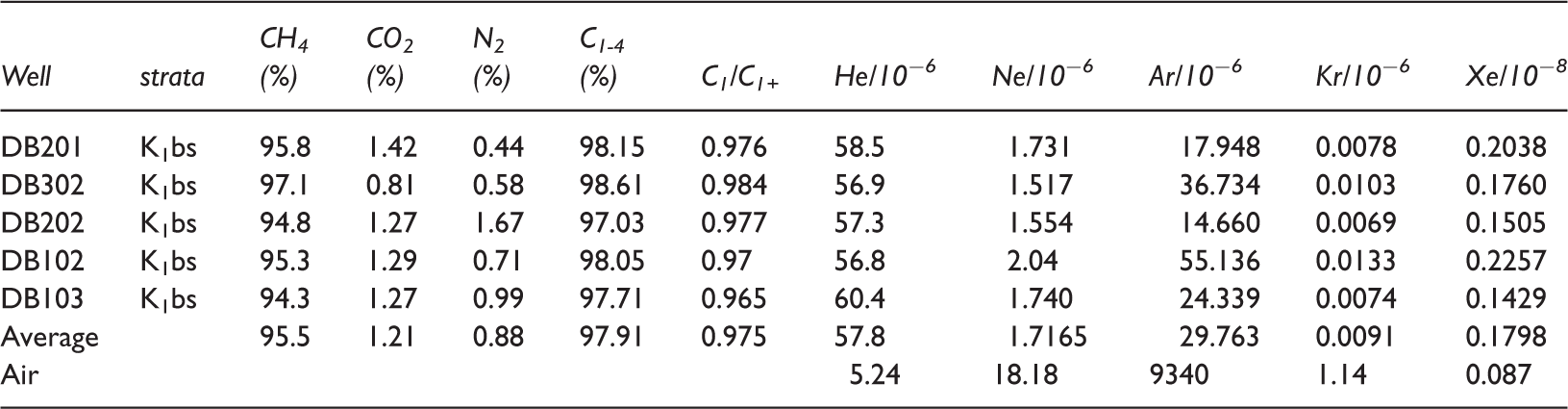
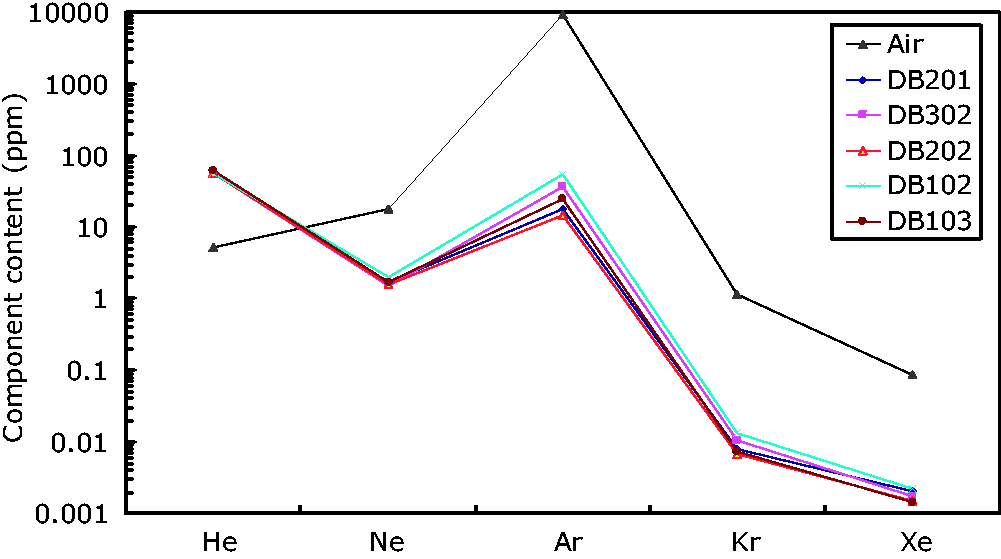
The distribution characteristics of total component contents of rare gases in natural gases from Dabei gas field follow as (Table 1, Figures 3 and 4): (1) The He content is mainly distributed around (56.8–60.4) × 10−6 with an average value of 57.8 × 10⁻⁶, which is about 1 order of magnitude higher than the air content value. (2) The Ne content is mainly distributed around (1.517–2.040) × 10−6 with an average value of 1.716 × 10⁻⁶, which is about 1 order of magnitude lower than the air content value. (3) The Ar content is mainly distributed around (14.660–55.136) × 10−6 with an average value of 29.763 × 10⁻⁶, which is about 2–3 orders of magnitude lower than the air content value. (4) The Kr content is mainly distributed around (0.0069–0.0133) × 10−6, with an average value of 0.0091 × 10⁻⁶, which is around 2–3 orders of magnitude lower than the air content value. (5) The Xe content is mainly distributed around (0.0014–0.0023) × 10−6 with average value of 0.0018 × 10⁻⁶, which is about 1–2 orders of magnitude lower than the air content value. So, the He content of natural gases in Dabei gas field is slightly higher than the air content value; whereas the Ne, Ar, Kr, and Xe contents are relatively lower than air content values. Considering from industrial utilization, the average He content value of 57.8 × 10⁻⁶ in natural gases for Dabei gas field, which is just 1 order of magnitude slightly higher than the air content value, cannot reach the threshold of 500 × 10−6 for industrial utilization. The Ne, Ar, Kr, and Xe contents are generally lower than air content values, having no resources and technical advantages comparing with air separation and extraction.
Histogram of total component contents distribution of He, Ne, Ar, Kr, and Xe for Dabei gas field. Fold line chart of total component contents of He, Ne, Ar, Kr, and Xe for Dabei gas field.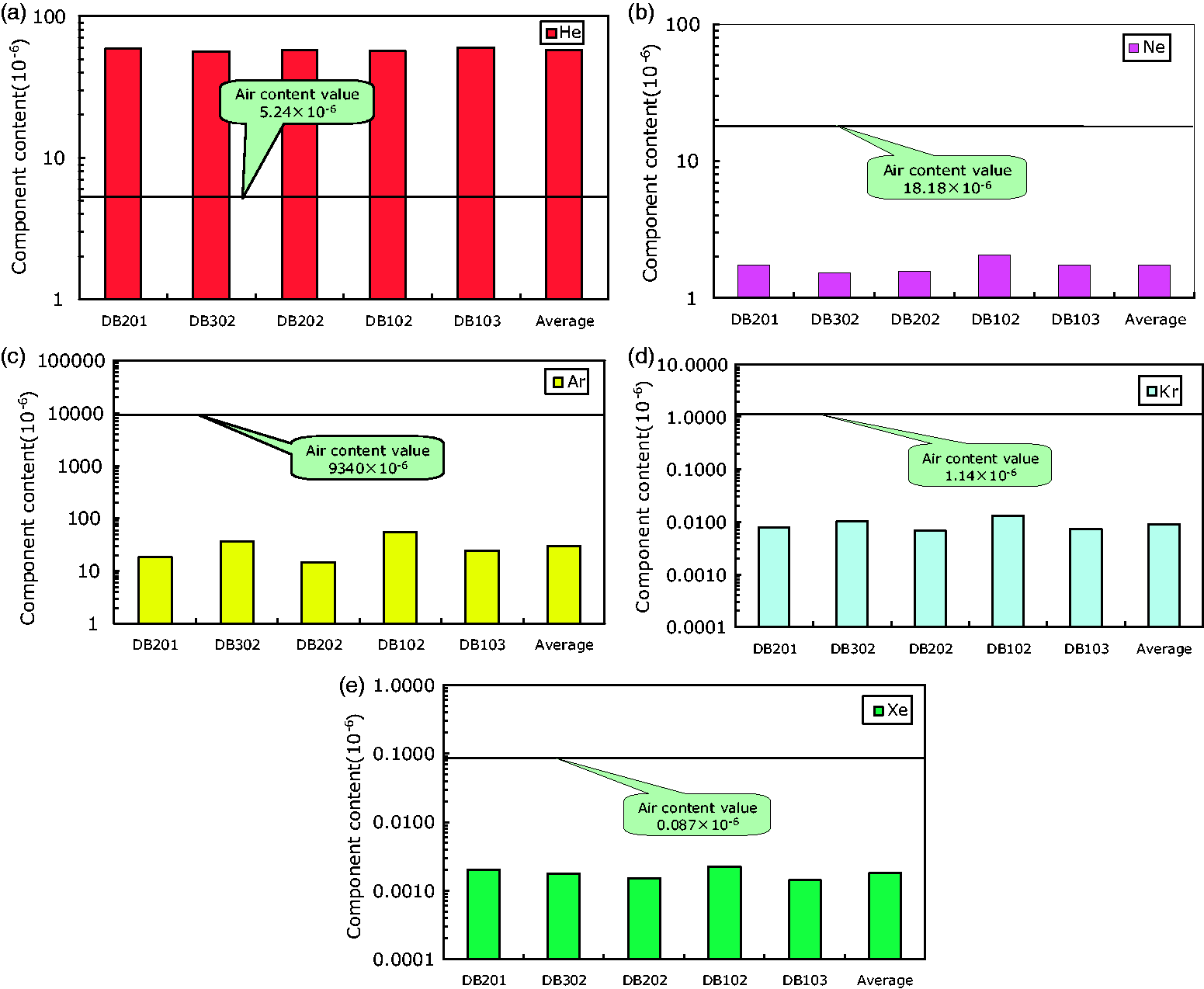
Isotope characteristics and genesis of rare gases
Hydrocarbon
The carbon isotope value of methane (δ13C1) in natural gases for Dabei gas field is from −31.9‰ to −29.4‰ with an average value of −30.7‰, while the carbon isotope value of ethane (δ13C2) is relatively heavier, which ranges from −24.2‰ to −19.4‰ with an average value of −22.0‰.
The stable carbon isotopes of natural gases are the most reliable and frequently used method for gas identification and source rock correlation currently (Dai, 1992, 2014; Dai and Qi, 1989). As we known, the δ13C1 value of biogenetic origin is generally less than −55.0‰, the δ13C1 value in natural gases for Dabei Gas Field is usually from −31.9‰ to −29.4‰, which determines that Dabei gas field is not biogenetic gas. The carbon isotope value of ethane (δ13C2) is usually less effected by maturity of source rocks than that of methane, and the δ13C2 value of natural gases generated from source rocks with diferent organic material types differs significantly. The smallest δ13C2 value of coal-formed gas is −28.3‰, meanwhile the biggest δ13C2 value of oil-type gas is more than −29.0‰, hence the δ13C2 value of −28.5‰ can be regarded as the reliable discrimination index for coal-formed gas and oil-type gas (Dai, 1992, 2014). The δ13C2 value of natural gases in Dabei Gas field mainly ranges from −24.2‰ to −19.4‰ with an average value of −22.0‰, which is obviously heavier than −28.5‰. So it can be identified as typical coal-formed gas, showing significant differences with that of oil-type gas in the Tazhong oil and gas field, Tarim Basin (Figure 5).
Genesis identification of carbon isotopes of methane and ethane for Dabei gas field.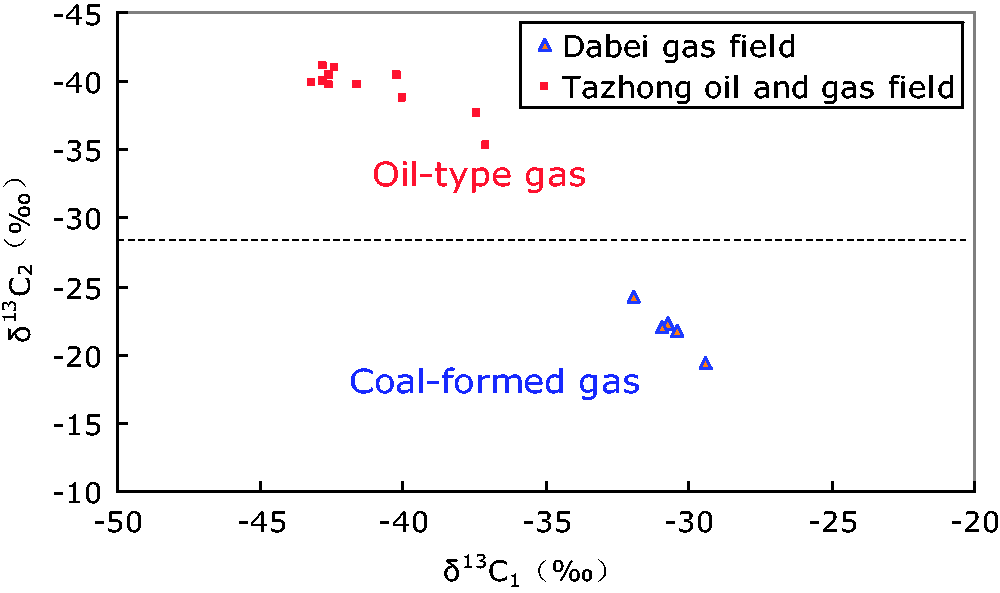
He
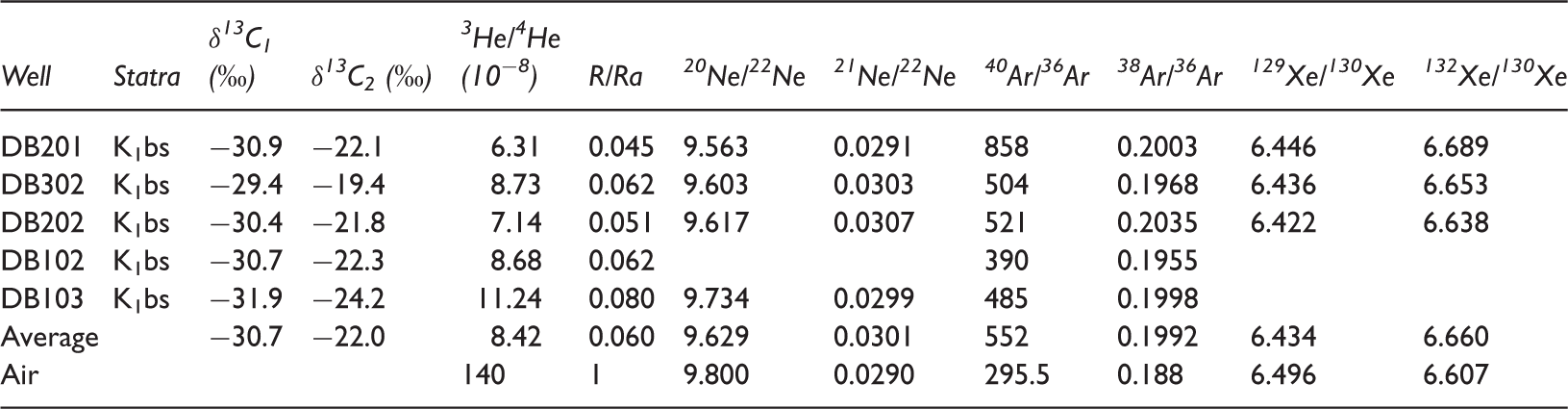
Helium has two stable isotopes, 3He and 4He with different genesis. 3He is the nuclide when element is formed, and 4He is the product from decay of natural radioactive elements, uranium (U) and thorium (Th) on the earth (Clarke et al., 1976; Mamyrin et al., 1970; Xu et al., 1979). The genetic types of helium in natural gases include atmospheric, crustal, and mantle helium. The 3He/4He value of atmospheric helium (Ra) is 1.40 × 10⁻⁶. The 3He/4He value (Rm) of mantle helium is usually taken 1.1 × 10⁻⁵ as the typical characteristic value (Lupton, 1983), whereas due to the existence of radiogenic origin He in crustal helium, the typical characteristic value of 3He/4He (Rc) is 2 × 10⁻⁸ (Poreda et al., 1986). The 3He/4He value (R) of natural gases in Dabei gas field is mainly distributed around (6.31–11.24) × 10−8 (0.045–0.080 Ra) with an average value of 8.42 × 10⁻⁸ (0.06 Ra) (Table 2). From the genesis identification map of He—R/Ra in natural gases for Dabei gas field, it can be found that the 3He/4He value of natural gases is mainly distributed around 0.01 < R/Ra < 0.10, sample points generally fall in the typical crustal genesis area (Figure 6), indicating that the helium in natural gases of Dabei gas field is typical crustal genesis, mainly originated from the decay of crustal radioactive elements U, Th, and etc.
Genesis identification map of He—R/Ra in natural gases for Dabei gas field. Some isotopic compositions of methane, ethane, and rare gases for Dabei gas field.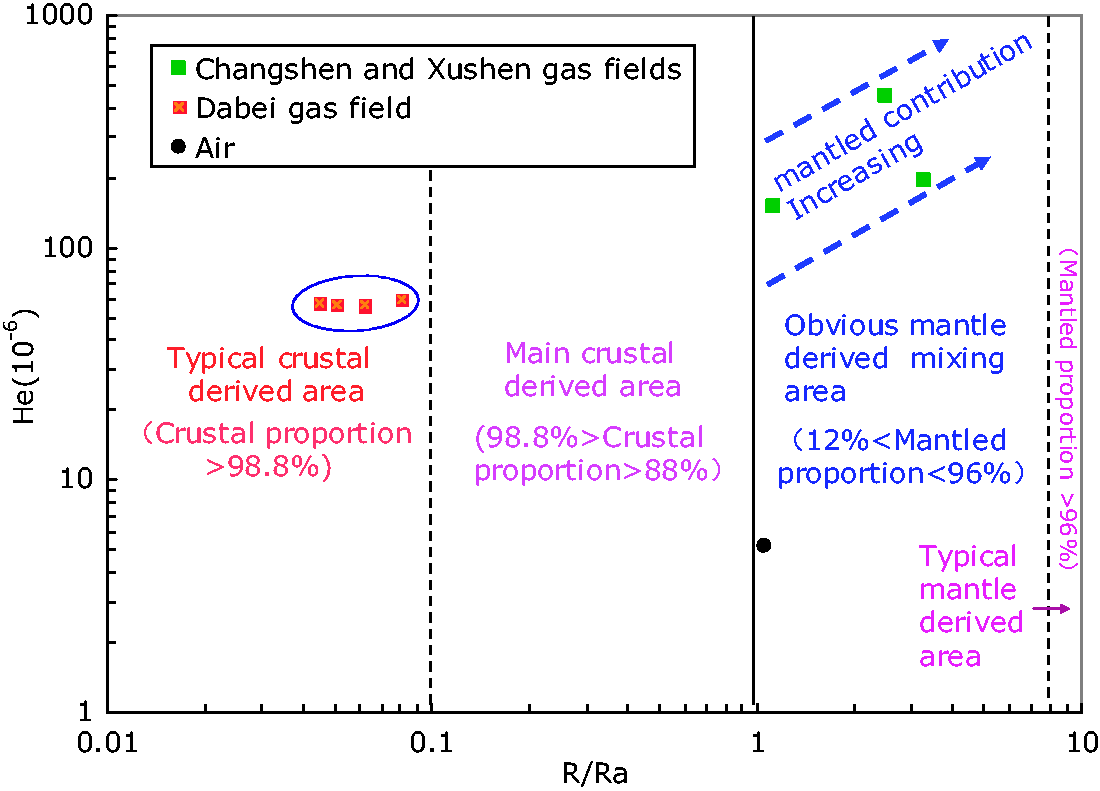
Ne
Neon has three stable isotopes: 20Ne, 21Ne, and 22Ne. Neon is mainly of three origins: original origin (synthesized by nuclear fusion), radiogenic origin (produced by radioactive decay and nuclear reactions), and spallation origin (produced by the reaction of cosmic radiation with the substance) (Du, 1989; Mamyrin and Tolstikhin, 2013). The 20Ne/22Ne and 21Ne/22Ne in air have stable isotope values of 9.8 and 0.029 separately. The 20Ne in mantle substance from mid ocean ridge basalt (MORB) and ocean island basalt (OIB) is more excessive that of in air, reflecting that the solar wind type neon with original component exists in mantle; whereas the surplus 21Ne and 22Ne mainly relate to the radioactive nucleus reactions of the elements uranium, thorium, oxygen, and fluorine in crust, for instance, 18O(n, a) 21Ne and 19F(n, a) 22Ne may lead to the more enrichment of 21Ne and 22Ne than these of in air (Ballentine and O’Nions, 1992; Hiyagon et al., 1992; Honda et al., 1991; Kennedy et al., 1990; Sarda et al., 1988; Xu et al., 1996). From the genesis identification map of 3He/4He—20Ne/22Ne, it can be concluded that the surplus 20Ne in Changshen and Xusheng gas fields reflects the mixing of solar wind type neon and mantle source contribution (Figure 7). The 20Ne/22Ne value of natural gases in Dabei gas field is mainly distributed around 9.563–9.734 with an average value of 9.629, and the 21Ne/22Ne value is mainly distributed around 0.0299–0.0307 with an average value of 0.0301 (Table 2). Comparing with Changshen and Xusheng gas fields, the 20Ne is relatively depleted while 21Ne and 22Ne are relatively surplus in Dabei gas field, it is indicated that the Neon is mainly of crustal genesis (Figure 7), mainly originated from the radioactive nucleus reactions of the rich elements of uranium, thorium, oxygen, and fluorine in the crustal material.
Genesis identification map of 3He/4He—20Ne/22Ne in natural gases for Dabei gas field.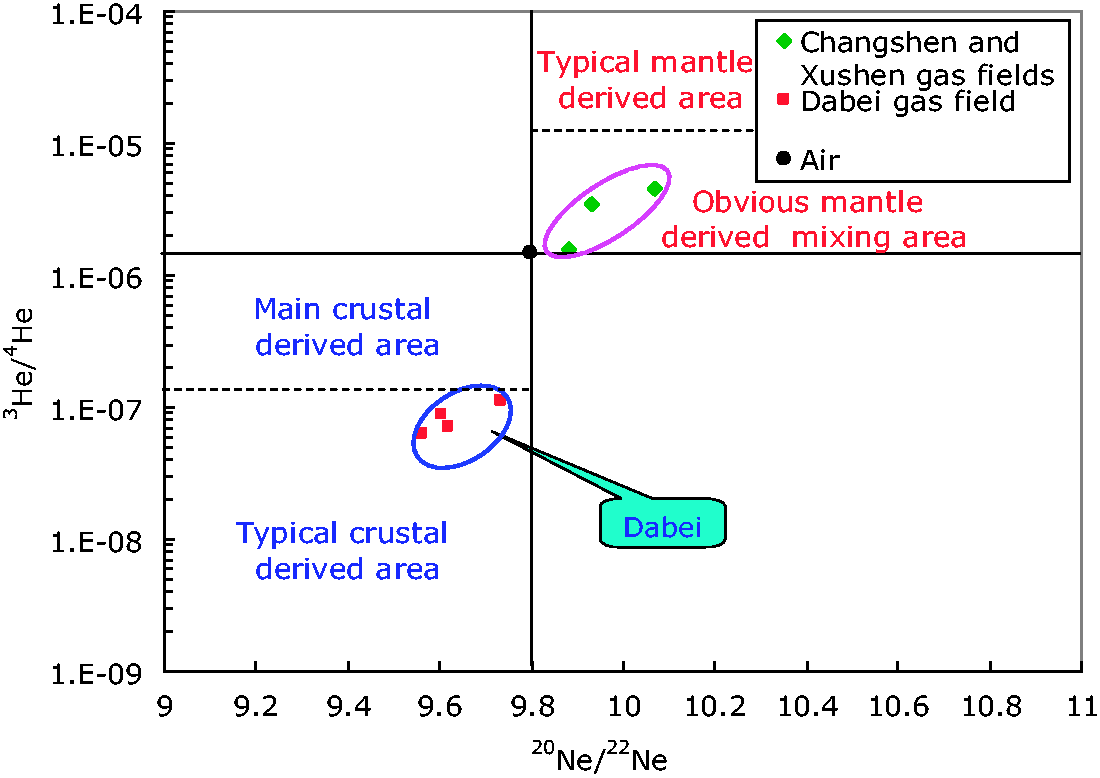
Ar
Ar has three stable isotopes: 36Ar, 38Ar, and 40Ar. 36Ar and 38Ar are originally generated nuclides, whereas 40Ar is mainly originated from the radioactivity decay of K (kalium) (Ozima and Podesek, 2002; Wang, 1989; Xu, 1996; Xu et al., 1979). There are stable isotopic compositions of Ar in air: the 40Ar/36Ar value is 295.5, and the 38Ar/36Ar value is 0.188 (Ozima and Podesek, 2002; Wang, 1989; Xu, 1996). Due to heterogeneous distribution of decay matrix 40K of radioactive Ar, the isotopic compositions of Ar vary greatly in the crust and the mantle. The 40Ar/36Ar value in upper mantle is around 295.5–10000.0, but in lower mantle it is far below that in upper mantle (Liu and Xu, 1987, 1993; Shen et al., 1995; Xu, 1996). The distribution range of 40Ar/36Ar value in natural gases for Dabei gas field is wide, mainly distributing around 390–858 with an average of 552. The 38Ar/36Ar value is mainly distributed around 0.1955–0.2035 with an average value of 0.1992 (Table 2). It can be gotten from genesis identification map of 3He/4He—40Ar/36Ar of natural gases for Dabei gas field that the 3He/4He value in natural gases from Changshen and Xushen gas fields is greater than 1.4 × 10⁻⁶, the 3He/4He and 40Ar/36Ar values have a positive incremental relationship, indicating rare gases have mixing characteristics with obvious mantle derived genesis. Whereas the 3He/4He value of natural gases for Dabei gas field is mainly distributed around (6.31–11.24) × 10−8 with an average value of 8.42 × 10⁻⁸, the 3He/4He and 40Ar/36Ar values have a negative incremental relationship, indicating the Argon of natural gases in Dabei gas field are mainly of typical crustal derived genesis (Figure 8).
Genesis identification map of 3He/4He—40Ar/36Ar in natural gases for Dabei gas field.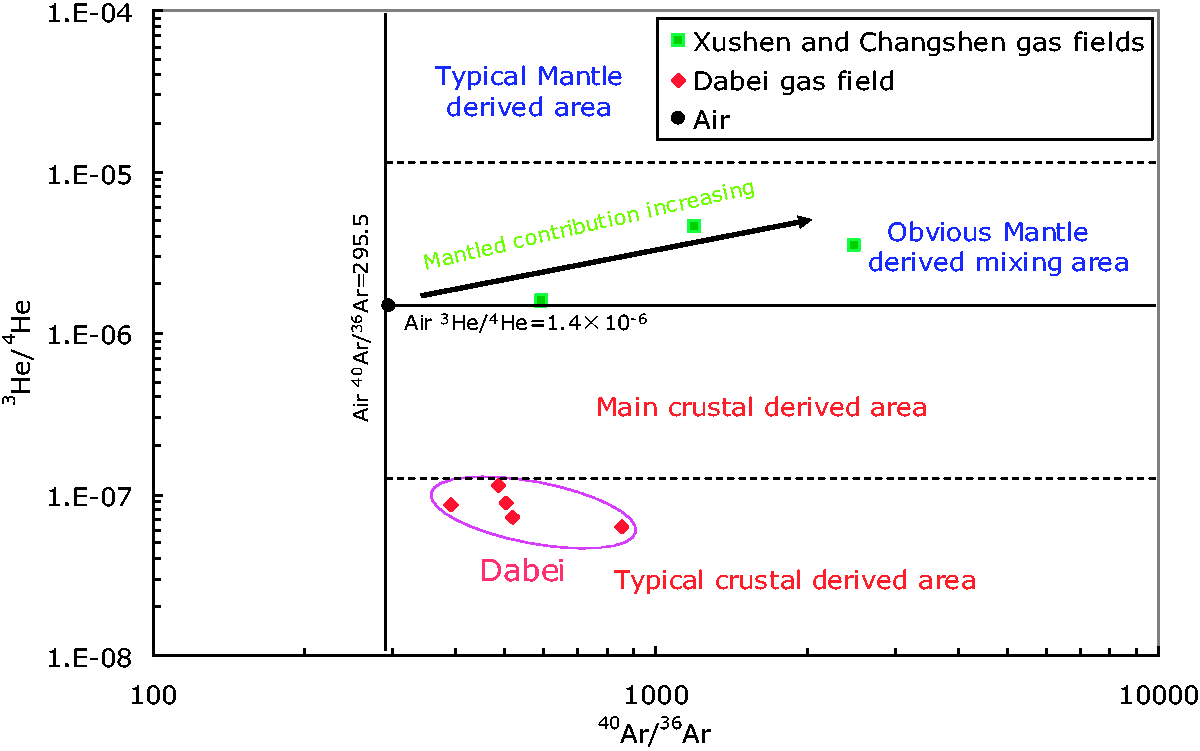
Xe
The 129Xe in terrestrial matter was mainly formed from the radioactive decay of the extinct 129I (with a half-life of 18Ma), and 131–136Xe was formed from the spontaneous fission of 238U or the radioactive decay of extinct 244Pu (with a half-life of 82Ma). Because of short half-lives of 129I and 244Pu, they were completely decayed into 129Xe and 131–136Xe before the crust was formed and were trapped in the mantle (Xu et al., 1997). It is found that the 129Xe and 131–136Xe in MORB are relatively surplus and they have a positive correlation, reflecting the results of 129I and 244Pu decay in the mantle (Xu et al., 1997). Therefore, the changes of xenon in crustal material can only reflect the relative surplus of 131–136Xe caused by the spontaneous fission of 238U instead of the relative surplus of 129Xe. From the genesis identification map of 129Xe/130Xe—132Xe/130Xe in natural gases for Dabei gas field (Figure 9), it can be found that the 129Xe existing in natural gases from Changshen and Xushen gas fields in Songliao basin is relatively surplus with mantled substance contribution. Comparatively speaking, the 129Xe in natural gases for Dabei gas field is relatively depleted, whereas the 132Xe is relatively surplus, indicating that the rare gas Xeon in natural gases from Dabei gas field is mainly of crustal derived genesis.
Genesis identification map of 129Xe/130Xe—132Xe/130Xe in natural gases for Dabei gas field.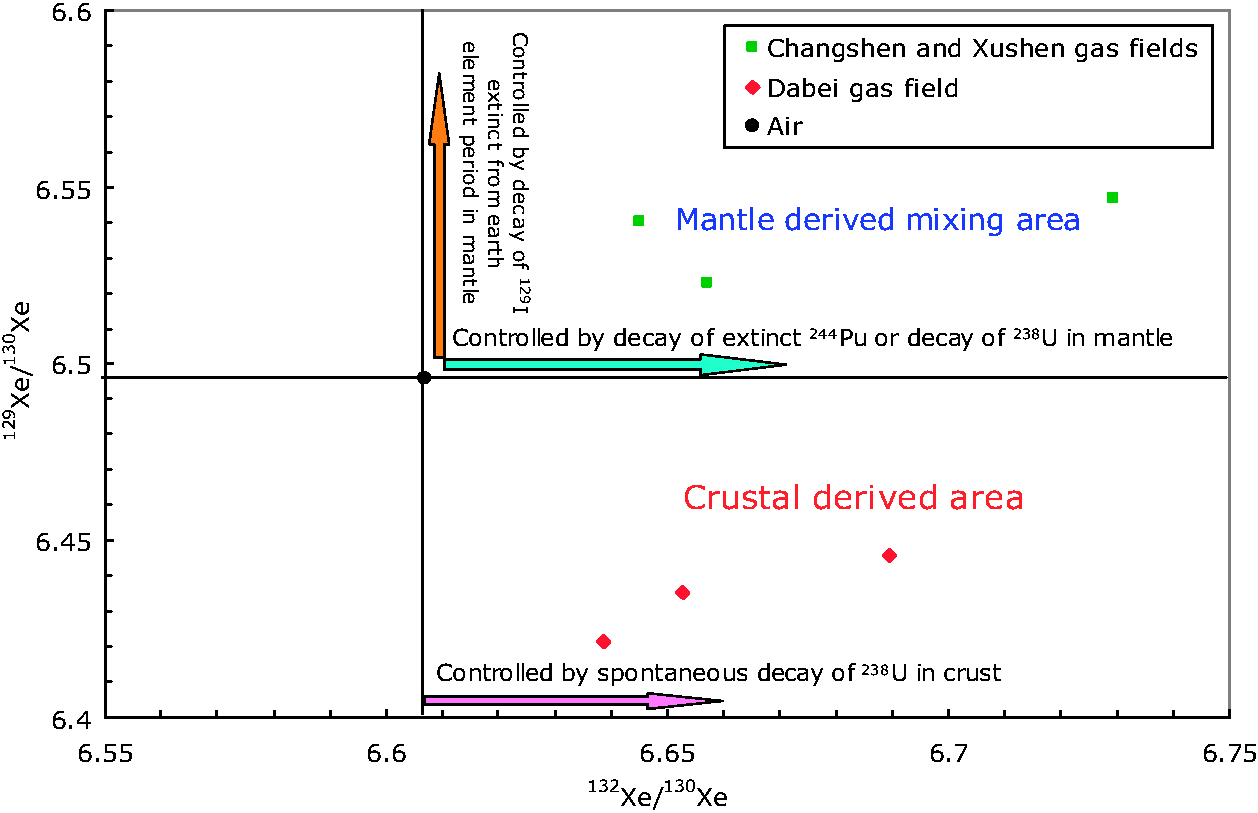
Gas source correlation
From the research on conventional hydrocarbon components and isotopes that the gas maturity of Dabei gas field is around 1.6%–1.8% (Dai, 2014; Dai and Qi, 1989; Zhang and Zhu, 2008; Zhu et al., 2014), and the δ13C2 value is around −24.2‰–−19.4‰, it can be concluded that the natural gases in Dabei gas field are typical coal-derived gas with high maturity. So, the natural gases are mainly originated from humic type coal series in Jurassic-Triassic.
Rare gases have an important role in tracing and indicating the geological processes. Based on rare gases genesis identification, the rare gases source correlation of Dabei gas field is carried out according to age cumulative effect, and finally the contribution proportions of source rocks are preliminarily evaluated. (1) The 3He/4He value in natural gases for Dabei gas field is mainly distributed around (6.31–11.24) × 10−8 with an average value of 8.42 × 10⁻⁸, mainly distributing from 5 × 10⁻⁸ to into 10−7, indicates the crustal genesis 4He originated from U and Th in crust is relatively not very rich, the cumulative time of 4He is relative short and source rocks may be relative new. The source rocks may be argillaceous rocks with relatively low U and Th contents in clay minerals, or carbonate rocks with even lower U and Th contents. Considering that the carbonate rocks have relative old geologic age and are also not developed, while the relative younger humic coal series source rocks in Triassic-Jurassic are well developed in Kuche depression, so the possible source rocks are coal series source rocks of Triassic-Jurassic. (2) The 40Ar/36Ar value in natural gases for Dabei gas field is mainly distributed around 390–858 with an average value of 552, which is close to the estimated value of 571–920 from source rocks of Triassic-Jurassic, reflects rare gases are mainly originated from humic coal series source rocks of Triassic-Jurassic. In addition, the average value of 40Ar/36Ar in natural gases is more closed to estimated value from Jurassic source rocks, indicates the contribution of Jurassic source rocks is greater than that of Triassic. (3) Because of difference contents of potassium-bearing minerals in mudstones and coal rocks, the 40Ar/36Ar values of natural gases generated from different source rocks are apparently different. The contribution proportion for different organic matter types of source rocks can be discussed based on their differences (Liu and Xu, 1987; Xu et al., 1996; Zhang et al., 2005). Based on the above method, a preliminarily evaluation on contribution proportion of coal and mudstone rocks in coal series source rocks of Triassic-Jurassic is carried out. The research results indicate that the contribution proportions of humic coal series source rocks of Triassic-Jurassic, coal rocks account for 63% and mudstones account for 37%.
Conclusions
1. In Dabei gas field, the main component of methane ranges from 94.3% to 97.1%, accompanying with N2 ranging from 0.44% to 1.67%, CO2 varying from 0.81% to 1.42% and C1/C1+ distributing from 0.965 to 0.984. In total component contents of rare gases, the He content is mainly distributed from 56.0 × 10⁻⁶ to 60.4 × 10⁻⁶ with an average of 57.8 × 10⁻⁶, which is generally 1 order of magnitude higher than that of the air content value. The Ne, Ar, Kr, and Xe contents are 1–3 orders of magnitude lower than the corresponding air content values. The Ne content is mainly distributed around (1.517–2.040) × 10−6 with an average value of 1.716 × 10⁻⁶. The Ar content is around (14.7–55.1) × 10−6 with an average value of 29.8 × 10⁻⁶. The Kr content is around (0.0069–0.0133) × 10−6 with an average value of 0.0091 × 10⁻⁶. The Xe content is around (0.0014–0.0023) × 10−6 with an average value of 0.0018 × 10⁻⁶. 2. The δ13C1 value in Dabei gas field is from −31.9‰ to −29.4‰ with an average value of −30.7‰, while the δ13C2 value is relatively heavier, ranging from −24.2‰ to −19.4‰ with an average value of −22.0‰. The δ13C2 value of natural gases for Dabei Gas Field is obviously heavier than −28.5‰, which can be identified as typical coal-formed gas. 3. The 3He/4He value in natural gases is generally from (6.31–11.24) × 10−8 with an average value of 8.42 × 10⁻⁸. The 20Ne/22Ne value is mainly from 9.563 to 9.734, and the 21Ne/22Ne value is from 0.0298 to 0.0307. The 40Ar/36Ar value is usual from 390 to 858 with an average value of 552, and the 38Ar/36Ar value is from 0.1955 to 0.2035. The 129Xe is relative loss, while the 132Xe is relative surplus. The comprehensive genesis identifications of He, Ne, Ar, and Xe indicate that rare gases are crustal derived genesis, mainly originating from the decay of radioactive elements in crust. 4. The natural gases in Dabei gas field are originated from humic coal series source rocks of Triassic-Jurassic, mainly from Jurassic in vertical strata and coal rocks in organic matter type, of which coal rocks accounting for 63% and mudstones accounting for 37%.
Footnotes
Acknowledgements
The authors are grateful to the anonymous reviewers for their careful reviews and detailed comments.
Declaration of conflicting interests
The author(s) declared no potential conflicts of interest with respect to the research, authorship, and/or publication of this article.
Funding
The author(s) disclosed receipt of the following financial support for the research, authorship, and/or publication of this article: This work was financially supported by the National Special Science and Technology Major Project (2011ZX05007-002), and the Major Program of PetroChina (2014B-0608, 2011B-0603).