



Abstract
This study presents the first large-scale analysis of the role of unions in how technological change impacts transitions to new employment following job loss. The authors use large-scale matched employer–employee data from the Netherlands for the period 2001–2016 to assess how technology implementation within enterprises impacts the job search duration among workers whose job ended during the implementation period. The authors study to what degree industry unionization moderates this impact. They find job searches to be significantly longer in enterprises implementing new technologies, but industries with stronger unions exhibit a weaker association between technology implementation and job search duration. The results suggest unions enhance training, and re-education, and facilitate work-to-work transitions, increasing the employability of workers under technological change.
Introduction
Does technological progress create a ‘world without work’ (Susskind, 2020)? According to estimates by Frey and Osborne (2017), almost half of US occupations are at risk of automation in the coming decades. Other studies estimate the risk of automation to be much lower considering within-occupation heterogeneity in job tasks. Assessing the risk of automation of tasks within occupations, Arntz et al. (2017) estimate the automation risk of US jobs (and for 21 OECD countries on average) to be 9%. Employing a similar approach, Nedelkoska and Quintini (2018) find the percentage of jobs at high risk of automation to be 14% when using data that involve a broader set of workers and including 32 OECD countries. While the labour market effects of technological change have been widely studied (Acemoglu and Autor, 2011; Acemoglu et al., 2020; Autor et al., 2003; Goos et al., 2014), less is known, and findings are less clear on how technological innovation impacts the employment of individual workers. Some studies find that technology adoption in firms increases the likelihood of job separation and lowers the likelihood of re-employment (Bessen et al., 2019). Others find technology to increase firm employment (Acemoglu et al., 2020; Bessen and Righi, 2019), and to decrease the likelihood of job separation (Bachmann et al., 2024; Damelang and Otto, 2023; Ten Berge et al., 2020) – in particular for higher skilled (Damelang and Otto, 2023; Ten Berge et al., 2020), younger, less tenured (Bachmann et al., 2024; Ten Berge et al., 2020) and native workers (Ten Berge and Tomaskovic-Devey, 2022). Others report negative employment effects which are offset by investments in skill upgrading which enable successful job transitions (Dauth et al., 2021).
Trade unions’ involvement and bargaining with employers in times of technology-related reorganizations may play a role in how technology impacts individual employment outcomes. However, the role of unions has received modest attention in the literature (Bachmann et al., 2024; Haapanala et al., 2023). The few studies so far indicate that union presence in labour markets leads to more favourable earnings growth but a declining employment share in technology-affected occupations (Haapanala et al., 2023; Parolin, 2021). These studies were conducted at the country or labour market level and do not directly inform on the consequences of unionism for individual workers’ employment outcomes when their employer implements new technology. Case study evidence from the US shows that the workplace bargaining process between unions and employer matters for employment outcomes (e.g. layoffs) following technology implementation (Fernandez, 2001). The only large-scale study using linked employer–employee data found no effect of industry union density on how firm-level technology implementation affected Dutch employees’ likelihood of job loss (Ten Berge et al., 2020). Union bargaining may, however, have consequences beyond layoffs. Most importantly, unions can impact employees’ transitions to new employment after technology-induced job loss. This has not been studied yet, although literature focusing on employer–union agreements around layoffs documents that unions opt to participate in jointly managing labour force reductions to ensure job security with employers, rather than just avoiding layoffs (Kelly, 2004). Unions’ role in securing employment after technology-induced job loss may also be relevant due to institutional structures: in a number of European countries, among which the Netherlands, statutory labour laws regulate layoffs, but arrangements facilitating successful transitions following a layoff to new employment (e.g. upskilling) are governed by employer–union bargaining (Emmenegger, 2014).
The present study helps to fill this gap by addressing how unionism relates to the re-employment chances of workers who separate from their employer under technological change. We draw on theoretical and empirical work on technological change, unionization and reorganization and unionization and training to argue that unionization contributes to the power of workers to bargain for access to resources such as training, work-to-work and transitional arrangements, which help workers secure employment in times of technological change.
We link a large-scale, biannual longitudinal survey of technological innovation within Dutch private sector enterprises (2001–2014) to capture technological change at the establishment level to Dutch social security data on employees’ jobs. The unique matched employer–employee dataset allows us to study technology implementation in over 30,000 enterprises and the job transitions of over 3 million employees. We use survival analysis to analyse the job search duration among workers whose jobs terminated, estimate the impact of technology implementation at the former employer on workers’ duration until next job following displacement, and establish to what degree more and less unionized industries differ in the duration of job search following technology-induced job loss. We capture unionization at the industry rather than workplace level because in the decentralized and coordinated model of Dutch collective bargaining, negotiations almost exclusively play out between industry- or sector-wide workers’ unions and employer’s associations (Garnero, 2021).
Theory
Theories explaining divergent effects of technological change for workers often boil down to the argument that workers who have the skills to complement new technology benefit, while workers who are adept at tasks that can increasingly be replaced by technology are disadvantaged (Autor, 2022). These skill and task biased technological change frameworks have, however, been criticized for overlooking the role of power inequalities between workers, and relatedly, for their inability to explain divergent effects of similar technological change trajectories in different institutional settings. For example, Western Europe and the US saw similar rates of computerization (OECD, 2024a, 2024b; US Bureau of Labour Statistics, 2005) and robotization (Acemoglu and Restrepo, 2020). Income inequality, however, rose less steeply in Western Europe (Blanchet et al., 2022), which has been related to European welfare systems mitigating workers’ wage and employment loss (Doorley et al., 2024) and a greater power diffusion within its systems of industrial relations (Kristal and Cohen, 2017). In the current article we argue that we need both perspectives to understand why technology differently impacts the employment prospects of workers. We argue that skills are an important factor determining the eligibility of a worker for a specific job. At the same time, the allocation of organizational resources that build skills, such as training and jobs, depends on bargaining processes between employers and employees, in which the power of workers plays an essential role. In the following we first theorize on the impact of job separation under technological change on the duration of workers’ job searches. Second, we elaborate on how the empowerment of workers through unions may mitigate this technology effect.
Technological change and job transitions of workers
The implementation of new technology in workplaces changes labour processes and the organization of work. These changes affect workers differently. Some workers will fit within this new organization of labour, or will be retrained to do so, while others risk job loss. To understand how the employment risks and opportunities of technological change are distributed many studies use a framework that categorizes workers based on the degree to which technology complements or replaces their skills and job tasks (Acemoglu and Autor, 2011; Arntz et al., 2017; Autor et al., 2003; Frey and Osborne, 2017). For example, the implementation of robotic assisted surgery has altered work processes around operations, but doctors are still needed to operate the robot and are retrained to do so. In this case, new technology complements the skills of doctors, albeit with some skill adaptation. Alternatively, the introduction of robots in car manufacturing replaced rather than just complemented workers, leading to mass-layoffs and altering the type of workers and skills that are employed in the car manufacturing industry (Chigbu and Nekhwevha, 2022).
Incorporating this axis of skill and task complementarity and replaceability, studies have aimed to classify which groups of workers are more likely to find their employment opportunities improved and which impoverished by technology. A quite consistent finding is that negative employment effects are biased towards lower and middle educated workers (Haapanala et al., 2023) while the benefits of technological change disproportionally befall higher educated workers (Damelang and Otto, 2023; Haapanala et al., 2023; Ten Berge et al., 2020). The predominant explanation for these findings is that higher educated workers are more likely to have the necessary skills to work with new technologies and are better able to navigate technological innovations within workplaces, while middle and lower educated workers are more often adept at performing tasks that are prone to automation technology. Analyses by Liu and Grusky (2013) support the framework of skill-upgrading due to technology. However, they expose two weaknesses within this literature. First, they refute unidimensional accounts of skill, such as cognitive skills or level of education, by showing that technology specifically increases synthesis, critical thinking, and related analytical skills (and less so often-mentioned technical and creative skills). Secondly, they show that skills attained in workplaces are more important than educational attainment.
While skills learned on the job may be particularly helpful for working with the technology present in an organization, a danger is that when technological change alters the work process, the value of these skills which will be partly attuned to old work processes and technologies will depreciate. Following this reasoning researchers have proposed that technology particularly weakens the position of older workers and workers with organizational tenure, who lean more heavily on firm and technology specific skills. Indeed, there is some empirical evidence indicating older and tenured workers to be at higher risk of job loss when firms implement technology (Bessen et al., 2019; Ten Berge et al., 2020).
In the current article we argue that workers who are at risk of losing their job to new technology are moreover at risk of having greater difficulty finding a new job. This is because when certain work tasks and skills are made redundant because of new technologies being implemented within the organization, similar technological changes are likely to take place within other organizations in the same environment (e.g. industry, market), owing to the diffusion of technological innovations across organizations (Adner and Kapoor, 2016; Hall and Khan, 2003). Consequently, when a worker is affected by technological changes in one organization, this is likely to happen to other potential jobs with similar requirements in other organizations as well. This is problematic, as workers are most successful in applying for jobs that to a large extent involve similar job tasks to their previous job (Goos et al., 2019). So, again taking the example of automation technology in the car industry. Workers who lost their jobs to robot technology are trained and skilled in labour processes tailored to car manufacturing. The employment risks, however, arguably extend beyond the risk of layoff. This is because other (car) manufacturers are likely also in the process of automating their production processes, decreasing the demand for workers who have skills tailored to old production processes. This means they will either have to retrain to obtain the skills that are required in a technologically more advanced workplace or find another job which will likely have different skill requirements. Consistent with these arguments, Bessen et al. (2019), studying the adoption of automation technology in Dutch firms, find that automation not only increases separation incidences among incumbent workers, but incumbent workers who lost their jobs subsequently showed higher rates of non-employment.
Based on these arguments we hypothesize that:
Hypothesis 1: Technology implementation lengthens the job searches of workers who separate from their employer.
Technological change, unions and job transitions
A critique of studies gauging the labour market impact of new technology (Acemoglu and Autor, 2011; Arntz et al., 2017; Autor et al., 2003; Frey and Osborne, 2017) is that such approaches overemphasize the role of technology, while failing to sufficiently recognize that technological change and its effects are shaped by the socio-economic and political environment (Acemoglu and Johnson, 2024; Doellgast and Wagner, 2022; Fleming, 2019; Hanley; 2014; Howcroft and Taylor, 2023; Kristal, 2013; Lloyd and Payne, 2019; Spencer, 2018; Wajcman, 2017). For example, Lloyd and Payne (2021) show how similar technological innovations in food and drinks processing show very different outcomes between the UK and Norway, with the latter showing a greater share of profit for labourers, greater involvement of employee representation in the selection of technology and implementation, and more commitments to training workers to operate new technology. The central explanatory mechanism that the authors point to is the distribution of power between workers and employers. More specifically, they point to the associational power of unions in Norway, which backed by national regulations and collective agreements have more influence on decisions around technology use and are more able to secure greater social welfare and training provisions that mitigate risks for workers facing job loss. Organizational changes such as new technologies are shaped by and coalesce with a process of bargaining over organizational resources such as wages, jobs, tasks, training and benefits (Doellgast and Wagner, 2022; Fernandez, 2001; Vallas, 2006).
Importantly, the distribution of such organizational resources depends on how power is divided between employers and employees, and different groups of workers (Kristal, 2013; Refslund and Arnholtz, 2022; Tomaskovic-Devey and Avent-Holt, 2019; Vallas, 2006; Wajcman, 2006). For example, studying the retooling of a food processing plant in the US, Fernandez (2001) shows how bargaining between the employer and the union resulted in the adoption of a ‘high-road’ strategy securing no layoffs and wage guarantees in return for the union supporting the company’s retraining efforts and by relaxing seniority and work rule requirements. Studying the effects of robotization in Germany, Dauth et al. (2021) find that automation relates to more stable employment for incumbent workers, who take over new tasks within their original plant, while displacement incidence mostly falls on young labour market entrants. The authors attribute this effect to a relatively strong protection of incumbent workers combined with investments in the skills of workers. Moreover, skill investments not only helped incumbent workers to transition to jobs within firms, but also young labour market entrants to transition into service jobs.
In this article we argue that the effects of union bargaining extend to benefit workers who are unable to retain their jobs under technological change. We expect union bargaining to achieve this in two ways. First, by increasing worker access to (organizational) resources that up- or re-skill workers. And second, by enforcing arrangements that mandate organizations to facilitate work-to-work transitions.
Training and re-skilling programmes are costly. When employers do not expect a return on investing in workers’ skills, they have little incentive to do so. Moreover, the position of workers who are targeted for layoff through labour saving technologies is arguably particularly precarious, as the expected returns to skill-investments are even lower. When an employer has no or little interest investing in training, the importance of bargaining increases. Adolfsson et al. (2022) find in their cross-country comparative study that access to employee representation increases workers’ access to employer-paid training, which they attribute to increased bargaining power of workers. A similar relationship between unionism and worker access to training is found in Great Britain (Green et al., 1999), although other work found this relation to be weak (Hoque and Bacon, 2008). Moreover, Wang et al. (2023) studying firms in the UK find that union representation increases process and marketing innovation, which can in part be attributed to union influence on training provision.
Other research established that institutions of collective bargaining shape training at different levels. The study of Kriechel et al. (2014) on Germany’s decentralized, workplace-level bargaining system finds that German firms with works councils make a significantly higher net investment in training compared to firms without (see also Stegmaier, 2012). Moreover, they find that higher-level (e.g. industrial) collective bargaining agreements amplify the local effects of works councils. Similarly, Wotschack (2020) finds that organizational employee representation and bargaining coverage both positively associate with higher rates of training participation among low-skilled workers. Studying 27 EU countries, Wiss (2017) concludes that employee representatives increase the probability of companies providing training needs and time off for training. In line with Wotschack (2020), they find this association to be stronger for low-skilled employees. Allaart et al. (2009) compare the provision of further training by companies in Germany and the Netherlands and conclude that industry-level vs firm-level collective bargaining both impact firms’ decision to train employees, but the type of training provided differs. The German further training system is characterized by a minimal degree of collective regulation, while in the Netherlands collective labour agreements regulate the allocation of funds for training purposes. Resultingly, Dutch enterprises provide more formal training, whereas in Germany, the percentage of enterprises providing informal, work-related forms of training is slightly higher.
Union bargaining and training in the Netherlands
The current study focuses on the Netherlands, which is characterized by a high degree of centralized rather than firm-level consultation and bargaining (Garnero, 2021; Mundlak, 2020). This industry-level bargaining takes place between unions, union federations, employer organizations, government, employee representation such as works councils and employee representative bodies, and industry associations. Bargaining involves all issues concerning employment and working conditions, such as collective labour agreements, the improvement of employment conditions and social security, and can involve collective action to defend workers’ interests. Bargaining also includes funding for training and employment protection (Hall and Soskice, 2001; Hartog et al., 2002). The corporatist structure and regulations about collective coverage result in relatively high levels of workers covered by a collective agreement (79% in 2016, ranking 9th among 36 countries included in OECD data [OECD, 2018]).
Training provision and financing are institutionalized in collective labour agreements. Collective agreements contain agreements on funds intended to keep the skills and competences of personnel in a certain branch at a high level. The training and development funds (O&O funds) are the most prominent and are financed through a levy on the gross wage bill of the firms in the respective industry (Allaart et al., 2009).
The provision of training within this corporatist institutional context is thus to a large extent the result of industry wide bargaining and is formalized in collective labour agreements. As unions play an important role representing worker interests in industry wide bargaining, we expect that unions improve worker access to training, as training provisions are secured within collective agreements.
Union bargaining and work-to-work transitions in the Netherlands
A second way in which we expect unionism to impact employment of workers is by enforcing and shaping arrangements surrounding layoffs and dismissals. Institutional arrangements may mandate organizations to enhance the employability of employees who are laid off, thereby mitigating the impact of technological change on employment. In the Dutch context, such arrangements have existed since the beginning of the 1980s, when the Netherlands developed its corporatist institutional model (De Beer and Keune, 2017). There is statutory dismissal protection legislation in place in the Netherlands that applies to all workers and thus may explain earlier findings of no union impact on technology-related dismissal rates (Ten Berge et al., 2020). Unions and employers may therefore focus on areas of bargaining that are less regulated (Emmenegger, 2014), such as transitional arrangements. Trade unions still form an integral part of the consultation procedures relating to dismissals. In the case of larger layoffs, employers are obliged to notify national and industry employee associations and propose arrangements – in form of a written plan (‘Sociaal Plan’) – how to mitigate negative consequences of the layoff for workers’ employability. While it is not statutory in the Netherlands to consult with collective workers’ unions regarding arrangements, in practice it is often done as unilateral arrangements are seen as less valid in case of arbitrage. The participation of unions in proposing arrangements thus legitimizes the actions of the employer for external parties, and also shapes the actual content of the ‘Sociaal Plan’ via negotiations between employers and unions. Arrangements can, but not necessarily, include the (re-)training of employees, aid in work-to-work transitions, salary payments during the period of job search and severance pay.
Under such collective bargaining arrangements, union ‘voice’ at industry level is likely to be an important factor in determining how extensive transitional arrangements are (see Freeman and Medoff, 1984; see also Bryson and White, 2006 on unions and the provision of severance pay). As a result, we can expect that in industries with stronger unions – in terms of union density – employees are more likely to benefit from better transitional arrangements assisting them in finding a job, and therefore experience less difficulty in transitioning to a new job.
Concluding, we argue that unions empower workers to bargain for training provisions. Consequently, we expect workers in more unionized industries to be more likely to have the necessary skills to find employment. Furthermore, we argue that unions empower workers to bargain for transitional arrangements that facilitate work-to-work transitions. We therefore expect that:
Hypothesis 2: The effect of technology implementation lengthening job searches of workers who separate from their employer is smaller in more strongly unionized industries.
Data
Our study makes use of the combination of a large-scale enterprise survey and social micro-register data from the Netherlands. We study the Netherlands because of the unique availability of micro-register data that can be combined with survey data on technology implementation. Furthermore, the Dutch ‘flexicurity’ approach to employment encourages the use of activating policies and labour movement (Muffels and Luijkx, 2008), which arguably raises the significance of the type of union bargaining central to the study. Data on enterprise investment in technology are taken from the Community Innovation Survey (CIS). The CIS is a large-scale cross-national survey of innovation activity in enterprises (Mortensen and Bloch, 2005). A strength of the CIS is that it enquires about technology that was newly acquired. An alternative option is the ICT by Enterprises survey, which contains more detailed information about technology use by enterprises. However, since these are not panel data, it is not possible to distinguish between newly adopted technology, i.e. technological change, and technology which was already in use. We therefore opted for the CIS. The CIS survey is a large-scale stratified random sample of organizations in all industries of the economy, excluding agriculture and fisheries, micro-enterprises (fewer than 10 employees), and organizations in the public sector. The sample is stratified by industry and establishment size. We use data from the period 2001–2014, during which a total of 37,520 enterprises participated in the Dutch CIS. Linking the enterprises to register data on workers’ jobs and demographic characteristics from the System of Social Statistics Databases (SSB) of the Dutch Central Bureau of Statistics, we created a matched employer–employee dataset. 1 Linking the survey data to register data allows tracking when a person’s job ends and when a person’s job starts, allowing us to study the duration of job searches. For the study we selected all job endings and subsequent job searches occurring within all surveyed enterprises between 2001 and 2014. A job is defined as a contractual employment relation between an individual and an enterprise. If an individual had more employment contracts with the same enterprise, we aggregated them as one record.
Our sample includes workers whose employment ended with their previous employer. We excluded workers younger than 30 because jobs in early career are more transitional and matches are more likely to be imperfect, leading to a high number of job switches. In addition, our sample only includes workers whose job was a permanent employment contract when it ended. Temporary contracts, approximately 16% of all jobs of workers above the age of 30 in 2014, 2 are excluded for two reasons. First, because often both workers and employers expect fixed-term contracts to end, which impacts job termination, transitional arrangements and search behaviour in such ways that the mechanisms become incomparable to those with permanent jobs. Second, because other types of non-standard employment such as gig-work or micro-work currently fall outside collective agreements. Unions are searching for ways to represent the interest of these workers (Vandaele, 2018). The question of how technology impacts non-standard employment is, of course, highly relevant, but it is beyond the scope of our study. Finally, we exclude a small number of observations past the legal retirement age, 67 (2,886 observations, 0.12% of total observations).
To arrive at our analytical dataset, we exclude a number of cases due to missing data. We exclude observations of workers whose level of education was not registered (634,323 individuals, 34.52% of all individuals). 3 We also exclude a small proportion of enterprises that could not be linked to an industry (994 enterprises, 2.79% of all enterprises), and for which we have no information on organizational innovation (274 enterprises, 0.77% of all enterprises). The remaining dataset consists of 33,139 enterprises, 1,181,799 workers, and 1,556,065 observations of job ending. Table 1 provides descriptive statistics and t-tests comparing means of key worker and firm characteristics before and after deleting missing cases. While some of the mean differences are statistically significant, which is partly attributable to the large sample size, they are substantially negligible. The only more meaningful differences are in the means of organizational tenure and age, both of which are slightly lower in the analytical sample. These differences are likely due to exclusions of a relatively higher number of older workers because full-population educational registers are only available for younger cohorts. To address possible biases due to sample exclusions, our regression models control for both age and tenure and their interactions with technology.
Descriptive statistics before and after deletion of missing cases.
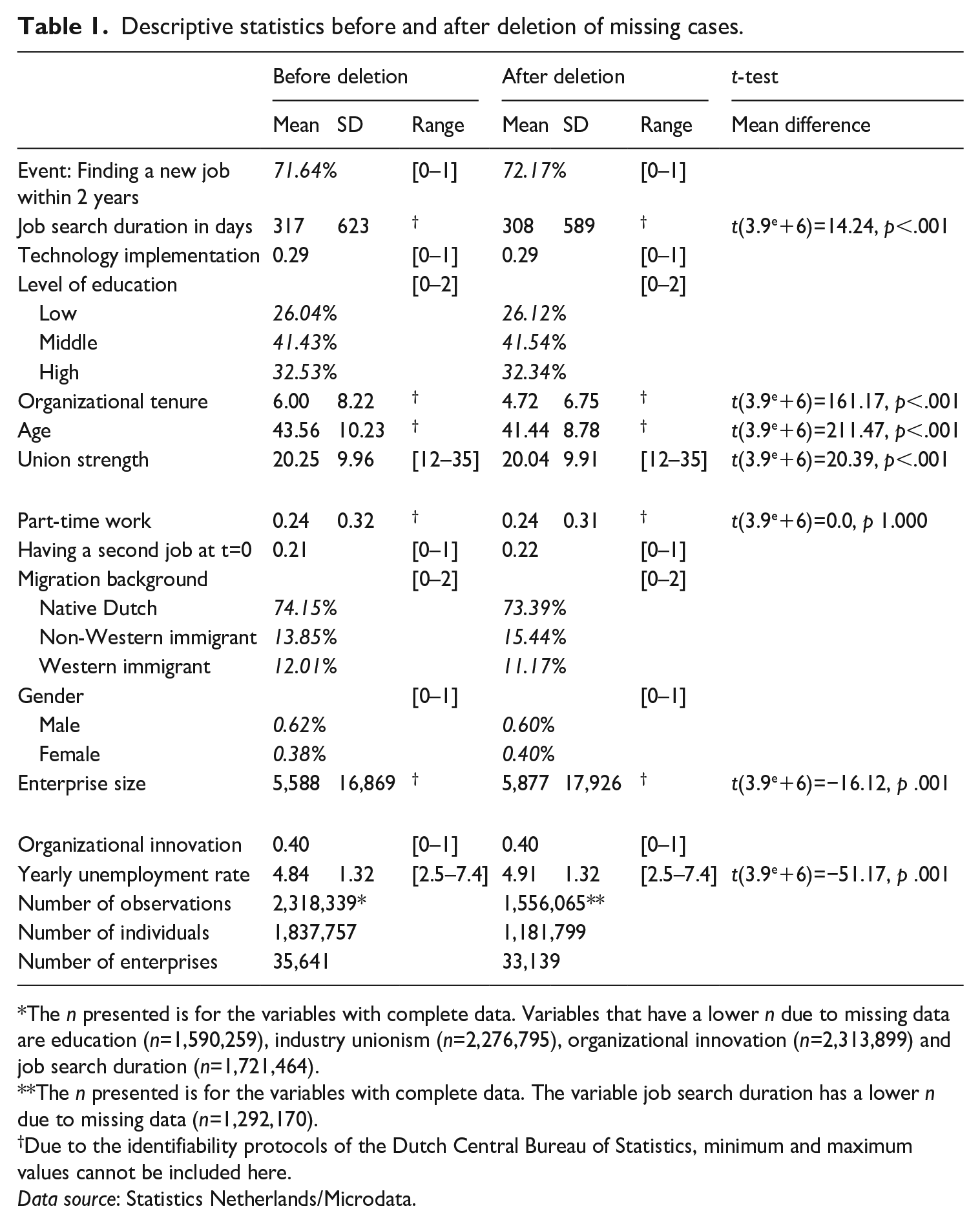
The n presented is for the variables with complete data. Variables that have a lower n due to missing data are education (n=1,590,259), industry unionism (n=2,276,795), organizational innovation (n=2,313,899) and job search duration (n=1,721,464).
The n presented is for the variables with complete data. The variable job search duration has a lower n due to missing data (n=1,292,170).
Due to the identifiability protocols of the Dutch Central Bureau of Statistics, minimum and maximum values cannot be included here.
Data source: Statistics Netherlands/Microdata.
Measurement
Dependent variable
Finding a new job is measured as the point in time at which a person whose contractual employment relation with an enterprise ended enters a new contractual employment relation with a new employer. Having information about the beginning and end of employment relations between individuals and enterprises of all workers from the register data we can reliably document beginnings and endings of workers’ jobs.
Independent variables
Implementation of technology was measured using an item from the Community Innovation Survey. A high-level manager in the enterprise was asked whether, over the past two to three years (depending on the survey date), the enterprise purchased advanced machinery, equipment (including computer hardware) and/or software with the goal to significantly improve products, services and/or production processes. Out of the 1,529,334 observations of job ending, 451,110 (29.50%) occurred in an enterprise implementing new technologies.
Union density is measured as the percentage of unionized employees among the total number of employees who carried out paid work for at least 12 hours per week within an industry (Statistics Netherlands, 2012). Within the Netherlands union bargaining results in collective agreements that cover both members and non-members. Union membership, however, is a key determinant of the bargaining power that unions have to shape such collective agreements (Mundlak, 2020).
Controls
Level of education is measured according to the International Standard Classification of Education (ISCED). Eight educational levels are distinguished. We recoded the levels into three broad categories following guidelines from the ISCED 2011 manual (OECD/Eurostat/UNESCO Institute for Statistics, 2015).
Organizational tenure is measured as the number of years the worker worked for the enterprise when the job ended. The average number of years worked within the enterprise is 4.8 years. For the analyses we mean centre the variable.
Age is measured in years since birth. The average age of workers over the years of observation is 41.5 years old. For the analyses we mean centre the variable.
Part-time work refers to the job that ended and is measured as jobs that are less than one full-time equivalent (35 hours per week or more). The Netherlands is among the countries with the highest rates of part-time employment in the world. In 2014 over 38% of employment was part-time (OECD, 2024c).
Second job at t=0. Some of the observed job endings occur while workers hold other jobs at another organization. Since job search duration is likely to depend on whether a worker is unemployed or has other jobs, we control for having a second job.
Migration background is measured using information on the birthplace of a person and the birthplace of the parents. Following the categorization of Statistics Netherlands, we define as native those who are born in the Netherlands and whose parents are also born in the Netherlands. The category workers with a non-Western immigrant background include those workers who were born in a non-Western country, or whose mother or father was born in a non-Western country. Non-Western countries are, according to the Statistics Netherlands definition, those in Asia, Africa and Latin America and Turkey. Workers with backgrounds in Indonesia (due to the colonial population of the former Dutch Indies) and Japan are categorized as Western. As are workers with backgrounds in Europe, North America and Oceania.
Gender is taken from municipal register data.
Enterprise size. We control for enterprise size to account for differences in job search durations that may differ for workers who leave larger organizations compared to workers leaving smaller organizations. Because the distribution of enterprise size is strongly right skewed, we use the log of enterprise size in the analyses.
We control for organizational innovations to capture non-technological changes in the organization of the enterprise that may lead to job ending and subsequent job searches (Bauer and Bender, 2004). The CIS survey measure indicates whether over the past two to three years the organization introduced new business procedures, new methods for the organization of professional responsibilities and decision making, or new methods to organize external relations with other companies or institutes.
Finally, we control for unemployment rate in all models to capture labour market fluctuation, measured as the national yearly unemployment rate of the Netherlands. On average, the unemployment rate was 4.92% over the period 2001–2014.
Analytical approach
We estimated Cox proportional hazards models with cluster-robust standard errors (at the enterprise level) to test the relation between technological change and the probability of starting a new job at a new enterprise. 4 Cox proportional hazard models have two major advantages over other statistical procedures. First, they allow us to correct for the time dependency of the event of study. In this case, we correct for the fact that over time, the chances of re-employment decrease, as re-employment is more likely right after job separation and decreases over time. Second, the procedure allows for valid statistical testing when there is censoring in the data (DellaVigna and Paserman, 2005; Hosmer et al., 2011; Klein and Moeschberger, 2003). In our case censoring refers to the cases who do not find a new job by the end of the observation period. We right censored the data at 730 days (two years after the observation period ends) because we have data until two years after the final survey year (2014). The final observation day is 30 December 2016. Out of the total of 1,556,065 cases of job ending observed in the study, 1,121,893 events of re-employment were observed (72.10%) within the observation period of two years. In 170,277 cases (10.94%) re-employment took place after the two-year observation period. In 263,895 cases (16.96%), we did not observe re-employment within the data.
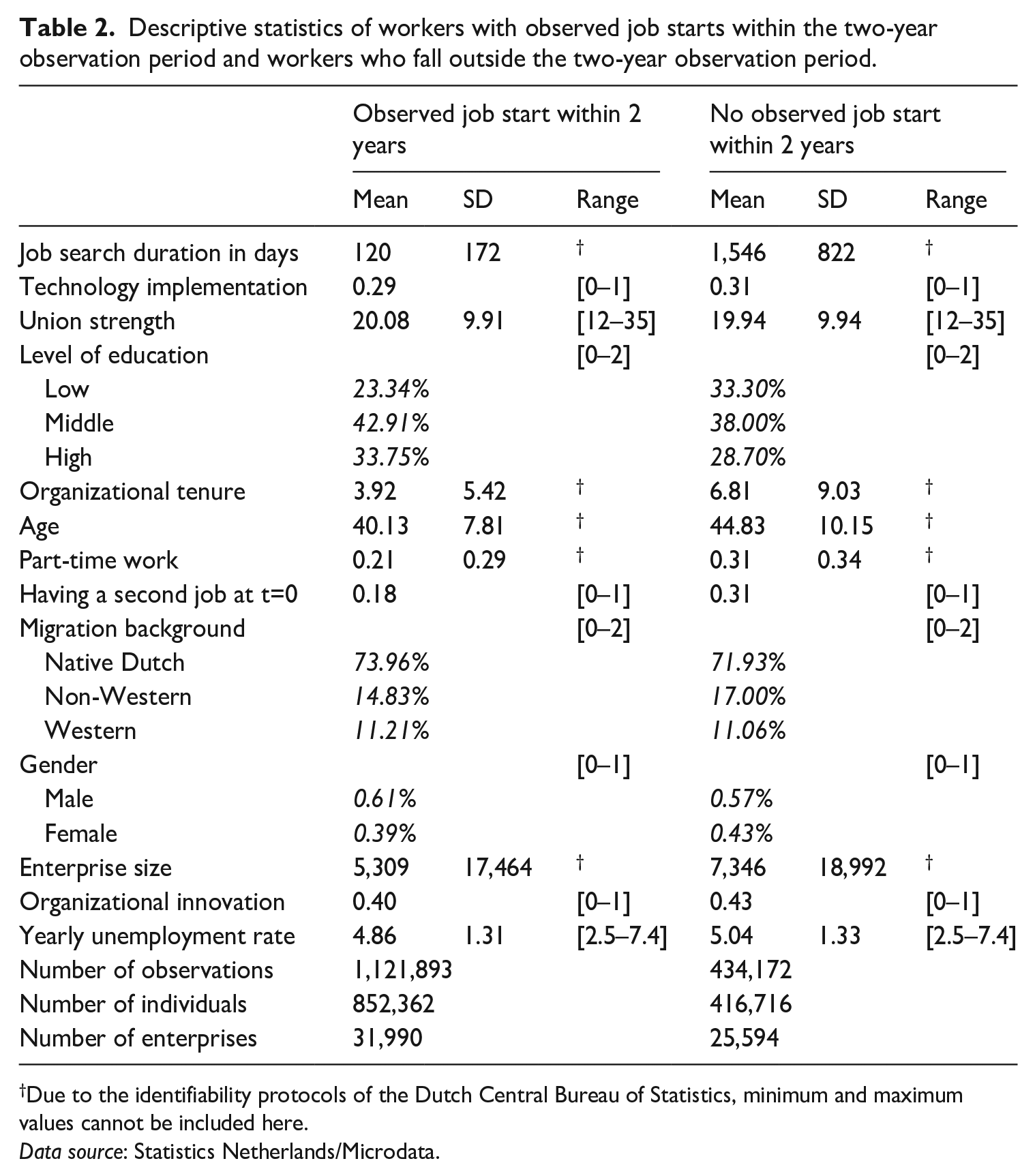
Some workers already have a second job when we observe job ending. Out of the 434,172 cases of job ending for which we do not observe an event of re-employment within two years, 30.84% of the cases (133,887) were observed in combination with this person having a second job, which likely decreases the chances of these people looking for a job. Moreover, in 10.90% (47,328) of cases the second job had started within the month prior to the observed job ending, which likely means this person had already started a new job before the old one ended. Table 2 provides descriptive statistics of the observations for which we do and do not observe the event of re-employment within two years. It shows that workers who were not observed to be re-employed within two years are more likely to be lower educated, longer tenured, older, part-time workers, compared to workers for who we observe job starts within the two-year observation period. This may be expected, as workers who quit the workforce are more likely to be older workers (who are also more likely to be lower educated and to have long organizational tenure) and part-time workers. 5 We followed the methodological literature’s advice not to use the sampling weights of CIS as they are primarily a function of enterprise size, which is included in our regression model as a variable. In such cases unweighted estimates are preferred because they are unbiased, consistent, and have smaller standard errors than weighted estimates (see Winship and Radbill, 1994).
Descriptive statistics of workers with observed job starts within the two-year observation period and workers who fall outside the two-year observation period.
Due to the identifiability protocols of the Dutch Central Bureau of Statistics, minimum and maximum values cannot be included here.
Data source: Statistics Netherlands/Microdata.
Controlling for compositional effects
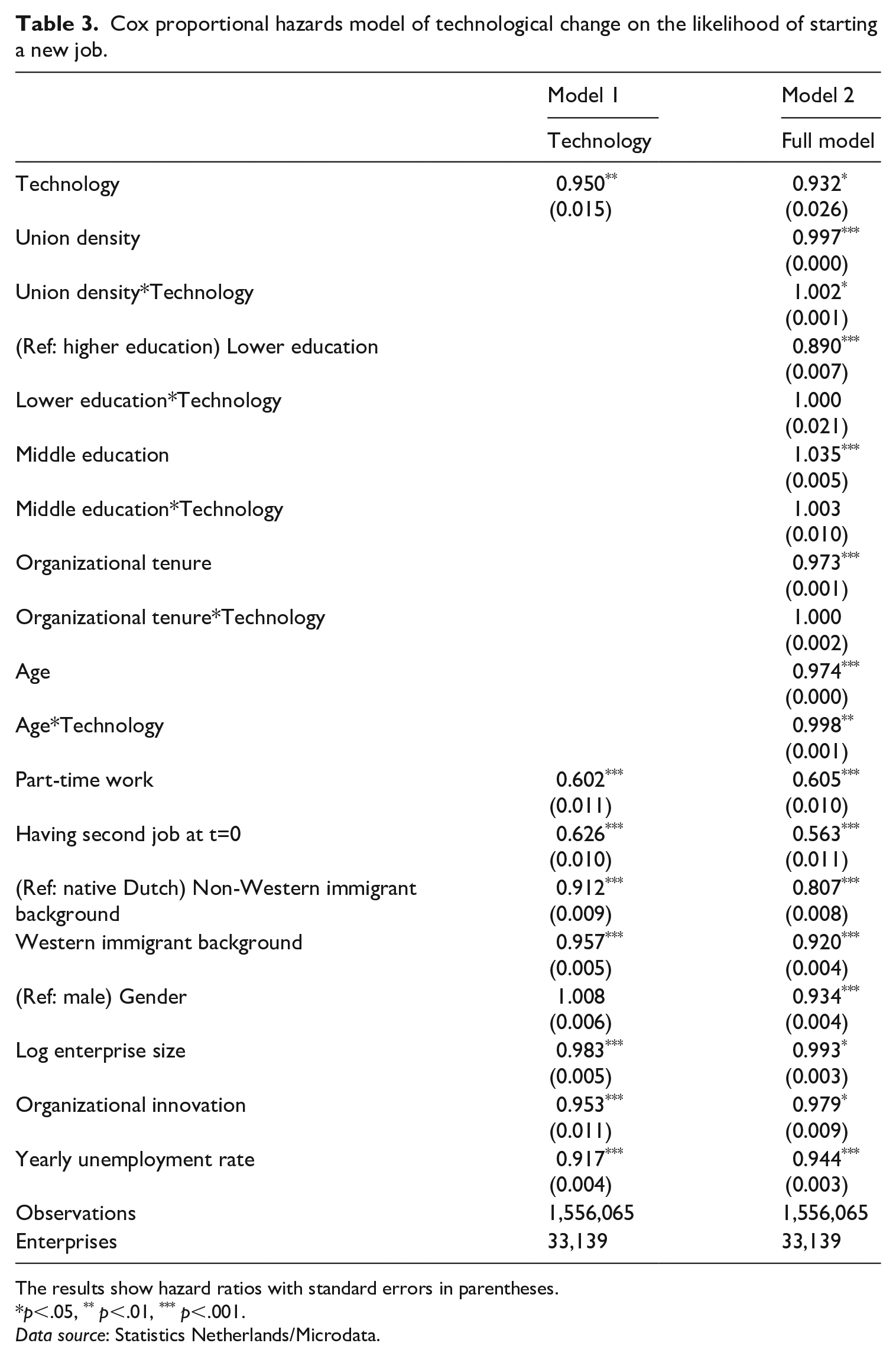
In our first model (Table 3) we test the effect of technological change on the likelihood of finding a job. In the second model we test the moderating effect of unionization while including as controls education, tenure and age, and their interaction effects with technological change. We include additional interaction controls as earlier research established heterogeneous effects of technological change on employability of workers by indicators of human capital and adaptability. Workers with greater general human capital, proxied as education, are found to be better able to adapt to and accommodate technological changes (Haapanala et al., 2023; Ten Berge et al., 2020). At the same time, higher (firm) specific human capital (captured with tenure) and lower technological adaptability (captured with worker’s age) by new technologies has been related to a relative decrease in employability of workers and older workers (Bessen et al., 2019; Ten Berge et al., 2020).
Cox proportional hazards model of technological change on the likelihood of starting a new job.
The results show hazard ratios with standard errors in parentheses.
p<.05, ** p<.01, *** p<.001.
Data source: Statistics Netherlands/Microdata.
The composition of workers also differs between high and low union density industries. Union dense industries, such as manufacturing and industry, generally employ more lower educated workers who tend to have longer employment relations. In order to study the role that unions play, compositional effects should therefore be taken into account (Card, 2001; Western and Rosenfeld, 2011). Including education, organizational tenure and age of workers, as well as interaction effects with firm technology implementation, we account for selection biases originating from compositional differences between industries. This full model provides a more reliable test of differences by union density than the bivariate model without controls.
Results
Model 1 in Table 3 provides the Cox proportional hazards regression estimates for the effect of technology implementation on the hazard ratio of re-employment with only controls included. The hazard ratio for technology implementation in model 1 indicates how the ratio of re-employment differs between job endings occurring under technological change relative to job endings occurring when no new technology was implemented at the former employer. The effect is lower than 1 (HR=0.950**), indicating that the relative rate of re-employment is 5% lower ((0.950-1)*100=5%) when job ending occurs during a period of technology implementation at the former employer. This finding supports our first hypothesis. Estimating the marginal effect of technology implementation, i.e. how the technology implementation impacts the probability of re-employment in absolute as opposed to relative terms, we find that workers leaving an enterprise that is implementing new technologies show an 1.18% decrease in the probability of re-employment.
In model 2 we test whether the effect of technology implementation on job search duration differs depending on industry unionization. We account for compositional effects by controlling for the level of education, organizational tenure and age of workers, and by including the interaction term of these characteristics with technology implementation. 6 While we do not find the hazard of re-employment under technological change to differ depending on education and organizational tenure, we do find technology implementation to decrease the rates of re-employment more strongly for older workers. Turning to the interaction effect between technology and unionization we find a small but statistically significant relation between union strength and the effect of technology implementation.
Figure 1 shows the estimated marginal effects of technology implementation by union density. It shows that, overall, chances of starting a new job are higher in industries with lower union densities compared to industries with high union density. Furthermore, it shows that in industries with a low union density (10%), technology implementation on average is associated with lower chances of starting a new job compared to when enterprises are not implementing new technologies. For example, in the retail and in the business service industry where the average union density is 12%, the predicted chances of starting a new job for workers leaving an enterprise under technological change is 51.53%. Within these industries, for workers leaving an enterprise that is not implementing new technologies the predicted chance of starting a new job is 53.53%, which is 2.00% higher.
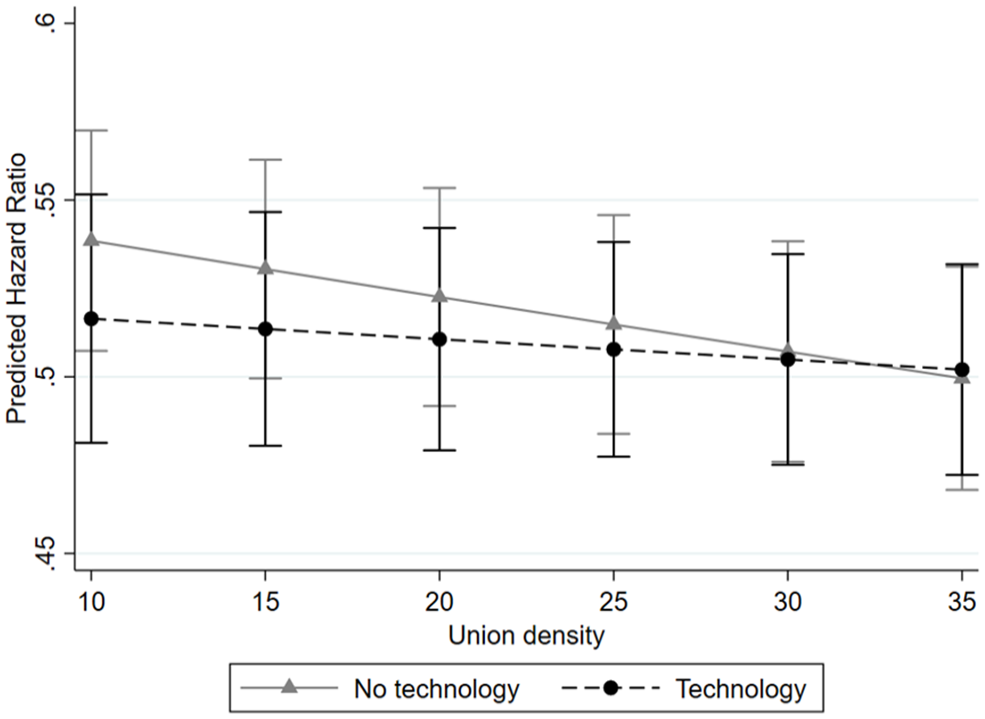
Predictive margins of the relative hazard of starting a new job by industry union density and technology implementation.
In line with our expectations, we find that this negative association between technology implementation and chances of starting a new job is smaller in industries with higher union densities. For example, within energy and water management, where the average union density is 35%, workers’ predicted chances of starting a new job after leaving enterprises implementing and not implementing new technologies are 50.21% and 50.00% respectively. Thus, in an industry with 12% union density, technology implementation is associated with an estimated 1.80% decrease in chances of starting a new job, whereas in an industry with 35% union density technology implementation is associated with an estimated 0.21% increase in chances of starting a new job.
Thus, as union density increases, the expected ‘penalty’ of leaving an enterprise implementing new technologies decreases. This finding supports hypothesis 2.
Conclusion and discussion
We present the first study that investigates how the effect of technological change on the job search duration of workers depends on the strength of unions within industries.
While there are voices that technology implementation leads to employment growth instead of decline (Bessen and Righi, 2019), our findings for individual workers whose jobs do not ‘survive’ the advent of technology lean to somewhat more pessimistic conclusions. We report that finding re-employment after job ending is more difficult when job ending coincided with the implementation of new technology. This finding seems to underscore policy efforts aimed at re-education and work-to-work transitions (European Commission, 2019), which are likely to be especially beneficial to workers with weaker employability following technological advances.
Our main conclusion is that unions partly mitigate the technology penalty on re-employment. This finding seems to indicate that unions play a role in securing resources, such as training and work-to-work transition programmes, that increase the employability and job mobility of workers under technological change. It should be noted, however, that the effect sizes are small, indicating that the role of unions is limited. In part, these small effects of unionism reflect that the duration of job searches depends on a wide variety of factors including the characteristics of workers, organizations, industries and economic conjuncture, as reflected in our analyses. At the same time, at the level of the working population, even small effects can be considered relevant. Furthermore, the small effect sizes should be interpreted in a context of declining union membership and union resources in the Netherlands. While unions are an integral part of the Dutch corporatist model, the bargaining power of unions in the Netherlands has declined since the turn of the century (De Beer and Keune, 2017). Waning union memberships have arguably weakened the legitimacy of unions, undermining workers’ bargaining power (Boeri et al., 2001; De Beer and Keune, 2017; Keune, 2016). Furthermore, member contributions dry out, reducing unions’ capacity to be a meaningful counterforce against employers (De Beer and Berntsen, 2019). Finally, some research indicates that pressured by the argument that firms need to modernize to remain competitive, capital is increasingly able to achieve union compliance with management prerogatives (Rutherford and Frangi, 2021).
Although our study does not analyse aggregate employment outcomes, our findings contribute to our understanding of the institutional embeddedness of technological impact on labour markets. At least in the short term and derived from worker outcomes, unions appear to be able to improve employment prospects of workers affected by technological change. Several authors warn us that new technologies such as AI may only deepen societal inequalities if no measures are being taken to mitigate the employment risks of new technology and to redistribute the wealth it generates (Acemoglu and Johnson, 2024; Autor, 2022; Spencer, 2018). Governments in advanced economies seeking to optimize economic competitiveness (e.g. through incentivizing new technologies) and aiming to reverse rising inequality may best ally with unions to achieve better results. Institutional settings that empower rather than marginalize unions appear to show better returns on social investments (Durazzi and Geyer, 2020). When institutions guarantee union influence, this may open up space to contribute to creative and politically feasible solutions, while defensive attitudes from unions faced with significant trade-offs narrow the spectrum of (constructive) collective actions. Dutch regulation upholds unions and nationwide collective labour agreements by making the agreements applicable regardless of the number, size and membership of participating unions (De Beer, 2016). Our findings seem to suggest that unions, despite their decreasing membership, still play a role in mitigating destructive consequences of technological changes. This effect is likely to be in part attributable to the cooperative nature of the corporatist system in which bargaining takes place. For example, the efforts of training and development funds (O&O), which aim to maintain skill levels within a sector, are the result of consultations between employer and employee representation. The current study seems to underscore maintaining or enforcing this system, even when union memberships wane.
Recent studies highlight that unions can also have countervailing effects that may lead to labour market dualization. A US-based study by Parolin (2021) and a cross-country comparison by Haapanala et al. (2023) suggest that unions’ efforts to maintain the wages and employment of older, higher-wage, skilled workers (‘insiders’) comes at the expense of the industrial employment of young, less educated workers (‘outsiders’) by showing that occupational or industrial exposure to robotization has led to a more substantial decline of industrial employment in more unionized segments. While our study does not aim to address aggregate-level job creation and destruction dynamics, studies that did take this approach pointed out that dualization effects do not necessarily lead to unemployment, as displacement effects can be offset by job generation in other industries, such as services (Dauth et al., 2021). However, for such transitions to be successful, workers need access to education, reskilling programmes or alternative employment opportunities, and unions are argued to play an essential role in ensuring such investments in workers (Durazzi and Geyer, 2020; Haapanala et al., 2023). In addition, it is debatable whether union-induced dualization is to be expected to play a large role in the Dutch context. Dualization is shown to be less prominent when unionization is more encompassing, meaning that union bargaining also benefits non-union members (Doellgast et al., 2018; Haapanala et al., 2023). This coordinated system is prevalent in Nordic, northwestern European countries, and is evidenced in the Netherlands by the relatively large proportion of workers covered by a collective agreement (~79%) compared to the proportion of unionized workers (~17%). Although broad coverage may apply for standard forms of employment, dualization may be pronounced if we are to widen our scope to include non-standard forms of employment (Chung, 2019). The introduction of platform work and the gig-economy has greatly increased non-standard employment as these workers are nearly all categorized as independent contractors. This poses a huge challenge to collective bargaining systems and unions since they are still largely predicated on standard employment relationships (International Labour Organisation, 2016; Jansen and Lehr, 2022; Vandaele, 2018). The protection of workers with standard employment contracts through union bargaining likely incentivizes employers to engage with platform workers to avoid hiring workers as formal employees (Sharma, 2022). At the same time, new forms of worker solidarity and grassroots organizing arise as a response to employers circumventing labour institutions and organized labour (Doellgast and Wagner, 2022; Tassinari and Maccarrone, 2020; Vandaele, 2018). A valuable contribution of future studies would be to contrast our findings with the employment effects of technological change for workers with non-standard forms of employment, possible countervailing effects of unionization and the role of new forms of labour organizing.
To what degree do our findings from the Netherlands generalize to other contexts? We would argue that both collective bargaining systems and national labour policy regimes can matter. In even further decentralized and less coordinated systems, such as the UK (Garnero, 2021), the reliance of local vs higher-level bargaining capacities of unions increases the significance of having unions for outcomes at workplace and worker level. Regarding bargaining systems, our study on the union impact from the coordinated Dutch case captures a theoretical ‘lower limit’ across industrial nations. Regarding national policy regimes, the Dutch (and Nordic) ‘flexicurity’ approach to employment, which encourages the use of activating policies and labour movement (Muffels and Luijkx, 2008), may stir collective bargaining and local bargaining between employers and unions towards transitional arrangements in case of dismissals. In contexts where the use of active labour market policies is less common, e.g. in Mediterranean and Eastern European countries, union bargaining in technology-impacted firms and industries may centre around avoiding dismissals, rather than transitional arrangements. Studies in the field of comparative employment relations emphasize how specific firm and institutional characteristics shape the design, implementation and consequences of technological change (Doellgast and Wagner, 2022). We believe that the current findings warrant studies employing a comparative case study approach common within the comparative employment relations field to study how specific institutional contexts, for example regarding employment protection, shape union bargaining and technology.
A challenge common to studies on the duration of job searches is the possible presence of selection bias (Mueller et al., 2021). In the article we conclude that job ending under technological change increases job search duration among workers. However, from this test it remains unclear whether this effect can be explained by the effect of technology, i.e. technology leads to skill depreciation, or whether there is a selection effect in which individuals who ceteris paribus have longer job searches, for example because their job search skills are lower, happen to be more likely to experience job ending under technological change. In that case, longer job search duration coincides with, but is not caused by technological change. Likely, both explanations are valid to some degree. For the results of the current study this possible selection effect is arguably not very problematic. Our aim was to establish whether the hazards of finding a job differ between workers depending on technology implementation. We did not aim to disentangle the degree to which technology causes longer job searches, for example via skill depreciation, from the degree to which technology is biased to destroying jobs of workers who happen to show longer job searches. Nevertheless, we should be careful in interpreting the relation between technology implementation and the hazards of finding a new job as causal. Our data are cross-sectional, as only a minor share of the firms is observed repeatedly. However, recent efforts directed at developing methods that separate ‘true’ duration dependency from selection effects using longitudinal data (Mueller et al., 2021) may be helpful in separating the two effects in future studies.
In the current study we focused on workers’ job searches. An important avenue for further research is to investigate the quality of the jobs that workers move into under technological change. Reflecting on the discussion on work replacement by technology (Arntz et al., 2016; Frey and Osborne, 2017), some authors indicate the problem is not so much whether people will have work, but rather the risk that technology will force people into labour of poor pay and quality (Autor, 2022; Spencer, 2018). Recent evidence shows that digital technology can both improve and harm job quality depending on how they are used (Berg et al., 2023). Drawing on human-centred design principles, they argue that worker participation at both the innovation and adoption stages is important for securing good job quality outcomes. Considering the findings of the current study, it would be relevant to study the role unions play in advancing such human-centric innovation.
Footnotes
Appendix
Declaration of conflicting interests
The authors declared no potential conflicts of interest with respect to the research, authorship, and/or publication of this article.
Funding
The authors received no financial support for the research, authorship, and/or publication of this article.
