



Abstract
There is an emerging literature focusing on the impact of technological change on work quality. This study contributes to the literature by examining (1) workers’ expectations regarding the effect of technological change on perceived job insecurity, as well as physical and psychological job demands, and (2) how these expectations are shaped by the degree of labor organization within countries. The article uses cross-national data for 25 OECD countries. It is found that labor organization decreases perceived levels of job insecurity related to technological change, but also lowers workers’ expectations of technology improving the quality of their work. These findings may indicate that in environments where technological change is less strongly moderated by organized labor, workers put greater emphasis on technology as a driver of (short-term) work changes. Alternatively, these findings may signal a lack of ‘worker power’ of organized labor to enforce technologies that improve the quality of employment.
Introduction
Technological developments in AI, robotization, and digitization are rapidly changing the way we work, and predictions are that this is only the beginning of a digital revolution (Susskind, 2020). These new technologies bring opportunities to improve the quality of work, for example by replacing repetitive, strenuous, dangerous, or stressful tasks. There are concerns, however, that new technologies can also deteriorate the quality of work, for example by increasing surveillance of workers (Zuboff, 2015), decreasing worker autonomy, lowering job security, and fostering new forms of precarious (platform) work (Berkers et al., 2022; Gallie, 2017; Moore et al., 2018; Van Aerden, 2023).
Workers are thus presented with predictions of impending disruptive technological changes, but also vast uncertainty about the implications of such changes for the future of their work. As a result, people strongly differ in how they expect to be impacted by new technology, as well as how desirable they perceive these changes to be (Dodel and Mesch, 2020). Importantly, workers’ expectations regarding new technology can have profound real-world implications. For example, workers who feel threatened by technology can resist changes, hampering innovation (Lapointe and Rivard, 2005). Furthermore, feelings of anxiety and threat about the impact of technological changes on workers’ livelihoods have been linked to far-right political extremism as well as xenophobia (Milner, 2021).
Consequently, researchers have sought to understand the divergent perceptions and expectations of digitization (Dekker et al., 2017; Dodel and Mesch, 2020; Lim, 2020). These studies show that people’s perceptions of new technology are strongly mediated by the expected personal gains and losses that people see resulting from new technology. From this self-interest hypothesis it follows that workers who are better positioned to reap the benefits of technological change also have more positive expectations of technology. In part, this position is determined by individual characteristics, such as skills, occupation, or the position that someone holds within an organization. Research, however, shows that the institutional environment also plays an important role in determining the position of workers (Doellgast and Wagner, 2022). When workers are more strongly organized, and worker voice is integrated within labor institutions, workers are better positioned to bargain for their interests (Lehndorff et al., 2018; Refslund and Arnholtz, 2022). Strengthening the bargaining position of workers, labor organization can increase the possibilities for workers to shape technological change (Fernandez, 2001; Haipeter, 2020; Lloyd and Payne, 2021a; Martin, 1987; Sandberg et al., 1992), or mitigate negative employment effects (Lloyd and Payne, 2019, 2021b). This arguably increases workers’ trust in new technology. In line with this argument, preliminary research findings show more positive expectations of technological change in environments with stronger labor organization (Dekker et al., 2017).
A shortcoming of previous research on workers’ perceptions on new technology, however, is the focus on job replacement and job loss (Payne et al., 2023). The dominant narrative regarding the effect of technological change concerns job automation, and this is reflected by a focus within the literature on perceptions of job insecurity. Consequently, we know very little of workers’ expectations of new technology and other more qualitative aspects of work such as stressfulness, work pleasure, or work safety. This is remarkable, since a big current labor market challenge concerns the sustainable employability of workers, in which workers’ physical and mental work demands play a key role (Rigó et al., 2021).
The first contribution of the current study is that we expand understanding of workers’ expectations regarding the effects of new technology on the quality of their work by studying both job security and automation, as well as expectations regarding technology’s effect on the psychological and physical demands of workers’ jobs. In doing so, we aim to complement discussions on technological change and work that highlight that technology unequally impacts workers, and importantly, that a large share of this inequality is rooted in qualitative aspects of work, rather than the risk of job loss (Gallie, 2017).
The second aim of the study is to explore the role of organized labor in mitigating workers’ expectations regarding the effect of technological change on the psychological and physical demands of their jobs. While there is some preliminary evidence that labor organization mitigates fear of technology-induced job loss (Dekker et al., 2017), it remains unclear whether such effects also extend to other aspects of work, including the relation between new technology and physical and psychological job demands. Labor organization can enable workers to influence and co-determine the course of technological change (Lloyd and Payne, 2021a; Martin, 1987; Sandberg et al., 1992), and currently unions seek to increase this influence (Doellgast and Wagner, 2022; Haipeter, 2020; Lucio et al., 2021; Visser, 2019). There are, however, concerns about the capacity of labor organization to influence technological change (Hampson and Sandberg, 2022). Declining rates of union membership, decreasing collective agreement coverage (Visser, 2019), and a (technology-enabled) shift in power to managers, employers, and capital (Doellgast and Wagner, 2022; Kristal, 2013) may have impaired labor organizations’ capacity to condition technological change towards the improvement of work quality.
To answer these questions, we make use of the 2020 OECD Risks that Matter survey (OECD, 2023a), which provides information on over 20,000 workers’ expectations on the impact of new technology on work across 25 OECD countries. We combine this survey with data on union density and collective bargaining coverage within countries to address the role of organized labor.
Theoretical background
The introduction of new technologies tends to spark fears of making human workers redundant. In recent times, studies on the labor replacing potential of new technologies have re-ignited such concerns, as multiple authors claim vast segments of jobs are at risk of disappearing (Brynjolfsson and McAffee, 2014; Ford, 2015; Frey and Osborne, 2017; Susskind, 2020). Such predictions are reflected in people’s perceptions of the impact of technology. In a 2017 Eurobarometer survey, 72% of respondents agreed to the statement that robots and AI steal people’s jobs (European Commission, 2017).
A critique of studies gauging the impact of new technology among science and technology studies (Howcroft and Taylor, 2023; Wajcman, 2017), comparative employment relations (Doellgast and Wagner, 2022; Lloyd and Payne, 2019), and sociology of work scholars (Kristal, 2013; Spencer, 2018) is that such approaches overemphasize the role of technology, while failing to sufficiently recognize that technology is a product of its social and political environment (see also Acemoglu and Johnson, 2023; Fleming, 2019). The implication is that to understand how technology impacts employment, we should study the interplay between technology and its socio-economic and political context. In the remainder of this theoretical section, we explore how labor organization – embodied by unions and collective agreements – contributes to a social shaping of workers’ perceptions on the outcomes of technology. In particular, we distinguish between quantitative job risks (job loss) and qualitative job risks (loss of job quality).
Labor organization, technological change, and job loss
An essential strategy for workers to improve their working conditions is to organize. Through organizing, workers strengthen their position to bargain for their interests (Korpi, 2006). As new technology changes the organization of work, technology is subject to bargaining processes. Such bargaining can be about the technology; what technology is developed or acquired. But it is also about how new labor processes are organized, how different parts of the workforce are impacted, and how negative impacts on the workforce are mitigated (Doellgast and Wagner, 2022; Fernandez, 2001; Payne et al., 2023; Vallas, 2006).
How such bargaining plays out depends on how power is distributed (Dauth et al., 2021; Kristal, 2013; Tomaskovic-Devey and Avent-Holt, 2019; Vallas, 2006; Wajcman, 2006). Generally, capitalist logics of accumulation and competition produce hierarchical relations within organizations that incentivize the acquisition of technology that increases productivity, increases managerial control over labor processes, and decreases labor costs (Kristal, 2013; Spencer, 2017). Within this hierarchical organization, the interests of workers and employers often do not align (Thompson and Vincent, 2010). Consequently, how technological changes affect employment depends on how much bargaining power workers have to shape technological change (Doellgast and Wagner, 2022; Spencer, 2018).
Labor organization strengthens the bargaining power of workers. Through institutions that organize workers, such as unions, works councils and collective bargaining, workers can (to varying extent) enforce terms regarding technological change (Doellgast and Wagner, 2022; Fernandez, 2001; Haipeter, 2020; Hampson and Sandberg, 2022; Rutherford and Frangi, 2020). One of the topics that is often central to bargaining regarding technological change is job loss. For example, in a US case study of a plant-retooling Fernandez (2001) describes how union bargaining secured no-layoff guarantees in return for supporting the company’s retraining efforts and agreeing to relax seniority and work rule requirements. Illustrative is that in retooling the plant, management did consider a ‘low-road’ strategy in which redundant workers would be laid off, but pressured by union bargaining opted a ‘high-road’ strategy to retrain and retain workers. Avoiding unemployment resulting from technological change, for example through retraining and reallocation of workers, or help in work-to-work transitions, is often a focus of bargaining by employee representation (Haapanala et al., 2023; Lloyd and Payne, 2021b; Martin, 1987).
As labor organization reduces the likelihood of job loss due to technological change, workers arguably are also less fearful of being made redundant by new technology. Studying workers’ perceptions of workplace robotization in 20 European countries, Dekker et al. (2017) find that workers in countries with higher trade union densities are less fearful of the introduction of robots in the workplace, which they relate to greater protection from harmful decision-making by management. Based on the above we expect:
H1: In countries with higher levels of union density and greater collective bargaining coverage, workers are less likely to expect their jobs to be replaced by new technology.
Labor organization, technological change, and job quality
Technology also brings opportunities and risks for the quality of work. An optimistic view, embodied in the theory of the knowledge-based economy, points to the growing importance of knowledge to production. In this view technology improves the quality of work by replacing dull, repetitive, straining, or dangerous tasks with more creative, interpersonal, and analytical tasks (Van Aerden et al., 2023). While there is evidence of such an effect, scholars have warned of a polarization in which higher educated workers reap the benefits of work improvements due to technology (Acemoglu and Autor, 2011; Kristal, 2013), while the replacement of repetitive work tasks pushes middle wage workers into low skilled service occupations of poor quality (Acemoglu and Autor, 2011; Fleming, 2019; Goos and Manning, 2007). Furthermore, new technologies have been predicted to open new ways of monitoring workers and increasing managerial power and control over labor processes (Kristal, 2013; Moore et al., 2018; Spencer, 2018; Van Aerden et al., 2023). Surveillance technologies bring new opportunities for work intensification by controlling and fine-tuning workflows, and by surveying and sanctioning individual performance (Gallie, 2017; Zuboff, 2015).
How and to what degree labor organization can mediate the risks and opportunities of technologies for the quality of work is unclear. The way new technology is implemented by organizations and accordingly, perceived by people, depends on how technology is embedded within a wide range of institutional arrangements that differ across countries. In other words, one could argue that markets and organizations always operate within so-called ‘fields’, that consist of national institutions and actors (Fligstein, 2001). This institutional setting is the result of historical developments within these countries and consists of different (active and passive) social security arrangements, employment relations, as well as industrial relations systems, such as the domestic role of social partners (Doellgast and Wagner, 2022). Regarding the latter, trade unions have the power to call for strikes and/or influence over policy reforms at a national and company level. Shifting our attention towards new technology, the specific institutional setting may moderate the implementation and perceived outcomes. In this way, several authors argue that the consequences of new technology for employment are simply not that predictable and less clear-cut, because it highly depends on the specific institutional context (Acemoglu and Johnson, 2023; Autor, 2022; Fleming, 2019). Following this line of reasoning, two hypotheses are formulated.
First, from power resources theory (Korpi, 2006; see also Dekker and Koster, 2018), one could argue that collective worker power, which relates to trade union activity, works councils, and collective wage bargaining, fuels the perceived positive outcomes regarding new technology. In other words, worker voice is positively related to positive outcomes from new technology, because it highlights the interests of workers (labor), as the extent of worker power counters the possible negative effects. Exploring the relation between organized labor and technological change in Sweden in the post-war period of the 20th century, Martin (1987) describes an evolution of bargain efforts. Initially, bargaining focused on ensuring new jobs for workers displaced by technology. The scope of bargaining was later extended to decisions affecting the pace and composition of technological change and the quality of jobs resulting, to finally include influence on the development of technology itself and thereby co-determining the scope for choice concerning characteristics of jobs resulting from technological change. The increasing attention to work quality is illustrated by the successive widening of its occupational health and safety objectives. Initially confined to protection against physical injury in the narrow sense, the conception gradually expanded to embrace psychological health in broad terms, including not only protection against hazards such as stress and isolation, but also provision of conditions for personal growth through participation and skill development. For example, these efforts resulted in Scandinavian participatory design practices characterized by the inclusion of workers in the development of new technology, and institutional pressure on positive social impact (Hampson and Sandberg, 2022; Sandberg et al., 1992).
Comparative studies provide further evidence that labor organization can indeed mitigate the impact of technological changes on work quality. Lloyd and Payne (2021a) compare the use of industrial robots in the food and drink processing sector in Norway and the UK and find union power at the workplace and national level to relate to improved outcomes for workers. The Norwegian unions’ strategic approach hinges on plant competitiveness and productivity, a fair share of profit for labor, and training existing workers to operate new technology. They find that unions have a say in the selection of technology and its implementation. And while they do not find union representatives to be systematically included in job design decisions, they do find examples of their involvement, as they confirm unions to have pushed management to remove repetitive and dangerous tasks in all Norwegian case studies. The incorporation of organized labor in decision-making is furthermore shown to impact discourses around technological change more broadly. Comparing national discourses on the digital future of work, based on newspaper articles between 2013 and 2019 (public discourse), and documents from social partners (elite discourse), Marenco and Seidl (2021) state that technological change is talked and thought about very differently in different countries. The discourse on technological change is most positive in Sweden and Germany, while in Ireland and the UK technological change is perceived more negatively. Interpreting this result, they argue that in corporatist institutional environments in which policymaking is more collaborative and involves a stronger level of labor organization, technological change is more often framed as an opportunity, and discourses emphasize the need for investments that help workers and companies thrive in the digital economy. For example, the German union strategy project ‘Work 2020’ aims to strengthen the works councils’ position. By recruiting new members, activating works councils to engage with management, and increasing participation to foster democratic legitimacy in negotiations, they seek greater co-determination rather than obstruction of new technology (Haipeter, 2020). In contrast, for the UK Marenco and Seidl refer to unions’ defensive response to the government’s unilateral approach, which did not involve them in drafting the UK’s digital industrial strategy. This unilateral approach contributed to a large discrepancy between a positive discourse by the government and a much more negative discourse among the public. All in all, in countries with a stronger level of labor organization, there tends to be more collaborative policymaking and more constructive narratives regarding new technology – nationally and at the workplace (e.g. Garnero, 2021; Marenco and Seidl, 2021).
Concluding, it can be argued that labor organization strengthens the bargaining power of workers, pushing employers towards technological innovation strategies that – to a greater extent – are supported by employee representation and that take into account the interests of workers. Resultingly, workers in more organized contexts may be more likely to trust and expect new technological developments to lead to improvements in the quality of their work. Based on these arguments, we formulate the following hypothesis:
H2: In countries with higher levels of union density and greater collective bargaining coverage, workers are more likely to expect new technology leads to physically and psychologically less demanding jobs.
In addition, one could also formulate an alternative hypothesis. In an institutional context with a stronger emphasis on employee voice (and public debate), the perceived outcomes of new technology may be less clear-cut. In contrast to the first hypothesis, it can be argued that the direction of new technology remains unclear, because the direction of new technology is subject to societal debate. For example, Acemoglu and Johnson (2023) argue that the future path of technology as well as its outcome remains to be written, because it depends on the ideas and discussions that are rooted within society. Marenco and Seidl’s (2021) analysis shows that country-specific histories and institutional contexts influence what aspects of digitization are emphasized. This ‘varieties of digitalization’ perspective underscores that workplace digitalization does not uniformly create pressures in all national economies (see also Doellgast and Wagner, 2022). Instead, digitization is influenced by institutional power and manifests divergent struggles over particular national practices. For example, they show that in Sweden the response to the rise of gig work focused not so much on the employment status of gig-workers, as was the case in many other countries, but instead on ensuring labor platforms follow Swedish taxation rules and collective agreements. In Germany, the national discourse emphasizes the country’s dominant manufacturing sector. Discussions on industry 4.0 and good work focus on data protection, work time flexibility and retraining. In the UK and Ireland, the discourse focuses on the threat of automation, either as destroying jobs or increasing inequality, and much less about the need for investment in knowledge-based capital.
All in all, it appears that as labor organization is more influential and more institutionally embedded, technological change is indeed more strongly socially moderated. However, the specific goals and contents of such moderation differ between national and local contexts (Doellgast and Wagner, 2022; Eichhorst et al., 2022; Thelen, 2019). While there appears to be a collective and sustained effort within organized labor to address ‘traditional’ risks like job displacement caused by automation (Eurofound, 2021), it is more ambiguous whether organized labor unequivocally (and successfully) pushes more qualitative aspects of work in bargaining on digitization (Gautié et al., 2020; Lloyd and Payne, 2021b; Payne et al., 2023).
How does this ambiguity translate to workers’ perceptions on the impact of new technology? Arguably, it simply becomes harder to predict the impact of technology. In liberal contexts where free market principles are upheld, the impact of technology can more linearly be predicted by extrapolating from developments in new technological possibilities that enhance productivity and profit maximization (Spencer, 2018). Labor organizations that institutionalize bargaining add complexity to the social shaping of technology by enforcing the interests of workers, codifying existing work practices and procedures, and limiting management autonomy (in this vein labor organizations are accused of hampering innovation and competitiveness, which is subject to scientific debate; see for example Berton et al., 2021; Wang et al., 2023). Concluding, it can be argued that the impact of organized labor on the relationship between technological change and physical and psychological job demands is ambiguous. Based on this ambiguity, we formulate an alternative hypothesis:
H3: Workers’ perceptions on the impact of new technology on the physical and psychological demands of their jobs do not significantly differ depending on the level of union density and collective bargaining coverage of countries.
Data
The study uses data from the OECD 2020 Risks that Matter (RTM) survey (OECD, 2023a), a cross-country representative sample of over 25,000 people aged 18 to 64 years old in 25 OECD countries. In this survey, respondents are asked about their social and economic circumstances, their attitudes towards public policies and government effectiveness, and the role of digitization and technology in a changing world of work. RTM is implemented online using non-probability samples recruited via the internet and over the phone. Sampling is conducted through quotas, with sex, age group, educational level, income level, and employment status used as the sampling criteria. Quotas for each country are based on OECD data. 1 Probability weights are available to compensate for minor variations in imperfectly filled bins, which are used in our analyses. The target sample is 1,000 respondents per country. To account for possible confounding variables at the country level we add several controls. These are the unemployment rate, the degree of employment protection, the percentage of GDP spent on active labor market policies (LMPs), and the percentage of GDP spent on technology and R&D. Our country level measures are taken from publicly available OECD databases.
In the study we focus on workers’ expectations regarding the effects of technological change on their work. We therefore only include respondents who indicated being employed, excluding 7,628 workers who indicated they were not employed at the time of survey or never had been employed (29.55%). The remaining dataset consists of 18,186 respondents.
Measurements
As our dependent variables we have three dimensions of work quality, namely job security, physical job demands, and psychological job demands. To measure these work quality aspects, we make use of three sub-items within the RTM questionnaire that enquire about the expected impact of technology on a respondent’s job. The main item reads as follows: ‘How likely do you think it is that the following will happen to your job (or job opportunities) over the next five years?’ After which a respondent is asked to assess whether the event is very unlikely, unlikely, likely, very likely, or can’t choose.
Risk of automation is measured by the following sub-item: ‘My job will be replaced by a robot, computer software, an algorithm, or artificial intelligence.’ The average score is 2.08. Out of the 17,328 respondents 33.28% indicate job automation is very unlikely, 34.94% indicate it is unlikely. 22.74% indicate it is likely, and 9.04% indicate it is very likely.
Physical job demands are measured by the following sub-item: ‘Technology will help my job become less dangerous or physically demanding.’ The average score is 2.47. Out of the 16,689 respondents 18.55% indicate it is very unlikely that technology alleviates physical job demands, 29.65% indicate this is unlikely, 37.61% indicate this is likely, and 14.19% indicate this to be very likely.
Psychological job demands are measured by the following sub-item: ‘Technology will help my job become less boring, repetitive, stressful or mentally demanding.’ The average score is 2.54. Out of the 16,768 respondents 14.23% indicate it is very unlikely that technology alleviates physical job demands, 31.40% indicate this is unlikely, 40.56% indicate this is likely, and 13.80% indicate this is very likely.
Our independent variables consist of two country level indicators of labor organization, namely unionization and collective bargaining.
Unionization is measured as the number of workers within a country who are member of a union as a percentage of the total number of workers. The degree of unionization is indicative of the strength and influence unions have (Mundlak, 2020). We make use of the OECD/AIAS ICTWSS database on unions. When available we use the 2020 values. When data for 2020 are missing we replace them with the last year for which the data are available. 2 Despite the fact that union coverage does show minor changes over the years, we consider the values consistent enough over time to use the data in a comparative analysis between countries.
Collective bargaining is measured as the proportion of employees covered by a collective agreement. Data are taken from the OECD/AIAS ICTWSS database. As with our unionization measure, we use the 2020 values when available. When the 2020 data are not available, we use the last year for which the data are available instead. 3 We include collective bargaining coverage as a measure of the strength of labor organization because collective bargaining is an institution that can expand the influence of unions beyond its members. As such, collective agreements are a vehicle to bargain for workers’ interests, even as actual union memberships are low and/or decreasing, such as in the Netherlands, Germany, or Austria (Mundlak, 2020).
Unemployment rate is measured as the number of unemployed people as a percentage of the labor force and is taken from the OECD Unemployment Rate dataset (OECD, 2023b). We control for unemployment rates because unemployment impacts organized labor. For example, higher unemployment can weaken the bargaining position of workers and labor organization, as the supply of workers exceeds demand. However, unions may also buffer against unemployment by protecting workers (Scruggs and Lange, 2001). At the same time, unemployment may be related to perceptions on the impact of technological change. For example, technology can be seen as causing unemployment (McClure, 2018). We control for unemployment rate to control for such possible confounding effects.
Employment protection regular contracts is measured as the strictness of regulation on dismissals. The measure focuses on the procedural and financial costs of dismissal by considering procedural requirements, notice periods and severance pay, unfair dismissal regulations, and enforcement of regulations. The employment protection of temporary contracts is measured as the ease at which fixed-term contracts and temporary work agency contracts can be used in place of regular contracts. The indicators are compiled by OECD relying on statutory laws, collective bargaining agreements, case law, and advice from country experts (OECD, 2024a, 2024b). Because both forms of employment protection are complementary, protection is strongest when both types of protection are present. We therefore add interaction effects. We control for employment regulation because it associates with the level of labor organizing, while also influencing decision-making by employers on digitization strategies (Doellgast and Wagner, 2022).
Public expenditure on labor market policies is measured as the percentage of GDP that flows into labor market programs that help people find jobs or stay employed, such as job search assistance, training programs, and internship or apprenticeship programs (OECD, 2024c). We control for public expenditure because, on the one hand, it is positively associated with labor organization, and on the other hand, relates to how technological change impacts workers. For example, re-skilling can heighten employability under technological change.
Expenditure on R&D as a percentage of GDP is measured using data on financial and human resources devoted to research and experimental development (R&D) complemented with indicators of outputs and potential outcomes of scientific and technological activities, namely patent data, and international trade in R&D-intensive industries (OECD, 2024d). We include this control variable to account for differences in technological advancement and investment between countries, which may be related to how workers perceive the risks and opportunities of technological change. At the same time, labor organization can impact technology adoption. For example, unions may increase wage compression, which has been related to accelerated technological change (Kostøl and Svarstad, 2023).
Level of education is measured within the RTM survey as the self-reported highest level of education attained by a respondent. The nine answer categories are: no formal education; incomplete primary school; complete primary school; incomplete secondary school: technical/vocational type; complete secondary school: technical/vocational type; incomplete secondary: university-preparatory type; complete secondary: university-preparatory type; some university-level education, without degree; university-level education, with degree.
Age is measured as the year of birth from which the respondent’s age is derived.
Type of employment is measured using two items from the RTM survey. The first asks whether a respondent is currently working as an employee or self-employed. The second zooms in on those who answered as employed and asks what type of employment contract someone has. These include three answer categories; employed on a permanent contract, employed on a temporary contract, and employed without a contract.
Gender is measured in the RTM survey asking how a respondent would describe themselves, with three answer categories: male, female, in another way.
Occupation is measured in the RTM survey by enquiring what occupation best described a respondent’s role in their current job. There are 11 answer categories: manager or senior official; professional; technician or associate professional; clerical support workers; service or sales workers; skilled agricultural, forestry or fishery worker; craft or trade worker; plant and machine operator or assembly worker; elementary occupation; other/prefer not to answer; not applicable: never been employed.
Table 1 reports descriptive statistics for the (in)dependent variables, followed by the country-level scores (Table 2) and correlation matrix (Table 3).
Descriptive statistics.

Country level variables by country.

Correlation matrix.

Methodology
Our aim is to analyze to what degree workers’ expectations regarding the effect of technological change on work differ depending on the degree of labor organization within a country. Our data have a two-level hierarchical structure, in which individuals are nested within countries. Therefore, we use multilevel regression analysis to investigate and account for this nested structure of the data. A challenge common to cross-country analyses using multilevel techniques is the low number of countries in the sample. A low n on the country level can lead to deflated standard errors, and therefore type-two errors in which hypotheses are falsely adopted (Bryan and Jenkins, 2013). Relying on simulations Bryan and Jenkins (2013) suggest that 25 is a lower limit for linear models, and 30 for non-linear logit models. With our sample of 25 countries, using non-linear multinomial regressions, we fall below the limit of 30 countries. To remedy the risk of a type-two error, Bryan and Jenkins (2013) suggest supplementing the regression-based modeling with more descriptive analyses of measured country differences. We adopt this strategy. Additionally, we provide supplementary analyses in which we use linear regression, thus reducing the risk of deflated standard errors.
The multinomial multilevel regression central to the article disentangles the variance of the dependent variables into an individual component, and a country level component, allowing us to study how much variation at the individual level can be explained by country level differences. To estimate the proportion of total variance explained by the grouping of observations in countries, we calculate the intraclass correlation coefficient (ICC) using an intercept only model. This intraclass correlation can be interpreted as the expected correlation between two randomly drawn people from the same country. Within the literature there is no consensus about how much level-2 (country level) variation is large enough to indicate that the assumption of independence of level-1 (individual level) observations is violated and multilevel regression techniques are necessary. While no clear cutoff-point exists, some authors suggest that ICC values as small as 0.05 can invalidate hypotheses tests and confidence intervals (Kreft and De Leeuw, 1998), others suggest ICCs of around 0.10 (Hox, 2002). In case ICCs turn out to be small we resolve this issue by estimating more parsimonious OLS regressions with clustered standard errors and contrasting the findings between the two regression analysis techniques.
Results
Looking at the descriptive statistics in Table 1, workers indicate it is relatively unlikely that their jobs will be automated in the coming five years, and relatively more likely that technology will make their jobs less physically and mentally demanding. Furthermore, looking at the standard deviations there appears to be considerable variation in workers’ expectations regarding the impact of technology on their job quality. We start our analysis by investigating how much of this variance can be attributed to differences between countries. Comparing the country level variance with the individual level variance, the ICC of the intercept only model (model 1 in Table 4) shows that 7.1% of the total variation in individuals’ expected likelihood of job automation can be attributed to cross-country differences in expected likelihood of job automation. Looking at the variance components regarding workers’ psychological and physical job demands in model 11 and 21 in respectively Table 5 and 6, these values are 7.1% and 4.9%. Because these ICC values are quite small, questioning the need for multilevel modeling, we also estimate ordinal logistic regressions. Comparing the results from the multilevel ordinal logistic regressions and ordinal logistic regressions (see online Appendix Tables A1–A3), it appears that both types of analysis lead to similar conclusions.
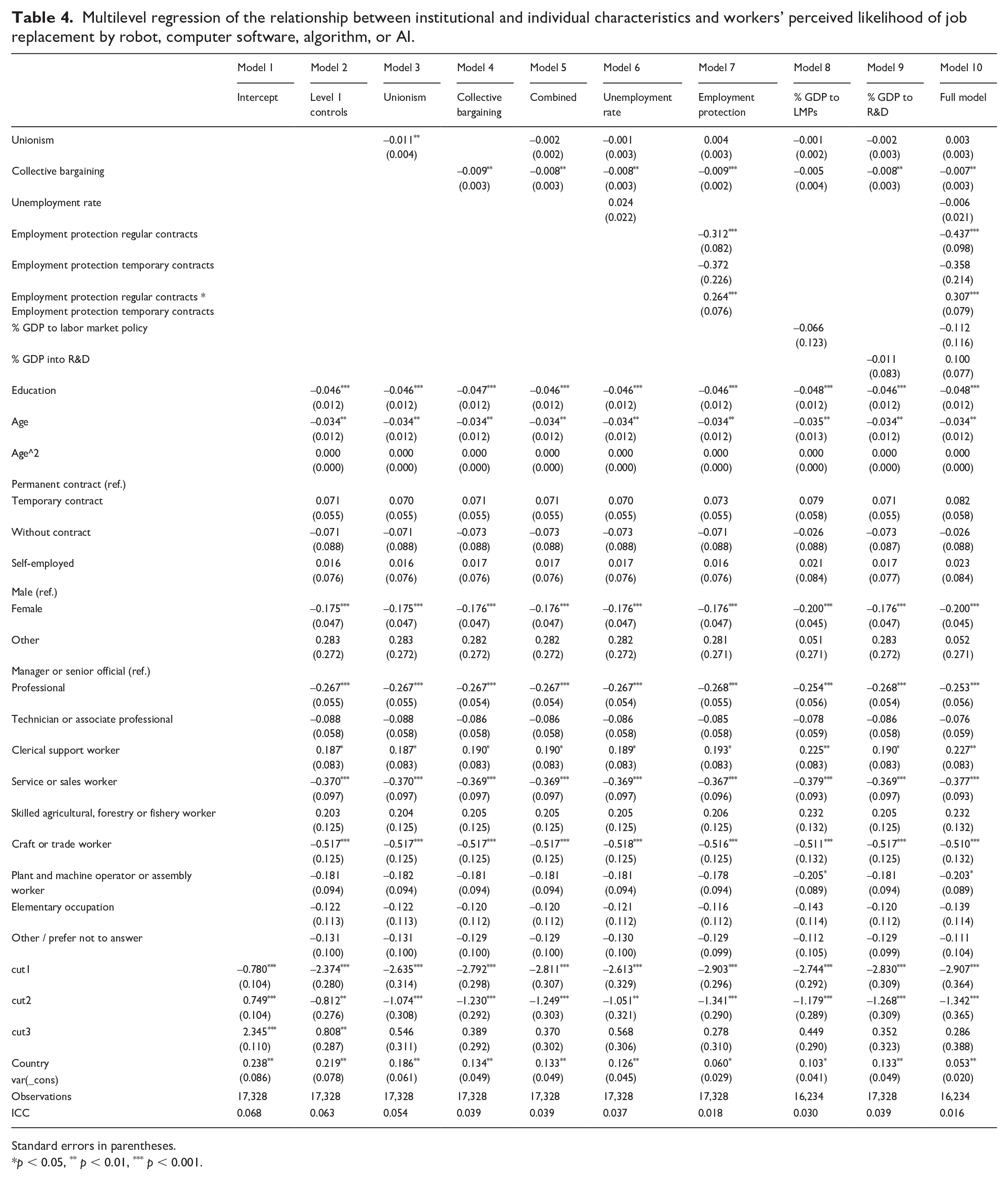
Multilevel regression of the relationship between institutional and individual characteristics and workers’ perceived likelihood of job replacement by robot, computer software, algorithm, or AI.
Standard errors in parentheses.
p < 0.05, ** p < 0.01, *** p < 0.001.
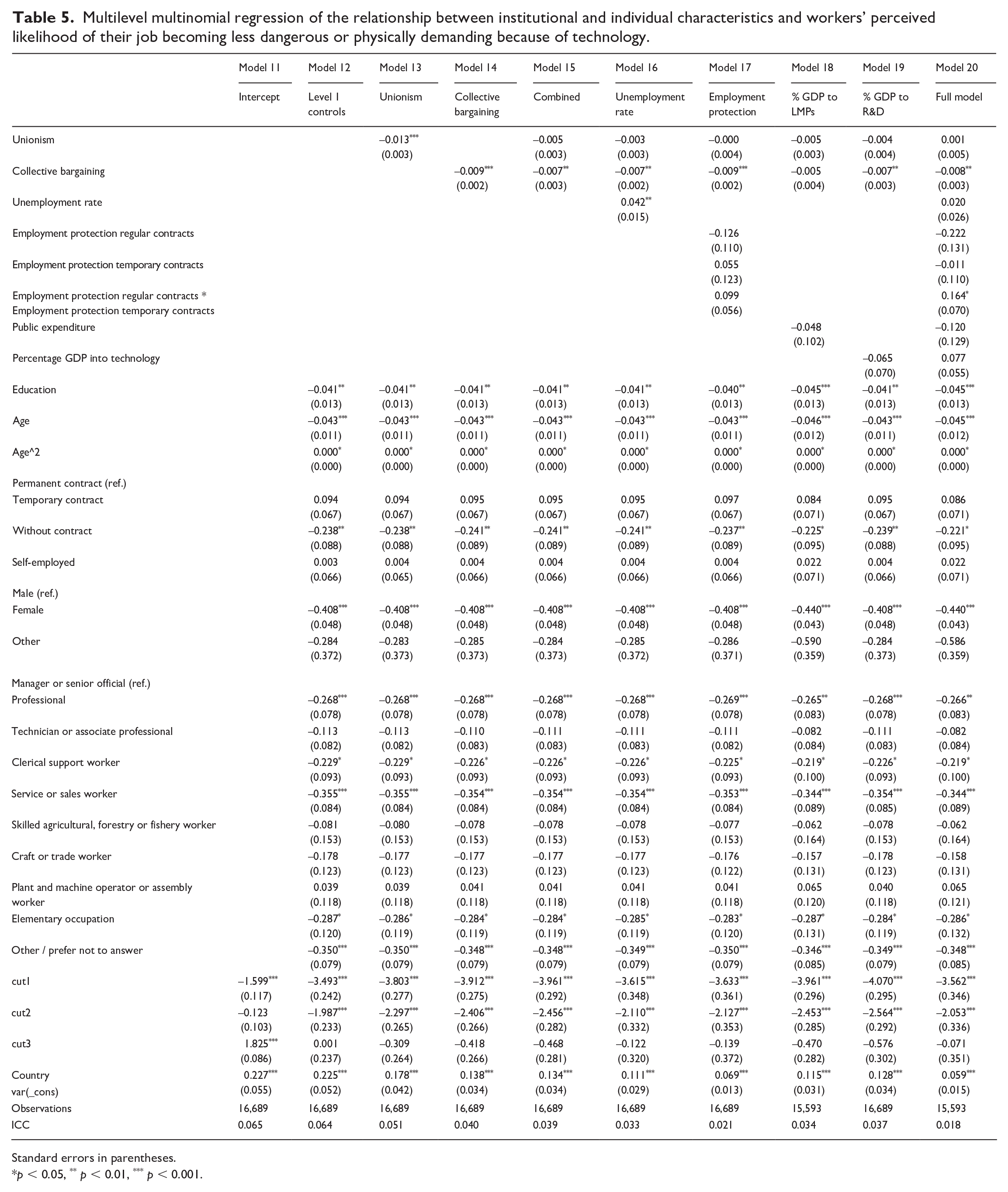
Multilevel multinomial regression of the relationship between institutional and individual characteristics and workers’ perceived likelihood of their job becoming less dangerous or physically demanding because of technology.
Standard errors in parentheses.
p < 0.05, ** p < 0.01, *** p < 0.001.
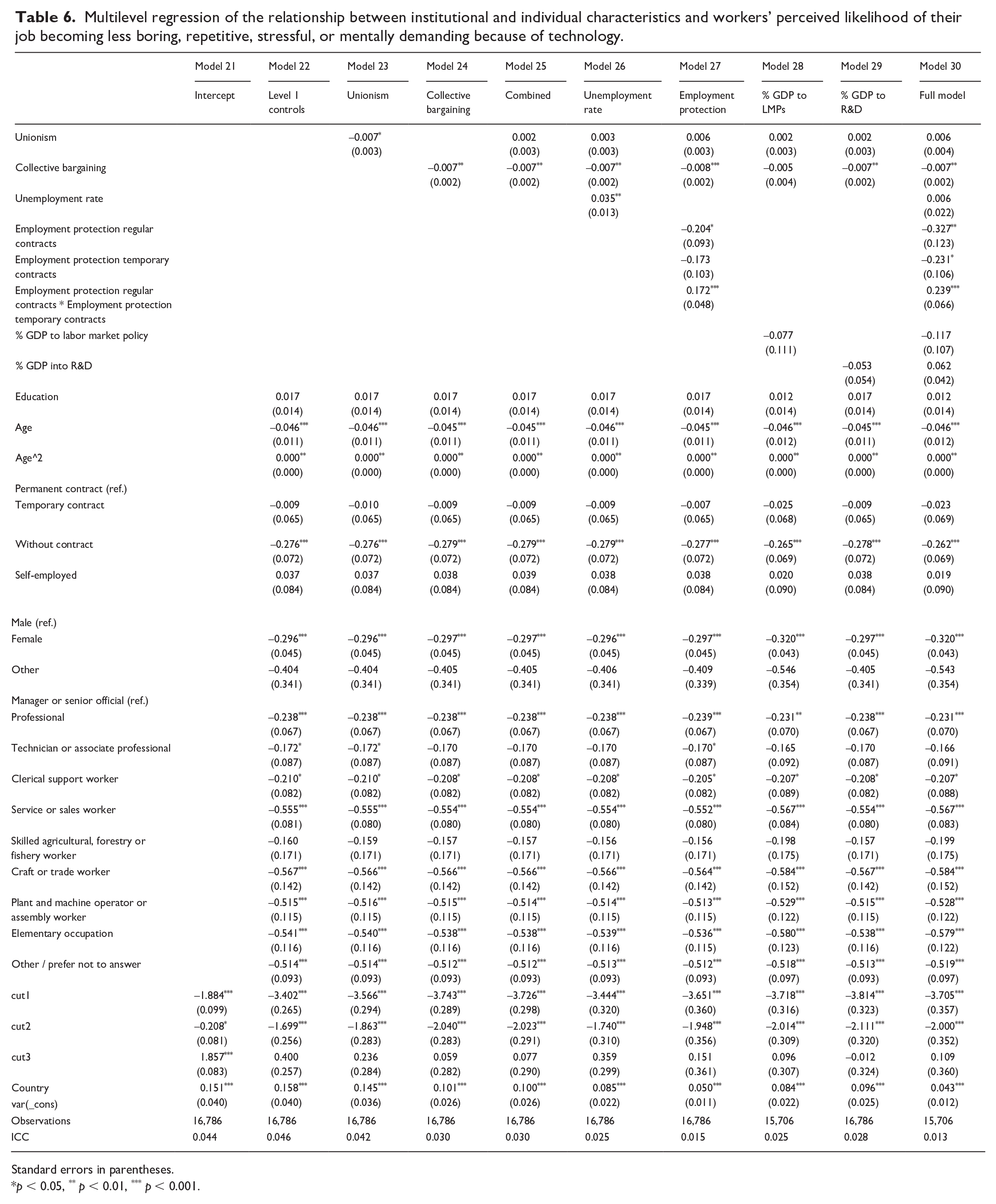
Multilevel regression of the relationship between institutional and individual characteristics and workers’ perceived likelihood of their job becoming less boring, repetitive, stressful, or mentally demanding because of technology.
Standard errors in parentheses.
p < 0.05, ** p < 0.01, *** p < 0.001.
Table 2 shows the average scores per country, and scores for the main dependent and independent variables are presented in Figures 1 and 2. Scanning the scores, we see some indicative patterns emerge. For example, countries where expected job automation is lowest, Austria, Finland, Slovenia, and Norway, are also countries where workers are less expectant of new technology lowering physical and psychological job demands. At the same time, these countries have relatively high rates of unionism and/or collective bargaining coverage. The correlation matrix shown in Table 3 affirms these relationships.
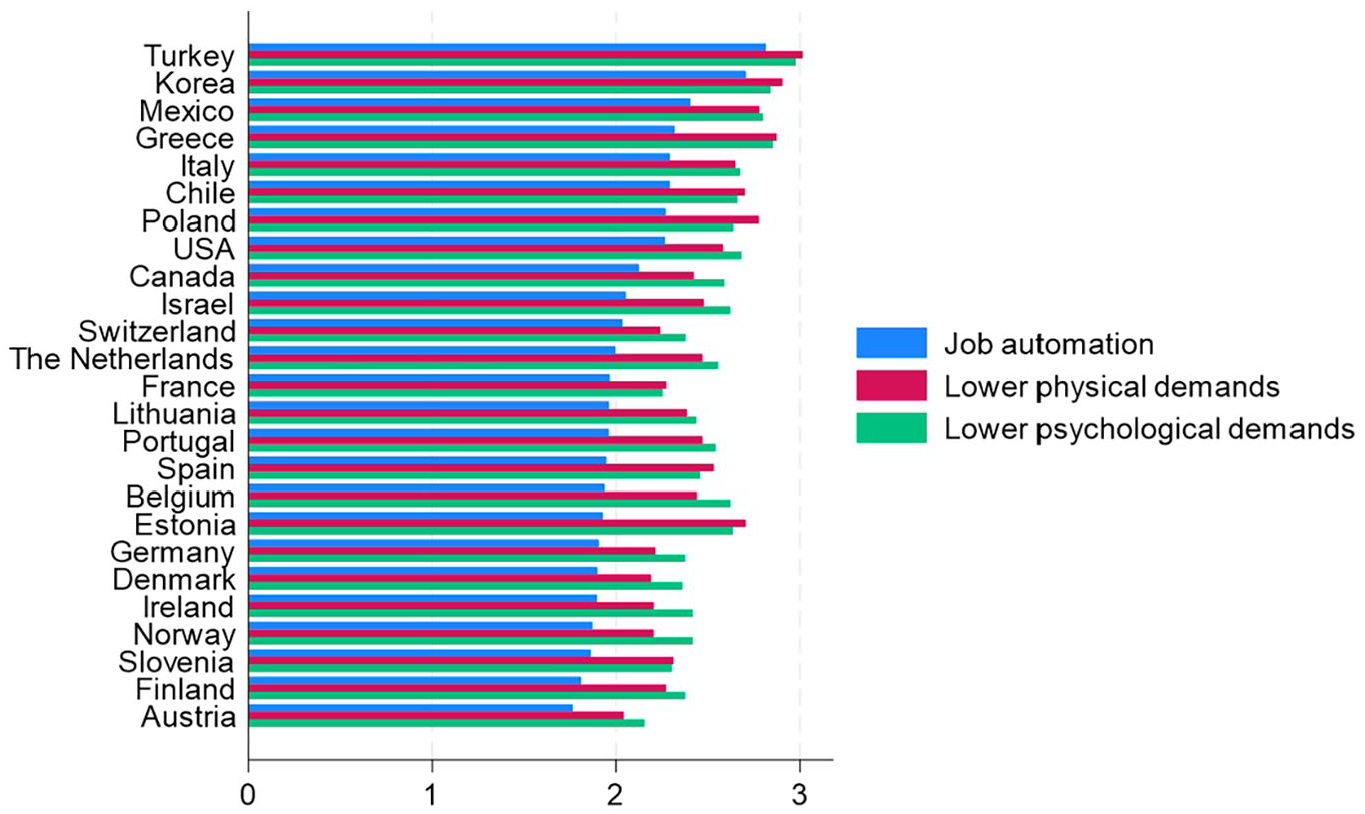
Average scores of dependent variables; estimated likelihood of loss of job or job opportunities, reduced physical, and reduced psychological demands due to technology over the next five years by country.
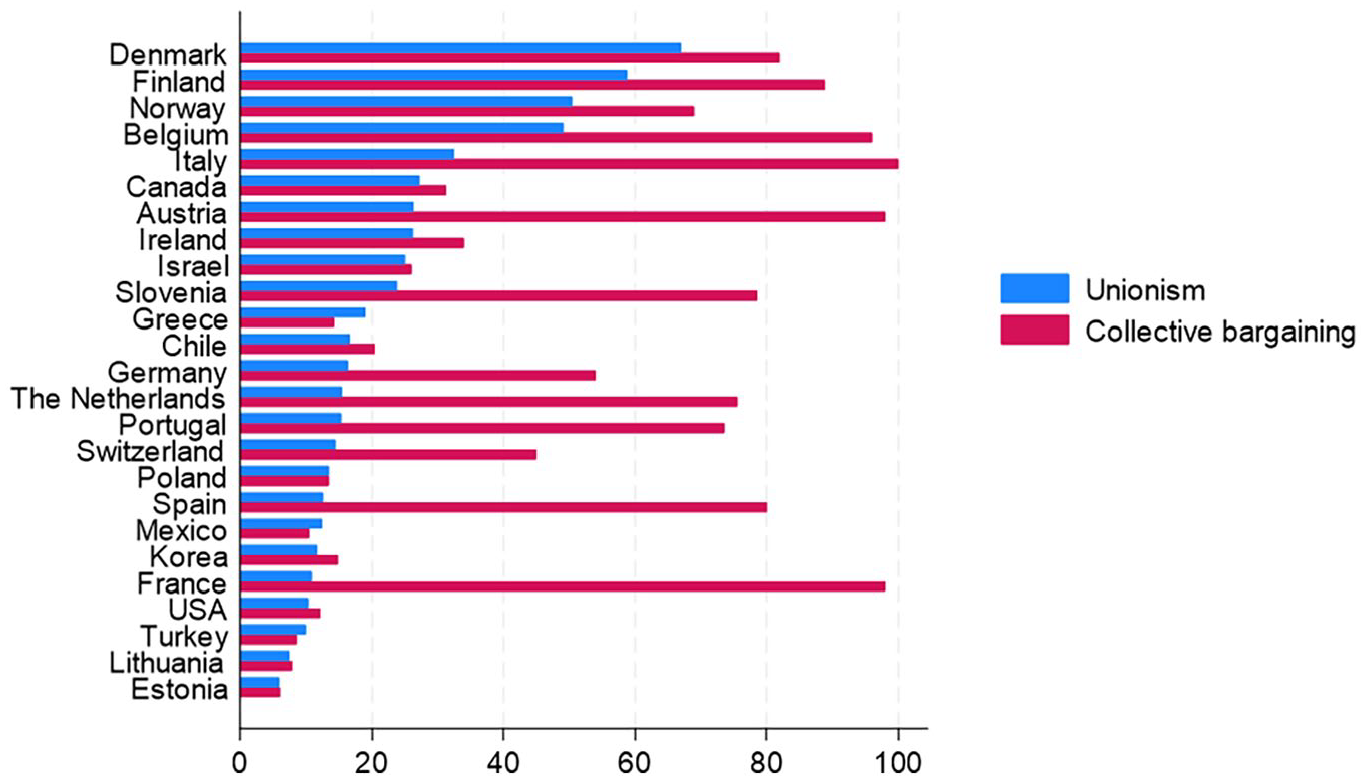
Union density and collective bargaining coverage by country.
Job automation
Testing this relationship, Table 4 shows multilevel ordinal logistic regression estimates of the relation between institutional and individual characteristics and workers’ perceived likelihood of their job (or job opportunities) being replaced by robots, computer software, algorithms, or AI in the next five years. In model 2 we add the individual level control variables. It shows that higher educated, older, and female workers perceive less risk of job automation. Furthermore, compared to managers and senior officials we see that professionals, service and sales workers, and craft and trade workers are less likely to expect job loss due to technology, whereas clerical support workers perceive the most risk from automation.
In models 3 and 4 we add unionism and collective bargaining coverage. We see that both unionism and collective bargaining coverage decrease perceived risk of job automation. However, model 5 shows that when both variables are added, unionism no longer has a statistically significant effect. This finding can in part be attributed to covariance as the two variables are quite highly correlated: 0.54. As demonstrated in Figure 2, higher union membership exclusively associates with high collective bargaining coverage. In contrast, there are instances in which unionism is only moderate, but collective bargaining coverage is high. The theoretical implications are discussed in the discussion section.
In models 6–9 we add the country level controls. We find the negative association between collective bargaining coverage and estimated risk of job loss to not be explained by its associations with unemployment rates and employment protection and the percentage of GDP that goes into R&D. However, including the percentage of GPD going into active labor market policies, collective bargaining is no longer significant. This likely results from the strong correlation between the two variables, which is 0.77. However, testing the full model (10), collective bargaining coverage appears to uniquely explain variation in how workers from different countries perceive the risk of job automation. The findings support hypothesis 1.
To further investigate this relationship, we estimate marginal effects plotted at different degrees of bargaining coverage. The results plotted in Figure 3 show that as collective bargaining coverage increases, the likelihood of workers indicating their jobs and job opportunities to be very unlikely to get automated increases, while the likelihood of workers indicating it to be likely or very likely to see their jobs automated decreases.
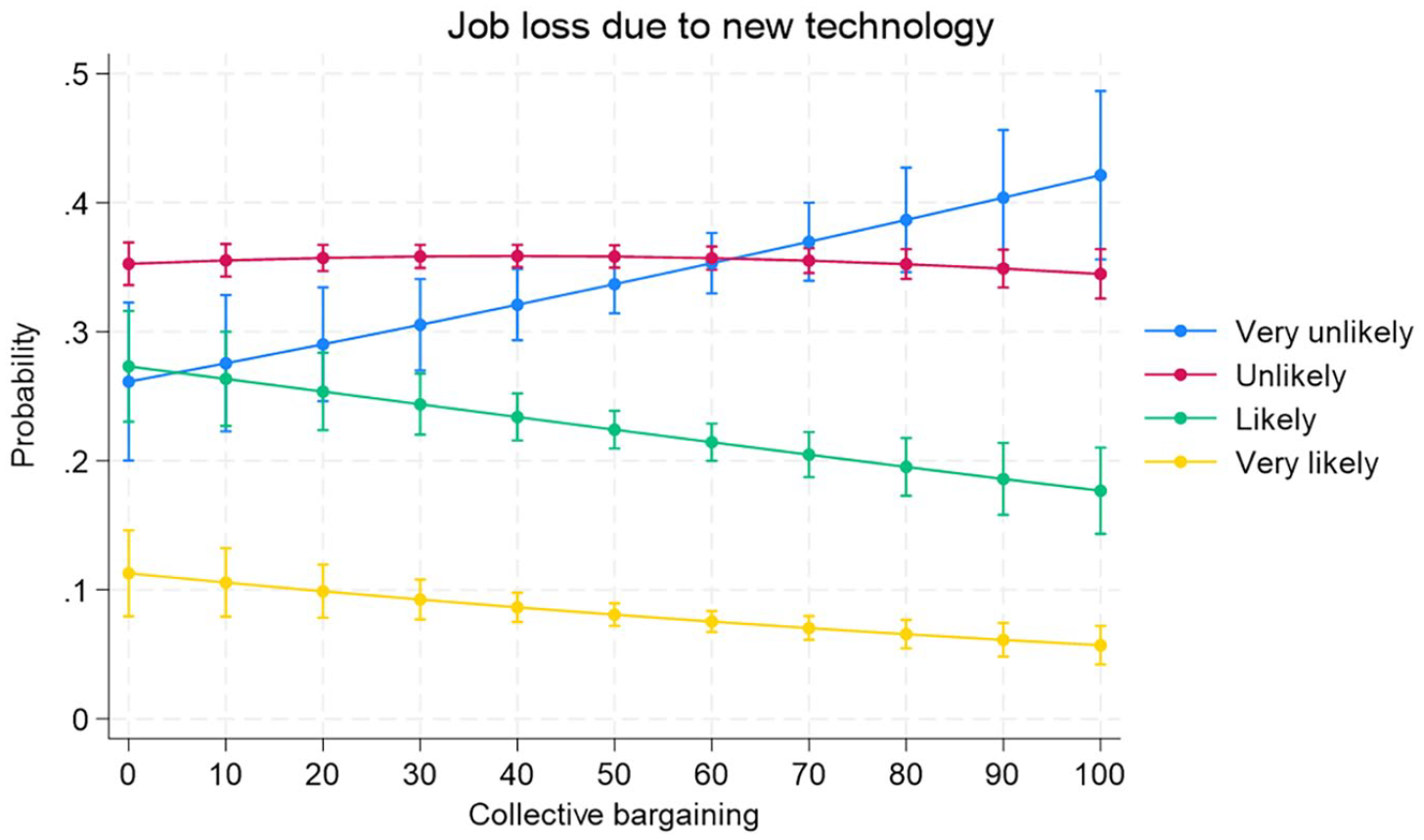
Plotted marginal effects of the perceived likelihood of job loss at different rates of collective bargaining coverage (based on Model 10).
Physical job demands
Table 5 shows the multilevel ordered logistic regression of workers’ perceptions on the likelihood of technology making their job less dangerous or physically demanding. Looking at the individual controls in model 12, we see that generally higher educated, older, female workers and workers without a contract are less likely to expect a decrease in physical job demands due to new technology. Turning to models 13–15, we see similar results to Table 3. Unionism and collective bargaining both negatively associate with workers expecting reductions in physical job demands due to technology, with unionism no longer having a statistically significant effect when both included in the model. Including the country level controls, we find that workers from countries with greater collective bargaining coverage are less likely to expect technology to reduce physical work demands. To illustrate this relationship we estimate marginal effects. Plotted in Figure 4, the results show that as collective bargaining coverage increases, the likelihood of workers indicating it is unlikely or very unlikely that technology will make their jobs less physically demanding increases, while the probability of people indicating that technology will likely or very likely decrease physical job demands drops.
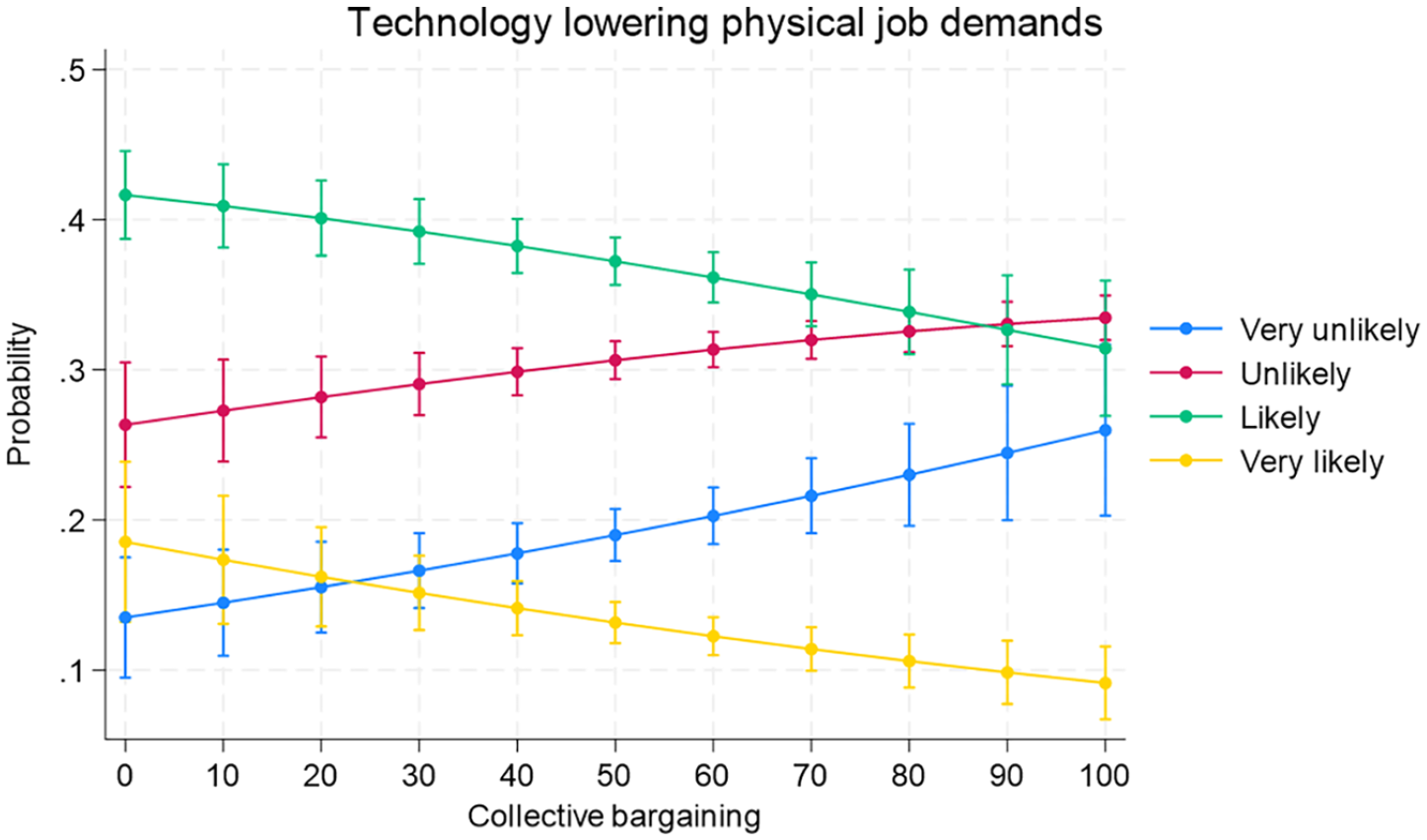
Plotted marginal effects of the perceived likelihood of technology lowering physical job demands at different rates of collective bargaining coverage (based on Model 20).
Psychological job demands
Finally, Table 6 shows the multilevel ordered logistic regression of workers’ perceptions on the likelihood of technology making their job less boring, repetitive, stressful, or mentally demanding. Again, we see older, female workers, and workers without a contract to expect less reduced psychological job demands from technology. Higher educated workers, managers, and senior officials are most likely to expect their jobs to become less psychologically demanding because of new technology. Moving to models 23–25 we find that unionism and collective bargaining both have a negative effect on workers expecting reductions in physical job demands due to technology, with unionism no longer having a statistically significant effect when both are included simultaneously. This relationship remains when controlling for country unemployment rate and employment protection. Moving to model 28, we again find that investments in labor market policies and collective bargaining coverage similarly explain country variance, which may be expected given the strong covariance (see Table 3). Finally, looking at the full model (model 30), we find differences in collective bargaining coverage to uniquely explain variation between countries in expected reductions in psychological job demands due to technology.
To illustrate this relationship, we plot the marginal effects in Figure 5. It shows that as collective bargaining coverage increases, the probability of workers indicating it is likely or very likely that technology decreases psychological job demands decreases. While the probability of workers indicating this is unlikely or very unlikely increases.
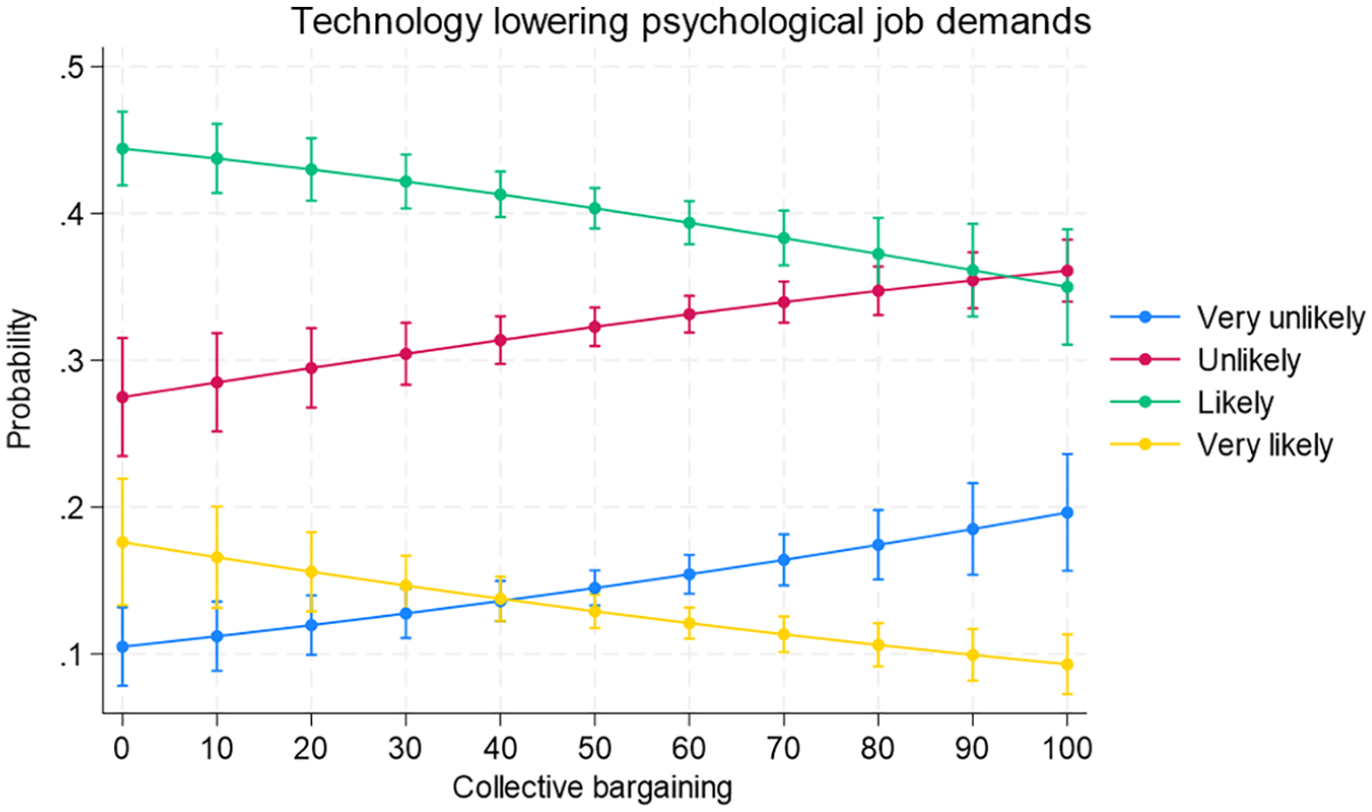
Plotted marginal effects of the perceived likelihood of technology lowering psychological job demands at different rates of collective bargaining coverage (based on Model 30).
In conclusion, based on our findings we do not find labor organizing to increase the likelihood that workers expect significant reductions in the psychological and physical job demands from technology. Instead, we find evidence for the opposite effect. We therefore reject both hypotheses 2 and 3.
Supplementary analyses
There is an ongoing discussion within the literature on the role of labor organization in labor market dualization. This labor market dualization refers to a division between a protected segment, with stable employment, good wages, and benefits typically enjoyed by workers with permanent contracts, and a precarious segment characterized by temporary, part-time, or informal employment with lower wages, fewer benefits, and less job security. Labor organization can strengthen dualization when bargaining primarily promotes the interests of core or member workers at the expense of peripheral or non-organized workers (Haapanala et al., 2023). However, bargaining can also extend to include and benefit peripheral workers, for example by including non-standard work in collective bargaining agreements (Carver and Doellgast, 2021). Because of the potentially dualizing effects of labor organizing, it is possible that the results do not generalize to workers in non-standard employment. We therefore explore the role of dualization by analyzing whether labor organization differently relates to perceptions on the impact of technology depending on the type of contract workers have. The results of this analysis are reported in Table 7. 4 We find some indication of dualization. Self-employed workers in more highly unionized countries appear to be less expectant of technology reducing physical and psychological job demands compared to workers with permanent contracts. However, overall, the differences between workers with varying contracts do not appear to be very pronounced. All in all, it appears that the influence of labor organizing can include peripheral workers (Carver and Doellgast, 2021), and arguably has spillover effects on perceptions on technological change more broadly. This seems to be in line with findings by Marenco and Seidl (2021) that national narratives on technological change differ and are influenced by institutions such as labor organizations.
Multilevel multinomial regression of the relationship between labor organization and the type of work contract, and workers’ perceived likelihood of loss of job or job opportunities, reduced physical, and reduced psychological demands due to technology over the next five years.

Standard errors in parentheses.
p < 0.05, ** p < 0.01, *** p < 0.001.
Conclusion and discussion
This study investigates workers’ expectations regarding the consequences of new technology for different aspects of employment and how these expectations are mitigated by the level of labor organization.
The results show that a substantial share of workers fear job automation, but that an even greater share of workers expect technology to decrease the physical and psychological job demands of their work. Mirroring predictions of substantial job automation (Arntz et al., 2016; Frey and Osborne, 2017), about one third of the workers indicate that it is quite likely that their job will be replaced by new technology. At the same time, about half of all workers indicate that new technology is likely to make their work safer, less physically straining, stressful, repetitive, and less boring. Thus, workers also report a great potential and opportunity in new technology. While this does not invalidate concerns about technological unemployment and labor market polarization (Frey and Osborne, 2017; Goos et al., 2009), these findings call for attention to how we can fully realize this potential to improve work quality in accordance with workers’ expectations.
We find labor organization, and collective agreements in particular, to mitigate workers’ expectations of technology’s impact on work. In countries in which larger shares of workers are covered by collective agreements, workers indicate that it is less likely that their jobs (or job opportunities) are at risk of replacement by new technology. This finding seems to support the argument that labor organization helps secure employment under technological change, thereby decreasing fear of job loss due to new technology (Dekker et al., 2017). Regarding technology and its potential to increase job quality, we find collective bargaining coverage to show a negative relationship with workers expecting new technology to decrease physical and psychological job demands. Thus, we do not find evidence for the argument that workers through unions and collective bargaining have greater means to influence technology towards perceived job quality improvements.
What these results seem to suggest is that workers in institutional environments with more collective agreements being present, generally expect fewer short-term changes because of technological change. The presence of institutions that formalize bargaining between employers and employee representatives appears to temper the perception of technology as an agent of disruptive change. For example, in Turkey and Korea, where the rates of collective bargaining coverage and unionism are among the lowest, the expected disruptiveness of technology, both regarding the risk of job loss and improvements in work quality, are highest. Possibly, the lack of institutions that mediate technological change by subjecting it to a process of bargaining and negotiation, result in workers emphasizing the magnitude and speed at which new technologies can affect their work. In contrast, in Austria and Finland, where unionism and particularly collective bargaining coverage are widespread, workers are among those least expecting short-term job changes from technology. Possibly, processes of bargaining slow down or temper the impact of new technology, which is reflected in workers’ perceptions. Another factor may be that in environments where technological changes are subject to bargaining, workers consider the impact of technology alongside other ways of improving job quality, such as a better organization of work and labor processes, or organizational policies that improve work–life balance. Workers may therefore ascribe relatively less potential for improvements in job quality to technology, putting a greater emphasis on organizational and social policy.
It is also possible that the findings signal workers’ feelings of disenfranchisement. Movements of labor organizing have been established with the aim to enhance workers’ voice to achieve better working conditions. However, the power of organized labor has declined steadily over the last decades (Lehndorff et al., 2018; Payne et al., 2023; Visser, 2019). Furthermore, some research indicates that capital is increasingly able to achieve union compliance with management prerogatives under the guise of increasing firm competitiveness (Rutherford and Frangi, 2021). It is possible that increases in the power of management and shareholders to shape technology to serve their interests has caused workers to meet new technology with greater skepticism and distrust. Our findings show that, except for agricultural, forestry and fishery workers, managers and senior officials are more likely to expect reduced psychological job demands from technology than any other occupation. The finding that technology primarily serves management seems to fit Kristal (2013), who finds computerization to have increased capitalists’ share of national income at the expense of labor’s share. Importantly, she links this decrease in labor’s share to the erosion of worker power by showing that workers’ shares declined only in core unionized industries that saw declines in organized labor, despite the massive flow of computer technologies across all industries. Moreover, she points to computerization as one of the causes of declining worker power through empowering management control over labor processes, increasing worker monitoring, automating unionized blue–collar work, and increasing polarization that reduces worker solidarity. The loss of voice among organized labor may be reflected in more critical attitudes towards technology. For example, Kochan et al. (2019) indicate that voice gaps are more frequent among unionized workers and document growing percentages of workers experiencing voice gap regarding new technology.
We believe it is important to further investigate how labor organizing influences perceptions of technology. Several authors warn us that new technologies such as AI may only deepen societal inequalities if no measures are being taken to redistribute and share the prosperity brought by new technology (Acemoglu and Johnson, 2023; Autor, 2022; Spencer, 2018). The question is what measures, policies, and institutional frameworks are needed to achieve this (Kochan and Kimball, 2019). Arguably, countries with more cooperative institutional environments and more regulated markets are better situated to tackle this challenge than more liberal environments. However, we do not find this reflected in more techno-optimism in the current study. The question is whether this signals the failure of current labor organizing to empower workers, or is an effect of labor organizing de-emphasizing technology, implicitly or explicitly, as the core driver of work improvement. While labor organization appears to shield workers from fears of job automation, it remains a question how labor organizations and institutions can direct and shape technological change in such a way that they are welcomed by workers as drivers of job quality. Such shaping could for example be the advancement of early-onset involvement of workers in the development of technology, which is currently limited (Eurofound, 2021; Kochan and Kimball, 2019; Rutherford and Frangi, 2021).
In this study, we find collective agreements to be associated with workers’ expectations regarding the effect of new technology, but we find no such association for the level of unionization. Without the institutionalization of union bargaining into collective agreements and regulation, the influence of unions on technological change appears to be limited (see also Gautié et al., 2020; Payne et al., 2023). This may on the one hand reflect a decreasing influence of unions related to the steady decline of union memberships and union power (Payne et al., 2023; Visser, 2019). On the other hand, this finding may indicate that union bargaining in the absence of encompassing collective agreements has only limited influence as it more narrowly serves the interests of incumbent union members, often at the expense of less well represented non-union members (Gallie, 2017; Haapanala et al., 2023; Jansen and Lehr, 2022) (although Chung [2019] finds unions to increase subjective employment security among insiders without worsening that of outsiders). A limitation of the current study is that we were not able to investigate the possibility of such dualization, because we do not have information on individual level union membership.
Importantly, it should be acknowledged that our cross-country analysis is broad brush, and is unable to clarify the role of country, sector or organizational specific institutions, discourses, processes, and practices that uniquely shape technological change (Doellgast and Wagner, 2022) and the role of organized labor therein (Payne et al., 2023; Rego, 2022). We contribute to the literature by bringing in the perceptions of workers on the future of work, problematizing current labor organization in empowering workers to shape new technology. However, we agree with Doellgast and Wagner (2022) that comparative (case-study) research on different models of collective voice may be particularly helpful in identifying under which conditions labor organization empowers workers and increases workers’ trust in new technology.
Another limitation that deserves attention is the lack of granularity in our measurement and conceptualization of non-standard employment, and in particular self-employment. The growth of solo self-employment in recent decades is challenging conventional narratives and (statistical) categorizations of employment relations that rely on dichotomies such as employer–employees, and entrepreneurs and precarious workers (Bozzon and Murgia, 2022; Murgia and Pulignano, 2021; Murgia et al., 2020). Solo self-employment is a highly heterogeneous group that includes genuine self-employed, but also growing precariousness in the form of freelancers, as well as bogus or imposed false self-employment, platform workers, and part-time self-employed. Further blurring employment boundaries is a growing group of workers engaged in hybrid work arrangements who hold multiple jobs with varying degrees of (in)dependency (Armano and Murgia, 2017; Bögenhold and Klinglmair, 2017). This heterogeneity is likely reflected in perceptions of new technology. Moreover, the varying precariousness of self-employment will make workers rely differently on institutions and organized labor for mitigating the effects of technological changes. A further complication is that institutional contexts vary greatly with regard to the prevalence and type of self-employment (Hipp et al., 2015), their employment rights, and representation by organized labor (Marino et al., 2018). Efforts are currently being undertaken to arrive at new classifications of solo self-employment (Murgia et al., 2020), for example based on economic and operational dependency (Bozzon and Murgia, 2022). Future research could benefit from employing more contemporary worker classifications, which are likely to more accurately reflect how different groups of self-employed workers perceive new technology and rely on (new forms of) labor organization (Pitts et al., 2023) to mitigate its effects.
Supplemental Material
sj-pdf-1-eid-10.1177_0143831X241265911 – Supplemental material for New technology and workers’ perceived impact on job quality: Does labor organization matter?
Supplemental material, sj-pdf-1-eid-10.1177_0143831X241265911 for New technology and workers’ perceived impact on job quality: Does labor organization matter? by Jannes ten Berge and Fabian Dekker in Economic and Industrial Democracy
Supplemental Material
sj-pdf-2-eid-10.1177_0143831X241265911 – Supplemental material for New technology and workers’ perceived impact on job quality: Does labor organization matter?
Supplemental material, sj-pdf-2-eid-10.1177_0143831X241265911 for New technology and workers’ perceived impact on job quality: Does labor organization matter? by Jannes ten Berge and Fabian Dekker in Economic and Industrial Democracy
Supplemental Material
sj-pdf-3-eid-10.1177_0143831X241265911 – Supplemental material for New technology and workers’ perceived impact on job quality: Does labor organization matter?
Supplemental material, sj-pdf-3-eid-10.1177_0143831X241265911 for New technology and workers’ perceived impact on job quality: Does labor organization matter? by Jannes ten Berge and Fabian Dekker in Economic and Industrial Democracy
Supplemental Material
sj-pdf-4-eid-10.1177_0143831X241265911 – Supplemental material for New technology and workers’ perceived impact on job quality: Does labor organization matter?
Supplemental material, sj-pdf-4-eid-10.1177_0143831X241265911 for New technology and workers’ perceived impact on job quality: Does labor organization matter? by Jannes ten Berge and Fabian Dekker in Economic and Industrial Democracy
Footnotes
Declaration of conflicting interests
The authors declared no potential conflicts of interest with respect to the research, authorship, and/or publication of this article.
Funding
The authors received no financial support for the research, authorship, and/or publication of this article.

Supplemental material
Supplemental material for this article is available online.
Notes
Author biographies
References
Supplementary Material
Please find the following supplemental material available below.
For Open Access articles published under a Creative Commons License, all supplemental material carries the same license as the article it is associated with.
For non-Open Access articles published, all supplemental material carries a non-exclusive license, and permission requests for re-use of supplemental material or any part of supplemental material shall be sent directly to the copyright owner as specified in the copyright notice associated with the article.
