




Abstract
The Federal Vacation Act stipulates a minimum entitlement of four weeks’ vacation, yet the average entitlement in Germany is considerably higher, at approximately 28 days. The present study examines the factors that influence the amount of vacation entitlement at firm level, with a particular focus on the relationship with the dual system of interest representation. The analysis is based on firm data from the IAB-Job Vacancy Survey 2023, with a linear ordinary least square regression being utilised to identify the determinants of the amount of vacation entitlement. Collective bargaining coverage plays a decisive role: On average, firms with collective agreements have 1.3 days more vacation entitlements and firms oriented towards collective agreements have 0.8 days more vacation entitlements than firms that are not bound by collective agreements. Furthermore, a positive correlation is identified between the existence of a works council and vacation entitlements. The ‘works council premium’ is equivalent to 0.8 days. In particular, firms that are not bound by collective agreements benefit from the existence of a works council in the form of more vacation entitlements. In East Germany, the average vacation entitlement is significantly lower than that in West Germany, especially in firms that are not bound by collective agreements. Higher wage levels are associated with greater vacation entitlements; this correlation is less pronounced in firms with collective bargaining agreements. Longer full-time working hours are associated with fewer vacation entitlements, a trend that is more pronounced in firms without a works council. The results show that the dual system of interest representation in Germany is central to the amount of vacation entitlements at firm level and safeguards better working conditions in Germany.
Keywords
Introduction
Research on working time typically tends to focus on daily and weekly hours, with less emphasis placed on vacation entitlements. However, longer breaks from work in the form of vacation are also an important aspect of working time and a crucial factor in the organisation of working time. Maintaining or restoring working capacity and thus ensuring the productivity of employees is the main purpose of paid vacation (Gündel et al., 2014; Speth et al., 2023). Vacations are an important mechanism for improving well-being and recovering from work demands. Occupational health studies have shown that vacation not only contributes to recovery and maintains health, but also strengthens performance and increases life satisfaction (De Bloom et al., 2009, 2013). The creation of optimal working conditions, for example, in the form of generous vacation offers, can also serve as an incentive system that can be advantageous in increasing competition for skilled labour (Freuding et al., 2023). When faced with a choice between ‘fewer working hours’ and ‘more money’, employees largely prefer time relief in the form of more vacation days (Ruf et al., 2024).
The determinants of vacation entitlements are therefore highly important, although they have received little attention in the German context. Previous analyses have focussed primarily on the employee level and addressed the amount of vacation entitlements and, in particular, the underutilisation of vacation. The firm level, however, has been little researched. According to Fakih (2014), workplace- and firm-related factors play a more important role in determining the amount of vacation than sociodemographic characteristics do. In this study, I therefore focus on industrial relations at the firm level. Specifically, I examine the relationships among collective bargaining, codetermination and vacation entitlement levels, which are also conditional on other typically collectively agreed-upon working conditions such as wages and weekly hours. Most employees in Germany work 5 days a week, and the Federal Vacation Act sets the minimum vacation entitlement in Germany at 4 weeks or 20 days of paid annual vacation. This is only the minimum requirement, as the legal framework is supplemented by regulations at the collective bargaining level. As a result, collectively agreed vacation entitlements 1 are significantly greater, amounting to an average of 29.6 working days in 2023 (IAB, 2024), or just under 12% of the collectively agreed-upon or standard annual working time (see also Supplemental Figure A1 in the supplementary material).
When collective voice theory is applied, collective bargaining coverage is likely to be an important positive factor influencing the level of vacation entitlement, as collective agreements significantly improve working conditions (Lübker and Schulten, 2024). For example, collective bargaining coverage is associated with greater vacation entitlements in the UK (Bryan, 2006) and Canada (Fakih, 2014, 2018). However, the findings on vacation days and collective bargaining coverage from other countries cannot simply be transferred to Germany, as the system of industrial relations in Germany differs fundamentally from that in Anglo-Saxon countries (Goerke and Jeworrek, 2021). Works councils are also likely to actively promote the interests of employees and support the implementation of optimal working conditions, for example, protecting employees from discrimination and safeguarding their interests. The analyses available to date focus on institutional factors, such as connections with the existence of a works council or with membership in a trade union (Goerke et al., 2015; Goerke and Jeworrek, 2021). For Germany, it has been shown that union members and employees in firms with a works council tend to have more vacation days and that a works council helps employees make greater use of their vacation entitlements (Goerke and Jeworrek, 2021).
Empirical studies reveal that the existence of a works council affects working conditions, such as wages or employment stability, depending on whether the firm is bound by collective agreements or not (Ellguth and Kohaut, 2021; Grund et al., 2016; Keck and Brussig, 2021). Therefore, the interaction between collective bargaining coverage and works councils is likely to be relevant for vacation regulations. To date, there are no empirical studies in the German context that consider both industrial relations institutions together. This study addresses this research gap by examining the existence of a works council together with a firm’s collective bargaining regime and identifying the relationship with vacation entitlements measured at the firm level.
In addition, these relationships need to be analysed in the context of other important working conditions that are typically covered by collective agreements. For example, weekly working hours are shorter and wages higher in firms with industry-wide agreements (Ellguth and Kohaut, 2021; Kölling, 2022). For this reason, the firm’s wage level and average weekly working hours are also included in the analysis of vacation entitlements, as these are also economically relevant for employees.
Against the background of this state of research, I contribute to the literature in several respects. First, this study takes a firm-level perspective. In contrast, the majority of the existing research focuses on the employee level and here on the underutilisation of vacation entitlements. Second, identifying the determinants of vacation entitlements is crucial, as employee recovery is a key issue for employees, employers and society as a whole. There has been little research on this topic with German data, so this study makes a valuable contribution. Third, the situation in Germany is presented using very recent data from the IAB-Job Vacancy Survey (IAB-JVS) from 2023. This makes it possible to map current trends and practices relating to the average vacation entitlements. Fourth, the different correlations between vacation entitlements depending on the different collective bargaining regimes have not yet been investigated, that is, whether there are differences between firms that are not bound by collective agreements, those that are oriented towards collective agreements or those covered by firm- or industry-wide collective agreements. Fifth, by investigating the interactions between the different collective bargaining regimes and the role of works councils for the first time, I can expand the knowledge in relation to vacation entitlements, which adds further depth to the analysis. These interdependencies between the dual system of interest representation and the average vacation entitlement are also analysed in relation to other working conditions, such as wages and working hours, in the German context.
The study proceeds as follows. The next section summarises the existing empirical evidence, describes the institutional background, and sets out the theoretical reasons why one might expect collective bargaining coverage and codetermination to influence vacation entitlements. This is followed by a section that presents the data and describes the variables. The results are then presented and the robustness analyses carried out are explained. The discussion section concludes the study. The online Supplemental material contains additional information and documents the results of a series of robustness tests presented in the main text.
State of the research
In Germany, almost all previous empirical research is based on employee data from the Socio-Economic Panel (SOEP), which included questions on the amount of vacation entitlement and utilisation of vacation in 1999, 2004, and most recently in 2009. Schnitzlein (2011) used these data to show that, in particular, a higher professional position is associated with greater vacation entitlements. He also examined, as did Saborowski et al. (2004) and Saborowski (2005), the difference between entitlements and vacation days used. They found that the number of vacation days to which an employee is entitled but not taken decreases with age, firm size, and tenure. Young workers and those with higher qualifications, in particular, often do not utilise their vacation entitlements. This is associated with greater career advancement and compensation and is considered an investment in human capital. In addition, these studies examined the effects of unused vacation entitlements on various indicators of subjective well-being. The consequences of incomplete vacation include lower job and life satisfaction (Saborowski et al., 2004), a decline in satisfaction with leisure and health, an increase in sickness absence, and a significant increase in wages (Schnitzlein, 2011).
Goerke et al. (2015) focussed on the effects of an individual’s union membership and showed that it is positively correlated with vacation days taken, which is related primarily to self-selection effects. Furthermore, the number of vacation days taken varied with employees’ age, tenure, firm size, and nationality. Goerke and Jeworrek (2021) examined the relationship between codetermination and paid vacation and showed that the existence of a works council is associated with higher vacation entitlements among employees and that men in particular make more extensive use of their vacation entitlements in firms with a works council.
Freuding et al. (2023) is the only study to descriptively examine the amount of vacation time and other arrangements on the basis of a survey of human resources managers at the firm level. They showed that the average annual vacation entitlement varies only slightly across economic sectors or size classes. Other employer offers, such as unpaid leave, educational leave, sabbaticals, and workcations, are also relatively rare in Germany.
While the literature on the effects and determinants of vacation entitlements and their use is limited for Germany, there is significantly more evidence for the Anglo–Saxon world. The U.S. stands out in the international comparison of paid vacation standards as the only highly developed economy that does not guarantee paid vacation to its employees. Ray and Schmitt (2008) found that a quarter of U.S. workers have no paid vacation during the year. According to empirical research, full-time employees have an average of 14 days of paid vacation after 10 years of service (Baluch, 2024).
For the UK, Bryan (2006) showed that vacation entitlements are strongly related to educational attainment, occupation, seniority and other characteristics of the employer. Evidence from the U.S. confirms the link between paid vacation and seniority (Altonji and Usui, 2007; Maume, 2006). In this context, it is evident for Germany that vacation entitlements increase with age (Goerke et al., 2015), which can also be explained by longer tenure (Goerke and Jeworrek, 2021). However, the Federal Labour Court ruled in 2012 that staggering vacation entitlements according to age could be interpreted as age discrimination. While staggering vacation days on the basis of tenure is still possible, such provisions are rarely found in collective agreements.
Furthermore, longer vacation entitlements are associated with higher earnings, even after controlling for human capital and job characteristics. Union members and those covered by union bargaining have greater entitlements to paid vacation in the UK than nonunionised workers do (Forth and Bryson, 2019). Employees covered by collective agreements also have higher vacation entitlements in Japan (Ohtake, 2003), the UK (Bryan, 2006) and Canada (Fakih, 2014, 2018). Overall, job- and firm-related factors play a more important role than sociodemographic characteristics do in determining the amount of paid and unpaid leave taken (Fakih, 2014). In addition, there is a positive correlation between the number of hours worked and the number of days of leave taken (Wooden and Warren, 2008) and between the hourly wage and the paid and used leave (Fakih, 2014).
Another line of research examines differences in the length of paid annual vacation in a cross-country comparison, but this is hampered by the quality and comparability of international data (Ray and Schmitt, 2008; Ostoj, 2019). Together with the length of the working day and working week and the number of paid public holidays, the length of annual vacation is crucial in determining the working time potential in any economy and the cost of hiring a full-time employee. The use of paid leave has a direct effect on the total number of hours a person works in a given year. The number of days taken is therefore an important factor in explaining fluctuations in GDP per capita (Altonji and Oldham, 2003). An additional week of vacation reduces the annual working time by less than one working week (Altonji and Usui, 2007), suggesting that employees compensate for part of the paid leave taken by working longer hours.
Institutional framework and theoretical foundation
The dual structure of the German industrial relations system is characterised by two key elements: collective bargaining and works councils. Industry-wide collective agreements play a central role in shaping working conditions. They are usually negotiated on a regional and sectoral basis and ensure a level playing field in terms of labour costs. Wages and working conditions can also be agreed upon at the firm level with trade unions in so-called firm or in-house collective agreements or in individual employment contracts. According to Hohendanner and Kohaut (2024), around a quarter of firms in Germany were bound by collective agreements in 2023—22% by industry collective agreements and 2% by firm collective agreements. Collective agreements set the standard weekly working hours and pay as the main elements of regulation. However, they also contain many other agreements, such as vacation entitlements or special payments such as Christmas or vacation bonuses. In the majority of cases, these go beyond the statutory minimum standards and thus represent an improvement in the position of employees compared with a situation without collective agreements (Lübker and Schulten, 2024). Many firms that are not bound by collective agreements base their relevant working conditions on the industry collective agreement, for example with regard to wages, working time regulations, vacations or additional financial benefits. On average, however, these are worse than under an applicable industry collective agreement. Around 30% of German firms were classified as orientation firms in 2023 (Hohendanner and Kohaut, 2024).
Works councils are a form of codetermination at the firm level in the private sector, whereas staff councils exist in the public sector. 2 In 2023, around 41% of employees worked in firms with works or staff councils (Hohendanner and Kohaut, 2024). According to the Works Constitution Act (§77), these have information, consultation and codetermination rights that increase with the size of the firm. However, works councils are prohibited from negotiating on issues already covered by collective agreements, such as wages and vacation entitlements (Goerke et al., 2015). On the other hand, according to §87 of the Works Constitution Act, works councils do have a right of codetermination even in questions related to vacation entitlements if there is no statutory or collective agreement (Ellguth and Kohaut, 2021). The works council plays a pivotal role in the organisation of working conditions, particularly in firms that are not bound by collective agreements.
In both West Germany and East Germany, collective bargaining coverage and employee participation through works councils have been declining for years (Hohendanner and Kohaut, 2024). A decline in collective bargaining coverage among firms and employees is reflected overall by worse working conditions. Even today, the average hourly wage in East Germany is only approximately 85% of the average wage in West Germany. This is mainly because half of the employees there are not covered by collective agreements, as the collective wages between East Germany and West Germany have now largely been equalised (Ragnitz, 2023).
Differences in vacation entitlements depending on collective bargaining coverage and codetermination can be explained on the basis of collective voice theory (Hirschman, 1970). From this perspective, works councils and trade unions are voice institutions, that is, they represent the interests of employees vis-à-vis the employer. These interests include better working conditions. In this way, displeasure about working conditions can be expressed in a protected manner without having to resign (Schnabel, 2020). According to the collective voice approach, the existence of works councils or trade unions as the voice of the workforce should therefore result in the enforcement of better wages and working conditions. One specific interest would be greater vacation entitlements, and these voice institutions could represent this interest and use their power to enforce it for their employees.
Better working conditions can be worthwhile for firms if they are reflected in increasing work engagement, lower staff turnover rates or higher productivity (Schnabel, 2020). As the voice function is not available without works councils or trade unions, this can lead to lower vacation entitlements. Furthermore, according to the bargaining approach (Jirjahn, 2011), the individual bargaining power of employees is likely to be lower than the collective power associated with trade unions, which also leads to lower vacation entitlements without collective bargaining coverage. Greater bargaining power means that pensions can be redistributed or that inefficiencies caused by incomplete contracts or power imbalances can be overcome (Schnabel, 2020).
Moreover, formal collective bargaining coverage through industry or firm collective agreements and orientation towards collective agreements cannot be regarded as equivalent, for example, the adjusted wage level in ‘orientation firms’ lags significantly behind that in firms bound by industry collective agreements (Ellguth and Kohaut, 2021). On average, firm collective agreements fall below the cost level of industry collective agreements (Bach et al., 2022). As they stipulate longer working hours and lower wages, differences in vacation entitlements compared to industry collective agreements could also be expected. The following hypotheses can be summarised:
Hypothesis 1 (H1): Vacation entitlements at firm level are positively correlated with the collective bargaining regime in firms; the more comprehensive the collective bargaining coverage is, the greater the vacation entitlements.
Hypothesis 2 (H2): Vacation entitlements at firm level are positively correlated with the existence of a works council in the firm.
It should be noted that the works council does not formally have any rights to become involved in negotiations on vacation arrangements if these are governed by a collective agreement. However, the works council has a right of codetermination in these matters if there is no statutory or collectively agreed upon regulation. For this reason, the works council has an important role in the organisation of vacation entitlements in firms that are not bound by collective agreements. Here, the number of days of vacation in excess of the statutory minimum is a matter for each individual employee to negotiate. If there is a works council in the firm, it is likely to use its ‘voice’ and right of codetermination on vacation issues to try to smooth out inequalities and protect employees from discrimination.
While there are no studies in the German context on the joint influence of industrial relations institutions on vacation, there is extensive empirical literature on its effects on wages. The collective negotiation of pay and working conditions at the industry or firm level leads to significantly higher effective gross hourly earnings (Addison et al., 2014; Hirsch and Mueller, 2020; Kölling, 2022). In addition, the existence of a works council influences a firm’s wage level, depending on whether the firm is bound by a collective agreement or not (Ellguth and Kohaut, 2021). Older studies concluded that the influence of works councils is greater in firms not bound by collective agreements (Hübler and Jirjahn, 2003). More recent studies, on the other hand, have shown that works councils have a significant influence on wage levels, especially in firms covered by collective agreements (Ellguth and Kohaut, 2021). It is less clear how exactly this higher pay is achieved in firms with collective agreements and works councils. For example, the proximity of many works councils to trade unions could lead to the professionalisation of the work of works council, greater efficiency in working methods and greater scope for distribution (Jirjahn, 2017). To summarise, no clear theoretical prediction can be made regarding the correlation between a works council and collective bargaining coverage on vacation entitlements. On the one hand, it is to be expected that the existence of a works council is associated with greater vacation entitlements, particularly in firms not bound by collective agreements; on the other hand, according to the efficiency argument, a works council could also be associated with greater vacation entitlements in firms bound by collective agreements.
Therefore, the relationship between collective bargaining coverage and works councils on vacation entitlements is not explicitly hypothesised.
Vacation entitlements form part of an overall firm remuneration package, alongside working hours and wages, and cannot be considered in isolation. Empirical research on the relationship between income and vacation entitlements shows that higher income is associated with greater vacation entitlement (Altonji and Usui, 2007; Bryan, 2006). This suggests that firms with higher wages tend to offer more generous vacation entitlements. Job search models show that some organisations offer a combination of high pay and paid leave as part of an appropriate benefits policy to attract employees (Bryan, 2006; Fakih, 2014). In addition to wages, the level of full-time working hours can also correlate with vacation entitlements. Empirical studies conclude that higher vacation entitlements are associated with shorter weekly working hours for full-time employees (Altonji and Usui, 2007). As with wages, this suggests that firms use a combination of shorter working hours and more vacation to make themselves more attractive as employers.
Hypothesis 3a (H3a): Vacation entitlements at firm level are positively correlated with higher wage levels.
Hypothesis 3b (H3b): Vacation entitlements at firm level are positively correlated with shorter full-time working hours.
The overall remuneration package is often better in firms covered by collective agreements; for example, the working time in workplaces covered by collective agreements is almost 1 hour shorter than that in workplaces not covered by collective agreements (Lübker and Schulten, 2024). Wages in firms covered by collective agreements are higher than those in comparable firms without collective agreements (Addison et al., 2014; Hirsch and Mueller, 2020; Kölling, 2022). Furthermore, shorter working hours in firms covered by collective agreements are associated with higher wage levels. Ellguth and Kohaut (2021) showed that weekly working hours depend on the institutional setting and are lowest in firms with industry-wide collective agreements. In firms with a works council full-time working hour are shorter than in firms without a works council (Promberger and Ellguth, 2007). This is due to the fact that works councils act as a control authority. Particularly in firms without collective bargaining agreements, their intervention ensures that collectively agreed-upon standards become de facto effective. The amount of vacation entitlement is therefore likely to depend on other provisions usually agreed upon in collective agreements or with the works council, such as the wage level in the firm or the weekly full-time working hours. In firms bound by collective agreements or work councils, the impact of wage levels on vacation entitlements should be smaller, given that the total compensation package is more comprehensive. This is also reflected in collective bargaining models that offer the choice between ‘more time’ or ‘more money’ (Ruf et al., 2024). This could indicate an exchange relationship between the different remuneration components, particularly in firms bound by collective agreements or those with a works council. In these firms, the observed correlation between collective bargaining coverage or works councils and vacation entitlements could correspond to a wage or working time effect. In firms without collective bargaining coverage or a works council, however, it is more likely to be an additional benefit in order to compete for skilled labour. Therefore, the links between vacation entitlements and wages or working hours should not be viewed in isolation from the institutional context. This leads to the following hypotheses:
Hypothesis 4a (H4a): The wage effect (H3a) should be less pronounced in firms that have collective bargaining agreements or works councils than in those without.
Hypothesis 4b (H4b): The working hours effect (H3b) should be less pronounced in firms that have collective bargaining agreements or works councils than in those without.
Data
The IAB-JVS (see Bossler et al., 2020) is a repeated, cross-sectional establishment survey that collects representative information on the number and structure of job vacancies and recruitment processes in Germany. The IAB-JVS is conducted in the fourth quarter of a year via a written online or paper questionnaire.
The survey population consists of all establishments with at least one employee liable for social security contributions in December of the previous survey year, excluding private households, from the establishment file of the Federal Employment Agency. A disproportionately stratified random gross sample is drawn from this population each year; stratification is carried out by region, establishment size class, and economic sector. Establishments without employees liable to social security contributions – for example, one-person establishments or establishments that employ only marginal employees or civil servants – are not included in the IAB-JVS. In the fourth quarter of 2023, there was the option of including questions on vacation entitlements for a subsample (see Supplemental Figure A2 in the Supplemental material). A total of 4142 interviews with valid information on vacation entitlements were available. The following empirical analyses evaluate these data descriptively using selected firm structural information.
Furthermore, it is possible to link the IAB-JVS to administrative data, the Betriebshistorikpanel (Establishment History Panel, BHP; see Ganzer et al., 2023) of the Federal Employment Agency. These data are compiled from mandatory social security notifications submitted by employers and records numerous attributes of the establishment and its employment structures. The majority of the firms (90%) consented to a ‘record linkage’. To examine whether the vacation entitlements of these ‘record linkage’ firms differ from those of the entire sample, a dummy for ‘no record linkage firm’ was included in the model. The proportion of employers willing to opt for ‘record linkage’ is slightly greater in establishments bound by collective agreements (93%) than in establishments not bound by collective agreements (89%). Including the dummy variable ‘no record linkage’ in the regression model did not reveal any statistically significant differences in vacation entitlements, even as a function of collective bargaining coverage or codetermination (see Supplemental Table A1). Following the exclusion of establishments that had declined to consent to record linkage and cases in which values for the independent variables were missing, 3648 establishments remained in the sample for the multivariate analysis.
Variables
Dependent variable
The dependent variable is the average number of vacation days in the firm for full-time employees. Vacation entitlements are measured by the following question: ‘What is the average annual holiday entitlement of full-time employees in your establishment?’ In addition, the number of normal working days per week for full-time employees was also asked (see Supplemental Material, Supplemental Figure A2). As the number of days worked per week affects the amount of annual vacation entitlement and to use the maximum number of observations, data not based on a 5-day week have been converted accordingly. 3
Explanatory variables
Collective agreements significantly improve working conditions (Lübker and Schulten, 2024), so the influence of collective bargaining coverage is likely to have a positive effect on vacation days. The variable considers firms without a collective agreement on the one hand, and firms that are not formally bound by collective agreements but orient themselves towards them (‘orientation firms’) on the other hand. In regard to firms covered by collective agreements, a distinction can be made between firms that are covered by a sectoral collective agreement (industry CA) and firms that have negotiated a firm or in-house collective agreement (firm CA). To isolate the role of collective bargaining coverage from other industrial relations factors, I consider the existence of a works council (WC) or staff council as another industrial relations institution. Works councils should actively promote the interests of employees and support the implementation of optimal working conditions (Goerke and Jeworrek, 2021).
Control variables
The dataset allows me to control for a variety of other factors that may influence vacation entitlements. The definitions and descriptive statistics of all the variables are presented in Supplemental Table A2 in the Supplemental material. The metric variables are mean-centred in the regressions, which facilitates interpretation, and a value of 0 indicates an easily interpretable average variable value.
As described, the majority of the firms agreed to link the survey data with the administrative data. For these establishments, additional information, for example, on qualifications or salary structure or even on the year of establishment, can be obtained from the BHP (Ganzer et al., 2023). The BHP covers establishments that employ at least one person liable for social security contributions. For this purpose, the information is aggregated from employers’ employee notifications to social security at the firm level. I have provided the information for the middle of the year (reference date: 30 June) 2023, including from previous years from 2017 onwards.
The structure of the workforce is considered on the one hand, by the share of marginally employed persons from the IAB-JVS, especially because this group is more frequently deprived of vacation (Stegmaier et al., 2015). On the other hand, the BHP provides the following aggregated data on the employment structure at the establishment level: share of part-time workers, share of trainees, share of low-skilled employees and share of employees with highly complex tasks. The average age of employees in the firm is also included in the analysis from the BHP.
The creation of optimal working conditions, for example, in the form of generous vacation entitlements, can serve as an incentive system that can provide an advantage in the context of increasing competition for skilled labour. For this reason, the personnel situation in the firms is also considered. Various variables provide information about the demand for labour in the firm. These are the vacancy rate, a dummy variable if no vacancies (vacancy rate = 0) were reported by the firm, the labour turnover rate and a dummy variable if no fluctuations were observed. Another variable that may indicate matching problems is regional labour market tension, that is, the ratio of unemployed individuals to vacancies. This variable is generated at the district level from data provided by the German Federal Employment Agency and is included in the models in a logarithmic manner.
Decision-making processes in organisations are highly dependent on organisational rules and structures. More or less persistent organisation-specific ‘cultures’ can emerge from the given structures (Ellguth et al., 2017). Accordingly, current decisions also depend on ‘grown’ firm structures. In addition to the year of foundation, from which the age of the establishment is calculated, this also includes the location of the firm in West or East Germany. Even 30 years after reunification, there are still regional differences in certain macroeconomic variables, such as gross wages and salaries or weekly working hours (Ragnitz, 2023). In addition to a dummy variable for the region (East Germany), seven firm size dummies and 23 industry dummies are included in the sample selection according to the stratification variables. In particular, the industry variables are intended to capture industry-specific influences that are not already reflected in the other variables, for example, West-East differences, size effects or the structure of the workforce. These are therefore unaddressed industry characteristics that influence the amount of vacation. I also control for method effects, that is, whether the questionnaire was completed online or on paper.
The following information was also used for further analyses. The individual wage information for employees in the establishments is aggregated to form an establishment-wide average wage level per full-time employee (based on full-time equivalents). The annual growth of average wages of full-time employees is calculated for the period 2017–2023. The average weekly working hours of full-time employees in firms are not recorded in the IAB-JVS, information on weekly working hours is available from firms for a part of the sample, namely, when the establishment had hired a new employee that was liable to social security contributions in the last 12 months. To ascertain whether the vacation entitlements of these firms differ from those of the overall sample, a dummy variable, designated the ‘last case of new hire’, was initially incorporated into the model. The model revealed no statistically significant differences (see Supplemental Table A3 in the Supplemental material). All the models that include the variable ‘weekly working hours full-time’ are based only on that subpopulation, namely those establishments that provided information on the weekly working hours of the last new hire (35–48 hours full-time). The variable ‘no turnover’ is not included in these models, as firms with new hires have a turnover rate greater than zero. Furthermore, weekly working hours are additionally included in the models in quadratic form to control for nonlinear relationships.
Descriptive results
Data from the IAB-JVS for 2023 demonstrate that firms grant an average of 27.8 days of annual vacation on the basis of a 5-day working week (see Figure 1). The values are weighted and therefore describe the differences extrapolated to the population of German establishments. The median value of the average annual vacation in 2023 is 30 days (48.6%). Vacation entitlements are lower in 48.8% of firms and higher in 2.6% (see Supplemental Figure A3 in the Supplemental material). On average, for the sector, there are differences of up to 4 days of vacation (see Supplemental Figure A4 in the Supplemental material).
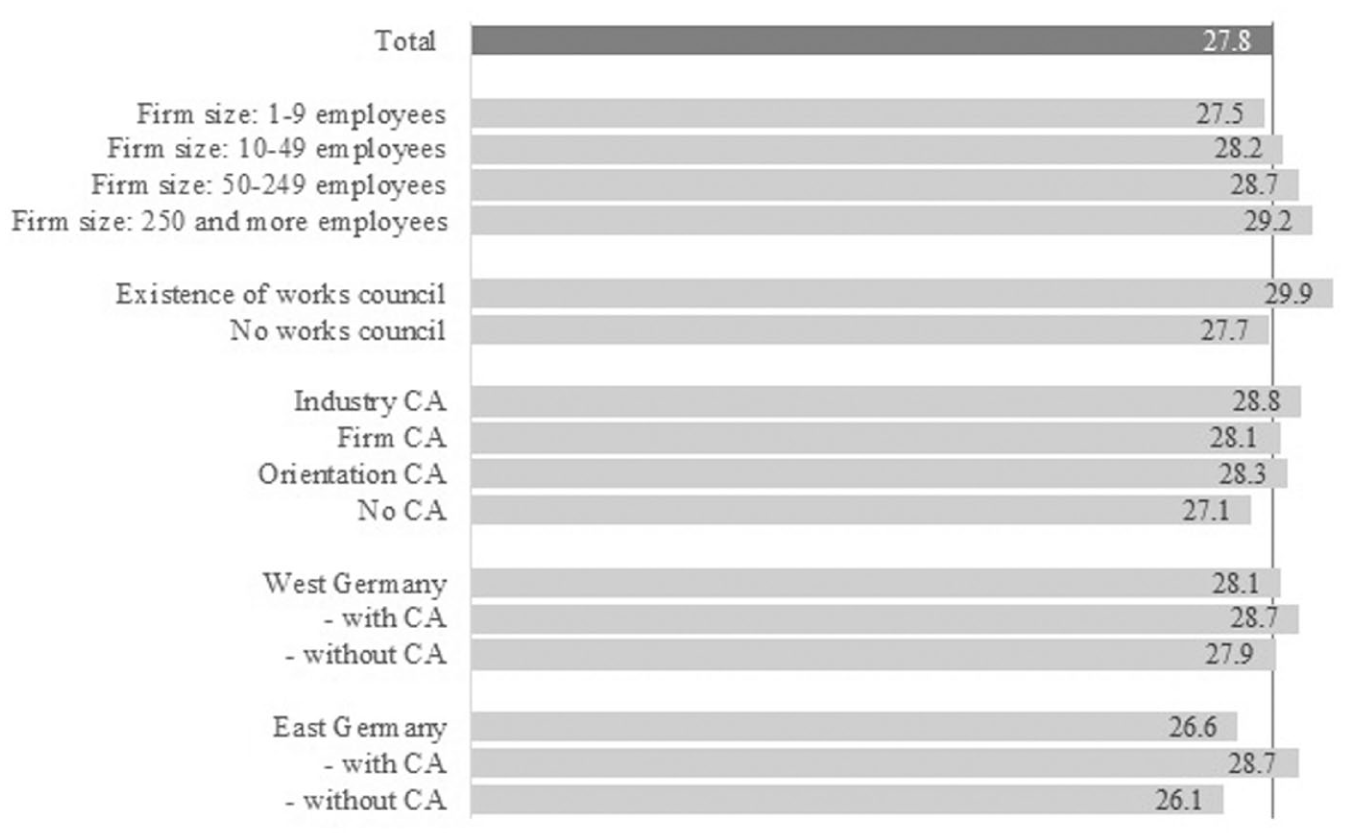
Average vacation entitlements in firms by selected characteristics, 2023, in days.
Where there are collective agreements and works councils, vacation entitlements are significantly greater (see Figure 1), and the average number of vacation entitlements also increases with the size of the firm, which is probably also related to collective agreements. Despite harmonisation in many areas, there are still clear differences between East Germany and West Germany. While the average number of paid vacation days in East Germany is 26.6 days, the average in West Germany is 28.1 days, that is, 1.5 days more. In East Germany, more firms are not bound by collective agreements 4 , which contributes largely to the differences between West Germany and East Germany. At 28.7 days, the vacation entitlements in firms covered by collective agreements are the same in both East Germany and West Germany (see Figure 1). 5
Table 1 provides a descriptive overview of the variables of interest in their various combinations according to the collective bargaining regime and codetermination, limited to firms with record linkage. The values are weighted and confirm that vacation entitlements are more favourable in firms with a collective agreement and the existence of a works council and that employees are best off in terms of working conditions. However, West German establishments with a firm-level collective agreement and no works council stand out in terms of low vacation entitlements, although the differences are not statistically significant. 6 The p values indicate whether vacation entitlements or other characteristics differ significantly in the various collective bargaining regimes depending on the existence of a works council. Overall, the results show significant differences for the variables vacation entitlements and wage level.
Description of the selected variables by collective bargaining regime and codetermination.
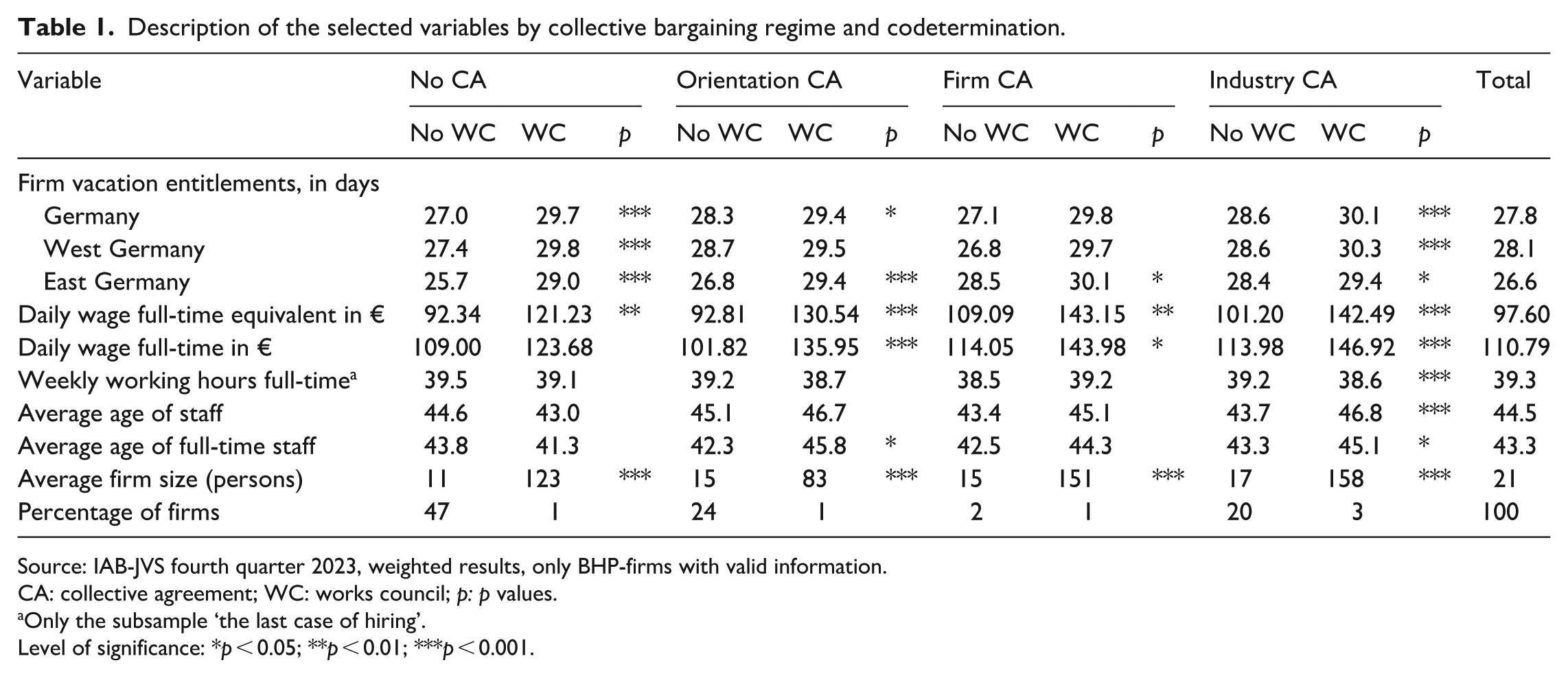
Source: IAB-JVS fourth quarter 2023, weighted results, only BHP-firms with valid information.
CA: collective agreement; WC: works council; p: p values.
Only the subsample ‘the last case of hiring’.
Level of significance: *p < 0.05; **p < 0.01; ***p < 0.001.
Estimation results of the multivariate analysis
In unweighted, linear ordinary least squares (OLS) regressions with robust standard errors, the relationship between the number of vacation entitlements and other independent establishment characteristics is modelled on the basis of the record linkage sample (Supplemental Table A4 in the Supplemental material shows the detailed model results with all control variables). Dependent variables that correspond to a count variable, that is, are positive and an integer, can also be estimated using a Poisson model (Goerke et al., 2015; Saborowski, 2005). OLS models have the advantage over nonlinear Poisson models in that they are easier to interpret, which is why they are most frequently used in vacation analyses (see Altonji and Usui, 2007; Fakih, 2014, 2018; Maume, 2006; Wooden and Warren, 2008). This allows the coefficients to be interpreted in terms of fewer or more vacation days when the independent variable changes by one unit. 7 The various institutional settings in combination with the works council are considered with corresponding interaction terms.
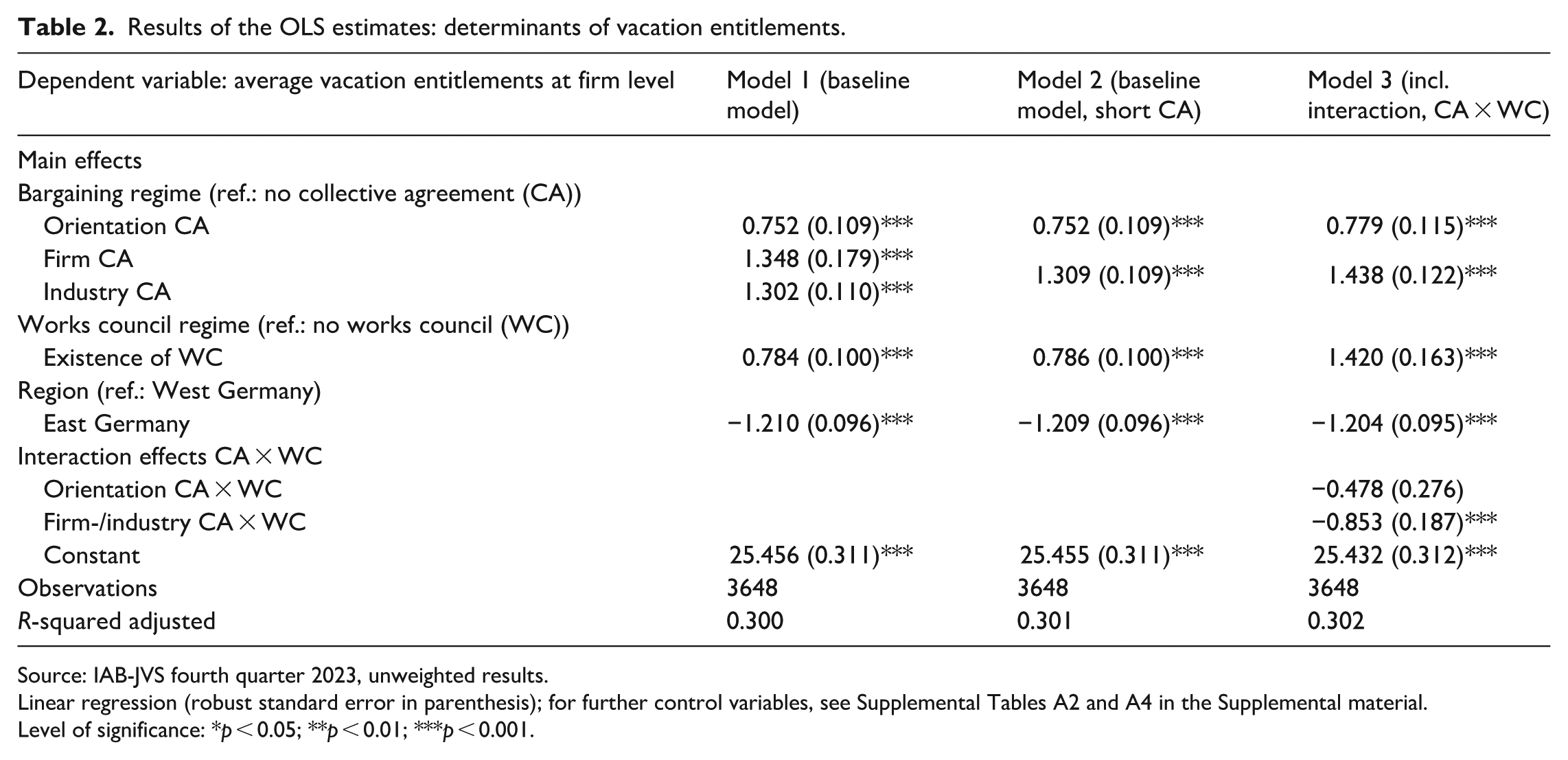
Table 2, Model 1 shows the results of the OLS regression for the variables of interest. H1 and H2 state that collective bargaining coverage and a works council are positively related to vacation entitlements. These hypotheses are confirmed in the model. Compared with firms without a collective agreement, employees in firms with an industry collective agreement (1.3 days, p < 0.001) or a firm collective agreement (1.3 days, p < 0.001) have significantly greater vacation entitlements. However, there are no major differences between the firms with a collective agreement at the industry level and those at the firm level. The ‘collective agreement premium’ is consistent with results from Canada (Fakih, 2014), which also found the difference between employees with and without a collective agreement to be an average of 1 additional day of vacation. If the firm states that it is guided by a collective agreement, the level of vacation entitlement is approximately 0.8 (p < 0.001) days greater than that in firms without a collective agreement. Therefore, a collective bargaining orientation is not a substitute for formal collective bargaining coverage, as shown by Ellguth and Kohaut’s (2021) results on wage differentials. Consequently, the second part of H1, ‘the more comprehensive the collective bargaining coverage, the greater the vacation entitlements’, is only confirmed with regard to the orientation firms. However, no significant differences were found between industry and firm collective agreements.
Results of the OLS estimates: determinants of vacation entitlements.
Source: IAB-JVS fourth quarter 2023, unweighted results.
Linear regression (robust standard error in parenthesis); for further control variables, see Supplemental Tables A2 and A4 in the Supplemental material.
Level of significance: *p < 0.05; **p < 0.01; ***p < 0.001.
The existence of a works council also has the expected positive effect on the amount of vacation entitlement at firm level, albeit to a lesser extent than collective bargaining coverage does. At 0.8 (p < 0.001) additional days of vacation, the results are in the range of the ‘works council premiums’ found in other studies for Germany (e.g. Goerke et al., 2015) and can also be observed in other countries (Fakih, 2014; Maume, 2006; Ohtake, 2003; Wooden and Warren, 2008).
Region also plays an important role: employees in East German firms have more than 1 day less vacation entitlements (–1.2 days, p < 0.001) than employees in West German firms do. Working conditions in East Germany and West Germany differ not only in terms of wages or weekly working hours (Ellguth and Kohaut, 2021; Jirjahn and Smith, 2018) but also in terms of vacation entitlements.
As the estimated coefficients for vacation entitlements between firm- and industry-level collective bargaining are not statistically different, the decisive differences in vacation entitlements primarily exist between no collective bargaining, orientation towards collective bargaining and collective bargaining of any type. For this reason, no further distinction is made between the two types of bargaining, and subsequent analyses combine firms with firm- and industry-level collective agreements (see Table 2, Model 2).
Interaction between collective bargaining agreements and works council
As the effect of a works council is likely to depend on the level of collective bargaining coverage in a firm, the following analysis includes the different institutional combinations of collective bargaining coverage and the existence of a works council, considering the relevant interaction terms.
With a collective agreement or orientation towards, the impact of the works council on the respective firms is less (see Table 2, Model 3). The main effects of industrial relations are of similar magnitude as those in Model 2 but with higher coefficients for firms with collective agreements (1.4 days, p < 0.001) and, in particular, for firms with a works council. This can be interpreted as vacation entitlements being 1.4 (p < 0.001) days longer in firms with a works council than in workplaces without and in those without a collective agreement. This underlines the importance (‘voice’) of works councils in workplaces where there is no collective agreement and their safeguarding role there. In firms with a collective agreement, the effect of a works council is statistically significantly lower at 0.6 days (1.420–0.853, p < 0.001); and in firms oriented towards collective agreements, it has an effect of approximately 0.9 days (1.420–0.478, p < 0.1) compared with firms without collective agreements. However, this is only statistically significant at a p-level of 0.1.
The finding that works councils in firms covered by collective agreements also influence vacation entitlements, albeit to a much lesser extent, is surprising. Formally, works councils have no right to negotiate vacation regulations if these are already regulated by a collective agreement or works agreement. Following Jirjahn (2017), this finding could be explained by the proximity of many works’ councils to the unions and the associated professionalisation of the work of works councils, as well as the greater efficiency of working methods and greater scope for distribution. Another explanation could be that works councils, especially in firms bound by collective agreements, are associated with lower staff turnover (Schnabel, 2020). This can lead to longer tenure in these firms, which in turn can result in higher vacation entitlements. Since the average age of the firm’s workforce can be controlled for, but not the average length of employment of the workers, the effect of longer tenure could be partly reflected here.
Figure 2 illustrates the marginal effects of collective bargaining coverage and the existence of a works council on the predicted values of vacation entitlements by region. The presence of a works council is associated with higher vacation entitlements, with a stronger impact in East Germany. In particular, firms without a collective bargaining agreement in East Germany have 2 days more vacation than those without a works council; in West Germany, the difference is 1 day. In East Germany, a works council also makes a significant difference in firms oriented towards collective agreements. In summary, the existence of a works council in firms with no collective agreements creates a balance and reduces the gap to firms covered by collective agreements, especially in East Germany. In addition, vacation entitlement is closely linked to other remuneration components such as working hours and wages. These aspects are analysed in more detail in the following sections.
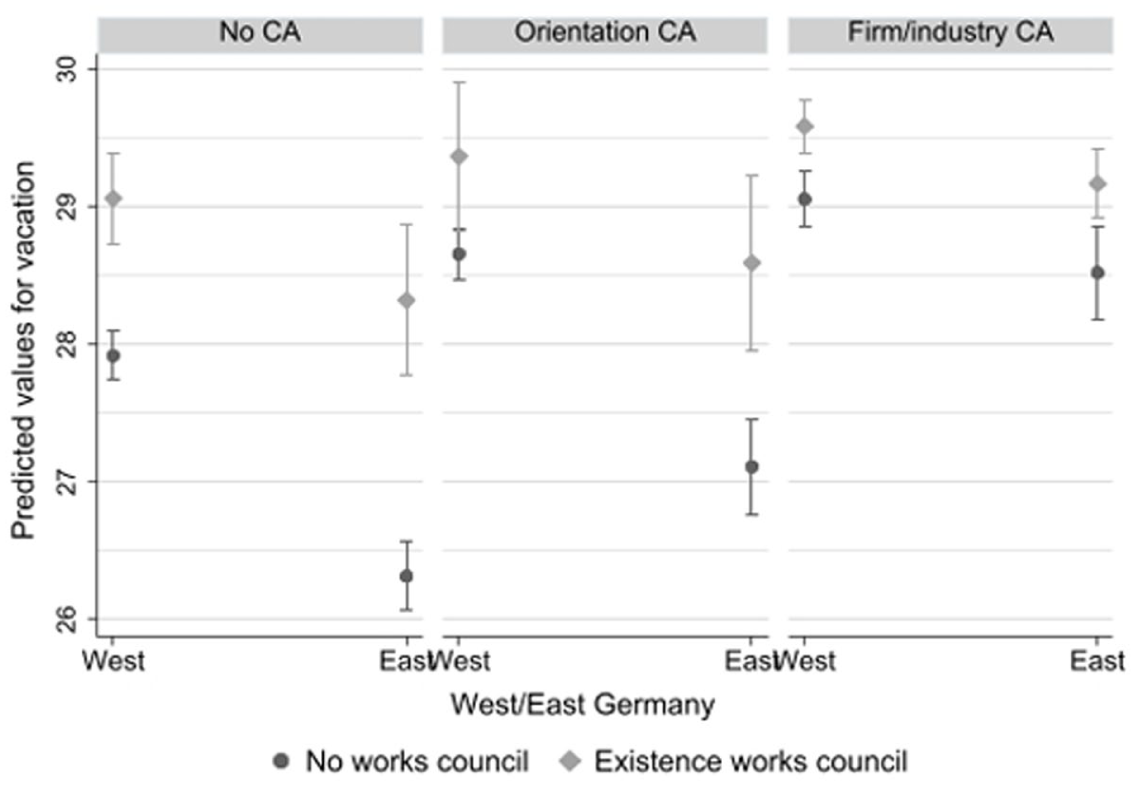
Predicted marginal effects of the OLS estimate with the interaction between collective bargaining and works council by region.
Interactions between collective bargaining agreements, works councils and wage levels
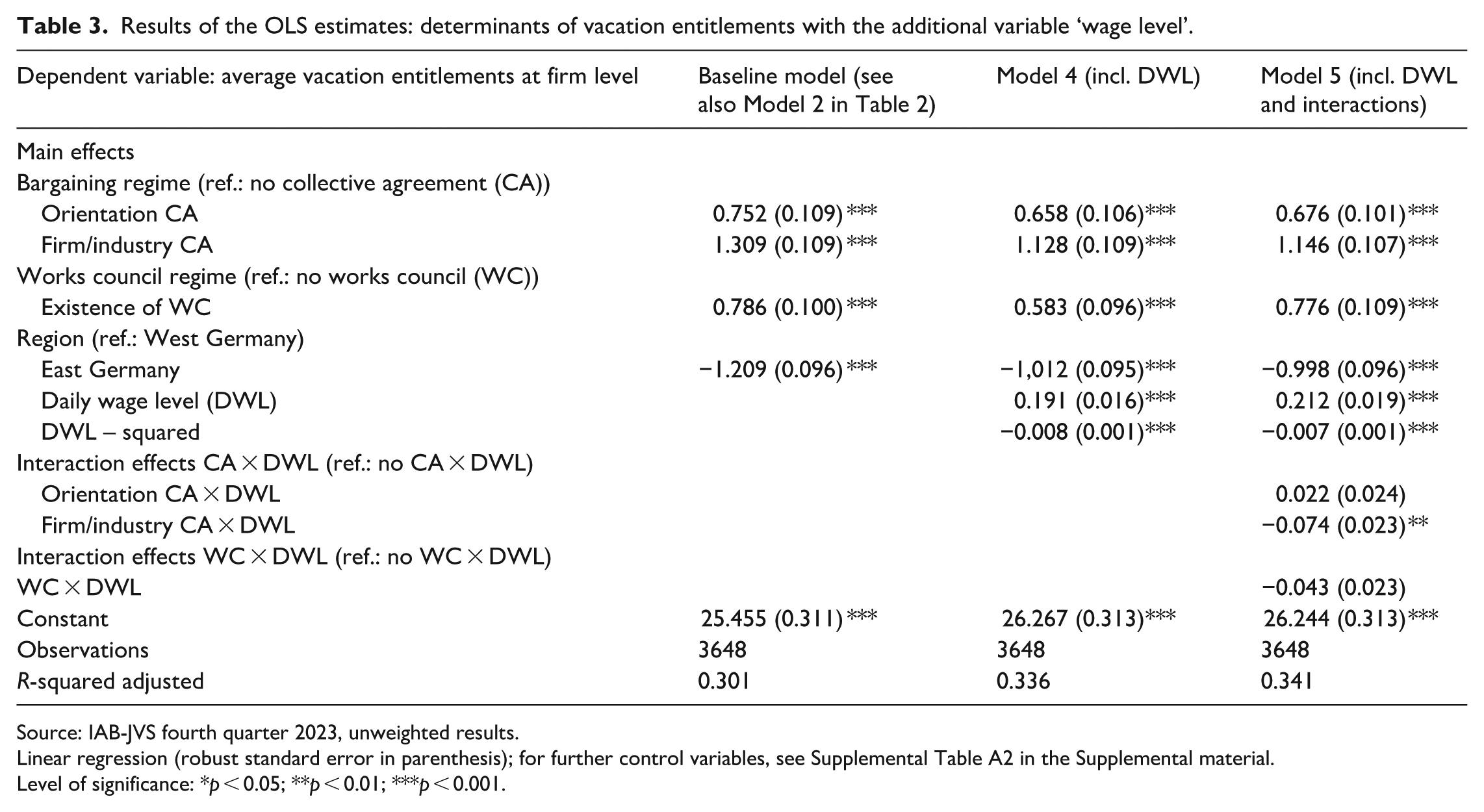
In Table 3, the first column shows the estimated coefficients from the baseline model (see also Table 2, Model 2). In addition, the control variable ‘wage level’ (Model 4) and interactions with the dual system of interest representation (Model 5) are added.
Results of the OLS estimates: determinants of vacation entitlements with the additional variable ‘wage level’.
Source: IAB-JVS fourth quarter 2023, unweighted results.
Linear regression (robust standard error in parenthesis); for further control variables, see Supplemental Table A2 in the Supplemental material.
Level of significance: *p < 0.05; **p < 0.01; ***p < 0.001.
The statistically significant correlation between the firms’ wage level and vacation entitlements (0.191, p < 0.001) shows that greater vacation entitlements are associated with better conditions in terms of wage levels 8 (see Table 3, Model 4); these findings are in line with those of Fakih (2014). This confirms H3a, which states that firms with higher wage levels also offer more vacation entitlements. An increase in the (daily) wage level of €10 per day is associated with 0.2 more days of vacation. One possible explanation is that firms offer better wages and working conditions to attract workers in the labour market and reduce turnover. The negative correlation with the squared wage level indicates a nonlinear relationship: with increasing wages, the positive effect on vacation entitlements decreases (−0.008, p < 0.001). By including the wage level, the estimated coefficients for industry collective agreements and works councils are correspondingly lower by around 0.2 days. This suggests that the vacation effect is related to different wage levels in firms with and without collective agreements or works council.
Based on H4a, I assume that the increase in vacation entitlement linked to higher wage levels is influenced by collective agreements or works councils. The wage effect should be less pronounced in firms with these institutions than in those without. Table 3, Model 5 shows the results of the interaction between the wage level and collective bargaining coverage or codetermination. The interaction terms reveal that in firms with collective bargaining agreements the positive wage effect on vacation entitlements is significantly lower (−0.074, p < 0.01) compared to firms without collective agreements. No significant differences can be seen in orientation firms or firms with works councils. H4a is therefore confirmed with regard to firms covered by collective agreements. In these firms, the increase in vacation entitlement alongside rising wage levels is weaker than in the other firms; thus, enabling a substitutional relationship to be established (see also Supplemental Figure A5 in the Supplemental material).
Interactions between collective bargaining agreements, works councils and full-time working hours
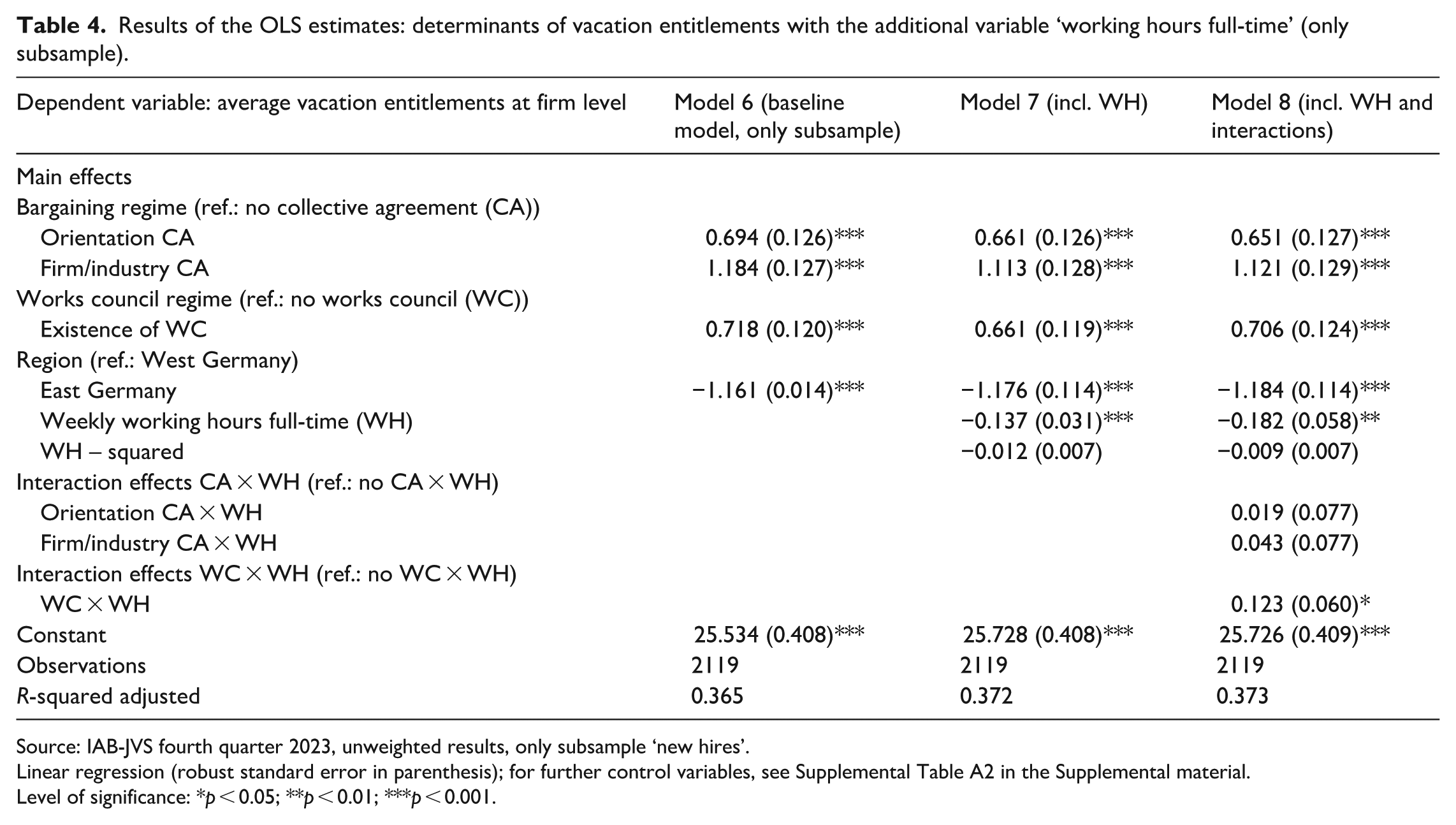
Different working time arrangements, particularly the length of working hours, can also influence the amount of vacation entitlement within a firm (Wooden and Warren, 2008). As described, the models with the variable ‘working hours’ are based on the subpopulation ‘firms with new hires’ (Table 4). The correlations between vacation entitlements and the dual system of interest representation of the baseline model (Table 2, Model 2) are confirmed on the basis of the subsample (Table 4, Model 6) in terms of strength, direction and significance; the coefficients are marginally lower to those for the full sample.
Results of the OLS estimates: determinants of vacation entitlements with the additional variable ‘working hours full-time’ (only subsample).
Source: IAB-JVS fourth quarter 2023, unweighted results, only subsample ‘new hires’.
Linear regression (robust standard error in parenthesis); for further control variables, see Supplemental Table A2 in the Supplemental material.
Level of significance: *p < 0.05; **p < 0.01; ***p < 0.001.
Table 4, Model 7 indicates, that there is a statistically significant negative correlation between weekly full-time working hours and vacation entitlements: one additional full-time hour per week equals 0.1 days (−0.137, p < 0.001) less vacation entitlements. It is by no means the case that longer weekly working hours are compensated by more vacation days; on the contrary. H3b is thus also confirmed. With generous regulations, firms could also strive for high employee retention and attractiveness as employers. The squared term of weekly full-time hours is not significant; a non-linear relationship with vacation entitlements is not evident. In this context, it is hypothesised (H4b) that the impact of working hours on vacation entitlements is likely to be less pronounced in firms with collective agreements or co-determination than in firms without these institutions. There are no significant interactions for the collective bargaining agreement variables (see Table 3, Model 8). But, the negative correlation between an increase in weekly working hours and a decrease in vacation entitlements is smaller in firms with a works council (0.123, p < 0.05). Therefore, H4b is confirmed for firms with a works council compared to firms without (see also Supplemental Figure A6 in the Supplemental material).
Robustness checks
To ascertain the robustness of the results, the models were calculated using different samples and estimation methods. As collective bargaining coverage and codetermination are significantly higher in the public sector and, in contrast to the private sector, have not declined in recent years (Prümer and Schnabel, 2023), the protective function of collective agreements and works councils is much stronger in the public sector. The models are therefore calculated separately for the public and private sectors. The results of the variables of interest are shown in Supplemental Table A5 in the Supplemental material. For the private sector, there are no differences from the estimates based on the entire sample in terms of the direction, strength or statistical significance. In the public sector, there are no significant differences in vacation entitlements based on whether firms are oriented towards collective agreements or on whether a works council exists. However, as 85% of this subsample are bound by collective agreement, there are insufficient cases in the remaining groups to enable reliable comparisons to be made. The comprehensive employee protection afforded by collective agreements and codetermination in the public sector is reflected in smaller differences in vacation entitlements in terms of working conditions. Since firms in the public sector are often automatically covered by a collective agreement, no decisions need to be made regarding individual vacation entitlements, as these are predetermined.
Since the observations are randomly selected in sample surveys, but individual observations have different selection probabilities, weighted models are often applied (Williams, 2021). In regression analyses, the use of weights can usually be dispensed with if all stratification variables are included in the estimation equation (cf. Bossler et al., 2018, 2022; Winship and Radbill, 1994). Williams (2021) recommended investigating whether unweighted and weighted OLS coefficients differ, as such differences may indicate problems with the model specification. For this purpose, the weighted model results have been included in the Supplemental material (see Supplemental Table A4 in the Supplemental material). The weighting in the IAB-JVS is based on the stratification characteristics of region (West Germany/East Germany), firm size (1–9, 10–19, 20–49, 50–249, 250–499, 500–900, 1000 + employees) and 24 economic sectors according to the Classification of Economic Activities, Edition 2008. These stratification variables were included in the estimation equations. The results for the variables of interest do not differ significantly in terms of the strength, direction or statistical significance. Differences arise above all with respect to the firms with firm-level collective bargaining, which lose their statistical significance in the weighted estimate, which may be related to the small number of cases in this group. In contrast, the works council effect becomes stronger with weighting. However, unweighted OLS estimates should be preferred because they are unbiased, consistent and have smaller standard errors than weighted OLS estimates do (Winship and Radbill, 1994) when the sample weights – as in this study – are included in the model as independent variables.
Choice models, in which employees can choose between a pay raise and more time off, are playing an increasingly important role in collective bargaining policy (Lesch, 2019). Often, not all workers in a firm have this right – it may be reserved for union members, shift workers or parents of young children. Given the choice between ‘fewer working hours’ and ‘more money’ under a collective agreement, there is a clear preference among employees for time off, particularly in the form of more days of vacation (Ruf et al., 2024). Inequalities in vacation entitlements between different groups of employees could therefore also emerge in firms bound by collective agreements. In these firms, this is likely to be reflected not only in the wage level but also in the average growth rate of the firms’ wage level. Higher vacation entitlements could therefore interact with lower growth rates in wage levels and collective bargaining. The results show that a higher growth rate has a dampening effect on vacation entitlements, suggesting that negotiations on wages and vacation are negatively interrelated. But this finding was independent of the collective bargaining regime. However, differences in employees’ vacation entitlements due to choice models only have an impact at firm level if a large proportion of the workforce is affected. Therefore, this may not be adequately reflected in the underlying data.
Discussion
While the dual system of interest representation in firms and research remains a highly relevant topic (Hohendanner and Kohaut, 2024; Schnabel, 2025), it has thus far been largely neglected in empirical vacation research. Therefore, the aim of this study was to analyse the relationships between collective bargaining agreements, works councils, and vacation entitlements on the basis of the IAB-JVS. Consistent with the collective voice approach, the collective bargaining regime and the existence of a works council, as well as interdependencies, emerge as key factors. Apart from employee level studies investigating the influence of works councils or trade union membership on vacation entitlements and, above all, vacation underutilisation, there have been no German studies to date on the interaction of the dual system of interest representation on vacation entitlements. Since vacation is also related to wages or weekly working hours, these working conditions were also examined.
The OLS estimates show that firms covered by collective agreements have 1 day more vacation than those without collective agreements do, controlling for a variety of firm level and structural variables. Formal collective bargaining and orientation towards collective agreements are often viewed as more or less equivalent in terms of working conditions. But firms that are oriented towards collective agreements cannot be equated with firms that are bound by collective agreements; the level of vacation entitlements is significantly lower.
In addition, collective bargaining agreements are not the only institution that guarantees higher vacation entitlements; the existence of a works council also contributes to higher vacation entitlements, with the works council bonus amounting to almost a day. In addition, works councils contribute to higher vacation entitlements, especially in the absence of a collective agreement. This connection could not recently be proven for wage determination (Ellguth and Kohaut, 2021), which could indicate that better vacation regulations for works councils are easier to enforce than wage increases are. There are regional differences; the existence of a works council in nonunionised firms is associated with significantly higher vacation entitlements in East Germany than in West Germany. Overall, the results on vacation entitlements underline the crucial importance of the dual system of interest representation in Germany for safeguarding working conditions and thus for protecting employees, as Ellguth and Kohaut (2021) have already shown for wage setting and working time.
The results also show that vacation entitlements are positively correlated with a higher wage level or lower full-time working hours in the firm. The results suggest that the total remuneration package of firms is influenced differently depending on whether there is collective bargaining coverage or a works council exists. In firms with collective bargaining coverage, there is a significant less pronounced correlation between vacation entitlements and the wage level. This indicates that, within collective agreements, vacation entitlements and wages are at least partly regarded as interchangeable components. In firms with a works council the negative link between vacation entitlements and working hours is less prevalent. This could be due to the fact that it is often easier to negotiate vacation entitlements and working hours than wages within these firms. These results emphasise how collective agreements and works councils influence the composition of remuneration packages, as well as the role played by the dual system of interest representation.
Given the framework conditions of labour relations in Germany, where collective agreements generally apply to all employees of a firm, collective bargaining favours the vacation entitlements of all employees in a firm. A further erosion of the collective bargaining system (Schnabel, 2025) could also result in reductions in vacation entitlements. Nevertheless, the increased competition for labour could favour a spread in vacation entitlements, particularly in firms without collective agreements. Working conditions can be a lever to bind employees more closely to the firm. The greater the mobility of the labour force is, the greater the likelihood that employees will opt for firms that offer them the best working conditions. For example, Fakih (2018) showed that operational difficulties in filling vacancies for men result in 0.3 more days of leave. Carrillo-Tudela et al. (2023) reported that firms in Germany are able to fill vacancies more quickly if they make relatively high wage offers. In addition to wages, this could increasingly apply to vacation arrangements. Workers may increasingly migrate to firms bound by collective agreements because of better working conditions. This could even have an impact on firms’ motives for collective bargaining. The majority of employees establish a positive correlation between pay, job security and working time organisation and the ‘signal’ of collective bargaining coverage (Bach and Fulda, 2024).
Furthermore, this study, like any other study, has several limitations. First, the level of vacation entitlements reflects an estimated average across all (full-time) employees of a firm and therefore provides only a general estimate. Moreover, the question arises as to the extent to which vacation data relating to full-time employees can be transferred to firms with many part-time employees. For part-time employees, vacation entitlements are based on the number of working days per week, regardless of the number of weekly hours. Part-time employees whose working hours are evenly distributed across all working days of the week therefore have the same entitlements as full-time employees. Furthermore, according to the Part-Time Employment Act, a part-time employee may not be treated less favourably than a comparable full-time employee because of their part-time work. This applies to all working conditions. Therefore, their vacation entitlements should not differ. To capture possible impacts, I also control for the share of part-time workers in the firm in all the models.
One of the most important limitations is the cross-sectional nature of the data. To identify causality and unobservable firm level effects, longitudinal data on vacation patterns, which are currently not available for Germany at the firm level, would have to be used. Therefore, reverse causality or unobserved heterogeneity cannot be ruled out. An important variable that plays a significant role in many empirical studies at the employee level is tenure. Longer tenure is often associated with higher vacation entitlements. The current version of the BHP does not provide information on the average length of employment of employees in the establishment. In Germany, staggered vacation days based on tenure are only occasionally found in collective bargaining agreements; in particular, staggered vacation days based on age can be interpreted as age-discriminatory under German case law. In addition, as average values are reported at the level of the establishment, this variable is likely to be of less relevance. To reduce the potential for omitted variable bias, I consider work and wage characteristics of employees in the establishment that are correlated with unobserved tenure, such as the average age of employees, the age of the establishment or the wage level, thereby reducing the potential for omitted variable bias.
In future research, it would be advantageous to have current longitudinal data available from which not only correlations but also causal effects could be derived. For example, no definitive statement can yet be made about what changes a firm’s joining or leaving an employers’ association actually leads to in terms of vacation entitlements. Another line of research could examine in more detail whether offering more vacation days is an effective strategy for recruiting and retaining skilled workers, and whether it is a useful competitive tool in the ‘war for talent’. The research could investigate the extent to which offering higher vacation entitlements helps firms stand out from other employers in the competition for skilled workers. The research could compare the effectiveness of such measures with that of other incentives, such as wage increases or flexible working time models. It could also analyse how different age groups and occupational fields react to such offers, and the long-term effects on employee satisfaction and loyalty.
Overall, the results of this study, which is based on employer data from Germany, indicate that firms subject to a collective agreement or those with a works council tend to grant their employees more generous vacation entitlements. This emphasises the safeguard function of the dual system of interest representation for employees.
Supplemental Material
sj-docx-1-gjh-10.1177_23970022251379805 – Supplemental material for Vacation entitlements in Germany: The role of collective bargaining and works councils
Supplemental material, sj-docx-1-gjh-10.1177_23970022251379805 for Vacation entitlements in Germany: The role of collective bargaining and works councils by Susanne Wanger in German Journal of Human Resource Management
Footnotes
Acknowledgements
I am grateful to two anonymous reviewers, and the editors of this Journal for their comments.
Author contributions
Not applicable as sole authorship
Funding
The author received no financial support for the research, authorship, and/or publication of this article.
Ethical considerations
Not applicable.
Consent to participate
Not applicable.
Consent for publication
Not applicable.
Data availability statement
For my analyses, I used the IAB-Job Vacancy Survey and the Establishment History Panel of the Institute for Employment Research (IAB). Both datasets are available from the Research Data Centre (FDZ) of the IAB, the research institution of the Federal Employment Agency in Germany. The availability of this data is subject to restrictions and is not publicly accessible. Further information on data access can be found at  .
.
Supplemental material
Supplemental material for this article is available online.
Notes
References
Supplementary Material
Please find the following supplemental material available below.
For Open Access articles published under a Creative Commons License, all supplemental material carries the same license as the article it is associated with.
For non-Open Access articles published, all supplemental material carries a non-exclusive license, and permission requests for re-use of supplemental material or any part of supplemental material shall be sent directly to the copyright owner as specified in the copyright notice associated with the article.
