




Abstract
The aim of this case study was to explore the abilities and limitations of trade unions in their response to undeclared work, which has received scant attention in research on working conditions and industrial relations. The authors use power resource theory to examine the outcome of a Swedish government initiative aimed to boost the ability of the social partners to tackle undeclared work. The findings confirm previous literature suggesting cross-sectoral differences in the extent and nature of undeclared work and an association between low levels of power resources and high risk of undeclared work. The authors recommend that future initiatives take account of cross-sectoral differences in the nature and extent of undeclared work and available power resources. Future research should consider how different actors can contribute to the ability of the social partners in different sectors to engage in the battle against undeclared work.
Keywords
The response of trade unions to precarious employment is receiving increasing attention (Doellgast et al., 2018; Grimshaw et al., 2016; Keune, 2013; Keune and Pedaci, 2020; Wright, 2013). Although there is no generally accepted definition of precarious employment, scholars agree that the construct includes multifaceted elements related to workers’ employment conditions, including: employment insecurity, inadequate financial compensation, income volatility, and lack of rights and protection in their employment relationship (Benach et al., 2007; Bodin et al., 2020; Eurofound, 2019; Kreshpaj et al., 2020). Some confusion may exist when addressing precarious employment as this construct has been used interchangeably with non-standard employment, but precarious working conditions can also be found in standard forms of employment (Gunn et al., 2022; ILO, 2016).
This article is about the response of trade unions to a sub-section of precarious employment called undeclared work, commonly defined by researchers and practitioners as paid activities that are not declared to the authorities in order to evade tax and social security contributions and/or labour laws (European Commission, 2016; OECD, 2017; Williams and Horodnic, 2019). Undeclared work includes infringements of labour law related to pay, working time and occupational safety and health (OSH), the latter being a strong indicator for undeclared work (De Wispelaere and Gillis, 2021). Figure 1 illustrates the overlapping concepts of precarious employment, undeclared work and non-standard employment to make clear that not all undeclared work is precarious, not all precarious employment is undeclared and that some but not all non-standard employment is undeclared.
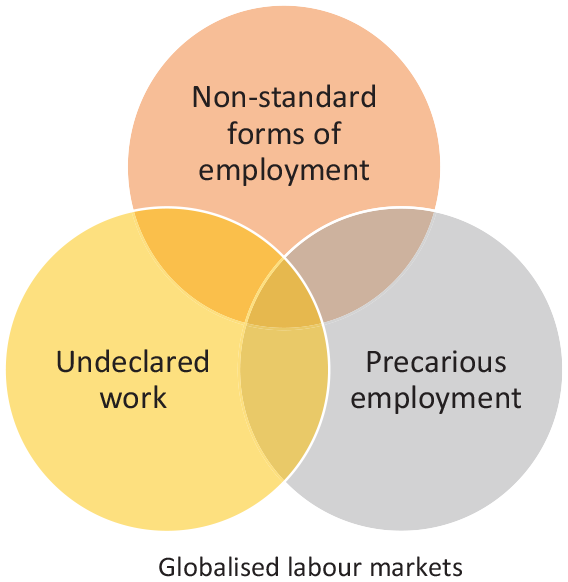
The relationship between employment precarity, non-standard forms of employment and undeclared work in the broader context of globalised labour markets.
The focus of this article is on the precarious type of undeclared work, often linked to migrant workers from low-income and middle-income countries working longer hours and in more dangerous jobs and industries than non-migrants (Aktas et al., 2022; Hargreaves et al., 2019). The most vulnerable migrants can be found in the intersection of the three circles in Figure 1 and include undocumented migrants (Aktas et al., 2022), often working in sectors such as agriculture, construction and services (Koseglu Ornek et al., 2022). In Europe in recent years, the situation of these workers has gone from a matter discussed mainly by trade unions to one receiving attention at the highest political level. The aim of this article is to explore capabilities and limitations of trade unions to contribute to the response to precarious employment within a tripartite context, with specific focus on undeclared employment. To do so, we have studied a Swedish government initiative that, since 2018, funds one-year projects with the aim of activating the social partners in the national response to undeclared work. While both employers’ and workers’ organisations were invited to participate, the initiative primarily engaged trade unions, hence the focus on unions in this study. The relationships between participants’ ambitions and perceived outcomes are analysed using a model inspired by Walter Korpi’s ‘power resource theory’ (1978) and more recent studies using his theory (Keizer et al., 2021; Kjellberg, 2021a; Mendonça and Adăscăliței, 2020; Refslund and Arnholtz, 2021). Building on project documentation and interviews with the government and the organisations involved in projects funded in 2018–2021, this study asks: How can power resources explain the outcome of a governmental initiative adopted to tackle undeclared work directed towards the social partners? To answer this question, the authors have examined the participating organisations’ perceptions of having achieved the objectives of the projects or not and what could explain their relative success or failure.
The present article adds to existing literature on trade union efforts to defend precariously employed workers (Benassi and Vlandas, 2016; Doellgast et al., 2018; Keune and Pedaci, 2020; Morgan and Pulignano, 2020) by investigating the factors that reinforce or undermine the unions’ ability to tackle undeclared work in sectors where such work is common. It further contributes to literature on undeclared work by examining the role of the social partners, rather than focusing only on the behaviour of governments (Williams, 2019). It does so in the context of precarious employment, where undeclared work has received only scant attention (Doellgast et al., 2018; Morgan and Pugliano, 2020). Further, it responds to an existing gap regarding evaluated initiatives addressing precarious employment (Gunn et al., 2021, 2022). By placing power resource theory in the context of undeclared work, the article also expands on its previous applications (Refslund and Arnholtz, 2021). Power resource theory considers the significant consequences that the distribution of power resources has for the ability of the social partners to contribute to the creation of decent working conditions. These contributions occur in different forms depending on national contexts and the ways in which power resources are distributed across different sectors.
This qualitative case study does not intend to offer results that are widely generalisable. However, by exploring a tripartite initiative aimed to combat undeclared work, it argues that the examined effects related to the availability of power resources have analytical value beyond the case. The growing incidence of undeclared work affects not only the workers themselves but also employers, governments and other workers. The authors hope that this article will contribute to the academic debate about trade union solidarity with precariously employed workers (Benassi and Vlandas, 2016; Doellgast et al., 2018; Keune and Pedaci, 2020; Morgan and Pulignano, 2020) as well as to the discussion about what governments can do to tackle undeclared work (Williams, 2019).
The article begins with an overview of undeclared work and a brief introduction of the study context. A description of the research design comes next, followed by a presentation of the results. The last section provides a discussion and conclusion.
Characteristics of undeclared work
Undeclared work is estimated to comprise 9% of total labour input in the European Union (EU) private sector (Williams et al., 2017) but due to its illegal nature, precise numbers are missing. For example, Eurobarometer surveys on undeclared work only consider European citizens, thus excluding undocumented workers from non-EU countries and others who remain ‘under the radar’ (Williams and Horodnic, 2020). In Sweden, survey data from 2016–2017 show that half of the employers in the cleaning sector and a third of those in the construction, transport, hotel, restaurants and agriculture sectors declared that they felt obliged to bend the rules to stay competitive (Arbetsmiljöverket, 2016, 2017). According to the European Labour Authority (ELA), sectors in which undeclared work is prevalent in Europe include construction, agriculture, road transport, tourism, renovation or repair works, cleaning, provision of childcare and hotel, restaurant, catering and food services (ELA, 2022a). These sectors are similar to those identified by Swedish government agencies: construction, restaurants, cleaning, car repair shops, beauty salons, transport and agriculture/forestry (Migrationsverket et al., 2021).
There is a wide array of terms used for undeclared work, including ‘shadow’, ‘black’, ‘informal’ and ‘underground’ economy/sector/work (Williams, 2019). The terminology used by the Swedish government has changed from ‘black work’ to ‘the grey sector’ (Thörnquist, 2017) to ‘working life criminality’ (arbetslivskriminalitet) (Dir 2021:74; DS 2021:1), a term also used in Norway. In this article we opted for ‘undeclared work’ due to the consensus around this term in both the scholarly and policy-making community (Williams, 2019). Even this consensus, however, needs further consideration. Undeclared work can be by worker choice or by circumstances forcing worker choice. The distinction made by some authors describes the former as exit-driven, in reference to persons who intentionally opt to leave the declared economy to avoid taxes, and the latter as exclusion-driven, in reference to persons who take this kind of work out of necessity (Williams and Bezeredi, 2018). Yet others suggest a dual undeclared labour market consisting of workers in an exclusion-driven ‘lower tier’ and an exit-driven ‘upper tier’ (Williams and Bezeredi, 2018). The concept of exclusion-driven undeclared work is derived from the marginalisation thesis, according to which undeclared work is a survival strategy undertaken by people who are marginalised from the declared economy and do not have alternative means of making a living. Consequently, undeclared work is more prevalent in poorer countries and regions than in wealthier ones. Workers engaged in undeclared work more often experience periods of unemployment, financial difficulties, and have fewer years of full-time formal education than declared workers (Williams and Kayaoglu, 2020).
Williams and Kayaoglu (2020) divide undeclared work into three types. First, undeclared employees, who have no written employment contract and are not registered with the authorities. They are unable to receive employment-related financial support but may be able to receive welfare benefits depending on the social security system. Second, under-declared employees, who are in declared employment but receive an additional undeclared ‘envelope wage’ to their declared wage. Employers using this tactic can evade paying the full tax and social contributions they owe to the state. Third, bogus self-employed or dependent self-employed, who are registered as self-employed but work under the same conditions as regular employees and/or depend on a single employer for all or most of their income. However, these workers are not eligible for employment related benefits available to the regular employees. All three types of undeclared work can be found in the descriptive typology presented by the Swedish National Audit Office (Riksrevisionen, 2020) on undeclared work in Sweden: labour exploitation, social benefits abuse, OSH law abuse, migration law abuse and economic crime.
Tackling undeclared work
The main responsibility for tackling undeclared work lies with the national government, generally operating through one or more types of enforcement bodies: (1) labour inspectorates addressing abusive behaviour linked to working conditions and/or health and safety legislation; (2) social security inspectorates addressing fraud linked to social insurance contributions; (3) tax authorities addressing tax evasion. In some EU Member States, customs authorities, migration bodies, the police, the public prosecutor’s office and the social partners are also involved (ELA, 2022b). Sweden is a member of the EU, and the government has been involved in and inspired by EU efforts to tackle undeclared work. The rationale for those efforts is concern with the negative effects on workers, businesses and governments across Europe in terms of sub-standard salaries and working conditions, unfair competition between companies and the loss of tax revenues (European Commission, 2016; Williams, 2019). In this context, EU governments have been prompted to combine measures that counter undeclared work with measures that will promote the transformation from undeclared to declared work, so as not to destroy job opportunities (European Commission, 2007; ILO, 2015). Another feature of EU policy is the statement by the European Parliament and Council (European Commission, 2016) that tackling undeclared work requires a ‘holistic approach’. This entails collaboration between different government agencies as well as between government and non-government stakeholders – including the social partners (Williams, 2019). Despite substantial political attention, tackling undeclared work at the national level has proved difficult and the holistic approach is hampered by government departments working in ‘silos’ and by limited cooperation with the social partners (Lapeyre and Williams, 2020).
The European Trade Union Confederation (ETUC) has highlighted the crucial role that trade unions can play in combating undeclared work and protecting undeclared workers. The ETUC Resolution on Undeclared Work (2014) states that trade unions should raise awareness about undeclared work, provide advice for undeclared workers, and become involved in policy work, tripartite bodies and research. The extent to which trade unions are active in tackling undeclared work is largely undocumented. One example is the EU-funded project ‘Tackling undeclared work in the construction industry’, bringing together employer federations, trade unions and enforcement authorities in seven countries in joint activities (European Federation of Building and Woodworkers [EFBWW] and European Construction Industry Federation [FIEC], 2020). Another is the Western Balkan Network Tackling Undeclared Work, which produced a toolkit with methods on how enforcement authorities and social partners can initiate, develop and manage partnerships with other stakeholders (Stefanov et al., 2019).
Power resource theory
To analyse the capabilities and limitations of trade unions to effectively address undeclared work, this study uses power resource theory to provide a conceptual framework. This theory was introduced in the research of Swedish sociologist Walter Korpi (1978) on explanations regarding the emergence and development of social policy institutions. Korpi emphasised both (1) the role and strength of labour mobilisation and (2) trade unions’ ability to acquire new power resources, mobilise their resources in new ways, and extend existing power resources into new areas of the labour market. This article is inspired by more recent applications of power resource theory in Keizer et al. (2021), Kjellberg (2021a), Mendonça and Adăscăliței (2020) and Refslund and Arnholtz (2021), and builds on five types of power resources:
1. Associational power resources result from the formation of collective organisations of workers (Refslund and Arnholtz, 2021) and are manifested in the number and level of involvement of trade union members. Below-average trade union density is particularly common in sectors with low-wage competition, such as cleaning, agriculture, transport and road haulage (Refslund and Thörnquist, 2016) – sectors that are also considered at high risk of undeclared work (e.g. Williams, 2019).
2. Structural power resources result from the position of workers in the production system and depend on the importance of different work tasks for the production process. These resources can be divided into workplace power, i.e. the dependency of employers on the workers and the ease of replacing them, and market power, i.e. how unions are affected by the overall labour market, economic cycles, and supply and demands for skills (Refslund and Arnholtz, 2021). Structural power resources are typically low in sectors with low-wage competition (Refslund and Thörnquist, 2016) and low levels of employment security (Keizer et al., 2021). This, in turn, has negative effects on the strategic ability of trade unions, defined by Kjellberg (2021a) as one dimension of trade unions’ ability to successfully use available power resources.
3. Coalitional power resources result from trade unions’ collaboration with other stakeholders, such as political parties, grassroots movements and employers (Keizer et al., 2021). As structural and associational power resources continue to dwindle, the creation of new strategic coalitions is increasingly important to reduce social exclusion (Doellgast et al., 2018). Partnerships between the workers’ and employers’ organisations, described by Huzzard et al. (2004) as ‘dancing’ rather than ‘boxing’, can be useful in the context of undeclared work. The holistic response suggested by the EU is a potential invitation for the social partners to acquire new coalitional power resources. The ETUC Resolution on Undeclared Work suggests a willingness to capitalise on this opening, suggesting coalitions with governments and employers in ‘policy work and tripartite bodies and research agencies’ (ETUC, 2014).
4. Ideational power resources derive from the capacity of individual or collective actors to influence normative and collective beliefs. Ideas and stories can improve trade unions’ ability for renewal and engagement (Keizer et al., 2021; Refslund and Arnholtz, 2021), something that is particularly important in times of increased precarity and individualism caused by the continuous influence of neoliberal policies on society (Gumbrell-McCormick and Hyman, 2013; Kjellberg, 2021a).
5. Institutional power resources derive from the labour laws and the extent of coverage and organisation of the welfare system, employee participation at the company level, collective bargaining, and mechanisms for arbitration and reconciliation (Keizer et al., 2021). These power resources are important for union participation, representation and enforcement of claims (Korpi, 1978) as well as political influence (Kjellberg, 2021a). In the case of undeclared work, collective agreements and legislation are often deliberately ignored by employers, especially in settings or countries with weak labour market laws and welfare systems, making it harder for trade unions to act. The ETUC declaration (2014) stresses the importance of efforts at the institutional level:
To fight undeclared work the right balance of prevention, controls and sanctions is essential. This can be done through a consistent approach with awareness-raising activities by governments and social partners, transnational cooperation between Member States, more resources for inspections and persuasive sanction mechanisms.
The Swedish context and responses to undeclared work
Long renowned for the collective agreement coverage and high membership rates, both in the workers’ and employers’ organisations, the Swedish labour market model is under pressure for various reasons, including globalisation and EU membership in 2004 (e.g. Dølvik and Visser, 2009; Refslund and Thörnquist, 2016). While overall Swedish trade union density has remained fairly constant with a slight decrease from 77% in 2006 to 74% in 2021, there has been a significant decline among blue-collar workers from 77 to 62% (Kjellberg, 2021b). The number of workers that are not covered by collective agreements has grown to some half a million workers across a wide range of sectors: the taxi and transport sectors, cleaning, retail, media and IT, communication, legal firms and accountants, e-trade, the gig economy as well as foreign companies and posted workers in the construction sector (Kjellberg, 2021a). The Swedish labour market model rests upon a social pact forged in 1938 between the government and the social partners. In return for social peace, the government has little or no say regarding salary levels (which is why Sweden has no minimum wage) and many secondary working conditions, which are regulated in collective agreements. Because of this division of responsibilities between the government and social partners in Sweden, participation of the social partners is essential for the implementation of a holistic approach to tackling undeclared work.
OSH is primarily regulated by law but workers’ voice and trade union influence are guaranteed via legal provisions stipulating workplace dialogue through local OSH representatives, safety committees and regional OSH representatives appointed by the trade unions in workplaces not covered by collective agreements (Frick, 2014; Kjellberg, 2021a). The labour inspectorate (Swedish Work Environment Agency) monitors compliance with OSH law.
Undeclared work has been described as a threat to the labour market model in Sweden as well as its neighbouring countries (Neergaard and Woolfson, 2017; Refslund, 2016; Woolfson et al., 2014) and is a more recent phenomenon there than in other parts of the EU. In Sweden, undeclared work has surged to the top of the labour market policy agenda in an increasingly confrontational government discourse in which it is currently called ‘working life criminality’ (Skr. 2020/21:92).
Although undeclared work can be found among Swedish as well as non-Swedish workers, political and media discussions about undeclared work are mostly focused on migrants for being particularly vulnerable to this form of work. The context of the increased political interest in undeclared work is not likely the surge in popularity of anti-migrant party the Sweden Democrats, as Swedes score comparatively low on racism and xenophobic attitudes (Neergaard and Woolfson, 2017). A plausible explanation for the increased political interest in undeclared work is EU legislation on public procurement and posted workers combined with media coverage on exploited undeclared workers and pressure from the social partners in sectors most affected by unfair competition and labour exploitation (Riksrevisionen, 2020; Thörnquist, 2017).
For a long time, undeclared work in Sweden was mainly exit-driven, consisting of natives choosing to render services ‘on the side’ without paying taxes. Stricter laws and tax reductions, aiming to induce service providers and consumers to stick to the rules, led to the reduction of this type of undeclared work. More recently there has been a rise in exclusion-driven undeclared work, undertaken by workers with limited opportunities to engage in other types of work (Williams and Bezeredi, 2018). While there is heterogeneity within this population, overall, non-Swedish born undeclared EU and third-country 1 workers are a growing population sub-group at an increased risk for labour exploitation, especially among non-resident third-country workers with a work permit in Sweden or another EU country, asylum seekers exempted from the work permit requirement, posted workers and irregular (undocumented) workers (Riksrevisionen, 2020). In 2021, more than half of the 55,000 registered posted workers in Sweden were in the construction sector; the most common country of origin was Poland (Arbetsmiljöverket, 2022). Among the 21,000 workers granted third-country permits in 2021, most were from Asia (in particular Thailand and India). Among the most common occupations, except for engineers and IT/other technical specialists, were those identified at high risk of undeclared work: chefs and other types of restaurant staff, forest workers, berry pickers, cleaning staff and construction workers (Migrationsverket, 2022).
The increase in migrant workers in Sweden started in earnest after the 2004 inclusion of former East European countries into the EU and accelerated after a reform in 2008 of the Swedish labour immigration law, a result of successful lobbying by employers to facilitate labour migration from non-EU countries. The new law made Sweden, in the words of the Organisation for Economic Co-operation and Development (OECD) (2011: 11), ‘the most open labour migration system among OECD countries’ and has been criticised for producing one of the largest unemployment gaps between native-born and non-native-born residents among the European OECD countries (OECD, 2011). Since then, the number of non-Swedish workers as well as regular immigration has grown, especially during the 2015 wave of refugees.
The Swedish Trade Union Confederation (LO) has been involved in the question of undeclared work since 2004, when it launched a policy and action programme called orderliness in the labour market. In 2014, this became a 10-item joint strategy together with the Social Democratic Party (SAP) and the subsequent motto of the SAP-led government (Thörnquist, 2017). Trade unions in the construction sector, at times together with employers’ organisations, took a lead during these years, launching whistleblowing projects, general rules for identity requirements and attendance reporting to make it more difficult for unauthorised persons to enter construction sites (Ds 2021:1). Similar to unions in other countries, Swedish unions also try to organise migrants to keep up membership rates and resist precarious employment (Eldring et al., 2012; Marino et al., 2017; Thomas, 2020). In 2021, union density rates among non-native workers in Sweden were lower than among natives but still high in international comparison (Kjellberg, 2021b).
Government efforts to tackle undeclared work started in 2014, when a new SAP-led government was installed. The labour inspectorate received earmarked resources from the Ministry of Labour to coordinate multi-agency inspections of companies deliberately violating regulations in order to gain competitive advantages (Ds 2021:1). The move was intended to confront a tendency among employers to break not only one but several laws, for example tax, migration and OSH (Migrationsverket et al., 2021). In addition, the government revised legislation on contract labour, forced and exploited labour. Tackling undeclared work became a priority area in the government’s work environment strategy for 2021–2025 (Skr. 2020/21:92) and in 2021 a ‘national commission against working life criminality’ (i.e. undeclared work) was established with the explicit aim (among others) to improve collaboration between the government and the social partners (Dir 2021:74).
The case: Description and background
The focus of this study is an ongoing initiative set up by the Swedish government in 2018 with the goal to promote the participation of the social partners in developing methods for cross-government agency controls aimed at counteracting crime and other rule violations (SFS 2018:1404). Since then, the labour inspectorate has organised yearly calls with one-year renewable grants open to workers’ and employers’ organisations. Applications submitted jointly by workers’ and employers’ organisations and initiatives that contribute to sustainable results and/or have a regional perspective are given priority (SFS 2018:1404 §1, §6, §7). The calls in 2018–2021 financed a total of 15 projects. 2
Behind the initiative was the perception that government agencies did not collaborate enough with the social partners (Ds 2021:1; Riksrevisionen, 2020; Vänje and Ottosson, 2020). The initiative was also inspired by experiences in Norway and Denmark, where trade unions had played a more prominent role in counteracting undeclared work. According to a former high-level official of the Ministry of Labour, and previous employee of LO, another reason for the initiative was that discussions with trade unions had revealed that some were too weak to act when employers disrespected the collective agreements:
. . . they [trade unions] were complaining of the situation [. . .] we had crime in some sectors, especially in construction but also in some other sectors, [. . .] some trade unions were rather weak because they had rather few members [. . .] the weakest trade unions were organising workplaces with the worst conditions.
The interviewee also said that the initiative had been designed in such a way that it would not affect the decentralised Swedish labour market model:
. . . I mean, the trade unions are responsible for some part of the Swedish model, but the state should not pay them for doing that. This is a way of saying that this is some extra money for a period of time to do something that is more than [. . .] something else than they usually do.
3
Research design and methodology
This case study draws on qualitative data from 13 projects funded through the initiative between 2018 and 2021 to increase understanding if, and to what extent, this government initiative succeeded in strengthening the ability of unions that received a grant to tackle undeclared work. The projects took place in four sectors: construction, restaurants, forestry and entertainment (including musicians and stagehands). As illustrated in Table 1, three projects received funding for one year, one project was renewed once, and two projects were funded for four consecutive years. Eight of the projects were led by a trade union alone and five projects by a trade union in collaboration with an employers’ organisation. In addition to these 13 projects, a trade union in the transport sector was granted funding for a project that never started, and the trade union declined to be interviewed.
Characteristics of participating organisations and projects financed by the Swedish government 2018–2021.
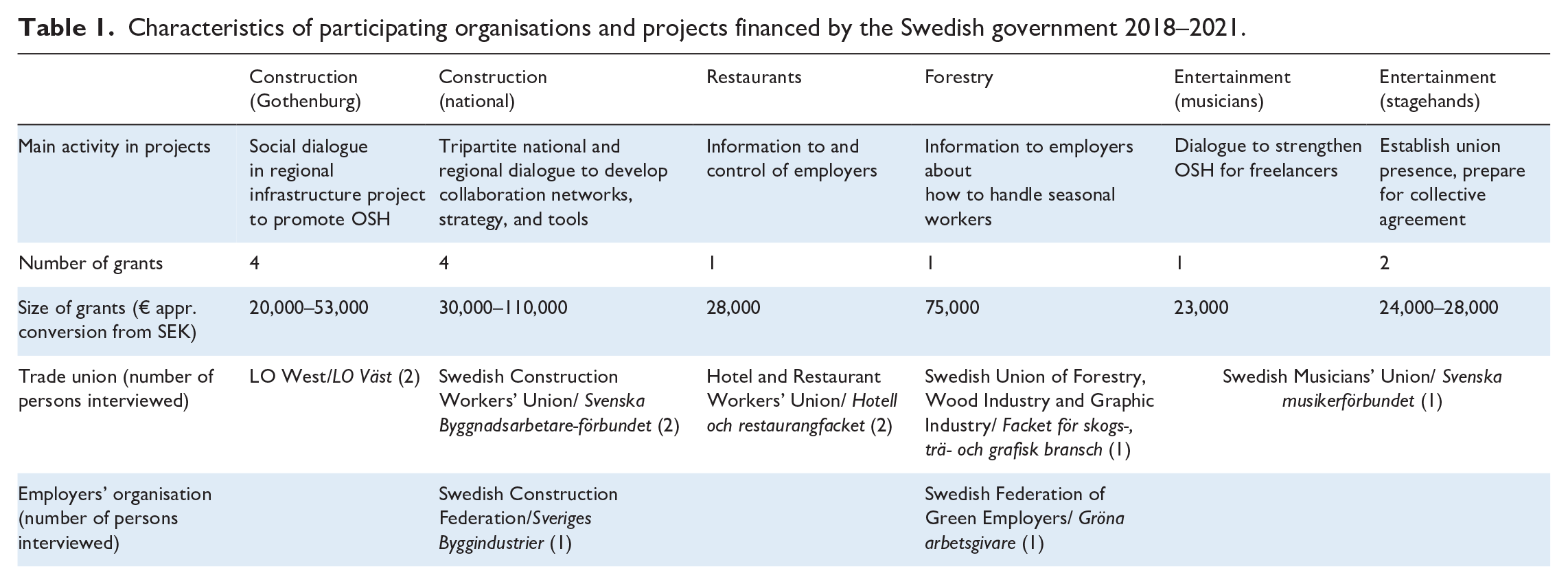
Our study used a multimethod approach encompassing document analysis and eight semi-structured interviews with 11 persons; interview information was combined with document information through a triangulation process aiming to achieve richer and complementary descriptions for each of the projects (Bowen, 2009).
The document analysis considered two types of information. First, policy documents concerning the government decision to initiate the effort and the call instructions published on the internet by the agency administering the call provided information on the rationale of the initiative. Government reports provided information on the Swedish response to undeclared work. Second, project documents consisting of 13 applications provided information about the project objectives. Eleven project reports provided information about the extent to which the participating organisations reported having achieved the objectives. Information retrieval from applications and reports was facilitated by standardised forms containing detailed information about project objectives, planned activities and outcomes. A comparison of the intended outcomes in the projects’ applications and the intended rationale of the initiative from the policy documents made it possible to assess the extent to which the project objectives were in line with the objectives of the initiative.
One of the interviews was with a high-level official of the Swedish Ministry of Labour active in 2018, when the initiative was launched. This interview shed light on the ways in which the idea of the initiative was generated, thus adding to the information about the initiative rationale retrieved from the policy review. The other seven interviews were with officials previously or currently in charge of the projects in various workers’ and employers’ organisations. Information from these interviews complemented the document review with more elaborate descriptions of the grantees’ experiences with undeclared work and of their opinions of the initiative.
All interviews took place during the first half of 2020 in Stockholm, except for two outside Stockholm that were carried out via video conference in the same period. All interviews were recorded and transcribed, and the English translated transcriptions were used to conduct the thematic analysis (Braun and Clarke, 2006). Project documentation and other documents were used to complement the themes identified in the interviews. Power resource theory (Korpi, 1978) was used as the analytical framework and heuristic concept to enhance interpretation of the material. The authors looked for evidence that aligned with the five types of power resources described earlier. Because of the international constellation of co-authors involved in the analytical process, all documents and interview transcripts were translated into English and specific Swedish concepts explained. The lead author (CH) participated in all interviews and two of the co-authors (BK, MA) participated in some of them. All authors participated in the coding, analysis, interpretation and synthesis of the results.
Findings
The sectors in which the examined projects took place covered three of the seven sectors identified by Swedish authorities as high-risk regarding undeclared work: construction, restaurants and forestry (Migrationsverket et al., 2021). Among the other four sectors identified as high-risk (transport, cleaning, car repair shops, beauty salons), only one (transport) applied for funding but returned the money and declined to participate in this study.
The rest of this section considers whether the social partner organisations in charge of the projects reported having achieved the objectives of the projects or not and, drawing on power resource theory, what could explain their relative success or failure in doing so.
Each project received grants ranging from about EUR 20,000 to EUR 110,000 per year and was managed by a trade union or jointly by a trade union and an employers’ organisation. Table 1 provides an overview of the various projects. The projects are referred to as ‘national construction’, ‘Gothenburg construction’, ‘restaurants’, ‘forestry’, ‘musicians’ and ‘stagehands’. In the presentation of the findings, ‘national construction’ and ‘Gothenburg construction’ share the heading ‘Construction’. Likewise, ‘musicians’ and ‘stagehands’ are found under the common heading ‘Entertainment’.
Construction
The goal of ‘Gothenburg construction’ was to ensure a common basis of rights and working conditions via two parallel sets of social dialogue. The context was a large public procurement project called the West Link (Västlänken), estimated to cost SEK 20 billion (approximately EUR 2 billion), including a railway tunnel and three new underground railway stations. One social dialogue involved representatives from the LO unions present at the different worksites, representing service and communication, construction, painting, transport, electricity and metal work. The other social dialogue involved LO and the public procurement agency: the Swedish Transport Administration.
The goal of ‘national construction’ was similar to that of ‘Gothenburg construction’ but with larger ambitions, including national and regional dialogues between the social partners, companies, banks, credit institutions, insurance companies, authorities and ministries.
The ambitions and activities of the two projects should be seen in the context of increasing prevalence of non-standard and precarious work in the construction sector. Increased competition drives enterprises to extract savings via the informalisation of labour contracts and different types of social protection (Theodore, 2020). The use of low-cost migrant labour has pushed the industry from a traditionally ‘high-road’ towards a ‘low-road’ model with weaker trade unions, fewer collective agreements (Lillie and Greer, 2007) and greater health and safety risks (Cunningham et al., 2018; De Wispelaere and Gillis, 2021; Flouris et al., 2021; Lamm et al., 2017). In Sweden, construction unions have tried to sustain ‘high-road’ employment relations through strategies such as the introduction of ‘principal contractors’ responsibility’ in the collective agreements, which makes the principal contractor responsible for ensuring that all rules and agreements are complied with on a construction site, including by subcontractors (Arnholtz and Ibsen, 2021).
Concerns about OSH were central in both projects, as illustrated in the following quote from an interviewee in the ‘Gothenburg’ construction project:
We had seen for a very, very long time that occupational safety and health was used as a competitive factor in different parts of the procurement process.
Both projects reported success in obtaining their project objectives. ‘Gothenburg’ reported fruitful discussions among the trade unions at the site as well as with the public procurement agency. The dialogue in ‘national construction’ resulted in a joint vision to combat undeclared work in the construction sector and a strategic agenda with a common goal and seven ‘rules of the game’. Another result was the creation and strengthening of local and regional networks with regional representatives of government agencies active in the national response to undeclared work.
We suggest that the relatively high level of associational power resources was a contributing factor to the reported success, due to a legacy of ‘high-road’ employment relations in the past (Arnholtz and Ibsen, 2021; Lillie and Greer, 2007) and comparatively high union density levels. The construction sector had the second highest membership level (58%) among Swedish blue-collar trade unions in 2020 after manufacturing with 73%. This is high in international comparison (Kjellberg, 2021b) but much lower than in 2006, when it was 81% (Kjellberg, 2021b). Another indicator of associational power resources was that discussions between unions to collaborate had started already before the call and the extensive participation and involvement in both projects of many organisations and sub-sectors in strategic and problem-solving discussions.
We also suggest high levels of structural power resources, as employment in the Swedish construction sector has increased by 60% since 2000 (Arnholtz and Ibsen, 2021). However, the influx of foreign labour and contractors might point at the introduction of a low-productivity and low-wage strategy (Arnholtz and Ibsen, 2021). Also, similar to what has been observed in other countries (Theodore, 2020), there appears to be developing a divide between specialised high-skilled segments of the workforce, consisting of native and non-native workers, and low-skilled segments (for example demolition and scaffolding), where non-natives dominate and most of the undeclared work takes place (Westermark, 2021). It is unclear whether or not these undeclared workers should be labelled exclusion-driven.
The projects also illustrated a high level of coalitional power resources. In ‘Gothenburg construction’, this was demonstrated by the collaboration between the trade union and the public procurement agency (the Swedish Transport Administration). This relationship was initially frosty because of a letter to the editor from the trade union published in the local Gothenburg newspaper about potential safety risks in the West Link project. Later it improved and was followed by fruitful discussions about infringements of the collective agreements that the trade unions had observed. Where the trade unions could not solve a problem themselves, the public procurement agency took up the matter directly with the contracting companies. In ‘national construction’, the coalition between workers’ and employers’ organisations bridged a gap resulting from a previously confrontational relationship (Bengtsson, 2013). The change of the employers’ organisation from resistance to acceptance of problems related to undeclared work caused initial suspicion among the unions, but slowly they became convinced of the employers’ will to ‘dance’ rather than ‘box’ (Huzzard et al., 2004) as illustrated in the interview with the trade union:
. . . something that we see as positive is that they still want to talk about these things [. . .] you can’t double-play forever [. . .] but there have been tensions during the course of the project because [. . .] I mean [. . .] it is a trade union task to always be a little sceptical and not just swallow everything.
In ‘national construction’, much time was taken to create trust between the participating workers’ and employers’ organisations. The project leader used the analogy of a national soccer team, in which players from opposing club teams need to collaborate in order to beat a common opponent. Yet another indicator of coalitional power resources was the attention by the government and from media to the projects, as illustrated by a quote from a ‘Gothenburg construction’ interviewee:
. . . and there we also met the [. . .] responsible State Secretary
4
[. . .] in 2019 there was a lot going on . . . there was a lot of attention around this project, we featured in Arbetet and ETC [Swedish journals] [. . .] and we received a lot of attention, which is fun of course but it also consumed time.
The level of institutional power resources seemed low given the difficulty in inspecting workplaces characterised by mobility, intricate subcontracting chains, deregulation and internationalisation (Keune and Pedaci, 2020; Lillie and Greer, 2007; Weil, 2014). An interviewee from ‘Gothenburg construction’ described a tunnel where 60 subcontractors were active at the same time, and how working teams, which would typically consist of 30 persons some decades ago, had been reduced to four persons working side by side. On the other hand, changes of the law that primarily target fraud and OSH risks in the construction sector (Ds 2021:1) seem to indicate a relatively higher level of institutional power resources than in other sectors with similar problems due to undeclared work.
A significant level of ideational power resources was demonstrated in these projects, as reflected in the creation of a joint vision and strategic agenda, as well as the high-level project ‘Construction Market Commission’ (Byggmarknadskommissionen), an interesting spin-off from ‘national construction’. Initiated and funded by the social partners together with large Swedish construction companies between 2020 and 2022, this commission published reports that mapped the extent of undeclared work and made proposals on how the government could promote a ‘healthy construction industry with good social conditions and fair competition’ (Byggmarknadskommissionen, 2022).
Forestry
The goal of ‘forestry’ was to inform employers about their obligations when recruiting seasonal non-Swedish staff. This was done in two meetings, one in Stockholm and one in Malmö, that were recorded and made available online.
The project should be understood in the context of many seasonal migrant workers from non-EU countries who are employed in this sector. Comparable to the construction sector, employment in this sector appears to have become divided between natives with standard forms of employment in technologically advanced work and seasonal migrant workers from non-EU countries with simpler work tasks in specific parts of forestry such as thicket cleaning and planting, often with precarious working conditions including non-payment of wages and substandard housing (Refslund and Thörnquist, 2016; Woolfson and Thörnqvist, 2012; Woolfson et al., 2014). Forestry and berry picking are, after engineers and IT-specialists, the most frequent occupations in the statistics of work permit requests for non-EU nationals (Migrationsverket, 2022). These workers may be considered exclusion-driven because salaries are even lower in their native countries.
With regard to OSH, forestry is one of the more dangerous sectors with high risks of serious work accidents (European Agency for Safety and Health at Work [EU-OSHA], 2020), musculoskeletal disorders associated with strenuous and repetitive work, and disorders associated with whole-body and hand-arm vibrations. Climatic conditions, long working hours and poor housing at remote temporary sites may increase the strain and has led the International Labour Organization (ILO) to issue a code on forestry work (ILO, 1998) and guidelines for labour inspectors that include the specific aspects of temporary, vulnerable workers (ILO, 2005).
According to the reports and interviews, the trade union and employers’ organisation leading the project agreed that it had met its objectives, but the trade union was in doubt as to whether the project had contributed to a better situation. Whereas the employers’ organisation saw the results as helpful in guiding employers with burdensome bureaucracy, the trade union argued that labour exploitation and a too lax labour immigration policy (OECD, 2011) were the main problems.
The union interviewee expressed doubts about the sincerity of the employers’ organisation to tackle undeclared work but was nevertheless happy with the debate and political attention that resulted from the project:
. . . we had to make a kind of assessment – does participation somehow have an upside for us or not? Yes it had. We got a forum in which we could express our thoughts and we got it in other contexts as well [. . .] We have had debates in the Parliament [. . .] about labour immigration and such.
We suggest that the doubts about the project’s usefulness are associated with the low level of associational power resources. The union has only 40,000 members (Kjellberg, 2021b) and covers other sectors besides forestry, resulting in few staff and financial resources. According to the interviewee, this lack of resources combined with remoteness of worksites located in the vast forests of Sweden, explains why the union is not able to support undeclared workers. Existing literature confirms the difficulties in organising the non-native seasonal staff (Refslund and Thörnquist, 2016) and that unions tend to focus on settled migrants (Berntsen, 2016).
The steady inflow of low-wage third-country workers also explains the low level of structural power resources and the unlikeliness that it will grow unless employers start employing resident labour in place of temporary migrants. According to the trade union interviewee, decent salaries and working conditions would attract Swedes to the jobs but the interviewee from the employers’ organisation had another view:
I know that the union is happy to say that there is labour to recruit in Sweden. If there was, we would like to bring them to our member companies, but they do not find them and schoolchildren, who may have planted before, do not want to do it anymore. They prefer a job at McDonald’s and to be free a couple of weeks in the middle of summer.
The divergent views about the root of and solutions to problems in the sector also illustrate the low levels of coalitional power resources, and ‘boxing’ rather than ‘dancing’. With regard to ideational power resources, we were unable to detect any except possibly the satisfaction of having received political and media attention on the exploited workers in Swedish forests. The findings also demonstrated a low level of institutional power resources as the Swedish labour migration law remains generous compared to other countries and it is difficult for government agencies and workers’ organisations alike to inspect remote and mobile workplaces.
Entertainment
The goal of ‘musicians’ was to strengthen the workplace dialogue between freelance musicians, their contractors and OSH representatives and to improve the possibilities of freelance musicians to appoint workplace OSH representatives.
The goal of ‘stagehands’ 5 was to organise this, until recently, largely unorganised sector. This occupational group turned to LO for assistance to get organised and LO incorporated the Swedish Musicians’ Union into its membership.
Work of musicians is characterised by non-standard employment that is highly mobile and has multiple employers (Lizé et al., 2022). Much of it is precarious (Greer et al., 2018) and individuals depend on their social capital to find work and make a career (Lizé et al., 2022). One thing that sets it apart from the other sectors in this study is that it is less characterised by migrant labour. According to the interviewee, stagehands in Sweden are just as exposed to non-standard employment as musicians and undeclared work is common both in terms of tax evasion and gigs off the books. However, occupational safety is a larger problem among stagehands than musicians and entails, according to the interviewee, exposure to heavy lifts, time pressure and work at elevated heights as well as subcontracting chains that complicate responsibility for OSH and other working conditions, combined with a lack of OSH competence among managers.
The goal of ‘musicians’ was met according to the interviewee and the reports. Solutions to the lack of OSH representation were developed during workplace visits and meetings with musicians, employers and other trade unions. The only thing that did not go according to plan was that the employers’ organisation for music, dance and theatre (Svensk scenkonst) declined to enter into a dialogue, thus preventing the proposals for change from being bilateral, as originally intended. The goal of ‘stagehands’ was also met, as the foundations for a collective agreement were established, covering contractors in theatres and television companies, companies providing stagehand services, as well as customers of stagehand services such as festival organisers and municipalities. Activities included nationwide dialogue between the trade union and stagehands, companies of different sizes and organisers of events.
The level of associational power resources did not, at first glance, seem to explain the relative success of the projects. The trade union represents less than a quarter of the approximately 10,000–20,000 stagehands and musicians. This is high compared to other countries but results in a low level of funding for staff and activities. However, the activity level of the union was very high and seemed to compensate for the low membership rate and limited financial resources, as illustrated in the following quote from the interviewee:
Yes, we are a small union, so we have like, I don’t know, we have fourteen employees throughout the country, so it’s like keeping the nose above the water surface just to keep the business rolling. If you want an extra push for something you have to deprioritize something else.
A low level of structural power resources was similarly demonstrated due to the tough competition (more among musicians than stagehands) and detrimental consequences of digitalisation in the recorded music industry on income generation, making live music more important for livelihoods (Lizé et al., 2022). At the same time, many musicians have entered the field precisely because they wish to get away from formal rules and bureaucracy (Umney, 2016), and should therefore be considered as exit-driven undeclared workers. To some extent, the musicians are similar to the chefs, among whom only a small handful become stars. The vulnerability of musicians and stagehands to economic cycles became evident during the Covid-19 pandemic, when the entertainment labour market came to a virtual standstill.
The steps taken towards a collective agreement for the stagehands indicate a relatively high level of coalitional power resources. Among musicians, this level may be lower because of the failure to bring the employers’ organisation for music, dance and theatre into the dialogue and fear of bad publicity among employers, which, according to the interviewee, led to reluctance to engage in dialogue with the union. The interviewee also reported that employers sometimes deny access of regional OSH representatives to the workplace as a deliberate move to keep the union out.
The level of ideational power resources, measured by the engagement and optimism emanating from the union, seemed high compared to the frustration and disappointment conveyed in the interviews with the restaurant and forestry unions. Engagement beyond traditional trade union activities mirrors international literature reporting musicians’ unions campaigning over politically important issues or raising awareness among musicians about problems like unpaid work (Greer et al., 2018).
We also suggest a low level of institutional power resources due to the multitude of employers and weak or non-existing unions, making them a difficult fit in the national systems of labour law and collective agreements (Lizé et al., 2022). Their multi-employer reality and geographical mobility, similar to construction and forestry workers, further aggravate the difficult fit of industrial relations and labour law, as the notions ‘employer’ and ‘workplace’ become blurred. The inability of freelance musicians to appoint or be appointed OSH representative, even when there are more musicians than any other occupational group in these workplaces, deprives musicians of a communication channel about health and safety.
Restaurants
The goal of ‘restaurants’ was to inform employers about their collective agreement obligations and monitor the extent to which they respect them. The background to this project idea was the systematic misuse of work permits for third-country nationals in the context of employment subsidies in cafes and restaurants aimed to improve the inclusion of unemployed people into the labour market. To counteract the subsidies being used to attract and exploit migrant workers, the Migration Agency and the Public Employment Agency required a union opinion on the employment conditions before agreeing to hand out work permits and subsidised employment (Frödin and Kjellberg, 2018).
The plan of the project was to improve the insights of the trade union and to monitor the extent to which employers live up to legislation and collective agreements by distributing a survey about basic employment conditions and OSH, followed by visits from regional trade union OSH representatives.
Restaurants is one of the sectors in Europe (ELA, 2022a) and Sweden (Migrationsverket et al., 2021) where undeclared work is most prevalent. During the Covid-19 pandemic, temporary financial support from governments to restaurants and other companies put a light on the many undeclared workers active in this sector who, according to the rules, are not eligible for government support (Williams, 2021). Undeclared restaurant workers can be found in unregistered restaurants, mobile food sellers and home restaurants as well as in registered restaurants that under-declare the wages, employ unskilled staff to work excessive hours without compensation and utilise chefs who are compensated for overtime via envelope wages on top of the regular salary (Williams, 2021).
The project did not take off due to a delay in the recruitment of a project manager. A contributing factor was that the late launch of the call left little time to execute the planned activities. Using power resource theory, we can postulate reasons beyond late funding that caused the project to fail. One likely reason was the low level of associational power resources. The union density rate in this branch (34% in 2020) is one of the lowest of all sectors in Sweden and is due to high turnover and a large share of young and foreign-born workers, both of which are under-represented groups in Swedish trade unions (Kjellberg, 2021b). A multitude of small workplaces scattered around the country also challenges the activity level of the union as it makes cohesion and joint activities difficult. Finally, weak finances due to the low membership rates make any action difficult, which is why the trade union saw the project as an opportunity to do something that would otherwise have been outside of their reach:
Yes, I was disappointed because I thought this was an excellent opportunity to really dig deep into several health and safety questions [. . .] I saw a potential in nailing those who cheat. [. . .] in the hotels- and restaurant branch, they don’t come anywhere close to the OSH law. Least of all in normal restaurants – the pizzeria around the corner and cafes.
High turnover also has negative effects on the level of the structural power resources. Except for small segments of, for example, specialised chefs, the sector is characterised by transitional and low-skilled labour (Kjellberg, 2021a), making it relatively easy for employers to replace labour. The sector is furthermore very sensitive to downturns in demand caused by economic cycles or other reasons, which was particularly evident during the Covid-19 pandemic (Kjellberg, 2021b; Williams, 2021). Whether undeclared restaurant workers are exit-driven or exclusion-driven is not immediately obvious. Those with a residence permit are protected from the type of exclusion-driven poverty that exists in many other countries thanks to the Swedish welfare system. At the same time, unscrupulous employers take advantage of the desire for a permanent residence permit to exploit asylum seekers and other third-country workers (Frödin and Kjellberg, 2018).
The level of coalitional power resources is low due to the low collective agreement coverage (Kjellberg, 2021b), and to less ‘dancing’ between the social partners compared to other sectors. The frustration and disappointment emanating from the interviewees also suggested a low level of ideational power resources. As for institutional power resources, the restaurant sector faces the same challenge as other sectors in this study: many small companies (restaurants) scattered throughout the country make it difficult for the labour inspectorate and the unions to control whether employers live up to OSH law and the collective agreements. Compared to countries such as the USA, where the restaurant market is dominated by a few large chains, most Swedish restaurants are independent. The opportunity to inform government organisations that inspired the project idea could, had it been accompanied with financial resources, have increased the institutional role of unions in the sector. However, a large number of requests, in combination with low levels of power resources, led to a heavy (and unpaid) workload that eventually led the union to refuse informing about unfit employers (Riksrevisionen, 2020).
Concluding discussion
The aim of this case study was to explore the possibilities and limitations of trade union action in response to precarious employment. The current Swedish government has shown a growing interest in involving the social partners in its fight against undeclared work. To this end it made funds available for one-year projects in four sectors of the economy: construction, restaurant, entertainment and forestry. This article uses power resource theory to help explain differences in the outcome of the projects.
Although focus is on trade unions, this case study is tripartite in nature. The aim of the government initiative was to boost the power resources of the social partners to increase their ability to act. In two of the sectors (construction and forestry) workers’ and employers’ organisations led joint projects; in the other two sectors they were led by trade unions. Our findings show that coalitional power resources in the construction sector were key to reaching the objectives of the projects as workers’ and employers’ organisations ‘danced’ rather than ‘boxed’ (Huzzard et al., 2004). Collaborative initiatives between the social partners had started already before the projects. The availability of ‘neutral’ funding helped deepen this collaboration. The project in the forestry sector had more modest results, reflecting the lower level of coalitional (as well as other types of) power resources.
These results confirm previous literature suggesting that cross-sectoral differences in the type and extent of precarious employment and the level of power resources affect the ability of trade unions to defend vulnerable workers (Benassi and Vlandas, 2016; Keune and Pedaci, 2020; Refslund, 2021). One of these cross-sectoral differences was the location of workplaces. While several projects demonstrated problems related to monitoring employers due to mobility and remoteness of the worksites, this was particularly problematic in the forestry project. Another cross-sectoral difference was the use of migrant labour. All projects except the entertainment projects addressed problems related to economic internationalisation and employers bringing in low-cost labour from abroad, thereby pushing the industry towards a ‘low-road’ model defined by a weakening of trade unions and collective agreements (Lillie and Greer, 2007). However, whereas the restaurant and construction projects addressed problems related to settled as well as seasonal migrants, the forestry projects only addressed seasonal third-country workers. As it is easier for unions to organise settled migrants than temporary ones, we suggest that these differences should be taken into consideration when trying to understand their ability to act (Berntsen, 2016).
The findings also confirm the associations found by others (e.g. Refslund and Thörnquist, 2016) between low levels of power resources and sectors with high risk of undeclared work. A possible bias in our findings is due to the fact that the initiative did not receive any applications from sectors that are widely seen as having a high risk of undeclared work: cleaning, beauty salons, agriculture, tourism, renovation or (car) repair works, provision of childcare and hotels (ELA, 2022a; Migrationsverket et al., 2021). A restaurant project was started but did not reach completion. Something similar occurred with a project initiated by the transport workers’ union.
These results suggest that while trade unions may play an important role in mitigating the negative effects of precarious and undeclared work on the rights and well-being of workers, their role can be difficult and complex. Cross-sectoral differences in the causes and nature of problems with undeclared work and the ability of unions to address those are key to understanding what could be done to improve the ability of unions to act (Keune and Pedaci, 2020). Unions with fewer power resources have fewer means to act when employers do not respect labour standards. We have shown how the social partners in the construction sector were able to generate new power resources by ‘dancing’, thereby raising expectations among unions in other sectors. We do not know whether this collaboration could become a door-opener in other sectors too, leading us to ask what governments and workers’ and employers’ organisations could do to promote it. Another question is how to enable participation of unions active in sectors characterised by undeclared work that did not apply to the call. We suggest that trade unions are treated as a resource in the societal strategy for handling precarious work and that policy makers keep in mind the cross-sectoral differences in the causes and nature of problems as well as levels of power resources when designing future initiatives with the same or similar aim.
Power resource theory proved useful for informing our understanding of how trade unions can be effective in resisting undeclared work. We used a model consisting of five types of power resources: associational, structural, coalitional, ideational and institutional. Using these as a tool to examine the ability of trade unions to tackle undeclared work functioned well overall in guiding the analysis and interpreting the findings. Nonetheless, it was sometimes hard to decide what could be considered ‘ideational power resources’ as it is rather loosely defined in the model. Also, it was somewhat difficult to distinguish between institutional and coalitional power resources because of the Swedish model that gives preference to collective agreements over legislation. Similarly, the dichotomy exit-driven/exclusion-driven undeclared work (Williams and Bezeredi, 2018) proved difficult to apply to a country characterised by generous welfare provisions for residents, obscuring who should be considered exclusion-driven. Moreover, the steady inflow of workers from low-income countries raised the question of how to categorise these: exit- or exclusion-driven?
A limitation of our approach was that the information gathered came from interviews and documents from organisations with strong interests in the matter and thus likely to present problems and solutions from their own organisational perspective. The former high-level official of the Swedish Ministry of Labour, on the other hand, was no longer working for the government, and thus able to speak more freely without the evasiveness often connected to interviewing persons in positions of power (Glas, 2021). Another limitation was that the investigation only included insights from the grantee organisations, not organisations that had not applied for the grants. Therefore, this article can only present findings on the outcome of the initiative in some organisations and sectors of the labour market. It is likely that union power resources are even weaker in the sectors pinpointed as problematic but not represented in the grant applications.
Footnotes
Declaration of conflicting interests
The authors declared no potential conflicts of interest with respect to the research, authorship, and/or publication of this article.
Funding
This research was funded by FORTE, Swedish Research Council for Health Working Life and Welfare. Grant number 2019-01226.
Notes
Author biographies
