




Abstract
By comparing protections for part-time work in France, Germany and the UK, this article contributes to the comparative debate over whether industrial relations actors are mitigating or creating labour market dualisation. Significant variations in incidence and form of part-time work (a ‘spectrum of precariousness’), between and within the three countries, are explained through a theoretical frame that layers the actions of industrial relations actors against a backdrop of welfare and labour market rules and gender relations. This reveals important path dependent differences in part-time work patterns, including in the lines by which part-time work is segmented. The findings call for a more nuanced approach to dualisation that recognises that trade union responses to precarious work, albeit conditioned by their own path dependencies, have involved active efforts to extend protections to part-timers through twin strategies of support for legislative instruments and new forms of organising, albeit with only partial success.
Keywords
Introduction
The rise of precarious work, often associated with non-standard employment, presents a major challenge to European industrial relations systems that typically better protect those in standard employment. This has generated widespread debate on how industrial relations actors, especially trade unions, are responding to these challenges and whether they are creating or mitigating employment dualisation. The dual union roles of protecting vested interests versus wielding a sword of justice (Flanders, 1970) are juxtaposed but often without detailed attention to how labour market institutions, including social dialogue, legal, welfare and tax measures, together with labour supply issues, shape the extent and form of non-standard jobs and their implications for precariousness. Furthermore, the tools available to industrial relations actors to respond to precarious work also differ between national contexts for structural or political reasons. This article takes a more detailed and structured approach by focusing on only one non-standard employment form, namely, those with guaranteed hours below standard or full-time hours. This enables a mapping of the degree and type of precarity associated with this employment form across nation states and consideration of how current outcomes are shaped by both historical institutional arrangements and more recent policy responses. This approach leads to a more nuanced interpretation of the roles of industrial relations actors in protecting part-time workers beyond the dichotomies of dualisation or egalitarian universalism.
Here, we focus on three countries with divergent approaches to working-time regulation, namely, unilateral in the UK, mandated but adjusted through bargaining in France and negotiated in Germany (Eurofound, 2016). Divergent industrial relations systems also tend to offer different resources on which to draw and generate different attitudes towards response strategies. France has a state-centred industrial relations system, Germany retains a main focus on voluntary collective bargaining while the UK’s voluntary system has been largely displaced by unilateral manageral action, except in the public sector, and unions have limited opportunities to work with the state on strengthening protections. Each country has a significant share of employment that is part-time and unions have not mainly sought to limit acceptable employment to full-time. However, the different histories of women’s integration across the three countries can be expected to have helped shape the form and extent of part-time work.
To develop the analysis the dualisation debate in industrial relations is introduced and its application to part-time work considered. After a discussion of methods used to underpin the analysis, current part-time work patterns are mapped and their implications for precarity considered within and across the three countries. The next section returns to the dualisation debate to consider industrial relations actors’ responses to the challenges posed by part-time work, focusing particularly on legislative measures and new forms of both organising and social dialogue.
Part-time work and the dualisation debate
A key debate in industrial relations is whether efforts are being directed towards extending protection to those in precarious and non-standard work or if instead there is a retreat into areas of collective strength, to shore up protections for workers in a standard employment relationship (SER), thereby reinforcing labour market dualisation. This latter argument is associated with both the insider-outsider thesis of mainstream economics (that too high protections cause employers to utilise non-standard forms with lower protections (Lindbeck and Snower, 2001)) and the industrial relations argument of Palier and Thelen (2010), developed specifically in reference to France and Germany, that unions have acquiesced in increasing dualisation as their reduced power no longer enables them to pursue an inclusive approach. In contrast, in the UK, despite wider labour market inequalities, trade unions have been generally regarded as less complicit in dualisation due to their general weakness, particularly in the private sector.
According to the dualisation argument, even where unions retain some strength, either through voluntary organisation or the support of the state, they have been forced back into defending vested interests instead of promoting more universal protections, following their sword of justice role. One reason for prioritising insiders – or core members – is the fear that strategies to extend protection may weaken collective regulation in the longer term, for example, if reliance on legislative measures increases (Gautié, 2010; Milner and Gregory, 2014) or if new forms of organisation and social dialogue emerge outside of traditional collective bargaining structures. In contrast, Bosch (2004) has argued that failing to extend SER protections to those in precarious work, including part-time, risks long-term erosion of the SER and its associated protections. Likewise others consider that precarious work presents opportunities for new forms of organising and social dialogue that could kickstart a renewal of trade unions and worker organisation (Meardi et al., 2019; Milkman, 2013; Stone and Arthurs, 2013).
Vosko (2010) provides a further twist by arguing that collective and legislative efforts to reduce precarious work have tended to only provide partial protection, thereby creating new boundaries of exclusion from standard employment. This argument considers any regulation that stops short of universal coverage to be a source of dualisation, in contrast to Bosch’s argument for extending SER protections even when not fully inclusive. Thus, in assessing the dualisation argument, we need to be sensitive to the risk of new lines of segmentation arising from policies that protect some precarious workers but not all.
Methods
To explore precariousness in part-time work, we draw theoretically on Bosch’s (2004) proposition that the SER’s importance lies in its contribution to decommodifying labour; it is the substantive protections embedded in the SER that matter, not the employment form itself. Drawing on complementary studies that have specified objective and subjective measures of job quality (e.g. Broughton et al., 2016) or focused on insecurity and instability as features of precarious employment (Doellgast et al., 2018), here we build on a six-country European study into protective gaps between the prevailing SER and other employment forms including part-time work (Grimshaw et al., 2016). These protective gaps are considered across four key dimensions necessary for quality of working life, namely, security, opportunity, fair treatment and rights to a life beyond work (see Rubery et al., 2018).
Key characteristics of part-time work in France, Germany and the UK, 2019.
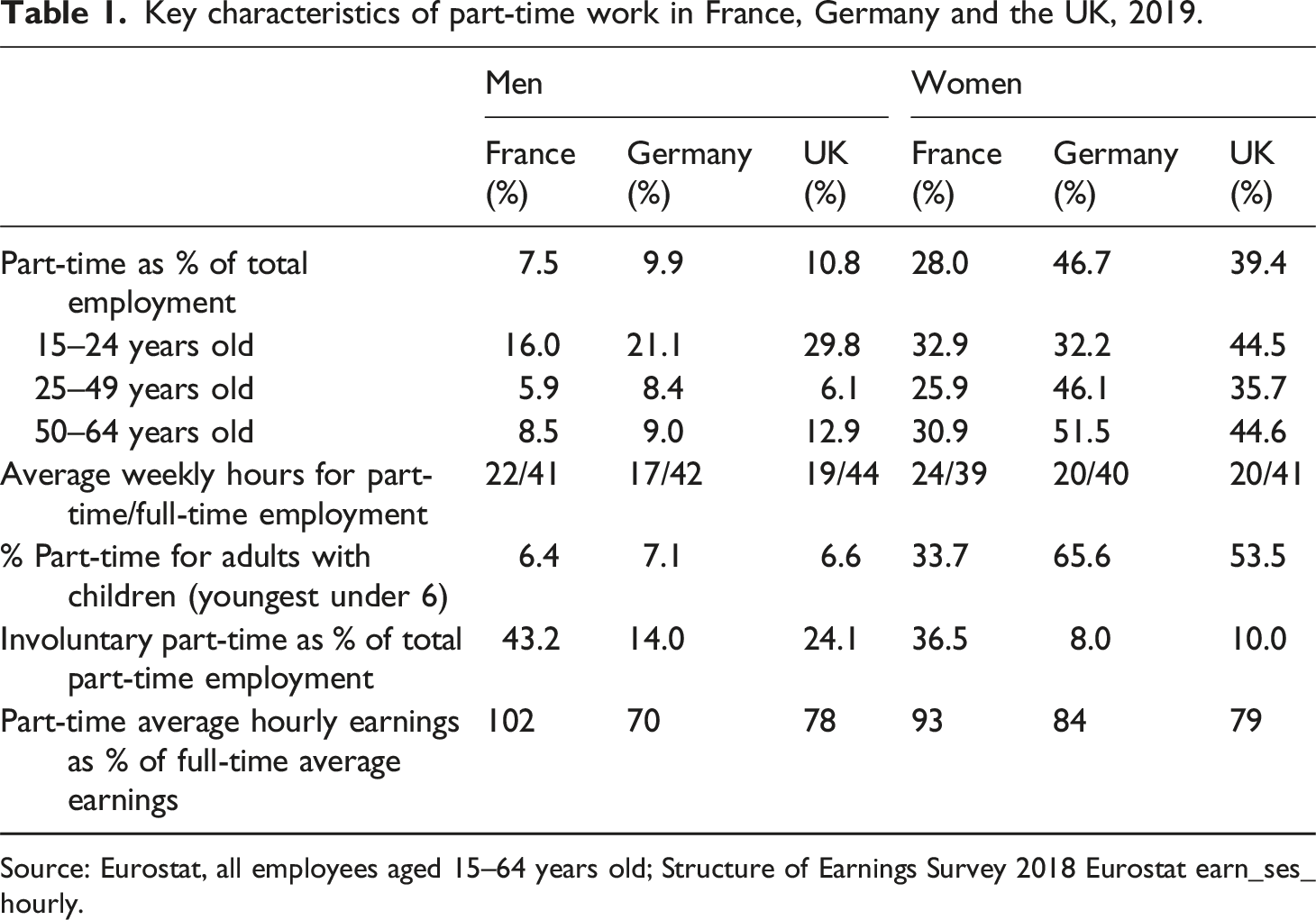
Source: Eurostat, all employees aged 15–64 years old; Structure of Earnings Survey 2018 Eurostat earn_ses_ hourly.
The spectrum of precariousness for part-time workers
These revealed variations in incidence and form of part-time are very much rooted in historical developments in gender and welfare systems. After the second world war France, keen to raise its birth rate, supported mothers to work full-time through affordable childcare (Lewis, 1992) while the UK and Germany assumed mothers would stay home or work part-time. This history has contributed to France’s high involuntary part-time work rate (Table 1), including among mothers. In contrast, Germany’s tax-splitting system has significantly subsidised families with one partner not working or working in a mini job. In the UK, incentives for women to work part-time stemmed both from tax subsidies for low-wage work for employers and workers and from very high childcare costs.
These historical differences have been overlain by more current regulations that are influencing both the overall precarity experienced by part-time workers and segmentation between groups of part-time workers. Figure 1 provides a schematic depiction of the spectrum of precariousness based on current employment regulation (legal and collective), where degree of precariousness is measured by distance from standard SER protections. The least precarious part-time jobs in all three countries are those where workers exercise rights to reduce hours (France and Germany) or to request reduced hours in the UK in SER-type jobs. These jobholders should retain SER protections, although progression opportunities for part-timers may still be more limited than for full-timers (Grimshaw and Rubery, 2015). Spectrum of precariousness for different types of part-time work.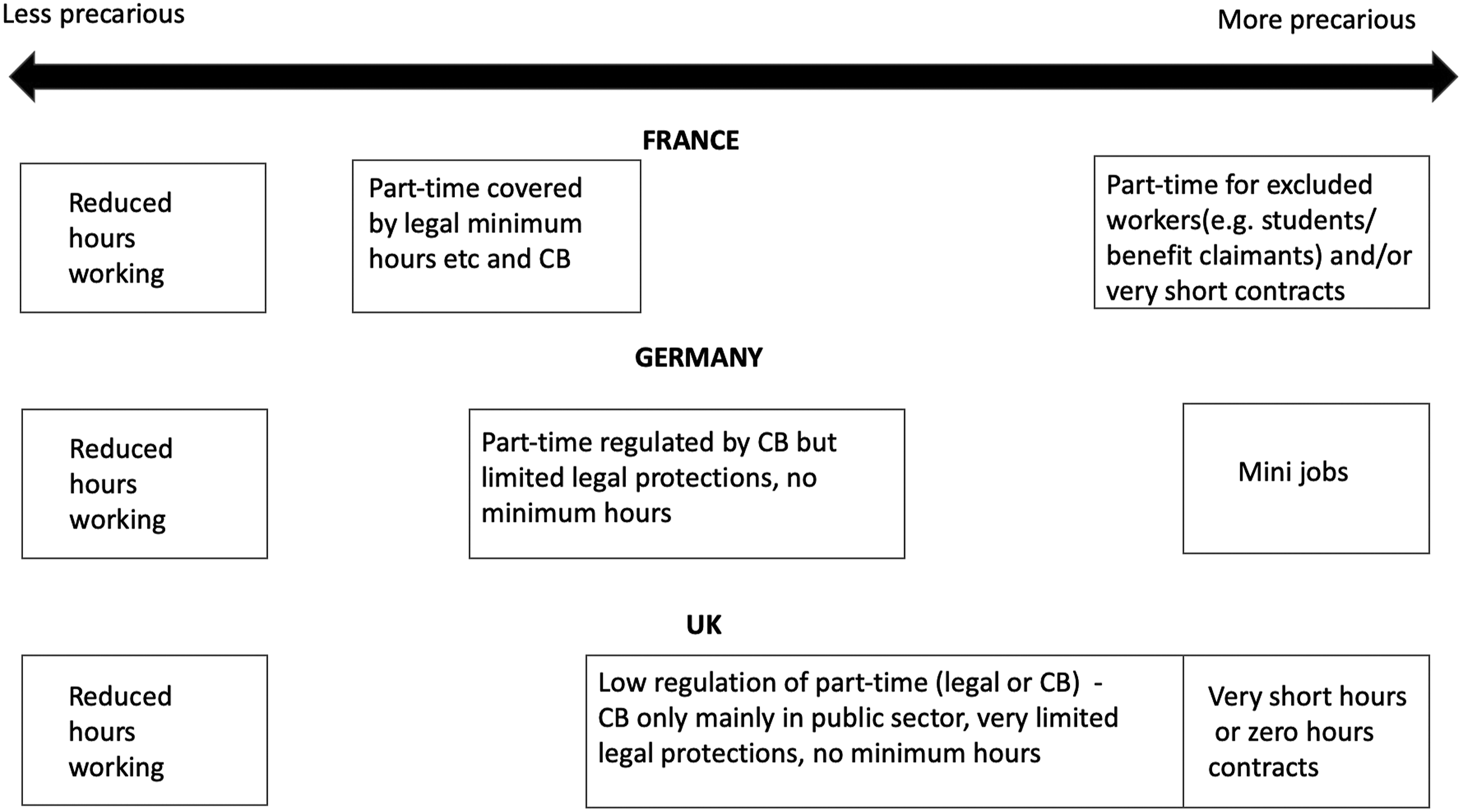
At the spectrum’s most precarious end are jobs designed as part-time and only guaranteeing short or even zero-hours contracts and very short duration contacts, typically less than a week, even if daily hours are full-time. In these jobs, employers have discretion over when and how much work is offered. Detailed comparative data on part-time work types is scant but the UK and Germany have more short hours jobs, while France and Germany, but not the UK, have regulations that limit employer opportunities to vary hours.
Although jobs in all three countries range across the whole spectrum, particularly as regulations may not be fully enforced, Figure 1 indicates where jobs are clustered on the spectrum due to historical systemic factors and contemporary regulations. France’s high level of regulation of minimum hours, variations in hours coupled with a high statutory minimum wage clusters part-time jobs towards the less precarious end. However, those excluded from regulations on hours (not the minimum wage) include anyone receiving in-work or unemployment benefits, students under age 26, those voluntarily opting out or covered by a collective agreement that has derogated from the 24-h minimum. Furthermore very short duration contracts, even if offering full-time daily hours, have grown in response to liberalisation of regulations for combining benefits with paid employment (Lamanthe et al., 2020).
In Germany the key divide is between mini jobs and other forms of part-time work. Mini jobs have a specific fiscal status: provided earnings fall below €450 per month they are free of tax and social insurance deductions, though employers must pay a 30% levy. These jobs are of particular importance for women with employed husbands as otherwise the tax-splitting system would require them to pay taxes from the first euro earned. This tax advantage also applies to mini jobs taken as second jobs, the main source of growth in mini jobs since 2009. 4 Since the national minimum wage, introduced in 2015, significantly reduced the financial benefits to employers, mini jobs have declined. Nevertheless, there is clear segmentation of part-time work in both France and Germany, as distinct regulations and conditions apply to different groups or categories of jobs.
In the UK segmentation is mainly between those on reduced hours versus all other part-time jobs, most of which are located at the precarious end of the spectrum due to weak legal and collective regulation. Some are employed on short hours contracts in order to save the employer and the employee the cost of social security contributions and these workers are excluded from social benefits. 5 However, unlike mini jobholders in Germany, UK workers on short hours can increase hours and earnings without incurring cliff-edge taxation on all earnings. Also, those with primary responsibility for children under 12 receive credits for pensions as well as citizen-based free healthcare. Mini jobs and tax-splitting in Germany and the social security contribution threshold and high childcare costs in the UK provide some explanation for their larger available labour supply for short hours work than France.
To explore the implications of this spectrum of part-time work in the three countries we consider the potential risks for workers with respect to four dimensions of employment quality – security, opportunity, fair treatment and life beyond work (Rubery et al., 2018). These capture the main SER protections but also highlight their limitations. For example, many women are unable to sustain an SER-protected job due to their commitments to life beyond work and the rigid organisation of some SER jobs. Similarly, opportunity under the SER may be biased towards those pursuing full-time linear careers.
The security of the SER stems from its open-ended contracts, full-time hours and access to social protection; in comparison, part-time workers risk low and insecure income due to low hourly wages, short and sometimes variable hours and limited social protection. France does most to mitigate these security risks: its high minimum wage reduces the gap between part-time and full-time hourly wages (Table 1) and its 24 h minimum contract (since 2014, initially 20 h in 1973) and requirement for contractual hours to be upgraded in line with actual hours mitigates risks of short and variable hours. Mandatory limits to overtime for part-timers to 10% of contractual hours and a mandating minimum 10% wage premium for extra hours disincentivises employers from varying hours. However, significant parts of the part-time workforce are excluded from these hours regulations (see above).
Security in Germany and the UK is weaker than in France though in both countries part-timers have been the main beneficiaries of new and/or uplifted national minimum wage systems; the UK’s minimum wage is now the highest in Europe after France and the German minimum wage is to be substantially uprated in 2022 from a relatively low level. Neither Germany nor the UK have done much to mitigate risks of short hours, although some German collective agreements do require upgrading of contractual hours to actual hours. In the UK, despite consultations on measures to limit so-called one-sided flexibility, legislation is still lacking. 6 Those on zero hours who work mainly for one employer should be treated as ‘workers’, entitling them to the minimum wage and holiday pay but many are still treated as self-employed. Employers increased their use of zero hours as unions became weaker (Jaehrling and Méhaut, 2013), growing supplies of migrant labour facilitated poor quality contracts (Connolly et al., 2014) and to evade new EU rules on equality for agency work (Grimshaw et al., 2016). Such contracts allow employers to withdraw shifts in the run up to redundancy or maternity dates, thereby limiting entitlements.
Part-timers may also face worse access to social protection. France and the UK have minimum pension entitlements for those qualifying for pensions; minimum benefits (or in the UK a low flat rate benefit for all) subsidise low paid workers, many of whom work part-time. In France, part-timers must work around 600 h per year at minimum wages to qualify for pension credits while in the UK they must work at least 700 at the minimum wage to qualify (2020 data). Moreover, fewer work short hours in France, while in the UK nearly two million workers fall outside social protection due to not earning enough to make contributions (TUC, 2020). In contrast, in Germany, pension entitlements are strictly proportional to the value of monetary contributions, thereby increasing reliance on derived pension rights via partners. Furthermore, while in principle mini jobbers in Germany have some basic employment rights including holiday pay and sick pay, surveys suggests employers and employees have low awareness of these rights (Bosch, 2017), a situation similar to that for zero-hours workers in the UK (CIPD, 2013). In Germany, those in mini jobs rely either on protection in their main job or on derived social protection rights from partners.
Increasingly important for mitigating income security risks, particularly in France and the UK, are in-work tax credits or opportunities to combine unemployment benefits with casual work; in France, this has led in part to the growth of very short duration fixed-term contracts (Lamanthe et al., 2020). However, many in part-time work –particularly women with employed partners –i are ineligible for household means-tested tax credits and in France those claiming tax credits are excluded from employment protections such as minimum hours.
Opportunity for part-time workers may be limited by risks of exclusion from SER-type training and career progression. Jobs designed as part-time tend to cluster in sectors with limited training and advancement opportunities. France includes part-timers in its individual training accounts policy, but part-timers still receive under a third of the training hours of full-timers (Céreq, 2014). In Germany, mini jobbers are in practice often excluded from further training (Bosch, 2017). Rights to flexible working (though only to request in the UK) allow a key group of part-time workers to retain their SER, and in principle opportunities to progress through internal training and development. In practice, many reducing hours may find themselves on ‘mommy tracks’ offering limited training and progression opportunities (Grimshaw and Rubery, 2015), despite the EU’s equal treatment directive. Partial rights to return to full-time hours in France (priority for full-time vacancies) and in Germany (for parents) may facilitate a rebooting of careers. In the UK, there is current consideration of allowing requests for flexible working from the point of hire, rather than after 6 months employment, to reduce women’s entrapment in jobs without advancement.
Risks to fair treatment for part-time workers arise both from less involvement in employee voice mechanisms and from their employment context. Mini jobbers and part-timers count for works council representation and in principle mini jobbers are as eligible for works council protection, for example, against dismissal, as regular employees. In France, part-timers are protected by equal treatment rules (on voting and eligibility). In the UK, there are no formalised representation rules and part-timers may be disadvantaged when employee voice mechanisms rely on informal communications with managers, due to their reduced presence at work (Marchington and Suter, 2013). In all three countries, the concentration of part-time work in low trade union membership sectors such as care, retail and hospitality reduces the likelihood of fair treatment, including rights to voice and grievance, as full-timers also experience limited rights in these workplaces. Legal redress against unfair treatment may also be more difficult. In the UK, low-wage workers were effectively excluded from legal action by the very high employment tribunal fees introduced in 2013 that caused a dramatic fall in cases. In 2017, just after our project ended, the supreme court deemed the fees discriminatory and cases rose again.
Many may take up part-time jobs to maintain a life beyond work, to combine other commitments (including education or care) with wage work. Ironically many may still struggle to maintain a life beyond work because employers may require those in non-standard employment to accept more variable, demand-determined schedules with regular scheduling more the norm in standard employment. Regulations on scheduling hours may mitigate these pressures. France requires mandatory collective bargaining over scheduling, interruption periods, and notice for schedule changes, all of which should reduce unpaid time spent waiting for work. Germany requires 4 days notice of schedule changes and on-call workers’ shifts must last at least 3 hours, with 10 h per week guaranteed, although collective agreements can derogate from these protections.
Overall, this review has revealed both major inter-country differences in the role and design of part-time work and intra-country variations in types of part-time work due to variations in the clustering of part-time work along the spectrum of precariousness and in the key lines of segmentation. Apart from the more protected workers on reduced hours, in France the main divide is between those covered by regulations and those excluded due to age, being students or on benefits, while in Germany it is between mini jobs and other part-time jobs that are more integrated into standard and regulated employment. In the UK, most part-timers face high risks due to limited legal and collective regulation.
Industrial relations actors, dualisation and the shaping of part-time work
Industrial relations actors play a significant role in shaping part-time work but that role, according to current debates, may not be supportive of reducing precarity but possibly a source of wider labour market divisions. From our exploration of factors shaping part-time work in three countries, a more nuanced approach to the dualisation debate is called for. In Germany, dualisation of employment conditions is not new; there is a legacy of wide inter-sectoral collective wage differentials with services and female-dominated sectors faring less well than manufacturing (Schäfer and Gottschall, 2015). Dualisation is also associated with the German gender relations and welfare system, in particular its tax-splitting system that encourages second earners to take up mini jobs which are tax exempt. In the Palier and Thelen golden age of German collective regulation, many women were outside the labour force, not even in mini jobs, and reliant on male-breadwinner wages and derived rights. No era of full inclusivity therefore ever existed. Assessing the stance of German unions is complicated. The German Trade Union Confederation (DGB) has passed multiple resolutions opposing mini jobs but with little impact to date, in part because of a lack of response from the state. However, union campaigning for a new national minimum wage (see below) did signal a major change in German industrial relations towards a more inclusive approach (Bosch, 2018; Marx and Starke, 2017) that has significantly increased wages in mini jobs, thereby reducing their numbers. Thus, the unions’ indirect inclusive strategies have been more effective than their stated direct opposition to mini jobs.
In France the dualisation argument focused more on the social protection system and inequalities in employment and income as wages structures are relatively integrated under its ‘close interaction’ system of minimum wage rules and extended collective agreements (Grimshaw et al., 2014). Palier and Thelen see the increasing segmentation of the social protection and employment systems (linked to expanding in-work benefits and opportunities to combine work with unemployment benefits) as evidence that weakened trade unions have acquiesced in a more exclusive pursuit of collective interests. In contrast, others see unions’ acquiescence as a response to persistent high long-term unemployment and the need to boost incomes and access to benefits for disadvantaged workers (Vlandas, 2013; Clegg, 2021). Those claiming benefits while working part-time are excluded from many legal protections for part-timers, including minimum hours (see above) but trade unions are not responsible for this exclusion. Unions have in fact promoted more ‘transferable rights’ for those changing jobs and fought against unemployment benefits reforms that could have decreased rights for the weakest segment of the workforce. Indeed research suggests it is employers who have gamed the system by designing very short duration contracts, often lasting only days even if offering full-time daily work (Lamanthe et al., 2020). However, as we argue below, industrial relations actors have been to some extent complicit in sanctioning short hours working as many collective agreements have derogated from the mandated 24 h part-time minimum.
In the UK dualisation is stronger on many dimensions including wider pay gaps between part-time and full-time workers, but trade unions have not been considered complicit. Instead these outcomes are attributed to neoliberal employment policies implemented in the UK context of weak sectoral bargaining without extension mechanisms. These factors combined to expose the UK workforce to widening inequality. The issue for UK trade unions is not whether to focus on areas of strength but how to exert any influence given their overall weakness. Trade unions have been proactive in efforts to combat precariousness through new organising activities and new regulatory demands, including using European law to force reforms in UK law (see below) – an approach spearheaded by feminist union activists (Heery and Conley, 2007). Thus, by the 1990s, trade unions were fully behind proposals for a national minimum wage, abandoning their more ambivalent position in the 1970s. This legislation in conjunction with the EU working-time directive raised pay and mandated paid holiday for part-timers. However, recent minimum wage increases have squeezed differentials in the bottom half of the labour market, a further sign of union weakness in protecting rights and wages for full-timers as well as part-timers.
To explore further the role of industrial relations actors in closing protective gaps for part-time workers, we examine differences between countries in relation to two major protective tools: use of legal instruments; and new forms of organising and social dialogue.
The legislative approach
One strategy for industrial relations actors to limit the precarity associated with non-standard work is to seek more legal protections. Variations in the three countries’ promotion of legislative measures to protect part-time workers reflect wider differences in their industrial relations systems and traditions. France’s greater use of legislation reflects its state-focused industrial relations system whereby the state either sets standards or mandates collective bargaining to set standards. In contrast, German and UK trade unions traditionally opposed direct state interventions in wage setting and other spheres, an approach that in some respects limited their capacities to address precarious conditions in non-standard work. Opposition to legislative measures in both cases has eroded over time, attributable in part to the challenges posed by non-standard employment, including part-time, to the capacity of voluntary collective bargaining to function without reinforcement from legal measures.
These country differences are evident in relation to the regulation of both the hours and wages of part-time workers. Only France has adopted statutory minimum hours; the 24 h weekly minimum was introduced in 2014 by translating a 2013 national collective agreement into law, indicating the integration of collective bargaining and legislation. The new law did not make a major difference to practice as part-timers’ average hours only rose from 23.2 in 2011 to 23.7 h in 2016 due to the prevailing social norm of long part-time hours. This norm has emerged through state support for combining work and family through early provision of affordable childcare and the long history of state-regulated hours including a legal floor of 20 h established in 1973. However, while supporting the national legal standard, industrial relations actors have in practice exploited opt-out possibilities for sectoral bargaining in the 2014 law. Out of 59 sectoral agreements examined in 2017 (covering approximately half of all part-time workers) the majority fixed a lower floor either for all workers or specified jobs, ranging from 2 to 23 h per week (Ministère du Travail, 2017); a minority maintained the legal threshold and only two agreements raised it. Therefore, although France is ahead of the other two countries in adopting a high statutory minimum, the industrial relations actors are negotiating opt-outs from these rules.
Lack of affordable childcare restricted mothers’ employment choices in Germany and the UK but the part-time work option was reinforced in the UK by lower social security costs for low-wage work and by the tax-splitting and mini jobs system in Germany. In the 1980s, UK trade unions sought to improve protection and challenge exclusions of part-time workers from benefits by using European law. They successfully made the case, before the EU’s Part-time Work Directive requiring equal treatment was introduced into UK law, that hours-based thresholds excluding part-time workers from sick pay, occupational pensions and redundancy payments was indirectly discriminatory (Heery and Conley, 2007). This turn to legislation can be considered an outcome of both the undermining of traditional trade union strength in the 1980s and the coincidence of European law becoming available as a new resource upon which to draw. Yet despite UK unions’ activity in pushing for a more comprehensive set of rights to underpin the floor to the labour market, these actions have not provided a platform for further development and integration in the SER. This is evident in the low pay and limited training opportunities for part-timers relative to full-timers, particularly in the private sector. Germany has had a more mixed system based on both stronger collective regulation and more legal employment rights than traditionally prevailed in the UK. German unions have therefore relied less on European law to protect part-time workers but Brexit undoubtedly reduces such opportunities for British trade unions.
The history of implementation of national minimum wages provides an even clearer example of both historical differences and processes of convergence in the industrial relations actors’ responses to precarious, low paid work. In France, the high minimum wage emerged as a political response to the 1968 political protests; a formula was agreed with unions to share the benefits of rising productivity with low earners as part of the upgrading of the minimum wage (Gautié and Laroche, 2018). As more part-timers are paid close to the minimum wage than full-timers, this formula benefitted part-timers, although the key union driver was for greater equality in the labour market, not an explicit concern for part-time workers. The UK union movement was converted to legal intervention following the massive decline in union power in the 1980s. The 1990s saw the abolition of the wages councils that had set legal minimum wages through quasi collective bargaining in some weakly organised and low-paying sectors, such as retail and catering, where part-time work was concentrated. As a result, part-timers’ wages fell in real and relative terms and were thus the main beneficiaries when the national minimum wage was finally introduced in 1999. By this time, the UK trade union movement fully appreciated part-time workers’ need for legal protection (Heery and Conley, 2007), although the decline in part-time wages in the 1990s may have encouraged the Low Pay Commission’s cautious approach to setting the minimum wage during the first few years.
In Germany, reliance on voluntary opt-ins to collective regulation became increasingly strained due to unification and employer associations’ increased reluctance to agree to extend agreements to non-signatory employers (Paster et al., 2020). The growth of posted workers and the expansion of mini jobs increased employer opportunities to undercut wages, resulting in a major increase in low-wage work, with a majority in part-time jobs. 7 This growing dualisation led to increased recognition among unions that collective bargaining alone could not plug the employment protection gaps. Nevertheless trade unions’ response in supporting a national minimum wage constituted a major turnaround in attitudes to state intervention. However, the trade unions also pushed for various measures to integrate the minimum wage within the overall collective bargaining system rather than allowing it to become a substitute for collective regulation. Social partners thus sit on the Minimum Wage Commission that uprates the minimum wage and new regulations facilitate public interest extensions of collective agreements. So far, the actual effects have been limited, mainly due to employer associations’ continued reluctance to extend collective agreements (Paster et al., 2020). Furthermore the 2022 announced 22% rise in the minimum wage to €12 was agreed not through collective negotiation in the Minimum Wage Commission but through a cross-party pact in the new federal government.
New forms of organising and new forms of social dialogue
An alternative response to precarious work by industrial relations actors is either to engage directly in organising those in precarious work or to work collaboratively with new forms of organising and new actors such as NGOs, community groups and independent unions to foster new forms of social dialogue. Indeed some regard the opportunities for organising and for protest associated with growing precarious work as a potential catalyst for renewing and reviving trade unionism and collective action (Meardi et al., 2019; Milkman, 2013; Stone and Arthurs, 2013).
The UK is regarded as having led the way in Europe in developing an organising model for renewing trade unions through recruiting excluded workers often in precarious work including part-time jobs (Vandaele and Leschke, 2010). Mobilisation by both traditional and new unions, such as the Independent Workers Union of Great Britain, has been central to efforts to improve conditions for workers on short and variable hours who may also be denied basic worker rights, namely, minimum wages, holiday pay and sick leave. Organising has been key to efforts to enforce existing rights. UK unions have also worked actively with NGOs, particularly the Living Wage Foundation that has led the campaign for a voluntary living wage. Trade unions have taken up the baton and used various strategies from local campaigns to strategic work with major clients or public bodies to promote living wages via procurement for both social justice and reputational reasons (Heery et al., 2017). Unions have campaigned for employers and public bodies to sign up to good employment charters and the public services union, UNISON, launched an ‘ethical care charter’ to raise standards in social care (Johnson et al., 2021). Local authorities that sign up to the charter must adopt living wages (as defined by the NGO) and no zero-hours contracts as standards in their procurement policy with private sector care providers. These initiatives have, however, been constrained by austerity budget cuts to local authorities that fund social care.
According to Vandaele and Leschke (2010), German unions were slower than UK unions to develop an organising approach. Nevertheless, in the 2000s a change in direction occurred, with major trade unions including IG Metall making efforts to recruit temporary agency workers and establish works councils in temporary agencies. These were mainly full-time manufacturing workers and efforts to organise part-time and mini job workers have had only limited effectiveness to date. Attempts to organize employees in the German cleaning sector enjoyed some success in 2009 when regional strikes were held for the very first time in that sector and received a very positive public reaction (Knoche-Gattringer, 2009). However, mobilisation efforts continue to be severely hampered by cleaners’ low bargaining power due to their short-term and short hours contracts. Moreover, the relationship between union effectiveness and mini job workers’ status is interdependent: where mini jobs are concentrated, such as in retail, the trade unions and collective bargaining systems are also weaker.
In France trade unions, despite low membership, are still able to mobilise large scale protests by workers who are sympathetic to union demands even if not actually members. Thus, organising of both traditional and new types of members has not been high on the agenda in France, although some unions are promoting new forms of organising for the unemployed, for migrants and for self-employed platform workers, such as Uber and the like. Action remains focused at the national/sectoral level and most efforts to promote the interests of part-timers and those on variable hours contracts have focused on working hours as the relatively high statutory minimum wage provides limited scope to raise basic wage rates at a local or sectoral level (Grimshaw et al., 2016).
Discussion and conclusion
Each country studied here has faced quite specific challenges in seeking to alleviate the precarious working conditions found in jobs that fall outside the full scope of protections afforded by a standard employment relationship (SER). This article uses the investigation of protections for part-time work as a specific precarious employment form through which to contribute to the comparative dualisation debate over whether industrial relations’ actors are seeking to mitigate or are acquiescing in dualisation processes. This required first an exploration of variations in incidence and form of part-time work (a ‘spectrum of precariousness’) in France, Germany and the UK. Explanations for these variations were sought through a theoretical frame that layers the actions of industrial relations actors against a backdrop of welfare and labour market rules and gender relations, thereby revealing important path dependencies in patterns of working. For example, in Germany the mini jobs system arises primarily out of its tax-splitting policy and associated gender relations; in the UK, low pay and insecure contracts for part-timers arise out of its flexible employment system; and in France efforts to regulate minimum hours arise out of both the compressed wage structure at the bottom of the labour market and the opposition to part-time working among women as well as trade unions.
By exploring both the shaping role of regulations and institutional factors and the strategies and actions adopted by industrial relations actors, we identified significant variations in the extent and lines of segmentation both between part-time work and full-time or standard work and within this category of non-standard employment. Our evidence points to a more segmented picture than is associated with dualisation arguments and also confirms the importance of unions’ twin strategies of using legislative instruments and new forms of organising in varied efforts to improve protections for part-time workers, albeit sometimes with only partial success.
These different segmentation patterns are manifest not only in the variable incidence of types of part-time work across the three countries, but also in the different lines around which the workforce is segmented. In France, the dominance of the minimum wage in the low-wage labour market raises the significance of hours and contract in providing income security. In Germany, there is more variation in pay, both between mini jobs and regular part-time work and by sector as the collectively bargained minimum wages provide varying uplifts above the national minimum wage. The UK follows France in the dominance of the minimum wage, though until recently at a lower level of relative pay. Here, the divide between jobs designed as part-time and SER jobs at reduced hours – mainly in the public sector – is probably stronger than in the other two countries because of low collective regulation, especially in sectors where part-time is concentrated. There is a further divide between those on minimum hours or zero-hours contracts and those with guaranteed hours. The growth of in-work tax credits in France and particularly the UK has created another form of segmentation between those in claimant households (mainly single parents and overall low income households) and those ineligible under the household means-testing rules for income subsidies.
In comparing industrial relations actors’ responses to the challenges of part-time work, France had clearly done most to integrate part-time work within the norms of an SER, including the legal mandating of sufficient hours for a decent income. Yet these protections increasingly apply only to those who are neither young nor in receipt of benefits and, crucially, only where sectoral collective agreements have not set standards below the statutory minimum. UK trade unions have also been working towards a more inclusive and integrated labour market, albeit from a lower starting point; notable strategies include involvement in living wage campaigns led by an NGO, campaigning to abolish zero-hours contracts and efforts to organise non-standard workers. German trade unions’ main response has been support for a national minimum wage system, which has raised pay for mini jobs and somewhat reduced their prevalence. 8 This is an indirect but largely welcome consequence of the national minimum wage strategy which has served the twin aims of shoring up the existing collective bargaining system (although so far with limited impact on extensions of agreements (Schulten, 2021)) and creating a more inclusive wage setting system.
Overall, this comparison has demonstrated that, while industrial relations actors’ strategies are significant in shaping the use and the conditions associated with non-standard employment, these outcomes need to be understood against a specific backdrop that extends beyond industrial relations’ traditions to labour and welfare institutions, especially social protection (taxes and subsidies), minimum wages, working-time measures and support for working parents. This cross-layered complexity of actor strategy and institutional shaping generates potential for considerable variation in precariousness between and within countries even for the seemingly similar example of part-time work. In a context of increasing calls for the re-institutionalisation of Europe’s labour markets post-Covid-19 (e.g. ILO and OECD, 2020; Spasova et al., 2021), further detailed empirical investigation of the limits and opportunities presented by labour market regulations and trade union actions is critical to understanding the scope for national and pan-national efforts to promote more inclusive, secure and dignified employment for all workers.
Footnotes
Acknowledgements
We are grateful to the European Commission and to the full teams in France, Germany and the UK who provided the national reports on which this comparative analysis by the current authors draws. French team: C. Kornig, N. Louit-Martinod, P. Méhaut, V. Insarauto; German team: K. Jaehrling, C. Weinkopf, I. Wagner, G. Bosch, T. Kalina; UK team D. Grimshaw, M. Johnson, A. Keizer, J. Rubery
Declaration of conflicting interests
The author(s) declared no potential conflicts of interest with respect to the research, authorship, and/or publication of this article.
Funding
The author(s) disclosed receipt of the following financial support for the research, authorship, and/or publication of this article: This article draws on results from a European commission-funded project on reducing precarious work: protective gaps and the role of social dialogue (DG Employment, Social Affairs and Equal Opportunities VP/2014/004, Industrial Relations and Social Dialogue) coordinated by Damian Grimshaw.