




Abstract
This study aims to longitudinally investigate the undesirable effect of overwork climate and its underlying mechanism in the context of telework. Teleworkers have been known for intensive working and even overwork. Moreover, although some empirical evidence shows the adverse effects of overwork climate, its longitudinal effects and mechanism have been underexplored thus far. Consequently, this study expected overwork climate to be related to lower levels of psychological detachment that eventually leads to higher exhaustion, with this effect being more profound among full-time teleworkers. The authors base their analyses on a two-wave study with four-month time intervals, with a sample of 375 teleworkers. The results show that an overwork climate led to exhaustion four months later due to impaired ability to detach from work. Notably, this effect was more substantial among those teleworkers who worked from home full-time.
Introduction
Long work hours have become characteristic of a large portion of the global workforce (Messenger, 2018). Organizations might pressure employees to work extra hours to compensate for a shortage of workforce (Hart, 2004), while managers might consider employees’ willingness to overwork an indicator of their effort and commitment (Golden, 2009). Because overwork is related to lower job satisfaction and impaired health (Tucker and Rutherford, 2005), resulting in poor recovery, burnout symptoms and negative work–home interference (Van der Hulst and Geurts, 2001), it is crucial to understand its causes. Significantly, neither economic nor sociological explanations have clarified the rapid increase in overwork. Therefore, researchers (e.g. Feldman, 2002) have urged to search for individual and organizational factors.
Mazzetti and colleagues (2016) presumed that employees’ tendency to work excessive hours might be motivated by the perception of a work environment that encourages overwork, i.e. overwork climate. Accordingly, they have developed a measure for overwork climate and found overwork climate to foster workaholism. Similarly, Afota et al. (2020) found overwork climate to be related to higher strain eight months later. However, except for the study by Afota et al. (2020), to the best of our knowledge, no studies have explored the longitudinal effects of overwork climate and its mechanism.
Based on the theory of situational strength (Mischel, 1973, 1977), we assume that by conveying expectations to engage in work behaviourally or mentally, an overwork climate will impair employees’ ability to detach from work psychologically and eventually lead to exhaustion. We examine this effect in the context of working from home. The research in this area is particularly relevant as due to the COVID-19 pandemic, the rate of employees working from home increased up to 48% (Eurofound, 2020b). Moreover, organizations will likely retain working from home after the pandemic (Eurofound, 2021a). If this is the case, understanding the benefits and pitfalls of working from home is indispensable.
Teleworkers have been known for intensive working and even overwork (Ojala et al., 2014; Quinlan and Bohle, 2008). Moreover, the more intensive the teleworking, the longer working hours and the more health problems the teleworkers face (EU-OSHA, 2021). Furthermore, teleworkers usually try to compensate for their absence in the organization by dedicating extra time and energy to their work (Hill et al., 2003). Consequently, we expected overwork climate to be related to lower levels of psychological detachment that eventually leads to higher exhaustion, with this effect being more profound among full-time teleworkers.
With this study, we make a few timely contributions to the literature. First, we longitudinally test the negative effect of overwork climate and its mechanism. Although overwork climate has been shown to contribute significantly to extensive working (Mazzetti et al., 2016), to the best of our knowledge, only one study to date (Afota et al., 2020) has investigated its detrimental effects longitudinally. Our study sheds light on the cross-lagged effect of overwork climate and its mechanism. Second, we demonstrate that an overwork climate might be particularly harmful to those who work from home all the time. Albeit previous empirical evidence shows teleworkers complain about being overworked (e.g. Galinsky et al., 2001), our study demonstrates that the negative effect is more profound among employees working from home on a full-time basis. This way, our study adds to the growing body of empirical research about the benefits and pitfalls of telework during the lockdown caused by the COVID-19 pandemic. Third, we offer valuable practical implications by suggesting certain practices that organizations might use to prevent the adverse effects of teleworkers’ exhaustion.
Theoretical framework and hypotheses
Overwork climate and its correlates
Overwork climate refers to the perception of a work environment that encourages overwork (Mazzetti et al., 2016). More precisely, when overwork climate is high, employees perceive that to complete their tasks, be handed over for a promotion, and be valued by the supervisor in general, they need to perform overwork. Thus, the overwork climate is mainly driven by management and supervisors who expect employees to overwork and encourage it by employing specific procedures, policies and practices and acting as role models themselves (Ostroff et al., 2003). Hence, the organizational environment where employees are pushed to overwork might significantly enhance intensive working (Porter, 2004). For example, a study by Mazzetti and colleagues (2016) showed overwork climate to have a strong positive association with workaholism. Moreover, in their research on the antecedents of workaholism, Mazzetti et al. (2014) have found that overwork climate can foster workaholism, especially in combination with certain individual factors, such as perfectionism, achievement motivation, self-efficacy and conscientiousness.
These results align with the theoretical reasoning provided by the theory of situational strength (Mischel, 1973, 1977) that emphasizes the role of situations in guiding behaviours. Situation strength denotes the extent to which situations constrain behaviours (Judge and Zapata, 2015). In strong situations, individuals have a clear perception of which behaviours are assumed appropriate, the rewards for displaying them, and the negative consequences associated with a failure to show them (Meyer et al., 2010; Mischel, 1977). Alternatively, there are no apparent clues in weak situations as to what appropriate behaviours are, resulting in more behavioural latitude for individuals (Mischel, 1973).
Following this reasoning, we argue that an overwork climate offers clear guidelines for employees as to how much to invest into their work and might impair psychological detachment from work. A psychological climate denotes the subjective perception of employees regarding features of their work environment. It defines how employees individually make sense of the behaviours that are expected in the organization (Parker et al., 2003). If psychological climate unambiguously points towards specific behaviours, it creates strong situations that impact individual behaviours. Even if we consider psychological climate a subjective interpretation of the environment (James et al., 1978), as long as it conveys what behaviours are expected and rewarded, it may ‘result in psychological pressure on the individual to engage in and/or refrain from particular courses of action’ (Meyer et al., 2010: 122). In other words, if an individual employee perceives certain behaviours to be encouraged, he/she will likely perform them, disregarding the degree of variability in individual climate perceptions within the organization, because climate ‘remains a property of the individuals regardless of the agreement or disagreement among individuals’ perceptions’ (James et al., 2008: 20). Meta-analytical research (e.g. Carr et al., 2003) supports this idea by showing that individual climate perceptions mediate the relationship between work environment and employees’ outcomes.
As mentioned in the previous section, overwork climate reflects the perception that the work environment ‘requires and expects employees to perform overwork’ (Mazzetti et al., 2016: 884). Thus, for example, a high overwork climate would signal that working in the evening or during the weekend are the behaviours that are expected and valued in the organization (Mazzetti et al., 2014). Moreover, such behaviours are essential for success and career advancement (Schaufeli, 2016). In contrast, those who do not engage in expected behaviours might be punished via lower performance evaluations or poorer career opportunities. Thus, by and of itself, psychological climate functions as a situational factor that induces or inhibits individual behaviour.
In line with this reasoning, we claim that a high overwork climate will impair employees’ ability to detach from work psychologically. When the overwork climate is high, employees will feel the expectation and the corresponding obligation to engage in work behaviourally or mentally. As a result, they will likely ruminate about unfinished work tasks even after working hours, and will be more prone to answer work-related calls or emails or even perform work tasks that will impair their detachment from work. When employees remain available for work-related issues after working hours, psychological detachment will unlikely occur (Barber and Jenkins, 2013; Park et al., 2011).
Moreover, failure to detach from work inherently means that an employee is constantly exposed to job demands. According to the job demands-resources (JD-R) theory (Bakker and Demerouti, 2014), work demands require sustained effort and attention. When employees do not detach themselves from their work during their free time, work-related thoughts continue draining their resources. Not surprisingly, failure to break from these demands leads to adverse health and well-being outcomes, including exhaustion (Sonnentag et al., 2010). Furthermore, reduced psychological detachment can undermine the restoration of depleted resources. It implies that employees return back to work in a not fully recovered state the next day. Correspondingly, more effort has to be invested in order to meet job demands (Binnewies et al., 2009), leading to higher strain. Indeed, the large scale of empirical evidence shows that inability to detach oneself from work might increase strain and deteriorate well-being, such as impaired mood, fatigue and lower life satisfaction (e.g. Sonnentag and Fritz, 2015). Impaired psychological detachment is especially likely when information and communication technologies are used. For example, Derks et al. (2015) have demonstrated that the supervisor and colleagues’ norms regarding availability and connectedness in private hours determine how information and communication technologies intrude into the family domain. Similarly, Dettmers (2017) found extended work availability to be related to increase in emotional exhaustion over time. Initial empirical evidence shows that overwork climate is related to strain over time (e.g. Afota et al., 2020). Based on these theoretical considerations and existing research, we infer that overwork climate will impair psychological detachment, resulting in emotional exhaustion, and hypothesize as follows:
H1: Overwork climate will be related to higher exhaustion over time through lower psychological detachment.
The intensity of working from home as a moderator in the relationship between overwork climate, psychological detachment and exhaustion
As discussed in previous sections, we expect an overwork climate to result in lower psychological detachment, eventually leading to higher exhaustion. We also assume these effects to be more robust under the high intensity of working from home.
We base our assumption on the following rationale. First, teleworkers work longer hours, work more often on irregular schedules and have shorter rest periods between working days than the rest of the workforce (EU-OSHA, 2021). This tendency was observed to be more pronounced among highly mobile workers. In contrast, employees who work from home occasionally reported high-quality working time, similar to those always working at an employer’s premises. As suggested by Eurofound (2020a), intensive forms of telework might impair working time quality.
Second, putting extra time and effort into work is especially likely among those working from home. Existing empirical studies show that teleworkers report more social isolation (Kurland and Bailey, 1999), receive less pay and benefits and experience more job insecurity (Rovi, 1997). Moreover, telework might negatively impact career prospects. Because employees who work from home do not share the same physical space and time with colleagues and supervisors, they are less connected to the informal network necessary for advancement. Additionally, spending less time in the office increases anxiety of being passed over for promotion (Judiesch and Lyness, 1999). Indeed, teleworkers consider themselves at a disadvantage in their performance review and development process (Kelliher and Anderson, 2008). The reasons mentioned above might prompt teleworkers to compensate for their invisibility in the organization by dedicating more time and energy to their work. Some empirical studies show that teleworkers often complain about being overworked (e.g. Galinsky et al., 2001) and are more susceptible to workaholism (Hill et al., 1998). Since teleworkers are more likely to perform overwork in general, we expect them to be more responsive to implicit overwork expectations communicated by the organization. More precisely, employees working from home will react more intensively to cues indicating that the organization expects intensive working. Consequently, we expect the intensity of working from home to moderate the relationship between overwork climate, psychological detachment and exhaustion and propose the following hypothesis:
H2: The overwork climate will be related to higher exhaustion through lower psychological detachment so that this relationship is stronger among those who work full-time from home.
The hypothesized model is depicted in Figure 1.
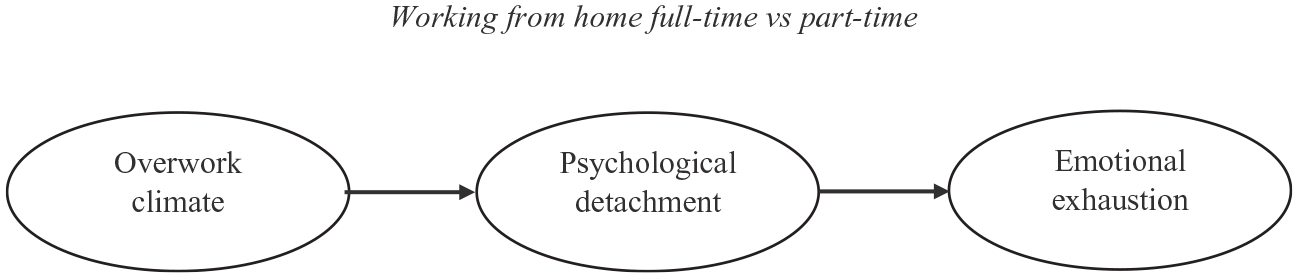
Research model.
Method
Participants and procedure
To recruit the participants, we relied on network sampling with the help of student research assistants. Prospective participants were contacted through email and invited to take part in the survey. After completing the initial questionnaire, respondents were invited to participate in the second wave of the study and were asked to express their consent by providing a contact email address. Two surveys were spaced by a four-month interval, a period that allows limiting respondent attrition due to organization or supervisor change. Participating in the first wave were 375 white-collar employees holding one job. The sample consisted of 286 (76.3%) women and 89 (23.7%) men ranging in age from 18 to 65 years (M = 34.35; SD = 12.370); 61.3% of the respondents worked in the public sector, and 38.7% worked in the private sector; 81% of the sample held full-time jobs; the average tenure was 6.37 years (SD = 8.28 years).
The number of employees participating in both waves was 236, with a response rate of 67.8%. We conducted a dropout analysis by comparing the two groups on the study and control (age, gender, education, sector) variables. It showed that those individuals who dropped out of the study were somewhat younger (t = −3.248, df = 336, p = .001) and more likely to be male (χ2 = 5.128, df = 1, p = .024) than the remaining respondents. However, the results of the first phase of the study only trivially predicted which subjects would remain in the second phase of the study when all of the study and control variables were included as predictors into a logistic regression model (Nagelkerke R2 = .069). Hence, it can be concluded that attrition bias was low.
Measures
The survey included demographic questions, as well as items measuring study variables.
Overwork climate was measured with the Overwork Climate Scale (Mazzetti et al., 2014). This measure consists of eight items, rated on a five-point Likert-type scale, ranging from 1 – totally disagree to 5 – totally agree. A sample item is: ‘Almost everybody expects employees to perform unpaid overtime work’.
Psychological detachment was assessed by a subscale from the Recovery Experience Questionnaire (Sonnentag and Fritz, 2007). The subscale consists of four items, rated on a five-point Likert-type scale, ranging from 1 – totally disagree to 5 – totally agree. A sample item is: ‘During time after work, I forget about work’.
Emotional exhaustion was measured by four items obtained from the Oldenburg Burnout Inventory (Demerouti et al., 2003). All items are rated on a four-point Likert-type scale ranging from 1 – totally disagree to 4 – totally agree. A sample item is: ‘There are days when I feel tired before I arrive at work’.
Intensity of teleworking was assessed by asking respondents to indicate how many days per week they were working from home. Based on their answers, the respondents were divided into two subsamples: those working from home part-time (n = 109) and working from home full-time (n = 239).
Because the current study was based on two-wave multi-group data, all scales were tested for measurement invariance. Regarding longitudinal invariance, full scalar invariance was established for the overwork climate and detachment measures, and full metric invariance was found for the exhaustion measure. Regarding multi-group invariance (i.e. across the two subsamples), full scalar invariance was established for all measures. More detailed information on these analyses is available from the first author upon request.
Data analyses
The data were analysed through structural equation modelling with Mplus version 8.7. The study variables were represented by the following latent constructs: exhaustion comprised of four item-level indicators, detachment comprised of four item-level indicators, and overwork climate comprised of four two-item parcels. We used the item-to-construct balance approach for creating item parcels (Little et al., 2002), based on factor loadings from a unidimensional overwork climate model. Furthermore, descriptive and measurement model analyses were conducted at both time points. To establish the best measurement model, we estimated the hypothesized three-factor model of the main study variables (i.e. overwork climate, detachment and exhaustion) and compared it to alternative two-factor models as well as to an overarching one-factor model.
To test the hypotheses, indirect effects were analysed using cross-lagged modelling. Because our data are based on two time points, partially longitudinal mediation was tested first, as suggested by Cole and Maxwell (2003) and Taris and Kompier (2006). Following their recommendations and prior research practices (e.g. Nikolova et al., 2019; Vander Elst et al., 2014), two series of cross-lagged models were estimated to inspect the direction of the effects. Specifically, we investigated the so-called path a model comprising overwork climate as the hypothesized predictor and detachment as the mediator. Four competing models were compared to this end: a stability model that consists of auto-regressive paths; an expected direction model that additionally estimates a cross-lagged relationship between T1 overwork climate and T2 detachment; a reversed direction model that links T1 detachment to T2 overwork climate; and a fully reciprocal model. The same procedure was repeated for path b comprising detachment and exhaustion. The best fitting path a and path b models were selected based on these results and included in final mediation analyses. In addition to the lagged pathway, a cross-sectional path a (i.e. T1 Overwork climate -> T1 Detachment) was also added to the final mediation model, which allowed us to inspect a half-longitudinal indirect effect as well. Although a lagged analysis provides more robust evidence about the direction of the effects, it is theoretically possible that overwork climate has an immediate effect on detachment, and for this reason both cross-sectional and lagged paths a were estimated. Notably, whereas due to the two-wave design path c cannot be tested in partial longitudinal mediation (cf. Cole and Maxwell, 2003), its estimation would make sense in a half-longitudinal model. Therefore, a direct path from T1 overwork climate to T2 exhaustion was included in the final analyses.
Hypothesis 1 was tested on the full sample (N = 375) by computing the indirect effects ab. They were estimated using 5000 bootstrap samples. The decision about the existence of an indirect effect was based on 95% bootstrap confidence intervals not overlapping with zero. Hypothesis 2 was tested using a multi-group approach, where the subsample of participants working from home part-time (n = 109) was compared to the subsample working from home full-time (n = 239). The indirect effects were compared across the subsamples via the model constraint command in Mplus. To benefit from all available information, missing data were accounted for by means of full information maximum likelihood (FIML) in all analyses.
Results
Means, standard deviations and correlations between the study variables are provided in Table 1. Age and gender showed either non-significant or trivial correlations with the main study variables. Therefore, they were not included as covariates in further analyses. Interestingly, working from home part-time versus full-time did not seem to relate to the levels of the main variables either. The largest correlation coefficients were observed between the same variables measured at different time points, whereas overwork climate, detachment and exhaustion showed moderate intercorrelations, the weakest r = .28, and the strongest r = –.46. Subsequent measurement model analyses are reported in the online Appendix. Results showed that the hypothesized three-factor structure had the best fit to the data at both time points. Hence, the investigated constructs were considered distinct from each other.
Means, standard deviations and intercorrelations between the study variables.
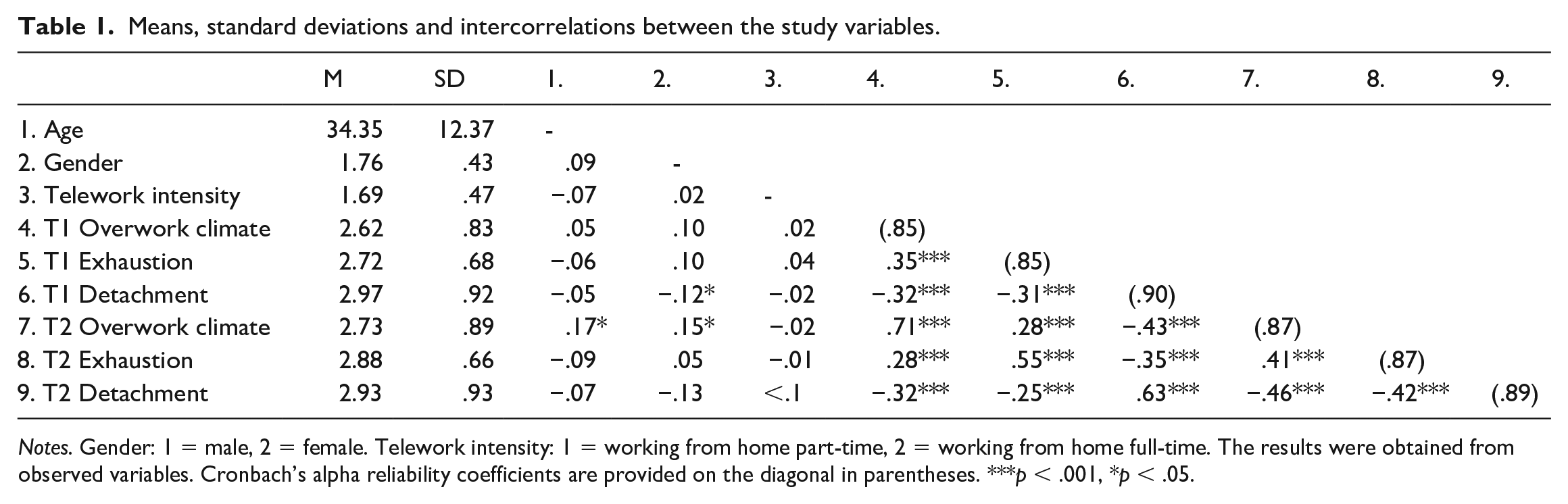
Notes. Gender: 1 = male, 2 = female. Telework intensity: 1 = working from home part-time, 2 = working from home full-time. The results were obtained from observed variables. Cronbach’s alpha reliability coefficients are provided on the diagonal in parentheses. ***p < .001, *p < .05.
Table 2 shows the results from path a (series 1) and path b (series 2) cross-lagged model analyses. As seen in the table, both the expected and reversed direction models fit to the data better than the autoregressive model, Δχ2(1) = 4.29, p < .05 and Δχ2(1) = 13.08, p < .001, respectively. The reciprocal model provided a better fit than the expected direction model, Δχ2(1) = 11.89, p < .001, but it was not superior to the reversed direction model, Δχ2(1) = 3.10, p = .08. In light of the inconclusive results, we prioritized the reciprocal model as it outperformed at least one of the one-directional models and allowed us to further test the hypothesized indirect effects. Furthermore, series 2 analyses suggested the expected direction model as the most optimal one. It provided a better fit than the autoregressive model, Δχ2(1) = 12.42, p < .001, whereas the alternative reversed direction model did not, Δχ2(1) = 2.42, p = .12. The reciprocal model did not outperform the expected direction model, Δχ2(1) = 1.62, p = .20, hence the latter was retained for final analyses.
Path a and path b cross-lagged model comparison.
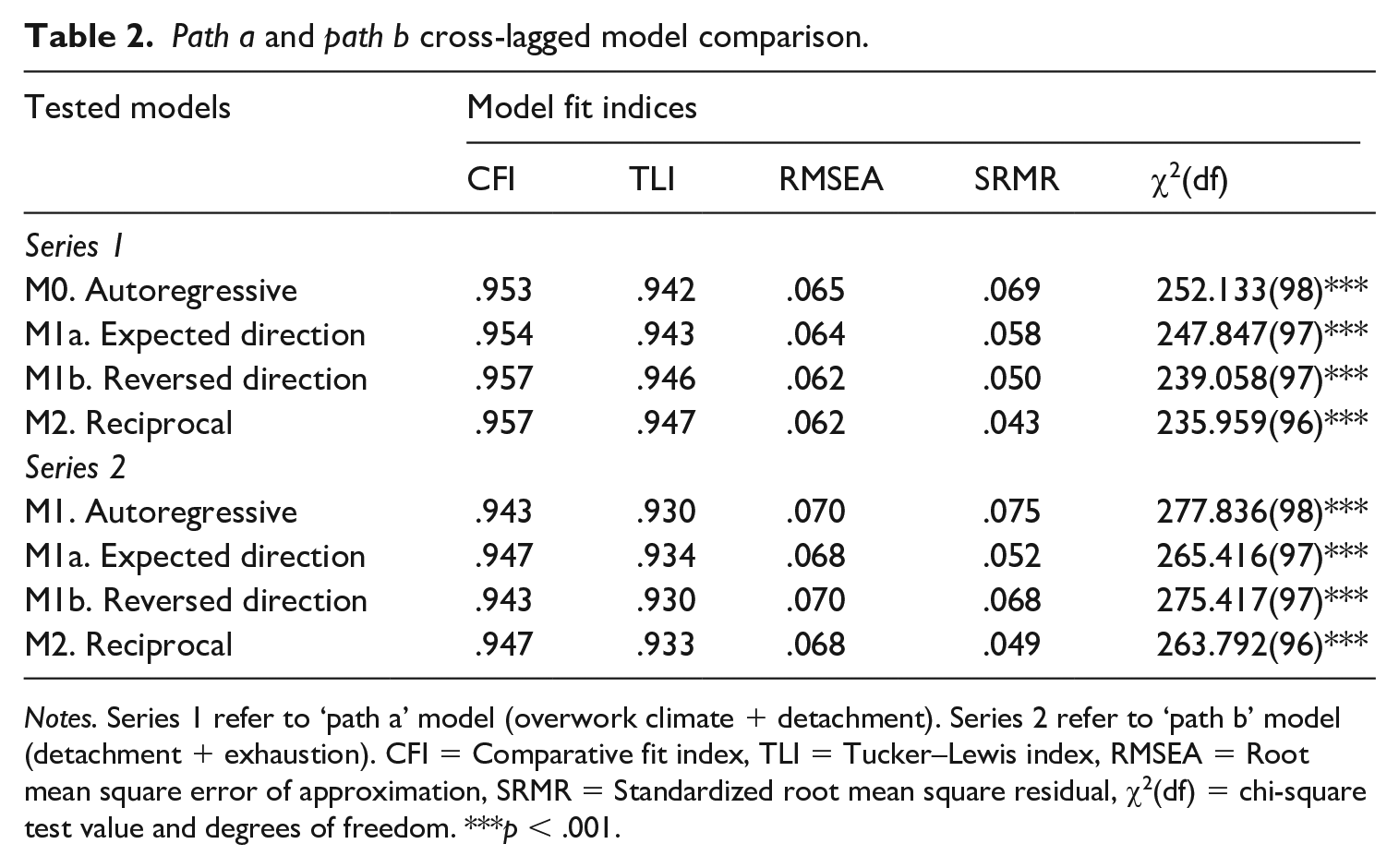
Notes. Series 1 refer to ‘path a’ model (overwork climate + detachment). Series 2 refer to ‘path b’ model (detachment + exhaustion). CFI = Comparative fit index, TLI = Tucker–Lewis index, RMSEA = Root mean square error of approximation, SRMR = Standardized root mean square residual, χ2(df) = chi-square test value and degrees of freedom. ***p < .001.
Table 3 informs about the regression paths obtained in mediation analyses. The full sample model fit the data well, χ2(228) = 453.93, p < .001, CFI = .952, TLI = .942, RMSEA = .051, SRMR = .059. The cross-lagged relationship between overwork climate and detachment (i.e. lagged path a) was not significant, which also resulted in a marginal longitudinal indirect effect linking overwork climate to exhaustion via detachment, a1bunstandardized = .016, 95%CI [.001; .043]. By way of contrast, a substantial half-longitudinal effect composed of the concurrent path a and lagged path b was observed, a2bunstandardized = .053, 95%CI [.017; .104]. Hence, Hypothesis 1 was supported.
Standardized regression estimates in the full sample and by telework intensity.
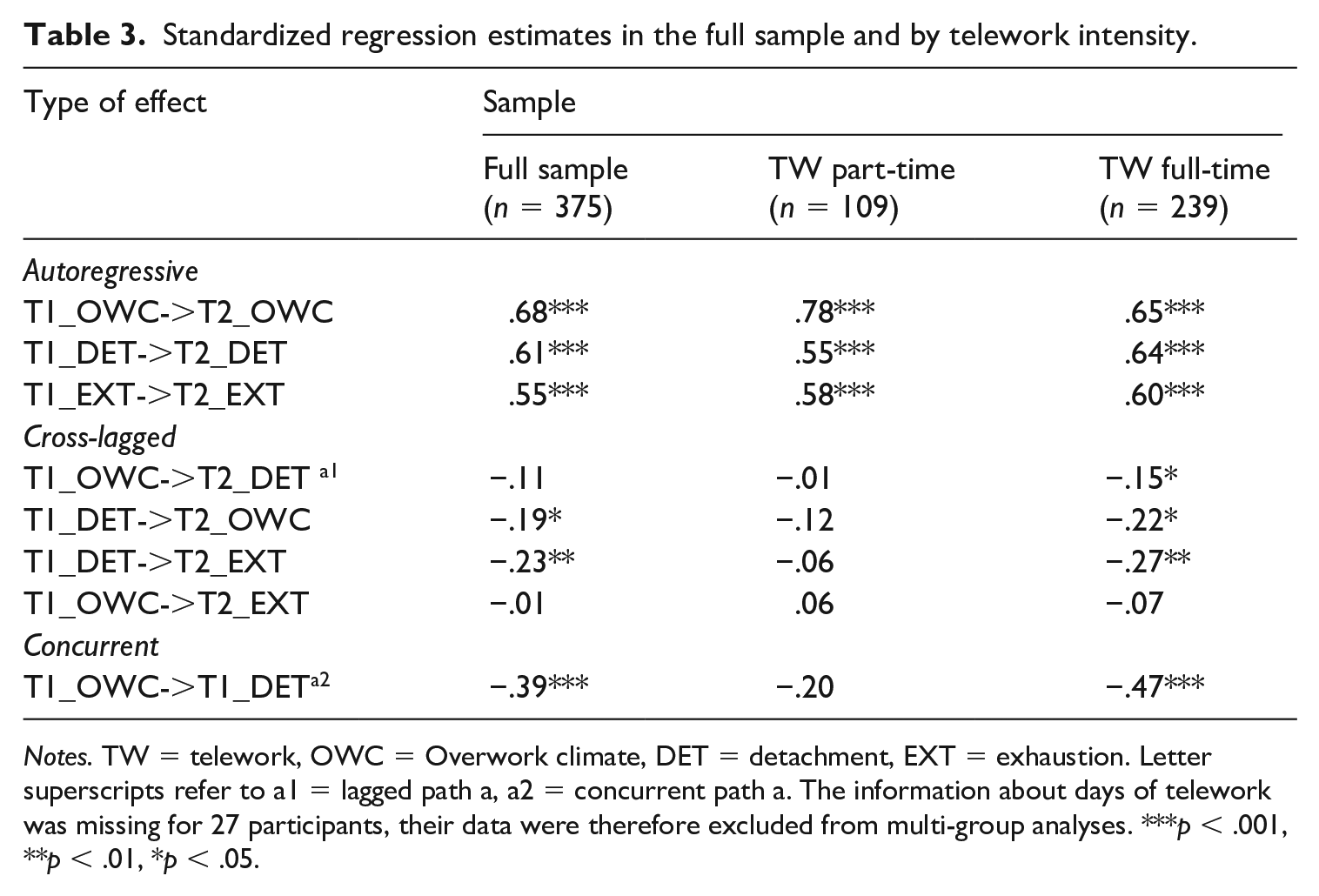
Notes. TW = telework, OWC = Overwork climate, DET = detachment, EXT = exhaustion. Letter superscripts refer to a1 = lagged path a, a2 = concurrent path a. The information about days of telework was missing for 27 participants, their data were therefore excluded from multi-group analyses. ***p < .001, **p < .01, *p < .05.
Subsequently, a multi-group mediation model was estimated, χ2(228) = 806.59, p < .001, CFI = .932, TLI = .924, RMSEA = .061, SRMR = .082 (see Table 3 for regression coefficients). A comparison of employees working from home part- versus full-time revealed a different indirect effects pattern. In line with Hypothesis 2, both longitudinal and half-longitudinal indirect effects were negligible among those teleworking on a part-time basis, a1bunstandardized <.001, 95%CI [–.050; .028] and a2bunstandardized = .008, 95%CI [–.042; .071], respectively. Detachment was found to mediate the relationship between overwork climate and exhaustion among employees who were teleworking on a full-time basis, a1bunstandardized = .026, 95%CI [.001; .055] and a2bunstandardized = .079, 95%CI [.017; .142], with stronger support for the half-longitudinal effect. The difference in longitudinal indirect effects was quite small and subsample comparison yielded a non-significant statistic, Δa1b = .026, p = .254, whereas the difference in half-longitudinal effects was only significant at the .10 level, Δa2b = .071, p < .082. Hence, Hypothesis 2 was only partially supported.
Discussion
This study aimed to longitudinally investigate the undesirable effect of overwork climate and its underlying mechanism in the context of telework. Although there is some evidence showing the adverse effects of overwork climate (e.g. Mazetti et al., 2016), its longitudinal effects and mechanism have been underexplored thus far. More precisely, we have demonstrated that an overwork climate leads to exhaustion four months later, partly due to impaired ability to detach from work psychologically. Notably, this effect was more substantial among those teleworkers who worked from home full-time. This way, our study adds to scarce knowledge on the mechanism and longitudinal outcomes of overwork climate. Furthermore, it contributes to the growing literature about the risks of tele-work that has become a prevailing way to work due to the COVID-19 pandemic.
The results of our study show that the higher the overwork climate, the lower the psychological detachment, which results in higher emotional exhaustion four months later. In other words, the overwork climate leads to emotional exhaustion because it impairs employees’ ability to detach from work. This way, employees continue facing job demands even after working hours that deplete their resources and impair the restoration and recovery process. Thus, our results add longitudinally tested evidence to the adverse effects of overwork climate that has been previously tested cross-sectionally (e.g. Mazzetti et al., 2016). Moreover, we complement the results obtained by Afota et al. (2020), who found overwork climate to be related to strain eight months later partly through workaholism. While their study showed overwork climate to result in intensive working behaviours, our research shows that overwork climate might have an adverse effect on well-being because of intensive mental engagement in work. In other words, one might suffer exhaustion due to overwork climate not only because of working long hours but also because of the inability to detach mentally from work.
Moreover, the aforementioned effect was more salient among full-time teleworkers showing that teleworkers may be more sensitive to overwork expectations in their organization. Although it might appear counterintuitive at first glance, a few studies (e.g. Galinsky et al., 2001) have shown teleworkers to be more prone to long working hours and even workaholism. A recent report by EU-OSHA (2021) has shown teleworkers work longer and have shorter rest periods between working days than other workers. Furthermore, these trends were more pronounced among highly mobile workers. Higher levels of telework intensity might be detrimental since they are often associated with the experience of working for longer hours and on irregular schedules. In addition, as Eurofound (2020a) suggested, workers in highly mobile telework arrangements and regular home-based teleworkers are more likely to report health problems than on-site workers, particularly headaches, eye strain, fatigue, sleeping problems and anxiety. This is interpreted as a result of the high levels of supplemental work these workers undertake and poor-quality working time.
One result of this study that warrants attention is the cross-lagged relationship between psychological detachment and overwork climate. More precisely, psychological detachment and overwork climate were reciprocally related over time among full-time teleworkers. In other words, not only overwork climate led to poor psychological detachment, but lowered psychological detachment has also led to the evaluation of the working environment as more demanding to overwork. This result is in line with the JD-R theory (Bakker and Demerouti, 2014), claiming that lack of resources might lead to the perception of work as more demanding. Presumably, as lack of detachment inherently means the prolonged exposure to job demands and impaired ability to restore exhausted resources, employees might lose their finite personal energetic resources and get caught in a so-called loss spiral, resulting in a decreasing resource reserve for confronting other job demands (Ten Brummelhuis and Bakker, 2012). This warrants attention to overwork climate that may lead to adverse outcomes in the context of intensive teleworking.
Limitations and directions for future research
The results of this study should be interpreted in light of several limitations. First, we based our analyses on employees’ self-report measure of perceived overwork climate reflecting their subjective view of their organization’s dominating norms and expectations because we focused on the relationship between climate and individual levels of exhaustion. Alternatively, other sources of information (e.g. aggregated team ratings) might be used in future research. This way, a more objective estimation of the overwork climate might be obtained.
Second, a fully longitudinal mediation analysis is not possible with a two-wave design. While a partial longitudinal approach is less biased than a purely cross-sectional one, it still may produce inaccurate estimates if the stationarity assumption does not hold (cf. Cole and Maxwell, 2003). Hence, future studies would benefit from a study design including three or more waves, allowing for a more detailed analysis of the hypothesized indirect effects.
Third, we have analyzed the intensity of working from home as a moderator in the relationship between overwork climate and psychological detachment. Future studies might focus on personal characteristics as empirical evidence. Mazzetti et al. (2014) shows that certain personality characteristics (for example, conscientiousness and perfectionism) make employees more vulnerable to overwork climate.
Fourth, the sample of this study consisted of full-time white-collar employees, having one job. Having in mind the ascending rates of teleworkers and the possible occupational health and safety risks related to various employment situations among home-based workers (e.g. Quinlan and Bohle, 2008), future studies might focus on employees falling under precarious working conditions, such as self-employed employees or those holding part-time multiple jobs.
Finally, the results of our study should be interpreted in the context of the COVID-19 pandemic. Most of the empirical evidence of teleworking was obtained before the pandemic when teleworkers comprised about 19% of employees in Europe. Teleworking itself was mainly determined by the type of job and/or initiative of the employee (Eurofound, 2020a). Due to the COVID-19 pandemic, the rate of working from home increased dramatically up to 48% (Eurofound, 2020b) as working from home became the customary mode of working for many employees who had limited or no previous experience of teleworking. Therefore, the experience of teleworking might be different when compared to that pre-pandemic.
Practical implications
Our study offers some practical implications. First, as the study results suggest that overwork climate is related to higher emotional exhaustion over time through lower psychological detachment among employees working from home all the time, organizations and their management should note the potential pitfalls of telework and adopt strategies to counteract them. For example, organizations could consider adopting a hybrid approach instead of complete teleworking.
Second, organizations might benefit from creating and sustaining an environment that does not support excessive working. Specifically, the change in overwork climate could be achieved by modifying the corresponding procedures, policies and practices (Kopelman et al., 1990). Organizations should cultivate work–life balance by defining clear boundaries between work and leisure time instead of promoting working hard at all costs (Van Wijhe et al., 2010). For instance, employees could be discouraged from working at the weekends or during the evening by communicating that work tasks should be completed and work-related communication should be done within conventional working hours. Moreover, the organization could reward its employees for working smart instead of hard and focusing on rewarding in-role performance instead of extra-role behaviours (Van Wijhe et al., 2010). Managers should not consider subordinates’ willingness to do overwork to indicate their efforts and commitment to their job (Golden, 2009). In addition, a supportive work–family culture, characterized by the extent to which organization and its members are perceived to support the integration of work and private life, allows maintaining work–life balance (Peeters et al., 2009). Lastly, the contribution of managers to the formation of a healthy work environment is essential as their behaviour and communication with employees form shared practices (Ostroff et al., 2003). Therefore, managers and supervisors should serve as role models demonstrating behaviours favouring healthy work–life balance and disapproving overwork (Van Wijhe et al., 2010). It becomes crucial when considering that managers usually suffer from overworking (Brett and Stroh, 2003).
The findings of our study underscore the importance of psychological detachment for preventing emotional exhaustion. Moreover, the current results are highly relevant in an era in which information and communication technologies increasingly interconnect the work and home domain (Valcour and Hunter, 2005). Therefore, employees should be encouraged to switch off mentally from work during their free time. For example, employees would benefit from relaxation exercises (Carlson and Holye, 1993), mindfulness practices (Althammer et al., 2021) or engaging in off-job activities different from one’s work (Sonnentag, 2012). This way, employees will reduce the cues that might prime them to think about their work (Sonnentag and Fritz, 2015). Employees might also benefit from short breaks during the working day that helps to enhance psychological detachment (Hunter and Wu, 2016) and take care of various family matters. Engaging in break activities might be especially suitable for teleworkers who have flexible working hours and control their work schedule (Clauss et al., 2021). Similarly, engaging in short daily exercises of positive reflection might also help restore resources (Clauss et al., 2018). Notably, strategies for psychological detachment become especially important for teleworkers as traditional strategies such as finishing work tasks before leaving the office do not work for them. By the same token, organizations could support their employees’ detachment from work during off-hours by clearly communicating that employees are encouraged to switch off from work after working hours and by employing the right to disconnect. In the light of exponential growth in teleworking as a result of the pandemic, the right to disconnect might serve as a legal means to balance better the opportunities and the risks brought by telework (Eurofound, 2021b).
In summary, a climate that does not pressure employees to devote an exceptional amount of time and energy to work is essential to reduce the cost of working from home.
Supplemental Material
sj-pdf-1-eid-10.1177_0143831X221095111 – Supplemental material for Pressed to overwork to exhaustion? The role of psychological detachment and exhaustion in the context of teleworking
Supplemental material, sj-pdf-1-eid-10.1177_0143831X221095111 for Pressed to overwork to exhaustion? The role of psychological detachment and exhaustion in the context of teleworking by Jurgita Lazauskaitė-Zabielskė, Ieva Urbanavičiūtė and Arūnas Žiedelis in Economic and Industrial Democracy
Supplemental Material
sj-pdf-2-eid-10.1177_0143831X221095111 – Supplemental material for Pressed to overwork to exhaustion? The role of psychological detachment and exhaustion in the context of teleworking
Supplemental material, sj-pdf-2-eid-10.1177_0143831X221095111 for Pressed to overwork to exhaustion? The role of psychological detachment and exhaustion in the context of teleworking by Jurgita Lazauskaitė-Zabielskė, Ieva Urbanavičiūtė and Arūnas Žiedelis in Economic and Industrial Democracy
Footnotes
Data availability statement
The data that support the findings of this study are available from the corresponding author upon reasonable request.
Declaration of conflicting interests
The authors declared no potential conflicts of interest with respect to the research, authorship, and/or publication of this article.
Funding
The study was funded by the Research Council of Lithuania (LMTLT), Grant No. S-MIP-20-1.

Supplemental material
Supplemental material for this article is available online.
Author biographies
References
Supplementary Material
Please find the following supplemental material available below.
For Open Access articles published under a Creative Commons License, all supplemental material carries the same license as the article it is associated with.
For non-Open Access articles published, all supplemental material carries a non-exclusive license, and permission requests for re-use of supplemental material or any part of supplemental material shall be sent directly to the copyright owner as specified in the copyright notice associated with the article.
