




Abstract
While resistance to human resource management (HRM) practice transfers from multinationals has been widely researched in economically advanced countries, emerging economies are generally assumed to be institutionally more welcoming. This article contributes to debates on international HRM diffusion both by highlighting hitherto neglected arenas of host-country resistance and identifying the multiple levels at which this plays out. Specifically, this article examines the transfer of Japanese multinational corporations’ HRM practices into Indonesia. The study reveals that alongside apparently consensual micro-level (organization) relations between home- and host-country management, important political power games are occurring at the meso-level (subnational). These games involve competing notions of ‘best practice’ with host-country actors more powerful than deterministic models of diffusion would predict. The study shows how local actors seek to defend elements of the established Indonesian business system, while Japanese actors bypass host-country regulations by mobilizing corporate business associations. The findings extend current understanding of cross-border management practice transfer, highlighting contestation and negotiation at the meso-level.
Keywords
Introduction
There are long-standing debates over the transfer of HRM practices and employment systems (e.g. Doellgast and Marsden, 2019; Dundon et al., 2020). While early discussions tended to assume that dominant corporations were well positioned to transfer their management models internationally (e.g. Oliver and Wilkinson, 1988), later research reveals the complex and often contested nature of these processes. In particular, recent studies have explored multi-levels of analysis (Almond, 2011; Ferner et al., 2012; Vincent et al., 2020), deepening our understanding of societal and institutional influences at organizational levels (Delbridge et al., 2011; Edwards et al., 2013). However, there is a need to further explain the variation of outcomes in practice adoption and adaptation resulting from ongoing contestation of transfer processes across these levels, particularly when the dominant management model is being transferred into an emerging economy that has a well-established local management model (e.g. Witt, 2019).
This article focuses on practice transfer at three levels: macro- (state), meso- (subnational) and micro- (organization) in order to (1) embrace the complexity of the multi-actor dynamics and power relations involved in producing contested outcomes and (2) investigate the relationship between transfer processes across levels of activity. The context is that of asymmetrical power relations with ‘dominant’ Japanese multinational companies (MNCs) seeking to transfer their practices to Indonesia. Despite some research on the negotiation activities of low-power actors such as trade unions and local subsidiary managers in economically dependent countries (Edwards and Edwards, 2011; Gajewska, 2013; Mihály, 2021; Sippola, 2019), multi-level analyses are still very rare. Moreover, the literature often assumes that in economically dependent countries local actors are inherently receptive to transfers (e.g. Kvinge and Ulrichsen, 2008). These gaps and the problematization of these assumptions have led to calls for more multi-level research (Morris et al., 2018; Vincent et al., 2020).
Our article examines the persistent coexistence of two models in Japanese–Indonesian joint venture automotive manufacturers. We present evidence of how competing views of ‘best practice’ human resource management and ‘harmonious’ employment relations (HRM-ER) are used by foreign and local dominant actors in contesting management models. We also show how these notions play out in the joint ventures’ autoparts supply chains (e.g. Khan et al., 2015). Guiding our study is the following research question:
How do Japanese and Indonesian actors mobilize at macro-, meso- (subnational) and micro-levels to promote their versions of best HRM-ER practice, and what are the consequences?
To address this question, evidence from the automotive industry is presented on the contested nature of the transfer process in Indonesia, an emerging economy where MNCs might be expected to hold the balance of power. Our findings show that studying the meso-level in such contexts is particularly useful. A focus on this level reveals dialectical processes of contestation between dominant and low-power actors in navigating and overcoming institutional constraints (i.e. national regulation and established organizational policies and management practices), rather than linear top-down imposition or bottom-up rejection. Emerging market economy (EME) contexts may have weak local institutions (Miles, 2015) but our study reveals that ties between networks of firms, business associations and government at the meso-level are particularly relevant for local actors whose interests are in maintaining local HRM-ER systems (Sato, 1996), and that MNCs respond to institutional constraints on their influence. Our study contributes to emerging areas of research interest in international HRM research by undertaking a multi-level analysis. We show how this more inclusive empirical framing provides important insights into how management practices are transferred since it is at levels beyond the individual firm that many of the relevant processes take place. This approach overcomes some weaknesses of literature that tends to focus on either macro-level institutions or on corporate actors alone, and specifically neglects the meso-level in dependent economies.
In the following sections, the article applies distinct but complementary approaches to the discussion of practice diffusion, namely system–society–dominance–corporate (SSDC) effects (Delbridge et al., 2011; Smith and Meiskins, 1995) and multi-level ‘institutions-with-power’ (Ferner et al., 2012). Analyses are presented of three Japanese–Indonesian automotive manufacturer joint ventures and their local supply chains, which expand along tiers of outsourcing (three tiers are identified in these cases). The analysis looks at both managerial and labour actors at the company level, meso-level and national level to understand the variation in dominant vs low-power actor interactions, relations and resources.
Framing headquarters–subsidiaries relations in emerging economies: SSDC effects and actors’ power
Research has been increasing into the diffusion of HRM practices between multinationals’ headquarters and subsidiaries in more peripheral economies, and the power relations between home- and host-country actors around them (Meardi et al., 2009; Pudelko and Harzing, 2007). Recent works have investigated subsidiaries’ strategies and sources of power (Conroy et al., 2019; Dörrenbächer and Gammelgaard, 2016; Khan et al., 2018; Tippmann et al., 2018). While often mentioning the importance of institutional resources, these studies have limited themselves to the micro, corporate level of analysis. Some scholars have however tried to incorporate other levels into the analysis of multinationals, as in the case of the system–society–dominance approach and its later reformulations.
Smith and Meiksins’ (1995) system–society–dominance approach was an early attempt to theorize cross-national organizational analysis, moving beyond the convergence/divergence debate. Their work inspired studies of Japanese practice transfer to other advanced economies (e.g. Dobbins and Dundon, 2017; Edwards et al., 2013). To understand strategic choice (corporate effects), Delbridge et al. (2011) extended the framework to system–society–dominance–corporate effects (SSDC) and these effects have been examined in corporate Japan (Aoki et al., 2014). SSDC thus offers a starting point for investigating the transfer of Japanese practices to East Asian emerging market economies (EMEs) where Japanese influences are especially prominent (e.g. Gajewska, 2013; Huo et al., 2022). Smith and Meiksins’ (1995) approach was particularly valuable in highlighting the key institutional influences on cross-national organization that stem from the political economic system, national societal effects and the isomorphic pressures exerted by dominant management models and economic actors. However, concerns have been raised about whether the application of the approach has omitted complexities in diffusion processes, in particular the varying impacts of the different effects as experienced by local actors, and that the emphasis on institutional effects towards convergence has resulted in a downplaying of the continuity of local business practices (Edwards et al., 2016).
Ferner et al. (2012) built on Smith and Meiksins (1995) to integrate structural, institutional and micro-political insights into practice transfer. Specifically, Ferner et al.’s ‘power with institutions’ approach provides a more fine-grained analysis of power relations and the organizational levels in which they develop, and can be operationalized for the study of the contextual framing of organizational processes and a careful evaluation of institutional contexts.
Ferner et al.’s (2012) work identifies that dominance effects exist at macro-, micro- and subnational (i.e. meso) levels and they highlight different dimensions of actors’ power (i.e. power of meaning, resources and relations). While they focus mainly on micro- and macro-levels, their approach has also inspired studies of the meso-level (e.g. Almond, 2011; Monaghan et al., 2020). Drawing on Ferner et al. (2012) to extend Smith and Meiksins (1995) advances our understanding of cross-border management practice transfers beyond more mechanistic approaches (e.g. Kostova, 1999; Kostova and Roth, 2002). While SSDC is useful to frame social institutional factors and levels of influence, Ferner et al. (2012) provide a finer-grained analytical grid for understanding multilateral power relations and the levels in which they develop. This article thus builds on both SSDC and Ferner et al. (2012) in examining the impact of multiple levels of institutional setting on practice transfer, and by doing so responds to calls for HRM to be situated in its contexts (Vincent et al., 2020). Thus, the theoretical approach of this study differs from micro-political approaches in paying greater attention to the meso-level actors and factors (Monaghan et al., 2020).
SSDC and power concepts can be fruitfully applied to a large dependent economy like Indonesia. The system effect manifests itself in capitalist and market pressures over enduring authoritarian planning institutions. While Japan is generally considered to be a coordinated market economy (Hall and Soskice, 2001), Indonesian capitalism is poorly coordinated (Ford, 2020). Nevertheless, business conglomerates have a central role in industrial policy and over protectionist measures (Dieleman and Sachs, 2008; Rosser, 2014; Witt and Redding, 2013). The society effect operates in the (in)formal institutions, norms and customs that shape the Indonesian national business system. Developing East Asian states have been keen to foster such national specificities. Albeit eroded at the global level, the dominance effect of Japanese practices is still highly visible in East Asian countries; strong economic ties and official development assistance (ODA) underpin economic and human capital development in cooperation with Japan (Gajewska, 2013; Johnstone et al., 2019; Witt, 2019). The corporate effects of foreign direct investment (FDI) and ownership structures are evident in variations in how specific firms respond to their institutional contexts and how headquarters influences play out at workplace levels.
The case of Indonesia
Indonesia has long been an important economic partner for Japan and Japanese ODA agencies have been present since in 1954 (Williamson, 1994). Currently, both Japanese and Indonesian public and private actors exert power in economic and labour domains. Their influence happens mainly through ‘soft’ approaches that leave discretion to lower-level actors (management and unions) (Gajewska, 2013; Hong and Snell, 2015). Japanese ODA organizations mitigate actors’ conflicts of interest, power inequality and institutional constraints at macro- and micro-levels; Williamson (1994: 163) terms this ‘labour diplomacy Japanese-style’ in promoting democratic labour movement and employee participation. Williamson (1994) identifies three key examples of tripartite arrangements involving the state, enterprise and ODA organizations: (1) Japanese ODA organizations focused on management and technical training, particularly the Association for Overseas Technical Cooperation and Sustainable Partnerships (AOTS); (2) the quasi-government agency Japan International Cooperation Agency (JICA) focused on government-to-government (G2G) and not-for-profit labour advocacy; and (3) the Rengo-sponsored Japan International Labour Foundation (JILAF). They operate under ODA funding, undertaking policy and ‘sustainable’ sociopolitical economy development activities that support overseas Japanese supply chain productivity and the promotion of a grassroots labour movement with strong employee engagement/participation. Our study centres on disentangling these organizations’ multifaceted roles and impacts on Indonesian HRM-ER.
In Indonesia, legislation forbids foreign nationals from occupying HRM-ER functions (Ford, 2000), limiting the activities of expatriates and therefore direct control from foreign headquarters. This is relevant because Japanese MNCs have traditionally relied on direct control of subsidiaries through expatriates in comparison to American MNCs that rely often on indirect control through standardized organizational procedures. Consequently, successful transfer of practices to Indonesia requires the development of effective procedural control and a high degree of Indonesian managers’ collaboration. The latter is achieved primarily by influencing managers’ training and networks. However, this effort is also subject to Indonesian institutional frameworks, opening up the potential for contradiction and conflict. Nonetheless, since the collapse of Soeharto’s 33-year rule, trade unions have formally organized and employees’ voices have gained representation (Ford and Gillan, 2021), with trade unions having dynamic involvement in both imported and locally developed ER systems.
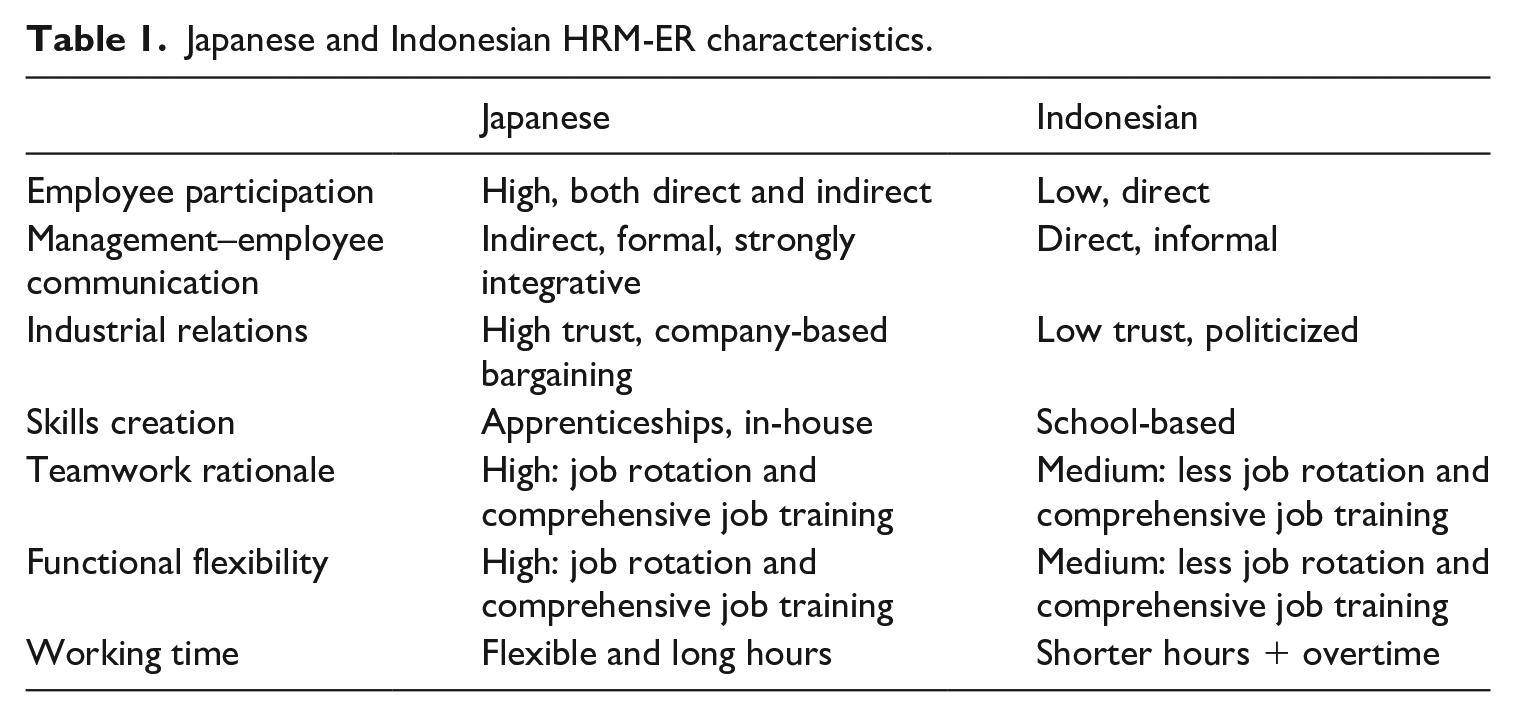
The primary area of conflict emerging between Japanese MNC and Indonesian subsidiary management lies in their respective approaches to management–employee relations and skills creation. Japanese MNCs shun adversarial labour relations in foreign subsidiaries and encourage advanced forms of employee participation and trade union engagement. On the other side, they are not as committed to skill creation abroad as they are within Japan, given their reliance on Japanese institutions. By contrast, Indonesian managers traditionally follow a paternalistic approach, including a belief that local employees and unions lack the necessary organizational understanding, commitment and skills to be treated as equal partners. However, they have an interest in industrial upgrade and therefore skill development. The Indonesian HRM model thus differs markedly (Caraway and Ford, 2020; Rosser, 2014) from the Japanese HRM model (Endo et al., 2015; Witt, 2019) (see Table 1).
Japanese and Indonesian HRM-ER characteristics.
Methodology
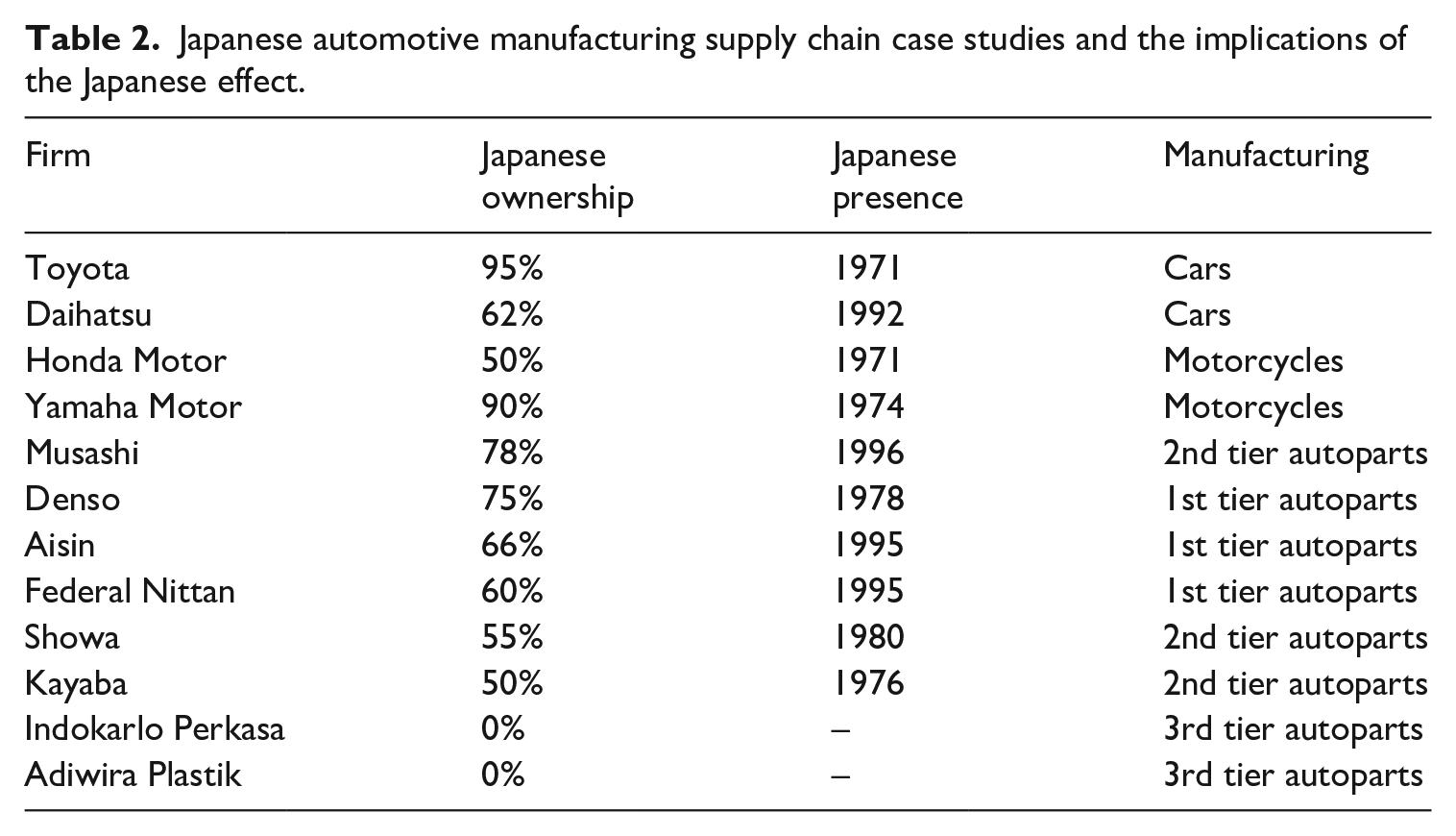
The complex and unexplored nature of relations between Japanese headquarters and Indonesian subsidiaries calls for qualitative research that facilitates contextualized explanations and novel theoretical accounts (Tsui, 2004; Welch et al., 2011). Our data come primarily from interviews in 12 automotive manufacturers with Japanese participation within Astra International, the Indonesian conglomerate holding that has driven industrialization in the country since the 1950s (Sato, 1996). This layered case study allows us to consider the meso-level of the largest holding and its institutional context, and the micro-level of 12 specific Indonesian–Japanese joint ventures as units of observation, which vary with regard to the degree of Japanese control. The 12 cases include a range of large and medium-sized Japanese MNCs and operations from different tiers of the supply chain, from final assembly to the third tier (see Table 2 for details). Interviewees covered respondents from corporate (e.g. chamber of commerce, business group, employer and employee associations) and non-corporate business associations (e.g. advocacy groups, non-profit organizations, NGOs of Japanese ODA agencies, AOTS, JICA and JILAF), and managers and employee representatives from the company levels, including all four main Indonesian unions. Access was obtained first from senior management and then, independently from management, from the various trade unions.
Japanese automotive manufacturing supply chain case studies and the implications of the Japanese effect.
One-on-one interviews lasted between 60 and 90 minutes, while group interviews lasted between 90 and 120 minutes and typically involved 5–15 research participants.
Data were collected in two phases. The first phase took place between November 2014 and September 2016 and consisted of one-to-one and group interviews with participants from manufacturing plants, training sites and organizations in Japan and Indonesia. Direct observation took place at Toyota, Daihatsu and Denso plants and AOTS training centres (kensyu) in Japan, in workplaces in Karawang International Industrial City (KIIC), and in the unions’ headquarters in Jakarta, Indonesia. Additionally, union activities (e.g. negotiation, labour standards and compliance, and management–union interactions) were observed for one week at the ‘house of labour’ (Omah-Buruh), the historical union site. The second phase was conducted between March and November 2019 to complement phase one with participation in the training programme for Indonesian HR management/directors at AOTS and union stewards/leaders at JILAF in Japan. We corroborated our analysis with secondary data from public and company reports.
In the first phase, interviews were conducted with 110 individual participants (10 in Astra, 12 in Toyota, 25 in Honda, 35 in Astra Otoparts [AOP] and 28 in business associations), drawn from a wide range of hierarchical levels and functional business areas. In the second phase, interviews were carried out with 42 individual participants (4 Toyota-Astra, 5 Daihatsu, 8 Yamaha, 5 Denso and 20 in business associations). In this phase, there was a greater emphasis on automotive management in Japan (Toyota, Daihatsu and Denso), Toyota-Astra management and Denso Indonesia trade unions as well as AOTS, JICA, JILAF and the Indonesian employers’ association APINDO (Asosiasi Pengusaha Indonesia). Respondents have consented to refer to the name of each organization but individual participants are anonymized.
Interviews were conducted in English, Japanese and Bahasa Indonesian depending on respondents’ preferences. The lead author is fluent in these languages, which facilitated accuracy and consistency in the translation into English for coding.
Data analysis
A three-stage analysis was conducted, building from first-order concepts derived directly from the interview transcripts. We used NVivo to assist with organizing 152 interviews; the analysis processes entailed the construction of Japanese and Indonesian actors’ episodic interventions and general analysis of the adoption of the Japanese HRM-ER policies. Through a three-cycle coding process, the analysis was systematically refined to develop a conceptual picture and articulate insights (Miles et al., 2014). Data analysis continued until theoretical saturation was reached (Eisenhardt and Graebner, 2007) in order to gain a fuller understanding of actors’ power interactions and relations at micro-, meso- and macro-levels. These inductive processes examine three primary areas for consideration: (1) actors’ power relations in the diffusion processes; (2) the process of adopting ‘best practice’ in Indonesia at meso-level; and (3) the context for actors’ activities at macro-level in maintaining socioeconomic relations. Our presentation of the data proceeds through a detailed consideration of the activities of corporate and non-corporate actors related to diffusion, adoption and competition ‘best practice’ transfer processes and implications in Indonesia. The findings are presented in ways that seek to integrate the empirical evidence with the theoretical base (Corley and Gioia, 2011; Welch et al., 2011), although we also offer a small sample of direct quotations throughout the article to exemplify the nature of our data and give voice to key participants. The coding process is detailed in the Annex Table 1 available online.
Findings
Within Astra, local managers, workers, unions and business associations have resisted some core elements of Japanese HRM-ER that potentially undermined Indonesian industrial relations and business systems. Astra’s HR and ER directors expressed pride in the Indonesian Pancasila ideology, as ‘the foundation of [our] democratic labour relations, endogenously built from local blood and sweat’ (Astra HR director, 2014). Astra management is committed to protecting and advancing local HRM-ER practices and training and development policies. Resistance to foreign influences sits alongside adoption and adaptation of aspects of the Japanese model, as Astra participants also stated that they ‘do acquire and localize some elements of Japanese manufacturing-working practices, i.e., technical skill and development that suit [their] local circumstances and enabling technology transfer’ (Toyota Indonesia HR director, 2014).
Responses to the transfer of the Japanese model vary across the three levels of analysis. At the organizational level, findings reveal mostly a pattern of tacit consent, with one major exception (Denso) where resistance was open. The tension between Japanese and Indonesian actors over HRM-ER ‘best practice’ is most evident at the meso-level, while little interaction occurs at the macro-level, as Indonesian and Japanese state actors maintain an arm’s-length approach. However, relations between the Indonesian government and local actors are significant. The interviews also show a degree of acceptance, particularly of Japanese technical manufacturing and working practices. As Toyota Indonesia management and employees reported, ‘made in Japan’ resonates with a powerful global reputation that inspires Indonesian subsidiaries. Nonetheless, on closer examination, there are nuances to the degrees of acceptance: Indonesian management sought to control the inflow of certain types of Japanese management–employee relations and trade union–management partnership. The following sections present the findings on conflict, influence and acceptance at the three institutional levels.
Micro-level
The observed joint ventures have different degrees of Japanese ownership (Table 2). Japanese actors are increasingly interested in extending direct control throughout the supply chain, including tiers 3 and 4, which currently have limited/no direct Japanese influence, to standardize subsidiary practices. Interviewees from the government-related Japan External Trade Organization (JETRO) noted: Japanese companies always want to increase their share. . . . But there are regulations, so at 50/50, this is not a wholly Japanese company but a joint venture. So not only relationships between management and union but also on the management side a different management style, that is, Indonesian and Japanese management. It is very hard for Japanese people to control. (JETRO Japan representative, 2016) Partnerships with SME automakers in Indonesia, especially operating outside KIIC, are very desirable because they are not yet bought and controlled by Astra! (JETRO representative in Indonesia, 2019)
There are then limits, in terms of ownership and of scope for expatriates, over micro-level subsidiary control. Japanese HQs make attempts to circumvent those limits at local level. One Honda HRM-ER audit team interviewee offered his view on Japanese practices: In terms of policy, it is true that Japan cannot intervene with our HR. This is a local affair. However, due to increasingly organized industrial action, to some extent, Japan must get involved. Japan has planned to place an ‘HR advisor’ in our office (using a bogus title, but we know his role and intention). The aim is to provide some general management advice and expertise. (Honda Indonesia management representative, 2014)
Nonetheless, overall, company-level management and unions express positive views of Japanese HRM-ER, especially in the Toyota case. For instance, one Toyota union interviewee stated: Japanese ER promotes management–union relationships. The Japanese company values its employees as an asset and the union as a partner. There are harmonious relationships throughout the organization within Toyota supply chain’s tier 1. However, we also acknowledge that there are some management–union relations issues, mostly in tier 3 of Toyota’s supply chain. (Toyota Indonesia union representative, 2014)
While many Indonesian unionists appreciate elements of Japanese management involvement, others regard the rigid monitoring of Japanese ER practice as too strict for the local actors, and simply not compatible with their approach. Nonetheless, organized Indonesian workers are particularly interested in understanding Japanese ER regulations and union/employee participation. Also, the positive image of Japanese industrial development inspires Indonesian unions. A Federal Nittan interviewee stated: ‘That is my hope: to see local firms moving forward to value their employees and unions as partners. That is what I learned about Japan.’ The micro-level prevalence of consent does not mean that interests of Indonesian and Japanese actors are always aligned, however, as revealed by some cases where latent conflict exists.
The Denso case: emerging contestation
The research identified one important case that deviates from this picture of compliance. Denso Indonesia, a tier 1 auto component supplier, displayed open contestation between Japanese and Indonesian actors. Denso Indonesia’s union aspired to equal partnership with management, yet Astra and Denso Japan have markedly divergent views. There are two major areas of contestation. First, Denso Japan supports the idea of Denso Indonesia employees joining federated trade unions while Astra firmly supports maintaining a company union, making the case that the external union does not appreciate local conditions and internal management–employee relations. Second, among union federations, Astra and AOP managers prefer K-SPSI, which is seen as cooperative, while the majority of Denso Indonesia employees prefer FSPMI, which is considered radical by management. 1 The FSPMI aligns with Metal, Denso Japan’s trade union (JILAF and Rengo representatives’ interview, 2019). In justifying their position, Astra and AOP management note that the company union facilitates management–employee communication and firm-level negotiation. Denso Indonesia and Astra management argue that each workplace has its own organizational approaches and capabilities, so issues are best solved internally with shared understanding between management and union.
Between the first and second phases of data collection, industrial relations at Denso worsened. Seven Denso Indonesian union leaders were ousted. Union respondents at Denso and seven other AOP sub-units suggested that Denso Japan had let Astra have its way in managing Denso Indonesia’s industrial relations. Dissatisfaction remains high, and employees continue to join the confederated union. Throughout the dispute over union recognition (which involved the employer organization APINDO), the fired union members were prohibited from entering the plants by the police and three union leaders were jailed. In 2019, the Supreme Court (Makamah Agung, the Supreme Court of Republic of Indonesia, 30 January 2019) found violation by Denso Indonesia management on the basis of the ‘Union Busting’ Act, the imprisoned leaders were released, and compensation was paid to all seven unionists. Thereupon, the Japanese management counterpart and Astra management replaced the HRM-ER Denso Indonesia director with one that had undergone substantial HRM training in Japan.
The Denso Indonesia case manifests latent rivalry between Denso Japan and Astra Indonesia management. Whereas the Japanese exert greater control over the adoption of Japanese production systems and the flow of technology, Astra and AOP maximize the ‘Astra way’ in industrial relations. Under these contested conditions, the roles of business associations are important in mitigating Japanese–Astra management tensions. For example, AOTS provides HR management training, JILAF offers union advocacy and education, and APINDO Indonesia trains Indonesian candidates on HRM-ER issues in Japan. Astra is compliant with these employee training and development initiatives/investments but remains strongly resistant to changing labour unions. Moreover, post-training in Japan, Astra tries to ensure that the imported practices do not discredit Astra’s own organizational values, business philosophy and management practices. Denso Indonesia is the largest tier 1 component supplier in the country, is 25% owned by Toyota, and has major Japanese technological input and investment. Hence, while not representative of the sector, it shows the conflict dynamics at their highest, most sensitive point within the supply chain.
Disciplinary differences: local moderation within a ‘Japanese approach’ to HRM-ER
Indonesian interviewees were consistent in their view that certain Japanese HRM-ER elements and corporate expectations were profoundly incompatible with the Indonesian ER settings and referred to the second Pancasila principle of the Indonesian constitution, stating, ‘We are God’s creatures, not Japanese; we do not live to work . . . we are not Japanese, devoting life for work’ (Aisin employee representative, 2014). They saw the Japanese model as being built on specific Japanese economic and cultural conditions: . . . being a part of the machine . . . human capital instead of human resources. We have to live, pray five times a day [Indonesia is the world largest Muslim country], observe one month fasting Ramadan [once a year], family and social commitment. We do not live to work; we go home when we finish, no karaoke, no after-work commitments or long hours’ meeting. (Federal Nittan union representative, 2014).
Another participant concurred, referring to the Japanese work ethic as ‘kerja rodi’ (romusha or forced labour) (AOP employees and union representatives, 2014). This is a local term alluding to the brutal Japanese occupation of Indonesia during the Second World War. Given this memory of the war, there is a delicate and sensitive connection between the Japanese military invasion and the introduction of Japanese ‘best work practices’.
Such differences in understanding of appropriate management and union roles are exemplified in a disciplinary procedure observed at Aisin Autoparts, a Japanese manufacturer in Indonesia. Management accepted union representation in disciplinary cases, which is otherwise rare in Indonesia. According to Aisin Japan’s guidelines, employment can be terminated after three warnings. However, Aisin’s HR manager and union representatives claim that ‘management and union share responsibility in employment termination decisions’. According to some Astra directors, Japanese disciplinary schemes and some other employment practices are perceived by local actors as ‘inhumane and contradictory to the Indonesian state ideology of humanitarianism, incompatible with local HR policies and norms, and inappropriate, since Indonesia lacks the appropriate social welfare system, including unemployment insurance and parental leave’ (Astra HR/ER directors, 2019).
Although Japanese training promotes the Japanese arrangements and Japanese management–union partnership may reflect the Japanese approach, the Indonesian-type ‘humane’ disciplinary scheme was upheld by the local HR manager and union. In one case, where the union objected to the disciplinary dismissal of an employee on the grounds that his parents were sick, the Aisin HR manager consented (2014), saying: We need to consider what would happen to his wife, child and ill parents. Indonesia does not have social support for unemployed workers, child or elderly care as in Japan.
There is a significant material difference between dismissal in Japan and Indonesia; the latter does not have the social welfare system to provide financial support during periods of unemployment or help for workers to upgrade their skills. Indonesian actors (both unions and management) resisted a home-country practice that did not fit with the host-country institutions.
Contestation through the supply chain
Differences of opinion were expressed between Indonesian managers at different levels in the automotive supply chain. For instance, AOP managers were generally sceptical of Japanese HRM-ER ‘best practice’ while HR managers in AOP’s sub-units (e.g. Aisin, Federal Nittan and Indokarlo) were interested in experimenting with Japanese practices that might improve their HRM-ER. However, Federal Nittan and Indokarlo HR managers reported that Astra management did not support this and had even overseen the activities of local HR managers within AOP supply chain firms to diminish their influence. Both HR managers (2014) reported: Astra and AOP management rotated us [HR managers] within AOP sub-units without even giving HR managers the opportunity to discuss [the matter] with union stewards. . . . On the one hand, Astra and AOP claim this work rotation is within the Japanese work system. It aims to gain the breadth of knowledge and skills. On the other hand, the Japanese claim that the rotation is solely at the discretion of Astra and AOP management, so HR managers of autoparts are twisted, not knowing who to trust or comply with. It is not a conducive management–union relationship.
The practice of rotation caused local HR managers to lose their grip on HRM-ER issues. HR managers in eight AOP sub-units unequivocally depicted Astra HR management’s rotation practices as a means of exerting control. AOP employees and union members were unhappy with this situation, stating: ‘We have lost trust: we must build a new relationship with the new HR manager in engaging with old problems without commitment to finding solutions’ (Indokarlo union representative, 2014). This contrasts with the approach of the automotive assemblers, such as Toyota and Daihatsu Indonesia, where HRM-ER directors and management strongly advocate the Toyota Way without intervention from Astra. Toyota and Daihatsu managerial practices then influence AOP sub-units, shaping AOP HRM-ER both directly through the Japanese managers but also by working with AOTS and JILAF.
These examples introduce the ‘layered contestation’ of Japanese HRM-ER in AOP supply chains, i.e. the involvement of further levels. While the large car assemblers, Toyota and Daihatsu Indonesia, train and upscale trade union leaders to take on HR managerial roles and responsibilities, thereby promoting ‘harmonious’ management–employee relations, Astra management has direct control in the automotive manufacturers and supply chains and this informs patterns of resistance, influencing local adoption and adaptation at organizational level. An understanding of these layers thus needs to extend through the supply chain, but it also includes actors beyond the firms directly involved through their activity at the meso-level.
Meso-level
The influence of Japanese meso-level actors
Japanese corporations have ways to overcome the limits over their direct control and power over micro-level local actors through ideological power, which is exerted primarily at the meso-level through their cooperative institutional arrangements with ODA agencies, namely AOTS and JICA (non-corporate) and JILAF (corporate). Activities take the form of knowledge dissemination and training conducted in Japan – as well as ongoing monitoring, auditing and advising in the trainees’ country of origin (Gajewska, 2013; Williamson, 1994). In seeking to overcome resistance at the local level, Japanese management coordinates strategic choices and procedural influence at the meso-level. As we discuss below, meso-level influence is more significant than the macro-level, because Japanese corporations and business associations, rather than state agencies, play the pivotal roles in diffusion processes (Steven, 2016).
AOTS is the primary example of the influence of business associations at the meso-level. AOTS is financed by Japanese ODA and has close ties with the Japanese government and Japan’s corporate sector. Through its direct communication with local Indonesian institutions, AOTS has spread Japanese management practice and ideology. While it serves mainly Japanese-affiliated organizations, it also encourages the ODA mission of developing local human capital beyond Japan supply chains, for example, local government agencies in handling trade and investments. It focuses on promoting ‘Japanization’ through management/technical training and on-site coaching of local actors within bilateral agreements. Through this approach, AOTS has influenced locally dominant actors, such as APINDO, Astra management and the Indonesian Chamber of Commerce and Industry, KADIN (Kamar Dagang dan Industri Indonesia), partnering with them to promote Japanese training programmes in Indonesia. Training programmes are coordinated with local providers, and while focused on automotive production they are open to other sectors. Another business association, JICA, plays a similar role. These training programmes extend beyond Japanese supply chains to regional and municipal government officials across Indonesia. The training programmes promote the adoption of Japanese HRM-ER and the local ‘embedding’ of that model.
The responses of Indonesian actors
Many respondents were nonetheless critical of some of the content of the training, claiming that it was not consistent with the participatory ideology of the Japanese model. Critics included former AOTS trainees (local management, employees and union members) and participants from Toyota, Honda, AOP and APINDO who had worked in the Japanese automotive industry for over three decades. One Astra manager (2019) commented similarly: The Japanese are only interested in keeping us as well-trained machine operators, not in investing in the Indonesian people’s know-how, training as engineers, because the Japanese keep the technology in Japan. Japanese expatriates are stationed in Singapore for a quick response when we need their expertise to fix machines.
Local business associations, namely chambers of commerce and APINDO, are somewhat distrustful of AOTS. They are interested in boosting local firms and management practices to compete with foreign investors. Their activities are supported by Astra, which invests capital and resources in APINDO and engages in dialogue to help the organization understand locally recognized HRM-ER best practices – the ‘Astra Way’. However, this is an area where there is a degree of contestation over content. Japanese and local business associations have engaged in partnerships to provide technical and HRM-ER training (i.e. AOTS–APINDO, JICA-G2G and JILAF-Union since 1959; Homma, 2020) and participants reported that certain Japanese practices were adopted as a blueprint for local APINDO–Astra training and workshops, with Japanese expatriates actively participating in this local knowledge dissemination as guest speakers and/or trainers. Nonetheless, Astra’s advantage over foreign investors lies in its collaboration with APINDO in administering on-site, in-house training, also for non-Astra management, at Astra’s head office. Consequently, in the local context, Astra has superior knowledge, strategies and embedded business relations, which it seeks to maintain through the control of supply chain auditing.
Astra conducts internal audits on its supply chains. While this HRM-ER audit was welcomed by some, the lower-tier suppliers were outspoken about their experiences in maintaining the audit requirements imposed by the Astra management standard. Overall, their view was that the auditing schemes aim to provide guidance but with little financial and human resources support from Astra or Japanese assistance without permission from Astra. Moreover, according to the autoparts participants, such schemes are tactics for the ‘big brother’ (Astra) to control weak small firms. In fact, tiers 1, 2 and 3 AOP participants perceive this auditing as systemic coercion. While Astra claims that the auditing mechanism is welcomed by its Japanese counterparts, three Japanese Toyota-Astra directors reported that Astra independently conducts the audit, adding that the Japanese counterpart could engage in the auditing only if Astra were to grant permission. Thus conflicts persist between Japanese and Astra management with both valuing the HRM-ER scheme as a direct influence opportunity but each seeking to control the process. There are somewhat similar conflicts over the specifics of the training that is provided, with Astra exercising some control over who participates: to ‘gain training in Japan, Astra engages in the selection process and must approve those management trainees . . . [but] Astra is too strong’ (Toyota-Astra Japanese manager, 2019).
Astra has extended both its knowledge and influence through engagement in business partnerships. This has enabled it to build Japanese-technological know-how and maintain the local business system. As an AOP manager stated: Astra accumulates knowledge from Toyota, Honda and Daihatsu, and expertise to construct in-house quality control. Astra modifies it so that it will be applicable not only in local manufacturing sites, but also in management, HR and other operations. I think that is what makes Astra extraordinary in balancing foreign technology need and local best management practice. (AOP management representative, 2019)
Although Astra has gained strategic influence over local management practices at the micro-level, Japanese MNCs continue to control technological resources and production systems, creating relational power dependency. Indonesian actors’ relations with Japanese counterparts are contingent not only on the level of ownership, but also on areas within Astra’s management jurisdiction, specifically, HRM and with third-tier AOP firms where it can influence management–employee relations and manage employee participation and union roles. While employees do not welcome Astra’s handling of ER, Japanese actors are unable to negotiate with Astra because local regulations prevent them from becoming involved in managing company-level HRM-ER.
Broadening and embedding Japanese influences at the meso-level
While it is understandable that local management is interested in protecting its local business systems, major challenges remain as Japanese corporate and ODA actors continue to spread their influence. The AOTS training scheme is based primarily in Japan with additional training in Indonesia, while APINDO’s influence is limited only to the local context. As a consequence, Japanese business associations operating under ODA bilateral policies and financial support (that includes the Asian Development Bank, ADB) have an advantage in shaping local HRM-ER through their broader influence. This is most apparent in the role played by the AOTS trainees following their training. Alumni reported that former Indonesian AOTS trainees have gained managerial and directorial positions in Indonesian employers’ organizations and industry. AOTS convinces local actors that the Japanese management system is in their best interests and diffuses it through an alumni network of former trainees and close partnerships with APINDO. According to management, employee and union participants, AOTS’s training promotes Japanese HRM-ER over local practices. It also enables trainees to apply this knowledge to their workplaces. A JICA representative (2019) reported: The goal is to spread out the expertise that is needed, less on disseminating the perfection of Japanese management practice. Since the objective is to establish mutual understanding, partnership and training that is associated with the Japanese, spillover is expected. The [local] HR development does not necessarily focus on transferring high-tech, robot-type skills, but the focus is on the know-how, more on the soft skills and diplomacy.
The evidence suggests that AOTS’s underlying objective is the influencing of local HRM by promoting the Japanese management model to influential decision-makers both within and beyond the boundaries of Japanese supply chains. As one interviewee explained: JETRO helps Indonesia in the form of sending Japanese expatriates to develop local businesses and people, particularly small businesses and supply chains that do not have access to Japanese knowledge, technology and funding to pay Japanese expatriates. (JETRO representative in Indonesia, 2019)
This agenda is complemented by Japanese MNCs that collaborate with AOTS in designing and providing training materials and training sites for Japanese expatriates dispatched to Indonesia and Indonesian trainees invited to Japan. Because AOTS is a not-for-profit organization, its ODA operations are exempt from FDI policy and local institutional constraints that apply to foreign private investors: this makes it a privileged avenue for Japanese corporations. Its training arrangements illustrate Japanese interests in broadening their influence. An AOTS representative (2019) noted: These days, Japanese companies want to promote local people – not only executives, but also R&D and production managers – because Japanese companies want to localize, and at the same time globalize. In order to do this, they need local people’s cooperation.
In arrangements at the meso-institutional level, we can see both how Indonesian actors are seeking to exercise control that mediates the transfer of the Japanese model and how both Japanese MNCs and meso-level actors are responding. AOTS’s structural power relations are deployed to mediate, circumvent or even avert tensions, while Japanese MNCs and the state invest resources and knowledge in extending and broadening their influence with Japanese business associations’ activities in both training and the development of an alumni network of central significance.
Macro-level
Evidence of resistance
At the macro-level, Indonesian actors are capable of exerting influence through national regulations and laws that empower local management to adopt firm policies. However, Indonesian regulations to protect and organize workers are compatible with Japanese regulations on labour standards and practices. A Denso union group interview (2019) reported: ‘It is our understanding that the Japanese tend to respect the rule of laws, policies and agreements, in particular how to uphold the values of harmonious management–employee relationships.’
To mitigate dominant Japanese actors’ control, Astra maintains close relationships with the Indonesian government, enabling it to lobby for favourable labour regulations and enhancing a visa vetting scheme for business expatriates. Visa permits for Japanese business people have been a particularly sensitive issue, with accusations of malpractice, including by Japanese HR managers, and a subsequent tightening of regulations. As the largest automotive producer and distributor in Indonesia, Astra gains significant influence from political alliances and institutional networks with the state and local government organizations, most notably APINDO: Some Indonesian ministers sit on the APINDO board as executive members and vice versa. APINDO board members have taken ministerial roles in the current presidential administration. APINDO represents employer and management to present the ER road map and the blueprint of laws, capable to give advice to the ‘transition’ government [from Soeharto cabinets to current administration], to ministries whose capacities are in investment, labor, transmigration and industrial relations. That is where and how Astra engages and participates in the development of our national employment policy. (Toyota-Astra Indonesian IR Director, 2014)
At the macro-level, the Indonesian state, and its agencies such as APINDO, and Astra all demonstrate their strong commitment to exercising procedural means of influence on (and on occasions resistance to) the transfer of the Japanese model of HRM-ER. This includes the active engagement with the development and interpretation of regulations, laws and policies. While these influences are at the macro-level and are not overtly contested by Japanese actors, the consequences set the context for the layered contestation observed at workplace level and provide the motivation for the activities that we have observed at the meso-level.
The key position of Japanese and Indonesian business associations
The strategic importance of the meso-level to bypass institutional resistance and business regulations at macro-level as well as to develop compliance for the micro-level explains the increasing attention of Japanese MNCs for coordinated action through associations and inter-organizational networks. The need to coordinate relations with the Astra conglomerate, with its strong institutional and political power, is particularly important, but the employer association APINDO is also influential.
APINDO works on policy development with the Indonesian government but also collaborates with Japanese ODA organizations, such as AOTS, JICA and JILAF; as such it has an important role in cross-border transfers. In general, this role strengthens local management’s control, which is viewed as a defensive effort by our respondents.
The perceived government shortcomings in industrial and employment policy at the macro-level have provided APINDO with both the need and the opportunity to act at the meso-level, to defend and develop local labour market institutions and business values. A key role is in diffusing local best HRM-ER practices. Moreover, it is the only non-government and non-corporate actor to formally participate in the national tripartite body (ILO Indonesia). Using its self-proclaimed status as an ‘independent’ organization, APINDO has a complex apparatus. Its operations are layered at the macro- (drafting regulations and lobbying government) and micro- (advising and training HRM managers) levels, and embedded institutionally within meso-level networks.
Discussion
Our findings show that the process of transferring Japanese HRM practices through the Indonesian automotive supply chains is varied and not without contestation and barriers. Such variations appear most clearly if adopting a multi-level approach that is sensitive to power relations (Vincent et al., 2020). In particular, the findings point to the importance of business associations at the meso-level. While the power of Japanese business cartels, associations and networks is well-known, the research highlights that Japanese meso-level actors also have articulated, if highly embedded, strengths.
Participants from all three tiers of Toyota, Honda and AOP confirm that the lead companies and first-tier AOP suppliers (with the exception of Denso) have adopted Japanese HRM-ER practices more fully, resulting in more favourable working conditions and ER than in the second and third tiers. Thus, the automotive production chain illustrates how each further tier generally involves more friction in the transfer process and more local embeddedness. All sites, including those with weaker Japanese participation, are affected by the need to align the dominant Japanese model with local HRM-ER best practices, but our study illustrates that institutional and societal constraints, expressed in management practices, make the meso-level a crucial arena for competing influences.
If corporate factors explain differentiation, a puzzle remains over why differing management transfer configurations at the micro-level are rarely expressed in open conflict at that level. The research indicates that much of the transfer of the Japanese model competition is shaped by the activities of business associations at the meso-level. As we have seen, Japanese business associations influence their Indonesian business association counterpart, APINDO, management (Astra) and unions at the meso-level. Japanese corporate actors are keen to overcome legislative restrictions on using expatriates and to foster local managers’ commitment to Japanese HRM-ER. These Japanese actors find that these objectives are best accomplished outside the company through invitational training in Japan and cross-border knowledge transfer networks, i.e. ODA economic cooperation and bilateral policy. Indonesian actors, by contrast, are aware of their lower economic power in the workplace at the micro-level, yet they can leverage Indonesian networks to raise the importance of local insider information and political connections. Interestingly, both managerial and union actors are strongly engaged at the meso-level, demonstrating its strategic importance.
Japanese dissemination strategies have reached lower tiers that have no Japanese ownership through meso-level networks and agencies. But the second and third tiers, with less Japanese MNC direct influence, also derive resources through local AOP management, Astra and business associations. Meso-level influences are therefore crucial in both directions; Japanese MNC actors coordinate with Japanese government and business associations (i.e. AOTS, JICA and JILAF) to engage in diplomacy, ‘soft power’ promoting Japanese management global standards and practices that are required to support its manufacturing systems and meet global quality standards. The network of the alumni of training programmes that has been created within and beyond the automotive supply chain also serves to deepen and broaden Japanese influence. On the other side, Indonesian agencies, associations and networks exert a degree of control over how the transfer happens and who participates in it.
By exploring the multiple levels of influence, this article situates the transfer of HRM practice in the political economy setting of MNC actors and their local counterparts. Equally significant is the analysis of the multiple actors that are involved: management, employees, trade unions and business associations are all engaged in political power games to mobilize their diverse interests. Despite the more dependent nature of their national economy, we have seen how Indonesian actors with meso- and micro-level power resources can mobilize defence mechanisms and also how they have developed strong relationships with their government to secure macro-level influence. At the same time, Japanese MNCs have ‘layered’ a range of activities in seeking to reproduce their dominant power not just at the micro- and macro-levels but also at the meso one. Figure 1 reflects the inter-relationships and dynamic power relations between the different actors and captures illustratively the comparative strength of influence across diverse management and union interests. The figure presents a general, stylized model illustrating the inter-relationships and negotiations between host country managers and unions, their home country equivalents, and the centrality of meso-level actors. It shows how meso-level actors contribute to balancing otherwise asymmetrical power relations, and how they mediate relations of influence among actors that otherwise do not have direct relationships: Japanese management with Indonesian employees, as well as, to a lesser extent, Japanese unions with Indonesian management. Such mediations replace direct control and action with more subtle forms of ideological power on the practical operationalization of general principles. This model can have a heuristic potential for the study of dominant MNCs’ influences in the contexts of other emerging economies.
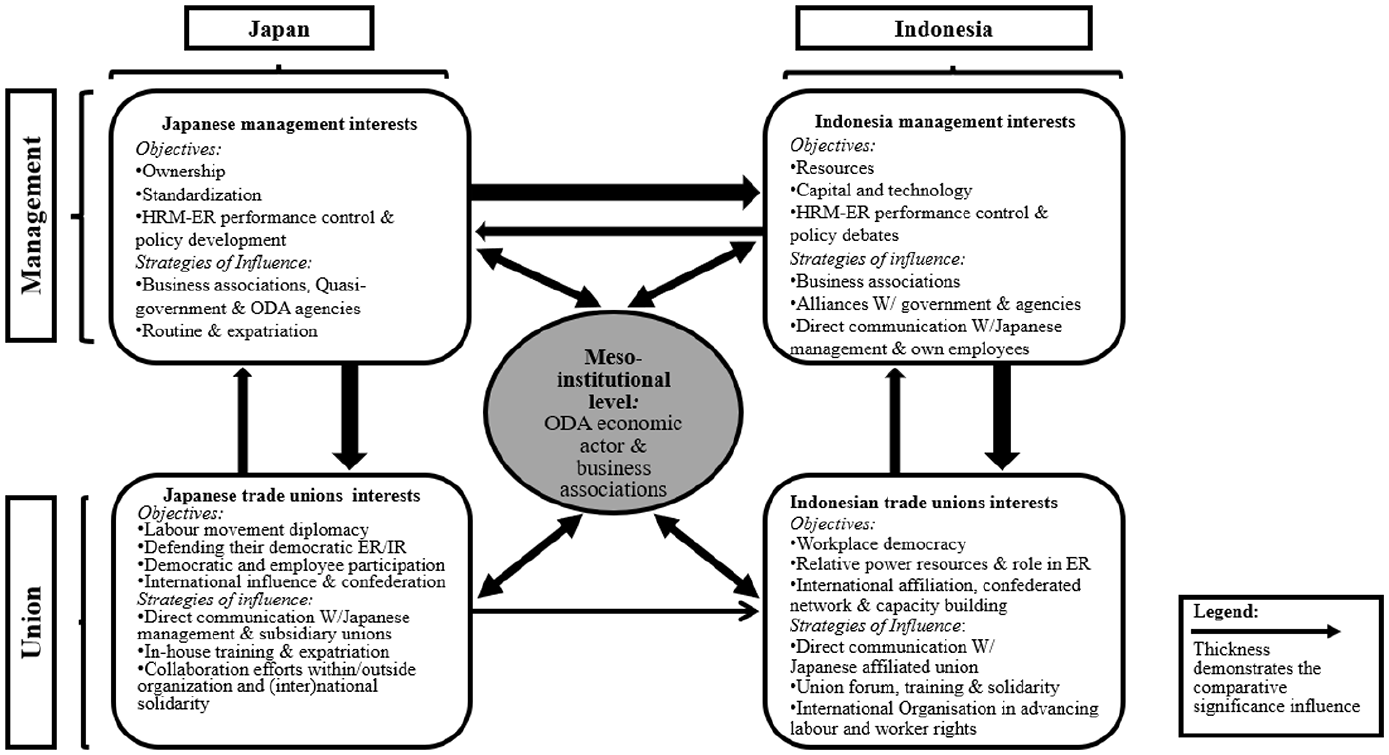
Embedded and layered power relations in the diffusion of dominant HRM-ER models in the MNC network.
Conclusion
While macro- and micro-level factors are discussed in the work of Ferner et al. (2012) and in the original SSDC framework, this article shows that the meso-level is also strategically crucial; this has been under-represented in research to date (but see Almond, 2011; Delbridge et al., 2011). Our findings are in line with other recent research on Japan (e.g. Gajewska, 2013; Huo et al., 2022; Morris et al., 2018) which also underscores the hitherto largely neglected importance of the meso-level, as well as with the industrial relations literature on the relevance of the sector (Bechter et al., 2012). A multi-layered approach contributes to the development of international HRM theory (e.g. Harney and Collings, 2021; Vincent et al., 2020). Specifically, our study has examined the layered nature of actors’ power relations across three institutional levels in situating HRM-ER practices in their cross-border political and economic context and with consideration of different forms of power (Ferner et al., 2012). While Japanese MNCs have substantial power resources, their relational power and (ideological) power of meaning can only be mobilized through investment in meso-level structures and activities. Otherwise, their relational direct control of Indonesian subsidiaries would be too distant, and local managers’ endorsement of the meaning of Japanese practices would be too shallow. The research highlights both the inter-related nature of relationships across these levels and the significance of non-MNC actors in management transfer practice processes (Gajewska, 2013; Monaghan et al., 2020).
Our empirical analysis demonstrates the contestation of elements of HRM-ER practices and policies even when dominant actors are transferring practices to emerging market economies. The evidence suggests that studying the meso-level as a significant locus of power for both MNCs and local actors in such contexts is particularly useful. First, it directs attention to dialectical processes between dominant and low-power actors, rather than linear, top-down imposition or structured rejection (Bouquet and Birkinshaw, 2008; Geppert and Dörrenbächer, 2014). The EME context of weak local institutions but important ties between firms and government is one where action at the meso-level is particularly relevant both for local actors in mobilizing these relationships and for the MNCs in responding to constraints on their influence. Second, an integrated approach that examines multiple actors across levels (namely unions, MNCs and not-for-profit organizations) is important in interpreting how each engages with the others not just directly but also, and sometimes more, through the mediation of agencies and associations. More research is needed on both these aspects but the rich complexity of our findings suggests that both of them are more relevant to how practice transfer is negotiated than it is generally assumed in studies limited to the organizational level.
These findings have therefore implications for international HRM and comparative ER. First, in terms of theoretical framing, the findings indicate that studying the meso-level as an important source of power for MNCs is useful in two key ways. First, it demonstrates a new way of viewing the contested ‘best practice’ and economic diffusion process, or an alternative way of analysing the variety of national business systems and management practices beyond the coordinated/liberal market economies typology (Morris et al., 2018). Second, such a framing centres attention on dialectical processes between dominant and low-power actors rather than linear, top-down imposition or structured rejection. In terms of future research, there are two key insights that may be drawn from this study. First, the findings show that a multi-level analysis is required in understanding how ‘dominant’ management models are transferred since the primary site for much of the key activity was found to be beyond the individual organizational level. Second, the value of adopting an approach that combines concerns with institutional context, pressures to conform and an understanding of actors’ agency and power relations is demonstrated both in the variations in negotiated outcomes and the subtleties through which these are arrived at. Such insights would usefully inform future studies of practice diffusion, particularly when a ‘dominant’ model is being transferred to EME contexts. These insights also inform two practical lessons. First, MNCs investing in EMEs cannot take local actors’ acceptance of ‘best practice’ for granted, nor should they assume that local actors are powerless. These MNCs are likely to need to invest in training and practices that foster the ideological tenets of their model and promote local managers’ consent. Second, investment in relatively young democracies with newly industrialized economies must take the meso-level seriously, as it will frame beliefs within managerial networks, and may become a hidden arena of competition between different models. Although the processes identified in this study are limited to Indonesia, a single national case, they indicate a novel research perspective that might be confirmed by future research on other emerging economies and multinationals from other dominant countries.
Supplemental Material
sj-pdf-1-eid-10.1177_0143831X221086019 – Supplemental material for The hidden layers of resistance to dominant HRM transfer: Evidence from Japanese management practice adoption in Indonesia
Supplemental material, sj-pdf-1-eid-10.1177_0143831X221086019 for The hidden layers of resistance to dominant HRM transfer: Evidence from Japanese management practice adoption in Indonesia by Joey Soehardjojo, Rick Delbridge and Guglielmo Meardi in Economic and Industrial Democracy
Footnotes
Declaration of conflicting interests
The authors declared no potential conflicts of interest with respect to the research, authorship, and/or publication of this article.
Funding
The lead author received financial support for the research from Research and Development Management Association (RADMA); John Crump Studentship, British Association for Japanese Studies (BAJS); European Association for Japanese Studies (EAJS); The Harvard-Yenching Library Research Grant, Harvard-Yenching Institute; The Sasakawa Japanese Studies: Travel grant and Postgraduate Studentship, Great Britain Sasakawa Foundation (GBSF); Japan Society for the Promotion of Science (JSPS) International Research Fellow; and UK Research and Innovation: the Economic and Social Research Council (ESRC, ES/T007826/1).

Supplemental material
Supplemental material for this article is available online.
Notes
Author biographies
References
Supplementary Material
Please find the following supplemental material available below.
For Open Access articles published under a Creative Commons License, all supplemental material carries the same license as the article it is associated with.
For non-Open Access articles published, all supplemental material carries a non-exclusive license, and permission requests for re-use of supplemental material or any part of supplemental material shall be sent directly to the copyright owner as specified in the copyright notice associated with the article.
