




Abstract
Based on employer responses to 6000 job applications, this article tests whether greater work experience lowers discrimination against job applicants of immigrant origin in the Finnish labour market. It does so by comparing the callbacks received in response to two sets of job applications: applications in which applicants of immigrant background had identical work experience as the majority applicant and those in which they had two years’ more experience than the majority candidate. The article further investigates if additional experience elicits more callbacks in jobs in which higher work experience and a vocational diploma are required and when the vacancies are high-skilled. The findings of this empirical investigation suggest the presence of deep-seated ethnic hierarchies in the Finnish labour market. They clearly demonstrate that immigrants’ chances of securing a job interview offer do not significantly change even when they possess substantially greater work experience than their majority counterparts.
Keywords
Introduction
Despite the adoption of abundant anti-discrimination legislation, research has consistently shown that labour-market discrimination against minority workers is prevalent across all Western societies leading to stark socioeconomic inequalities. Numerous steps have been taken for its eradication over the decades, yet it still poses a significant challenge to gaining employment opportunities and occupational attainment for these workers (e.g. Dancygier and Laitin, 2014; Drydakis and Vlassis, 2010; Fibbi et al., 2006; Koivunen et al., 2015; Larja et al., 2012; Pager and Shepherd, 2008; Quillian et al., 2019; Uhlendorff and Zimmermann, 2014; Zegers de Beijl, 2000; Zschirnt and Ruedin, 2016). A number of studies have indicated that discrimination, in addition to acting as a disincentive for further investment in human capital, dampens immigrants’ motivation for investing in job search (e.g. Pager and Pedulla, 2015), and may further result in withdrawal from the labour market and, in fact, social life itself (see e.g. Blank, 2005; Massey and Denton, 1993). Combating discrimination has thus remained high on the agenda of relevant government institutions, since a failure to integrate into the labour market can ultimately hamper a successful integration into society as a whole (e.g. Alba and Nee, 2003; Portes and Rumbaut, 2001). This especially holds true for contemporary Western societies in which work has, in an important way, come to define individual identity and chances for upward mobility.
Prior research has sought to address the questions of why discrimination, despite the introduction of many legislative and policy measures, still persists as well as how it can be identified and measured objectively. As regards the former question, theoretical paradigms examining this recalcitrant phenomenon vary in their explanations depending on their disciplinary backgrounds. In economics, there are two conceptual frameworks that have often been used to explain labour-market discrimination: pure (or taste-based) and statistical discrimination models. Expounded by Becker (1957), the pure discrimination model argues that economic agents such as employers, co-workers or consumers belonging to the majority group have biased attitudes towards the recruitment of ethnic minority workers. According to this model, employers will still discriminate such workers, regardless of the risk of a potential financial penalty involved and even if these workers fulfil all the productivity-relevant requirements. By comparison, in contrast to the emotional and irrational actions of individuals in the pure discrimination perspective, the statistical discrimination model argues that discrimination against minority workers can also be the result of time-efficient, rational actions by employers seeking to maximise their profit. Originally developed by Phelps (1972) and Arrow (1973), this economic model of labour-market discrimination proposes that employers discriminate because they have imperfect information about the productive potential of the jobseekers. In responding to these uncertainties about workers’ human-capital attributes, they may employ skin colour, race or ethnic group membership as a substitute for the unobserved skills and work attitudes of workers that can be costly, unobservable or impossible to measure (Kirschenman and Neckerman, 1991; Phelps, 1972). The present study will test some of the assumptions of these two economic models.
As regards the second question referred to in the beginning of this discussion, namely how discrimination can be measured, previous research has resorted to a number of methods. One of the methods frequently employed to investigate and measure discrimination includes comparing minority and majority workers’ wages and occupational mismatch by controlling for their human-capital-related attributes. This method, however, is not without its limitations: if human capital is not measured accurately and there are mean differences in human capital between minorities and the mainstream population, the effect of the omitted variable, namely human capital, can be wrongly attributed to discrimination (Gaddis, 2015). There are also other issues, such as those related to insufficient measurement of cumulative discrimination effects and sample-selection bias (e.g. Jones and Kelley, 1984; Lucas, 2008). Another approach has relied on qualitative interviews or survey research to investigate minorities’ experiences of differential treatment while seeking employment. This method, though offering us valuable information, has its own problems too, as minority workers may not always impartially judge the treatment meted out to them by employers because of the subjective element involved. This subjective element may cause them to overstate or understate the actual encounter with the employer. Interviews with employers have also been used to study why immigrants face obstacles in finding employment. However, again, this method has its own difficulties, as employers may not express their true opinions due to social desirability bias. As Pager and Quillian (2005) show, there can be a significant disparity between what employers say and what they actually do.
Given the problems associated with the above methods, research on discrimination in hiring over the years has increasingly employed field experiments to investigate this phenomenon. Especially, the correspondence methodology utilised in the present study has been the predominant approach to measure ethnic discrimination (e.g. Rich, 2014). In this method, pairs of fictional applicants with identical curriculum vitae containing similar personal attributes such as age, education, work experience, vocational diploma and other productivity-related characteristics apply for the advertised vacancies. They all have comparable attributes, but differ only in one respect, that is, their name. The applicants’ ethnic affiliation in CVs is signalled through carefully chosen names. Given that all the crucial variables can be controlled in CVs, the correspondence method offers us one of the most effective ways to objectively measure discrimination (Pager and Shepherd, 2008). Scholarship using this methodological tool has been conducted in various other countries including, among others, Switzerland (Zschirnt, 2019), Belgium (Baert et al., 2017), Norway (Midtbøen, 2015), Germany (Kaas and Manger, 2012), Ireland (McGinnity and Lunn, 2011), Australia (Booth and Leigh, 2010), Greece (Drydakis and Vlassis, 2010) and Great Britain (Wood et al., 2009).
Research questions
This article reports the findings of a correspondence test carried out in Finland. It investigates the effect of additional work experience on the chances of receiving a job interview offer for job applicants of Finnish, English, Russian, Iraqi and Somali background in the Finnish labour market. Specifically, the article explores a number of questions with corresponding hypotheses based on pure and statistical discrimination models. First, do minority applicants, with all other personal attributes held constant, face less discrimination when they possess significantly greater work experience than the majority candidate at the hiring level? According to the statistical discrimination model, employers discriminate against minority candidates simply because they have imperfect information about their true credentials, rather than out of any subjective bigotry or prejudice. If this type of discrimination constitutes the actual reasons behind excluding immigrant applicants, it should then be lower against immigrant candidates with greater work experience, as it signals to the employers that the jobseeker has the required credentials, thus reducing their level of uncertainty. Accordingly, hypothesis 1 is that applicants of immigrant origin with more experience can be expected to receive a higher number of job interview offers, as employers are likely to associate greater professional experience with more effective performance of the job tasks. Moreover, having greater experience can also communicate to the firms that there would be fewer employee training costs. These practical considerations and greater information about workers’ productive potential, as a result, would presumably lessen employers’ aversion towards recruiting immigrant candidates. However, if there is no significant change in their callback rates than in jobs in which they have identical experience as the majority candidate, this can be interpreted as a support for the pure discrimination model.
Second, does additional work experience bring more callbacks for immigrants in jobs in which the requirement for greater experience is explicitly mentioned in the job ad? Hypothesis 2 assumes that employers would especially prefer applicants with more experience for these jobs, since experienced workers can be viewed as being able to ‘hit the ground running’. Thus, we can expect employers to be more willing to take a ‘risk’ in terms of hiring immigrant applicants with additional experience in jobs in which a greater amount of previous experience is required.
Third, does additional experience yield more callbacks for immigrants in high-skilled versus low-skilled occupations? As it takes more time and effort to learn the job tasks in a high-skilled than a low-skilled position, it is reasonable to assume that employers would potentially pay more attention to the acquired experience of the jobseekers than their ethnicity when hiring employees for medium and high-skilled vacancies. Accordingly, hypothesis 3 states that in high-skilled occupations the odds would differ less between Finnish and immigrant applicants when the immigrant candidates have more experience than the majority applicant.
Fourth, does additional experience increase the odds of receiving a callback for immigrants in jobs in which a vocational diploma is demanded than when it is not required? Although the possession of a required diploma indicates to the hiring firm that the prospective employee has at least the minimum qualifications for the job in question, the newly graduated diploma holders may not necessarily have a sufficient command of the actual job tasks they are required to carry out in the job. Therefore, hypothesis 4 states that the hiring firm can be expected to attach greater value to applicants’ additional experience in selecting new employees, as a combination of a vocational diploma and sufficient previous experience suggests smooth functioning of the new job. Consequently, the hiring firms may show more willingness towards the minority candidates possessing these two attributes.
The study reported in this article sought to achieve its objectives through gathering two sets of data. In the first data set, as is often the case in correspondence tests, all the job applicants possessed similar personal attributes including age, education, vocational diploma, work experience and Finnish-language proficiency, so that the only difference between them was, in fact, a different name. In the second data set, all the applicants were similar across all the above-mentioned personal attributes, except in the degree of previous work experience: the immigrant applicants always had two years’ more work experience than the Finnish candidate. For example, if the majority applicant indicated one year’s experience in the job application, the minority candidate mentioned that s/he had three years of experience. By comparing the two data sets side by side, it not only allows us the opportunity to see the employer responses when applicants of immigrant origin have identical credentials as the Finnish applicant, but it also helps to observe simultaneously if greater work experience leads to more employment chances for immigrants.
The study described here contributes to the existing literature in a number of ways. First, although correspondence tests have been conducted in various Western countries for over two decades, only a few studies employing field experiment techniques have been carried out in Finland, several years ago (Ahmad, 2005; Larja et al., 2012). This study thus provides recent evidence of the labour-market situation of immigrants in this Nordic society. Second, the debate on immigrants’ economic integration in Finland has generally explained their lower employment opportunities and meagre occupational mobility in terms of their deficient personal qualifications (Ahmad, 2015). The present study empirically tests the validity of these human-capital-driven explanations, by including second-generation immigrants who possess all the required credentials, including host-language proficiency, education and work experience. Third, another important contribution of this study is that, by holding all other personal attributes constant, it explores whether a change in immigrants’ work experience mitigates the extent of discrimination they encounter in the labour market. There are only a few studies that have explored this connection empirically (Baert et al., 2017; Bertrand and Mullainathan, 2004; Bursell, 2007; Vernby and Dancygier, 2019). Fourth, the present study is based on a large data set, which helps to ensure that the study results are systematic and not due to some spurious effects. Fifth, in contrast to many previous studies that are limited to a small number of occupations and regions, it tests discrimination in over 15 occupations throughout the major cities in Finland. Lastly, previous research has often focused on one or two ethnic groups, with studies investigating three or more groups being comparatively less common. The present study has concentrated on four immigrant groups – including both European and non-European. It is important to include diverse ethnic groups because immigrants are not just a single group. Rather, there are two types of immigrants, namely Western and non-Western, and attitudes towards these two groups may vary significantly in society and, by extension, in the labour market. The present study fruitfully offers the possibility to test this assumption empirically.
The Finnish context is interesting in that not only is it a society which prides itself on the principles of universalism and equity with various anti-discrimination laws, but also where immigration has predominantly been a recent phenomenon. This can be judged by the fact that while the proportion of immigrant population constituted 0.8% in 1990, it corresponded to around 7% of the total population in 2017. In fact, from the beginning of the twentieth century until as late as the 1970s Finland had rather witnessed a significant emigration of its people to many economically advanced countries, especially Canada and the United States, to find work in their mining and forestry industries. In particular, it also experienced the large-scale movement of its nationals to Sweden at the end of the 1960s because of poor economic conditions at home. However, while the Finns have migrated to various countries in large numbers, foreigners and refugees were for a long time perceived as a threat to the country’s security due to its geopolitical position (Paananen, 2005). Despite the fact that immigration has been suggested as a possible future remedy in the official discourse and media to invigorate the ageing workforce and to broaden the tax-revenue base for pensioners, there has been a widespread belief that immigrants are an economic burden. Especially with respect to Muslim immigrants, fears have centred on preconceived ideas about the different cultures and traditions that Muslim immigrants may bring to Finland. Since the 1990s, a number of surveys on the attitudes of the mainstream population towards various immigrant groups have been carried out (e.g. Jaakkola, 2005, 2009). These surveys revealed a clear ethnic hierarchy: while immigrants from European countries, such as from Britain and Norway, were predominantly located at the top, those from Iraq, Somalia and other non-Western countries found themselves at the low end of the ethnic hierarchy. No recent information is available on ethnic hierarchies since the last comprehensive survey conducted in 2009. However, the discussions carried out in the media over the ensuing years seem to suggest that these hierarchies have not changed significantly.
Considering the prevailing attitudes and negative sentiment towards immigrants, it is no wonder then that the task of integrating workers who are especially less proximate to the mainstream population in terms of colour, culture and religion into a mostly white and mono-ethnic labour market has not been an easy one. Thus, despite the introduction of several language and vocational-training measures, the labour-market performance of immigrants still lags behind the mainstream population along several dimensions. For example, in Helsinki, where a significant proportion of people of foreign origin reside, immigrants’ unemployment rate in 2016 was 17%, which was more than two times greater than that for the majority group (Saukkonen, 2017). However, there are differences within the immigrant population. Immigrants from Asia or Africa show higher unemployment rates than those originating from Western countries. Particularly, immigrants of African and Middle Eastern background have been reported to encounter significant discriminatory practices in entering the labour market. Immigrants are also reported to show greater job mismatch, as they face more barriers to gain jobs of better status (e.g. Myrskylä and Pyykkönen, 2014). Many of them, especially from developing countries, are employed in the retail trade and service sectors, often on short-term and part-time employment contracts (see Sutela, 2015).
Data, experimental design and methods
This correspondence experiment was conducted between June 2016 and March 2017. The data consist of employer responses to two sets of job applications sent out to a total of 1200 vacancies advertised on the website of the Finnish national employment service. They were answered by five fictitious job applicants of Finnish, English, Iraqi, Russian and Somali background, who responded to each of these selected job openings. Thus, altogether 6000 job applications were sent out to various enterprises. In the first set of applications sent to 1000 jobs, all the applicants had identical personal attributes such as age, education, proficiency in the Finnish language, vocational diploma, work experience, and computer and software skills. In this case, the only thing that primarily differentiated them was their name. In the second set of applications sent to 200 jobs after completing the first data set, all five candidates were equivalent across all the above dimensions, except in the amount of previous work experience: the applicants of immigrant background always had two years of additional work experience than the Finnish candidate. All the jobs were answered by email, which is the most common way to respond to a vacancy in Finland. Also, in all the jobs tested, the applicants were asked to send their application via email.
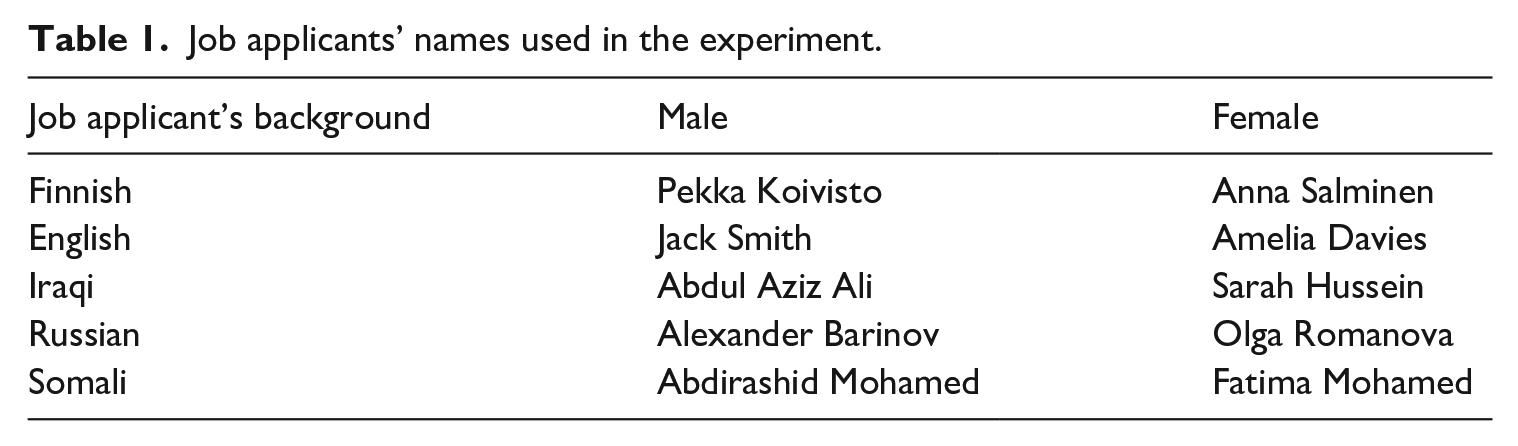
The study focused on applicants with previous experience, who were seeking work with their recent job having ended between one and three months ago. They were aged 24–28 years. The rationale behind selecting this particular age group was twofold. First, this choice makes sense as the focus of this research was second-generation immigrants. Also, selecting this age bracket is relevant, since in Finland the immigrant population predominantly belongs to a younger cohort. Secondly, the aim was also to avoid the possible confounding effect of age discrimination on receiving a callback, as employers may be more inclined to employ younger than older workers (see e.g. Koivunen et al., 2015). As is often the case in correspondence studies, the ethnicity of the applicant was signalled to the recruiters through carefully chosen and ethnically distinguishable names. For this purpose, a number of names were first picked from different websites that listed the most common and popular names among the selected immigrant groups. A final list of names was then prepared after consultation with members of the respective groups. The names used in the study are those they thought were most typical of their group. However, in order to remove any ambiguity, the ethnicity of the immigrant applicant was also indicated by clearly stating the mother tongue of the candidate in the CV and job letter. Finnish names, on the other hand, are quite distinctive and the employers should have no problems in recognising that the job applicant is Finnish. Both first and surnames were used in the job application. There was only one name used per origin. Table 1 provides a list of names used in this experiment.
Job applicants’ names used in the experiment.
As regards gender distribution, half of the jobs were answered by male and half by female applicants in each of the five job-seeking groups, but men and women did not apply for the same job. Occupations tested varied from low-skilled to medium-skilled and high-skilled jobs and included restaurant staff, waiters, cooks, cleaners, sales representatives, office clerks, receptionists and shop cashiers. Based on extensive discussions with immigrants, the selected advertised positions represent the kind of jobs that they often apply for in Finland. However, the sectoral distribution of jobs was also affected by the nature of vacancies that were advertised during the period of data collection. In this study, an attempt was made to answer two types of job openings: those that required face-to-face contact with customers and those that did not. The aim behind this was to test whether or not employers discriminate differentially based on perceived customer preferences. All the jobs were located in private firms, which varied in size from micro and small companies to medium and large enterprises. 1 All the five job applications were sent out within a period of four hours. Jobs answered were located all over the major cities in Finland, including Helsinki, Espoo, Tampere, Vantaa, Turku, Oulu, Lahti, Kuopio, Jyväskylä and Pori.
The job application consisted of a job letter and a CV. Five job letters sent out for any vacancy were qualitatively equivalent. The letters effectively conveyed to the recruiters that the minority jobseeker had excellent proficiency in the Finnish language and was an ambitious, motivated, flexible, team-oriented and affable person, who was eager to develop personal skills and knowledge base. The CVs were created with the help of a CV generator software. For any job, this software created five equivalent CVs for the five job applicants (excluding the second data set in which the minority applicants always had two more years of work experience than the majority candidate, as mentioned earlier). The CVs did not contain a photograph, which is not customary or a requirement in Finland. In this experiment, it was especially excluded to prevent any impact that physical appearance may have had on an employer’s decision to invite a certain candidate for an interview. This preference was informed by the literature on aesthetic labour suggesting that the hireability of job applicants in interactive service work can also be affected by their physical appearance and attributes (see Nickson et al., 2012). The aim was to leave to the recruiters the job letter and the CV as the only criteria for judging the applicant. The CV included such details as age, education, Finnish-language skills, vocational diploma, work experience, computer and software skills, names of schools and other vocational institutes at which they had obtained their diploma, phone number, email and postal address, mother tongue and hobbies.
Although all the five job letters and the accompanied CVs sent to any position were equivalent in terms of content, slight stylistic differences were required to avoid risk of detection. These included differences in font type, font size, layout and the order in which the various sections followed. 2 For the same reason, small differences in age were also kept between the five candidates (varying between five months to one-and-a-half years) when they responded to the same vacancy in order to prevent any chance of suspicion. The order of sending the application to a job opening was altered each time the applicants applied for a job: if, e.g., the order of sending job applications for the five applicants in one job was: Finnish (first), English (second), Iraqi (third), Russian (fourth) and Somali (fifth), in the next job, the order could be the following: Somali, Russian, English, Iraqi and Finnish. The aim behind this practice was to avoid any remote possibility where some applicant was preferred in the screening process because of the employer having received his/her application earlier than the others.
The employer calls were not answered directly, but a voicemail box was set up for each of the candidates separately, with the telephone service provider’s standard message requesting the caller to leave his/her message after the beep. Employers contacted the applicants in three ways: email, telephone or/and SMS. Finally, as regards the coding of employer responses, it was done as follows: a response was categorised as positive if the applicant received a job interview offer. Conversely, a response was regarded as negative when the applicant was rejected as well as cases when there was no response from the employer at all.
In this article, a logistic regression model was used to analyse connections between a binary dependent variable and a number of independent variables. If we compare the odds for two values of an independent variable, we get the odds ratio showing the expected change in the odds due to the change on the independent variable. The coefficients of the model give an estimate of the change in odds when random variation and the influence of the other independent variables have been removed from the observed values of the independent variable. In the tables, the odds ratios are given both in logarithmic form (B) and the exponential form (Exp(B)). The change is always given in relation to a reference category. In the present analyses, the SPSS defaults have been used, which means that the reference category is the last category of each variable. The greater the coefficient for a group is, the greater the odds (callback received/no callback received) are compared with the callbacks received in the reference category. The statistical significance of the parameters (the probability of obtaining the odds ratio given by the model, if the null hypothesis were true) is also given in the tables. The hypotheses in this article concern technically interaction terms between two or three independent variables. In the tables, the main effects model is given first (Model 1) and then the model with interactions implied by the relevant hypothesis (Model 2).
For any given sample size, increasing the number of terms in the model makes it more difficult to obtain statistical significance. The required effect of an independent variable must be the stronger the larger the model is. Since there are many categories in some of the independent variables, it is possible that the effect of some parameters would remain non-significant, even if the effect is important. Especially, interactions of categorical variables quickly increase the number of parameters to be estimated. In order to address this issue, models where all immigrant groups were grouped into one category and tested against the Finnish applicants, were thus also fitted to ensure that substantially important effects were found. However, in the present context, this has a drawback of concealing possible and important differences between the immigrant groups. For this reason, while the results obtained with combined groups are included in the discussion, the immigrant groups are kept separate in the tables.
The data consist of responses to the five applications submitted for each job. It is possible that the employers have slightly different response patterns compared with other employers. This effect (sometimes called clustering effect) could produce intra-employer correlations, which would be against the basic assumption of independence of cases in the data. This might distort the results and, above all, the tests of significance. To avoid this, a modified version of the logistic regression model fitting was used. This can be done in the SPSS software in a couple of ways. In the present case, a complex sample design was used. This required defining a complex analysis plan where each case is given a weight of 1, and a clustering variable (in this case the variable identifying the employer) is given. Then, the SPSS will run an analysis of weighed data taking into consideration the possible clustering effect.
Results
Does additional experience moderate discrimination against immigrants?
Table 2 offers a comparison of callbacks received by the five job applicants after sending 6000 job applications and tests hypothesis 1. In the table, ni denotes the number of job interview offers received by each ‘i’ group when N applications are submitted. The callback rate column is the percentage of callbacks of all applications for each applicant group, indicated by 100 × ni/N. The other columns are output from two logistic regression analyses in which the null hypotheses assumed that the odds ratios for receiving callbacks are the same. In other words,
H0:
for all immigrant groups, where the subscripts I and F stand for immigrant and Finnish group respectively, c for callback received and nc for no callback received. As we can see from Panel A, where all the applicants possess identical work experience, the null hypothesis can be rejected in all cases. There appear to be noticeable differences between the odds when comparing immigrant and Finnish applicants. With a callback rate of 39%, the Finnish candidates received the highest number of job interview offers. Only applicants of English and Russian origin came somewhat closer to the majority applicant, receiving a callback in 26.9% and 22.8% of the cases respectively. As Panel A further highlights, applicants with an Iraqi and Somali name with equivalent work experience and other personal attributes seem to be the least attractive options for the Finnish employers.
A comparison of callback rates by ethnicity with identical and additional experience, a logistic regression model.
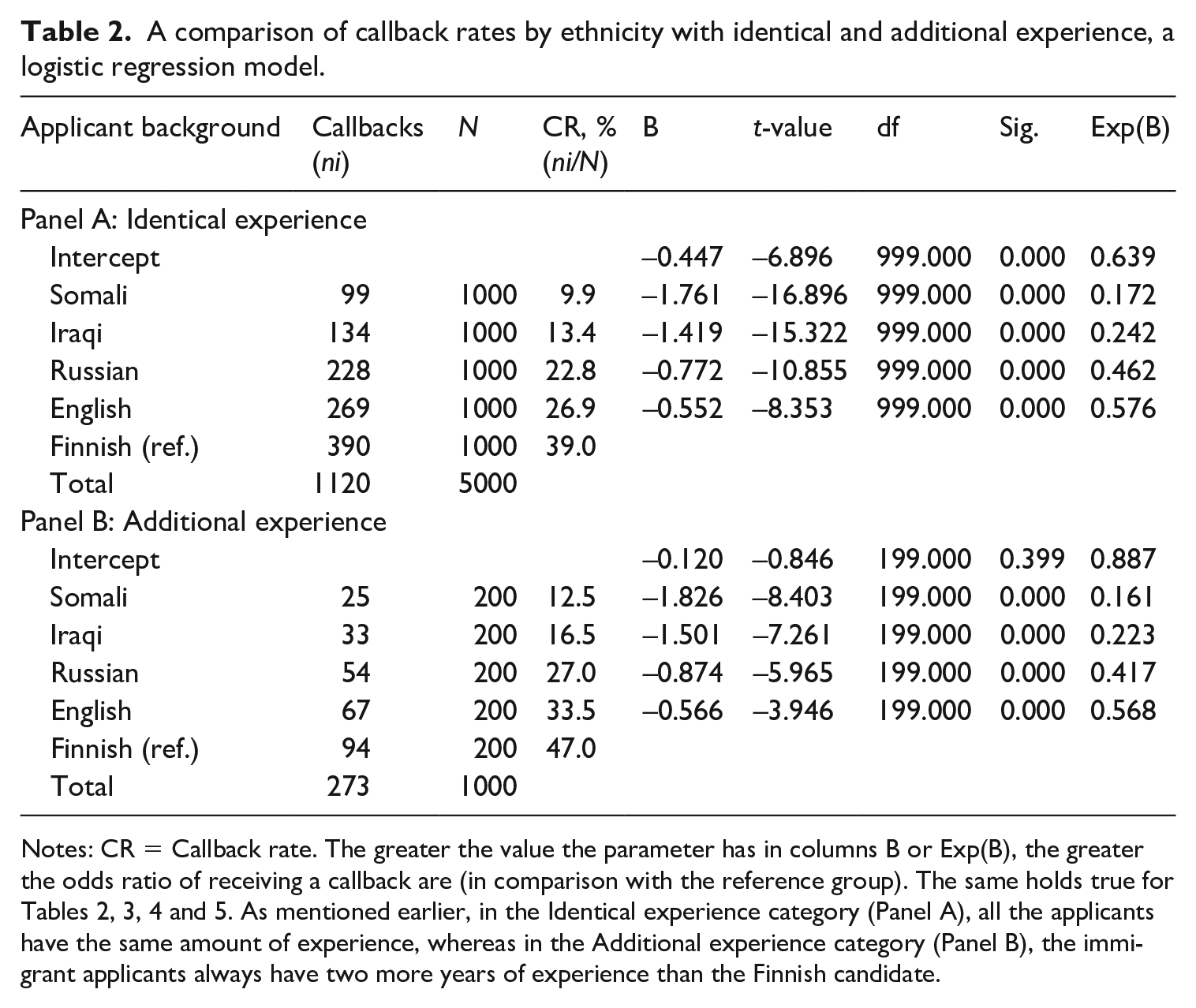
Notes: CR = Callback rate. The greater the value the parameter has in columns B or Exp(B), the greater the odds ratio of receiving a callback are (in comparison with the reference group). The same holds true for Tables 2, 3, 4 and 5. As mentioned earlier, in the Identical experience category (Panel A), all the applicants have the same amount of experience, whereas in the Additional experience category (Panel B), the immigrant applicants always have two more years of experience than the Finnish candidate.
It can be argued that because of discrimination, employers would be more inclined to give short shrift to minority applicants when a majority candidate with similar work experience and other human-capital credentials is also available. Panel B throws light on whether applicants of immigrant origin having a significant advantage in respect of work experience would be more desirable to the hiring firms. Again, as can be observed, the null hypotheses assuming equal odds for immigrant and Finnish applicants are rejected by a large margin. Instead of giving them a significant edge over the majority candidates, a two-year additional experience is clearly not sufficient for immigrants to bring them even on a par with their Finnish counterparts. Even the observed odds ratios follow quite similar patterns in both panels. With identical experience, the odds ratios for English, Russian, Iraqi and Somali applicants against Finnish candidates are 0.576, 0.462, 0.242 and 0.172 respectively. With additional experience, the corresponding odds ratios stand at 0.568, 0.417, 0.233 and 0.161 respectively. Thus, the callback rates of different immigrant groups do not seem to change whether they have equal or more experience, suggesting a strong ethnic hierarchy prevailing in the Finnish labour market. It is true that all immigrant groups in Panel B receive more callbacks than in Panel A. However, the same holds true for Finnish applicants, too.
To investigate whether the small differences in Panels A and B could be explained by random variation only, the data used in Panels A and B were merged to obtain a file of 6000 cases. A new variable was added to indicate whether a case came from Panel A or Panel B. This was named ‘Additional experience (equal in Panel A, not equal in Panel B)’. Then, a model with the interaction term Additional experience by Ethnicity was fitted. The interaction term (not shown in the table) did not prove to be significant. Thus, hypothesis 1, which stated that minority applicants with more experience can be expected to receive a higher number of callbacks and face less discrimination as hiring firms are likely to associate greater professional experience with more effective performance of the job tasks, is not supported by the data. By implication, the findings also do not appear to offer support to the statistical discrimination model either. Rather, they may lend more credence to the pure discrimination model, according to which unequal labour-market outcomes of minority workers are the result of employers’ exclusionary attitudes towards their recruitment.
Effect of additional experience in jobs requiring greater experience
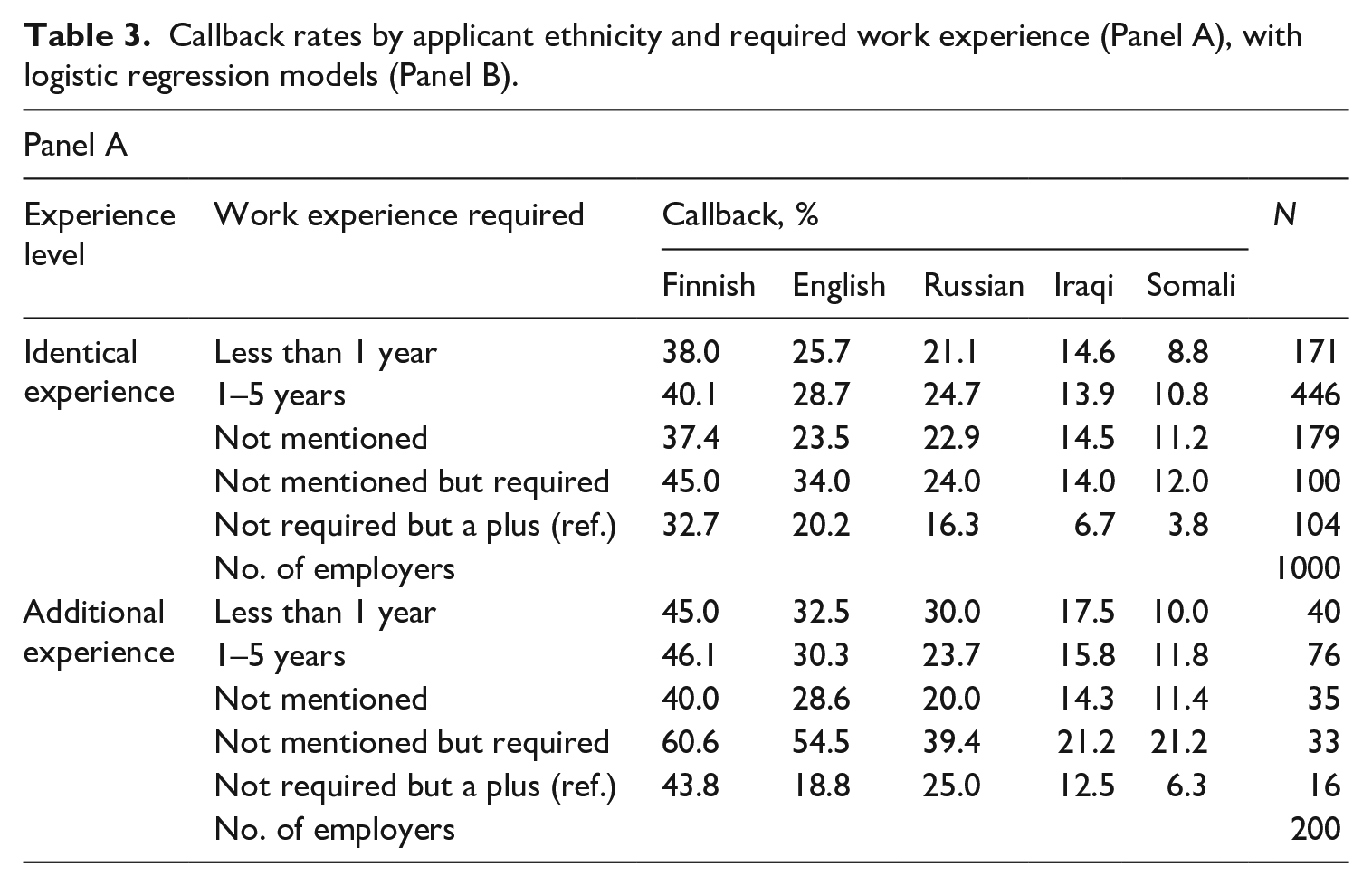
Next we turn to test hypothesis 2, according to which in jobs in which a greater amount of work experience is demanded, employers would be significantly more willing to consider immigrant jobseekers with additional experience and pay less attention to the ethnicity of the immigrant applicants, which is irrelevant to the effective performance of the actual job tasks. Before testing the hypothesis, Panel A in Table 3 provides us a concrete comparison of the possible differences resulting from immigrant applicants possessing a two-year additional experience. One would expect the effect of additional experience to be largest where experience is specifically required, namely in the category 1 to 5 years of experience. We see whether this is the case: with identical experience, the callback rates stand at 40.1%, 28.7%, 24.7%, 13.9% and 10.8% for Finnish, English, Russian, Iraqi and Somali applicants respectively. In comparison, with additional experience, these callback rates are 46.1%, 30.3%, 23.7%, 15.8% and 11.8% for these applicant groups. As we can see, contrary to what one would expect, additional experience has in fact widened the distance for the above immigrant groups to the Finnish candidates: from 11.4, 15.4, 27.2 and 29.3 percentage points to 15.8, 22.4, 30.3 and 34.3 percentage points respectively. Also, in other categories of required work experience, having greater experience has not yielded any benefit in terms of receiving more interview offers for immigrant jobseekers.
Callback rates by applicant ethnicity and required work experience (Panel A), with logistic regression models (Panel B).
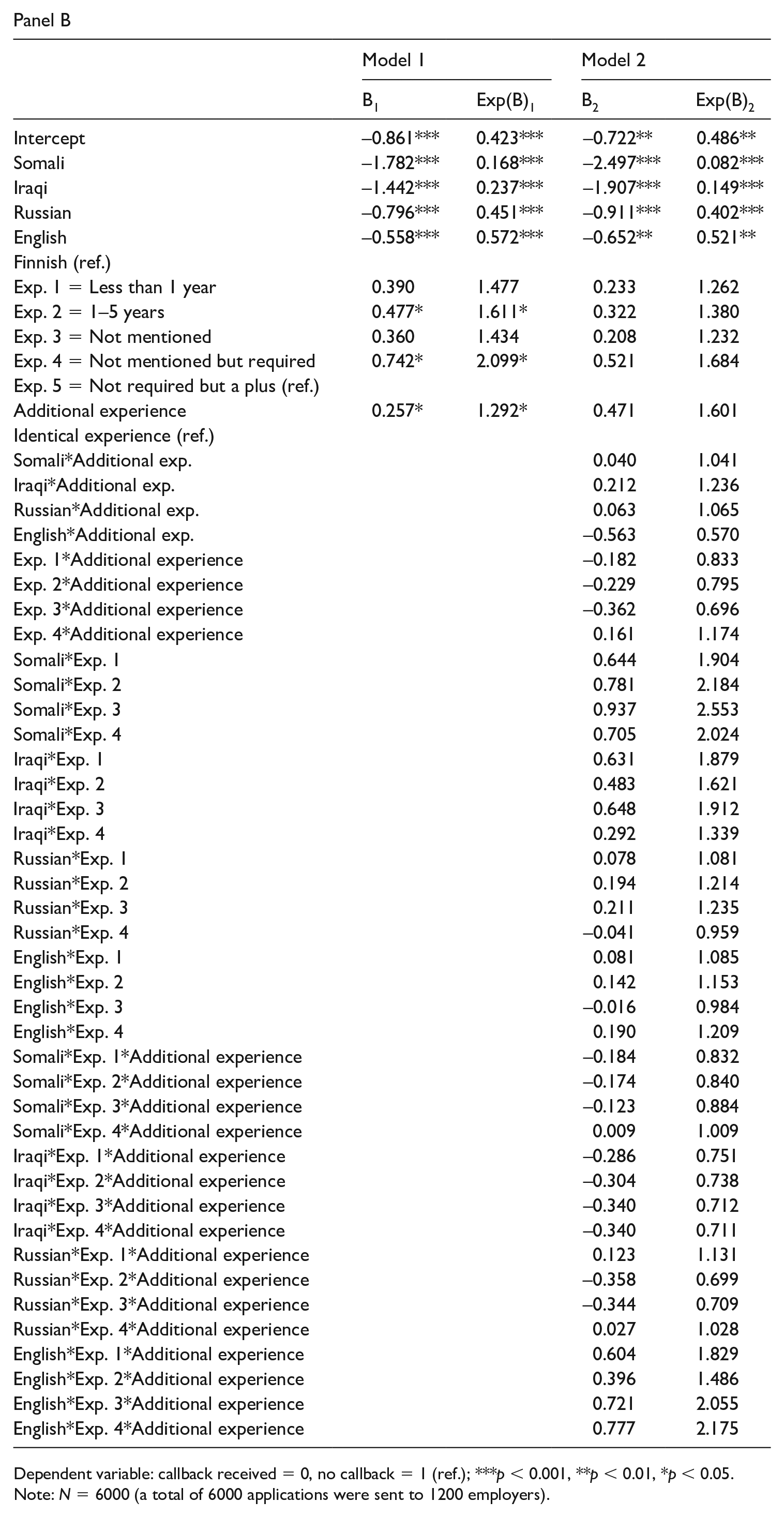
Dependent variable: callback received = 0, no callback = 1 (ref.); ***p < 0.001, **p < 0.01, *p < 0.05.
Note: N = 6000 (a total of 6000 applications were sent to 1200 employers).
Table 3 further tests hypothesis 2 by fitting two logistic regression models in Panel B. In Model 1, with main effects only, the odds in all immigrant groups are smaller than in the Finnish group, indicating the same result as noted earlier in Table 2. Although two categories of the required work experience (‘1–5 years’ and ‘Not mentioned but required’) deviate significantly from the reference group, the difference is however the same for all applicant groups. Similarly, the odds of receiving a callback are about 30% greater in the data where the immigrants have additional experience to the Finnish applicants. Again, the difference is the same for both majority and minority applicants alike and does not suggest less discrimination or more opportunities for immigrants. When all immigrant applicants were combined into one group, the model (not shown here) produced similar results and the same parameters were significant as the ones in Model 1 of the table. In Model 2, the only significant variable is ethnicity. As we can see, hypothesis 2 is not confirmed, as none of the interactions are significant. Again, the tests were re-run with a model where different immigrant groups were combined into a single group. For this purpose, both a model with only two-way interactions and a model with two-way and three-way interaction were fitted. The results, however, remained the same: neither any two-way interaction nor any three-way interaction was found to be significant. In the model with the three-way interaction included, the odds ratio of the combined immigrant group was 0.275, while p = 0.000. The odds ratios in the three-way interaction varied in this case between 0.96 and 1.19, and the smallest p-value was 0.730. In other words, for immigrant applicants, the possession of a two-year significant advantage in work experience compared to their Finnish counterparts does not translate into real advantage in the labour market. Based on these observations, it seems reasonable to argue that it is more important for Finnish employers to cater to their prejudices by excluding a jobseeker with an immigrant background than hiring workers with potentially more productivity and better skills that can be assumed to follow from possessing additional experience.
Effect of additional experience in high-skilled occupations
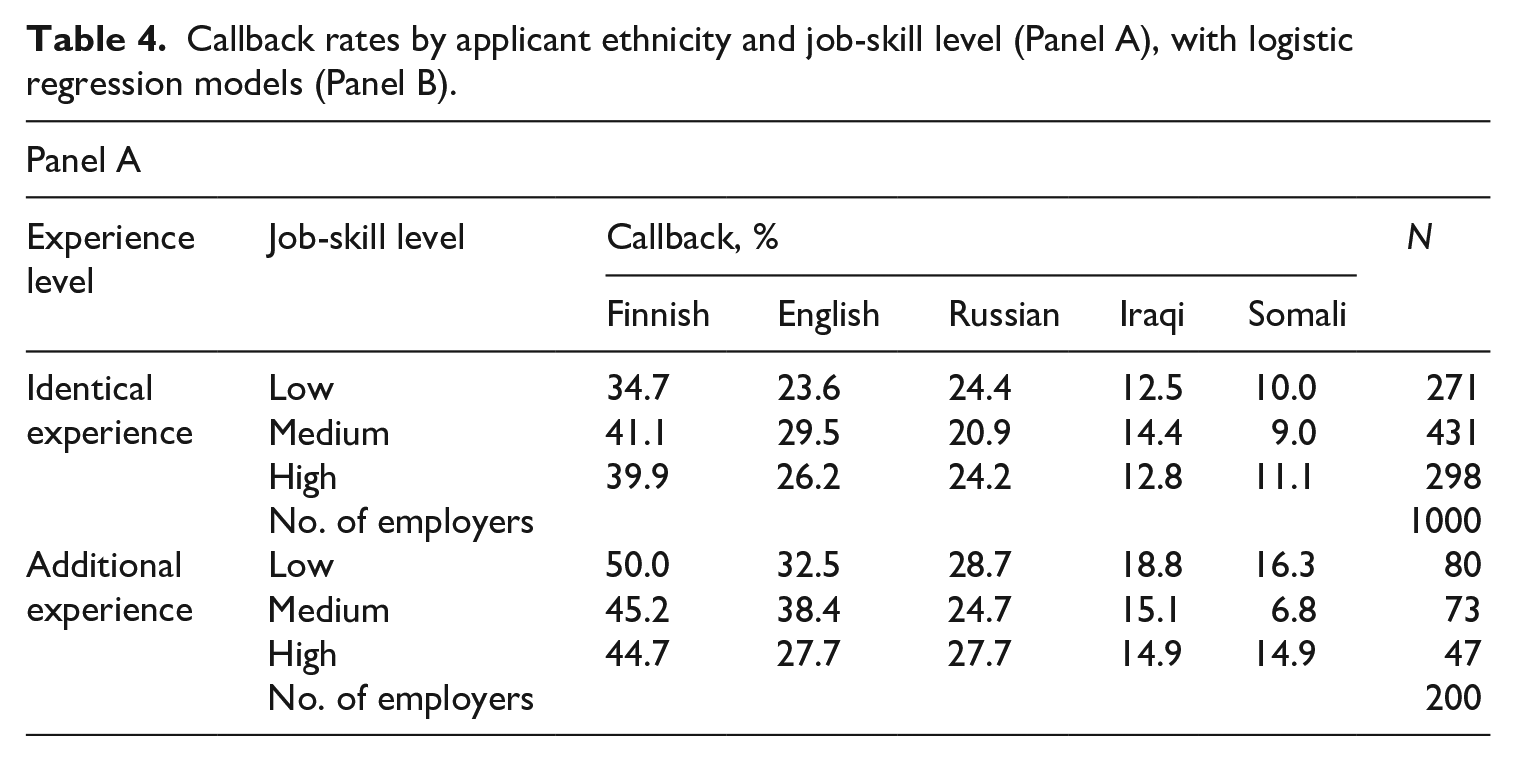
Hypothesis 3 relates to the assumption that as it takes more time and effort to learn the job tasks in a high-skilled occupation, one would expect employers to be potentially paying more attention to the acquired experience of the jobseekers rather than their ethnicity when hiring workers for these vacancies. Accordingly, in high-skilled occupations, the odds are likely to differ less between Finnish and immigrant applicants when the immigrant candidates have significantly greater experience than the majority applicant. To explore this, we turn to Table 4. In this table, Panel A first gives the callback rates by ethnicity and the skill level of the advertised position, split by the experience level. As the comparison of the two experience levels reflects, the chances of immigrant applicants to get invited to a job interview in high-skilled jobs do not seem to grow with a substantial increase in their experience. Finnish applicants whether they possess less or equal experience as the immigrant candidates are the principal choice for hiring firms, leaving behind other groups at a considerable distance. Although the callback rates of immigrant applicants seem to show a slight improvement with an increase in experience, they have not improved their position at all with respect to the Finnish candidate answering the same vacancy.
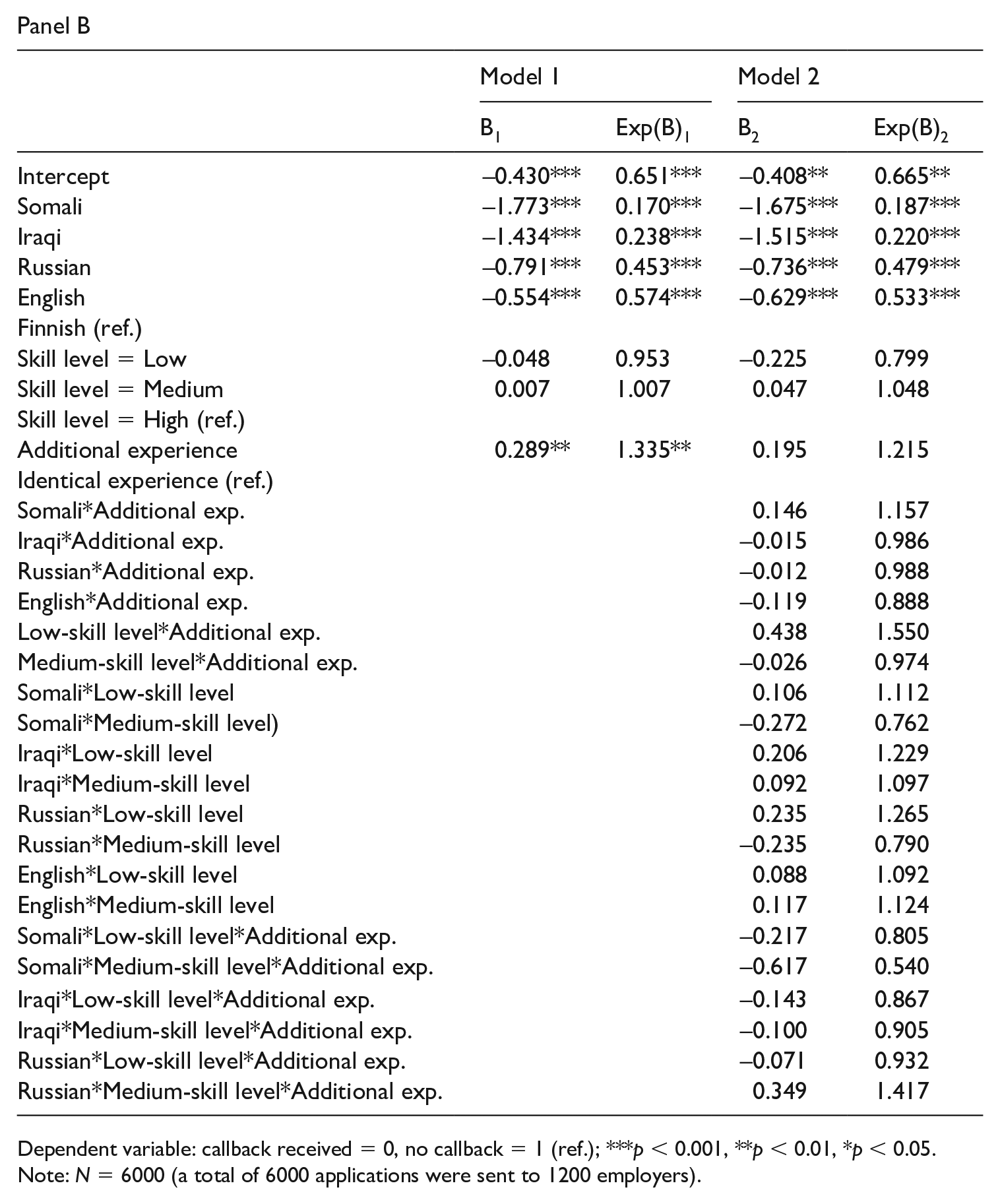
Callback rates by applicant ethnicity and job-skill level (Panel A), with logistic regression models (Panel B).
Dependent variable: callback received = 0, no callback = 1 (ref.); ***p < 0.001, **p < 0.01, *p < 0.05.
Note: N = 6000 (a total of 6000 applications were sent to 1200 employers).
In order to investigate whether the differences observed in Panel A are non-random indications of the true connections between the variables as well as to test hypothesis 3, logistic regression models were fitted as shown in Panel B of the table. In Model 1 of the table, we can see that the variable Skill level is not significant, and the other two variables show the same results as in Table 3, with a minor difference in the coefficients only. In Model 2, the three-way interaction term Ethnicity by Skill level by Additional experience for the immigrants can be used to test the validity of the third hypothesis. According to the hypothesis, in comparing the opportunities between an immigrant group and the Finnish group, the immigrants should receive callbacks closer to the Finnish candidates when they have additional experience and when the job-skill level is high than in the case when they possess identical experience to the Finnish applicants and when the job-skill level is low. As we can see, this is not the case, however, as the three-way interaction term is not significant. Thus, we are left with the main effects model only. The model clearly reflects that although there is an increase in opportunities for immigrant applicants with additional experience, the same holds true for Finnish candidates as well even when they have two years’ less experience than the minority applicants. As previously, the tests were re-run with immigrant groups combined into a single category and models, first with two-way interactions and then with the additional three-way interaction, were fitted. No two-way interaction or three-way interaction obtained any statistical significance. In the model with the three-way interaction, the odds ratio of the immigrant applicants vs the Finnish applicants was 0.34, while p = 0.000. The three-way interaction parameters were 0.80 (p = 0.47) and 1.03 (p = 0.93). In short, the possession of greater experience has not enabled immigrants to narrow the gap with their majority counterparts. Accordingly, hypothesis 3 is not supported by the data.
Effect of additional experience in jobs requiring a vocational diploma
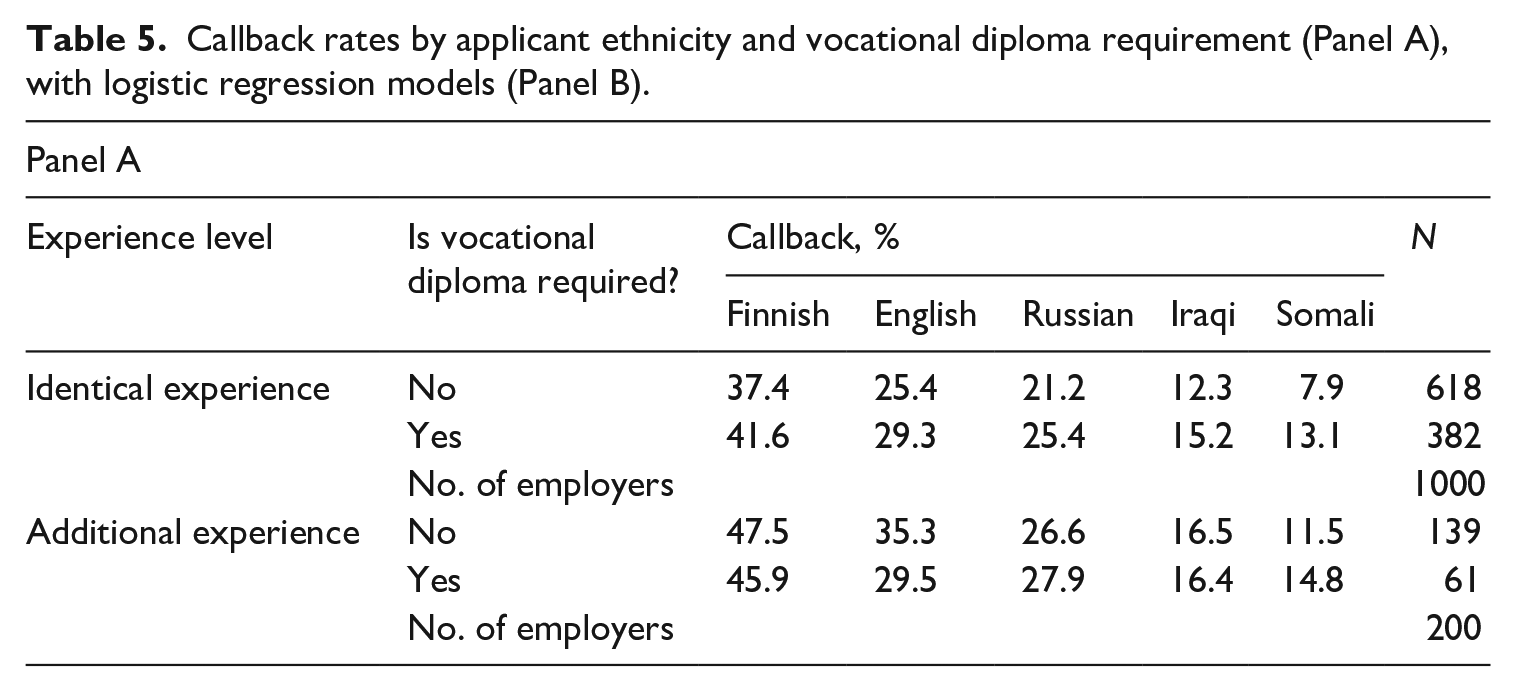
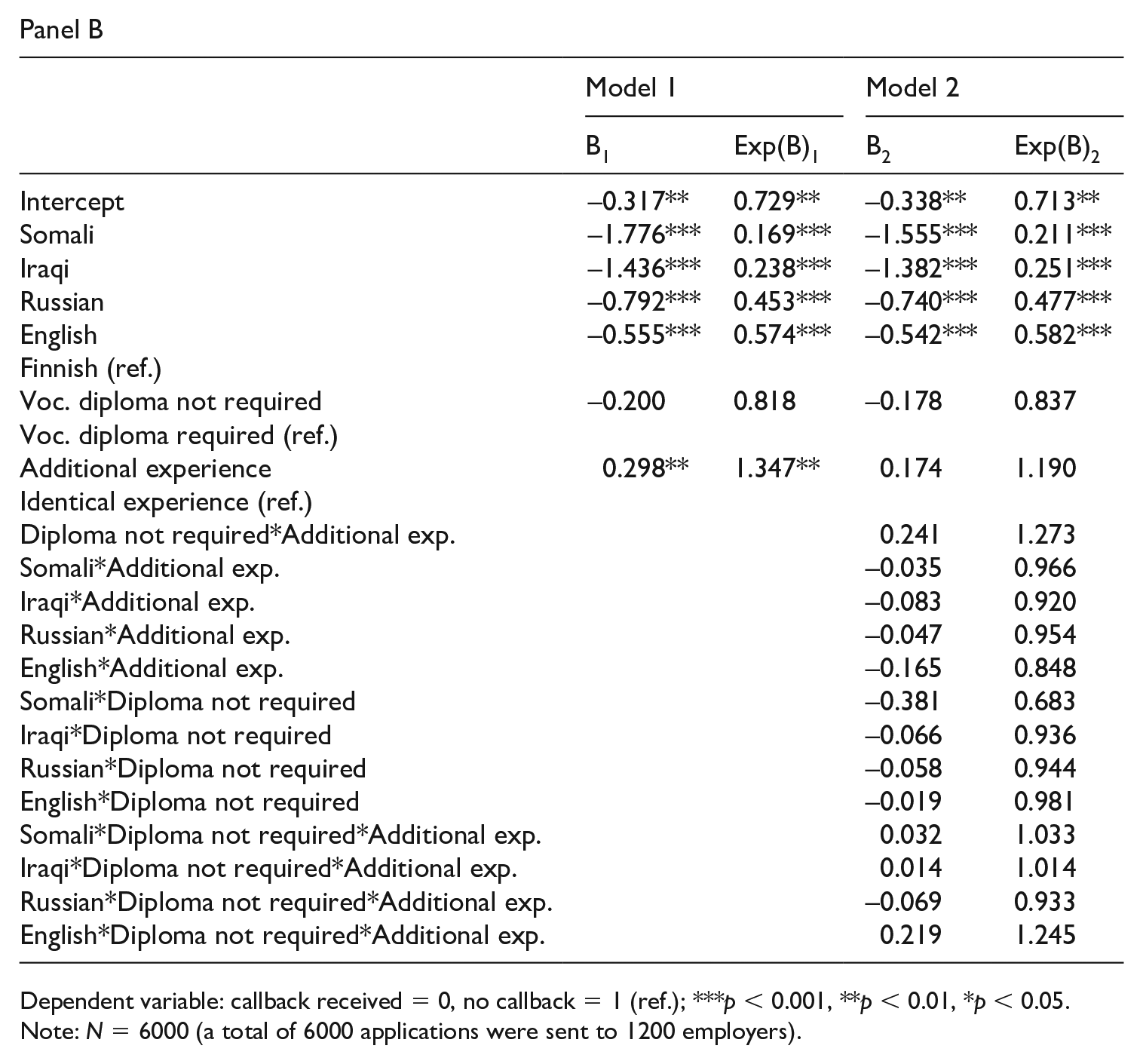
This section tests hypothesis 4, which stated that as a combination of a vocational diploma and sufficient previous experience would suggest to the recruiters smooth functioning in the new job, the hiring firm can be expected to attach greater value to applicants’ additional work experience in hiring new employees. Consequently, the decision-makers may show more willingness to consider minority candidates possessing these two attributes. However, as Panel A in Table 5 reveals, the same patterns continue to persist as noted previously in the discussion thus far: there does not appear to be any major difference between the two experience levels in terms of obtaining job interview offers. The differences between the different immigrant groups suggest the same ethnic hierarchy and their unequal chances in the Finnish labour market. In Finland, a recent study by Böckerman et al. (2019) has shown higher labour-market returns to post-secondary vocational education. As the above observations highlight, not all job applicants can benefit equally from their human capital due to an ethnic penalty. Panel B gives the results of the two logistic regression models testing hypothesis 4. However, none of the interactions was found to be significant, and therefore a more concise model with main effects only can be accepted as a final model in Table 5. Reverting to the matter under consideration, hypothesis 4 would require that the effect of having a diploma would bring minority applicants closer to the majority candidates when they have a major advantage in experience over them. As can be seen, the interaction parameters that would indicate this to be true are not significant, therefore suggesting no support for hypothesis 4. The results remained the same when the tests were repeated by combining all the immigrant groups together. The three-way interaction term was 0.915 (p = 0.470).
Callback rates by applicant ethnicity and vocational diploma requirement (Panel A), with logistic regression models (Panel B).
Dependent variable: callback received = 0, no callback = 1 (ref.); ***p < 0.001, **p < 0.01, *p < 0.05.
Note: N = 6000 (a total of 6000 applications were sent to 1200 employers).
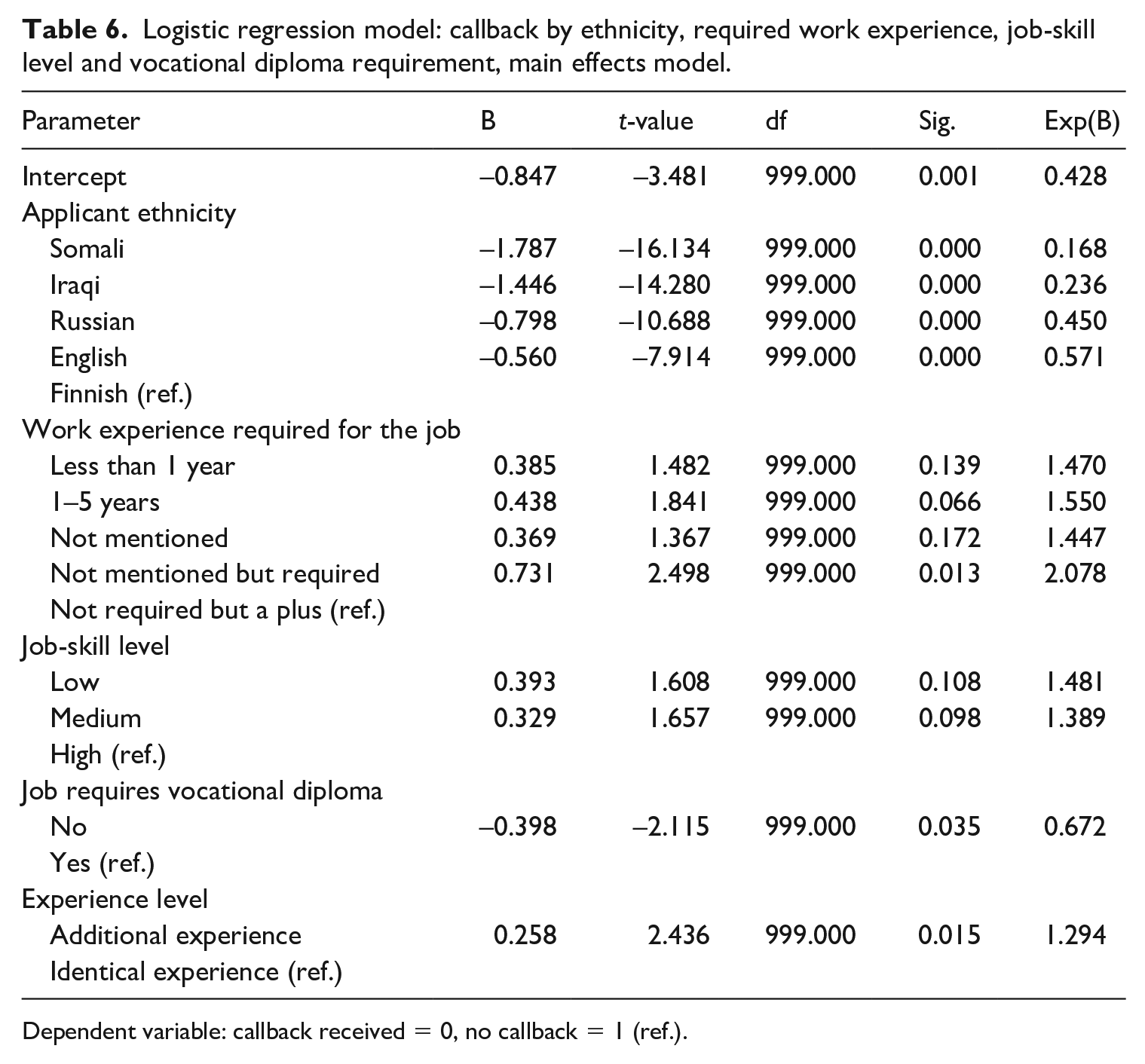
Thus far, the article has explored the role of additional experience in the context of different important variables. Now, we turn to investigate further the significance of additional experience by employing the logistic regression model. In the analyses previously reported in different sections, the data were not sufficient to allow fitting a model with all variables and interactions used. Therefore, separate tables were used to give models where interactions were included. As the interactions are not found to be significant, it is therefore possible to proceed to a model with main effects only by including all the variables analysed separately earlier in the same model, as reported in Table 6. In the table, the parameter estimates (B) describe the expected difference between a group (e.g. English) compared with the reference category (e.g. Finnish). The major advantage of this model is that we can see the effect of one independent variable with all other independent variables held constant.
Logistic regression model: callback by ethnicity, required work experience, job-skill level and vocational diploma requirement, main effects model.
Dependent variable: callback received = 0, no callback = 1 (ref.).
As can be observed from the table, three of the four independent variables have significant effects on the odds of receiving a callback from the employer. Among them, applicant’s ethnicity is the most prominent. Although its importance has already been noted in receiving a job interview offer in other tables, the logistic regression analysis further corroborates its significance. The odds of immigrant groups vary between around 17% for Somali and 57% for English candidates in comparison with the Finnish applicants. The difference between European and non-European applicants is also noticeable, clearly suggesting that the more distant a group is from the majority group in terms of colour, culture, religion and the economic level of the country of origin, the more negative reception is it likely to receive from the mainstream population (see e.g. Ford, 2011; Sides and Citrin, 2007). In addition to ethnicity, the other two significant factors are the requirement of vocational diploma and the experience level (all groups have identical experience or immigrants have two years’ additional experience to Finnish candidates). In vacancies which do not require a diploma, the odds of receiving a callback for immigrants are 67% of the odds in jobs where a diploma is required. The effect, however, is the same for all applicant groups. The same also holds true for the identical experience vs additional experience variable. Here, the odds of getting invited to an interview for immigrants with additional experience are 129% or 29% higher than that with equal experience, but the same is true for the Finnish group as well. The increase in callback rate between the two data sets could possibly suggest a slight increase in labour demand. However, irrespective of the reason lying behind this change, the basic finding remains the same: the applicants of immigrant origin, in either case, face a much greater challenge in being invited to a job interview than their Finnish counterparts.
Conclusion
This article has investigated whether ethnic discrimination declines if applicants with an immigrant background possess significantly greater work experience than those representing the majority population, controlling for all other personal attributes. It has contributed to the literature on correspondence experiments where studies testing this relationship empirically are comparatively lacking. The findings of this study clearly suggest that for applicants of immigrant origin, having a considerable advantage in work experience does not seem to offer them much leverage vis-a-vis the mainstream candidates in crossing the first hurdle of the job-seeking process: the indispensable opportunity to attend a job interview. In other words, additional work experience does not reduce the level of discrimination immigrants confront in the labour market even if the job applicants are second-generation immigrants. In this regard, the findings corroborate previous scholarship. For example, studies by Bursell (2007) and Vernby and Dancygier (2019) in Sweden have shown that additional merits do not affect the callback rate for applicants with foreign-sounding names. Similar conclusions have also been reported by other studies by Baert et al. (2017) and Bertrand and Mullainathan (2004).
This article has tested several hypotheses in different contexts assuming that, ideally speaking, additional experience should lead to more job interview offers for candidates of immigrant origin. However, none of the hypotheses received any confirmation from the large data set collected for this study. The callback rates of immigrants remained significantly lower than their majority counterparts in either case: namely when they had identical experience to the Finnish candidate and when they had two years of additional experience. Although the callback rates showed a slight improvement with additional experience, their situation vis-a-vis the majority candidates did not improve at all. In other words, Finnish applicants remained the principal choice for hiring firms, leaving their immigrant counterparts at a significant distance behind. Employer preferences varied considerably towards immigrant applicants with a European or non-European name. While candidates with an English and Russian name were the most desirable choice, receiving an interview offer in 26.9% and 22.8% of the cases, applicants of Somali and Iraqi origin found themselves lowest on the employers’ preference order with a callback rate of 9.9% and 13.4% respectively. Summarising it differently, while the callback rate for applicants of English and Russian background was 31% and 41% less than the Finnish candidate, for the Iraqi and Somali applicants it was 66% and 75% less respectively. The differences between the groups remain the same, even if the immigrant applicants possess greater experience than the Finnish applicant. Also, several models in which different theoretically interesting variables were incorporated did not change the overall picture of discrimination towards different immigrant groups.
At least in the context of this study, the findings do not provide support to the statistical discrimination model, which assumes that employers discriminate not because of any personal bigotry but because they are uncertain about the actual productive potential or the behavioural traits of minority workers. The possession of significant host-country work experience, language skills and other qualifications should have, in principle, amply indicated to the employers that not only were the immigrant jobseekers competent workers, but also that they were familiar with the sociocultural realms of society and the functioning of the labour market. However, all this valuable information at hand largely did not prevent the employers from discriminating minority applicants when there was a choice to be made between minority workers with far greater and majority workers with fewer experience credentials. In this respect, the empirical findings may offer more support to the pure discrimination model, which posits that employers discriminate simply because they have a ‘taste’ or preference for workers representing their own ethnic group, and they will do so even if the minority candidates meet all the criteria for a suitable candidate and even if there is an additional penalty to be paid for this act. Whatever the reasons underlying discrimination, it makes no difference to the ultimate outcome: some sections of society are denied equal access to opportunities, as their claims to resources are not perceived as legitimate because of belonging to an out-group.
In Finnish labour-market research as well as public debate in Finland, there seems to be an implicit assumption that labour markets are some kind of neutral and undifferentiated arena in which the labour-market actors, namely jobseekers and employers, sell and hire labour according to the rational and competitive rules of supply and demand. In line with this assumption, it is thus perceived that immigrants, like any other jobseekers, should be able to get whatever they aspire to if only they possess the relevant skills and qualifications required for a certain job. However, as the analyses have shown, at least in the context of immigrants, the assumption that the labour market is a competitive and undifferentiated space in which human capital is the only predictor and equaliser of people’s employment opportunities may not fit well with the empirical observations of this study. Rather, what the findings seem to suggest is that there is a strong ethnic hierarchy in the Finnish labour market, which significantly affects immigrants’ scope of employment opportunities. However, it is easy to observe that applicants of non-European origin are significantly at a greater disadvantage compared to those of a European background. In this regard, the findings corroborate earlier scholarship claiming that the less proximate a group is to the majority group in terms of colour, culture and religion, the more disapproving sentiment it is likely to receive from the dominant group.
To conclude, the findings of this study indicate that ethnic hierarchies prevailing in society can also be translated into the realm of labour markets, creating disparate employment chances for otherwise equal job applicants. They also suggest that although anti-discrimination laws as well as language and vocational-training measures are self-evidently indispensable for ameliorating immigrants’ employment situation, the task of effectively incorporating them into the labour market extends well beyond the realms of government institutions. It stems from the fact that it is not only government policies and initiatives that affect immigrants’ economic integration, but also existing sociocultural hierarchies and the prevailing political climate play an important role in shaping their opportunities. This is precisely the reason why discrimination in the labour market and in society in general still remains such a recalcitrant phenomenon, even though so many efforts have been made to hasten its demise. In addition to active discussions in the media to highlight issues related to discrimination in society, measures such as anonymous application procedures, which are currently being tested in some Finnish municipalities, could be useful to prevent discrimination at least at the job interview stage, even though evidence from different countries regarding the efficacy of these measures is not consistent. The field experiment method utilised in this study is invaluable in that it not only offers an effective tool to measure discrimination objectively, but also to monitor whether labour-market discrimination especially towards vulnerable immigrant groups has remained stable, increased or declined over the years. It would therefore be imperative to conduct such studies periodically to assess changes in these trends over time and to determine the success of existing integration plans aimed at promoting the incorporation of immigrants into the labour market and, by implication, wider society.
Footnotes
Declaration of conflicting interests
The author declared no potential conflicts of interest with respect to the research, authorship, and/or publication of this article.
Funding
This research was supported by Koneen Säätiö [089958].
