




Abstract
Although trade union revitalization processes have been thoroughly examined by industrial relations scholars, less is known about the implications of such processes on unions’ self-image. This article addresses that gap in knowledge by investigating how the self-image of a major Swedish public-sector trade union, the SKTF/Vision, changed after a thorough revitalization process took place. The findings indicate that due to pressure resulting from public-sector privatization, the union abandoned much of its former self-image and replaced ideas of ‘the collective’ with individualism. This article analyzes these changes and discusses the implications for the union movement.
Introduction
Globalization and neoliberal reforms have thoroughly changed working conditions around the globe in the past 30 years. Needless to say, these changes have put enormous pressure on trade unions, throwing them into a crisis with plummeting membership numbers – and thus diminishing their political influence and bargaining power (Bieler and Lindberg, 2011; Fleming and Søborg, 2014; Waddington, 2015). As a response to the union crisis, numerous attempts have been made to ‘revitalize’ the trade union movement in the past few decades; however, it has proven to be very difficult to reverse the negative trend.
The primary challenge for unions in the public sector has not been coping with competition from the global market, but rather handling rationalization and structural changes due to austerity politics and neoliberal reforms (Camfield, 2007). From a mobilization perspective, the privatization of public-sector services is particularly challenging. Privatization transfers employees from the public sector to the private sector; this often results in working conditions becoming more precarious, while some of the advantages of being public employees, such as job security and benefits, disappear. Furthermore, this transfer of employees alters the structural basis upon which a union’s identity was originally built. Such transformations inevitably affect the members’ and union’s self-perception. In the worst case, this kind of organizational change may trigger an identity crisis in which the organization and its members struggle to redefine the meaning of membership.
Although the revitalization literature is comprehensive and trade union revitalization strategies have been thoroughly analyzed (Frege and Kelly, 2003; Gumbrell-McCormick and Hyman, 2014), little attention has been paid to the connection between the trade union crisis, renewal processes, and self-images. Trade union renewal entails recruiting new members and regaining political power; however, in order to reach such goals, the self-image of the organization must be adapted and redefined to the new circumstances. Examining these internal transformations is important in order to understand how collective action comes about. In social movements, identity mobilizes individuals to join organizations, and promotes loyalty and commitment to the organization. These are important elements for building a vivid trade union movement. But how can a self-image be successfully reformulated?
One effective case of trade union revitalization is that of the Swedish Municipal White Collar Workers’ Union (Sveriges kommunaltjänstemannaförbund, SKTF). After losing members since the 1990s and being heavily pressured by structural changes, the SKTF took action in 2011 to launch a thorough renewal process that involved a new name and logo, among other changes. As a result, the union not only managed to stem membership losses, but also started to grow; today, it has an increasing number of members (Kjellberg, 2017: 295–298). The SKTF’s renewal process appears to have been very successful in terms of recruiting members. This makes it an interesting case study for understanding how unions can transform through renewal processes, while coping with pressures from structural changes and neoliberal reforms. In this article, I analyze how the revitalization process changed the self-image of the SKTF and discuss the implications of this transformation for collective action.
Union revitalization: Transforming self-images
In the literature on revitalization, globalization (and everything it entails) has been described as one of the main reasons for the union crisis. Globalization has changed labor standards, strengthened the bargaining power of employers, changed employment contracts, impaired employment security, and caused labor to become global while unions remain national (Bieler and Lindberg, 2011; Fleming and Søborg, 2014; Kim and Kim, 2003; Standing, 2011; Williams et al., 2013). In order to cope with these changes, unions employ different strategies, which mainly focus on rebuilding union membership. Turning negative membership trends around requires not only ‘taking back’ former members, but also recruiting groups that were previously underrepresented in trade unions, such as part-time employees, employees with atypical employment contracts, women, youth, and immigrants – in other words, employees who may be neither male nor industrial workers (Frege and Kelly, 2003, 2004; Frege et al., 2014; Gumbrell-McCormick and Hyman, 2014: 81–101; Mrozowicki and Trawińska, 2013; Mustchin, 2012). However, attracting new groups and adjusting to the new economic structure require active identity work because identity is crucial for mobilization.
According to mobilization theory, a focus on identity helps reveal why individuals transform into collective actors (Kelly, 1998: 24–38). In fact, identity is often the reason why individuals join social movements; it is said to be the ‘glue’ that keeps the parts of an organization together by promoting group solidarity, commitment, and loyalty toward the organization (Ashforth and Mael, 1989; van Knippenberg and Ellemers, 2003: 30–34). Thus, when a union employs renewal policies and recruits new groups, it must often redefine its identity and employ image management strategies in order to attract these groups. Moreover, when union membership goes through structural changes, such as when new groups join the union or the members’ position on the labor market changes (e.g., through privatization or other changed working conditions), the union must adapt its organizational identity to the transformation. Organizational identity, which is understood to mean the central, distinctive, and enduring features of an organization (Albert and Whetten, 1985), is dependent on who the members are: If the membership composition changes, so do the central, distinctive, and enduring features. Identity is therefore linked to revitalization processes. How well trade union leaders acknowledge this fact is decisive in how successful the revitalization is. An organization that clings to a pre-established self-image without making adjustments may come across as obsolete and narcissistic to many potential members, which will affect the possibility of recruiting new members. On the other hand, an organization that adapts to external impulses too quickly and unhesitatingly can end up in a situation where old members no longer recognize the organization, and consequently leave it (Hatch and Schultz, 2002). Thus, adjusting to the global economy and recruiting new groups while retaining old members is a difficult task that calls for active identity work.
Moreover, what the organizational identity comprises and how it changes over time affects how mobilization is carried out. Self-images create a logic of appropriateness – that is, norms and codes of appropriate behavior for organizational members (March and Olsen, 2004) – which is essential in order to ensure uniform action among members. Moreover, the way in which unions think about themselves and their role in society affects their actions, not only internally, toward their members, but also externally, toward employers and politicians. Thus, a union’s self-image establishes a frame for what the union can do and what it can expect and demand from its members. Image management is a crucial part of trade union renewal, and examining how a union’s self-image changes as it adopts successful renewal strategies will deepen the current understanding of how modern trade unions work, add a new dimension to revitalization literature, and contribute to our understanding of successful renewal strategies.
Union revitalization in Sweden: The transformation of the white-collar workers
For several reasons, the case selected for this study is that of the SKTF. The SKTF, which was founded in 1936, organizes white-collar workers in the municipalities and counties of Sweden. Historically, the SKTF has been one of the main trade unions organizing public-sector employees in Sweden, and it still holds this position. Although Sweden is still a comprehensive public-funded welfare state, major neoliberal reforms in the 1990s and 2000s opened the way for competing private actors to execute services in many public welfare sectors, such as elder care, primary education, healthcare, and childcare (Blomqvist, 2004; Blomqvist and Rothstein, 2008). These reforms quickly shifted the related workplaces from the public sector into the private sector, especially in the primary-care sector; the share of private actors in the primary-care sector in the early 1990s was 1–2%, but became 30% by 2006 (Blomqvist, 2016). Since primary care, elder care, childcare, healthcare, and primary education are provided by the municipalities and counties in Sweden, the SKTF was one of the unions whose members were particularly affected by these reforms.
Meanwhile, union density was relatively high in Sweden throughout the twentieth century. When the union crisis struck labor at the international level, it did not significantly affect the Swedish organizational level (Medlingsinstitutet, 2016). This situation changed in the mid-1990s, and escalated after the center-right government reformed the unemployment insurance scheme in 2006–2007. Union membership dropped rapidly, and to such a degree that it would be difficult to uphold the Swedish collective bargaining model if the trend continued (Nordmark, 2013). This development prompted a series of measures to reverse the trend. In particular, the white-collar unions that were organized under the umbrella organization Tjänstemännens centralorganisation (TCO, i.e., the Swedish Confederation of Professional Employees) took action. After conducting surveys to map young people’s perception of the union movement, the TCO and its member unions, which had been severely affected by the fast drop in union density, launched the campaign Facketförändras.nu! (The trade union movement is changing. Now!) in the autumn of 2007. This campaign marked the beginning of a major renewal process in the TCO and its affiliates, which involved hiring PR and marketing firms (Galli, 2016: 157). Organizational changes such as mergers and name changes were some of the effects of this process.
The SKTF particularly embraced the idea of revitalization. The union had been losing members since the 1990s, and had been badly affected by membership losses during the first decade of the twenty-first century (Figure 1) for several reasons. Neoliberal welfare state reforms, which left many of the SKTF members privately employed rather than being employed by municipalities, had changed the membership composition, thus making the very name of the union (i.e., the Swedish Municipal White Collar Workers’ Union) outdated. Problems with recruiting new members had resulted in an old membership, and calculations made in 2010 suggested that one in ten members would retire within five years. The need to attract younger people was pressing. However, critics maintained that the union was perceived as ‘old-fashioned’ and male dominated. The union was also challenged by the changing educational requirements for the occupations it organized: Jobs that did not require a college degree up to the 1990s now did. Therefore, the union needed to reach out to employees with higher levels of education. The renewal reforms that were decided on by the union’s congress in 2010 were, however, contested (Interview with official responsible for education at Vision, 29 April 2015; Lindman, 2011: 16–17; TCO-tidningen, 2010a, 2010b).
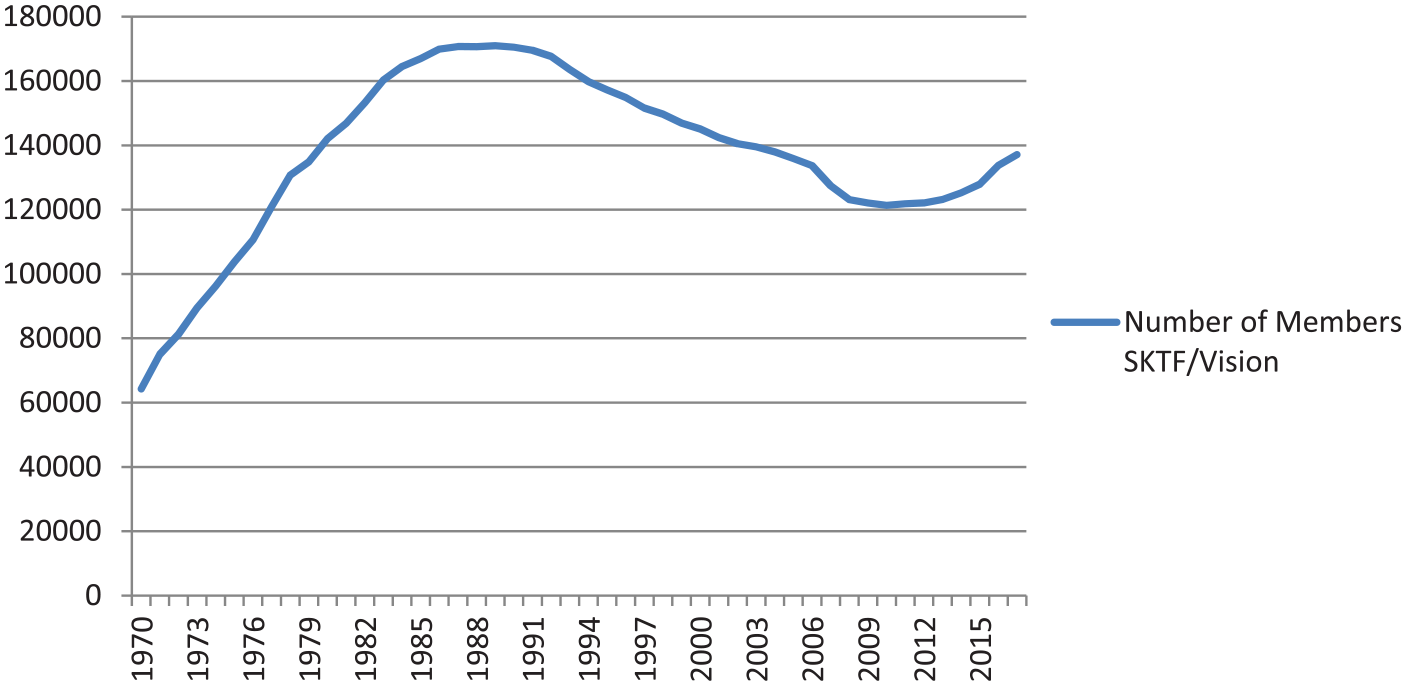
Number of members of the SKTF/Vision from 1970 to 2015.
In response, the SKTF initiated a thorough renewal process that included a new name and logo, which were launched literally overnight in 2011. The union’s name changed from one describing its membership to the less intuitively understandable Vision. The name change was preceded by a long internal debate on the renewal of the organization (Lindman, 2011: 16–17).
Analytic framework for studying self-images
Identity in organizations can be examined in numerous ways (see Gioia et al., 2013; He and Brown, 2013), one of which is to concentrate on the meaning of the image that the organization attributes to itself – that is, the central and distinctive features of the organization (Albert and Whetten, 1985; Ashforth and Mael, 1989; Gioia et al., 2013: 131). Here, central refers to traits that the organization attributes to itself, while distinctive refers to traits that distinguish the organization from other actors. For a trade union, a natural ‘other’ is always the counterpart on the labor market: the employer. Therefore, the employer plays a crucial role in the mobilization of employees in unions (Kelly, 1998: 44). Another possible ‘other’ is other unions, since identity is ultimately crucial in distinguishing between similar organizations.
But how can the central and distinctive characteristics of an organization be measured? I propose that self-images can be captured through examining how an organization describes its history (‘where we came from’), properties (‘what we are’), and actions (‘how we act’) (Figure 2). History, properties, and actions can be seen as arenas in which the central and distinctive traits of an organization are articulated. The history of the organization captures its origins. No organization exists in a temporal vacuum, and once an organization has been established, it will develop a past to which it relates. Historiography helps union members orient themselves within a broader context. In contrast, the properties of the organization focus on the characteristics of the organization and its members. The properties attributed to an organization will guide the actions of that organization. Actions include how an organization acts and how its members are expected to act in various situations.
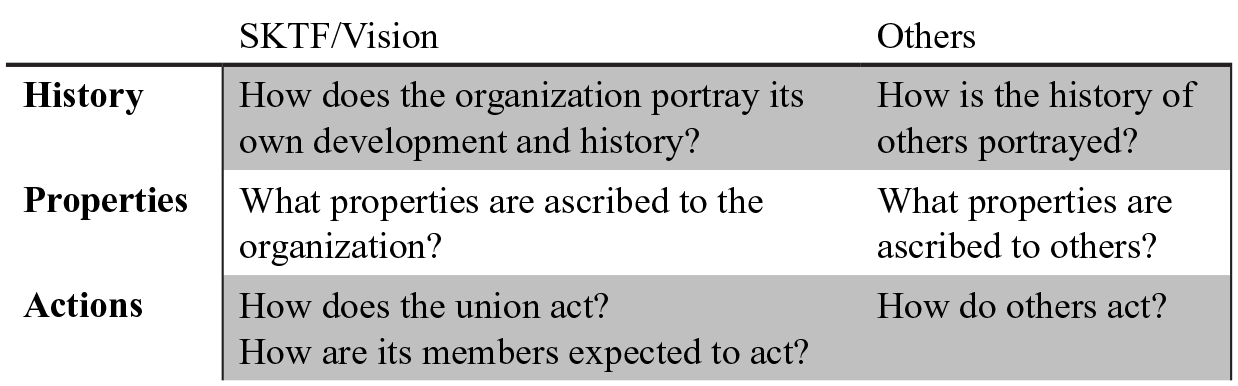
Structure of the analysis.
Analyzing an organization’s self-image over time calls for appropriate material, which brings us to the issue of how self-images are produced in organizations. Previous research into workers’ education has suggested that internal education programs in organizations are good arenas for identity formation, as they offer a perfect opportunity for leaders to communicate their definitions and views of the organization and of the societal context in which it operates (Jansson, 2016, 2020). Internal educational settings help to transmit values, norms, culture, and identity between generations of members. The purpose of most internal education is to explain to union members and officials how things work in the organization, what the organization is, what values it stands for, and how the organization and its members act (or should act). Here, if anywhere, the union’s self-image should appear.
In this case study, therefore, I analyze educational materials produced by the SKTF from the 1970s and 1980s, along with supplementary material produced by the confederation for white-collar workers, the TCO, from the 1990s. Although the latter material was used by the SKTF, it was not exclusive to that union. The SKTF and TCO organized a large number of different courses during the time period, all of which are not analyzed in this article. Instead, I made a selection of membership courses that were specifically intended for training union activists and new members – that is, courses with many participants. 1 Vision’s educational material is posted on the union’s website, and I analyzed material from 13 courses (a total of 23 courses were offered in 2015). Again, I chose the main courses, courses that were intended for new as well as old members, local union officials, etc. These courses had many participants and, thus, this educational material had been thoroughly developed by the union. In addition, I conducted one interview with the official responsible for Vision’s education.
Self-images in the SKTF
Educational programs for SKTF members were arranged by three organizations: Tjänstemännens bildningsverksamhet (TBV), the white-collar workers’ educational association (Almryd, 1985: 35; Andersson, 1980: 112–113); the union itself; and the TCO. The educational programs that were offered were very similar to those offered by the working-class educational movement, in both form and content (SKTF, 1970), and the TBV’s educational programs were popular among its members (Carlsson, 1976: 63–79). The educational material, which referred to philosophy and broader societal theory, was intended to cultivate as well as educate in a practical sense (SKTF, 1974; Wahlund and Wallén, 1982).
All of the educational materials from the 1970s, 1980s, and 1990s included sections on the history of the SKTF and TCO (TCO, 1994; Wahlund and Wallén, 1991). This historiography highlighted two main themes: the growing union movement and the specific characteristics of publicly employed white-collar workers. The union’s account of its history depicted the white-collar worker movement as having increasing strength and influence. The 1970s were a good decade for the SKTF: The union had grown rapidly, and between 1970 and 1972, SKTF membership increased by 26.5% (SKTF, 1973: 3:1). In part, this upsurge was due to the legislation on collective bargaining rights that came into force in 1966, which gave public employees the right to negotiate collective agreements and initiate industrial action (SKTF, 1981: 10, 44). The SKTF and other public-sector unions used these powers in the 1980s, during a decade when unions organizing white-collar workers in the public sector were among the most aggressive (Thörnqvist, 2007: 332–333). Because of the SKTF’s successful actions, according to the material, it was impossible for the state and employers to ignore white-collar workers (SKTF, 1981: 10, 44).
The accounts of the union’s history in the educational material draw comparisons with the labor movement. Landsorganisationen i Sverige (LO, i.e., the Swedish Trade Union Confederation for blue-collar workers) constituted a significant ‘other’ for the SKTF. On the one hand, the similarities were stressed. The LO and the SKTF were the same type of (employee) organization, both had long histories (founded in the late nineteenth century in each case), and both struggled against injustice and exploitation, although the struggle of the working-class union was far more contentious (Wahlund and Wallén, 1982: 9). Labor market relations were depicted in similar ways for the white-collar and working-class unions: Employers were depicted as capitalists wanting to buy labor as cheaply as possible (Wahlund and Wallén, 1982: 9). The material pointed out that white-collar worker unions cannot be considered as completely separate from workers’ unions due to these similarities; thus, workers and white-collar workers should cooperate.
On the other hand, the differences between the SKTF and the LO were also emphasized: They organized employees of different classes, and the different class positions and subsequently differing chores and duties the classes implied motivated different organizations for blue-collar workers and white-collar workers (Wahlund and Wallén, 1982: 15). White-collar workers occupied a middle position between labor and employers, which at first hampered mobilization. At the beginning of the twentieth century, the notion that employers and white-collar workers had converging interests was still widely accepted. However, awareness arose among white-collar workers that employers would not act in their interests. ‘The factual situation and the emotions it aroused formed the breeding ground for strong cohesion and solidarity,’ the SKTF wrote in its educational material from 1982 (Wahlund and Wallén, 1982: 11). Although the same structural conditions induced blue- and white-collar workers to form unions, it was assumed to be natural that the different classes had separate organizations.
Recurring themes appear among the properties that are ascribed to the SKTF in the educational material. The organization is repeatedly described as ‘vertical,’ ‘democratic,’ and ‘politically neutral’ (SKTF, 1981: 11). ‘Vertical’ referred to the organizational structure: the SKTF organized any white-collar worker employed in the municipal sector, regardless of profession, pay grade, educational background, or position (SKTF, 1973: 3:2, 3:19). This ‘vertical’ structure meant that the SKTF included both managerial and non-managerial members, which could hamper the construction of a cohesive ‘we’ in the organization. It is clear in the material from the 1970s that the union was aware of this and spent a considerable amount of time explaining to its members why vertical organization was appropriate. As the union’s name indicates, the common denominators were that the union’s members were employed by Swedish municipalities and were white-collar workers (SKTF, 1981: 11).
Although ‘white-collar worker’ (Swedish, tjänsteman) is not clearly defined in the material, the concept was crucial to how the organization described itself. Members of the SKTF were white-collar workers and, as such, had common interests. The concept of a white-collar worker was used by the movement in the same way that the concept of a blue-collar worker was used in the labor movement. Some trade union issues were specific to white-collar workers, and the TCO and its affiliated unions would act to safeguard these issues. The TCO even published a series of works entitled ‘White-collar issues,’ whose title emphasizes the uniqueness of white-collar workers relative to blue-collar workers and employers (SKTF, 1970; 1973: 3:23). Thus, class position was crucial in the self-definition of the SKTF and the TCO.
SKTF members had another distinctive trait: They were civil servants employed by municipalities (the ‘K’ in SKTF stands for kommunal, i.e., municipal). Having municipalities as the employers led to certain implications for the working conditions of SKTF members. A lengthy section of the educational material from 1981 describes the characteristics of municipalities as employers (SKTF, 1981: 25–29). White-collar civil servants in the municipal sector were extremely important for municipalities, and were described as experts on local matters who provided so-called ‘municipal competence’ (SKTF, 1983: 47). Even though white-collar workers in general occupied similar sorts of positions, certain things distinguished municipal from private-sector white-collar employees (SKTF, 1973: 3:24): notably, while municipalities are politically controlled, their employees are not (SKTF, 1981: 25–29, 34). The line between politics and administration was described as a problem for all public-sector officials, but particularly in the municipalities due to their small size and limited budgets.
Another characteristic of the SKTF was political neutrality, meaning that the SKTF did not cooperate with any particular political party. This neutrality was a consequence of the dispersion of white-collar workers who, although in some sense constituting a class, did not have a naturally given political affiliation, such as the LO’s affiliation with the Social Democratic Party. Neutrality, however, did not prevent white-collar workers from acting politically (SKTF, 1981: 22; Wahlund and Wallén, 1982: 15–16). The SKTF stated that it should ‘pursue white-collar politics within the political parties rather than party politics in the white-collar movement’ (Wahlund and Wallén, 1982: 17). Consequently, political neutrality was not considered to hinder the TCO from making statements on issues such as redistribution, taxation, and social security issues. The TCO material even proclaims that the white-collar movement is based on an ideology of ‘wage earners,’ a concept that was strategically used by the Social Democratic Party to widen its constituency in the 1950s (Svensson, 1994). The TCO claimed that white-collar workers were wage earners, and that this structural position implied certain values. For example, wage earners were considered to have common positions on redistribution that justified the union’s actions on redistribution issues. The ‘wage-earner ideology’ consisted of four components: security, democracy, solidarity, and cohesion. These values included: the right of all people to physical, mental, and social well-being; equality; the acknowledgment that people, although equal, in fact do not have the same opportunities in life due to structural factors; and, finally, cohesion, which was described as the means to realize and consolidate security, democracy, and solidarity (Wahlund and Wallén, 1982: 19).
According to the SKTF, democracy was essential to trade unionism. Internal democracy was only possible through the activism and engagement of members in union work at all levels of the organization. Member activism required organizational skills on the part of the activists (e.g., techniques for moderating meetings), so active members were encouraged to acquire such knowledge (SKTF, 1973: 4:1). In the 1980s, the active member was prominently featured in the educational material: ‘Every organization is a product of its members’ desires and activities’ (SKTF, 1981: 7, 15).
Finally, in regard to actions, two important characteristics distinguish the SKTF and the white-collar movement from other organizations. The material from 1970 noted: ‘Union strength requires cohesion and effective advocacy. The TCO is trying to gather all white-collar workers under one umbrella organization. It is believed that white-collar workers have common interests, and cooperation is essential to promote the members’ interests in the best way’ (SKTF, 1970). Cohesion, which was part of the wage-earner ideology, was desirable for action: It would allow white-collar workers to act together against employers or the government (Wahlund and Wallén, 1982: 19). Creating a common sense of ‘we’ among disparate white-collar workers and encouraging them to work together were apparently highly prioritized. One assignment in the educational material from 1973 read: ‘Think about it: Employers’ organizations have a strong position relative to employees’ organizations because of the latter’s division and fragmented actions. What do you think this means for the employees?’ (SKTF, 1973: 3:33). The participants were then instructed to discuss the importance of solidarity and cohesive action by the unions. For the SKTF, solidarity and cohesion were important traits of ideal members and were seen as principles that guided how members should act (SKTF, 1983: 40; Wahlund and Wallén, 1982: 23).
The employers constitute another ‘other’ in the material. Naturally, the employers were the party with whom the SKTF negotiated regarding working conditions and wages. In the material, the SKTF stressed that negotiations do not necessarily run smoothly, and that unions and employers often disagree. After all, employers did not share the unions’ interests, so all union members should be prepared for conflict (SKTF, 1973: 3:8). Negotiation was the SKTF’s primary tactic; however, if required, the SKTF had an important weapon: the strike. Although a strike was always a sacrifice and never desirable, if a situation called for conflict action, the SKTF would make use of the strike (SKTF, 1981: 20–21). It is hardly surprising that the materials from the 1970s and 1980s contain descriptions of strikes – an era when Swedish white-collar workers were involved in several large labor market conflicts. These descriptions of strikes may be regarded as an expression of the zeitgeist. However, as discussed below, Vision’s material no longer describes strike actions.
Self-images in Vision
After the SKTF became Vision, its internal educational programs changed. Vision offers no courses with broader, cultivating aims such as surveying literature or politics, or general courses in trade union studies, such as those previously organized by the TCO (TBV ceased to exist in 2004).
Nowadays, Vision’s internal educational programs for its members and officials are designed and implemented by the union’s communication department (Interview with official responsible for education at Vision, 29 April 2015). Although the union formally collaborates with the study organization Sensus, courses conducted with and through Sensus are less common than those arranged by the union itself. There is no educational cooperation with other TCO unions except through the TCO University, and these courses are tied to academic institutions and can hardly be considered internal training. Although Vision arranged a few general membership courses during the period investigated here, most of the educational programs offered by the union were primarily intended to educate union officials. The courses are typically two-day courses or constitute e-learning in the form of ‘webinars’ – that is, Internet get-togethers that allow union members to freely choose when and what to study. These educational methods are quite different from those used by the SKTF, such as study circles, in which interactions with other activists were considered crucial for learning. Vision’s goal has been to create paperless educational programs, as far as possible; all material must be in digital form (e.g., PDF files) and must be easily accessible on the Internet, in order to make the programs flexible (Interview with official responsible for education at Vision, 29 April 2015). The material is in booklet form and, in comparison with the materials used in the 1970s, 1980s, and 1990s, the current material is very brief. No original texts by other writers are included in the courses.
In the material, the history of Vision is not mentioned at all. The fact that the SKTF had a very long and, in many ways, successful history has been completely left out; not even the name change or the old name ‘SKTF’ is alluded to. This is a significant change from the SKTF’s material, which featured the union’s history. The closest Vision comes to historiography is a short film on the union’s website (Vision, 2014) that briefly describes the union’s development. The lack of a narrative placing Vision within a historical context makes the union appear to be a new organization, without a past. Branding the organization as new has certain advantages, such as not limiting the organization by its past actions. This is hardly a coincidence, and Vision is not the first to apply such strategies: New Labour under Tony Blair also downplayed history (Wring, 2005: 161). When asked what the greatest challenge for the union was, Eva Nordmark, the former Chair of the SKTF and the initiator of the renewal reforms, answered: ‘the union’s traditions’ (Lindman, 2011: 24). However, removing history also results in the members no longer being described as part of a larger movement; of course, this could affect how the organization is perceived by its members, with consequent effects on loyalty and commitment.
In regard to the properties ascribed to the organization, Vision is democratic, and the importance of this is repeatedly emphasized in the material (Vision, 2015a: 3, 5; 2015b: 2; 2015c: 6). Making democracy work in the movement requires active members, because the movement ‘starts with the member’; according to the material, if a member chooses not to participate actively, he or she has renounced the right to influence the union (Vision, 2015b: 5). Throughout Vision’s educational materials, the concept of ‘democracy’ is used in various and often watered-down or directly confusing ways. For example, the union claims that social movements are democratic organizations, and that as Vision is a social movement, it is democratic (Vision, 2015b: 5). Another example is an attempt to explain what democratic values mean: ‘Democratic values and principles mean that the views of human beings and attitudes are built upon active values that originate from the principles of democracy’ 2 (Vision, 2015e: 4). This circular definition of democracy makes little sense. The fact that the communication department produces the educational material may be the reason for such unclear messages.
Just as the SKTF did, Vision describes the union as growing, although the claim has been somewhat revised. To Vision, ‘growing’ is not just part of the description of the union’s history; rather, it is an essential property – an ongoing process. Vision’s ambition is to be an ever-growing union; in order for that to happen, members must be active, especially in recruiting new members. For Vision, ‘growing’ has been materialized in the form of an actual goal: that of recruiting 1000 new members every month (Vision, 2015c: 7). The target has been broken down to the regional and local organizational levels, as well as to sectors, so that everyone knows what is ‘required’ of the local organizations every month. The number of new members recruited in the past month appears on the union’s website. Whereas growth was just one aspect of the union’s history in the 1970s and 1980s, for Vision, growth is at the heart of its identity. Looking at the membership rates, Vision has been able to reverse the trend of declining membership and is actually growing in size. The growth goal is reasonable and realistic, the material claims, as only a third of all potential Vision members are members. In other words, the organization is not only growing, but has great potential to grow further (Vision, 2015c: 7). ‘And most of the new employees do not actively choose which trade union they join; rather, the union that asks first has the best chance of recruiting’ (Vision, 2015d: 9). Active members can recruit these individuals.
The properties ‘active’ and ‘growing,’ which are clearly parts of the renewal process, raise the question: in relation to what? There seems to be a general perception that the ‘old’ white-collar movement had been in crisis for a long time (Lindman, 2011: 80–84), which is confirmed by the membership losses (Figure 1); in that context, recruiting 1000 new members a month is a bold goal. According to Veronica Karlsson, the current Chair of Vision, the old union, the SKTF, was ‘grey, old-mannish, and out-of-date’; on the other hand, Vision represents the ‘new’ trade union movement for white-collar workers, and the new union is active (Olaisson, 2015). A similar analysis has been made by the TCO: The union movement was perceived as old and defensive instead of active and progressive (Nordmark, 2013).
The concept of the white-collar worker, which was very important for the SKTF, disappeared in the renewal process, and is not used at all in Vision’s educational material. This concept was an attempt to create a cohesive collective identity among white-collar workers, not only in the SKTF but in the whole TCO, and its disappearance from the educational material blurs the commonalities between Vision members and other white-collar workers. White-collar workers still exist as a structural group and still constitute a class; however, the modern white-collar worker is not called a ‘white-collar worker’ anymore. Nevertheless, the concept has not been replaced.
Vision is also described as ‘developing’ and ‘changing’ – perhaps because it is active. Being flexible allows Vision to keep up with changes on the labor market (Vision, 2015c: 2). Moreover, the union is young. The organization has set the goal that 30% of the entire organization’s board members, at central and local levels, should be under 35 years old (Vision, 2015f: 3). It is not argued whether or not the boards should mirror the membership composition; young people in unions are simply seen as desirable. The background of this policy was the aging membership. In addition, age quotas would make it easier for younger people to advance in the union as officials. Although this reform was controversial in the union, the board managed to mobilize support at the union congress in 2010 (TCO-tidningen, 2010b).
Just like the SKTF, Vision is politically neutral, and this is often mentioned in the material (Vision, 2015d: 6; 2015e: 2; 2015f: 5; 2015g: 6), although it does not mean that Vision is apolitical (Vision, 2015d: 6; 2015e: 2; 2015g: 6). Labor market issues are political, and by engaging in labor market issues, the union makes political statements. This reasoning is similar to the SKTF’s, although it is not clear a priori what position the union will take on policy issues. While Vision emphasizes that it is neutral in party politics, it repeatedly emphasizes that it also is an ideational organization. The union does not specify what ‘ideational’ means or what ideas the organization is espousing. The SKTF, on the other hand, did not assign the property of being ideational to itself; instead, the old organization claimed for itself a ‘wage-earner ideology,’ which was fairly well-defined. For example, according to the old educational material, the organization’s goal, among others, was to achieve ‘a more even income and wealth distribution’ (Wahlund and Wallén, 1982: 19). This reluctance to define values a priori may be an effect of the increasingly volatile middle class and may be due to a fear of scaring off members if political goals are defined by the union.
On some issues, Vision expresses clear positions. One such issue is gender equality: Vision holds that wages should increase more and faster in female-dominated sectors. As 72% of Vision’s members are women (Kjellberg, 2014: 25), equal pay is an important issue for the union. Work in sectors dominated by women tends to be less valued than work in male-dominated sectors, according to the union, and this inequality should be redressed by raising wages in sectors dominated by women (Vision, 2015d: 11). The main problem is not that wage differences exist between women and men performing the same work tasks – those could be due to individual factors and performance – but that different sectors have different wages. Striking a balance between sectors is therefore essential.
Finally, certain actions are described in the material. Vision promotes ‘tonality’ (Vision, 2015d: 7), which is centered on members taking a stand and how they are doing that. Tonality, tonalitet, is a concept usually used to describe music or colors, and Vision does not define the concept. Instead, the union describes how the ideal member forms an opinion on working life issues and speaks up; the ideal member is not quiet (Vision, 2015c: 8). The ‘tonality’ of Vision is supposed to breathe personality and closeness to the member – that is, to ‘you’ (Galli, 2016: 162). Some elements of discipline are expressed in the educational material, which states that once decisions are made, members should uphold them; otherwise, the organization’s credibility could be at risk (Vision, 2015b: 5). Credibility is highly valued. Vision also points out that active members must think twice before speaking or taking action: ‘What you say and do affects people’s ideas of Vision’ (Vision, 2015d: 21). However, the union does not tell its members what to think about various issues; according to the educational material, that is not the union’s task. Therefore, different opinions can be expressed by different members. According to Vision, this is not a problem for the union: Diverse ideas can coexist as long as they are not contrary to basic values such as equality and democracy. There are two sides to this permissive attitude. On the one hand, the movement includes many different opinions – in other words, it is open to everyone, and constitutes a sort of catch-all organization; on the other hand, there is a risk that common values and views will be so few or so vaguely defined that the organization will have difficulty acting cohesively.
In the SKTF material described above, actions represented the collective struggle of union members. This collective struggle was materialized through negotiations, of which solidarity and cohesion were the pillars. In Vision, negotiations are hardly mentioned at all. Instead, attention is directed toward the members’ individual careers. The term career, which is barely mentioned in the SKTF material, is an important theme in Vision’s materials. For example, Vision writes that ‘you should develop in your career’ (Vision, 2015b: 4), that the welfare sector provides ‘good career prospects’ (Vision, 2015c: 4), and that ‘because the union focuses on members’ careers, more interest negotiations take place than ever before’ (Vision, 2015c: 3). All of these expressions stress individualism rather than collectivism. ‘Interest negotiations,’ that is, all kinds of local negotiations that take place within Vision, are also intended to improve the individual’s conditions. Where the SKTF had its starting point in the collective, Vision is clearly taking its point of departure in individualism.
The theoretical definition of identity contains not only central features of the organization, but also distinctive features. In the educational material of Vision, however, virtually no space is given to describing other actors: Neither the state, employers, nor other unions are mentioned in Vision’s material. More importantly, the TCO is not mentioned at all.
Trade union renewal and redefining the organization
The renewal process of the SKTF/Vision has left a profound impact on the union’s self-image. Some endurable characteristics are still discernable; however, it is safe to say that the union has undergone comprehensive changes. Similarities and differences between the SKTF and Vision are summarized in Figure 3. Whereas some properties, such as ‘democratic,’ ‘active,’ and ‘politically neutral,’ are enduring features that both organizations value, the arguments and motivations for these traits have changed over time. Some prominent pieces of the SKTF’s self-image have disappeared, such as the union’s history, any mention of connections to other white-collar unions, and the use of strikes as a means of pursuing the union’s work. The rhetoric of solidarity and cohesion – a linchpin of the TCO’s descriptions of the white-collar movement – has disappeared. In fact, there are no talks about a white-collar movement anymore. Identity and values, factors that are usually very important for mobilization in social movements, are downplayed in the rhetoric when Vision talks about recruiting new members.
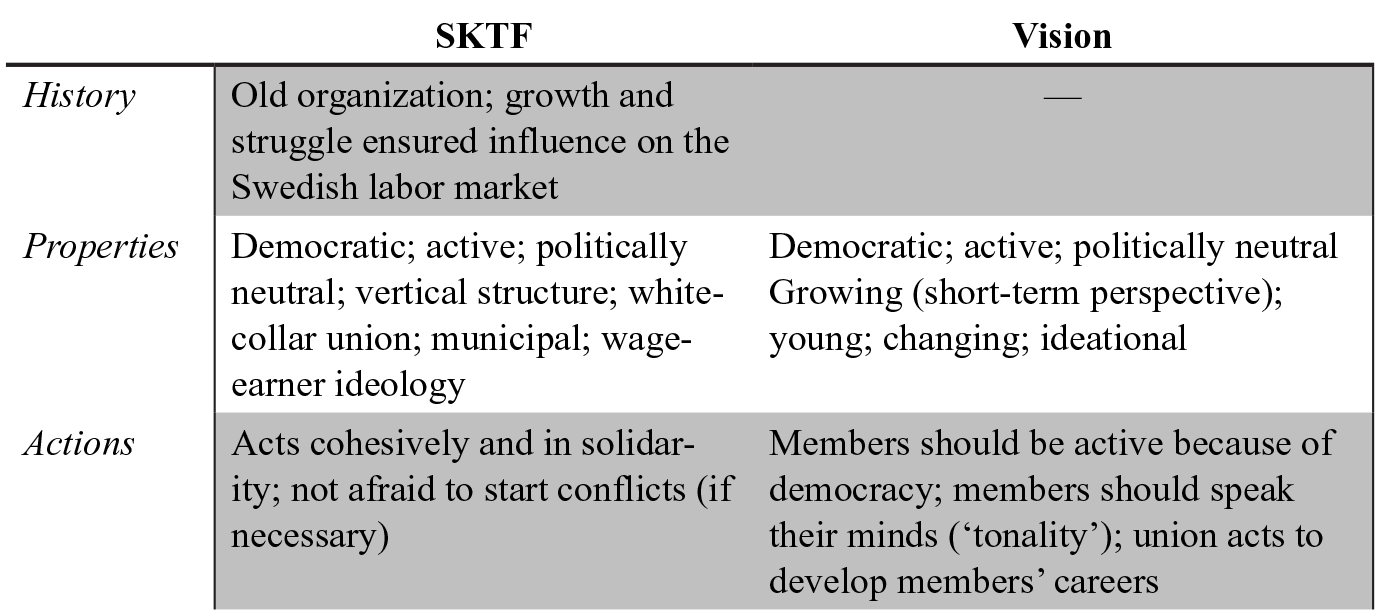
Results of the analysis.
The crisis of the trade union movement consists of several elements; however, one of the most profound problems for the union movement in Europe has been the shrinking working class and the growing number of white-collar workers (Gumbrell-McCormick and Hyman, 2014: 33). The size of this new middle class makes it important to organize in order to sustain a collective agreement model with extensive coverage. However, the middle class is difficult to organize: It has no particular attachment to party politics or ideology, and has proven to comprise volatile voters. Thus, the middle class does not have a ‘natural’ ideology, nor does it consist of individuals who would be inclined to subordinate themselves to such an ideology. Through the construction of the concept of the white-collar worker, the SKTF created an ideology that could be used in mobilization, as suggested by Kelly (1998: 24–38, 52). The SKTF thereby used the structural preconditions under which their members worked: Being an organization for white-collar workers underlined the class position of the members as well as the sector in which they worked. However, the concept of the white-collar worker is completely absent from the materials of Vision, as is the concept of the employer – the second important component in the construction of class identity. It is typical for trade unions to use the conflict between employers and employees for identity construction, in order to highlight what type of organization the union is: an organization that promotes employees’ interest. Highlighting class position underlines collectivism. The SKTF emphasized collectivism in various forms, especially while discussing its actions; collectivism involved showing solidarity and being prepared to fight through work stoppages. In addition, the TCO proposed an unexpectedly political wage-earner ideology in the 1980s and 1990s, which was incorporated into the self-image of the white-collar movement. Such ideological statements surely mirror a society in which the Social Democratic Party had dominated politics for half a century.
On the other hand, Vision has shifted attention toward how trade unions can promote personal development and careers. This shift is an important finding of the analysis. A significant part of Vision’s educational material talks about what the union can do for the individual. The collective (i.e., the white-collar workers, the municipal employees) has more or less disappeared from the material. The participants in Vision’s educational programs do not learn how to become a member of a movement; rather, they learn how the individual member can make use of the membership, as if they were buying insurance. Sweden scores very high on self-expression values, and is a highly individualized country (Ingelhart and Welzel, 2005), the middle class being the most individualistic strata of society. The shift from collectivism to individualism in the SKTF/Vision’s self-image should be put into that context. But the neoliberal reforms, privatizing the production of welfare services, is another important explanation for this shift. Most of Vision’s members work in the municipal sector, but this does not necessarily mean that the employer is municipal anymore. After various reforms, many former municipal employees nowadays find themselves working in the private sector performing public services. ‘Municipal’ has ceased to work as a common characteristic trait for the members of the SKTF/Vision and Vision has fewer common structural features to make use of than the SKTF had. From that perspective, Vision’s focus on individualism is understandable and may even be a precondition for recruiting new members.
Concluding remarks
Two reflections can be made from the findings of this study. First, selective incentives seem to have become increasingly important for trade unions. If ideology cannot mobilize members, perhaps selective incentives can? Mancur Olson has claimed that selective incentives are necessary for individuals to ‘act in a group-oriented way’ (Olson, 1965: 51). It has been suggested that the ongoing union revitalization process that has been observed in Sweden and elsewhere over the past 10 years could lead to the transformation of unions from social movement organizations into insurance companies (Pettersson and Jansson, 2013). Such a transformation would have a profound impact on how unions can act: If the membership is reduced to merely ‘buying a service’ – that is, if selective incentives have become the prime reason for joining a union – then the members’ obligations to the movement are likely to be less clear. Reducing members to consumers could have long-term effects on the nature of unions and on their ability to act; for example, it could diminish solidarity and loyalty toward the union, which might translate into difficulty mobilizing members for a strike. The TCO-affiliated Financial Sector Union presents a typical example of such a scenario. In 2014, the union began a strike against an employer that refused to enter into a collective agreement. However, the members refused to strike, so the work stoppage did not have the anticipated effect. Afterwards, the union concluded that it should have better explained to its members that union membership might entail industrial action (Berner, 2014). Although a focus on selective incentives might prompt people to join unions, it might simultaneously erode the foundations of collective action.
Second, it has been suggested by scholars examining revitalization strategies that unions should engage in political campaigns as a renewal strategy (Frege and Kelly, 2003: 9; Gumbrell-McCormick and Hyman, 2014: 46–47; Hamann and Kelly, 2004: 94). There is little support for such a claim in this study. Transforming the SKTF into Vision more or less meant removing anything that could be classified as party politics or political statements from the union’s self-image. Just as ideology has become a ballast to be jettisoned for political parties that are trying to catch all voters (Möller, 2018: 85), Vision avoids defining its values and visions. In terms of recruiting members, this strategy seems to have worked. Research has suggested that in the absence of ideological traditions, post-industrial activists – and especially activists belonging to the middle class – engage in ‘personalized politics’ (Lichterman, 1996). For such activists, individual expression rather than structures becomes the driving force for activism. In its mission to organize the middle class in trade unions, Vision seems to have adopted such ideas, downplaying collectivism and stressing the individual benefits of membership. This strategy constitutes a considerable change in what trade unions are and how they can act. Empirical investigations of these reflections should be crucial issues for future research.
Footnotes
Declaration of conflicting interests
The author declared no potential conflicts of interest with respect to the research, authorship, and/or publication of this article.
Funding
The author received no financial support for the research, authorship, and/or publication of this article.
