



Abstract
With rising consumer prices, tight labour markets, a resurgence in labour militancy, and a new post-Covid appreciation of the role of government and market regulation, the conditions for renewed union growth seem favourable. But unions have to come from far. Across the OECD, unions have lost members and power, young people increasingly stay away from unions and labour markets have thoroughly changed from what they were. How likely, then, is a new era for trade unions? This article explores four scenarios for the future of trade unions – marginalization, dualism, substitution and revitalization – each grounded in a few assumptions about the environment and behaviour of unions. Drawing on data and research from 12 OECD member states, the article explores middle range theories for each scenario and weighs arguments pro and contra its likelihood. It concludes with a set of critical propositions about the future of trade unions and research about the future.
Introduction
If ever there was a time for the trade union it is now. Unemployment is lower and labour markets are tighter than has been the case in many years. Inflation has sharply risen after a long period of price stability. In many countries there is a recent upward trend in work stoppages and more workers are involved in strikes. Econometric studies have identified these conditions as propitious for union growth. Moreover, public opinion appears to have changed. After decades of market supremacy and deregulation the combined challenges of inequality, climate change and Covid-19 have brought back a ‘desire for government and competence’. 1 Many economists have added their voice to call for a fairer labour market and new social contract. 2
Will the fortune of trade unions turn around after decades of decline, or have unions weakened too much and is the model broken? To raise this question is no more than indicating one of several possibilities. Rather than a futile attempt to predict the future, I shall present four scenarios – marginalization, dualization, substitution and revitalization – grounded in a few assumptions about unions and their environment. My time frame is one generation: trade unions 20 or 30 years from now. Drawing on data and research from 12 OECD member states and the OECD-AIAS-ICTWSS database, 3 arguments for and against each scenario will be explored. The countries included are Belgium, Denmark, Britain, Germany, France, Italy, Japan, Poland, Slovakia, South Korea, Sweden and the United States. This choice is motivated by variation in our principal subject, the trade union, and the availability of research and data.
Scenario analysis
Scenario analysis is a useful tool when there is uncertainty about the future agency and environment, in our case the trade union (will it still be a membership-based organization?) and the environment in which it operates (will labour markets be overrun by robots, platforms and AI? Will most people still be working for wages like they did during the past century?). The aim is not to foretell the future(s), but to break the habit of thinking that these futures will look like the present and stimulate debate linking outside events over which organizations have little control with processes of innovation within them (Wilkinson and Kupers, 2013).
Regarding the environment of trade unions I start from two vastly different assumptions. One I will call ‘placid’, or slowly changing with a future not radically different from the present. The contrast is ‘turbulent’, when upheavals are many, large and hard to anticipate. In turbulent environments ‘the ground itself is in motion’ (Emery and Trist, 1965). The second axis is made up of assumptions about union behaviour. At one end, I assume that trade unions, on aggregate, will behave reactively and within the boundaries of their existing resources and legacies. In Shell’s scenario analysis it is called a ‘scramble’. 4 Each participant sticks to its own needs and aims, with limited cooperation and policies driven as much by opportunism as rational focus. At the other end, I assume that unions act proactively and with foresight, and engage in as yet novel coalitions from which they draw new resources, a capacity for innovation and a new sense of purpose. The Shell analysts call it a ‘blueprint’, in which several issues and approaches are combined in order to forge new alliances, harmonized in an overall plan.
Combining the two dimensions we get Table 1, allowing us to anchor four different scenarios in expectations about unions and their environments. Next, I will approach each scenario by proposing a specific ‘middle range theory . . . close enough to observed data to be incorporated in propositions that permit empirical testing’ (Merton, 1968: 39).
Four scenarios for the future of trade unions.

Marginalization
This scenario foresees that trade unions will lose their relevance for regulating labour markets. This outcome might be based on extrapolating current membership trends. In the OECD, trade union density has halved in one generation, from 26.4% in 1990 to 13.2% in 2019. If that decline continues, the survival of trade unions as a bargaining force will be severely at risk by mid-century. Figure 1 shows that unions in all 12 countries are on a path of decline (panel A). In only three – Sweden, Denmark and Belgium – do trade unions organize a majority of employees or almost. In the UK, US, Germany and France current union density rates in the private sector are lower than in the decade before the First World War; in Poland and Slovakia lower than in the interwar years.
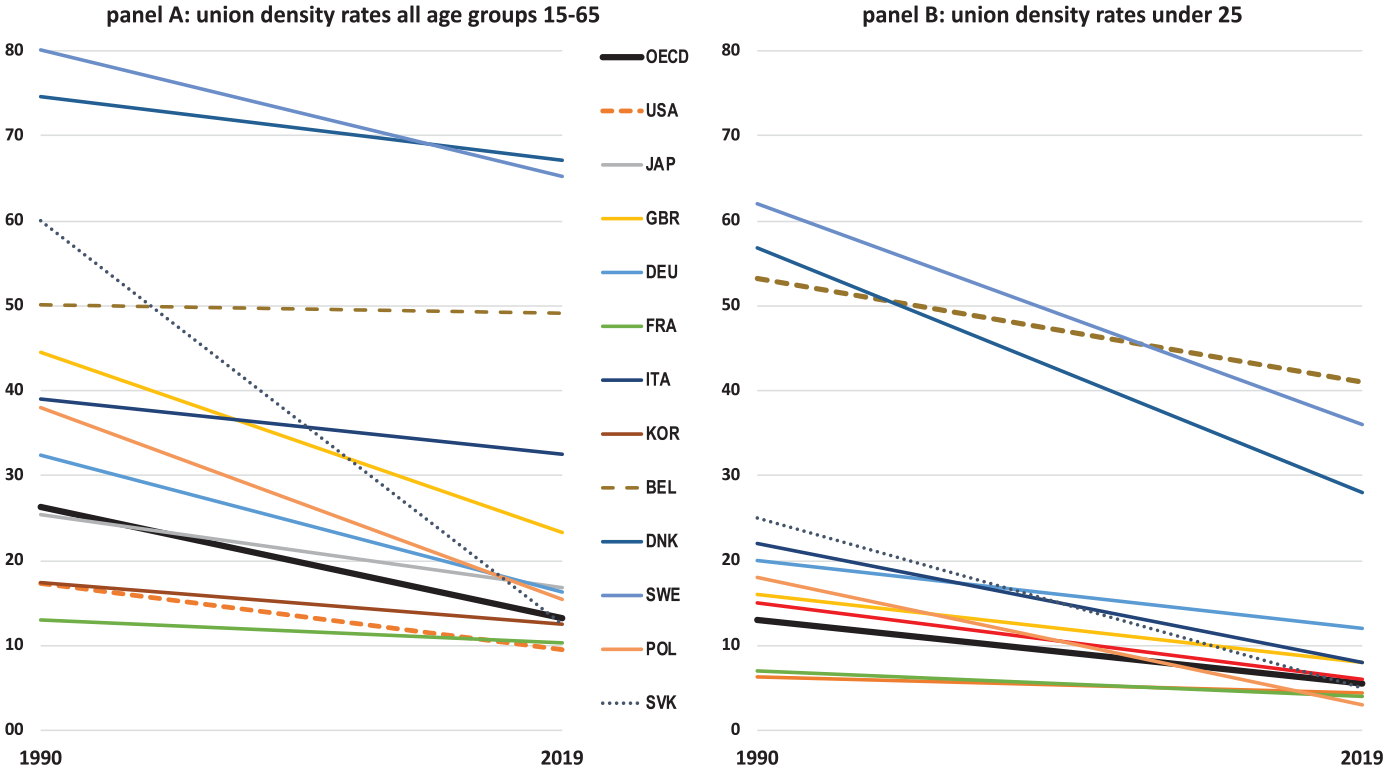
Union density rates in 1990 and 2019.
Mere extrapolation of past trends is not good enough. We are on safer ground if we identify the causes of decline and understand the permanence of these causes. My middle range theory in this scenario starts from workers’ choice. Why do workers join a union? The bottom-line is that they want something – better wages and working conditions, security and protection – that for many and perhaps most of them requires collective action. Econometric studies model this by relating the demand for membership to inflation, unemployment, benefits, indexation, etc. One such study, covering 15 Western European countries over a period of nearly half a century (1950–1996), found that ‘union density rates declined because unemployment increased, newcomers in the labour force were recruited or sorted into jobs and workplaces less covered by unions, inflation decreased, indexation clauses were dismantled and replacement rates lowered, public employment shrank and strike activity declined’ (Checchi and Visser, 2005: 17). Before we rush to the conclusion that the fortunes of unions will be restored now (some of) these economic factors – especially inflation and unemployment – are moving in the opposite direction and making union membership again a price worth paying, we need to consider how much the labour market has changed and the social fabric and institutions securing trade unions have weakened.
As voluntary organizations trade unions depend on the willingness of sufficient workers to join in the collective effort. However, any worker stands to gain when enough others organize without personally joining in the effort. Unions employ various strategies to limit ‘freeriding’, for instance by lowering the costs of membership, providing membership-only activities and benefits, and by offering and administrating unemployment insurance and job placements (like they do in Denmark, Sweden and Belgium). Lacking compulsory membership, trade unions need existing members to remind potential members to join in the collective effort. This is the core of the social custom theory which proposes that compliance with the norm of membership derives from the common human desire to stay in good repute with the group (Booth, 1985). A plausible hypothesis is that compliance is an increasing function of union density (Corneo, 1997; Ibsen et al., 2017): when the number of people complying with the norm increases, deviants are more readily punished, because punishment – ostracizing non-members as egoists – is harsher and the cost of sanctioning lower to each. Where union density is lower, the effectiveness of the union to provide protection will be lower and reputation losses from non-membership weaker, which will attract and keep fewer in the union, and so on, until a point is reached where union membership becomes the minority choice. Consequently, any fall in membership caused by a temporary shock tends to become persistent and self-reinforcing. Moreover, with the declining stability of labour markets, when more employees experience and expect relations with each other to be short-term, they have fewer reasons to put energy into sustaining a group norm and fewer reasons to fear reputational damage from individualistic choices. At some point joining the union becomes the deviant choice.
Labour markets have changed. Large firms and manufacturing outlets, the basis for unionism in the past century, have closed or downsized by contracting out tasks and jobs. The growth of commercial services, with on average smaller establishments and more greenfield sites, has raised the challenge for unions to gain recognition as viable organizations. Occupational changes and the fracturing of labour markets, with better educated, newly graduated professionals and skilled workers on the one hand, and less educated, unskilled workers on the other, tend to create two different universes, one in which workers are encouraged to believe that security and betterment result from personal achievement and mobility, and the other with workers for whom collective action remains crucial but disappointment in what unions achieve looms large. This socio-cultural shift is most manifest among young people. Increasingly, young people in their early careers experience a high degree of insecurity related to temporary contracts, unemployment and interrupted career paths (Blossfeld et al., 2008). In Poland, which was until few years ago the frontrunner in job flexibility among our 12 countries, 5 the main response among young people is either self-confident individualism with no time for the union, considered a relic of the past, or frustrated reformism, critical of the ‘junk labour market’ in which they are stuck and critical of unions seen as old and ineffective (Mrozowicki et al., 2016). No surprise, then, that only about 2–3% of young workers under the age of 25 join a union.
The average union density rate in the OECD of workers under the age of 25 has nearly halved in little more than a decade, from 11% in 2002 to 6% in 2014, continuing a process that began decades ago. In all countries, including high-density countries like Sweden and Denmark, there has been a significant fall in the share of young people joining a union (Figure 1, panel B). Combined with demographic change and smaller cohorts entering the labour market, the young people’s share in the unions has dwindled. The OECD average is 5.5%, down from an estimated 18% in 1990. Currently the age group of union members nearest to leaving the labour market, those over 55 years, is on average four times larger than the 15–24 age group entering the unions. Such a dynamic is consistent with accelerated decline, as unions face an uphill battle to replace members who leave with workers who join.
The youth crisis of trade unions not only threatens continuity but also the legitimacy of the unions in the eyes of new generations (Hodder and Kretsos, 2015). The Youth Committee of the European Trade Union Confederation (ETUC) does not mince its words: ‘Trade unions face an existential crisis. Either we recruit new, young members in considerable numbers, or within a matter of decades we will no longer exist as mass membership organisations.’ 6
Dualization
In this scenario trade unions concentrate their resources and activities on the (potential) members closest to them at the neglect or expense of outsiders. Whereas in the previous scenario I started from the choices workers make, here I start from the choices unions make. My middle range theory posits union organizing as an investment in which the benefits that accrue from additional members, like additional dues payments, representation claims, legitimacy and bargaining power, are set against the costs of recruitment and retention. The marginal cost of recruiting new members will rise if the easiest-to-organize workers with stable employment and established representation rights are already in the union. Expanding or creating trade unions outside customary domains is costly and instead of spending resources on ‘outsiders’ with a poor or uncertain return on investment, unions concentrate their resources on domains, firms and groups closest to them. The expense of establishing and sustaining a union in greenfield sites or among new groups will be high relative to the marginal costs of maintaining and expanding the membership where unions already exist. In Denmark researchers found that a density rate of 45–65% is self-sustaining. Hence, it makes sense for the unions to concentrate their organizing efforts in workplaces that are at or just below that level (Ibsen et al., 2017). Economies of scale suggest furthermore that organizing efforts in larger firms or sites have a higher pay-off.
Across the OECD, 63% of all union members are employed in firms of 100+ employees, whereas 7% work in small firms with 1–9 employees (data for 2015). Of the non-union members, 37% work in 100+ firms and 27% in small firms. Union density rates increase with firm size in all 12 countries and this has been the case at least since the 1930s when, for example in the US, unions succeeded in organizing the big companies in steel, oil, cars, shipbuilding and related manufacturing. The most extreme divide is found in Japan and South Korea, but also in the US, 7 Germany, France and Poland, we find a high concentration of union members in large firms (Figure 2, panel A).
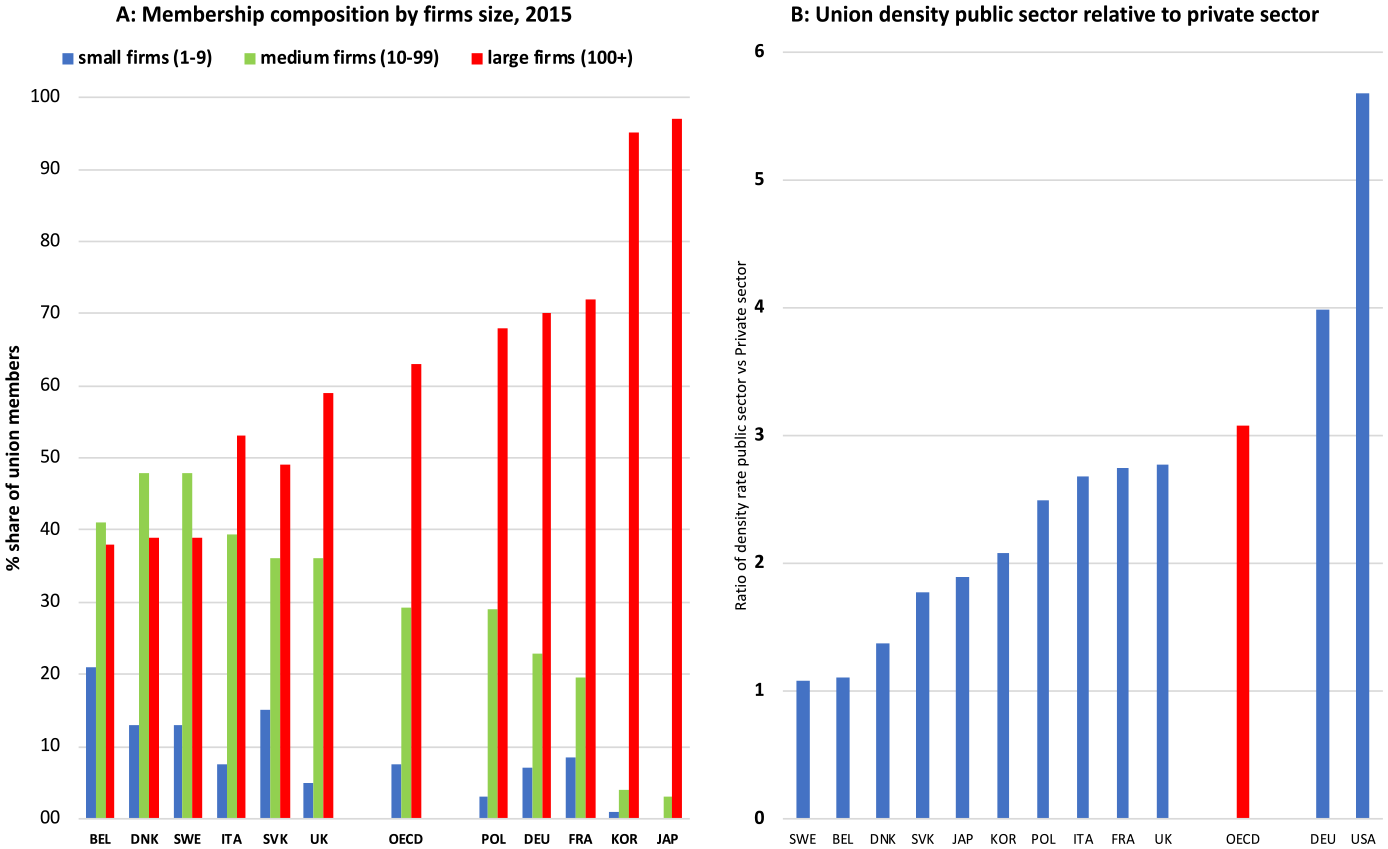
Membership composition by firm size and public versus private sector unionization.
In 2019 45% of all union members in the OECD worked in the public sector, a rise from 33% in 1980. In these 40 years the share of public employment – public administration and security, social security, education, health and social assistance – barely increased, from 19% to 21%. Whereas union density fell in both the public and private sector, the public/private difference in union density increased from 2.1[
The concentration of membership in large firms and among public sector workers does not necessarily translate into a dualist policy of ‘differential treatment of insiders and outsiders’ (Emmenegger et al., 2012: 10). Union organization and the structure of collective bargaining matter, as do the policies conducted and values propagated by the union. Enterprise unions in Japan and South Korea differ from European-style industry unions, and decentralized collective bargaining in North America differs from sectoral bargaining found in mainland Europe. In a multi-level analysis with German data, Benassi and Vlandas (2022) show that coverage by a sectoral agreement contributes more to decreasing the risk of low pay than individual union membership. However, coverage rates in Germany have fallen and even in covered industries employers fail to extend the agreement to all workers and often exclude the non-union members who happen to be concentrated among the young and at the lowest pay level (Hirsch et al., 2022).
Decentralization and opening clauses in sectoral collective agreements have weakened the solidarity element in sectoral bargaining. Deriving industrial clout from their strong membership base among skilled workers in large firms with above average productivity, for many years West Germany’s industrial unions maintained a solidaristic wage policy of redistributing bargaining power and earnings by negotiating for all firms and workers in one encompassing sectoral bargaining unit, with limited scope for local variation. As ships sailing in convoy, workers in weaker positions could get more, made possible by those in stronger positions who could be convinced or coerced to hold back. This presupposed centralized decision making and professionalism, ‘help[ing] to insulate a union’s political process against pressures from the membership, and especially from sectional groups within it’ (Streeck, 1984: 15). But the ships no longer sail in convoy. ‘Even if the core idea of the sector agreement remains unchanged, many certainties of the wage policies of the past fifty years no longer automatically apply. Most notably, this is the case with the “convoy principle”, which allowed weaker companies and sectors to achieve good wage results in the wake of the strongest.’ 8 Behind this lie changes in industrial organization, the pressures of globalization and subcontracting, decentralization within the union and in collective bargaining, the use of opening clauses and the reality and fear of unemployment.
In a decentralized bargaining context, a union drawing its strength from its position in large firms is more readily biased towards dualism. This is one of the central findings of the comparative case studies presented by Doellgast et al. (2018) in Reconstructing Solidarity. In comparison with Belgium and Denmark, where the unions attain higher membership levels across various groups including workers in small firms, bargaining coverage is higher and workplace representation operates through a single-channel allowing coordination with the external union, German trade unions in the metal, chemical and slaughterhouse industries were less capable of forging solidaristic policies. With employee-elected works councils in control of negotiating and implementing company agreements, these councils ‘weakly coordinated with sectoral unions . . . and mainly responded on a logic of preserving job security for the core and extending flexibility for the periphery while safeguarding the economic interests of the company’ (Doellgast et al., 2018: 120). In France, sectoral agreements cover (nearly) all workers but their content has been minimalized and actual pay is increasingly set in enterprise negotiations, depending on where unions can mobilize support, which is predominantly in large firms and in some sectors only (Blavier and Pélisse, 2022). In sum, dualization does not have to result from deliberate union policy choices. Instead it can be the outcome of the large-firm membership bias in the unions combined with weak associational and institutional resources.
Palier and Thelen (2010) trace the beginning of dualization in France and Germany to the follow-up of the 1970s crisis when large firms began restructuring their operations through outsourcing and increased the productivity of the remaining workforce through internal flexibility and intensification of work in exchange for employment guarantees. Helped by strengthened representation rights and a shift towards enterprise bargaining, works councils defended job protection rights for a smaller core workforce. Hassel (2014), analysing the union response to the crisis following German reunification, basically repeats the story, adding that industry unions did not unite against the liberalization plus low-cost drive in services advocated by exporting firms. The complicity of unions in dualization in North America has long been discussed in relation to internal labour markets and labour market segmentation (Freeman, 2007; Osterman, 1988). Enterprise unions in Japan typically represent only regular employees, excluding subcontracted and nonstandard workers. Union policies reflect their concern with the maintenance of business productivity and competitiveness (Watanabe, 2018). The renegotiation of lifetime employment and seniority pay during the 1990s crisis had its foundation in intensified cooperation between unions and management for a smaller but stable core and the exclusion of a growing number of subcontracting firms and workers (Thelen and Kume, 2003). In South Korea, the suppression by authoritarian governments of workers’ efforts to build union structures at industry level and the unwillingness of enterprise unions to protect any but their own members have left a growing army of young, female and temporary workers in precarious conditions and without representation (Lee, 2010; Yang and Chae, 2020). After the Asian financial crisis of 1997/8, a dualist strategy of restructuring, downsizing and inhouse subcontracting was adopted by Korean business with union support (Durazzi et al., 2018).
Continuous de-unionization in the US demonstrates the limits of dualization as a membership stabilization strategy. The drop in private sector unionization – from about 33% in 1956 to 10% 40 years later – chiefly resulted from the difference between employment expansion in non-union enterprises and low or absent job growth in the union sector. Farber and Western (2001) calculate that no amount of union organizing in the union sector could have compensated for that. Politically dualization is vulnerable to its dependency on continued cooperation with management, the willingness to invest in unionized industries and firms, the competition from excluded groups within and outside large firms, and the absence of obvious coalitions within the union movement with other well-organized groups, in particular the highly unionized professionals in the (semi-) public services. The latter do not support the low-tax cost-saving policies towards services pursued by firms treating national economies as export hubs.
Doellgast et al. (2018: 1) state that ‘exclusive strategies are rarely sustainable in the long run’ and argue that workers and unions have no alternative but to seek equal representation and treatment for all. ‘Where core workers do not show solidarity with vulnerable workers, they undermine their own bargaining power through lower-cost competition’ (Doellgast et al., 2018: 1). Realizing that agency work has become a permanent fixture in the German car industry and undermined its bargaining position, IG Metall started in 2007/8 a successful ‘Equal Work – Equal Pay’ campaign aimed at the large number of agency workers in the industry (Benassi and Dorigatti, 2015). Around 2014, unions in the Slovak car industry also revised their policies in favour of temporary agency workers, with limited success (Bernaciak and Kahancová, 2017). After 2000, Japanese unions began to organize part-time, read: irregular, workers. Their density rate went up from 2.7% in 2001 to 5.6% in 2010, but has stagnated since and remains low. The enterprise unions remained wedded to the protection of regular workers in large firms (Watanabe, 2021). The upsurge of militant unionism in South Korea that in the 1990s led to the formation of a second union federation was initially directed towards organizing new groups but has since morphed into ‘militant pragmatism that was used to gain exclusive benefits and strengthen employees’ sense of association with their own workplace’ (Cho, 2013: 9). Dualization may be a dead end, but once unions have moved halfway down that road it is difficult and costly for them to change track and a policy turn often faces considerable opposition from the existing membership.
Substitution
The trade union is the response to the workers’ demand for representation and protection. It took the distinct form of a voluntary association, characterized by member subscriptions, not-for-profit goals, democratic procedures and elected leaders. In the course of history, unions have evolved from small mutual benefit societies in which members knew each other and leadership positions rotated between them to mass organizations with a professional staff and formalized decision making and election procedures. Like any invention or product, trade unions are subject to competition.
The 200 years’ history of trade unions, from the initial fight to gain the upper hand over guilds and mixed organizations of owners and workmen, at first only in the skilled crafts but later opening up to the less skilled on the one hand and salaried employees on the other hand, to women and migrants, expanding into mass organizations, consolidating and more recently shrinking in size, can be modelled with the Product Life Cycle (PLC) theory with its phases of introduction, expansion, maturation, saturation and decline (Anderson and Zeithaml, 1984). In their current phase of decline, unions face competition from more technologically advanced and perhaps less costly solutions. Changes in demand – what workers want – and changes in the organizations and markets where they work and in technologies available to them may make the existing product – the trade union as voluntary association – obsolete or costly in comparison with alternative solutions. Interventions of employers and politics may speed up or slow down the replacement of this once successful product. Over a long enough stretch of time, the middle range theory predicts a bell-curve, with long tails for the initial and final stage, and maximum expansion of the unions’ market share in the middle.
Figure 3 pictures the development of unionization in 30 industrial countries over 130 years. We observe something like an inverted U-curve, with the peaks of maximum expansion between 1950 and 1980, though these peaks reach different heights at different times in different countries. The interquartile range has narrowed as there are fewer countries with high density rates. Rather than the particulars of each country’s unionization path, the general pattern of ascendency, expansion, saturation and decline is the one of interest.
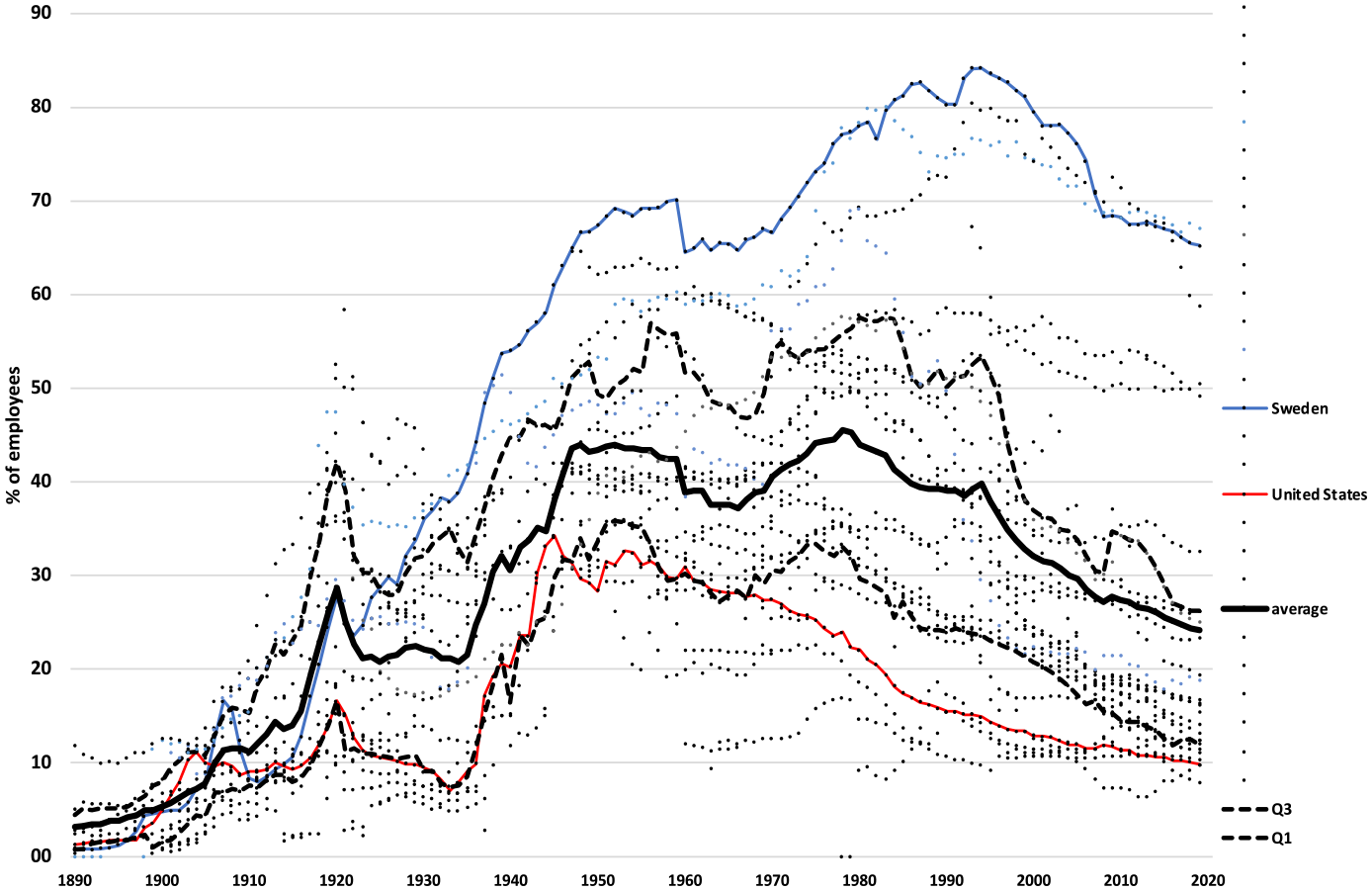
Unionization rates 1890–2019, 30 industrial countries.
What in Figure 3 misses and prevents it from showing a full bell-curve are the early years before 1890 and what lies ahead after 2020. For the formative years there are no good time-series data and the future is unknown. From historical accounts we learn that it took half a century or longer before trade unions separated from guilds, fraternities and secret societies, and became worker-only organizations. ‘The nascent trade unions worldwide in the eighteenth and nineteenth century borrowed many tactics, strategies and rituals from their predecessors, and the collective actions of all these entities ran parallel for a very long time’ (Lucassen, 2021: 388). A similar drawn-out process of experimenting with new forms of social action replacing the union is to be expected during its twilight phase. To understand that process, we best begin with analysing changes in the world of work.
In their formative stage it was the dispossession of workers from their tools, the gradual separation between working for wages and household labour, later the mechanisation of production and concentration in large factories and workplaces that promoted the rise of unions as ‘continuous organizations of wage earners’ (Webb and Webb, 1920 [1894]: 1) and acquire what Marx called ‘the power of numbers’. 9 Markets made unions and unions made markets, the latter when they became strong enough and gained the support of state and law: ‘Unions were major contributors of the transformation of employment from a spot market contract to an organisational relationship or from a contract of work to a contract of employment’ (Streeck, 2005: 265). Even in its best days this model of unionism applied only to a limited number of industrial countries and surely not to all workers. Women and migrants were often excluded. The unionized labour market time and again drew a lifeline from a secondary labour market in which employment was unregulated, nonstandard and contingent (Berger and Piore, 1980).
In the substitution scenario ‘the ground is in motion’ and unions are no longer able to standardize employment relations. For many workers, though not necessarily all, contingent employment will be the new normal. This prediction is not outlandish but builds on what has actually happened during the past decades. In The Fissured Workplace Weil (2017) describes how major companies have responded to intense pressure to improve financial performance by focusing their businesses on core competencies and shedding activities deemed peripheral. These changes go beyond the narrower concepts of temporary or contingent work and affect the employment relation itself. Online platforms further push the process of decentralization, networking, outsourcing, subcontracting and breaking up work into ‘gigs’ to a new limit with the wage-nexus of the employment relation increasingly being replaced by a commercial civil-law contract.
In the wake of the decline of the standard employment contract ‘new regulatory approaches are emerging in many places and in disparate forms’ (Stone and Arthurs, 2013: 1). This process of discovering and spreading new solutions is probably slow and hazardous, with many half-baked products entering the market. Existing providers will try to keep their product alive through loyalty measures, branding and, where possible, monopoly rights. New providers will have to prove their credibility. The heterogeneity of work-life situations and diversity of labour markets that shape worker demand support the hypothesis that not one but several actors and products will fill the void of union representation. We can enrich our middle range theory by approaching union substitution as happening in an ‘organizational field’, a meso-level social order with its own rules, dynamics and conflicts between incumbents and challengers (Fligstein and McAdam, 2012). The different functions that were combined in the trade union at its best – collective bargaining; advocacy and enforcement of labour standards; mobilizing employee voice in enterprise and politics; worker education and labour market exchange; social protection and social insurance – will probably be parcelled out. This hypothesis is supported by scattered empirical evidence based on the non-union substitutes we know.
Without a claim of covering all substitutes, Table 2 offers an overview of the manifold ways in which trade unions can be replaced, distinguishing between four major functions (wage setting, labour standards, voice in the workplace, social insurance) and five suppliers (state, employers, law and business firms, professional associations, social and community organizations).
Substitution for trade unions: providers and products.
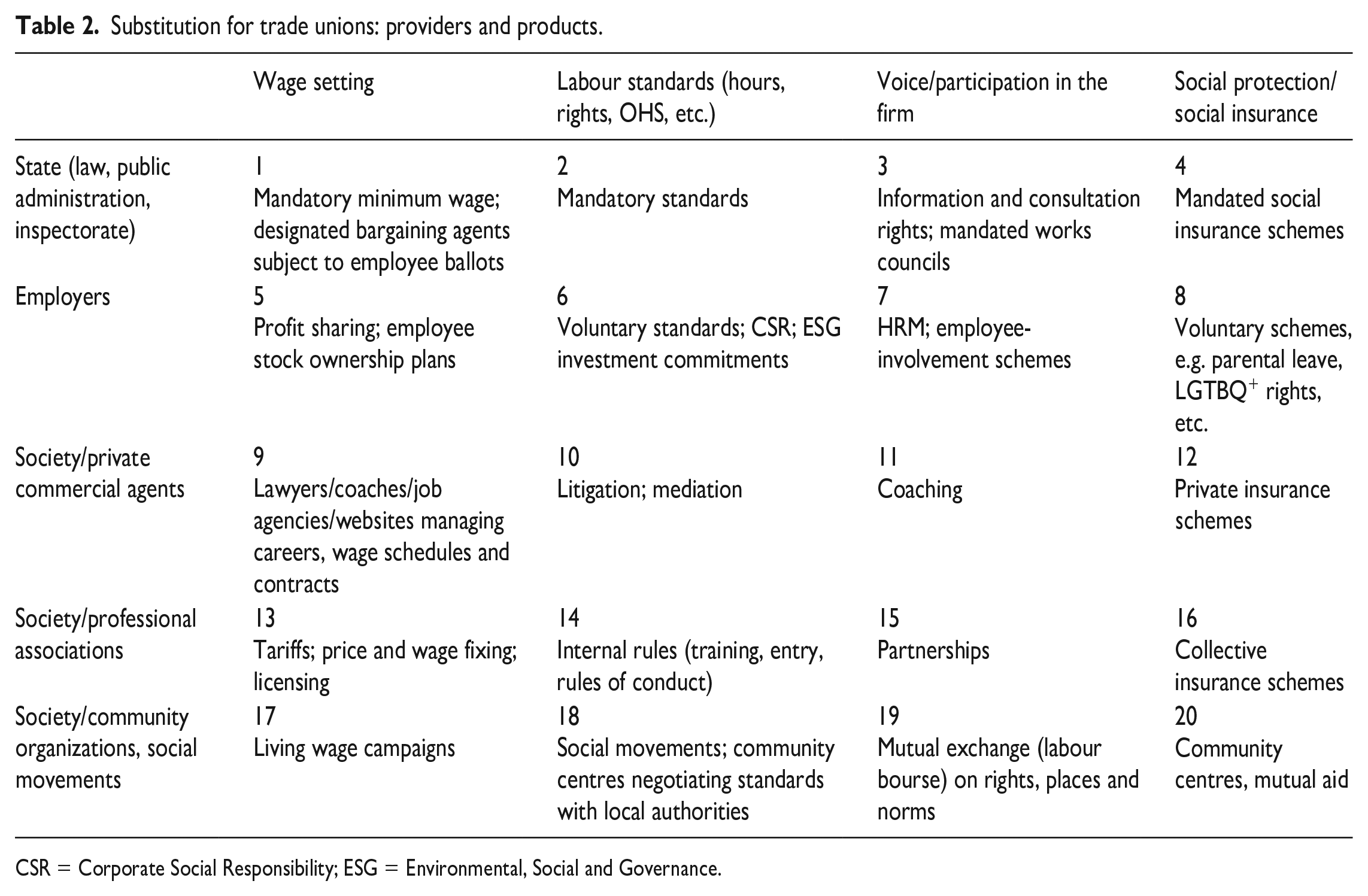
CSR = Corporate Social Responsibility; ESG = Environmental, Social and Governance.
It is impossible to discuss and evaluate each of these products. A few observations based on research in this area must suffice. In Emerging Labor Institutions for the Twenty-First Century US scholars examine various so-called non-membership solutions, like human rights and labour advocacy groups, living wage campaigns, vigilantes and inspectorates, professional associations, training intermediaries and worker–management partnerships. They conclude that even in the US, where union membership is at an all-time low, ‘the new institutions have a long way to go before they will be able to provide remotely comparable economic benefits to unions’ (Freeman et al., 2005: 4). Analysing the British Workplace Employment Relations Survey since 1980, Bryson et al. (2009) report that the drift from union-only to non-union voice is a ‘long-goodbye’ rather than sudden shift. Between 1980 and 2004 the share of workplaces without any voice for workers stayed the same (25%), fewer workplaces report union-only or mixed voice channels, whereas workplaces with employer-provided voice doubled, from 25% to 58%. This shift is partly explained by deregulatory measures that reduced legal support for British trade unions. Unencumbered by statutory limits, newly-founded enterprises tend to avoid the union and adopt their own solutions.
Poor enforcement is the weak spot in many non-union solutions offered by employers or the state (Basu et al., 2010). Any labour standard faces the inherent difficulty of implementation as employers often and workers sometimes have incentives for non-compliance. Enforcement by the state is difficult since its agencies are located outside the workplace. Workers are best placed but face various obstacles (Davidov, 2010). The presence of shop stewards or works councils is often crucial for the exercise of effective control, for instance in the case of occupational health standards (Donado and Wälde, 2012). Analysing the failure of state agencies to enforce labour policies in the US, Weil (2005: 36) concludes ‘that, absent a labour union, it is difficult to devise an institutional arrangement that effectively aligns its interests with those of the workforce and at the same time has the kind of access to the workplace necessary to act upon these interests’. Tapia et al. (2015: 158) argue that the effectiveness of direct employee participation, corporate social responsibility, international framework agreements and community organizations cannot be measured independently from what unions do, and conclude that the void created by union decline ‘is at best only partially filled by the emergence of alternative forms of worker voice, advocacy and representation’.
Each of the union-replacing activities and services listed in Table 2 has its limitations. None replaces the entire range of tasks and activities of the union and none addresses the full spectrum of class positions that trade unions, in their best days, tried to represent. Many cherry-pick and find their paying clientele among better-positioned workers and professionals; others address the demands of the most vulnerable. Finally, while some of these providers and projects intend to beat or avoid the union, others are supportive or neutral (Donaghey et al., 2012). A popular website for young people like YoungOnes (https://youngones.com/uk/), one of many job and wage information sites that has sprung into existence in recent years, can exist perfectly alongside the more traditional trade union, and unions could probably learn much from them. AI raises the potential of such matching solutions.
Revitalization
Union revitalization is the process of democratic experimentation with renewal of union structures, redefining their purpose and constituency, new repertoires of action and practices of participation of members and workers, with the aim of bringing more members into the union and better protection for more workers. Theories of diffusion of innovations should guide us here (Wejnert, 2002), treating ‘union revitalization experiments’ as innovations with public consequences and externalities, emphasizing the importance of knowledge and value sharing, the relative costs and benefits of change, the location and standing of innovators, interpersonal and interorganizational networks, and environmental conditions like common language, cultural beliefs and perceptions, and political conditions. The vibrant academic literature of the past 30 years on union organizing and revitalization has yet to make a start in this direction, moving beyond the current emphasis on scattered case studies.
Today, union revitalization is associated with the ‘Organizing Turn’, the activist campaigning to stop decades of union decline in the US (Erickson et al., 2002). But it is not the first time in their history that trade unions try to reinvent themselves and embrace new constituencies. They did so in mid-19th century with the creation of organizations that could survive business downturns following the New Model Union based on high subscription rates and benefit packages, exclusive for the skilled workers who could afford it. Around 1890, amidst an upsurge in worker militancy, New Unionism emerged and proposed ‘a new set of strategies, policies and forms of organization for unions’, reaching out to ‘hitherto unorganized or unorganisable workers’ (Hobsbawm, 1984: 152). After their initial international success, the new unions had a hard time to defend the gains of 1918–20, like the eight-hour working day and bargaining rights in heavy industry, against the counter-offensive led by big firms in a conservative political climate with nationalism and fascism on the rise. In the US, the rapidly expanding mass production industries – iron and steel, metals, electronics, chemicals, oil and food-processing – ‘seemed impervious to trade unionism’ (Brody, 1980: 82) until the 1935 National Labor Relations Act ended the ‘open shop’ doctrine that had given employers a free hand. A decade later, helped by wartime mobilization, full employment and interventionist government policies, most of these industries experienced thorough unionization.
As symbiosis of the modern trade union and the nation-state, Political Industrial Unionism (Streeck, 2005) completed the promise of New Unionism, giving it the stability of continuous collective bargaining, political recognition and state support guided by Keynesian economics. It became the dominant model of the post-1945 world, combining advocacy in the political arena for higher labour standards and social protection with pressure on employers and steady collective bargaining in the industrial arena, preferably to set wages and working conditions for entire sectors, union members and non-members alike. This type of unionism matched with the expanding government administration and welfare state and found its maximum expansion in the 1960s and 1970s.
Organizing and representing the non-manual workers in the rapidly expanding commercial services – from sales and office staff, workers in retail stores and the hospitality industry to technical, financial and managerial professionals – became the new challenge for unions. In most countries, however, unions failed to move from industrial to encompassing (catch-all) organizations. Figure 4 shows the lagging behind in organizing women and private services in comparison to men and manufacturing workers. In the 2010s, in most countries, though not in Germany, Japan or South Korea, women unionists reach (almost) parity with men, at least in terms of membership rates and shares, also thanks to the decline of (male) manufacturing and rise in (female) welfare state jobs (panel A). In commercial services unionization rates have remained low in all but a few countries. The gap with manufacturing is particularly glaring in Germany, Japan, South Korea and Poland (panel B).
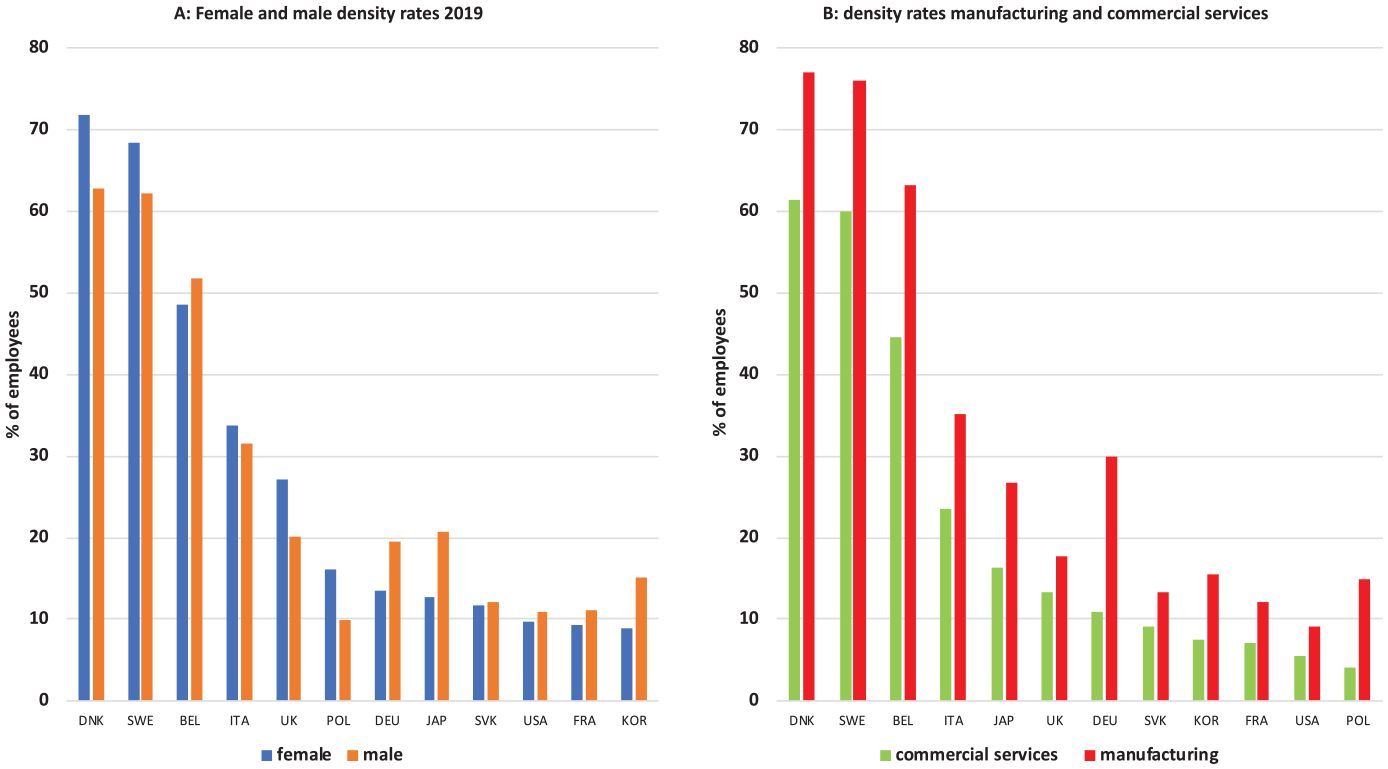
Union density rates by sex (A) and industry (B).
Another challenge was the organization of older workers, mostly through membership retention after retirement and the expansion of services to them. Nearly all European unions witnessed a rise in pensioner-members, though none as much as the Italian unions, where pensioners have made up half of the membership since 1996. Carrieri (2019: 48) calls the investment in separate pensioner unions one of ‘two organizational innovations that turned out fortunate, with sustainable beneficial effects for the trade unions as actors’. The second innovation was the strengthening of a network of easily-accessible services and assistance in matters of taxes, social benefits and legal aid. Against the trend in most European countries, Italian trade unions appear to have increased income from contributions and service fees. Temporary and freelance workers have been approached through dedicated unions, immigrant workers through specialized strategies, the elderly and virtually all fragile citizens through social negotiations with local governments. As ‘reference points easily accessible to workers and citizens, as well as organized interlocutors available to public and private institutions and counterparties at every level’ (Regalia and Regini, 2018: 70), Italian unions turned out to be more resilient during the 2008 Great Recession than other unions in the region.
The Organizing Turn of the 1990s was a belated correction of the failure to organize workers in commercial services and connect with citizens and marginal workers. No surprise that its birthplace was the US. Post-1968 Western Europe witnessed a brief resurgence of union bargaining power and militancy, often leading to major institutional and political concessions (Crouch and Pizzorno, 1978). It connected the unions with the Women’s Movement and student organizers. In the US, 1968 was the peak (of civil unrest) but not the start of something new in the labour unions.
First in Britain, later in the Baltic states and via the European Organizing Center, sponsored by American unions, organizing campaigns gained ground in Europe, though mainly limited to unions in the North-West (Givan and Eaton, 2021). These campaigns have in common (1) more professional attention for and resources committed by the national union and its leadership to recruitment; (1) rank-and file mobilization in driving the bargaining agenda connected to recruitment campaigns; (3) more attention directed at the vulnerable position of migrants and temporary workers; and, in some cases, (4) more space for alliances beyond the workplace and coalition building with community organizations and social movements (Frege and Kelly, 2004). Union policies holding back against migrant, part-time and agency workers have been revised and many unions have engaged in campaigns to improve wages and social protection for security guards, agency workers, cleaners and meatpackers, workers in call centres, fast food outlets and shopping centres, carers, hotel workers and many more.
Will organizing revitalize the unions? Since it is not always clear what union organizing campaigns were supposed to achieve – recruitment, participation, union democracy, a new social movement model of union? – it is not easy to establish whether they were a success or failure. Critics bemoan an excess of recruitment tactics and lack of strategy (Simms and Holgate, 2010; Turner, 2005). The key question is whether the ‘system’ is broken or can be repaired by adding union members and bargaining power to the existing unions. If the system is broken and the standard employment relation is passé, how can 20th century institutions as intertwined with it as trade unions and collective bargaining survive? Surely, adding numbers and members will not do.
This is the take of those advocating social movement unionism. Indeed, if four decades of neoliberalism have eroded the institutional securities on which unions relied, nothing short of a countermovement, beyond collective bargaining as we know it, will do (Kelly, 1998). If precariousness is the new normal and affects all aspects of life, union revitalization must take a more politicized form of collective action with claims centred on housing, civil rights and access to public welfare (Breman and Van der Linden, 2014; McDonald, 2018), a trend already seen in the parts of Central and Eastern Europe where collective bargaining is nearly extinct (Bernaciak and Kahancová, 2017). From this perspective, union revitalization cannot be defined in terms of a rise in the union density rate or any other criterion tied to collective bargaining (Sullivan, 2009). Rather, unions must become social movements (Clawson, 2003; Johnston, 2001) or move in close alliance with social movements (Heery, 2018). This advice is not followed everywhere, however, nor is the premise that existing institutions are broken. Reviewing academic accounts of these campaigns, Ibsen and Tapia (2017) find that for trade unions in mainland Western Europe, operating in a more ‘institutionally secure’ environment, alliance building played a minor role. The exceptional Italian case can be characterized as one in which broader citizens’ alliances are already built into the unions. Still, in the past decade, many trade unions in Southern and Eastern Europe had bruising encounters with new protest movements of mainly young people (Campos Lima and Artiles, 2018). The paucity of civil society in South Korea and Japan has limited the potential for alliances outside the unions, while enterprise unions remained hard nuts to crack (Kojima, 2020; Yang and Chae, 2020).
Historically, each renewal came with a realignment of powerful interests inside and outside the unions, with liberal elites behind the New Model Union, socialists advocating New Unionism, social democracy together with state and firm administrators allying with Political Industrial Unionism, a variable array of interests, movements and pressures within a weakening and receding welfare state behind the move towards encompassing unions and the recent Organizing Turn. As in previous ‘reboots’, successful revitalization happens when ‘old’ and ‘new’ constituencies merge and lend each other strength in common action for shared goals. Usually, this requires organizational change and comes with new activities (Table 3).
Union renewal: union types, constituencies and activities.
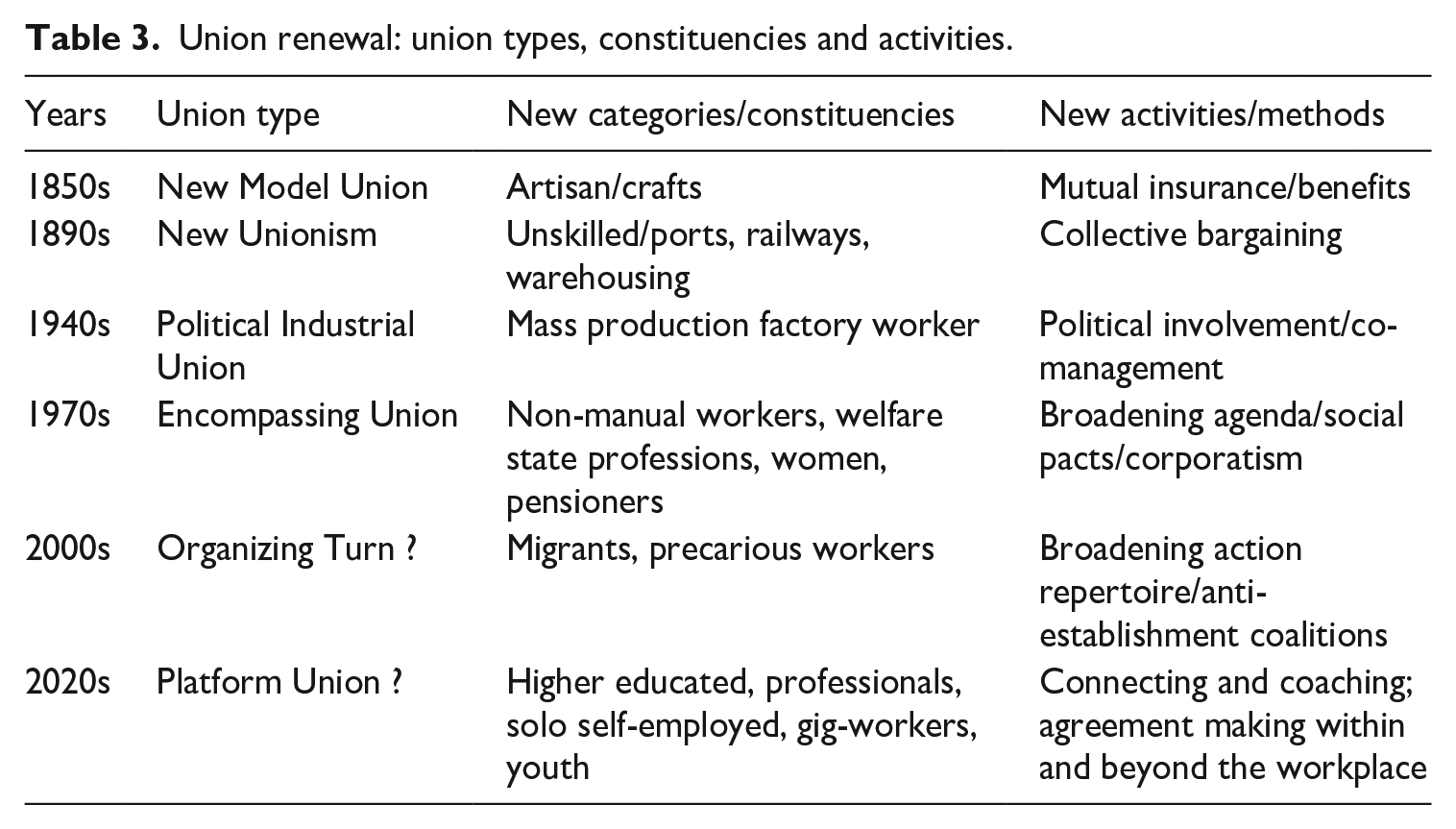
Union revitalization in the 2020s goes beyond organizing and is not just about gaining a new constituency added to the ageing membership of today. Revitalization happens when unions make themselves relevant for both the highly-skilled employees and solo self-employed workers with tertiary education and expand their presence among the growing army of mostly young platform workers, migrants and employees with part-time and fixed-term contracts. Revitalization includes also new activities, which I define here as coaching, connecting, assisting and ‘agreement making’, not just with employers, but also with civil authorities, online platforms and between workers themselves. Last but not least, revitalization requires new methods of ‘doing’ and ‘being’ a union, i.e. new approaches to communicate with members and non-members, to consensus building and decision making within the union and regarding collective bargaining. Reconnecting with young people is key to any strategy of union revitalization. More unions now experiment with interactive websites and social media, but the next step might be, especially when approaching young people, to act like a social medium, taking the example of Facebook (Bryson et al., 2010), with a model of membership or participation that is easy and cheap, with low entry or exit costs, adaptable to both common and specific needs, based on connectivity with strong network bandwagon effects.
Conclusion
This article started from an observation – that the current economic, political and intellectual climate should help unions to gain members, power and prestige and end the long-term trend of decline. At present there are signs of membership growth, bargaining wins and resurgent militancy, but doubts remain that these are sparks that do not ignite a fire. The underlying causes of de-unionization – instability of work, erosion of the standard employment relation, depletion of the union norm, weaker institutional supports – remain. In most countries and most workplaces levels of unionization are too low for re-establishing a social norm of union membership without outside intervention, changing the interaction between workers among themselves and with their employers, and restoring the stability of workplaces and employment.
This article is not meant as an exercise in futurology or an attempt to forecast the world 20 years hence. Nor do I claim to predict the future of unions. Too much academic writing about the future of trade unions expresses a belief in seeing what the authors want to see, be it the near-death or the impending rebirth of the union, much like religious zealots who claim to witness the apparition of the Virgin. Predictions of the next ‘upsurge’ in (American) unionism based on the fusion with social movements (Clawson, 2003), a new mobilization wave related to a presumed Kondratieff cycle (Kerry, 1998), or a new international militancy following the lead of unions in the Global South and exploiting the fragility of the international supply-chains in today’s predator capitalism (Moody, 1997; Silver, 2003) were already proving false by the time they were published. Social scientists should be very modest when it comes to prediction because our causal knowledge of what explains past patterns of union growth and decline is still limited. Even our best models contain high levels of unexplained variation. Moreover, any real world event like the financial crash of 2008, the Covid-19 pandemic of 2020/1, the energy crush following the current Russian war against Ukraine, and who knows what next (water wars?, a surge in migration related to heatwaves?) is likely to throw any prediction off balance.
The predictions in a scenario analysis are of a different kind, of the type: if X, then Y. For example scenario 1, which basically says: on current trends in labour markets, demography and politics (i.e. rise of flexible work, ageing of union members and lack of state support), and without unions changing their ways, marginalization is the likely outcome. The advantage of a scenario analysis is that its conditional predictions allow for agency and the identification of policies that can avoid or mitigate the predicted outcome – one reason why scenario analysis is used in military planning and business decision making. Scenario analysis suits the aims of this article, which is to go beyond academics talking to academics and stimulate debate in the unions, among researchers and in the wider policy community. What lessons can we draw from the preceding analysis?
Firstly, although downward trends are common, not in all countries are trade unions weakened to the same extent (Figure 1, panel A). Marginalization or substitution is further away and less threatening for the unions in Sweden, Denmark, Belgium or Italy, compared to the US, South Korea, Poland or Slovakia. They have more time, more resources and perhaps also a larger inventory of effective policies compared to weaker unions in a less secure environment. Yet, these are no reasons for complacency. All union movements face the challenge of reconnecting with young people (Figure 1, panel B) and this is probably the number one priority of revitalization everywhere.
Secondly, the marginalization and substitution scenarios cast the unions in a passive role – the initiative lies elsewhere (market forces, employers, governments, other suppliers of services, non-union organizations and movements). Bernaciak et al. (2014: 11) write, hopefully: ‘Unions are not condemned by external forces to eternal decline and eventual irrelevance. Against the odds, they have still scope for strategic choice.’ The marginalization and substitution scenarios put the odds squarely on unions failing to get their act together, make a decisive strategic choice or know what that choice should be. Instead, trade unions, each in its own way, scramble for resources and stick to their own needs and aims, with limited cooperation between them. The marginalization scenario is like the doom of global warming, known to all, but hard to fight without painful decisions and intense cooperation. Marginalization, to be clear, does not mean that unions disappear, merely that they become irrelevant for regulating labour markets (Baccaro and Howell, 2017).
Thirdly, marginalization and substitutions feed on each other. The more unions weaken, the more other actors, entrepreneurs and interests see opportunities to step in and offer substitutes. The more these substitutes gain ground and can prove themselves, the less space there is for the union. Tapia et al. (2015: 163) rightly make the point that ‘the void in worker voice was both created and filled by the emergence of flexible forms of employee participation and work organization that started with terms such as job enrichment, job enlargement, quality circles, quality of work life, socio-technical systems’. The statutory minimum wage presents a similar ambiguity for the lower end of the labour market. It fills a representation gap where unions fail to negotiate the wages and protection of the lowest-paid wage earners and it softens the pressure on these workers to seek protection through union organization.
Fourthly, where union weakening has gone very far, as in Poland and Slovakia, trade unions are seen to be shifting their strategies from collective bargaining towards political campaigning, transnational alliances and citizen protest (Greskovits, 2015). Rather than being replaced by non-member organizations, unions become non-member organizations, what Heckscher and Carré (2006) call ‘quasi-unions’ acting as campaign organizations while missing the stability, membership commitment and authority for collective bargaining. This often comes with a new attention for the plight of precarious workers outside the scope of collective bargaining. There is some logic in this, since it is near impossible for precarious workers to pay the subscription rates necessary for a well-functioning union.
Fifthly, sticking to where they are (still) strong, as in the dualization scenario, may be a dead end for unions. ‘Labelling work-places as “lost causes” . . . is a double-edged sword’ (Ibsen et al., 2017: 517). The gains in staff and resources must be set again losses in legitimacy and political standing, and a permanent, perhaps increased threat of sub-standard competition. As a union strategy dualization lacks a compelling societal message and ideology. In that scenario trade unions must drop the pretence to act for the benefit of all workers and they must accept, and will be subject to, state intervention, as is clear in minimum wage legislation. In this sense dualization is the exclusive version of what back in the 1970s seemed a promising scenario for union stability and strength: corporatism or macro-social negotiations with large firms and governments in the pursuit of economic growth and stability in exchange for employment protection and welfare state expansion (Goldthorpe, 1984). It does not seem likely that this constellation of forces and interests can be brought to life again.
Sixthly, are we at the start of a paradigm shift, a rethinking of the premises guiding public policy after a period of increasing failures and anomalies (Hall, 1993)? Nothing less may be needed to bring the unions back in the game. Farber et al. (2021: 39), after highlighting the beneficial contribution of labour unions to lowering inequality in the first post-war decades in the US, write that Covid-related protests and union election campaigns at Amazon and Google and more recently Apple and Starbucks ‘recall the 1930s’, but add that ‘without legal or other institutional changes at the federal level, translating this activity into growth in union density or coverage will be difficult’. Avdagic and Baccaro (2014: 719) draw a similar conclusion. In their assessment, union revival only has a chance ‘if the state accepts that union involvement in employment relations produces positive “externalities” for society and is willing to intervene in favour of unions’. It is up to the unions to develop the ‘blueprint’ spelling out the sense of purpose and forge the alliances that realize these positive externalities.
Footnotes
Declaration of conflicting interests
The author declared no potential conflicts of interest with respect to the research, authorship, and/or publication of this article.
Funding
The author received no financial support for the research, authorship, and/or publication of this article.
