



Abstract
In response to membership decline, trade unions have attempted a number of revitalization strategies. One of these is political campaigning. If used as a revitalization strategy, political campaigns are not just employed because the union desires a specific policy outcome but also as a way to convince new members to join the union. Drawing from the literature on both union revitalization and interest group strategies more in general, we seek to explain why some unions attempt this revitalization strategy where others do not. We use a controlled comparison of two trade union federations in the same country facing the same membership pressures to determine which factor or factors contribute to using this strategy. One trade union organized a campaign to increase the minimum wage specifically to boost its membership (the #Voor14 campaign), while the other did not. On the basis of interviews with key actors in both unions, we identify a key factor in determining union strategic choices: some groups risk their relations with the government and employers to gain more power at the negotiation table, while others believe that expanding membership is not worth risking the relations with the government and employers.
Introduction
In the Western world, labor unions are faced with increasingly tough conditions (Ibsen and Tapia, 2017: 175): they are losing members and mobilization capacity, their membership is skewing further from the “average” worker and their political power is decreasing. In response, labor unions have sought to revitalize. One strategy that unions pursue is political mobilization to pressure the government to adopt worker-friendly policies or what is termed “outside lobbying” in the broader literature on interest groups (Grant, 2001). Unions pursue political campaigns not only because they favor these policies, but also because they believe that these actions will grow, diversify and increase activism in their membership base. While there is ardent academic interest in labor union revitalization, there is a smaller body of literature about the conditions under which labor unions pursue particular revitalization strategies. In this article, we focus on political mobilization campaigns. We seek to answer the question “under what circumstances do labor unions employ outside lobbying as a means of labor union revitalization?”
In order to understand this, we build on the literature on labor union revitalization (Behrens et al., 2004; Frege and Kelly, 2003; Ibsen and Tapia, 2017), as well as the wider literature on interest group strategies. There is a growing body of literature that seeks to explain the conditions in which interest groups use different strategies (Binderkrantz 2005; Dür and Matteo, 2013; Hanegraaff et al., 2016). Following Grant (2001), these authors differentiate between inside strategies, such as the direct lobbying of civil servants, ministers and members of parliament, which requires privileged access to policymakers, and outside strategies, which include campaigns where interest groups mobilize their base to pressure the government. Labor unions, particularly in corporatist systems, have both tools at their disposal.
This article offers a controlled comparison based on the most similar case method (Gerring, 2006). We will examine two labor unions in the same national context that face similar levels of membership decline. One of them uses political mobilization in order to boost its membership and the other does not. Our key question is “why?”. The specific cases are the Federatie Nederlandse Vakbeweging (Netherlands Trade Union Confederation, FNV) and the Christelijk Nationaal Vakverbond (National Federation of Christian Trade Unions, CNV). The former started a public mobilization campaign to raise the national minimum wage, #Voor14 (#ForFourteen), with the internal goal being to boost its membership. Our goal is to understand why these two unions—which operate in the same context and face the same pressures—pursue different strategies. Our study is based on interviews with key players from both unions, complemented by media interviews and documentation.
We contribute to two bodies of literature. We add a stronger analytical focus to the literature on labor union revitalization. The literature has focused strongly on the question of how labor unions have attempted to revitalize, but not as much attention has been paid to the question of why specific revitalization strategies have been pursued. As Frege and Kelly (2003: 10) lamented two decades ago, there is not a lot of research into the strategic choices labor unions make (but see Kochan et al. 1986). While some studies have examined revitalization from a cross-national perspective (Baccaro et al. 2003), which emphasizes the importance of structural features, our analysis compares two labor unions, focusing on their organizational characteristics. It is important to note that our paper does not simply concern the question of when trade unions mobilize (e.g., Grumbell-McCormick and Hyman, 2013, Chapter 3) but when they do so as a revitalization strategy.
Moreover, we add a qualitative case study to the literature on interest group strategies. Most of the work in this area has been quantitative in nature. Those studies focused on different types of organizations. However, authors like Hanegraaff et al. (2016) recognize that simply looking at group type is problematic because different groups balance different goals. Moreover, the quantitative literature has tended to neglect unions because they sit uneasily in the typologies that authors employ. Our study allows us to trace more precisely how groups respond to a declining member base.
The rest of this article is structured as follows: we first discuss the literature on labor union revitalization and on outside and inside strategies. We derive a set of expectations from this discussion that help to explain the differences between our two unions. Next, we present our case selection, our qualitative methodology and our results. We draw our conclusions in the final section.
Labor union revitalization
Union power in Western democracies has been in decline for at least the last 30 years. The decline of power can be seen in a myriad of indicators (Behrens et al., 2004; Frege and Kelly, 2003): declining membership; low membership among specific segments of the working population (e.g., young workers); declining capacity to mobilize their membership; eroding structures of interest representation; diminished bargaining coverage; and waning political power.
In response, labor unions have attempted to revitalize. Revitalization is the attempt by labor unions to regain or re-establish associational power 1 where it has been lost (Ibsen and Tapia 2017: 178). Behrens et al. (2004) identify four different dimensions of labor union revitalization: membership, political power, bargaining power and institutional vitality. The dimension “membership” includes not only attempts to raise union membership, but also attempts to diversify the union's membership beyond the traditional base of native-born male workers with stable employment. If a labor union's membership is not representative of the general working population, the union may find it difficult to aggregate the interests of all working people. Bargaining power is the ability of unions to increase wages or improve working conditions. This does not just depend on membership figures but also on the bargaining structures. Political power is the ability of unions to affect government decision-making. Governments may be more inclined to listen to larger unions, but the power of unions also depends on their integration in the decision-making process (Otjes and Green-Pedersen, 2021). The final dimension is internal vitality. A union's power also depends on its ability to use the resources that it has at its disposal. Organizational restructuring may offer ways for unions to better use existing resources.
While union power depends on different factors, the number of members is one important factor. Not only do unions rely on dues for their budgets, but they also need unionized workers to learn from and communicate with workplaces (Hyman, 2002). Moreover, the legitimacy of labor unions as negotiation partners of the government and employers depends in part on the size of the membership (Culpepper and Regan, 2014). A small membership base may even undermine the union's legitimacy in the eyes of working people, which can further exacerbate their already declining power (Dufour and Hege, 2010).
Frege and Kelly (2003) identify a number of different revitalization strategies. One prominent method is organizing as a way of recruiting new members and mobilizing the existing membership. Unions can also increase their power through coalition building with social movements, partnerships with employers or strengthening international ties. Finally, unions can also engage in political campaigns. These political campaigns are the core focus of this article. During these campaigns, unions frame themselves as cause groups campaigning for social values beyond the working conditions of their members (Valentini et al., 2020). This has included minimum and living wage campaigns, most prominently the “Fight for Fifteen” campaign in the United States (Bruno 2017; Ibsen and Tapia, 2017). When used in the context of revitalization, these political campaigns have a secondary goal, in addition to their explicit policy goal. These campaigns can activate the existing membership base, expand the membership base and diversify the membership.
Outside strategies by interest groups
In the literature on interest groups, the term “outside strategies” is used to describe the work of organizing protests to demand political change. When pursuing policy goals, groups have two options (Grant, 2001): firstly, they can choose to lobby civil servants, ministers and MPs directly, outside the public eye, in what is termed an “inside strategy.” In corporatist systems, this kind of direct contact with the administration occurs in advisory committees. Secondly, groups can choose to use public pressure to convince government officials to act, for instance, through demonstrations.
Some authors, like Grant (2001), assume that outside strategies are used by groups that lack the inside track and that once groups have privileged access, they will not use outside strategies; outside lobbying is considered a weapon of the weak (De Bruycker and Beyers, 2019). In contrast to this expectation, Binderkrantz (2005) finds no relationship between having privileged access and opting out of outside strategies. Instead of inside and outside strategies being exclusive, they are actually correlated: most groups have multiple strategies in their repertoire (Binderkrantz, 2005: 695; Binderkrantz et al., 2014; Page, 1999).
Groups can use different strategies, dependent on the goals they have (Binderkrantz, 2005). In contrast to how some authors conceptualize groups (e.g., Berry and Wilcox, 2018; Brunell, 2005), interest groups are not merely policy maximizers; they also have organizational goals, such as maintaining or expanding their membership base (Hanegraaf et al., 2016; Lowery, 2007). Outside strategies may be used to demonstrate to potential members that the group is working actively to promote their policy goals (Dür and Matteo, 2013). Political mobilization is seen as a way to boost membership not only in the industrial relations literature but also in the interest group literature more widely. Binderkrantz (2005, 2008) finds that groups in a competitive situation with regard to attracting members are more likely to pursue outside strategies and less likely to pursue inside strategies.
When do labor unions engage in political mobilization?
We will use both the literature on interest groups more generally and labor union revitalization more specifically to understand the conditions under which labor unions engage in outside strategies to boost or diversify their membership base. The literature on labor union revitalization suggests three factors: the wage-bargaining structure, the identity of the union and the centralization of the union's organization. At the same time, the general literature on interest groups points to four factors: routine involvement in policymaking, group type, group resources and internal democracy. We will first engage with country characteristics (wage bargaining structure and routine involvement in policymaking) and then look at group identity (linking to identity from the industrial relations literature and group type from the interest group literature) and group organization (centralization, internal democracy and group resources).
Country characteristics
The literature points to two closely related country characteristics that make unions more likely to pursue outside strategies: the wage-bargaining structure and the routine involvement of groups in policymaking. Systems, where unions and employers are routinely involved in government policymaking and where the government can make bargaining agreements between unions and employers can be made binding for entire sectors, are often called corporatist (Jahn, 2016). The wage-bargaining structure affects how problematic membership decline is for unions (Frege and Kelly, 2003). Many revitalization strategies originated in the United States, where wage bargaining is not institutionalized and unions are institutionally insecure (Arnholtz et al., 2016). In corporatist systems, union power is not simply dependent on their membership but also on their integration into the tripartite bargaining structure (Frege and Kelly, 2003). The revitalization strategies that developed in the United States first have spread to European corporatist systems (Baccaro et al., 2003; Ibsen and Tapia, 2017). 2 For instance, Belgian and British unions have pursued political campaigns for minimum wage increases, modeled on the Fight for Fifteen (Flohimont, 2019; Prowese et al., 2017).
The existing cross-comparative research on interest group strategies shows that there is a difference between corporatist systems where a specific set of groups has privileged access to the government and pluralist systems, where groups tend to use outside strategies more often (Hanegraaff et al., 2017). In pluralist systems, interest groups in general tend to use more outside lobbying strategies, while they are more reliant on inside lobbying in corporatist systems (Hanegraaff et al., 2017). This is particularly true for groups that have privileged access to the government, such as labor unions (Binderkrantz, 2005; Schamp, 2012). Outside strategies are less attractive here, because unions fear alienating employers and governments. Under corporatism, where actors have repeated interactions with each other, the reputation of being a reliable, cooperative and honest agent is valuable (Teulings and Hartog, 1998).
Group identity
Many authors link group types to lobbying strategies (Binderkrantz, 2005; Dür and Matteo, 2013; Hanegraaf et al., 2016; Maloney et al., 1994). They distinguish between public interest groups that pursue so-called diffuse goals that would benefit wider society, such as environmental groups, and specialized interest groups that represent specific interests, such as plane manufacturers. Interest groups that represent specific interests tend to engage with the administration more directly (Dür and Matteo, 2013). They do not want public attention on the issue they are working on, as this will show how they make private gains at the cost of the public. Contrariwise, diffuse groups tend to use outside strategies (Binderkrantz, 2005). They can expect public support for their policies and believe that they will benefit from drawing attention to them (Binderkrantz, 2008; Dür and Matteo, 2013). Moreover, some groups representing diffuse interests consider themselves outsiders and, therefore, prefer not to make deals with the government behind closed doors (Binderkrantz, 2008). Whether or not the goals of the groups are seen as radical or moderate by policymakers also informs the extent to which they can realistically pursue inside strategies (Maloney et al., 1994).
Curiously, labor unions sit uneasily in this typology, as they tend to represent a specific group (workers in a specific sector), but, as a whole, labor union federations represent the interest of a large segment of society. Some studies of inside and outside strategies do not explicitly examine them (e.g., Dür and Matteo, 2013, fn.2) or lump them together with business groups (Binderkrantz, 2005, 2008).
The industrial relations literature can help us to understand how unions make choices. An important element here is union identity (Frege and Kelly, 2003; Hyman, 1994). We follow Whetten (2006: 220) in defining identity as “the central and enduring attributes of an organization that distinguish it from other organizations”. This includes an ideational component but also reflects the organization's culture (Grumbell-McCormick, 2013).
Hyman (2001) offers a prism through which we can understand union identity. He distinguishes between three ideal types: business unionism, societal unionism and class unionism. Business unions are focused on negotiations regarding wages and working conditions with employers; societal unions are vehicles for social integration and influence government policy through tripartite bodies with other social partners; and class unions are occupied with the struggle between labor and capital, not simply in the negotiations regarding wages but also in broader anti-capitalist mobilization. Hyman (2001) and others in literature (e.g., Simms, 2012) emphasize that the majority of union identities do not conform to a single ideal type but instead combine two of the three ideal types.
A labor union's identity concept is related to a union's ideology, which may be laid down in bylaws or declarations of principle. These principles on paper only affect identity if they are internalized by the union's leadership and membership and are reflected in their behavior (Grumbell-McCormick, 2013). Class-oriented labor unions are often socialist or communist. Societal labor unionism is associated with both Christian democracy and social democracy (Hyman, 2001). Business unions prize their ideological neutrality. Class-oriented unions are more likely to fit in the category “radical” from the interest group literature, while business- and society-oriented labor unions more likely fit the category “moderate.”
With these different identities come different repertoires of contention (McAdam et al., 2003). Business-oriented labor unions may engage in strikes as part of a negotiation strategy with employers. Class-oriented labor unions may employ strikes and other forms of mobilization as part of a broader anti-capitalist agenda. For them, antagonizing employers or governments is a benefit instead of a cost. Society-oriented labor unions focus on the tripartite bargaining table and are likely to employ the tools in their toolbox with an eye on what benefits them at this table.
Union revitalization strategies may reflect an interest group's identity (Hodder and Edwards, 2015). The extent to which labor unions pursue outside strategies that may alienate employers and the government depends on how much they value these relationships. Business labor unions are unlikely to employ political mobilization as a revitalization strategy; for them, political advocacy is not an option. Society-oriented labor unions are also unlikely to do so, because this may alienate their partners in tripartite bargaining. Class-oriented labor unions are most likely to employ political mobilization.
1. Identity hypothesis: the more society- or business-oriented a labor union federation is, the less likely it is to pursue an outside strategy to boost its membership.
Group organization
We look at three features of organizations: democracy, resources and centralization. Binderkrantz (2005) proposes that groups that are more internally democratic show their members that they are working on their issues by exhibiting more activity. Higher levels of internal democracy make group leaders responsive to the membership base (Levi et al., 2009). The level of internal democracy of labor unions can be understood by the extent to which rank-and-file members can and do participate in decision-making about policy and leadership (Levi et al., 2009). A democratic union uses a one-person, one-vote electoral system for elections for the union's executive officers and the convention, as well as referendums for collective bargaining agreements and support for government policies and the level of participation in these elections and referendums is high (Levi et al., 2009). Binderkrantz (2005) finds that organizations with a high level of membership influence tend to be more active in both lobbying the administration and mobilizing their supporters. This suggests that, in more democratic organizations, the labor union leadership is rewarded for activity.
A second consideration is a union's organizational structure: Frege and Kelly (2003) emphasize that this political action is facilitated by centralized peak organizations. They have both the authority to make political choices as representatives of their members, and they can operate in a unified way to pursue a particular strategy directed at the government.
A third organizational feature that the interest group literature points to is resources. Groups with more staff focusing on political work tend to be more focused on the administration, parliament and the media (Binderkrantz, 2005; Maloney et al., 1994). Political campaigns are costly, and groups can only afford to pursue them if they have sufficient resources (in terms of staff) to do so. This leads us to the following three hypotheses:
2. Member influence hypothesis: a labor union federation, where individual members have more influence, is more likely to pursue an outside strategy to boost its membership than a labor union federation, where individual members have less influence. 3. Centralization hypothesis: a centralized a labor union federation is more likely to pursue an outside strategy to boost its membership than a decentralized labor union federation. 4. Resource hypothesis: a labor union federation that has more resources is more likely to pursue an outside strategy to boost its membership than a labor union federation that has fewer resources.
Case selection
The goal of this article is to see how different labor unions respond to labor union decline. To this end, we examine a country that has seen a sharp decline in labor union density and where there are multiple labor union federations. Table 1 shows several Western democracies and the level of labor union density in 1960 and 2018, 3 as well as the effective number of labor union federations. In five countries, labor union density declined by more than a quarter of the working population. In four, there is one “effective” labor union federation, which organizes more than 80% of unionized workers. Among these, the Netherlands is the only that has multiple labor unions: there is one larger labor union that organizes 60% of unionized workers and two smaller ones. This makes the Netherlands an important case to study the revitalization strategies of labor union federations (in plural).
Labor union strength in 21 democracies.
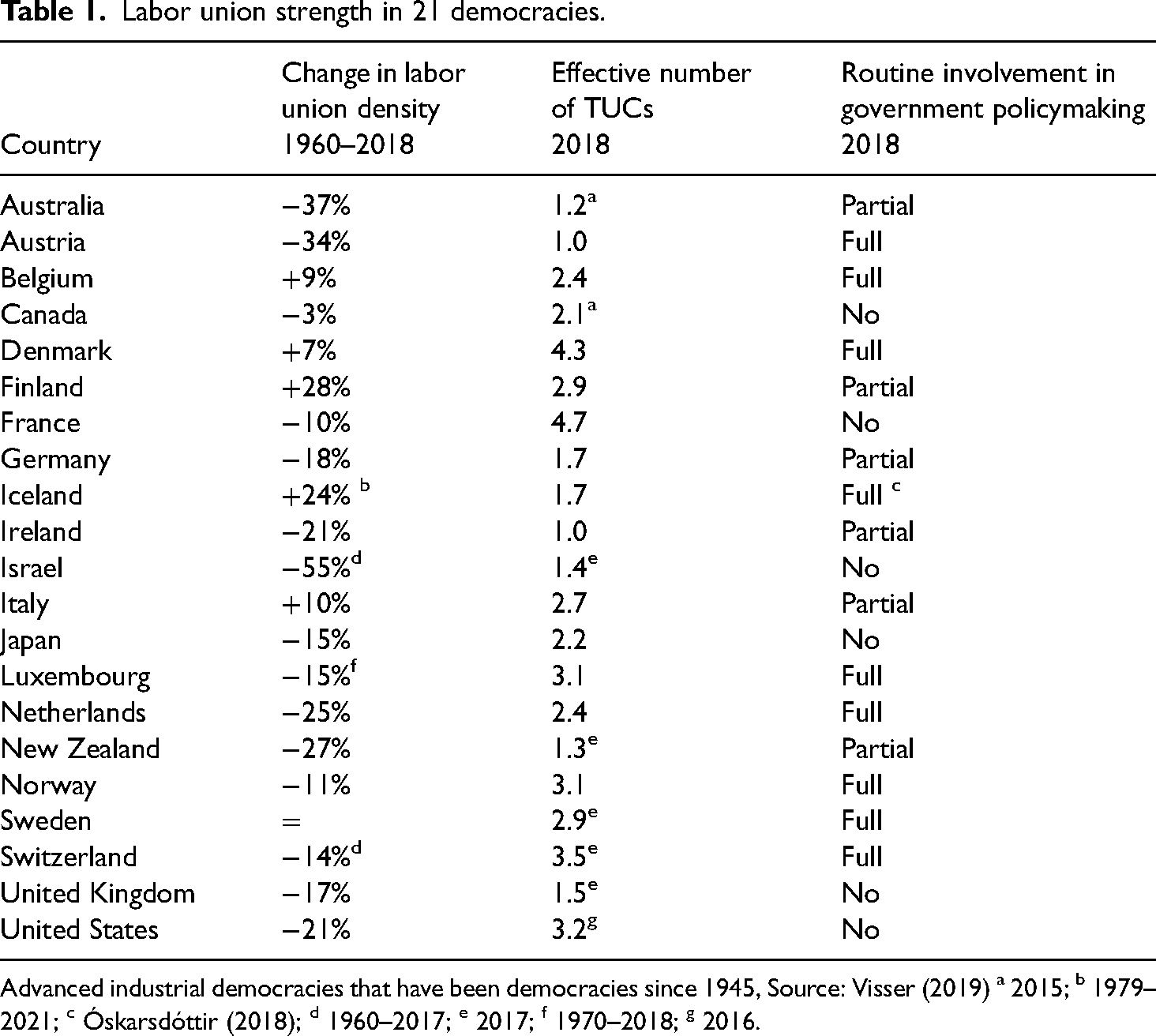
Advanced industrial democracies that have been democracies since 1945, Source: Visser (2019) a 2015; b 1979–2021; c Óskarsdóttir (2018); d 1960–2017; e 2017; f 1970–2018; g 2016.
The Netherlands is a corporatist country where labor unions have privileged access to government policymaking. This means that inside lobbying is likely to be productive. This makes the Netherlands among the least likely countries to see labor unions using political mobilization for revitalization. In pluralist countries, the dilemma of maintaining good relations for an inside strategy or boosting members through an outside strategy is much weaker.
Within the Netherlands, we employ a most similar case design. In its most pure form, the selected two cases are similar in all aspects except for the variables of interest (Gerring, 2006: 131). Therefore, in order to keep our comparison as controlled as possible, we study two similar labor unions in the Netherlands that differ in their use of outside strategies for revitalization.
There are three recognized labor union federations in the Netherlands: the FNV, the CNV and the Vakcentrale voor Professionals (Trade Union Federation for Professionals; VCP; which was called the MHP historically). The CNV was founded in 1909 as a Christian alternative to the socialist, class-oriented labor unions, including one of the predecessors of the FNV (Hazenbosch, 2009). It subscribed to a Christian-social worldview, where labor and capital are expected to cooperate harmoniously. Both the CNV and the predecessors of the FNV integrated into the corporatist structures that the government created in the 1950s. In the 1970s, the Dutch labor unions radicalized. The strong bond between the Catholic party and the Catholic labor union federation weakened, as the latter adopted a class-based societal vision, as opposed to a Christian social one (Otjes, 2016). The idea of a single non-denominational labor union emerged. In 1975, the FNV, a merger of the socialist and Catholic union confederations, was formed. The CNV did not join this new formation out of fear of losing its moderate, Christian-social identity, to a much broader and more radical FNV (Otjes, 2016). While other Christian-social labor unions in Europe secularized, the CNV kept its identity (Grumbell-McCormick and Hyman, 2013). The FNV was formally politically and religiously neutral but has always had an affinity for social democracy (Otjes, 2016). The FNV is more “radical” than the CNV (Akkerman et al., 1995; Valkenburg and Coenen, 2000). It has become more politically assertive in recent years (Grumbell-McCormick and Hyman, 2013). Specifically, the FNV has returned to a Keynesian model in wage negotiations since 2015 (Boumans, 2023).
The predecessor of the VCP was also formed in 1975. It was a labor union for middle management personnel affiliated with the Catholic Union Confederation that refused to join the FNV. It espouses pragmatism. The VCP is structurally different from the FNV and the CNV, as it is a rather weak, decentralized confederation of fifty different unions and associations of professionals, instead of a more centralized union. 4
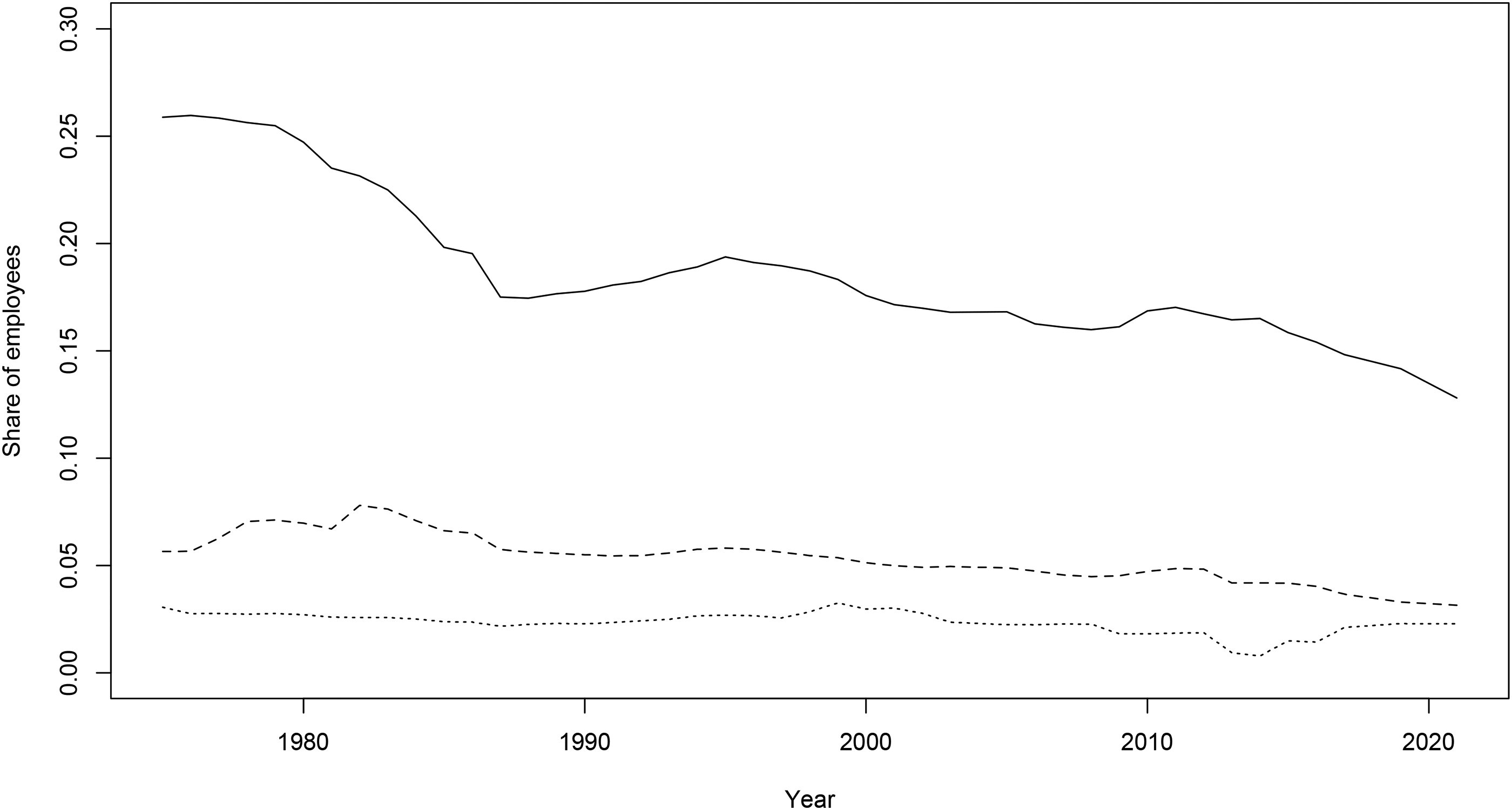
Union strenght in the Netherlands, 1975–2021. Full line: FNV (Federatie Nederlandse Vakbeweging); dashed line CNV (Christelijk Nationaal Vakverbond); dotted line: VCP (Vakcentrale voor Professionals; formerly MHP Vakcentrale voor Middengroepen en Hoger Personeel).
Figure 1 shows the development of their membership since 1975—the year that the FNV was formed. In this year, the FNV organized a quarter of workers in the Netherlands. It saw the sharpest decline in the first decade of its existence, when it lost 3% of its membership every year. In this period, a number of Catholic unions left FNV to join CNV. Union membership increased in the 1990s, but since 2000, the FNV has lost 2% of its membership yearly. Currently, it organizes one in eight Dutch workers. The CNV organized 5% of Dutch workers in 1975; now, this is 3%. The CNV saw its membership grow in the early 1980s, as entire Catholic unions joined it. It has been in decline since 2000, losing 2% of its membership every year.
As we discuss below, the FNV pursued an outside/mobilization strategy to boost its membership; therefore, we focus on this case. In our paired comparison, we look at another case that did not do so but is as similar as possible. Given the strongly decentralized organization of the VCP, we focus on the comparison between the FNV and the CNV.
Method
We performed a comparative, qualitative study. Our goal was to compare the two cases to see what drives the decision to engage in outside campaigning as a revitalization strategy. We used a multi-method approach. An important element of our study was having elite interviews (Harvey, 2011): we held eight purposely sampled, semi-structured interviews with union leaders and organizers. Specific people were interviewed to discuss their insights into how labor unions make strategic choices. We interviewed three board members of both the FNV and the CNV, including the chairs of both organizations (listed in Table 2), focusing on their strategic choices. We supplemented this with two interviews with FNV organizers to see how the FNV strategy was implemented on the ground. There is no consensus in the qualitative interviewing literature regarding what number of interviews is “enough” (Saunders and Townsend, 2016); this depends on context (Baker and Edwards, 2012). When thinking about the number of interviewees in qualitative elite interviews, it is useful to think about what the unit of analysis is. If the unit of analysis is the individual decision-maker, then one must ensure that the sample is sufficiently large, diverse and preferably representative of the population; if the unit of analysis is at a higher level (e.g., the organization), the interviewees are a source of information about the object of study. In this case, the quality of the interviewees is more important than their number. It is essential that respondents have information about how decisions were made and were “in the room where it happened.” Our case falls into this category. We are not interested in the union leaders per se, but rather in the comparison between the two organizations. Therefore, we wanted to talk with the key decision-makers in both unions. When it comes to interviews with people in these leadership positions of this type, Adler and Adler (2012) observe that relatively few people—between six and a dozen, for instance—may offer insights. Six interviews with board members were conducted in the fall of 2021 and two interviews with organizers in the spring of 2023. Due to COVID-19 and scheduling restrictions, all interviews were held remotely using Microsoft Teams, which was also used for recording and transcription. The interviews lasted between 20 and 60 min.
Interviewees.
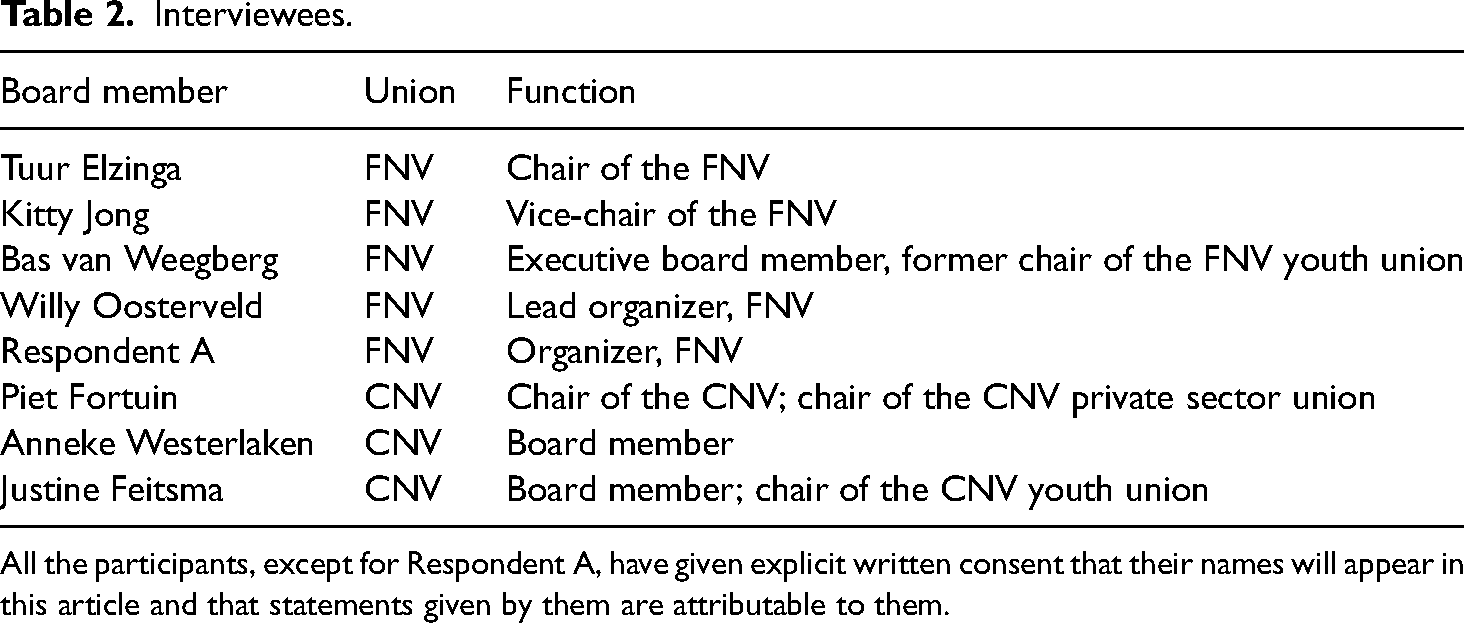
All the participants, except for Respondent A, have given explicit written consent that their names will appear in this article and that statements given by them are attributable to them.
The interviews were held by the junior of the two authors, because he had ample experience and contacts inside the union movement. The questionnaires can be found in Appendix A. The interviews were held in the context of a broader research project. After establishing a rapport with the interviewees, the interviews with the union leaders focused on questions concerning how union leaders decided on the campaign and what kind of constraints and criteria they employ when choosing between inside and outside strategies. The interviews with the organizers focused on how the campaign was implemented. The codebook, which can be found in Appendix B, was based on the methodology established by DeCuir-Gunby et al. (2011) and was designed to evaluate and analyse the in-person interviews. The codebook functions as a simplified operationalization and was mainly used to identify reactions within an interview and show how they relate to the core concepts. All interviews were conducted in Dutch and all quotes were translated by the authors.
These interviews are supplemented with newspaper reports. 5 This includes both specific reports about the #Voor14 campaign and more general interviews with labor union leaders that concern membership decline. It is important to note that in these newspaper interviews, labor union leaders are likely to be more strategic and cautious than in an interview with a researcher; union leaders give interviews to newspapers in order to communicate the union's positions to the broader population. Moreover, these interviews tend to be highly redacted. As a final source of data, we used information concerning the union federation's organization (e.g., bylaws, annual and financial reports) to gain an understanding of the differences between the two union federation's resources, organization and ideology.
Union decline
In general, both the FNV and CNV leadership see membership decline as problematic. As Anneke Westerlaken (CNV) stated, membership decline “is problematic, because it puts your legitimacy and independence under pressure, because you don’t want to become an organization that is financed by employers or the government … [Another problem] is thinking power. If you bind people to you, you can use their expertise and knowledge. And the last [point] is finance. We still get most of our money from member fees … At CNV we lose about 2.5% of our membership every year that affects your income … [and] puts you[r budget] under pressure.” Bas van Weegberg (FNV) emphasized the importance of size for union power: “You sit in [negotiations with employers] on the basis of your representativity. You have a base that pays you every month and part of them are engaged with what you are doing. And employers know this and they know that when you do not negotiate with this union, they have a large problem … [there is a] sense of threat.” The leadership of both unions agree on the need to “grow larger and stronger” (Bart Plaatje, FNV) 6 and “organize membership growth” (Piet Fortuin, CNV).
Campaigns of FNV and CNV
In April 2019, the FNV launched a broad, multipronged public campaign to raise the minimum wage. This campaign is still underway as of the spring of 2023. The campaign is organized at both the local and national level. Organizing occurs both at the sectoral level and the neighborhood level. Local organizers focus on both political and business targets. They lobby municipal councils—from the capital, Amsterdam, to small towns like Valkenburg—to adopt resolutions in favor of raising the minimum wage. They also target specific companies that only pay employees at minimum wage levels to increase pay. At the national level, the campaign consists of a diverse set of approaches from public protests and petition drives to raising awareness through publications and a series of online seminars. The campaign caught both national and local media attention and garnered the support of left-wing parties. 7 In setting up this campaign, the FNV looked “with a certain admiration to the Fight for Fifteen in the US” (Tuur Elzinga, FNV). 8
For the FNV, the #Voor14 campaign was started with the explicit goal of boosting membership growth in demographics and sectors where the union had difficulty gaining members. Elzinga (FNV) said: “That number fourteen … that was not the first thing on the table, like “this is a good number and we need a campaign to realize it.” No, rather it is the other way around: how can we reach groups that are difficult to reach, those [groups] in a precarious situation … how can we organize them and make them realize things, so that they become interested in members of the union.” The work organization of the FNV was focused on different segments of society than before, as lead organizer Willy Oosterveld noted: “It is a tactic but it was also really our goal to find other people than we normally find at the FNV, by behaving differently, by positioning differently and by using other images, so that you also specifically attract people of color and women.” The goal was not just to increase membership but to increase it among these specific groups 9 and not just to find passive members but also new local union leaders. All FNV campaigns have membership growth as a (secondary) goal and are evaluated on this goal by the union's management. 10
The CNV also organizes campaigns. Leave for bereavement is an example of a recent campaign, which was mentioned explicitly by two of the three respondents. This shows how the CNV operates: the issue had come up organically from the union's base. The union first held an internal poll on the matter to determine the nature of the problem. Then it commissioned a representative poll to show the size of the problem among working people and the support for the solution that the CNV proposed. The CNV then developed a position paper for parliament and a manual for HR professionals. The union shared this manual with employers’ organizations. The CNV also shared it with its members, as they might have a colleague who lost family members, and organized webinars on the issue. The political arm of the campaign was focused on lobbying parliament. This campaign is an example of inside lobbying, not outside lobbying.
The CNV also wants to increase its membership. Fortuin (CNV), however, does not believe that mixing goals (policy and membership growth) is wise: “If my goal is raising the minimum wage and secondarily, I’m also going to organize growth, then your goals get mixed. I think you have to be razor-sharp in your goal.” The CNV does not link specific campaigns to membership growth, as Westerlaken stated: “We never say: we are going to organize a campaign on pensions and we want to have 500 extra members.” Fortuin also expressed concern about retaining members: “Does it make sense to set up a large campaign, to very quickly, very hastily gain 10,000 new members, if you lose 5000 of them next year? The question is if that is smart, because you need to keep that [campaign] motor running.”
One might wonder how the CNV seeks to boost its membership. Fortuin expressed a preference for empowerment to boost membership figures: “engage our members with what we do, don’t develop everything in this tower in the Utrecht [where the CNV's headquarters is located]. That has to draw new members.” 11 In their interviews, board members Justine Feitsma and Westerlaken emphasized the importance of specific benefits for members, following a model of service unionism.
In summary, the FNV set up the political mobilization campaign #Voor14 to boost and diversify its membership. The CNV does engage in political campaigns, but these are inside lobbying campaigns, and not part of a revitalization strategy. This makes both organizations a relevant most similar case study to determine why one of the two unions engages in a political mobilization campaign to boost its membership and one does not.
Identity
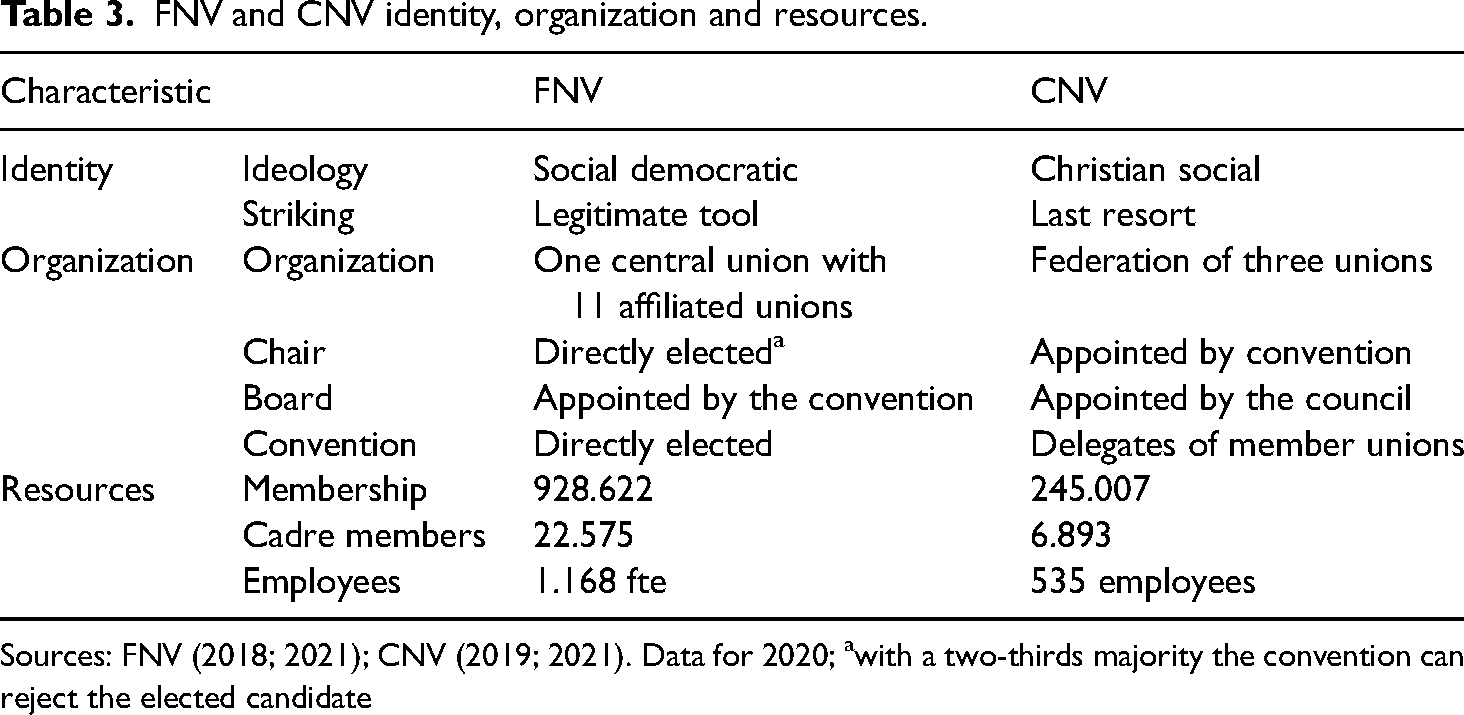
Four explanations for the difference between the two unions have been listed above. Table 3 illustrates the differences between the unions. Our first explanation is identity. To this end, we would have to place the FNV and the CNV in a triangle between business unionism, class-oriented unionism and society-oriented unionism.
FNV and CNV identity, organization and resources.
The CNV comes close to the ideal type of a society-oriented union. Like many society-oriented labor unions, it is inspired by Christian social thinking, which is explicitly stated in its bylaws. This also mentions its commitment to mutual responsibility and the notion that people should develop according to their nature. An important characteristic of CNV is its constructive attitude (Feitsma, CNV): it seeks to be a constructive partner of employers in negotiations regarding wages and working conditions and of the government and employers in tripartite negotiations.
When it comes to the tools at its disposal, it is notable that the bylaws of the CNV do not explicitly mention strikes. The CNV sees strikes as a last resort. When it comes to insider and outsider strategies, according to Fortuin, “you need both. Sometimes you just need a demonstration, a strike or whatever … you sometimes need that politicians think ‘shit, there are a lot of people who think this.’” Compared to the FNV, however, the CNV is more reticent to use public pressure. Westerlaken gave an example of the FNV organizing a protest before collective bargaining had stated: “the FNV had drummed up about forty people [from the sector], who stood outside with literal drums and whistles. We had not exchanged a word with employers … [I think] first go talk to each other … This is a show of power and I just don’t like that.”
As seen above, CNV chair Fortuin did not want to mix goals. The relationship with the government and employers plays a role here: “If you organize that kind of subgoal then you are no longer honest in your lobby.” In his view, the negotiation partners take notice of this: “employers and politicians often accuse us, the labor union movement, of this: ‘yes, but you only do this to organize membership growth.’”
The FNV does not easily fit into one of the categories described by Hyman. The FNV, although stating its political neutrality in its bylaws, has a social-democratic orientation with a commitment to values like equality, solidarity and a fair distribution of labor, prosperity, knowledge and power. The FNV has a different approach to the tripartite and bipartite arenas than the CNV. With regard to the tripartite Social Economic Council (SER), the FNV interviewees ranged from sceptical to pragmatic. The chair, Elzinga, is a more pragmatic voice: “I think that we have to use every tool and the SER is on one of them … that we can use to raise our voice to improve deliver a better outcome for workers than if we leave it over to the forces of the free market where we have no voice.” Vice-chair Kitty Jong represents a more sceptical voice: “the impact [of SER advice] is too small, while we have to strike compromises that limit our own actions.” With regard to bipartite negotiations for wages and working conditions, the FNV is far less likely to accept proposals from the employers’ organizations in wage negotiations compared to the CNV. 12 In its bylaws, it explicitly mentions strikes as one of the tools at its disposal.
As seen above, activism and revitalization go hand in hand for the FNV, as Jong (FNV) stated: “I believe in activism, with as a goal the strengthening of the FNV. A compromise such as an advice in the Social-Economic Council or a [social] agreement is good for society as a whole, but not for us as an organization.” FNV board member Van Weegberg similarly argued: “without that union power there is no way of pursuing your policy goals.”
This difference in identity between the CNV and the FNV has long historic roots: the independent existence of the CNV is due to its commitment to its own identity. The #Voor14 campaign is part of an organizing strategy that the FNV has adopted since the late 2000s, which included public campaigning (Connolly et al., 2015; Vandaele and Leschke, 2010). In that period, the CNV did not engage in organizing in the same way as the FNV did.
In an international comparison, the FNV and the CNV both share a lot of characteristics of a society-oriented union. However, in a relative comparison, this identity fits the CNV better than it fits the FNV. As one would expect from a society-oriented labor union, the CNV prioritizes its relationships with employers and the government over boosting its own membership. In contrast, with comparatively more characteristics of a class-oriented union, the FNV prioritizes its own power in numbers over its relationships with these actors.
Democracy and centralization
The FNV and the CNV have different organizational models (see Table 3). Two elements are relevant to this study: the level of centralization and democracy. We contrast between a federal and unitary model, dependent on whether (most) members join the central organization directly or if they only do so indirectly. We assess the level of democracy by the direct election of the convention and chair; the use of referendums for coalition bargaining agreements and the tripartite agreements; and the level of participation in direct decision-making.
The CNV is a federation of three unions (one for the public sector, one for the private sector and one for young workers). The federal convention consists of delegates from conventions from the member unions. Member unions appoint five of the six members to the board. The board co-opts one member. From these six, the convention selects the chair. The board is responsible for the convention. The CNV organizes referendums on collective bargaining agreements and tripartite agreements. In a recent referendum on the tripartite pension agreement, 18% of CNV members participated. 13
In contrast, the FNV's organization is more centralized and democratic. Three-quarters of its members are members of the central FNV organization. Additionally, there are several affiliated unions that did not merge into the central organization for historical reasons. 14 The members of the FNV elect the chair and a 100-member convention on the basis of one person, one vote. 15 The parliament elects the board. In the last election for the chair, 13% of the members voted. 16 Like the CNV, collective bargaining agreements and tripartite agreements are submitted to referendums. In the referendum on the pension agreement, 37% of the FNV members voted, which is two times the participation level of the CNV. 17 On the basis of the use of direct election for board members and the level of participation in referendums, we can conclude that the influence of members is more direct in the FNV and less direct in the CNV.
The #Voor14 campaign was an implementation of a resolution adopted by the FNV membership parliament, initiated by the FNV board. In selecting a specific campaign from a myriad of options, the FNV board did consider “support within the different sectors, because you need that, you don’t want to impose it top down” (Jong, FNV).
As described above, in the example of the bereavement lobby campaign, the CNV also keeps close contact with its base. In setting goals for such a campaign, the federation organized “membership polls [to determine] how people feel about the issue, what do they think is important” (Feitsma, CNV) and “surveys … [when] we get a lot of reactions and then we think OK we really have something here” (Westerlaken, CNV). The membership base of CNV does not pressure them to campaign publicly. Westerlaken (CNV) said: “We don’t have a base that often calls on us to protest. So, sometimes when we protest, we do so because we feel [that it is important] in the union headquarters.” This means that, even if the CNV organization would have been democratic, it is unlikely that this would lead to more campaigns, because the membership is less likely to desire such campaigns—and this is closely tied to issues of identity.
One may also note that the current organizational model of the FNV was only adopted in 2015. Before that, the FNV was organized in the same indirect democratic and confederal model as the CNV. However, the FNV did engage in public campaigning in this period. It is not the case that the shift towards a more directly democratic model led to a change in strategy: the FNV had also chosen these kinds of strategies before its reorganization.
Resources
There is a clear difference between the FNV and the CNV in terms of resources. Table 3 gives an overview based on the organization's annual reports. It shows that FNV has about four times the members of CNV. This difference persists with regard to volunteers and employees. 18
To what extent do resources play a role in pursuing political campaigns? For these “you need sufficient financial resources, manpower” (Elzinga, FNV). When developing #Voor14, there were 21 possible campaign plans. That number had to be cut down. “We don’t have twenty-one campaign leaders that have enough experience to do this kind of thing” (Van Weegberg, FNV). Campaign plans need to be worth the investment: a plan “has to lead to demonstrably more members. It has to lead to demonstrably more volunteers” (Jong, FNV).
As described above, the CNV's campaigns are smaller than the FNV's, as Feitsma observes: “we have fewer financial resources to set up these larger things … the FNV is much larger in this respect.” The CNV's federal organization also prevents them from mounting broad campaigns. Feitsma said “there are many themes that are federation-wide … but at that level we only have a small policy staff and two communication people.”
While there are clear numerical differences between the resources of the FNV and the CNV, it appears unlikely that they are the reason that one uses campaigns to boost its members and the other does not. Despite differences in resources, both unions organize campaigns to change public policy. While the CNVs are on a smaller scale than the FNVs, this does not necessarily mean that membership growth could not have been a secondary goal.
Conclusion
This article examined the conditions under which labor unions use public campaigns as a revitalization strategy or, from an interest-group perspective, to what extent boosting and diversifying membership played a role in the decision to engage in outside lobbying. We sought to contribute to the literature on labor union revitalization. There is a considerable body of work which observes that labor unions use specific strategies to revitalize their organization, but there is less work on why some labor unions attempt specific strategies and others do not. At the same time, we also sought to contribute to the literature on interest group strategies by showing, in a case study, to what extent organizational goals like boosting membership play a role in the decision to employ outside strategies, while a correlation has already been established in large-N studies.
We looked at the Netherlands, a country with a considerable decline in labor union density, and we examined the differences between two labor union federations: the CNV and the FNV. The FNV organized a large, sustained, public political campaign to attract new members. The CNV did not. These two organizations differed in four dimensions: identity, democracy, centralization, and resources. The social-democratic FNV is larger, centralized and more democratic while the Christian-social CNV is smaller, federal and less democratic. Using qualitative evidence from interviews and documentary sources, we attempted to explain why the FNV engaged in a campaign while the CNV did not. We believe democracy and centralization can be dismissed as an explanatory factors: despite its confederal organization, the CNV board stays in close contact with its members. These members do not want the union to campaign. We found that the organizations have different amounts of resources (employees, volunteers, members), but we also observed that both groups engage in campaigning. One connects this to expanding its membership base and the other does not. This difference is unlikely to be driven by resources.
We found evidence that differences in identity play a role here. The CNV more closely fits the ideal type of society-oriented labor unionism than the FNV. The CNV's leadership sees a display of raw power in numbers as a last resort, preferring negotiations over demonstrations. Specifically, there is a fear that organizing a political campaign with an ulterior motive (boosting membership) can sour relationships with employers and the government. For the CNV, tripartite negotiations are the key arena, and it does not want to be accused of playing politics with policy. The FNV, in contrast, emphasizes that its power at the negotiation table dwindles without sufficient power in numbers. In their view, activism is necessary to ensure the strength and the survival of the organization.
It might seem puzzling that the CNV still engages in campaigning. However, if we look at one of its campaigns more closely, we can see that it is, in many ways, not an example of an outside strategy aimed at public mobilization, but an example of an inside strategy. Lobbying parliament and employers to adopt policies for bereavement would not necessarily lend itself to a membership drive, which the CNV also did not connect to the campaign.
What do our results say outside of this specific small, corporatist, European country? Given both the membership pressures that labor unions experience in Austria, Australia, Germany and Switzerland and their embeddedness in corporatist structures, the same dilemma is likely to be present for unions here: pursuing a political mobilization strategy as a means to boost and diversify labor union membership risks estranging partners at these negotiations. Which options unions choose depends on how much they value goodwill at these tables versus power in numbers. In systems where this dilemma is less present—because unions are involved less in tripartite negotiations (e.g., the United States or the United Kingdom)—political campaigning as a revitalization strategy, is a less costly strategy. Future research would benefit from a more systematic and comparative study into how the interaction between group identity and features of the political system interact to shape the revitalization strategies of different unions.
How to place these results in the existing literature? We contribute to the literature on labor union revitalization strategies (Frege and Kelly, 2003). Here, we offer an example of how one union pursued a strategy of revitalization. The FNV pursued a political mobilization, similar to unions in other countries (Bruno, 2017; Ibsen and Tapia, 2017). This political mobilization campaign served not just the FNV's policy goals but also to revitalize the union by boosting and diversifying its membership. By contrasting the FNV's choice to use outside campaigning as a revitalization strategy with the CNV's reticence to do so, we also shed light on how union characteristics matter for their strategic choices. So far, research into the “why” of revitalization has received relatively little attention and the literature has pointed to differences between countries to explain choice (Baccaro et al., 2003). Yet, we found that two unions in the same country, facing the same pressures, make different choices. We found that union identity, an important element from the labor union literature (Hyman, 2001), was an important driver of this difference. In relative terms, the CNV fits the category of a society-oriented trade union better than the FNV. While formal organization characteristics, such as the level of centralization or the level of internal democracy (Frege and Kelly, 2003; Levi et al., 2009), are unlikely to be the cause.
Our results do not only speak to the literature on labor union strategy but also to the literature on interest group strategy in general. While several studies on interest groups see them as policy maximizers (Berry and Wilcox, 2018; Brunell, 2005), we show that in line with the work of Lowery (2007) the reason why interest groups lobby, reflects organizational goals. Both the CNV and the FNV are not merely focused on policy. The strength of the organization, either in raw numbers or in the credibility at the negotiation table, is also valued. The assessment of what kind of power was more important reflects differences in the identity of these interest groups. Although mentioned by Binderkrantz (2008) and Maloney et al. (1994), group identity does not play a major role in the study of interest groups. An organization's strategy is assumed to follow the type of organization and its resources. Groups are categorized into crude categories, such as specialized or diffuse interests, which are assumed to all behave in a similar fashion. We found that within the category of labor union, which sits uneasily in this typology anyway (see Binderkrantz, 2005, 2008; Dür and Matteo, 2013), identity matters for choices. Future research about interest groups may want to take into account how groups see themselves and how this affects their evaluation of the different tools at their disposal. It could very well be that the difference in the strength-by-numbers approach of the FNV and the strength-by-credibility approach of the CNV also matters for different environmental groups, for instance.
Supplemental Material
sj-docx-1-jir-10.1177_00221856231201776 - Supplemental material for “Without union power, there is no way of pursuing your policy goals”: when do labor unions use political mobilization as a revitalization strategy?
Supplemental material, sj-docx-1-jir-10.1177_00221856231201776 for “Without union power, there is no way of pursuing your policy goals”: when do labor unions use political mobilization as a revitalization strategy? by Luuk Voncken and Simon Otjes in Journal of Industrial Relations
Footnotes
Declaration of conflicting interests
The authors declared no potential conflicts of interest with respect to the research, authorship, and/or publication of this article.
Funding
The authors received no financial support for the research, authorship and/or publication of this article.

Supplemental material
Supplemental material for this article is available online.
Notes
Author Biographies
Appendix A: Questionnaire
References
Supplementary Material
Please find the following supplemental material available below.
For Open Access articles published under a Creative Commons License, all supplemental material carries the same license as the article it is associated with.
For non-Open Access articles published, all supplemental material carries a non-exclusive license, and permission requests for re-use of supplemental material or any part of supplemental material shall be sent directly to the copyright owner as specified in the copyright notice associated with the article.
