




Abstract
This article explores whether comparative institutionalism can be used to identify path-dependent approaches to the management of ageing workforces in the United Kingdom (UK) and Hong Kong Special Administrative Region (HKSAR), and considers whether and how the global phenomenon of population ageing is leading to a convergence of approaches between Western and Eastern economies. Using semi-structured expert interviews, the article discusses these countries’ approaches to employment regulation, welfare provision and public sector employment. The findings show that the two economies exhibit a converging trend: namely shifting responsibilities for extended longevity from the state and employer towards the individual worker. However, stakeholder pressure (especially from trade unions) has tempered this trend in the UK more than in HKSAR. This indicates that stakeholders’ relative ability to use their agency in setting and pursuing agendas that diverge from public policy paths influences not only national-level policy-making but also organisational-level HRM.
Keywords
Introduction
Populations worldwide are ageing and pressures are mounting on welfare states to support increasing numbers of older people. While there has been attention from academics, governments and practitioners in Europe and North America to how public policies are both encouraging people to save more towards retirement and creating new pathways to extended working life (Ebbinghaus and Radl, 2015), less attention has been given to East Asian economies. However, according to the United Nations World Population Ageing Report (2015), East Asian economies are also faced with projected declines in labour market participation rates of people 50+; early statutory retirement ages; and modest first-tier pensions.
Although the 50+ workforce is growing, it is also a vulnerable labour market group (Oesch and Baumann, 2015). This is due to the persistence of age stereotypes that dub them to be less productive and healthy, and less willing to learn and change relative to their younger peers – stereotypes which exist in both the UK and HKSAR (Chiu et al., 2001). Consequently, older individuals are generally less likely to be recruited, retained (Büsch et al., 2009), trained and promoted (Billett et al., 2011). There is evidence that age-positive human resources management (HRM) is becoming more prominent (Urwin et al., 2013), but often only through the influence of legislation (Flynn et al., 2014) or pressure from unions and age advocacy groups (Muller-Camen et al., 2011).
There is a small but growing body of literature exploring the explanatory power of comparative institutional theory in understanding public and firm-level HRM in relation to age (Böhm et al., 2014; Schröder et al., 2014). Because most countries have ageing demographics (Kulik et al., 2014), common pressures should be leading employers and governments alike to adopt approaches aimed at keeping workers productive in later life, including propagating and implementing age-positive HRM (Böhm et al., 2014). Ageing should therefore lead to a convergence, or, at least, greater directional similarity (cf. Mayrhofer et al., 2011), of national approaches to work and retirement. However, the literature points to the institutionalist concept of ‘path-dependency’ to explain differences in how nation-states deal with the common challenges. Path-dependency suggests that national institutions react to exogenous pressures by making only small deviations from established ‘paths’, and institutional regimes limit the choices of institutional players in responding to such pressures. Government can play an ‘entrepreneurial’ role in changing the course of national institutions (Child et al., 2007; Nasra and Dacin, 2010) (e.g. from one favouring early retirement to one oriented towards active ageing [Flynn et al., 2014]) but is nevertheless bounded in its actions by institutions like the welfare state, industrial relations and national business systems (Lægreid et al., 2015; Muller-Camen et al., 2011).
A hitherto unexplored question is how institutions in both Eastern and Western economies shape and bound approaches to workplace ageing, as well as the extent to which non-governmental stakeholders can use their agency to influence such approaches. There has been a strand of study of institutional theory devoted to debating whether and how Asian economies differ from Western ones in how they are organised and what commonalities bind them together (Carney et al., 2009). With an aim of understanding the waves of rapid economic expansions in Japan, the ‘Tiger economies’ of Taiwan, South Korea, Singapore and Hong Kong, and finally China, scholars have looked for ways in which Asian economies differ from classical institutional models as developed in a mainly Western context (Walter and Zhang, 2012). Of particular interest has been the role of the state in using the levers of regulation and welfare as well as its interaction with other economic stakeholders such as representatives of business and labour to manage economies and to facilitate growth (Cohn, 2015). More recently, arguments have been raised that the 1997 Asian Financial Crisis and the 2008 Great Recession have greatly restricted Asian governments’ agency over their respective economies, so much so that Asian economies have become virtually indistinguishable from liberal market economies like the UK and USA (Mok and Hudson, 2014).
In responding to calls for research and theory development on Asian contexts as well as across East and West (see Barkema et al., 2015), we consider whether and how the global phenomenon of population ageing is leading to a convergence of approaches across the East and West. We further respond to calls for the in-depth study of specific business systems in order to advance business systems theory (Witt et al., 2018). To achieve this, we will use the case studies of the United Kingdom and the Hong Kong Special Administrative Region (HKSAR). These represent case studies of European and Asian economies as developed in the second half of the twentieth century. The former developed with a view towards ensuring social rights and buffering capitalism through decommodifying social welfare (Esping-Andersen, 1990). The latter, by contrast, is characterised as ‘a growth-oriented state and subordination of all aspects of state policy, including social policy, to economic/industrial objectives’ (Holliday, 2000: 709). Given the complexities of regulatory and welfare states, an East/West comparison is facilitated by selecting two economies which are institutionally closest to one another as the UK and HKSAR are, given their connectedness through colonial history (Carroll, 2007).
Three institutional models
To explore how employment regulation, welfare provision and public sector employment practices affect public policy on work and pensions in the two economies, we employ three institutional models: National Business Systems (NBS), Welfare Regimes and Industrial Relations (IR) regimes. First, NBS (Whitley, 1999) emphasises institutional complementarities between actors representing the state, business and labour in predicting outcomes relating to work and has explanatory usefulness of the role of the state in implementing social change through either the engagement or suppression of other social actors like business or trade unions (Schröder et al., 2014). Whitley (1991) has extended his framework to include Asian economies. However, theoretical frameworks associated with comparative institutionalism fall short in accounting for human agency (Tempel and Walgenbach, 2007) with agency being insufficiently theorised (Olsson, 2016). Nevertheless, it is acknowledged that different stakeholders within an institutional context might pursue conflicting agendas (McGaughey et al., 2016). Furthermore, the literature discusses the paradox of embedded agency and the role of institutional entrepreneurs in institutional change (see Battilana et al., 2009). It is therefore argued that some actors might have the ability to act agentically by using the power and resources at their disposal to initiate and implement divergent institutional change.
In classifying the two economies discussed here based on the NBS framework, the UK represents a regulatory business system (Whitley, 2008). The British labour market is flexible, and draft employment regulations typically are posited as ‘light touch’ (Flynn, 2010). HKSAR is also classified as a regulatory state. According to Whitley (1991: 16), the manufacturing sector grew in the 1970s ‘despite the state rather than with its assistance’. Other Tiger economies have been described as developmental states in which government has taken an instrumental role in managing economic development through collusion with and/or suppression of other economic stakeholders (Lee et al., 2007). However, economic non-interventionalism became a governing ideology in Hong Kong to serve the interests of British mercantilists (Cheung, 2000). This limited government approach was also codified into the Basic Laws which governed financial arrangements after Hong Kong’s transfer to China (Lee, 2005).
There are two ways in which HKSAR’s NBS diverges from the UK’s. First, small businesses dominate the economy and low levels of supply chain integration lead to a fragmented business system (Whitley, 1991; Witt et al., 2018) in which inter-firm relationships are personal and short-term, and firms tend to act in opportunistic ways. Second, Asian institutional contexts, including HKSAR, are dominated by wholly family-owned firms (Witt and Redding, 2013) in which there is less shareholder pressure (Carney et al., 2015). Consequently, institutional stakeholders in HKSAR would be expected to have fewer routes to influence firm-level HRM practices than their UK equivalents.
Next, drawing on Esping-Andersen’s (1990) welfare state typology, the UK is considered a liberal residual welfare regime in which social welfare, including pensions, is mostly privatised and minimally redistributive. HKSAR is also residual but like other Asian welfare states has been clustered into a typology of productivist welfare states (Hudson et al., 2014). Productivist regimes are characterised as growth-oriented, with social policy being subordinated to economic and industrial goals (Holliday, 2000). Within this cluster, Holliday differentiates HKSAR from other Asian economies as a facilitative welfare state, ‘which has something in common with Esping-Andersen’s liberal type except it espouses an overarching commitment to growth which puts a different spin on things’ (Holliday, 2000: 710). As an example, Holliday (2000) cites the role of government in making land available for production and the building of public housing in order to boost the construction industry. However, Price and Ho (2012) point to the influx of migrants after the Chinese Revolution and industrial unrest in the 1970s as the drivers for expansion of the welfare state which would indicate social rather than purely economic goals. Lee and Law (2013) have suggested that while other Asian governments sought to expand their welfare states following the 2008 Great Recession, the Hong Kong government pursued austerity measures focused on maintaining a budget surplus. This is partly because while South Korea and Taiwan have transitioned to democracies in which stakeholders like unions have more influence in shaping social policy (Lee, 2012), the HKSAR government lacks pressure from interest groups to expand welfare rights and can maintain its anti-welfarist social policies (Wilding, 2008).
Finally, we draw on the literature on industrial relations regimes to be able to evaluate the role of stakeholders within institutional contexts that might aim to pursue divergent institutional change by questioning the status quo of the prescribed institutional path. Hyman (2001) suggests that British trade unions are primarily driven by two orientations: promoting class interests and exercising market agency. Unions are therefore able to mobilise workers across workplaces and industrial sectors in defence of union members’ existing employment rights and social policies (Flynn et al., 2013). This is particularly the case regarding pensions, as unions have ageing memberships (Flynn, 2014).
Hong Kong unionisation has historically been built around the servicing model (Chiu and Levin, 2001) in which union members’ involvement is built on the delivery of work-related services rather than organising for political and industrial solidarity. Hong Kong trade unions have been further hampered by the extreme fragmentation of the trade union movement (Fosh, 1997; Moon, 2011) as well as by worker apathy and industrial pacifism (Chan and Snape, 2000). Although decolonisation has resulted in a shift in union activity towards political activism, unions’ clout has been hampered by the Asian Financial Crisis (Chan, 2001).
Research methodology
We review secondary literature and discuss findings from expert interviews (Bogner et al., 2009) conducted in the UK and HKSAR in 2013 and 2014. These interviews were drawn from a larger qualitative dataset as part of a research project on age management in the UK and HKSAR. The project was jointly funded by the UK Economic and Social Research Council and HKSAR Research Grants Council. Experts are authorities in a specific field (Flick, 2009) and have specialist, process-oriented and interpretive knowledge referring to this activity, context and culture. The interest is therefore not in the person but in their expert knowledge. Purposive sampling was conducted until a theoretical saturation of different perspectives was achieved (Guest et al., 2006). In the UK, we conducted seven semi-structured face-to-face interviews with senior representatives concerned with issues regarding ageing, work and retirement in the government (Department for Work and Pensions [DWP]), in an old-age pressure group (Employers’ Network for Equality and Inclusion [ENEI]), in four employee interest organisations (Trades Union Congress [TUC], National Union of Teachers [NUT], the public service union UNISON and the Public and Commercial Services Union [PCS]) and in an organisation representing employers and human resource managers (Chartered Institute for Personnel and Development [CIPD]). In addition, one focus group with representatives of Age UK, the Resolution Foundation, the Age and Employment Network (TAEN) and the National Institute for Adult Continuing Education (NIACE) was conducted. In HKSAR, five interviews were conducted in a government office (the Efficiency Unit [EU]), a quasi-governmental group (Elderly Commission [EC]), two employer and management organisations (Hong Kong Institute of HRM [HKIHRM] and Community Business [CB]) and the Hong Kong Council of Social Services (HKCSS).
Topics discussed in the interviews were the role of the state, unions and other stakeholders in setting the age agenda; (recent changes to) legislation concerning work, anti-age discrimination and retirement/pensions, their implementation and effectiveness, and perceptions thereof by employers and employees; and resulting age management practices at the firm-level. Interviews lasted between one and three hours each. After having received informed consent, the interviews were audio-recorded and transcribed. Subsequently, we conducted a thematic analysis using an ongoing reflexive dialogue to avoid inconsistent application (Braun and Clarke, 2006). This included side-by-side coding, ongoing reflective communication between the researchers, the use of computer-aided (QSR NVivo 10) data analysis, and the triangulation of the data with findings from the literature.
Findings: Age, work and retirement in the UK and HKSAR
Table 1 shows the extent of demographic and workforce ageing in the UK and HKSAR. Both workforces are ageing rapidly due to increased longevity, low fertility rates and increasing labour market participation of older people. However, the two economies face similar age demographic problems in terms of industrial change, skills shortages and low pension savings.
Ageing workforces in HKSAR and the UK.
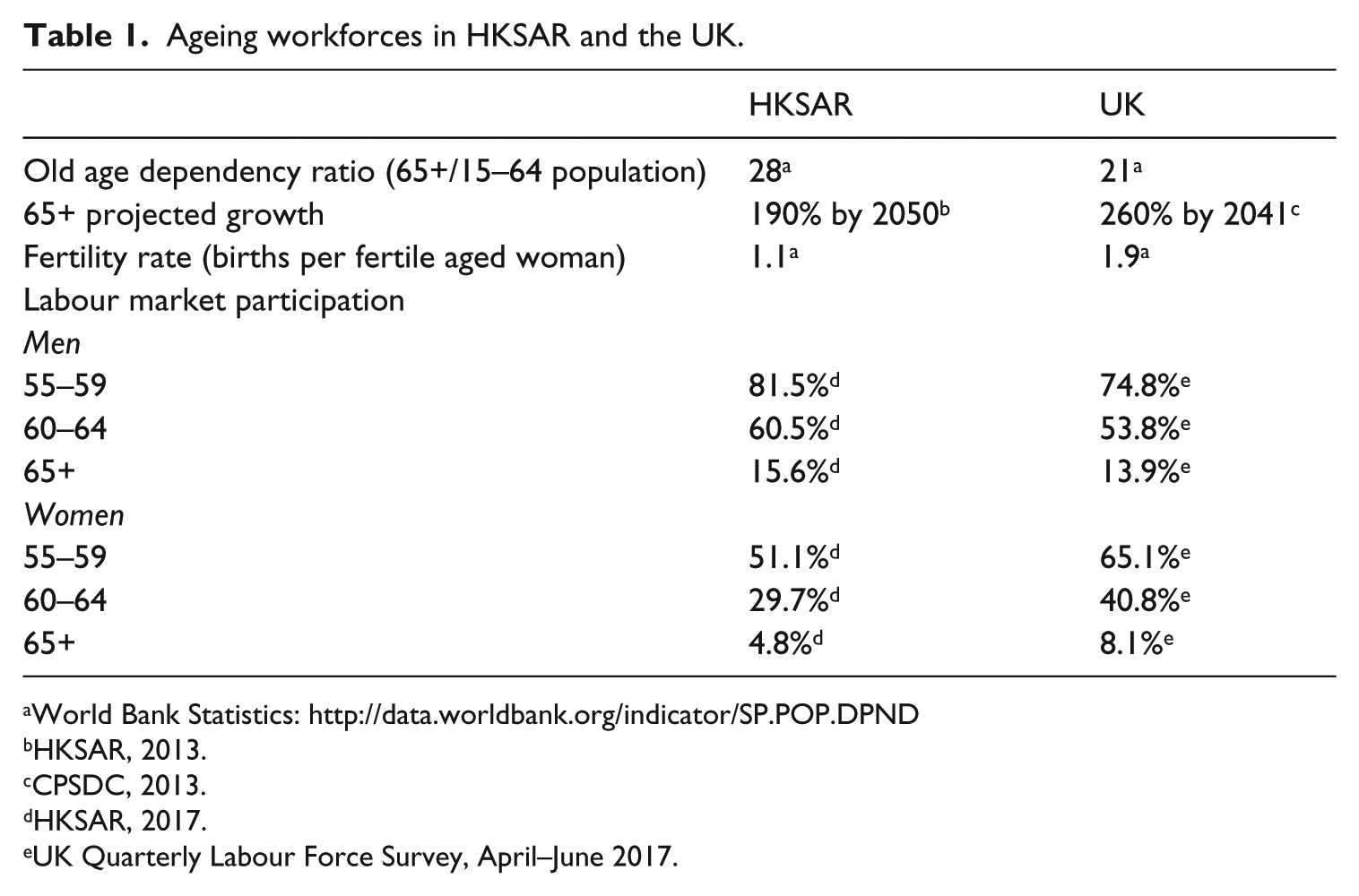
World Bank Statistics: http://data.worldbank.org/indicator/SP.POP.DPND
UK Quarterly Labour Force Survey, April–June 2017.
Differences in labour force participation are partly due to divergent changes to industrial composition. In the UK, the loss of low-skilled manufacturing jobs began in the mid-1980s, was accelerated by the 1990–1991 recession (Taylor-Gooby, 2001) and replaced by part-time service jobs in female-dominated industries like social care (Perrons, 2002). Male participation rates bottomed out in 1997 and have since been rising. The shift from a manufacturing to service industry-led labour market occurred in HKSAR slightly later, accelerated by the 1997 Asian Financial Crisis as well as decolonisation and growth of the neighbouring city of Shenzhen as a manufacturing hub (Chiu and Ngan, 1999). According to our HKSAR respondents, the transition to a service industry-led economy has limited older workers’ employability: [T]he generation who are retiring just at the moment, quite a large proportion of them have fairly limited and relevant interest now but I don’t think the next generation of retiring people … want to have a backbreaking manual labour and they want to keep intellectually-active and engaged. (EU)
Furthermore, demographic change is impacting pension systems in both economies. However, while financial sustainability is the main focus of pension reform in the majority of OECD member states, in the UK, the focus has been on reducing old-age poverty (Bongaarts, 2016). The UK pension system has the third smallest net replacement rate globally of 41.8% (OECD, 2011) and HKSAR’s is even lower at 36.8%. At the same time, demographic change contributes to labour and skills shortages in both the UK (Banner, 2011) and HKSAR (Bauhinia Foundation Research Centre, 2014). In the UK, there are projected to be 13 million job vacancies over the next decade (UKCES, 2014), while in HKSAR labour force participation is projected to decline from 3.6 million to 3.43 million by 2038 (HKSAR, 2015).
Both governments have relied on volunteerism to encourage both extended working lives and increased savings towards retirement. Such a ‘business case’ approach is operationalised by good-practice age management guides issued by the respective governments (Bunt et al., 2005; Labour Department, 2006) as well as publicising exemplar organisations which have profited from adapting HRM policies to support older workers. However, volunteerism has had limited success: both governments identified a need to extend regulation (DWP, 2014; HKSAR, 2013) to compel rather than just encourage HRM reform and retirement savings.
Next, we will use our qualitative evidence to discuss how the two governments have taken both similar and divergent paths. We analyse the extent to which institutional factors have affected ageing workforces, and how the two governments have responded. In doing so, we consider three broad policy initiatives: (a) how government has used employment regulations, interface with the business community, charities and trade unions to create pathways for older workers to extend working life; (b) how government is using the levers of the welfare state to encourage greater savings towards retirement; and (c) the effect of these changes upon work and retirement in the public sector.
Employment regulations and social activation
We start by exploring how the two governments have regulated employment practices regarding age discrimination, mandatory retirement and labour market activation in relation to older workers, as well as the institutional stakeholder pressures on public policies.
The HKSAR government has thrice issued consultation papers on abolishing age discrimination. The first time occurred pre-repatriation (LegCo, 1996) after ordinances protecting employees against discrimination on the basis of gender, caring responsibilities and family status had been enacted. Petersen (1997) argues that the HKSAR government’s first approach to addressing age discrimination was triggered by efforts within the Hong Kong legislature (LegCo) to introduce stronger regulations which would not only prohibit age discrimination, but also mandatory retirement. Further, existing anti-discrimination regulations would have been consolidated and new ones introduced to address discrimination based on disability, race and age (Petersen, 1996).
The second public consultation on age was issued in 2006 when the government’s argument for tackling age discrimination shifted from emphasising social to economic factors, namely future labour supply. Neither the 1996 nor the 2006 consultation led to regulations addressing age discrimination. At both times, the HKSAR government instead responded by launching public outreach campaigns to encourage employers to adopt age-neutral HRM policies (Labour Department, 2006).
Although employers recognised labour shortages, lobbying by business organisations emphasised demands on government to permit more mainland Chinese workers to immigrate to HKSAR instead of fostering extended working life (Hong Kong General Chamber of Commerce [HKGCC], 2013). Only the pro-Beijing Hong Kong Federation of Trade Unions (HKFTU) had an official policy supporting an age discrimination ordinance. This support was framed as a preferred alternative to increasing migration and was therefore considered a labour supply rather than equalities issue (HKFTU, 2001). Likewise, our EC respondent described encouraging older workers to delay retirement as a short-term solution to skills shortages while identifying the importation of overseas staff as a more long-term solution.
In 2006, the Labour Department had issued guidelines for businesses on good practice regarding age which focused on age-neutral recruitment and promotion policies. It did not recommend that employers abolish their mandatory retirement ages, arguing that such policies could be necessary for succession planning and in the creation of career development opportunities for younger workers (Labour Department, 2006). According to the HKIHRM representative, employers generally view mandatory retirement as a justifiable contractual issue with employees, and abolishing it would make it difficult for employers to dismiss underperforming older workers.
[The HKSAR government] cannot set a rule of retirement. It is very difficult for Hong Kong nowadays to take actions that people will go on demonstration for very trivial matters. … it is like opening Pandora’s Box. (HKIHRM)
In 2014, the Hong Kong Equal Opportunities Commission (HKEOC) began the third consultation on age discrimination which covers a similar scope to the 2006 consultation: abolition of ageism in recruitment and career development against both younger and older workers, however, not considering the merits of abolishing mandatory retirement. The consultation was launched after a 2014 review of existing discrimination ordinances. Age charities as well as the employer network Community Business had called for ageism to be part of the larger review on discrimination law in order to address multiple discrimination.
One barrier to employing older workers which was mentioned by three of our respondents (HKIHRM, EC and HKCSS) concerned workplace injury insurance which, according to the informants, rises after the employee reaches the age of 60.
It is difficult for the company to get the higher premium to buy worker insurance for them. That is why they urge the government seeing whether they can do something in the policy so that insurance; the age line can be relaxed. (HKCSS)
In 2015, as part of a review of its anti-discrimination ordinances, the EOC launched a review of age discrimination (HKEOC, 2016). Importantly, the EOC excluded within its terms of reference consideration of a new age discrimination ordinance (HKEOC, 2014). The review found that the voluntary guidelines have had marginal reach, especially among small and medium-sized enterprises. It recommended that insurers set more transparent criteria for age-based premiums and modest subsidies for employers to retain older workers. Finally, it declined recommending abolishing mandatory retirement, positing either setting a standard ‘default retirement age’ (similar to the UK, see below) or extending the right to re-employment for retirees. The crux of the report was in the conclusion: Today’s public opinion is divided on many issues, but on age discrimination, a clear majority hold the same view. As much as 70% of employed persons … agreed there was a need for legislation on age discrimination. Employers and Legislative Councillors, however, have shown their hesitation. … They took the view that under current economic circumstances (viz low unemployment rate and enforcement of minimum wage), employers found great difficulty in recruitment, let alone discriminating mature people [sic]. (HKEOC, 2016: 4)
The passage is significant for two reasons: first, the perspectives of government and business are conflated and juxtaposed against public opinion, which is described as unified. Second, the reasons for not regulating are contradictory: either new regulations would impose a burden on business or would be redundant since labour shortages negate any incentive on employers to discriminate. As we will discuss below, this paradoxical opposition from business mimics that of parts of British commerce and shaped the UK government’s approach, particularly in relation to mandatory retirement.
Despite the HKSAR government’s failure to enact age discrimination regulations, it has been able to initiate relatively modest programmes to support older people’s reskilling and employability. The Hong Kong Elderly Commission, a quasi-governmental body set up by the HKSAR government to advise on ways to improve the quality of lives of elderly people, and the Labour Department established the Elderly Academy in 2008 to promote lifelong learning. The Labour Department also runs a programme known as Employment for the Middle Aged which provides training support. This programme has been extended to job seekers who are placed in part-time jobs.
According to the HKCSS respondent, universities and NGOs are also piloting initiatives to support older workers into work by matching them with employers with job vacancies: There are NGOs who have started doing research talking about how the seniors go back to their workforce. We call it age-friendly employment. … They organise recruitment opportunity date[s] for the seniors and also [help] them to have a nice match with potential employees. (HKCSS)
A final factor which our respondents mentioned as significant was the influence of supra-national institutions in shaping public policy relating to age. The Elderly Academy, according to our EC respondent, originated from HKSAR’s involvement in the World Health Organization’s ‘Age-Friendly Cities’ initiative. Further, two respondents (CB; HKIHRM) noted that the aforementioned government efforts to legislate on ageism and retirement were partly aimed at transposing the International Labour Organization’s (ILO) conventions on discrimination based on protected characteristics like gender, race, disability and family status, as well as a non-binding recommendation on age.
Our government when under the British sovereignty was to be praised for having a seat at the ILO. … When they have some bills to be passed, Hong Kong as a tiny British colony, we actually have … duties, that we have to follow every protection passed by the ILO as well as adhering to its regulations. (HKIHRM)
Turning to the UK, the UK Equality Employment (Age) Regulations (superseded by the Single Equality Act 2010) was enacted in 2006 transposing European Commission (EUC) Directive 2000/78/EC on Employment Equality. Successive UK governments had been reluctant to legislate on the issue, mostly because British businesses did not want government to legally interfere in their personnel practices. This was at least the position held by the Confederation of British Industry (CBI, 2003), although in 1995 the employer network ‘Employers’ Forum on Age’ (EFA, later ENEI) was formed to provide an alternative business voice on ageism, and to work with unions and age charities to promote anti-discrimination regulations (Muller-Camen et al., 2011).
Despite pressure from unions and other stakeholders, successive British governments have advocated a voluntarist business case approach to managing age relations – though without achieving the intended outcome (Duncan, 2003) – and while the EUC Directive had to be implemented by 2006, this was done as minimally as possible to comply with employer demands (Coupland et al., 2008). For example, under the 2006 regulations, the then-Labour government opted against abolishing mandatory retirement and instead set a ‘default retirement age’ (DRA) of 65, above which employers could lawfully dismiss employees for reasons of age. The DRA was abolished in 2010 after a governmental impact assessment concluded that abolition would have minimal business costs which would be offset by benefits such as skills retention and reduced pension costs (BIS, 2011). By 2010, employer resistance to the abolition of DRA had decreased: So the default retirement age was a safety net introduced by government in response to employers who were very nervous about how they would get rid of older people who were past their sell-by-date but its effectiveness was interesting. Rather than enabling employers to safely dismiss someone it seemed to open up more opportunities for people to stay … a lot of noise about very little. (CIPD)
While the age regulations and accompanying abolition of the DRA have helped older employed people stay in work, they have been less helpful for older job seekers in finding new employment, possibly due to persistent age discrimination (CAB, 2015): I think if you are in a job, that is fine. If you are out of a job and out of a job for any lengthy period of time it is increasingly difficult to get back into employment. … I think that is probably structural … in terms of hidden age discrimination … which would mean that employers are not going to look twice at somebody who’s aged 55 who has been out of work for more than a year. (ENEI)
Although the regulations prevent age discrimination in recruitment, proving that discrimination occurred tends to be very difficult (Cory, 2012).
A modest state welfare programme to support older incapacity benefit claimants back to work on a part-time basis was abolished in 2010 when the government privatised job seekers’ support to regional Works Programmes. Although the programme was set up to generate tailored approaches to supporting hard-to-place workers into secure jobs, none of the privately run organisations has developed initiatives designed to support older people back into work (Age UK, 2013). Furthermore, government itself has taken a step back, and while they had led programmes on work activation in the past, the Coalition government, in power at the time of the interview, had externalised the age agenda to stakeholders, as mentioned by our DWP respondent: The current government believes that we should leave it to employers and stakeholders and we can facilitate that in a way that is helpful to them but as a result, whereas we used to run the programmes that led that agenda and worked with stakeholder and employers and individuals. (DWP)
Finally, in 2010, the UK government consolidated its anti-discrimination regulations into a single Equality Act. The aim was to create a regulatory framework to address multiple forms of discrimination as well as to ensure consistency in the application of regulations which had been enacted in a period stretching from 1965 to 2006.
Welfare state and pensions
Next, we turn to the welfare states of the UK and HKSAR, both of which are considered residual with government intervention limited to providing a basic safety net for citizens. The UK basic state pension is less than 60% of the absolute low-income threshold (DWP, 2015). Although there is also a second state pension (S2P) which is redistributive, people who are members of an employer-funded occupational pension can ‘contract out’ of the S2P with both the employee and employer receiving a rebate on national insurance contributions. In 2015, government changed the state pension by introducing a single flat pension and by abolishing S2P as well as means-tested pension credits. The rebate was also abolished, adding costs on both employers and employees. According to our PCS respondent the abolition of the contracted-out rebate was a concern for union representatives as employers would lose a financial incentive to fund an occupational pension.
The UK pension age for men is currently 65, and for women, between 2010 and 2018, is rising from 60 to 65. From 2018, pension ages for both men and women rise first to 66 by 2020, then step-by-step to 69 by the mid-2040s (HM Treasury, 2014). The UK Treasury expects further rises to be linked to life expectancy (Cridland, 2016).
HKSAR’s first-tier pension is even less generous than the UK’s. The Old Age Allowance is a universal social benefit for people 70 years and over, and a means-tested Old Age Living Allowance for people 65–69 is two-thirds of the poverty line (Lam, 2012). Pension coverage for the younger element is means-tested, and covers only about 5% of the overall older population, specifically those without access to a work-based pension (Aaron, 2013).
The main pension reforms in the UK and HKSAR concern second-tier pension provision. Almost two-thirds of UK private sector workers have no access to an employer-funded occupational pension scheme (Forth et al., 2014). HKSAR faced an almost identical gap in coverage in the 1990s (World Bank, 1994). In 1995, LegCo passed the Mandatory Provident Fund (MPF) Ordinance which, since coming into effect in 2000, has mandated that 5% of a salary is contributed each from employees and employers into a defined-contribution provident fund which pays a lump sum to the employee upon retirement (see Flynn, 2016). MPF has three notable features. First, it is non-redistributive, and contributions are paid into regulated but privately managed financial products. Second, although considerable progress was made in extending second-tier pension coverage universally (97% of applicable workers are members of an MPF or workplace pension scheme), pension savings in Hong Kong are still very low. Third, since MPF was introduced, the number of employees who are members of employer-funded and -managed pension schemes has rapidly diminished from 1 million in 1992 to 383,000 in 2015 (MPFA, 2015). These figures include civil and public services in which the final salary pension schemes were closed to new members in 2000.
In the UK, the Pensions Act 2008 established the National Employment Savings Trust (NEST), a national savings scheme for people who do not have access to a workplace pension. Like MPF, NEST involves mandatory pension contributions from employer, employee and the state, and a contribution from the government in the form of an income tax rebate. Employees are automatically enrolled but can opt out. From October 2017, employees pay in 4%; employers pay in 3%; and government contributes 1% in the form of tax relief.
Trade unions had campaigned for a new second-tier pension to be at least partly based on defined-benefit. Their concern was that the establishment of NEST would trigger employers who offer occupational pensions to close their schemes, opting instead to pay into employees’ NEST accounts (as had happened in Hong Kong). Our TUC respondent noted that unions recognised that defending access to defined-benefit schemes could be problematic as it had the potential to create schisms between constituencies which already have access to workplace pensions and those which do not.
Our response to that is to always say pensions matter for everybody. … It is not a divide and rule, because the private sector pension provision has deteriorated a lot in the last decade that is not a reason for levelling down. The economic arguments for it don’t make sense because you then end up with lots of people who are just living off benefits. (TUC)
Thus, pension reforms in HKSAR in 1995 and the UK in 2008 produced similar structures for the delivery of universal second-tier pensions: non-redistributive defined-contribution pension schemes which require relatively modest employee and employer contributions. One important difference between NEST and MPF is that while the latter channels savers to privately managed financial products, the former is run by a non-governmental board of trustees which is accountable to government through the UK DWP. Union representatives argued that its ‘stakeholder’ management would mitigate risky financial decisions.
Public sector employment
Although neither government has pursued public policies favouring early retirement, public sector employers have used early-exit HR policies to manage workforce levels. The HKSAR government has also used early retirement to manage job attrition, especially with the post-decolonisation of the Civil Service and later restructuring. In 2015, the Civil Service Bureau (CSB) began consultation on whether to raise the mandatory retirement age by five years to 65 for new recruits classified as civilian grades and to 60 for discipline grades. In addition, rules were changed already in 2014 to give government departments greater flexibility in retaining older civil servants, either by extending their retirement age or rehiring retired staff on a temporary contractual basis.
According to our Hong Kong Efficiency Unit respondent, the Civil Service has had a chronic skills shortage which has been made worse by losing employees to retirement at a relatively young age. Civil servants would frequently retire on a full pension and go to work in the private sector where their public policy knowledge and skills are highly valued.
I think … it’s … trying to move things away from simply a discussion of retirement age that age diversity within the workforce can help make us to better understand and communicate with the diverse society we have, and that means we will have to think about how well we get the organization working. (EU)
The proposed change would have a different impact on civil servants recruited before and after May 2000. The former group would be members of a defined-benefit occupational pension scheme. The ages at which they can draw their full pensions do not change with the CSB reforms. For them, changes to the mandatory retirement age will offer the chance to defer their pensions at a better accrual rate. Those appointed after May 2000 contribute to the HKSAR-wide Mandatory Provident Fund (MPF) which is a non-redistributive and portable defined-contribution second-tier pension. MPF rules allow early withdrawal of benefits between age 60 and 65, but only when completely withdrawing from the labour market and accepting a reduced lump sum. The civil service unions were generally supportive of the CSB’s proposal to raise the mandatory retirement age. Their main objection has been that the higher mandatory retirement ages will only apply to future civil servants. Present civil servants can only extend working life with the support of their line managers, which unions had said gives too much discretion to management.
In the UK, early retirement routes in the four largest public sector pension schemes were largely eliminated in pension reforms in 2006–2007, resulting in public sector unions to declare the first national day of action in 60 years. Because of these reforms, public sector employers have had to find alternative approaches to managing older workers whose performance or health is declining. According to unions, public sector employers are using performance-based dismissals to dispense with older employees who in the past would be retired early.
The horror that is seen for colleagues and the thought of it for myself which I just can’t believe would be the case, that you will be pressured that you will end up going either through sickness or stress or capability when you’ve had 30 years as an excellent teacher. That is what is on the cards. I think it is just ridiculous, but it is money driven. (NUT)
In 2010, the government sought further reforms of public sector pensions. The most recent round of pension reform was carried out under the auspice of public sector austerity, although the government was explicit in its intention to level down pension rights, with the Prime Minister using the pejorative ‘Pensions Apartheid’ to describe differences in pension rights between typical public and private sector employees (Flynn et al., 2013).
The main changes were: a change in the way that pension increases would be calculated; an increase in employee contributions; a shift in the way that future pension rights would be calculated from final salary to average earnings; and linking occupational pension ages to the state pension age (SPA). The most important pension change, and one which united the 10 largest unions in a national strike, was the linking of occupational pension ages with the SPA. Hitherto, the former varied by date of appointment and occupation but was for most members of the four largest public sector pension schemes either 60 or 65.
Unions campaigned against the pension reforms and were almost entirely unsuccessful in stopping or delaying the reforms. They then focused on shaping the reforms in the subsequent negotiations with employers over changes to the individual schemes. In negotiations over the teachers’ pension scheme, unions focused on minimising the actuarial reduction which teachers who retired before their occupational retirement ages would take.
… we envisage that there will be obvious difficulties with teachers going to age 68 and sought to mitigate that by giving them a way out at something like 65, but obviously if teachers want to retire at 60 or something like that as time goes by that is going to become increasingly difficult. (NUT)
The most successful initiative was in the health service. In concluding the national strike, the health sector unions had negotiated with government the concession that it would assemble a working group made up of National Health Service (NHS) Employers (the management group for health sector trusts) and unions to investigate the impact of extended working life on the delivery of health services. According to the UNISON respondent, unions pressured government to investigate age management HRM practices in health services: After the industrial action, we approached the Health Secretary to say, ‘You want people to work to 68. OK, where is the evidence that health service professionals can work that long without negatively impacting the delivery of health services?’ … we asked for this working group so that employers and unions could sit down and look at what adjustments would need to take place in the NHS if people are going to have to work longer. (UNISON)
The NHS Working Longer Review Group issued a preliminary report which included recommendations for health service employers, unions and government, including measures to help older health care professionals to prepare for retirement; facilitate longer working lives by adapting working practices and enabling redeployment; and develop an evidence-based approach to future reviews of occupational pension ages (NHS Working Longer Review Group, 2014). The last recommendation was the most important for the unions as representatives said that this was seen as critical to tamping down future pension age rises. However, initiatives concerning improving career pathways were also important wins for the unions as they involved unions as ‘leads’ with NHS Employers to deliver reforms.
Discussion
Both the UK and HKSAR governments have tried not only to legislate against age discrimination, but also to tackle multiple discrimination through a consolidated set of regulations. Furthermore, both governments are shifting responsibility for saving towards retirement and extended working life away from the state and employer and towards the individual – a trend that was already observed in the UK in the 1980s and 1990s (Ginn and Arber, 1999) and that since gained traction globally (Holzmann, 2013). This can be seen in the emphasis on default-contribution retirement savings, rising pension ages, a voluntarist approach towards eliminating workplace ageism, and residual social activation. It is also manifested in public sector HRM policies aimed at reducing occupational pensions without corresponding improvements in employment protection for older public servants. Such findings indicate a convergence of public policy-making on ageing demographics between these two economies – a contrast to earlier comparisons, for example between the UK and Germany, which has suggested path-dependency (Muller-Camen et al., 2011). However, the scope and pace of public policy reform in the UK and HKSAR reflect the influence of national institutions, which we will discuss below.
We have identified several institutional characteristics which distinguish HKSAR from the UK: (a) the more fragmented business and industrial relation systems; (b) the espoused (but contestable) productivist goals of its welfare state in placing economic development above social welfare; and (c) the role of stakeholders, especially trade unions, in influencing public policies. In terms of welfare state goals, there is little to distinguish the UK and HKSAR. The former does provide a larger first-tier pension, but the basic state pension is set far below the living wage, and will continue to be so even after the government’s proposed reforms. While both governments are expanding second-tier pension coverage, they are doing so by expanding the consumer market for financial products at the expense of defined-benefit pension savings.
The more significant distinction is the connection between the government and other stakeholders. On the one hand, the HKSAR government faced less resistance from unions and age advocacy groups in implementing changes to social policies. Because Hong Kong unions are fragmented along both employer and political lines, they are in a weak position to implement the defensive strategies (Hyman, 2001) of British unions of protecting existing employment rights including access to occupational pensions. However, while British unions have primarily focused on ill-fated efforts to resist rises in both state and occupational pension ages, they have transitioned to dual strategies of both protecting existing pension rights and seeking to expand new employment rights (Flynn et al., 2013). Union campaigns to enhance the support provided to older workers have also been carried out in employers like British Telecom and London Underground (Flynn, 2014).
While the HKSAR government has faced little opposition from unions and other stakeholders in reforming pensions, it has also been unable to mobilise the support of stakeholders in either enacting an age discrimination ordinance or encouraging employers to adopt age-inclusive HRM policies. Here, the literature on New Social Movements (NSM) (Offe, 1985) concerning how new alliances form (and dissolve) to protect existing rights and create new ones within the context of global economic and social change might be relevant. However, Upchurch and Mathers (2011) argue that the de-politicised de-classed approach of NSM limits its explanatory value in explaining, first, how existing institutions mobilise opposition/support along existing social class lines and, second, the interface between new and existing institutions and the state in responding to both global and national economic and social change. Instead, Upchurch and Mathers (2011: 277) suggest that the role of union agency in developing ‘innovative forms of action to sustain opposition’ to neoliberal state and employer policies be discussed. The dual strategy of British unions might show such agency in responding to conflicting pressures, while Hong Kong unions did not possess the power, influence or resources to pursue this agenda.
These findings are particularly important within the context of political change in Asia. As some ‘Tiger economies’ move towards democratic political structures, not only are restrictions on trade union organisation lifting, but governments are even taking a more pluralist approach to consulting stakeholders on public policies. The South Korean government, for example, has established a tripartite commission on pension reform (Lee and Wolf, 2014), while in Taiwan, trade unions have had success in shifting government welfare policies away from reducing pension benefits and towards raising contributions through taxation (Chen et al., 2003). HKSAR’s weak institutional pressures from stakeholders like unions is therefore a divergence from the UK, but potentially also from other ‘Tiger economies’.
Our research shows that both unions’ traditional role of defending existing rights including the right to retire and promoting new employment rights like the right to delay retirement are both points of divergence between the UK and HKSAR. On the one hand, social class opposition to pension reforms has played an important role in the UK in tempering (though not eliminating) changes to the SPA and public sector pensions. On the other hand, the state’s engagement with both business and social organisations, including trade unions as well as age charities, has been central to government efforts to change employer practices. In contrast, HKSAR respondents had pointed to global institutions (ILO, World Bank and WHO) as originators of social policy changes. Further, the HKSAR government has shown limited effectiveness in realising relatively limited influence over business practices, such as engaging insurance providers in relation to workplace injury insurance.
Conclusion
Given the parallel changes to employment law, the welfare state and public sector HRM in the two economies, it is perhaps unsurprising that we see limited usefulness in distinguishing between East and West per se. Although we acknowledge that HKSAR is an outlier from the Asian developmentalist model (Lee et al., 2007), we also note that there are limited commonalities between how the UK government and European inclusive corporatist governments respond to global changes. The role of other stakeholders in engaging with government is a notable differentiation, and we note calls for more research on social movements in advanced Asian economies (Buechler, 2000). However, even this distinction may be fading as some ‘Tiger economies’ transition towards multiparty democracies, and governments respond to stakeholders in new ways (Lee, 2012).
Finally, we would note that our study has focused on two economies in the East and West in which governments have shared an arm’s length regulatory orientation. An added dimension to assessing the utility of the Asian institutional typology would be to compare government action within Eastern and Western coordinated market economies. For example, there has been a great amount of literature on how conservative and social democratic European welfare states have shifted from an early retirement towards an Active Ageing model, while at the same time, Japan has been cited as a model of how government has engaged with the business community in creating pathways to extended working life for some workers. We would argue that analysis across institutional lines would help identify commonalities across geographical lines.
Footnotes
Declaration of conflicting interests
The authors declared no potential conflicts of interest with respect to the research, authorship, and/or publication of this article.
Funding
This project was jointly funded by the Economic and Social Research Council (UK) and Research Grants Council (HKSAR).
Author biographies
 ) He has led cross-national research projects on ageing workforces in Europe, Asia and North America. He is currently leading a four-country study on social dialogue and active ageing.