




Abstract
Nordic trade unions are known to be sceptical of statutory minimum wages. The peak level organizations are generally against legislation, as they believe that their model of bargaining is preferable. In contrast, trade unions in many other parts of Europe find it necessary with statutory minimum wages to protect all workers and not just the unionized. Legislation can also be considered a way of preventing wage dumping and avoiding poverty. This article explores the attitudes among Nordic trade unions below the central/confederate level. The empirical basis is a survey of a large number of organizations in the five countries. The data show a great deal of scepticism towards statutory minimum wages, but some responding organizations recognize certain benefits. It is concluded that Swedish unions are most sceptical of the possible advantages of legislation, whereas in regard to attributed disadvantages Norwegian but also Danish unions are most inclined to agree. Type of industry and size of the organization are other factors with some impact on attitudes towards statutory minimum wages.
The issue of statutory minimum wages has been debated in Europe for many years now. Nordic trade unions have distinguished themselves by their scepticism and resistance towards this kind of state regulation (Eldring and Alsos, 2012: 84–87, 2015; Eurofound, 2016; Fernández-Marcías and Vacas-Soriano, 2016: 99; Furåker and Bengtsson, 2013; Furåker and Lovén Seldén, 2013; Schulten, 2008: 434; Schulten et al., 2015: 345–350; Vande Keybus, 2012). Most EU member states have legislated minimum wage levels; after Germany introduced legislation in the beginning of 2015, there have been only six exceptions: Austria, Denmark, Cyprus, Finland, Italy and Sweden (Eurofound, 2016). Two of the five Nordic countries – Iceland and Norway – are not members of the EU and they have not introduced minimum wage legislation either. However, Finland, Iceland and Norway admit extension of collective agreements by law, although this option is employed to a lesser degree in Norway (Eldring and Alsos, 2015: 71–78). Denmark and Sweden have no statutory minimum wages and no legislation regarding extension. The absence of legislation in the Nordic countries does not imply that minimum wages do not exist; it is just that they are the result of negotiations between trade unions and employers’ associations.
For the time being we find no indication that the Nordic countries would be about to introduce statutory minimum wages. One reason for this is that the central trade unions largely have a very negative attitude in this regard. In the current article I explore whether the organizations just below the confederate level are similarly negative. Most of the Nordic trade unions belong to national confederations, but the focus here is on the unions next to them in the organizational hierarchies. The objects of study are typically top organizations within a given sector. To get a fuller and more nuanced picture of the state of opinion in the union movement it is asked whether these organizations agree or disagree with various arguments for and against statutory minimum wages. Moreover, I examine whether or to what extent there are intra-Nordic national differences. I also ask if the attitudes among trade unions are linked to type of sector and to size of the organizations.
The empirical basis for the analysis is a survey with trade unions in the five Nordic countries: Denmark, Finland, Iceland, Norway and Sweden. In addition to the survey data, I also make use of interviews with trade union officials, both in confederate organizations and in organizations at sectoral level. Some were carried out within the framework of the current study and others were made in connection with a previous and directly related research project. They were all conducted with key trade union officials.
Why are Nordic trade unions sceptical of statutory minimum wages?
Nordic trade unions usually take a negative stand on statutory minimum wages – in sharp contrast to many other unions in different parts of Europe (see e.g. Eldring and Alsos, 2012: 84–87, 2015; Furåker and Bengtsson, 2013: 172–173; Furåker and Lovén Seldén, 2013; Schulten, 2008: 434; Schulten et al., 2015: 345–350; Vande Keybus, 2012). Because of this the issue has been repeatedly debated within the European Trade Union Confederation (ETUC), which has had difficulties in finding a distinct policy on the matter. As a result a compromise has been formulated (ETUC, 2013):
Wage setting is to remain a national matter and be dealt with according to national practices and industrial relations systems. Negotiations between social partners at the relevant level are the best tool to secure good wages and working conditions. The statutory minimum wage in those countries where trade unions consider it necessary should be increased substantially; in any event all wage floors should respect Council of Europe standards on fair wages.
A main idea in the above quotation is that wage setting should be dealt with in accordance with national practices and industrial relations systems. Collective bargaining is held to be the most fruitful method of obtaining adequate wages and working conditions, but trade unions are not always sufficiently powerful to achieve their goals in that way. Therefore, when they consider it necessary, statutory minimum wages should be implemented. This is obviously a widespread view among European unions, but the ETUC recognizes that different solutions must be applied in different contexts.
From previous research and various documents we can outline the main arguments behind the Nordic trade unions’ negative views on statutory minimum wages. The underlying arguments are related to the fact that the unions have a viable alternative, that is, a system of collective bargaining in which the social partners have a significant degree of autonomy. This is a model believed to have served not only the trade unions and the workers very well but also the economies as a whole. Legislation is regarded as a restriction on the partners’ freedom to conclude independent agreements (Eldring and Alsos, 2015: 85). In a series of interviews a few years ago with centrally located representatives in the Swedish trade union confederations it was fervently emphasized that the autonomy of collective bargaining is a matter of principle (Furåker and Lovén Seldén, 2013: 514–515). Behind the Nordic scepticism there is also the fear that further European campaigns and initiatives on statutory minimum wages might lead to further European regulations with negative consequences (Eldring and Alsos, 2015: 84). The unions do not want anyone to touch the autonomy of their functioning bargaining model.
We must ask whether wage setting through collective bargaining leads to better results for workers. It has been observed that wages in selected key industries in the Nordic countries are substantially above the agreed minimum levels (Eldring and Alsos, 2015: 74–78, 85). This is the case even in industries with low coverage of collective bargaining, due to a contagion effect of collective agreements. State regulation might then be a slap in the air. On the other hand, it may have some normative impact in the opposite direction. Even proponents of statutory minimum wages admit that state regulation can be a dampening factor in wage setting. A Belgian trade union official claimed in an interview that it might be difficult to achieve higher pay than the norm set by legislation (Furåker and Lovén Seldén, 2013: 515). One step further was taken by a Spanish interviewee stating that statutory minimum wages could push all other wages downward. Both of these trade unionists were strongly in favour of legislation.
It might consequently become acceptable to use the legislated minimum as the reference point rather than the standard set through collective bargaining. In a reasoning on imaginable futures, it is suggested that ‘with high labour immigration – and thus a good supply of workers who accept low pay – two labour markets may develop: one covered by collective agreements and another relating exclusively to the statutory minimum’, which may lead employers to ‘attempt to break free of the collective agreements’ (Eldring and Alsos, 2015: 85). In a debate mentioned in the Nordic Labour Journal (2015), Knut Bodding, head of the Norwegian Confederation of Trade Unions (LO), argued that two different minimum pay levels could imply a significant wage cut:
If you introduce a statutory minimum wage it will lie considerably below the collective agreement. You end up with two minimum wages; the one in the collective agreement and the statutory one. In the service industry this could mean a 20 percent wage cut overnight.
Yet another aspect is that the rationale for joining a union could be undermined by statutory minimum wages (Eldring and Alsos, 2015: 85–86; Furåker and Lovén Seldén, 2013: 515). It might become more difficult for trade unions to recruit members, simply because the crucial decisions on wages are made somewhere else. This reasoning could be applied to employer organizations as well. Inversely, there is also the counterargument that legislation may increase the legitimacy of unions, because it could be a way of making them matter at societal level (Furåker and Lovén Seldén, 2013: 515; Vande Keybus, 2012). If any such effect appears, however, it is questionable whether it would be more than temporary.
The Nordic trade union movement is obviously not in favour of statutory minimum wages and it expresses a number of reasons for its negative position. To turn things around, we may ask what are the principal claims supporting legislation and what do we know about the Nordic trade unions’ reactions to them? The subsequent section deals with these issues.
Arguments in support of statutory minimum wages
For the Nordic trade unions, a state-regulated minimum wage at best seems to be ‘a necessary evil’ (Eldring and Alsos, 2015). In their eyes it may be appropriate in some countries where unions are very weak (if present at all) and are therefore not able to achieve sufficiently good wages for workers. In other parts of Europe many unions do not at all look at legislation as an evil but as an indispensable arrangement. A principal argument is that state regulation is required to provide protection for all workers (Furåker and Lovén Seldén, 2013; Schulten, 2008; Schulten and Watt, 2007). Legislation might secure that all workers – and not only the organized – are covered. In an interview that I conducted with a Spanish trade union official in 2012 this was stated very clearly:
The strongest argument for minimum wages is that it is necessary to protect all workers by one instrument … But it is not necessary to have it by law; it could just as well be by collective bargaining. This is a difference of culture, because in some other countries it is a tradition to protect only affiliates – perhaps 10, 20, 30% – and not workers who are not members. We come from a tradition in which the unions fight for all. In Spain we have 19–20% union density and 80% are non-members.
Notably, the interviewee did not maintain that legislation would be necessary; minimum wages could just as well be set through collective bargaining. Still, if only very few of the workers are unionized a majority would be left out (of course, unless there is extension of collective agreements by law). In another interview, German trade union representatives in the same vein said that they would prefer wages to be set through collective bargaining, but if this option was not successful or was not available there would have to be something else, that is, legislation (Furåker and Lovén Seldén, 2013: 514). With the high membership rates in many of the Nordic trade unions this is often not an issue at all.
A second argument is – to quote another Spanish union official – that with statutory minimum wages ‘you have a limit on wage dumping’ (Furåker and Lovén Seldén, 2013: 514). In our interviews in the two research projects this argument was mentioned quite frequently (see also Vande Keybus, 2012). If there are collectively agreed minimum pay levels it is of course difficult for employers to go below them, but without such arrangements legislation appears to fill an important function. The introduction of statutory limits to wage dumping can also be helpful in struggles against decreasing inequalities in society (Schulten, 2008; Schulten and Watt, 2007; Vande Keybus, 2012). From a Nordic perspective, wage dumping has very much to do with the rules in the Posting of Workers Directive, that is, with the relationship between posted workers’ pay and the standards in the host country.
If wage dumping goes far enough in a country there will be poverty or, more precisely, in-work poverty. One reason for minimum wage regulations by the state is hence to fight such a development by ensuring that people get a ‘living wage’ (Schulten, 2008; Schulten et al., 2015: 339–341). This requires that the bottom level is set sufficiently high, but the statutory minimum wages in many European countries are so low that they do not prevent income poverty (Schulten, 2014: 13). It should be noted that the percentage of working poor is generally lower in the Nordic countries than elsewhere in Europe (Eldring and Alsos, 2015: 34–36). Therefore it may not be so easy to convince Nordic trade unions that legislation is necessary to avoid in-work poverty. Moreover, the ETUC (2015: 35) has stated that the fight against in-work poverty requires more than statutory minimum wages; it is also important to strengthen collective bargaining systems:
Minimum wages alone cannot offer an adequate response to labour-cost competition and in-work poverty. Strengthening collective bargaining systems and their coverage is essential to prevent a downward slide in wages.
It has also been argued that it is necessary to introduce a common European policy regarding minimum wages (Eldring and Alsos, 2015: 13–21; Fernández-Marcías and Vacas-Soriano, 2016; Schulten, 2008, 2014; Schulten and Müller, 2014; Vande Keybus, 2012; Vaughan-Whitehead, 2010). Although some general norm might be established in this respect, there must be much more coordination of wage setting in Europe before such a standard could have a real impact. Previous research indicates that central trade unions in Denmark, Norway and Sweden have little interest in that kind of arrangement (Furåker and Bengtsson, 2013: 172–173). In the survey used here we have asked whether the ETUC should work for European common norms on minimum wages (see further below).
Analytical considerations and specification of research questions
In this article I explore the attitudes to various aspects of statutory minimum wages among trade unions below the central or confederate level in the Nordic countries. Do these organizations fit in with the general pattern of resistance to state regulation that we find among the confederations? It seems likely that the answer is yes to that question, but it might be expected that some variation in attitudes will be revealed.
Another question is whether there are differences across the Nordic countries as to the pros and cons of statutory minimum wages. In the literature it is common to distinguish a Nordic model of labour markets and industrial relations (Dølvik, 2013; Ferner and Hyman, 1998; Larsson et al., 2012; Traxler et al., 2001; Visser et al., 2009). Denmark, Finland, Iceland, Norway and Sweden undoubtedly show some significant similarities, making them special compared with other countries, but – as we will come back to below – there are also differences among them. The Nordic countries have well-developed collective bargaining systems with strong social partners. One indicator of this is union density, which is high in international comparison. Iceland has the highest level with over 80% organized (ICTWSS). The corresponding figures in Denmark, Finland and Sweden are somewhat lower or a bit below 70%. In Norway union density is around 52%, still much above what we find in most other countries.
Another indicator of the strength of the Nordic bargaining system is the proportion of employees covered by collective bargaining agreements. Adjusted for certain sectors and occupations excluded from the right to bargain we again encounter quite high figures: 93% in Finland, 89% in Iceland and Sweden, 84% in Denmark and 67% in Norway according to the latest available information (ICTWSS). Once more the Norwegian figure is lower, but it is much higher than for union density in the country. All five Nordic countries are above the OECD average in terms of collective bargaining coverage (OECD, 2014: 103).
The Nordic resistance to statutory minimum wages is evidently related to the strength of the trade unions and their effective cooperation with employers in bargaining. We should not forget however that there are certain institutional differences across the Nordic countries, among other things in regard to extending collective agreements by law. As mentioned above, this possibility exists in Finland, Iceland and Norway, but is more limited in Norway. Denmark and Sweden have no erga omnes rule, which means that wage setting is merely a matter for the social partners in the labour market; there is no role for the law.
In spite of the opposition among confederate Nordic trade unions to statutory minimum wages, not everyone supports the prevailing view. There are also those that make other assessments. The FTF (Confederation of Professionals) became the first union in Denmark to speak in favour of statutory minimum wages and its chairman Bente Sorgenfrey continued to argue for this as President for the Council of Nordic Trade Unions (NFS) (Nordic Labour Journal, 2015). Some time ago the transport workers’ union in Sweden brought up the issue of extending collective agreements by law (Nordic Labour Journal, 2015). In an interview in 2015, conducted within the current research project, the chairman pointed out that this initiative was ‘not popular in the LO’, but the simple justification was ‘that we are in the industry that has been most exposed to social dumping’ and something had to be done. Nevertheless I expect the Danish and Swedish trade unions to be most negative to the issue of state regulation. An interview study carried out in 2005 and 2006 provides further support for this hypothesis (Busemeyer et al., 2008: 444). As we have seen, certain changes have taken place since then, but its general conclusions are likely to hold even now.
The analysis will also take two other factors into account: type of sector and size of organization. To some extent these factors can be regarded as control variables, but they are of interest on their own as well. Concerning possible sectoral differences the data at hand do not allow any detailed analysis. I therefore make a distinction between unions in sectors that are more strongly subjected to competition, involving also international exposure, and unions accustomed to a lower degree of competition. In our study the first category contains metal, construction, transport and banking/finance (mainly private sector industries) and the second includes health care (often organized within the public sector or at least paid for by public authorities). As the Nordic bargaining model has been developed in a context where market mechanisms prevail, trade unions in competitive industries can be supposed to find it more important to safeguard the model. Accordingly, these unions should be more inclined to reject statutory minimum wages.
Nevertheless a few reservations are in order here. With some exceptions, the private sector industries selected in our study have relatively high pay levels. There are other sectors – such as hotels and restaurants – in which trade unions have had greater difficulties in keeping up wages. Low pay levels may make trade unions more inclined to see statutory minimum wages as a way of obtaining acceptable standards. In other words, we should not only focus on competition per se but also pay attention to the outcome of bargaining. In regard to the health care sector wages differ substantially across occupations; many workers have low wages and may thus see advantages with legislated minimums. It is not possible with our data to make comparisons of pay levels, but altogether it seems likely that the trade unions in metal, construction, transport and banking/finance will be more negative towards statutory minimum wages than those in the health care sector.
Yet another factor that can be expected to have some impact is the size of the organization. It should be obvious that larger unions are better positioned to achieve success in collective bargaining. They have greater resources in terms of both finances and staff and therefore have better possibilities of monitoring employers’ compliance with collective agreements. Smaller unions may accordingly have more to gain from legislation, although monitoring can be a problem. In addition, the larger unions are likely to have more influence at the confederate level; they have more delegates to assemblies and are on the whole closer to the centre of power. For these reasons I expect them to be relatively more negative to statutory minimum wages.
Survey data and key variables
Within the framework of the current research project, a web-based survey (in some cases supplemented by paper copies of the questionnaires) was sent out in 2015 and 2016 to basically all European trade unions just below the central level in five selected industries: metal, construction, transport, banking and finance and health care. The following analysis is focused on the responses of the Nordic trade unions. The questionnaire was sent to a total of 117 unions in Denmark, Finland, Iceland, Norway and Sweden. The number of organizations approached differs across the five countries – from nine in Iceland to 24 in Sweden. In total, 73 completed questionnaires were obtained, implying a response rate of a little more than 62%. Respondents were most often people in high positions in the organizations such as general secretaries, presidents, deputy presidents and national/international secretaries. In other words, they were well suited to state the organizations’ positions. Nevertheless, in some cases the organization may not have taken a clear stand, which is at least partly reflected in the ‘don’t-know’ answers. The highest response rate was achieved in Sweden with almost 88%. In Denmark we received 42%, in Finland 62%, in Iceland 69% and in Norway 61%. The low Danish response rate is related to the fact that the sample includes many small trade unions in the health care sector among which it was difficult to get answers.
The survey contains seven questions with relevance for the minimum wage issue or – to be more specific – statements on which respondents were asked to express their organization’s view. The overriding question was: ‘To what degree does your organization agree with the following statements on nationally legislated minimum wages?’ Six of the items include statements that might be regarded as arguments for or against national legislation. They gauge whether statutory minimum wages (a) ‘are necessary to prevent wage dumping’; (b) ‘undermine the role of trade unions’; (c) ‘are the best way for unorganized workers to get decent wages’; (d) ‘are necessary to prevent poverty’; (e) ‘make it more difficult for unions to recruit members’; and (f) ‘may lead to lower collectively agreed wages’. The seventh statement was aimed at exploring attitudes to a possible role for the ETUC and has the following wording: ‘ETUC should work for common European norms on minimum wages’. Each of the seven items could be answered with ‘To a high degree’, ‘To some degree’, ‘To a low degree’ or ‘Not at all’.
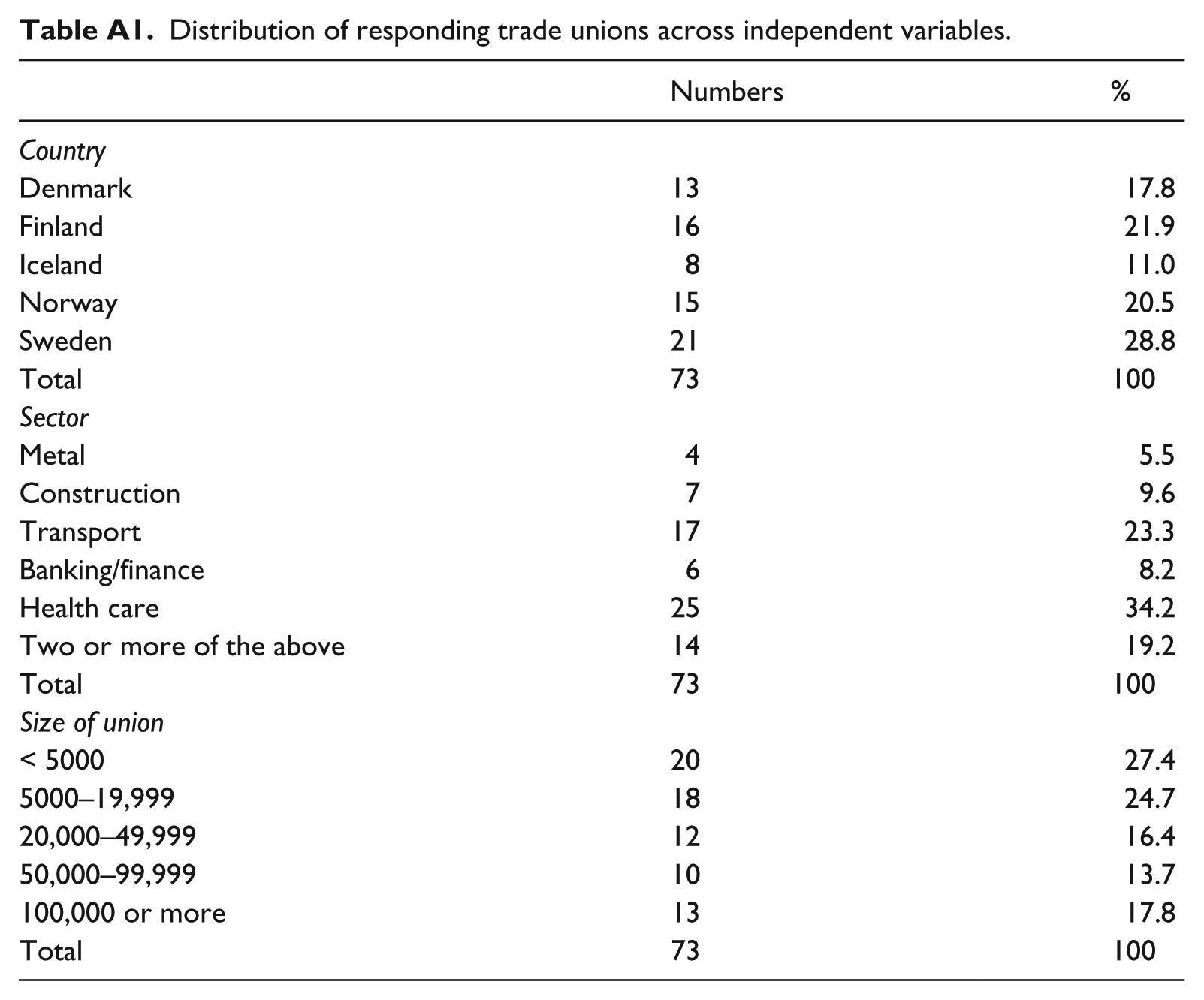
Besides the mere description of the answers on the attitudinal items, I also examine whether or to what extent they are associated with country, sector and size of organization. Although there are limits to what can be done in this regard due to the small number of respondents in certain categories, I tentatively analyse the impact of these three independent variables in ordinary least square (OLS) regressions. The distribution of the responding trade unions across the three variables is shown in the Table A1 in the Appendix.
As pointed out above, the dataset encompasses certain country differences: Sweden has the highest number of respondents and Iceland has the lowest. The remaining three countries are represented by 13–16 organizations. A problem in the categorization of sectors is that several unions have members in different sectors. Moreover, in some sectors we find only a few organizations. One reason for this is that the trade unions are large, for example in the metal industry. For the purpose of using regression analysis I have reorganized the data into two categories: health care on the one hand and metal, construction, transport and banking/finance on the other. The first category is less subject to competition as it is often organized in the public sector or is at least tax-financed, whereas the second category represents industries in which market competition more clearly predominates. Also, those trade unions that organize people in more than one sector are classified into the one or the other of the two main categories, so it is possible to identify their main membership. Finally, we have a variable on size of the trade unions. It is based on data from the survey, in which it was asked approximately how many members the organization had. Respondents were requested to give their answers in predetermined categories. More than one-quarter claimed to have fewer than 5000 members, whereas less than a fifth filled in that they had 100,000 members or more.
Results
The results from the survey are presented in different steps. To begin with, we see the outcome on the seven statements for all the responding organizations (Table 1). By collapsing the two most positive answers (agree to a high degree or to some degree) and the two most negative answers (agree to a low degree or not at all), a balance score for each of the items can be calculated. The proportion of ‘don’t-know’ answers (varying between 5 and 16%) are then excluded.
Degree of agreement among Nordic trade unions with various arguments concerning statutory minimum wages (in percentages).
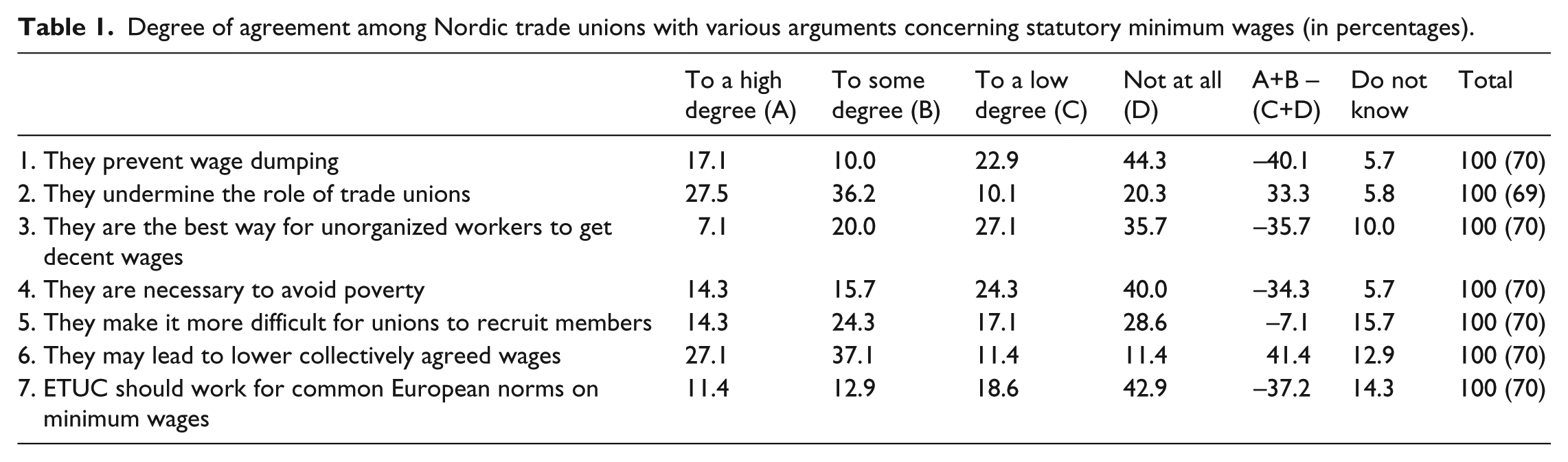
A main conclusion from Table 1 is that the Nordic trade unions under investigation generally have rather negative attitudes to statutory minimum wages. Most of them do not agree that legislation prevents wage dumping, that it would be the best way of helping unorganized workers to get decent pay or that it is necessary to avoid poverty. Instead a majority tend to believe that it would undermine the role of the trade unions and even lead to lower collectively negotiated wages. Regarding the issue of whether state regulation increases the problem of recruiting members the balance score is negative but not so far from zero. On the final item – whether the ETUC should work for common minimum wage norms in Europe – most trade unions have responded negatively.
Nevertheless, we find some variation across trade unions; some of them have deviating opinions. It seems that the items in the questionnaire represent at least two different categories and to confirm this I have run a principal component analysis. Because the last item in Table 1 is not a matter of advantages or disadvantages of statutory minimum wages, it is not included in the following. In line with expectations, the principal component analysis shows that the remaining six statements fall into the two very distinct categories. The first one refers to the three items measuring conceivable advantages with statutory minimum wages (1, 3 and 4) and the second covers the three items assessing conceivable disadvantages (2, 5 and 6). It is worth noting another difference between the two scales. The advantages in the first index are largely a matter of benefits for all employees, no matter whether they are organized or not, whereas the disadvantages in the second index primarily entail concerns about unions. This is important to keep in mind in the interpretation of the data. Cronbach’s alpha is .90 for the first scale and .74 for the second, implying that both are clearly consistent.
As there are two distinct components, I have created two scales running from 3 to 12, where 3 means no agreement at all and 12 denotes a high degree of agreement with each of the statements. In order to include as many cases as possible I have replaced ‘don’t-know’ answers by the average of the three items for each responding trade union. The two scales, the advantages index and the disadvantages index, are negatively correlated (–.4) with one another.
By means of these procedures there are 67 and 66 cases to analyse. The means for the disadvantages scale are considerably higher than those for the advantages scale: that is, trade unions were much more inclined to agree with the items in the former case. There are some national differences to observe. On the advantages index, the Swedish trade unions get the lowest mean (2.0) and it is much lower than for the rest. This does not imply, however, that the Swedish respondents agreed to a larger extent than the others with the possible disadvantages of statutory minimum wages. In that respect it is instead the Norwegian unions that get the highest score: 9.2 compared to 6.9 for the Swedish (and the Danish get 7.4).
Next I make use of OLS regressions to examine how the two scales are related to the three independent variables: country, type of sector and size of organization. The results of these analyses are presented in Table 2. As we can see, adjusted R2 – the measure of explained variance – is .30 with respect to the first dependent variable and .23 as to the second, indicating that the three independent variables have stronger explanatory power as to the first scale.
Perceived advantages and disadvantages of statutory minimum wages by country, sector and size of union. OLS regressions (unstandardized regression coefficients).
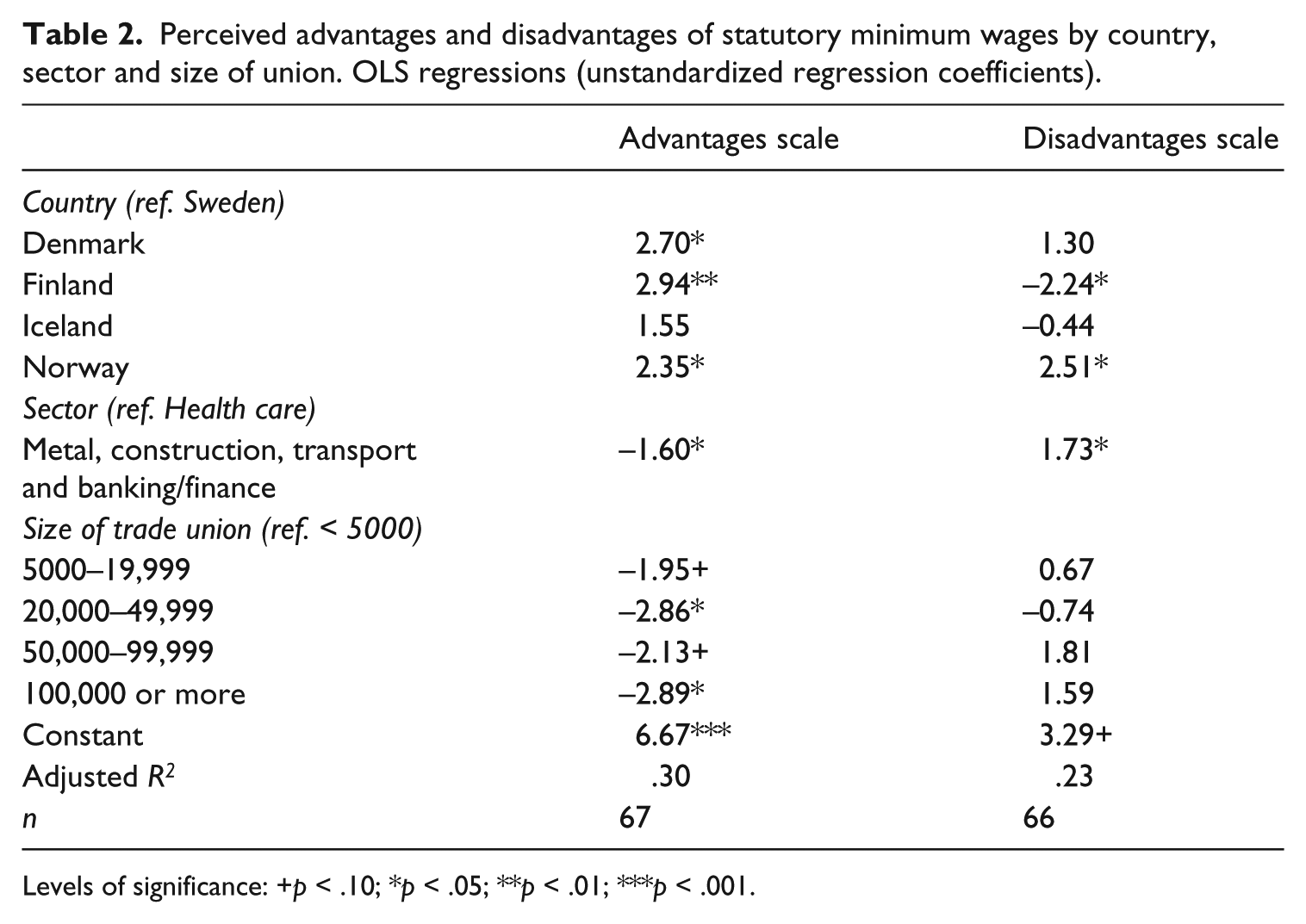
Levels of significance: +p < .10; *p < .05; **p < .01; ***p < .001.
Starting with the advantages scale, we discover significant differences between the Swedish trade unions, on the one hand, and the unions in Denmark, Finland and Norway, on the other. Sweden is used as the reference category as the Swedish organizations are expected to be particularly sceptical towards statutory minimum wages. It comes as no surprise that the Finnish and Norwegian respondents are more inclined to agree with possible advantages of state regulation, but it could be assumed that the Danish would be similar to the Swedish. The coefficient for the Icelandic unions is also higher than for the Swedish, but the difference cannot be verified statistically; this has to do with the low number of respondents in Iceland (see above).
As regards sector it appears that trade unions in the competitive metal, construction, transport and banking/finance sectors are less likely to see advantages with statutory minimum wages. This is consistent with expectations that these organizations would be more negative to the alternative to their collective bargaining model. I have also run other models in which other distinctions between sectors have been used, but they did not allow any other conclusions.
There are quite a few trade unions in the sample with fewer than 5000 members and all the unions larger than this are less in favour of legislated minimum wages. The association is not all that straightforward, however. We discover the highest coefficient for the largest unions, but the middle category (with 20,000–49,999 members) scores almost the same. It might be added that running the regression with only one or two of the independent variables at a time does not change the general outcome presented in Table 2.
The results of the regression on the second dependent variable – the disadvantages scale – are less clear and it is not surprising that R2 is lower. There are obviously cross-national differences, but it is not the Swedish trade unions that are most prone to agree with the possible disadvantages with statutory minimum wages. Instead, it is the Norwegian organizations that show the highest coefficient. The Danish respondents also score relatively high, although their deviation from their Swedish colleagues cannot be verified. In contrast, the outcome for Finland on this scale is in line with the results on the previous dependent variable. The Finnish organizations do not agree with the alleged disadvantages to the same degree as the Swedish – and certainly not as the Norwegian.
Given the high score for Norwegian trade unions on the disadvantages scale, I have run a separate model with Norway as the reference category (not shown). We then get significantly lower coefficients for the Finnish, Icelandic and Swedish organizations, while the difference with respect to the Danish cannot be proved statistically. The results indicate that not only the Norwegian but also the Danish respondents are especially inclined to see disadvantages with statutory minimum wages; it is thus possible that they are more worried about the standing of the unions.
Concerning sector, the outcome on the disadvantages index corresponds to the picture emerging on the advantages scale. Trade unions in metal, construction, transport and banking/finance tend to perceive disadvantages to a higher degree than trade unions in health care, precisely as they tend to see advantages to a lesser degree.
Finally, the differences on size of trade unions cannot be confirmed statistically. There are relatively high regression coefficients for the two categories with the largest membership, but they do not deviate significantly from the reference category.
We shall also take a look at the outcome on the final item in the battery of questions, namely to what degree respondents think that the ETUC should work for common European norms regarding minimum wages. As we just have a single item, I have run cross-tables with each of the three independent variables used in the regressions and I merely present how the survey answers are distributed by country (Table 3). The outcomes on the other two independent variables are briefly described in the text.
Degree of agreement with the statement ‘ETUC should work for common European norms on minimum wages’ by country (in percentages).
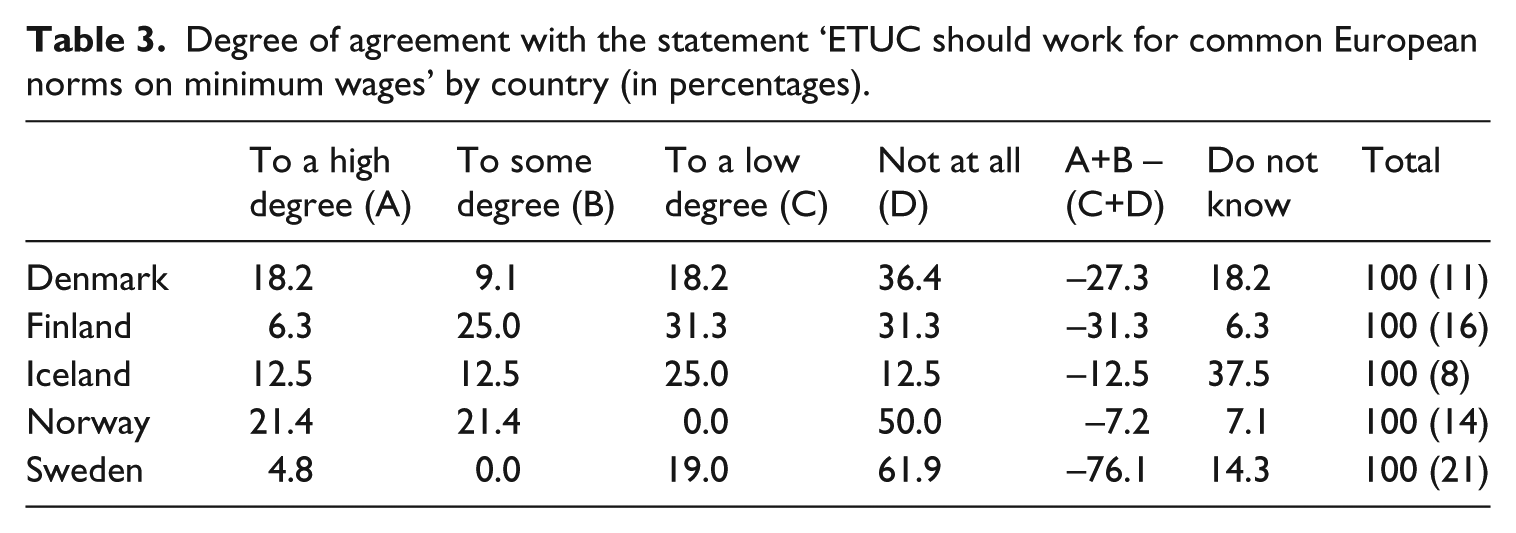
Table 3 shows negative balance scores for all five countries, but particularly for Sweden, where just one trade union has answered in the positive. The Norwegian respondents come across as closest to zero, followed by the Icelandic. We should observe that Iceland is only represented by 8 cases and that the number replying ‘don’t know’ is high (3 out of 8). The trade unions in Denmark and Finland get stronger negative outcomes, but still far from the Swedish figure.
For both sectors distinguished in this article we find strong negative balance scores. It should be mentioned, though, that more than one-quarter of the responding trade unions in health care have answered that they do not know. Finally, the smallest trade unions tend to be relatively positive towards the idea that the ETUC should work for common European norms on minimum wages. Larger organizations turn out to be negative to a much greater extent. The correlation is not entirely straightforward, but none of the largest unions (100,000 members or more) agrees to a high degree or to some degree with the statement.
Conclusion
From the above analysis several conclusions appear possible. The general picture is that Nordic trade unions below the central/confederate level are sceptical of statutory minimum wages. Clear majorities of the unions responding to our survey dispute the main arguments usually brought forward in support of such state regulation. They are doubtful of the claims that legislation is the best method for unorganized workers to obtain decent wages, that it can impede wage dumping and that it is necessary to prevent poverty. Instead, they think that state regulation undermines the role of trade unions and that it may lead to lower collectively agreed wages. A somewhat different outcome emerges regarding the issue of whether legislated minimum wages would have a negative impact on their possibilities of recruiting members. Many responding organizations agree with this, but still more concur only to a low degree or not at all. Finally, an unambiguous result is that most trade unions do not back the idea that the ETUC should work for common European norms on minimum wages.
To take the analysis a bit further I have constructed two indices: the first measuring possible advantages with legislation (mainly referring to all employees) and the second gauging conceivable disadvantages with it (mainly referring to concerns for trade unions). Most respondents tend to see more disadvantages than advantages with statutory minimum wages. There are, however, certain exceptions: some have answered contrary to the overall pattern and others have indicated that they do not know where they stand.
As to the arguments in favour of statutory minimum wages we discover distinct country differences. The trade unions in Sweden tend to be less in agreement with the relevant items than the unions in Denmark, Finland and Norway. The difference between the organizations in Iceland and those in Sweden goes in the same direction but cannot be verified statistically. Moving on to the arguments that speak against statutory minimum wages, the response patterns are somewhat different. The Norwegian (but perhaps also the Danish) trade unions stand out by being particularly inclined to see the alleged shortcomings, while the Finnish organizations are least apt to do so.
My expectations of country differences are thus only partially confirmed. Swedish trade unions are most distrustful of the alleged advantages with legislated minimum wages, whereas the Danish respondents in that case do not differ much from those in Norway and Finland. In terms of possible disadvantages it is the Norwegian (and Danish) organizations that emerge as most inclined to agree. There is no immediate explanation at hand for this, but the relatively lower union density in Norway might be a factor to consider, as it implies a more vulnerable standing for trade unions. The Finnish represent the opposite pole, which is consistent with the outcome on the advantages scale.
Regarding sector, a simple dichotomy is used here, grasping the degree of competitive pressure with health care on the one hand and the remaining industries (metal, construction, transport and banking/finance) on the other. The analysis reveals that the trade unions within the health care sector are more inclined to concur with the arguments in favour of legislated minimum wages. Moreover, these trade unions are also less prone to perceive drawbacks with statutory minimum wages. In other words, this is the reverse pattern compared to the results on the advantages index, which seems reasonable. We should add that some of the health care workers are not so well paid, which is another factor to take into account.
Size of unions is an important factor concerning the thinkable advantages with statutory minimum wages. Although the relationship is not straightforward and partly just weakly verifiable, larger organizations show lower support for statutory minimum wages. Somewhat surprisingly, no statistically significant differences can be discovered in respect of the disadvantages measure. I expected to see higher levels of agreement with the negative scale among the larger organizations, but although the data point in that direction they do not allow any safe conclusion of that kind.
As mentioned previously, the ETUC has arrived at a settlement on minimum wages according to which it is recognized that different solutions are relevant due to national traditions and circumstances. The organization has even emphasized that collective agreements represent the best way to obtain good wages and appropriate working conditions, but that legislation can be necessary elsewhere (ETUC, 2013). Provided this compromise and the continuing resistance to state regulation among Nordic trade unions, we must ask – like three experts in the field (Schulten et al., 2015: 350) – why ‘the apparently robust and sustainable Nordic labour market regimes could feel threatened by a European minimum wage policy that is intended primarily for countries with low minimum wage levels or no functioning minimum wage regimes’. Schulten et al. suggest that the unions in the Nordic countries have not really embraced the importance of the low-wage issue in other parts of Europe.
Most Nordic trade unions are probably satisfied with the current ETUC compromise, as its main content is that wage setting should be adjusted to the national context. They have apparently achieved what they wanted to achieve. Furthermore, as long as the compromise is valid, trade union cooperation in Europe does not have to be negatively affected, although it means that the struggle for legislated minimum wages is not a joint effort of European unions.
The key question is, however, what will happen in the long run. It seems likely that the Nordic countries’ collective bargaining model will be put under pressure when most other European countries have statutory minimum wages. For example, the Laval verdict by the European Court of Justice some years ago implies certain drawbacks of not having legislated minimums (e.g. Skedinger, 2008: 28–29; Woolfson et al., 2010). Without such a regulation unions’ possibilities of industrial action are circumscribed. We cannot expect that the Nordic collective bargaining model will be extended to other European countries, because their trade unions are too weak and show a tendency to become even weaker (ICTWSS). The same negative development is also taking place in the Nordic countries and this does not facilitate the spread of their system with negotiations between strong social partners. Another aspect is that employers do not seem to be that interested in negotiating with trade unions if it can be avoided; they tend to believe that they do better on their own. In a European perspective the Nordic trade unions are not sitting in the driver’s seat; what they can do is essentially to fight for the preservation of a collective bargaining model that so far has served them fairly well.
Footnotes
Appendix
Distribution of responding trade unions across independent variables.
| Numbers | % | |
|---|---|---|
| Country | ||
| Denmark | 13 | 17.8 |
| Finland | 16 | 21.9 |
| Iceland | 8 | 11.0 |
| Norway | 15 | 20.5 |
| Sweden | 21 | 28.8 |
| Total | 73 | 100 |
| Sector | ||
| Metal | 4 | 5.5 |
| Construction | 7 | 9.6 |
| Transport | 17 | 23.3 |
| Banking/finance | 6 | 8.2 |
| Health care | 25 | 34.2 |
| Two or more of the above | 14 | 19.2 |
| Total | 73 | 100 |
| Size of union | ||
| < 5000 | 20 | 27.4 |
| 5000–19,999 | 18 | 24.7 |
| 20,000–49,999 | 12 | 16.4 |
| 50,000–99,999 | 10 | 13.7 |
| 100,000 or more | 13 | 17.8 |
| Total | 73 | 100 |
Acknowledgements
The author wants to thank Bengt Larsson, Mattias Bengtsson and Tomas Berglund at the Department of Sociology and Work Science, University of Gothenburg, for valuable comments on the manuscript.
Declaration of conflicting interests
The author declares no potential conflicts of interest with respect to the research, authorship, and/or publication of this article.
Funding
This article is part of a research project funded by the Swedish Foundation for Humanities and Social Sciences, Riksbankens Jubileumsfond.