




Abstract
The heat decarbonisation challenge remains substantial, competing low carbon solutions such as hydrogen and heat pumps (HPs) and the entrenched position of gas combination boilers create inertia in many markets. Hybrid appliances which can directly replace gas boilers may provide a low disruption, low-cost pathway to net zero in gas-reliant markets. Emerging compact combination (CoCo) hybrid heating appliances which combine a gas combi boiler and a small HP unit in one appliance have been modelled for the English housing stock across a range of different scenarios. CoCo hybrids offer sizeable energy demand reduction of up to 60% compared to current gas boilers, also reducing peak electrical demand by 10 GW compared to air source heat pumps. The control strategy for switching between HP and gas boiler is key in determining the scale of demand reduction. Modelling sensitivity to the HP size within CoCo hybrids showed that a 50% reduction in energy demand compared to gas boilers could be achieved with a standard 2.5 kW HP. A lack of clarity in regulation and policy incentives for hybrids exists. To drive innovation and performance improvement, product regulation for hybrids needs to be improved to support decarbonisation of heat with this promising technology.
Practical Application
Convenient, low disruption heat decarbonisation technology is crucial to the speed of deployment necessary to achieve net zero. This article defines the size of HP necessary to achieve rapid low disruption impact and distinguishes the types of compact hybrid which can deliver the highest decarbonisation impact while minimising in house disruption and the electrical grid impact.
Introduction
Domestic energy demand accounts for 29% 1 of the UK national total. Energy is used within the home primarily for space heating and gas boilers continue to dominate domestic heating in the UK making up the majority of the 22 million homes heated by fossil fuel boilers. 2 Over 1.7 million boilers are being installed annually, 3 both as replacement and in new build homes, further adding to the install base of fossil fuel burning heating systems which need to be decarbonised. Combination boilers are the most popular in the market accounting for 59% of installed gas boilers. 2
Combination boilers provide both space heating and instant hot water production within one appliance with no need for a separate hot water tank. As such they are more compact, cheaper and quicker to install than traditional ‘system’ boilers with hot water tanks. Once installed in a home, ‘like for like’ replacement, either planned or part of a ‘distress purchase’ is simple and inexpensive. Instantaneous hot water is beneficial for energy efficiency in terms of avoiding heat loss from the storage tank, but inefficiencies of ‘combi loss’ 4 and cycling due to the high outputs and limited modulation ranges 5 can negatively impact the efficiency.
Electrification of heat is a key part of decarbonising the built environment. The UK Government plans to eliminate fossil fuel gas connections from new buildings and the IEA is recommending that only hydrogen ready boilers are installed from 2025. 6 Heat pumps play a central role in Government policy, aiming to increase the deployment of heat pumps (HPs) annually to 600,000 from 30,000 in 7 years. 7 This is likely to be a more significant change to household heating than the introduction of gas central heating which took 40 years to grow from 25% of homes in 1970 to over 90% by 2010. 8 This shift to electrically driven heating will impact life within the home and the whole energy system.
Utilising gas boilers for space heating and instantaneous hot water places considerable demand on the gas network to supply energy when required for combustion and heat. The concentration in demand from channeling cyclical heat demand onto the gas network results in large variations of demand across the seasons and diurnally. Research into the scale of the heat demand, as embodied in the network gas demand, has led a number of researchers to estimate the current demand and model the impact of future electrification of heat on the electricity grid. The scale of current gas heat demand has been estimated as being of the order of 170 GW of peak demand 9 building on the work of Wilson on daily gas demand 10 and utilising demand data from 8700 dwellings. Monitoring of real gas demand shows peaks of up to 214 GW in the gas network during cold weather periods. 11 There remains uncertainty in the estimation of the gas heat peak demand with alternative models based on a UK heat demand model using a regression model of GB gas demand merged with daily empirical heating profiles. Such a model yielded 277 GW peak domestic heating demand.12, 13 The uncertainty of heat demand is critical in light of the general acceptance that significant electrification of heat will be necessary although the scale remains uncertain. 14
A radical and rapid increase in the electrification of heat poses considerable risks to the decarbonisation of electricity. Currently, two factors contribute to decarbonisation: the reduction in electricity demand plus the deployment of renewable generation, in particular offshore wind. The steady decarbonisation of electricity in the UK 15 could be reversed if the increase in demand from the installation of HPs outstrips the construction of renewable generation. The risk of electrifying heat too quickly is increased utilisation of gas power generation making it cheaper and more carbon efficient to deploy gas boilers than gas-fired electricity generation.
Besides the unknown scale of grid improvements necessary to electrify heat at a local level, other factors affect the decarbonisation pathway of domestic heat. The dominance of gas boilers in homes is one aspect of a wider uniformity to the heating sector with far reaching implications for a transition to low carbon heat. Appliance manufacture and supply, installation workforce and customer expectations have developed around the gas boiler, embedding it as the default. The workforce is especially aligned with the technology, with over 100,000 installers active in the UK for fitting and servicing boilers, compared to approximately 1000 heat pump installers. 16
Conversion of combi boiler heating systems to electric heat pump systems is a relatively costly and disruptive transition. 17 Additional insulation on the building fabric, hot water storage and low temperature heat emitters are some of the aspects which need to be considered. Crucially, the installation requires additional certification18,19 of an installer instead of, or in addition to, the current industry standard accreditation for gas boiler fitting, GasSafe membership. 20 Once installed, the heat pump may also need to be operated continuously to operate efficiently, a culture change in UK home heating.
The Committee on Climate Change has recommended that, given the rapidity of the change needed in the heating sector and the uncertainty around electricity grid impact, that hybrid heating appliances should be rapidly deployed at scale to homes on the gas grid with an aim to having up to 10 million appliances installed by 2035. 21 A hybrid heating system is one that combines a gas boiler and heat pump in one heating system. The HP can be added to the existing boiler system allowing for the boiler to provide ‘peaking’ service when a higher power output is required such as when fast warm up or higher temperatures are required in the radiators on colder days. The hybrid is typically suggested as a suitable solution to address two potential issues. Local electrical network grid capacity problems caused by simultaneous use of multiple heat pumps which could be mitigated by the use of hybrids as switching hybrid heating systems from electricity to gas at certain times would help to avoid costly network upgrades. Costly and disruptive aspects of HP installation can also be averted with hybrid systems, such as the upgrading of radiators or the installation of a hot water tank. This is seen as a ‘low regrets’ policy move due to the preservation of multiple decarbonisation options the future including, district heating, fully electric heating and hydrogen based heating pathways.
However, most hybrid systems such as those trialled in the Freedom Project 22 are essentially two heating systems in parallel with a central controller; this is more akin to a bivalent heating system than the integrated petrol/electric hybrid systems in transport vehicles. Bivalent systems with active secondary heat sources (HPs, biomass burners rather than passive solar thermal) have cost and space implications due to the redundancy built in and the lack of integration. The complexity of this type of bivalent boiler/HP system presents a challenge to occupants and heating professionals which can be exacerbated when incompatible equipment from multiple manufacturers is installed. For occupants, understanding what the system is doing at any given time can be challenging, or for heating engineers to find faults or commission multiple units. Utilising two heat sources to heat the home presents a control and optimisation challenge. Although a hybrid heating systems has two distinct heat sources, generally they both serve the same heat emitter system; therefore, the control systems must balance efficiency optimisation with predictable and desirable heat provision through appropriate heat emitter temperatures and flow rates. This can lead to complex hydraulic configurations and control algorithms. For example, the HP and boiler could operate hydraulically in parallel or series and the control algorithm can be programmed to avoid HP operation under certain outdoor temperatures or central heating flow temperatures. Keeping cost, complexity and disruption to a minimum could prove critical in kickstarting the shift to low carbon heat given the current convenience and familiarity of gas combi boilers.
By reducing the thermal output and size of the heat pump, manufacturers have developed appliances which combine a boiler and air source heat pump in one unit.23,24 The compact combination hybrid (CoCo hybrid) is a technology which could offer the consumer a relatively cost-effective appliance which can be installed by the current cohort of boiler installers as the HP is a sealed unit internal to the appliance only. By placing the HP and boiler in one unit, some benefits can be realised over a traditional hybrid. The HP can scavenge waste heat from the boiler in addition to the normal outside air, the control system can be optimised to the characteristics of the appliance components rather than being generalised and both manufacturing and installation costs can be reduced compared to traditional hybrids. The boiler part of the CoCo hybrid like the standard boilers used in standalone or traditional hybrid systems can be made to be ‘hydrogen ready’ so as not to lock in extended natural gas dependency. The compromise of the system is that the HP is typically smaller than required to heat the home solely. However, the discrepancy between the high instantaneous power demand for hot water (∼20–30 kW and space heating (∼1–15 kW) which causes inefficiencies in the current boiler fleet 25 can prove to be advantageous for the CoCo hybrid where the hot water can be heated only by the boiler and space heating by both the HP and the boiler with the higher efficiency HP taking over the heating load at the low heat demand levels (and mild outdoor temperatures) which force boiler cycling inefficiency. It is worth noting that the requirement for instantaneous water heating, as opposed to stored hot water, has driven the large boiler sizes common today. Using hot water storage would reduce this requirement and reduce the negative impacts of boiler cycling on efficiency. However, 2 million hot water stores have been removed from UK homes and 4 million additional combination boiler systems installed in the last 10 years and occupants may be reluctant to lose the space they have recently gained. Although advances are being made in the area of thermal storage to add value both to the consumer and the wider energy network, smart thermal stores can monitor energy prices to reduce running costs and phase change materials are being used to reduce the size of thermal stores. This research endeavours to understand to what extent the modest size of the HP within a CoCo hybrid could deliver carbon savings of HP heating while mitigating the necessity for widescale grid reinforcement during a transition.
Methodology
The impact of the choice of heating systems manifests itself in many ways across society, through investment capital spend, disruption to homes, household energy bills, grid demand of the electrical and gas networks and more. This research focusses on a sub-section of this complex system landscape. The parameters and relationships of interest in this research are modelled with different heating system types/sizes and control methodologies to map the boundaries of how CoCo hybrid heating can impact the home heating sector in comparison to both the incumbent technology (gas boilers) and the leading low carbon technology (heat pumps). The five indicators of performance used in this article are as follows: • Peak electricity/gas demand as a function of outdoor temperature, • load duration curves for electricity and gas under standard climatic conditions, • energy demand, • energy bills and • domestic heating CO2 emissions.
In order to derive these indicators, an hourly bin model was constructed in Microsoft Excel. The schematic representation of the model is shown in Figure 1. Flow diagram of information within the CoCo hybrid stock model.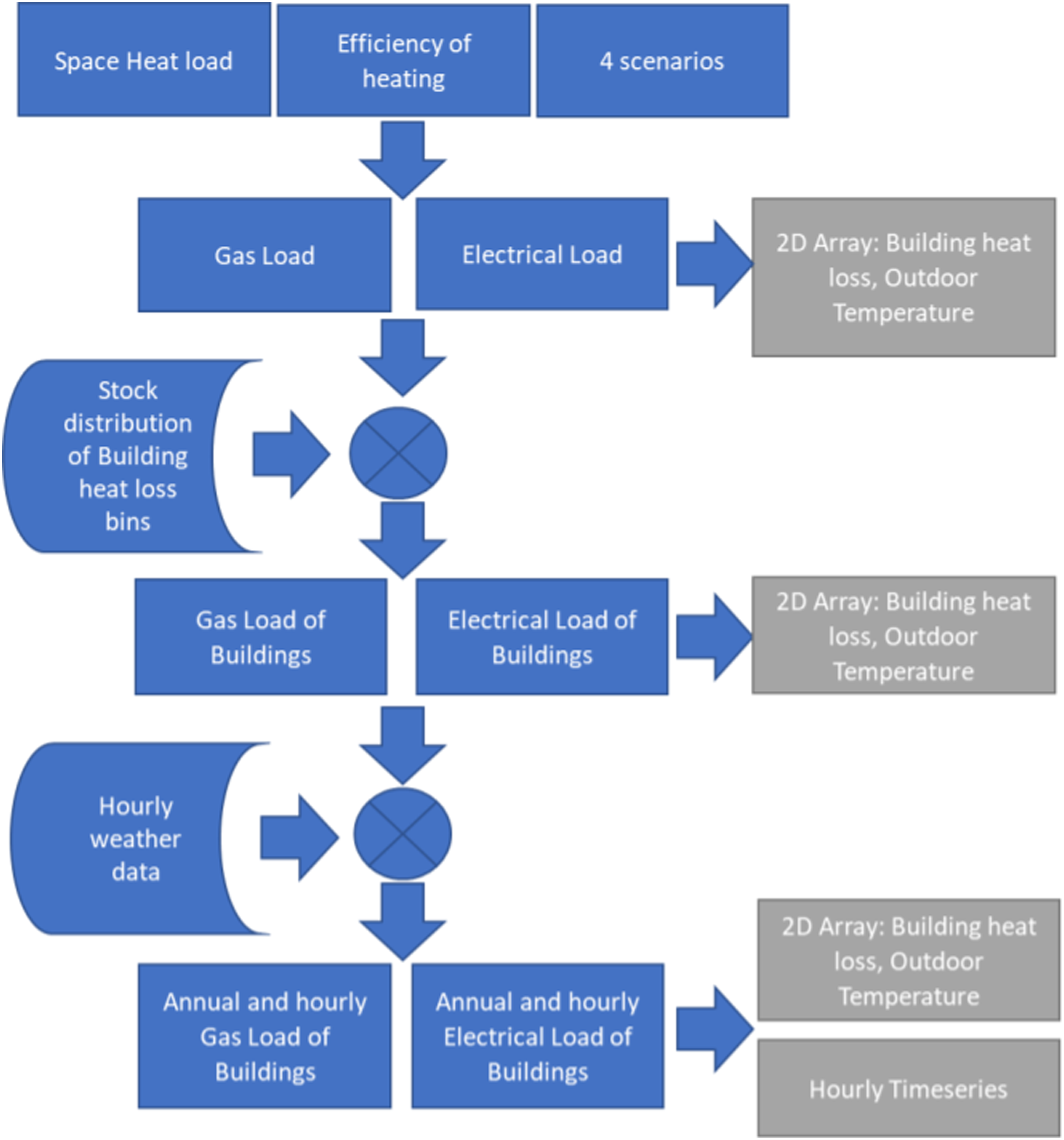
The model foundation is a 2D array of building heat loss (100 W/K resolution) and outdoor temperature bins (1°C resolution) which is used to calculate the steady-state heating demand for each heat loss intersection of building heat loss across the outdoor temperature spectrum with constant internal temperature, accounting for fixed internal (metabolic, cooking, appliances, etc.) and solar gains. Maintaining incidental gains at a fixed level is a simplification which borrows partly from the SAP 4 monthly methodology which takes such gains as being constant over each month. Solar gains were assumed constant to simplify the modelling. The focus of the model is on the comparative impact of heating systems, which have been shown to be the critical parameter in sensitivity analysis of building stock models. 26
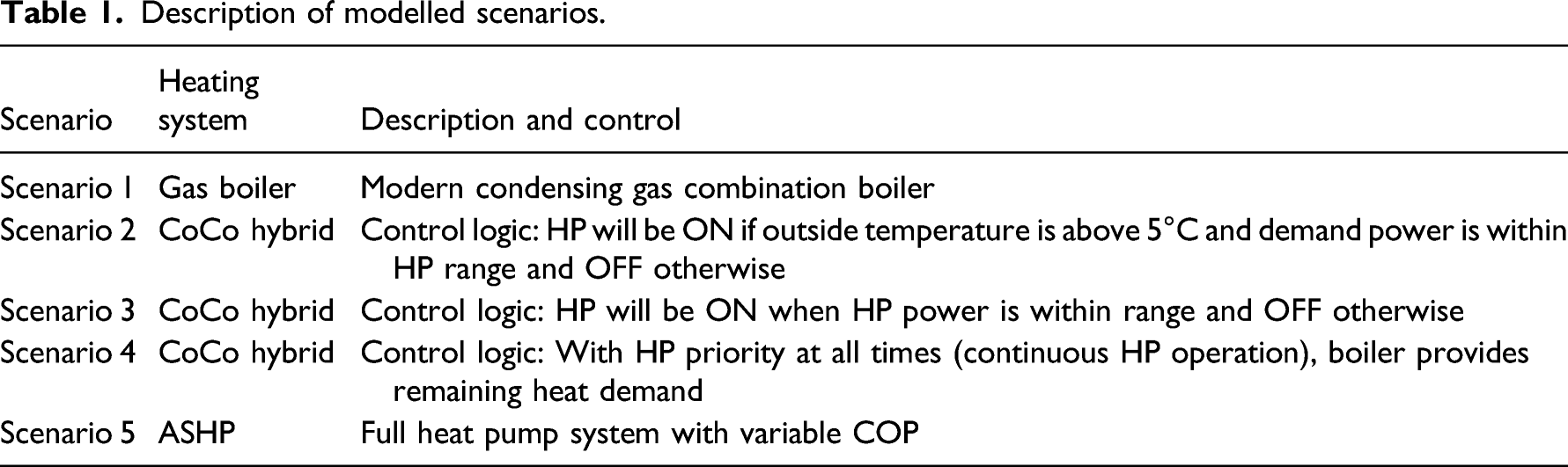
Description of modelled scenarios.
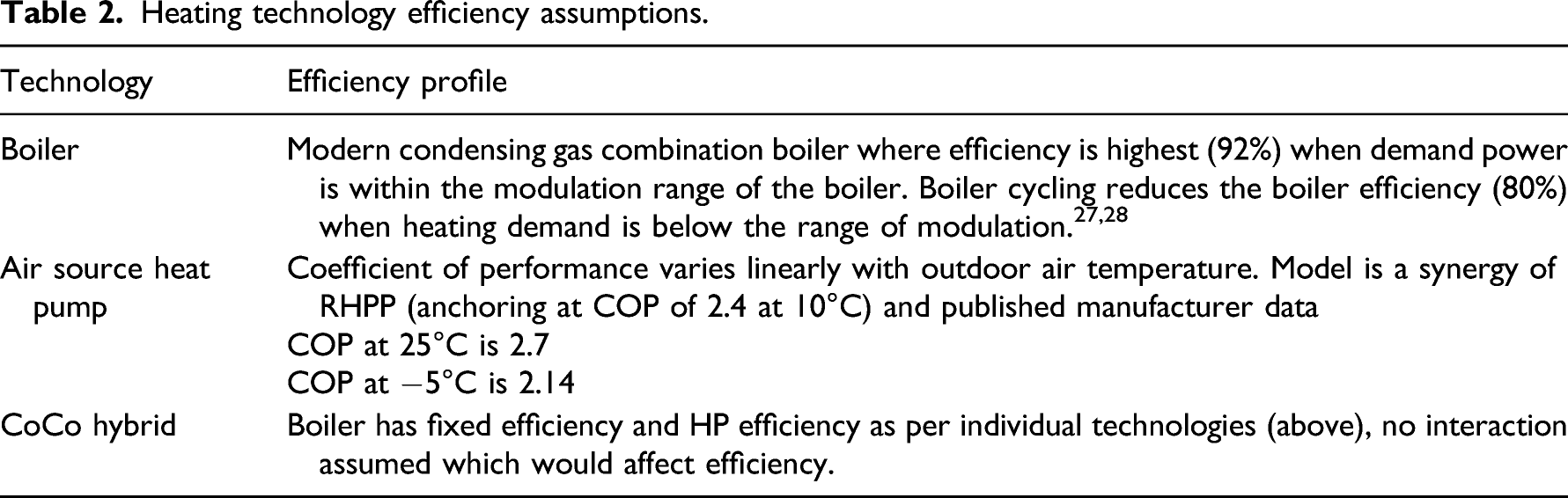
Heating technology efficiency assumptions.
The model assumes a distribution of heat loss in the English housing stock equivalent to what was measured as part of the 2011 English Housing survey and reported in the Cambridge Housing Model. 29 Scaling the gas and electrical demand according to this distribution using the appliance definitions from Table 1 gives the stock level array of energy demand (split by gas and electricity) to heat the English housing stock as a function of external temperature. Mean internal temperature was assumed to be constant at 19°C to account for the simplicity of the model not implementing a bi-modal heating profile but representing expected mean temperatures in homes. 30
Taking this distribution and combining it with a representative weather profile from ASHRAE’s International Weather for Energy Calculations (IWEC) project 31 (location: Finningley UK, based on the period 1982–1999) gives the hour by hour heat load on the gas and electricity networks for the different scenarios. Using an hourly model with continuous 24 h heating of the buildings makes two simplifications which counteract each other. Modelling with hourly weather data will overestimate the heat load on the building due to the omission of the temperature dampening effect of the building thermal mass. However, the continuous heating profile, as mentioned earlier, smooths heating up peaks of demand when the heating schedule starts, and extra power is needed to quickly raise the internal temperature; as mentioned earlier, the mean internal temperature was chosen to account for the difference between set point temperatures and cooling down periods.
Modelled results and discussion
Plotting the total heating demand against outdoor temperature (before the addition of the weather profile), Figure 2 shows the scale of peak heating demand reduction potential during colder periods and the scale of power availability requirement needed to satisfy the steady-state heat demand. Throughout this analysis, ‘power’ is defined as the input power to the heating system (as would be measured by the gas or electric metre) for the purpose of conversion to space heating rather than delivered heat. The different hybrid systems modelled (Scenarios 2–4) perform differently with up to two times the power required for Scenario 2 compared to 4, and the difference is greatest at temperatures below 4°C. This stage of the model demonstrates the potential of heat pumps in the building stock to alleviate load demand on the whole energy system as well as the electrical grid at periods of high heat demand. Total space heating energy demand as a function of outdoor temperature. Hybrid HP size 4 kW.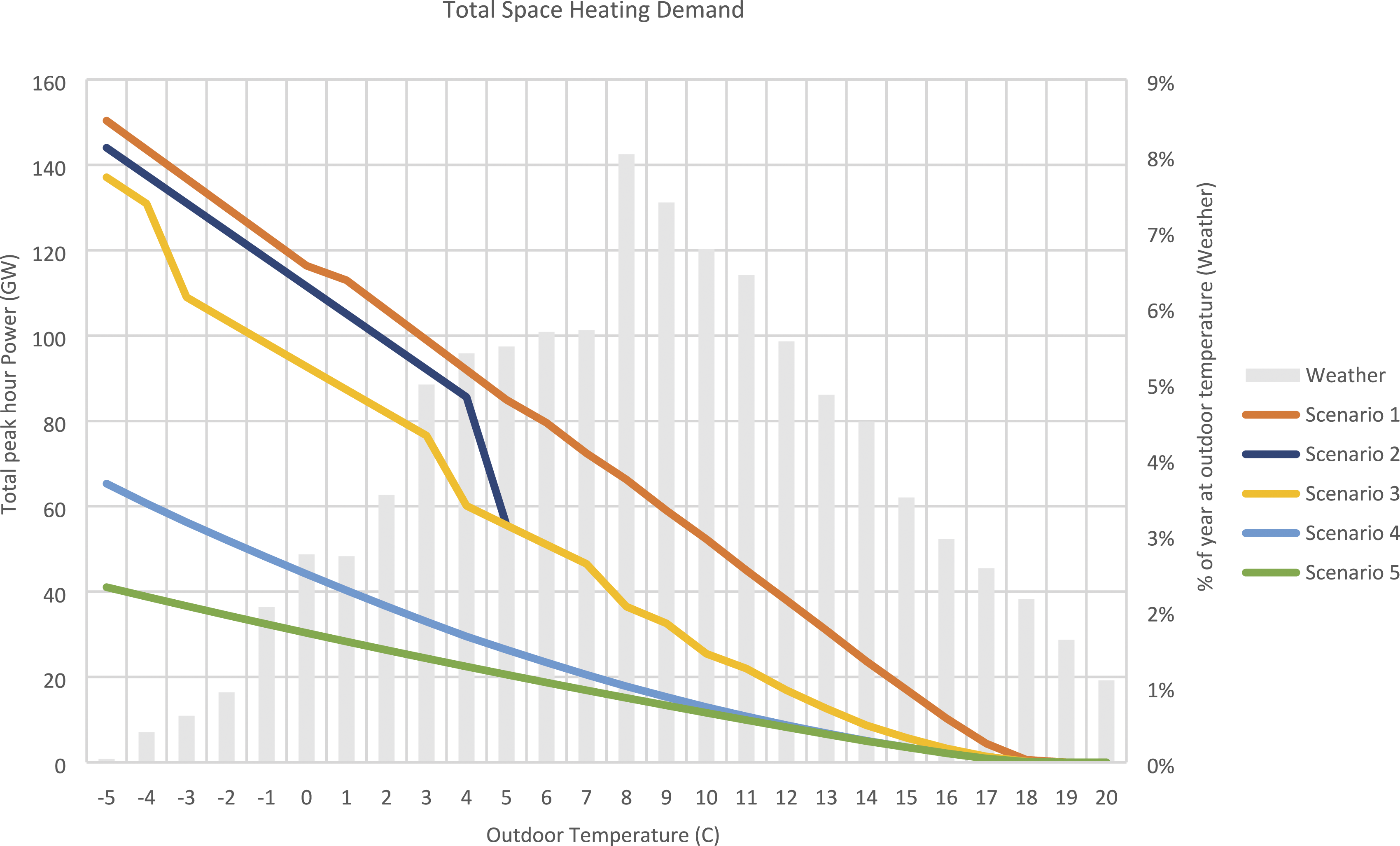
The complete conversion of heating systems to air source heat pumps, as per Scenario 5, indicates over 100 GW of peak heating power reduction (electricity and gas combined) in sub-zero weather conditions (Figure 2). However, this steady-state modelling overlooks start up and heat up loads which would be higher in all cases unless heating was continuous. However, since the gas and electricity networks operate differently with regard to provision of peak loads (linepack for gas and peaking plant for electricity), it is necessary to look deeper at the split between gas and electricity power profiles. Also, this input power demand is just for providing space heating, not for hot water demand which currently drives the sizing of combi boilers.
The space heat energy demand was modelled on a disaggregated basis across the two modelled energy vectors, gas and electricity. Scenario 1, representing the incumbent dominant boiler technology, is limited to gas only and displays the highest input energy demand across all temperatures due to the fundamentally lower, and limited, boiler system efficiency. The demand is approximately representative of the underlying building heat demand before heating efficiency since the boiler efficiency approximates 90% across the model. Scenarios 2, 3 and 4 are compact hybrids, in this baseline case with a HP size of 4 kW. The impact of varying the CoCo hybrid HP size will be explored later in the article. The difference in peak demand between Scenarios 2, 3 and 4 stems not from the physical dimensions or thermal output of the CoCo hybrid (which are constant) but solely on the control methodology implemented.
While all CoCo scenarios offer lower overall power demand across the temperature spectrum, the temperature-based control strategy of Scenario 2 which operates the HP only above 5°C shows the lowest potential to reduce peak demand at low temperatures but above 5°C where the HP can operate freely and the building heat loads are lower across the stock giving the HP part of the CoCo hybrid a greater role. At these higher ambient temperatures, demand is significantly lower.
Removing the outdoor temperature limit of the HP (set at 5°C), as in scenario 3, but still implementing a reduction to COP with outdoor air temperature, improves the performance and lowers the overall heat energy demand at lower temperatures. However, the ‘either/or’ control strategy which precludes running the HP and boiler simultaneously in Scenarios 2 and 3 limits the overall reduction in input power demand. Scenario 4 is based on a control strategy where the HP is used whenever possible and the input power demand is supplemented with the boiler to satisfy the current heat need. This greatly increases the proportion of heating provided by the HP which improves the efficiency thereby lowering the demand.
Analysing the split of gas and electricity demand underlying the scenarios (Figure 3) gives greater insight into the operation of the CoCo hybrids across the English housing stock, highlighting the sharp drop in HP contribution from the CoCo in Scenario 2. There is a similar electrical demand across all scenarios (except Scenario 1: boiler) at milder air temperatures [for reference, the long-term average UK outdoor temperature during the October to March heating season is 6.35°C (1981–2010)
32
and increasing at approximately 0.22°C per year since 1970
33
] as the control algorithms converge into 100% HP operation over a lower building stock heat demand. This is interesting in the context of the implication of aggressive building heat demand reduction through fabric measures (the so called fabric first strategy) which would shift the heat demand into this area even at lower outdoor temperatures, reducing the need for hybrid appliances. In the absence of large reductions in building heat demand, which has been shown to pose its own problems of cost and embodied carbon payback,
34
it is therefore reasonable to assume that demand reduction through heating efficiency will need to deliver significant proportion of the emissions reduction. Space heating energy demand, gas and electricity as a function of outdoor temperature. Hybrid HP size 4 kW.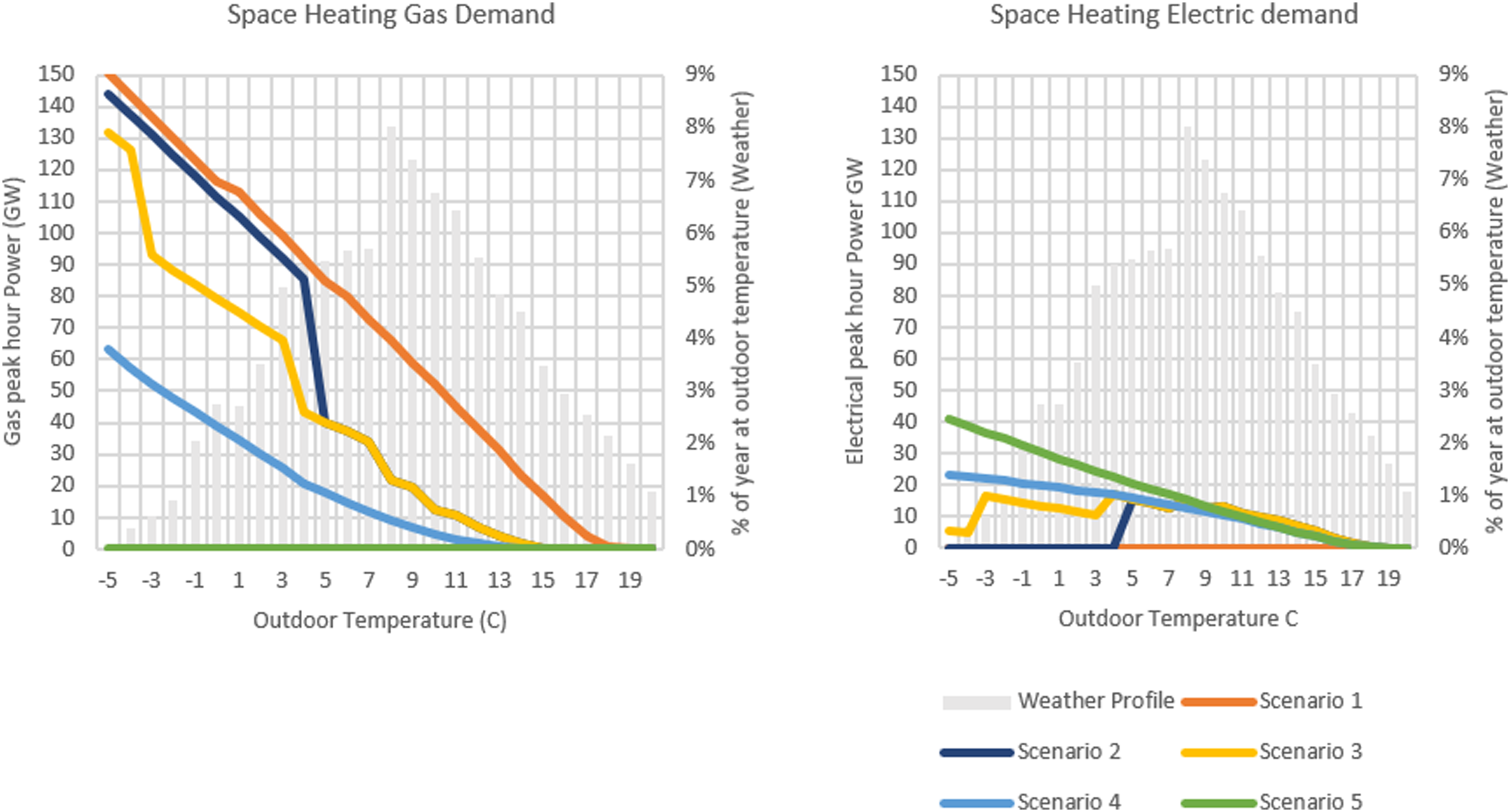
The next stage of modelling takes the temperature-dependent heating profile of the English housing stock and calculates the time series energy demand profile across a full year. To achieve this, the complete stock was modelled at a representative location for England. A central weather profile was chosen for the modelling, centred on the Finningley location 31 and using weather data from the US Department of Energy, also utilised in the commonly used EnergyPlus modelling environment. 35
For the purposes of this analysis, all homes were assumed to be heated constantly. This is a departure from the known bi-modal heating schedule commonly seen in the UK36,37 and formalised in the UK’s Standard Assessment Procedure (SAP). However, the shift to continuous heating profiles is integrated in SAP to accommodate smaller output heating systems with smaller plant size ratios (PSRs). The PSR is a measure of the ratio of the heating system thermal output to the building heat load. A smaller PSR limits the heating ramp rate of the heating system and therefore the viability of the bi-modal heating, requiring continuous heating schedules. This is a separate effect from the reduction of flow temperatures, either in a boiler or HP system, which will benefit efficiency but also reduce the thermal output of the existing emitters in retrofit cases, limiting heating up times and also the steady-state thermal output, probably requiring upgrades to the emitters. The benefit of a lower PSR and longer heating schedule is lower capital expenditure for the heating system and heat emitters and higher efficiency during operation. The higher efficiency can significantly outweigh the longer operating times resulting in both higher thermal comfort and lower running costs both for boilers 5 and heat pumps. The internal set point temperature was initially chosen to be representative of the mean internal temperature rather than a thermostat set point. This is a significant simplification in the modelling and reduces the complexity of heating schedule occupant behaviour36,38 and heating system response to a single parameter. Internal temperature levels and profiles are ongoing areas of research. It is recognised that more detailed, higher temporal resolution, dynamic building simulation models may offer more detail to explore temporal and geographic variation in internal set point, and for the purposes of this analysis, a uniform temperature was considered sufficient.
After calculating the hourly power needed to satisfy the building stock space heating demand over the complete simulated year, the load duration curve of the gas and electricity demand is plotted to (Figure 4) explore what the scale of gas and electrical supply would need to be in a typical year. Load duration curve for gas and electricity.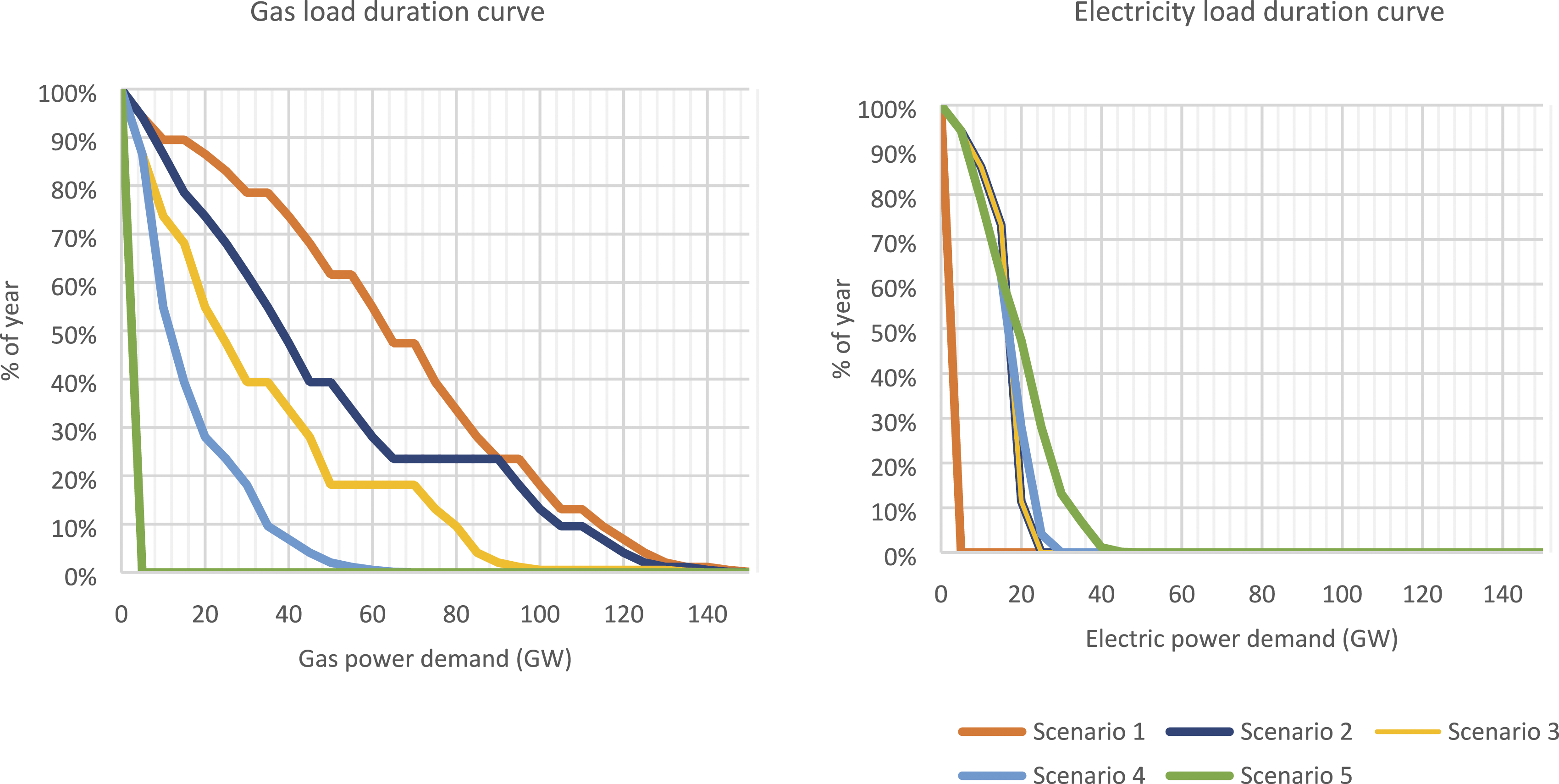
The impact on the load duration curves is most notable in the shape of the gas load over the year, where Scenarios 3 and 4 reduce both the total gas demand and also the peak demand. The simplest CoCo heating control strategy in Scenario 2 does reduce gas consumption but has little impact on the peak demand due to the shutting off of the HP at lower temperatures. The electricity load duration curve shows the significant impact that the hybrid control strategy can play on peak electrical demand, with the impact that it can therefore have on total generation capacity. Compared to the estimated peak of over 40 GW for when heating all homes with ASHP in Scenario 5, the CoCo hybrid scenarios reduce that peak to 30 GW for Scenario 4 and between 20 and 30 GW for the other hybrid scenario.
The load distribution curves presented in Figure 4 are based on the heating system’s internal control algorithms which are modelled to respond to a combination of building heat demand and outdoor temperature. However, with the introduction of internet-connected heating appliances, there is the opportunity for an individual heating system to respond to price signals or to remotely control groups of heating systems to the benefit of the wider energy system. The ability of a hybrid to provide Demand Side Response (DSR) services through switching from HP to boiler, that is, electricity to gas, at times of low availability of renewable electricity or high electricity cost, is an aspect of hybrids which could prove useful as the proportion of renewables increases through allowing grid operators or DSR aggregators limited control of the operation of a hybrid. This would change the shapes of the load duration curves in such a way to reduce the use of electricity, but the limits of the switching capacity of the building stock would be greater for the scenarios with higher proportions of HP usage.
Peak demand is an important criterion for the transition of heating from gas to electricity and heat pumps but needs to be balanced against the cost, energy demand and carbon emissions associated with the split of gas and electrical energy used in heat generation.
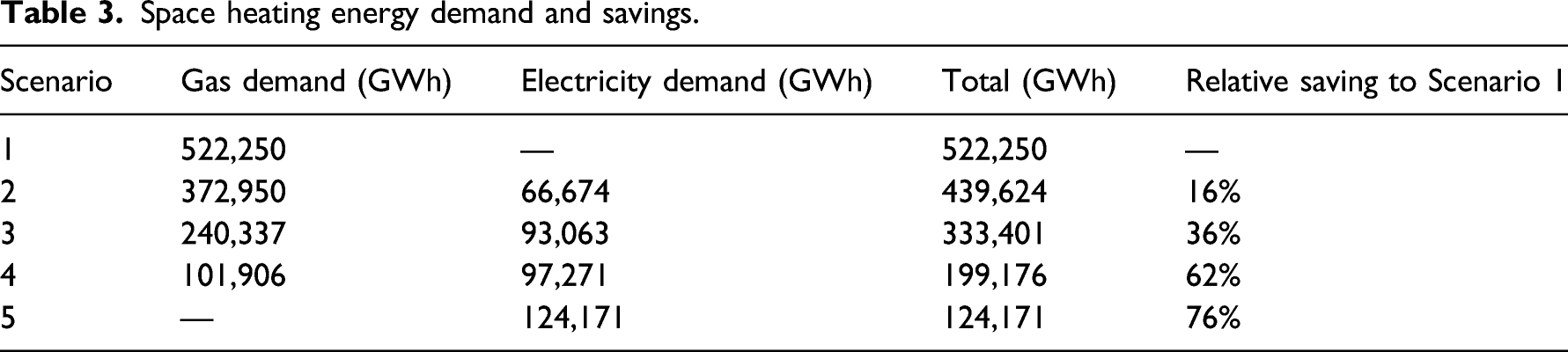
In Figure 5, the total modelled space heating demand across the 5 scenarios can be seen. The impact of the high efficiency of ASHPs increases as the proportion of heat provided by the HP increases up to the maximum in Scenario 5. It is striking that although the heating appliance capacity and thermal output is constant across Scenarios 2–4, the input energy demand is more than halved. Scenario 4 most closely follows the gas/electricity split of 50:50 which is assumed in the Standard Assessment Procedure. The variation in the distribution of heat demand to the boiler or HP within the hybrid is important to recognise as the control algorithms for heating appliances are generally not captured in the appliance testing methods which test the boiler and HP separately, combining the resulting efficiencies in a standard ratio, as happens in SAP at the level of 50:50. Stock annual input energy demand.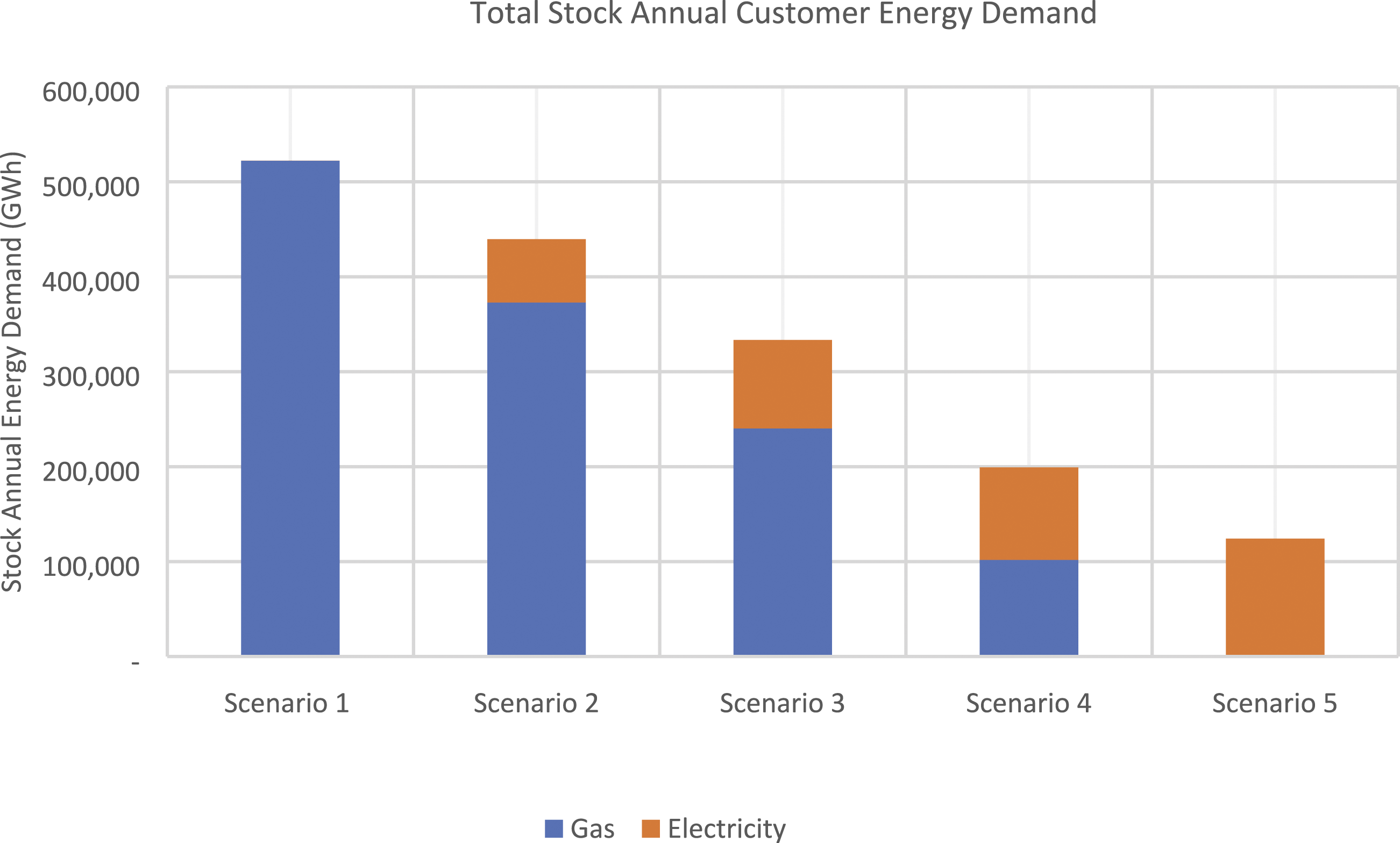
Space heating energy demand and savings.
The predicted emissions from the modelled scenarios (Figure 6) depend strongly on the assumptions of the emission intensity of the electricity grid; three different emission factors are explored in this article. The emissions factors from SAP (SAP 2012 519 gCO2/kWh and SAP10 233 gCO2/kWh) were used since it is the most widespread building modelling tool in the UK used across millions of homes for Energy Performance Certificates. Also, an estimate of the grid intensity in 2030 was taken from the National Grid Future Energy Scenarios 2020, ‘System Transformation’ scenario (75 gCO2/kWh). Note that more ambitious scenarios of carbon intensity reduction have also been modelled by the National Grid including zero carbon electricity by 2030. Stock annual emissions of carbon dioxide.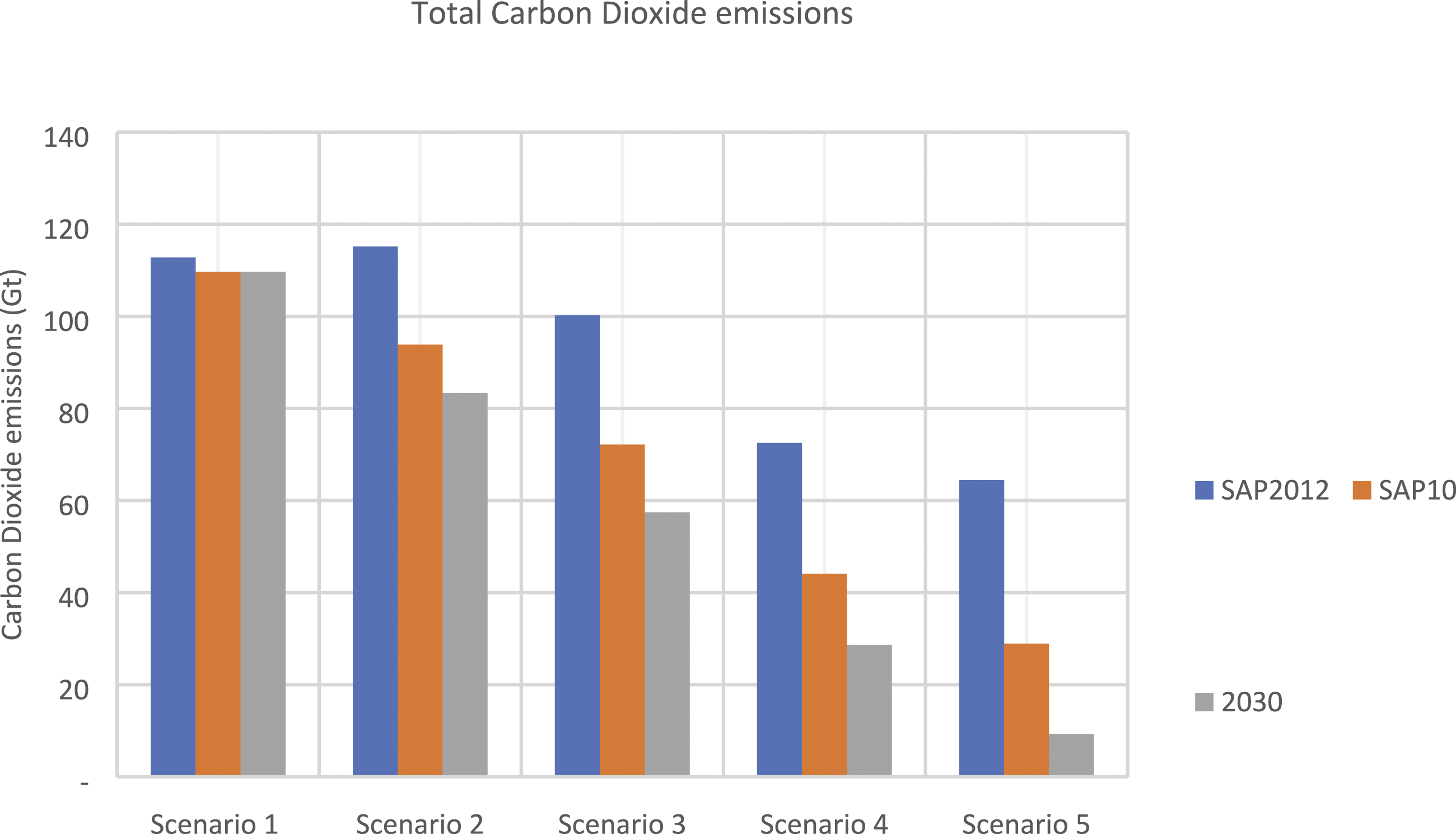
With the exception of Scenario 2 with SAP 2012 intensity factors, all CoCo hybrid scenarios present significant reductions in carbon emissions from heating. The considerable carbon emission impact of both HPs and hybrids can be seen with a potential 60% reduction in emissions for the best performing hybrid (SAP10 factors), but caution should also be exercised as the worst performing hybrid in Scenario 2 only delivers 15% carbon savings.
Modelling carbon emission factors for radical changes to heating in homes is complicated by the feedback effect that any major electrification of heat will cause. The rapid decarbonisation of the grid through increased proportion of renewables may be reversed as the demand grows, possibly causing increased reliance on gas fired electricity generation, therefore shifting the carbon balance back in favour of combustion of gas at the home directly for heat.
Energy costs play a key role in the consumption of energy for heat. Modelling future gas and electricity prices is beyond the scope of this research. The role of government policy governing where environmental and social obligation costs are levied and how they change over time plays a large role in the absolute and relative costs of gas and electricity.39,40 A significant part of the higher costs of electricity lies in the 22.9% obligation costs compared with just 1.9% for gas.
41
Competition between energy suppliers is a well-established feature of the UK energy market, presenting the consumer with considerable variation in energy prices driving around 400k consumers switching supplier per month.
42
Taking a snapshot of how the modelled scenarios would affect average dwelling energy bills is presented in Figure 7. The costs presented represent only the space heating portion of domestic energy use and are calculated using the mean unit cost of gas and electricity per kWh without fixed and standing charges of 3.3 p/kWh for gas and 17.4 p/kWh for electricity.
43
Viewing the impact of the modelled hybrids and ASHP through the lens of energy bills, the impact is negative, with no financial incentive to drive a shift from gas boilers. This highlights the distortion of energy prices with respect to both energy demand and carbon emissions both of which would benefit from the modelled heating systems, even in the case of the crude CoCo hybrid in Scenario 2. The decline in total energy demand seen in Figure 5 is distorted by the electricity price driving bills up when the proportion of heat produced by the HP is increased. The modest differences in electricity demand between Scenarios 2 and 5 are amplified by the cost factor; Scenario 3 has the highest costs due to the relatively crude HP/boiler switching resulting in a similar electricity demand as Scenario 4 but without the corresponding drop in gas demand. Estimated annual energy costs for customers per dwelling.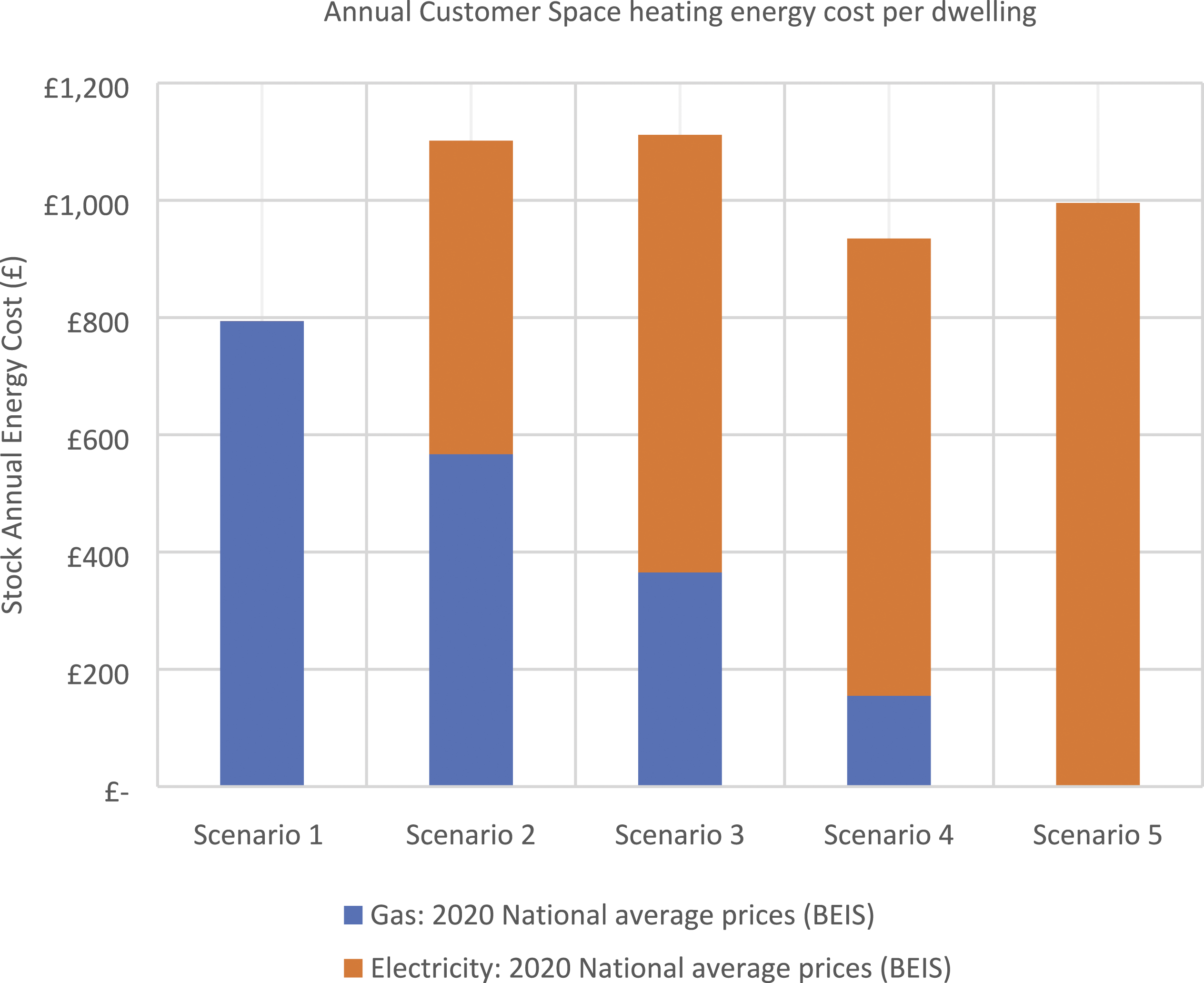
Sensitivity analysis
Comparing scenarios of CoCo hybrid heat provision on a national scale with both incumbent boilers and a full HP scenario has allowed for the exploration of differing control strategies of hybrid, operating the boiler and HP according to different rules and inputs. So far these CoCo scenarios2,3,4 have been based on the same fundamental physical CoCo hybrid specification. The boiler was sized above the maximum building heat load (28 kW) with a fixed minimum output of 5 kW, typical of combination boilers in the UK 44 and the HP was sized at 4 kW. A key feature of the CoCo hybrid concept is that the HP is contained wholly within the appliance casing, therefore minimising the space taken by the HP and contributing to making the whole appliance more comparable to the existing boilers which they could replace. A sensitivity analysis was performed on the model varying the HP size of the CoCo appliances from a minimum of 0.5 kW up to the level of standalone HPs, 8 kW. The boiler output size was maintained at 5–28 kW, typical of UK combi boilers.
In Figure 8, the variation in modelled peak electrical space heating demand for the reference year is shown. The ASHP Scenario 5 is shown as 41 GW across all CoCo hybrid HP sizes for comparison. None of the CoCo scenarios reach the levels of the full HP scenario reflecting the continued contribution of boilers in hybrid systems even when the HP is theoretically capable of providing all the heat, but the boiler helps at lower temperatures. Peak electrical energy demand for varying CoCo HP size.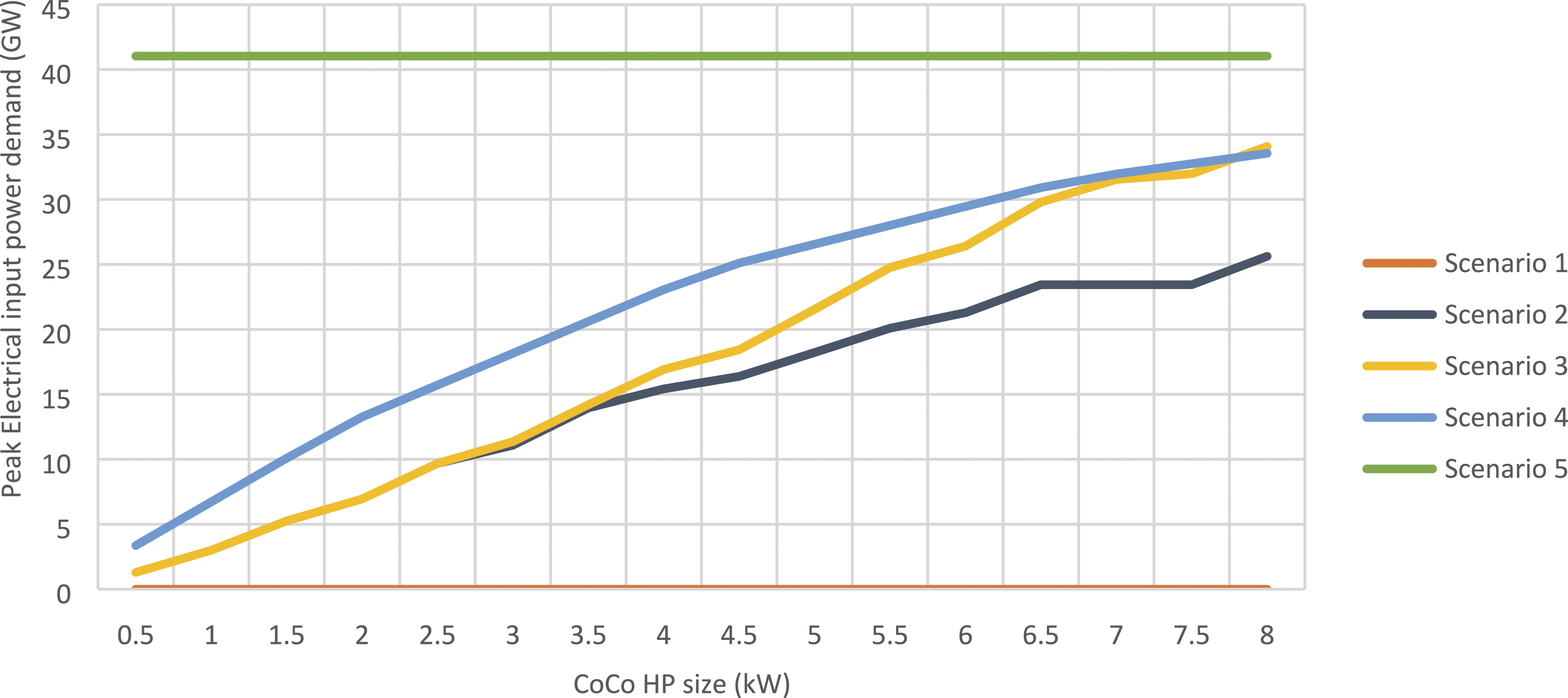
The total modelled energy demand (gas and electricity) is shown in Figure 9. Here, the differences between the CoCo control strategies are stark; the temperature limited HP operation of Scenario 2 limiting the HP contribution and therefore energy demand reduction, regardless of the HP size. Scenario 4 shows the greatest energy demand reduction, relative to gas boilers, with a 50% reduction with the more modestly sized 2.5 kW HP. The more restrictive operating parameters of Scenario 3 CoCo hybrids would require a HP size of 6.5 kW to achieve the same 50% reduction. Total input energy demand for space heating (gas and electricity).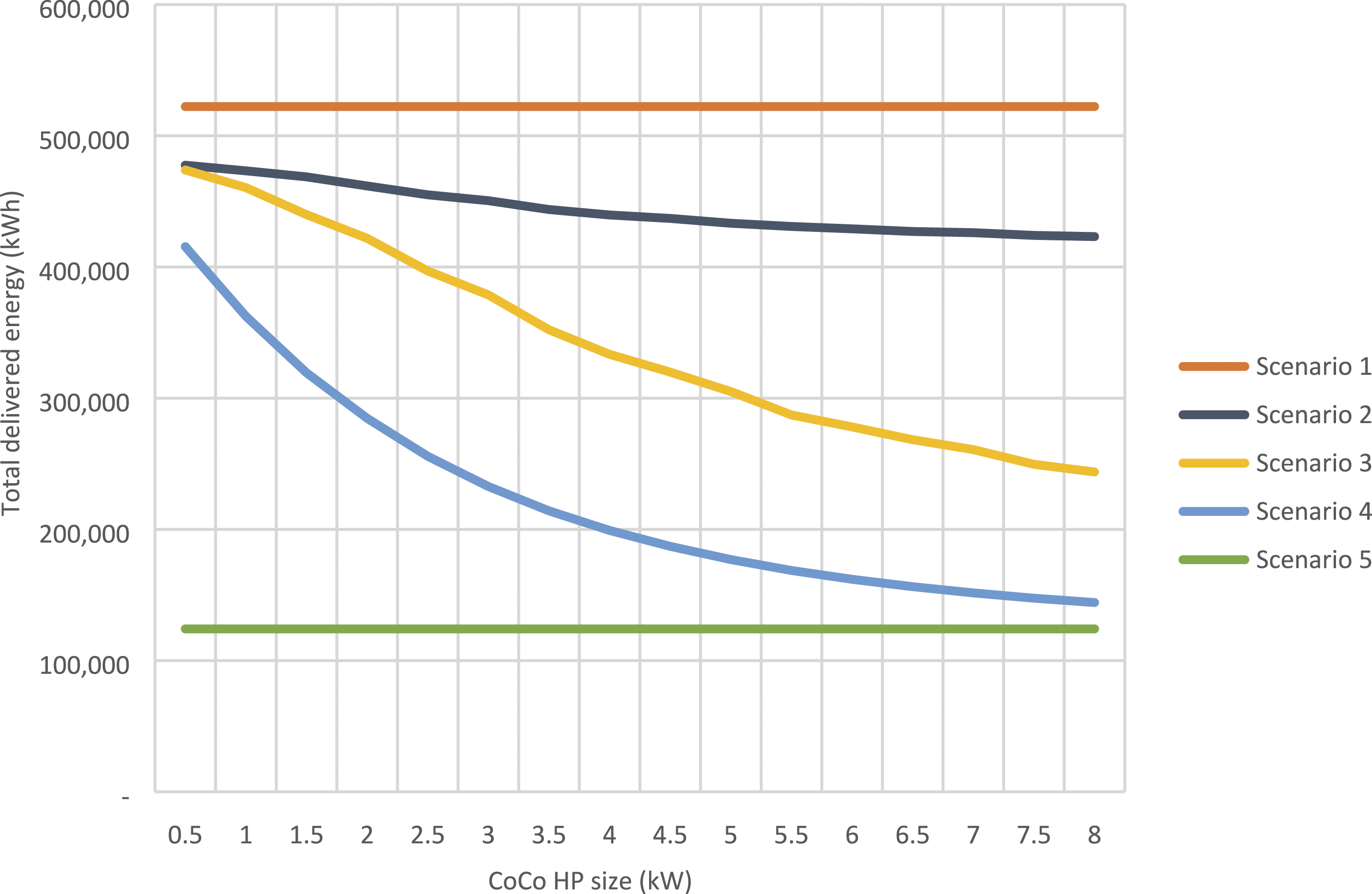
Energy bill cost (Figure 10), estimated at today’s prices as before, again highlights the price disparity that undermines using electricity for heating, despite the energy savings demonstrated the incurred cost is opposite. The larger HP sizes lead to rapid increases in billed energy cost; the case in Scenario 3 is such that the cost exceeds the fully electrified cost of ASHPs. Modelled space heat energy cost across different hybrid HP sizes.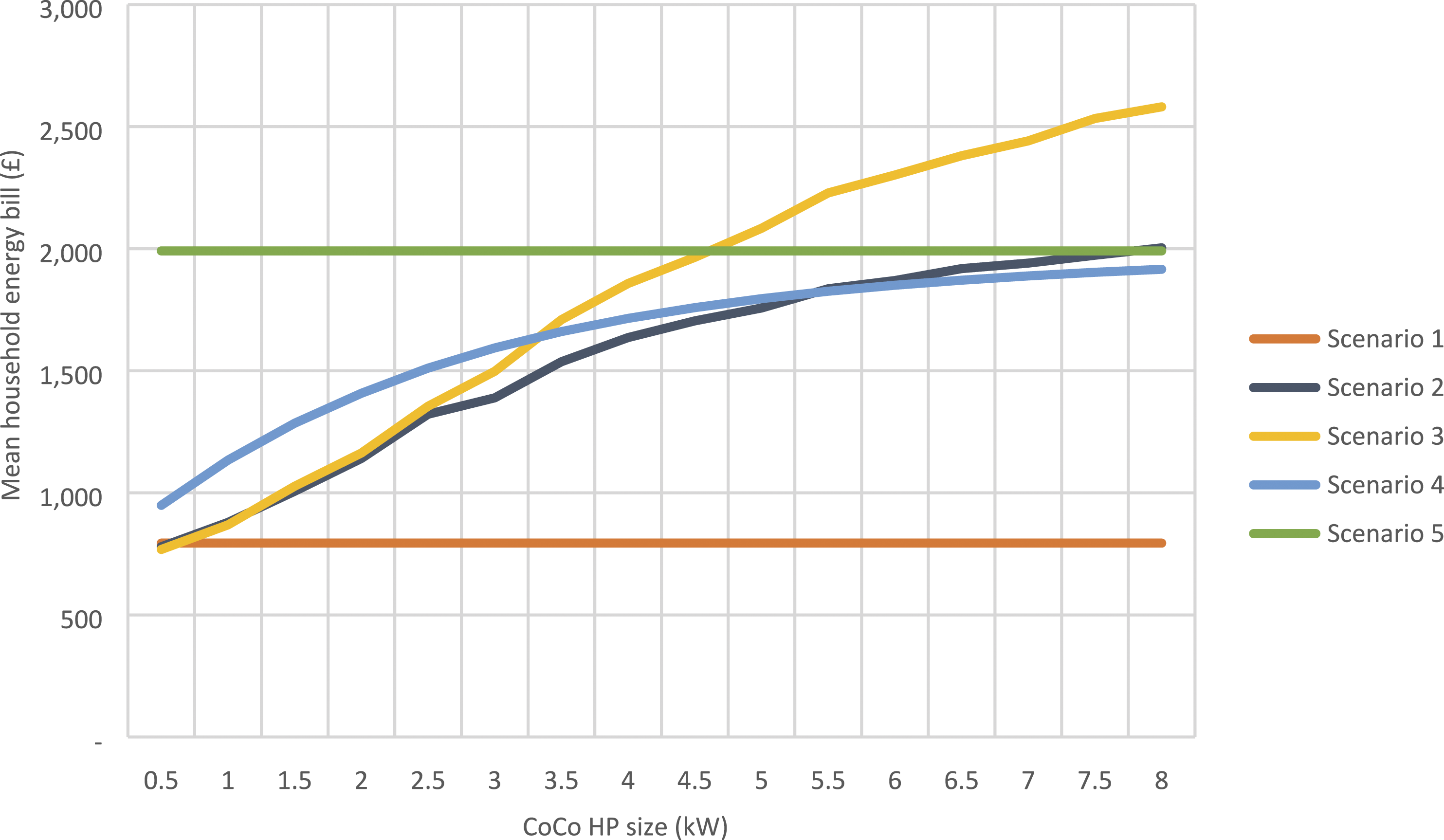
Conclusions and implications
Existing English and UK space heating demand is highly seasonal and variable over a day. The swings in demand that space heating places on the wider energy system are buffered by the gas grid through its use of linepack. 45 The dominance of gas central heating and combination boilers allows for high levels of heating demand without outages or swings in energy cost to the consumer. In order to reach net zero, high levels of electrification of heat through heat pumps is foreseen. The risks to the energy system of high peak demands on the electricity grid are prompting policy makers to assess the role of hybrid heating. The compact combination hybrid appliances seek to provide a way to alleviate the impact of electrification of heating on the grid, while also providing a relatively compact appliance with reasonable up front capital investment costs.
By modelling a full transition of the English domestic building stock from gas boilers to CoCo hybrids, the limit case of impact can be seen. The CoCo control strategy is of key importance as it determines the proportion of heat generated by the higher efficiency ASHP within a hybrid. This has implications for the policy governing product standards and the methodology behind the UK’s Energy Performance Certificate. It is clear from the modelling that not all hybrids are created equal and that a standard of specific performance testing should be developed to reflect the role of control algorithms in heating system performance. Energy demand and carbon emissions vary significantly across the modelled scenarios which maintain a constant heating system configuration for the hybrid models, but vary only the control strategy. The diminishing relative reduction in energy demand as the HP size of a CoCo hybrid increases shows that significant decarbonisation of heat could be made with relatively modest HPs within the CoCo package. With a 2.5 kW HP within the CoCo hybrid, a 50% reduction of energy demand at the national stock level is possible, if the HP use is not limited. The variability of demand across different hybrids (control strategy and specification) means that the simple split of heat demand 50:50 between the boiler and HP in any hybrid system forms part of the Standard Assessment Procedure used for EPCs and is inadequately flexible to account for variation in hybrid performance. It is likely that this conclusion holds as much for hybrids as for other hybridised or complex heating systems, which are likely to become more widespread in the future.
Cost of energy has been shown to play a key and contradictory role in a shift to hybrid heating technologies. The cost of electricity does not reflect the underlying carbon intensity, even at 2020 levels and prices. The incentive shown in terms of energy and carbon emission reduction across all CoCo hybrids is in contrast to increased energy bills, thereby disincentivising the consumer to make the switch. Without addressing the retail energy price’s masking of carbon intensity of energy, the role of hybrids or heat electrification is likely to be minimal.
A full deployment of hybrids in the housing stock is not anticipated as a practical scenario for heat decarbonisation; the modelling presented is envisaged as demonstrating a limit case, whereas, in line with CCC recommendations, the heating mix is likely to be more complex, with full HP systems being preferable where cost and grid constraints allow. Similarly, the deployment of hybrids, CoCo or otherwise, is likely to be sensible in areas where the conversion of the local gas grid to hydrogen is planned, which is unlikely to be widespread or uniform across the country. The modelling presented is limited by the exclusion of hot water production which is assumed to be 100% heated by the boiler component of the hybrid. Although building heat load seasonality and diurnal variability could be simplified in the model sufficiently to generate useful results, the lack of high quality data in hot water demand levels and diversity prevented satisfactory inclusion at this stage. Further work is planned to collect high frequency hot water consumption data which will form the basis of a supplementary hot water element to the hybrid model presented here.
A key finding of the research is the importance of the hybrid control strategy. In the modelled scenarios, the hardware component specifications in terms of kW output of boiler and HP parts of the hybrid were kept constant across scenarios. But the difference in control played a significant role in the split of energy demand between boiler and HP within the hybrid and therefore the savings relative to boilers. Hybrids cannot be assumed to be homogeneous in their performance or decarbonisation potential. This has implications both for the policy governing hybrids which would need to account, either explicitly in definition or in performance testing, for the range of hybrid performance due to control and boiler/HP specifications. The potential for CoCo hybrids, if designed and developed optimally for energy demand reduction, is significant but needs careful consideration in policy, both in terms of hybrid product regulation and also the wider context of differences in gas and electricity prices.
Footnotes
Declaration of conflicting interests
The author(s) declared no potential conflicts of interest with respect to the research, authorship, and/or publication of this article.
Funding
The author(s) disclosed receipt of the following financial support for the research, authorship, and/or publication of this article: This work was supported by the UK Research and Innovation via the Centre for Research into Energy Demand Solutions (grant numbers EP/R035288/1).
