




Abstract
Prior studies commonly emphasized the beneficial impacts of a growth mindset on students’ success and well-being. However, recent evidence cast doubts on the ability of a growth mindset to optimize desirable achievement and psychological outcomes. This study contributes to this line of evidence by exploring the association of mindsets in talent—a new domain of implicit theories encompassing belief about the nature of talent—with students’ subjective well-being, academic buoyancy, and general health among selected Filipino high school students. Results of structural equation modeling indicate that whereas incremental theory in talent (or growth mindset) was more strongly and positively correlated with academic buoyancy, school connectedness, and joy of learning, entity theory (or fixed mindset) was more strongly and positively associated with educational purpose and general health. These findings underscore the mental health rewards associated with cultivating both growth and fixed mindsets about talent in school contexts.
Keywords
The implicit theories of the intelligence model (Dweck, 1999; Dweck & Leggett, 1988) posit two fundamental mindsets that characterize individuals’ beliefs about intelligence and various types of abilities. On the one hand, the incremental theory of intelligence or growth mindset involves believing that intelligence is relatively malleable and can change over time through practice and effort. On the other hand, the entity theory of intelligence or fixed mindset pertains to the belief that intelligence is relatively fixed and unchangeable. This theory predicts that espousing an incremental theory of intelligence or growth mindset appears a more adaptive approach in conceptualizing the nature of intelligence (Blackwell et al., 2007), personality (Dweck & Leggett, 1988), and morality (Chiu et al., 1997).
However, there have been a number of criticisms in the growth mindset literature. First, a recent meta-analytic review (Burgoyne et al., 2020) has argued that the evidence regarding the effectiveness of mindset interventions is highly questionable as the effect sizes are relatively weak and, in some instances, negative in terms of magnitude. Second, although studies have shown that a growth mindset in the area of intelligence was linked to well-being outcomes such as self-esteem (Diseth et al., 2014), positive emotions (King, 2017), and psychological well-being (Zeng et al., 2016), these findings may not automatically generalize to understanding how mindsets towards other performance domains (e.g., talent) track mental health. According to Bloom (1985), talent should cover not just academic abilities but also artistic and athletic skills. In line with this, Sternberg (2005) emphasized that talent should not depend on analytic skills but it should include creativity and practical intelligence (e.g., adapting to life changes). In a study by Siegle and colleagues (2010), talents were categorized into 15 areas (e.g., music skills, art skills, mathematical skills, overall academic skills, and leadership skills) based on Gardner's theory of multiple intelligence (1983) and field-test with eight university students. It was found that students’ interest in their talent area is positively correlated with how they assess their skill in that specific area (i.e., those who have a high interest in athletics also had a high assessment with their athletic skills). In particular, higher correlations were found in the non-academic talent area. Results also showed that students’ implicit theory of intelligence does not necessarily affect their belief that ability is significant in academic performance. Meanwhile, there is a lack of research on how talent is associated with well-being. It is reasonable to anticipate the distinct role of mindset about talent well-being given the existing evidence regarding the unique nomological network of growth mindset in giftedness (Makel et al., 2015), willpower (Job et al., 2015), and socioeconomic status (Zhao et al., 2021).
Third, while past investigations demonstrated that a fixed mindset was linked to maladaptive outcomes like reduced life satisfaction and increased negative affect (Diseth et al., 2014; King, 2017), they concentrated on the link of implicit theories of intelligence to mental health outcomes which could not generate insights on the role implicit theories of other performance areas in adolescents’ mental health functioning. Fourth, prior studies paid much attention to the psychological benefits of mindsets in Western and individualist societies, so the findings have limited generalizability to students belonging to non-Western contexts. Most of the studies done in the Western context emphasized the significant role of a growth mindset and how it is more important in intelligence than promoting a fixed mindset (e.g., Burnette et al., 2013; Karlen et al., 2019; Robins & Pals, 2002). Bostwick et al. (2020) examined the growth orientation (GO) of teachers, students, and classrooms on academic engagement and achievement in Australia. Results showed that student and classroom GO were liked to mathematics outcomes while teachers’ GO was positively related to classroom engagement. However, teachers’ GO also has the potential to reduce academic engagement when they are in a classroom with high GO. However, in a study by Chan et al. (2022), a growth mindset was categorized into four: intelligence, ability, personality, and relationship. According to them, intelligence and personality are fixed while ability and relationships can be changed based on Chinese cultural beliefs. Interestingly, their findings were aligned with these Chinese cultural beliefs showing that ability and relationships are more malleable than intelligence and personality, although the relationship was seen to be less malleable for adolescents in Hong Kong. They also found that all four mindsets positively predicted all six dimensions of psychological well-being in the younger age group. Meanwhile, in the Philippine context, findings revealed that both growth and fixed mindset were positively linked to career and talent self-efficacy among Filipino undergraduate students (Buenconsejo & Datu, 2020). According to the meta-analytic review of Costa and Faria (2018), participants from different continents were also found to be different in how their intelligence beliefs influenced their achievement. While participants from America showed a negative relationship between entity beliefs and achievement, Asian and Oceanian students showed a positive link between incremental beliefs and achievement. On the other hand, espousing entity beliefs may be useful for them as it showed that entity beliefs and achievement were positively correlated. Given that existing literature has demonstrated cross-cultural differences not only in conceptions of self (Vignoles et al., 2016) but also in implicit theories of intelligence (Echazarra, 2020), it is important to examine the role of mindsets in non-Western societies.
Hence, this research offered preliminary evidence about the role of implicit theories of talent (e.g., sports and extra-curricular activities) in students’ well-being at school (e.g., the joy of learning, school connectedness, academic self-efficacy, and educational purpose), resilience to day-to-day academic hassles (academic buoyancy; Martin & Marsh, 2008), and perceived physical health in selected Filipino adolescents. Given the exploratory nature of this study, no specific predictions were proposed on how mindsets in talent may be linked to well-being outcomes.
Methods
Participants and procedures
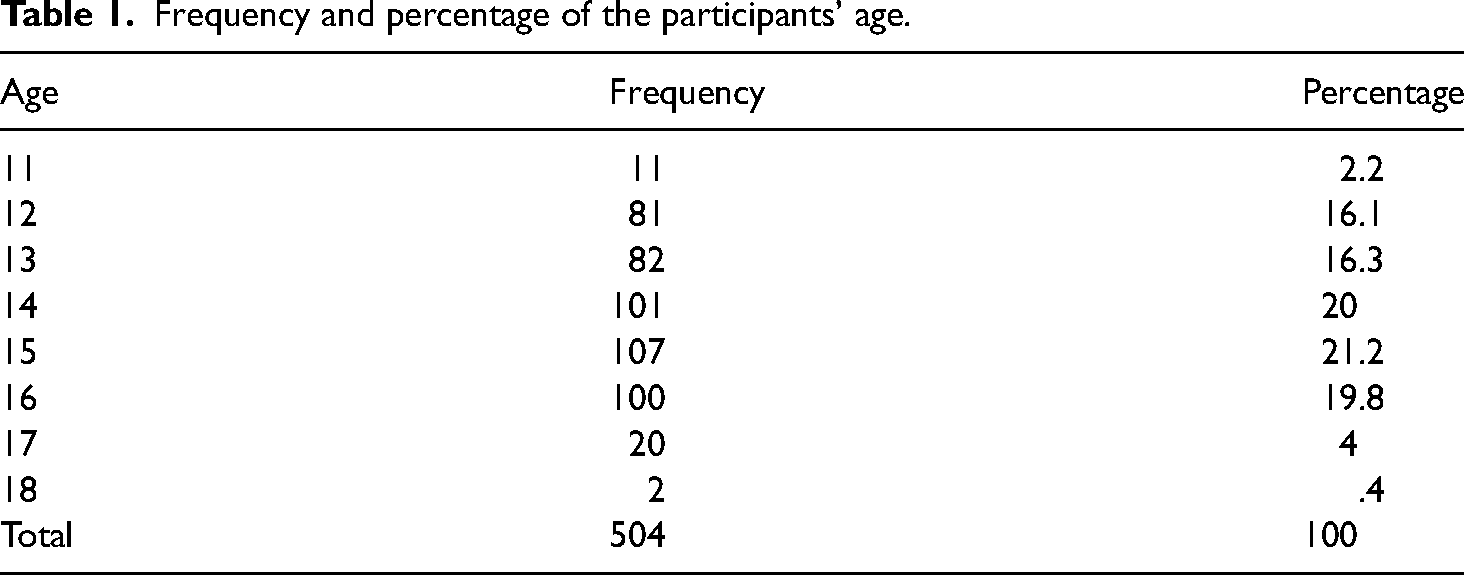
The sample comprised of 504 high school students from a private school in a province in the Philippines with a 100% participation rate. The average age of participants was 14.19 (SD = 1.54). The teachers handed out the questionnaires to students individually after seeking their consent to participate in the study. Students were able to complete the questionnaire in around 10 min and the whole data collection was completed after a month. Table 1 describes the frequency and percentage distributions of the participants’ age. The majority of the participants are girls (n = 282). Before implementing this project, the author secured ethical review clearance from the Human Research Ethics Committee of The Education University of Hong Kong. After getting approval from the committee, an invitation letter was sent to the president of the participating school.
Frequency and percentage of the participants’ age.
Measures
Mindset. The 6-item adapted version of the Implicit Theories about Giftedness Scale (Makel et al., 2015) was used to assess incremental theory (three items) (i.e., “No matter who you are, you can change your talent a lot”) and entity theory (three items) (i.e., “You have a certain amount of talent, and you really can’t do much to change it”) about talent or non-academic abilities (e.g., sports and music). The items were adapted by replacing the term “giftedness” in each item with “talent.” Items were rated using a 6-point Likert scale (1 = Strongly disagree; 6 = Strongly agree). Cronbach's alpha coefficients of the entity and incremental theories were .70 and .74, respectively. Results of CFA showed a good fit of the two-factor model of implicit theories about the giftedness scale: χ2 = 6.716, df = 8, p > .05, CFI = 1.00, GFI = .996, TLI = 1.004, and RMSEA = .000.
Academic buoyancy. The 4-item Academic Buoyancy Scale (Martin & Marsh, 2008) was used to measure the participants’ ability to cope with everyday academic challenges. Items were marked on a 7-point Likert scale (1 = Strongly disagree; 7 = Strongly agree). Sample items are: “I’m good at dealing with setbacks at school” and “I don’t let study stress get on top of me.” The Cronbach's alpha reliability coefficient of this scale in the study was .73.
General health. The 3-item Global Self-Rated Health scale (Eriksson et al., 2001) was used to assess overall perceived physical health among participants. Items were rated using a 5-point Likert scale (1 = Poor; 5 = Very good). A sample item is: “How would you assess your general health status compared to that of others of your own age?” The Cronbach's alpha coefficient of this scale in this study was .84.
Student subjective well-being. The 16-item Student Subjective Well-being questionnaire (Renshaw et al., 2015) was used to measure four different dimensions of participants’ well-being at school: the joy of learning (i.e., “I get excited about learning new things in class”), school connectedness (i.e., “I feel like I belong at my school”), academic self-efficacy (i.e., “I am a successful student”), and educational purpose (i.e., “I feel like the things I do at school are important.” Items were rated via a 4-point Likert scale (1 = Almost never; 6 = Almost always). The Cronbach's alpha coefficients of the joy of learning, school connectedness, academic self-efficacy, and educational purpose subscales were .79, .77, 80, and .80.
Data analysis
Descriptive statistics (mean, standard deviation, and normal distribution) and reliability were calculated. Pearson-r was performed to test the relationship of incremental theory in talent to academic buoyancy and mental health and well-being outcomes using Statistical Package for the Social Sciences (SPSS) v27. To address this study's objective, structural equation modeling (SEM) via the maximum likelihood estimation approach was conducted via the Analysis of Moment Structures (AMOS) v2. The hypothesized structural model incorporated entity and incremental theories latent constructs (with three indicators and error terms) as predictors of academic buoyancy (with four indicators and error terms), general health (with three indicators and error terms), and all dimensions (i.e., school connectedness, educational purpose, academic self-efficacy, and joy of learning) of student subjective well-being (with four indicators and error terms for each dimension). In judging the fit of this model, the recommended cut-off values of Lance et al. (2006) were adopted such as (a) Comparative Fit Index (CFI) and Tucker-Lewis Index (TLI) of higher than .90; and (b) Standardized Root Mean Square Residual (SRMR) and Root Mean Square Error of Approximation (RMSEA) of lower than .8. Since outcome variables were all well-being variables, error terms were correlated (Rubio & Gillespie, 1995).
Results
The results of reliability, descriptive statistical, and correlational analyses are reported in Table 2. After checking for skewness and kurtosis, no violations of normality were identified. All scales demonstrated adequate reliability based on their Cronbach's alpha coefficients. Relationships between demographic variables and academic and well-being outcomes were also tested. Pearson-r correlational coefficients indicate that age was negatively correlated with incremental theory, joy of learning, academic self-efficacy, and general health. Similarly, year level was also found to be negatively correlated with incremental theory, the joy of learning, academic self-efficacy, and general health. Meanwhile, gender was negatively correlated with school connectedness, the joy of learning, educational purpose, academic self-efficacy, and general health. Pearson-r correlational coefficients indicated that incremental theory in talent was positively correlated with academic buoyancy and remaining well-being outcomes. Further, entity theory had positive significant correlations with all mental health outcomes except for school connectedness.
Descriptive statistics, reliability, and correlational analyses among mindsets and well-being outcomes.
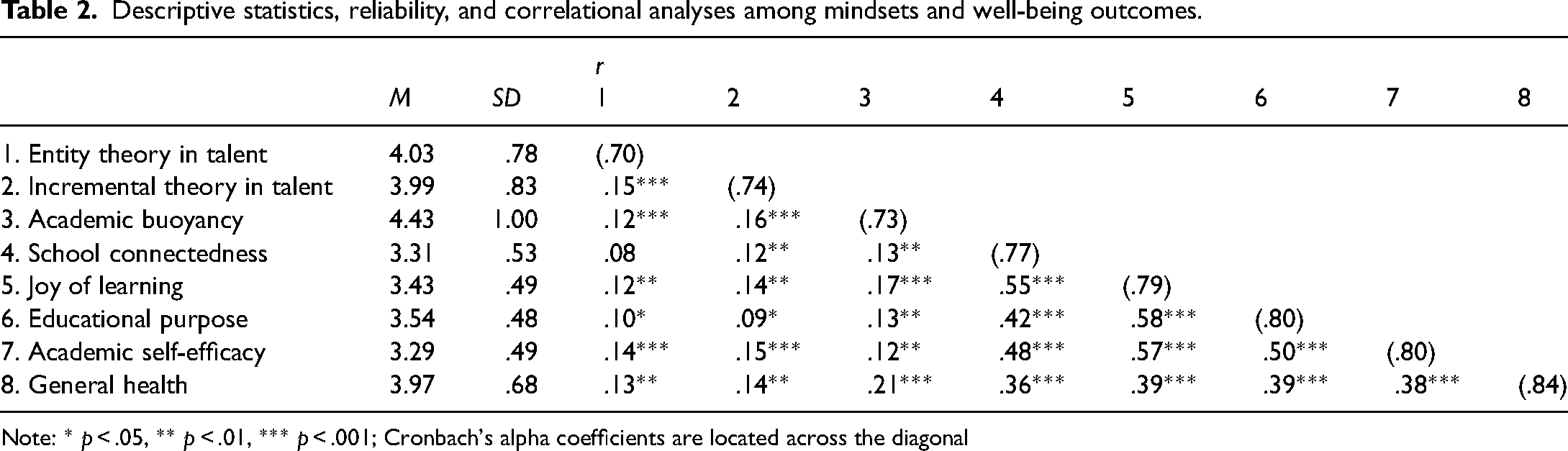
Note: * p < .05, ** p < .01, *** p < .001; Cronbach's alpha coefficients are located across the diagonal
Results of SEM showed that the structural model (see Figure 1) had a good fit: χ2 = 690.45, df = 350, CFI = .93, TLI = .92, RMSEA = .04 (.039, .049), and SRMR = .0 1. Incremental theory of talent positively predicted academic buoyancy β = .183, p < .01, school connectedness β = .099, p < .01, joy of learning β = .10, p < .05, academic self-efficacy β = .108, p < .01, and general health β = .138, p < .01. Entity theory of talent positively predicted academic buoyancy β = .163, p < .01, joy of learning β = .095, p < .05, educational purpose β = .085, p < .05, academic self-efficacy β = .106, p < .05, and general health β = .142, p < .01.
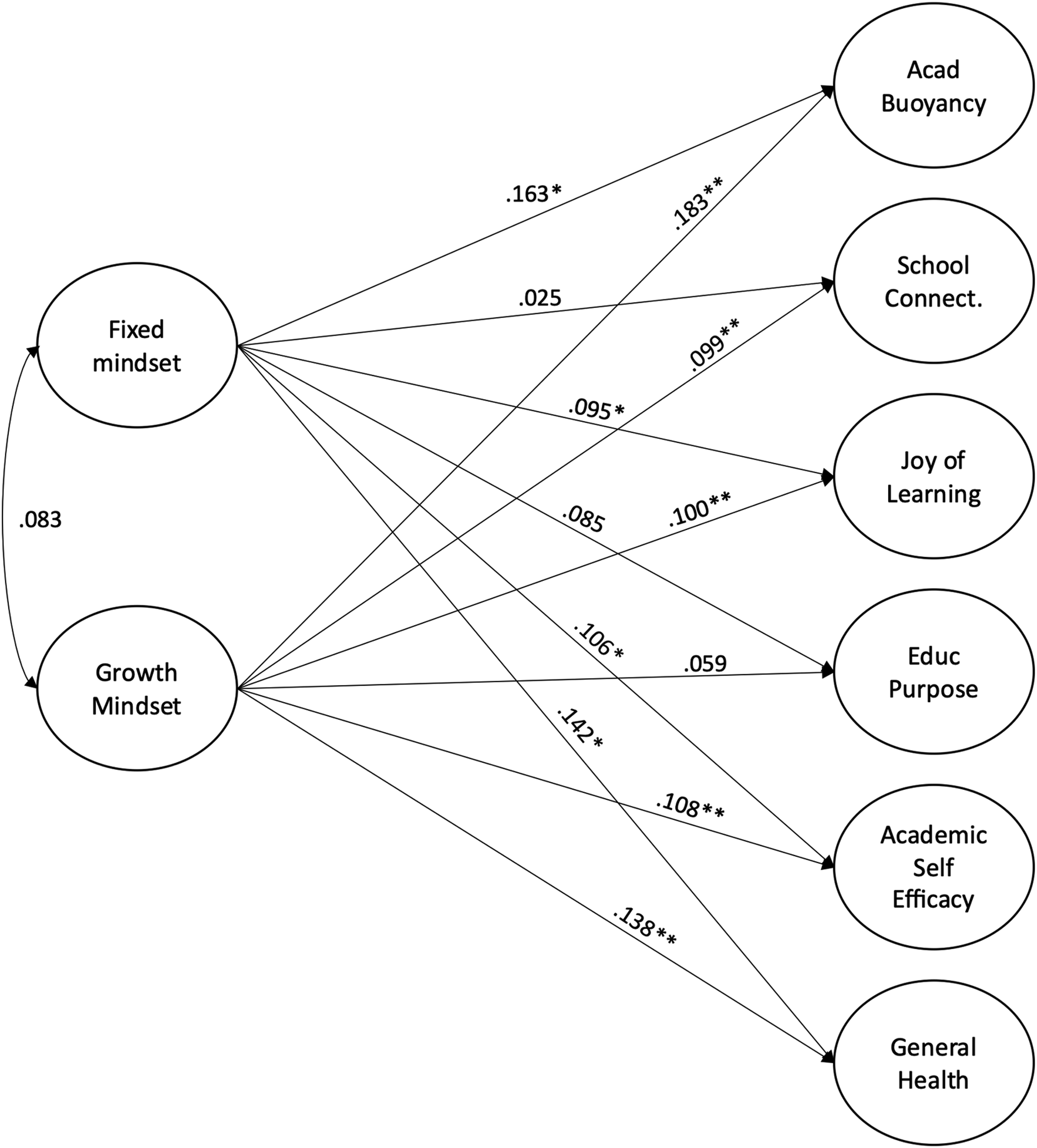
Result of structural equation model—growth mindset on academic buoyancy, subjective well-being, and general health.
Discussion and conclusions
Prior studies emphasized the benefits of a mindset about intelligence for well-being, with a growth mindset demonstrating positive associations with mental health outcomes (Diseth et al., 2014; King, 2017). However, there is sparse evidence on how mindset in other domains of performance relates to adolescents’ well-being, especially in non-Western and collectivist societies. This study addresses this gap by exploring the associations of mindsets about talent with subjective well-being, academic buoyancy, and physical health in selected Filipino adolescents.
Incremental theory of talent appears to be more strongly associated with academic buoyancy and selected dimensions of subjective well-being (i.e., school connectedness and joy of learning) than the entity theory of talent, which partly confirms previous research on the mental health benefits of growth mindset in intelligence (Diseth et al., 2014; King, 2017). These findings indicate that compared to adolescents with increased tendencies to adopt a fixed mindset, those who believe that their talents are malleable through effort are likely to effectively cope with academic struggles, relatedness to parents and teachers, and positive experiences in school activities. These results indicate that previous research findings about the mental health rewards associated with a growth mindset (Chan et al., 2022) seem to be generalizable in a non-Western society such as the Philippines. This may also imply that despite the meta-analytic review of Burgoyne et al. (2020), mindset interventions may still offer promising results to non-Western participants such as Filipinos.
Contrary to prior evidence regarding the psychological hazards of a fixed mindset of intelligence (Diseth et al., 2014; King, 2017, 2020), this study demonstrated that the entity theory of talent seems to be more strongly related to educational purpose and perceived physical health. Contradicting how all four growth mindsets (ability, personality, intelligence, and relationships) positively predicted all dimensions of psychological well-being (Chan et al., 2022), these results suggest that compared to adopting a growth mindset, espousing a belief that talent is fixed may be associated with increased school motivation and physical well-being. These findings suggest possible psychological benefits of a fixed mindset in talent, supporting results from prior research regarding the positive association of a fixed mindset in talent with talent development self-efficacy (Buenconsejo & Datu, 2020). It is likely that a fixed mindset in talent may exhibit positive correlations with adaptive well-being outcomes as Dweck (2007) has underscored the importance of espousing a fixed mindset in selected domains of performance (e.g., arts like drawing and music like playing the violin).
A potential explanation that might account for the equally beneficial role of a fixed mindset in selected Filipino adolescents involves the relative salience of dialectical thinking style in non-Western and collectivist cultures (Nisbett et al., 2001; Peng & Nisbett, 1999). As espousing a dialectical thinking style involves increased tolerance of contradictions in dealing with various situations in life (Peng & Nisbett, 1999), individuals with an increased tendency to use this thinking style are likely to recognize the benefits of believing that their talent is relatively fixed or permanent. For example, if a student sees that his or her talent in sports is difficult to change, he or she can invest in other domains of performance that are perceived as relatively malleable. Hence, it is likely that cultural differences in thinking style might explain why a fixed mindset in talent appears to yield mental health benefits in Filipino adolescents. However, this speculation requires further investigation as this study did not explore the role that thinking style plays in the link of mindsets about talent well-being outcomes.
This study has limitations. As this research was correlational in nature, findings cannot generate causal evidence between mindset in talent and well-being. This shortcoming can be addressed through conducting longitudinal (e.g., cross-lagged panel and latent growth curve modeling approach) and experimental designs in order to provide stronger evidence on the benefits of mindsets in talent for well-being. Additional demographic information about the participants such as their socioeconomic status was not collected. To address this gap, more background information from the sample may be taken into consideration during data analysis (e.g., controlling for relevant demographic variables). Given that self-reported measures of implicit theories of talent and well-being outcomes were used in the study, results are susceptible to common method bias. Future studies can address this limitation by utilizing objective measures of mental and physical health. In addition, as there is limited data on the reliability and validity of Implicit Theories about the Giftedness Scale (Makel et al., 2015), it is also recommended to investigate its validity and reliability for samples in different cultural context.
Nonetheless, this research has theoretical implications for understanding the benefits associated with mindsets in specific domains. To date, this is the first known research to demonstrate the role of mindset about talent in well-being. This study also showed that both growth and fixed mindsets were linked to a diverse range of well-being outcomes which seems to contradict prior research findings favoring a growth mindset over a fixed mindset in promoting mental health (Diseth et al., 2014; King, 2017). Our findings regarding the differential contributions of mindsets to well-being outcomes underscore the importance of stimulating further research about the nomological network of domain-specific mindsets. Indeed, this research reinforces doubts about the bold claims that a growth mindset guarantees well-being and optimal mental health outcomes in various cultural contexts.
The study has implications for school-based mental health practitioners. School psychologists, guidance counselors, and other allied health professionals are recommended to collaborate in designing school-wide prevention programs that promote a balanced understanding of the importance of growth and fixed mindsets in talent on a wide range of health outcomes. Given the salient notion that only a growth mindset guarantees school success and psychological health, psychologists and mental health professionals are encouraged also to practice caution when generalizing this premise to ethnic minority students from non-Western and collectivist societies. Importantly, the results of this research can serve as a basis for creating culturally sensitive and evidence-based mindset interventions for adolescents in various sociocultural milieus.
Footnotes
Declaration of conflicting interests
The author declared no potential conflicts of interest with respect to the research, authorship, and/or publication of this article.
Funding
The author received no financial support for the research, authorship, and/or publication of this article.
