




Abstract
Non-suicidal self-injury (NSSI), which involves deliberate damage to body tissue without suicidal intent, has long been a concern for schools and school staff. Secondary schools are an ideal setting in which to identify, and appropriately refer, students who self-injure as well as implement evidence-based prevention and early intervention programs. However, in the context of the global COVID-19 pandemic, schools have been closed and students sent home to learn online. This may result in the exacerbation of existing anxieties and pose several new stressors that cumulatively may increase risk of NSSI. In this article, we draw on recent research and our collective experience working with schools, as well as digital mental health, to outline some of these potential stressors and offer resources for school staff to help students who are engaging in or at risk of NSSI.
Non-suicidal self-injury (NSSI), deliberate and direct engagement in behaviours that cause direct tissue damage without conscious suicidal intent (International Society for the Study of Self-Injury, 2018), represents a significant mental health concern for young people and their communities. In addition to causing distress for the individual and their loved ones (Ferrey et al., 2016), NSSI predicts poorer future psychosocial wellbeing (Buelens et al., 2019; Robinson et al., 2019). Notably, although NSSI refers to behaviours explicitly without suicidal intention, NSSI is linked to suicidal thoughts and behaviours. People who engage in NSSI are over four times more likely to subsequently make a suicide attempt (Ribeiro et al., 2016), and engaging in NSSI predicts the transition from suicidal ideation to suicidal attempts among adolescents (Mars et al., 2019). Given that NSSI typically begins during early to mid-adolescence (Plener et al., 2015), secondary schools play a vital role in responding to NSSI. However, the COVID-19 (novel coronavirus, SARS-Cov-2) pandemic has seen wide scale school closures in an effort to limit viral transmission. These closures, as well as the context of the pandemic in general, are having a significant negative impact on students, access to care, and family life (Ghosh et al., 2020), all of which may increase risk of NSSI in this uncertain time. The purpose of this article is to outline some of these risks and provide strategies to help students, families, and schools support students at risk of self-injury. To do so, we draw on recent literature regarding how to appropriate address and respond to NSSI in schools, and our collective experience in working within school environments, including mental health on a digital platform.
What is non-suicidal self-injury?
Although often a private behaviour (Whitlock et al., 2011), approximately 17% of adolescents worldwide engage in NSSI (Swannell et al., 2014). NSSI is a highly variable behaviour; some young people self-injure a few times in a discrete period whereas others engage in the behaviour more chronically over a longer period of time (Barrocas et al., 2015). NSSI commonly manifests in early to mid-adolescence (Plener et al., 2015) as cutting or burning skin, or by punching or banging against surfaces (Plener et al., 2009; Whitlock et al., 2011), and young people often use two or more methods to self-injure (Lloyd-Richardson et al., 2007). NSSI is prevalent among both males and females (Bresin & Schoenleber, 2015; Swannell et al., 2014), and there is growing evidence to suggest elevated rates of NSSI among individuals who identify as lesbian, gay, bisexual, transgender, and other nonbinary identities as compared with their heterosexual and/or cisgender peers (Liu et al., 2019; Veale et al., 2017). NSSI usually functions as a way for an individual to change their emotional states, most commonly to gain temporary relief from overwhelming or unwanted emotional states (Klonsky & Glenn, 2009; Taylor et al., 2018).
Impact of COVID-19 on students
Since the start of the COVID-19 pandemic, many schools worldwide have shut down. Children were suddenly sent home from school with no sense of when they might return. Students in countries that operate on an academic calendar year (e.g. the United States of America, Canada, United Kingdom, much of Europe and Asia) found themselves finishing the school year at home, missing important milestones like end-of-year dances (e.g., end-of-year formal, prom) and graduation. Students in countries with a calendar year schedule (e.g., Australia, New Zealand, South Africa) were sent home early into their new academic year, with limited time to establish new friendships for those who had transitioned to new schools and grades. Social support from peers is important to youth under normal circumstances; conversely, decreased support from peers is associated with NSSI risk (Hankin & Abela, 2011). The physical and social distancing required to limit the spread of COVID-19 may further decrease support for some students, potentially increasing risk for NSSI. Additionally, the lack of direct social interactions with peers has led to increased loneliness and social isolation, which may further impact the risk of NSSI. Further research is required to test this possibility.
The physical health consequences of COVID-19 are also likely to create unique stressors for young people and their communities. Worldwide, tens of millions of people have tested positive for COVID-19, and hundreds of thousands have died (World Health Organization, 2020). Given the severity of the COVID-19 pandemic, many young people and their families are likely worried for their safety, and the safety of their loved ones. Indeed, a number of studies have now shown elevated rates of anxiety among students (Huckins et al., 2020), healthcare workers (Chen et al., 2020), and the general community (Li et al., 2020). Of note, there is significant anxiety directly attributed to fears about COVID-19 (Lee, 2020; Lee et al., 2020). In cases of illness, regardless of whether relatives, friends or the adolescents themselves are affected, the quarantines and visiting restrictions applied around the world pose further stress on all individuals involved. In addition, many funeral practices critical for grieving, such as the New Zealand Māori traditional tangihanga ceremony, where the body lies on the communal meeting house for people to pay their respects (Paterson, 2015), were restricted or banned in efforts to limit the spread of COVID-19 (New Zealand Government, 2020), thus creating additional distress during an already difficult time.
The effects of isolation and social distancing are compounded by disruption to education and the move to entirely online learning. Although there are both benefits and challenges with online learning, adapting to a new educational style can produce significant anxiety for students, teachers, and families (Abdous, 2019). The extent to which students feel prepared to transition from a traditional learning environment to online learning is a significant factor in their anxiety (Abdous, 2019). In many countries students have experienced the swift transition to online learning at home and it is likely that it could have drastically elevated the rates of anxiety and worry about their education In line with this, there is significant uncertainty about end-of-year exams. This is particularly true for students in the final years of secondary school who are dependent on exam results for admission to university or college. If, when, and how exams are to be held, and how results are to be used, vary from school to school. In the United Kingdom, the announcement that A Level exams would be cancelled and that results from mock A Levels would be used to determine university admission, is suspected to have contributed to at least one suicide (Murphy-Bates, 2020). For younger adolescents, home schooling often means a high level of parents’ involvement, which can create substantial interpersonal tension, particularly in families that are already facing parent-child relationship difficulties, which is common among adolescents who self-injure (Tatnell et al., 2014).
The increased demands that COVID-19 places on medical facilities may also mean that that young people and/or their caregivers are less willing to access medical care for injuries, especially as medical facilities may be seen as unsafe places where the risk of contracting COVID-19 is higher. Previous research has also highlighted that some medical health professionals hold negative and stigmatising attitudes towards people who self-injure (Karman et al., 2015; Saunders et al., 2012). These attitudes may be exacerbated during the increased stress and demands on resources created by COVID-19, perhaps impacting subsequent help-seeking behaviour beyond the current pandemic (Staniland et al., 2020).
Lack of access to school counsellors and schools as a place of safety
Given the important role that schools play in the safety and security for youth, school shutdowns have had a significant and adverse impact on mental health. In a recent survey by the UK mental health charity YoungMinds, 83% of participants up to age 25 said the pandemic made their existing mental health conditions worse (Thomas, 2020). The prolonged isolation and lack of social safety net has not only disrupted structure, routines, and peer interactions, but also limited the mental health resources youth usually have access to through their school (Golberstein et al., 2020; Lee, 2020).
The loss of support provided by schools is even more harmful for youth at risk of, or engaging in, NSSI. Coupled with the stigma associated with NSSI (Burke et al., 2019; Lloyd et al, 2018; Staniland et al., 2020) and the hesitation among youth to disclose their self-injury (Rosenrot & Lewis, 2018), the loss of school support presents an added layer of challenges to receiving services. The protective factor that school mental health professionals play in offering accessible, face-to-face support and mitigating negative outcomes of youth who engage in NSSI (Hasking et al., 2016) has been interrupted. This disruption of ongoing care, and the inability for youth to reach out if needed, requires school staff and mental health professionals to remain consistently connected, engaged, and present, particularly with vulnerable youth.
The lack of physical proximity and being in the same building as students, has resulted in school staff and mental health professionals having to rely on creative and virtual supports to maintain connections with students at risk. Identifying students who may be at risk has been particularly challenging. Students are typically identified through teacher or other staff referrals. Staff may note the presence or lack thereof during scheduled Zoom classes, students’ level of motivation and engagement, or any changes in behaviour. This has resulted in school staff taking the time to phone, email, or text students deemed at risk for NSSI, which at times has not led to a response from the student. Students may have to contend with not having school staff and mental health professionals easily accessible for support, while school staff and mental health professionals may have to spend significantly more time attempting to connect with students. This in turn may impact students who engage in NSSI who likely have limited coping and benefit most from easily accessing school supports.
Impact of staying at home
Stay-at-home orders and school closures also mean that young people are spending extended periods of time at home with family and siblings. The extended time at home and changes to usual house operations may result in less alone time and space for adolescents than is desired (Wang et al., 2020). During school closures, parents and caregivers are expected to take on new roles as teachers in supervising their youth’s online education, while simultaneously adjusting to remote working and work demands. These family-work conflicts are associated with impaired distress tolerance, reduced parental satisfaction, and greater psychological distress (Janzen et al., 2007; Kinnunen & Mauno, 1998). In addition, a number of researchers have noted the potential for impaired physical health as a result of excess screen time, more irregular sleep patterns, and less physical activity (Ghosh et al., 2020; Wang et al., 2020).
The economic consequences of COVID-19 are predicted to be wide ranging (OECD, 2020), and thus parents and caregivers are likely also experiencing elevated stress and anxiety regarding potential job loss and financial insecurity. Given the evidence that higher-than-usual negative affect predicts subsequent NSSI thoughts and behaviour (Kiekens et al., 2020), these additional stressors are likely to impact NSSI engagement and recovery among young people with a history of NSSI. In addition, the number of life stressors (e.g., changing school, parental unemployment, major personal injury or illness, trouble with parents), in the past six months predicts the onset of self-injury among adolescents (Kaess et al., 2019). Thus, it is possible that prevalence of NSSI may increase in the context of the COVID-19 pandemic.
Some populations of youth who self-injure may also experience unique challenges as a result of the COVID-19 pandemic. NSSI is a prominent health concern among the lesbian, gay, bisexual, transgender, and queer (LGBTQ+) community (Watson & Tatnell, 2019). LGBTQ+ youth are two to five times more likely to engage in NSSI compared to same-age peers internationally (Batejan et al., 2015; Blosnich & Bossarte, 2012). Not all LGBTQ+ youth disclose their gender identity and/or sexual orientation to family members while they are still residing with them and attending school (Rosario et al., 2009). Parental rejection of a youth’s sexual minority identity is associated with increased depressive symptoms and suicidal ideation (Ryan et al., 2009), and family support is associated with decreased risk for NSSI (Reisner et al., 2014; Tatnell et al., 2014). Support for sexuality-related stress from sexual minority friends is especially important, and has been found to buffer the effects of emotional distress (Doty et al., 2010). LGBTQ+ youth may find themselves isolated at home with unsupportive or rejecting family members, which may increase overall distress and result in home environments that range from uncomfortable to actively hostile (Fish et al., 2020). Encouraging LGBTQ+ youth to keep connections with sexual minority friends and organisations can help mitigate the effects of emotional distress, and help prevent self-harming behavior such as NSSI (Fish et al., 2020).
A silver lining?
Despite elevated anxiety and lack of access to the protective resources available at school, spending more time at home may actually offer many benefits to vulnerable students. In some instances, more quality family time may secure family bonds, a significant factor in adolescents ceasing to engage in self-injury (Tatnell et al., 2014). Staying at home may reduce rates of bullying at school, which is one of the major risk factors for NSSI (van Geel et al., 2015), and may also reduce pressures to conform or fit in for students who are shy or prefer to be alone. For these students, the transition back to face-to-face learning as COVID-19 restrictions are scaled back will warrant consideration.
The role of the internet for students in the COVID-19 pandemic
Many students are “digital natives” meaning that the transition to online learning may pose less of a challenge for them than for their parents (Medone, 2019). As a result, some students may enjoy the digitalization pressure on schools that has been generated by the COVID-19 pandemic. In addition, the effects of isolation may be attenuated by the use of social media, since research has found that most youth use social media in the service of critical adolescent developmental tasks, such as identity development, aspirational development, and peer engagement (Uhls et al., 2017). For adolescents, the Internet allows differentiation between “physical distancing” and “social distancing” - at least to a certain extent. Nonetheless, similar to data outside the COVID-19 pandemic (e.g., Riehm et al., 2019), extensive social media use among adults has been shown to be related to increased anxiety and depression among individuals during COVID-19 lock downs (Gao et al., 2020).
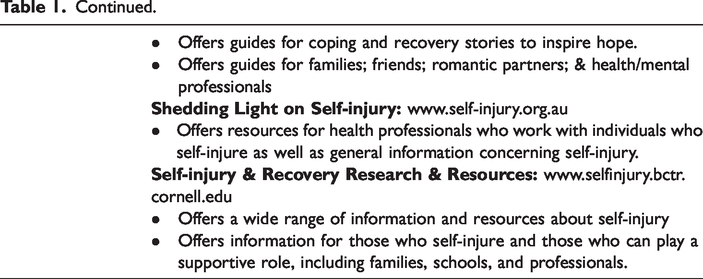
The potential impact of extensive social media use among students is subject to ongoing research. Specifically for individuals engaging in NSSI, online activities may play an even more important role during the COVID-19 pandemic, as research has shown the Internet may have particular salience for youth who self-injure (e.g., Lewis et al., 2011; Lewis & Seko, 2016). As online activities related to NSSI may carry both potential benefits (mitigation of social isolation, recovery encouragement, emotional self-disclosure, curbing NSSI urges), and potential risks (NSSI reinforcement, triggering NSSI urges, stigmatization of NSSI; Lewis & Seko, 2016), it will be important to foster open communication with youth about their online activities, and to share websites and resources youth can draw upon when needed (see Table 1; Lewis et al., 2019; Mahdy & Lewis, 2013).
Resources schools can share to support students.
Consistent with the above, it will be important to harness the Internet as a means of fostering social support among students – especially those students who engage in NSSI, who may feel particularly alone (Lewis & Seko, 2016). Indeed, in the context of COVID-19, many students are likely to experience a thwarted sense of connection with friends, fellow students, and their broader school community, due to stay-at-home orders and school closures. Although a number of these youth may already be supporting one another given their high usage of online activity and related social networking (Uhls et al., 2017), schools can nonetheless play a role in facilitating social support. At a basic level, messaging students to encourage regular social time with peers via online video conferencing software or their existing social network platforms may be beneficial. In line with this, some schools have implemented “school spirit” campaigns to bring students together in an effort to maintain a sense of school community. This can involve daily or weekly themes (e.g., centred on art, music, holidays, sports, or dressing in a particular way) or other light-hearted activities (e.g., contests, scavenger hunts, and games) in which students meet virtually or post photographs or videos that are viewable by others within that community. Naturally, the frequency of these initiatives would hinge on the nature of the activity and the school’s resources. Further, it would be important that these activities be light-hearted and distinct from the delivery of academic curriculum; they also ought to be tailored to the developmental level of students. To this end, eliciting student input may encourage student engagement. Additionally, schools can similarly engage students in activities with altruistic themes (e.g., video or photo messages to front-line workers or related community-based organizations). Such activities may not only offer a sense of connection and support but also be rewarding for students. Extra-curricular activities such as these are known to be associated with greater school engagement and improved academic outcomes (Chapin et al., 2019; Covay & Carbonaro, 2010).
E-mental health
Beyond provision of social support, the use of tele-health, online, and virtual platforms has been endorsed by a number of countries (e.g., Order of Psychologist of Quebec; Australian Government; WHO Inter-Agency Standing Committee). Yet adapting to using online platforms to provide mental health support requires time to understand how to use the technology and for youth to have a safe space and comfort level in receiving services in this manner. Students report uncertainty about confidentiality and a preference for face-to-face services as barriers to seeking support online (Kauer et al., 2014). Despite these concerns, the benefits of youth receiving online support by (school) mental health professionals cannot be understated; for example, an increased use of online support among adolescents with mental health problems has recently been observed during the German COVID-19 lock-down (Kaess et al., 2020). Keeping this in mind, traditional therapeutic interventions that have been practiced by mental health professionals in supporting youth who engage in NSSI prior to the COVID-19 pandemic need to be altered in the current context. Moving forward, it will be critical to implement creative, evidence informed, and sustained support using online platforms to connect with youth, as well as user-friendly resources and information that resonate with youth who engage in or are at-risk for NSSI (Golberstein et al., 2020). Some initiatives and projects are currently underway (e.g., Kaess et al., 2019), hopefully being able to provide adolescents who self-injure with easily accessible, but evidence-based, intervention via the Internet.
Limited access to internet
It is worth noting that many students do not have regular access to virtual technology, and for some the Internet may not be accessible at all. Accordingly, it will be important to implement initiatives that include all students (Ghosh et al., 2020). In some regions, schools may be able to lobby within their school boards or provincial/state educational bodies to provide WiFi or broadband access to families who do not presently have such access. In some cases, schools may also be able to provide families with temporary access to laptops or tablets. Where this is not viable, schools can work toward expanding their WiFi signals, thus permitting families and students to drive to school parking lots to access online materials and thus engage in some of the suggested activities noted above. In a similar vein, schools can make use of busses as “WiFi hotspots” (assuming appropriate social distancing protocols can be maintained) that can drive to central locations in communities as a means of providing connection to the Internet. Outside of this, schools can make use of letter-writing campaigns and issue in-print school newsletters in which some of the above initiatives (e.g., at-home games, school-based challenges) are shared. Among high school students, just 10 minutes per week spent writing gratitude letters is associated with increased life satisfaction, feelings of connectedness, and motivation to improve themselves (Armenta et al., 2020). Gratitude diaries also foster school belonging among primary school students (Diebel et al., 2016). As delivery times through postal services may be delayed in the current pandemic context, use of pick-up stations at schools can ensure more timely access to materials and busses can also be used to deliver materials to students. In keeping with mention of engagement in altruistic activities, schools can encourage social connection and community by offering letter-writing or card-making initiatives for front-line workers or other community stakeholders (e.g., individuals in long-term care).
What can schools do?
As previously stated, and addressed in greater detail elsewhere (e.g., Hasking et al., 2016), schools can play a vital role in the context of supporting students who self-injure and in fostering a climate in which students feel safe reaching out for support. The role of schools in responding to NSSI is perhaps especially salient given the current COVID-19 pandemic context and the exacerbation of stress and mental health difficulties known to play a role in NSSI. Indeed, school staff and mental health professionals can play vital support roles by ensuring students are aware that they are there, engaged, and ready to offer support (Berger et al., 2013). This is especially necessary for youth who are more vulnerable.
As noted above, it will be critical to implement sustained support using online platforms to connect with youth who engage in or are at-risk for NSSI. While the development of specific e-mental health for NSSI is still in its early stages, the Internet can still be used as a medium to provide information and care to students who need it. A key step in this regard is the widespread provision of resources that students can use to cope with urges to self-injure and the difficult emotional experiences that often precede NSSI. Further, it is important that school staff and mental health professionals who interact with students are equipped with resources to share with students and to draw on when discussing NSSI with them (Berger et al., 2017). The centrality of effectively responding to students who self-injure during this uncertain period cannot be overstated. As staff and school mental health professionals may also interact with families during these challenging times, being aware of resources to share with concerned parents and caregivers will also go a long way in supporting students who self-injure.
Accordingly, Table 1 outlines a number of resources for responding to NSSI (grouped by stakeholder) that can be widely distributed to, and discussed with, administrators, school staff, families, and youth. To maximize the uptake of these resources we recommend that administrators distribute and review them with all school staff and professionals. Doing so ensures that all school personnel are equipped to address and respond to NSSI, and signals the prioritization of student mental health and wellbeing. In addition, sharing student and family-focused resources on school websites, social media platforms, and in-print newsletters can go a long way to ensuring these resources are easily accessible during times of need. Alongside this, providing resources in the context of other health and wellbeing initiatives (e.g., mental health awareness campaigns, healthy coping activities, stress-reduction ideas) that occur throughout the school year can further increase the awareness and use of these resources.
Further, we recognize that COVID-19 has impacted all individuals. To this end, it is essential that school staff and personnel do not forget their own wellbeing. The many demands placed upon them in the current pandemic context, in tandem with their own stressors brought on by COVID-19, underscore the need for staff to also prioritize their own mental wellbeing. As has been noted in mental healthcare contexts (Hofmeyer & Taylor, 2020; Pfefferbaum & North, 2020)) consulting and debriefing with colleagues as well as seeking support when needed is recommended.
Strategies for supporting parents
Youth are less likely to disclose NSSI to parents than to peers, but during a pandemic when many youth and parents find themselves at home together for longer periods of time, parents may be more likely to discover their child’s NSSI. Alternatively, parents may learn of their child’s NSSI from school counselors or other school personnel (Oldershaw et al., 2008). During the COVID-19 pandemic, school-based mental health professionals should be prepared to continue to assist youth who self-injure, and their parents, in multiple formats. Research on parent reactions and needs related to their child’s NSSI tend to converge on a few main areas: education about NSSI, providing information and resources about support and self-care, and help in finding treatment for their child, themselves, and/or family therapy (Arbuthnott & Lewis, 2015). Parents experience an array of emotions upon learning of their child’s NSSI including shock, anger, sadness, guilt, and embarrassment (Byrne et al., 2008). It is also common for parents to feel overwhelmed, helpless, and alone in their struggle with this particular issue, while also having misunderstandings about NSSI and why their child would choose to hurt themselves. Parents report struggling with stress about their child’s self-injury and its effect on their confidence in parenting (Whitlock, et al., 2018). Additionally, some parents choose to increase their time at home with a child who is self-injuring, which may create financial strain on the family if working hours are decreased or eliminated (McDonald et al., 2007).
For all of these parental concerns, schools can prepare to respond by identifying printed materials and reputable websites on youth NSSI and being ready to distribute this information as needed (see examples in Resources table). Initial support for parents is critical since research has found that poor initial support for parents about NSSI is associated with decreased likelihood of parent’s seeking treatment for their child (Oldershaw et al., 2008). Schools can also be ready to provide information to parents on local or virtual support groups. Many parents express a desire for such groups as they anticipate receiving emotional support, learning from other parents in similar situations, and decreasing their feelings of isolation (Byrne et al., 2008). School personnel can search and inquire about local and virtual resources to be able to recommend to parents who need them. Lastly, parents likely need to be reminded to engage in self-care in the midst of supporting their child who self-injures, along with looking after other family members, and the general stress that the COVID-19 pandemic has created (Coyne et al., 2020). If schools have the resources to do so, they may consider offering programs such as the Resourceful Adolescent Parent Program (RAP-P) or the Supporting Parents and Carers (SPACE) program. Both are focused on supporting parents of children with suicidal or self-injurious behavior and have been shown to improve family functioning and decrease parent distress (Pineda & Dadds, 2013; Power et al., 2009). Online resources for parents will be essential for the near feature as the uncertainties of COVID-19 and its impact on schools, children, and families looms large.
Ethical considerations
While the availability and accessibility of online supports and resources appears to offer a panacea for vulnerable students, there are several ethical issues that warrant consideration. As noted above, online activities can have both benefits and potential risks for individuals who self-injure (Lewis & Seko, 2016). Among the potential risks is the possibility that sharing experiences of NSSI online may prompt comments that reinforce the behaviour, or comments that may further stigmatise individuals who self-injure. The potential for graphic or stylised images of NSSI to be triggering for vulnerable individuals has led to online environments such as Instagram and Facebook modifying their policies to prohibit posting such content (Mosseri, 2019).
Further, schools are often concerned about the potential for socialization effects, whereby discussion of NSSI among students may increase risk of students engaging in NSSI. While most individuals who self-injure do not disclose their behaviour to others, some students can gain the idea to self-injure from others. For this reason, we recommend that schools discuss self-injury within a broad context of coping strategies and avoid detailed discussion of methods of self-injury or displaying graphic NSSI images (Hasking et al., 2019, 2020). Given the significant benefits of online support for individuals who self-injure (Lewis & Seko, 2016), we encourage schools to embrace online resources during the pandemic, but to be mindful that the resources they are recommending follow these guidelines.
Beyond the provision of information and resources online, e-mental health treatments also come with benefits and potential risks (Hilty et al., 2017; van Daele et al., 2020). Among the benefits, particularly during the COVID-19 pandemic, are the ability to provide more equitable access to care, and continuity of care to students who regularly see the school mental health professional (Committee for Evidence-Based Practice, 2019). However, there are a number of ethical arguments against the provision of e-mental health (Stoll et al., 2020.) Among the most important is the need to ensure privacy and security of any information being transmitted online. Students may be reluctant to discuss their mental health from home, where parents or siblings may be in close proximity. Further, e-mental health requires that mental health professionals are trained in both the technology and in the provision of online services. Communication may be more difficult online, as many of the non-verbal cues (e.g., body posture, gait when entering a room) may not be available. Weak internet connections may also mean time lags, or periods of drop out, where important clinical information may be missed. In these cases, email communication may be helpful, although may limit the ability to express empathy (Stoll et al., 2020). Finally, particularly in the context of NSSI, e-treatments may offer a point for crisis intervention. With access to emergency departments limited (or perhaps unfavourable options to some), students may reach out to a mental health professional online and receive immediate care and support. Further evidence regarding the efficacy of these approaches in the context of NSSI is needed.
Future research directions
The rapidly changing and ongoing nature of the COVID-19 pandemic means that, by necessity, the recommendations and considerations discussed here are drawn from research conducted outside of pandemic settings. In addition, although previous research has demonstrated the impact of previous modern public health crises such as SARS, H1N1, and Ebola on psychological wellbeing in general (Brooks et al., 2020), given the widespread nature of the COVID-19 pandemic, these previous crises -and thus their findings- may not be directly comparable. Efforts to provide up-to-date evidence are underway. Mostly notably, John et al. (2020) are currently conducting a living systematic review of the impact of the COVID-19 pandemic on self-harm and suicide. New research is screened monthly, and the report updated regularly in order to provide a regular review of the current evidence to guide health and policy decision-making. Given that some places are re-entering widespread lockdown/quarantine measures after a period of loosening restriction (Victoria, Australia; Lorio, 2020) or extending stay-at-home orders indefinitely (California, USA; Shelby & Parvini, 2020), research should consider the impact of multiple lockdown transitions and extensions for adolescents, their families, and schools. Finally, research is needed to guide schools’ responses in supporting students and families in the transition back to face-to-face teaching, and the stress and uncertainty these changes bring.
Conclusion
Schools are usually ideally positioned to identify and appropriately refer students who self-injure, and to offer evidence-based prevention and early intervention programs to support the emotional wellbeing of students. In the advent of the COVID-19 pandemic, many of the protective factors provided by schools are no longer available to students. Concerns about the impact of COVID-19 may elevate existing anxieties, and social isolation, shifts to online learning, and lack of access to resources pose additional challenges for students, staff, and families. Schools can work to ensure ongoing care to students at risk of NSSI by engaging in online support of students, and provision of resources to students and their families.
Footnotes
Declaration of conflicting interests
The author(s) declared no potential conflicts of interest with respect to the research, authorship, and/or publication of this article.
Funding
The author(s) received no financial support for the research, authorship, and/or publication of this article.
