




Abstract
This paper presents an experiment on the comprehension of the negative indefinite pronoun nessuno (‘no one’) in different syntactic structures in Italian children aged 4 to 6. Specifically, the study aimed at determining when the meaning of nessuno is acquired, as well as whether negative concord structures showing both the sentential negation non (‘not’) and postverbal nessuno (e.g., ‘Non l’ha vinto nessuno’, lit. ‘Not it has won no one’) are easier to compute and, therefore, acquired earlier than structures displaying only preverbal nessuno (e.g., ‘Nessuno l’ha vinto’, lit. ‘No one it has won’) – a prediction following from a decomposition analysis of negative indefinites coupled with the Transparency Principle. Forty Italian-speaking children completed a Truth Value Judgement Task from which it emerged that the comprehension of nessuno is already almost at ceiling at 4 years of age, and that no difference in accuracy rates holds between pre- and postverbal nessuno. Although these findings neither support nor refute our predictions – that is, that the more linguistic material realised, the easier the comprehension – they are particularly interesting as they provide evidence for an early acquisition of nessuno regardless of the syntactic context. This, in turn, corroborates the idea that the late mastery of the double negation reading of certain Italian sentences featuring a preverbal negative indefinite followed by the sentential negative marker non is not to be attributed to difficulties in the processing of the negative information conveyed by the indefinite itself. Rather, it is more likely due to the processing of double negation requiring increased working memory resources and involving the detection and integration of both pragmatic and prosodic cues.
Introduction
The Acquisition of Negation in Italian
In propositional logic, negation can be defined as the abstract operation which reverses the truth value of any sentence p to which it is applied. This means that if p is true, its negation ¬p will be false. Conversely, if ¬p is true, p will be false. Importantly, negation can be applied iteratively to the same sentence in logic. Whenever negation is applied to an already negated sentence (¬¬p), the meaning of the resulting sentence equals to that of the original, non-negated one (p).
Negation in natural language (NL) is not as straightforward, though. First, NL negation can be expressed in a variety of ways. For example, it can be conveyed via anaphoric negative markers such as no, sentential negative markers like not, but also adverbs like never, indefinite pronouns like no one or nothing, verbs like doubt, or prefixes like in- or un-. Second, negation can take scope over entire sentences, but it can also scope over parts of them. Third, only in some languages do two negations appearing in the same clause end up conveying a (weakened) affirmation as in logic (Horn, 1989). In a sub-group of languages (van der Auwera & Van Alsenoy, 2016), two clause-mate negations are rather interpreted as a single semantic negation, a phenomenon known as ‘negative concord’ after Labov (1972) – henceforth, NC. Fourth, negative sentences are acceptable only if pragmatically justified in the context of utterance, that is, if employed to deny some previously built expectations (Givón, 1978, 1993; Glenberg et al., 1999; Horn, 1989; Wason, 1965, 1971; Zhou et al., 2014).
Given all these factors, one could assume negative systems to be fairly complex to acquire for the language learner. Yet, children start producing negation in language very early on. The acquisition of negation has received much attention in a variety of languages in the past few decades (Dimroth, 2010), but when it comes to Italian, the literature is somewhat sparse. As reviewed in Tagliani et al. (2022), only Volterra and Antinucci (1979) conducted a pragmatic study on the acquisition of negation, and Pagliarini et al. (2018, 2022) looked at the interpretation of sentences displaying both negation and disjunction. To respond to the lack of a systematic investigation in this area, Tagliani et al. (2022) carried out a corpus search on the CHILDES database (MacWhinney, 2000) in which they first identified the longitudinal studies conducted with monolingual Italian children aged 1;6 to 4;0. To spot possible developmental patterns, they subsequently isolated the children whose observation period was longer than 6 months, and whose speech would present negative expressions. This left them with four children aged 1;7 to 3;4 from the Calambrone (Cipriani et al., 1989) and the Antelmi (1997) corpora. Their utterances were examined to inspect the development of the mapping between the negative words no (‘no’) and non (‘not’) and the negative functions of ‘rejection’ (i.e., when no/non are used to reject something that children might have been told or offered), ‘nonexistence’ (i.e., when no/non are employed to convey that something is missing or has disappeared), and ‘denial’ (i.e., the truth-functional use of no/non). The authors observed that Italian children begin to say no around 19 months of age, whereas the first instances of sentential non appear around 23/24 months. However, in line with cross-linguistic observations, they also noticed that children seem to map more limited functions onto these negative words than those mapped by adult speakers. Specifically, their findings appear in line with Bloom’s (1970) argument, in that Italian children initially use anaphoric no – or the nonadult-like form no + VP – to mainly convey rejection. Later on, their productions begin to show instances of the functions of nonexistence and denial, which are expressed more and more via sentential non (‘not’) with the increase of age and, importantly, of mean length of utterance (MLU). Additionally, Tagliani et al. (2022) looked at the emergence of NC constructions in the children’s spontaneous speech, focussing on the negative indefinites niente, nulla (‘nothing’), and nessuno (‘no one’). They found NC constructions to be produced from age 2, with the most frequent negative indefinites being niente and nulla. As for nessuno, it was found to be less frequent than the other two, and to be first produced at 2;1 years of age, either in postverbal position following sentential non (1) or in ungrammatical sentences such as (2): 1
(1) No non c’è nessuno.
2
No NEG there is n-one ‘No, there isn’t anyone’ (NC) (2) *C’è nessuno.
3
There is n-one ‘There is no one’
To our knowledge, aside from Tagliani et al. (2022), only four experimental studies were conducted on the acquisition of negative indefinites in Italian. Moscati (2024) employed an eye-tracking Visual World Paradigm to look at the online processing of the preverbal indefinite determiner nessuno (‘no’) versus the universal quantifier tutti (‘all’) (as in ‘Nessun treno è giallo’ versus ‘Tutti i treni sono gialli’, lit. ‘No train is yellow’ versus ‘All the trains are yellow’), where he found that the processing of nessuno is more costly than that of tutti until age 5. Tagliani (2019) and Moscati (2020) focussed instead on the interpretation of the preverbal indefinite pronoun nessuno in structures that can receive a double negation (DN, i.e., affirmative) reading, as in (3) and (4): (3) Nessuno non è andato all’asilo.
4
N-one NEG is gone to-the kindergarten ‘No one didn’t go to the kindergarten’ = ‘Everyone went to the kindergarten’ (DN) (4) Q: Chi non è arrivato al party di Puffetta?
5
‘Who didn’t reach Smurfette’s party?’ A: Nessuno. N-one ‘No one [didn’t reach Smurfette’s party]’ = ‘Everyone reached Smurfette’s party’ (DN)
From these works, it emerged that Italian children do not master DN readings until age 7;3. Before that age, they tend to interpret DN sentences as if they were NC, in line with cross-linguistic observations even from languages whose adult grammar in principle does not allow for NC, such as German (Nicolae & Yatsushiro, 2020), Standard English (Thornton et al., 2016), and Mandarin Chinese (Zhou et al., 2014). These findings were interpreted by the authors as evidence that the comprehension of DN structures poses additional challenges compared to that of NC ones. Such challenges may arise, on the one hand, from increased working memory demands, since the processing of DN sentences requires to first hold two negative elements in memory, and to subsequently derive their equivalence to an affirmative meaning (Tagliani, 2019). On the other hand, they may also stem from the fact that DN interpretations are typically signalled by specific pragmatic (Nicolae & Yatsushiro, 2020; Puskás, 2012) and prosodic cues (Nicolae & Yatsushiro, 2020; Prieto et al., 2013), and young children are known to be less sensitive to both pragmatics (Chien & Wexler, 1990; Grodzinsky & Reinhart, 1993; Reinhart, 2006) and prosody (Gualmini et al., 2003; Speer & Ito, 2009), or at least to struggle to coordinate their pragmatic abilities with both prosody and syntax (Grinstead, 2021; McDaniel & Maxfield, 1992; Serratrice et al., 2004; Zhou et al., 2012; for a broader discussion, see also Driemel et al., 2023).
Turning to production, using an elicited production task, Tagliani (2019) observed no consistent productions of DN structures until age 7;3, but reported correct productions of simple negative sentences with nessuno as the sole negative element around age 4. By contrast, Bill et al. (2025), always via an elicited production experiment, found that Italian-speaking children struggle with the production of subject nessuno until around age 5. In their earlier work, Bill et al. (2024) had discovered similar difficulties with the production of subject kein (‘no’) in German children up to age 6. There, the authors could verify that only when prompted to produce subject kein did children resort to alternative structures where, for instance, kein was placed in object position. This asymmetry was indeed not mirrored in comprehension, nor in the production of the universal quantifier alle (‘all’). Adopting a decomposition analysis of negative indefinites (Bech, 1955; Jacobs, 1980; Penka, 2007, 2011; Rullmann, 1995; Sauerland, 2000; von Stechow, 1993), the authors explained these findings as follows. In order for kein subjects to be interpreted as negative, the indefinite must be covertly reconstructed under a silent negative operator. Such reconstruction is not required with kein objects, instead, as in these cases, the indefinite already sits in the scope of the negative operator. Hence, they concluded that children’s tendency to avoid producing kein subjects could reflect an attempt to circumvent the costly operation of reconstructing the subject under negation, rather than a more general difficulty with the negative expression kein.
The main findings reported by Bill et al. (2024, 2025) – namely, the subject (preverbal) versus object (postverbal) asymmetry in the production of kein in child German, and the difficulties in the production of subject nessuno in child Italian – raise interesting cross-linguistic questions that can be tested in Italian via the even more minimal comparison between preverbal and postverbal negative indefinite subjects. In line with that, our study contrasts the comprehension of structures where postverbal subject nessuno is licensed by the sentential negative marker non with that of sentences in which preverbal subject nessuno is the only negatively marked element in the clause. To better specify our research questions and predictions, we provide relevant linguistic background in the next section.
Linguistic Background
The phenomenon of negative concord has been explained as a form of syntactic agreement between (multiple) elements syntactically marked as negative – but crucially lacking semantic negation – and a negative operator which must always be overtly realised or can sometimes remain silent, depending on the language (Brown, 1999; Deal, 2022; Ladusaw, 1992, 1995; Penka, 2007, 2011; Tubau, 2016; Zeijlstra, 2004). In languages displaying this phenomenon, negatively marked elements thus have no negative semantic import themselves. They only carry uninterpretable [uNEG] features which need to be checked against the [iNEG] feature of a c-commanding negative operator Op¬ (Zeijlstra, 2004).
In languages presenting a non-Strict type of NC (Giannakidou, 1998, 2000), such as Italian, negative words must co-occur with overt sentential negation when postverbal, though not when preverbal. That is because when negatively marked elements are postverbal, Op¬ is realised as the sentential negative marker, so that it is the sentential negation that carries the interpretable [iNEG] feature against which the [uNEG] features of the other negative words are checked (5). With preverbal negative words, the checking of [uNEG] features rather happens against the [iNEG] feature of a c-commanding abstract Op¬, which is introduced to license these words in the structure (6).
(5) Maria non ha visto nessuno. Maria non[iNEG] ha visto nessuno[uNEG] Maria NEG has seen n-one ‘Maria didn’t see no one’ = ‘Maria didn’t see anyone’ (NC) (6) Nessuno ha visto Maria. Op¬ [iNEG] Nessuno[uNEG] ha visto Maria N-one has seen Maria ‘No one saw Maria’
Importantly, following Penka (2007, 2011), English and German negative words are also semantically non-negative elements only morpho-syntactically marked for negation and receiving a negative interpretation through agreement with a silent Op¬. From this, it follows that without agreement, the meaning of negative indefinites (e.g. nessuno or no one) would be equal to that of the correspondent positive indefinites (i.e. qualcuno or someone) both in languages with and without NC.
The Study
Aims and Objectives
In line with cross-linguistic observations (Nicolae & Yatsushiro, 2020; Thornton et al., 2016; Zhou et al., 2014), Tagliani (2019) and Moscati (2020) found that Italian-speaking children have difficulties in the comprehension of preverbal nessuno when its co-occurrence with the sentential negative marker non conveys a DN reading. At the same time, Tagliani (2019) documented accurate productions of simple negative sentences with preverbal nessuno from around age 4. Conversely, Bill et al. (2024, 2025) reported that Italian-speaking children tend to avoid producing subject nessuno until about age 5, whereas German-speaking ones showcase difficulties in producing kein up to age 6 when the negative indefinite functions as (preverbal) subject, though not as (postverbal) object. Now, assuming that, in languages with a non-Strict type of NC, the semantics of DN structures is different from that of NC ones (Zeijlstra, 2004), that negative indefinites universally lack a negative semantic import (Penka, 2007, 2011; Zeijlstra, 2004), and that it is easier for children to learn structures encoding concepts in a one-to-one way than in a many-to-one way – something known as the Transparency Principle (Jackendoff, 1990; Slobin & Bever, 1982; Van Hout, 1998; Weist et al., 1997; see also Guasti et al., 2023 for an updated version) – one could expect Italian children to find NC sentences with object negative indefinites as (5) to be easier to understand and produce than sentences with subject negative indefinites as (6). (5) can indeed be held to be more transparent than (6) in that, in (5), Op¬ is overtly spelled out as the sentential negative marker non. This is not the case in (6) though, where the operator making nessuno interpretable as negative remains silent. In (5), all the elements taking part in the negative agreement relation are overt, whereas in (6), this relation must be retrieved based on the evidence that the preverbal indefinite bears a morphological, but semantically void, marker for negation.
The hypothesis that structures with object negative indefinites could be more transparent and easier to acquire than those with subject negative indefinites can be tested in Italian in an interesting way. Italian indeed allows for postverbal subjects, which German does not. This means that the contrast between (preverbal) subject and (postverbal) object kein can be replicated in Italian via the more minimal comparison between pre- and postverbal subject nessuno (7–8). 6
(7) Non l’ha vista nessuno. Non[iNEG] l’ha vista nessuno
[uNEG]
NEG her-Cl has seen n-one ‘No one saw her’ (NC) (8) Nessuno l’ha vista. Op¬[iNEG] Nessuno[uNEG] l’ha vista N-one her-Cl has seen ‘No one saw her’
Predictions
Following from the discussion above, the current study was designed with a twofold aim. First, it intended to identify at what age Italian children master the meaning of nessuno, whether it occurs as the sole negatively marked element in the clause or within NC configurations. Second, it sought to verify whether sentences showcasing co-occurrence of postverbal nessuno with the sentential negative marker non are easier to understand than their correspondents featuring only preverbal nessuno – which could be attributed to the former structures being more transparent than the latter. Based on a decomposition analysis of negative indefinites on the one hand, and on the Transparency Principle on the other, our expectation was to detect higher accuracy rates in the comprehension of structures with postverbal nessuno compared to structures with preverbal nessuno.
Materials and Methods
Participants
Our study was addressed to monolingual Italian-speaking 4 to 6-year-olds. 7 The reason why we decided to target this specific age range is that even though spontaneous production data suggest that children begin to produce nessuno as early as age 2 (Tagliani et al., 2022), experimental evidence remains inconsistent. Tagliani (2019) reported accurate productions of sentences containing preverbal subject nessuno around age 4. In contrast, Bill et al. (2025) found more persistent difficulties in the production of subject nessuno. Similar delays were observed in comprehension, though it must be pointed out that existing studies are limited in number and mainly focus on nessuno in DN structures (Moscati, 2020; Tagliani, 2019). Nevertheless, all these works indicate that the understanding of nessuno continues to develop beyond early childhood. Taken together, these findings thus led us to expect that the comprehension of nessuno would still be incomplete between 4 and 6 years of age.
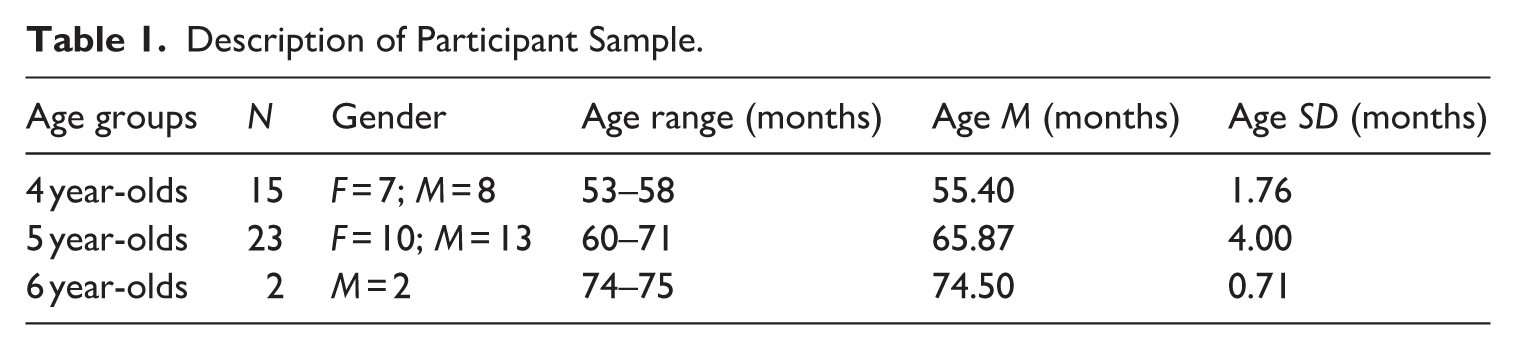
We recruited 60 children, of whom 10 were enrolled for a preliminary pilot study which we conducted to ascertain that the task did not present any major issues and that participants would remain engaged for the entire duration of the game. This pilot allowed us to refine and improve the final version of the experiment. Of the 50 remaining participants, 8 were excluded because they were bilingual – and thus did not meet our inclusion criteria – and 2 because they exceeded the threshold of 25% wrong answers to the second question of each trial (Q2), which was set as a marker of general distraction or lack of involvement in the game (see section ‘Experimental task’). Hence, our final sample was comprised of 40 children (17 females) aged 4;5–6;3 (M = 5.20, Standard deviation [SD] = 0.55; for a more detailed description, see Table 1). The sample was overall balanced for gender and age (χ2(16) = 15.31, p = .50).
Description of Participant Sample.
The study was approved by the Ethics Committee of the University of Milano-Bicocca. None of the children included was identified as having psychiatric, emotional, sensory, or language disabilities. According to the World Medical Association Declaration of Helsinki’s ethical principles, signed informed consent to participation was obtained from parents and verbal consent by children.
Experimental Task
The experiment consisted of a dynamic version of the Truth Value Judgement Task (TVJT) (Crain & McKee, 1985; Crain & Thornton, 1998) in the spirit of Thornton et al. (2016), in which children were first presented with short video-stories and then asked to judge whether Camilla, an absent-minded squirrel who was watching the videos with them, could correctly recall what she saw. In the videos, participants were shown three characters interacting and entertaining the possibility of doing different things. At the end of each story, the characters realise that they did some but not all the things that they wanted to do and, crucially, that there was one thing that no one did (Figure 1). This was arranged in order to meet one of the fundamental requirements for TVJTs, namely, the Condition of Plausible Dissent (Crain et al., 1996), according to which the Question Under Discussion of the story (QUD; Roberts, 2004; von Fintel, 1994) must have at least two possible answers in the context. One is the story’s actual outcome, the other is an alternative outcome whose addition ensures that the true/false utterances that participants are subsequently asked to evaluate be felicitous in the context. Either these utterances are made true by the actual outcome of the story and false by the alternative outcome, or vice versa.

Screen capture of an experimental story.
Below, we report the translation of the whole video-story exemplified in Figure 1: 8
It is the last day of school before Christmas holidays, and the queen, the soccer player, and the clown meet in the hallway.
So, are you ready for the lottery?
Well, I’m not that excited. I never win anything I like!
Oh, come on, it’ll be fun!
Exactly! And who knows what prizes they have this year!
Yeah, we’ll see. Good luck!
At the end of the morning, the three friends meet again in the hallway.
So, how did it go? Did you win anything you like?
It was not too bad. . . I really wanted to win the sunglasses but I’m happy, anyway. I won a new water bottle!
Nice! I wanted the sunglasses, too, but I only won these Christmas cookies. . .
So, I was the unluckiest. I wanted the sunglasses and I won a puzzle, but I hate puzzles!
At the end of each video-story, to check whether she was paying attention, the narrator would ask Camilla if she could recall what happened via two questions, a target and a control one. Target questions made the squirrel answer using a sentence with subject nessuno, be it in preverbal or in postverbal position, as illustrated in (9) in relation to the story in Figure 1.
(9) Target exchange: NARRATOR: ‘Allora Camilla, vediamo se ti ricordi: qualcuno ha vinto il puzzle?’
9
‘So, Camilla, let’s see if you can remember: did anyone win the puzzle?’ CAMILLA: ‘Nessuno l’ha vinto/‘Non l’ha vinto nessuno’ (F) n-one it-Cl has won/NEG it-Cl has won n-one ‘No one won it’/‘No one didn’t win it’ = ‘No one won it’ (NC)
Control questions rather made her answer using a sentence with pre- or postverbal subject definite Determiner Phrases (DPs), as in (10) – always with reference to the story in Figure 1.
(10) Control exchange: NARRATOR: ‘E qualcuno ha vinto la borraccia?’ ‘And did anyone win the water bottle?’ CAMILLA: ‘Il calciatore l’ha vinta/‘L’ha vinta il calciatore’ (F) The soccer player it-Cl has won/It-Cl has won the soccer player ‘The soccer player won it’
In this way, Camilla’s control answers allowed us to check whether children showed any preference for pre- or postverbal subjects independently of the property under scrutiny – namely, the impact of the presence/absence of sentential negation on the comprehension of nessuno.
After each exchange between the narrator and the squirrel – be it target or control – participants were asked to say whether Camilla was right or wrong (Q1 – in target exchanges, that is the question addressing the comprehension of nessuno) and why (Q2 – a more general comprehension question, added as further control). To exemplify Q1 and Q2, in (11–12), we report the specific elicitation formulas that the experimenter would use after the exchanges in (9–10), respectively.
(11) Q1 (EXP): ‘Camilla ha risposto bene?’ ‘Did Camilla answer correctly?’ Q2 (EXP): (if child answer was YES) ‘Quindi qualcuno ha vinto il puzzle? (Chi?)’
10
‘So, did anyone win the puzzle? (Who?)’ (if child answer was NO) ‘Perché no?’
11
‘Why not?’ (12) Q1 (EXP): ‘Camilla ha risposto bene?’ ‘Did Camilla answer correctly?’ Q2 (EXP): (if child answer was YES) ‘Quindi qualcuno ha vinto la borraccia? (Chi?)’ ‘So, did anyone win the water bottle? (Who?)’ (if child answer was NO) ‘Perché no?’ ‘Why not?’
The study presents a 2 × 2 design, with within-subject manipulation of the factors ‘Subject Position’ (preverbal-postverbal) and ‘Question Type’ (target-control). In this way, the sentences that children were asked to evaluate as true or false could appear under four possible conditions:
(a) target – preverbal: subject nessuno preceded the verb and sentential negation was not spelled out.
(b) control – preverbal: subject definite DPs preceded the verb.
(c) target – postverbal: subject nessuno followed the verb and sentential negation was spelled out.
(d) control – postverbal: subject definite DPs followed the verb.
Following Thornton et al. (2016), we created seven short video-stories (one practice, six experimental). The stories in Thornton et al. (2016) centred on two main actions, whereas we opted to simplify our stories by centring them on a single one, which we selected from their pool. We thus ended up representing the following actions: mangiare (‘eat’), vincere (‘win’), cucinare (‘cook’), comprare (‘buy’), pulire (‘clean’), and guidare (‘drive’/‘sail’).
As described above, children were asked to judge two sentences after each video, one target and one control. Overall, participants thus labelled as true or false fourteen sentences, of which six were target – the two utterances following the practice story being controls. Both sentence types were equally divided between those featuring preverbal and postverbal subjects.
The study was implemented on PowerPoint. We generated six random strings of numbers ranging from one to six using an online random string generator. Based on these strings, we created six presentations in which the order of appearance of experimental stories was randomised. We opted to always have the target exchange before the control, and to merely counterbalance ‘Subject Position’ and the truth/falsity of the squirrel’s utterances across stories and sentence types.
The experiment was administered in person. Children were tested individually in a quiet room of the respective schools. Their answers were recorded using an audio recorder and transcribed immediately onto paper by the experimenter. Overall, the task took 20 to 25 min to complete.
Variable Coding
Our measured variables were the accuracy at Q1 and Q2 after all the exchanges between the narrator and Camilla. ‘Q1 accuracy’ was coded as 0 (incorrect) or 1 (correct), whereas ‘Q2 accuracy’ was coded as −1 (incorrect) or 1 (correct). This coding allowed us to derive a further variable summarising in a unique and unambiguous way the joint performance at Q1 and Q2 after each exchange. This variable, which we named ‘Accuracy overall’, was added for descriptive purposes. Given that its four-level coding consists of the four possible combinations of accuracy scores at Q1 and Q2 (−1, 0, 1, 2), it allowed us to directly relate the behaviour at the two questions and to track potential error patterns. The four levels are interpretable as follows:
-1: participants gave wrong answers to both Q1 (0) and Q2 (−1). Such an error pattern could either signal a lack of understanding of the video-story or distraction.
0: participants answered correctly to Q1 (1) but not to Q2 (−1). Since the wrong answer here was given to the general comprehension question, this score could indicate that the answer to Q1 was unreliable.
1: participants answered wrong to Q1 (0) but correctly to Q2 (1). This pattern could signal difficulties with the comprehension of nessuno despite understanding the story, or with adopting Camilla’s perspective.
2: participants answered correctly to both Q1 (1) and Q2 (1).
Data Analyses
As mentioned in the ‘Predictions’ section, our first goal was to observe when Italian children master the meaning of nessuno, while the second was to verify if accuracy rates were higher with postverbal than with preverbal nessuno. Accordingly, we ran two separate mixed-effects binomial logistic regressions on ‘Q1 accuracy’ and ‘Q2 accuracy’, with ‘Subject Position’ and ‘Question Type’ as fixed effects in interaction, ‘Participant’ as random intercept, and ‘Age’ as covariate – as our participants were unevenly distributed across age groups, which precluded age-based group comparisons. For this reason, we also treated ‘Age’ as a continuous variable, centring and scaling it before including it in the model. We chose this approach over treating ‘Age’ as a two-level categorical variable contrasting 4 to 5-year-olds with 5 to 6-year-olds because the former provides a more fine-grained assessment of potential developmental effects, at the same time avoiding issues related to the imbalance between age groups.
Results
Overall Accuracy
Before running the models, we preliminary inspected the data by calculating the rate of occurrence of the four levels of ‘Accuracy overall’. In Table 2, we report the percentage of the various accuracy patterns across ‘Subject Position’ (preverbal-postverbal) and ‘Question Type’ (target-control).
Rates of Accuracy Patterns Across ‘Subject Position’ and ‘Question Type’, Where 2 Stands for Q1 and Q2 Correct, 1 for Q1 Wrong and Q2 Correct, 0 for Q1 Correct and Q2 Wrong, and −1 for Q1 and Q2 Wrong.
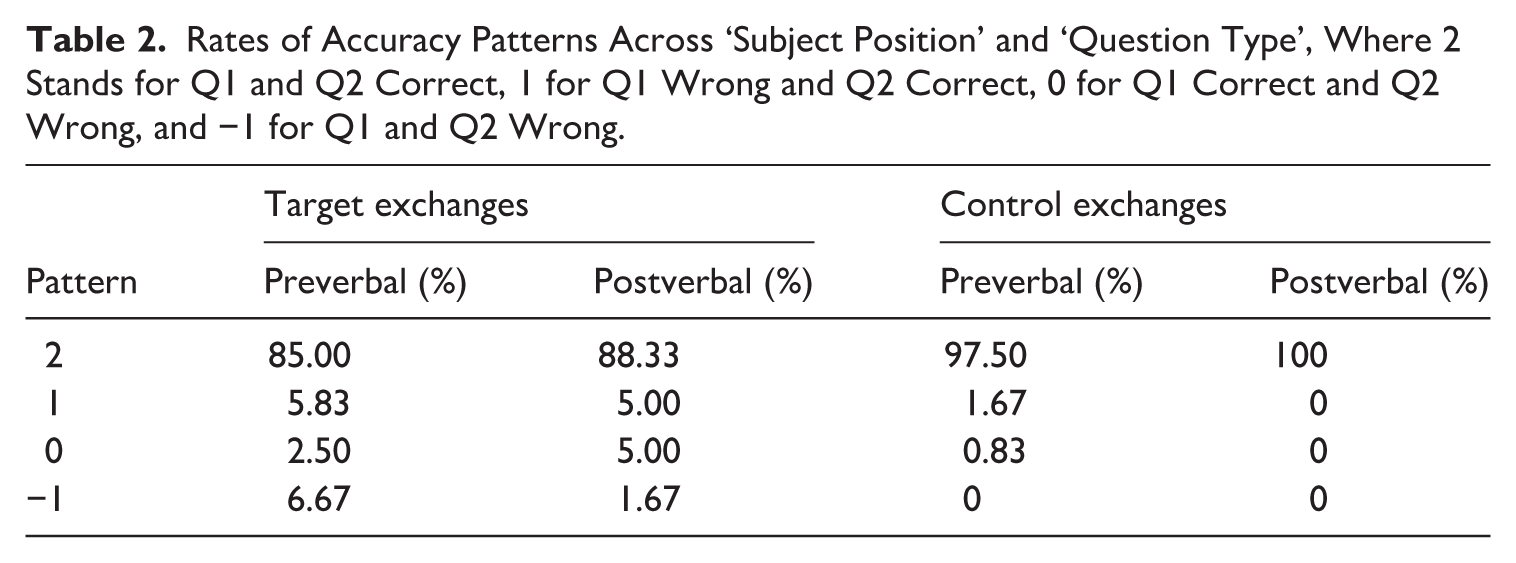
As it can be seen, all patterns occurred at very similar rates across conditions, with Pattern 2 – the one signalling correct responses to both questions – being predominant. We interpreted this as preliminary evidence that participants understood both the content of the video-stories and Camilla’s sentences. As detailed in the following sections, this preliminary evidence was subsequently confirmed by our statistical models.
Accuracy at Q1 and Q2
Contrary to our experimental predictions, the model run on ‘Q1 accuracy’ did not return a significant interaction effect between ‘Subject Position’ and ‘Question Type’ (χ2(1) = 0.01, p = .93), nor a significant main effect of either factor (‘Subject Position’: χ2(1) = 0.01, p = .93; ‘Question Type’: χ2(1) = 0.01, p = .92), nor of ‘Age’ (χ2(1) = 3.45, p = .06). As illustrated in Figure 2, children’s accuracy was overall very high in evaluating all the squirrel’s utterances irrespective of the location of the subject.
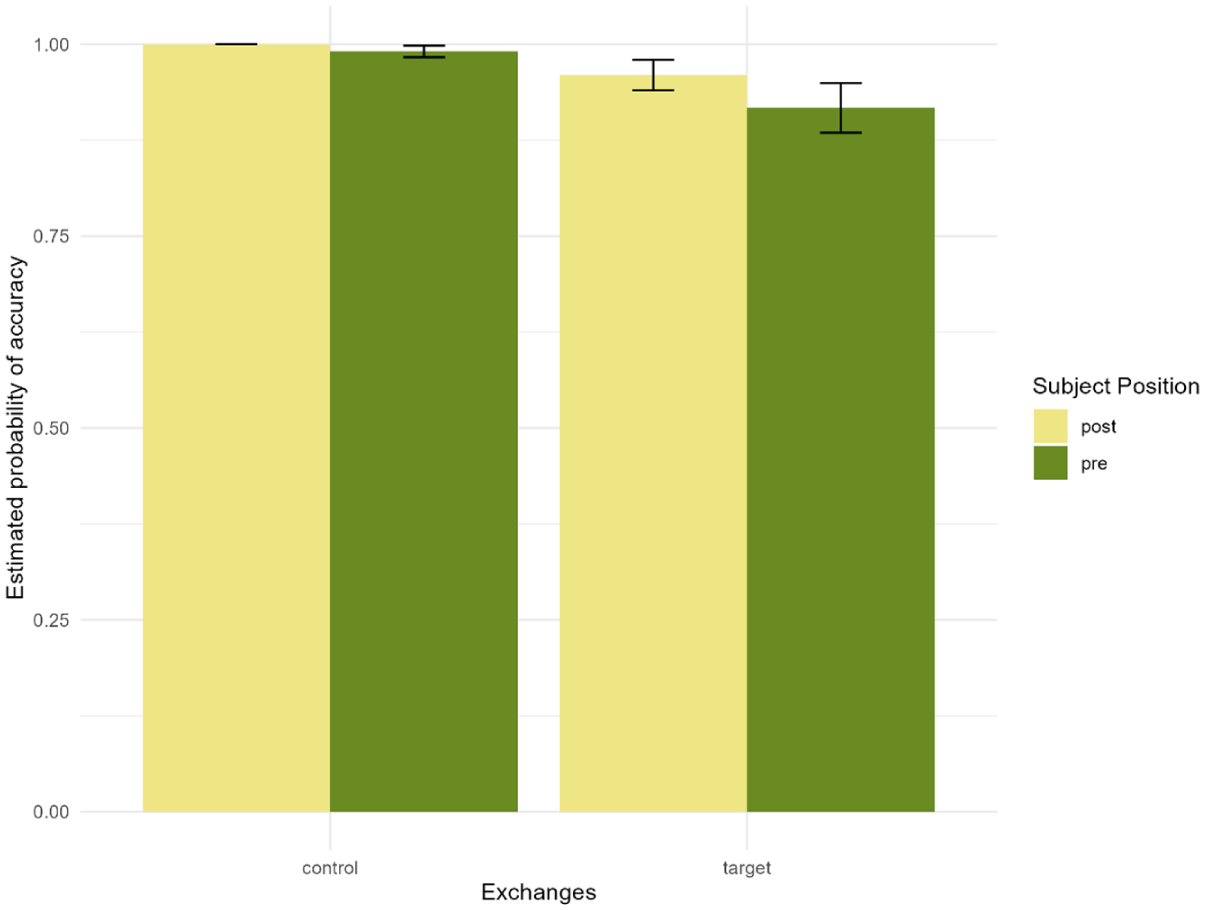
Predicted means of accurate responses at Q1 across ‘Subject Position’ and ‘Question Type’.
Also the model run on ‘Q2 accuracy’ revealed no significant interaction between ‘Subject Position’ and ‘Question Type’ (χ2(1) = 0.00, p = .95), nor a significant main effect of either factor (‘Subject Position’: χ2(1) = 0.00, p = .95; ‘Question Type’: χ2(1) = 0.01, p = .94), nor of ‘Age’ (χ2(1) = 1.52, p = .22). As shown in Figure 3, the accuracy rates at Q2 were very similar in control and target exchanges, and they were also almost identical to the accuracy rates at Q1.
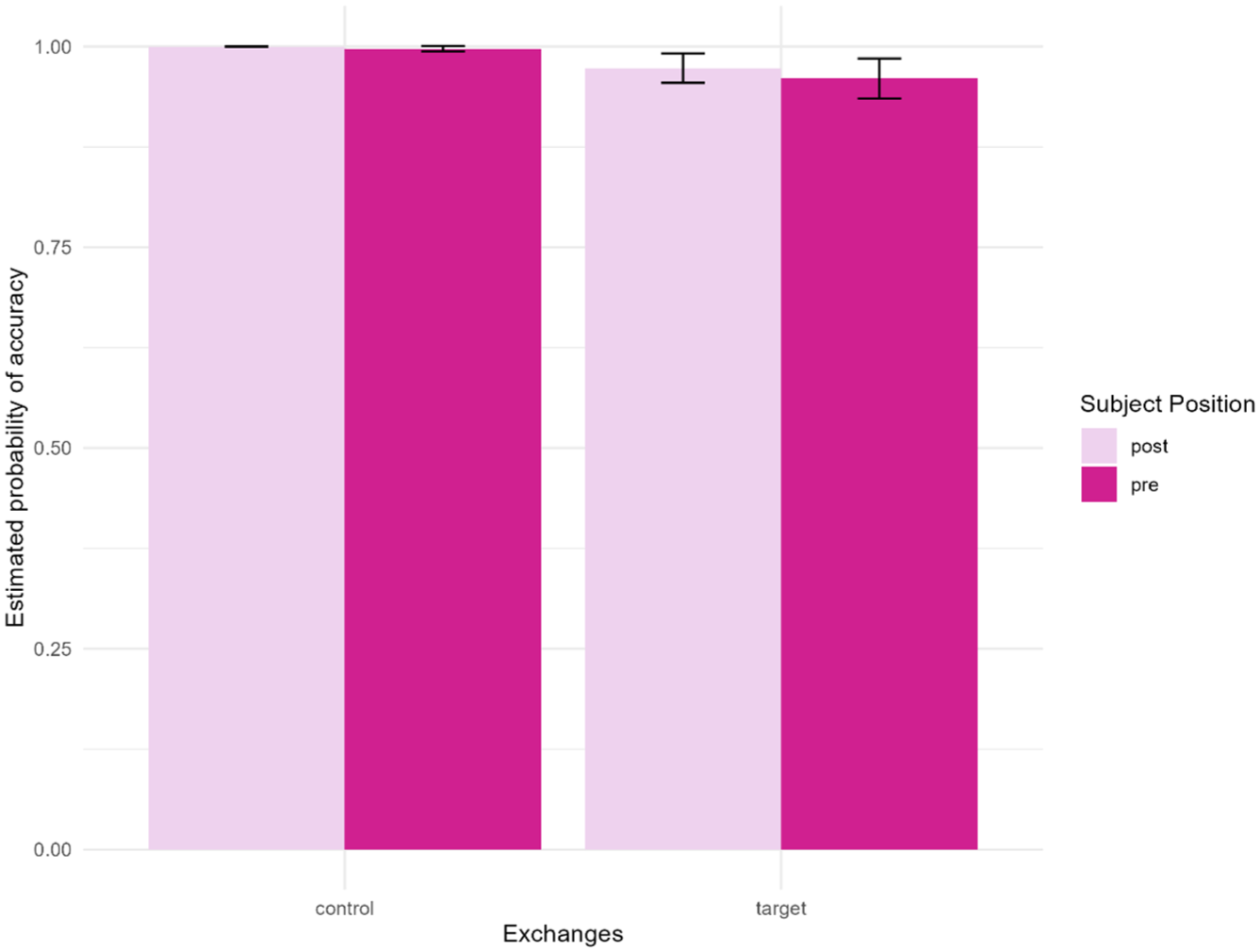
Predicted means of accurate responses at Q2 across ‘Subject Position’ and ‘Question Type’.
Production
Although the goal of the present research was to assess the comprehension of nessuno, the study was set up in a way that it also generated exchanges between the experimenter and the children, which were all recorded and transcribed. Thus, we also collected some ancillary production data, which we will comment upon in a qualitative way.
As mentioned in the ‘Experimental task’ section, participants were asked to judge as true or false six target exchanges. This means that, with 40 participants, there were potentially 240 exchanges between the narrator and the squirrel whose judgement might have prompted children to utter sentences or fragments with nessuno. We say potentially, though, because the aim of the experimenter’s Q2s was just to double-check the comprehension of the situational context, not to make children produce nessuno. Thus, as long as children responded to Q2, even via simple ‘Yes/No’ answers, the experimenter would go on with the administration of the task. This left us with very few data points, which are summarised in Table 3.
Production Rates of Nessuno and of Subject Definite DPs in Children’s Answers to Q2 in Different Constructions.
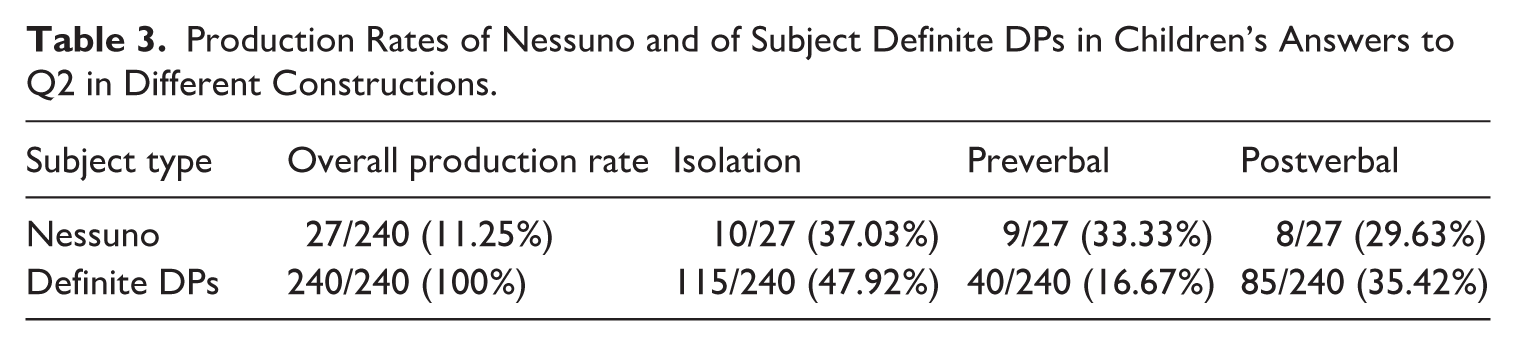
Out of 240 potentially suitable contexts, nessuno was spontaneously produced only 27 times, which equals to an 11.25% production rate. Of these, 10 instances were of nessuno in isolation – as, for example, in ‘No, nessuno’ (lit. ‘No, no one’) – 8 were of nessuno in postverbal position and 9 were of nessuno in preverbal position. All children’s answers to the Q2 of control exchanges displayed subject definite DPs, instead. Of the 240 productions coded, 115 were DPs in isolation – for example, ‘Sì, la regina’ (lit. ‘Yes, the queen’) – 85 were postverbal definite DPs and 40 were preverbal definite DPs.
Discussion
All in all, the current study revealed that the meaning of the negative indefinite pronoun nessuno is already mastered at 4 years of age. The combination of the accuracy scores at Q1 and Q2 (Table 2) – indicated an extremely low and homogeneous rate of occurrence of all possible error patterns, which we took as preliminary evidence that the few documented errors were more likely due to temporary distraction than to any specific difficulty in understanding nessuno or the experimental stories per se.
To verify this conjecture, we carried out more thorough inspections of the responses to Q1 and Q2, separately. The investigation of the accuracy scores at Q1 disclosed a very high proportion of correct responses in the evaluation of sentences with nessuno irrespective of its position (Figure 2). Our statistical model confirmed that the comprehension of nessuno is in place already at 4 years of age and in fact resembles that of the arguably easier-to-process definite DPs.
The examination of the accuracy at Q2, then – the general comprehension question aiming at assessing children’s understanding of the video-stories, as well as the reasoning behind their responses to Q1 (Figure 3) – indicated that participants generally understood the videos. The proportion of correct answers to Q2 was so high that we could safely exclude that the few wrong answers to Q1 in target exchanges were due to a failure to understand the situational context.
Consequently, our research hypothesis stemming from a decomposition analysis of negative indefinites coupled with the Transparency Principle – that is, that the more linguistic material overtly realised, the better the comprehension – could not be verified. Yet, our results prove noteworthy as they challenge the idea that the meaning of nessuno is still difficult for Italian children at age 5 (Bill et al., 2025). While our findings do not dispute that the processing of nessuno might be harder than that of other elements such as the universal quantifier tutti (Moscati, 2024), they rather suggest that, despite its higher processing costs, Italian children can fully grasp its meaning as early as age 4.
As far as production is concerned, the sparse observations that the setup of our paradigm allowed us to collect revealed a clear preference for subject definite DPs in postverbal position, though apparently no preference for nessuno in any specific position. However, no reliable conclusion can yet be drawn because of the very few data points gathered. First and foremost, a more systematic assessment of the production of nessuno in child Italian is therefore needed.
In a large-scale study on the acquisition of quantifiers, Katsos et al. (2016) administered a TVJT to 768 children speaking 31 different languages belonging to 11 different language subfamilies. From this work, it emerged that negative quantifiers are acquired earlier in languages with NC than in languages without NC. According to the authors, this could be attributable to negative concord better highlighting the difference between positive and negative quantifiers. It must be noticed that this view also aligns with an analysis claiming that NC structures are more transparent than non-NC ones due to the negation there being overtly realised not only syntactically, but also semantically – in Italian, for instance, Op¬ is spelled out as non with postverbal nessuno. The idea that children acquiring languages with NC could be exposed to a more transparent linguistic input, which is what would in turn facilitate the acquisition of negative indefinites, is thus contemplated both by Katsos et al.’s (2016) proposal and by the decomposition approach (Bill et al., 2024).
Although caution should be exercised, as the paradigms employed were different, the comprehension data collected by Bill et al. (2024) in German and via the current study in Italian do not seem to provide evidence supporting the advantage of NC in the acquisition of negative indefinites. The evidence that we collected indeed aligns with the German data. Both in German and Italian, the accuracy rates were fairly high in the age range tested. In German, no significant difference was found between the comprehension of kein subjects and that of kein objects (Bill et al., 2024: 22). Similarly, in Italian, no difference was observed between the accuracy rates with pre- versus postverbal subject nessuno (Figure 2).
Despite not observing higher accuracy rates in the comprehension of the allegedly more transparent postverbal nessuno, our findings can still find an explanation within Katsos et al.’s (2016) account. The fact that the comprehension of nessuno was found to be at ceiling as early as age 4 independently of its co-occurrence with sentential non could be explained in the following terms. In a non-Strict NC language like Italian, where the same meaning can be conveyed through NC and non-NC structures, children are often but, importantly, not always exposed to a more transparent input. This exposure may itself facilitate the acquisition of negative indefinites and potentially accelerate their mastery. Once these forms are well established, then this knowledge would generalise to the less transparent constructions so that, after a certain age, any differences in the comprehension and/or production of negative indefinites across structures would no longer be observable.
Something that may resemble a facilitatory effect of exposure to a language with NC could instead be the alleged lack of a difference between the production of pre- and postverbal nessuno in Italian. While in German, children were found to struggle with the production of kein subjects but not of kein objects up to age 6 (Bill et al., 2024), the evidence coming from the Italian experiments is rather contradictory. Tagliani (2019) observed that Italian children can correctly produce sentences with preverbal nessuno already at age 4, whereas Bill et al. (2025) reported difficulties with the production of subject nessuno in older children. Our scattered spontaneous production data seem to align more with Tagliani’s (2019) findings, in that no difference between the production of pre- and postverbal subject nessuno emerged from our study. We acknowledge that this observation is far from reliable because of the few instances of nessuno collected via our paradigm – which was indeed not designed to elicit nessuno, but only to make children justify their previously given answers. Still, if a more systematic assessment of the production of nessuno confirmed our – and Tagliani’s (2019) – preliminary observations, then the advantage of NC might be said to also manifest in the absence of difficulties in producing negative indefinites in any position, at least starting from age 4.
This claim, however, would benefit from further empirical support through a systematic assessment of the production of negative indefinites across a broader range of languages – both with and without NC – as well as in younger age groups, as it is possible that differences in the production of pre- and postverbal nessuno emerge also in Italian, though at a younger age than the one targeted by our study. It can indeed be that via the current work, we recruited children who were already too old and for whom the comprehension of nessuno was already at ceiling. Hence, it remains an open question whether structures with postverbal nessuno might prove to be significantly better understood than their preverbal counterparts by younger children.
As hinted in the ‘Participants’ section, based on previous studies, we expected the comprehension of nessuno to be still incomplete between 4 and 6 years of age. On the contrary, we found no developmental effect within this age range. Several factors may explain why performance in our task was higher than anticipated, even among the younger children. To start with, our results appear consistent with the implicit evidence reported in Moscati (2024), who observed good comprehension of simple negative sentences featuring subject nessuno in (roughly) 4 to 6-year-olds. Moreover, our study targeted less complex structures than those examined in the comprehension experiments by Moscati (2020) and Tagliani (2019). Hence, these results seem to indicate that the comprehension of nessuno both as the sole negative element in the clause and within NC configurations emerges earlier than in DN constructions.
The comparison with the evidence reported in Bill et al. (2025), instead, opens a broader discussion. Acknowledging that any comparison between the two studies should be advanced with caution, given that Bill et al.’s (2025) task assessed production rather than comprehension, there are at least two dimensions along which our experiment may have been less demanding for children. The first concerns the role of contextual support. In our study, the squirrel’s sentences were not only preceded and, thus, legitimised, by the narrator’s questions, but these exchanges were also introduced by videos providing contextual information essential to determine the truth or falsity of Camilla’s statements. By contrast, in Bill et al.’s (2025) experiment, little – if any – contextual information was provided before children were asked to describe test pictures using sentences with subject nessuno. This, we believe, could have played a crucial role in making Bill et al.’s (2025) task hard for 4 to 6-year-olds, as previous research shows that both the comprehension and the production of negative sentences are hindered when the context does not adequately justify their use (Givón, 1978, 1993; Glenberg et al., 1999; Horn, 1989; Wason, 1965, 1971; Zhou et al., 2014).
The second factor relates to working memory demands. Given that our videos lasted about 1 minute, we opted to insert pictures summarising the outcome of the stories at the end of each video – which were displayed while participants listened to the dialogues between the narrator and the squirrel. These visual cues were intended to reduce working memory load, thereby allowing children to fully focus on the comprehension and evaluation of Camilla’s utterances. It is true that the children in Bill et al.’s (2025) experiment were also prompted to produce sentences with subject nessuno while still viewing the relevant pictures. However, it is possible that in a production-based experiment – which is itself more demanding than a comprehension-based one in many respects – and in the absence of sufficient contextual support for negative statements, this aid was insufficient to reveal children’s full competence. By contrast, in a comprehension-based task as our own, in which adequate contextual support was also provided, the inclusion of memory cues could have facilitated the full emergence of children’s understanding of nessuno. We acknowledge, however, that such supports cannot substitute direct assessments of cognitive abilities. Accordingly, the points raised above should be understood as cautious hypotheses rather than definitive claims about the memory demands of our task, given that we did not collect any independent measure of working memory or related capacities. This limitation underscores the importance of integrating cognitive measures into linguistic experiments in future work. This would indeed enable researchers to disentangle linguistic competence from domain-general processing demands, to quantify the extent to which cognitive factors shape linguistic performance, and to ultimately reach a more precise characterisation of children’s linguistic abilities.
While some features of our task may have promoted optimal performance among 4 to 6-year-olds, it is also worth noting that the current paradigm might exceed the cognitive resources of younger children, unless appropriately adapted. For instance, the current time of administration of the task, which was not problematic for 4 to 6-year-olds, might become so for younger children, who may grow tired or bored over time – especially when considering the cognitive demands of the videos in terms of attention and memory load. One possible way to address this issue could be to make the video-stories even shorter and more essential in terms of actions displayed. Alternatively, one could lessen the cognitive load of the task by adopting other kinds of stimuli, such as images, and perhaps even other methodologies, such as an eye-tracking Visual World Paradigm – but this would require a radical rethinking of the whole experiment.
Another aspect which could make this study too complex for younger children is the presence of the squirrel Camilla, around whom the whole game is built. It is common practice in language acquisition research to construct experiments upon the collaboration between participants and a figure other than the experimenter. This is usually done with the purpose of setting up an ultimate goal to achieve, of making children willing to play, and of keeping them engaged throughout the task. While the presence of Camilla did not hinder comprehension in our sample, it may do so in younger children. The fact that she is absent-minded indeed causes our study to also target Theory of Mind (ToM) abilities (for an overview on ToM, see Garfield et al., 2001). Participants know that the squirrel is watching the videos with them, and that she should in principle come to know what they also come to know. However, the fact that Camilla might get distracted creates a scenario comparable to the Sally-Ann task (Baron-Cohen et al., 1985), and perhaps even more complex than that. If, in the Sally-Ann task, children are aware that they possess a piece of information that one of the characters lacks, in our task, they have no way of knowing whether Camilla got distracted, at least not until she answers the narrator’s questions. We have reasons to believe that this uncertainty makes our task more complex than the Sally-Ann task. A solution to this specific issue could be to get rid of Camilla’s character and to convert the exchanges between her and the narrator into exchanges involving only the participant and the experimenter – which would make the task change in a quite radical way, though. Otherwise, one could make children judge sentences uttered somewhat more out of the blue at the conclusion of each video, but this could go to the detriment of their felicity and of the plausibility of the whole task.
In sum, given that some features of the current experiment are likely to make it unsuitable to assess the comprehension of pre- versus postverbal nessuno in children younger than age 4, we highlight the importance of identifying new strategies to test younger children.
Conclusions
In this paper, we presented a TVJT conceived to test the comprehension of the negative indefinite nessuno in monolingual Italian 4 to 6-year-olds. Specifically, this work aimed at assessing when nessuno is acquired, and at verifying whether structures displaying co-occurrence of postverbal nessuno with sentential non are easier to process and, therefore, mastered earlier, than structures featuring only preverbal nessuno – a prediction following not only from the most recent theoretical accounts on negative indefinites, but also from the Transparency Principle. The evidence collected did not help us verify this hypothesis. At least in the age range tested, children appear to have already mastered the meaning of the indefinite. Their accuracy rates were consistently high in structures with both preverbal and postverbal nessuno, which indicates that their comprehension was not facilitated by the realisation of additional linguistic material. These findings are all the more interesting, though, as they provide evidence in favour of an early acquisition of nessuno. This, on the one hand, is in line with accounts calling for an early acquisition of negative indefinites in languages with NC (Katsos et al., 2016). On the other hand, it supports the view that the delayed mastery of DN readings in Italian may stem from the additional working memory demands of DN structures (Tagliani, 2019) and/or the need to detect and integrate the pragmatic and prosodic cues signalling DN into the interpretation – along the lines of McDaniel & Maxfield (1992), Serratrice et al. (2004) and Zhou et al. (2012).
Footnotes
Acknowledgements
We wish to thank Chiara Saponaro, Silvia Silleresi, Cory Bill, Andreea Nicolae, and all the members of the LeibnizDream project for the insights on the ideas presented in this paper. We would also like to thank Vincenzo Moscati and Merle Weicker for the valuable comments on this work. Our thanks go as well to Silvia Curti, Valentina Demasi, Andrea De Varda, Giulio Faccenda, Chiara Gramegna, and Chiara Sparascio for their contribution to the realisation of the experimental materials. Lastly, we are grateful to the heads of the schools that collaborated with us, the families and children who agreed to participate in the study, and Francesca Lualdi for collecting the data.

Ethical Considerations
The study was approved by the Ethics Committee of the University of Milano-Bicocca.
Consent to participate
According to the World Medical Association Declaration of Helsinki’s ethical principles, signed informed consent to participation was obtained from parents, and verbal consent was obtained by children.
Consent for publication
In compliance with the guidelines of the Ethics Committee of the University of Milano-Bicocca, anyone contributing to the realisation of the experimental materials (audio/video) provided signed consent for publication.
Author contributions
Funding
The authors disclosed receipt of the following financial support for the research, authorship, and/or publication of this article: This paper is part of a project that has received funding from the European Research Council (ERC) under the European Union’s Horizon 2020 research and innovation programme (grant agreement number: 856421).
Declaration of conflicting interests
The authors declared no potential conflicts of interest with respect to the research, authorship, and/or publication of this article.