




Abstract
Afrikaans is a West Germanic language that originated in South Africa as a descendent of Dutch. It displays discontinuous sentential negation (SN), where negation is expressed by two phonologically identical negative particles that appear in two different positions in the sentence. The negation system is argued to be an innovation that came about through the reanalysis of a discourse-dependent (pragmatically conditioned) structure in Dutch, reinforced by proponents of the standardisation of Afrikaans who prescriptively imposed a negative concord structure onto the Dutch negation system. The Afrikaans negation system is therefore argued to be artificially created, making it crosslinguistically rare and syntactically complex, the latter possibly having a delaying effect on acquisition. This study investigates both the comprehension and production of negation by young child speakers of Afrikaans. Sentences containing negative indefinites (NIs) (niks ‘nothing’ and geen ‘no’/ ‘none’ with a final negative particle) are compared with those containing two negative particles (referred to as SN), which are syntactically less complex. We examined (1) whether the comprehension of sentences with NIs is more difficult to acquire than that of sentences using SN and (2) when and how negation is produced by young children. Data were collected through a picture selection task (comprehension) and recordings of spontaneous speech during free play (production). Results show that the comprehension of SN was acquired before that of NI, indicating that sentences containing NIs were indeed more difficult to comprehend than those containing SN. The production data showed that even the youngest participants (age 3;0) could produce grammatically well-formed negated constructions, but that errors occurred until age 4;3. In comparison with that found for other West Germanic languages, Afrikaans’ complex system of expressing negation seems to have a delaying effect on the comprehension of negation, specifically NIs, but not on production.
Introduction
Young child speakers of many languages tend to pass through the same general phases in their development of negation (see Wode, 1977, for Bulgarian, Latvian, Russian, English, German and Swedish; Dimroth, 2010, for an overview). These phases appear to be related to not only cognitive development but also the language’s formal negation structures (Choi, 1988). Although children start to produce negation very early, with the equivalent of no already occurring in the holophrastic stage (Dale & Fenson, 1996), earlier research suggests that negation is only fully acquired by 4;6 years of age in a variety of languages (Pea, 1980 for English; see Dimroth, 2010; Thornton, 2020, for an overview of research on a range of languages).
Several earlier studies have drawn their conclusions from data on the spontaneous and/or elicited production of negation, specifically looking at longitudinal data on child language acquisition (e.g. Bellugi, 1967; Choi, 1988; Vorster, 1982). A commonly held assumption in child language research is that comprehension abilities precede production abilities (e.g. E. Bates et al., 1988). However, Wojtecka et al. (2011) found an asymmetry between scores on comprehension and production of negation, with production preceding comprehension between 3 and 4 years of age in German-speaking children (see Ünal & Papafragou, 2016, for a similar finding on Turkish evidential morphology in 3- to 6-year-olds). This emphasises the importance of considering both production and comprehension data to achieve a fuller understanding of how children acquire negation.
There is currently only one traceable study on the acquisition of negation by Afrikaans speakers (Vorster, 1982) and its small sample size does not allow for firm conclusions to be drawn. Studying Afrikaans, a language that originated in South Africa from Dutch origins, in more depth offers the possibility to explore the influence of formal syntactic properties on the development of negation, as Afrikaans has structural features that are distinct from those found in other languages studied thus far. Afrikaans displays discontinuous sentential negation (SN), where negation is expressed by two seemingly identical negative particles (nie) that appear in two different positions in the sentence (see Biberauer, 2008, 2012; Den Besten, 1986; Molnárfi, 2004; Oosthuizen, 1998; Robbers, 1992). These negative particles, while phonologically identical, have different functions, with the first negative particle being the real or ‘true’ negator, while the second is a concord element, which does not contribute its own negative meaning. Crucially, because of this manner in which nie operates semantically, the second negative particle is different from negative concord-elements such as pas in French (Biberauer, 2012) and the Afrikaans’ discontinuous negation pattern is therefore distinct from both negative concord in Romance languages and other West Germanic bipartite negation structures (see below for a discussion). It is argued to be an innovation that came about through the reanalysis of a discourse-dependent (pragmatically conditioned) structure in Dutch (Roberge, 2000), reinforced by the ‘prescriptive intervention of the language advocates of the Afrikaans Taalbeweging [Afrikaans Language Movement – authors’ translation]’ (Biberauer, 2015, pp. 163–164) during the standardisation of the Afrikaans language. Biberauer (2015) argues that because some of the properties of the negation system result from prescriptive stipulations, determined by those involved in standardising the language, it is a ‘highly unusual’ system (p. 130) that possibly cannot be acquired ‘straightforwardly’ (p. 165) by children, a point to which we return later. Given that the equivalent of the adult Afrikaans negation system appears to be crosslinguistically extremely rare, information about the acquisition of negation by child speakers of Afrikaans will contribute to the literature on how negation develops in child language.
This study aims to describe monolingual children’s ability to comprehend and produce negation in Afrikaans. Specifically, we study the comprehension of non-anaphoric true negatives in the form of SN and negative indefinites (NIs). Non-anaphoric negation is not in response to a previous utterance and holds its negative meaning independently, and true negatives describe the truth of a situation. A non-anaphoric true negative will thus be an independent utterance to the effect of ‘The apple is not sweet’ in a context in which the apple is indeed sour. (These types of negation are discussed in more detail below.) Moreover, we investigate the production of negation in young Afrikaans-speaking children.
Results from studies on other languages suggest that negation is acquired by 4;6 years of age. As stated above, there are structural differences between negation in Afrikaans and other, previously studied West Germanic and Romance languages. The more complex negation system of Afrikaans could pose a higher processing load, which in turn could have a delaying effect on the acquisition of Afrikaans. We therefore hypothesise that negation would not be fully acquired until later than age 4;6 years in Afrikaans-speaking children, in terms of comprehension and production.
Negation in Afrikaans
As stated above, Afrikaans makes use of both SN and NIs. Some of the manners in which these pattern in adult Afrikaans are discussed below. Note that we only discuss negation of simple sentences; for a discussion of negation in embedded sentences, see Huddlestone (2010).
Sentential negation
SN is the negation of an entire clause, as opposed to constituent negation, which negates a single word or phrase. Afrikaans displays discontinuous SN: Negation is expressed by two ‘bits’ of form, which appear in two different positions in the sentence. As such, it is characterised as a negative concord language, namely, a language which makes use of multiple instances of negation to express a single negation. What makes Afrikaans somewhat unusual is that it expresses discontinuous negation with two (apparently) identical elements: As illustrated in (1), there is a post-verbal, sentence-medial negative marker nie and a sentence-final negative marker nie (the latter indicated by (1) Ons maak we make not a mess ‘We’re not making a mess’.
Independent properties of the verbal system determine negation placement in Afrikaans. Importantly, although Afrikaans displays a word order asymmetry between subject-initial main clauses (SVO) and subject-initial embedded clauses (SOV), the common consensus is that it is an underlying SOV language with finite verb movement (V-to-C), or Verb Second (V2), in main clauses (Koster, 1975; Vikner, 2019). Both negation markers in V2 structures necessarily occur post-verbally, as in (1) above. In sentences containing adverbs, the sentence-medial nie is preceded by sentential adverbs and either preceded or followed by other adverbs, while it either precedes or follows objects. This word order variation which relates to the placement of the direct object with respect to an adverb is traditionally labelled scrambling or object shift (see Karimi, 2003). In sentences that consist only of a (non-negative) subject and a finite verb – or of a (non-negative) subject, a finite verb and a pronoun as object – only one nie is realised, as illustrated in (2a and b): (2) (a) Die kind eet nie. the child eat not ‘The child is not eating’. (b) Ons sien hom nie. we see him not ‘We don’t see him’.
As in other Germanic languages, like Dutch and German, the sentence-medial nie is a negative adverb,
1
which, because it serves as a negative operator, can be interpreted in the semantics without any computation in the syntactic component, and so no NegP is necessary (Zeijlstra, 2004, 2008). Biberauer (2017, p. 85) argues that the second nie, in turn, is a CP-peripheral Pol(arity) head, which accounts for its sentence-final position. This analysis can be represented schematically in (3b): (3) (a) Ons het nie die boek gelees nie. we have not the book read ‘We have not read the book’. (b) [PolP [CP Ons het [TP
ons het
[VP ons nie [VP die boek gelees]]]] nie]
Turning to question constructions, the formation of (negative) WH and yes–no questions in Afrikaans involves subject–verb inversion, similar to Dutch and German, as illustrated in (4) and (5): (4) Wat het julle nie gelees nie? / Wat lees julle nie?
2
what have you not read ‘What haven’t you read? / ‘What aren’t you reading?’ (5) Het julle nie die boek gelees nie? / Lees julle nie die boek nie? have you not the book read ‘Haven’t you read the book?’ / ‘Aren’t you reading the book?’
Finally, in terms of negative imperatives, Afrikaans differs from other West Germanic languages, like Dutch and German, in which negative imperatives, or prohibitives, use the same form of the verb as a canonical imperative together with the negative marker. In Afrikaans, a dedicated prohibitive marker for negative imperatives, moenie ‘must-not’, is used instead of the sentence-medial nie, as illustrated in (6): (6) Moenie eet nie! / Moenie die koek eet nie! must-not eat ‘Don’t eat!’/ ‘Don’t eat the cake!’
Negative indefinites
Sentential negation in Afrikaans can also be expressed using an NI,
3
together with the sentence-final nie, as illustrated in the sentences in (7). Sentence (7a) features the negative adverb niks ‘nothing’, while sentence (7b) features the negative determiner geen ‘no’/‘none’ which can also be produced in the phonologically reduced form g ′n: (7) (a) Ons het niks daar gesien nie. we have nothing there ‘We didn’t see anything there’. (b) Ons maak geen gemors nie. we make no mess ‘We’re not making a mess’.
This is similar to strict negative concord languages, such as Czech, which requires the realisation of a negative marker in all negative sentences, regardless of whether they additionally contain an NI. Zeijlstra (2008) argues, therefore, that negative elements in strict negative concord languages are semantically and formally non-negative.
4
However, unlike other strict negative concord languages (such as Czech), in Afrikaans sentences that contain more than one NI (or an NI and sentence-medial nie), together with the sentence-final nie, are unacceptable on a single negation interpretation (see [8]).
5
This leads Biberauer and Zeijlstra (2012) to posit that, unlike both strict and non-strict negative concord languages, but similar to double negation (i.e. not negative concord) languages like English and Dutch, NIs in Afrikaans are semantically negative: (8) Niemand het niks gebring nie. no-one have nothing ‘No-one brought nothing’, i.e., everyone brought something
Biberauer (2015, p. 163) notes that this type of system of negation is crosslinguistically rare and argues that the acquisition of the full negation system would require explicit metalinguistic input (we return to this point in the next section).
In terms of the syntactic status of NIs, Zeijlstra (2011) argues that in West Germanic languages these elements are the phonological realisation of a syntactic structure consisting of a negative operator and an indefinite. This analysis of an NI as the spell-out of a piece of syntactic structure is based on evidence that NIs in West Germanic languages can have a split-scope reading, where the negation component and the indefinite meaning component of the NI semantically take scope independent of each other. Consider, for instance, the example from German in (9), from Zeijlstra (2011, p. 113), and an equivalent example from Afrikaans in (10), which illustrate similar possible scope readings: (9) Du musst keine Krawatte anziehen. You must no tie wear a. ‘It is not required that you wear a tie.’ ¬ > must > ∃ b. ‘There is no tie that you are required to wear.’ ¬ > ∃ > must c. ‘It is required that you don’t wear a tie.’ must > ¬ > ∃ (10) Hulle mag geen deure oopmaak nie. They may no doors open-make a. ‘They are not allowed to open any doors.’ ¬ > may > ∃ b. ‘There are no doors that they are allowed to open.’ ¬ > ∃ > may c. ‘They are allowed not to open doors’, i.e., it is in order for them to not (e.g. no longer) open doors. may > ¬ > ∃
According to this analysis, NIs in Afrikaans are the result of a spell-out rule that realises a syntactic structure consisting of a negative and an indefinite sister (Zeijlstra, 2011, p. 119), as given in (11), which illustrates that what is spelled out as geen in Afrikaans is a syntactically and semantically complex component of structure that contains both a negation and an indefinite component. Thus, NIs are not created within the lexicon, but are the result of a syntactic process in accordance with a Phonetic Form rule (Zeijlstra, 2011, p. 120).
(11)
The L1 acquisition of negation
English-speaking children have been found to comprehend ‘no’ and ‘not’ only after 2 years of age, despite having produced ‘no’ at a much earlier age (Austin et al., 2014). In a replication of the Austin et al. study, Feiman et al. (2017) conclude that (1) children younger than 2 years of age might not have the mental maturity (measured in their study by executive functions relating to inhibition and attention shifting) needed to fully comprehend negation and (2) the linguistic ability to map the negation concepts to the words ‘no’ and ‘not’ has not been fully acquired by 2 years. Another study of English-speaking 2-year-olds revealed that when affirmative sentences preceded a negative sentence, negative sentences were comprehended more accurately than when presented in isolation (Reuter et al., 2018). Reuter et al. (2018) conclude that the syntactic structure of the affirmative sentences could be scaffolding the comprehension of the negative constructions. These findings suggest that cognitive development affects the acquisition of negation at earlier ages but that syntactic features affect the child’s ability to comprehend negation consistently.
Apart from the abovementioned syntactic and cognitive aspects that can affect the development of negation, negation has also been studied from a pragmatic point of view, making a distinction between anaphoric and non-anaphoric negation. Anaphoric negation occurs when the negative utterance is in response to the content of a previous utterance (e.g. ‘Your shirt is blue’, ‘No, it’s not blue’). Non-anaphoric negation is not in response to a previous utterance but holds its negative meaning independently (e.g. ‘This apple is not sweet’), and languages often express such SN by means of certain lexical items, a negation particle, or morphological marking (e.g. Dahl, 1979; Weissenborn et al., 1989). Non-anaphoric negation can broadly be used in two different contexts: true negatives, which describe the truth of a situation, and false negatives, which falsely characterise a situation (e.g. Wason, 1971). For example, if a dog is sleeping under a tree, the utterance in (12) would be a true negative as it describes the situation accurately, whereas (13) would be a false negative as it falsely describes the situation: (12) The dog is not running. (13) The dog is not sleeping.
It has been proposed that true negatives are harder to comprehend than false negatives as there is a higher cognitive load associated with the processing of true negatives, both in adults and in children (Kaup et al., 2006, for adults; Wojtecka et al., 2011, 2013, for children).
Turning to production, there is evidence of the early presence of negation in child language, with the equivalent of no being an early-acquired word in the holophrastic stage (see Brink, 2017, for Afrikaans). The only traceable study of negation in Afrikaans-speaking children is that of Vorster (1982). Spontaneous language samples were recorded from Afrikaans-speaking toddlers during mother–child interaction at 2-week intervals over the period of a year. The four participants were 18 months old at the start of data collection. Two never progressed further in terms of negation than producing only isolated nee ‘no’. The other two participants produced constructions using only the sentence-final nie. Vorster (1982) thus concludes that the post-verbal, sentence-medial negative marker nie emerges after the sentence-final nie.
Crosslinguistic studies have determined that adult-like negation (i.e. grammatically correct negation, which follows the rules of the standard form of the language) develops somewhat faster in certain languages than it does in others. In some languages, very young children are believed to regard negation as an adverb at first because this does not necessitate the early development of a NegP (Thornton & Tesan, 2013). For example, child acquirers of English are delayed in their production of adult-like negative sentences. This delay could be a result of children being unable to deduce that there is both an adverbial form of negation and a negative head in English (Thornton & Tesan, 2013). By contrast, in some Romance languages, adult-like forms of negative sentences begin to emerge as early as 16 months in child speakers (see Déprez & Pierce, 1993, for French; Grinstead, 1998, for Spanish and Catalan; Guasti, 1993, for Italian). These Romance languages are regarded as negative concord languages, oftentimes consisting of a negative clitic along with a negative adverb. In such negative concord languages, the input the child is exposed to always has negation as a head, which may allow the child to develop the functional category NegP earlier (Thornton & Tesan, 2013). In this regard, Thornton and Tesan (2013) posit that children do not develop all functional categories in their hierarchical structure at first because these categories are only learned by means of positive evidence from the input.
Current study
As alluded to above, Biberauer (2015) postulates that Afrikaans might not be acquirable on natural input alone and that children exposed to Afrikaans would need explicit feedback, in the form of negative evidence, to acquire an adult-like negation system. Biberauer’s theory is based on Afrikaans not patterning like a strict negative concord language (in which all negative elements are semantically non-negative), nor as a non-strict negative concord language (in which NIs are semantically non-negative, while negative markers are semantically negative; Biberauer, 2015; Zeijlstra, 2008). Instead, Afrikaans employs NIs that are semantically negative with semantically non-negative SN markers. Afrikaans thus falls into a gap between strict and non-strict negative concord languages.
Following Feiman et al. (2017), who conclude that children older than 2 years of age should have the cognitive maturity needed to comprehend negation, that is, the ability to understand the abstract concept of negation in non-linguistic thought, we anticipate that the children participating in the current study will behave similarly, as they are all older than 2 years of age. Therefore, we expect their comprehension abilities to be affected more by syntactic (language-specific) factors than by cognitive development (i.e. by universal factors). Moreover, based on the conclusions above by Biberauer (2015) and Zeijlstra (2008), we hypothesise that the acquisition of negation will be delayed in comparison with both strict and non-strict negative concord languages because the complexity of the semantics and syntax of the Afrikaans negation system may require a greater exposure to positive and negative evidence for successful acquisition.
Based on Zeijlstra’s (2011) position that NIs are complex syntactic elements in West Germanic languages, we hypothesise that NIs will be more difficult for young Afrikaans-speaking children to comprehend and produce than SNs. Below, we discuss the methodology used for the comprehension and production studies which explore NIs and SN (both anaphoric and non-anaphoric) in two samples of Afrikaans-speaking children.
Comprehension study
Method
Participants
Participants included 70 children between the ages of 2;7 and 5;3 (mean age 4;4), of which 38 were male and 32 female. The study’s inclusion criteria designated that the children had to be typically developing, monolingual speakers of Standard Afrikaans. Participants had to be defined by their teacher as following a developmental trajectory that satisfied the criteria of the class she or he was attending. (Teacher ratings have been found to be a reliable source of information about children’s language ability; see Bedore et al., 2011.) All participants were from monolingual Afrikaans-speaking homes and all attended Afrikaans-medium day care centres where all teaching and interaction with the children were in Standard Afrikaans only. Teacher interviews and classroom observation by the first author confirmed that all participants were speakers of Standard Afrikaans. Informed consent for participation was obtained from the parent or caregiver of each child by sending letters home via the day care centres.
Materials
The comprehension task consisted of two practice and 40 test items. The test items consisted of 20 SN sentences and 20 NI sentences presented in a randomised order. Ten of the NI sentences incorporated the NI geen ‘no’/‘none’ and the other 10 the NI niks ‘nothing’. These two NIs were chosen because they are able to be depicted in child-friendly pictures with more ease than other NIs. For example, it would be more difficult to depict the concept of ‘never’ than the concept of ‘nothing’. Table 1 provides an example of the types of constructions: SN, NI:Niks and NI:Geen.
Example of stimulus sentences in comprehension task.
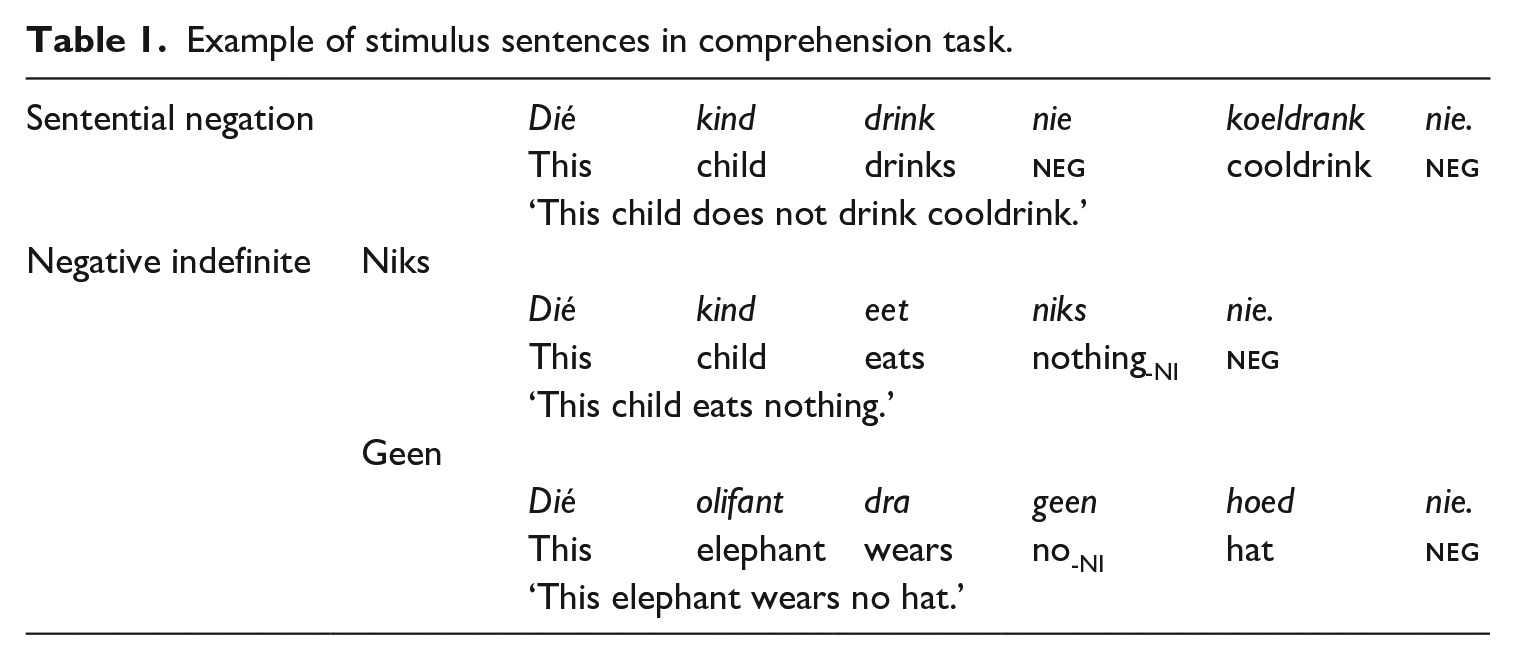
The stimuli were all true negative sentences that contained one high-frequency lexical verb and one animate actor. The nouns and verbs chosen were common words that are simple for young children to comprehend (see Alcock et al., 2020; Brink, 2018; Fenson et al., 2007; Hattingh & Tönsing, 2020). The actors included in the target constructions were animals, children or adults. The stimulus sentences were kept gender-neutral by using words such as persoon ‘person’ or kind ‘child’; otherwise, the participant may have been led to the correct answer; some pictures contained both male and female characters, where the distractor and target were of different genders. See Table 7 in Appendix 1 for the full list of stimulus sentences.
The pictures used were adapted from the Receptive and Expressive Activities for Language Therapy (Southwood & Van Dulm, 2012). They are colourful and child-friendly and were designed to be culturally suitable for use with children from South Africa, as objects and situations depicted are familiar to most South Africans. Each picture contained more than one actor or object, where one was the target of the true negative sentence. The other elements in the stimulus pictures were present as distractors that would correspond to an affirmative interpretation of the sentence. The number of distractors per picture varied between one and four across stimulus items. Stimulus sentences were kept at a maximum number of eight words to preserve simplicity. See Figures 1 to 3 for the pictures that accompany the stimulus sentences in Table 1.
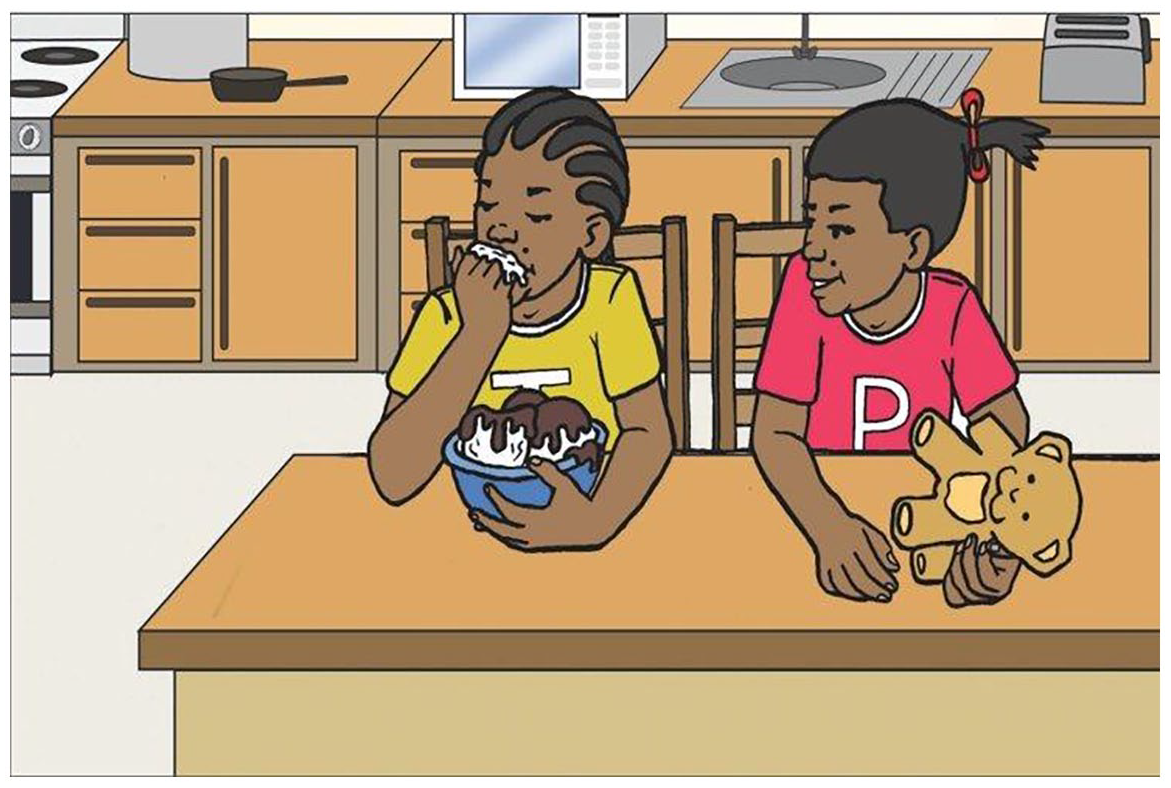
Stimulus Picture for Dié kind eet niks nie ‘This Child Eats Nothing’.
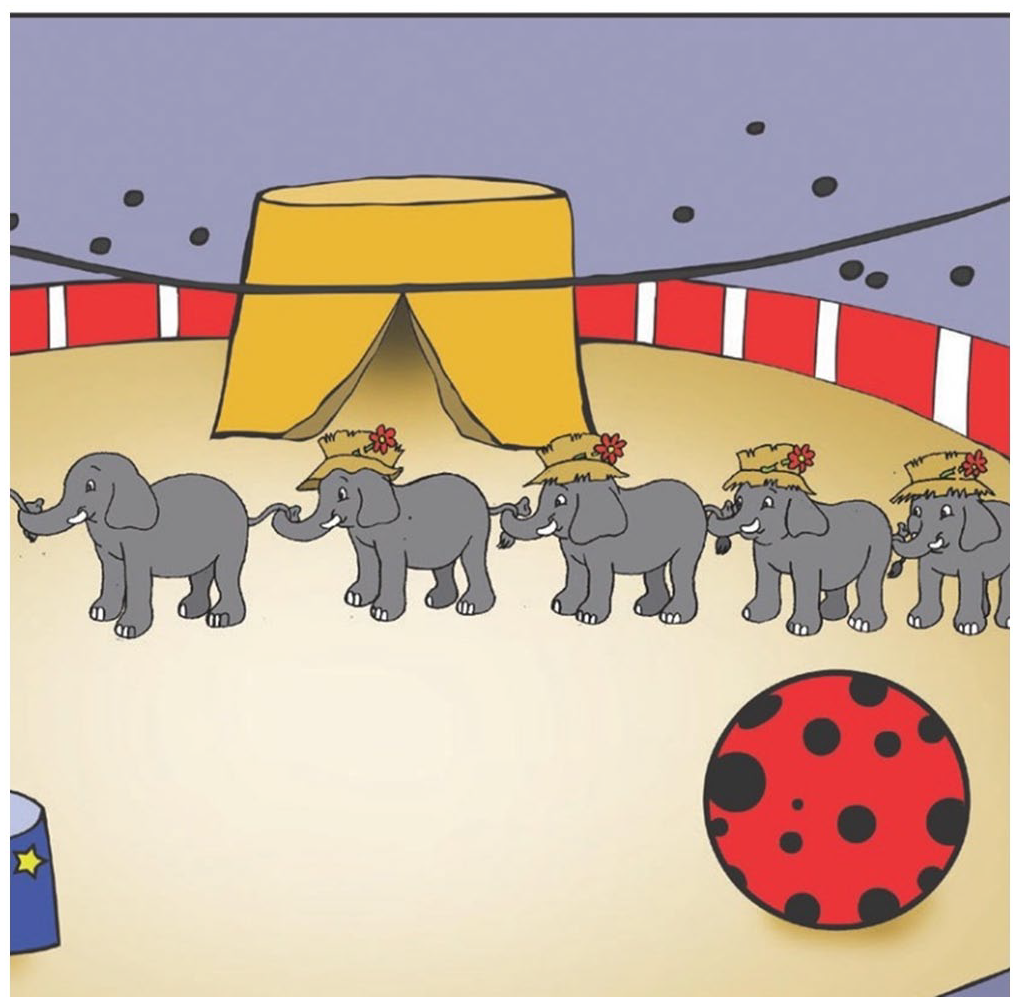
Stimulus Picture for Dié olifant dra geen hoed nie ‘This Elephant Wears No Hat’.
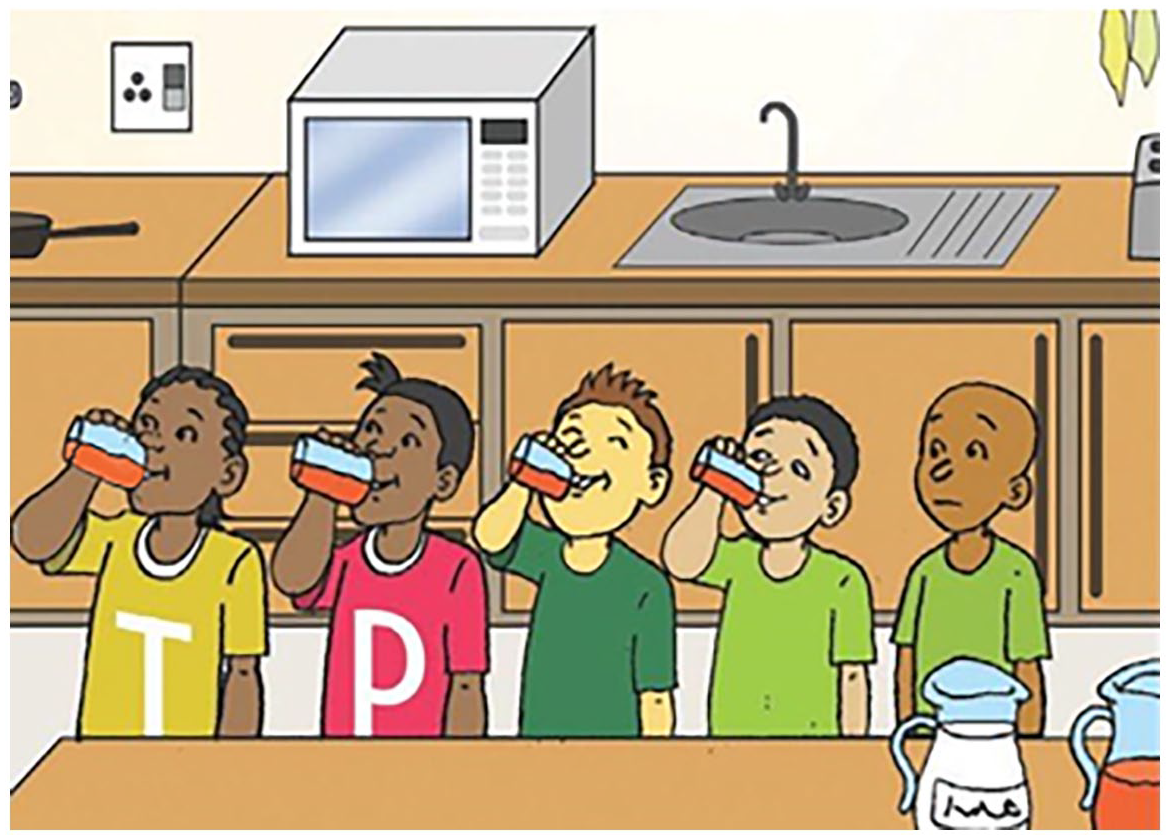
Stimulus Picture for Dié kind drink nie koeldrank nie ‘This Child Does Not Drink Cooldrink’.
Procedure
Participants were tested individually in a quiet room in their respective day care centres. The first author presented the participant with the pictures and the participant was requested to point to the element in the picture that corresponded to the sentence that was heard. Pictures were presented on a 15.60-in. laptop screen, which was big enough for the first author to see the element that the participant was pointing to, as well as close enough to the participant that they could touch the screen when pointing at the element. The stimulus sentence was produced while taking care to limit variations in terms of speed and prosody. Each testing session lasted approximately 15 minutes. Participants were informed beforehand that they could request breaks at any time; none did so and no signs of participant fatigue were noticed during testing.
Each answer was scored as either correct or incorrect. Where immediate, spontaneous revisions took place and the revised answer was scored. Correct responses were considered to be only those for which the participant pointed to the target actor.
Results
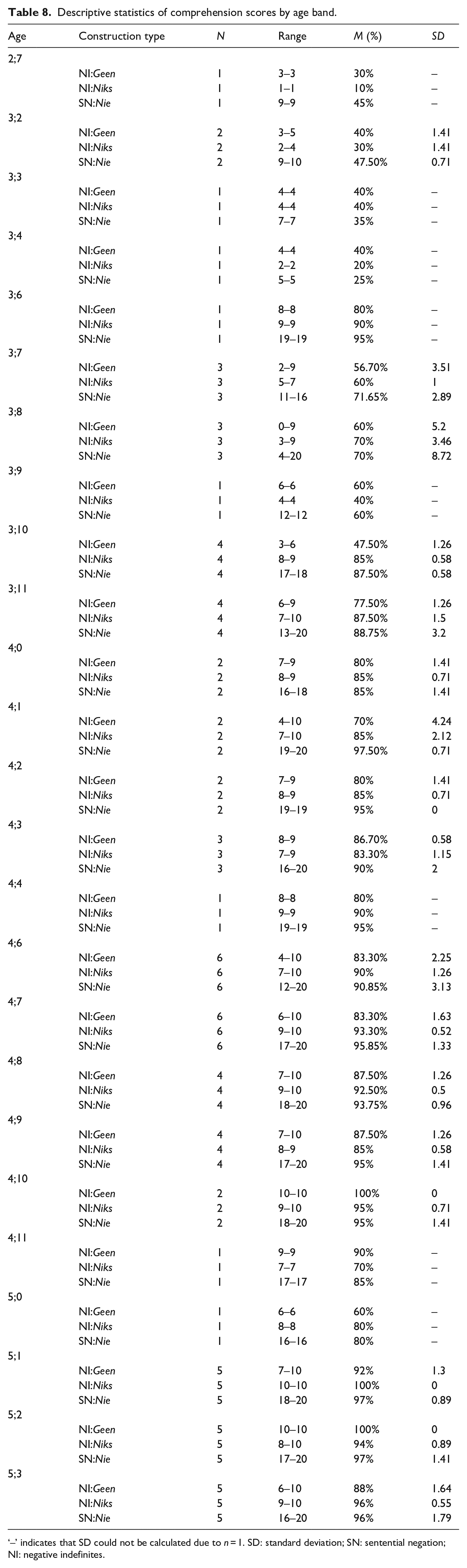
Table 8 in Appendix 1 shows the mean scores of the items as percentages, the range and the standard deviation per age. Overall, the majority of participants (48 of the 70) achieved a score of 90% 6 on the SN condition, with the youngest being 3;6. For the comprehension data, we follow Glennen et al. (2005), who considered a syntactic structure to be acquired when 75% of the participants achieved scores of 90% or more. For SN, more than 75% of participants 3;6 and older obtained a score of at least 90% (47 of 61 participants in this age range).
For the NI:Niks condition, 45 of the 70 (64%) scored 90% or higher, with the youngest being 3;6, the same participant with 90% accuracy for SN. From age 3;11, 75% of participants score at or above 90% on the NI:Niks condition (40 of 53).
Scores for NI:Geen remain comparatively lower, with the first 90% emerging at 3;7 and only slightly over half of all participants achieved 90% (38 of the 70). In addition, more than 75% of the sample achieved 90% or more only at 4;7 and older (25 of 33), a much older age than for the aforementioned conditions.
An overall score of 90% or more (including both NI conditions and the SN condition) was attained by 32 of 70 participants (46%), with the youngest being 3;8. Scores above 90% for all conditions were achieved by 75% of the sample at 5;0 and older (12 of 16). For an overview of mean scores in percentage by age, see Figure 4.
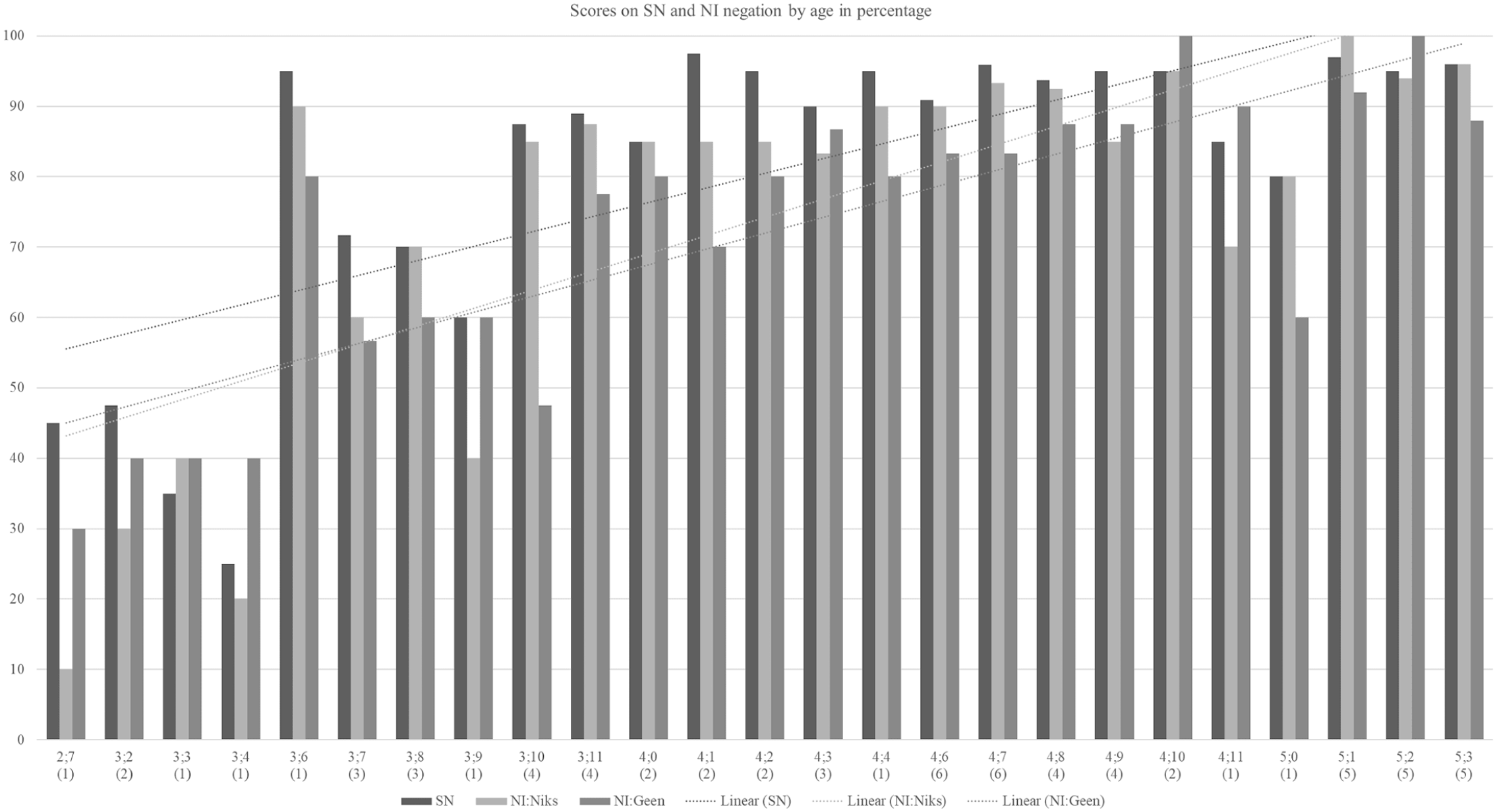
Mean of Comprehension Score in Percentage for SN, NI:Niks and NI:Geen, per Age with n in Parentheses, With Trendlines.
Statistical analysis was undertaken by fitting a Generalised Linear Mixed-effects Regression model with a binomial likelihood function from the lme4 library (D. Bates et al., 2015) in R (R Core Team, 2021). Score was entered as the dependent variable while Construction type (SN, NI:Geen and NI:Niks), Age and Sex were entered as fixed effects. Sex was entered as a fixed effect based on previous child language acquisition research that a child’s sex can be a predictor of language outcomes, with females usually outperforming males (see Adani & Cepanec, 2019, for an overview). Participant and Age were treated as random effects and were included as Participant-by-Age random slopes. Results showed that Sex was not a significant predictor of Score (β = 0.45, SE = 0.27, z = 1.67, p = .09) but that Age was a highly significant predictor (β = 0.16, SE = 0.03, z = 6.21, p < .001), where Score increased with an increase in Age. Construction type also significantly predicted Score, such that both NI conditions predicted lower Scores than the SN condition did (NI:Geen: β = −0.85, SE = 0.14, z = −6.16, p < .001; NI:Niks: β = −0.41, SE = 0.15, z = −2.85, p = .004), indicating that the NI constructions were more challenging for the participants and that NI:Geen was the most difficult. Post hoc pairwise comparisons showed that NI:Niks had significantly higher scores than NI:Geen (p = .012).
Production study
Method
Participants
Spontaneous language recordings of typically developing monolingual Afrikaans-speaking children were retrieved from the SouthwoodWhite (Southwood & White, 2016) corpus on CHILDES (MacWhinney, 2000). To be considered for inclusion, the language samples were required to be from typically developing children younger than 6 years. The ages of the 22 participants (11 males, 11 females) whose samples were selected were 3;0 to 5;0 (mean age 4;1) in order to match the ages of the children who participated in the comprehension study.
Procedure
All language samples from the Southwood and White (2016) corpus were collected by the second author of the current study at the participant’s day care centre or home. Language sample elicitation took the form of free play between the participant and the second author with toys that included little figurines with accessories such as radios, hats, mugs and brooms; plastic kitchen furniture and wooden building blocks. The author initiated the interaction by inviting the participant to join her in kitting out the figurines, building a house, and/or assembling the kitchen. If the participant was quiet for extended periods, the author used parallel play, engaged play, self-talk, statements, and question asking (both WH and yes/no questions) to encourage conversation, without deliberately producing utterances that would elicit child utterances containing negation.
Twenty-two language samples ranging in length from 10 minutes 29 seconds to 34 minutes 46 seconds (mean length: 25 minutes 48 seconds) were included. The total number of words each child produced ranged from 429 to 1462 (mean: 828.59), including repetitions, false starts and revisions, abandoned starts, and fillers.
Vocd, a lexical diversity measure that uses mathematical modelling to yield a so-called D value (Malvern & Richards, 2002), was deemed more suitable for use in this sample than Type Token Ratio because it is less affected by varying text lengths. Vocd was calculated using the CLAN programme (MacWhinney, 2000). There was a large variability between D values in this sample, the lowest being 32.93 and the highest 85.30. Table 2 provides selected information on the language samples.
Selected characteristics of language samples.
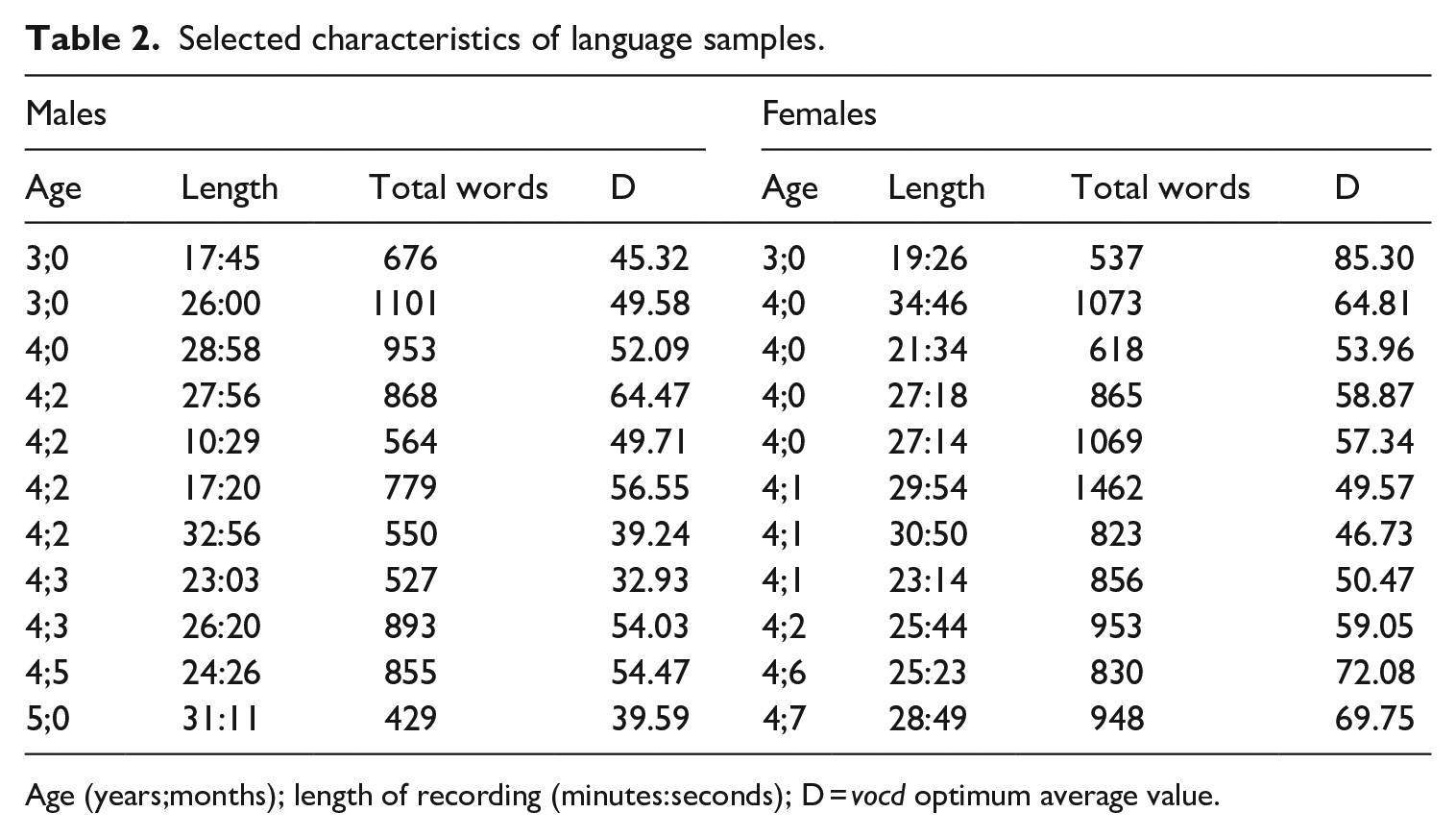
Age (years;months); length of recording (minutes:seconds); D = vocd optimum average value.
Analysis
The CLAN function of CHILDES (MacWhinney, 2000) was used to perform word counts and to identify the number of negative elements in each sample. The occurrence of the nominal and adverbial negative elements niemand ‘nobody’, nooit ‘never’, nêrens ‘nowhere’, niks ‘nothing’, as well as the determiner geen/g ′n ‘no’ was counted in the samples – on Huddlestone’s (2010) classification of NIs in Afrikaans – along with the negative particle nie ‘not’ and moenie ‘must-not’.
In consultation with one another, the first two authors of this study (1) categorised all utterances containing negation as either grammatical or ungrammatical according to the standard form of the language; (2) divided utterances into anaphoric and non-anaphoric (where the context in which each negative sentence was produced was analysed by means of looking at the preceding utterances to determine whether the utterance was anaphoric or non-anaphoric) and (3) divided utterances into the following 13 more refined syntactic categories:
0 Repetitions and formulaic utterances (e.g. Ek weet nie ‘I don’t know’), excluded from further categorisation and analyses
1.1 Simple sentences that are V2 structures without a sentence-initial adverb (Adult form: both nies occur post-verbally) (e.g. Sy is nie die juffrou nie ‘She is not the teacher’)
1.2 Simple sentences with a sentence-initial adverb (Adult form: both nies occur post-verbally) (e.g. Toe loop hy nie weg nie ‘Then he didn’t walk away’)
2.1 Simple sentences consisting only of a (non-negative) subject and a finite verb (or non-sentence-initial adverb) (Adult form: only one nie is realised) (e.g. Sy hardloop nie ‘She doesn’t run’)
3.1 Complex (non-coordinate) sentences in which the main clause is negated (Adult form: the second nie occurs in the sentence-final position, at the end of the embedded clause/object clause/relative clause, and not at the end of the main clause) (e.g. Ek weet nie waarvan jy praat nie ‘I don’t know what you are talking about’
4.1 Negated embedded/relative clauses without V2 (Adult from: the sentence-medial nie precedes the verb) (e.g. Ek het ′n katjie wat nie bruin is nie ‘I have a kitten that isn’t brown’)
4.2 Negated V2 embedded/relative clauses (Adult form: the first nie follows the verb) (e.g. Ek weet hy skop nie die bal nie ‘I know he doesn’t kick the ball’)
5.1 WH questions with an auxiliary (e.g. Hoekom kan ons nie speel nie? ‘Why can’t we play?’)
5.2 WH questions without an auxiliary (e.g. Hoekom het hy nie ′n hoed nie? ‘Why does he not have a hat?’)
5.3 Yes/no questions (e.g. Wil jy nie speel nie? ‘Don’t you want to play?’)
6.1 Imperative sentences (e.g. Moenie raas nie ‘Don’t make a noise’)
7.1 Sentences containing NIs (e.g. Daar is geen aarbeie nie ‘There are no strawberries’)
8.1 Sentences containing ellipsis (e.g. Nie hier nie ‘Not here’)
For each ungrammatical utterance, the type of error was identified, after which utterances containing similar error types were grouped together. We considered all ungrammatical negated utterances (not only those with ungrammatical use of negative elements) because it served to contextualise the linguistic abilities of the children in a broader sense.
With regard to errors particular to negation, the following four types of ungrammatical utterances emerged; the ungrammaticality pertained to either the omission of an obligatory negative element or the inappropriate insertion of a negative element:
A. Simple sentence; final nie omitted
B. Simple sentence; medial nie omitted
C. Sentence containing an embedded clause; main clause negated and final nie omitted (including NIs)
D. Nie inappropriately inserted
In relation to errors not involving negation, we identified the following six types of ungrammatical sentences containing intact grammatically well-formed negation:
E. Incorrect word order
F. Verb/copula/auxiliary omitted from obligatory context
G. Verb/copula/auxiliary inappropriately inserted
H. Semantically ill-formed but syntactically well-formed sentence
I. Ungrammatical ellipsis
J. Obligatory subject omitted
After categorising the ungrammatical negated sentences by error type, all ungrammatical utterances and 10% of the grammatical utterances were categorised independently by the third author. For the grammatical utterances, there was 97% reliability between the first two authors’ and the third author’s categorisations, and for the ungrammatical utterances 93%. Differences between the authors’ categorisations were resolved via discussion.
Results
To assess the production of SN and negation with NIs, a word frequency search was conducted within all the language samples. The word nee ‘no’ occurred 269 times in the language samples, which comprised 18,229 words in total. Regarding the occurrences of NIs, none of the 22 children produced the NIs geen, g ′n or nêrens, whereas niks appeared 14 times, niemand twice and nooit once. Niks occurred for the first time at 4;0, niemand at 4;2 and nooit at 4;6. The negative particle nie appeared 553 times in the samples, with every one of the 22 children having produced it.
The number of utterances containing negation amounted to 338 (total number of utterances in the 22 samples: 4318), of which 20 were instances of negative elements being inserted or omitted inappropriately and 11 were ungrammatical constructions despite the negative elements being grammatically well-formed. Figure 5 shows the number of each participant’s negation utterances, both grammatical and ungrammatical.
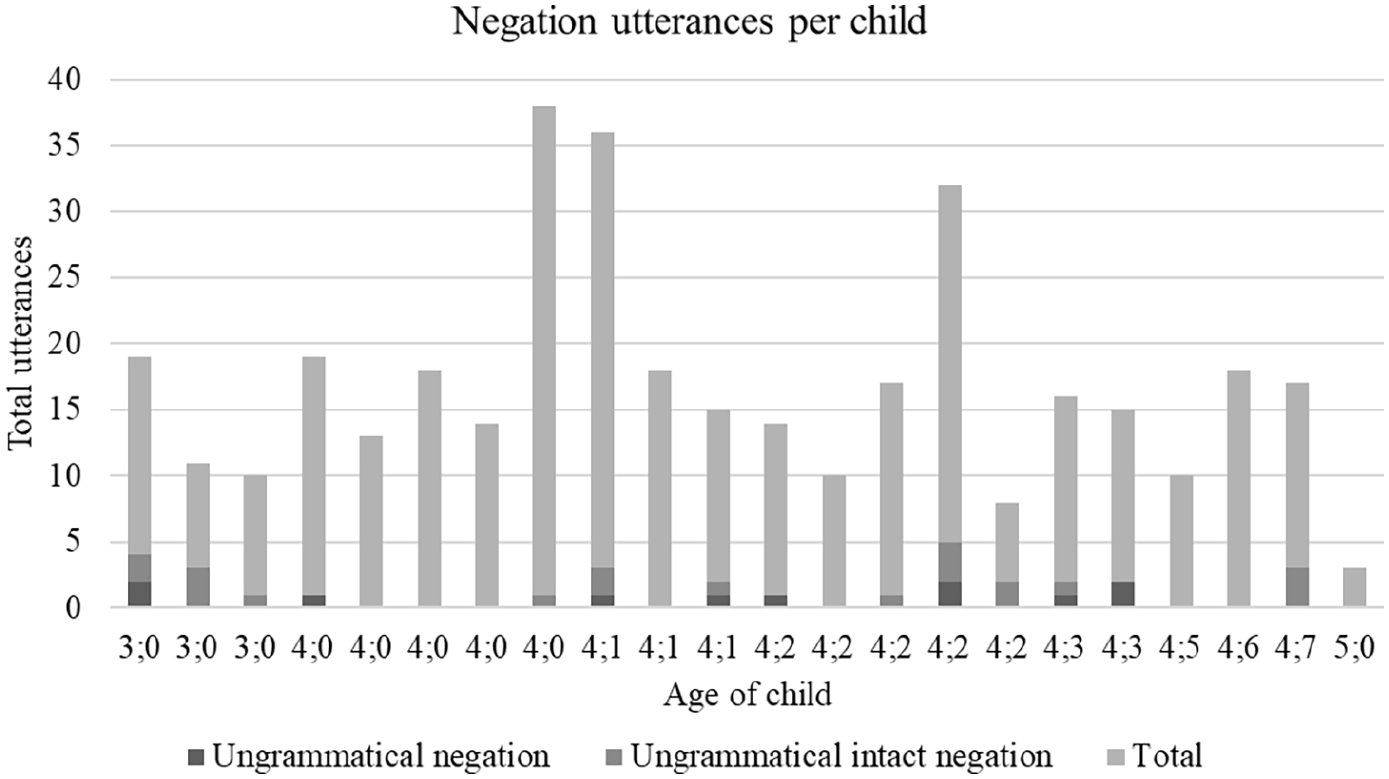
Number of Utterances Produced per Participant in the Categories: Grammatical, Ungrammatical Negation, and Ungrammatical With Negation Intact.
The grammatical and ungrammatical utterances were then grouped into anaphoric versus non-anaphoric and into the categories set out above. Anaphoric negation occurred more frequently than non-anaphoric negation (65% and 35%, respectively) in the grammatical utterances. See Table 3 for a breakdown of the grammatical utterances.
Total number of grammatical utterances, and number and age range of children producing the utterance, by category.
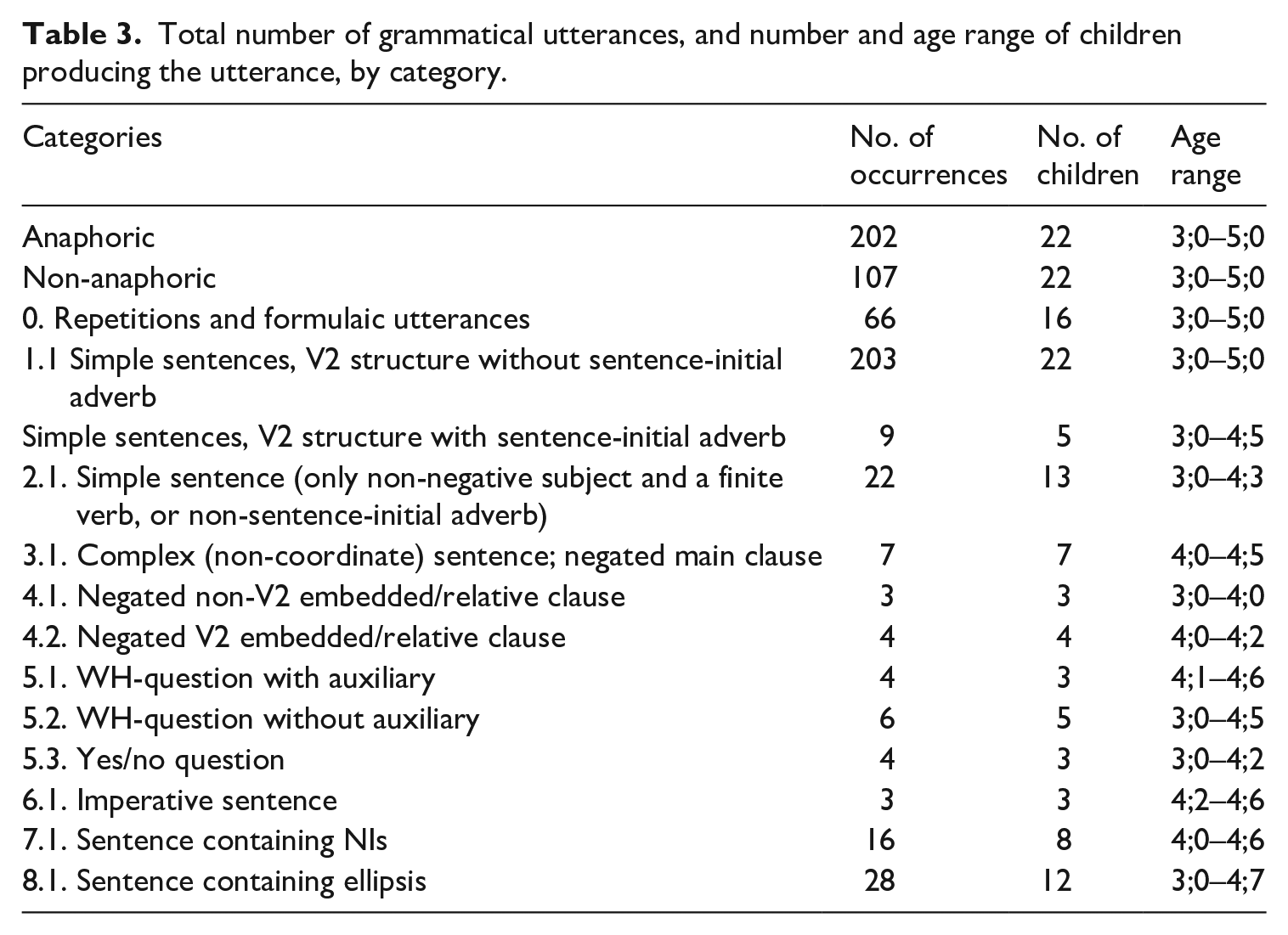
As can be seen from Table 3, NIs begin to occur at 4;0 in these language samples, with eight children collectively having produced 16 grammatical utterances with NIs. The most common construction was Category 1.1, with all 22 children having produced such a construction. An example of a Category 1.1 construction is given in (14), an utterance by a 4;0 female (4;0FA); see Table 4 for the utterances by child: (14) Ons het nie die koek geëet nie. we did not the cake eat- ‘We did not eat the cake’.
Number of grammatical, negated utterances per construction type and child.
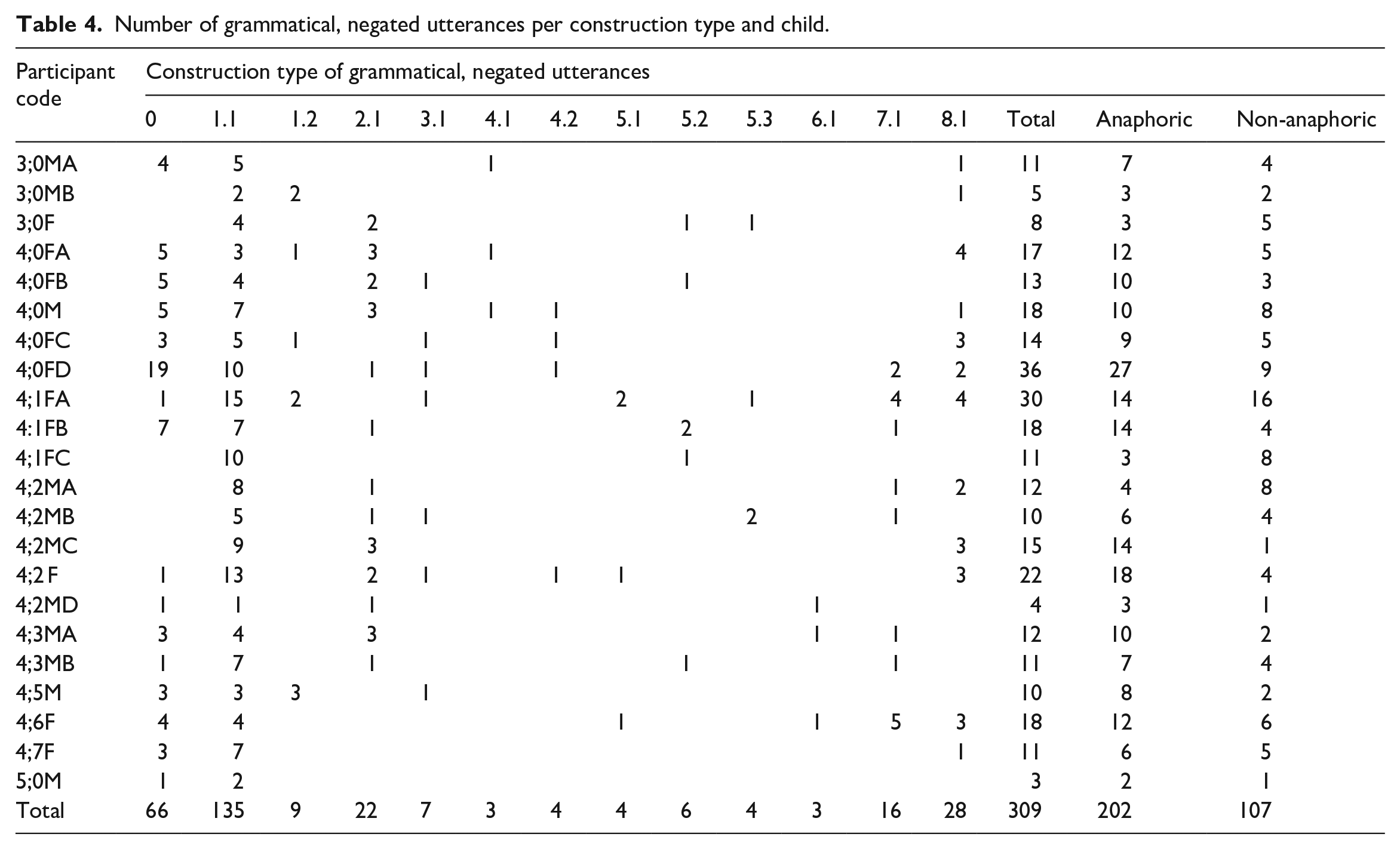
The second most commonly occurring construction was Category 2.1, which was produced by 13 children between the ages of 3;0 and 4;3. An example from this category is the utterance in (15) from a 4;0 male (4;0M): (15) My katte byt ook nie. my cats bite also not ‘My cats also don’t bite’.
Categories 5.1 and 6.1 were the latest emerging in this sample of children, at 4;1 and 4;2, respectively, with three children having produced at least one of these two categories of negated utterances. Examples of Categories 5.1 in (16) and 6.1 in (17) are from a 4;6 female (4;6F) and a 4;3 male (4;3MA), respectively: (16) Hoekom moet sy nie babatjies kry nie? why must she not babies- ‘Why mustn’t she have babies?’ (17) Nee moet nog nie tel nie no must yet not count ‘No, don’t count yet’.
Table 4 indicates the number, and number of different, grammatical negative structures used by each child. The child who produced the largest number of grammatical negative utterances (n = 36) was a female of 4;0 (4;0FD). She used seven different utterance categories, the same number as 4;2F who was 2 months older and who used fewer grammatical utterances (n = 22). The child (4;1FA) with the largest number of different utterance categories (n = 8) produced a total of 30 grammatical utterances containing negation. The oldest participant, a 5;0 male, used both the smallest number of grammatical negated utterances (n = 3) and the smallest range of utterance types (n = 2). The only other child who produced such a limited range was a female aged 4;1 (4;1FC).
Turning now to the ungrammatical utterances in the sample: In contrast to the asymmetric distribution of anaphoric versus non-anaphoric grammatical utterances, anaphoric and non-anaphoric negation occur with a more similar frequency in ungrammatical utterances: 55% and 45%, respectively. Akin to the grammatical utterances, anaphoric negation is more prevalent than non-anaphoric negation in ungrammatical utterances. See Table 5 for a breakdown of the ungrammatical utterances by category.
Total number of ungrammatical utterances and number and age range of children producing the error, by type.
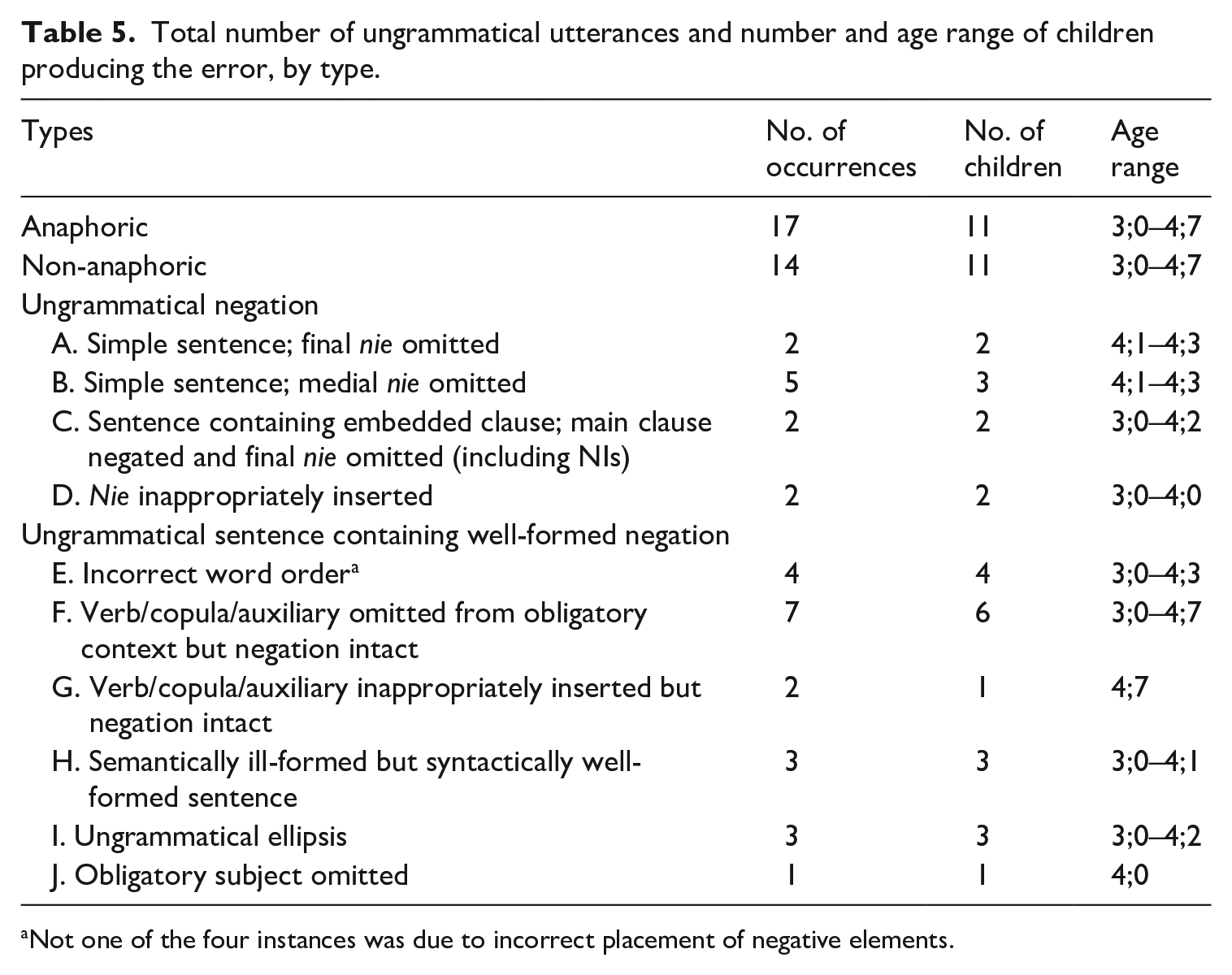
Not one of the four instances was due to incorrect placement of negative elements.
The oldest child to produce an ungrammatical sentence containing grammatical negation was 4;7 (4;7F); however, she was the only child to produce a type G error and her only other error was type F. Neither of these categories are negation errors because the negation remained grammatically well formed. See (18) for her type F and (19) for her type G error. Target: (18) *My rugsakkie nog nie aan nie My rugsakkie is nog nie aan nie. my backpack- ‘My backpack is not on yet’. (19) *Ek kan nie dit laat op die fiets kry nie Ek kan nie dit op die fiets kry nie. I can not it let on the bicycle get ‘I can’t get it on the bicycle’.
Considering only those errors which directly pertain to negation, the oldest child to produce an ungrammatical utterance was 4;3 and the most common error was type B. The illustrative example (20) comes from a 4;3 male (4;3MB): Target: (20) *As jou wiele pap is kan jy ry nie As jou wiele pap is kan jy nie ry
nie.
if your wheels flat are can you drive ‘If your tyres are flat, you can’t drive’.
Errors that included NIs were not common (it should be noted that the production of NIs was also not common); in fact, only one child made an error in an NI construction and this was regarded as type C because the final nie was omitted. This error was produced by a male aged 4;2 (4;2MA) and can be seen in (21): Target: (21) *Hy staan en niemand sien hoe hy kyk Hy staan en niemand sien hoe hy kyk nie. he stand and nobody see how he look he stand and nobody see how he look ‘He stands and nobody sees how he looks.’
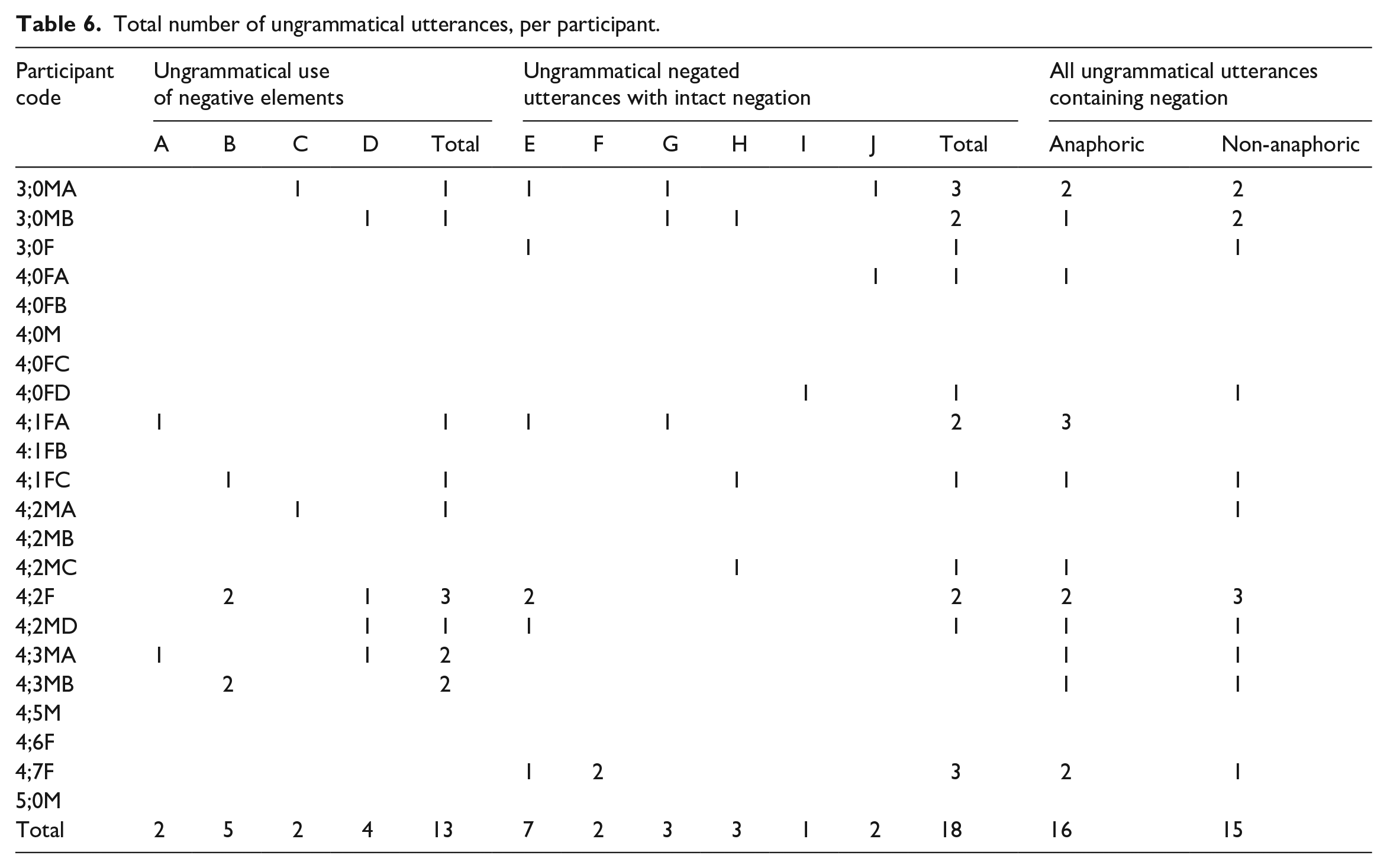
Table 6 provides the number of ungrammatical utterances produced per child. The utterances in which the ungrammaticality lay with the inappropriate insertion or omission of negative elements are presented separately from those ungrammatical utterances with grammatically well-formed negative elements. Fourteen of the 22 participants produced ungrammatical negated utterances, three only of types that pertained to the inappropriate insertion or deletion of negative elements, and five only of the types where the utterances had grammatically well-formed negative elements but were ungrammatical for other reasons. The child who produced the highest number of grammatical, negation-containing utterances (4;0FD; n = 36) produced only one ungrammatical utterance. Participant 4;2F produced the highest number of ungrammatical utterances (n = 5, of three different types). The child who used the largest range of ungrammatical utterances containing negation (four types) was 3;0MA, one of the three youngest participants.
Total number of ungrammatical utterances, per participant.
Discussion
This study sought to uncover typically developing monolingual children’s ability to comprehend and produce negation in Afrikaans. Considering that Afrikaans’ negation system is syntactically complex in comparison with that of other West Germanic and Romance languages (as laid out in the previous sections), we expected that the acquisition of negation would be delayed, for both comprehension and production.
The comprehension results showed that negation started to emerge early, at 3;8, but that the majority of children in the sample had only acquired all conditions after 5;0. We also expected that SN would be easier to comprehend and produce than NIs, which was indeed found to be the case as scores for both NI conditions were significantly lower than those for SN.
Production data showed that negation was used spontaneously from age 3;0 onwards (which was the age of the youngest child in our production study’s sample), with the majority of utterances being grammatical, while ungrammatical utterances in which negative elements were inserted or omitted inappropriately were produced until 4;3. Ungrammatical utterances with grammatically well-formed negative elements occurred until 4;7. This age (after 4;3) at which negative elements were used grammatically is earlier than we hypothesised but supports the findings from other West Germanic languages (see Thornton, 2020).
Negation in comprehension
The comprehension task assessed children’s ability to comprehend non-anaphoric true negatives in two types of constructions, namely, SN and NI. False negatives are thought to be easier to comprehend than true negatives, due to the cognitive load that accompanies the comprehension of the latter (Wojtecka et al., 2011, 2013) Thus, to determine whether children can comprehend negation in a complex pragmatic form by age 5;3, the more challenging true negatives were utilised. The results showed that age was a highly significant predictor of outcomes on the comprehension task, with scores increasing with an increase in age. Construction type was also a significant predictor of scores, with SN being the easiest construction type to comprehend, followed by NI:Niks, while NI:Geen was the most challenging. A closer look at the data showed that more than 75% of participants 3;6 and older scored 90% or higher on the SN condition. Although 90% was reached at 3;11 and older for NI:Niks, NI:Geen was only considered as acquired in this sample at a much later age, 4;7 and older. As discussed earlier, Zeijlstra (2011) states that NIs, rather than being created within the lexicon, are the result of a syntactic process in accordance with a Phonetic Form rule. Therefore, one of the possible explanations for the observation that NI conditions yielded significantly lower scores might be that NIs are syntactically more complex. NIs also include semantic content that goes beyond simple negation, making them more complex semantically. Recall that in SN, the Afrikaans sentence-medial nie is a negative adverb, which can be interpreted in the semantics without computation in the syntactic component, and that no NegP is therefore necessary (Zeijlstra, 2004, 2008). Not needing a NegP for interpretation could be a further reason for SN structures being less complex than NIs for young Afrikaans-speaking children.
This does not however explain the difference in age of acquisition between the two NIs, geen and niks. One could speculate that input-related considerations are at issue here. However, given that Afrikaans has no corpora of adult spoken Afrikaans, nor of child-directed speech, it is not yet known what input Afrikaans-speaking children are exposed to, and therefore whether an input-based explanation is feasible here. Further research on this topic is warranted.
Two children aged 3;8 achieved 90% or higher on all conditions, while the next children to do so were 3;11. Therefore, the data show that target-like comprehension of negation starts to emerge from 3;8. The finding for English-speaking children (e.g. Pea, 1980) indicates that negation is largely acquired by 4;6. If one looks at the overall scores of the Afrikaans-speaking children, 75% achieved 90% or more on all conditions only at 5;0 and older, which is slightly later than for English-speaking children. However, as laid out previously, results pattern differently according to construction type. Interestingly, no participant scored zero overall and only one participant scored zero for any one condition: a 3;8 female scored zero of 10 for the NI:Geen condition. The lowest overall score was 17.5%, which was attained by the same participant.
Negation in production
The production data showed that children produced more grammatical than ungrammatical negated utterances. Ungrammatical productions in which errors purely involved negation were infrequent, even among the youngest children, and after age 4;3 were no longer found in the language samples. While some errors were indeed made by children older than 4;3, three children aged 4;0 were among those eight (of 22) participants in this study who made no negation errors. These results could indicate that the production of grammatically correct negation is acquired after 4 years of age but before 4;6 years in Afrikaans-speaking children, which would be in line with previous literature on other languages (e.g. English; see Pea, 1980; Thornton & Tesan, 2013) that places the acquisition of negation in production between 4 and 5 years. Note however that firm conclusions about the production of negation by young Afrikaans-speaking children cannot be drawn due to the possibility that children could have simply avoided producing more challenging negative constructions.
Turning to the grammatical constructions, the only negation construction type used by all 22 children was a simple sentence with a V2 structure (without a sentence-initial adverb). This was also the construction type with the highest collective number of occurrences (135). Note that non-negated main clauses in Afrikaans have a V2 sentence structure and occur frequently, which could be the reason for simple V2 sentences being the most frequently occurring negated construction type in the data.
There is a large gap between the most and second-most frequently produced grammatical negation construction, the latter being sentences containing ellipsis (disregarding the 66 occurrences of self or interlocutor repetitions and formulaic utterances). Sentences containing ellipsis collectively occurred 28 times in 12 of the children’s language samples. This was followed by simple sentences consisting of only a non-negative subject and a finite verb with optionally a non-sentence-initial adverb. Collectively, these simple sentences were used 22 times by 13 children and utterances containing NIs were used 16 times by eight children. The other construction types (including WH and yes/no questions) occurred maximally 9 times and were produced by maximally seven children.
In terms of SN, the early acquisition in terms of production of the sentence-final nie (as attested by its omission from only four of the 340 negated utterances collectively produced by the children) requires mention. As discussed in the description of negation in Afrikaans, the sentence-final nie is argued to occupy a left peripheral position. However, according to Friedmann et al. (2020), while the lower field of the left periphery – including a Q(uestion)P which allows for the acquisition of subject and object WH questions, yes/no questions, and sentence-initial adverbs – is acquired in a second stage of development, following the acquisition of the TP/IP, the rich structure of the left periphery (including the higher CP field) is completely acquired later in the acquisition process. The presence of the sentence-final nie is therefore somewhat of a puzzle for theories that view stages of acquisition as following the geometry of the syntactic tree, along the lines of the cartographic analysis of the clause (Rizzi, 1997). However, if one considers the acquisition of sentence-final nie to follow a development from clause-peripheral to clausal integration, as the left periphery is acquired, then this could account for its early acquisition, especially given its salience in the speech of Afrikaans-speaking adults (see also Biberauer, 2018).
Both negated yes/no questions and negated WH questions without auxiliaries were present at 3;0 in our samples, despite WH questions in Afrikaans requiring a further syntactic operation, namely, WH-movement (Oosthuizen, 1996), in addition to the subject–verb inversion required by both WH and yes/no questions in Afrikaans (similar to Dutch and German) (Biberauer, 2012). WH questions with auxiliaries appeared later (4;1). Given the absence of published data on the acquisition of WH questions by young Afrikaans-speaking children, one can merely hypothesise that the more complex, auxiliary-containing predicate contributes to the comparatively late age at which this construction is produced. This echoes the findings of Guasti et al. (1995) who conclude that negative WH questions were acquired later than their non-negated counterparts in English-speaking children’s grammars (also see Thornton & Tesan, 2013). Note however that because spontaneous language samples, and not elicitation tasks, were used in the current study, one cannot conclude that the participants had not yet acquired the ability to produce this construction as they may have employed the strategy of only using simple constructions.
Anaphoric negation, where the negated utterance is in response to the content of an utterance that occurred previously in the discourse, was used almost twice as frequently as non-anaphoric negation. Yet, a similar number of syntactic errors were made in constructions containing anaphoric and non-anaphoric negation, indicating that the proportion of errors in non-anaphoric utterances is higher. This higher frequency of anaphoric negation was possibly due to the participating children showing a preference for responding to the interlocutor’s utterances over spontaneously producing negative utterances, or to the fact that, in the case of non-anaphoric utterances, there is no directly preceding interlocutor utterance to serve as scaffolding for the child’s negated utterance. Anaphoric negation contains a (part) repetition of the preceding utterance with the addition of a negator, which could account for the lower error rate in these utterances.
Turning to types of errors, 9% of the negated utterances in the language sample contained errors, and of these 31 error-containing utterances, only 13 entailed the omission or inappropriate insertion of a negative element (in all cases, nie). The number of pure negation errors can therefore be regarded as 4%. Of these errors, there was mostly only one occurrence of any error type per sample. In fact, of the total of 10 error types occurring in the samples, eight were made by only one to three children each.
Note that the omission of the negative element nie led to utterances containing one nie. Some grammatical negated Afrikaans sentence constructions indeed contain only one nie (see [2]), so single-nie constructions will indeed be present in the input the children are exposed to. The omission of the nie in the child utterances, however, all occurred in sentences containing an object that was not a pronoun, and as such required both a sentence-medial and a sentence-final nie. Although negation errors of the type that involves the inappropriate insertion or omission of negative elements persist until 4;3 in our production data the error rate is very low, even in the younger children.
Limitations and future directions
The current study is a first step in understanding the acquisition of negation in Afrikaans. Yet, there are several limitations. Spontaneous language sampling rendered very few negation utterances; therefore, firm conclusions cannot be drawn that can be generalised to the wider Afrikaans-speaking child population. To have a more thorough overview of the production of negation, an elicitation task targeting negation should be employed. This would also make it possible to elicit production data on a wide range of construction types, thereby providing all participants equal and sufficient opportunities for the production of negated utterances while removing the opportunities that spontaneous language samples offer for the avoidance of the production of those construction types not yet fully acquired. Moreover, the comprehension task that was used in this study could have resulted in a response strategy where the children favoured the picture that depicted the ‘odd one out’, possibly leading to artificially inflated comprehension scores. Spontaneous language sampling and/or an elicitation task, as mentioned above, would be less prone to such biases.
This study also only considered one aspect of Afrikaans negation, that is, the syntactic component. Negation is a complex phenomenon that draws on other linguistic knowledge (such as semantic and pragmatic) and on cognitive knowledge (whether conceptual negation is available to non-linguistic thought), and therefore further studies from other theoretical perspectives are indicated. Referencing a corpus of child-directed speech (once such a corpus becomes available for Afrikaans, or indeed any corpus of spoken Afrikaans) would also allow future studies to determine the kinds of input a child is exposed to, and specifically the frequency of negation in the input Afrikaans-speaking children receive.
Studies with larger sample sizes, with comprehension and production assessed in the same sample of children, would allow for generalisability of findings. Finally, longitudinal data may lead to more fine-grained conclusions on the process of acquiring negation in Afrikaans.
Conclusion
Afrikaans is a West Germanic language which displays discontinuous SN in which (typically) two seemingly identical negative elements (nie) appear in different positions in the sentence, which vary somewhat according to sentence type. We studied the comprehension and production of negation by young child speakers of Afrikaans, hypothesising that negation will be acquired later than the age at which it has been reported to be acquired in other West Germanic languages. Specifically, we considered (1) the comprehension of NI versus SN negation to establish whether NIs are indeed more challenging than SN constructions and (2) the production of negation to establish what types of sentence structures are negated in the spontaneous speech of Afrikaans-speaking children and whether negation is used grammatically. Recall that despite previous studies of child speakers of languages other than Afrikaans (e.g. Pea, 1980) indicating acquisition of negation by age 4;6, we hypothesised that negation would be fully acquired somewhat later in Afrikaans-speaking children, in terms of both comprehension and production, due to the complex nature of Afrikaans’ discontinuous SN possibly placing a greater processing demand on young children acquiring Afrikaans.
Our hypothesis was partially borne out by our data, although our results are mixed. Our findings point to the late acquisition of comprehension of at least NIs, which also supports the claims made by Biberauer (2015). Most of our participants had a comprehension accuracy of 90% or more on all negation conditions from 5;0 (even though the SN condition was acquired by the participant group by 3;6 and older), although these results should be interpreted cautiously as it is the strict operationalisation of ‘acquired’ employed by Glennen et al. (2005) in their study. Errors in the production of negative elements only occurred until 4;3 in the language samples (which does not point to late acquisition) and hint at an asymmetry in production and comprehension, which has been found in a previous study of negation (Wojtecka et al., 2011). One should, however, bear in mind that the children might have employed a strategy of avoiding the production of more complex negative sentences, thereby limiting the negation errors they produced. This can only be confirmed by future studies.
Considering individual conditions, NIs were found to be more difficult to comprehend than SN and were also produced less than SN in the production data, which offers support for Zeijlstra’s (2011) argument that NIs are complex syntactic elements in West Germanic languages. The significant difference between NI:niks and NI:geen in the comprehension data was unexpected and cannot be explained by the current study. It is interesting to note, however, that geen was not found in the production data, whereas niks was, thus supporting the findings from the comprehension data that NI:geen items were more difficult, which could have led to NI:geen having been avoided in production.
This study is the first to explore the acquisition of Afrikaans negation experimentally. It offers a foundation for future studies to build on, which can expand on the insights gained. Future studies that address the limitations of the current study will enable one to draw less tentative conclusions about the acquisition of the comprehension and production of the negation system of Afrikaans.
Footnotes
Appendix 1
Descriptive statistics of comprehension scores by age band.
| Age | Construction type | N | Range | M (%) | SD |
|---|---|---|---|---|---|
| 2;7 | |||||
| NI:Geen | 1 | 3–3 | 30% | – | |
| NI:Niks | 1 | 1–1 | 10% | – | |
| SN:Nie | 1 | 9–9 | 45% | – | |
| 3;2 | |||||
| NI:Geen | 2 | 3–5 | 40% | 1.41 | |
| NI:Niks | 2 | 2–4 | 30% | 1.41 | |
| SN:Nie | 2 | 9–10 | 47.50% | 0.71 | |
| 3;3 | |||||
| NI:Geen | 1 | 4–4 | 40% | – | |
| NI:Niks | 1 | 4–4 | 40% | – | |
| SN:Nie | 1 | 7–7 | 35% | – | |
| 3;4 | |||||
| NI:Geen | 1 | 4–4 | 40% | – | |
| NI:Niks | 1 | 2–2 | 20% | – | |
| SN:Nie | 1 | 5–5 | 25% | – | |
| 3;6 | |||||
| NI:Geen | 1 | 8–8 | 80% | – | |
| NI:Niks | 1 | 9–9 | 90% | – | |
| SN:Nie | 1 | 19–19 | 95% | – | |
| 3;7 | |||||
| NI:Geen | 3 | 2–9 | 56.70% | 3.51 | |
| NI:Niks | 3 | 5–7 | 60% | 1 | |
| SN:Nie | 3 | 11–16 | 71.65% | 2.89 | |
| 3;8 | |||||
| NI:Geen | 3 | 0–9 | 60% | 5.2 | |
| NI:Niks | 3 | 3–9 | 70% | 3.46 | |
| SN:Nie | 3 | 4–20 | 70% | 8.72 | |
| 3;9 | |||||
| NI:Geen | 1 | 6–6 | 60% | – | |
| NI:Niks | 1 | 4–4 | 40% | – | |
| SN:Nie | 1 | 12–12 | 60% | – | |
| 3;10 | |||||
| NI:Geen | 4 | 3–6 | 47.50% | 1.26 | |
| NI:Niks | 4 | 8–9 | 85% | 0.58 | |
| SN:Nie | 4 | 17–18 | 87.50% | 0.58 | |
| 3;11 | |||||
| NI:Geen | 4 | 6–9 | 77.50% | 1.26 | |
| NI:Niks | 4 | 7–10 | 87.50% | 1.5 | |
| SN:Nie | 4 | 13–20 | 88.75% | 3.2 | |
| 4;0 | |||||
| NI:Geen | 2 | 7–9 | 80% | 1.41 | |
| NI:Niks | 2 | 8–9 | 85% | 0.71 | |
| SN:Nie | 2 | 16–18 | 85% | 1.41 | |
| 4;1 | |||||
| NI:Geen | 2 | 4–10 | 70% | 4.24 | |
| NI:Niks | 2 | 7–10 | 85% | 2.12 | |
| SN:Nie | 2 | 19–20 | 97.50% | 0.71 | |
| 4;2 | |||||
| NI:Geen | 2 | 7–9 | 80% | 1.41 | |
| NI:Niks | 2 | 8–9 | 85% | 0.71 | |
| SN:Nie | 2 | 19–19 | 95% | 0 | |
| 4;3 | |||||
| NI:Geen | 3 | 8–9 | 86.70% | 0.58 | |
| NI:Niks | 3 | 7–9 | 83.30% | 1.15 | |
| SN:Nie | 3 | 16–20 | 90% | 2 | |
| 4;4 | |||||
| NI:Geen | 1 | 8–8 | 80% | – | |
| NI:Niks | 1 | 9–9 | 90% | – | |
| SN:Nie | 1 | 19–19 | 95% | – | |
| 4;6 | |||||
| NI:Geen | 6 | 4–10 | 83.30% | 2.25 | |
| NI:Niks | 6 | 7–10 | 90% | 1.26 | |
| SN:Nie | 6 | 12–20 | 90.85% | 3.13 | |
| 4;7 | |||||
| NI:Geen | 6 | 6–10 | 83.30% | 1.63 | |
| NI:Niks | 6 | 9–10 | 93.30% | 0.52 | |
| SN:Nie | 6 | 17–20 | 95.85% | 1.33 | |
| 4;8 | |||||
| NI:Geen | 4 | 7–10 | 87.50% | 1.26 | |
| NI:Niks | 4 | 9–10 | 92.50% | 0.5 | |
| SN:Nie | 4 | 18–20 | 93.75% | 0.96 | |
| 4;9 | |||||
| NI:Geen | 4 | 7–10 | 87.50% | 1.26 | |
| NI:Niks | 4 | 8–9 | 85% | 0.58 | |
| SN:Nie | 4 | 17–20 | 95% | 1.41 | |
| 4;10 | |||||
| NI:Geen | 2 | 10–10 | 100% | 0 | |
| NI:Niks | 2 | 9–10 | 95% | 0.71 | |
| SN:Nie | 2 | 18–20 | 95% | 1.41 | |
| 4;11 | |||||
| NI:Geen | 1 | 9–9 | 90% | – | |
| NI:Niks | 1 | 7–7 | 70% | – | |
| SN:Nie | 1 | 17–17 | 85% | – | |
| 5;0 | |||||
| NI:Geen | 1 | 6–6 | 60% | – | |
| NI:Niks | 1 | 8–8 | 80% | – | |
| SN:Nie | 1 | 16–16 | 80% | – | |
| 5;1 | |||||
| NI:Geen | 5 | 7–10 | 92% | 1.3 | |
| NI:Niks | 5 | 10–10 | 100% | 0 | |
| SN:Nie | 5 | 18–20 | 97% | 0.89 | |
| 5;2 | |||||
| NI:Geen | 5 | 10–10 | 100% | 0 | |
| NI:Niks | 5 | 8–10 | 94% | 0.89 | |
| SN:Nie | 5 | 17–20 | 97% | 1.41 | |
| 5;3 | |||||
| NI:Geen | 5 | 6–10 | 88% | 1.64 | |
| NI:Niks | 5 | 9–10 | 96% | 0.55 | |
| SN:Nie | 5 | 16–20 | 96% | 1.79 |
‘–’ indicates that SD could not be calculated due to n = 1. SD: standard deviation; SN: sentential negation; NI: negative indefinites.
Acknowledgements
We are grateful to Prof Roelien Bastiaanse for her invaluable contributions and comments on earlier versions of this article. We thank the children and families who contributed to this research, and the reviewers for their helpful comments.
Author contribution(s)
Funding
The author(s) disclosed receipt of the following financial support for the research, authorship, and/or publication of this article: This work was partly supported by the Research Council of Norway through its Centres of Excellence funding scheme, project number 223265.
