




Abstract
While it is established that parental wh-questions, as a high-quality language input, are associated with child language outcome, less is known about the role of children’s wh-questions in their language development. This study examines whether children’s wh-questions during a dinnertime conversation are associated with their receptive and expressive language skills. The sample consists of a unique group of bilingual children: 32 Chinese preschoolers (aged 3–5 years) in Norway. At the onset of the study, parents self-recorded a dinnertime conversation with the target child and other family members present. Over the following year, we assessed children’s receptive vocabulary, expressive vocabulary, and narrative skills in Chinese three times. Individual growth modeling revealed that concurrently, the density of children’s wh-questions was associated with children’s expressive vocabulary and narrative skills, but the association faded when controlling for family demographics. Significantly, even when accounting for all control variables, children’s wh-questions predicted their receptive vocabulary growth across one year. These findings underline children’s active role in shaping their language learning and development. This study also contributes to our understanding of bilingual children’s home language development. Implications and directions for future research are discussed.
Introduction
Judge a man by his questions rather than by his answers. ― Voltaire
This quote can be well applied to children. Children play an active role in shaping their environment and engaging in their learning process. Their questions not only reflect their cognitive activities–what they are thinking and curious about–but also have the power to redirect instructions and influence the input they receive from others (Butler et al., 2020). In child language development, extensive research has focused on parental input and its impact, while little attention has been given to the child’s own contribution in eliciting and shaping that input (Rowe, 2013; Tamis-LeMonda et al., 2018). Consequently, our understanding of how children’s questions contribute to their language development remains limited. This study aims to bridge this gap by examining children’s use of questions, particularly wh-questions, during dinnertime conversations–a natural and interactive setting where children actively participate in discussions (Snow & Beals, 2006). Moreover, we draw on a unique population, Chinese children in Norway, a group that navigates a linguistic environment distinct from the more commonly studied contexts in countries with larger Chinese communities. Through exploration of these bilingual children’s questions during dinnertime conversations, this study aims to gain insights into their home language development.
Child questions
Children ask questions to learn and comprehend (Wellman, 2020). In the preverbal stage, infants already use gestures and vocalizations to elicit information and learn more about their surroundings from caregivers (Begus et al., 2014; Lucca & Wilbourn, 2018). When they acquire expressive language, they frequently use questions to seek information (Harris et al., 2017; Li et al., 2013). For example, Chouinard (2007) analyzed questions of four children (aged 1–5 years old) from the Child Language Data Exchange System (CHILDES) database, and found that when children are actively engaged, they ask an average of more than one question per minute. While this number is for mid-socioeconomic status (SES) children, low-SES children generally ask fewer questions (Callanan et al., 2020; Kurkul & Corriveau, 2018).
Not only do children ask questions early and often, but they also ask persistently in order to get information. When a child’s question was only responded to (without information) but not answered (with information) by caregivers, the child tended to repeat the question to get an answer (Chouinard, 2007; Frazier et al., 2009; Kurkul & Corriveau, 2018). In addition, preschool-aged children are already skilled at evaluating responses to their questions and identifying the right person to ask (Corriveau & Kurkul, 2014; Frazier et al., 2016; Kurkul & Corriveau, 2018). In Corriveau and Kurkul’s (2014) experiments, preschoolers were presented with circular (i.e., reiterated without new information) and non-circular (i.e., informative) explanations and were asked to choose their preferred response and reliable respondent. The result showed that these children had a clear preference for non-circular responses and judged those who provided informative responses more credible (Corriveau & Kurkul, 2014).
Furthermore, because of attentional and motivational interest, children pay close attention to the answers they receive through question-asking (Wellman, 2020). Psychological studies showed that compared with the information given unrequested, children remember more about the responses elicited by their own questions (Chouinard, 2007); compared with non-informative explanations, they recall better the informative explanations (Frazier et al., 2016). Studies in educational settings confirmed this notion. For example, interventions training students to engage in questioning are associated with greater learning in higher-order thinking and retention of information (e.g., Aflalo, 2021). Similarly, students’ questions were associated with outcomes such as problem-solving, subject-specific reading comprehension, and knowledge construction (for a review, see Chin & Osborne, 2008).
Drawing from the aforementioned literature, this study centers on child questions rather than parental responses for three reasons. First, it is well established that children are persistent in seeking information through questions. This persistence ensures that their questions will mostly be answered. Second, multiple experimental studies demonstrate that children have the ability to evaluate responses and select reliable respondents. In light of these abilities, it seems likely that the single dinner time conversation we recorded is typical of the families’ conversations on other occasions: children are drawing upon past interactions to determine whom to ask for a satisfying answer. Third, and most importantly, while parents often provide unsolicited explanations, children might show no interest in learning. By contrast, when children ask questions, it is indicative of their willingness and readiness to learn. Answering their questions taps directly into their attention and motivation, which is why children’s questions are so important. Although previous studies have examined how children’s ability in asking questions as part of their language acquisition (e.g., Bloom et al., 1982; Fahn, 2003), the direct link between these questions and their overall language development remains unclear. Therefore, this study focuses on the association between children’s questions and their language learning process.
Wh-questions and language learning
Caregivers’ linguistic input, both in quantity and quality, plays a crucial role in children’s language development (for a review, see Anderson et al., 2021). In monolingual settings, it is well-documented that input quality, compared with input quantity, is a stronger predictor for preschool-aged children (e.g., Rowe, 2012a). The results for bilingual children are less obvious: some studies yield similar findings (Gámez et al., 2023; Gámez & Levine, 2013), while others find input quantity to be more important (Bowers & Vasilyeva, 2011; Grøver et al., 2018). Beyond the most common indicators of input quantity, such as the amount of talk, and input quality, such as vocabulary diversity, parental use of questions has demonstrated strong associations with children’s language skills, such as receptive vocabulary (Cristofaro & Tamis-LeMonda, 2012; Luo et al., 2022; Zambrana et al., 2020), expressive vocabulary (Duong et al., 2021; Fletcher et al., 2008; Rowe et al., 2017), and narrative skills (Chang, 2003; Kang et al., 2009; Kuchirko et al., 2016). In particular, parental wh-questions, interrogative questions that begin with what, where, who, when, why, and how, showed stronger associations with positive child language outcomes (Cristofaro & Tamis-LeMonda, 2012; Leech et al., 2013; Rowe et al., 2017). This could be attributed to two aspects. First, compared with close-end questions, wh-questions elicit longer and more linguistically complex responses (Leech et al., 2013; Rowe et al., 2017). Second, wh-questions often lead to more back-and-forth exchanges, providing opportunities for the sequential flow of conversations (Leech et al., 2023).
When we flip the lenses, these aspects of wh-questions should remain valid. Namely, children’s wh-questions, too, elicit more and richer responses from the caregivers, and lead to more exchanges of conversations. We know from at least some previous studies that caregivers are prone to provide informative responses to address children’s questions (Callanan & Oakes, 1992; Chouinard, 2007; Kurkul & Corriveau, 2018). Grounded in social interactionist theory, which highlights the role of interactions in language learning (Grøver et al., 2019; Vygotsky, 1978), we assume a reciprocal relationship between children’s questioning and language development. On one hand, children’s ability to express curiosity and seek attention through questions relies on their concurrent language skills, especially expressive language. On the other hand, the type and frequency of questions children ask shape the quantity and quality of responses they receive, thereby contributing to their language growth.
Dinnertime conversations as a site for questioning and language learning
Dinnertime, a natural, everyday-occurring setting, offers more than a meal. Previous studies have indicated that it is a context filled with an abundance of new words (Beals, 1997), rare words (Beals & Tabors, 1995), and decontextualized talk such as narration and explanation (Grøver Aukrust, 2002; Sheng et al., 2022; Wei et al., 2020). Hence, it is an optimal site for language learning (Snow & Beals, 2006). Beyond linguistic richness, dinnertime conversations also provide children with more freedom and spontaneity to play a central role, and to explore their curiosity through questions at home. In fact, observational studies found that children asked many more questions at home than at preschools (e.g., Tizard & Hughes, 1984), and many researchers have used dinnertime conversations as a site for studying child questions (e.g., Callanan et al., 2020; Callanan & Oakes, 1992; Chouinard, 2007).
Chinese children in Norway and their Chinese language learning
According to Statistics Norway (2023), approximately 13,000 Chinese reside in Norway. In comparison to countries with larger Chinese immigrant communities, such as the United States, Canada, and Australia, this relatively small population implies that Chinese children in Norway have limited Chinese language input outside their homes. Moreover, in Norway, children as young as one year old can attend Norwegian preschools, and the enrollment rate for 3- to 5-year-olds is over 97% (Statistics Norway, 2024). While children’s home languages are valued in preschools, the language of communication is Norwegian (Norwegian Ministry of Education and Research, 2017). As a result, the home environment becomes a crucial source of Chinese language input for these preschoolers. While they typically develop proficiency in Norwegian, a recent study (Yang et al., 2023) has revealed a negative correlation between their parent-reported Chinese language skills and their age, suggesting a trend toward home language attrition.
This trend raises important questions about bilingual children’s home language development. Compared with studies on monolingual children, there is limited research focusing on naturalistic social interactions at home and their impact on bilingual children’s language development, particularly concerning home language development (Paradis, 2023). Investigating children’s questioning during dinnertime conversations in relation to their home language skills can enhance our understanding of bilingual children’s home language development and offer potential strategies for families to mitigate language attrition. In our study, we drew on a sample of 3- to 5-year-old Chinese children in Norway, audiotaped their dinnertime conversations at the onset of the study, and assessed their language skills in Chinese three times across one year. Using individual growth modeling, we addressed the following research questions:
Are there associations between bilingual children’s wh-questions and their concurrent home language skills (receptive vocabulary, expressive vocabulary, and narrative skills)?
Do bilingual children’s wh-questions predict their home language skills (receptive vocabulary, expressive vocabulary, and narrative skills) growth over a one-year period?
Method
Participants
The present study is part of a larger study on the home literacy environment of Chinese children in Norway (for detailed recruitment and procedures, see Yang et al., under review). The research project was approved by the Norwegian Center for Research Data AS. All the data collection and handling complied with the Personal Data Registers Act. We recruited 32 3- to 5-year-old-children (11 boys and 21 girls) who spoke Chinese as a home language in Norway. All children were born in Norway and began attending Norwegian preschools at a mean age of 17.5 months (SD = 5.07). Their average age at the onset of the study was 51 months (SD = 8.79). Among them, nine children had a Norwegian father, while the others had both parents who spoke Chinese. For children in Chinese–Chinese families, the predominant language used was Chinese, whereas in Chinese–Norwegian families, children used Norwegian with their father. We had a set of siblings, so there was a total of 31 families. All the families were highly educated, with fathers and mothers averaging over 18 years of education (i.e., a master’s degree). Most of the mothers were in their thirties (M = 35.5, SD = 3.25) and had been residing in Norway for an average of nine years (SD = 3.55).
Procedure and measures
During the first visit, parents were informed about the project information and signed an informed consent form to allow the processing of their personal data. To ensure a naturalistic setting, we instructed parents to record an ordinary dinner by themselves. They were encouraged to talk as usual without revealing any traceable personal information. Following the first visit, we received 31 recordings of dinnertime conversations. The length of the recordings was calculated from the beginning until the moment when the target child finished dinner and left the table. The recordings varied from 5.73 to 52.25 minutes (M = 19.11, SD = 10.21), with two to six people present (M = 3.25, SD = 0.72). The typical configuration consisted of the father, mother, and child, while in some cases, siblings or grandparents were also present.
All the dinnertime conversations were transcribed verbatim by research assistants adhering to the conventions of the CHILDES (MacWhinney, 2000). A Chinese native speaker (the first author) and a Norwegian native speaker verified the transcriptions for accuracy. The unit of transcription was the utterance, which was delimited by the change of intonation or customary pause (Rowe, 2012b).
Child questions were identified by the use of interrogative particles or the rising questioning intonation. They were marked as child utterances that contained a question. Child questions were categorized into two types: wh-questions and other questions. wh-questions were framed with interrogative words such as ‘what’, ‘who’, ‘whose’, ‘when’, ‘where’, ‘why’, and ‘how’ (e.g., Where is my little hamburger? Why are you recording?). Other questions included yes/no questions (e.g., Can I have another bite?), tag questions (e.g., There is snow, right?), choice questions (e.g. Is it two or three?), and interrogative responses (e.g., Hmm, Friday?). In cases where children’s questions were not immediately addressed so they repeated the question, previous studies have adopted different coding strategies depending on the research focus. For exploring persistence in seeking information, the repetition was coded as a separate question (e.g., Chouinard, 2007; Frazier et al., 2009; Kurkul & Corriveau, 2018), while for assessing question density, repeated questions were coded as a single instance (e.g., Chouinard, 2007). Consistent with the latter (Chouinard, 2007, p. 22), we also counted these repeated questions as the same questions to quantify children’s question density. Note that some of these child questions contained minor errors (for an example, see the excerpt in ‘Discussion’ section), but given that the children were bilingual learners, we included all questions as long as they were intelligible. To account for the substantial variation in the length of dinnertime, instead of the raw numbers, we opted for a density measure of child questions.
Family input was measured by the total word tokens (input quantity) and types (input quality) produced by all the family members (except the target child) across all languages combined. For Chinese, we used the KIDEVAL command in Computerized Child Language Analysis (CLAN; MacWhinney, 2000) to obtain the statistics. For Norwegian, we hand-coded the code-switching in the transcriptions and used the FREQ command to calculate the total. English words and phrases were sporadically present, and we included these as well. Similarly, to account for varying lengths of dinnertime conversations, we utilized a density measure for word tokens and word types.
Children’s language skills were assessed three times over one year: during the first visit, seven months later (instead of six months because of a pandemic lockdown), and a year later. Attrition was low; only one child missed the last data collection due to mobility.
Child’s receptive vocabulary was assessed using the Peabody Picture Vocabulary Test-Revised (PPVT-R; Dunn & Dunn, 1981). The test was administered in Mandarin, translated, and validated in Taiwan (Lu & Liu, 1998). In the test, the child chose one picture out of a set of four options to match what they heard from the assessor. The possible scores range from 0 to 125. The internal consistency in our sample was excellent, with a Cronbach’s alpha of .94.
Child’s expressive vocabulary was assessed by the Expressive Vocabulary Test (EVT; Williams, 1997), which was translated and used in previous studies of Chinese bilingual learners (e.g., Chen et al., 2018). In the test, the child named the pictures one by one, and synonyms were accepted. Possible scores range from 0 to 123. The Cronbach’s alpha of internal consistency for our sample was .97.
Child’s narrative skills were assessed using the Bus Story test (Renfrew, 1997). The test was translated from English to Chinese by the first author and then back-translated by a bilingual research assistant to verify its accuracy. In the test, the child was presented with a series of 12 pictures while listening to the story. Afterward, the child was asked to retell the story with the pictures as prompts. We marked the scores based on the storyline and the number of keywords provided in the manual. Possible scores range from 0 to 52. The Cronbach’s alpha of internal consistency for our sample was .94. Because no norms were available for PPVT-R, EVT, and Bus Story for Chinese bilingual children, we used raw scores of these tests in data analysis.
Data analysis
We adopted individual growth models to estimate the changes in children’s receptive and expressive language skills over a year (Singer & Willett, 2003). The multilevel model for change enables us to answer both research questions simultaneously, for it quantifies the influence of predictors on both the initial status (i.e. the concurrent language skills) and the rate of change (i.e. language growth). Given the variation in children’s age, we re-centered the Time variable to the onset of the study, specifying the number of months elapsed since the start. To improve interpretability and to account for differing scales among predictors, we standardized the child questions and family input variables. In addition, control variables that were ratio variables (i.e. child age and parental education) were mean-centered. Dichotomous variables (i.e. family type) remained uncentered. Considering the small sample size, we used restricted maximum likelihood (RML) estimation for all models (Bryk & Raudenbush, 2002). To compare model fit, we primarily used the deviance statistics (−2 log-likelihood). We calculated the difference in deviance statistics between the two models and compared the difference to the critical value from a chi-square distribution with degrees of freedom equal to the difference in the number of parameters between the two models. Since the deviance statistics can only test for variance components in RML, we also referred to Akaike information criterion (AIC) and Bayes information criterion (BIC) statistics for the overall model fit (Morrell et al., 2009; Singer & Willett, 2003).
Before addressing the research questions, we conducted a preliminary analysis of the Spearman correlation to examine the relationships among all variables. The potential predictors were categorized as (a) priority predictors (i.e. children’s wh-questions and other questions), (b) family input predictors (i.e. family members’ word tokens and word types), and (c) demographic predictors (i.e. child age, family type, parental education). Following the guidelines of Singer and Willett (2003, pp. 105–106), we developed a taxonomy of fitted models. First, we ran the unconditional models. To determine the function form of the change, we fitted the unconditional growth model with both the linear and quadratic specifications. The model fit statistics favored linear growth (−2LL = 759.36) over nonlinear growth (−2LL = 763.34), a result that was in agreement with empirical growth plots; thus, we fitted the following models with a linear specification. Then, we included the child questions in the model for both the initial status and rate of change. After testing the priority predictors, we added family input predictors in the model for both the initial status and rate of change. Next, we sequentially integrated demographic variables as controls in the models. Throughout this process, we compared model-fit statistics and significance levels. Finally, we settled on a final model predicting growth in children’s receptive and expressive skills. The statistical formulation and the interpretation of the parameters can be found in Appendix 1. All analyses were conducted in STATA (StataCorp, 2019).
Results
In this section, we first present the descriptive statistics and correlations among the variables. Since our research questions focus on both the concurrent skills and the growth associated with three language outcomes, we have structured our report around these outcomes. Specifically, each set of models for each of the three language outcomes will address both research questions simultaneously.
Descriptive
Table 1 displays the descriptive statistics. Child questions are shown in both raw numbers and density measures. On average, children asked 14 (SD = 10.05) questions during dinnertime, equating to roughly four questions every 5 minutes (SD = 0.55). Approximately one-third of child questions were wh-questions (M = 4.81, SD = 3.98). The most common among the wh-questions were the what-questions (M = 2.53, SD = 2.29), followed by why-questions (M = 1.06, SD = 1.54). Family members spoke an average of 83 words per minute, with approximately 21 different words. The Chinese language dominated dinnertime conversations, with Norwegian constituting less than 5%. Note that language input varied across family types: Norwegian accounted for a greater portion in Chinese–Norwegian families than in Chinese–Chinese families. We will address this matter in the Discussion section. All outcome variables showed an increase of over three time points and their high SDs indicated the variability in the sample.
Descriptive statistics of child questions and family input during dinnertime conversations and child outcomes.
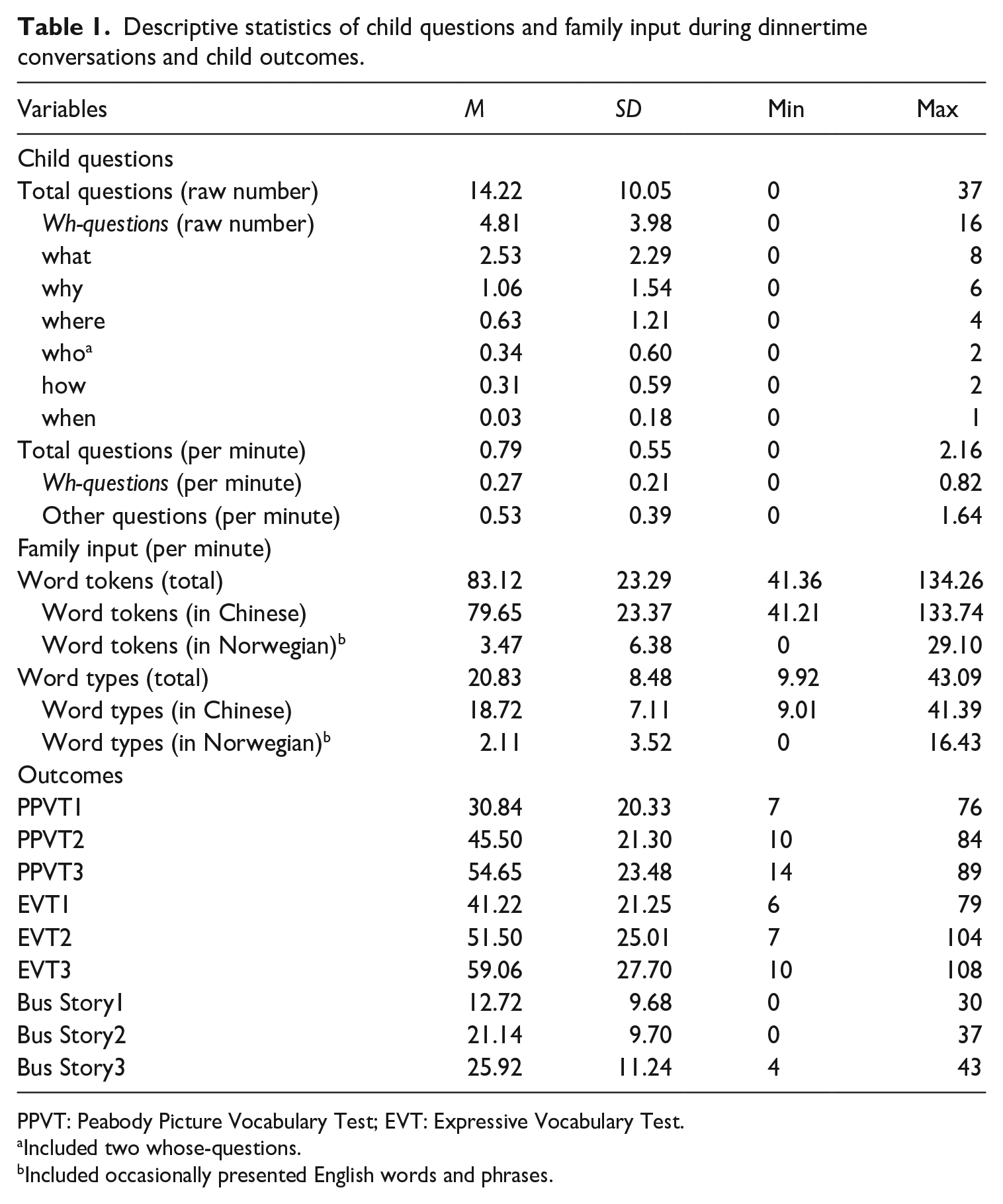
PPVT: Peabody Picture Vocabulary Test; EVT: Expressive Vocabulary Test.
Included two whose-questions.
Included occasionally presented English words and phrases.
Table 2 presents the correlations among all the variables in the study. Notably, children’s wh-questions, compared with other questions, exhibited stronger positive correlations with outcome variables. Child age correlated with children’s wh-questions (marginally) and most outcome variables, indicating that the older children tended to ask more wh-questions and had better receptive and expressive language skills. While family type was not correlated to children’s wh-questions, children from Chinese–Chinese families exhibited higher scores in all language tests than their peers in Chinese–Norwegian families. Parental education, while not correlated with children’s wh-questions, showed a moderate correlation with several outcome variables. Contrastingly, the family input quantity and quality yielded no significant relationships with either child questions or outcome variables. Beyond the variables included in the table, we found a negative correlation between the number of family members present during the dinnertime conversation and children’s questions, suggesting that children asked fewer questions in the presence of more family members.
Spearman correlation matrix of all the variables in the study.
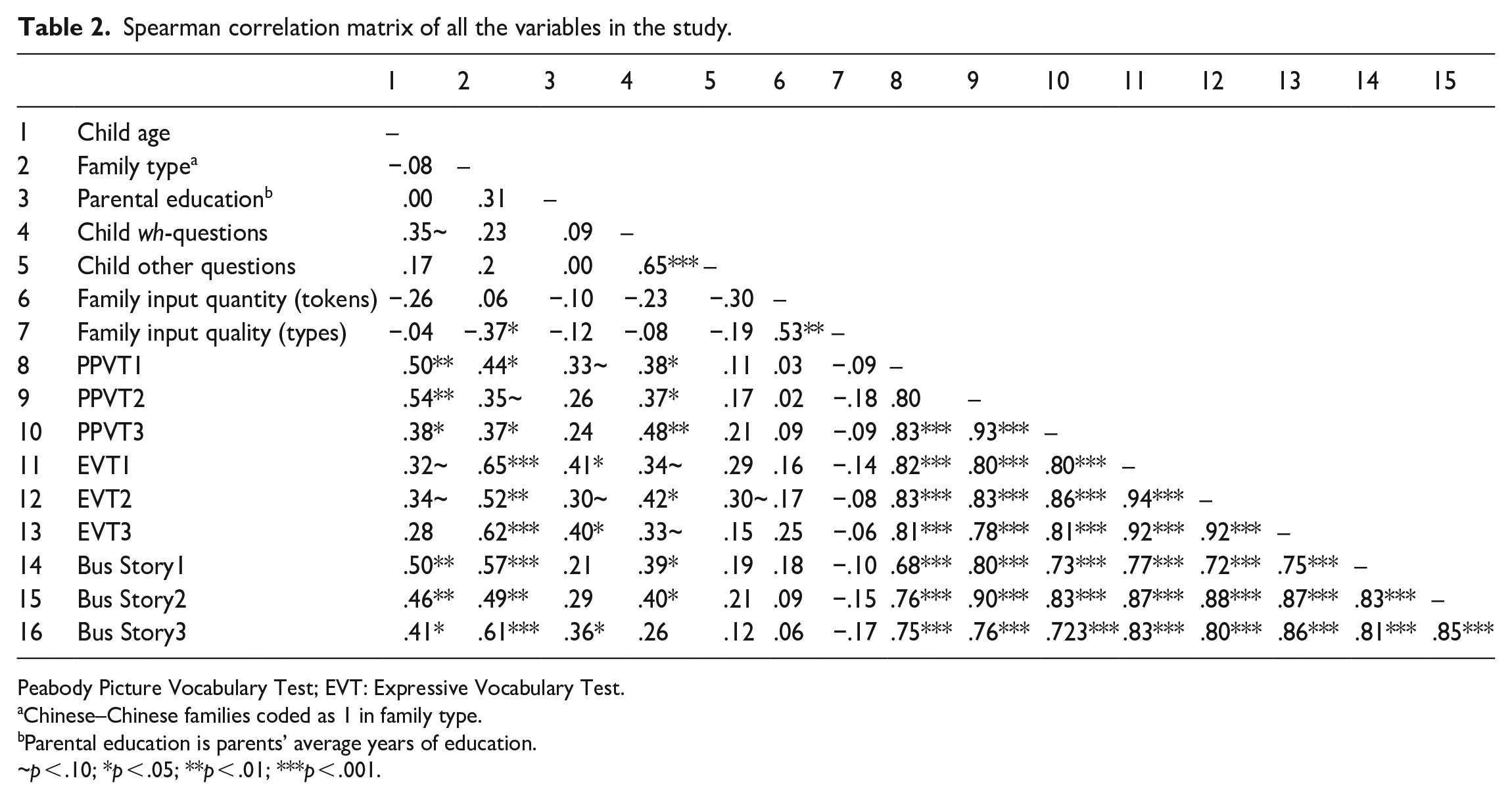
Peabody Picture Vocabulary Test; EVT: Expressive Vocabulary Test.
Chinese–Chinese families coded as 1 in family type.
Parental education is parents’ average years of education.
~p < .10; *p < .05; **p < .01; ***p < .001.
Receptive vocabulary (PPVT-R)
Table 3 demonstrated a taxonomy of fitted models predicting children’s Chinese receptive vocabulary over one year. Model 1 displays the unconditional growth model as a baseline for comparison. We then assessed the role of children’s wh-questions as well as other questions. As expected, children’s other questions were not associated with their receptive vocabulary, but their wh-questions were. As Model 2 shows, the density of children’s wh-questions was not linked to concurrent receptive vocabulary, but it was predictive of their receptive vocabulary growth over time. Models 3 and 4 show the isolated effects of family input quantity (word tokens) and quality (word types) on children’s concurrent receptive vocabulary, where neither family input quantity nor quality were significant predictors. Upon adding the demographic variables in Models 5–7, children’s wh-questions continued to predict their receptive vocabulary growth. Model-fit statistics suggested that Model 7 was the tentative final model. On average, children gained 1.92 points per month (p < .001), and every 1-SD unit increase in wh-question asked per minute was associated with an average increase of 0.53 points in PPVT-R per month (p < .01). Moreover, older children whose parents were both Chinese and had more years of education were associated with higher concurrent receptive vocabulary skills in Chinese (see Model 7).
A taxonomy of fitted models for change predicting children’s Chinese receptive vocabulary (PPVT-R) across one year.
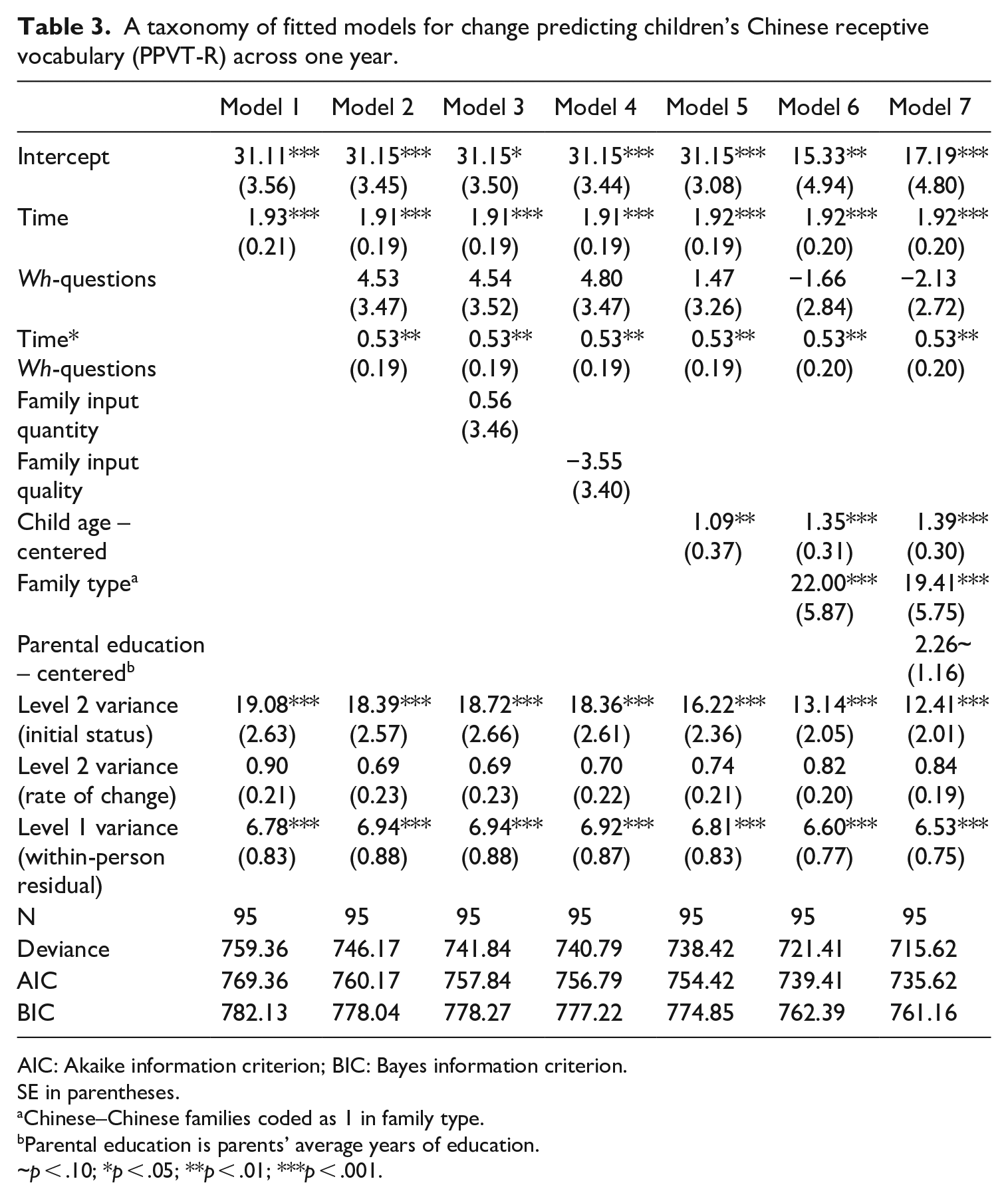
AIC: Akaike information criterion; BIC: Bayes information criterion.
SE in parentheses.
Chinese–Chinese families coded as 1 in family type.
Parental education is parents’ average years of education.
~p < .10; *p < .05; **p < .01; ***p < .001.
Figure 1 plots the prototypical growth trajectories of children who asked wh-questions at an above-average (90th percentile), around-average (median), and below-average (10th percentile) density during the dinnertime conversation while controlling for all significant predictors based on Model 7. Children whose density of wh-questions was at the 90th percentile (dark line) ended up with receptive vocabulary scored approximately 13 points higher than those asking questions at the 10th percentile (light line) 12 months after the dinnertime conversation.
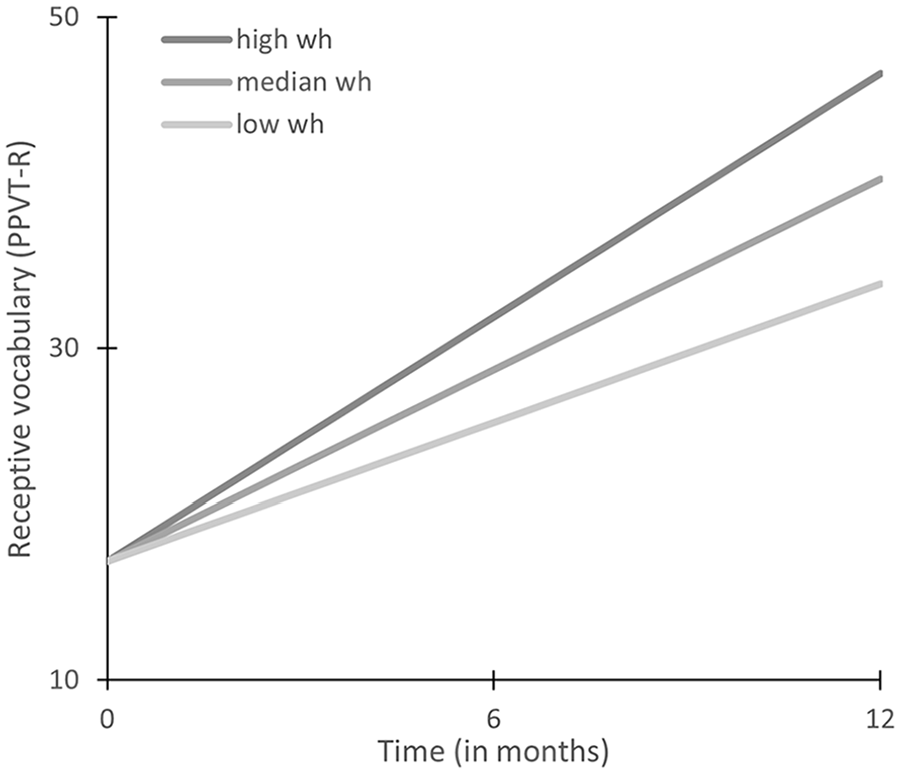
Fitted Trajectories for Prototypical Children Asked Wh-Questions at High, Median, and Low Densities During the Dinnertime Conversation.
Expressive vocabulary (EVT)
Similarly, we fitted a series of multilevel models for change predicting children’s expressive vocabulary in Chinese (see Supplementary Materials). Children’s wh-questions were a significant predictor for the concurrent expressive vocabulary skills: a 1-SD increase in wh-questions density resulted in over 9-point difference in their EVT scores at time one. However, this significant association diminished upon adding the family type (i.e. whether one or two parents were Chinese). The final model indicates that children who were older, from Chinese–Chinese families, and with more educated parents scored higher in their expressive vocabulary at the onset of the study, and they grew by an average of 1.39 points every month.
Narrative skills (Bus Story)
The final set of models investigated the relationship between wh-questions and children’s narrative skills (see Supplementary Materials). Similar to children’s expressive vocabulary, wh-questions were a significant predictor for the initial status. A 1-SD increase in wh-questions density resulted in an increase of over 4 points in their Bus Story retelling at the onset of the study. But when controlling for family type, the significance disappeared. The final model suggests that children, on average, gained 1.06 points per month in their narrative scores, and their concurrent narrative skills were related to their age and family type.
Robustness checks
We conducted robustness checks to address three main concerns. First, our sample size is relatively small; even though we have sufficient data points, we cannot rule out the risks posed by accounting for both fixed and random effects (Singer & Willett, 2003). Therefore, we ran a set of multiple regression models to verify the results of the multilevel models. For the concurrent language skills, wh-questions were used to predict outcome variables at time one, and for growth, outcomes at time three were predicted while controlling for time one. We ran the models with and without the control variables. The results were comparable to the multilevel models. Second, the children in our sample are bilingual learners. Among 154 wh-questions, nine of them were asked in Norwegian and answered (by Norwegian fathers) in Norwegian, and another nine were asked in Norwegian and answered in Chinese. We examined subsets of wh-questions asked and answered in Chinese as well as asked in mixed languages and answered in Chinese. While the significance level decreased, probably due to reduced cases, the consistent findings remained. Third, the sample comprises 22 families with two Chinese parents and nine families with one Chinese parent. Acknowledging the sheer difference in their language use at home, we ran the growth models for each subgroup. For receptive vocabulary, the results remained the same in Chinese–Chinese families; and in Chinese–Norwegian families, although the data points were reduced to 27, children’s wh-questions still marginally predicted their receptive vocabulary (p = .08). For expressive language skills, children’s wh-questions were a marginal predictor for the concurrent skills in Chinese–Chinese families but not in Chinese–Norwegian families. Detailed results can be found in the Supplementary Materials.
Discussion
This study explored bilingual preschoolers’ questioning behavior in a natural home setting – dinnertime conversations and their home language development. The findings revealed that the density of wh-questions children asked during the dinnertime conversations was associated with their concurrent expressive vocabulary and narrative skills, but the association diminished when controlling for demographic factors. More importantly, even when accounting for all control variables, wh-questions continued to predict their receptive vocabulary growth over one year. These findings echo previous studies highlighting the significance of children’s questions in shaping their learning environment and promoting cognitive development (Chouinard, 2007; Ronfard et al., 2020). Moreover, the study extends our understanding of the role children’s wh-questions play in their receptive and expressive language development, contributing to a growing body of knowledge on bilingual children and their home language development (e.g., Gámez et al., 2023; Rydland & Grøver, 2023).
For the first research question, we found that children who asked a higher density of wh-questions during dinnertime conversations also produced more correct words in EVT assessment and narrated more keywords in retelling the Bus Story. Linguistic studies on wh-question acquisition have implied that the correct use of wh-questions in discourse manifests children’s expressive language skills (e.g., Bloom et al., 1982). Our finding empirically confirmed this intuitive conclusion. It is noteworthy, however, that our sample consisted of bilingual learners, adding to the complexity of the demographic factors and family linguistic input (Hoff, 2020). For instance, around one-third of children have a Chinese mother and a Norwegian father. For them, all family conversations involving their father were conducted in Norwegian. As language use connects substantially with expressive skills (Ribot et al., 2018), it is no surprise that family type accounted for more variation in children’s expressive language skills. Consequently, when we included family type as a control variable, the association between children’s wh-questions and expressive language was no longer significant.
By contrast, even when accounting for control variables, children’s use of wh-questions predicts their receptive vocabulary growth across one year. This finding supports our assumption that children’s wh-questions are an integral part of language learning. We considered two possible explanations for why wh-questions predict receptive vocabulary growth. First, children ask questions to learn and comprehend. Each question posed by children and answered by family members provides an opportunity for children to acquire new information and expand their understanding. This improved comprehension can be reflected in the growth of their receptive vocabulary as measured by the PPVT (Dunn & Dunn, 1981). Second, the bilingual factor might play a part, as we know that bilingual learners develop their receptive and expressive skills in different languages at different rates (Hoff, 2021). Although in some families, children asked wh-questions in Norwegian and heard fathers’ responses in Norwegian, all mothers used Chinese to respond. This sheer amount of Chinese input for children’s wh-questions might provide more opportunities for their comprehension rather than production in Chinese, potentially leading to more pronounced receptive vocabulary development in Chinese.
One aspect that limits our understanding of the finding is that we did not analyze family members’ responses to children’s questions. Instead, our interpretation is built upon the established relationship between children’s questions and family responses suggested by the existing literature on caregiver–child interactions. On one hand, studies have shown that children’s questions elicit same-cognitive-level responses from caregivers (Callanan & Oakes, 1992; Chouinard, 2007; Kucherenko et al., 2024). For instance, Callanan and Oakes (1992) conducted a study where parents kept a diary of their responses to children’s causal questions (i.e., ‘how things work’ and ‘why things happen’) and found that parents addressed children’s questions according to the question’s form and provided information as requested. Similarly, a recent study on bilingual children in preschool settings found that the quality of teacher responses was dependent on the type of questions children asked, with explanation-seeking questions resulting in more informative and rich teacher responses (Kucherenko et al., 2024). On the other hand, the research by Kurkul and Corriveau (2018) compared child questions and adult responses, and revealed that mid-SES children asked twice as many questions than their low-SES counterparts, and received more appropriate and higher-quality responses. The authors argue that ‘differences in children’s question asking are a result of the quality of the adult’s responses’ (Kurkul & Corriveau, 2018, p. 290). Collectively, these studies highlight a tight connection between children’s wh-questions and the quality of family members’ responses. Despite the limitation of not coding for family responses, these previous studies support the notion that examining children’s questions can provide informative insights into the nature of family interactions.
To illustrate this point further, we use an excerpt from the data as an example. In the excerpt, a dinnertime conversation unfolds between a 5-year-old child and the parents, both of whom spoke Chinese and held PhD degrees:
You will be starting elementary school, and you will have to clean up by yourself. (你要上小学了, 你就得自己擦了。)
When you need to poop, you will have to do it by yourself. (拉粑粑的时候, 你也得自己来。)
At that time, no one will be helping you. (那个时候, 也没有人可以帮你了。)
What else will I do when I start elementary school?
When you are in elementary school, you need to prepare the things you are going to bring every time. (你上小学的时候呢, 每次要一个人准备好你要带的东西。)
And when school is over, you need to bring everything back. (然后放学的时候, 还要把所有东西带回来。)
Can’t I lose things on the way home? (回来的时候不能把东西弄丢吗?)
Correct, you need to be careful not to lose things. (对, 要小心不能把东西弄丢。)
Such as your water bottle, lunchbox, gloves. (比如水杯呀, 饭盒呀, 手套呀。)
Hat. (帽子。)
Yes, hat. (对呀, 帽子。)
Also, clothes, pants. (还有衣服、裤子。)
Right. (没错。)
Whatever you took in the morning, you had to bring back in the evening. (你早上带了什么东西去, 晚上就要带回来。)
This child extended the father’s comments about starting elementary school by asking a wh-question. It should be noted that probably due to cross-linguistic influence, the child made a small error in word order. The correct order in Chinese should be ‘在我上小学的时候,我还会干什么? (When I start elementary school, what else will I do?)’ Regardless, the child’s wh-question stimulated a long and rich discussion. Not only did the mother provide a detailed answer, but the child also co-constructed the answer by asking a rhetorical question and supplementing the mother’s responses. In line with the literature on parental wh-questions (Leech et al., 2013, 2023; Rowe et al., 2017), this dialogue exemplifies the power of children’s wh-questions in encouraging extensive and enriched responses, as well as facilitating reciprocal exchange of information. Such input, characterized by its quantity, diversity, and interactivity, is beneficial to children’s language learning (Rowe & Snow, 2020).
This study draws upon a unique bilingual sample from a small Chinese immigrant community in Norway–a country undergoing rapid immigrant growth. By focusing on the role of child questions during family interactions, our study complements and extends recent research that delves into the home language development of bilingual children through naturalistic observations (Gámez et al., 2023; Pace et al., 2022; Rydland & Grøver, 2023). For example, Gámez et al. (2023) highlighted caregivers’ lexical diversity and warmth in predicting the home vocabulary growth of Spanish children in the United States. Similarly, in the Norwegian context, Rydland and Grøver (2023) demonstrated that parental inferential questions and children’s responses during shared book reading were significant predictors of bilingual children’s home vocabulary development over an 8-month period. Our study adds to this body of work by highlighting the vital role of family interactions in bilingual development, reflecting trends observed in monolingual contexts.
Intriguingly, our study also presented an unanticipated but interesting finding. Previous studies underline the importance of social and cultural impacts on child questioning behaviors (for a review, see Gauvain & Munroe, 2020): children from mid-SES backgrounds posed more questions than their low-SES counterparts (Kurkul & Corriveau, 2018), and Western children asked more explanation-seeking questions than non-Western children (Gauvain et al., 2013). However, in our cross-cultural sample of Chinese children in Norway with highly educated parents, the high rates of child questions challenge the prevailing impression that Chinese students ask fewer questions (Tan, 2007). We observed a considerable number in both children’s total questions (M = 14.22) and explanation-seeking questions (‘why’ and ‘how’ questions: M = 1.37). This raises the question: can this difference be attributed to their family SES, or their upbringing in a Western environment? This is a question that demands future research.
It is sensible to interpret the findings with caution due to certain limitations of the study. First, our sample size is small, which limits the statistical power. Replication with larger sample sizes is needed to validate the results. The small sample size also presents challenges in drawing conclusions about demographic factors contributing to child questioning behavior, such as SES, gender, and family type, aspects that warrant future exploration. Second, as previously mentioned, our analysis did not include family members’ responses. Although it is well documented that wh-questions encourage enriched responses and conversation exchanges, a recent study by Mills et al. (2022) suggests that parental responses vary considerably depending on their personal characteristics and parenting style. Hence, future studies should examine the nuances of caregivers’ responses to children’s wh-questions and investigate their potential link to children’s language development. Another aspect we did not explore involves the dynamics in multiparty dinnertime conversation. Our finding shows that children tended to ask fewer questions when more speakers were present, raising questions about how the number of speakers influences the group dynamics and children’s language input. These are interesting areas that deserve attention in future research. Finally, even though this is a longitudinal study, it has a correlational nature, and thus, no causal conclusion can be drawn.
Despite these limitations, this study contributes to the field in several ways. Building on the social interactionist view of language learning, we emphasize children’s role in shaping interactions. Together with studies focusing on child contribution during interactions, such as their spontaneous talk (Kim et al., 2011) and follow-up questions (Kurkul et al., 2022), we highlight the importance of children’s active involvement in learning. Moreover, our findings are particularly salient for bilingual children, showing that regardless of the language in which bilingual children asked their wh-questions, caregivers’ consistent use of home language in their response contributed to children’s receptive home vocabulary growth. Furthermore, this study also underlines daily routines like dinnertime as essential contexts for child participation and language learning, where meaningful interactions and constructive learning can take place. Parents and other caregivers are significant in supporting and responding to children’s questions. Creating a supportive environment where questions are encouraged and valued can not only foster children’s curiosity and confidence but also pave the way for their language development.
Supplemental Material
sj-docx-1-fla-10.1177_01427237241242177 – Supplemental material for What else will I do when I start school? Preschoolers’ wh-questions in dinnertime conversations and their language development
Supplemental material, sj-docx-1-fla-10.1177_01427237241242177 for What else will I do when I start school? Preschoolers’ wh-questions in dinnertime conversations and their language development by Junyi Yang, Joshua F. Lawrence and Vibeke Grøver in First Language
Footnotes
Appendix 1
In the individual growth models, Level 1 described children’s initial status and change of receptive and expressive language skills (within-person differences), and Level 2 described how the initial status and change differ across children (between-person differences). The basic statistic model is as follows:
Level 1:
Level 2:
Where
In the equations, the subscript i denotes the child, and the j denotes the months elapsed since the first data collection. π 0i represents the intercept, which is the true value of childi’s receptive vocabulary, expressive vocabulary, and narrative skills at the onset of the study, and π 1i represents the slope, which is the true change rate for childi over time. The residuals ε ij represents the proportion of childi’s language skills that is not predicted by the time variable.
Since we coded children whose parents are Chinese as 1 for Family type, and centered child age and parental education to its mean, the first part of Level 2 regression parameters can be interpreted as follows:
Similarly, the second part of the Level 2 equation specifies the growth of children’s receptive vocabulary, expressive vocabulary, and narrative skills across one year. To give a couple of examples,
Acknowledgements
The authors thank all the participating families for their time, interest, and contributions. The authors also wish to thank the editor and the anonymous reviewers for their insightful feedback.
Author contribution(s)
Declaration of conflicting interests
The author(s) declared no potential conflicts of interest with respect to the research, authorship, and/or publication of this article.
Funding
The author(s) disclosed receipt of the following financial support for the research, authorship, and/or publication of this article: The study was supported by the Department of Education at the University of Oslo.

Supplemental material
Supplemental material for this article is available online.
References
Supplementary Material
Please find the following supplemental material available below.
For Open Access articles published under a Creative Commons License, all supplemental material carries the same license as the article it is associated with.
For non-Open Access articles published, all supplemental material carries a non-exclusive license, and permission requests for re-use of supplemental material or any part of supplemental material shall be sent directly to the copyright owner as specified in the copyright notice associated with the article.
