




Abstract
The delayed acquisition of Spanish ser and estar is generally understood as rooted in the cognitive demands imposed by the integration of semantic-pragmatic and world-knowledge factors associated with their lexical meanings. Here we ask (1) what is the nature of this language world-knowledge integration? and (2) what is the developmental trajectory including its age distribution? We examine Spanish copula production and comprehension in 142 children (age range: 4–12 years) and 26 adults. Using two tasks, sentence-choice (comprehension) and cued-production (production), we test the hypothesis that estar use is constrained by an ability to construe an alternative to the copula predication; an ability that develops with life experience. We test estar/ser use in two contexts: alternative-supporting, favoring estar use; and alternative-neutral, neutral regarding estar use, and possibly favoring ser use. The results show that for comprehension, children do not reveal adult-level sensitivity to context, exhibiting instead over-selection of estar sentences. For production, all children over-produce the estar sentence, even after having just chosen the ser counterpart. However, in this task, the 10- to 12-year-olds do behave similarly to adults and differently from 4- to 6-year-olds, consistent with our hypothesis. Alternative construal requires exposure to entities and properties in a variety of situations; exposure that older children are more likely to exhibit. Collectively, these results (1) support the properties of estar use hypothesized to underlie the language-world-knowledge integration, and (2) delineate a potential developmental trajectory whereby mastery of the copula may not begin to manifest until 10–12 years of age, not because of any one linguistic factor but rather due to specific world-knowledge exposure constraints.
Introduction
We investigate the acquisition trajectory of the Spanish copula verbs ser and estar (English ‘be’) in 4- to 12-year-olds. Ser and estar are of interest because they show different yet sometimes overlapping distributions in adult use, showing in some cases variation among Spanish dialects. Past studies have also observed that children acquiring Spanish sometimes over-use estar, a pattern which appears independent of dialect (Holtheuer, 2011; Schmitt et al., 2004; Schmitt & Miller, 2007; Sera, 1992; among others). This raises the question of what gives rise to the observed distributional patterns and how children come to acquire the adult patterns.
The copula distinction that is often invoked is that estar is used to express temporary properties, whereas ser is used to indicate that a property is inherent to a given entity and, therefore, holds permanently (Bello, 1951; Gili Gaya, 1961). For example, the use of ser in (1a) indicates that the banana is permanently green (e.g. a Granny Smith), whereas the use of estar in (1b) describes the banana as being temporarily green (e.g. an unripe banana).
1. (a) La banana es verde ‘The banana is green’ (b) La banana está verde ‘The banana is not ripe yet’
This traditional view cannot capture the diversity of contrastive copula patterns observed across dialects in modern Spanish. The uses of ser and estar in (2) below, for example, are not determined by the temporary/permanent properties of the curtain’s length. Indeed, in both (2a) and (2b), the length of the shower curtain is expected to be permanent. Examples like this indicate that ‘permanent/temporary’ or ‘inherent/extraneous’ may not be the determining factors of copula use (see Sánchez-Alonso, 2018; Sánchez-Alonso et al., 2016, for full discussion).
2. (a) La cortina del baño es corta ‘The shower curtain is short’ (b) La cortina del baño está corta ‘The shower curtain fitting is short’
Partly to explain copula uses like (2) above, other accounts describe ser and estar patterns by leveraging proposed semantic and/or pragmatic distinctions between the copulas: individual/stage level distinction (Diesing, 1992); aspectual-based distinctions (Camacho, 2012; Luján, 1981; Schmitt, 1992, 1996, 2005; among many others); and pragmatic/discourse contextual interactions (Clements, 1988, 2005; Maienborn, 2005; Roldán, 1974; Sánchez-Alonso et al., 2016; see also Holtheuer, 2011, 2011 for an overview). All these accounts converge on the following: (a) the ser/estar difference appears to be lexico-pragmatic, (b) it is related to world-knowledge, and accordingly (c) contextual cues play a role in the specific reading that they may give rise to. These notions are the starting point for our investigation into the acquisition patterns of the ser/estar distinction.
Despite the interest in these verbs, investigations into the acquisition of the Spanish copula remain limited. So far, the available studies suggest that children use copulas contrastively by relying on morphosyntactic cues and their use differs somewhat from that of adults even as late as 9;0 years of age, with full mastery beginning at around 12;0. For example, Holtheuer and Rendle-Short (2013) reported agreement errors in children aged 1;10–3;4, and still others have reported an over-production/over-acceptability of estar in children regardless of age tested (i.e., use of estar predications in cases in which adults would choose ser) (Alonqueo, 2007; Johnson & Johnson, 2005; Schmitt et al., 2004; Sera, 1992; among others).
Two kinds of complementary explanations have been proposed to capture why children take longer to master copula use. The first explanation is that children show delayed adult use due to the compositional demands of copular constructions, which require integration across linguistic components (i.e. lexical-semantics, syntax, and pragmatics), some involving knowledge of time reference, experience with the world, and an understanding of the speaker’s point of view (Holtheuer, 2011; Johnson & Johnson, 2005; Schmitt et al., 2004; Schmitt & Miller, 2007; Sera, 1992). The second explanation concerns the presence of non-linguistic cognitive constraints, such as children’s limited conceptualization of time or limited knowledge of the world. Specifically, the suggestion is that it takes some degree of exposure to the world and life experience for children to fully grasp that, at any given situation, objects and properties in the world can be assumed as more stable (a meaning preferentially conveyed with ser) or more changeable (preferentially conveyed with estar). Indeed, prior findings on copula acquisition converge to suggest that children’s copula use is correlated with knowledge of how much a given property is stable/changeable (Alonqueo, 2007; Requena et al., 2015; Schmitt et al., 2004; Sera, 1992; among others). Here we propose the first explanation to be a subset of the second and focus this study on the larger possibility that copula acquisition is constrained by the interaction between specific linguistic and plausibility constraints. We argue that this general view can be made more precise once we are able to be more explicit regarding the lexical-semantics of the two copulas and their compositional requirements. Accordingly, we address two questions: (1) what is the constraint on language-world-knowledge integration that underlies Spanish copula use? and (2) what are the implications of this constraint for the developmental trajectory of its acquisition?
To address these questions, we examine Spanish copula production and comprehension in an age range wider than all previous studies (4–12 years) and with a larger set of copula predications, some of them never tested before with children. To explore the lexical-pragmatic-world-knowledge integration, we focus on the connection between the two copulas and the explicit linguistic context (Clements, 2006; Maienborn, 2003, 2005; Sánchez-Alonso, 2018; Sánchez-Alonso et al., 2016). In the following two sections, we elaborate on the contextual dependency of estar predications, which distinguishes it from ser, and which gives rise to the specific hypothesis regarding the distinctions between the lexical requirements of estar versus ser, and their interaction with the context. This is followed by a summary and discussion of the past experimental literature motivating our study.
The contextual dependency of estar predications
A common observation regarding the ser/estar copula distinction is that estar expresses a ‘contrast’ whereas ser does not (e.g., Crespo, 1946; Falk, 1979; Franco & Steinmetz, 1983; Gumiel-Molina et al., 2015). The contrastive nature of estar predications is observed not only in predicates that describe a temporary property of the entity-denoting subject (1a), but also in predicates that do not describe the property as holding temporarily, such as those in (1a–b): 3. (a) ¡La carretera es/está ancha! ‘The road is wide!’ ser: in comparison to the average width of roads estar: in contrast to other parts of the same road (b) La Capilla Sixtina es/está hermosa ‘The Sistine Chapel is beautiful’ ser: objective statement estar: in contrast with prior expectations
The use of ser in these examples lacks the contrastive meaning expressed by estar and instead simply asserts that the predication holds for the subject referent. By contrast, the use of estar in (3a) indicates that the road is wider than expected, thus contrasting the road with other parts of the same road. In (3b), estar indicates that the Sistine Chapel is more beautiful than expected. That is, the beauty of the Sistine Chapel is contrasted with the speaker’s prior beliefs or expectations. Note that in the estar uses in (3a–b), the possible temporary nature of the predication is irrelevant. For example, whether the Sistine Chapel undergoes future changes that affect its beauty is not what is being conveyed by the speaker.
All pragmatic-based accounts of the ser/estar distinction are based on two key insights: (1) estar predications express a contrast of some sort, not present in ser predications; and (2) the felicity of estar predications is context dependent (i.e., when estar is used, but not ser, a richer and more specific context is necessarily invoked) (Clements, 1988; Maienborn, 2005; Roldán, 1974; Sánchez-Alonso, 2018; Sánchez-Alonso et al., 2016). Here, we follow the contextual-dependency analysis as presented in Sánchez-Alonso et al. (2016) and Sánchez-Alonso (2018), which builds on prior analyses (Clements, 1988, 2006; Maienborn, 2005, 2006). It proposes that both ser and estar have the same meaning: both indicate that a given predication holds of the subject denotation. Importantly, estar additionally contains the presupposition that such predication holds contingently at utterance time. Therefore, the felicitous use of estar, but not of ser, depends on specific inferences that hearers must make upon encountering the copula to satisfy its contingency presupposition.
The specific nature of the presupposition is as follows: estar requires the hearer in a conversation to construe alternatives that contrast with the stated estar predication. These contrastive alternatives can be construed from the immediate context or from common ground knowledge. For example, consider the context in which a journalist is traveling on the Pan-American Highway from Buenos Aires to Lima and she notices that the highway is much wider near Lima; then, she says: ¡La carretera está ancha! (Example 3a). This use of estar is considered acceptable by Spanish speakers because the context includes the speaker’s prior knowledge about the road width at some other spatially defined part of the road (e.g., the road near Buenos Aires). The context invokes alternatives in the hearer in which the property of being wide may not apply to the road near Lima, thus establishing a contrast with the current predication. In this example, one such alternative is that the road near Lima is as wide as the road near Buenos Aires, which contrasts with the stated predication. These alternatives are thus entered as part of the common ground between the speaker and the hearer. From this it follows that a context that allows access to alternative situations that contrast with the current predication facilitates fulfillment of estar’s presupposition. The crucial consequence of the presupposition-based analysis is that the meaning of estar is context-dependent; that is, it requires interlocutors to have a shared knowledge regarding the relevant contrasting alternatives that satisfy the presuppositional component encoded in estar. This contextual dependency on contrasting alternatives is not observed in ser predications. The cognitive challenge for the comprehender of an estar sentence is therefore in being able to construe the contrasting alternatives in real-time. Such a process relies directly on the life experience of the comprehender, including their world knowledge, and on their ability to detect in the context the relevant information that supports the construal (of situations that are an alternative to the one asserted in the estar sentence).
How are these different referential properties of the copulas acquired by children? We start with the observation that these contrasting alternatives can be explicitly suggested in the discourse context, thus facilitating their construal. Indeed, it has been shown that when adult speakers are provided with the possibility of existing contrasting alternatives from the context, estar predications are more likely to be judged acceptable and are processed with greater ease (Sánchez-Alonso, 2018; Sánchez-Alonso et al., 2016). We argue that the same facilitatory effect should be observed in children. Following prior studies with adults, we focus here on copula predications in which both ser and estar are possible, but ser is considered the preferred choice by adults when the sentence is presented without an estar-facilitating context (i.e., a ‘estar-neutral’ context). Therefore, correlated use of estar and estar-supporting contexts can be safely attributed to the context in which the predication is embedded (for findings with adults, see Sánchez-Alonso, 2018; Sánchez-Alonso et al., 2016). Before presenting the study, we discuss prior findings on copula acquisition.
Previous findings on copula acquisition
Previous studies on Spanish copula acquisition have assumed the traditional view associated with the copulas, whereby estar appears with temporary/changeable predications and ser with permanent/stable predications. In one of the earliest studies, Sera (1992) used spontaneous and semi-spontaneous elicited speech production data and reported that Castilian Spanish-speaking children (aged 1;6–9;0) used the two copulas contrastively in an adult-like fashion. However, in that same study they also showed that children (aged 3;0–5;0) produced estar + adjectival predicates in cases in which adults would use ser. This so-called ‘overuse’ of estar was found to decrease in 9;0-year-olds.
Since then, this pattern of over-production/over-acceptability of estar has been robustly documented in children. In a picture-matching task, Schmitt et al. (2004) reported that, in contrast to adults, Chilean Spanish-speaking children (aged 4;0–5;0) chose the picture representing the property as holding permanently not only when they were asked questions with ser, but also when they were asked questions with estar. 1 In an acceptability judgment task, they presented children (mean age of 5;0) with copula predications across three different conditions that differed in terms of the kind of restrictions they contained: lexical restrictions, syntactic restrictions, or discourse-pragmatic constraints. The responses across the three conditions were different from adults’ responses, and children showed more difficulties when they had to judge sentences according to discourse-pragmatic constraints: inherent/permanent/stable or temporary/changeable. Specifically, in this condition, children showed a preference for estar even in permanent contexts (for similar results, see Schmitt & Miller, 2007; Holtheuer, 2012, which replicated the results using an acceptability task with Cuban Spanish-speaking children, aged 3;3–7;3). Across these studies, permanent versus temporary properties of the copulas were analyzed as pragmatic implicatures that emerge from the copulas’ syntactic characteristics. Estar was analyzed as a state that asserts that the predicate is true at a particular point in time, which gives rise to the implicature that estar is temporal; ser, however, is not restricted and has no corresponding implicature. On this view, children first acquire the syntactic and semantic constraints of copula, and only later in development acquire the associated implicatures (i.e., pragmatic constraints).
Overuse of estar has been found not only in production but also in comprehension. Johnson and Johnson (2005) reported results from four different tasks: sentence repetition, completion, comprehension, and judgment (Mexican-Spanish, n = 29, aged 2;6–4;0). Performance was closer to that of adults in the production relative to the comprehension tasks. The errors across tasks, however, were similar. In the production tasks, errors were always related to using estar in cases where ser would be the expected adult use. In the comprehension tasks, children also differed markedly from adults, over-accepting sentences with estar. The authors concluded that copula uses that depend primarily on semantic and pragmatic knowledge are particularly challenging for children.
Most previous studies on estar/ser acquisition have investigated acquisition in children under the age of 7 years and often include stimuli with adjectives referring to properties such as size, color, shape, which are well-known to children regardless of age (e.g., El perro está gordo ‘the dog is fat’). Different results are obtained when older children are studied, and a wider set of properties are tested. For example, Alonqueo and Soto (2005) used a picture-matching task with familiar objects and properties (e.g., color/size/shape properties), but novel adjectives. As in previous studies, they studied copula comprehension using the inherent/temporal distinction (n = 240, aged 4;4–12;0, Castilian Spanish) and did not provide contextual information. Their results were consistent with Schmitt et al.’s (2004) findings: children associate estar with permanent properties significantly more than adults. Interestingly, they begin to show a closer adult-like use of estar at 8 years of age that seems established by the age of 12. Therefore, children’s adult use of these ser/estar readings takes place much later than previously expected. The authors propose that such delay is due to the children’s developing knowledge regarding stable and changeable characteristics (see also Alonqueo, 2007). In another study, Alonqueo and Soto (2011) tested instead psychological traits and observed similar results, which suggests that understanding of finer-grained semantics of the predication (i.e., mental states vs physical properties) matter for copula acquisition.
Requena et al. (2015) used a similar picture-matching paradigm and novel adjectives. In this case, however, the properties included were also novel and their focus was on changes in color and size properties. In contrast to Alonqueo and Soto’s (2005, 2011) findings, the authors report that children preferred to associate estar with temporary properties (84%) (n = 52, aged 4;0–7;2; Puerto Rican-Spanish). Furthermore, they found that by 4 years of age (their youngest group), children already associated estar primarily with temporary properties. Finally, in a recent study, using the same experimental paradigm, Requena (2020) observes that 3-year-olds show chance performance when associating temporary properties with estar and this selection did not differ significantly from that of ser (n = 38, aged 2;2–3;8; Argentinian Spanish). Therefore, the author concludes that the copula distinction emerges between the ages of three and four.
Altogether, previous work converges on the following: (1) children overuse estar relative to adults and (2) the factor at issue is connected specifically to the estar use, and with implications related to pragmatic-discourse processing (possibly involving world-knowledge). However, important gaps in our understanding remain. First, when do children begin adult-level copula use and what exactly triggers/promotes the change in performance? Second, do the properties identified in the overuse of estar in comprehension extend equally to production? Third, what is the developmental trajectory for any one variety of Spanish? Fourth, what exactly are the meaning domains that interact differentially with copula use and why? The study that we present below seeks to bridge these gaps. Specifically, the study (1) expands the age range of children tested; (2) examines copula use in both production and comprehension tasks, and (3) implements an experimental design that embeds the copula construction in predictable contexts, which more precisely identify the factors that link the copula’s lexical representation to pragmatic/world-knowledge. Our experimental design is grounded in an understanding of estar whereby the link between estar and world-knowledge integration is facilitated by the requirement imposed by estar and encoded in the form of a presupposition. Satisfaction of this requirement allows construal of situations that are an alternative to the one asserted in the estar sentence and without which the interpretation of that sentence is not felicitous.
The present study
We address our research questions by systematically varying the contextual information that is presented along with copula predicates in children aged 4;0–12;0 acquiring Venezuelan Spanish as a first language. We operationalize the lexical-world-knowledge integration with the following generalization: A core distinction between the copulas is that estar requires construal of contrasting alternatives as invoked by the context, whereas ser is neutral in this respect. That is, the use of estar is constrained by the possibility of constructing, from the explicit context or word-knowledge, alternative situations to the stated estar predication. So, for an estar predication to be felicitous, the hearer must construct an alternative situation that contrasts with the asserted estar predication. Therein lies the contrastive property and contextual dependency of estar. Here, we present children with contextual information that either strongly supports the contrastive uses of estar observed in adults or is neutral with respect to this contextual requirement. We examine children’s behavior across both production and comprehension tasks. To this end, two tasks were included: a sentence-choice task, testing copula comprehension; and an immediate sentence-recall task, testing copula production.
Methods
Participants
A total of 142 children participated in the study. Participants were between 4;0 and 12;0 years of age, native speakers of Venezuelan Spanish, and had no reported language or auditory difficulties. The children were tested at two different elementary schools in the city of Caracas (Venezuela). All children had lived in Caracas since birth and were raised in families in which at least one of the parents had college-level education.
Participants were divided into three different groups based on schooling level: Groups 4–6 comprised the youngest children, who had not yet started primary education (4;0–6;0 years old); Groups 7–9 consisted of children who were developing reading and writing skills (7;0–9;0 years old); and Groups 10–12 comprised children from the last 2 years of primary education (10;0–12;0 years old).
Our adult control group included 26 native speakers of Venezuelan Spanish (14 females, aged 17–28 years, mean: 23 years, SD = 2.8). They were all born in Venezuela and had lived in Caracas most of their lives.
Materials
Twelve pairs of copula sentences in Venezuelan Spanish were created for a total of 24 sentences. The copula was always either immediately followed by an adjective phrase (eight pairs of sentences) or by either a noun phrase or prepositional phrase (four pairs of sentences). For the adjective phrase cases, each pair of sentences differed only in whether the sentence included the copula ser or estar. For the noun phrase/prepositional phrase cases, an additional morphosyntactic difference had to be introduced for grammaticality purposes: the sentences differed by the copula and by the complement phrase type (prepositional phrase for estar sentence and noun phrase for ser counterpart) as estar always requires the preposition de ‘of’: ser mecánico versus estar de mecánico (in both cases ‘be (a) mechanic’).
For each sentence pair, we created two types of contexts. The first context type, the
4. Examples of Materials:
La tarta de limón de Martina ha mejorado, sobre todo el relleno porque antes le quedaba muy seco.
‘Martina has improved her lemon cake, especially the filling, which used to be very dry’.
Elena me dio la receta de la tarta de limón que prepara su madre y hoy mismo la hice. ‘Elena gave me her mom’s lemon cake recipe and I made one today’.
(i) Me parece delicioso, el relleno
(ii) Me parece delicioso, el relleno Both (i)/(ii) translated as: ‘It seems delicious, the filling is soft and with an intense lemon flavor’.
The context in (4a) describes the speaker’s experience-based assessment of the cake’s taste and, therefore, a subjective evaluation of the cake. We included two other types of predicates (examples in Supplementary Materials): (i) temporary predicates, which describe the property as holding of individuals over limited temporal durations, and (ii) relational predicates, in which the property is interpreted as obtaining to a degree that depends on a relation between the subject and some other entity salient in the discourse context.
Six additional unrelated sentences were created and included as fillers. All sentences were created by three Venezuelan speakers with vocabulary familiar to children. Two additional speakers of Venezuelan Spanish reviewed the sentences for acceptability.
Design and procedure
Each experimental item (context + two copula sentences) was presented auditorily with the corresponding illustrative pictures presented over two slides on a computer screen. The first slide introduced the context sentence (either alternative-supporting [AS] or alternative-neutral [AN] context) auditorily, as well as in written form, with two images that depicted the event(s) described (Figure 1: AS context; Figure 2: AN context). The second slide introduced the copula sentences by showing a picture and two bears, one at the lower right corner and another at the lower left corner of the slide (Figure 3). Each bear produced a copula sentence describing the picture. Specifically, one bear produced the copula sentence with ser, and the other bear produced the same sentence with estar. The audio was recorded by two different female speakers of Venezuelan Spanish (born and raised in Caracas). The order of presentation of the audio (left or right bear) was randomized throughout the experiment. The copula sentences were not presented in written form, only via audio. To help the children focus on the sentence and the corresponding bear, the bear was made to wiggle slightly while producing the sentence. To ensure that participants paid attention to the experimental items and processed them fully, only participants that responded correctly to at least 80% of the comprehension questions were included in the final analysis.
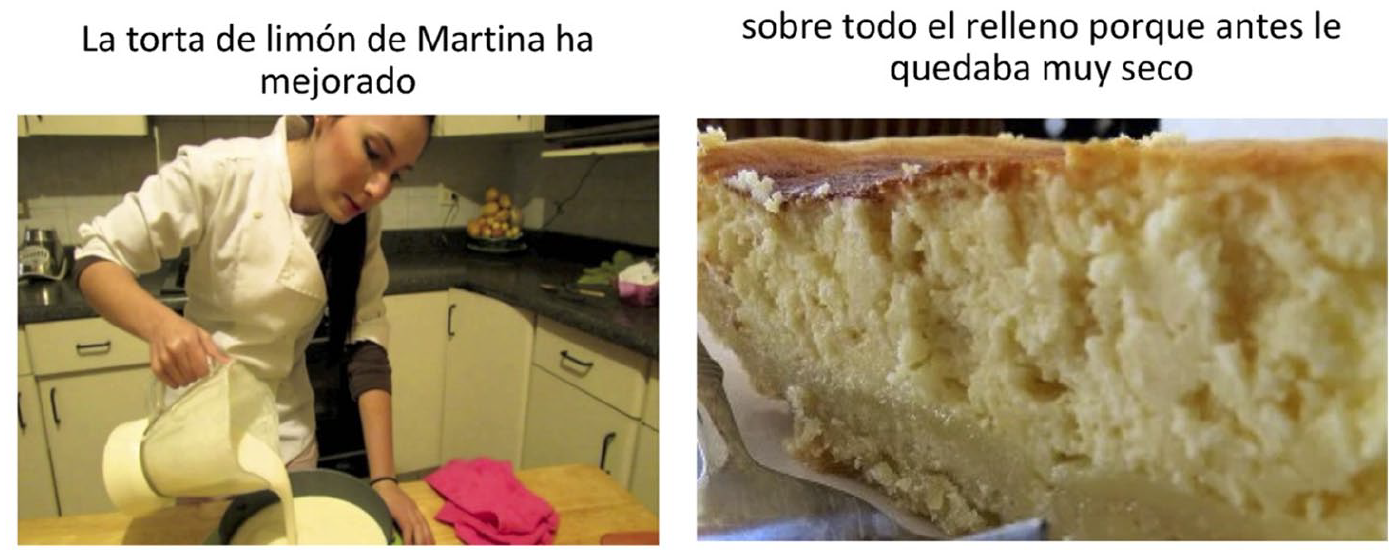
Alternative-Supporting (AS) Context Sentence. Translation: (1) ‘Martina has improved her lemon cake, (2) specially the filling, which used to be very dry’.
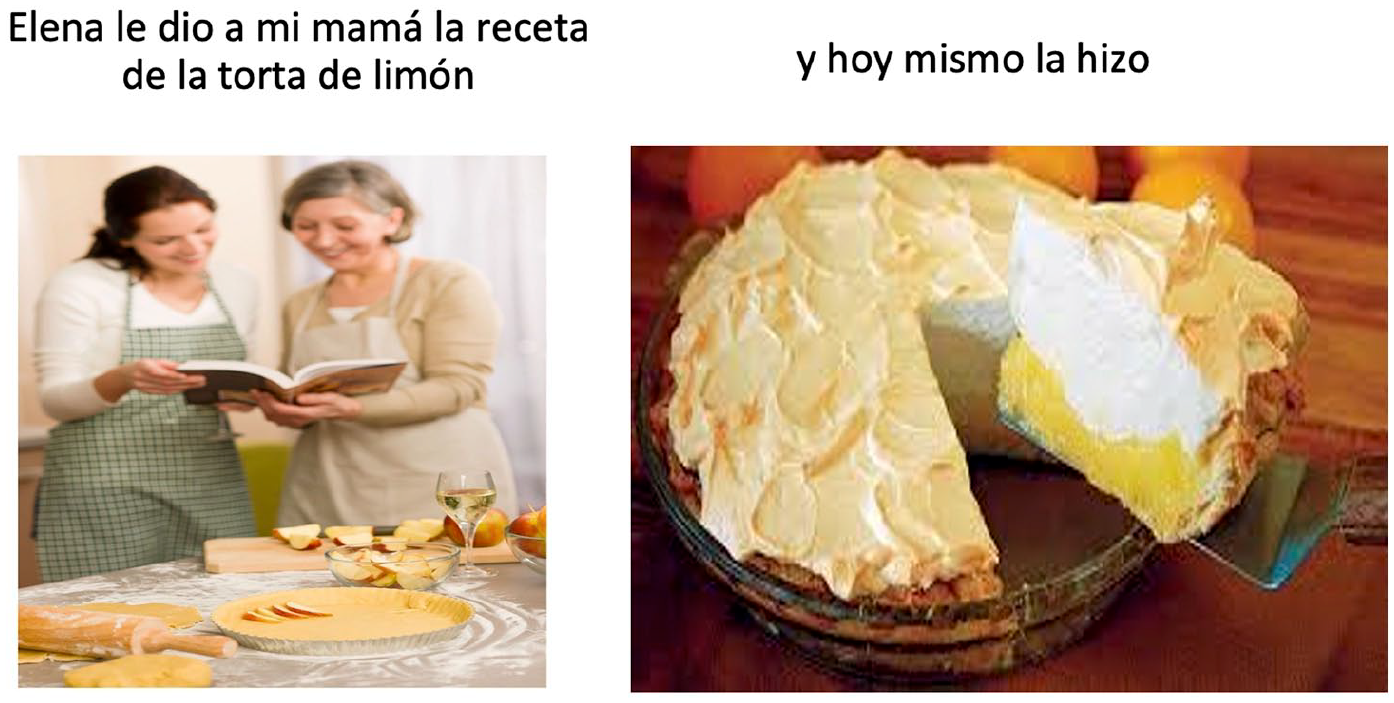
Alternative-Neutral (AN) Context Sentence. Translation: (1) ‘Elena gave me her mom’s lemon cake recipe, (2) and I made one today’.
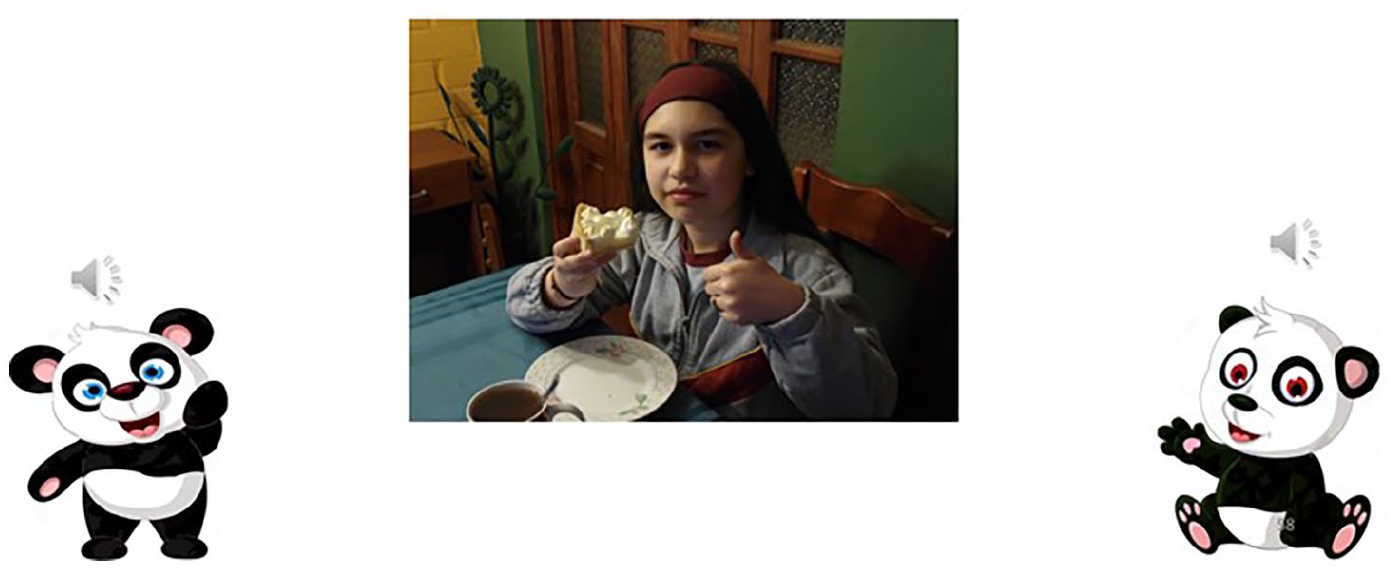
Presentation of Copula Sentences with Ser or Estar. Depicted Sentence: Me parece delicioso, el relleno es/está suave y con un intenso sabor a limón. Translation: ‘It seems delicious, the filling is soft and with an intense lemon flavor’.
Participants performed two tasks: a sentence-choice task and an immediate cued-production task. In the choice task, participants were asked to choose between the two bears on the screen. Specifically, the experimenter asked the following: Por favor, elige el oso que dijo mejor la frase, el que la dijo como tú la dirías (‘Please, choose the bear that said the phrase better, the one that said it like you would’). Immediately after each choice-task stimulus, participants responded to a cued-production-task question. In the cued-production task, participants were asked to produce the version of the sentence that they had chosen, as said by the bear. The experimenter asked: ¿Te acuerdas de lo que dijo el oso? (‘Do you remember what the bear that you chose said?’). The goal of this task was not necessarily for participants to repeat what the bear said verbatim, but rather to express that they understood what the bear had said, thus providing a measure of copula production. It also served as an additional confirmatory measure of the participant’s understanding of each chosen sentence. The rationale is that participants would have more time to process the contextual information by the time they were asked to produce the sentence. Following the cued-production task, participants answered a yes-no comprehension question after 50% of the sentences to ensure that they were paying attention and processing the sentences fully.
Each pair of copula sentences was always presented twice in the study: once preceded by an AS context and a second time preceded by an AN context. The study took 30 minutes with a 5-minute break half-way through.
Predictions
For adults, we hypothesized that the proportion of estar choice/production would be higher when the preceding context provides explicit support for estar’s presupposition (AS contexts) than when it does not (AN contexts). For children, we predicted that their preference to choose/produce estar with AS contexts relative to AN contexts would depend on the extent to which they are able to construe the alternatives from the context that satisfy estar’s presuppositional component. That is, differences in copula choice across participants would be determined by the participant’s ability to successfully extract the alternatives from the context to satisfy estar’s presupposition. We expected this ability to show an association with age, increasing with experience: as children are incrementally exposed to estar uses across a variety of contexts, they should find it easier to construe contrasting alternatives from the contextual information. Therefore, any developmental differences would be reflected in the extent to which they choose/produce estar with AS contexts relative to AN contexts.
Crucially, percentages of copula choice/production were not expected to be absolute, since both copulas are acceptable with all predicates included in the study. As noted, the key prediction is that successful construal of relevant alternatives from the context was expected to increase estar’s choice/production, particularly with AS contexts. The adult results served as a baseline for determining the extent to which adult participants are able to identify the relevant contrastive alternatives from the context. Children were compared against this baseline in both tasks.
Results
Sentence-choice task
We performed a generalized linear mixed model (GLMM, Baayen, 2008) for binary data (logistic regression) with copula choice (ser or estar sentence) as the dependent measure and binary coding estar = 0 and ser = 1. This GLMM analysis allowed the evaluation of the effects of context type (AS vs AN) and age group (4- to 6-year-olds, 7- to 9-year-olds, 10- to 12-year-olds, and adults) on copula sentence choice. The variable context was sum coded. The AS condition was coded as −0.5 and the AN condition as 0.5, thus centering the effects at the grand mean (i.e., the mean of the two group means). The variable age group with four levels (4- to 6-year-olds, 7- to 9-year-olds, 10- to 12-year-olds, and adults) was treatment coded by setting the level adults as the reference level and, therefore, as the baseline for comparison. All possible interactions between fixed effects were included at the beginning of the iterative model selection. Random effects included intercepts for subjects and items.
For the GLMM analysis, we used R version 4.0.3 (R Core Team, 2019) and the ‘glmer’ function (‘lme4’ package, version 1.1-26, Bates et al., 2015). P-values were obtained by likelihood ratio tests of the full model with the effect in question against the model without the effect. We tested the main effects of the final model with type II Wald’s χ2 tests using the ‘anova’ function (‘car’ package, Fox & Weisberg, 2018). We performed post hoc multiple comparison tests on the variable age group using Tukey’s honest significant difference (HSD) test.
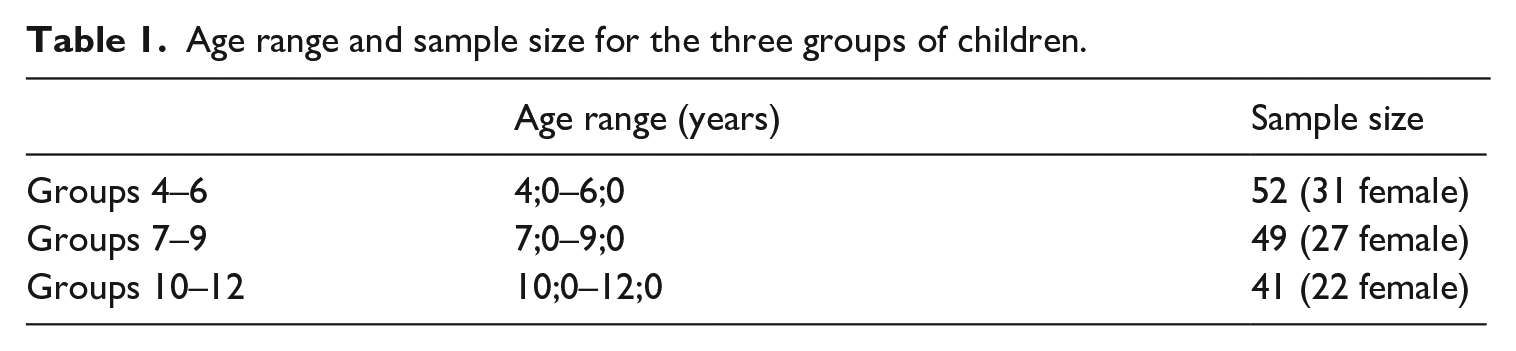
Out of the 142 participants tested, 30 were excluded from the final sample for the following reasons: (i) the child did not respond correctly to at least 80% of the comprehension questions, (ii) the child systematically chose the same bear in over 80% of items, and/or (iii) data were missing for over 50% of items. The final sample consisted of 112 children (65 girls) (see Table 1). The mean percentage of response accuracy was 88% in children and 90% in adults.
Age range and sample size for the three groups of children.
We found a main effect of age group (χ2 = 14.51; df = 3; p = .002). The post hoc analysis revealed a significant difference in copula sentence choice between adults and children, which was primarily driven by the youngest and oldest children (Groups 4–6: β = 0.63; SE = 0.17; z = 3.7, p = .001; Groups 7–9: β = 0.34; SE = .15; z = 2.16, p = .13; Groups 10–12: β = .47; SE = .16; z = 3.06, p = .014) (Figure 4). We found no main effect of context type (χ2 = 2.86; df = 1; p = 0.09).
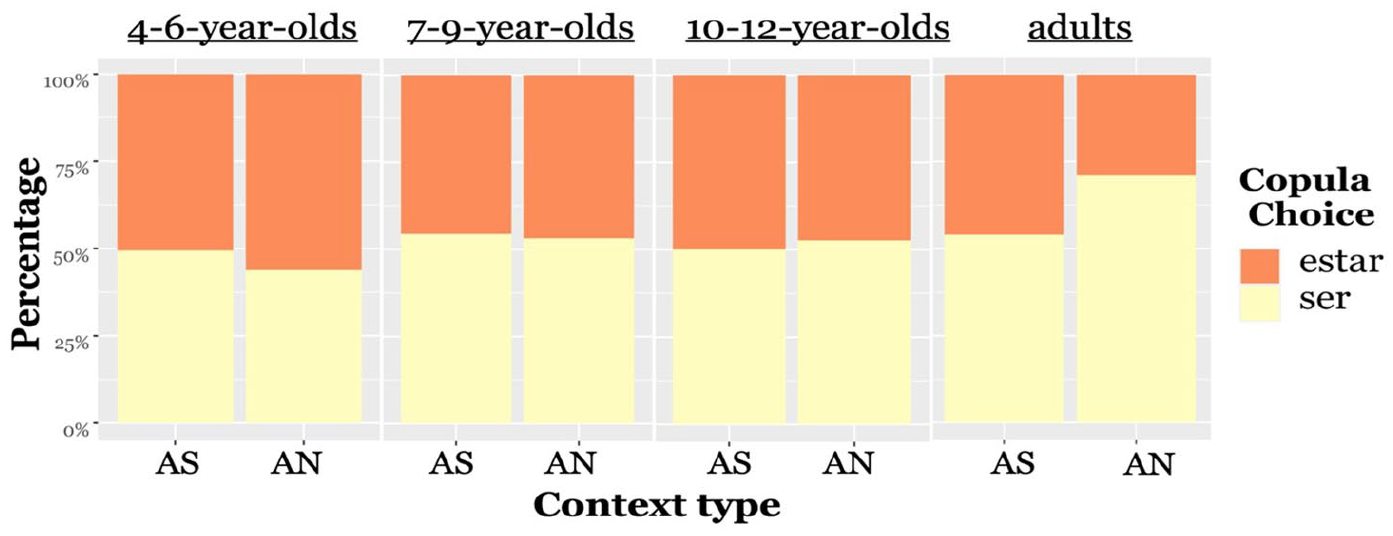
Percentages of Copula Choice by Context Across Age Groups (AS = Alternative-supporting Context, AN = Alternative-neutral Context).
Furthermore, we found a context by group interaction (χ2 = 18.99; df = 3; p < .001). Specifically, children chose estar sentences significantly more with AN contexts than adults, which was the case for all three age groups (main effect of age group with AN contexts: χ2 = 26.11; df = 3; p < .001, and subsequent Tukey’s tests: Groups 4–6: β = 1.19; SE = .24; z = 5.03, p < .001; Groups 7–9: β = .8; SE = .22; z = 3.7, p = .001; Groups 10–12: β = .85; SE = .22; z = 3.97, p < .001). We found no main effect of age group with AS contexts (χ2 = 2.24; df = 3; p = .5) (see Figure 4).
Cued-production task
We performed a GLMM for binary data (logistic regression). In this case, we aimed to assess the effect of context type and age group on copula sentence production (cued production of a sentence with ser or estar) as the dependent measure with binary coding estar = 0 and ser = 1. The variable context type was sum coded. The AS condition was coded as −0.5 and the AN condition as 0.5, thus centering the effects at the grand mean (i.e., the mean of the two group means). The variable age group with four levels (4- to 6-year-olds, 7- to 9-year-olds, 10- to 12-year-olds, and adults) was treatment coded by setting the adult group as the reference level and therefore as the baseline for comparison. All possible interactions between the fixed effects were included, as well as random effects for subjects and items.
We observed a main effect of age group (χ2 = 30.22; df = 3; p < .001). The post hoc analysis revealed a significant difference in cued production of copula sentences between adults and children (Groups 4–6: β = 1.64; SE = .29; z = 5.6, p < .001; Groups 7–9: β = 1.14; SE = .27; z = 4.18, p < .001; Groups 10–12: β = .88; SE = .27; z = 3.26, p = .006). As shown in Figure 5, adults are more likely to produce a lower percentage of estar sentences in comparison to children, irrespective of context type. In addition, the youngest group (Groups 4–6) and the oldest group (Groups 10–12) of children also showed differences in cued production of copula sentences (β = .76; SE = .27; z = 2.83, p = .023). Specifically, the oldest group showed a behavior closer to that of the adult group. That is, the oldest group was more likely to produce a lower percentage of estar sentences relative to the youngest irrespective of context. We also observed a main effect of context type (χ2 = 24.78; df = 1; p < .001), which indicated a significant difference in cued production of copula sentences as a function of context type. Specifically, the probability of producing estar was significantly higher when the sentence was preceded by an AS context independently of age group (Figure 5).
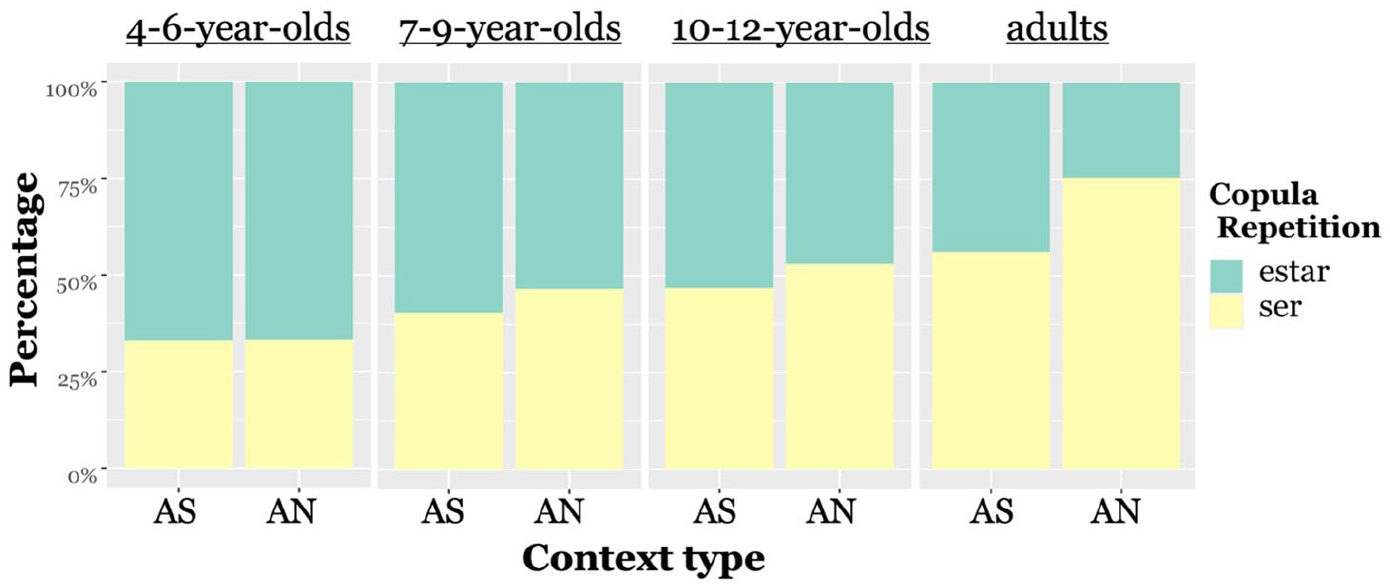
Percentage of Copula Sentence Repetition by Context Across Age Groups (AS = Alternative-supporting Context, AN = Alternative-neutral Context).
In addition, we found a context by group interaction (χ2 = 14.26; df = 3; p = .003). In comparison to adults, children produced significantly more sentences with estar when presented with AN contexts (main effect of age group with AN contexts: χ2 = 42.82; df = 3; p < .001; and subsequent Tukey’s tests: Groups 4–6: β = 2.23; SE = .34; z = 6.5, p < .001; Groups 7–9: β = 1.63; SE = .31; z = 5.2, p < .001; Groups 10–12: β = 1.29; SE = .3; z = 4.24, p < .001). Among children, the Groups 4–6 also produced significantly more estar sentences with AN contexts than the Groups 10–12 (β = .94; SE = .3; z = 3.07, p = .011). Moreover, the Groups 4–6 was more likely to produce a higher percentage of sentences with estar when presented with AS contexts relative to adults (main effect of age group with AS contexts: χ2 = 12.7; df = 3; p = .005; and a subsequent Tukey’s test: β = 1.17; SE = .33; z = 3.5, p = .003) (Figure 5). 2
Discussion
The present study investigated the acquisition of the Spanish copular verbs ser and estar across production and comprehension tasks in a large cross-sectional sample of children aged 4–12 years. Children participated in two tasks: (i) a sentence-choice task, aimed at testing copula comprehension and (ii) a cued-production task, aimed at testing copula production. A control adult population was included for comparison purposes. We tested the hypothesis that copula use is associated with distinct contextual requirements (Maienborn, 2005; Sánchez-Alonso, 2018; Sánchez-Alonso et al., 2016), and included in our experimental design copula uses that go beyond the permanent/temporary distinction traditionally (but incorrectly) associated with ser and estar use, respectively. Specifically, our research questions aimed to investigate (i) the production and comprehension patterns of copula use across age, and (ii) the specific role of the context/world-knowledge construal in the acquisition process. We investigated these questions by systematically varying the explicit contextual information that preceded copula predicates with ser or estar. Our results addressed these two questions and showed that (i) all children are sensitive to the contextual information that precedes copula sentences; yet (ii) when compared with adults, children and particularly the youngest group show both over-acceptability and over-production of estar. We discuss these findings below.
Sensitivity to contextual information in children’s use of estar
We predicted that adults would show a preference for choosing/producing estar when the predication is preceded by AS contexts and, accordingly, ser would be preferred in AN contexts. This prediction was borne out by the results in the adult group, which suggests that copula choice/production is subject to world-knowledge integration via identification of contrasting alternatives from the explicit context. This result replicates previous findings observed in adult Spanish speakers of Argentinian, Iberian, Mexican, and Venezuelan dialects (Sánchez-Alonso, 2018; Sánchez-Alonso et al., 2016).
By the same token, we predicted that differences in copula choice across children would also be determined by their ability to successfully construe contrasting alternatives from the explicit context to satisfy estar’s presupposition. This construal of contrasting alternatives, we suggest, is only possible to implement with enough knowledge of the world, knowledge that presumably grows as the individual gains life experience. This explains the late adult-like copula production by children in the cued-production task and could possibly underlie children’s difficulty in tasks that require integration of similarly demanding contextual-pragmatic information (Grigoroglou & Papafragou, 2018; Papafragou, 2018; Requena et al., 2015; Schmitt et al., 2004).
In the production task, all children were sensitive to the contextual information preceding copula predicates and showed a preference for producing estar with AS contexts relative to AN contexts. This suggests that children can indeed produce copulas contrastively from the age of 4;0. In addition, we observed age differences in copula production between the youngest children and the oldest children. Specifically, 4;0–6;0-year-olds produce estar more frequently with AN contexts relative to the 10;0–12;0-year-olds and adults. These results indicate that children show a non-adult-like pattern of copula production up to 8;0–9;0 years of age. In the comprehension task, children did not show a main effect of context on copula choice as a function of context across age groups. Yet, when compared with adults, children did show a preference for choosing estar with AN contexts. Indeed, children over-select estar in contexts in which adults prefer ser – a finding we will turn to in the next section.
Regarding the absence of context modulation in children for the comprehension task, we offer two possibilities: (1) the response is required too soon after presenting relevant contextual information, limiting the time that the child has to construe the intended alternative before the answer is required; and (2) the pressure of estar’s higher frequency of use in the Venezuelan variety allows children to select the estar-sentence regardless of context (Sánchez-Alonso et al., 2016). Support for (1) comes from the production results in which the older group of children shows context sensitivity, but crucially only sometime after the context and sentence have been presented. Support for (2) comes from their observed across-the-board overuse of estar, whose meaning importantly differs from ser’s only by the presence of the presupposition. That is, even in the AN contexts, estar is only less felicitous, it is not necessarily unacceptable. We suggest that both of these factors, time limitation and estar -favoring frequency pressures, act in tandem to obscure the effect of the children’s context-sensitivity.
While these results provide evidence that children are sensitive to the contextual information in which copula predications are embedded, it is unclear to what extent the results of the sentence-choice task would generalize to spontaneous elicitations since children are not commonly presented with two sentences together and asked to make a choice. Furthermore, children were required to make a binary choice in the sentence-choice task, and therefore it is difficult to obtain gradations between the two choices. This may be particularly important when one of the copula choices is more frequently used in daily speech than another. For example, the sentence ‘es cocinero’ (be [ser] a cook) is likely to be more frequently encountered than ‘está de cocinero’ (be [estar] a cook), which reflects a more nuanced situation, which would lead to a less frequent use of the expression. It is unclear whether differences in input frequency may have impacted the results by biasing children toward the more frequent option. Future studies should address this limitation by controlling for frequency effects in copula constructions.
Over-acceptability and over-production of estar in children
Our findings indicate that the over-acceptability and over-production of estar is extended, until late in childhood, to contexts in which ser would be the preferred adult option. Thus, our results suggest a transition from an over-acceptability/over-production of estar to an adult-like use. Our findings do not specify whether such transition is sharp or gradual.
The over-acceptability/production of estar has been robustly reported in previous work. As noted earlier, the first studies to report this finding were conducted by Sera (1992) and Johnson and Johnson (2005), who observed an overuse of estar in children aged 3;0–5;0 in contexts in which the preferred adult form would be ser. Further studies that manipulated contextual cues obtained a similar finding, in which children seem to show a preference for estar early in development (Holtheuer, 2012; Schmitt et al., 2004). In studies that focused on older children (aged 7;0–12;0), the over-acceptability of estar was observed from ages 7;0 to 9;0, suggesting that this preference for estar lasts longer than previously hypothesized (Alonqueo, 2007; Alonqueo & Soto, 2005, 2011). Our results seem consistent with these previous findings and further reveal that this over-acceptability/production of estar is generalizable to a larger set of contexts, well beyond the permanent-versus-temporary uses previously tested. Furthermore, the results are consistent with a presupposition-based approach of estar use, which provides a precise connection between estar use and context/world-knowledge. Explanations that rely exclusively on the ability of the child to identify temporariness of certain contexts are not supported by our results.
The over-acceptability/production of estar in children has also been associated with the child’s learning process of copula use and, in general, the way in which word meanings are acquired through contextual exposure: in a piecemeal fashion after exposure to a variety of contexts (Alonqueo, 2007; Bales & Sera, 1995; Brooks & Kempe, 2012; Sera, 1992; Silva-Corvalán & Montanari, 2008). Our results are consistent with this possibility with the proviso that the contexts themselves need to be comprehensible by the child so that the child can recognize their alternative-inducing relevance. For example, for the context-sentence pair ‘Hacía tiempo que Lola no veía a Ana. Cuando la vio, Lola dijo: Ana está alta’ (‘It’s been a while since Lola last saw Ana, When she saw her, Lola said Ana is being tall’) to be interpreted as contrastive alternative-inducing, the comprehender needs to know that there is more than one way of becoming tall in a given situation, for example, because Ana has grown since last seen, or she is wearing particularly high heels. So, without this experience-based understanding, the comprehender cannot recognize the relevance of the use of estar in that context, thus rendering it indistinguishable from ser.
Delineating a developmental trajectory of copula acquisition
Finally, we argue that the findings reported in the present study contribute to our understanding of the process of copula acquisition. We observed age-related differences in context modulation of copula production, namely, that the youngest children (4- to 6-year-olds) produce a higher percentage of estar sentences with AN contexts relative to the oldest children (10- to 12-year-old group). These differences are explained as follows. Even though all children have the ability to construe the required alternative, the content of this construal is directly dependent on the child’s knowledge that an alternative to the eventuality or situation associated with the estar predication is possible. This knowledge is not linguistic, it is conceptual. It emerges from the conceptual structure that is built as a result of the child’s exposure to entities and properties in a variety of situations; this exposure takes place over time and is the basis for the associated conceptualized situation. As such, this ability to construe the required alternative is less expected in the youngest children (4- to 6-year-olds) and more expected in the older group (10- to 12-year-olds).
Evidence to this effect comes from Holtheuer (2013), the only previous study that specifically analyzed copula production. The study tested 8 children (aged 1;10–3;7) and their parents to examine the role of corrective parental input (i.e., immediate explicit feedback provided by the caretaker in response to an erroneous copula use). This study reported that the structures used by children were qualitatively different from that of their caretakers. In contrast to adults, children seemed to follow specific clues when using ser and estar related to the morphology of the adjectives (e.g., participial adjectives, like com
Altogether, we conclude that estar’s developmental pattern is closely guided by the lexico-pragmatic requirements of the copula. The implementation of these requirements is cognitively costly, not only because it demands the satisfaction of a presupposition, but also because it requires the presence of a significantly rich conceptual system. And it is here where the younger child’s system is less effective: younger children have the ability to identify alternative situations that contrast with the current estar predication but cannot do so competently due to the limitations associated with a still underpopulated conceptual system.
Supplemental Material
sj-docx-1-fla-10.1177_01427237221100913 – Supplemental material for Contextual dependency and overuse of estar in the acquisition of Spanish copula verbs
Supplemental material, sj-docx-1-fla-10.1177_01427237221100913 for Contextual dependency and overuse of estar in the acquisition of Spanish copula verbs by Fraibet Aveledo, Sara Sanchez-Alonso and Maria Mercedes Piñango in First Language
Footnotes
Author contribution(s)
Declaration of conflicting interests
The author(s) declared no potential conflicts of interest with respect to the research, authorship, and/or publication of this article.
Funding
The author(s) disclosed receipt of the following financial support for the research, authorship, and/or publication of this article: This work was supported by the National Science Foundation [NSF-INSPIRE grant number 1248100 to M.M.P.].
Ethical approval
This study was considered by the School of English Language and Literature Ethnics Committee, and given permission to proceed under the exceptions procedure as outlined in paragraph 6 of the Ethics Guidance to Schools of the University of Reading.
Supplemental material
Supplemental material for this article is available online.
Notes
References
Supplementary Material
Please find the following supplemental material available below.
For Open Access articles published under a Creative Commons License, all supplemental material carries the same license as the article it is associated with.
For non-Open Access articles published, all supplemental material carries a non-exclusive license, and permission requests for re-use of supplemental material or any part of supplemental material shall be sent directly to the copyright owner as specified in the copyright notice associated with the article.
