




Abstract
During the second year of life, children acquire words and expand their receptive and expressive vocabularies at a rapid pace. At this age, toddlers’ phonological abilities are also developing rapidly. The current study investigated the effect of phonological complexity of words on the order in which they are acquired, receptively and expressively. Data were collected from Hebrew-speaking parents of 881 typically developing toddlers: 417 girls and 464 boys, aged 1;0 to 2;0 years old. Parents reported on their child’s receptive and expressive vocabularies by completing a computerized version of the Hebrew adaptation of the MacArthur-Bates Communicative Development Inventories. Phonological complexity scores of the target words were calculated using the Phonological Mean Length of Utterances measure. The proportion of children who were reported to understand and produce each word at each age was calculated. Results showed that phonological complexity affected the acquisition of word comprehension and word production. Words that are less phonologically complex were acquired earlier, representing a process of subconscious selection of words that are easier to produce.
Introduction
During the second year of life, children add words to their receptive and expressive lexicons at a fast rate (Fenson et al., 1994; Frank et al., 2021). Their growing vocabulary comprehension allows them to have a better understanding of objects, people, and situations in their surroundings. Their growing vocabulary production allows them to express their desires, needs, and thoughts more accurately. Acquisition of the lexicon is related to factors such as frequency (e.g. Goodman et al., 2008), phonological complexity of words (e.g. Gayraud et al., 2018), and dynamic parent–child interactions (e.g. Adi-Bensaid et al., 2017).
Toddlers’ phonological abilities also develop during the second year of life. They develop the ability to recognize the phonological characteristics of their mother tongue, the ability to distinguish between the speech-sounds of the language spoken to them versus speech-sounds of other languages (Jusczyk et al., 1993; Mehler et al., 1988), and the ability to produce sounds that are similar to the phonemes of their caregivers. With age, their phonological abilities mature, and they are gradually able to articulate words more accurately. The characteristics of words affect the order of acquisition. These include frequency in the adults’ lexicon (Goodman et al., 2008), saliency (Bleses et al., 2008), babiness (i.e. the association of the word with infancy) (Braginsky et al., 2019), concreteness (Swingley & Humphrey, 2018), and imageability (Hansen, 2017). Words that score high on scales of the above characteristics are likely to be learned earlier.
Phonological complexity is another characteristic that affects acquisition. It is defined qualitatively by using markedness scales (unmarked units are considered less complex than marked ones) and quantitatively by counting the number of phonological units in the word (see ‘Methods for measuring phonological complexity’ section). Studies show that children use patterns of ‘lexical selection and avoidance’ that are determined by the child’s productive phonological abilities and preferences. This account suggests that children choose target words that are consistent with their production capacities (Davis et al., 2018; Stoel-Gammon, 2011). Note that phonological development relates to the child’s articulatory capacities, suggesting that the child’s articulatory system and sound production capacities drive his or her choices of words (Davis et al., 2018). Stoel-Gammon (2011) suggested that phonological development includes two factors which interact with one another. The first one is a biologically based factor related to the development of speech–motor skills. The second one is a cognitive-linguistic component representing the phonological system of the target language. The current study explored whether toddlers select or avoid words based on their phonological complexity and whether the processes of selection and avoidance are similar for expressive and receptive vocabularies. We tested a large sample of Hebrew-speaking toddlers, a language that has not been examined previously, exploring whether the phonological complexity of words influences the order in which they are comprehended and produced.
The development of comprehension and production of early vocabulary
During the second year of life, toddlers accumulate receptive and expressive vocabularies of hundreds of words (Fenson et al., 1994; Frank et al., 2021). It is agreed that receptive and expressive vocabularies are closely related, and comprehension of a word precedes its production. Toddlers across different languages understand many words before they produce their first word (Bates et al., 1989; Frank et al., 2021). For example, 18-month-old, Hebrew-speaking toddlers who ranked in the 50th percentile of comprehension and production have 240 words in their receptive lexicon in contrast to just 80 words in their expressive lexicon (Gendler-Shalev & Dromi, 2021).
This gap between receptive and expressive vocabulary may be explained by the different skills needed to comprehend and produce words. Understanding a word includes knowing its phonological form (the sound sequence of the word), its meaning, and the connection between the form and its meaning. In production, in addition to the processes described above, toddlers pronounce the sounds representing meanings they know (Bloom & Markson, 1998).
Findings from different languages show that the number of words toddlers of the same age understand and produce varies greatly (Frank et al., 2021). For example, there is a large difference in productive vocabulary size between 18-month-old Hebrew-speaking toddlers ranked in the 90th percentile of the production lexicon to toddlers ranked in the 50th percentile. Toddlers in the 90th percentile have more than 200 words in their expressive vocabulary compared with 80 words of toddlers in the 50th percentile. Toddlers ranked in the 90th percentile of the comprehension vocabulary have more than 350 words in their receptive vocabulary compared with the 240 words of toddlers in the 50th percentile (Gendler-Shalev & Dromi, 2021). This variation necessitates data collection from a large sample to determine typical vocabulary development characteristics that can be generalized.
The relationship between phonological complexity and vocabulary acquisition
The relationship between phonological complexity and vocabulary acquisition is well documented in production such that words that are phonologically simpler are acquired before words that are phonologically complex (e.g. Braginsky et al., 2019; Gayraud et al., 2018; Schwartz & Leonard, 1982; Stoel-Gammon, 2011). However, studies that explored the effects of phonological complexity on word acquisition in receptive vocabulary are sparse. In studies that tested children’s learning of novel words, 1- to 2-year-old toddlers were exposed to nonsense words, which served as names of unfamiliar objects. For example, Kay-Raining et al. (1998) and Schwartz et al. (1987) tested lexical comprehension by asking the child to point at an object or to give it to the examiner, and tested lexical production by asking the child to name the object. Results revealed that the acquisition of target words in production was affected by the child’s phonological knowledge. Words with consonants and syllable structures that the children already produced accurately were acquired more than words with phonological structures the child did not produce yet. In contrast, this effect was not seen with comprehension. Similar patterns of dissociation between comprehension and production were found in a recent study by Braginsky et al. (2019). In this study, data were collected via the MacArthur-Bates Communicative Development Inventories (MB-CDI) in 10 different languages. Parents were presented with a list of words and reported which of the words their child understands or says and understands. Phonological complexity was measured by the number of phonemes in the target word. The results revealed that word length (number of phonemes) was predictive of production but not of comprehension, such that phonologically simpler words were produced but not understood earlier than phonologically more complex words.
In the above studies, the effects of phonological complexity on receptive versus expressive word acquisition were observed at the end of the first year of life and the second year of life. To explain this gap, Pater (2004) suggested that a single linguistic subsystem is responsible for perception and production (see also Stoel-Gammon, 2011) and that there is an effect of phonological complexity on perception in the prelinguistic stage, which decreases before the first words are produced. In line with this approach, perception studies show different preferences for simple phonological words, as compared with phonologically complex words. These studies assume that the head turn preference paradigm reflects comprehension to some extent (Ambridge & Rowland, 2013). In two laboratory studies using the head turn preference paradigm, DePaolis et al. (2011) and Majorano et al. (2014) found that infants in the prelinguistic stage were more attracted to words containing sounds that they still did not produce more than sounds they did produce. The authors interpreted these results as a novelty response, meaning the infants preferred to listen to new consonants rather than to consonants known to them from their own babbling. These findings represent differences between simple and complex words but note that there is a gap between perception and comprehension. The gap between comprehension and production of words might reflect different effects on the same process along the acquisition path. It is possible that phonological complexity affects perception in the prelinguistic stage (Pater, 2004) and that the effect decreases in the one-word stage. The current study explored vocabulary acquisition in the one-word stage. Thus, we predict that the phonological complexity effect would not be shown in vocabulary comprehension.
The influence of phonological factors on expressive vocabulary acquisition and lexical selection of target words is recognized. It is suggested that young children prefer to produce target words that are phonologically ‘simpler’ (Gayraud et al., 2018; Schwartz & Leonard, 1982; Stoel-Gammon, 2011). They produce target words with already acquired consonants and avoid producing target words with consonants they have not yet mastered (Davis et al., 2018; Ferguson & Farwell, 1975; Schwartz & Leonard, 1982). Note that phonological factors emerge at the prelinguistic stage, which provides motor practice for the phonological units of early words, and for the formation of an auditory-articulatory loop (for an overview, see Stoel-Gammon, 2011).
Other phonological units, such as complex syllables, show similar lexical selection results revealed in the phonological level. For example, children attempted to produce target words with three consonantal clusters (CCCV) only after they successfully produced words with biconsonantal clusters (CCV) (Shatz, 2019), and words with final stress after words with penultimate stress (as the former is considered more phonologically marked; Adam & Bat-El, 2009). The phonological characteristics of the American-English MB-CDI, which represent the early vocabulary of children, support this assumption. These words are short (most of them are monosyllabic), with simple syllable structures (CVC and CVCV), unlikely to have a consonant cluster, and have stress on the first syllable (see Stoel-Gammon, 2011, for an overview).
Together, these findings suggest that phonological complexity in all levels (e.g. phonemes, syllables, words) affects early vocabulary production. The child’s early lexicon is affected not only by semantic and pragmatic factors, but also by his or her phonological capacity.
The effect of phonological complexity on vocabulary acquisition is also shown in atypical language acquisition. Studies showed that late talkers have small productive vocabulary and simpler phonological productions, compared with age-matched children with typical lexical development (Stoel-Gammon, 2011). Edwards et al. (2011) even claim that phonology develops together with the lexicon and that neither should be studied in isolation.
This study explored the effect of phonological complexity at early vocabulary acquisition in typical development between the ages of 12 and 24 months, predicting to find an effect of phonological complexity in production.
Methods for measuring phonological complexity
The phonological complexity of words is defined qualitatively and quantitatively. Defining word complexity qualitatively is based mainly on phonological markedness values. According to this view, each phonological unit or feature has a relative markedness value. For example, the feature of coronal place of articulation (i.e. consonants that are produced with the tip of the tongue) is considered unmarked with respect to other places of articulation (Paradis & Prunet, 1991). Marked phonological units are acquired later by children compared with unmarked units. For example, in the consonantal level, fricative consonants are acquired later than stop consonants. In the syllabic level, complex onsets (i.e. clusters) are acquired later than simple onsets. In addition, in the prosodic word level, trisyllabic words are acquired later than disyllabic words (Ben-David, 2020). Therefore, in all phonological and phonetic levels, units that are acquired later are considered more complex (Stoel-Gammon, 2010).
Defining complexity of words quantitatively is based on the number of units in the word. This can be measured by simply counting the number of phonemes (Braginsky et al., 2019). More comprehensive measurements like the Index of Phonetic Complexity (Jakielski, 2002) or the Word Complexity Measure (Stoel-Gammon, 2010) consider phonetic and phonological properties, such as consonant type and syllable structure (e.g. consonant clusters). These measurements are language-specific, and currently, there are no adaptations for them to Hebrew. Another quantitative measurement of phonological complexity is the Phonological Mean Length of Utterances (PMLU), which reflects the length of the words and the number of correct consonants produced by the child (Ingram & Ingram, 2001). This measure scales vowels and consonants differently (see details in the ‘Method’ section), thus is suggested to be more accurate than just counting the number of phonemes. Results from monolingual children acquiring various languages (including Hebrew), bilingual children, and children with delayed acquisition showed that the PMLU measurement corresponds with other phonological complexity measures (Saaristo-Helin, 2011; Vider, 2015). Therefore, we used the PMLU measure in the current study.
Unique phonological characteristics of Hebrew
Universal developmental characteristics of lexical development have been reported by Frank et al. (2021). However, specific language characteristics also affect lexical acquisition (Bleses et al., 2008). Comparing the languages tested by Braginsky et al. (2019) to Hebrew shows that Hebrew has phonological characteristics that differ from these languages. Therefore, exploring the effect of phonological complexity on the acquisition of Hebrew-speaking toddlers can expand our knowledge of phonological complexity on lexical acquisition. Hebrew has a high frequency of disyllabic words as opposed to English, which has a high frequency of monosyllabic words (Segal et al., 2008). In the syllable level, Hebrew has many fewer biconsonantal clusters in word initial position and almost no triconsonantal clusters in this position. Furthermore, final clusters are very rare in Hebrew (Asherov & Bat-El, 2019) as opposed to many of the languages that were examined by Braginsky et al. (2019) (e.g. English, Russian, Norwegian, Croatian). These characteristics are reflected in the PMLU measure and are explored in this study. In addition, Hebrew has characteristics that are not reflected in the PMLU. For example, it has two nonstop dorsals /x, ʁ/ as opposed to other languages that have one (e.g. French, Norwegian) or none (e.g. English, Italian) (Laufer, 1999) and it has a dominant final stress, while most of the languages examined by Braginsky et al. (2019) have nonfinal stress (except for French that has final stress, exclusively). Note that while the PMLU cannot detect the effects of final stress and the unique effect of nonstop dorsals, it is a sensitive measure of exploring patterns of disyllabic words, which are frequent in Hebrew, as it distinguishes between vowels and consonants. In addition, the PMLU can be sensitive to clusters, since it is sensitive to the number of consonants (for more details, see ‘Method’ section).
This study explored the effect of phonological complexity on comprehension and production during the second year of life, using cross-sectional data (age, in months). Following previous studies, for comprehension, we hypothesized that phonological complexity would not affect the order of acquisition of words. In production, we hypothesized that phonologically simple words would be produced at a younger age than more phonologically complex words.
Method
Participants
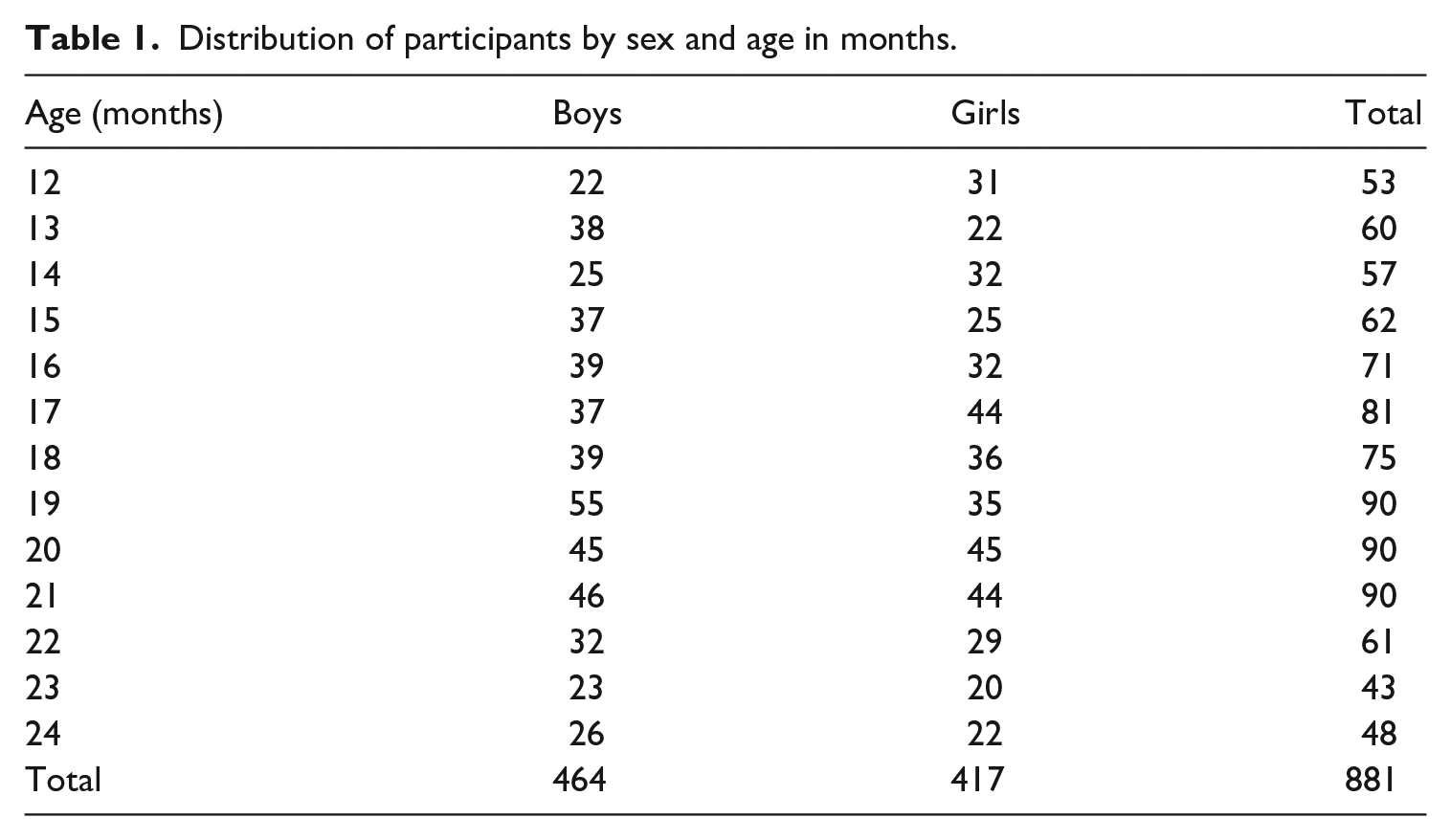
Eight hundred and eighty-one Hebrew-speaking, monolingual, typically developing toddlers (417 girls, 464 boys) ages of 1;0 to 2;0 years (see Table 1) participated in the study (Gendler-Shalev & Dromi, 2021). Based on parental reports, all children met the following study criteria: (a) the child was not treated for an ear infection more than once in the last 3 months; (b) Hebrew was the primary language the child hears for at least 10 hours a day; and (c) parents were not worried about the child’s development.
Distribution of participants by sex and age in months.
Materials
The MB-CDI WG questionnaire adapted to Hebrew was used. The questionnaire was found to be a reliable and valid tool for evaluating the early lexical development of Hebrew-speaking toddlers during the second year of life (Gendler-Shalev & Dromi, 2021). It consists of a list of 428 words in 18 semantic and grammatical categories (for a detailed description, see Gendler-Shalev & Dromi, 2021). Parents were asked to mark the words that the child ‘understands’ and the words that the child ‘says and understands’. Background information was obtained via 12 multiple-choice questions about the child and his or her development and 11 questions about the parents’ background. The background questions appeared at the end of the MB-CDI questionnaire.
Phonological complexity
Phonological complexity scores were calculated based on the ‘Whole Word’ approach presented by Ingram and Ingram (2001), suggesting that as the lexicon develops, children acquire words and not individual consonants and vowels. The PMLU calculates the correctness both of consonants and of prosodic units (syllables and words). It is used to calculate the phonological complexity of the child’s productions and phonological complexity of the target words and is often used to estimate the gap between them. In this study, we used this measure to estimate only the phonological complexity of children’s target words, and not the correctness of consonants. This is an extension of Ingram and Ingram’s (2001) original measure, allowing us to investigate phonological effects on the lexicon using the CDI questionnaire (Watson & Terrell, 2012; for other phonological measures used in CDI studies, see also Garmann et al., 2019; Wehberg et al., 2007). Therefore, the phonological complexity score for each word in the questionnaire was calculated as the sum of the number of different consonants and vowels, with consonants receiving 2 points each, and vowels 1 point each. For example, the word sveder (meaning a sweater in English) includes four consonants = 8 + 2 vowels = 10; the word mita (meaning a bed in Hebrew) includes 2 consonants = 4 + 2 vowels = 6.
Analysis
For each word, the proportion of children who were reported to understand or produce the word at each age was calculated. Note that in this study, multiple word phrases were excluded (i.e. lalexet lishon – go to sleep).
Thus, each word received 13 proportion scores (one for each month) for comprehension and for production (total of 26 proportion scores). Analysis of the predicted proportion of comprehension and production included two models. The predictor of age was the toddlers’ age in months. Mixed-effects logistic regression models were used to predict whether the child understands/produces each word based on their age, the phonological complexity of each word, and the interactions between age and phonological complexity. The binary nature of our dependent variable for Hebrew acquired words was 1 for child understands/produces the word and 0 for child does not understand/produce the word. The proportion of comprehension and production was set as the dependent variable. In the model, phonological complexity was set as a fixed variable, whereas age was set as a random variable. The formula for the comprehension model was set as follows: proportion of comprehension ~ 1 + phonological complexity × age + (1 + age| each word). The formula for the production model was set as follows: proportion of production ~ 1 + phonological complexity × age + (1 + age| each word).
Results
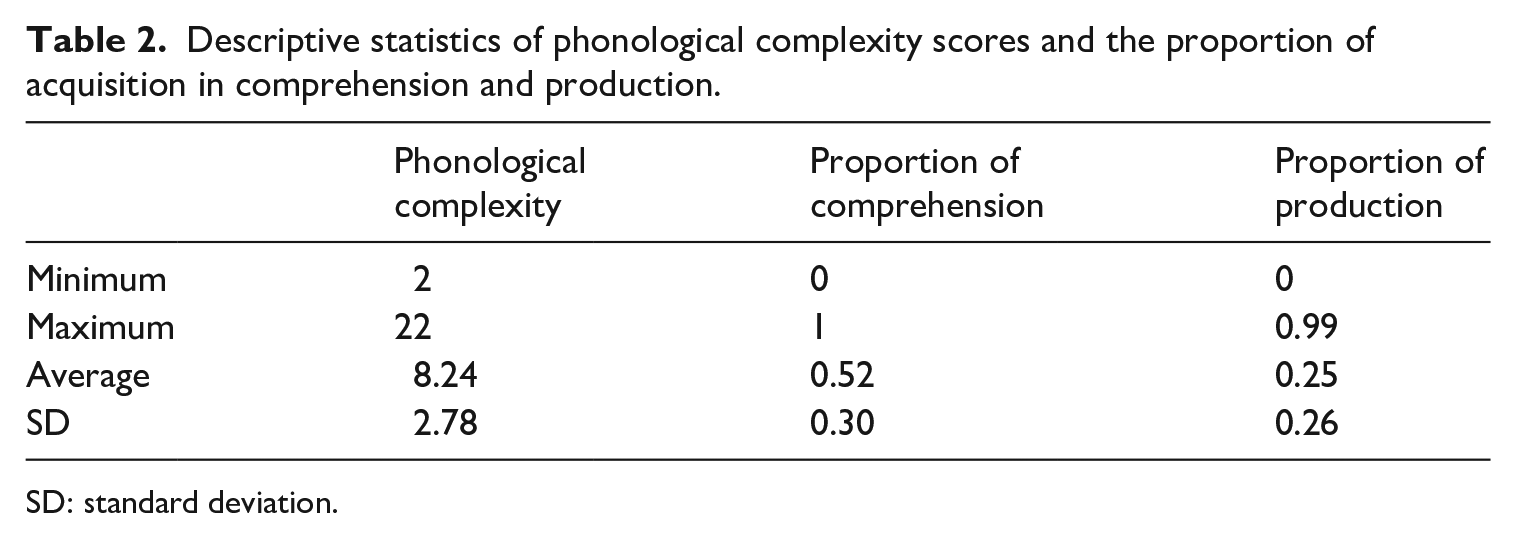
Phonological complexity scores and the proportion of acquisition in comprehension and production were calculated. Descriptive statistics of the scores (Table 2) show that the average proportion of comprehension is larger than the average proportion of production.
Descriptive statistics of phonological complexity scores and the proportion of acquisition in comprehension and production.
SD: standard deviation.
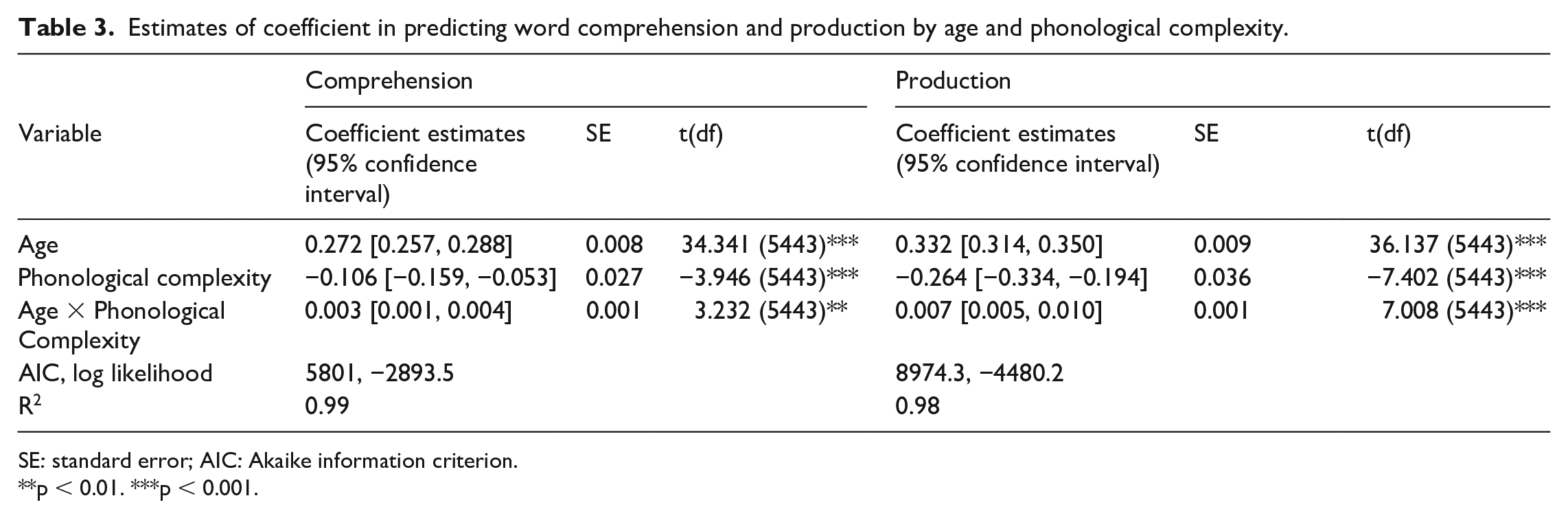
The effect of phonological complexity and age on word comprehension and production is shown in Table 3. A significant positive effect of age was shown on word comprehension and production. Moreover, a significant negative effect of phonological complexity was found on word comprehension and production, indicating that at young ages toddlers comprehend and produce a larger proportion of words from the questionnaire that are ranked as less phonologically complex (Table 3). Finally, a significant interaction of age and phonological complexity was found for both word comprehension and production, indicating varying effects of phonological complexity on word comprehension and production for different ages.
Estimates of coefficient in predicting word comprehension and production by age and phonological complexity.
SE: standard error; AIC: Akaike information criterion.
p < 0.01. ***p < 0.001.
To examine visually the significant interaction found between age and phonological complexity in comprehension and production, the trajectories of words by phonological complexity for each age were plotted for comprehension (Figure 1) and production (Figure 2). The plots for comprehension (Figure 1) show a ceiling effect at the older ages (22–24 months), probably due to the large proportion of words comprehended. At younger ages (12–21 months), the effect of phonological complexity on word comprehension is noticeable, meaning that fewer phonologically complex words were comprehended.
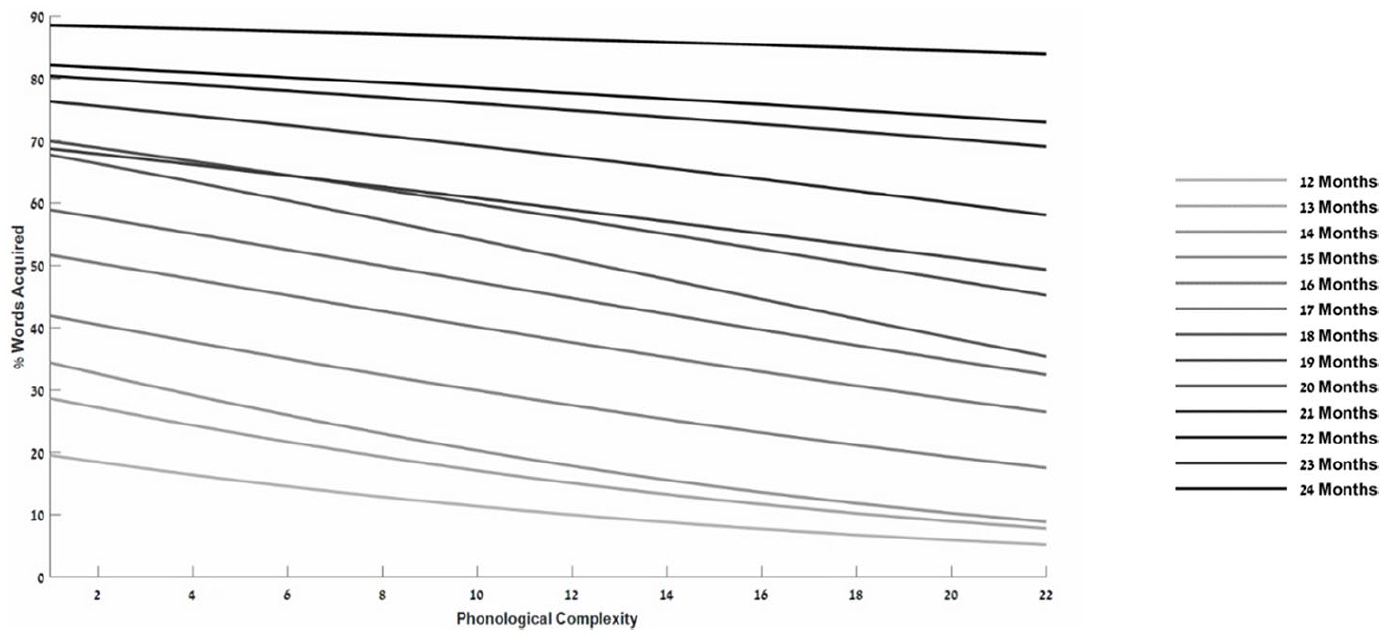
Comprehension Trajectories of Words by Phonological Complexity for Each Age in Months.
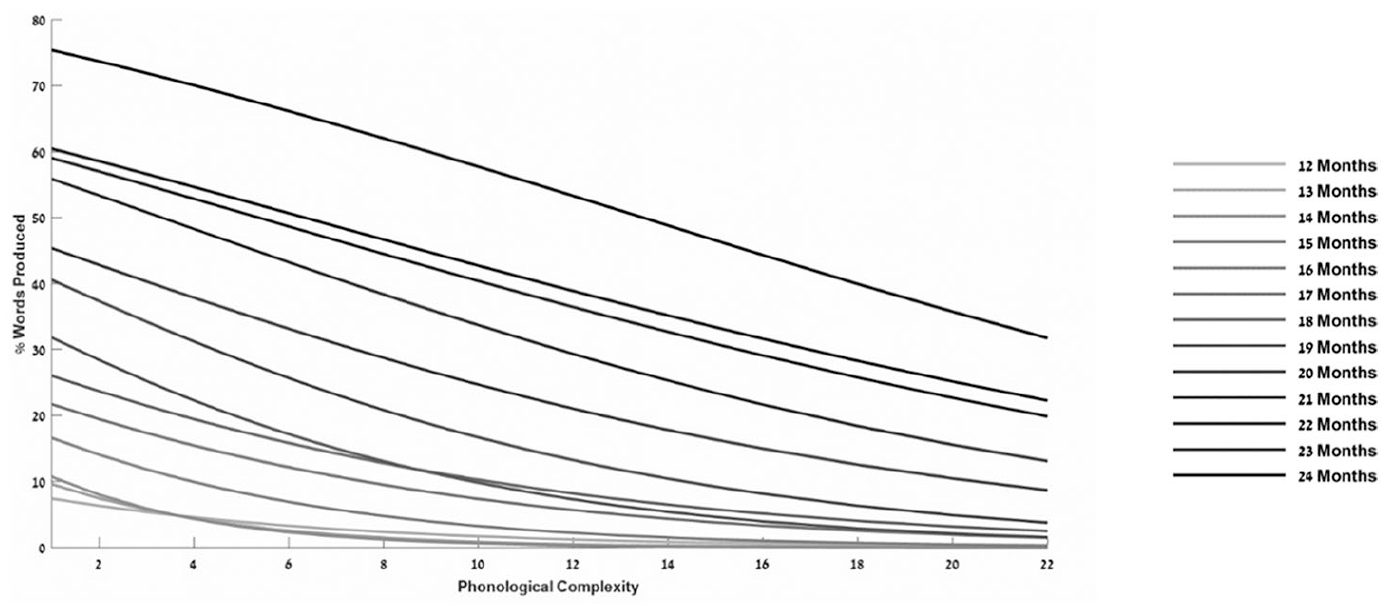
Production Trajectories of Words by Phonological Complexity for Each Age in Months.
The plots for production show a floor effect at the young ages (12–15 months), probably due to the small proportion of words produced. At older ages (16–24 months), the effect of phonological complexity on word production is noticeable, meaning that fewer phonologically complex words were produced.
To summarize, the findings showed that during the second year of life, phonological complexity influences acquisition of word comprehension and production. Words that are phonologically simpler were acquired before words that are phonologically complex. This effect was stronger for comprehension at the beginning of the second year of life, and for production at the end of the second year of life.
Discussion
The current study explored the effect of phonological complexity on comprehension and production during the second year of life. The first hypothesis focused on comprehension and predicted no phonological complexity effect. The second research question focused on production and predicted that phonologically simple words would be produced at a younger age than more phonologically complex words.
Our first hypothesis was that phonological complexity would not affect the order in which words are acquired in comprehension. This hypothesis was not supported by the results. We found that phonological complexity of target words did affect the acquisition of words in the receptive lexicon. This effect was stronger at the beginning of the second year of life and decreased with age. The findings are in line with those of Davis et al. (2018), who showed different pattern of phonological effects on word choices during early vocabulary acquisition. In addition, the findings support the idea of a single linguistic subsystem for both phonological perception and production (see Pater, 2004; Stoel-Gammon, 2011). This effect and its decreasing impact on the acquisition of word comprehension supports Pater’s (2004) claim that phonological complexity affects perception in the prelinguistic stage and decreases with age. Note that previous studies did not show this effect in comprehension (i.e. Braginsky et al., 2019; Kay-Raining et al., 1998; Schwartz et al., 1987). A possible explanation for the effect found in the current study might be related to the measure of phonological complexity we used. While Braginsky et al. (2019) used a measure of number of phonemes per target word, we used a PMLU measure that distinguishes between vowels and consonants and gives a higher score to consonants. For example, the word yeled (a boy) scores 5 points in the number of phonemes’ measure and 8 points in the PMLU measure. We suggest that PMLU is a more detailed measure that can detect the phonological complexity effect proposed by Pater (2004). To understand the effect found in the current study, future studies should explore the developmental trajectory of the effect of phonological complexity on comprehension using PMLU in other languages and with various methods longitudinally.
Our second hypothesis was that phonological complexity would affect the order in which words are acquired in production. The findings supported this hypothesis, showing that phonologically simpler words were acquired at a younger age than phonologically complex words, in line with previous studies (Braginsky et al., 2019; Hansen, 2017; Vihman, 2017). The results are important for answering questions related to universal versus language-specific acquisition processes. With regard to phonology, Hebrew has a different combination of phonological characteristics (e.g. common disyllabic words) compared with the languages that were explored for the effect of phonological complexity on lexical acquisition (Braginsky et al., 2019). Thus, the current findings support a universal pattern of preferring simple phonology in early acquisition stages of vocabulary production (Schwartz & Leonard, 1982). This idea awaits future support from additional languages with various phonological features.
The limitations of the current study are related to its method. Although parental questionnaire enables data collection from a large sample, it has limitations when exploring phonological complexity. This data collection method provides information about whether the child understands or produces words listed in the questionnaire but does not provide information about the way these words are pronounced. Moreover, the PMLU is a quantitative measure, which differentiates between vowels and consonants, but it does not capture qualitative phonological differences. For example, it does not capture the difference between stop and fricative consonants, or between front and back consonants (the former are suggested to be easier in production). While Hebrew includes two fricative dorsal consonants /x, ʁ/, the PMLU measure does not capture their unique effect on acquisition. Finally, PMLU does not explore features of markedness, which are assumed to affect phonological acquisition (e.g. stress pattern). Future studies might target these qualitative factors as part of the phonological complexity measure.
In conclusion, findings from this study showed that during the one-word stage, phonological complexity affects word acquisition in comprehension and production. Words that are less phonologically complex are acquired earlier than more phonologically complex words. This process represents a subconscious selection of less complex words, meaning that young children prefer target words that are phonologically simple.
