



Abstract
Irregular maritime migration from Bangladesh to Malaysia presents serious risks for Bangladeshi laborers who seek work overseas to change their precarious living conditions. Survivors’ voices are often unheard and their motivation and experiences are largely undocumented. This study details the accounts of 25 survivors of labor trafficking, all men, from three major trafficking hubs in Bangladesh. Interviews with selected stakeholders provide insights into this industry and its business model. The study seeks to understand how and why decisions to undertake the journey were made. It details the multi-faceted consequences for survivors, including loss of key assets (e.g., land, livestock, cash and future work opportunities). Most of the survivors never reached their planned destination and only two persons secured work for more than six months. As a direct result of migration, most moved from living marginally below the poverty line at pre-departure to extreme poverty. Migration, precarity and motivation theories help explain the perspectives and migration decisions of the research participants. These insights can inform policymakers to develop more holistic prevention, prosecution and reintegration measures.
Keywords
Introduction and background
Leading up to the Andaman Sea crisis of 2015, irregular migration traffic had increased in that area constituting a mixed migration flow. The International Organization for Migration (IOM) Glossary on Migration (Sironi et al., 2019: 141) describes mixed migration and mixed flows as “a movement in which a number of people are traveling together, generally in an irregular manner, using the same routes and means of transport, but for different reasons. People travelling as part of mixed movements have varying needs and profiles and may include asylum seekers, refugees, trafficked persons […] and migrants in an irregular situation.” The Andaman Sea crisis exemplifies such mixed migration.
Since 1978 there have been multiple incidences of forcibly displaced Rohingya fleeing from Myanmar to Bangladesh, the 2017 exodus being the largest (ACAPS, 2017). Many Rohingya sought refuge in the Kutupalong and Nayapara refugee camps in the Cox’s Bazar region of Bangladesh. The United Nations High Commissioner for Refugees (UNHCR) (2024) reports that Bangladesh hosts close to a million refugees from Myanmar in 33 highly congested camps in the Cox’s Bazar District and suggests that it is one of the largest protracted refugee situations in the world. Some Rohingya have attempted to migrate from the camp to countries like Malaysia, Thailand and Indonesia through sea-routes frequented by human smugglers and traffickers (UNHCR, 2009: 24-25). Bangladeshi laborers have also attempted irregular migration together with Rohingya migrants. Thus, the mixed migration flow constituting both forced migrants and economic migrants was swelling the traffic in the Andaman Sea before the Andaman Sea crisis, the plight of these irregular migrants in 2015 being reported worldwide (McConnachie, 2015; UNHCR, 2015).
The crisis was precipitated in May 2015 when Thai authorities discovered shallow graves near Thailand’s border with Malaysia and attempted to disrupt existing maritime smuggling operations. Smugglers responded by abandoning an estimated 5,000-8,000 irregular migrants in the Bay of Bengal and the Andaman Sea, leaving them adrift for many weeks (Connell, 2017). The UNHCR (2017: 11) estimated that there were almost an equal number of both Rohingya and Bangladeshi migrants due to the increasing number of Bangladeshis who joined Rohingya crossing by sea. Malaysian, Thai and Indonesian governments initially refused to undertake rescue operations or allow disembarkation. From the eight vessels abandoned in May 2015, an estimated 70 people died at a minimum (UNHCR, 2015). This paper focuses on the experiences of Bangladeshi laborers, but it is important to understand the characteristics of the mixed migration flow to comprehend the nature of trauma reported by this target group.
Bangladeshis aspiring to work overseas are often duped by brokers linked to a transnational network of human traffickers (Bhuyan, 2019), paying large sums for assistance in finding work in wealthier countries. These intermediary brokers or subagents known as dalals have active networks in communities and rural areas. They are mostly unregistered with any government or recruiting agency. Some work as subagents of trafficking networks. Rather than finding work, aspiring migrants may end up in virtual enslavement, debt bondage or face a gruesome death. If they survive the journey, the traffickers profit from using ransom and extortion tactics toward their impoverished families before releasing them (Amnesty International, 2015; OKUP, 2014).
Irregular labor migration is distinguished from labor trafficking by the latter’s use of violence, abuse and other forms of coercion (including demands for money) to exploit the person (UN, 2000). In contrast, irregular labor migration facilitated by smugglers involves the illegal crossing of borders by informal routes constituting a crime against the state, not the victim. Rohingya refugees seeking migration options increasingly turned to the maritime route via the Andaman Sea. Trafficking syndicates also targeted members of poor and remote Bangladeshi communities to migrate through these irregular channels. Push factors underpinning undocumented migration include rising rural poverty, lack of livelihood opportunities, climate change, food insecurity, decreasing value of existing resources and increasing pressure to remit income. Pull factors include the demand for lowly paid labor in the informal sectors of Thailand and Malaysia. The success stories circulated by dalals also play a role in fanning the migration aspirations of prospective migrants. Between January 2012 and May 2015, nearly 150,000 people took the risky boat journey in the Bay of Bengal (UNHCR, 2016), of which 50 percent of the passengers were Bangladeshis (Shum and Tan, 2017). Between 2013 and 2016, these irregular migration boat journeys claimed the lives of approximately 2,000 Bangladeshi and Rohingya migrants (IOM, 2017; UNHCR, 2021).
After the Andaman Sea crisis, the IOM worked with the Government of Bangladesh in 2015 and 2016 to enable 2,813 adult male survivors to be repatriated to Bangladesh from Malaysia, Indonesia and Thailand. A study by the IOM (Connell, 2017) examined survivors’ experiences and their reintegration into their home communities. A study by the Human Rights Commission, Malaysia (SUHAKAM) and Fortify Rights pointed out the magnitude of violence and suffering experienced by such groups (Fortify, 2019). However, these reports provided limited insight into the motivations and decision-making of the Bangladeshi laborers who experienced trauma.
This paper analyzes the experiences of 25 Bangladeshi labor migrants who are survivors of labor trafficking through the Andaman Sea route, an irregular maritime smuggling route. Interviews with survivors were undertaken throughout 2018. It seeks to understand how and why they made the decision to undertake the risky journey. The specific questions addressed by the paper are as follows: (1) what were the reasons for taking part in undocumented migration; (2) what were the specific experiences of migrants and what were they exposed to during their migration journey; and (3) what were the economic, social and health effects associated with informal migration? The study gives voice to returned migrants who had experienced maritime trafficking. Based on their perspectives, the study aims to enhance understanding of their aspirations, motivations and perceptions of risk that influenced their decisions to undertake undocumented migration, and the consequences of their decisions.
The United Nations Office on Drugs and Crime (UNODC) released a study into people smuggling in Bangladesh (UN, 2021). The report stated that “[t]he smuggling of Bangladeshi and Rohingya migrants across the Bay of Bengal to Malaysia continues to be rampant with unscrupulous criminal groups taking hostages and demanding large sums of money for ransom from their relatives (conduct which may arguably also qualify as trafficking in persons)” (UN, 2021: 5). Global Action against Trafficking in Persons and the Smuggling of Migrants - Bangladesh (GLO.ACT Bangladesh) also published “First National Study on Trafficking in Persons in Bangladesh” which identified risk factors for trafficking to include “[…] economic need, harmful traditional practices, internal and cross-border displacement, irregular migration and climate change” (UNODC, 2022: 14). It also identified that the “[…] general lack of awareness of dangers and potential harms of migrating irregularly” (UNODC, 2022: 15) needed to be addressed.
Other studies sought to identify the drivers behind the decisions of Bangladeshi migrants to undertake this dangerous journey (e.g., Hasan, 2019; Moretti, 2018; Rahman, 2020). These studies have identified macro drivers including climate change, political unrest in Bangladesh, global inequality, rising rural poverty, high unemployment, seeking better prospects, corrupt officials, stories about successful migrants, social networks, ignorance of the migration process, misinformation and the influence of agents such as dalals. However, there has been little focus on individual perceptions and motivations that underpin the decision-making of Bangladeshi undocumented laborers who have survived the maritime trafficking experience, nor of the economic and social impact of being trafficked on their individual lives. This study addresses these issues from a holistic appraisal of economic, social and psychological factors influencing their decision-making.
The next section draws on the literature to conceptualize the global economic pressures that impact Bangladeshi migrant laborers and their decisions around irregular migration to improve their own and their family’s circumstances in an environment wherein opportunities for economic sustainability and resource accumulation are increasingly threatened. A more detailed examination of the precariousness of working in the informal economy follows. It highlights the vulnerability of this cohort to misinformation and exploitation, feeding expectations that remittances from more lucrative wage work overseas will compensate for existing financial, health and community resources risked in the labor migration journey. The paper outlines the Conservation of Resources (COR) theory to conceptualize the motivation underpinning such risk-taking by irregular migrants, adopting a more holistic perspective around resource usage that highlights the challenges of resource accumulation for the informal sector in a post-colonial context.
Literature review
Macro-economic pressures impacting the decisions of informal economy workers
While individual drivers for undertaking the risks of irregular labor migration are complex, the UNODC (2022: 11) has noted that “[e]conomic need is the most significant risk factor making people vulnerable to trafficking in persons in Bangladesh.” An essential starting point in understanding these needs is the post-colonial legacy, particularly, the growth of the informal sector in the Global South as a dimension of contemporary global capitalism. Sanyal (2014: 15) identifies that “a significant part of the population in the post-colonial world remains excluded from the ‘modern and dynamic’ economy governed by the logic of capital […] inhabit[ing] an economic space of informal survivalism both outside and alongside the world of capital.” Thus, there exists a permanency to exclusion from the “world of capital” for many in the post-colonial informal sector, rather than a narrative of transition as both Marxist and neoliberal economists suggest. Sanyal (2014: 39) describes this phenomenon as “[…] commodity relations integrat[ing] capital and non-capital to form the post-colonial economic.” Munck (2013: 755) notes that since the structural adjustment crises of the 1980s, the informal sector has grown three to four times faster than the formal sector employment globally.
In Bangladesh, 85 percent of labor is employed in the informal sector (BBS, 2018). The formal sector offers limited growth and few options for low-skilled laborers. Despite the government’s five-year plans and aspirations to attain “[…] social inclusion, human and infrastructural development” (GED, 2015: 30), individuals and communities develop local strategies and take steps to improve the value of their assets or resources to meet both traditional obligations and transform their life chances.
When the use of assets or resources does not result in desired development outcomes, the stalemate requires employing different resources or strategies to increase assets. For many in the informal sector, the combination of income from subsistence resources and wage labor is not sufficient to invest in education to promote the development of future generations. In this situation, people will risk resources more readily when they can no longer support future goals and development needs. We discuss the relationship between risk, resources, goals and motivation by leveraging the COR theory. In the next section, we highlight facets of the precarious existence of the low-skilled Bangladeshi poor and their consequent vulnerabilities.
Precarity and vulnerability in the South
Early scholarship around precarity often reflected a Northern mindset. Precarious existence and working conditions were associated with a decline in social benefits and increasing social exclusion. However, Munck (2013: 752) suggests that this appraisal reflects a limited understanding of “precarity” in the Global South where “[…] super-exploitation, accumulation through dispossession and what might be called ‘permanent primitive accumulation’ have by and large prevailed.” In other words, in the Global South, work has always been precarious, with Sanyal (2014: 55) noting how most of the population in the Third World had their traditional subsistence economy destroyed by development processes while also being denied access to the formal cash economy.
According to the Bangladesh Labour Force Survey 2016–2017 (BBS, 2018), of the total 60.83 million persons employed, 85.1 percent work in the informal sector, of which men accounted for 82.1 percent while women comprised 91.8 percent. The informal sector provided around 40 percent of gross value added, particularly in agriculture, fisheries, trade and industries requiring low capitalization. Without a social welfare wage, the informal economy requires complex strategies for gaining and maintaining livelihoods that “[…] combine wages with non-wages income sources such as subsistence production […] petty commodity production for the market, small scale trading, as well as solidarity and reciprocity in various forms” (Scully, 2016: 166).
Scully (2016) indicates the forms of precarity and instability at the community and family level experienced by the unemployed, informal workers and the formally employed workers that shared a form of interdependence. This precarious interdependence can be compromised when resources are used to support irregular migration. For example, trading off land assets to finance migration can result in loss of access to subsistence income when other informal employment ceases. Given that the family often constitutes a major source of loans for migration costs, which is estimated at 18 percent (Siddiqui and Abrar, 2019), when the migration project fails, the unsuccessful migrant may lose social standing in the community, and the failure can also affect the welfare of others. As such, undocumented migrants potentially face a unique form of precarity. The loss of land can jeopardize subsistence and future development opportunities should alternative forms of income and remittances not be realized. However, the government is firmly committed to increasing remittance inflows to Bangladesh (GED, 2020), thus highlighting the benefits of seeking employment overseas to improve personal and family circumstances.
Paret and Gleeson (2016) suggest that “[…] the central significance of the precarity concept lies in the way in which it connects the micro and the macro, situating experiences of insecurity and vulnerability within historically and geographically specific contexts.” For the laboring poor in Bangladesh, balancing engagement in various dimensions of the informal economy characterizes their lifestyle, shaping the nature of precarity. In so doing, it provides insights into how they make decisions risking their existing assets, health, and life on precarious migratory journeys. Ettlinger (2007) has broadened the scope of precarity to include uncertainty and the unpredictability of terror, consistent with the horrific experiences of participants trafficked through the Andaman Sea route. We highlight the contribution of dalals, traffickers and their networks to this specific form of precarity below.
The role of dalals in the migration process
The Bureau of Manpower, Employment and Training (BMET) is responsible for facilitating the legal labor migration process and promoting the welfare of migrant workers. The BMET database has 1,211 licensed recruiting agencies (Siddiqui and Abrar, 2019). However, their subagents and grassroots brokers, collectively known as dalals, are neither formally registered with the government nor with recruiting agencies, and are mostly working in their individual capacities, receiving commissions from recruiting agents for securing would-be migrants (Ullah, 2010). Siddiqui and Abrar (2019) note that more than half the migrants in their studies blamed the dalals for deceiving them and the misfortunes they faced in Bangladesh and abroad. However, inexperienced migrants with little or no education rely on the local dalals. Some 72 percent of migrants said that the dalals they communicated with were from their own district. Dalals are often seen as accessible and trustworthy due to their broad experience in the formal migration process. In addition, rural populations rarely have access to the government recruitment agency named “Bangladesh Overseas Employment & Services Limited” (BOESL).
Deshingkar et al. (2019) also note the tension in the role that brokers play in helping some migrants strategize to move out of precarity. They concluded that migration brokerage inherently pushes many rural Bangladeshis towards greater precarity. For prospective migrants, however, brokers provide a means for clients to access work and migration opportunities that they believe hold the promise for long-term improvements in their socio-economic position.
According to Khan (2020), through their networks, dalals suggest innovative plans, promising to find aspiring migrants jobs overseas, irrespective of their skills. Many would-be migrants fail to comprehend the differences between legal and irregular migration, depending exclusively on information provided by dalals. One failed Bangladeshi migrant interviewed in a Thai jail admitted he had heard stories of what could go wrong, but the dalal told him they were made up by journalists (Sultan, 2015). Roy’s study (2017) highlighted that negotiations between dalals and prospective migrant workers were verbal, and payments were made without receipts. However, the value of dalals was their level of involvement in organizing migration, whether formal or undocumented.
Conservation of resources theory: A lens for interpreting decision-making
The COR theory suggests that “[…] individuals are […] motivated to obtain, retain, foster and protect the thing they value” (Westman et al., 2005: 168). Social beings universally value food, shelter, a positive sense of an effective self, and primary social ties. Secondary resources can include work, family, time, credit “[…] and other concrete and abstract structures and entities that are part and parcel of the cultural web […] create[d] to support primary resources” (Westman et al., 2005: 168). Thus, resources may be material (e.g., money and housing), social (e.g., social support and status) or psychological (e.g., personal mastery and sense of autonomy). The COR theory therefore helps provide a contextual understanding of how laborers perceive the pressures and risks associated with incurring significant debt or loss of material, physical and social resources in the process of investing in future activities to create new resource channels. Westman et al. (2005) conclude that the COR theory can thus help synergize the economic, psychological and social dimensions of an individual’s decision-making processes, providing a multi-disciplinary lens on strategies for the accumulation of resources and the nature of acceptable risk.
The COR theory also recognizes that the pursuit of resource gain can generate individual stress, especially when a broad range of resources are “gambled” or invested in the process of protecting them. Yet, people must invest resources to protect themselves against resource loss, and recover from losses and gain resources. Those with greater resources are less vulnerable to loss. For those with less resources, the initial loss can generate loss cycles occurring quickly and gaining in strength. Given that resources are linked in the process of loss and gain, resources such as self-efficacy, sense of control, social support and social status tend to converge around their impact on mental health and functional performance, resources tending to “[…] run in herds […] and indeed may vanish in aggregate” (Westman et al., 2005: 170).
Hobfoll et al. (2018) suggest that the COR theory applies internationally in organizations. However, in this study, we are concerned with its non-organizational relevance in the Global South to explain individual and community responses to urgent environmental stressors, particularly economic and social conditions. Such studies include George’s (2017) study of resilience of camp refugees in Sri Lanka, Huda et al.’s (2016) exploration of farmer’s coping and adaptation strategies related to climate change in Bangladesh and Zamani et al.’s (2006) study on coping with drought as a slow-onset disaster. Our study appears unique in applying the COR theory in helping understand the decisions and motivations of Bangladeshi laborers to risk resources in undertaking irregular maritime migration to achieve their goal of increasing family resources.
Methodology
Paret and Gleeson (2016: 278) recommend a comparative and multi-sited approach to investigate the relationship between precarity, individual and collective agency, and migration. They note that “[b]eyond the structures that render migrant life precarious, an honest account must also recognize struggle. Moments of agency, whether individual or collective, help us to understand how social change happens – even for those individuals who may be defined as outsiders […] [and] an ethnographic and interview-based approach […] allows [honing] in on the micro-mechanisms that generate and solidify broader patterns of precarity.”
In this study, Interpretative Phenomenological Analysis (IPA) was chosen to make meaning of respondents’ lived experiences. It followed Smith and Osborn’s (2004) phenomenological approach, examining details of the participants’ life world and capturing an individual’s perception and account of an event. The researcher plays an active role by trying to make sense of the participants’ narratives and descriptions through interpretation, while leveraging the researcher’s interpretation of events in the wider global environment. Thus, the IPA methodology is doubly hermeneutic as the participants make meaning of their generic experiential account, and the researcher tries to decode that meaning, thus making sense of the participants’ meaning making (Smith and Osborn, 2008).
Research participants
The study participants comprised a highly vulnerable group who shared a common experience of being trafficked by boat to Malaysia using the sea route from the coast of Bangladesh, Cox’s Bazar, through the Bay of Bengal and the Andaman Sea, up to the south of Thailand. It is challenging to collect data of trafficked people (Zimmerman et al., 2011). This study was conducted from late January to early April 2018 in three major maritime trafficking-prone areas of Bangladesh: Narayanganj-Narshingdi (central districts), Sirajganj (North-central) and Cox’s Bazar (South-eastern). These three regions have different migration histories and spatial or geographic contexts.
Three local non-governmental organizations (NGOs)—the Ovibashi Karmi Unnayan Program (OKUP), the Young Power in Social Action (YPSA) and the Development for Disadvantaged People (DDP)—helped identify and contact respondents. They were asked to find adult male Andaman Sea crisis survivors (over 18 years old at time of interview) who were known or registered with these organizations. A minimum of five and a maximum of eight respondents from each of the three regions were selected. In addition to the lists provided by the various stakeholder organizations, seven respondents were recruited from different locations through a snowball sampling technique in which one respondent referred the researcher to another potential participant. The final study sample consisted of 25 returnees. Most of the respondents were part of the 2,813 repatriated by the IOM to Bangladesh after the 2015 Andaman Sea crisis, some returned with the support of dalals. One respondent returned in 2016 and one returned in 2018.
Selected characteristics of research participants.
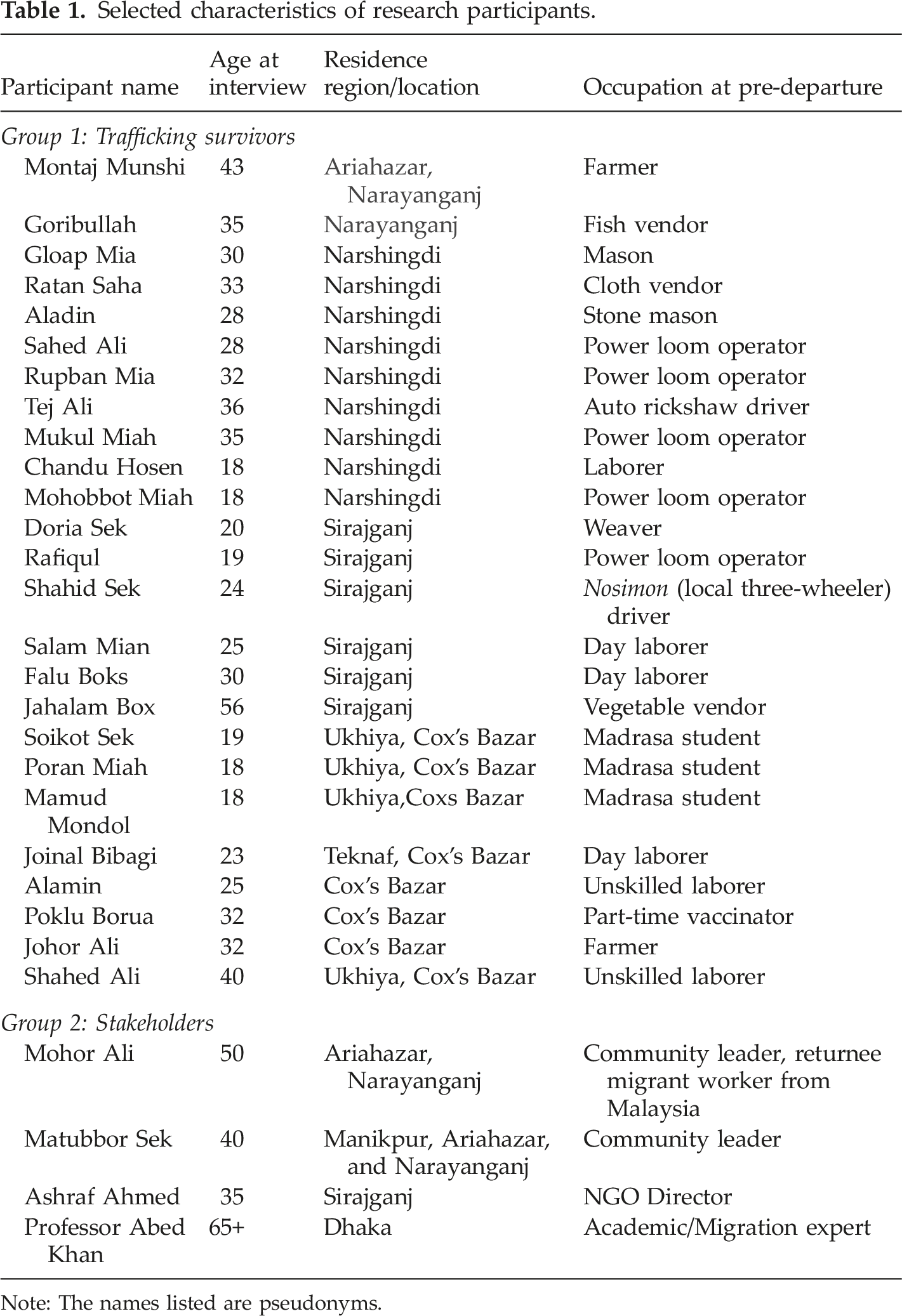
Note: The names listed are pseudonyms.
Method
Face-to-face interviews provided an effective means to explore participants’ economic and social experiences, as well as the psychosocial impacts of being trafficked (Creswell, 2009). All participants were first fully informed of the purpose, methods and demands of study participation, as well as potential risks or discomfort, to facilitate voluntary consent of the participants. Prior to the interview, a simple information form in Bengali or Bangla language was provided to subjects through their stakeholder organizations, NGOs or community leaders. Participants were assured of confidentiality, privacy, and anonymity, pseudonyms being applied to protect their identities, their age and location only being recorded for data analysis.
All interviews were conducted by the first author at a secure public location (NGO office, school or community center). Local police were informed of the location and interview schedule to provide protection should the need arise. Security was required during field work in the Ukhiya and the 80-kilometer-long marine drive of Cox’s Bazar which was a hub of drug and human trafficking.
Ethics approval was gained through the Human Research Ethics Committee at Western Sydney University, reference number H 12415. To maintain ethical and academic standards and address potential risks, an in-country Project Steering Committee was formed in Bangladesh, chaired by a senior academic from the University of Dhaka. The researcher and his support team worked under this body to ensure fieldwork was conducted ethically and sensitively. This in-country steering committee was covered by the Western Sydney University human research ethics committee approval dated 06 November 2017, and the first meeting of the in-country committee was held on 04 January 2018 to resume the field work. Participant consent was sought for audio recording the interview, after which, participants were asked if they wanted to add or revise anything. Representatives of NGOs were available to confirm that the data was collected according to principles of social justice and respect, and to ameliorate any negative consequences should participants want to withdraw from the interview. In addition, the researcher arranged a representative or counselor from each stakeholder NGO for dealing with stressful situations experienced by participants. The interviewer stopped interviews if participants felt distressed. Counseling was available to help participants obtain relief or arrange access to other support services, and all participants were provided with details of free counseling services that could provide support if needed.
To address the possibility of an unequal relationship between researcher and participants, the participants were initially selected and contacted by the NGOs. To overcome biased information from the participants who were beneficiaries of NGO services, the researcher did final selection of participants.
Interview questions concerned: (1) the life situation and reasons for taking part in undocumented migration; (2) experiences of labor trafficking; (3) the impact of trafficking; (4) reintegration support from family members/relatives/organizations; and (5) present health status. The duration of each interview ranged from 20 to 87 minutes; the researcher took note of respondents’ communication patterns and respected the scope of information sharing that the respondents were comfortable with. Prompts and funneling were used sparingly in the semi-structured interviews to help ensure that key dimensions of participants’ experience were included as a basis for subsequent thematic analysis (Chapman et al., 2015).
All recorded data was transcribed, producing verbatim transcripts. All transcripts of the 28 interviews (of 29 participants) were cross-checked against recorded audio files, field notes and journals. The first stage of analysis involved manual coding, identifying categories to be drawn from participants’ responses. The second stage involved interpreting emergent patterns and linking these to primary and secondary themes, grouping them according to conceptual similarities and providing each cluster with a descriptive label.
Further, data triangulation was employed utilizing three different and independent sources (Decrop, 1999), that is, the two respondent groups (returnees and stakeholders), available secondary literature and existing research and information on the issue. The combination of IPA analysis, respondent communication and application of insights from synergized theoretical frameworks concerned with conservation, allocation and loss of resources, motivation, coping, precarity, and human rights theory, allowed a multi-dimensional picture to emerge regarding the respondents’ experiences and journeys home.
Findings: Interpreting migrants’ experiences
Participants detailed their motivations, calculated risks and decisions around their job-seeking in Malaysia. Responses also provided insights into networks influencing their decisions and their psychological journey, and associated mental trauma in situations of terror, fear and abuse. Interpreting their stories through the lenses of precarity and COR theory aided an understanding of cultural considerations and nuanced perspectives influencing their willingness to trade resources and risk resource loss, conservation, and acquisition. This mode of interpretation also surfaced tension-ridden agendas of multiple stakeholders (including the government, local dalals and community and family members) affecting participants’ initiatives to break out of cycles of poverty.
Resource adequacy for future agendas
Economic pressure
Bangladesh has one of the lowest GDPs and income per capita globally and many struggle to earn USD 10 per day (Hasan, 2019). Most Bangladeshis are categorized as unskilled workers earning 5,000 to 7,000 Bangladeshi Taka (BDT) (less than USD 85) 1 a month. While two-thirds of the respondents were from the poverty-stricken region of Siranganj in Cox’s Bazar, those who ventured to migrate were not “the poorest of the poor.” Most were employed at the time of their decision to migrate, but they considered their income inadequate. For example, six of the research participants were mid-skilled power loom workers earning up to BDT 15,000 per month (USD 181). In rural areas, this income is just about enough to meet the average monthly household expense of BDT 14,156 (USD 171) for a family of four or more (BBS, 2017). The participants aspired to have a higher income to sufficiently cover the needs of their households, especially if they belong to large households. Twenty out of the 25 respondents had more than four family members under their care. The financial stress of meeting family responsibilities motivated many of the research participants to migrate. Most participants had little education due to poverty and thus sought poorly paid, low-skilled work abroad. However, one participant, Aladin (28–29 years of age and a stone mason by trade), reported that although he could make BDT 500 per day [USD 6] “[…] the wage fluctuated during the rainy season when it was not easy to get work. On average I could make [BDT] 15,000 [USD 181] or less per month. It was barely enough to support a family and I faced an income-deficit every month” (as cited in Khan, 2020: 67).
We referred earlier to the balancing of formal and informal resources as a type of “informal survivalism” in which individuals perceive resource trade-offs as offering the promise of escaping ongoing cycles of poverty and deprivation. Halbesleben et al. (2014: 1338) noted that a goal-based definition of resources, that is, “[…] anything perceived by the individual to help attain his or her goals,” supports a universal understanding of a willingness to risk trading existing resources to improve life chances. The director of an NGO in Sirajganj shared the same view: “Sirajganj is an area of river erosion, every year it is flooded, numerous people lose their houses and live a miserable life. People without any resources had to accept the reality of livestock being […] swept away–these people eventually take a few steps back in their lives” (as cited in Khan, 2020: 72). Accordingly, resources that were perceived as mechanisms for achieving subsistence needs were now traded for an opportunity to accumulate additional resources to invest in the local environment, often in building, retail and farming, including fish farming.
Social pressure
The pressure to provide remittances as a form of family income was essentialized within the country’s political economy. However, in making decisions about future resource utilization, participants were often misinformed and had limited understanding of the basis of “agreements” made with the dalals including the true cost of the trip and its funding. The offer of deferred payments and promises of well-paid jobs further allayed concerns about resource risk. A migration expert who was interviewed for the study, Professor Abed Khan, noted that “[…] grassroots brokers and human traffickers exploited government campaigns and misguided innocent masses to send them to Malaysia through illegal routes and means.” He also mentioned that dalals approached potential candidates for informal migration with promotional slogans that included “[…] we will be able to send you to Malaysia for BDT 20,000-30,000 (USD 241–361) and it will change your life and income.” Thus, those who had never heard of Malaysia believed they could provide remittances to change their families’ economic fortunes.
Importantly, trusted family and community members were also the source of (mis)information that legitimated risks associated with resource reallocation to meet goals. For example, the broker of Falu Boks (30 years old, a day laborer) 2 was his brother-in-law. Others emphasized the willingness of family members to invest in their journey. When goals were not achieved, psychological effects of having let down family and community meant significant loss of resources (i.e., loss of face, self-esteem and status in the local community).
Thus, macro- and micro-barriers to resource accumulation could seemingly be overcome by access to work in Malaysia and the acquisition of additional income through remittances. This extension of existing resources to new and more productive economic and social initiatives was seen as underpinning improved social standing of the poor Bangladeshi laborers, individual well-being and often enhancement of community infrastructure.
Regaining a sense of control
A key motivation of these migrants was to regain a sense of control over their individual, family, and community fortunes, and thus forge a path to prosperity in a developing Bangladesh. Participants also felt a need to fulfill the expectations of family and local community, aligning with the observation of Markus and Kitayama (1991) that in certain collectivist cultures, cultural goals and personal goals merge. Allah has given me three daughters. We are [the] poorest, most miserable. It is difficult for us to keep body and soul together. The work on the power loom is a hard job as I have to attend to my duty at night. It affects my health a lot […] bypassing sleeping in due time […] people get sick, severely sick. Another issue is to marry-off my three daughters. I have a son too […] I need to make them settled in life by arranging some property. (Rupban Mia, 32 years old, power loom operator)
However, the dream of regaining a sense of control only lasted for the first part of the journey. This was followed by a sense of helplessness, slavery or death—the potential price of not meeting payments demanded or unforeseen circumstances, such as increased border controls and immigration detention. The experience of participants reflects a gradual loss of autonomy over decisions around resource investment and resource risk in terms of physical and mental health, financial resources and social status on return.
Initially, dalals generally treated undocumented migrants well in holding places in Bangladesh while awaiting appropriate numbers of undocumented migrants. Subsequently, small boats transferred them to larger trawlers or ships. When they entered the ring of international trafficking, the behavior of handlers changed dramatically. Migrants were being sold in batches according to commission or exchange rates set by trafficking syndicates. At this stage, the research participants often changed their minds but were not allowed to turn back. They lost their autonomy and contact with the outside world, under the control of an armed guard. In the process of transferring from small fishing boats to trawlers or larger ships, thoughts of survival replaced those of autonomy. One participant related his experience: We boarded a trawler that night. After boarding, they showed us knives and machetes trying to create fear and terror in our minds. We told them that we thought there was something wrong and therefore we would not join the trip and would like to go back home. They created fear and assaulted us. (Ratan Sha, 33 years old, cloth vendor)
On the journey from the Bay of Bengal through the Andaman Sea, conditions on board were mixed. Some respondents were fed dry noodles and dried fish. Food or drinking water was inadequate. Migrants were verbally and physically abused for shifting the position of their bodies to gain physical relief; some were forced to work (cleaning and cooking) on fishing boats.
Significant resource re-evaluation occurred in the “receive ghor,” a “clearing or holding house” where migrants stay before their entry to Malaysia. It was used as a “torture cell” for many; a place of maximum pressure to extract final payment or ransom sufficient to enter “dreamland.” The receive ghor was located in ships anchored off the Thai–Malaysian border or on the mainland. Once the border was clear and all payments finalized, migrants were directly transferred to the mainland via a speed boat. Other clearing houses were located in hill camps in the Thai jungle. These participants described dangerous transport at night without food and drinking water. Once at the camps, they were separated individually for the departure to Malaysia and forced by the brokers or traffickers to call home to pay money. Respondents described how their tortured voices were heard by family members over mobile phones to ensure immediate payment for their release. Two respondents said their torture was witnessed by family via video call. One of the stakeholders, Matubbor Sek (40 years old, community leader from Narayanganj) noted that “[…] when the broker gets information that the family will pay, the beating stops. The one whose family fails to send money, they are beaten to a pulp. If they even utter a word, they get beaten up.”
Resource loss and its impact
Interviewees knew up-front that increased control over their future life chances could come at a cost (i.e., they suspected ill-treatment awaited if they failed to pay on time). Many families invested their last resources to release their “champion” and beloved child who was to return their investment and bring prosperity. A community leader described what can happen if participants have no resources at hand to meet a demand to urgently raise BDT 200,000–300,000 (USD 2,410–3,614): […] [T]hey have to sell their property, like a couple of cows, or the orchard, or even the house where they live! […] Though the father did not sell his land and house in tough days, when he gets information that his son has ended up in Receive Ghor, he then, without any hesitation, sells his house and land to rescue his son. (Matubbor Sek, 40 years old, community leader from Narayanganj) The father’s cherished dream is that his son is in a foreign land; the son will send money, and he can then repurchase the land. (Matubbor Sek, 40 years old, community leader from Narayanganj)
Pre-departure, undocumented migrants are often able to borrow funds from diverse internal and external sources (Ullah, 2010). As paid work in neighboring countries offered the promise of future financial security, interviewees were able to access debt financing, a common and accepted cultural practice. In addition to land sales, migrants frequently access other sources of funding, such as those from NGOs, traditional money lenders, relatives, friends and asset sales (e.g., their livestock, agricultural crops and small businesses). Ten respondents reported asset sales and loans as the principal means of funding their journeys. Six respondents entered into credit agreements directly with traffickers, typically via their recruiters, often without having to pay anything “upfront.” In many cases, family members were subsequently required to make these payments urgently under extreme duress. The outcomes of such deferred payments were economically and psychosocially devastating.
For one participant, the process of migration destroyed his family’s economic base. The deferred payment agreement required him to quickly arrange funds by selling his land at a low price. I was taken to the receive ghor for my final voyage to Malaysia once my family sent BDT 220,000 [USD 2,650] to the broker. There, the broker from my village asked me […] to give him BDT 30,000 [USD 361] more […] for a job he was going to find for me in Malaysia. Altogether, I had to spend BDT 250,000 [USD 3,012]. I had ten decimal lands and I had to pay this money by selling that piece of land. (Doria Sek, 20 years old, weaver)
Several other respondents did not anticipate paying additional monies to secure their job in Malaysia. Five respondents reported having to sell land holdings ranging from six to 12 decimals (242 to 485 square meters), variously comprising farming or agricultural land and residential homesteads. Two had to mortgage their land holdings. Nearly one-third of respondents lost their land property. One participant reported not only the loss of land and other assets but also the effects of this to future assets. A total of BDT 210,000 [USD 2,530] was given to the broker from the sale of my house. I had five cows including a calf. […] One was selected for kurbani (asacrifice in the name of God, during Eid–ul–Adha festival). My two brothers had also taken loans from their in-laws … I had to arrange all the money from loans. My shop got ruined and my lands and properties are lost now […] [my] whole life is ruined. I lost one year and six months of my life. […] As I have returned without retrieving my fate [sic], [my children] are now deprived of studying. (Jahalam Box, 56 years old, vegetable vendor)
Nine respondents took loans from relatives, including siblings and in-laws. Borrowing from banks, microcredit institutions and traditional money lenders proved unavoidable for six of the respondents. The most exploitative instances of loans involved local money lenders who charged an effective annual interest rate of 96 percent, typically USD 1 per month against USD 12.50.
The minimum reported fee or total “contract” cost of maritime migration paid to dalals and traffickers was BDT 20,000-30,000 (USD 241–361). However, the average cost for informal maritime migration to Malaysia has been reported at BDT 218,617 (USD 2,634) (Joarder and Miller, 2014). In this study, dalals extracted over BDT 300,000 (USD 3,614) on some occasions, although the average cost is similar to that cited by Joarder and Miller (2014). Almost half of the respondents paid more than BDT 200,000 (USD 2,410), with BDT 250,000 (USD 3,012) being the cost most frequently reported, the equivalent of approximately 2.5 years of pre-migration salary.
Nine respondents ultimately paid no money or ransom to the traffickers who abandoned them. Nevertheless, most considered the six to 18 months away as lost opportunity for critical income. In financial terms, direct transport costs and lost earnings averaged a 3.5 salary-year equivalent loss. Most incurred a range of other costs, such as bribes and interest on loans. One participant and his family lost more than 70 percent of their total assets. Another participant’s loss approached 100 percent having to mortgage his only residential land to release him from receive ghor at the Thai–Malaysia border.
The inability of 21 participants to secure paid work incurred income loss for periods of three to 24 months representing a significant opportunity cost both during and after migration. The “dream” of earning a minimum income of around BDT 20,000 (USD 241) per month (Connell, 2017: 3) ended as economic disaster for most.
Resource loss also included erosion of social status within respective communities. Community awareness of an “unsuccessful” return, particularly where respondents and family members were pursued by debtors, typically resulted in shame and loss of social standing for returnees. Respondents, especially older males, reported a reduced ability to benefit from the seniority and respect they might have acquired within their communities had they not tried to find work in Malaysia (Hossain et al., 2013).
Loss of social status was also significant. Some returned migrants became virtual “non-persons” in their communities. One stakeholder respondent, Mohor Ali (50 years old, community leader) described the fate of one returnee whose wife left him. The returnee came to lead an isolated existence in his community. A similar situation was reported by Joinal Bibagi (23 years old, day laborer) whose wife sued him with a false allegation, divorced him and left his house. In attempting to improve their economic and social standing, they became dependent and somewhat “fallen” figures within their communities, losing social dignity and self-esteem.
Even those who managed to find work suffered significant resource loss and threats to future income opportunities. One participant (Doria Sek, 20 years old, weaver) successfully entered the undocumented labor market in Kuala Lumpur in 2014. His family had sold 10-decimal land to pay BDT 200,000 (USD 2,410) to the broker as per contract. Eventually their family paid BDT 250,000 (USD 3,012) to the broker by selling the only family assets. After working only three months in Malaysia earning only BDT 50,000 (USD 602), he was arrested as an undocumented worker and, as a minor at the time, was sent to a juvenile detention center where he developed a skin disease affecting his ability to work. Finally, his family sent BDT 25,000 (USD 301) more for his return air ticket. Altogether he lost a year of his life and regular income, family assets—including 10-decimal land (BDT 275,000 or USD 3,313)—and, more critically, sound health and work capacity.
Due to lost assets and impaired functioning post-migration, many reported being able to earn only BDT 5,000 (USD 60) or less per month. Importantly, the bulk of this group shifted from living below the poverty line as the working poor, which in 2016 made up 52 percent of the Bangladeshi lower-middle-income class, to living in extreme poverty as the lowest 12.9 percent within the Bangladeshi community (BBS, 2017; World Bank, 2020). Their sense of failure and loss contributed substantially to distress and mental health issues.
Conclusions and policy and research implications
The study found that the Bangladeshi males involved in the Andaman Sea crisis were motivated largely by the lack of existing resources to meet the economic and social pressures confronting family and community, requiring new resource configurations to achieve their goals. Their specific experiences and exposures during irregular migration promoted and arranged by dalals, brought them asset loss, abuse, exploitation and torture by the trafficking networks in Southeast Asia. Using precarity concepts and COR theory as our primary conceptual lenses, we provided insights into Bangladeshi laborers’ decisions to gain some level of control over future life chances, drawing upon and modifying economic, social and psychological resources to manage the experience of undocumented migration and subsequent trafficking to achieve their goal of increasing family income though remittances.
This paper may benefit policy-makers by offering a nuanced appreciation of the role that remittances play as drivers of informal migration, especially given how migration is and has been a critical strategic policy of the country’s development. “[…] a country’s development trajectory in historical perspective […] [being] the starting point for any anti-trafficking intervention” (Kotiswaran, 2019: 380). Bangladesh’s 8th Five Year Plan (8FYP) (GED, 2020: 13) states: First, the migration of rural workers to international workplaces is one important factor for the tightening of the rural labor market, thereby enabling the growth of real wages. Second, income transfers from remittances have directly supported poverty reduction by increasing the income and consumption of the rural poor. Thirdly, […] the massive inflow of remittance income into the rural economy has boosted the expansion of housing, construction, trade and other services… provid[ing] a diversified employment base for rural workers. The multiplier effects of remittance inflows are a major contributor to rural transformation and diversified employment and income base for the rural poor.
Nevertheless, the drive to access remittances remains strong, and reliable trustworthy information remains scarce. This study has demonstrated the significant costs of engagement in informal migration that negatively affect the economic, social, and psychological resource-base of the individual and family. Such information needs to be accessible in rural communities. While the 8FYP incorporates enhanced “[t]echnology infrastructure in regions where UDCs (Union Digital Centers) are located […] to enable residents of the regions to access [government] services […] [a]wareness campaigns about the operations of UDCs at the local [level] need to be launched” (GED, 2020: 186), and these could include accurate information about the substantial risks of trafficking associated with informal migration.
Actions for increased regulation of labor migration include “[…] protection against exploitation by middle-men” (GED, 2020: 10) which will require time to take effect. In the interim, numbers of Bangladeshi laborers will likely continue to risk their lives and family assets in attempts to manage their precarious existence. The influence of dalals on potential informal migrants had rarely been questioned. They were trusted by many in the community, based on their experience and expertise in migration matters and their availability to manage the process which was not understood by many of the laborers.
In these circumstances, the benefits of social media cannot be ignored. As of January 2023, Bangladesh was the ninth largest country in terms of Facebook audience size (Statista, 2023). Other social media platforms are also popular and mobile phone use is extensive amongst migrant workers and their families (Khan, 2015). Social media is being used effectively in counter-trafficking efforts. For example, a community radio, run through social media, developed and maintained effective communication channels with targeted trafficking-at-risk stakeholders within Rohingya refugee camps (Alam et al., 2023). The Bangladesh UN Network on Migration undertook an eight-day social media campaign to promote activities against, and to increase awareness of, human trafficking through online platforms, marking the World Day Against Trafficking in Persons 2021 (The Daily Star, 2021). Thus, there appears to be value in developing social media sites for storytelling interventions to generate awareness of risk and potential costs for those being propositioned by dalals and bringing positive change to the social standing of returned irregular migrants. The government might also leverage trusted partnerships (e.g., YPSA) with access to vulnerable communities as part of its digitization to access public services, improve information flows in rural and remote areas, and provide alternative sources of information to those proffered by dalals.
Future research
Data presented here are firsthand accounts of respondents, collected around two years after their return to Bangladesh. This approach gives voice to participants in developing a narrative around the multi-faceted impacts of their irregular migration experience. The study obtained rich insights from the interviews with a small sample of 25 returnees and four experts. The small sample size and the rendering of Bangla into English also introduced a second level of interpretation. Translations were made in the interest of appreciating the experiences of respondents. Future research might explore the role and influence of dalals in the context of government policy as outlined in the 8FYP and the influence of interventions to improve information sources in remote areas, including social media initiatives and their effectiveness.
Footnotes
Acknowledgments
The authors acknowledge and appreciate the contribution of participants interviewed for this study.
Declaration of conflicting interests
The author(s) declared no potential conflicts of interest with respect to the research, authorship and/or publication of this article.
Funding
The author(s) disclosed receipt of the following financial support for the research, authorship and/or publication of this article: The first author received financial support for this study through the Human Rights, Society, and Multi-Level Governance Scholarship Program jointly administered by the Human Rights Centre, University of Padova and the School of Social Sciences, Western Sydney University.
