




Abstract
This paper analyzes how policy-relevant actors understand the causes and effects of labor immigration to Malaysia, the country that receives the highest number of migrant workers in Southeast Asia. Whereas most research on international migration governance has focused on governance system outputs, this paper adopts an actor-centered perspective to investigate how actors narratively construct labor migration dynamics in Malaysia and how they conceptualize the drivers and impacts of labor migration policies and practices. The empirical material comes from 41 in-depth interviews with government officials, policymakers, international and regional organizations, nongovernmental organizations, employers’ organizations, trade unions, and embassy representatives. The study found that Malaysia’s migration governance system was perceived as “chaotic” due to the seemingly inconsistent, unclear “ad hoc” policy measures implemented, and that the governance system is perceived as “corrupt.” Economic incentives were also seen as the primary driver of labor immigration, yet the main impact on Malaysian society was perceived as the spread of criminality, violence and disease, a narrative centered on migrant men. This paper argues that this discourse is problematic as it may drive types of policy measures that target migrant men.
Introduction
Malaysia is a key destination for migrant workers in Southeast Asia as employers rely on migrants to fulfill labor shortages in manufacturing, construction, agriculture and domestic work (ILO, 2018). Yet migrant workers in Malaysia face disproportionately high levels of exploitation including debt bondage, forced labor, nonpayment of wages, physical and verbal abuse and unsafe working conditions (Amnesty International, 2010; Ellis-Peterson, 2018). This paper argues that to understand how labor migration is governed in Malaysia, there is a need to investigate the perceptions of policy-relevant actors who are situated in particular organizational contexts within the migration governance system to explore how these actors frame labor immigration and how they conceptualize the drivers and impacts of labor migration policies and practices.
As noted by Geddes et al. (2019), policy actors’ perceptions have been overlooked in research on the governance of migration, which has instead primarily examined governance system outputs, and has often made assumptions about policy-making and decision-making processes. This is problematic as perceptions—and misperceptions—matter (Jervis, 1976) and we cannot understand governance without understanding the perceptions of actors within governance systems. This research seeks to close this gap by shedding light on the ways in which various types of policy-relevant “actor” in Malaysia’s governance system understand and interpret so-called “low-skilled” labor migration to Malaysia, how they conceptualize the drivers and impacts of labor migration policies and practices, and how they assess the labor migration policies that are in place. This paper seeks to make a key contribution to the governance literature by introducing some original perspectives. This is especially important to analyze in a Southeast Asian context as a lot of research on migration governance has overlooked governance processes in the Global South.
This study found that Malaysia’s migration governance system was perceived as “chaotic” and “corrupt” by many interviewees due to a range of policy reversals that have taken place and the suspicion that migration policy-making is driven by surreptitious money-making. The research also found that, while economic incentives were seen as the primary driver of labor migration, the main impact on Malaysian society was perceived as the spread of criminality, violence and disease, a narrative that centered upon migrant men. This paper argues that this discourse is problematic as it may drive types of policy measures that target and criminalize migrant men.
This paper is structured in six broad sections. The first section provides a brief overview of labor migration to Malaysia. The second section outlines the methodological considerations that underpin the study. The third section analyzes the constitution of Malaysia’s migration governance system. The fourth section examines policy-relevant actors’ understandings of migration dynamics and investigates how the causes and effects of migration are understood. The fifth section outlines the ways in which actors in this study perceive Malaysia’s migration governance system as “chaotic” and “corrupt.” The final section draws together the paper’s key findings and examines what this could mean for Malaysia’s policy-making landscape.
It is important to note that the fieldwork for this study took place in 2018 in the run-up to the 2018 general election 1 when the issue of migration was seen as particularly politically sensitive. It is also important to underline that the fieldwork occurred prior to a number of key events that have had subsequent impacts on migrant workers’ living and working conditions, including the COVID-19 pandemic, the 2020–2022 political crisis 2 and the entry into force of the Employment (Amendment) Act 2022.
Background: Labor migration to Malaysia
Malaysia is estimated to receive the highest number of migrant workers in Southeast Asia (ILO, 2018). The number of documented migrant workers in Malaysia has grown from less than 250,000 in 1990 (Pasadilla, 2011) to around two to three million in 2019 (Yi et al., 2020). However, there is also a substantial number of undocumented migrants working in Malaysia with estimates ranging from 1.5 million (Yi et al., 2020) to four million (Winrock International, 2021), while some actors in this study produced figures of up to nine million undocumented workers. This includes workers who entered the country without a valid work permit and others who became undocumented whilst in Malaysia.
The majority of Malaysia’s documented foreign workers come from South and Southeast Asia, with the majority of workers coming from Indonesia, followed by Bangladesh, Nepal and the Philippines (Yi et al., 2020). These workers are predominantly doing the classic “three D” (dirty, dangerous and difficult/demeaning) jobs which are considered low-skilled, receive low pay and which local workers deem as unappealing (Aziz et al., 2017). There is a stark gender divide in the sectors that migrants enter in Malaysia whereby migrant men dominate the plantation, agriculture, construction, manufacturing and services sectors, while migrant women, primarily from Indonesia and the Philippines, dominate the domestic work sector.
Malaysia has multiple ethnic groups and immigration has played a central role in forming Malaysia’s population and society (Haque, 2003). Nearly all policy issues are shaped by ethnicity and there are provisions in place that are specifically intended to improve the economic status of ethnic Malays (the majority ethnic group). 3 Malaysia separates migrants into different categories “on the basis of a calculation of their potential economic contribution to the ‘nation’” (Nah, 2012: 488). Whereas highly skilled migrants are categorized as “expatriates” and are hired on an employment agreement/work visa, so-called “low-skilled” migrant workers are regarded as a short-term solution for labor shortages and are categorized as “foreign contract workers” (Kaur, 2018). These workers are employed via a form of guest worker program that consists of strictly temporary contracts in which migrants’ work permits are tied to specific locations, sectors and employers (Kaur, 2018). 4 The Malaysian government has implemented a system of quotas and restrictions for this category of workers in order to reduce employers’ reliance on them and to protect job opportunities for local workers (ILO, 2016). 5 To manage short-term contract labor migration, Malaysia primarily uses bilateral agreements, in particular, Memorandums of Understanding (MoUs), and has signed MoUs with several countries including Bangladesh, Cambodia, Indonesia, Thailand and Vietnam.
This paper will shed light on Malaysia’s governance system for labor migration and outline the perceived chaos within the system due to (1) the two Ministries involved in migration policy-making, (2) the policy U-turns that have taken place and (3) the perception that labor migration policy-making is driven by money-making.
Methodological considerations
A range of scholars have shed light on the evolution of Malaysia’s migration policies (see e.g., Nesadurai, 2013; Garcés-Mascareňas, 2015; Kaur, 2018; Elias, 2018; Anderson, 2020), but we lack insight into how the actors that make, or seek to shape, migration and employment policies conceptualize migration-related issues and migration-related policies in Malaysia. This paper addresses this gap in the literature.
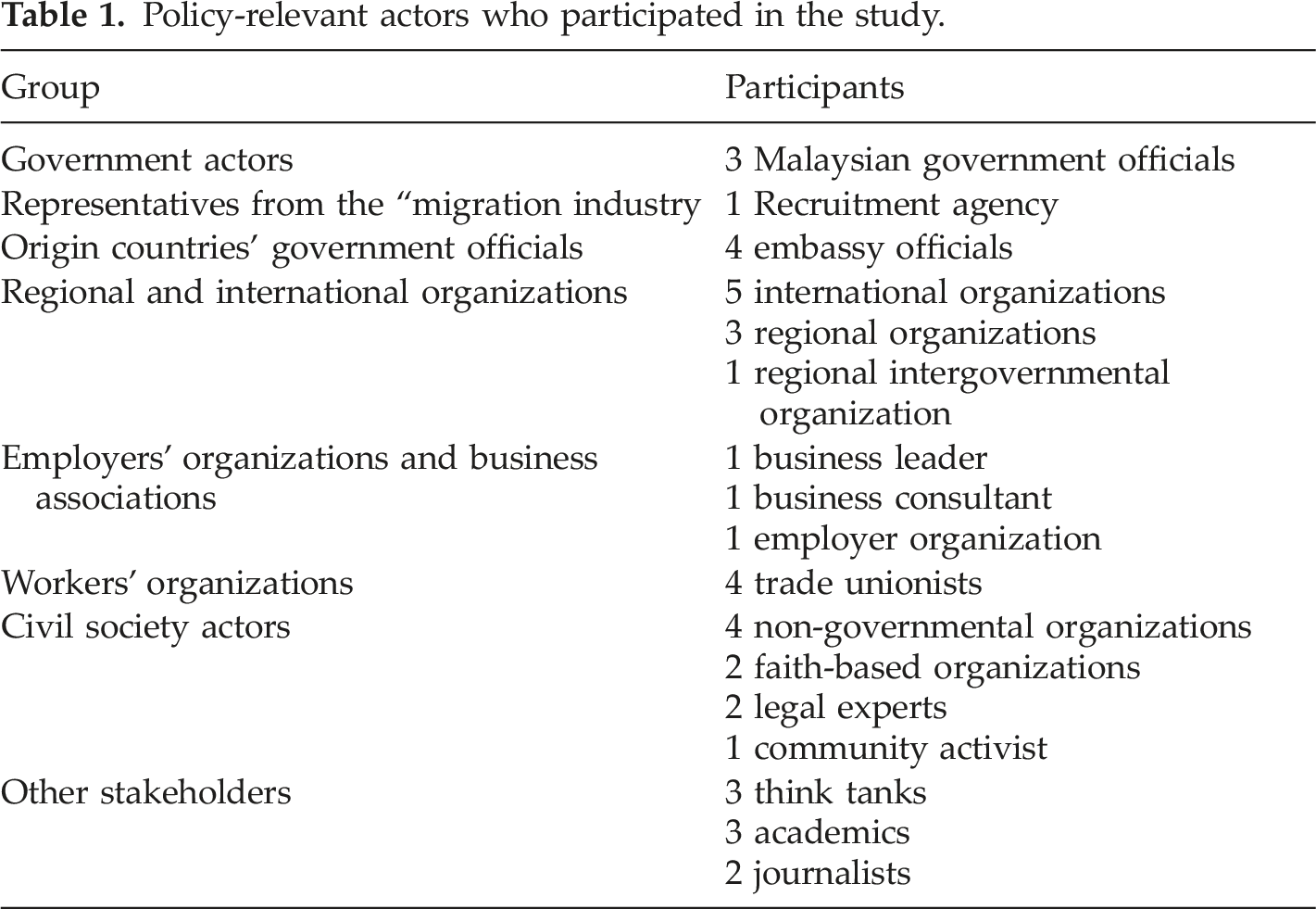
Policy-relevant actors who participated in the study.
The individual interviews were conducted in January–May 2018, in the run up to Malaysia’s 2018 General Elections. Broadly speaking, participants were asked: What shaped their understanding of labor migration; what they see as the causes and consequences of migration; and whether their understandings of labor migration are sufficiently reflected in policy outputs. The structured questionnaires were used to analyze the constitution of the governance system, to identify who the actors are and to examine where actors are located in the governance network in relation to “key” policy-makers and decision-makers. The questionnaire asked the research participants to list the individuals/organizations they discuss migration with, how frequently these interactions take place, how valuable they rate the exchange and what sources they access for information on migration and how often.
This research draws on the concept of policy narratives 6 (Boswell et al., 2011) in order to shed light on how actors construct stories about the causes and effects of labor migration and assess the impact of Malaysia’s migration policies and practices. Several scholars have argued that policy narratives are key elements of the policy process (e.g., Boswell et al., 2011; Van Hulst and Yanow, 2016). Communicating a narrative involves actors selecting the salient factors that warrant attention and then creating a consistent story that defines what the problem is, explaining how it came about (with “blame” implicitly or explicitly assigned “to specific factors or actors”) and describing what should be done about it (Boswell et al., 2011: 5; Van Hulst and Yanow, 2016).
Storytelling is not a neutral process as what constitutes a “problem,” how it is defined and what the proposed policy intervention should be, is shaped by policy actors “in ways calculated to gain support” for their political and/or organizational agendas (Stone, 1989: 282). In trying to make sense of a perceived problem, actors draw on a range of prior tacit knowledge and values from their own experiences and from other sources such as media, academic, legal, religious and scientific institutions (Van Hulst and Yanow, 2016), with Schwenken and Eberhardt (2010) arguing that assumptions about gender inform knowledge surrounding migration (see also, Foley, 2023).
As will be discussed in the next section, this research found that an elite number of actors, predominantly from the Home Ministry, control policy-making in relation to the in-migration of workers while the policies relating to workers’ employment conditions is largely decided by the Labor Ministry. Thus, it is important to note that many of the actors involved in this study (see Table 1) would not be considered as central to the policy-making and decision-making process. It was difficult to get Malaysian officials from these ministries to agree to an interview due to the sensitive nature of migration in Malaysia and the fact that fieldwork took place in the run up to the 2018 General Elections. Yet, while the majority of participants in this research were not government officials who hold decision-making powers, their perspectives are still valid. These actors seek to influence policy trajectories and many were able to liaise with key actors from the Labor Ministry, so their understandings still help to shed light on the wider governance system in Malaysia as well as providing an important assessment of the effectiveness of the migration policies in place.
Malaysia’s labor migration governance system
There is a need to define migration governance and the role of the state in Southeast Asia in order to contextualize the research findings. Governance broadly “involves the rules, structures, and institutions that guide, regulate, and control social life” (Barnett and Duvall, 2005: 2). Migration governance relates to the structures (institutions, the rules, norms and practices), strategies, policy-making processes and mechanisms of decision-making, which are aimed at controlling the cross-border movement of people (adapted from Levi-Faur, 2012). Migration governance occurs across multiple levels—local, national, regional and international—and involves numerous public and private actors including an increased number of international, regional and civil society organizations (CSOs) (Betts and Kainz, 2017). However, there remains no coherent single overarching global regime which governs states’ responses to migration, so migration remains almost exclusively managed by nation-states (Newland, 2010; Betts, 2011).
Across Southeast Asia, labor migration has been a prevalent feature since the 1960s and this has been driven by different levels of socioeconomic development and unemployment levels (Kaur, 2010). In this region, the crucial role that states play in regulating migration flows is particularly evident (Piper et al., 2018). This is because the nation-states and borders in Southeast Asia are more recent constructions having been created during colonial rule. Since gaining independence, the region’s political elites had to vigorously defend their borders and the desire to protect state sovereignty drove the construction of regimes to strictly control immigration (Case, 2013; Nah, 2012). Case (2013: 51–53) argues that Southeast Asian states strategically use and manage (or not manage) labor migration in ways to benefit the state and the region’s political elites 7 and that they have a remarkable “capacity to make use of these [migration] flows in ways that invigorate [states’] governing apparatus and sovereign territoriality” (Case, 2013: 60).
Malaysia’s governance system for labor immigration involves a network of multiple public and private actors working across the local, national, regional and international levels, with different actors having varying degrees of power and “centrality.” This study found that over the past decade, there has been an increase in the number of NGOs and other CSOs who seek to influence how migration is governed in Malaysia, many of whom have extensive networks throughout Malaysia and Southeast Asia. However, the Malaysian government remains the central actor in the migration governance system, as it is through the mechanisms of the state that policies are created, implemented and enforced.
The mechanisms through which migrant workers are recruited and regulated in Malaysia were described by interviewees as rife with “chaos” due to the array of actors and maze of jurisdictions involved (see also, Kaur, 2010). Part of this chaos stems from a blurring of roles whereby the departmental responsibility for labor immigration has transferred from being under the primary purview of the Ministry of Human Resources (also referred to as the Labor Ministry) to the Ministry of Home Affairs (also known as the Home Ministry). This transfer has coincided with a shift in state discourse where labor immigration has moved from being depicted as a “labor” issue to a “security” issue (Nesadurai, 2013; Kaur, 2018). The Home Ministry, namely the Immigration Department, is responsible for enforcing regulations relating to the admission and stay of migrant workers, but the Labor Ministry monitors the terms and conditions of migrants’ employment. Definitely you have heard the ping-pong ball that we are being always thrown here and there because we have two bosses, in an organization you cannot have two bosses. We have the Human Resources [Ministry] and we have the Ministry of Home Affairs… So one is looking in terms of the laws, the other one is looking in terms of welfare. (Representative, Faith-based Organization, Female, March 2018) The recruitment shouldn’t be done by the Home Ministry, they are not experts in labor so why do they need to do this? [It should] go back to the Labor Department… So this should be abolished, it shouldn't be run by the Home Ministry which is nothing to do with labor. (Representative, Labor Coalition, Female, March 2018)
Labor migration to Malaysia is understood as being strategically managed (and not managed) by the government in a way that benefits a select number of state actors, with the governing apparatus “controlled mainly by elite men” (Chin, 1998: 6–7, 168; Case, 2013). The Home Ministry is the central policy-maker and decision-maker for labor migration and according to the data obtained by the structured questionnaires and interviews, this Ministry operates in quite a closed setting and does not interact with many other actors in the wider governance system. There was never a discussion, there was never nothing, it’s just announcement [of a policy change] made by the Prime Minister. And you understand that this is coming from the Home Affairs’ Ministry talking about foreign workers and they seldom believe on this tripartism, they never discuss [with others] as compared to Human Resources Ministry. (Manager, Employers’ Organization, Male, March 2018) [Policy-making in Malaysia involves] an elite group of politicians and people with connections and people who are in the circle and who understand the issues a certain way. (Journalist, Male, March 2018)
Understandings of the causes and effects of immigration
This section analyzes: (1) how actors narratively construct the broad causes and effects of immigration to Malaysia, (2) who they assign blame to for the perceived problems associated with immigration and (3) what evidence actors use to support their claims. As defining the problem is the organizing axis of policy-making (Baumgartner and Jones, 1991), how actors understand the drivers and impacts of immigration in Malaysia will influence how they develop proposed policy solutions (see, Boswell et al., 2011).
Economic drivers and impacts
When policy-relevant actors were asked “What drives migration to Malaysia?” nearly all participants initially cited economic reasons. 12 Malaysia is viewed as economically prosperous whereas sending countries are perceived as unable to provide enough job opportunities, which results in their citizens seeking employment in Malaysia. This incentive to migrate is often connected to the perception of family obligation, especially for migrant women (see e.g., Killias, 2014). Furthermore, there exists a narrative that it is relatively easy to enter Malaysia for employment both in a documented capacity and in an undocumented capacity due to the demand for workers, the availability of work permits, the country’s geographic location and porous borders.
When asked about the effects of immigration, most actors initially responded by discussing the positive economic impact which benefits Malaysia, migrant workers, their families and sending countries. 13 Migration is seen as a driving force for Malaysia’s economy as migrants are seen as “cheap workers” who are able to fill labor shortages in key sectors like construction, manufacturing, plantations, agriculture and domestic work, with some actors underlining that Malaysia would be “paralyzed” and “collapse” if migrant workers were to stop coming (Trade Unionist, Male, February 2018). 14 Interestingly, the narrative that Malaysia relies on migrant workers for key sectors runs in contrast to attitudes among the Malaysian public. For example, the ILO and UN Women (2020: 3) found that 47 percent of respondents in Malaysia stated that migrants have an overall negative effect on the national economy, with 56 percent of respondents stating that Malaysia does not need “low-skilled” migrant workers. One trade unionist (whose attitude has since shifted) explained, “as a unionist initially we didn’t like migrants at all” due to the perception that they were “taking away our jobs, taking away our overtime” as “employers prefer to give overtime to migrant workers because they can be easily exploited” (Trade Unionist, Male, February 2018).
Economic incentives were also seen as shaping sending countries’ out-migration policies as remittances play in a key role in powering their economies. 15 However, two NGO representatives underlined that the monetary benefits for sending countries are so vital that the exploitation of workers tends to be glossed over. Furthermore, while most actors underlined the importance of remittances for the workers, their families and sending countries, 16 this discourse runs in contrast to the (public) narrative (driven by the media) that Malaysia is being negatively impacted by the amount of remittances leaving the country, with MYR 33 billion reportedly being remitted in 2017 (Rosli, 2018). 17
The negative aspects of the discourse that in-migration is driven by economic reasons is best exemplified in the dominant narrative that exists among non-state actors: that some elite Home Ministry officials are economically incentivized to facilitate bringing in large numbers of migrant workers as importing workers is “such a huge cash cow” (Journalist, Male, March 2018). This discourse is connected to the perception that Malaysia’s labor migration system is chaotic, shaped by “greed” and “corruption” and driven by elite actors seeking to make a profit. This discourse will be explored in more detail in the paper’s final substantive section.
In this study, the rhetoric around the economic benefit of migration was largely constructed around male migration (including by the recruitment agent whose business involves importing women migrant domestic workers), with construction, manufacturing and plantations (all male-dominated sectors), the most cited. Migrant women’s labor had little economic value attached to it in the majority of interviews. In fact, throughout most interviews, participants intuitively spoke about male migration flows to Malaysia and largely overlooked the role of migrant women. When migrant women workers were spoken of, this was largely in relation to the abuse and exploitation that they face in Malaysia. 18
The social impact of immigration
Some actors (one government official, one business consultant, one legal expert and one business leader) expressed concern over the changing composition of Malaysian society resulting from migration, citing that “Malaysia is beginning to look like Bangladesh” which is a widely used expression to convey the negative impact (and “threat”) of migration on the country. This sentiment is shared via social media and is also echoed by some politicians. 19 The perceived threat of the “migrant outsider” resonates in Malaysia as concerns about maintaining the country’s ethnic balance have resulted in making people suspicious about immigration. Notably, in research on public attitudes towards immigration, 68 percent of respondents in Malaysia stated that migrants are “threatening” Malaysia’s culture and heritage (ILO and UN Women, 2020).
The dominant narrative relating to the impact of immigration centered on narratives of migrants as criminals and “instigators of social unrest” (see, Wojnicka and Pustułka, 2017: 90), a discourse that centered upon migrant men. This was not surprising as, according to recent surveys, the perception that migrants are “criminals” is commonly held among the Malaysian public and among some employers. For example, the ILO and UN Women (2020) found that 83 percent of the Malaysian public believe that migrant workers cause the crime rate to increase, with 59 percent stating that migrants commit a disproportionate number of crimes (see also, Anderson, 2017). Some actors, such as trade unionists, the business leader, the employers’ representative and two government officials, specifically claimed that migrants are connected to drug cases, robberies and murders in Malaysia, while other actors underlined that the public holds these perspectives. [Migrants] have been perceived as a criminal, they have been perceived as actually the people who steal away the job, they have been perceived as the main social problem. (Representative, Regional Organization, Male, February 2018)
According to interviewees, the presence of migrant men in Malaysian society has led to perceived feelings of fear, especially about the perception that some public spaces are dominated by migrants. For example, some actors (two government officials, one trade unionist and one employer representative) noted that when migrants congregate in central spaces in Kuala Lumpur these gatherings cause “fear” among the local population due to the perceived possibility of violence and in-fighting: In certain areas you can see all the migrant workers will be around and we will not dare to go there because they create a fear for us, we will go away from them… I also feel fear because I worry that anything may happen there, they fight amongst themselves, [if] we are there we have become a victim of their fight, so we don't want to go there just to avoid problems. It's not that we want to discriminate but this has created that problem there, a perception to the younger generations that they do not want to get near to these people. (Official, Government Institution, Female, March 2018)
Many actors’ understandings of the impacts of labor immigration were not exclusively “positive” or “negative,” that is, many actors stated the economic benefits of immigration as well as emphasizing the negative social impacts of immigration. For example, if an actor stated that migrant workers benefit Malaysia’s economy, they would not then necessarily agree that migrants have a positive influence on Malaysia as a whole. For example, one business leader stated that Malaysia relies on foreign labor as they “really help the country [to] develop the economy” but noted that migration has had a “big impact” on the country as some migrant workers are “destructive to society” as they “create a lot of social issues, they rob or they are killing people, all these [incidents] will affect the country” (Male, March 2018).
“Chaos” and “corruption:” Understandings of how immigration is managed
Many interviewees described Malaysia’s policies as “chaotic” (see also, Devadason and Meng, 2013). The perception of chaos stems from two key factors: (1) policy reversals and (2) a perceived gulf between policy and practice. While migrant workers are integral to Malaysia’s economic development, the country has struggled to implement coherent policies to manage labor migration due to the competing pressure between businesses’ desire for “cheap” foreign labor and the political demands to curb immigration (ILO, 2016). These competing factors have driven a number of policy reversals since the 1990s which have seen the government oscillate between implementing migration bans, large-scale deportations (which capitalize on the discourse of migrants being a “threat”), legalization programs and return migration schemes (see also, Chin, 2017; Anderson, 2020). When the Malaysian government has cracked down on undocumented migrants this has caused stark labor shortages, which has often resulted in policy U-turns that, in some cases, even involved inviting back deported workers, and some employers were reportedly permitted to hire migrants straight from the immigration detention centers (Nesadurai, 2013; Garcés-Mascareňas, 2015). This has driven the perception that there is “no proper management system on migration” (Business Leader, Male, March 2018) and that the policies in place are often incoherent and “sometimes very difficult to understand” (Employers’ Representative, Male, March 2018).
The policy measures to manage migration were described as inconsistent “ad hoc” solutions with unclear intentions and which were often depicted by actors as “contradictory” (see also, Garcés-Mascareňas, 2012). Most non-state actors
20
depicted Malaysia’s policy landscape as chaotic and stated that they struggle to keep on top of the new changes that are being brought in, with some participants, notably trade unionists and employers’ representatives, stating that policies seem to come in “overnight” with limited, if any, consultation time. One key example is that the charge for employing migrants, the “migrant levy,” which was originally charged to the workers themselves but was suddenly shifted on to employers.
21
As a result, employers’ organizations had to go into firefighting mode to ensure that they were given sufficient time to prepare. Always [the] policy is being implemented like yesterday kind of thing and announced today. So, like a good example was this levy issue, the government just announced on 31st December 2016 “from 1st January you must bear the levy”. (Manager, Employers’ Organization, March 2018)
The majority of non-state actors believe that, while Malaysian employers rely on migrants for key sectors, the scale of labor immigration to Malaysia is actually exceeding employers’ demands. As noted previously, the dominant narrative among non-state actors is that elite government officials within the Home Ministry are incentivized to approve the importation of large numbers of foreign workers in order to make a profit, either via the “migrant levy” or through accepting bribes (although participants were vague as to who is bribing who). 22 Thus, there is the perception among participants that, instead of prioritizing the needs of Malaysia’s employers and the promises made to the public to reduce labor immigration, some Home Ministry officials were instead driven by the desire to make money. Non-state actors cited corruption, which Transparency International (n.d.) defines as “the abuse of entrusted power for private gain,” as a central issue that shapes the regulation of labor migration in Malaysia. 23 Hoffstaedter and Missbach (2021) examined corruption among security officials in Indonesia and Malaysia in relation to smuggling operations and argued that the participation of state agents “is necessary for the smuggling operations to succeed” (2021: 10). Franck (2019) has examined corruption in Malaysia, albeit focusing on police corruption instead of corruption within Malaysia’s government ministries or agencies, and found that “corruption forms an integral feature of immigration policing in Malaysia” and showed how migrants have to tactically pay bribes to avoid being arrested and deported (2019: 252). 24
Participants believed that Home Ministry officials largely ignore the system of quotas and restrictions in place in order to make money, with some actors stating that the Labor Ministry is being overruled by officials high up in the Home Ministry who constantly approve the importation of substantial numbers of migrants. This overruling is due to the fact that “the Home Affairs Minister is senior to the Human Resources Minister and he’s also the Deputy Prime Minister” 25 (Journalist, Male, March 2018). Furthermore, one journalist noted that “law enforcement is still a challenge, [as] corruption among law enforcers, especially the border patrol, is a problem” (Male, March 2018), whereby if a bribe is paid, workers are allowed in.
A key example of the perceived chaos with the migration governance system is the apparent policy U-turns that occurred between 2015 and 2016. In 2015, the government announced their intention to cap the total number of migrant workers in Malaysia at 1.5 million and that low-skilled migrant workers will be limited to 15 percent of the total workforce by 2020 (ILO, 2016: 3). Yet, the following year—2016—it was announced that Malaysia was to bring in around 1.5 million workers into an unspecified number of sectors (The Straits Times, 2016). This announcement was made by the (then) Minister of Home Affairs via a statement that Malaysia had signed an MoU with Bangladesh to bring in around 1.5 million workers over a three-year period (The Straits Times, 2016). Chin (2020: 43) states that Home Ministry claimed that the purpose of this proposal was “to enable the deportation of the existing undocumented workers” and that employers’ associations were actually behind the request for Bangladeshi workers. However, the proposal was met with backlash from the public, from CSOs, from trade unionists and from employers. As a result, the Home Ministry was forced to change track and instead announced a freeze on the importation of Bangladeshi workers. Such policies are understood by actors as ill-thought-out, as evidenced by the quick backtracking: The policy on the employment of foreign worker is always I would say, at best, knee-jerk reaction to what is happening. For example, in March 2016, the Deputy Prime Minister who is also the Home Affairs Minister announces that he wants to bring in 1.5 million Bangladeshis. [Following the backlash, they] impose[d] a total freeze on the intake of foreign workers [so] that shows it is just reacting to certain situations. (Manager, Employers’ Organization, March 2018). By 2020 the government has agreed to reduce the dependence on migrant workers to 15 percent, which won't happen... so we all know that it is not achievable because somebody in the Ministry of Home Affairs is making money out of it, it is a business actually, bringing in migrants is a business, it's a multimillion-dollar business. (Trade Unionist, Male, February 2018).
In particular, many non-state actors, notably those from trade unions and CSOs, portrayed Malaysia’s migration governance system as being shaped by corruption, believing that Malaysia’s migration policies have been shaped by those who are able to benefit from the lucrative profits involved in importing workers, as opposed to being driven by labor market needs. As one representative from a Labor Coalition (Female, March 2018) noted: “the policies are good for those people who are making money out of the whole thing.” As such, many non-state actors believed that the potential to make money from each additional migrant that is brought into Malaysia acts as a disincentive to challenge the status quo and this led many participants to conclude that the government has no intention to actually reduce the number of migrant workers being imported. However, it should be emphasized that migrant women rarely entered into the narratives surrounding the lucrative business of labor migration.
Some participants, notably trade unionists, journalists and NGO representatives, perceived some government officials, some recruitment agencies and some employers as seemingly “above the law” as they are able to facilitate bringing in large numbers of workers, without getting official approval. As one participant stated, “nobody is following” the system and that it is “chaos”: I have been following the changes of events [for] all these years, the chain of different ministers, different policies, both internally and externally, and it’s still evolving, still changing, but it has not come to the point at where you can sit down and enjoy a good immigration system in Malaysia, it’s not there yet, it’s still way off the target and all. [In Malaysia] when you have the system, nobody is following it! You have chaos. (Recruitment Agent, Male, March 2018) The Immigration Director been doing his job to try and actually make employers more aware about the issues that come with migrant labor, ill treatment of migrant labor and illegal hiring of migrant labor, having undocumented workers, things like that... But I think he's up against the machine, against the mechanism that is very cumbersome and that has all sorts of problems tied to corruption. (Journalist, Male, March 2018) This [employment] freeze and unfreezing is always a knee-jerk reaction and [it is] also the same thing on dealing with foreign work [and] illegal foreign workers, [it] is always based on knee-jerk reaction. If people complain [that] there is too much crime, too much social problems, then Immigration [Department] will have a special program to have these people legalized. And of course, all this legalization is to me is a money-making machinery. (Manager, Employers’ Organization, March 2018). For the past 20 years, the foreign workers’ management rules and regulations have been changing all the time, so it has always been an “ad hoc solution” for a problem. There’s no permanent solution for all the problems faced by the Malaysian businessman or employer… The main commercial sectors in Malaysia are in great pain handling the migrant workers’ issue because of inconsistency of the government policy in granting or restricting the hiring of foreign workers, now that has already escalated to this stage that today we have big, huge number of illegal migrant workers. (Recruitment Agent, Male, March 2018)
Concluding remarks
This study shed light on the constitution of the governance system (who the actors are and how they interact) and how policy-relevant actors in Malaysia construct narratives about labor migration dynamics, and the drivers and impacts of migration-related policies and practices. These perspectives thus far had been overlooked in the literature on governance. Two dominant narratives were found in relation to the causes and effects of labor immigration: economic incentives drive migration but this narrative often runs alongside the discourse that migration has a detrimental social impact on Malaysian society due to the perceived link between male migration, criminality, threats, violence and the spread of diseases. The role of migrant women was largely overlooked by actors.
In terms of the constitution of the governance system, Malaysia’s Home Ministry is the central policy-maker and decision-maker for labor migration policies and this Ministry operates in quite a closed setting and does not interact with many other actors in the wider governance system. The study found that there has been an increase in the number of NGOs and other CSOs involved in Malaysia’s wider governance system, yet these actors are still largely unable to access policy-making mechanisms. Within Malaysia’s migration policy-making setting (which CSOs are largely unable to access), actors perceive three key (competing) factors that drive policy actions with regards to labor immigration: Businesses’ needs, Malaysian public opinion and money-making, with each of these drivers centered upon specific discourse of either the profitability of male migration or the threat of male migration.
Malaysia relies on foreign labor for its most profitable sectors: agriculture, plantations, manufacturing and construction. Thus, in order to satisfy businesses’ demands and to prevent companies from moving elsewhere, the Malaysian government has allowed an increasing number of migrants to enter Malaysia for work since the 1990s. Yet, when the public demands a reduction in immigration due to the perceived social and economic impacts of migrants’ presence in society, including fears of immigration being associated with criminality and the spread of disease, 27 the government is pressured to act (or to be seen to be acting). In these instances, the government has responded via imposing caps on in-migration or via securitization measures (i.e., raids and deportations), which are centered upon specific constructions of male migration and its effects.
The dominant discourse among non-state actors is that corruption is rife within Malaysia’s migration policy environment and that this shapes Malaysia’s immigration policies and (often more clandestine) practices. The lucrative profits that are to be made from importing (mainly male) workers is seen as driving policy action as certain government officials are believed to be incentivized to facilitate the importation of large numbers of migrant workers. Government officials in charge of decision-making were often framed as corrupt or corruptible, and some actors believed that even if the publicly stated intention of Malaysia’s policy is to curb the number of workers being imported, the private intentions of certain connected individuals (e.g., certain elite state actors and those affiliated with the recruitment industry) is to maintain the status quo of importation as each worker represents a potential pay-out. Thus, the juggle between appeasing businesses, appeasing the public and the incentive to make money out of labor migration contributes to a policy landscape in Malaysia that is rife with chaos and “knee-jerk” policy U-turns.
What is important here is not whether these anecdotes are factually correct, but instead that this is how some actors narratively construct issues relating to labor migration dynamics. With regards to the discourse on corruption, it is important to note that there are less easily observable processes occurring during the policy-making process in Malaysia (which many interviewees do not have access to) that may be contributing to the understanding that the governance system is chaotic and corrupt, and that labor migration is mismanaged. Yet, as Boswell and Geddes (2011: 47) note, “[migration] policies will often reflect an intentional jumble or ‘fudging’ of different goals and priorities” due to the competing demands of different ministries, businesses, the public, and the media. This results in policies appearing “quite inconsistent or contradictory” (Geddes and Taylor, 2013: 66) but “this type of incoherence can be a quite rational response to unrealistic demands” as opposed to constituting a “policy failure” (Boswell and Geddes, 2011: 47–48). Therefore, the Malaysian government’s attempt to appease the demands of different actors is producing an incoherent policy landscape. That is not to say that corruption is not present, but that the discourse of corruption and money-making has become a catch-all excuse for policy inconsistency.
It is important to underline key gendered aspects relating to the narratives found in this study, as not only was the role of migrant women in Malaysia largely overlooked by actors, but the dominant discourse that connects male migration to criminality and the spread of disease is problematic in terms of policy-making. These narratives may be present in Malaysia’s policy-making and decision-making processes as the actors who portrayed migration in this way were mainly government officials, trade union representatives and employers’ representatives who are the actors that are better able to access migration policy-making processes. If criminality and disease-spreading are the dominant lens through which an actor understands the effects of male labor migration, then this may drive certain policy actions, such as “stop and search” measures, immigration raids, detention and deportations, as opposed to measures aimed at protecting migrant men from exploitation. This concern has been realized during the lockdown measures that Malaysia enacted in 2020 to stop the spread of COVID-19 whereby migrants have been targeted by government operations (Ahmed, 2020; Reuters, 2020).
Finally, it is important to note that, as the empirical research took place in 2018, this was prior to some key recent events, which have affected, or could potentially affect, how labor migration is responded to in Malaysia. These events include the COVID-19 pandemic; the entry into force of the Employment (Amendment) Act 2022; and the 2022 election result. 28 For example, the COVID-19 pandemic disproportionately affected migrant workers as it led to a deterioration in working conditions the implementation of a range of migration bans, securitization operations and some forced returns, in addition to causing an array of labor shortages in various sectors (see e.g., Foley and Piper, 2021). Therefore, there is a need for further research that examines how labor migration in Malaysia is framed, and responded to, in light of these key events.
Footnotes
Declaration of conflicting interests
The author(s) declared no potential conflicts of interest with respect to the research, authorship, and/or publication of this article.
Funding
The author(s) disclosed receipt of the following financial support for the research, authorship, and/or publication of this article: This work was supported by the European Research Council (FP7/2007-2013)/ ERC grant agreement no. 340430 for the project ‘Prospects for International Migration Governance’ and British Academy (GP1/100168).
