




Abstract
It is widely acknowledged that migration impacts men and women differently. Most prior research has looked at these effects on the migrants themselves, while those who remain in their places of origin have received less scholarly attention. This article investigates how male labor migration from the Dehradun district of India affects the wives who stay behind. It adopts a social resilience perspective by focusing on the opportunities and vulnerabilities that women face once their husbands migrate. Our findings identify four factors that shape these women’s resilience as well as four domains of resilience. While women with strong support networks and higher social statuses tend to experience a greater sense of resilience when their husbands migrate, their personal circumstances nevertheless interact in nuanced and sometimes surprising ways. We argue that stay-behind wives are neither particularly vulnerable nor emancipated but can occupy myriad positions along this spectrum.
Introduction
Studies on internal migration have found that migration often improves the economic circumstances of households in low-income countries (Mberu, 2006; Sinha et al., 2012; Wouterse, 2010). Yet scholars of gender and migration have pointed out that migration has differential impacts on household members. Results of studies that focused on women who migrate, either alone or together with their husbands, reveal that migrant women who particularly occupy different sectors of the economy and have different access to documented status are impacted differently than men (Dhar, 2012; Donato et al., 2006).
Until recently, less attention was given to the effects of migration on women who remain in their place of origin. As the comparatively small but growing body of literature is beginning to demonstrate, these effects are not straightforward. On the one hand, male migration may improve women’s lives, providing them with greater disposable income, increased decision-making power and the freedom to leave the household when desired (Pribilsky, 2004; Toma, 2014). On the other hand, it may also affect women negatively–having less help for household and agricultural work and having to deal with challenging situations on their own (Choithani, 2020; Radel et al., 2012).
In this study, we investigated how male out-migration from the Dehradun district in Uttarakhand state, India shapes the lives of the wives who stay behind. Male labor migration is an important phenomenon in India, and 20 percent of rural Indian households include a male migrant (Office of the Registrar General & Census Commissioner, 2011); Dehradun district is no exception to this “prolonged exodus” (Social Development for Communities Foundation, quoted in Banerji, 2022).
Our contribution to the growing literature on what is sometimes termed as “left-behind” women is twofold. 1 We employ a social resilience framework that takes as its point of departure Siegmann’s (2010: 346) recommendation to “open the black box of the household” to understand how its individual members’ resilience is affected. Additionally, Siegmann’s definition of resilience draws on Bourdieu in focusing not only on material but also on cultural and symbolic capital. Siegmann’s conceptualization therefore prompts us to focus on women’s subjective experiences of vulnerability and capability within the household. Our second contribution is using an innovative research design that distinguishes between long-term and short-term migrant husbands, thus uncovering important nuances in how specific forms of migration affect social resilience. These foci on the subjective and the temporal aspects allow us to contribute to the growing discussions on the particular challenges and opportunities that stay-behind women face.
In the next section, we review the literature on female social resilience and explain why it is a useful framework for this study. The section that follows introduces the research location and our methodology based on qualitative interviews. In the analysis section, we discuss the four factors we found to be important in assessing the impact of male labor migration on women. We conclude by arguing that such women’s social resilience is affected by their husbands’ departures, depending on their prior socio-economic statuses and social support networks.
Migration, gender, and female social resilience
Research on gender and migration has been fundamental in showing that migration affects members of a household differently (Donato et al., 2006; Donato and Gabaccia, 2015). Many studies on gender and migration have focused on women who themselves migrate (Belanger and Linh, 2011; Chowdhory et al., 2022; Dreby, 2007; Palriwala and Uberoi, 2005; Parreñas, 2012; Schmalzbauer, 2004). Comparatively fewer studies have investigated the way that male out-migration affects women who stay behind. Some studies have found positive effects.
Pribilsky (2004) showed how male out-migration in Ecuador required wives to enter the public sphere to take over male tasks, such as driving a car for agricultural production. Involvement in these new tasks may give women more control over revenues, increasing their economic independence and decision-making power (Jolly et al., 2005). Burki (1984) showed that in Pakistan, male migration and remittances stimulated the entrepreneurial activities and self-confidence of migrants’ wives because of the money made available and the relaxation of social norms. Yet migration can also have the opposite effect by increasing women’s levels of stress and vulnerability. In Guatemala (Hughes, 2011) and in Senegal (Hannaford, 2015), migrants’ wives were subjected to increased surveillance by in-laws wishing to protect the honor of the family, thus causing women great stress. Women feared being abandoned by their husbands in case of negative reports from their in-laws, and their financial dependence on their husband’s remittances placed them in a particularly vulnerable position (Hannaford, 2015; Hughes, 2011). Male absence can also mean more difficulty accessing basic services. In some South Asian societies, gender norms do not allow women to receive medical assistance without being accompanied by their husbands. Hence, women must find another male family member to accompany them or fail to access social assistance (Siegmann, 2010).
The past decade has witnessed the literature on stay-behind women gain in nuance and sophistication, to the extent that studies increasingly uncovered mixed results or questioned the conditions that determine which outcome prevails. A survey in Uttar Pradesh by Singh (2018) uncovered an increase in women’s social status and income but also an increase in loneliness, workload and vulnerability to abuse. Choithani (2020) found that a decrease in food security offsets gains in autonomy in Bihar, India. Maharjan et al. (2012) found that the size of remittances that Nepali women receive shapes the extent to which their decision-making capacities and workloads improve, while as Kaur (2022) showed, it is Punjabi women’s living situation after their husbands’ migration that makes the difference to their level of empowerment. Many of these discussions either employ empowerment (see also, Saha et al., 2018; Ullah, 2017) as a broad theoretical lens through which agency and decision-making power are considered, or seek to track measurable, tangible outcomes such as income or food security. Very few studies (Yabiku et al., 2010, is a notable exception) make a distinction between long- and short-term migration central to their analysis.
This study aims to contribute to this growing literature on the effects of male migration on women who stay behind by employing a social resilience framework. Social resilience encompasses the reactions that individuals or communities may develop to cope with challenging situations, such as natural hazards and disasters (Rockström, 2003), environmental variability (Adger, 2000), and social and economic transformations (Evans, 2011). The term social resilience indicates the process of adaptation of an individual to a significant change, risk or adversity, such as trauma, death or cultural change (Luthar et al., 2000). It was originally employed in the study of ecological systems and the social vulnerabilities connected with natural calamities but has increasingly been applied to the study of wider changes and shocks (Keck and Sakdapolrak, 2013). In recent decades, it has also become embedded in development policy agendas that view migration as a positive strategy that households may adopt to deal with economic shocks and vulnerabilities to livelihoods (Adger et al., 2002). But as Siegmann (2010) notes, such an approach obscures the role of women within households, specifically the symbolic and material capital they may be expected to produce and embody under such circumstances. Luthar et al. (2000) add that social resilience is gendered because gender may exacerbate adversities and increase an individual’s vulnerability. Peth and Sakdapolrak (2020) also point to the dynamic nature of resilience and adaptation–actors are engaged in a continuous process of honing their ability to deal with external changes. Migration is therefore not only an adaptation to shocks, such as climate change, but also a shock that must be adapted to itself.
Using the above observations as a starting point, we seek to critically interrogate the assumptions that migration decreases household vulnerability by empirically examining whether women do in fact report increased resilience in the face of the “shock of their husbands” out-migration. We take social resilience here to refer to behavior related to perceiving, thinking and decision-making across adversities (Agaibi and Wilson, 2005). This is in keeping with an emerging turn towards viewing social resilience as subjective and related to a range of qualitative issues, “such as perception of risk, sense of place, beliefs and culture, social norms, social cohesion, power and marginalization, and cultural identity” (Jones and Tanner, 2017: 8–9; see also, Jones, 2019). If a woman, embedded in these wider cultural norms and social structures (Ungar, 2008), nevertheless perceives an improvement in her household role and decision-making capacity after a momentous change, we can conclude that this change has left her more resilient.
In our review of the literature on wives who stay behind when their husbands migrate, four domains of daily tasks and responsibilities emerged as particularly important. Household expenditures is one such domain. As mentioned above, male migration may create opportunities for women to gain financial decision-making power (Pribilsky, 2004), but may conversely increase their dependency on their migrant husbands or in-laws (Adger, 2000). The different levels of access women have to money thus affect their respective positions within their families and society (Sinha et al., 2012). Another important domain is women’s physical mobility (Self and Grabowski, 2013; Sinha et al., 2012); this relates to their ability to autonomously decide when to leave the house and where to go. Cultural constraints may impede women from leaving the village on their own, even if it may be necessary for them to leave, such as seeking medical attention (Sinha et al., 2012). Mobility more broadly affects many aspects of women’s lives (e.g., accessing financial services, contraceptive methods and medical services), exposing themselves to working opportunities and social networks (Rao, 2012). Limited mobility may reduce women’s access to information, in turn making women less fully able to make informed decisions about themselves and their children.
Women’s workloads, especially outside the home, are also tied to their husbands’ migration. Male migration has been found to alter the strict division of labor within households (Burki, 1984). In societies where men are typically in charge of agriculture, scholars have found that women take on the tasks that male migrants leave behind, leading to a “feminization of agriculture” (Gartaula et al., 2010: 567) and the transfer of “men’s work” to women (Radel et al., 2012). This may give women more control over crops and income, but at the same time may decrease free time and the ability to decide how to spend their time (Siegmann, 2010).
Being able to decide on children’s health and education is the fourth and final pillar of our operationalization. Male migration might increase women’s responsibility for their children’s educational and health choices. For example, Hadi (2001) showed that in Bangladesh, international male migration often increases female decision-making power for children’s education, female involvement in school activities and girls’ school attendance. Likewise, women’s ability to make decisions regarding their children’s medical needs without having to consult their husbands or other family members showed the extent to which they feel empowered to react to challenging situations.
This study looks at the above four domains of women’s lives to investigate and operationalize the impact of male out-migration. Taking a social resilience approach, we asked women about their subjective experiences of coping with (and perhaps thriving through) the “shock” of male migration. In their review of the literature on stay-behind women, Saha et al. (2018) noted the relative dearth of in-depth qualitative investigations into lived experiences, a gap that this study aims to fill. Because the length of time for which out-migrants are away is highly likely to have an impact on women’s perceptions of this shock and their ability to adapt to it, we distinguish between women whose husbands are long-term migrants and those whose husbands travel for shorter periods.
Entering the field
Research methodology
Selected characteristics of the women interviewed.
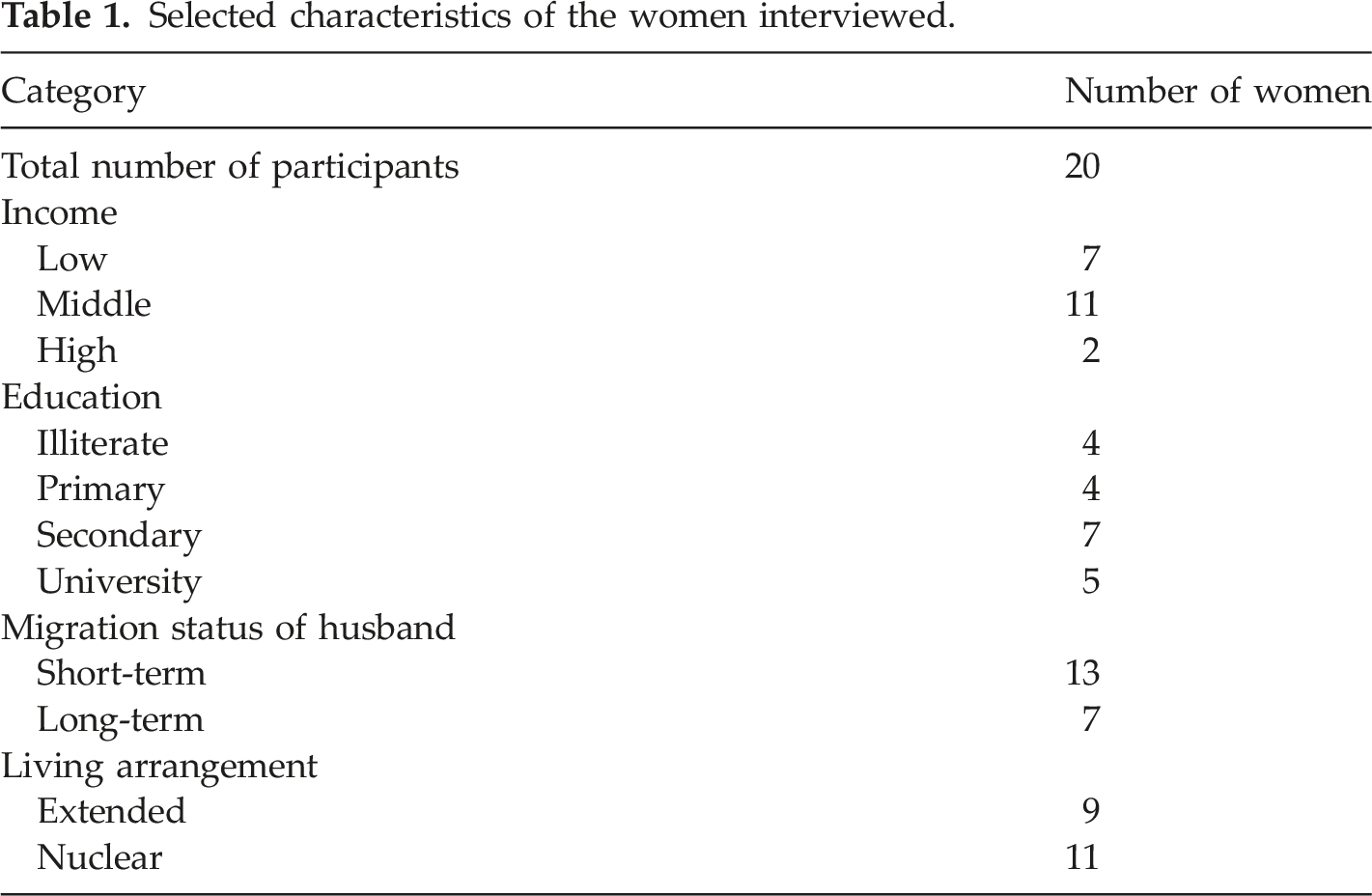
We conducted semi-structured interviews from February to May 2016, and women were visited several times throughout this period to establish trust and gain a fuller picture of their experiences. Through a translator, we asked respondents to reflect on their lives before and after their husbands’ migration (where relevant), and their abilities to cope with challenges that both preceded and were precipitated by this migration. After transcription, the interviews were analyzed along the four domains of women’s lives and inductively coded for emerging factors that explained differences between women’s experiences. The four domains outlined in the literature review were each analyzed with respect to the four factors that emerged from our findings as being discerning. We found that each domain was affected, often but not always in similar ways. Due to space limitations, we present our findings on the four factors drawing each time from a different domain as an illustration of how the factors can affect women’s resilience.
Male out-migration and women’s lives in rural Dehradun district
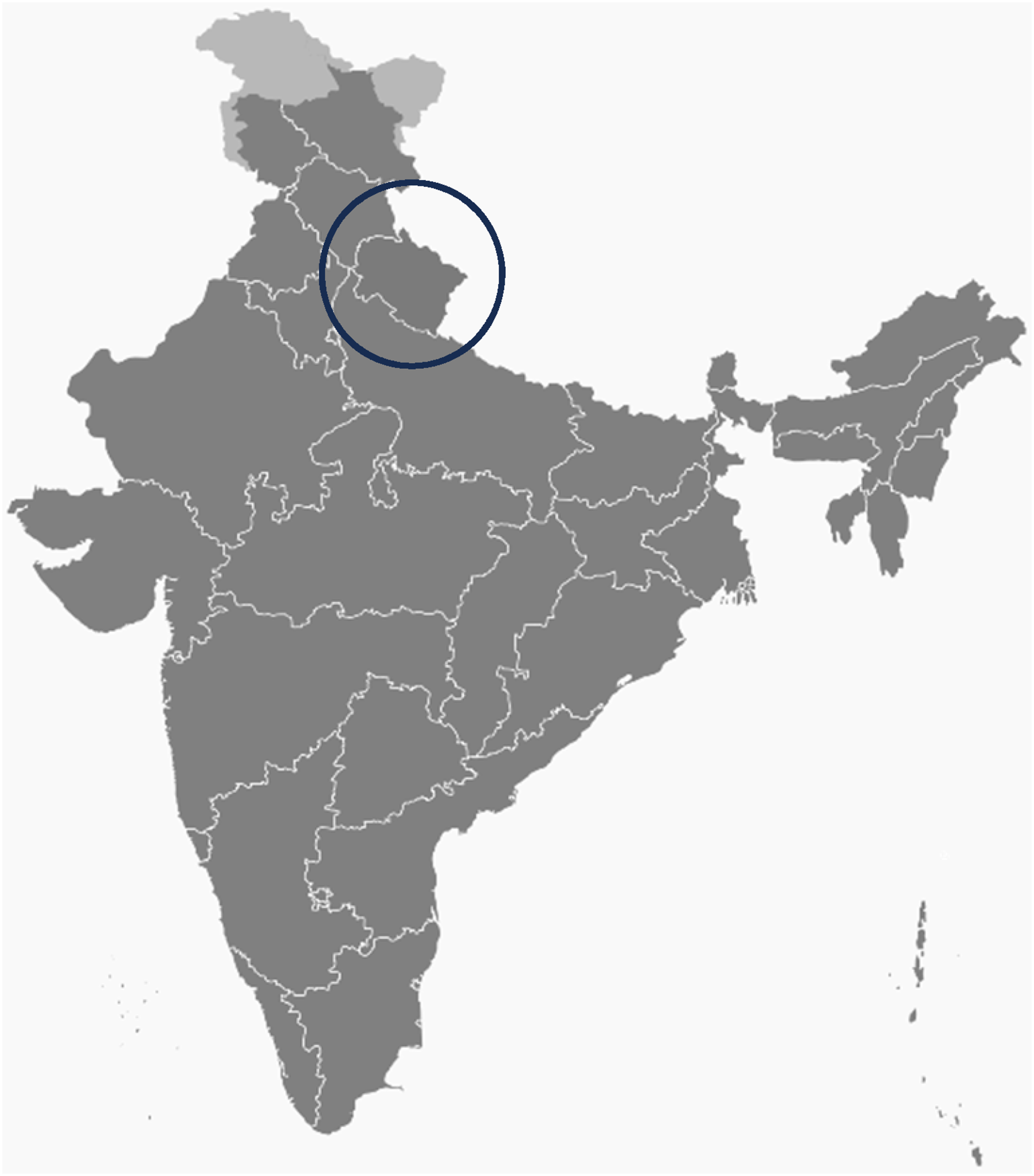
Nestled in the ranges of the Himalayas, Dehradun is one of the oldest cities in India and the capital of the state of Uttarakhand (see Figures 1 and 2). Dehradun is a large city, but most of the state’s population lives in rural areas (Srivastava and Sasikumar, 2003). The population of Dehradun district includes people of different castes and social backgrounds. Most belong to the Brahmin and Kshatriyas castes (the two highest castes), while approximately one-fifth of the population belongs to the lowest caste (Kumar, 2011). The location of Dehradun district in Uttarakhand State. The location of Uttarakhand State in India.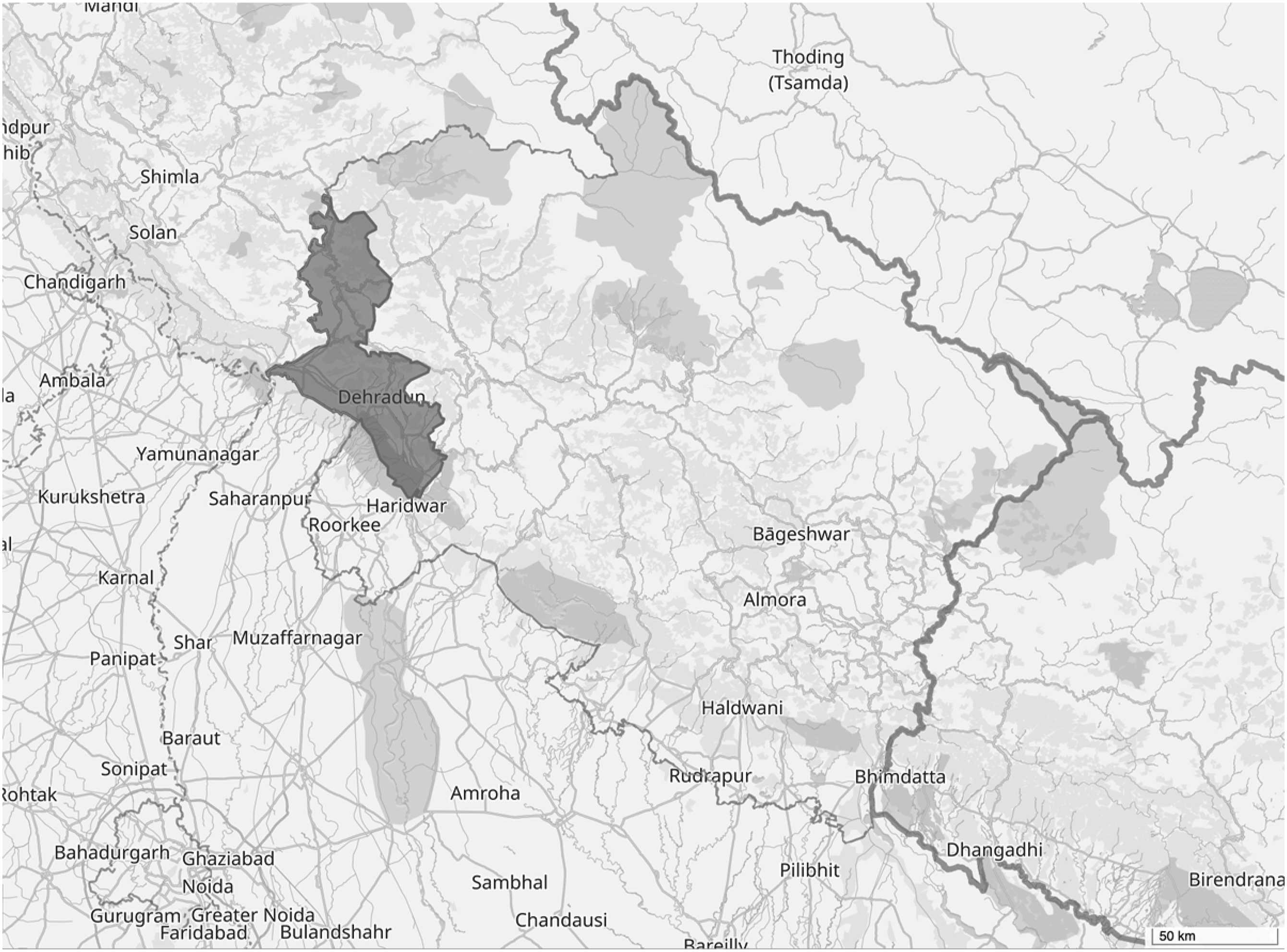
Caste belonging helps to explain much of the social context of Dehradun. The high number of Brahmins, who are traditionally associated with intellectual labor, explains the high levels of literacy in the district—89 percent, while the national average is 74 percent (Office of the Registrar General & Census Commissioner, 2011). Yet in practice, being from a high caste does not automatically equate with being rich. In the rural areas where we conducted our research, we encountered women from a variety of castes who were in both well-to-do and very poor households. Education is generally seen as a way towards upward mobility. However, access to good schools is highly dependent on income: Richer households send their children to private English-taught schools, while the poorest children primarily attend free government schools. Housing styles also reflect the diversity in wealth status. Richer households live in houses with multiple rooms, electricity, gas and plumbing; on the other hand, poorer households share one or two rooms and rely on natural resources such as firewood and water collected from the rivers.
Male labor migration is a common phenomenon in the villages of the Dehradun district, which have few employment opportunities (Jain, 2010). This migration is primarily internal to India (Jain, 2010) and is characterized by both long-term and temporary migration. Long-term migrants are especially those who work for the Indian army or government services. This type of migration was initiated by the British colonial authority, which developed a system of migration of able-bodied men from rural areas to serve in the army (Jain, 2010). The main areas where these men are posted are along the borders with Pakistan, Nepal and China. Men working for government services other than the army frequently live in Delhi, about six hours by train from Dehradun city. The typical pattern of public sector migration takes men away from their homes for 10 months per year, while they have two months of vacation to spend with their families (Jain, 2010). Other family members are not allowed to accompany men who are working in the army, as it is not considered safe enough and deemed distracting for the men. Both employment with the army and in governmental institutions ensure stability and a relatively good income that includes welfare benefits, such as medical assistance in military hospitals and a decent pension.
Aside from long-term migration, there is also a temporary form of migration in which men are away for a few months per year because the employment itself is of a temporary nature. Most temporary migrants are drivers or cooks who find jobs for three to four months per year and spend the rest of their time employed in agriculture in their home village. This form of migration can occur either on a regular basis or just when the opportunity is available to men (Bose, 2000). While temporary migration is more common among poor households, and long-term migration is typical of wealthier households with generally higher levels of education, this is not always the case. We thus looked at the type of migration, wealth of the household and education levels separately.
Women’s positions in families in Northern India can be seen in relation to their roles as wives, daughters, mothers and daughters-in-law (Arnot et al., 2012). After marriage, a woman generally migrates to her husband’s village, and is often expected to live with her family-in-law; this implies a limited degree of freedom to make important choices for herself. The needs and requests of other family members often come first (Rao, 2012). Younger daughters-in-law are the most vulnerable, especially when they are the first ones to be added to a family, as expectations of their behavior and workload are frequently very high (Luke et al., 2014). The traditional division of labor remains prevalent, with men expected to be the breadwinners and women the homemakers (Rao, 2012). Women thus spend most of their time at home involved in parenting, housework and domestic issues, and are largely dependent on men for their participation in the broader public sphere. Men work and make most household decisions. In the case of extended households, the male member who earns the most frequently makes decisions for the entire family.
Factors that explain how male labor migration affects female social resilience
Overview of the relationships between the four factors and four domains of social resilience.
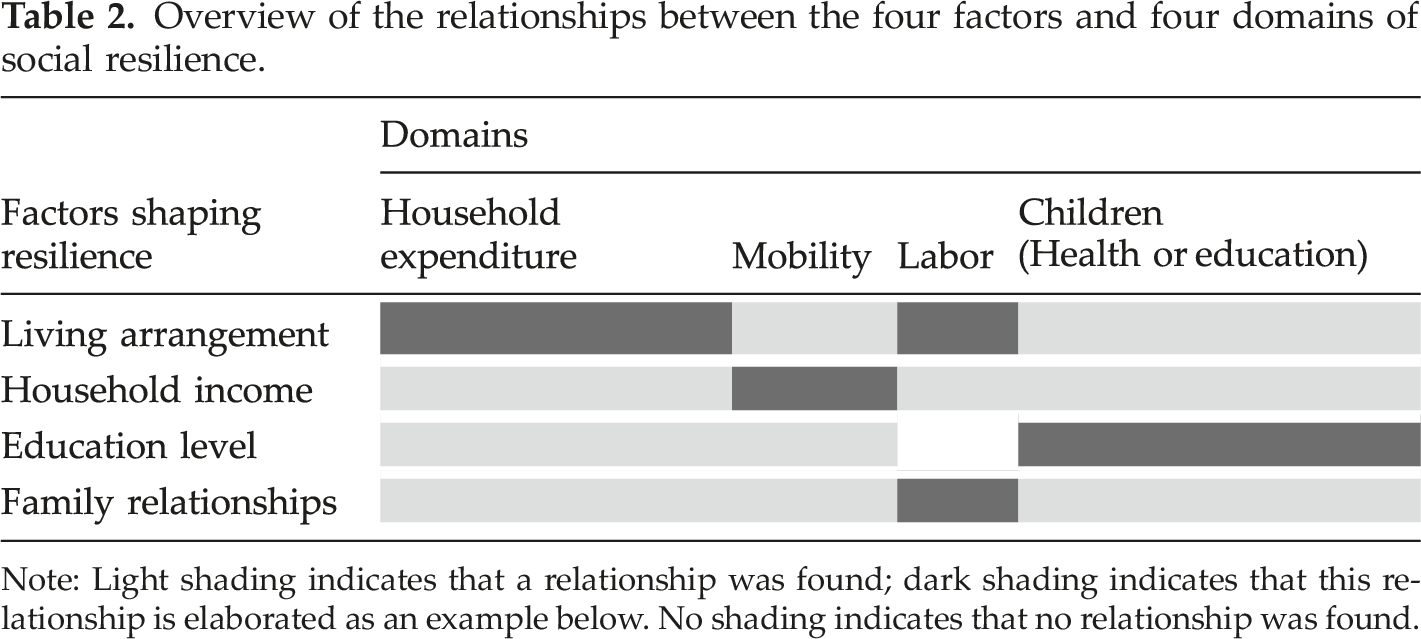
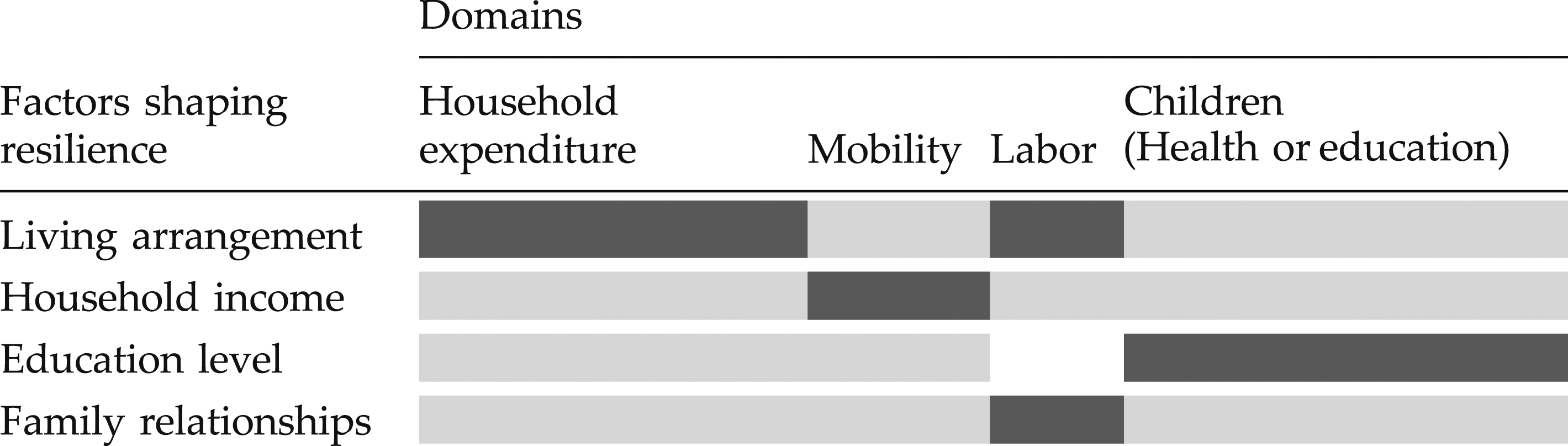
Note: Light shading indicates that a relationship was found; dark shading indicates that this relationship is elaborated as an example below. No shading indicates that no relationship was found.
Living arrangement
Whether they live in a nuclear or an extended family, a husband’s migration affects all four domains of women’s lives. Women living in nuclear arrangements tend to become heads of their households, making decisions on behalf of their husbands in the realms of household expenditures, mobility, time management and childcare. Women living in an extended arrangement, however, are less autonomous and often remain more dependent on their in-laws, who gain authority when husbands migrate.
The cases of 48-year-old Piya (in a nuclear family arrangement) and 65-year-old Bina (in an extended family arrangement) are illustrative in the domain of household expenditures. Piya’s husband is a long-term migrant working for the merchant navy of India. She lives alone with their children for 10 months out of the year and is responsible for the economic and material aspects of the household. She consults only with her husband; no one else makes decisions on her behalf. She described the process of buying a new washing machine. After consulting with her husband about which one to buy and listening to his advice, she decided on her own: “He suggested to buy an Indian washing machine, but I prefer European ones, so I bought what I wanted. In the end, I am the one who has to use it and who administers the money here.” Piya feels respected and trusted by her husband, who only gives suggestions but gives her the last word.
Bina’s husband is also a long-term migrant, yet for the first nine years of her marriage, she felt she had no autonomy while he was away. Bina lived with her mother-in-law for the first nine years of her marriage, while her husband was working at the Pakistani border as part of the Indian paramilitary forces. During these nine years, her husband sent remittances to her mother-in-law, who decided what and when to buy, never consulting Bina. After her mother-in-law passed away, Bina became financially responsible for her household. She explained: “When my mother-in-law passed away, I saw money for the first time. Before, I had no idea of what 10 rupees looked like.” While her mother-in-law was alive, Bina could not even decide what to buy at the market. Her only task was to carry home what her mother-in-law had bought. When she became the head of the household, Bina explained, it was not easy to manage money, but she learned quickly and welcomed the opportunity to make autonomous economic decisions. She reported that being financially autonomous has been crucial for building her self-confidence and making her feel free, mentioning that she has passed down to her daughters the importance of being financially responsible. At the time of the interview, Bina lived with her daughter-in-law, to whom she left the complete management of money: “I learned from my bad experience and I do not want to interfere. It is now time for her to manage and save money.”
Women’s living arrangements are also relevant in the case of male temporary migration, but in different ways—it is not so much women’s decision-making power that is affected but rather their workload. Because these men are gone for relatively short periods, they remain the main decision-makers on household matters such as household expenditures, their wives' mobility and their children’s education and health. Yet women are the ones who need to implement these decisions, placing a greater burden on women in nuclear family arrangements than those living with their extended family. Women in extended arrangements are usually supported by other male members of the family. Brothers-in-law or fathers-in-law tend to take over the migrant’s role.
Thirty-five year old Sera recounted how once her youngest son developed a high fever. It was late in the evening and she needed to reach a clinic in the city. She could not travel alone, as she could not drive, but her brother-in-law helped her, taking them to the clinic and staying with them throughout the night. Sera explained that she felt shy and embarrassed to have to ask for his help. At the same time, she was relieved, as she did not know how to handle this stressful situation alone.
Baya, 40 years old and living in a nuclear arrangement, experienced a greater burden in having to fulfill all of her husband’s tasks alone. During the months her husband (a temporary migrant) is away, she has to wake up at four in the morning to manage all the family activities. Baya described these mornings as laborious: She must light the fire, wake her four children for school, cook them breakfast and lunch, send them to school and clean the house on time. Collecting fuel is the most difficult activity for her, requiring a lot of time and physical energy. The activities she is always responsible for (e.g., cooking and cleaning) become an even greater burden. Baya found the absence of her husband challenging and complained that she had no time to socialize with other women in the village.
Household income
Levels of household income can also make a difference in deciding whether male migration results in greater or lesser female decision-making autonomy. Household income is relevant in all four domains of women’s lives: Household expenditures, mobility, time spent on labor, and children’s health and education. Taking mobility as an example, in high-income households, women tend to see an improvement in their ability to spend money on travel without asking for permission. In low-income households, women’s choices are instead often constrained by the limited resources available to the household. Regardless of the form that male migration takes, women in high-income households are generally free to leave the house daily for small distances (e.g., shopping) and may even be able to travel outside their villages or towns in their free time.
University-educated 31-year-old Suma is the wife of a long-term migrant and belongs to a wealthy household. She travels daily to the city to buy groceries and clothes and to take her daughter to school, without needing to ask permission. Suma also travels longer distances with great autonomy. Every winter she spends a week in Shimla with her school friends while her mother-in-law takes care of her daughter. According to Suma, neither her husband nor her mother-in-law interferes with her mobility for both long and short distances. Their higher income makes it possible for her to travel without creating tensions in the household.
Suma’s economic freedom becomes clearer when contrasted with cases of women belonging to low-income households. Sera cannot travel to visit her family of origin, whose village is not accessible by public transportation and is not affordable by taxi. She has been married for nine years and last visited her family of origin before giving birth to her first child, six years ago. She is saving money to visit her mother, but she is aware that if the money is needed for the household, she will have to postpone her travels again. She explained that the welfare of the family is more important than her own desire to travel.
For low-income households, while women’s mobility increases for practical reasons in the case of male long-term migration, it does not tend to change as much after short-term migration. When men migrate for a long time, women need to take on the tasks that would normally be accomplished by their husbands, such as leaving the house for daily needs and traveling outside the village to access medical care or to visit their husbands. Going to the market to buy groceries is mostly a male responsibility, but usually becomes a female task when the husbands’ absence is prolonged. 41-year-old Anu, the wife of a short-term migrant, did not perceive much change in her mobility when her husband is away. Indeed, her husband, who is typically away for three months, goes to the market before leaving and buys all the staples that she may need while he is gone. If something unexpected is needed, such as a new school uniform for the children, Anu calls her husband so that he can arrange for it to be delivered to her home. Women with long-term migrant husbands, however, frequently take over male roles: Reeva (40 years old), goes to the local market daily to buy groceries. When her children need particular things (e.g., schoolbooks), she travels on her own to the city to buy them. She is free to leave to satisfy her needs and the needs of the household.
Women’s level of education
Women’s level of education was found to be relevant in the domains of household expenditure, mobility, and children’s health and education. We discuss this relationship with respect to children’s education. Generally, the main responsibility of Dehraduni migrant husbands towards their children is to provide them with economic support, while daily aspects of childcare are mainly the responsibility of their wives. Women in our study who had higher levels of education showed confidence in their abilities to make choices about their children’s education and their satisfaction with this responsibility. Having the power to make decisions for the children’s future is considered by most women as a signal of trust and respect from the husband and the other members of the family.
Having attained a higher level of education tends to make women more autonomous, especially if they have studied more than their husbands have. Sada (38 years old) completed the 12th grade, while her husband—a long-term migrant—is illiterate. She explained: “He does not want to be bothered by the children’s education. He knows that I know better than him how to manage children’s education.” For this reason, Sada made an independent choice to send her children to a private English-medium school in the area and her husband has always supported her choice. Sada explained that she is glad to have such responsibility, as it shows how her husband and her family-in-law trust her and respect her decisions.
While women with higher educational levels tend to have more decision-making power and feel respected by their families, women with lower levels of education often find that they have to relinquish the power of decision over their children’s education to other members of the family when their husbands migrate. Chini (47 years old) and Prina (26 years old), two sisters-in-law with long-term migrant husbands, are illiterate. Their children attend a private school in Mussoorie, as decided by their respective parents-in-law. Chini and Prina were not happy about this, as their children have to travel for approximately two hours every day to reach the school. However, since their parents-in-law made the decision, these two women did not feel they could change the situation. They felt frustrated and sorry for their children but are aware that they do not have instruments to oppose the arrangement. They explained that their lack of education makes their parents-in-law more powerful.
While the above pertains to cases of men’s long-term migration, short-term male migration did not augment women’s autonomy in decision-making, even in cases of highly educated women. Again, we take the case of children’s education for comparative purposes. Women with lower education levels did not experience any change in their decision-making power, as their husbands continued to have the main say in their children’s education, even during their short-term migrations. Interestingly, higher-educated women also do not experience a change in their decision-making over their children’s education. Reeva completed the ninth grade of secondary school, giving her a higher educational level than her short-term migrant husband. She considered attending a good school to be very important for their children’s future and decided to send them to a private English-medium school while her husband was away. When her husband returned, he intervened in these arrangements, shifting the children to a cheaper government school. Reeva reported she felt irritated and disempowered by her husband’s intervention, but could not oppose his decision as head of the household. Reeva underscored that her husband had lower levels of education than her, but despite her frustration, she had to accept his choices and relinquish the decision-making power to him.
Quality of relationships with members of the family
Having a good relationship with other members of the family lessens the labor burden for women, while challenging relationships with family members tend to increase women’s workload, lessening their decision-making powers and resilience. The stress and burden experienced by women are not considerably affected by the duration of male migration, but more by the degree of support that women receive from other members of the family. The quality of relationships with family members was found to be influential in all four domains of women’s lives: Household expenditures, mobility, time spent on labor, and children’s health and education. The examples below show how this operated in the domain of labor (both as workload and stress).
Pali and Rati (41 years old and 37 years old, respectively) are sisters-in-law who both have long-term migrant husbands and live in an extended family arrangement with their parents-in-law. Pali has two children while Rati has three. Since the birth of Rati’s first son 10 years ago, Pali and Rati have shared the care for their children. They help each other with cooking, washing clothes and making sure the children are doing their homework. If they have a large amount of clothes to wash, they go to the river together, sharing the activity and reducing the time needed to complete it. Furthermore, when one of the two women is sick or particularly tired, the other is available to help. Sharing domestic responsibilities gives them more free time, which they usually spend together chatting or knitting. These women live in the same house and they tend to help each other when one of them (or their children) requires medical care. Most women with migrant husbands consider health issues to be a considerable source of stress; traditionally, women do not access medical care without the presence of their husbands. The two women explained how they feel strong together and are able to deal with such events without asking their father-in-law to accompany them.
Sixty-nine year old Doly, the wife of a long-term migrant, characterizes her relationship with her in-laws as “terrible.” Immediately after she joined the family, her parents-in-law started criticizing her decision to continue working as an English teacher after marriage. Instead of supporting her choice, they excluded her from family life, for instance by not sharing meals with her and her son. After a few years, Doly left the extended living arrangement to live alone with her two children, cutting her relationship with her family-in-law even further. Doly reported that despite feeling relieved at not having to live with “those terrible people,” she also feels the burden of having to manage everything on her own. In particular, health care has been a challenge to her. Doly explained that there was one night her son was ill when she waited hours before going to the hospital, hoping that the emergency would clear up without medical intervention because she felt insecure about accessing the hospital without a male companion. She did eventually go to the hospital and the medical problem was resolved, but she felt guilty after for making her son wait so long before seeking treatment. Now, Doly feels very lucky because she has moved close to a family who, after knowing her past, started treating her like a daughter and giving her support when needed.
A negative relationship with the other members of the family also results in more stress and burden for the wives of short-term migrants. Sony, 31 years old and the wife of a temporary migrant, has a challenging relationship with her in-laws. She works outside the house to increase the income of her household, especially since her in-laws do not provide any income to the household. In this way, she tries to be useful and to gain the appreciation of her parents-in-law. However, they criticized her for mixing her domestic activities with work outside the home. She complained that her mother-in-law never helps with child rearing or with the household chores while Sony’s husband is away, thus adding to her workload. Sony has no free time for herself and has to manage her difficult responsibilities alone. She expressed a desire to spend more time with her children or to socialize with other women in the village.
Conversely, 40-year-old Baya had a good relationship with her father-in-law, who has passed away. She described how he always helped her with her responsibilities, such as childcare, cooking and cleaning, when her husband was away working as a cleaner. She described her father-in-law as a loving man who used to spend time playing with his grandchildren or checking their homework; this enabled her to work and have some free time.
Conclusions
Studies on gender and migration have often focused on female migrants. In this article, we have focused on wives who remain in their place of origin and explored how their husbands’ out-migration impacts them. We used the lens of social resilience to examine how individuals embedded within broader social structures perceive gains and losses to their material and symbolic capital after a shock or potential adversity—in this case, the departure of a family member for labor migration. We paid particular attention to four domains of women’s lives that the literature on stay-behind women has argued to be particularly important for women’s autonomy, namely, (1) their ability to make decisions about household expenditures, (2) their own physical mobility, (3) the time they spend on labor and (4) their children’s health and education. Our theoretical lens allowed us to qualitatively engage with the lived experiences of our respondents and to initiate a discussion about the larger trade-offs between individual and societal coping strategies in the face of upheaval. In addition, it allowed us to distinguish between different lengths of male out-migration, as resilience and adaptation have a temporal dimension.
Our exploratory study indicates that women’s social resilience generally improved with their husbands’ migration when the former were better situated within their family and society, whereas women in more dependent and vulnerable positions tend to remain in such positions—or see these positions further entrenched. This chimes with the small but growing body of literature that has begun to explore the differential impacts and trade-offs of migration on women’s livelihoods and level of empowerment (Maharjan et al., 2012; Saha et al., 2018; Singh, 2018). Our analysis was distinctive in finding that women’s social resilience was affected by four factors relating to women and household characteristics, as well as women’s relationships with the extended family. However, women whose husbands were long-term migrants often experience the impact of these factors differently than those whose husbands were away for shorter periods.
First, the type of living arrangement influenced the extent to which women become autonomous decision-makers of household matters. In households of long-term migrants, nuclear arrangements allowed women to take on greater autonomy and decision-making power, while in extended arrangements decision-making is often taken on by elders or other male relatives. For short-term migrant households, it is the women’s labor time rather than their decision-making power that is affected, with women in nuclear family arrangements suffering greater workloads due to their husband’s absence.
The economic status of the household affected women’s autonomy in all four domains we investigated. Women living in higher income households, irrespective of whether their husbands were temporary or long-term migrants, reported having more decision-making freedom due to their husband’s migration, while women belonging to poorer households either have not seen a change in their decision-making power (in the case of temporary migration) or have seen an increase in their physical mobility (due to their husband’s long-term migration) as they need to fulfill tasks that their husbands would normally do.
Women with higher levels of education experienced more freedom to decide on behalf of husbands who were away for the long term, making the women feel trusted and respected. When their husbands are away for the short term, however, women find that their husbands still hold the role of decision-maker, especially in the realm of larger expenditures, and children’s health and education. Women with lower levels of education were limited in their decision-making power when extended family members took over the decision-making in their husbands’ long-term absence or when husbands remained the main decision-makers due to the short length of their migration.
Finally, the quality of relationships with the other members of the family was an important factor, irrespective of the type of male migration. Good relationships with the extended family mean a lighter work burden for women as they are supported by extended family members, while difficult relationships create stressful living environments and higher workloads for women.
Future studies could test the robustness of these relationships under different conditions or in different contexts. Furthermore, it is important to note that each of the factors we identified can intersect with each other in several ways. So, while we found, for example, that a woman whose husband is a long-term migrant will generally gain less decision-making power if she lives in an extended family arrangement, this finding will still be influenced by the quality of her relationships with her extended family and in-laws. When these relationships are good, her workload will often diminish. The extra help she can receive from her living arrangement may then actually offset or at least mitigate the potential lack of control in her decision-making. Understanding exactly how these factors intersect and with what consequences for female social resilience is an area for further inquiry.
This study focused on the perspectives of wives who stay behind in their place of origin. Investigating male migrants’ perspectives, as well as those of other family members, would allow for a more complete picture of female social resilience. For example, while we found that women in certain circumstances felt that their decision-making power was taken away from them by their in-laws, the latter may perceive the situation differently. Comparing these different accounts could add more insight into women’s positionality within the broader family and community context, as well as around the intra-household negotiations that inevitably result from “doing family” at a distance. Such a study would require a multi-sited design to allow for the interviewing of male migrants (in their locations of temporary or long-term residence), in order to collect their views on how the household is run during their absence, and what the role of their wives is in this arrangement.
While these findings depend on the geographical and cultural context of our study, there is a need to be careful about generalizing to other locations. This study has shown the importance of taking a social resilience perspective when analyzing how migration impacts those who stay behind. Such a perspective should not inherently assume that migration represents resilience for all household members in the face of economic vulnerability. Nor should it assume, on the other hand, that such women are necessarily at a disadvantage. What might be experienced as a satisfactory adaptation to livelihood precarity by some might be perceived as an additional shock and source of precarity by others depending on their position in society, the length of the migration and their role in the household. A social resilience framework that takes the decision-making power of those who stay behind into account allows for the possibility that this power is affected by the intersections of a multiplicity of factors. It thus gives a fuller account of the ways in which migration affects those family members who do not themselves migrate.
These findings have implications not only for literature on stay-behind women and social resilience but also for policymakers. Remittances can indeed be a source of resilience for migrants and their families—and even a source of empowerment—but to a limited extent. We recommend welfare and social protection policies for particular groups of stay-behind women (e.g., those of lower social status and those living in extended families whose husbands migrate only sporadically) and incentivize households to give women more independence in the spending of remittances.
Footnotes
Acknowledgments
This article is dedicated to Federica, whose young life came to a much too early end. We admire Federica for her unrelenting dedication to research and the women of Dehradun. It was an honor to work with her. We also thank Rachna Dushyant Singh and Manoviraj Singh for the love with which they welcomed Federica into their lives. We offer this paper to them and to Federica’s parents.
Declaration of conflicting interests
The author(s) declared no potential conflicts of interest with respect to the research, authorship and/or publication of this article.
Funding
The author(s) received no financial support for the research, authorship and/or publication of this article.

