



Abstract
This article frames rahar (desire) and badhyata (compulsion) as interdependent cultural logics that shape migration imaginaries in Nepali society. Drawing on ethnographic interviews with aspiring labor migrants and international students, the study explores how these affective frameworks operate dialectically, simultaneously reflecting subjective emotional experiences while recursively structuring the culture of migration. The analysis contends that badhyata is rooted in material deprivation, perceived limited opportunity structures, and existential precarity, and compels migration as a livelihood strategy. In contrast, rahar emerges from aspirational subjectivities shaped by media narratives, success stories of migrants, and status-driven ambitions. Together, these logics co-constitute a hegemonic migration culture, in which migration is not only normalized as the primary means of securing futures, capital and social recognition but also valorized as a pathway to social worth and belonging. By interrogating the emotional economies of rahar and badhyata, this article advances a critical framework for understanding how affective forces sustain and legitimize migration as both a personal aspiration and a sociocultural imperative in Nepal. The study contributes to broader migration discourse by emphasizing the cultural and emotional underpinnings of migration decisions, which are shaped by local contexts and shared narratives alike.
Introduction
The high volume of Nepalis engaging in transnational migration for work and education has made international migration an integral part of Nepali society (Nepal Labor Migration Report [NLMR], 2022; Sharma et al., 2014). In 2023 alone, Nepal observed over 800,000 departures for employment, and more than 100,000 individuals left for educational opportunities abroad (Department of Immigration [DOI], 2023). If each departure represents a unique individual; they constitute approximately three percent of Nepal’s total population or 5.7 percent of its economically active population exiting the country within a single year. These numbers reflect a long-standing trend, as Nepal has consistently exhibited high levels of outmigration for both labor and educational purposes over the past two decades. The persistence and magnitude of these trends have firmly established a distinct culture of migration in Nepal, where migration is normalized as a common life trajectory (Limbu, 2023).
Existing studies on Nepali migration often frame migration choices through pull-push dynamics, neo-classical economic models or theoretical frameworks such as the new economics of migration, social capital theory and cumulative causation theory (Bohra and Massey, 2009; Fonner et al., 2018; Piya and Joshi, 2016; Sharma, 2019; Shrestha, 2017; Tisdell and Regmi, 2000). While these approaches explain structural and economic drivers, they risk reducing migration largely to a rational, utility-maximizing calculus, thereby sidelining its cultural, affective and aspirational dimensions. This study addresses this by framing migration decisions through the dual lenses of rahar (desire) and badhyata (compulsion): Emotionally charged cultural logics that shape how Nepalis experience and negotiate migration within their sociotemporal contexts.
The conceptualization of rahar and badhyata aligns with Collins’s (2017) critique of reductionist migration theories and his proposition of an “affective turn” to foreground desire as a generative social force. Rahar encapsulates aspirational subjectivities, reflecting how individuals envision transformative futures through migration: Futures shaped by intersecting social hierarchies, material ambitions, and geographical imaginaries. Much like Collins’ notion of desire, rahar transcends mere intention; it embodies the relational and productive energies that propel individuals toward upward mobility and self-reinvention. Conversely, badhyata signifies the reactive compulsions of migration, rooted in structural precarity, such as economic deprivation, political instability and constrained opportunity structures, that make migration a necessity rather than a choice.
Building on Collins’s (2017) conceptualization of migration as a socio-material assemblage, this study emphasizes how migration is co-constituted through the interactions between individual agencies, institutional networks and cultural narratives. Migration in Nepal seldom operates as an isolated individual endeavor; it is mediated by familial obligations, recruitment infrastructures and media narratives (Bohra and Massey, 2009). Furthermore, migration functions as a transformative process of becoming, reshaping migrants’ subjectivities and social positioning in ways that defy rigid economic or policy-centric paradigms (Collins, 2017).
This article interrogates how rahar and badhyata collectively sustain Nepal’s migration culture. While rahar fuels aspirations for enhanced social status, economic prosperity and self-actualization, badhyata reflects the coercive realities that normalize migration as an existential imperative. Together, these forces form an emotional dialectic that transcends binary distinctions between “voluntary” and “forced” migration. By focusing on this duality, the study advances a framework that complements existing theories, drawing upon aspiring migrants’ experiences, affective struggles and temporal orientations.
Drawing on qualitative interviews with 30 aspiring Nepali migrants, including prospective students and labor migrants, this study aims to explore how rahar and badhyata influence migration decisions. The article discusses the participants’ accounts on these cultural expressions of emotion, which is simultaneously driven by personal aspirations and social or economic obligations. The central argument of the article is that the migration process should be understood not merely as a strategy to maximize utility but as a socio-culturally meaningful decision, and as evident in the study participants’ narrative, a normalized and expected step toward adulthood and social recognition in Nepali society.
Culture of migration in Nepal
Massey et al. (1993) posit that migration operates recursively. Its prevalence not only reconfigures community values and cultural norms but also amplifies future migratory flows. This self-perpetuating dynamic, termed the culture of migration, emerges through aspirational shifts driven by increased educational access, media narratives and the symbolic capital of returnee migrants who embody material success (de Haas, 2014). Migration to mature economies often catalyzes transformative desires for social and economic mobility, consumer modernity and improved quality of life (Massey et al., 1993). Over time, these individual aspirations coalesce into collective norms, positioning migration as a societal expectation. Non-migrants risk stigmatization as lacking ambition, thereby reinforcing migration as a rationalized communal practice (Massey et al., 1993; Reichert, 1981). Such normalization, as de Haas et al. (2019) and Kandel and Massey (2002) contend, evolves into a pervasive cultural logic that profoundly shapes life trajectories.
In Nepal, this culture of migration manifests with striking clarity. Scholarship on Nepali migration aligns with Massey et al.’s (1993) and de Haas’s (2014) theoretical propositions, yet the sociocultural mechanisms demand deeper contextualization. The proliferation of mass and social media in Nepal has intensified life aspirations, particularly among youth, who increasingly equate success with transnational migration. Media depictions of cosmopolitan lifestyles and consumerism (Piotrowski, 2013) intersect with material realities: Remittances not only bolster household economies but also confer social prestige through the acquisition of branded goods, modern housing and digital technologies (Poertner et al., 2011; Thieme and Wyss, 2005). Conversely, non-migrants face pejorative labels such as phaltu (idle), a stigma that demonstrates migration’s transformation from individual choice to communal obligation in Nepal (Sharma, 2011). These dynamics exemplify how migration in Nepal operates as both a cultural product and a social imperative.
Central to this analysis are the vernacular constructs rahar and badhyata, which crystallize the affective and structural forces underpinning Nepal’s migration culture. In Nepal, when asked to articulate their migration motivations, migrants and aspirants invariably invoke rahar, a forward-looking desire for self-reinvention; or badhyata, the coercive pressures of economic precarity, political instability or familial obligation. These terms transcend mere common expressions; they represent culturally situated emotional frameworks that mediate how migration is understood and legitimized.
Rahar operates as a dynamic, temporally layered force. It emerges through individuals’ negotiations of past constraints, present aspirations and imagined futures, often materializing as a longing to inhabit transnational spaces of opportunity. Culturally constructed media narratives, returnees’ success stories and familial networks collectively fuel this desire. Badhyata, conversely, reflects reactive compulsions shaped by structural inequities, such as stagnant wages, unemployment and systemic underdevelopment that foreclose local futures. Crucially, these forces are not oppositional but dialectically intertwined. As Collins (2017) argues, migration constitutes a socio-material assemblage: A convergence of familial obligations, brokerage infrastructures and state policies that normalize migration as a communal project. In Nepal, this assemblage manifests in the ubiquity of recruitment agencies, remittance-driven economies and celebratory discourses, all of which normalize migration as a rite of passage (Dahal, 2023; Sharma, 2011).
By framing rahar and badhyata as co-constitutive affective logics, this article illuminates how migration in Nepal transcends economic binaries of “desire” versus “compulsion.” Instead, it reveals a cultural ecosystem where desire and necessity recursively reproduce migration as a hegemonic pathway to modernity and success.
Rahar and badhyata in Nepali migration
Tribhuvan International Airport, once a symbolic portal for arrivals, now represents Nepal’s migration paradox as a theater of daily departures. Each day, over 3,327 students and workers (New Business Age [NBA], 2023) perform emotionally charged farewell rituals; garland exchanges, tearful embraces and commemorative photographs, marking their exits in pursuit of imagined futures abroad. These scenes crystallize a national dilemma: Are such departures driven by emancipatory desire (rahar) or existential compulsion (badhyata)? This tension permeates Nepal’s migration discourse, where individual aspirations collide with structural constraints.
Within this context, rahar and badhyata emerge as culturally resonant frameworks for interpreting migration. Rahar embodies the aspirational desire, a proactive drive toward self-reinvention through transnational opportunities. It manifests in the allure of foreign education systems, cosmopolitan lifestyles and professional advancement, all amplified by media narratives and success stories of migrants (Piotrowski, 2013). Conversely, badhyata reflects the reactive pressures of systemic precarity: Stagnant wages, political volatility and a collapsing agrarian economy that displaces youth from rural subsistence livelihoods (Koirala, 2023). Limbu’s (2023) analysis situates badhyata alongside dukha (hardship) as affective anchors in Nepal’s migration imaginary, where structural failures transmute migration from choice to necessity.
Historically, these dual forces trace their roots to colonial-era labor circuits. The racial categorization of Nepali people as a martial Gurkha race by colonialists provided the prospect of employment in foreign military services for Nepali youth in the early 19th century (Rai, 2018). This legacy evolved into today’s remittance-dependent economy, where 63 percent of households rely on migrant earnings (Koirala, 2025). Yet contemporary drivers reveal new complexities: Post-conflict political instability, deindustrialization and a youth bulge intersecting with anemic job creation (Williams and Pradhan, 2008). The result is a generational cohort caught between rahar’s aspirational pull and badhyata’s coercive push.
Nepal’s education system exacerbates this dynamic. Perceived as misaligned with global labor markets, it fuels rahar through student migration while deepening badhyata via increasing inflation and underemployment (Kharel, 2022). Graduates face a paradox: Degrees confer status but rarely local employment (Tamang and Shrestha, 2021), making migration a rational response to institutional failure. Meanwhile, political leaders’ inability to articulate a cohesive vision for youth exacerbates disillusionment. Strikes, policy paralysis and corruption scandals erode trust in domestic futures, normalizing exit over voice (Gautam and Adhikari, 2025).
The agrarian sector’s decline further adds to this phenomenon. Subsistence farming, once a livelihood mainstay, now fails to meet aspirations for consumer modernity (Koirala and Bashyal, 2025). As remittance-funded urban housing and consumer goods redefine status markers (Thieme and Wyss, 2005), rural youth tend to reject agrarian precarity (Sunam et al., 2025), embracing migration as a pathway to sukha (well-being). Yet this “sukha” reproduces dependency. Remittances inflate local prices without generating sustainable productivity, perpetuating cycles of badhyata (Limbu, 2023).
Ultimately, Nepal’s migration culture reflects a dialectic of hope and despair. Rahar and badhyata are not oppositional but co-constitutive, forming a feedback loop where aspirational imaginaries and structural failures mutually reinforce migration as a hegemonic rite of passage. This duality challenges binary narratives of migrant agency, revealing how cultural logics of desire and compulsion are recursively shaped by historical path dependencies and contemporary global asymmetries.
Methodology
This study draws on qualitative insights from 30 in-depth, face-to-face interviews conducted with aspiring Nepali migrants: Fifteen prospective international students and 15 labor migrants, to interrogate the role of rahar (desire) and badhyata (compulsion) in migration decision-making. Interviews were conducted in March 2023. Participants were purposively sampled across Kathmandu Valley to reflect Nepal’s socioeconomic and regional diversity, including individuals from urban, peri-urban and rural backgrounds, as well as varied age groups (early 20s to late 30s) and marital statuses. The student cohort comprised predominantly unmarried young adults from middle to upper-class families, aspiring to pursue higher education in destinations such as Australia, the United States of America and Canada, driven by ambitions for academic advancement and global exposure. In contrast, labor migrants, often older, married and from economically marginalized households, targeted employment in Gulf states (e.g., Saudi Arabia, United Arab Emirates [UAE], Southeast Asia [Malaysia], and Eastern Europe [Croatia, Romania]), motivated by immediate financial needs, familial obligations and long-term settlement plans.
Selection of study participants was conducted around the migration hubs in Kathmandu 1 : Education consultancies in Putalisadak and Bagbazar for students, and manpower agencies in Gaushala and Sinamangal for laborers. Semi-structured interviews conducted in the Nepali language to preserve linguistic and cultural nuance, probed participants’ motivations, perceived opportunities and evolving migration aspirations. Questions explored how rahar (e.g., fascination with cosmopolitan lifestyles) and badhyata (e.g., agrarian precarity, political disillusionment) shaped their decisions. Interviews were audio-recorded, transcribed verbatim in Nepali, and translated into English, with back-translation checks ensuring fidelity to participants’ original narratives.
Data analysis employed inductive thematic coding via Atlas.ti 23, beginning with transcript reviews to identify emergent motifs such as “social mobility,” “familial pressure,” and “structural disillusionment.” Initial broad codes (e.g., “education aspirations,” “remittance obligations”) were refined into axial themes like rahar as “cosmopolitan longing” and badhyata as “agrarian collapse.” A comparative lens revealed divergences: Students emphasized self-actualization and global exposure, whereas laborers prioritized survival and debt alleviation. However, overlaps emerged, such as shared anxieties about the stigma of non-migration. Temporal analysis, informed by Collins’ (2017) assemblage framework, traced how desire evolved in response to shifting personal circumstances (e.g., marriage, aging parents) and structural forces (e.g., unemployment, media narratives).
Ethical rigor was maintained through informed consent, anonymization and voluntary participation protocols. Reflexivity was critical given the researcher’s dual positionality as both an insider (a student and a labor migrant) and analyst. To reduce bias, the researcher kept detailed records of the analytical process and had colleagues review the interpretations. Working closely with participants’ stories did not make the findings less objective. Instead, it helped the researcher connect more deeply with their experiences, revealing the emotional layers of rahar and badhyata.
Discussion
The narratives of aspiring labor migrants and student migrants, while distinct in demographic contours; diverging in age, life stages and socioeconomic positioning, reveal a striking convergence of rahar and badhyata as dual engines of Nepal’s migration culture. This demonstrated how migration aspirations, whether framed as a survival or self-actualization strategy, are involved in shared structural precarities and aspirational imaginaries that transcend individual circumstances.
For labor migrants, badhyata emerged as a visceral force, rooted in the materiality of everyday struggle. Participants described financial pressures as a moral economy of obligation, a duty to sustain multigenerational households amid inflation, stagnant wages and the collapse of rural livelihoods. I tried running a shop, driving a taxi, but corruption and political strikes drowned my efforts. (Deepak, 22, labor migrant, rural Nepal, married) In Nepal, my degree is a paper; abroad, it’s a passport. (Ravi, 24, prospective international student, peri-urban, unmarried)
Both cohorts inhabited a cultural ecosystem where migration had been normalized as a rite of passage. Labor migrants’ references to “earning ijjat (respect)” through employment in the Gulf reflected not only an aspiration for financial stability but also a pursuit of social recognition and dignity within their communities. This discourse paralleled prospective students’ emphasis on achieving “global citizenship,” which they associated with access to transnational networks, cultural mobility and a sense of belonging beyond the limits of the nation-state. In both cases, migration was framed as a pathway to elevated status and broader inclusion, indicating how diverse groups mobilize the symbolic capital of migration to negotiate status, identity and belonging in a globalized world. This normalization, as Collins’ (2017) assemblage lens clarifies, is reproduced through relational networks: Recruitment agencies promising easy Gulf visas (short-term work permits facilitating temporary labor migration to countries such as the UAE, Qatar or Saudi Arabia), education consultancies marketing “pathway programs,” and returnees exhibiting success through consumer displays and narratives. Non-migrants, conversely, faced what one labor participant termed phaltu, a label of inadequacy amplifying the social compulsion to leave. I feel like here no one values you until you go abroad (bidesh) and start sending money home. Working in bidesh gives you ijjat, people look at you differently. (Ram, 28, aspiring migrant worker, rural, married) It’s not that we want to leave, but staying here feels impossible[.] Going abroad is both my dream and my only option. (Pradip, 26, aspiring migrant worker, peri-urban, married)
A little rahar, and a little badhyata
Badhyata and rahar emerge as a defining dialectic in Nepal’s migration narratives, transcending the distinct trajectories of labor and student migrants. While economic necessity often frames migration as a last resort, even ostensibly aspirational choices reveal undercurrents of systemic precarity, illustrating how these forces coalesce within Nepal’s normalized culture of migration. We had to make the difficult decision to leave our small baby, family, and everything behind and migrate for work. Who on earth would choose that path if they had other options? The situation (financial) at home is very challenging for us, and there are no other alternatives in the country. We do not have [the] capital to start a business, neither it is possible to get [a] job here. For [the] same reason, my husband went to Qatar months ago, and even his income is just sufficient for our big family for day-to-day expenses. Maybe when I too start earning, we will be able to save some money for our future. Due to this “badhyata,” despite the emotional difficulty of leaving our small child and family, we are migrating. (Maya, 30, aspiring migrant worker, rural, married) I could only complete my education up to the 10 + 2 level, majoring in Education. I wanted to study further in agriculture or hotel management, but those subjects were not available in my hometown, so I had to give up on that dream. I, with my family started a small cow farm but it was not profitable due to the remote location. Now I have both economic pressures and familial responsibilities, and I see going abroad for work can only change our situation. Here, [there] are no employment opportunities, no support for agriculture and all my friends who went abroad are earning well and sending money to their families. So why should I not go? (Pradip, 26, aspiring migrant worker, peri-urban, married) I come from a middle-class family that values education. My decision to study abroad is a combination of both aspiration and necessity. My family is making significant financial sacrifices to fund my education, with [the] hope that it will result into successful investment. We have seen many examples where those who chose to study abroad did very well both in terms of career and financially. Also, at the same time I can experience a different culture, gain a global perspective, most importantly earn while studying abroad and possibly settle there permanently. (Niraj, 21, prospective international student, peri-urban, umarried)
Both cohorts inhabit a cultural ecosystem where migration is normalized as the pathway to secure a future and success. Labor migrants equate migration with ijjat (respect), while students fetishize western degrees as tokens of global citizenship. Institutional assemblages perpetuated this normalization: Manpower agencies promising “easy visas, 100 percent success,” (a popular marketing phrase referring to simplified application processes where agencies claim to handle documentation, placement, and approvals with minimal effort from the applicant), educational consultancies offering “pathway programs” (courses that begin with language or diploma-level study and then transition into full university degrees with the prospect of permanent residency), and returnees displaying success through remittance-built homes, commodities and success narratives. Non-migrants, meanwhile, face phaltu stigma, colloquial Nepali term meaning “useless” or “worthless” and a social censure that frames immobility as personal failure and lack of ambition.
The student-labor dichotomy often hides these similarities. Niraj’s rahar for “earning while studying” is identical to Pradip’s pragmatic view of Gulf work as a means to fund future farming. Both narratives reveal how rahar and badhyata are co-constitutive: Aspirational horizons are shaped by structural constraints, just as compulsion is mediated by aspirational residue. This fluidity challenges economistic binaries, positioning migration as a habitus, a culturally ingrained response to localized deprivation and globalized promise.
Normalization of migration
In participants’ narratives, migration was evident to be an important aspect of everyday social life, sustained by shared aspirations, success stories and circulating narratives of opportunity abroad. Within families and peer networks, stories of those who have “made it” overseas serve as powerful examples, shaping how others imagine their own futures. These collective imaginaries cultivate both rahar and badhyata, making migration appear as an expected step toward progress and social status. The following accounts from Sunita and Prem illustrate how these forces intersect in shaping decisions to migrate. Growing up, I saw my older siblings and relatives doing very well after pursuing education and work abroad, unlike their contemporaries who chose to stay in Nepal. It has become a norm within my circle, a way to access better opportunities and improve our lives. Everyone I know wants to leave for the same reason. Experiences of those who went abroad inspire me to consider studying abroad. I think it is a natural and right path for personal growth. I can work and earn while I study, as many are doing. So, the stories and achievements of those who went abroad have helped me to reach my decision to explore opportunities abroad. (Sunita, 25, prospective international student, urban, unmarried) I waited for two years and recently got a working visa to Romania. My family is somehow financially stable. However, I find [the] overall situation here to be hopeless. No good employment opportunities and the prevalent political favoritism is frustrating. I worked as a teacher for two years, with a very low salary. Now, my goal is to escape the limitations I face in Nepal and achieve financial independence. I want to settle down in Romania or any European country, and I would return to Nepal only for family visits. I am committed to build a new life and future in Europe. (Prem, 23, aspiring migrant worker, rural, unmarried)
Sunita’s account shows the relational reproduction of rahar. Witnessing siblings and peers “succeed” abroad, she internalizes migration as an inevitable pathway to growth. It has become a norm within my circle […] a natural and right path for personal growth.
Prem’s trajectory, however, reveals how badhyata and rahar converge in unexpected ways. His pivot from teaching in Nepal to seeking work in Romania reflects a generational shift in destination preferences, driven by evolving rahar for European citizenship and meritocratic opportunities. Yet his choice is equally rooted in reactive disillusionment or badhyata. The prevalent political favoritism is frustrating […] here, nothing good will ever happen.
This dialectic is further fueled by political disillusionment, a recurring motif across interviews. Participants’ refrain: “Yaha kehi hudaina” (nothing good will ever happen here), captures a collective loss of faith in governance. Corruption, nepotism and policy paralysis are perceived as foreclosing local futures, making migration a pragmatic response to institutional decay. For labor migrants, this disillusionment manifests as economic fatalism; for students, as skepticism toward Nepal’s education-to-employment pipeline (Tamang and Shrestha, 2021). Both cohorts, however, frame migration as a rejection of systemic betrayal, a sentiment that normalizes exit over civic engagement.
Crucially, these narratives reveal how migration’s normalization is spatially and temporally contingent. Traditional labor corridors (e.g., Gulf states) persist but now compete with emergent European destinations, reflecting youth aspirations for permanent settlement abroad rather than transient employment. This shift, fueled by peer success stories and brokerage infrastructures, redefines rahar as a desire not just for income but for transnational citizenship, a longing to become global rather than merely work globally.
These narratives challenge dichotomous readings of migration as either “choice” or “compulsion.” Sunita’s rahar is tinged with anxiety about being left behind, while Prem’s badhyata is inflected with hope for reinvention. Together, they exemplify how Nepal’s migration culture operates as a habitus.
The Nepali culture of migration
The multifaceted influences of media, social network and shared norms collectively contribute to the acceptance and normalization of migration in Nepali society. Narratives used by the participants align with the attributes of the culture of migration discussed by Massey et al. (1993) and de Haas (2014), verifying the firm presence of the phenomenon in Nepal. The narratives reflect the influence of social networks, information and the stories of successful migrants, coupled with socio-economic and political adversity, leading towards the normalization and acceptance of migration. Accounts shared by Shekhar (33 years old) can be a representative case depicting how deeply the culture of migration is ingrained in Nepali society. Having previously worked in Saudi Arabia and Qatar for more than eight years, Shekhar is now going to Europe (Croatia). While Sekhar is motivated by the need to secure his family’s future and alleviate financial pressure, his goal is to settle down permanently in Europe. The lack of job opportunities in Nepal, political issues and uncertain future, although, were apparent reasons while explaining his migration intentions, upon further enquiry, he expressed the rahar of permanent settlement in Europe, driving him the most. Despite his love for the country, the practical considerations of future security, stability and perceived ujjawal bhabisya (bright future) drive his decision to settle in Europe, exemplifying the role of rahar produced by perceived badhyata. I spent nearly 6 years working for McDonald's in Saudi Arabia and an additional two years in Qatar. Upon returning, I found myself a year and a half only struggling to secure employment. In eight years in [the] Gulf, I was not able to save any amount of money that I could start a business here. I have heavy financial responsibilities; I need to support my two daughters and parents. So, this time [,] instead of returning to [the] Gulf, I want to explore opportunities in Croatia. After all, it is Europe. I am certain it will be better than in [the] Gulf, and I can be more secure financially there. Also, future-wise it has better prospects. There is the possibility of PR (permanent residence) and [a] European passport. (Shekhar, 33, aspiring migrant worker, peri-urban, married)
A phenomenon is presented by Pereira et al. (2021) where elevated migration aspiration among Nepalis has made them resort to even illegal routes or to the smuggling services costing them more than EURO 9,600 (EUR) US Dollars 11,000 (USD) only to reach European countries such as Portugal. Despite facing challenging living conditions in Europe, Nepali migrants find solace in the allure of “modernity,” embracing new lifestyles and experiencing enhanced individual freedom (Pereira et al., 2021). “If you don’t migrate, you’re a nobody,” was the shared expression by Nepali migrants in Portugal in the study by Pereira et al. (2021), confirming the established culture of migration. The fact that many Nepali migrants do not intend to permanently return from these destinations shows a shift in migration aspirations and values, with individuals viewing permanent settlement in developed countries as more desirable. Raju (27 years old), soon migrating to Romania for work, is another representative case that summarizes the story of young individuals aspiring to migrate and driven by the narratives of social status and allure of the citizenship of the high-income countries. We all know working and living in Europe or America is much better than in Gulf countries, both income-wise and in terms of quality of life. For the same reason [,] people living or working in those countries have better social status here. I worked in Dubai for four years and I still face financial problems upon my return to Nepal. I know life will not be any easier in Europe either, but there we have [the] opportunity to have better future. After several years of hard work [,] life will be stable and prosperous in Europe. We all have seen many examples around us. (Raju, 27, aspiring migrant worker, peri-urban, married)
Rahar and badhyata: A conceptual framework
Rahar and badhyata framework can be useful in understanding the cultural and emotional underpinnings in cultures of migration. Rahar embodies the aspirational drive, a forward-looking pursuit of elevated life goals, social status and transformative futures. They are often fueled by media portrayals of success abroad and the symbolic capital of migrant role models. In contrast, badhyata reflects the reactive necessity to escape systemic constraints, such as economic precarity, unemployment and political instability. Together, these dual forces shape migration as both a deeply personal quest for opportunity and a collective social expectation, normalizing it as a generational and communal practice (Figure 1). This convergence embeds migration into the social consciousness, transforming it into a rite of passage and perpetuating a self-reinforcing culture of migration. Rahar-badhyata framework of migration in Nepali society.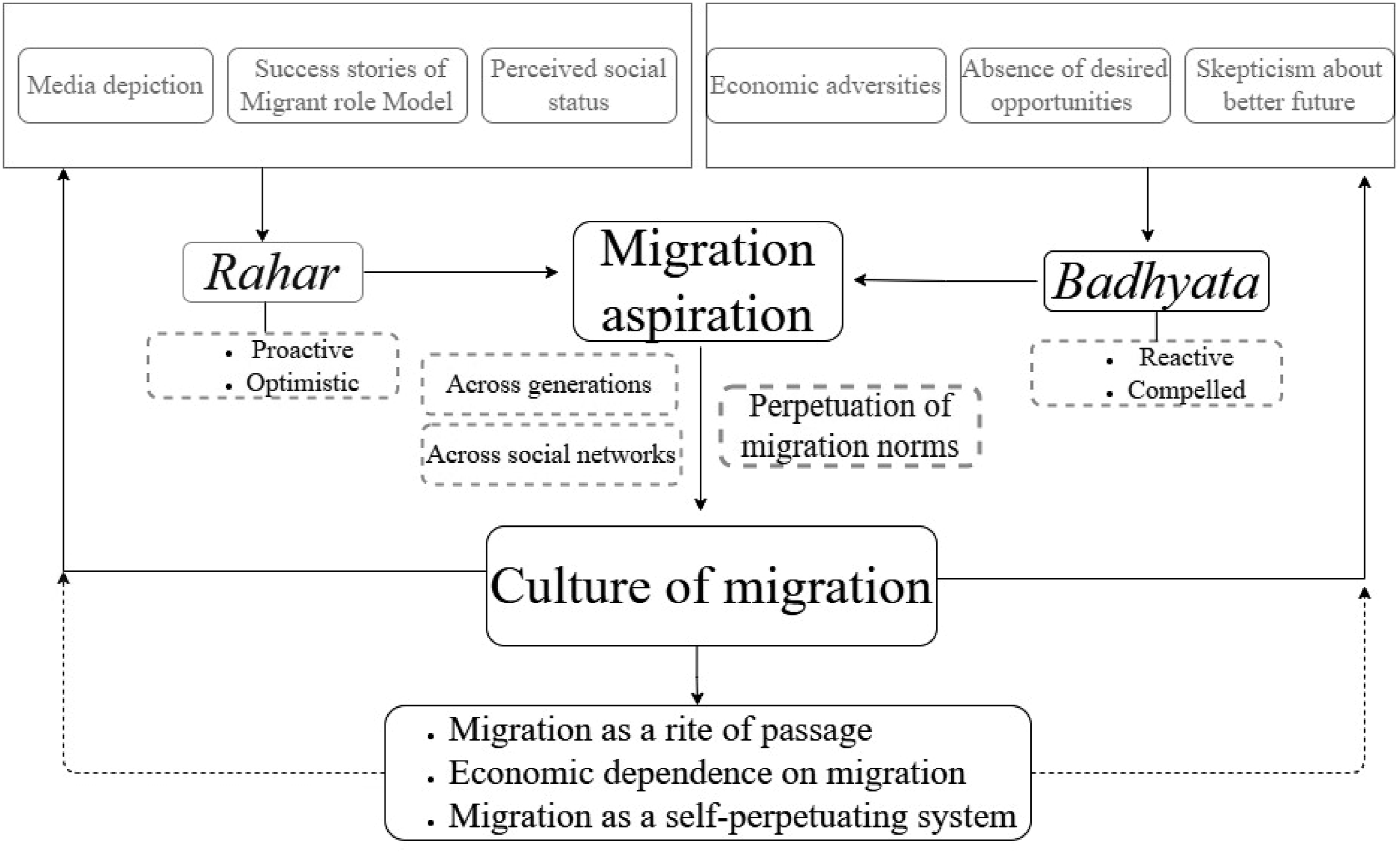
The framework presents how rahar and badhyata collectively sustain migration norms. The visible impacts of migration, such as remittances, improved household economies, and elevated social prestige, legitimize, and incentivize out-migration. For instance, remittance-funded homes and consumer goods become tangible markers of success, reinforcing rahar among non-migrants while masking the structural precarity (badhyata) that necessitates such migration. This cyclical dynamic ensures that migration is not merely an individual choice but a culturally valorized pathway, embedded in familial and societal expectations.
While rooted in the Nepali context, the rahar-badhyata framework has broader applicability to other migrant-sending societies where aspirational imaginaries coexist with structural barriers. By integrating individual motivations, shared cultural narratives, and systemic challenges, the framework provides a holistic lens for analyzing migration dynamics. It bridges the gap between micro-level aspirations and macro-level structural forces, offering an alternative to reductionist models.
The framework also indicates the need for structural reforms to address the root causes of badhyata while creating local opportunities that align with rahar. Policies aimed at reducing economic precarity, improving education-to-employment pathways and fostering political stability could mitigate the compulsion to migrate. Simultaneously, initiatives that celebrate local success stories and diversify aspirational horizons could recalibrate rahar toward domestic opportunities.
The rahar-badhyata framework enriches migration scholarship by focusing the cultural and emotional dimensions of migration. It complements economic narratives by illustrating how migration is shaped by the hope and precarity, desire and compulsion, and individual agency and structural constraints. By linking cultural logics to systemic realities, this approach broadens the discourse on migration, offering a more comprehensive understanding of why and how migration becomes a hegemonic practice.
Conclusion
Nepal’s migration dynamics are fundamentally shaped by the dialectical interaction of rahar (desire) and badhyata (compulsion), which collectively normalize transnational migration as both an individual ambition and a systemic imperative. These forces are not merely coexistent but co-constitutive, perpetuating a self-reinforcing cycle of migration. Badhyata is anchored in economic precarity, unemployment, political fragility and sociocultural expectations and compels migration as a survival strategy. Concurrently, rahar emerges from transnational success narratives, the symbolic value of foreign credentials and perceptions of global modernity, framing migration as a transformative pathway.
The normalization of migration in Nepal is driven by three interconnected dimensions: Structural deficits, aspirational imaginaries and institutionalized narratives. First, structural inadequacies, such as underemployment, educational disparities and scarce livelihood opportunities, make migration a rational response to local precarity. Second, aspirational imaginaries, cultivated through returnees’ success stories, remittance-enabled consumption and glorification of diasporic lives, position migration as the primary avenue for achieving social and economic capital. Third, institutional narratives, particularly among students and labor migrants, reinforce this cycle: Students perceive domestic education as insufficient for global competitiveness, while laborers face diminishing returns from agrarian or informal economies. Together, these dimensions solidify migration as a hegemonic practice, shaping intergenerational aspirations and undermining alternatives to transnational migration.
Nepal’s reliance on migration shows systemic failures in governance and development. The exit of youth reflects not only the response of individual agencies but also the state’s inability to provide viable futures. Addressing this necessitates multipronged structural reforms. Prioritizing educational reform to align curriculum with labor market demands, incentivizing private-sector growth through Small and Medium Enterprise (SME) subsidies, and investing in rural infrastructure could reduce badhyata by enhancing local opportunities. Simultaneously, recalibrating rahar requires dismantling the stigmatization of domestic livelihoods and amplifying narratives of local success. Policy interventions must also target bureaucratic inefficiencies and corruption, which erode trust in public institutions and perpetuate the perception of migration as an escape from systemic dysfunction.
Ultimately, reorienting Nepal’s development trajectory demands a decoupling of progress from transnational migration. This entails fostering economic pluralism, where domestic entrepreneurship, skilled formal employment and agrarian innovation are valorized alongside migration to diversify pathways to prosperity. By addressing the structural roots of badhyata and reshaping the aspirational frameworks of rahar, Nepal can cultivate a culture of “rooted mobility,” wherein migration is one of many equitable choices rather than a compulsory rite of passage. Such a shift would not only alleviate the human costs of mass outmigration but also recenter national development on sustainable, inclusive growth. The challenge lies in transforming migration from a symptom of systemic failure into a genuine expression of opportunity.
Footnotes
Acknowledgments
I would like to thank Professor Nathan Lillie at the University of Jyväskylä, Finland for his supervision and support. This article forms part of my doctoral dissertation completed at the University of Jyväskylä.
Ethical considerations
This research was conducted as part of my doctoral dissertation at the University of Jyväskylä. According to the university’s guidelines, the study did not require formal ethical review. Nonetheless, ethical principles, including voluntary participation, informed consent, anonymity, and data protection, were strictly observed throughout the research process.
Consent to participate
Informed consent was obtained from all participants involved in the study.
Consent for publication
I consent to the publication of this article and grant the publisher the right to reproduce and distribute the work as part of the journal’s publication process. Participants of the study were informed of the intention to publish research findings, and consent was obtained for the publication of anonymized data.
Funding
The author received no financial support for the research, authorship, and/or publication of this article.
Declaration of conflicting interests
The author declared no potential conflicts of interest with respect to the research, authorship, and/or publication of this article.
