




Abstract
Immigrant parents may have to rebuild their parenting knowledge after migration to keep up with their new milieu. Comparing two subgroups of Chinese immigrants, economic and knowledge immigrants, this study shows that the construction of different parental ethnotheories can be understood through the characteristics of their parenting knowledge acquisition, social networks and networking strategies. Findings from ego-network interviews with 15 economic immigrant mothers and 20 knowledge immigrant mothers indicate that the former tends to obtain practical tips and specific instructions directly from experts and acquire practical help from local, co-ethnic, small and dense networks, while the latter engages in critical peer-based learning in multicultural, open and long-distance networks. This study argues that a social network perspective can shed light on the “black box” of how parenting theories are reconstructed after migration.
Introduction
Migration brings difficulties and complexities to childrearing. Parents not only have to rebuild social networks that can help them with the task of parenting, they also need to rebuild their ideas and ideologies about childhood and parenting post-migration, as “old” ideas often do not work in the new setting. Chinese families have been described in the international literature as a unique case in this respect as they seem to be holding on to certain Chinese family norms and values, such as the emphasis on their offspring's obedience as well as on achievement via severe discipline. These beliefs are perceived to be so strong that they can be well-kept even after Chinese people have moved abroad (Kaufman, 2004). In the context of the current study, Geense (2005) has described how Chinese fathers working in the catering business in the Netherlands demonstrate their authority over children, in sync with paternal roles in Chinese tradition, which endows the father absolute power to rule the entire family. At the same time, studies also report on the tensions that holding on to such ideologies produces, especially among the second generation and women. For instance, Liu's (2014) work shows how Chinese immigrant mothers in the Netherlands experience communication problems and conflicts related to this traditional patriarchal order and the isolation felt by women. These issues remain prevalent even for the higher educated and better networked second-generation Chinese in the Netherlands (Zhang, 2013).
Research shows that the Chinese immigrant community is diverse which depends on the so-called migration “waves,” that is, groups that migrate at different times and for different reasons (Wang, 2008). In this study, we will particularly focus on two waves: the so-called “economic immigrants” and the “knowledge (or high skilled) immigrants,” a general typology that is recognized in the international migration literature (e.g., in the US, Wang, 2008; and in the UK, Wang, 2014). While both groups share a Chinese cultural background, both groups clearly differ in terms of their socio-economic background, schooling level and migration history (see below for further details on these waves in the Netherlands).
In our previous research on Chinese immigrant parents in the Netherlands (Zheng et al., 2018), we found that these two sub-groups of Chinese parents, despite their common ethnic background, differed greatly in their post-migration parenting ideologies. While the so-called “knowledge immigrants” carefully and systematically shaped the development of their children by offering them the opportunity to try all sorts of activities to build their identities and skills, the economic immigrants seemed to take the responsibility for their children's upbringing in a different way. While the knowledge immigrants considered care as a highly personal task, the economic immigrants were happy to share the care of their children with others, also for reasons of convenience. Apart from parenting being “communal” for the latter group, their parenting ideologies were also more homogeneous while the knowledge immigrants tended to build “unique,” individually motivated ideas on parenting. Another difference is the transparent, close, equal and democratic parent-child relationships valued by knowledge immigrants while economic immigrants tended to have hierarchical relationships with their children.
In addition, both groups may have different network relationships and media resources, which are important for developing their childrearing ideas and practices in their new setting. As stated, immigrants have the task to re-construct their “original” parenting ideologies and practices post-migration. How they do this, is a topic that is currently understudied (De Haan, 2011). Pointing to social and economic status and schooling level cannot adequately explain the particular contours these post-migration ideologies will take. In this article, we apply a social network perspective to understand these differences, as we believe that such an approach may enrich our understanding of parenting after migration.
A social network perspective on parenting
Parenting is usually defined as the parent's everyday understanding of child development, childcare and parental roles (Bornstein and Cote, 2004). As parenting can vary widely across socially- and culturally-diverse settings, following Harkness and Super (2006), we use the term “ethnotheories” to refer to the contextual variety in parents' implicit or explicit ideas about parenting (Harkness and Super, 2006). Building on the idea that these ethnotheories can vary depending on social class or ethnic group membership, we develop a social network perspective on ethnotheories based on Bourdieu's notion of social capital. Bourdieu argued that each individual is not only defined by social class, but also by all kinds of social capital that he or she can articulate through social relations. According to Bourdieu, social capital is the aggregate of resources which are linked to possession of a durable network (Bourdieu, 1986). Parenting knowledge can be viewed as a particular kind of capital that parents articulate through the multiple resources they possess (e.g., Fielden and Gallagher, 2008). By adopting a network perspective, it is not only possible to explain diversity in ethnotheories based on social class or ethnicity, but also in terms of social and cultural resources that parents can draw upon when building these theories.
Knowledge acquisition on parenting, the nature of social networks and media routines
This study is interested in how possible variations in the kinds of network Chinese immigrant mothers have at their disposal may explain the differences in parental ethnotheories found in previous research. The study examined the following questions: how closed or open are mothers to outside ideas? Do their networks differ in terms of ethnic background? Are they engaged in local or more transnational communities when it comes to ideas on parenting? How do they use the parenting knowledge they have access to?
Research has shown that parents vary in who they consult, the media they use and the resources they trust (Radey and Randolph, 2009; Tornatzky et al., 2002). Such differences ultimately result in varying network configurations that, in turn, define the information and learning possibilities of individuals (De Haan et al., 2014). The media routines of parents also influence their use of resources (Sarkadi and Bremberg, 2005). Books, magazines, television and a variety of Internet resources (Radey and Randolf, 2009; Simpson, 1997) offer information on parenting. Particularly, the Internet, including mobile devices with Internet access, is becoming an increasingly important means for parents to learn about parenting (Madge and O'Connor, 2006). In China, parents' knowledge acquisition patterns and strategies have been remarkably changing along with the historical shifts in economy and politics as well as with the development of social media in the past one or two decades (Luo et al., 2013). Young Chinese parents, especially those with a relatively high educational level, were found to critically merge traditional Chinese parenting values and newly emerged ideas as increasingly diverse available resources have provided them with more ideas to compare (Wang and Chang, 2010). Although this paper does not directly address these developments, we expect that its focus on the specificity of social networks and how it impacts upon media use is able to at least bring in another perspective on this issue.
Different networks, different resources on parenting?
Generally, it is argued that while closed and dense networks are important for mutual trust and support, open and low-density networks with more relationships to those outside a person's “own” community are important for the transmission of novel information (Eisingerich et al., 2010). In addition, research shows that a high concentration of network members in a single residential location is associated with more practical help (Bolt et al., 1998), while wider-reaching networks contain richer information (Lin, 2000). Furthermore, homogeneous networks, in terms of ethnicity, status, gender or educational level, for example, are generally seen as being able to provide more support to the users but offer less variety in information (Wasserman, 1994; Putnam, 2000).
With respect to the networks of immigrants, especially in the earlier stages of migration, people form dense and ethnically homogeneous networks, which help them to stay in touch with people they understand and trust and who can provide them with resources they need (Ryan, 2007, 2009). However, as Levitt and Schiller (2004) have argued, immigrants increasingly depend on transnational ethnic networks that are not confined to national boundaries or local immigrant communities (Levitt and Schiller, 2004). The literature on Chinese immigrants partly confirms this trend, as it shows how the social networks of the overseas Chinese community play a role in the lives of immigrants, for example, in consulting others on business issues and health care (e.g., Chu, 2009; Wu et al., 2011). However, it is possible that immigrant communities differ greatly in the extent to which they build such transnational communities, depending on their networks prior to migration, socio-economic status (SES) and their integration and networking strategies post-migration. The literature on Chinese immigrants confirms this variety as, for example, low SES Chinese immigrant communities are described as forming closed, relatively isolated, ethnically homogeneous communities in their host countries, both in North America (Da, 2008; Pih et al., 2012) and Europe (Pieke, 2004), while high SES immigrants in the US have been described as having more open networks reaching out to a diversity of communities (Zhang, 2012). Our interest here is how such variety, if it occurs, might impact on the way immigrants rebuild their knowledge on parenting after migration. Do the networks of low SES or “economic” Chinese immigrants differ in spatial concentration, homogeneity and openness from those of high SES or “knowledge” Chinese immigrants? How do these groups employ their social networks to gather knowledge on parenting? Moreover, how are these social networking strategies related to their overall media use, particularly, how do they use the Internet to obtain information about parenting?
About the study
Economic versus knowledge immigrants
The Chinese form the fifth largest non-Western immigrant group in the Netherlands today, consisting of over 100,000 immigrants originating from mainland China and Hong Kong (Gijsberts, 2011). Roughly half of these immigrants, who generally migrated after the new millennium, are referred to as knowledge immigrants. They primarily come from developed urban areas in China and pursued higher education before migrating to the Netherlands to continue their studies. After graduating from Dutch universities, they usually work as white-collar professionals. The other half is referred to as economic immigrants, who began migrating prior to 2000, with the purpose of finding work (Li, 1999). Until recently, this group was seen as typical of Chinese migration. They own small catering businesses, usually have not completed higher education, often come from the same hometown and have generally settled collectively in self-dependent, relatively closed communities. In the Netherlands, the first wave of economic immigrants came mainly from Hong Kong, followed by those from Wenzhou, Zhejiang Province who arrived in more recent decades.
As already stated, both types of immigrants are also seen as important prototypes of current migration from China across the globe in contemporary history. In the Netherlands, the group of economic immigrants falls under the category of Chinese labor migrants, who migrate to the developed countries to pursue a better-paying job and to improve their economic condition at home. Knowledge immigrants in the Netherlands are part of the rising international student wave from China, whose primary motivation is to pursue a better-quality higher education. Their choice of a place to settle down and raise a family mostly depends on the development of their careers (Chishti and Bergeron, 2011).
For reasons of comparability, we only invited Chinese mothers from mainland China who migrated after 2000 and raised their children in the Netherlands. Fifteen economic immigrants and 20 knowledge immigrants were included in the study. They all live in Utrecht, a medium-sized city in the urban heart of the Netherlands, where most Chinese immigrants have settled. Economic immigrants were recruited, using snowball sampling, from the three most important Chinese associations in Utrecht: a Chinese school, a Chinese church and the Dutch Chinese Chamber of Commerce. As knowledge immigrants use digital media to stay in touch after migration (Da, 2008) and were not represented in the church and Chamber of Commerce, we located them through the Chinese school and through advertisements on two popular online forums: bbs.gogodutch.com and bbs.xinhelan.com. We used the following criteria for inclusion in either of these groups: (a) self-identification (which group they identify themselves with); (b) occupation and (c) level of education.
While economic immigrants are typically engaged in the catering business, knowledge immigrants are in white-collar jobs, such as in the finance industry and engineering, or hold jobs as teachers or academics. Knowledge immigrants are typically highly educated, up to PhD level, while most economic immigrants had secondary schooling as their highest level. The two samples were matched in terms of age and number of children so that both were similar in these respects.
Data collection and instruments
Every participant was interviewed individually in a private or public space, such as their home, a café or an office. Informed consent was obtained in all cases. All the interviews were conducted in Mandarin by the first author and audiotaped, each with a duration of approximately 90 minutes. Data collection was conducted from November 2013 to April 2014.
We conducted an ego network interview followed by an in-depth interview. Ego network analysis, a methodology to map the composition, size, density and other features of the social network of one person, is particularly suited to obtaining insights into the relationships, composition and structure of the networks of individuals as opposed to network analyses applied to groups (Haythornthwaite, 2011). Using a “name generator,” we evoked the relationships (called alters) of the mothers (called egos) they considered relevant for their parenting. We asked the “ego” to list a set of alters (up to 30) whom she regarded as helpful in her daily childrearing, using prompts such as, “if you have to leave your child for a day at home, who do you turn to for help to take care of him/her?,” “with whom do you often talk about child-raising?” or “is there anyone else who sometimes provides information, knowledge and help about childrearing?” Then, we collected information about the type of relationship (e.g., family, friend, colleague, neighbor, etc.) and the characteristics of these alters (e.g., ethnicity, age, location of residence, rated importance using a 6-point Likert scale; the higher the value the greater the importance), as well as whether these alters knew each other. We registered the name and properties of the relationships a participant listed with the help of Excel software. This allowed us to calculate and compare the composition, homogeneity and geographical location of mothers' networks, as well as the relative openness of these networks later on (for a more detailed explanation, see De Haan et al., 2014). In the interview, we asked the mothers how they used these relationships to build knowledge on parenting, and also about other resources they might mobilize as well as how they valued these resources.
Data analysis
We tested for potential differences between both groups in the network composition (types of relationships, ethnic homogeneity, locations of residence, etc.), its size and density, and differences in resource use as well as the average rank of each resource mentioned. With the aim of comparing two groups of Chinese mothers on these variables, we employed independent sample t-tests and Mann–Whitney U tests in the case of any assumption of a t-test being violated. Lastly, the differences between the two groups in resource use were represented by the average rank of each resource.
The audiotaped semi-structured, in-depth interviews were transcribed. Using a discourse analytic approach, and with the help of Nvivo10.0 software, we focused on the resources that mothers employed and how they used digital and other media to build knowledge on parenting in relation to their social networks. As these issues are not independent of what kind of knowledge mothers were interested in, or how they thought this knowledge might best be acquired (e.g., by asking professionals, by reading books or chatting on social media), both of these elements were included. Our final goal with the analyses was to test whether the combined data (network data as well as media resource data) could shed light on the earlier found differences in parental ethnotheories between both groups.
Results
Demographic profile of research participants.
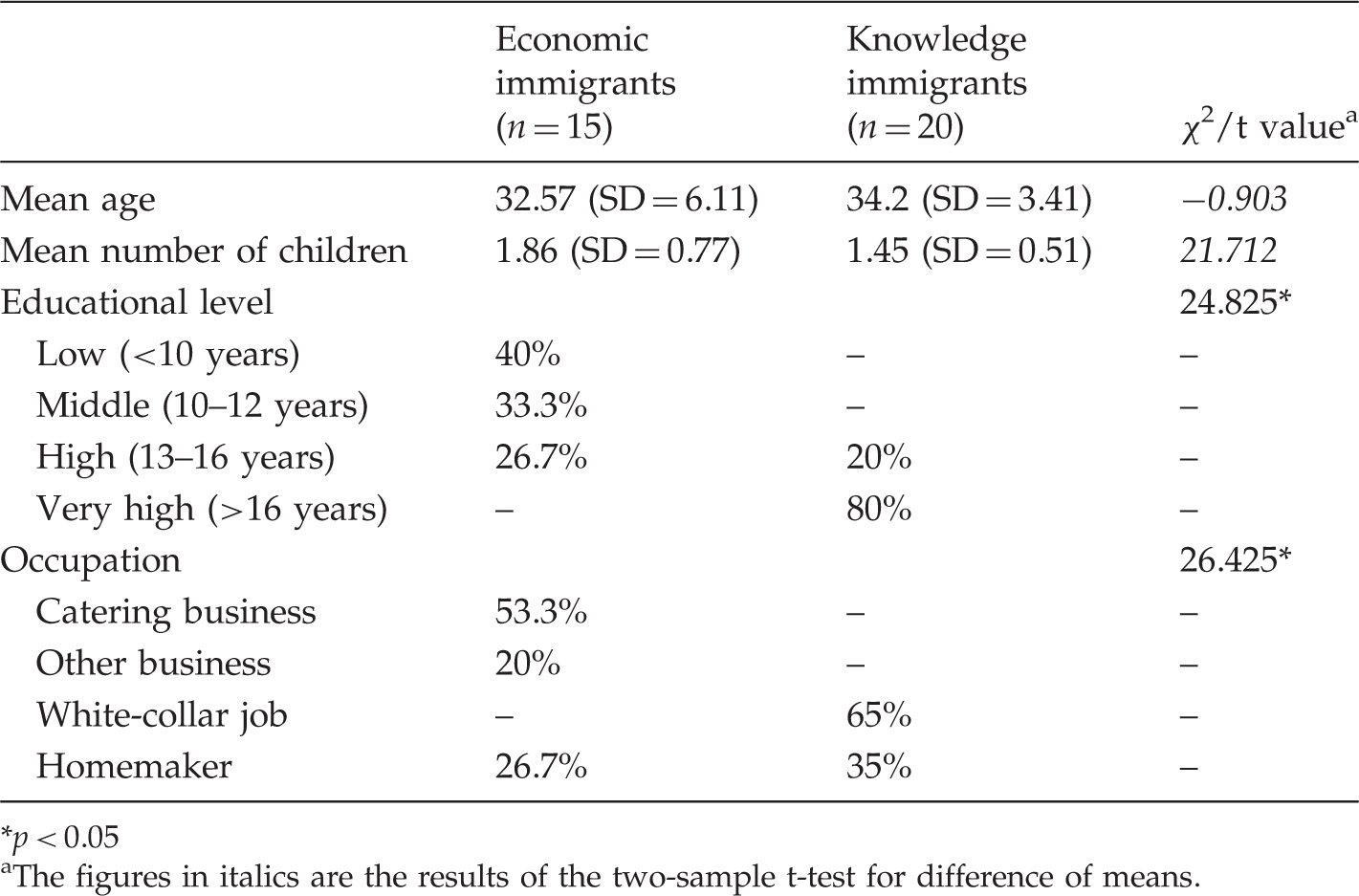
p < 0.05
The figures in italics are the results of the two-sample t-test for difference of means.
Differences in the networks of economic and knowledge immigrant mothers
Network composition and who is important for what
Distribution of the network composition, geographical spread per relationship and homogeneity of immigrant mothers' networks.
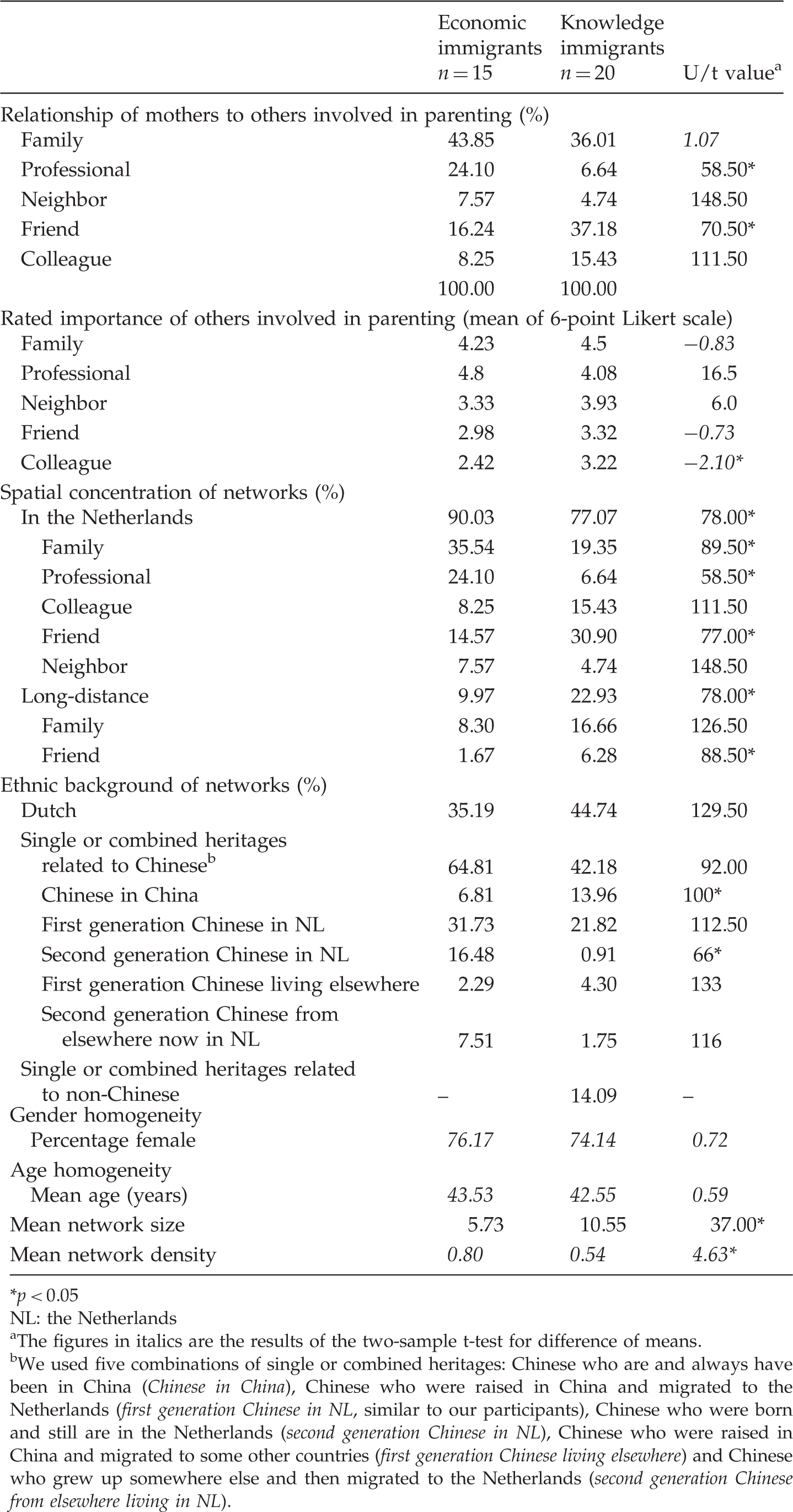
p < 0.05
NL: the Netherlands
The figures in italics are the results of the two-sample t-test for difference of means.
We used five combinations of single or combined heritages: Chinese who are and always have been in China (Chinese in China), Chinese who were raised in China and migrated to the Netherlands (first generation Chinese in NL, similar to our participants), Chinese who were born and still are in the Netherlands (second generation Chinese in NL), Chinese who were raised in China and migrated to some other countries (first generation Chinese living elsewhere) and Chinese who grew up somewhere else and then migrated to the Netherlands (second generation Chinese from elsewhere living in NL).
For economic immigrants' contacts in the Netherlands, family members are more frequently involved than for knowledge immigrants. Typically, parents or parents-in-law (if they are settled in the Netherlands) are considered second in importance for practical help and are engaged as babysitters or to pick up the children from school and cook for them. Neighbors, although far less frequently involved, have a similar function and are also considered rather important (ranked as the third most important) in providing practical help and ability to assist with local information, such as on the local school. Local professionals, who are mainly teachers and the kindergarten staff at their children's school, are ranked as most important and regarded as responsible for their children's education. They also involve significantly higher proportion of professionals than knowledge immigrants do.
Knowledge immigrants rely almost as frequently on friends as on family, although they state that family members rank as most important. Among family members, husbands are mentioned the most often for taking care of and making decisions about the children. The Chinese grandparents (who all live in China), as well as other family members who are not around, are often updated and consulted through digital media, or asked to assist in childcare during short-term visits to the Netherlands. Following family, knowledge immigrant mothers rank professionals as the second most important relationship, regarding them as an important partner in their children's education. They tend to obtain and share information about childrearing or news on their children's activities from friends (the fourth most important) and colleagues (ranked fifth), but they are rarely asked to babysit.
Geographical location, heterogeneity, size and density of networks
We compared the percentage of contacts that were local (i.e., those living in the Netherlands) with the percentage of long-distance contacts (i.e., those living in China or other countries), relative to the total number of contacts. The results of the Mann–Whitney U tests showed that the networks of economic immigrant mothers tend to be more local while the networks of the knowledge immigrant mothers tend to be more long-distance. Moreover, the long-distance contacts of knowledge immigrant mothers were in various countries. Apart from contacts in China, the economic immigrants only named two relatives living abroad: one was a sister in Belgium and the other a cousin in Italy. For knowledge immigrants, eight mothers mentioned 12 long-distance contacts located outside China who are living in seven other countries: Germany (3), the USA (2), Belgium (2), Canada (2), France (1), the UK (1) and Japan (1).
In analyzing the heterogeneity of their networks in terms of ethnic background, we distinguished between country of descent and country of immigration. Economic immigrant mothers’ networks contain only contacts with those having a Chinese or Dutch background. Knowledge immigrants did mention being in touch with people who have an international background besides Chinese and Dutch. More specifically, they mentioned eight different ethnicities, including Japanese, American, Indian, Singaporean, German, Spanish, Indonesian and Iranian. This indicates that the knowledge immigrant mothers form more diverse networks compared with the economic immigrant mothers, both in terms of where their contacts live and what their various ethnic backgrounds are, even if their networks still largely consist of Chinese in China. In contrast, economic immigrants have more contacts who are second-generation Chinese in the Netherlands in their network than knowledge immigrants do. There were no significant differences between the network contacts with respect to gender or age between both groups.
Furthermore, our data showed that knowledge immigrant mothers' networks were significantly larger in size (the number of people in one's network) than economic immigrants' networks while the density (the number of actual ties divided by the number of all possible ties in one's network) of the economic immigrant mothers' networks was significantly higher than that of the knowledge immigrant mothers. This difference in size and density is also visualized in Figure 1, which depicts the two immigrant mothers' networks.
Examples of two mothers' networks: (a) AS (economic immigrant) and (b) HM (knowledge immigrant).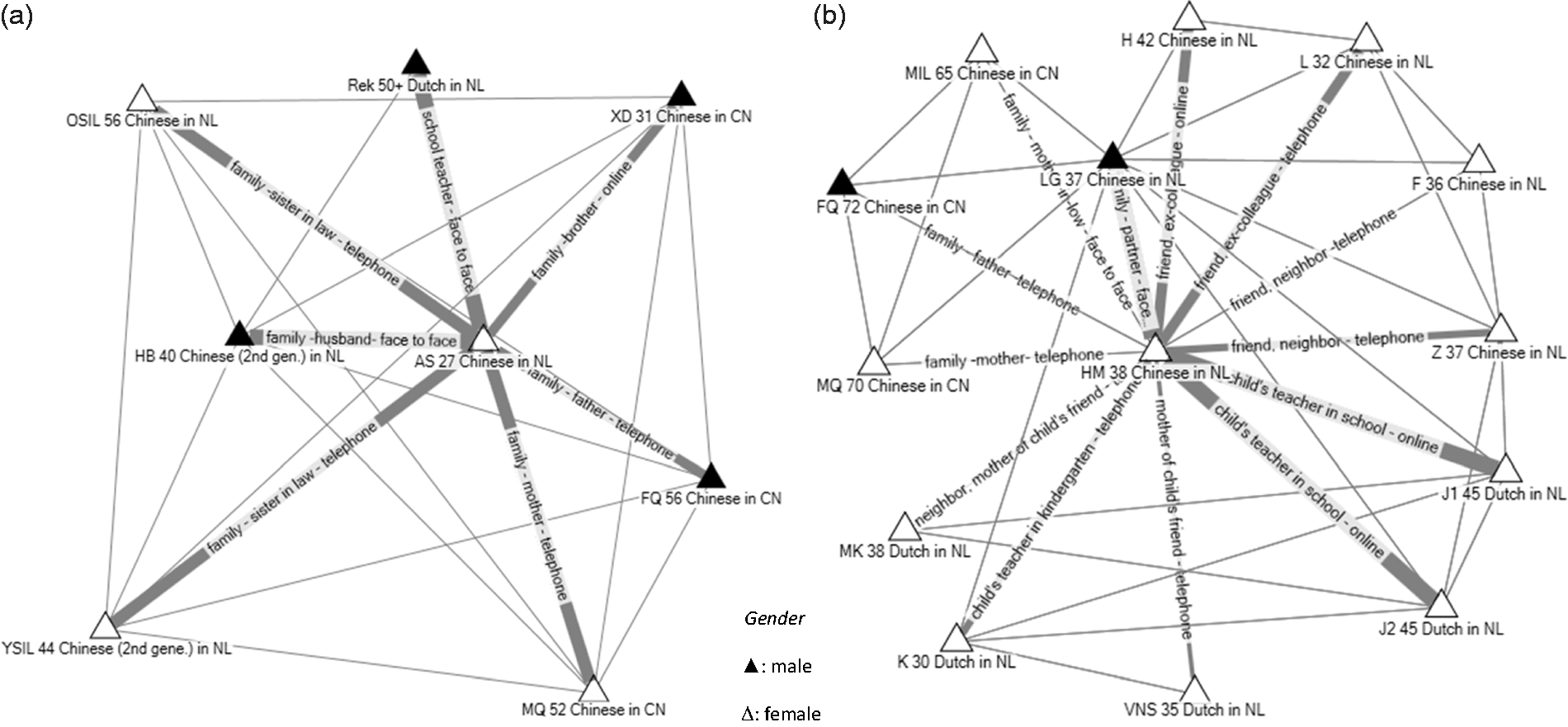
Figure 1 (a) and (b) represent what sociologists call ideal types. The figure provides a visual representation of the characteristics discussed: the knowledge immigrants' networks are larger, less dense and their relationships are more diverse in terms of ethnicity and location of networks than those of economic immigrants. The figure also includes details on resource use, which we will discuss in the following section.
Knowledge acquisition strategies on parenting
Economic immigrant mothers
I don't have time to watch TV or read a book, it is a waste of time, as they [books and TV programs] only talk about virtual theories; they are not applicable to my child's specific situation at all … Everybody can talk but I like action … when I encounter a problem, I go directly to the people who know about it and solve it. If she (my daughter) is ill, I go to the doctor; if she is unhappy, I go to the teachers.
Average rank and percentage of resources immigrant mothers use to inform themselves on parenting.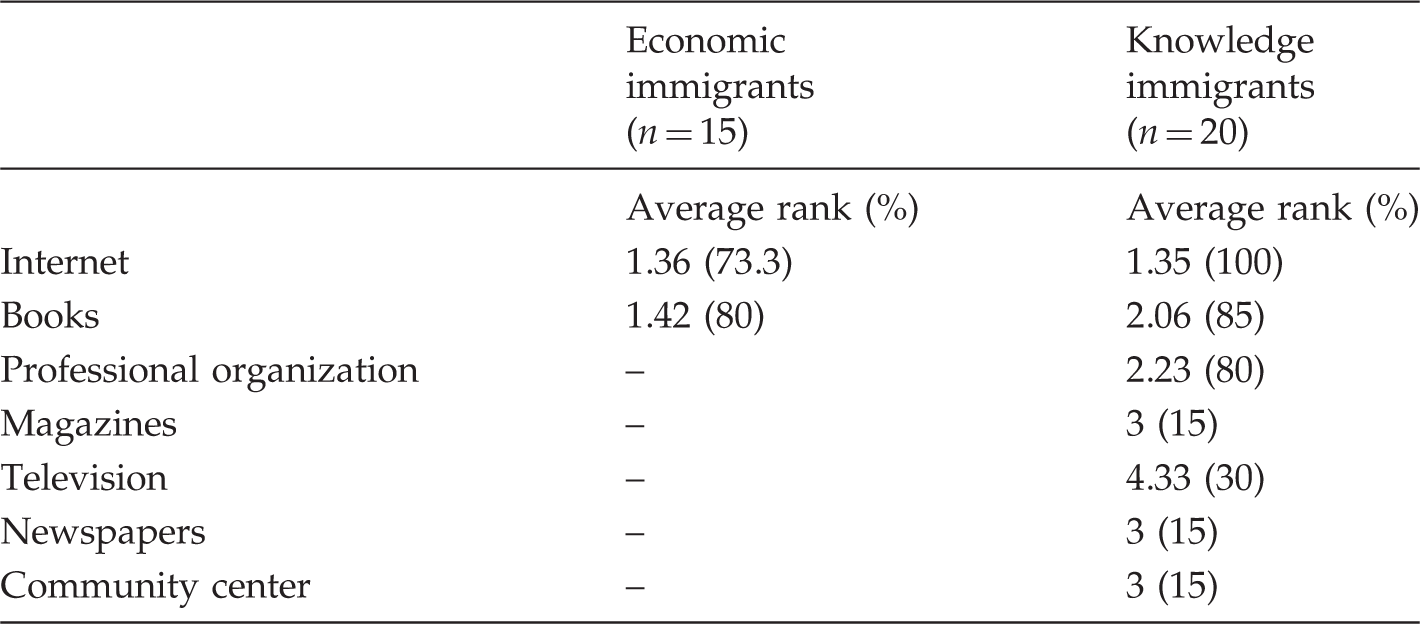
As a mother, I'm too concerned to judge. I always worry about him (my son) and I don't know if I'm doing good enough or not. Then, when the doctor told me he didn't have any problem with eating too much meat, I couldn't believe it. But I had to. She is the doctor!
We who were born in the 1980s are getting used to mobiles and Internet. People always share those kinds of articles [about parenting] on WeChatMoments. You see [showing an article entitled “10 tips from a developmental psychologist” to the interviewer] … Sometimes I think these are useful. But I only repost those written by experts. Anyway, it's not harmful to get something like this.
Although not included in the interview questions, XW (29-year-old, high school graduate, snack bar owner) told me spontaneously: I followed some people and groups on Weibo; some I know, some I don't. They post what they did today with their children … You know, Internet is [a] broad [concept]. Like in this group for “hot mothers” [in Chinese, 辣妈 la ma, an Internet buzzword in China, meaning mothers who stay in shape and have a positive life attitude], people share topics such as food, personal development or even talk about some hit live shows … I usually browse it for fun.
Knowledge immigrant mothers
In our study, they were critical seekers of information aiming to build up knowledge rather than directly applying it. Even when they were interested in practical knowledge, their concerns differed from the economic immigrant mothers. They seemed aware of the complexity of living between different traditions of childrearing, and often expressed their sense of responsibility as a parent to make this situation “work” for their child. For example, WN (36-year-old, MA holder, college lecturer) mentioned that the second-generation Chinese students in her class were confused and struggled when she asked them if they felt Chinese or Dutch. Her response to this situation was that she felt it was her responsibility to pay special attention to her own son's development of his ethnic identity to prevent him from experiencing the same confusing thoughts and feelings.
Generally, this group tends to generate knowledge on parenting by gathering a relatively large amount of information and various opinions from multiple perspectives, analyzing these and then forming their own opinion based on their own situation. They use a variety of different resources to obtain knowledge about parenting, including the Internet, books, magazines and television, alongside information from professional institutions.
Books are valued as they are, as one of the mothers stated: “a system which is internally consistent.” Another mother said she particularly liked books by authors who tell comprehensive and persuasive stories rather than “how to” instruction books. This group used the Internet differently from the economic immigrant mothers, using search engines to obtain specific information on parenting, rather than relying on information that circulates on social network sites. As HT (33-year-old, MA holder, logistics manager) explained: We sit behind the computer every day. It's so natural to Google anything we think about. [laughs] When I want to know anything about parenting or child development, that [searching online] is my first reaction. I don't need to bother anybody and I can compare all the different results.
While these mothers surfed the Internet and read books to form their opinions, they used their social networks as well. Some of them also used their transnational networks outside China to obtain information or contrasting opinions. For example, LH (46-year-old, MA holder, homemaker) mentioned that she sometimes talked with her sister in Canada and also browsed overseas Chinese forums in North America. She explained that she “would like to know what is happening in other Chinese families in the West; if I've made the same mistake, I'd correct it; if I haven't, I'd try to avoid it.”
However, usually when they use their social networks for issues on parenting, they use social network sites for Chinese immigrants in the Netherlands, such as Gogodutch.com, which is the most visited online forum by Chinese in the Netherlands. The knowledge immigrant mothers in our study, as a rule, did not personally know the other parents they had met in the forum. As one of the mothers, ML (33-year-old, MA holder, computer science engineer), explained: I've really learned a lot from it [gogodutch.com], they [other users] are very supportive. Sometimes our concerns are not understood by others, neither Dutch colleagues nor family in China. But they can [understand me] … And their comments are useful … We don't actually know each other, but that's the most amazing part.
Discussion and conclusion
Our results revealed that economic immigrant mothers develop different knowledge acquisition strategies to build their parental ethnotheories compared with knowledge immigrant mothers. Both groups also differ in their social networks, as well as how they employ those networks. The economic immigrant mothers who have family members close by depend on this family network for practical help, which includes second-generation family members who know their way around Dutch society. With regard to their ideas on parenting, they rely on professionals. Interestingly, they find this knowledge by consulting Dutch professionals and consuming knowledge published by experts in China, which is passed on through their online social network communities. The Internet has added a new dimension to their parenting. Their locally based, relatively small and dense networks have been extended and bring them into direct contact with professional knowledge that is passed on from China.
In contrast, the knowledge immigrant mothers usually do not have an extended family close by, and thus cannot rely on them for practical help. They feel they are responsible for building their own parental theories making use of a broad range of different resources. In contrast to the economic immigrant mothers, with their busy work schedules, they have more time to sort out things for themselves. They read books, surf the Internet for information and also share and discuss this information with other Chinese mothers in the Netherlands through social network sites. They usually do not personally know these mothers but form online “imagined communities” around the issue of parenting. Although they generally build these networks with Chinese mothers in the Netherlands, they also include relationships and resources from a variety of countries, and thus form more globally oriented, culturally diverse networks. Thus, while economic immigrant mothers form locally based, small networks to provide practical help, the knowledge immigrant mothers build larger knowledge networks to help them develop their parenting ethnotheories.
We can partly understand these differences in relation to the social class or educational level of these groups. Since the economic immigrants have busy work schedules and have not been trained to find and discuss scientific information on their own, it might be more practical for them to rely on the opinions of professionals. The knowledge immigrants' level of education and white-collar employment, in contrast, mean that they are used to critically examining opinions and combining a variety of resources on their own. The network perspective we applied here suggests further insight into what kinds of contacts both groups of mothers rely on, and also what kind of parental knowledge circulates through their networks. As economic immigrant mothers largely rely on professional knowledge published in China, it is likely that they maintain and transmit traditional Chinese knowledge on parenting, which is considered valuable by Chinese immigrant communities. At the same time, they are confronted with the knowledge of Dutch professionals, which means their ethnotheories are at least challenged and possibly adapted based on other ideas and influences. While a strict and hierarchical parent–child relationship, which is representative in traditional Chinese culture, is valued by most economic immigrants, they are likely to follow instructions from Dutch professionals if they consider these practical. For example, one of the economic immigrant mothers thought she was the person who should decide which middle school her daughter should go to when she graduated from primary school. However, the suggestion by the child's teacher that it was important for the child to make the decision for herself led the mother to change her mind and allow her child to decide based on her own wishes and the teacher's advice. This example shows that while this mother most likely followed the advice of the teacher because of the position of authority the teacher had as a professional, her ideas on hierarchical relationships were challenged.
Knowledge immigrant mothers, whose family members (apart from their husbands) are usually in China or other countries, do not count on local and dense networks to build knowledge on parenting. In contrast, they rely on more open, often virtual and partly transnational networks, which allow them to gain information from different people and multiple resources. This offers them a variety of different perspectives and opinions, which may facilitate the mothers' integration of all this information into their own hybrid parental ideology. The ethnotheories of knowledge mothers typically reflect diverse perspectives, for example, in how they think about parent-child relationships. While they continue to respect Chinese values, such as emotional closeness as represented in Confucianism, they also combine these with more open and democratic ideas common to Western middle-class families.
Although it is notably difficult to explain how differences in parents' ethnotheories come about, we hope to have shown how a social capital perspective can shed more light on how differences in networks might also have an impact on the formation of different parenting theories. By analyzing the kinds and forms of social capital mothers have, and by paying attention to specific characteristics, such as the composition, spatial concentration, homogeneity and structure of networks, our understanding of the origin and circulation of knowledge has been enhanced (see also De Haan et al., forthcoming). However, our analyses or results do not imply that there are no commonalities between the ethnotheories of both groups. The purpose of differentiating the two sub-groups is to illustrate the variety in the underlying mechanism and how these might impact the reconstruction of parental discourses post-migration. For researchers and practitioners who are working with migrant parents, this perspective means that parenting practices and ideologies should be seen as dynamic systems that are influenced by particular social and networked configurations. These network configurations play an important role in determining the direction in which parental ethnotheories form.
The results of this study on Chinese immigrant parenting in the Netherlands gained from taking a social network perspective could also provide an interesting perspective on the discussion in China on modern parenting and the impact of social media. Since the Internet has blurred the geographic borders between countries, young parents both in China and abroad have witnessed an information explosion, which in principle could facilitate the modernization of parenting. However, as this study suggests, having access to the Internet and other information sources does not lead to similar parental ethnotheories per se, nor would these necessarily develop using the same strategies. The fact that the knowledge immigrant mothers have developed personalized versions of parenting given their diverse and low-dense networks, in contrast with the more homogeneous networks and traditional ideas held by economic immigrant mothers, reminds us to take into account that the nature of their social networks as well as how they use this network to access information resources, will define the outcomes of such transformations to a great extent.
While there have been several studies acknowledging the reliability and validity of network methodologies (Coromina and Coenders, 2006), the stability of social networks and the issue of missing data are sometimes mentioned as threats to the reliability of this kind of data. In our study, economic immigrant mothers had more trouble recalling their network contacts compared with knowledge immigrant mothers. This might have led to an underrepresentation of the size of their networks, although we attempted to minimize reliability issues by preparing our interview in line with standard social network index methods.
As to the method of obtaining data only from an interview, this methodology has been criticized for not being able to register what people actually do or think due to social expectations or shyness (Hewett et al., 2004). In this research, cross-questioning technique and asking for more concrete examples were used during the interview to examine the validity of certain discourses from the interviewees.
In addition, the small sample size of the study, as well as the sampling strategy, means that we should be careful in generalizing these results to overall differences between the groups studied. Moreover, the convenience sampling method may have led to a relatively homogenous composition of each group.
Lastly, an additional weakness might be that within the scope of this study, we were not able to carry out an extensive content analyses of the information on parenting that the participants searched for, re-used and passed on. The network methodology, as we applied it here, pays more attention to the social dynamics of how information is spread, its reach and diversity, and the content we provided on parenting dilemmas was mostly illustrative. Future research could combine network analyses with more extensive content analyses in order to pinpoint more precisely how new ethnotheories are formed post-migration.
However, this should not downplay the fact that our study has shown that a network perspective is a powerful tool for understanding differences in parents' ethnotheories, alongside, or as an alternative to, socio-economic status and/or assimilation perspectives.
Footnotes
Declaration of conflicting interests
The authors declared no potential conflicts of interest with respect to the research, authorship and/or publication of this paper.
Funding
This research received no specific grant from any funding agency in the public, commercial or not-for-profit sectors.