




Abstract
Students with type 1 diabetes (T1D) need to take responsibility for their T1D and need professional support from school nurses. This study describes school nurses’ experiences in supporting students with T1D in school. A qualitative approach was used. After purposive sampling, six school nurses were interviewed and data were analyzed with qualitative content analysis. For professional support, a network around the student was enabled constituting of a continuous dialogue and responsibility and preparedness. For professional support a mutual commitment from the student, parents, and the school nurse was needed which was built from initiating participation and security, the school nurse’s ability to be present and available and on school nurse’s perceived competence. The conclusion of the study, and its practical implication, is that school nurses’ ability for professional support of students with T1D varied in relation to their perceived competence in nursing science as well as their ability to enable, strengthen and sustain teamwork and family–school team meetings.
Introduction
The general purpose of school nurses’ work is to promote health, which includes a responsibility towards students with specials needs such as type 1 diabetes (T1D). Type 1 diabetes is a widespread and growing health problem entailing vast health care costs for society. 1 Europe has the highest prevalence of children with T1D. 2 The incidence of T1D in children younger than 15 is increasing across Europe by an average of 3–4% per year 3 and approximately 130,000 children live with T1D in Europe. 2 Sweden has the highest incidence of childhood T1D annually, although there seems to have been a recent minor downward trend. 4
The treatment aims for best possible blood glucose level with a HbA1c below 6.0 mmol/L to prevent or postpone severe complications.5,6 Intensified insulin treatment leads to reduced long-term complications such as microvascular complications of T1D7,8 as well as increased well-being without adverse effects. 9 The treatment must be modified in view of the risks of hypoglycemia or a reduction in quality of life. Symptoms such as fatigue, anxiety, and irritability related to varying blood sugar levels affect the child’s learning opportunities. 10 The risk that a child with T1D will fail in school is increased compared with other children. 11
Parents of children with T1D manage an extensive and life-sustaining treatment every day, educate school staff and are always available on the phone in case of emergency call-outs; a task that is time consuming and entails a responsibility for the parents.12,13 Parents’ abilities to manage their own concerns and at the same time provide support ultimately affects the child’s well-being. 14 Teenagers with T1D need constructive support from their parents and their social network to develop self-management competence. 15 Hence, parents need support from school staff in the form of satisfactory communication involving the child, parents, school nurses, the diabetes team and others in order to promote a healthy outcome for the child.13,16,17 Since school attendance is mandatory in most European countries, these students need support, and school nurses play an important role for students with T1D 18 and for their families. 19 Adolescence is especially challenging when young people are learning self-management and require a supportive environment. 20 Type 1 diabetes is complex and demanding and the school nurses need to be very experienced and competent to support these students.21,22 Supporting students with T1D requires cooperation among students, parents, school nurses and a multidisciplinary team including pediatric diabetes nurses and school staff.13,23 Increased overall knowledge among school staff is necessary and the school nurse must educate school staff to provide care for these students. 22 Adequate health care resources at school are crucial to meet students’ needs for health promotion and learning as well as to meet the special needs of students with T1D. The American Association of Diabetes Educators 24 advocates implementing written care plans for students with T1D and school nurses are responsible for coordinating and leading school-based diabetes care to help students successfully manage their diabetes at school.
The outcome of both giving and receiving support is affected by age, personal experience, and the environment 25 and professionals’ personal attitudes affect the quality of the support they offer. 26 Social support offered within the social network requires working relationships and trust to be effective, while support offered by professionals is directly available but limited by professional knowledge and domain. 25
There is a predicted rise in students with T1D who will require both social and professional support in their daily life to succeed in their studies. Support is an interactive process and, to meet the needs of these students, knowledge of professional support from the school nurses’ perspective is required. This study aims to describe school nurses’ experiences in supporting students with T1D in school.
Method
Materials and methods
An inductive, qualitative approach was chosen for this study. Interviews were decided as the most appropriate method to understand school nurses’ experiences. 27 The data were analyzed with the use of qualitative content analysis. 28
Participants
A purposive sampling strategy 27 aiming for variation in age, specialized education, work experience as a school nurse, and work in different municipalities, was adopted. Participating school nurses varied in age from 40 to 61 years, they had a specialized district or school nurse education, their work experience as a school nurse varied from 1 to 25 years, and they worked in a variety of settings from schools in densely populated urban areas to schools in small countryside communities. The socio-demographic and cultural backgrounds of the students that the participating school nurses met also varied.
Data collection procedure
The school nurses were contacted by telephone and interviewed at a time and place of their choice. All interviews were performed by the authors (MF and VV), privately in the school nurse’s office, in a relaxed and undisturbed atmosphere. The interviews began with an open question: ‘Tell me about your experience in being supportive of students with T1D and their parents?’ During the interviews, the participants were encouraged to reflect on their experiences and probing questions such as: ‘Could you describe that a bit more?’ were posed. The interviews were recorded and transcribed verbatim.
Data analysis
Example of the analytical process.

Trustworthiness
This study addressed the school nurses’ experiences of supporting students with T1D in school. The data were considered to be rich and offered a variety of experiences from the school nurses. To ensure trustworthiness, an awareness of the interviewers’ pre-understanding was observed. During the analysis there is always a risk of interpretation to some degree. 28 To ensure consistency in the descriptions, the authors maintained an ongoing dialogue during the analytic process, in which two of the authors were experienced.
Ethical considerations
The ethical principles of the Declaration of Helsinki 29 were applied in the study. The heads of school services were informed and permission given to undertake this study. The participating school nurses received both written and verbal information regarding the study and signed an informed consent. They were also informed that their participation was voluntary and that they could withdraw from the study at any time without providing a reason.
Findings
Overview of main and subcategories.
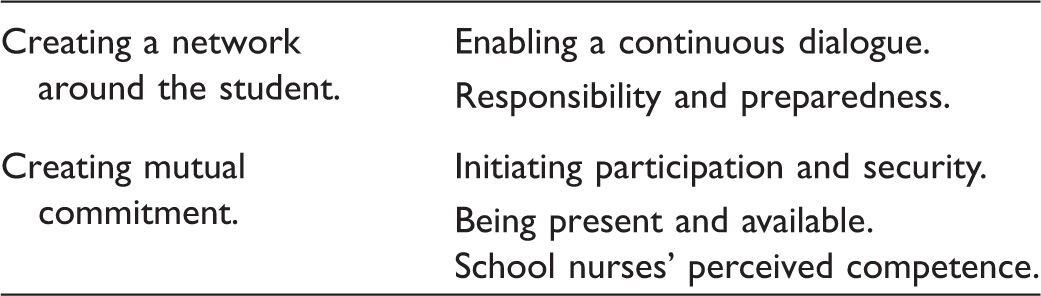
Creating a network around the student
The school nurses described themselves as coordinators in creating a network around students with T1D to support them. This involves enabling and sustaining a continuous dialogue with staff in school as well as between the school and the students’ family. This continuous dialogue was, together with responsibility and preparedness, an important factor in the support of these students.
Enabling a continuous dialogue
The school nurses regarded a continuous dialogue with the students’ parents and teachers as important to support students with T1D. A continuous dialogue included a two-way communication that enabled the exchange of information about these students with, for example, the head teacher or kitchen staff. This continuous dialogue contributed to all staff having the same information regarding students with T1D. I think it’s important … the information … everybody knows the same things because it makes this work and both child, parents and the staff feel secure. The contact with the parents is extremely important I think … very important … So they can feel secure.
Responsibility and preparedness
The school nurses took responsibility for an individual care plan that contained for example, insulin doses, administration of medication, acceptable blood glucose levels and symptoms of abnormal blood glucose levels. The existence of and information in the care plan assisted all involved and increased their vigilance in spotting signs of abnormal blood glucose levels. The care plan included contact information for both parents if staff should need additional information about the student.
The care plan was kept as a medical document in the school nurse’s office or, if the school nurse perceived it as important, relevant staff members had a copy in the classroom. Sometimes the student also had a special journal where teachers and parents could make a note if anything of importance had occurred during the day. Being supportive included every relevant person around the student taking responsibility, and when this was achieved the school nurses were more content with their support. I tell the parents and the teachers. The school is responsible when the student is at school … It cannot be the school nurse’s responsibility because I am not present in class or at lunch, so it must be the responsibility of the teacher in charge of the student at that time. And once they understood this it has not been a problem anymore. The responsibility lies too heavy on me I would say … It is lonely sometimes when a student needs a resource but could not get it from the headmaster. Felt as if I was the one to handle it, sort of …
Creating mutual commitment
Mutual commitment was described as initiating participation and security for the student and the parents, as well as the school nurse being present and available and the school nurse’s perceived competence. School nurses who felt able to offer adequate support described a deeper mutual commitment, while those describing difficulty in offering adequate support described a lack of mutual commitment.
Initiating participating and security
The school nurses’ goal was to initiate participation in any decisions concerning the student. It was important when offering adequate support that the student considered him/herself to be a participant and to be able to influence decisions affecting his/her daily life. The school nurses described that when students actively participated and gained a sense of control, they were more capable of taking responsibility for their T1D and this contributed to their autonomy. The most important, I think, is that everybody may decide for themselves.
Initiating participation and security provided the student with a sense of normality, which created a sense of being in control rather than being controlled by their T1D. The difficult situation brought on by the onset of a lifelong disease could be alleviated by support from the school nurses. When the school nurses initiated participation and security for the student, it contributed to a sense of being able to manage his/her own situation, which included adequate tools for self-care. A student with less ability for self-care was described as more difficult to support. In order to improve their approach in initiating participation and security for the student, the school nurses tried to understand why this student lacked ability for self-care.
Being present and available
To be present and available was described as important when supporting students with T1D. Being present was, however, described in various ways. Offering adequate support by being present meant also being available for the student when needed. Offering inadequate support meant they described their presence as more physical and support was then described as limited to services offered such as administering extra insulin.
The school nurses demonstrated their availability through keeping in contact with the student and/or parents and to listen to their concerns. Apart from planned visits, spontaneous visits from the students with T1D were seen as opportunities to assess how daily life at school functioned. The school nurses demonstrated their availability through showing interest in and consideration for the student. I do not forget these students I would say. It feels important to follow-up on how they are … and how everything is working for them … well, how they are experiencing this …
The school nurse’s perceived competence
The school nurses described knowledge and competence as preconditions for offering adequate support to students with T1D. Competence implied good knowledge of T1D as well as knowledge of how to act when abnormal blood glucose levels occurred. However, school nurses who described an ability to support these students, for example through increased self-care, deemed it less important with detailed knowledge about specifics such as insulin doses. On the other hand the school nurses that described their competence in terms of detailed knowledge about insulin doses also described a lack of ability to provide adequate support for students with T1D.
Increased knowledge about T1D, such as new treatments and diets, was described as important. Knowledge was gained through courses, or contact with other health care facilities and was communicated to other adults around the students. School nurses who described a lack of ability to support students with T1D expressed more uncertainty regarding knowledge of medical treatment and a feeling of inadequacy in relation to these students and their parents. Then I feel as if, that I should not interfere, we can handle this, the parents think. Sometimes I can feel that, sort of, why should we have insights in all of this if the parents do not want us to have it.
Discussion
The school nurses in this study described a continuous dialogue with the network around the student as effective in supporting students with T1D. This is in line with earlier research that describes support depending on positive and continuous communication between parents, school staff, and the student.15,24 The school nurse should have a coordinating role in the support of these students in order for the student to be able to succeed with school work.21,22 The school nurses in this study also described that this continuous dialogue induced responsibility and preparedness among the school staff, which created a network around the student. To achieve this, they cooperated with, and educated, other adults as well as the students’ classmates. Peery, Engelke and Swanson 30 point out the importance of school nurses to educate and inform when supporting students with T1D. School nurses who educate are perceived by parents as increasing the student’s ability for self-care and as supplying a better foundation for success with school work. 30 A written and available care plan, as described in our findings, is also found to increase parents’ satisfaction with support during school hours. 13 A varying blood glucose level can lead to symptoms that may affect the student’s school grades 10 and approximately half the students with T1D do not have a care plan for treatment of varying blood glucoses levels. 13 Thus, the school nurse’s ability to support students with T1D is important not only for the student’s ability for self-care, but also for his/her school achievements. 11
School nurses’ support for students with T1D depended on mutual commitment including initiating participation and security. This had a positive effect on the students’ ability to take responsibility for their T1D and their ability for self-care. The school nurses needed to understand the student in his/her context to initiate participation and security. Research describes that individual care is based on caregivers’ ability to perceive the student as someone with resources and to understand his/her life situation. 31 Parents and family are important resources that influence the student’s ability to handle his/her T1D.14,15,23,32 This implies the importance of school nurses’ active work in creating cooperation with parents in the support of their children at school, 17 implying the importance of a family-centered nursing approach.
The school nurses’ experiences of being present and available varied in this study. Some left it to the student and his/her parents to keep in touch and interpreted a lack of contact as an indication that all was well, while others actively kept in contact. Research shows that actively seeking contact is perceived by students and their parents as more supportive. 30 Since the school nurses in this study varied in their description of presence and availability, it could be assumed that support for students with T1D varies in school. This is in line with earlier research describing differences in the support offered among different schools.13,16 These studies explain differences as due to variations in resources such as number of students. Results of the present study indicate that there could also be a difference in the school nurses’ individual views of his/her own competence and knowledge. Sauls 26 points out that professionals’ private attitudes influence the quality of support.
Our findings demonstrate the need for further reflection on school nurses’ role and competence among practicing school nurses. Research33,34 stresses that school nurses must visualize and express their unique nursing competence to gain understanding from other staff at school as well as being flexible in their own approach to health problems among students. 34 Our findings imply that school nurses as support providers, may create (or fail to create) support as a result of their personal attitude which influences their professional role. 26 Thus it is important that school nurses reflect on their knowledge in nursing science and strengthen their nursing perspective to improve health and well-being in students.
Participating school nurses were selected according to the purposive sampling strategy designed to increase the credibility of the study. 27 Despite being limited in number of interviews the data were rich as a consequence of successful purposive sampling. The authors conducting the interviews were not accustomed to interviewing but continuous discussion among the authors during data collection improved their interview technique. In qualitative studies, rigor is obtained by making adjustments when appropriate to improve the quality of the data. 35 Throughout the study, different steps were taken in order to enhance reliability, 27 such as discussions during analysis with the authors who were more experienced in qualitative content analysis.
Conclusion and implications for practice
The school nurses’ experience of their ability to offer support to students with T1D varied in relation to their perceived competence in nursing. Our findings stress the importance of increasing school nurses’ awareness of their own competence in nursing sciences such as family-centered nursing. They also stress the importance of enabling and sustaining the teamwork within an interdisciplinary team at school and family–school team meetings of students with T1D. Further research could focus on how students with T1D experience support at school.
Footnotes
Acknowledgements
The authors acknowledge the assistance and cooperation of all participating school nurses. We also acknowledge the assistance of Anna-Karin Metz with completion of the manuscript.
Funding
The study was supported by the University of Skövde.
Conflict of interest
The authors declare that there is no conflict of interest.