



Abstract
Previous studies of research utilization competence of master's level nursing students have mostly focused on evaluations after a single evidence-based practice course. In this study, research utilization is defined as the process of acquisition, critical reading, and implementation of research knowledge. The aim of the study was to analyze the research utilization competence of postgraduate nursing students at the beginning and end of master's degree studies in Finland. Data were collected online from two groups of students (n = 33 and n = 60) with the structured Competence in Research Utilization-2 instrument and analyzed statistically. The study was reported using the STROBE guidelines. The students’ attitudes towards research utilization were positive. Students’ knowledge of research utilization was excellent and their skills were good at the end of their studies; they were higher than at the beginningof their studies. The study suggests that theoretically oriented nursing science education, including studies on conducting research, strengthens the research utilization competence needed for evidence-based practice.
Keywords
Introduction
Evidence-based practice – combining the best and latest research knowledge, the use of critical thinking to apply evidence judiciously, and patient preferences in applying evidence 1 – promotes safe patient care, improves quality of care, and reduces the risk of adverse events. 2 Although the importance of evidence-based practice has been highlighted for decades, 3 it has had relatively little effect on clinical nursing practice. Nurses’ attitudes towards evidence-based practice are positive, but evidence is still not sufficiently implemented. 4 Nurses more often rely on information from colleagues, the local intranet, and Google than on high-level sources, such as systematic reviews and evidence-based clinical guidelines.5,6
The focus of this study was on research utilization (RU), which is a core component of evidence-based practice. 7 A key barrier to evidence-based practice is the lack of RU knowledge and skills; 2 this includes a lack of search skills, difficulty in understanding research articles, and a lack of critical appraisal skills, 8 which are all considered important core competences in the education of health professionals at all levels.9,10 In this study, competence refers to areas of attitudes, knowledge, and skills representing a multidimensional approach. 11
As the scope of advanced practice nursing evolves, nurse specialists, educators, and managers must base their practice on the best available research evidence. 12 While the academization and development of higher nursing education in the Nordic countries has been somewhat similar, there are some clear differences. 13 In all the Nordic countries, nursing education has been organized in three cycles in line with the Bologna Process. 14 However, there are differences in the names and conditions of the degrees and in the allocation of European Credit Transfer and Accumulation System (ECTS) credits.14,15 There are also, at the European level, variations in higher nursing education, 16 and knowledge of evidence-based practice is integrated into bachelor's and master's study programs in different ways.9,17
Background
The concept of RU can be understood as an outcome – the use of research knowledge in nursing practice and decision-making – or as a process.18,19 In this study, RU is defined as the process of acquisition, critical reading, and implementation of research knowledge. Critical reading is the ability to analyze research systematically and to distinguish between reliable and unreliable information. It requires recognizing the different stages of the research process, understanding the concepts and language of research, and knowing how to assess the reliability of the research and the usefulness of the results. 20
Most previous studies on RU competence, including attitudes towards RU and RU knowledge and skills, have focused on bachelor's level nursing students or nurses in clinical practice, and have been conducted as cross-sectional tests immediately after evidence-based practice courses.21,22 Research shows that attitudes towards RU among bachelor's level nursing students23–26 and nurses27,28 are generally positive. However, their RU knowledge and skills range from low to moderate,23–25,27–30 whether based on tests or self-assessments. Results on the RU competence of bachelor's level nursing students have remained relatively stable over time and across geographical areas. 24 A recent review by Furuki et al. 31 shows that educational level, participation in evidence-based practice education, and experience of conducting research are associated with the RU knowledge and skills of nurses worldwide.
Research on the RU competence of master's level nursing students mostly focuses on the assessment of learning outcomes (knowledge, skills, attitudes, or use of research knowledge) immediately after an individual evidence-based practice course.11,32–34 Studies have found that after an evidence-based practice course, master's students have been more confident that research can add useful information to their practice, 32 their ability to find and evaluate research literature has improved,7,35,36 and their RU behavior in the clinical setting has improved by increasing students’ positive attitudes and self-efficacy.11,37 However, Leufer et al. 38 found that the beliefs of master's students about evidence-based practice returned to their pre-module level by the 12-month follow-up. Likewise, Crabtree et al. 39 found that a course improved basic skills and knowledge of evidence-based practice among master's students, but it was ineffective in providing the students with strategies to retain and use this competence outside the classroom. Other studies have shown variation in the major of the master's degree education in nursing, with only a few studies focusing clearly on nursing science education.37,40
There are different measures for assessing evidence-based practice and RU competence, and only one component of competence (attitudes, knowledge, or skills) has typically assessed at a time. 17 As a result, most findings are not directly comparable due to differences in concepts, research design, and measurement tools. There is a lack of assessments of learning outcomes from a wider perspective encompassing attitudes towards RU and knowledge and skills in RU. We found no studies that assessed the RU competence of masters’ level nursing science students during their university education.
Since previous studies have mostly focused on the RU competence of bachelor's level nursing students or nurses working in clinical practice, and the results have shown that there are gaps in their knowledge and skills, it was essential to study the RU competence of postgraduate nursing students and compare competence levels at the beginning and the end of a study program. Therefore, the aim of this study was to analyze the RU competence of postgraduate nursing students (hereafter master's student) at the beginning and end of the master's program.
Methods
A descriptive, cross-sectional study design was used with two groups of master's students in Finland. The study was reported using the STROBE guidelines.
Participants and setting
In Finland, five universities offer Master of Health Sciences degree studies, four of which are Finnish-language universities with a major in nursing science and one Swedish-language university with a major in caring science. Students can choose from the following minor subjects: Clinical nursing science; Preventive nursing science; Health pedagogy (Healthcare educator education); and Nursing management and leadership, depending on the university. 41 A general requirement for nursing science studies in Finland is a bachelor's degree in healthcare or nursing from a university of applied sciences. Most students have worked as healthcare professionals for some time before starting their academic studies. In nursing science education, students are admitted to a university master's program where they can work towards both undergraduate and postgraduate degrees; 42 those who have completed a bachelor's degree in health or nursing from a university of applied sciences must still complete a 1-year academic bachelor's degree before they can move on to a master's degree. Therefore, full-time university nursing science studies take approximately 3 years to complete.
The aim of the Master of Health Sciences degree in Finland is for graduates to have the ability to apply scientific knowledge and scientific methods and the ability to work independently in demanding expert tasks 43 in areas such as research and development, management, and education in the field of social welfare and health. 41 The universities are free to decide their curricula, 41 so the number of credits related to research methods, evidence-based practices, and theses in undergraduate and postgraduate studies can be in the range of approximately 20–45 ECTS.
The sample included the four universities offering a Master of Health Sciences degree studies in the Finnish language and with a major in nursing science, as it was assumed that they have corresponding curricula based on their major. All students who were starting their nursing science studies in autumn 2018 (n = 187) and students who were in the final phase of their studies in November 2021–May 2022 (n = 180) were invited to participate in the study. However, students complete their studies according to an individual timetable, so the invitation may not have reached exactly the same students in both data collection phases.
The participants received the instructions and link to the online questionnaire from a contact person at their university through an electronic learning platform (e.g. Moodle). One follow-up reminder was sent out. Participants responded to the questionnaire during a class or in their free time. The participants had to answer each question to be able to proceed to the next item.
Instrument
The Competence in Research Utilization (CompRU) instrument,20,23 developed in Finland, is based on a literature review and a nationwide thematic enquiry of principal lecturers (n = 37) working in universities of applied sciences. The CompRU instrument has been used to assess the RU competence of nursing students in Finland,20,23 Poland, 24 and Slovenia 25 and the RU competence of nurses in Finland 27 and Slovenia. 28 The CompRU instrument includes key contents of core competences for evidence-based practice. 8
The CompRU instrument consisted of 63 items in three sections: Attitudes towards RU; Knowledge of RU; and Skills of RU. Attitudes towards RU (16 variables in two categories) were measured with a 5-point Likert scale (1 = disagree completely, 5 = agree completely). Knowledge of RU was measured with a knowledge test in which each correct answer gave 1 point (maximum 31 points). The knowledge test had been divided into three categories and nine sub-categories. The scores of the test were divided into four categories 20 to describe the level of RU knowledge: excellent (26–31 points); good (19–25); fair (11–18); and poor (0–10). RU skills (16 variables in three categories) were self-assessed with a 5-point Likert scale (1 = very poor, 5 = very well). The instrument has proven to be reliable and valid.20,23–25,27,28
For this study, the original CompRU instrument20,23 was slightly modified and named CompRU-2. In the CompRU-2 instrument, the concept ‘nurse’ was replaced with ‘nursing expert’, which covered nursing leaders, developers, educators, and researchers. The content validity of the CompRU-2 instrument for the target group was assessed by six experts (nursing lecturers, researchers, and informatician) from a university and a university of applied sciences, from the perspective of the appropriateness and unambiguous of each item, and to identify any missing statements that would be essential to ask. Based on the assessments, the linguistic expression of some items was clarified so that the original meaning of the items was not changed. No new items needed to be added. The Cronbach α coefficient for the Attitudes towards RU scale was 0.84 and for the Skills of RU scale 0.94. It was not necessary to exclude any items to improve Cronbach's α coefficient. One question aimed to determine, on a scale of 1 to 10, the perception that the master's students had of their overall RU competence. This question aimed to find out whether students’ perceptions of their RU competence are consistent with those measured by the CompRU-2 instrument. Furthermore, five other background questions (age, highest completed degree, current job description, minor subject studies, and frequency of RU for work or study) were added to the instrument.
Data analysis
An analysis was carried out using SPSS version 28 software. The characteristics of the sample were reported using descriptive statistics (frequencies, percentages, mean values, standard deviation, range). Sum variables were formed based on theoretical background. These were obtained by adding up the coded answers and dividing the calculated sum by the number of variables. Knowledge sum variables were reported using the mean and percentages of right answers. The reliability of the sum variables was checked by calculating Cronbach's alpha coefficients and by using an item analysis to examine the compatibility of single questions within the scale. Dependencies between attitudes, knowledge, and skills were analyzed using linear regression models. Differences between years were tested using the independent samples t-test. A multifactor analysis of variance was used to find effects of background factors on sum variables (main effect model: continuous variables used as covariates and categorical variables used as fixed factors). Sidak adjustments for multiple comparisons were used for pairwise comparisons. A statistical test was considered to be significant if the p ≤ 0.05.
Ethical considerations
Ethical principles were followed throughout the study. The study protocol was approved by the Ethics Committee of the University of Turku (reg. no. 37/2018). In addition, permission for data collection was obtained according to the practices of each participating university. Participants were asked for their signed informed consent on the first page of the questionnaire. Participation was voluntary and anonymous, and participants could not be identified from the data.
Results
Characteristics of the master's students
There were 33 participants in the beginning phase of the study (18% response rate) and 60 participants in the final phase of the study (33% response rate). The mean age of the students was 33.2 years (SD 6.7, range 23–49) at the beginning of the studies, and 38.0 years (SD 8.1, range 28–59) at the end. Of the master's students, 66.7%–68.8% had a minor subject in Expertise and leadership and 31.2%–33.3% had a minor in Health pedagogy (Table 1). It is not known how many students were in both groups, so the groups are considered separately.
Characteristics of the master's students.
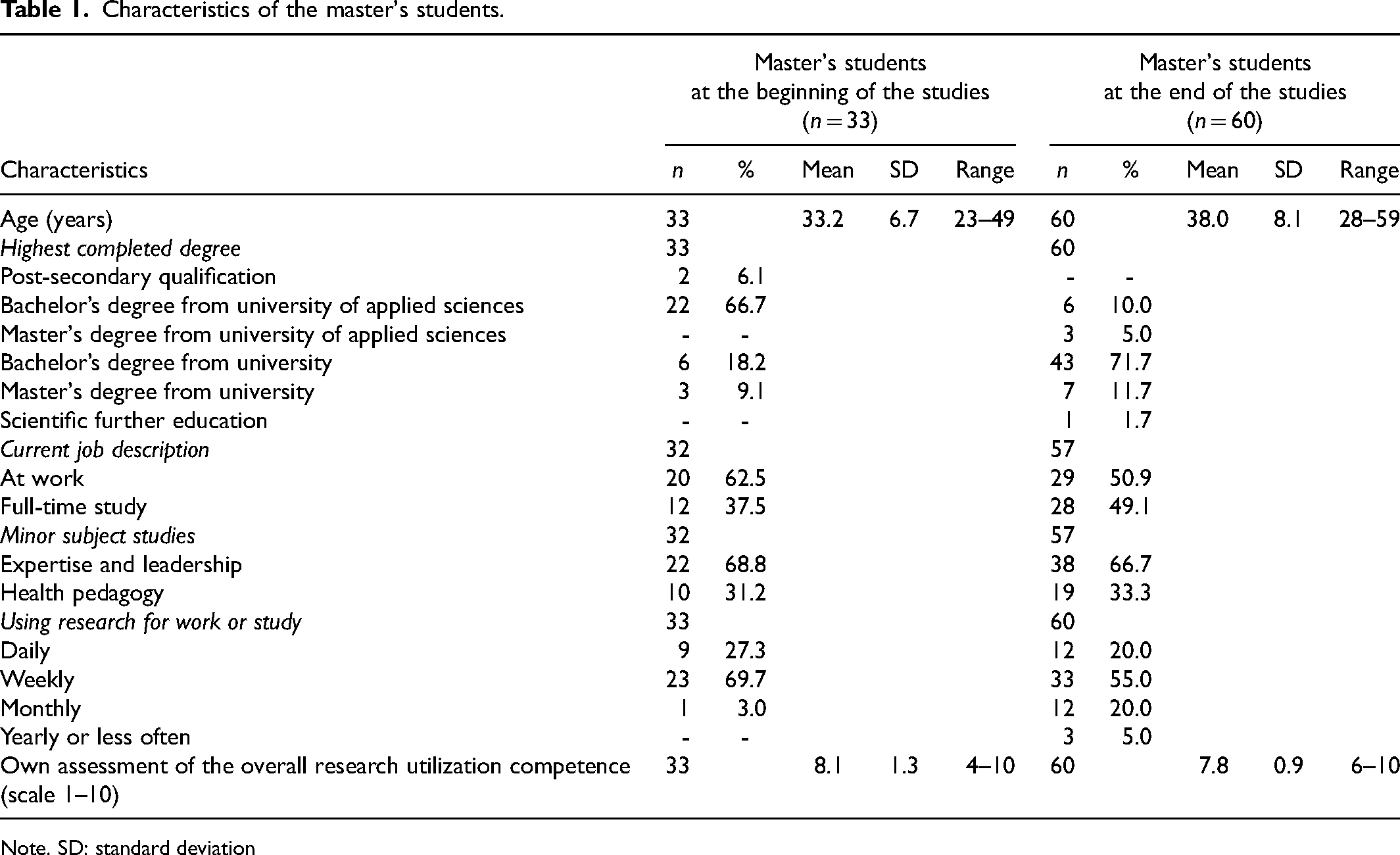
Note. SD: standard deviation
Master's students research utilization competence
The master's students had positive attitudes towards RU at the beginning (mean 4.13, SD 0.29) and at the end (4.13, 0.42) of the studies. At both stages of the studies, the students’ appreciation for RU (4.53 at the beginning and 4.59 at the end) was greater than their willingness to commit to it (3.69 at the beginning and 3.64 at the end). There were no statistically significant differences between the groups (Table 2).
Master’s students’ attitudes to and skills related to research utilization at the beginning and end of their studies.
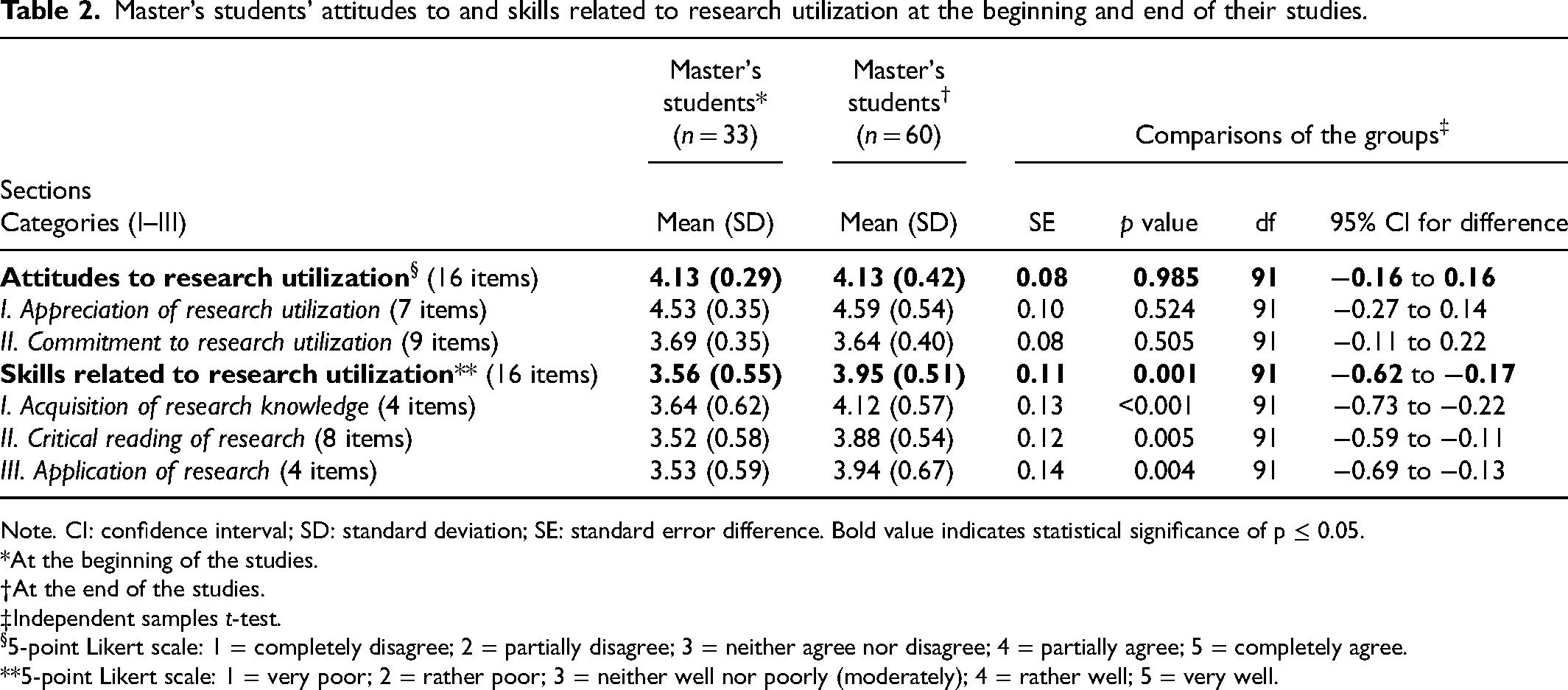
Note. CI: confidence interval; SD: standard deviation; SE: standard error difference. Bold value indicates statistical significance of p ≤ 0.05.
*At the beginning of the studies.
At the end of the studies.
Independent samples t-test.
5-point Likert scale: 1 = completely disagree; 2 = partially disagree; 3 = neither agree nor disagree; 4 = partially agree; 5 = completely agree.
**5-point Likert scale: 1 = very poor; 2 = rather poor; 3 = neither well nor poorly (moderately); 4 = rather well; 5 = very well.
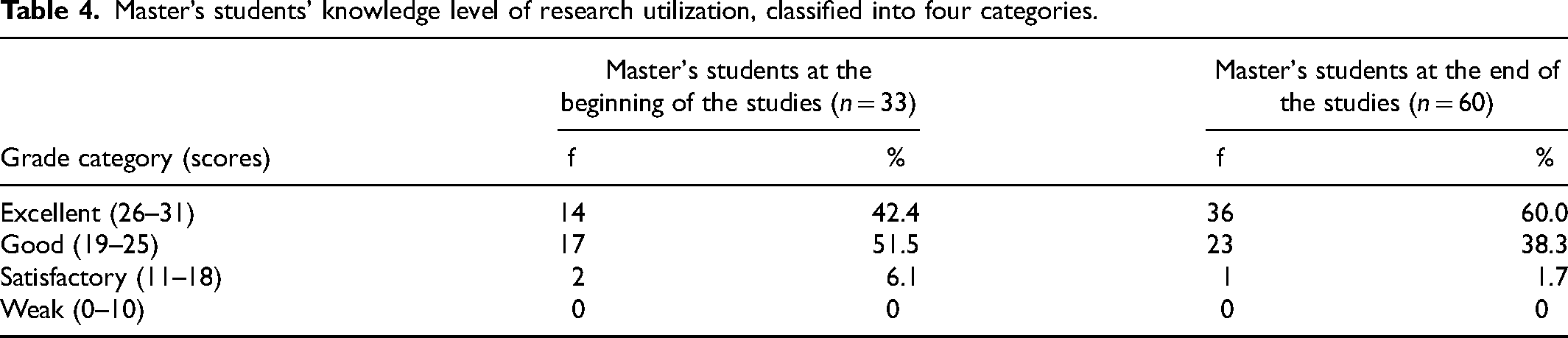
The master's students’ knowledge of RU was good (mean score 25.03, SD 3.91) at the beginning and excellent (26.08, 2.94) at end of the studies, but there was no statistically significant difference in the whole knowledge section level. However, at the category level, the students scored higher (20.28, 2.25) in ‘Research production process’ at the end of the studies (p = 0.045) than the students at the beginning (19.15, 3.06) (Table 3). Based on grade classification, 60% of the master's students had excellent knowledge (26–31 points out of 31) at the end of the studies compared to 42.4% at the beginning of the studies (Table 4).
Master’s students’ knowledge of research utilization at the beginning and end of the studies.
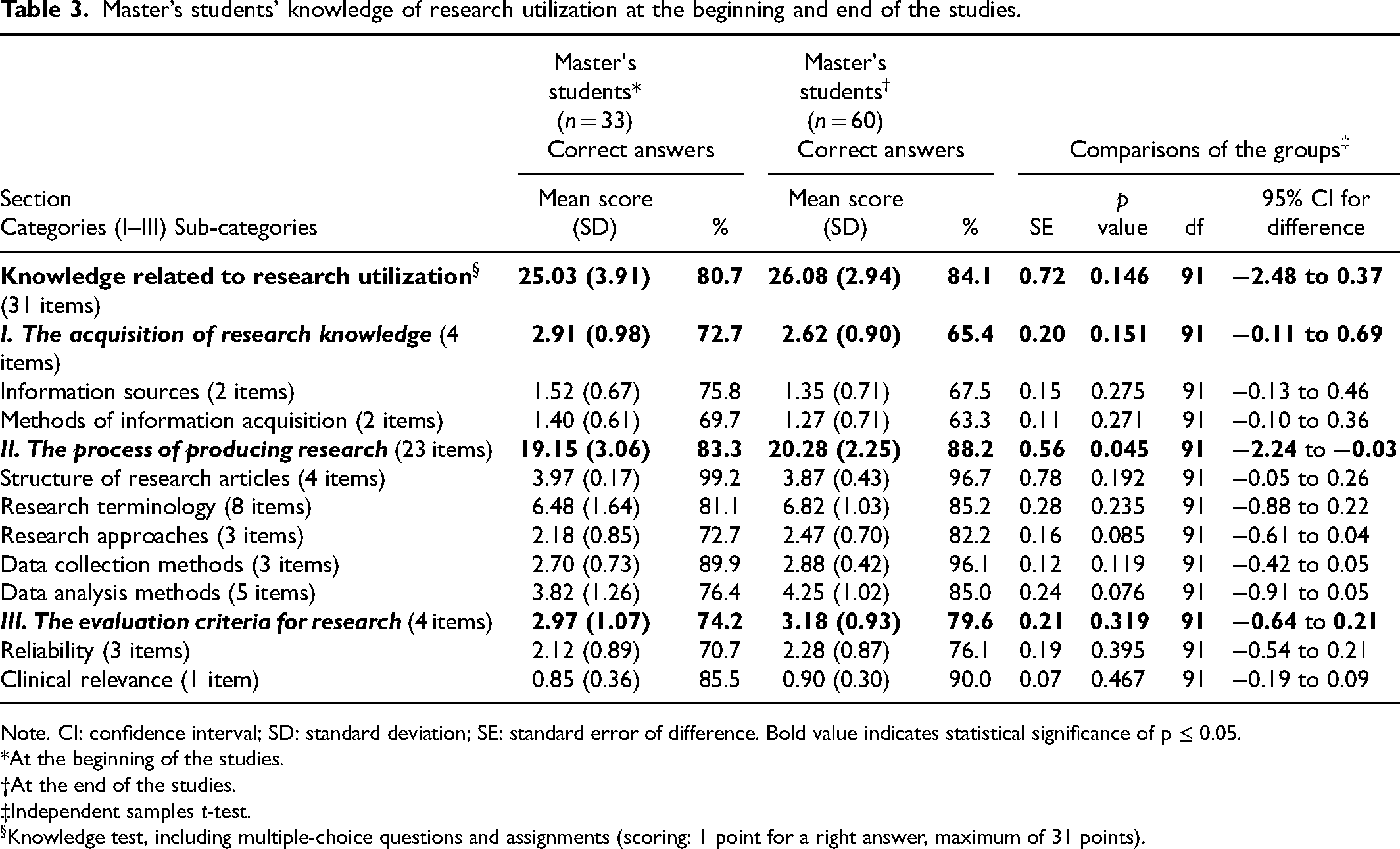
Note. CI: confidence interval; SD: standard deviation; SE: standard error of difference. Bold value indicates statistical significance of p ≤ 0.05.
*At the beginning of the studies.
At the end of the studies.
Independent samples t-test.
Knowledge test, including multiple-choice questions and assignments (scoring: 1 point for a right answer, maximum of 31 points).
Master’s students’ knowledge level of research utilization, classified into four categories.
The students assessed their RU skills throughout the whole skills section as moderate (mean 3.56, SD 0.55) at the beginning of the studies and as rather well (3.95, 0.51) at the end (p = 0.001). At the end of the studies, the master's students also rated their skills as statistically significantly better in all three categories (Table 2).
The associations between attitudes towards RU, RU knowledge, and RU skills were examined using linear regression models with each one as the explanatory variable in turn. The more positive the attitudes towards RU, the higher the master's students rated their RU skills at the beginning (B = 0.856, p = 0.007) and at the end (B = 0.606, p < 0.001) of the studies. Inverse associations were also observed (B = 0.259, p = 0.007 and B = 0.403, p < 0.001).
Associations of background variables with RU competence
Some background variables were statistically significantly associated with the RU competence of the master's students. One background variable aimed to determine, on a scale of 1 to 10, whether students’ perceptions of their RU competence are consistent with those measured by the CompRU-2 instrument. The higher the master's students rated their overall RU competence on a scale of 1–10, the more positive their attitudes towards RU were at the beginning of the studies (B = 0.110, p = 0.015). In addition, higher self-assessed overall RU competence was associated with the master's students’ RU skills at the beginning (B = 0.362, p < 0.001) and at the end (B = 0.386, p < 0.001) of the studies.
At the end of the studies, the master's students with a minor in Expertise and leadership scored higher (p = 0.016) on the RU knowledge test (mean 27.8 points) than the master's students with a minor in Health pedagogy (25.7 points). No other statistically significant associations were found.
Discussion
A descriptive, cross-sectional study design was used with two groups of master's students in Finland. The aim of this study was to analyze the RU competence of postgraduate nursing students at the beginning and end of the master's program. Since previous studies have mostly focused on the RU competence of bachelor's level nursing students or nurses working in clinical practice, and the results have shown gaps in the knowledge and skills of those groups, it was essential to study the RU competence of postgraduate nursing students and compare the similarity and differentiability at the beginning and end of the studies.
The results of this study show that master's students had positive attitudes towards RU. This finding is encouraging, but not unexpected in light of the previous studies, which show parallel results regarding bachelor's level nursing students,23–26 nurses,27,28 and master's students.11,32,37,40 In this study, master's students’ attitudes towards RU were the same in both groups. It is likely that students enrolled in nursing science education are interested from the outset in developing themselves and their work on the basis of research, so no changes were observed. Ekvall-Hansson et al. 32 also found that participants attending a course on evidence-based practice already had a pre-existing interest in the area. A positive attitude is associated with the implementation of research in clinical practice 37 and therefore important. However, it seems that positive attitudes alone are not enough to transform practices into evidence-based ones 4 – RU knowledge and skills are equally important core competences. 8
In this study, the master's students’ knowledge of RU ranged from good at the beginning of their studies to excellent at the end of their studies. The results are in contrast to previous studies of bachelor's level nursing students23–25 and nurses27,28 measured with the same CompRU instrument; the knowledge levels of these participants were low. Likewise, in the study by Graue et al. 36 the ability of master's students to find and evaluate research literature improved after an evidence-based course. The master's students in the present study have passed an entrance exam, which may have included research-related material, and probably also taken their first nursing research courses at the time of the first data collection, which may explain the good level of knowledge at the beginning of their studies. A statistically significant finding was related to the process of producing research with master's students scoring higher at the end of the studies than at the beginning. In their review, Hickman et al. 11 state that there is insufficient empirical evidence to support the best strategies for developing evidence-based practice competence for master's students in nursing education. By the end of their studies, master's students will have gained experience in doing research, at least by writing their master's thesis. The literature distinguishes between the competence of RU and conducting research, 7 but the results of this study suggest that doing research may also support the development of RU knowledge related to the acquisition of research knowledge, the process of producing research, and the evaluation criteria for research, which are prerequisites for critical reading in RU. 20 Based on their review, Wakibi et al. 45 suggest that students should be taught research and evidence-based resources in order to see the applicability of such knowledge in practice.
At the end of the studies, the master's students with a minor in Expertise and leadership scored statistically significantly higher on the RU knowledge test than the students with a minor in Health pedagogy. The data do not give an explanation for this, and we can only speculate on the reason for this finding. It may be because, in pedagogically focused education, the emphasis is on educational science and teaching methods. Moreover, the students may be more interested in learning how to teach than they are in RU. Oermann et al. 46 suggest that when introducing a new teaching practice or method, an implementation science framework could be used. This approach could also support the RU learning of health pedagogy students at the same time, as nurse educators play a crucial role in promoting evidence-based practice.11,47
In this study, the master's students’ moderate RU skills at the beginning of the studies are in line with previous studies of bachelor's level nursing students23–25 and nurses,27,28 indicating moderate self-assessed RU skills measured with the CompRU instrument. This consistency is likely due to the educational level of the above-mentioned groups being somewhat comparable to those in this study, with 73% of respondents having a post-secondary or bachelor's degree from a university of applied sciences. Encouragingly, at the end of the studies, the master's students assessed their RU skills statistically significantly higher than those at the beginning throughout the whole skills section and in all three skills categories regarding acquisition, critical reading, and application of research. The master's students’ perceptions of higher overall RU competence, which was explored with one question, was statistically significantly associated with the master's students’ RU skills, indicating high self-confidence among the students. In addition, positive attitudes towards RU were also statistically significantly associated with the higher RU skills of master's students in both groups, providing a good basis for promoting evidence-based practice.
In summary, it can be said that the master's students’ RU knowledge and skills were higher at the end than at the beginning of the studies. Although the study design does not allow us to draw strong conclusions, the results suggest that theoretically oriented nursing science education, including studies on conducting research, strengthens the RU knowledge and skills. The results get support from the review by Furuki et al., 31 which highlights that educational level, participation in evidence-based practice education, and experience conducting research are important factors associated with evidence-based practice knowledge and skills among nurses worldwide. A study by Skela-Savič et al. 16 found that only about one-quarter of master's programs include the teaching of evidence-based practice. This number will hopefully increase, as this study suggests that RU competence can be developed and deepened through nursing science education. This, in turn, can have a positive impact on the implementation of evidence, as academic educated nursing teachers, managers, and those in various professional specialist roles (such as clinical nurse specialists) have a key role in promoting evidence-based practice.11,47 Creating a seamless transition to develop and deepen RU competence at all levels of nursing education should be done strategically. 9
The results of this study are meaningful insofar as they represent an initial attempt within nursing science education to analyze the RU competence of master's students during their education as previous research has mostly focused on the evaluation of learning outcomes immediately after a single evidence-based practice course. The value of this study also lies in its aim to assess master's students’ RU competence from a wider perspective of attitudes, knowledge, and skills than have previous studies, and from their viewpoints at the beginning and at the end of the nursing science program. Using the same assessment method throughout the master's program can help the faculty to evaluate the progress of students’ learning. 37
The results of this study provide information that can be used by universities and further education institutions to develop and assess RU learning and teaching. However, more research is needed. It would be essential to assess the RU competence of master's students with a larger sample. Moreover, longitudinal research is needed to understand the sustainability of learning outcomes. As there are differences in master's level nursing education programs in the Nordic countries 13 and in Europe, 15 it would be important to assess the RU competences of master's students internationally to provide comparative evidence on effective RU teaching and learning outcomes.
Limitations
The present study has some limitations. The group sizes were small; therefore, only indicative results could be obtained. One reason for the relatively low response rates may be the method of data collection, as this study used online questionnaires. The average response rate for postal surveys is generally around 20% higher than for online surveys (53% for postal surveys and 33% for email surveys); therefore, paper surveys should be considered in the future to increase the response rate, even if it seems old fashioned in today's technologically advanced climate. 48 Second, two groups within university education in nursing science were examined. The groups are assumed to be comparable in terms of context and timing, but this is limited by the fact that only portions of the groups consist of the same students. However, it was reasonable to investigate the master's students RU competence in this way, even though it is not a longitudinal study. Third, this study focuses only on the RU competence of master's students in one country, and curricula vary between universities, even though objectives are the same and based on legislation. We have only a limited amount of data to be mirrored and are unable to say which underlying factors influence students’ RU competence. The results, therefore, do not give a complete picture of how RU competence developed over the course of the nursing science education program. The findings are indicative and cannot be generalized.
Conclusions
The RU knowledge and skills of master's students were higher than in previous studies on bachelor students and nurses measured with the same CompRU instrument. The present study suggests that theoretically oriented nursing science education, including studies on conducting research, strengthens the RU knowledge and skills needed for evidence-based practice. This study is meaningful insofar as it represents an initial attempt within nursing science education to analyze RU competence among master's students from a broader perspective than previous studies have done. Future research is needed.
Footnotes
Acknowledgments
We thank the master's students who participated in the study for their time and effort to take part in this study. We would also like to thank the contact persons at the four universities who helped us with the data collection.
Funding
The author(s) received no financial support for the research, authorship, and/or publication of this article.
Conflict of interest
The authors declare that there is no conflict of interest.
