




Abstract
China is the only one of the five original nuclear weapon states that is quantitatively increasing the size of its nuclear arsenal and it now is estimated to have approximately 260 warheads. The arsenal’s capabilities are also increasing as older missiles are replaced with newer ones. As China assigns a growing portion of its warheads to long-range missiles, the US intelligence community predicts that by the mid-2020s the number of warheads on missiles capable of threatening the United States could increase to well over 100. The nuclear warheads in the Chinese stockpile are intended for delivery mainly by land-based ballistic missile but also by aircraft and submarines. The current force has nearly 150 nuclear-capable land-based missiles, half of which are short-range and medium-range. China has also built two types of submarine-launched ballistic missiles, one developed for a submarine no longer considered operational and the other in the final stages of development.
We estimate that China has approximately 260 nuclear warheads in its stockpile for delivery by approximately 160 land-based ballistic missiles as well as aircraft 1 and an emerging ballistic submarine fleet. This estimate is 10 warheads higher than last year, primarily due to additional sea-launched ballistic missiles. Each missile in the Chinese arsenal is equipped to carry a single warhead, except a small number of silo-based missiles that have been equipped to carry multiple warheads. The warheads are not mated with missiles under normal circumstances and are instead kept separate in central storage facilities. 2
Chinese nuclear forces, 2015
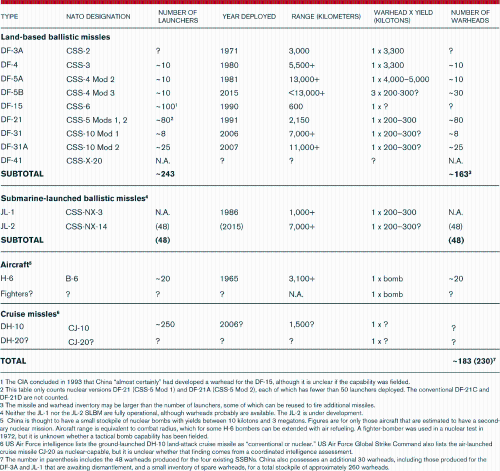
Land-based missiles
Modernization of the Chinese land-based ballistic missile force took an important new step in 2015 with reports that the country had equipped some of its silo-based ICBMs with multiple independently-targetable re-entry vehicles (MIRVs). The upgrade is part of a broad modernization of China’s land-based ballistic missile force, under which it is replacing older, transportable, liquid-fuel, slow-launching missiles with longer-range, road-mobile, solid-fuel, quick-launching missiles based at new or upgraded Second Artillery garrisons. As a result of this effort, a greater portion of China’s future land-based missile force will have longer ranges and be more maneuverable.
The current force has approximately 160 nuclear-capable land-based missiles of seven types, half of which are short-range and medium-range; the number of long-range missiles is increasing slowly.
The oldest missile in China’s inventory, the DF-3A (CSS-2), is a liquid-fueled, single-stage, maneuverable, intermediate-range ballistic missile that can deliver a 3.3-megaton warhead up to 3,000 kilometers (km), sufficient to target southeastern Russia and Japan. The Pentagon’s annual report to Congress on China in 2014 did not mention the DF-3A but the missile reappeared in the 2015 report (Defense Department, 2015). Apparently only one brigade of perhaps eight transportable DF-3A launchers remains but China may be in the process of retiring them and replacing them with the DF-21 (Kristensen, 2014a).
China also continues to maintain a single brigade of its second-oldest missile, the DF-4 (CSS-3) intercontinental ballistic missile (ICBM). The two-stage, liquid-fueled missile can deliver a 3.3-megaton warhead more than 5,500 km, sufficient to target India, part of Russia, and Guam. The brigade has approximately 10 transportable launchers, some or all of which may be based in caves with a roll-out-to-launch capability. The DF-4 is being replaced by the DF-31.
China’s DF-5A (CSS-4 Mod 2)—a liquid-fueled, two-stage, silo-based ICBM—has a range that exceeds 13,000 kilometers and has apparently been targeted at the United States and Russia since the early 1980s. The DF-5A is a longer-range modified version of the DF-5 (CSS-4 Mod 1). The Pentagon reported in May 2015 that China had equipped some of the DF-5As with multiple independently-targetable re-entry vehicles (MIRV) (Defense Department, 2015: 8). The MIRV’ed DF-5A is known as CSS-4 Mod 3. China has had the ability to deploy multiple warheads on the DF-5 for decades without doing so but apparently has recently decided to equip some of the DF-5 missiles with MIRVs, partly in response to the US deployment of a ballistic-missile defense system (Defense Department, 2015: 8, 31; Kristensen, 2015; Sanger and Broad, 2015). We estimate that China has approximately 20 DF-5As, of which perhaps half have been equipped with MIRVs.
China’s primary regional nuclear missile is the two-stage, solid-fuel, road-mobile DF-21 (CSS-5) medium-range ballistic missile (MRBM). The DF-21 exists in two nuclear versions: the DF-21 (CSS-5 Mod 1) and the newer DF-21A (CSS-5 Mod 2). The Mod 1 version has a range of 1,750-plus km but the new version probably has a longer range of about 2,150 km. The US intelligence community estimates that China’s inventory of DF-21s increased from 19 to 50 missiles in 2006 to 75 to 100 missiles in 2011 (Defense Department, 2006: 50; 2011: 78). Today there are fewer than 50 launchers of each type deployed, with an estimated 80 to 90 launchers in total (US Air Force, National Air and Space Intelligence Center, 2013: 17). China has also started deploying conventionally armed versions of the DF-21 (the DF-21C and DF-21D, the latter an anti-ship missile). This potentially dangerous mix of nuclear and conventional missiles increases the risk of misunderstanding, miscalculation, and mistaken nuclear escalation in a crisis. 4
Deployment of the new DF-31 (CSS-10 Mod 1) ICBM, first introduced in 2006, appears to have stalled for the time being with fewer than 10 launchers (possibly as few as eight) deployed along with an equal number of missiles. The three-stage, road-mobile DF-31 which is transported on a six-axle TEL (transporter-erector-launcher) in a 15-meter-long canister has a range of more than 7,000 km, which is insufficient to target the continental United States. The DF-31 might have been intended to take over the regional targeting of Russia, India, and Guam from the DF-4. The reasons for the slow introduction of the DF-31 are unclear.
The DF-31A (CSS-10 Mod 2)—a solid-fueled, three-stage, road-mobile ICBM—is an extended-range version of the DF-31, yet its range (11,000-plus kilometers) with a payload of a single 200- to 300-kiloton warhead is shorter than that of the DF-5A ICBM. We estimate that China deploys about 25 DF-31A ICBMs in three brigades. Fourteen years ago, the US intelligence community estimated that by 2015 China would have 75 to 100 warheads on ICBMs (DF-31As and DF-5As), primarily targeted at the United States (CIA, 2001: 3). This prediction did not come to pass. Of China’s 50 to 60 ICBMs an estimated 44, capable of carrying approximately 64 warheads in total, can target the continental United States.
Earlier versions of the Pentagon’s annual China report indicated that the DF-31A could target the entire continental United States, but that was misleading because the range was measured from the Chinese border closest to the United States rather than actual deployment sites inside the country. Later versions of the report stated that the DF-31A can reach “most locations” within the continental United States (Defense Department, 2013: 6; 2015: 8) but apparently not all. Some targets on the US East Coast would still require use of the longer-range DF-5A.
The Pentagon has reported since at least 1997 that China is developing another road-mobile ICBM known as the DF-41. After the initial reporting, references to the missile disappeared from the public estimates but they have recently reappeared in the 2014 and 2015 annual Pentagon reports on China. The 2015 report states that “China also is developing a new road-mobile ICBM, the CSS-X-20 (DF-41), possibly capable of carrying MIRVs” (Defense Department, 2015: 8).
In his prepared testimony to the Senate Armed Services Committee in March 2015, STRATCOM commander Admiral Cecil Haney described the situation a little differently, saying China was “conducting flight tests of a new mobile missile, and developing a follow-on mobile system capable of carrying multiple warheads” (Haney, 2015: 3). This statement implies that two new ICBMs are in development and that the second would be MIRV capable rather than “possibly capable” as stated in the Pentagon report.
Of China’s many types of short-range ballistic missiles, one is thought to be nuclear capable: the DF-15 (CSS-6). After reporting that the nuclear test conducted on August 16, 1990 may have been “related to development of a warhead for a Chinese short-range ballistic missile” (CIA 1990: 1), the CIA concluded in a September 1993 memorandum “that China will begin to field nuclear-armed CSS-X-6’s [sic] next year.” The memorandum went on, “China almost certainly has already developed the warhead for this system. Testing might be needed for formal weaponization or for additional warhead options” (CIA 1993: 5). Despite this apparent nuclear capability, it is unclear whether China ever completed and fielded a nuclear warhead for the DF-15. Regardless of nuclear status, DF-15-equipped units are thought to be mainly for conventional missions.
Submarines and sea-based missiles
China has built two types of submarine-launched ballistic missiles (SLBMs), the JL-1 and JL-2, which were developed for two types of nuclear-powered ballistic missile submarines.
The 1,700-km-range, two-stage JL-1 (CSS-NX-3) SLBM developed for a single old Xia-class (Type 092) submarine first entered service in 1986 and is not considered operational. The Xia is based at the North Sea Fleet base near Qingdao in the Shandong province. The submarine underwent a lengthy shipyard overhaul in 2005 and 2006 but appears to have stayed in port since then. The Xia/JL-1 weapon system is expected to be retired soon.
Development of the new JL-2 (CSS-NX-14) SLBM for the second-generation Jin-class (Type 094) submarine is nearing completion. The US intelligence community has predicted for several years that the missile was about to become operational, only to see further delays. After several setbacks, China appears to have overcome technical difficulties and successfully test-launched the JL-2 in 2013.
The JL-2 is a modified version of the DF-31. Equipped with a single warhead and possibly penetration aids, the JL-2 has never been flight tested to its full range but is estimated to have a range of 7,000-plus km. The 2015 Pentagon report estimates the range as 7,400 km (Defense Department, 2015: 9). Such a range is sufficient to target Alaska, Guam, Russia, and India from waters near China—but, unless the submarine carrying the weapon sails significantly eastward, not the continental United States.
Four Jin-class submarines are operational (without missiles) and all homeported at the South Sea Fleet base on Hainan Island, according to the Office of Naval Intelligence (ONI) (Office of Naval Intelligence, 2015: 14). There is some uncertainty about how many nuclear-powered ballistic missile submarines (SSBNs) China plans to build. The ONI predicted nearly a decade ago that China might build five Jin SSBNs (Kristensen, 2007). That projection was repeated in 2013 when ONI estimated that there would be four to five boats by 2020 (Kristensen, 2014b). The 2015 Pentagon report appears to agree with that projection, saying “up to five may enter service” before China begins work on a next-generation SSBN (Defense Department, 2015: 9).
Yet in early 2015 other government sources began suggesting that China might produce more Jin SSBNs. In his prepared testimony before the Senate Armed Services Committee in February 2015, Director of National Intelligence James Clapper said that China “might produce additional JIN-class nuclear-powered ballistic missile submarines” (Clapper, 2015: 7). And in April 2015 Admiral Samuel J. Locklear, commander of US Pacific Command, told the same committee that “up to five more [Jin SSBNs] may enter service by the end of the decade” for a total of eight Jin submarines (Locklear, 2015: 9).
The reason there are different estimates of how many Jin-class SSBNs China plans to build is unclear. The higher number seems strange given that China is already expected to proceed to development and production of a third-generation (Type 096) SSBN over the next decade.
With 12 missile-launch tubes per submarine, four operational Jin SSBNs could carry 48 missiles with as many warheads—a significant increase from the 12 SLBMs that the sole Xia-class submarine was equipped with.
The Pentagon asserts that the Jin/JL-2 weapon system “will give the PLA [Chinese] Navy its first credible sea-based nuclear deterrent” (Defense Department, 2013: 6). Yet the Chinese SSBN fleet faces several doctrinal, technical, and operational constraints. Under current doctrine, China’s Central Military Commission does not allow the military services to have warheads deployed on missiles under normal circumstances. Handing over custody of nuclear warheads to deployed submarines in peacetime would constitute a significant change of Chinese doctrine.
Moreover, no Chinese ballistic missile submarine has ever sailed on a deterrent patrol so China’s navy and the Central Military Commission have essentially no experience in operating a submarine force during realistic military operations. Developing this capability will require development of new command and control technologies and procedures.
But even if China deployed warheads on the SSBNs and sent them to sea in a crisis, where would they sail? For a JL-2 to reach the continental United States, for example, a Jin SSBN would have to sail through the East China Sea and well into the Pacific Ocean, through dangerous choke points where it would be vulnerable to hostile antisubmarine warfare
5
(see Figure 1).
Potential Julang-2 SLBM launch areas for targeting continental United States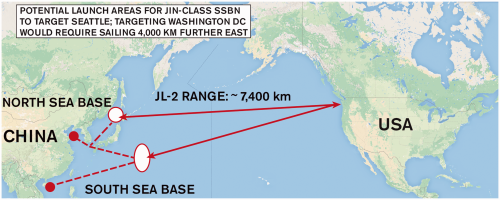
China’s main concern is making sure that its minimum nuclear deterrent would survive a first strike, and for that reason it spends considerable resources on modernizing and hiding its land-based missiles. This makes its submarine program puzzling, for it is much riskier to deploy nuclear weapons at sea, where submarines can be sunk by unfriendly forces, than to hide them in caves or forests deep inside China’s extensive territory (Kristensen, 2014a).
Cruise missiles
China produces and fields a number of cruise missiles, including land-attack cruise missiles that may have a nuclear capability. The CIA concluded in 1995 that a Chinese test scheduled for that year “may include warhead testing for … a cruise missile” (CIA, 1995) but the evidence for Chinese nuclear cruise missiles is sketchy and should be viewed with caution.
One potentially nuclear-capable Chinese cruise missile is the DH-10 (CJ-10) land-attack cruise missile (LACM), which is thought to have a range of perhaps 1,500 km. US Air Force Intelligence lists the DH-10 as “conventional or nuclear,” indicating that it is a dual-capable weapon (US Air Force, National Air and Space Intelligence Center, 2013: 29). The DH-10 is launched from a four-axle triple box launcher. The number of deployed DH-10s is uncertain, in part because the Pentagon has stopped releasing numbers for Chinese missiles. In 2011 the estimate was 40 to 55 launchers with 200 to 500 missiles (Defense Department, 2011: 78).
China is also developing an air-launched land-attack cruise missile known as the CJ-20 for delivery by modified H-6 bombers. An Air Force Global Strike Command briefing in 2013 asserted that the CJ-20 is nuclear-capable (Kristensen, 2013) but the US Air Force does not list the CJ-20 at all (US Air Force, National Air and Space Intelligence Center, 2013: 29).
Footnotes
Funding
This research was carried out with grant from the New Land Foundation and the Ploughshares Fund.