




Abstract
With several long-range ballistic missiles in development, the Indian nuclear posture is entering an important new phase. After nearly two decades of focusing on nuclear competition with Pakistan, New Delhi seems to now be paying attention to its future strategic relationship with China. India is estimated to have produced approximately 540 kilograms of weapon-grade plutonium, enough for 135 to 180 nuclear warheads, though not all of that material is being used. The authors estimate that India has produced between 110 and 120 nuclear warheads. The country’s fighter-bombers still constitute the backbone of its operational nuclear strike force, but it has made considerable progress in developing credible land-based ballistic missiles as well. They include the Agni-4, which will be capable of delivering a single nuclear warhead more than 3,500 kilometers, and therefore able to strike Beijing and Shanghai from northern India. In 2014, India conducted its first ever sea trial of a nuclear-powered ballistic missile submarine.
India’s drive to develop a nuclear triad reached an important milestone in 2014 with the first nuclear-powered ballistic missile submarine deploying on its initial, brief, sea-trial voyage. Now, with several long-range ballistic missiles in development, the Indian nuclear posture is entering an important and dynamic new phase. After nearly two decades of concentrating on competition with Pakistan, India’s nuclear outlook now seems to be focused more toward its future strategic relationship with China.
India is estimated to have produced approximately 540 kilograms (kg) of weapon-grade plutonium (IPFM, 2013: 21), sufficient for 135 to 180 nuclear warheads; however, not all of the material has been converted into nuclear warheads. Based on available information about its nuclear-capable delivery vehicles, we estimate that India has produced 110 to 120 nuclear warheads. It will need more than that to arm new missiles it is developing. In addition to the Dhruva plutonium production reactor near Mumbai, India plans to construct a second reactor near Visakhapatnam, on the east coast. An unsafeguarded prototype fast breeder reactor is also under construction 650 kilometers (km) south at the Indira Gandhi Centre for Atomic Research (IGCAR) near Kalpakkam, which will significantly increase India’s plutonium production capacity once it becomes operational.
Aircraft
Despite India’s considerable progress in developing credible ballistic missiles, its fighter-bombers still constitute the backbone of India’s operational nuclear strike force. Two or three squadrons of Mirage 2000H and Jaguar IS/IB aircraft are thought to provide India with a flexible capability to conduct nuclear strike operations deep into Pakistan and China.
The Indian Air Force’s Mirage 2000H fighter-bombers, which are undergoing upgrades to extend their service life and enhance their capabilities, are deployed at Maharajpur (Gwalior) Air Force Station with Squadrons 1 and 7 of the 40th Wing; we estimate that one of the squadrons has a secondary nuclear mission. The French-supplied Mirage has served a nuclear strike role in the French air force for many years.
India also has four operational squadrons of Jaguar IS/IB aircraft; two of the squadrons may be assigned a secondary nuclear strike mission. The Jaguar, designed jointly by France and Britain, was nuclear-capable when deployed by those countries. An upgrade of India’s Jaguar fleet is scheduled for completion in December 2017 (Government of India, 2012). The domestically manufactured, Soviet-origin MiG-27 Flogger fleet, sometimes rumored to have a nuclear strike mission, is also undergoing an upgrade (Government of India, 2012).
The original nuclear aircraft are aging, and India may be searching for a modern fighter-bomber that could potentially take over the air-based nuclear strike role. One potential candidate is the Rafale, produced by France, which uses the aircraft in such a role. After initially announcing plans to buy 126 Rafale fighter-bombers from France, however, the high cost appears to have caused the Indian government to consider reducing the number to 36 for now (Tran and Raghuvanshi, 2015).
Land-based missiles
Indian nuclear forces, 2015
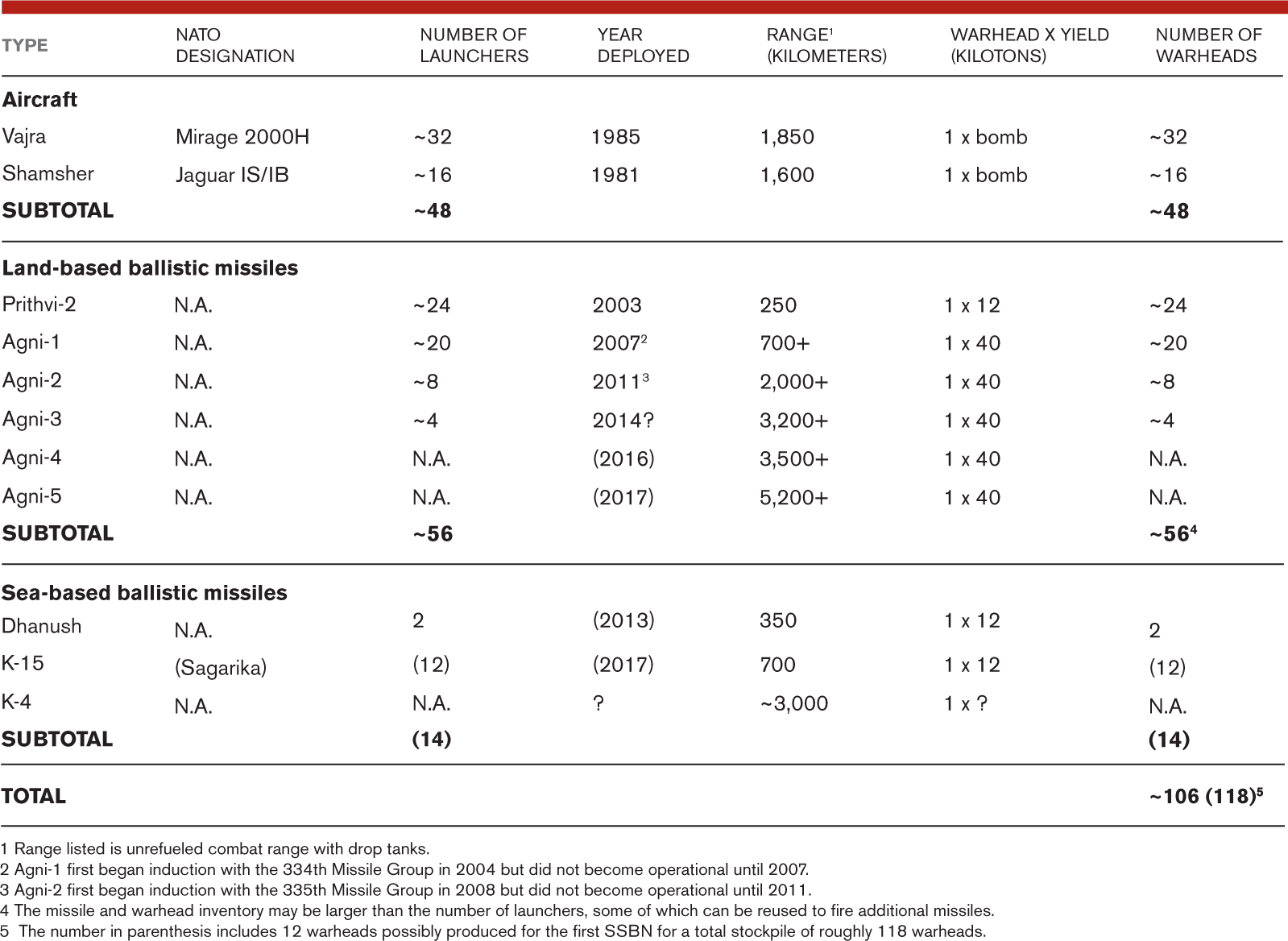
It remains unclear how many of these missile types India plans to keep in its arsenal. Some may serve as technology development programs for longer-range missiles. Although the Indian government has made no statements about the future composition of its land-based missile force, intermediate-range and medium-range missiles could potentially be discontinued, with only short- and long-range missiles deployed in the future to provide a mix of strike options against near and distant targets. Otherwise India appears to plan a very diverse and expensive missile force.
The Indian ballistic missile force remains dominated by the short-range Prithvi system. Initially, the 150 km range Prithvi-1 was thought to be nuclear, but it appears that the system might be conventional and being replaced with the Prahaar short-range missile system. The Indian government stated in 2013 that the Prithvi-2 missile was the first to be developed under the country’s prestigious Integrated Guided Missile Development Program (IGMDP) for “India’s nuclear deterrence” (Government of India, 2013). The Prithvi-2 can deliver a nuclear or conventional warhead to a range of 250 kilometers (155 miles). After test launches in 2011, 2012, and 2013, the Indian government reported the range as 350 km (see, for example, Government of India, 2012), but the US National Air and Space Intelligence Center (NASIC) lists the range as 250 km (NASIC, 2013: 13). The 350-km range version is sometimes called Prithvi-3 and has been converted to the ship-launched Dhanush missile. Given its small size (9 meters long and 1 meter in diameter), the Prithvi is difficult to spot in satellite images and therefore little is known about where it is deployed.
The two-stage, solid fuel, road-mobile Agni-1 missile became operational in 2007, three years after its introduction into the armed forces. The short-range missile is capable of delivering a nuclear or conventional warhead to a distance of approximately 700 km (435 miles). The mission of the Agni-1 is thought to be focused on targeting Pakistan, and an estimated 20 launchers are deployed in western India, possibly with the 334th Missile Group.
The two-stage, solid-fuel, rail-mobile Agni-2 is an improvement on the Agni-1, and can deliver a nuclear or conventional warhead more than 2,000 km (1,243 miles). The missile possibly began being introduced into the armed forces in 2004, but technical issues delayed operational capability until 2011. Fewer than 10 launchers are thought to be deployed in northern India, possibly with the 335th Missile Group. Targeting is likely focused on western, central, and southern China.
The Agni-3, a two-stage, solid-fuel, rail-mobile, intermediate-range ballistic missile is capable of delivering a nuclear warhead 3,200-plus km (1,988-plus miles). The Indian Ministry of Defence declared in 2014 that the Agni-3 is “in the arsenal of the armed forces” (Indian Ministry of Defence, 2014: 86), and the Indian military’s Strategic Forces Command conducted its third user trial on April 16, 2015 from the Wheeler Island Test Range. If the Agni-3 is operational, there are probably fewer than 10 launchers. Several years ago an army spokesperson remarked that “with this missile, India can even strike Shanghai” (Indo-Asian News Service, 2008), but this would require launching the Agni-3 from the northeastern corner of India.
India is also developing the Agni-4 missile, a two-stage, solid fuel, rail-mobile intermediate-range ballistic missile capable of delivering a single nuclear warhead 3,500-plus km (2,175-plus miles). The Indian Ministry of Defence lists the range as 4,000 km (2,486 miles) (Indian Ministry of Defence, 2014). Following the final development test on January 14, 2014, the Ministry declared that Agni-4 “serial production will begin shortly” (Indian Ministry of Defence, 2014: 86). A second flight test conducted on December 2, 2014 was the Army’s first Agni-4 launch (Indian Ministry of Defence, 2014). The missile will undergo a small number of induction tests before it becomes operational.
Although the Agni-4 will be capable of striking targets in nearly all of China from northern India, including Beijing and Shanghai, India is also developing the longer-range Agni-5, a three-stage, solid-fuel, rail-mobile, intercontinental ballistic missile (ICBM) capable of delivering a warhead more than 5,000 km (3,100-plus miles). The extra range will allow the Indian military to establish Agni-5 bases in central and southern India, further away from China.
India is modifying the Agni-5 launcher to carry the missile in a sealed canister. The new canister design “will reduce the reaction time drastically … just a few minutes from ‘stop-to-launch,’” according to Avinash Chander (Pandit, 2013b), the Agni program engineer who headed India’s Defence Research and Development Organisation from 2013 until he was sacked by the government of new Prime Minister Narendra Modi in January 2015—the same month the organization launched the Agni-5 from a canister launcher for the first time. The missile “was in its deliverable configuration that enables launch of the missile within a very short time as compared to an open launch,” the organization later stated (Defence Research and Development Organisation, 2015: 4).
Moreover, unlike previous Agni-5 flight tests that took place from rail-mobile launchers, the January 2015 flight test appeared to use a new road-mobile launcher with the canister erected by four hydraulic arms from a six- or seven-axle trailer towed by a three-axle truck. Although the Defence Research and Development Organisation released a video of the 2015 launch, the frame did not show the new road-mobile launcher (Defence Research and Development Organisation, undated a), unlike videos of the 2012 and 2013 launches that clearly showed the rail-mobile launchers (Defence Research and Development Organisation, undated b, undated c).
Despite widespread speculation in news media articles and on social media that the Agni-5 will be equipped with multiple warheads—even multiple independently targetable reentry vehicles (MIRVs)—there is good reason to doubt that India can or will add multiple warheads or MIRVs to its arsenal in the near future. 1 There are no reports of MIRV technologies being flight-tested, and loading multiple warheads on the Agni-5 would reduce its extra range, which was a key reason for developing the missile in the first place. The Agni-5 is estimated to be capable of delivering a payload of 1.5 tons (the same as the Agni-3 and -4), and India’s first- and second-generation warheads, even modified versions, are relatively heavy compared with warheads developed by other nuclear weapon states that deploy MIRVs. It took the Soviet Union and the United States hundreds of nuclear tests and many years of effort to develop reentry vehicles small enough to equip a ballistic missile with a MIRV. Moreover, deploying missiles with multiple warheads would invite serious questions about the credibility of India’s minimum deterrent doctrine; using MIRVs would reflect a strategy aimed at quickly striking many targets, and would also run the risk of triggering a warhead race with India’s adversaries. It remains to be seen whether China’s decision to equip some of its silo-based ICBMs with MIRVs will trigger a similar development in India.
Naval nuclear weapons
India is developing two naval nuclear weapon systems: a nuclear-powered ballistic missile submarine (SSBN) and a ship-launched ballistic missile.
After three decades of development, India’s first SSBN, the Arihant, finally sailed on sea trials in 2014. 2 The reactor on the Arihant first went critical in August 2013 (Indian Ministry of Defence, 2014: 38). The Arihant is equipped with 12 launch tubes designed to launch the 700-km (435-mile) range K-15 (Sagarika) submarine-launched ballistic missile (SLBM). A second SSBN is possibly under construction (Deccan Herald, 2014), and India might have plans to build three, although rumors about six are probably mistaken. A base for the SSBNs is rumored to be under construction near Rambilli on India’s east coast (Pandit, 2013a).
The utility of the K-15 is very limited; it would not be able to target Islamabad, only southern Pakistan, and would have to sail very close to the country’s coast to do so. Moreover, the K-15 would not be able to target China at all, unless the SSBN sailed through the Singapore Strait deep into the South China Sea. Due to these circumstances, the Arihant SSBN/K-15 SLBM weapon system should be seen as a technology development program intended to develop a more capable missile, rather than as a credible and secure means of retaliation. In March 2014, India was said to have test-launched a K-4 SLBM from a submerged launch platform, apparently to a range of more than 3,000 km. The Arihant would probably require modification to carry the K-4.
India’s third sea-based missile is the Dhanush, a 400-km (249-mile) single-stage, liquid-fuel, short-range ballistic missile designed to launch from the back of two specially configured Sukanya-class patrol vessels (Subhadra and Suvarna). The utility of the Dhanush as a strategic deterrence weapon, however, is severely limited by its short range; it would have to sail very close to the Pakistani or Chinese coasts to target facilities in those countries, making it highly vulnerable to counterattack.
Cruise missiles
There are also unconfirmed rumors that India is developing a nuclear-capable cruise missile, the Nirbhay. Neither the Indian government nor the US intelligence community has yet mentioned the missile having any nuclear capability. 3 The Nirbhay has been flight-tested several times, most recently on October 17, 2014, to a range of about 1,000 kilometers (621 miles).